The Cyrus Cylinder
Unknown Babylonian scribal workshop, working for the court of Cyrus II of Persia · c. 539-530 BC
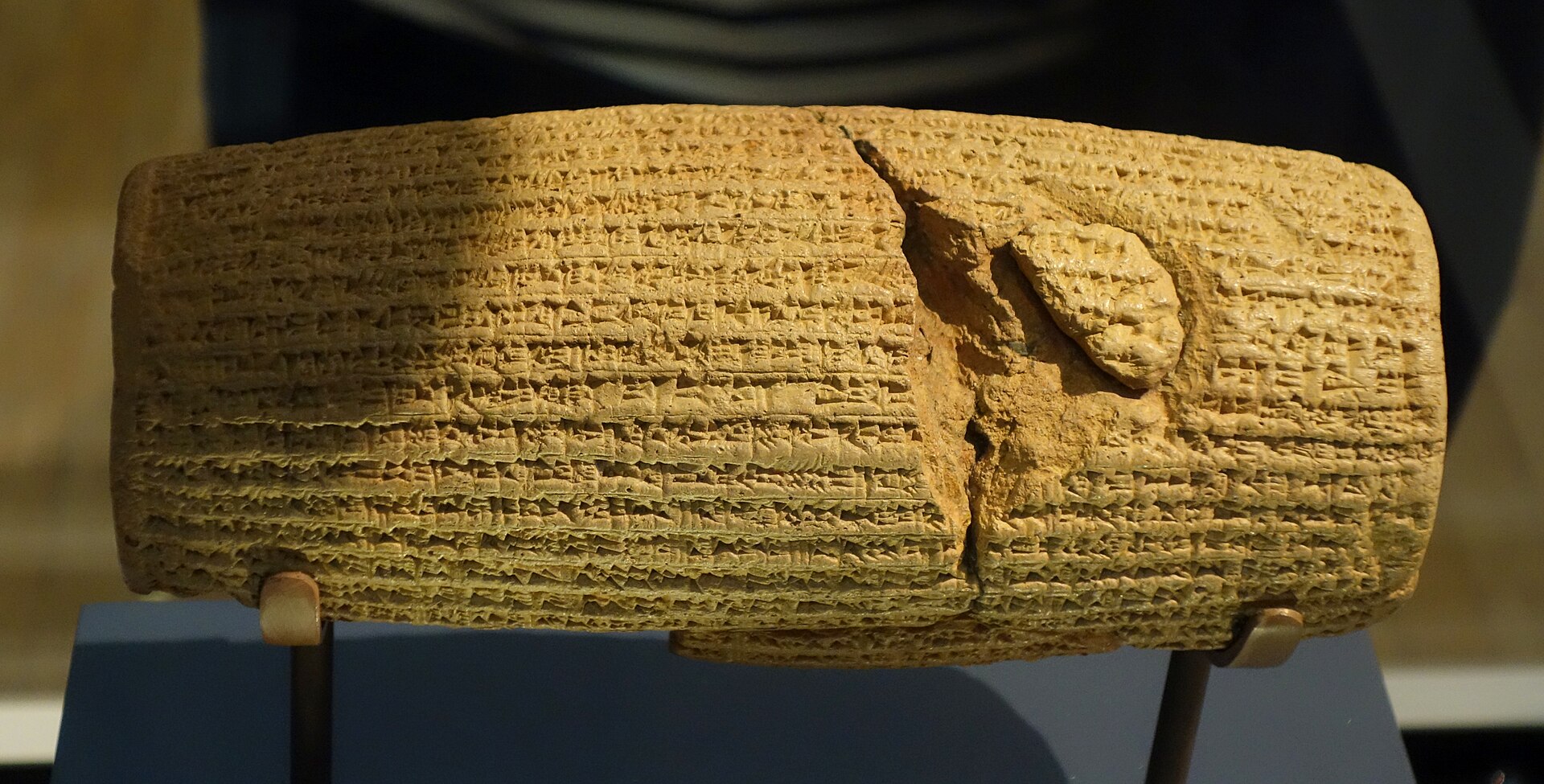
The object itself, British Museum, museum number 90920. Photographed by Daderot and released to the public domain under CC0 1.0.
| Artist | Unknown Babylonian scribal workshop, working for the court of Cyrus II of Persia |
|---|---|
| Date | c. 539-530 BC |
| Medium | Fired clay (barrel-shaped foundation cylinder), inscribed in Babylonian cuneiform |
| Dimensions | 21.9-22.8 cm long; diameter 7.8-8.2 cm at one end, 7.9 cm at the other, up to 10 cm at the maximum girth |
| Where it is now | British Museum, London, Room 52 (Ancient Iran gallery)last confirmed |
| Inventory number | Museum number 90920; registration number 1880,0617.1941; previous identifiers BM 12049 and L1166 |
| Attribution | UnknownNo maker is named on the object. Full note |
| Object type | Antiquity |
| Period | Achaemenid Persian, immediately following the Neo-Babylonian period |
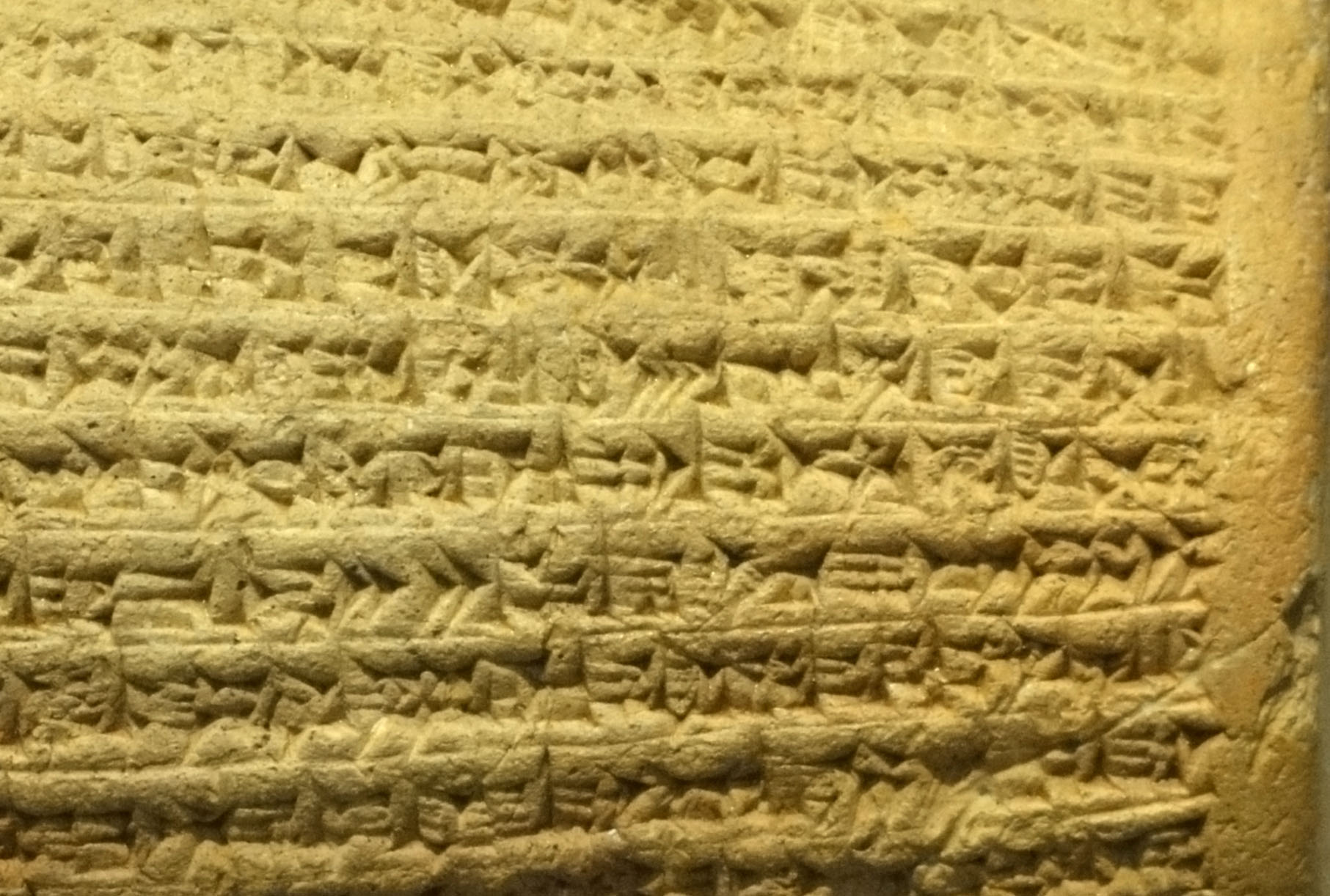
| Inscriptions | 45 lines of Akkadian cuneiform in the Late Babylonian script, running around the full circumference of the barrel. The text is a third-person account of Cyrus's conquest of Babylon (lines 1-19) followed by a first-person proclamation in Cyrus's voice listing his titles, his restoration of cults and repatriation of deported peoples, and his building works on Babylon's walls (lines 20-45). Roughly a third of the object is missing or damaged; the last nine lines (36-45) are known only because a separate fragment surfaced in the Yale Babylonian Collection. |
| Owners on record | 8 links8 documented |
| Sources | 22 cited |
About this record Last verified · 22 sources cited · Change log
On this page 9 sections
ContentsClose
A barrel of fired clay barely 23 centimetres long, buried in the foundations of Babylon's wall around 539 BC and dug up by workmen under the British Museum excavator Hormuzd Rassam in March 1879. In Babylonian cuneiform it records, in the conventional language of a much older Mesopotamian genre, how the Persian king Cyrus the Great took Babylon without a battle, restored the city's neglected cults, and released deported peoples to return home - a genre he shared, almost word for word, with the very predecessor his text condemns.
Two separate scholarly recoveries completed the object long after Rassam's spade left the ground: a fragment quietly sitting unrecognised in Yale's Babylonian Collection since 1920, identified as the cylinder's missing final lines by Paul-Richard Berger in 1970-71, and two further tablet fragments found inside the British Museum's own uncatalogued backlog in December 2009 and January 2010, proving the same proclamation had also circulated as an ordinary copied document, not only as a single buried deposit addressed to a god.
From 1971 the object also carries a second, entirely modern history: promoted by the Pahlavi state as the first charter of human rights, gifted in facsimile to the United Nations, and pressed into service as the emblem of a lavish state celebration staged by a government Amnesty International would soon name among the world's worst human-rights violators. Irving Finkel and other Assyriologists working on the actual cuneiform have said plainly that the reading does not survive contact with the text. Both histories belong on the same record, kept visibly apart.
Provenance
Each link is graded. Documented: a cited source supports it. Disputed: the identification is argued but not established. Unknown: no owner for that span, and the gap is not smoothed into a narrative. The grades in the glossary.
- c. 539-530 BC - 1879Buried as a foundation deposit, Amran ibn Ali mound (Esagila), Babylondocumented
Commissioned in the name of Cyrus the Great following his capture of Babylon in October 539 BC and buried, by genre convention, within the fabric of the city's rebuilt fortification wall or an associated temple structure. No documentary record survives between burial and its rediscovery in 1879; the intervening roughly 2,400 years are a gap, not a documented custody chain.16
- March 1879 - 1879Excavated by workmen under Hormuzd Rassam's overseer Daud Toma, for the British Museumdocumented
Recovered at the Amran mound, Babylon, between approximately 17 and 23 March 1879, under a firman granted by Ottoman Sultan Abdul Hamid II. Rassam himself had already left Baghdad (2 April 1879) and did not personally lift the object from the ground; it was found and reported by his site staff. Objects including the cylinder were shipped to London via the Baghdad merchant Baltazar and are reported to have arrived already broken.16
- 1879 - 17 June 1880British Museum (received, then formally registered)documented
Received and examined by the Museum's cuneiform curator Theophilus Pinches later in 1879; formally registered into the collection on 17 June 1880, the date reflected in registration number 1880,0617.1941. The gap between arrival and formal registration is ordinary Museum administrative practice for the period, not evidence of a separate transaction or owner.1
- 1880 - September 2010British Museum, Londondocumented
Continuous Museum ownership and, for most of this period, display. A first short loan to Iran took place around the October 1971 Persepolis anniversary celebrations, per Iranian and UN sources describing that event, though the exact duration of that 1971 loan is not detailed in the sources consulted for this record.115
- 12 September 2010 - April 2011On loan to the National Museum of Iran, Tehran; British Museum retained ownership throughoutdocumented
Unveiled in Tehran on 12 September 2010 after a loan process delayed since a promised 2005 date and further postponed from a planned 16 January 2010 unveiling, a delay the British Museum attributed to examining the newly identified duplicate tablet fragments BM 47134/47179 and which Iran's cultural heritage organisation, through Hamid Baqaei, treated as evasive, briefly cutting cooperative ties with the Museum on 8 February 2010. The loan, agreed for four months, was extended to roughly seven months amid strong attendance (reported approaching half a million visitors) before the cylinder returned to London.16171819
- April 2011 - spring 2024British Museum, Londondocumented
On permanent display in Room 52, the Ancient Iran gallery, with further short-term study or exhibition loans (including US venues from 2013) not exhaustively itemised in the sources consulted for this record.1
- spring 2024 - 30 June 2024On loan to the Yale Peabody Museum, New Haven; British Museum retained ownershipdocumented
The first loan of the cylinder from the British Museum to Yale, the institution that had unknowingly held the missing end of its text (the Nies fragment, NBC 2504) for roughly fifty years before Berger's 1970-71 identification. Negotiated over a reported four years.920
- 2024 - presentBritish Museum, Londondocumented
Returned to the Museum after the Yale loan. A further loan to the National Library of Israel, Jerusalem, was approved in principle by the Museum's trustees in March 2022 for prospective autumn 2024 dates and drew a formal protest from Iran's Directorate General of Museums in January 2024; the sources consulted for this record do not show this loan as confirmed, scheduled, or having taken place.21
Technical evidence
| Attribution note | No maker is named on the object. The text was composed and cut by a Babylonian temple or palace scribe or scribes working within weeks or months of Cyrus's entry into Babylon in October 539 BC, using the literary conventions of Babylonian royal building inscriptions. One duplicate tablet of the same text, found in the British Museum's own uncatalogued backlog in 2009-2010 (BM 47134 and BM 47179, from Dailem, south of Babylon), preserves a partial colophon naming the scribe who copied that tablet as Qishti-Marduk. Nothing establishes that the same hand cut the cylinder itself, and no scribe is named on the cylinder text as it survives. |
|---|---|
| Material and technique | Fired clay, wheel-made barrel form with a conical core containing large grey stone inclusions, built up with additional clay and finished with a finer surface slip before inscription.1 |
| Dimensions | Length 21.90-22.80 cm; diameter 7.80-8.20 cm at one end, 7.90 cm at the other, maximum girth up to 10 cm.1 |
| Script and language | 45 lines of Late Babylonian cuneiform script, Akkadian language, running continuously around the circumference.14 |
| Condition | Broken at or soon after discovery; survives in several joined pieces with roughly one third of the text missing from the object as excavated. Refired for conservation on 28 August 1961.1 |
| The Yale join | Lines 36-45 known only from a fragment (Yale Babylonian Collection, NBC 2504, published 1920, identified as part of this text by Paul-Richard Berger in 1970-71). Plaster fill and a cast of the Yale piece have been added to the object's rear.159 |
| Duplicate tablet fragments | BM 47134 and BM 47179, excavated by Rassam at Dailem south of Babylon in 1881, identified in December 2009 and January 2010 by Wilfred Lambert and Irving Finkel as pieces of a separate flat tablet duplicating parts of the cylinder's text (roughly lines 34-37 and lines 1-2, 42-45). One preserves a partial colophon naming the scribe Qishti-Marduk.811 |
| Registration | Museum number 90920; registration number 1880,0617.1941; earlier identifiers BM 12049 and L1166.1 |
| Findspot | Amran ibn Ali mound, Babylon (site of Esagila, Marduk's temple), excavated by Hormuzd Rassam for the British Museum, discovered by his site workmen under overseer Daud Toma between approximately 17 and 23 March 1879.16 |
Images
The record in full
Chapter 1What it is, physically
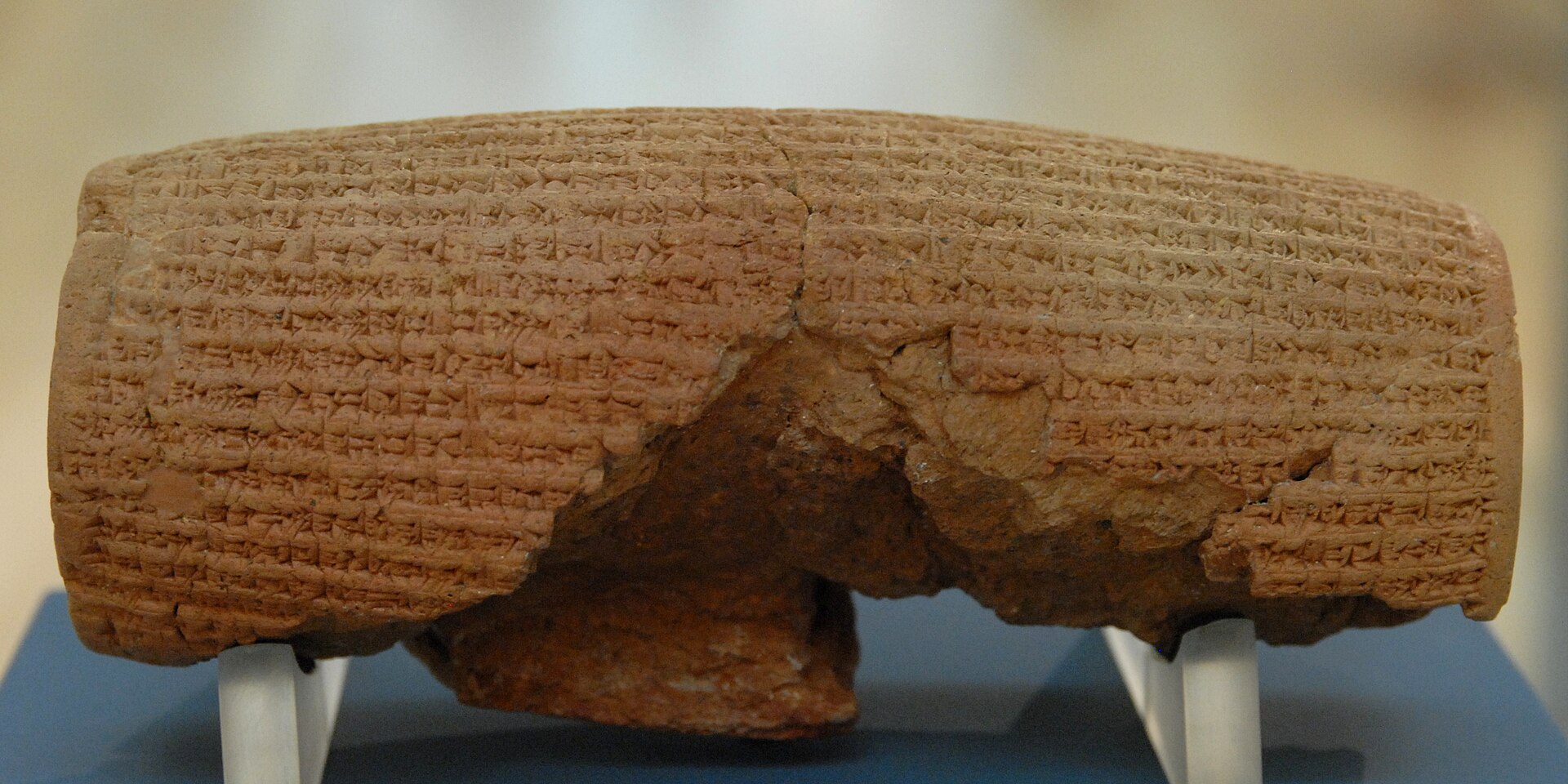
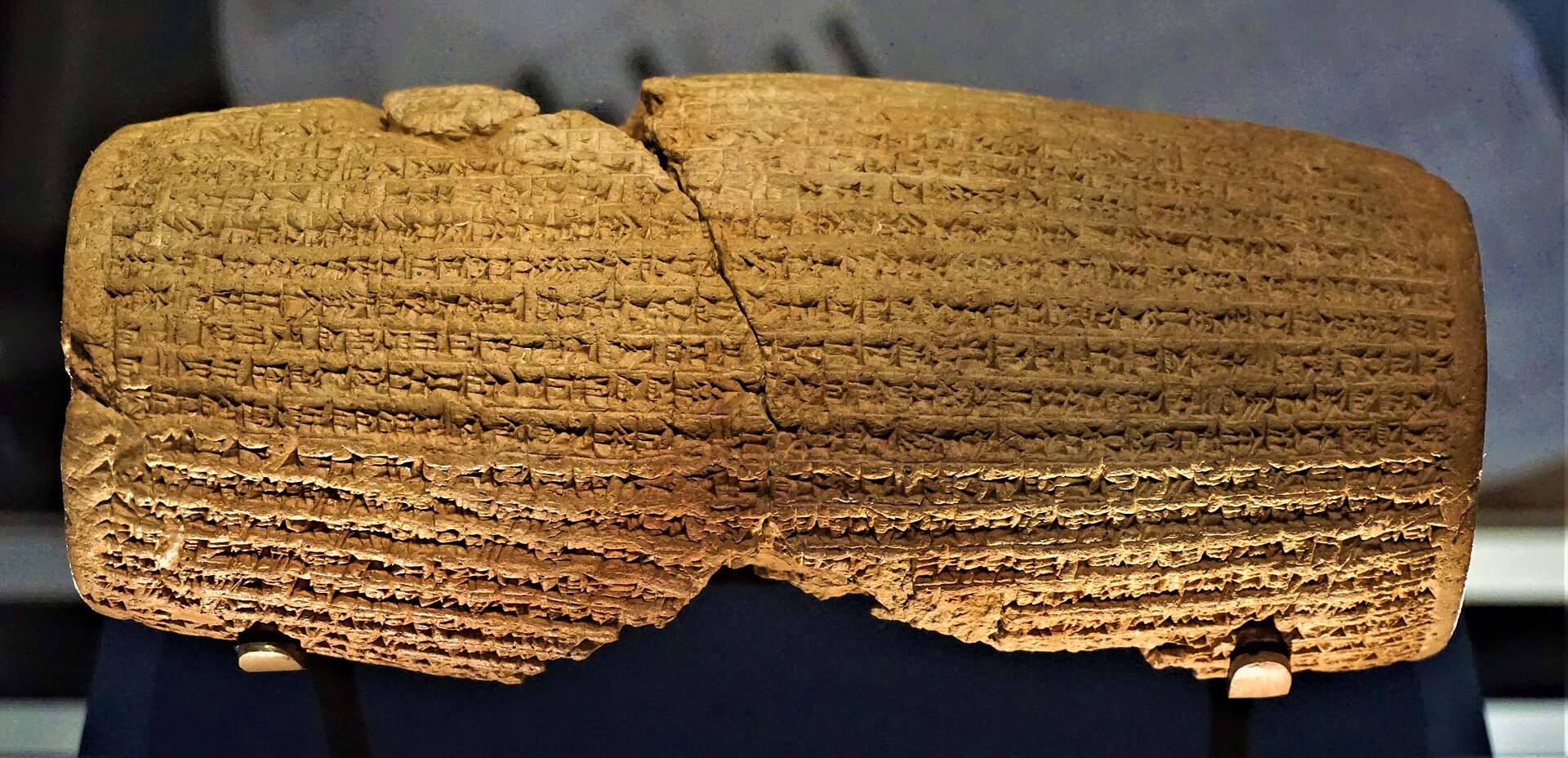
The Cyrus Cylinder is a barrel of fired clay a little under 23 centimetres long, roughly the size of a large rugby ball or an American football, tapering slightly from a maximum girth of about 10...
The Cyrus Cylinder is a barrel of fired clay a little under 23 centimetres long, roughly the size of a large rugby ball or an American football, tapering slightly from a maximum girth of about 10 centimetres to narrower ends of 7.8 to 8.2 centimetres. It is not a tablet and not a statue. It is a foundation document, a type of object Mesopotamian kings had buried inside the brickwork of temples and walls for well over a thousand years before Cyrus's scribes made this one, so that a god, not a human reader, would find it.
The clay body has a conical core containing unusually large grey stone inclusions, built up with further layers of clay and finished with a finer surface slip before the text was cut into it. Forty-five lines of cuneiform run continuously around the full circumference, in the Late Babylonian script and the Akkadian language, the administrative and literary language of Babylon rather than Cyrus's own Old Persian. The object was broken, at the time of discovery or soon after, and survives in several joined pieces; just over a third of the original text is missing. It was refired for conservation on 28 August 1961, and a cast of a joining fragment from the Yale Babylonian Collection has been affixed to the back since the 1970s.
It is easy to overstate the cylinder's grandeur from photographs. Irving Finkel, the British Museum curator who has worked on it longest, has been blunt that in the hand it is a modest, unglamorous lump of baked mud with a broken face and gaps in the text - the opposite of a monument built to be seen. Its importance is entirely in what is written on it, not in how it looks.
Chapter 2How it was made, and why that form
Barrel or cylinder-shaped foundation deposits were a standing genre in Babylonia by the sixth century BC, not a Persian invention.
Barrel or cylinder-shaped foundation deposits were a standing genre in Babylonia by the sixth century BC, not a Persian invention. Kings from the Neo-Assyrian and Neo-Babylonian periods, and Cyrus's own predecessor and enemy Nabonidus, had commissioned cylinders in the same shape, in the same language, for the same purpose: to be sealed inside the fabric of a rebuilt temple or wall as a permanent record addressed to the gods and to any future king who might one day rebuild the same structure and find it. Nabonidus's own Sippar cylinder and the four identical Ur cylinders follow a near-identical rhetorical shape to Cyrus's text - a lengthy titulary, an account of a god's anger and abandonment of a shrine, the god's reconciliation, a command to restore the building, and a king who piously increases the offerings.
That Cyrus's scribes reached for the same template they had just used to vilify Nabonidus is not an accident and not obviously ironic to the people who wrote it; it was the available literary form for exactly this kind of statement, and using it signalled continuity and legitimacy to a Babylonian audience steeped in the convention. The cylinder itself records that during the rebuilding of Babylon's Imgur-Enlil wall, workers came across an earlier building inscription of the Assyrian king Ashurbanipal (r. 668-627 BC), a detail that shows Cyrus's scribes working within a landscape of visible precedent, not composing in a vacuum.
The clay itself was almost certainly local Babylonian alluvial clay of the kind used throughout the city's own scribal and building tradition; no separate compositional or petrographic study of this specific cylinder's fabric has surfaced in the sources consulted for this record, and that absence is recorded here rather than filled with a plausible guess.
Chapter 3The find: Rassam's 1879 excavation
The cylinder was found in March 1879 at Babylon, in the ruin mound the excavators called Amran ibn Ali (also written Omran or Jumjuma), which covers the site of Esagila, Marduk's principal temple.
The cylinder was found in March 1879 at Babylon, in the ruin mound the excavators called Amran ibn Ali (also written Omran or Jumjuma), which covers the site of Esagila, Marduk's principal temple. The excavation was being carried out for the British Museum by Hormuzd Rassam, an Assyrian Christian from Mosul who had begun his career as a young assistant to Austen Henry Layard at Nimrud and Nineveh in the 1840s and had by 1879 been directing his own campaigns for the Museum for years, under a firman obtained from the Ottoman Sultan Abdul Hamid II with the help of Layard, by then British ambassador in Constantinople.
Rassam did not personally lift the cylinder from the ground. According to Irving Finkel's account, drawing on Rassam's own later correspondence, Rassam had already left Baghdad by 2 April 1879 and had left the Amran site in the charge of his overseer, Daud Toma; the object was recovered by Toma's workmen between roughly 17 and 23 March. Rassam had found the mound at Babylon badly plundered by local brick-diggers before he arrived, and his practical solution - hiring the same brick-diggers and letting them continue selling the bricks on condition they surrendered any inscribed material to him - is very plausibly what preserved the cylinder rather than losing it to the antiquities trade unrecorded. The recovered objects, including the cylinder, were entrusted to a Baghdad merchant named Baltazar for shipment to London by steamer; the cylinder is reported to have arrived already broken, and was received and examined at the Museum by the cuneiform curator Theophilus Pinches later in 1879. It was formally registered into the collection on 17 June 1880, the date embedded in its registration number, 1880,0617.1941.
Rassam's own role in this and in his wider career was for decades under-credited in favour of Henry Rawlinson, the scholar-administrator who oversaw and published much of the Museum's Mesopotamian material without having done the digging. Rassam, the first person from the region itself to direct excavations there on behalf of a Western museum, later had to sue a rival for libel in a London court after being accused of concealing finds - a case he won, but which shadowed his reputation in Britain for the rest of his life.
Chapter 4What the text actually says
The inscription falls into two parts. Lines 1 to 19 are a third-person narrative that portrays Cyrus's predecessor Nabonidus as an impious king who had suspended the cult of Marduk, Babylon's chief...
The inscription falls into two parts. Lines 1 to 19 are a third-person narrative that portrays Cyrus's predecessor Nabonidus as an impious king who had suspended the cult of Marduk, Babylon's chief god, and burdened the population with forced labour and unfit rites; it says the god Marduk, angered, searched among all the lands for a righteous king, found Cyrus, and called him by name to march on Babylon, which he then entered without a battle, welcomed by its people. From line 20 the voice shifts to Cyrus's own first person: a long royal titulary describing him as king of Anshan, descendant of a line of kings, follows an account of his restoration of temple cults, his return of divine statues that Nabonidus had brought into Babylon from other cities to their own shrines, and his release of unnamed deported peoples so that they might return to their settlements. The final surviving lines, recovered only via the Yale fragment, describe building work on Babylon's fortification walls, Imgur-Enlil, and a prayer to Marduk and Nabu on Cyrus's behalf and that of his son.
What the text does not say is as important as what it does. It does not name Jews, Judah or Jerusalem; the biblical books of Ezra and 2 Chronicles report a decree of Cyrus permitting the Jewish exiles to return and rebuild the Temple, and readers have long associated that decree with this object, but the cylinder itself is silent on that specific community - its language about deported peoples and restored cults is generalised, addressed to the peoples and gods of Babylonia and the region Cyrus had just absorbed, not to any single named group. It is also not a legal edict, a constitution or a proclamation addressed to a general population; as a Babylonian foundation deposit it was written to be read by Marduk and by a future king rebuilding the same wall, and its declared audience is divine and dynastic, not civic.
Chapter 5Genre, and how much is policy versus convention
Scholars comparing the cylinder against the wider corpus of Neo-Assyrian and Neo-Babylonian royal inscriptions - the building texts of Sargon II, Sennacherib, Esarhaddon, Ashurbanipal, Nebuchadnezzar...
Scholars comparing the cylinder against the wider corpus of Neo-Assyrian and Neo-Babylonian royal inscriptions - the building texts of Sargon II, Sennacherib, Esarhaddon, Ashurbanipal, Nebuchadnezzar II and Nabonidus himself - find that its rhetorical structure is conventional almost line for line: a king wronged by his predecessor's impiety, a god who selects a new king by name, a bloodless entry into the capital, and a programme of cultic restoration rewarded with increased offerings. The theme of divine abandonment followed by divine selection recurs specifically in the inscriptions of Esarhaddon and Ashurbanipal, and Cyrus's cylinder reproduces it closely enough that its authors were plainly working from the same scribal toolkit rather than inventing a new form to fit a new, more tolerant king.
Where scholars divide is on how much beyond the rhetoric is real. The account is corroborated in its broad shape by the independent Nabonidus Chronicle, a separate cuneiform text that likewise records Babylon falling to Cyrus's forces without a battle and records dissatisfaction with Nabonidus's religious policy, which gives the cylinder's central claims - a peaceful capture, an unpopular predecessor - a measure of external support. But the specific claims of clemency, cult restoration and repatriation are Cyrus's own self-presentation, written to a Babylonian audience within months of the conquest, and no comparably contemporary Babylonian source independently verifies the details of the repatriations it describes. The cylinder is good evidence for what Cyrus's court wanted a Babylonian public and posterity to believe about the new king. It is weaker evidence, on its own, for exactly what that policy achieved in practice.
Chapter 6The Yale fragment and what it fixed
The cylinder was excavated broken and remained incomplete in the Museum's hands for close to a century.
The cylinder was excavated broken and remained incomplete in the Museum's hands for close to a century. In 1920 the Yale Babylonian Collection published a small unidentified cuneiform fragment, 8.6 by 5.6 centimetres, from the collection assembled by the Brooklyn clergyman James B. Nies, who had bought it from an antiquities dealer years before his death in 1922; it was catalogued anonymously among other Nies pieces as tablet no. 32 in the Nies and Keiser volume of texts, with the museum siglum NBC 2504, and its connection to the Cyrus Cylinder went unrecognised for half a century.
In 1970-71 Paul-Richard Berger of the University of Munster, working through the Yale Babylonian Collection's published texts, identified NBC 2504 as the missing end of the Cyrus Cylinder, covering lines 36 to 45 - precisely the building-work and prayer section that had been entirely absent from the object as excavated. The fragment was subsequently sent to London; the British Museum's own conservation record shows plaster filling added before and after the join, and a cast of the Yale piece has been physically affixed to the back of the cylinder since, so that the object now on display in Room 52 presents a text closer to complete than the piece Rassam's workmen actually lifted from the ground in 1879. Berger's identification is the reason the cylinder's building and prayer section - the material that shows Cyrus operating within, not outside, the existing Babylonian genre of royal piety - is known at all.
Chapter 7The second discovery: duplicate tablets, 2009-2010
A separate and later discovery showed that the cylinder's text was not unique to this one buried object.
A separate and later discovery showed that the cylinder's text was not unique to this one buried object. On 31 December 2009, Wilfred Lambert, a retired Birmingham University Assyriologist working through the British Museum's enormous backlog of unpublished cuneiform fragments, recognised a small piece of a large clay tablet - registration number BM 47134 - as carrying text that duplicated part of the Cyrus Cylinder. On 5 January 2010 the Museum's own curator, Irving Finkel, identified a second, related fragment, BM 47179, from the same tablet. Both fragments had, like the cylinder, been excavated decades earlier by Rassam's expeditions, but from a different site: Dailem, south of Babylon, brought into the Museum's collection in 1881 and left unpublished and unrecognised for well over a century.
The two BM fragments duplicate different stretches of the cylinder's text - one covering roughly lines 34 to 37, the other lines 1 to 2 and 42 to 45 - and, because they come from a flat tablet rather than a barrel cylinder, they prove that the same proclamation was also copied onto ordinary administrative-format tablets and evidently circulated or archived more widely than a single buried foundation deposit. One fragment preserves a partially legible colophon giving the name of the scribe who wrote that particular copy, Qishti-Marduk - the only named individual scribe connected to any physical copy of this text. John Curtis, then the Museum's Keeper of the Middle East, called the find highly significant for exactly this reason: it recast the cylinder from a unique, hidden object addressed only to Marduk into one instance of a text that had also existed as a working, copyable administrative document.
Chapter 8The 1971 reframing: a human rights charter
The cylinder did not carry the description "first charter of human rights" in the nineteenth or early twentieth century; that language is a mid-to-late twentieth-century addition to its reception.
The cylinder did not carry the description "first charter of human rights" in the nineteenth or early twentieth century; that language is a mid-to-late twentieth-century addition to its reception. Mohammad Reza Pahlavi, Shah of Iran, is recorded describing it in these terms as early as 1968, and the framing became a fixture of state messaging around the Pahlavi monarchy's self-presentation as heir to Cyrus the Great. It reached its widest audience during the extravagant 2,500th-anniversary celebrations of the Persian monarchy staged at Persepolis and Pasargadae from 12 to 16 October 1971, where the cylinder's image served as the event's official emblem, appearing on the celebration's seal and subsequently on Iranian coins, banknotes and stamps.
On 14 October 1971, in the same window, the Shah's sister Princess Ashraf Pahlavi presented a ceramic facsimile of the cylinder to the United Nations in New York on Iran's behalf, received by Secretary-General U Thant; the accompanying description called it an ancient declaration of human rights and connected it explicitly to UN discussions on the protection of human rights in armed conflict. The facsimile, UN gift catalogue number UNNY068G, remains on display at UN Headquarters and is a modern replica manufactured from the British Museum's own cast of the original - not, and never presented by the United Nations as, the sixth-century BC object itself.
The 1971 celebrations have since been extensively analysed as an exercise in state image-making at a moment when the Pahlavi government faced mounting domestic criticism; Amnesty International would identify Iran under the Shah in 1976 as among the world's most severe human-rights violators, a fact scholars including those writing for Ajam Media Collective have set directly against the government's own use of the cylinder as a human-rights symbol five years earlier. The irony was, on the available evidence, unremarked at the time by the state that promoted the reading.
Chapter 9The scholarly pushback
Assyriologists who have worked directly on the cuneiform text have been consistent and public in rejecting the human-rights framing as anachronistic.
Assyriologists who have worked directly on the cuneiform text have been consistent and public in rejecting the human-rights framing as anachronistic. Irving Finkel has put it as starkly as the discipline allows: "There are no human rights in antiquity. There were never human rights in antiquity," and has described the cylinder's actual concern as narrowly practical - restoring peaceful and orderly conditions in a newly conquered city, not proclaiming a universal entitlement. Josef Wiesehofer, C.B.F. Walker and Lloyd Llewellyn-Jones are cited in the same body of scholarship as having independently examined the cylinder and the social conditions of Achaemenid Babylonia and concluded that its claims of religious freedom and proto-democratic tolerance do not hold up against what the text and its context actually support.
The scholarly case rests on several points that recur across this literature: the cylinder is a conventional Babylonian foundation inscription in a genre that predates Cyrus by well over a millennium, not a novel legal instrument; its declared audience is a god and a future king, not the governed population; it says nothing about individual liberty, due process or rights held against the state, concepts absent from the vocabulary and the political thought of sixth-century-BC Mesopotamia; and slavery and forced labour continued under Achaemenid rule after 539 BC, which sits uneasily with a reading of the text as an abolition of servitude in any general sense. None of this is presented in the scholarship as evidence that Cyrus's restoration of cults and release of deportees did not happen or was not, in its own context, a notable act of statecraft - only that describing it in the vocabulary of a later human-rights tradition imports a framework the text and its authors did not have.
Chapter 10Loan diplomacy: Iran, 2005-2011
The British Museum first promised to lend the cylinder to Iran's National Museum in Tehran in 2005, in the aftermath of its own Forgotten Empire exhibition on ancient Persia.
The British Museum first promised to lend the cylinder to Iran's National Museum in Tehran in 2005, in the aftermath of its own Forgotten Empire exhibition on ancient Persia. The loan slipped repeatedly. A display date of 16 January 2010 was agreed and then postponed by the Museum, which cited the need to examine the two duplicate tablet fragments identified by Lambert and Finkel in December 2009 and January 2010 before the cylinder travelled - a scientifically defensible reason that Iranian officials nonetheless received as evasive. On 8 February 2010 Iran's cultural heritage organisation, through its vice-president Hamid Baqaei, announced it was cutting cooperative ties with the British Museum over the delay, threatened to lodge a complaint with UNESCO, and said Iran had incurred costs from the postponement; the Museum's spokesperson Hannah Boulton maintained publicly that the delay was to allow joint study of the new fragments with Iranian colleagues, not a change of heart about the loan itself.
The loan went ahead later that year. The cylinder was unveiled at the National Museum of Iran in Tehran on 12 September 2010, initially agreed for a four-month run and then extended because of the scale of public interest; it remained on display until roughly April 2011, a loan of about seven months, seen by attendance figures reported as approaching half a million visitors, before returning to the British Museum. A separate, later controversy arose in 2024, when the Museum's approval of a possible future loan to the National Library of Israel in Jerusalem - alongside a confirmed loan to the Yale Peabody Museum running to 30 June 2024 - drew formal protest from Iran's Directorate General of Museums, which warned of unspecified risks and threatened legal action; as of the sources consulted for this record no Jerusalem loan had been confirmed or scheduled, and the Museum stated only that future venues would be announced in due course.
Chapter 11The restoration-of-cults policy in Mesopotamian religious politics
Within the world the cylinder's scribes were writing for, restoring a conquered city's own gods to their own shrines and reversing a predecessor's cultic changes was a recognised and repeatedly used...
Within the world the cylinder's scribes were writing for, restoring a conquered city's own gods to their own shrines and reversing a predecessor's cultic changes was a recognised and repeatedly used claim to legitimacy, not a personal innovation of Cyrus's. Assyrian and Babylonian kings before him had made variants of the same claim when consolidating rule over newly absorbed territory: a new king who honours the local gods, rather than imposing his own, presents himself as the gods' chosen restorer rather than a foreign conqueror, and does so in language a Babylonian temple elite - whose cooperation any occupying power needed to govern the city at all - would recognise and accept. Nabonidus's own cylinders, restoring shrines at Harran, Sippur and Ur, use the identical device a generation earlier, for the same practical reason: control of Babylon ran through control of, or at least accommodation with, its priesthoods.
Read this way, Cyrus's cult restoration and release of deportees are best understood as a documented act of statecraft with a specific, practical audience - argued for by the scholars named above - rather than as evidence of a personal or ideological commitment to universal tolerance for its own sake. That the policy was also, quite possibly, sincerely pious by the standards of the day, and that it materially benefited specific communities who were allowed to return home and rebuild specific shrines, are not claims this record disputes; they are simply a narrower and better-supported description than "the first charter of human rights," and the distance between the two descriptions is the substance of the modern scholarly disagreement covered above.
Chapter 12Comparanda: the Nabonidus cylinders
The closest formal comparanda for the Cyrus Cylinder are the cylinders of the king it displaces.
The closest formal comparanda for the Cyrus Cylinder are the cylinders of the king it displaces. Nabonidus's Sippar cylinder records his repairs to the Ehulhul temple of the moon god Sin at Harran and to shrines of Anunitu and Shamash at Sippar; a copy is held by the British Museum, with another in the Pergamon Museum, Berlin. Four identical Ur cylinders of Nabonidus, also in the British Museum, commemorate his restoration of a ziggurat sacred to Sin at Ur and name his son Belshazzar, the figure later associated with the biblical Book of Daniel. Structurally, these Nabonidus texts and the Cyrus Cylinder are close to interchangeable: a titulary, a god's abandonment and reconciliation, a command to rebuild, a king who increases the offerings. Cyrus's scribes deployed the same template his own inscription uses to condemn Nabonidus, which is the strongest single piece of internal evidence for how conventional, rather than novel, the cylinder's rhetorical machinery actually is.
Chapter 13What is happening to it now
The cylinder remains on permanent display in Room 52 of the British Museum, the Ancient Iran gallery, alongside the Oxus Treasure and other Achaemenid material, its ordinary state since its return...
The cylinder remains on permanent display in Room 52 of the British Museum, the Ancient Iran gallery, alongside the Oxus Treasure and other Achaemenid material, its ordinary state since its return from Iran in 2011 aside from further scheduled loans. A loan to the Yale Peabody Museum in New Haven ran from spring 2024 through 30 June 2024, the first time the British Museum had lent the cylinder to Yale, the institution that had unknowingly held the missing end of its text for half a century before Berger's identification. A further loan, to the National Library of Israel in Jerusalem, was approved in principle by the Museum's trustees in March 2022 for prospective dates in autumn 2024, but drew formal protest from Iran's Directorate General of Museums in January 2024; the sources consulted for this record do not show that loan as having taken place or as having been formally confirmed with dates.
The artist
No individual maker is named; the object was produced by an unidentified scribal workshop operating for the Babylonian temple or palace administration under the new Achaemenid Persian court, 539-530 BC
The Cyrus Cylinder carries no signature and names no scribe. What can be reconstructed is not a biography but a working context: a Babylonian scribal tradition, already well over a thousand years old, pressed immediately into service by a new foreign king who needed his conquest legitimised in a form the conquered city's own religious establishment would recognise. The single named individual connected to any physical copy of this text - the scribe Qishti-Marduk, on an unrelated duplicate tablet found in the Museum's own backlog in 2010 - is not known to have touched the cylinder itself. Everything else about the hands behind this object is inference from genre, language and comparison with other Babylonian royal inscriptions of the same decades.
Related works
| Work | Relation | Where it is |
|---|---|---|
| Sippar Cylinder of Nabonidus Neo-Babylonian royal workshop under Nabonidus | Closest formal comparandum: an earlier cylinder in the identical restoration-of-cults genre, by the king Cyrus's cylinder condemns Records Nabonidus's repairs to shrines at Harran and Sippar; shares the titulary-abandonment-restoration structure the Cyrus Cylinder reuses. | British Museum, London (a further copy in the Pergamon Museum, Berlin) |
| Cylinders of Nabonidus, from Ur Neo-Babylonian royal workshop under Nabonidus | Four identical cylinders in the same genre, naming Nabonidus's son Belshazzar Commemorate restoration of a ziggurat sacred to the moon god Sin. | British Museum, London |
| Nabonidus Chronicle Babylonian scribal chronicle tradition | Independent cuneiform account corroborating the cylinder's claim of a peaceful, largely unopposed Persian entry into Babylon A different genre, chronicle rather than royal proclamation, which gives the cylinder's central narrative external support without corroborating its specific claims of clemency. | British Museum, London |
| Duplicate tablet fragments, BM 47134 and BM 47179 Scribe Qishti-Marduk (named on one fragment) and an unnamed second scribe | Separate physical copies of portions of the same proclamation text, on flat tablets rather than a barrel cylinder Excavated by Rassam at Dailem in 1881; unrecognised in the Museum's own backlog until Lambert and Finkel identified them in December 2009-January 2010. | British Museum, London |
| Replica of the Cyrus Cylinder (UN gift UNNY068G) Modern cast, manufactured from a British Museum mould | The 1971 facsimile presented to the United Nations that anchored the object's human-rights reception history A modern object in its own right, not part of the ancient artifact's provenance; included here explicitly to keep it separated from the original per this record's version-safety standard. | United Nations Headquarters, New York |
Open questions
- Where exactly does composition sit within 539-530 BC? No source consulted gives a narrower date range than 'within about a year of the conquest' for when the text was drafted and the cylinder buried.
- Was the cylinder's scribe the same person, or workshop, that produced the duplicate tablets BM 47134/47179, or an entirely separate copying event? The colophon naming Qishti-Marduk belongs to the tablet, not the cylinder, and no source links the two directly.
- How many further copies of this text existed and were distributed through Cyrus's newly absorbed territories? The 2009-2010 discovery proved at least one tablet copy existed beyond the buried cylinder; Finkel has suggested more copies likely remain undiscovered in Iraq, but none has been reported found since.
- Has the clay body ever been subjected to a published petrographic or compositional sourcing study to confirm a Babylon-local origin? No such study appears in the sources consulted for this record.
- What was the exact original burial location and orientation of the cylinder within the Amran/Esagila foundations, beyond the general mound identification? The excavation predates modern stratigraphic recording and the sources consulted do not give a precise findspot within the mound.
- Has Iraq, as the modern state occupying the findspot, ever formally requested repatriation or made a public claim on the cylinder? No such claim appears in the sources consulted for this record, and its absence is recorded here as a finding rather than assumed.
Questions about this object
What is The Cyrus Cylinder?
The Cyrus Cylinder is an antiquity, dated c. 539-530 BC. Medium: Fired clay (barrel-shaped foundation cylinder), inscribed in Babylonian cuneiform.
Who made The Cyrus Cylinder, and is the attribution settled?
The attribution to Unknown Babylonian scribal workshop, working for the court of Cyrus II of Persia is recorded here as unknown. No maker is named on the object. The text was composed and cut by a Babylonian temple or palace scribe or scribes working within weeks or months of Cyrus's entry into Babylon in October 539 BC, using the literary conventions of Babylonian royal building inscriptions. One duplicate tablet of the same text, found in the British Museum's own uncatalogued backlog in 2009-2010 (BM 47134 and BM 47179, from Dailem, south of Babylon), preserves a partial colophon naming the scribe who copied that tablet as Qishti-Marduk. Nothing establishes that the same hand cut the cylinder itself, and no scribe is named on the cylinder text as it survives.
Where is The Cyrus Cylinder now?
British Museum, London, Room 52 (Ancient Iran gallery). Inventory number Museum number 90920; registration number 1880,0617.1941; previous identifiers BM 12049 and L1166. Last confirmed 19 August 2026. Excavated by Hormuzd Rassam for the British Museum in March 1879; received by the Museum later that year and formally registered 17 June 1880. In continuous Museum ownership since, aside from short-term loans.
What is still unknown about The Cyrus Cylinder?
Where exactly does composition sit within 539-530 BC? No source consulted gives a narrower date range than 'within about a year of the conquest' for when the text was drafted and the cylinder buried.
Sources
- 1British Museum, collection online catalogue entry for the cylinder (museum number 90920, registration 1880,0617.1941). britishmuseum.org/collection/...
- 2Yale Peabody Museum, press coverage of Irving Finkel's lecture dispelling myths about the Cyrus Cylinder. peabody.yale.edu/node/...
- 3Encyclopaedia Iranica, 'CYRUS iv. The Cyrus cylinder'. iranicaonline.org/articles/...
- 4Livius.org, 'Cyrus Cylinder', including translation notes based on the Cogan translation adapted to Schaudig's edition. livius.org/sources/...
- 5Zoroastrian Heritage (blog), 'The Cyrus Cylinder', drawing on Irving Finkel's 2013 book 'The Cyrus Cylinder: The King of Persia's Proclamation from Ancient Babylon'. zoroastrianheritage.blogspot.com/2013/...
- 6Zoroastrian Heritage (blog), 'The Remarkable Discovery of the Cyrus Cylinder', on Rassam's 1879 excavation, again drawing on Finkel's 2013 book. zoroastrianheritage.blogspot.com/2013/...
- 7World History Encyclopedia, 'The Cyrus Cylinder'. worldhistory.org/article/...
- 8World History Encyclopedia, image caption 'Additional Fragments of the Cyrus Cylinder Text'. worldhistory.org/image/...
- 9Yale Herald, 'Piecing Together the Cyrus Cylinder' (2024), on the Yale fragment history and the 2024 Yale Peabody loan. yale-herald.com/2024/...
- 10Aggregated web search synthesis on genre parallels between the Cyrus Cylinder and the royal inscriptions of Ashurbanipal, Esarhaddon, Sargon II, Sennacherib and Nebuchadnezzar II, including the cylinder's own reference to finding an Ashurbanipal building inscription during wall reconstruction. biblicalarchaeology.org/daily/...
- 11The Art Newspaper, 'Discovery of fragment belonging to British Museum's Cyrus cylinder further defers loan to Iran' (2010), on the BM 47134/BM 47179 discovery by Wilfred Lambert and Irving Finkel and the scribe Qishti-Marduk. theartnewspaper.com/archive/...
- 12Wikipedia, 'Cylinders of Nabonidus', on the Sippar and Ur cylinders and their shared rhetorical structure with the Cyrus Cylinder. en.wikipedia.org/wiki/...
- 13Aggregated web search synthesis on Neo-Assyrian/Neo-Babylonian royal inscription genre and the theme of divine abandonment and selection in the inscriptions of Esarhaddon and Ashurbanipal, compared to the Cyrus Cylinder. intralinea.org/current/...
- 15United Nations Gifts collection, entry on the 1971 ceramic replica of the Cyrus Cylinder ('Edict of Cyrus', gift ID UNNY068G) presented by Princess Ashraf Pahlavi. un.org/ungifts/...
- 16Al Jazeera, 'Iran cuts ties with British Museum' (8 February 2010). aljazeera.com/news/...
- 17Aggregated web search synthesis of contemporaneous 2010 reporting (The History Blog, Elginism, BiblePlaces, NBC News, BBC News) on the Cyrus Cylinder's 12 September 2010 arrival in Tehran, the extended roughly seven-month loan, and its return to the British Museum in spring 2011. thehistoryblog.com/archives/...
- 18Elginism, 'Cyrus Cylinder loan to Iran by British Museum finally goes ahead' (2010). elginism.com/similar-cases/...
- 19BiblePlaces.com, 'Cyrus Cylinder Loaned to Iran' (September 2010). bibleplaces.com/blog/...
- 20Aggregated web search synthesis on the Yale Peabody Museum 2024 loan terms and negotiation timeline. peabody.yale.edu/news/...
- 21The Art Newspaper, 'British Museum's planned Cyrus Cylinder loan to Jerusalem sparks protests from Iran' (26 January 2024). theartnewspaper.com/2024/...
- 22Ajam Media Collective, 'Reconstructing a Persian Past: Contemporary Uses and Misuses of the Cyrus Cylinder in Iranian Nationalist Discourse' (2013), on the 1968 origin of the Shah's human-rights framing, the 1971 Persepolis celebrations and UN gift, and named scholarly critiques (Wiesehofer, Walker, Llewellyn-Jones). ajammc.com/2013/...
- 23Wikipedia, '2,500-year celebration of the Persian Empire', on the cylinder's use as the event emblem and on coins, banknotes and stamps, and on contemporary criticism of the celebration. en.wikipedia.org/wiki/...
Last verified · Published
Change log
19 August 2026 - Record created at the house standard: researched narrative, technical evidence, maker dossier, graded provenance chain, prices with hammer and premium separated, related works, open questions and sources.