Stephen Daye
English, working in Massachusetts Bay · c. 1594-1668
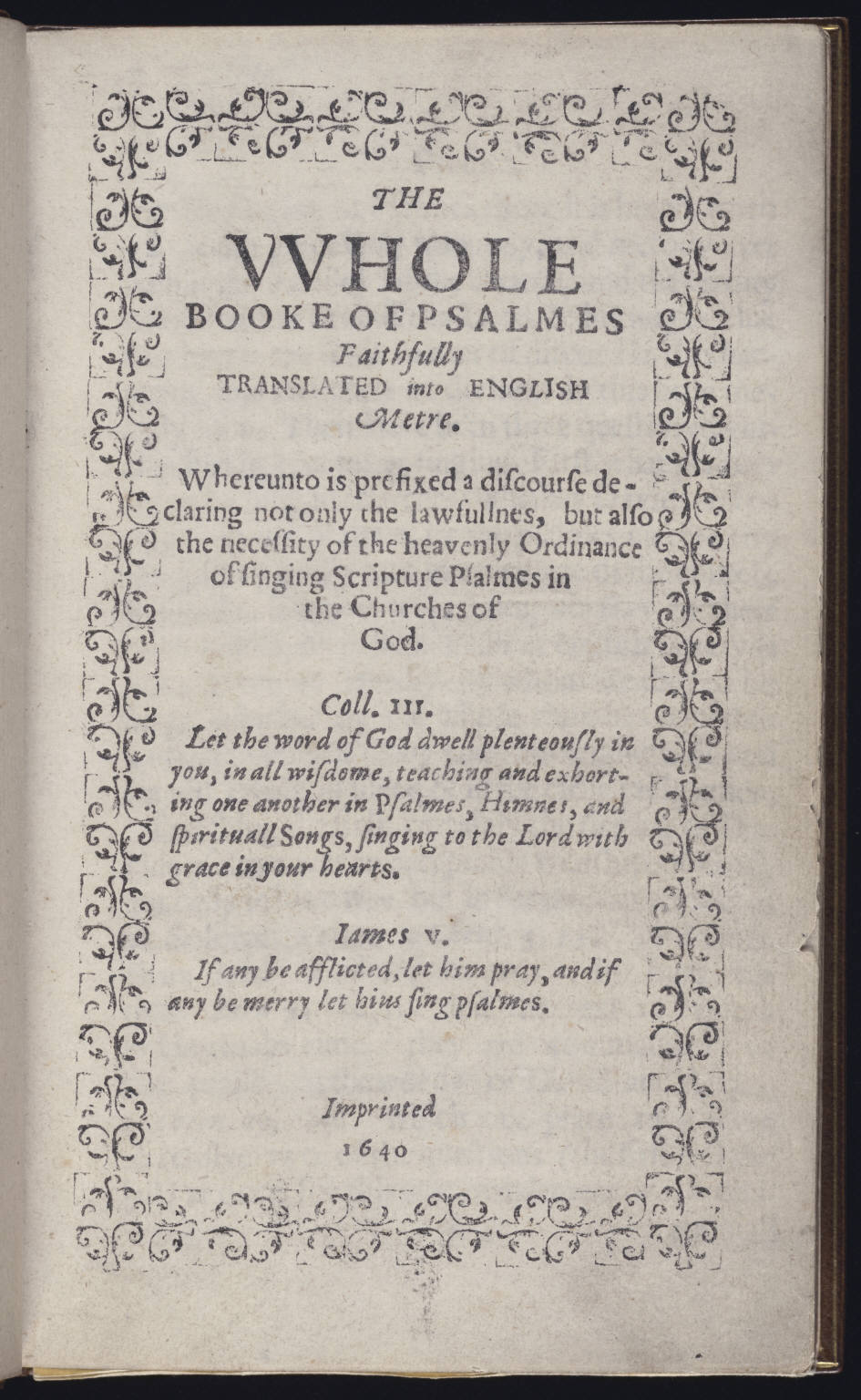
Title page, the Beinecke (Yale) copy The title page of the 1640 first edition, ending in the bare words 'Imprinted 1640' with no printer named. This is the Beinecke Rare Book and Manuscript Library's own copy at Yale, one of eleven surviving copies of the same edition and a different physical object from the Old South Church copy discussed elsewhere in this archive. No verified portrait. No securely identified likeness of this maker is known under a free licence. We do not publish a face we cannot verify.
Beinecke Rare Book and Manuscript Library, Yale University| Worked as | Printer, Locksmith |
|---|---|
| Died | 22 December 1668 · Cambridge, Massachusetts Bay Colony |
| Nationality | English, working in Massachusetts Bay |
| Movement | First-generation Massachusetts Bay printing |
| Sources | 17 cited |
| Last verified | 23 September 2026 |
About this page Last verified 23 September 2026 · 17 sources cited
On this page 13 sections
ContentsClose
The man credited with the first book printed in British North America was not a printer. Stephen Daye was a locksmith in Cambridge, England, hired in 1638 to accompany a printing press across the Atlantic, not to run one. The press itself belonged to a woman, Elizabeth Glover, whose clergyman husband bought it and died on the crossing before it ever touched land. Daye managed her enterprise for five years and is named on none of its books. If his teenage son Matthew, who is repeatedly said to have trained as a printer in London before the family emigrated, actually set the type of the book that made the father famous, no source consulted proves it either way.
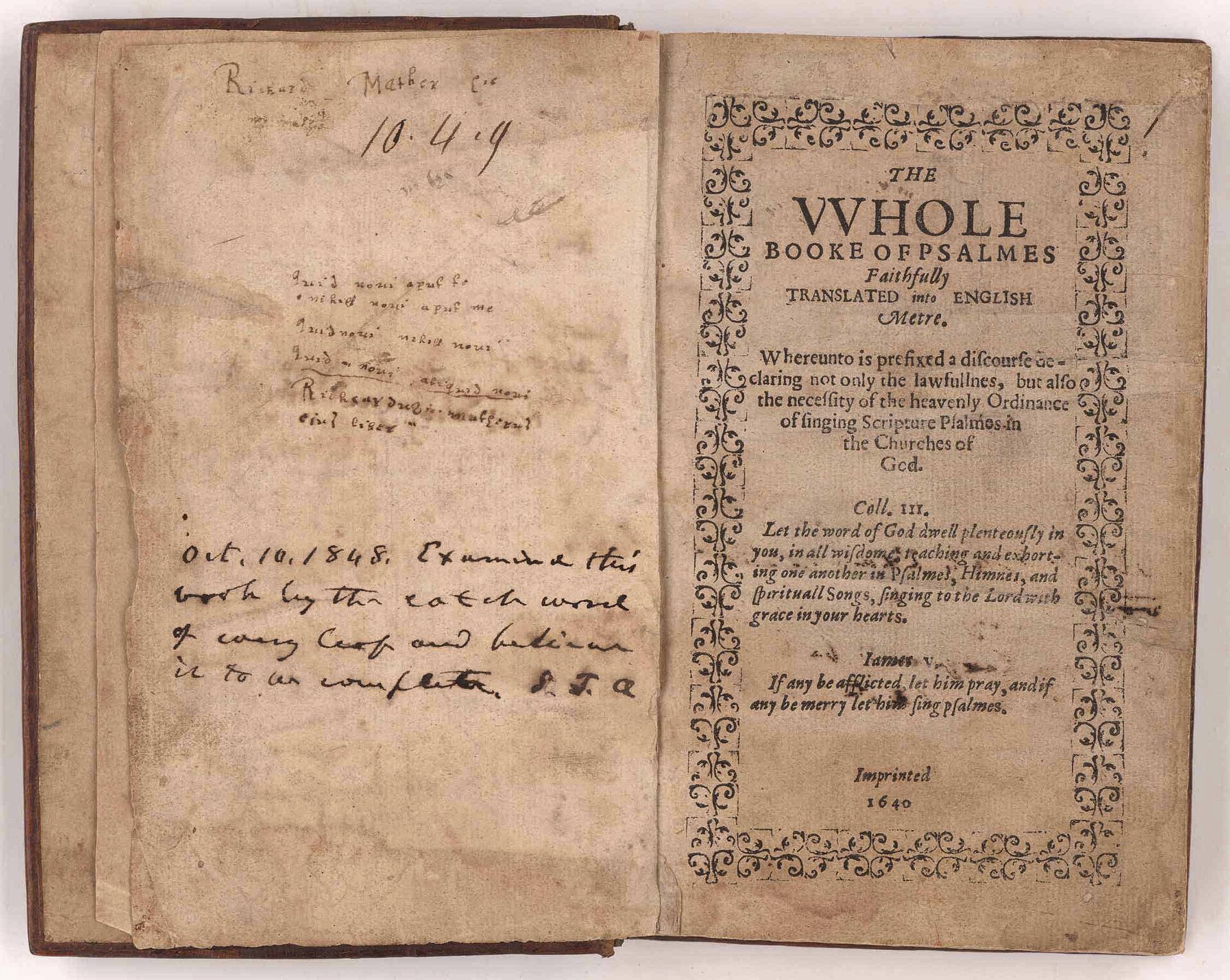
What is documented is stranger than the myth. The 1640 title page of The Whole Booke of Psalmes Faithfully Translated into English Metre, now called the Bay Psalm Book, ends with the bare words 'Imprinted 1640' and names no printer at all. The formula 'printed by Stephen Daye,' used everywhere including elsewhere in this archive, rests not on the book itself but on a single line in a 1641 Massachusetts land grant, which calls him 'the first that set upon printing,' and on the journal of Governor John Winthrop, who recorded what the press made and in what order without once describing how it was made or by whose hand.
This page is therefore less a biography of a craftsman than a record of an attribution: how a locksmith's name came to sit on the most expensive printed book ever sold at auction, what the workmanship itself says about who actually stood at the case, and what happened to the family, the widow who owned the press and the son who probably did the work, once the credit had already been assigned.
Images
Chronology
- c. 1594
Born in England; the year and place are both disputed among the sources consulted.67
- 1638
On 7 June, contracts with the Reverend Jose Glover at Cambridge, England, binding himself, his son Matthew and other household members to travel to Massachusetts Bay and work the press Glover is equipping.12
- 1638
Sails for Massachusetts on the John of London with the Glover household and the disassembled press.12
- 1638
Jose Glover dies of fever during the crossing; his widow Elizabeth becomes sole owner of the press and of Daye's contract.12
- 1638
In the autumn, Elizabeth Glover's household reaches Cambridge, Massachusetts, and sets up the press in a house on what is now Holyoke Street.29
- 1639
In January, the Freeman's Oath, a broadside, becomes the first item the press produces; no copy of this original printing survives.4
- 1639
William Peirce's almanac for New England is printed, the press's second production.216
- 1640
The Whole Booke of Psalmes Faithfully Translated into English Metre, later called the Bay Psalm Book, is printed, the press's third production and the first surviving book printed in British North America. The book names no printer.316
- 1641
On 22 June, Elizabeth Glover marries Henry Dunster, newly installed as the first president of Harvard College.2
- 1641
On 10 December, the General Court of Massachusetts Bay grants Daye 300 acres of land, naming him 'the first that set upon printing'; he does not take possession of the land until about 1657.616
- 1643
Elizabeth (Glover) Dunster dies on 23 June. By the most commonly repeated account, Daye is dismissed at this point and his son Matthew installed in his place.12
- 1647
By a different, Haraszti-derived account, this is the year Daye actually retires from the press, with Matthew recognized as its sole foreman only for the final two years before his own death.16
- 1647
Matthew Daye's name appears in print for the first time, on that year's almanac; it is the first time any Daye name appears on an imprint of the press.178
- 1648
Matthew Daye prints Edward Norris's Salem Catechism and the Book of the General Laws and Liberties.1
- 1649
Matthew Daye dies on 10 May, at about thirty years old. Samuel Green, who has no prior printing experience, succeeds him at the press.110
- 1656
Stephen Daye sues Henry Dunster for 100 pounds in unpaid compensation for his years at the press; the Middlesex County court decides for Dunster.117
- 1668
Stephen Daye dies at Cambridge, Massachusetts, on 22 December.16
- 2013
On 26 November, a surviving copy of the Bay Psalm Book (the Old South Church, Rubenstein copy) sells at Sotheby's New York for USD 14,165,000 with fees, a world record for a printed book.121314
The market
Stephen Daye's own corpus, in market terms, is really the market for one edition of one book, since almost nothing else credited to his years at the press survives as a physical object at all. This archive's own record for one specific surviving copy, the Old South Church copy bought by David Rubenstein in 2013, already carries that transaction's full provenance chain in detail; what belongs on this page is the comparative picture across the small number of times any copy has reached the open market.
Two sales, sixty-six years apart, each set a world record for a printed book in its own moment, and a third, decades earlier still, shows how far a copy's value has travelled from its first documented private sale.
| Date | Sale | Work | Result | Note |
|---|---|---|---|---|
| 26 November 2013 | Sotheby's, New York | The Bay Psalm Book, sale N09039, lot 1 (the Old South Church copy) | Hammer USD 12,500,000 (stated explicitly by two contemporary news reports; Sotheby's own released sale materials give only the fee-inclusive total) With premium USD 14,165,000 USD | World record for a printed book at the time. Bidding opened at USD 6 million and closed in under five minutes. Underbidder Steve Green of Oklahoma City, of the Hobby Lobby retail family, had entered a pre-set bid of USD 12 million intending the book for a planned Bible museum. Buyer David Rubenstein placed the winning bid by telephone from Australia. This archive's own record for this specific copy treats the hammer figure as derived rather than documented; this page notes both positions. |
| 28 January 1947 | Parke-Bernet, New York | The Bay Psalm Book, single-lot sale from the Gertrude Vanderbilt Whitney Trust (a different, also ex-Old South Church copy, now at the Beinecke Library, Yale) | Hammer USD 151,000 With premium No buyer's premium was charged in New York in 1947 USD | World record for a printed book at the time, ahead of a Shakespeare First Folio's roughly USD 77,000 in the same period. No copy of the Bay Psalm Book had been offered at auction again until 2013. |
Hammer is the price at which the bidding stopped; with premium adds the fee the house charges the buyer on top. Hammer price and buyer's premium in the glossary.
Where to see the work
| Institution | City | Holdings | Note |
|---|---|---|---|
| Library of Congress | Washington, DC | One of the eleven surviving copies of the 1640 first edition (incomplete) | Its digitized leaves supply several of this page's gallery plates. |
| Beinecke Rare Book and Manuscript Library, Yale University | New Haven, Connecticut | A complete copy of the 1640 first edition | The copy that set the 1947 auction record, ex-Old South Church, Crowninshield, Stevens, Brinley and Vanderbilt. |
| John Carter Brown Library, Brown University | Providence, Rhode Island | A complete copy of the 1640 first edition | Formerly owned by Richard Mather, one of the ministers usually credited with the metrical translation. |
| Houghton Library, Harvard University | Cambridge, Massachusetts | An incomplete copy of the 1640 first edition | Missing a number of leaves; held at the university the press itself once stood beside. |
| American Antiquarian Society | Worcester, Massachusetts | An incomplete copy of the 1640 first edition | The copy that belonged to Isaiah Thomas, the historian who wrote the first and harshest surviving verdict on the book's workmanship; it still carries his bookplate. |
| Bodleian Library, University of Oxford | Oxford, England | A complete copy of the 1640 first edition | The only complete copy held outside the United States. |
Forgeries and misattributions
- The Oath of a Freeman broadside, 1985
- No authentic copy of the Freeman's Oath, the very first item Daye's press produced in January 1639, has been seen since the mid-seventeenth century. In 1985 the document dealer Mark Hofmann offered a broadside he claimed to have found in a New York bookshop, priced at 1.5 million dollars, and early examination found nothing inconsistent with a mid-seventeenth-century original. The forgery was not caught by textual or scientific examination of the document itself. Hofmann was separately implicated in a pair of pipe bombings connected to his wider forgery activity, one of them fatal, and the resulting investigation exposed hundreds of his fabricated documents, including this one. He later admitted using period-correct paper, homemade ink and chemical ageing, and confessed that for the Oath specifically he had broken his usual practice and had the printing plate made by a professional rather than cutting it himself.4
The essay
Chapter 1A locksmith is given a press to mind
Before 1638 nothing connects Stephen Daye to printing.
Before 1638 nothing connects Stephen Daye to printing. Every source consulted, from the Encyclopaedia Britannica entry to the American Antiquarian Society's own account of the press, agrees on a single trade: he was a locksmith, working in Cambridge, England. On 7 June 1638 he entered into a contract with the Reverend Jose Glover, a nonconforming clergyman who had bought a complete printing press, type and paper in England with money raised from supporters, and who needed hands to move and operate it in the colony he was about to join. The agreement bound Daye, his son Matthew and other members of the household to the journey and to years of labour in consideration of their passage being paid.
Nothing in that contract, so far as the sources consulted describe it, names Daye a printer. He was engaged as labour, alongside three other workmen, for a venture whose actual craft he had no training in. That mismatch, a locksmith placed in charge of the first press in English America, is the fact every later account has to explain away or work around, and most simply do not mention it.
Chapter 2The widow who owned the enterprise
Jose Glover did not live to see his press unpacked.
Jose Glover did not live to see his press unpacked. He died of a fever during the Atlantic crossing on the John of London in the summer of 1638, leaving his widow, Elizabeth Harris Glover, the sole owner of the press, the type, the paper and Daye's contract of indenture. She and her household reached Cambridge, Massachusetts, in the autumn of 1638 and set up the press in a house on what is now Holyoke Street, next to the college that would become Harvard.
The historian Leona M. Hudak's assessment, quoted in the standard account of Elizabeth Glover's life, states the relationship plainly: Mrs. Glover was the proprietress or publisher of the press, and Daye was its overseer or manager. That is the correct hierarchy, and the phrase used everywhere since, 'printed by Stephen Daye,' erases it. Elizabeth Glover remarried in June 1641, to Henry Dunster, the newly installed first president of Harvard College, and the press passed under his direction. She died on 23 June 1643, not yet forty-one.
Her ownership was not honorary. After her death her son by Jose Glover sued Dunster over the disposition of her estate and the press within it, and a Middlesex County court eventually ruled in the son's favour, though Dunster kept most of the value regardless. The press that printed the first American book was, for its entire working life under the Daye family, the property of a woman and then of the man she married, never of the men who operated it.
Chapter 3What the press actually made, and in what order
Governor John Winthrop, a contemporary and not a bibliographer, is the source for the order of the press's first three productions, recorded in his own journal: 'The first thing which was printed was...
Governor John Winthrop, a contemporary and not a bibliographer, is the source for the order of the press's first three productions, recorded in his own journal: 'The first thing which was printed was the freemen's oath; the next was an almanac made for New England by Mr. William Peirce, mariner; the next was the Psalms newly turned into the metre.' That sequence, oath, almanac, psalter, is the spine of everything that follows.
The Freeman's Oath, a broadside printed in January 1639, was the loyalty pledge required of new colonists admitted to the franchise. No copy of the genuine 1639 printing survives; the text is known only from a handwritten draft and its reprinting in two later books. William Peirce's almanac followed later in 1639 and is likewise lost as an original imprint from that year. The Bay Psalm Book, the third production, is the first of the press's output to survive as an actual physical book, which is why it and not the oath carries the title 'first book printed in British North America.' The distinction between first item printed and first surviving book is real and is dropped by most popular accounts.
Chapter 4Whose hands actually set the type
This is the real corpus question, and it has never been closed.
This is the real corpus question, and it has never been closed. Stephen Daye had no attested printing background of any kind before 1638. His son Matthew is repeatedly described, in sources going back at least as far as the twentieth century, as a trained printer who had apprenticed in a London printing shop before the family emigrated, and modern popular accounts routinely state that Matthew, not Stephen, actually did the compositing and presswork for which his father is credited. No source consulted, however, produces a surviving apprenticeship record, indenture or Stationers' Company entry for Matthew Daye. One line of speculation held that the family descended from the Elizabethan printer John Daye, which would explain an inherited trade; other scholars find no evidence for the connection at all. The claim of Matthew's London training is old, widely repeated and, on the evidence gathered here, undocumented rather than false.
Bibliographers who have looked closely at the physical evidence disagree even about how many hands were involved. George Parker Winship, whose 1945 institutional history The Cambridge Press remains the standard account of the plant itself, judged the Bay Psalm Book's setting consistent enough that it read as the work of a single compositor. Zoltan Haraszti, examining the book in closer detail for his 1956 study The Enigma of the Bay Psalm Book, reached the opposite impression: that an attentive reading of the text's irregularities suggests a variety of hands rather than one. Neither position, as reported in the sources consulted, names which family member did which part. No signature identifies which family member set which part of the Bay Psalm Book, and the technique that has actually been used on the press's output is a different one: tracing the successive physical states, shifted borders, mid-run corrections, of a single print job across its surviving copies, to reconstruct the order sheets came off the press. Lawrence C. Starkey and, independently, the historian John A. Harrer applied that method to the nine surviving copies of the 1649 Cambridge Platform of Church Discipline, not to the 1640 Psalm Book. No source consulted describes a comparable analysis, of any kind, ever being carried out on the Bay Psalm Book specifically to separate Stephen's work from Matthew's.
What is not in dispute is Matthew's later, independent visibility. His name is the first Daye name to appear on any imprint of the press at all, on the almanac for 1647, seven years after the Psalm Book and after his father is no longer credited with running the shop. Harrer goes further for Matthew's next major job, the 1649 Cambridge Platform: on circumstantial grounds, that a printer facing the certain scrutiny of the colony's clergy and lawmakers would have taken particular care over the one page most likely to be judged, and that title pages were normally composed early rather than last, he argues Matthew personally designed and set that title page before illness ended his work, with Samuel Green completing the job after Matthew's death. That argument concerns a work from 1649, not 1640, and does not by itself resolve who set the earlier book. It does suggest that by the end of his short life Matthew Daye was capable of skilled, deliberate typesetting, which is more than the record establishes for his father at any point.
Chapter 5The book that names no printer
The title page of the 1640 Bay Psalm Book carries two scriptural epigraphs, from Colossians 3:16 and James 5:13, neither with its verse number given, and closes with the words 'Imprinted 1640.' It...
The title page of the 1640 Bay Psalm Book carries two scriptural epigraphs, from Colossians 3:16 and James 5:13, neither with its verse number given, and closes with the words 'Imprinted 1640.' It does not name Stephen Daye, or anyone else, as printer. His name appears on no book issued from the Cambridge press during his lifetime.
The attribution that fills that gap comes from outside the book entirely. On 10 December 1641 the General Court of Massachusetts Bay granted Daye 300 acres of land, describing him in the grant as 'the first that set upon printing,' though he did not take possession of the land until roughly 1657. That phrase, not any printed colophon, is the closest thing to a contemporary credit line Daye ever received, and it rewards a status, being first, rather than describing an object he made.
Chapter 6What Isaiah Thomas found on his own desk
The first serious historian of American printing had a personal, undisclosed conflict of interest when he wrote his verdict.
The first serious historian of American printing had a personal, undisclosed conflict of interest when he wrote his verdict. Isaiah Thomas, compiling his History of Printing in America, published in 1810, judged that the Bay Psalm Book 'abounds with typographical errors, and does not exhibit the appearance of good workmanship,' and that 'the compositor must have been wholly unacquainted with punctuation.' He wrote that assessment while working from a copy of the very book he was judging, one belonging to the Reverend William Bentley of Salem, which Thomas had borrowed in April 1809, promised to return, and never gave back. Bentley never asked for it either; the volume passed with Thomas's own library to the American Antiquarian Society, which he founded, and it remains there today.
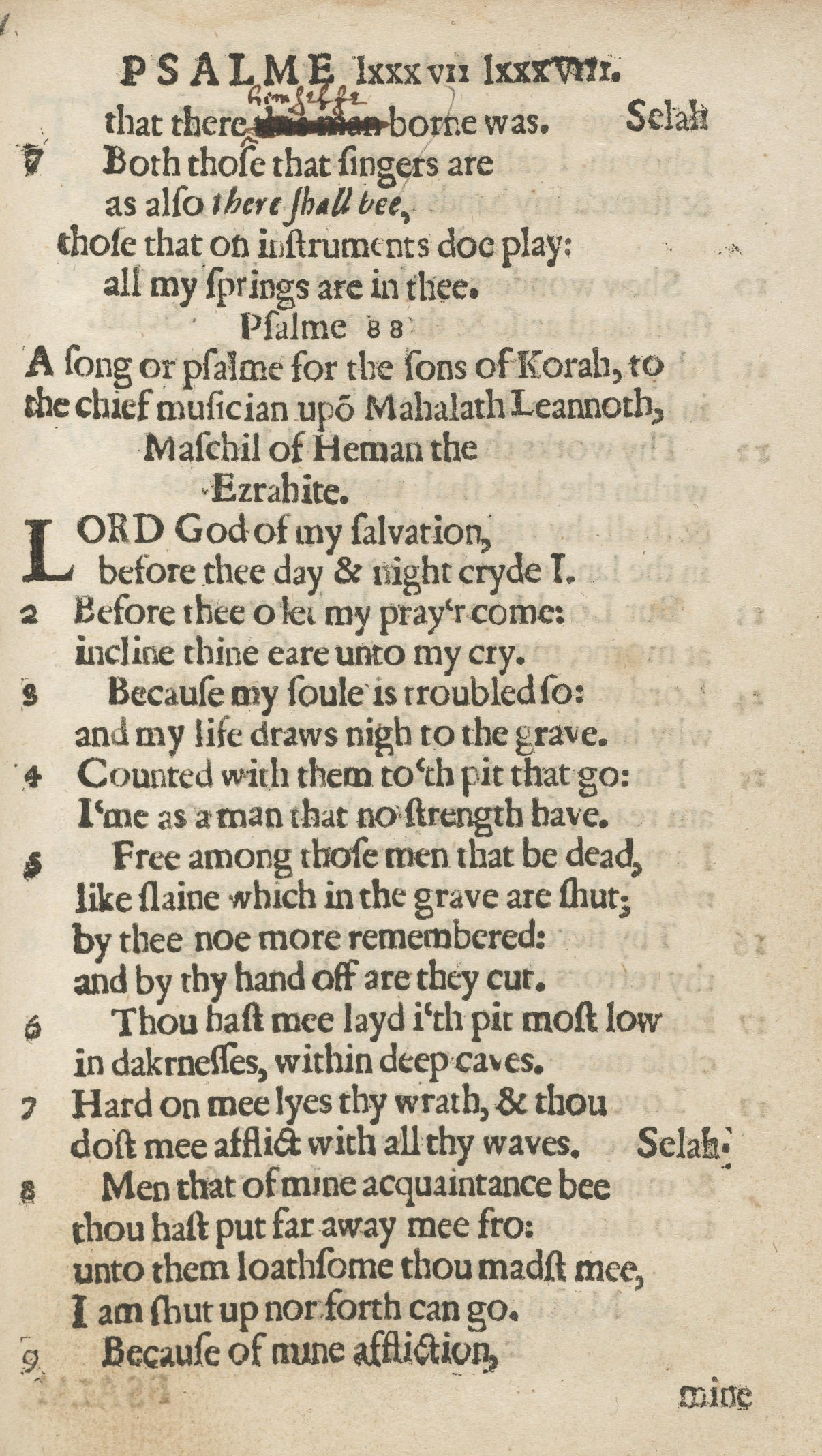
Thomas's verdict has outlived every softer reassessment. Zoltan Haraszti's 1956 study, working through the same physical evidence more than a century later, argued that the press-work was 'not worse than most provincial printing in England' during the disruption of the Civil War years there, and pointed out that the printed list of errata, headed 'Faults escaped in printing,' catalogues only about seven mistakes when a fuller count runs closer to seventy. Both verdicts, the 1810 condemnation and the 1956 contextual defence, are about the same seven-inch quarto, and neither is wrong so much as differently interested: one measuring the book against the craft it claimed, the other measuring it against the circumstances that produced it.
Chapter 7Being let go
The most commonly repeated account places Daye's dismissal precisely at Elizabeth Glover's death on 23 June 1643, with Matthew installed in his place immediately afterward.
The most commonly repeated account places Daye's dismissal precisely at Elizabeth Glover's death on 23 June 1643, with Matthew installed in his place immediately afterward. A different account, drawn from Haraszti's research, places Stephen's actual retirement two years later, in 1647, with Matthew recognized as the press's sole foreman only for the final two years before his own death. The two accounts cannot both be exactly right, and nothing read for this page reconciles them; it is possible Daye lost authority over the shop in 1643 while continuing some association with it until 1647, but that reading is offered here as a guess at reconciliation, not as an established fact.
Whichever date is correct, the pattern is the same. Stephen Daye's tenure ended not because of a single documented failure but because the two people who might have valued his continued service, Elizabeth Glover and then, implicitly, her heirs, were gone or had moved on, and a more capable operator, his own son, was already in place to take over.
Chapter 8The lawsuit over wages
In 1656, years after leaving the press, Stephen Daye sued Henry Dunster for 100 pounds, in what surviving Middlesex County court records describe as a compensation dispute connected to his years of...
In 1656, years after leaving the press, Stephen Daye sued Henry Dunster for 100 pounds, in what surviving Middlesex County court records describe as a compensation dispute connected to his years of work there. His own sworn testimony survives from that proceeding, in which he states that the paper Jose Glover had originally supplied the press, worth some 60 pounds when purchased in England, was used for printing under Dunster's direction until the press itself was sold to Harvard College, with roughly twelve reams of the remaining stock carried off by Dunster at that point. The court's judgment went against Daye.
A related and more general dispute, an accounting between Dunster and the Glover estate over years of guardianship expenses, was eventually settled by a panel of referees who queried several of Dunster's claimed costs, including years of retained livestock profits, before arriving at a reduced final award in Dunster's favour. Read together, the two proceedings describe a man who ran the first press in English America for the better part of a decade and, near the end of his life, was still trying and failing to be paid properly for it.
Chapter 9The broadside that does not exist, and the forgery that pretended to
No authentic copy of the Freeman's Oath, the first thing the press ever produced, has been seen since the middle of the seventeenth century.
No authentic copy of the Freeman's Oath, the first thing the press ever produced, has been seen since the middle of the seventeenth century. Its text survives only indirectly, through a manuscript draft and its reprinting inside two later books, New-England's Jonas Cast Up at London of 1647 and the Massachusetts Book of the General Laws and Liberties of 1648. Generations of collectors held out hope that an original might surface.
One did, in 1985, when the document dealer Mark Hofmann offered a broadside he claimed to have found in a New York bookshop, priced at 1.5 million dollars and initially judged by examiners to contain nothing inconsistent with a mid-seventeenth-century original. Hofmann was, in fact, one of the most technically sophisticated forgers in American history, using period-correct paper, homemade ink and chemical ageing; he later admitted to fabricating hundreds of documents and confessed that for the Oath specifically he had, uncharacteristically, had the printing plate made professionally rather than by his own hand. The fraud came to light only because Hofmann was separately implicated in a pair of pipe bombings connected to his other forgeries, one of them fatal. The first thing Stephen Daye's press ever made remains, to this day, a documented absence rather than an object, which is exactly the condition that made it worth forging.
Chapter 10Eleven copies, and what they have made
An estimated 1,700 copies of the Bay Psalm Book were printed in 1640.
An estimated 1,700 copies of the Bay Psalm Book were printed in 1640. Eleven are known to survive, five of them complete, and this archive's own record for one of those eleven, the Old South Church copy bought by David Rubenstein, already carries its full provenance and sale history in detail. What belongs here is the comparative picture: across the whole surviving corpus, the book has reached the open market twice in the last century, and both times it set a record.
On 26 November 2013 Sotheby's New York sold the Old South Church copy for a total of USD 14,165,000 with fees, a world record for a printed book. Two contemporary reports, one from ABC News Australia carrying wire-service reporting and one from HuffPost, both state the hammer figure explicitly as USD 12,500,000, with bidding opening at USD 6 million and closing in under five minutes; this archive's own record for that specific copy treats the hammer as a derived rather than a documented figure, because Sotheby's own released sale materials give only the fee-inclusive total, and this page notes both positions rather than picking one. The underbidder was Steve Green of Oklahoma City, of the Hobby Lobby retail family, who had entered a pre-set bid of 12 million dollars intending the book for a planned Bible museum; David Rubenstein, who won it, placed his winning bid by telephone from Australia.
Before that sale, no copy had come to auction since 28 January 1947, when the trustees of the Gertrude Vanderbilt Whitney Trust sold a different copy, also once the Old South Church's own, at Parke-Bernet in New York for 151,000 dollars, then itself a world record for any printed book, ahead of a Shakespeare First Folio's roughly 77,000 dollars at the same period. A third data point sits well below both: in 1933 the Rosenbach Company bought an imperfect copy, lacking eight leaves including the title page, from James Weatherup, a private owner in Belfast, for 150 pounds, after Weatherup's own itemised description of the book's condition satisfied A.S.W. Rosenbach that it was genuine. A different, more damaged copy, missing nineteen leaves and at that time owned by the Van Sinderen family, shows how fast the book's value climbed regardless of condition: the bibliographer Wilberforce Eames put its value at 50,000 dollars in the late 1930s, a few years after Rosenbach paid 150 pounds for the Belfast copy. Three sales, three centuries apart in the book's life and three wildly different figures, are really one market: there are only eleven of these objects, and the value of each one is set by how few of its siblings will ever be offered again.
Chapter 11What the standard account gets wrong
The tidy version of this story, a locksmith becomes America's first printer and produces its first book, survives because it is simple and because almost nobody checks the two things that complicate...
The tidy version of this story, a locksmith becomes America's first printer and produces its first book, survives because it is simple and because almost nobody checks the two things that complicate it: whether his name is actually on the object, and whether the historical record is even internally consistent about him.
It is not. The original 1885 Dictionary of National Biography entry for Daye gives his birth year as about 1610, states that he served an apprenticeship in London before Glover engaged him, in language that reads as though the apprenticeship were in printing rather than locksmithing, and describes him becoming a locksmith only after he stopped printing, around 1648 or 1649. That sequence runs backward from the modern consensus, followed by this archive's own Bay Psalm Book record and by Britannica, Wikipedia and the Encyclopaedia entries consulted here, which place his birth at about 1594 and his locksmith's trade firmly before his printing years, not after them. A single, fairly authoritative-looking nineteenth-century reference work and the twentieth-century scholarship that followed it disagree about the basic shape of the man's working life, and later popular writing has mostly copied whichever version it found first rather than flagging the conflict.
What is documented
Technique
The surviving work
- What is accepted
- Governor Winthrop's own journal names exactly three productions from the press's earliest years, in order: the Freeman's Oath (1639), William Peirce's almanac (1639) and the Bay Psalm Book (1640). Beyond those three, counts of the press's wider early output vary by what is being counted, given below as contested.
- What is contested
- The original 1885 Dictionary of National Biography credits Daye personally with about fourteen printed pieces before Samuel Green took over. Other tallies of the press's whole first decade, 1639 to 1649, which fold in Matthew Daye's later work and briefly overlap Samuel Green's earliest work after Matthew's 1649 death, arrive at about twenty-three imprints. No source consulted reconciles the two figures, because they are counting different things: one man's personal tenure against one press's first decade.
- Who rules on attribution
- No attribution board rules on a seventeenth-century colonial press. The standing authority is bibliographic consensus, fixed by Evans' American Bibliography and Winship's 1945 institutional history and essentially unchallenged since, because the corpus is closed by how few copies of each item survive rather than by any committee's ruling.
Catalogue raisonne
- George Parker Winship, The Cambridge Press, 1638-1692 (Philadelphia, 1945) The standard institutional history of the plant itself, covering Daye, his son and Samuel Green together; argued for a single, fairly uniform compositor's hand behind the Bay Psalm Book's typesetting, a judgment later disputed.1617
- Charles Evans, American Bibliography, vol. 1 (Chicago, 1903), entries for the Cambridge imprints of 1639-1649 The standing descriptive-bibliography checklist against which the press's known output is still numbered.3
- Zoltan Haraszti, The Enigma of the Bay Psalm Book (Chicago, 1956) A closer physical examination of the Bay Psalm Book specifically, arguing for several compositors' hands rather than Winship's single one, and for judging the press-work against ordinary English provincial standards of the period rather than against a modern one.1617
Questions about Stephen Daye
Who was Stephen Daye?
Printer; Locksmith. c. 1594-1668.
When did Stephen Daye live?
Died 22 December 1668, Cambridge, Massachusetts Bay Colony.
How are fakes and misattributions of Stephen Daye detected?
The Oath of a Freeman broadside, 1985. No authentic copy of the Freeman's Oath, the very first item Daye's press produced in January 1639, has been seen since the mid-seventeenth century. In 1985 the document dealer Mark Hofmann offered a broadside he claimed to have found in a New York bookshop, priced at 1.5 million dollars, and early examination found nothing inconsistent with a mid-seventeenth-century original.
Where can you see work by Stephen Daye?
Library of Congress (Washington, DC); Beinecke Rare Book and Manuscript Library, Yale University (New Haven, Connecticut); John Carter Brown Library, Brown University (Providence, Rhode Island); Houghton Library, Harvard University (Cambridge, Massachusetts); American Antiquarian Society (Worcester, Massachusetts); Bodleian Library, University of Oxford (Oxford, England).
What does the market for Stephen Daye look like?
Stephen Daye's own corpus, in market terms, is really the market for one edition of one book, since almost nothing else credited to his years at the press survives as a physical object at all. This archive's own record for one specific surviving copy, the Old South Church copy bought by David Rubenstein in 2013, already carries that transaction's full provenance chain in detail; what belongs on this page is the comparative picture across the small number of times any copy has reached the open market.Two sales, sixty-six years apart, each set a world record for a printed book in its own moment, and a third, decades earlier still, shows how far a copy's value has travelled from its first documented private sale.
What is still unresolved about Stephen Daye?
Whose hands actually set the type of the Bay Psalm Book in 1640, Stephen's or his son Matthew's. No source consulted resolves it, and the two standing scholarly positions, Winship's single uniform hand against Haraszti's several, do not even agree on how many compositors were involved.
Open questions
- Whose hands actually set the type of the Bay Psalm Book in 1640, Stephen's or his son Matthew's. No source consulted resolves it, and the two standing scholarly positions, Winship's single uniform hand against Haraszti's several, do not even agree on how many compositors were involved.
- Was Matthew Daye really trained as a printer's apprentice in London before he emigrated in 1638. The claim is old and widely repeated. No surviving apprenticeship record, indenture or Stationers' Company entry for him was found in any source consulted.
- When did Stephen Daye actually leave the press, 1643, on Elizabeth Glover's death, or 1647, as a different, Haraszti-derived account has it. The two dates cannot both be exactly right and nothing read for this page reconciles them.
- Where and precisely when was Stephen Daye born. Modern sources place it at about 1594; the original 1885 Dictionary of National Biography entry gives about 1610. No specific birthplace beyond 'England' is agreed among the sources consulted.
- Does any part of the actual wooden press Jose Glover shipped in 1638 survive in any collection. Not established by any source consulted for this page.
- What became of the press's type and equipment after Samuel Green's tenure. Not traced here.
- How many items should really be credited to Daye's own tenure, fourteen by the 1885 Dictionary of National Biography's count or a share of the roughly twenty-three usually counted across the press's whole first decade. No single source reconciles the two figures.
- Was there a guarantee or an irrevocable bid behind either side of the 2013 sale, and what was Steve Green's own ceiling above his pre-set bid. Not established in the sources consulted; this is a question about the market for Daye's whole surviving corpus, not only about the one copy sold that day.
Sources
- 1Wikipedia, 'Stephen Daye'. Tertiary; used for the contract terms, the land grant, the dismissal and death dates, and the two spellings of the name. Flagged for replacement with the Dictionary of American Biography entry it cites. en.wikipedia.org/wiki/...
- 2Wikipedia, 'Elizabeth Glover'. Tertiary; used for Elizabeth Harris Glover's family background, the voyage, her ownership of the press, the Hudak quotation on her role against Daye's, and her remarriage and death. en.wikipedia.org/wiki/...
- 3Wikipedia, 'Bay Psalm Book'. Tertiary; used for the print run estimate, the census of surviving copies and the holding institutions. en.wikipedia.org/wiki/...
- 4Wikipedia, 'Oath of a Freeman'. Tertiary; used for the loss of the original printing, its indirect textual survival and the 1985 Mark Hofmann forgery case. en.wikipedia.org/wiki/...
- 5Dictionary of National Biography, 1885-1900, 'Daye, Stephen', via Wikisource. A historical tertiary source, superseded on several points by modern scholarship; kept here specifically because its disagreements with the modern account (birth year, the sequence of locksmith and printing work) are themselves a documented finding on this page. en.wikisource.org/wiki/...
- 6Encyclopaedia Britannica, 'Stephen Day'. Tertiary; used for the modern-consensus birth and death dates, the locksmith trade and the land grant. britannica.com/biography/...
- 7Encyclopedia.com, 'Daye, Stephen'. Tertiary; used for the locksmith trade, the two name spellings and general biographical detail. encyclopedia.com/reference/...
- 8Encyclopedia.com, 'Daye, Matthew'. Tertiary; used for Matthew Daye's dates and his first appearance in print on the 1647 almanac. encyclopedia.com/reference/...
- 9John A. Harrer, 'The Reverend Jose Glover and the Beginnings of the Cambridge Press' (Part 1), Proceedings of the Cambridge Historical Society, vol. 38 (1959-1960), reproduced by History Cambridge. Secondary scholarly source, citing Winthrop, Winship and Starkey; used for the founding of the press, the household arrangements, and Harrer's own argument, made here and not in Part 2, that Matthew Daye personally designed and set the title page of the 1649 Cambridge Platform of Church Discipline before his death. historycambridge.org/articles/...
- 10John A. Harrer, same series (Part 2), on Samuel Green's 1649 printing of the Cambridge Platform. Secondary scholarly source; used for Green's inexperience and the state-by-state physical analysis, tracing shifted borders and mid-run corrections across the nine surviving copies to reconstruct printing order, that Harrer shares with Lawrence C. Starkey's article on the same book. This part does not mention Matthew Daye; the title-page argument is Part 1's. historycambridge.org/articles/...
- 11Colonial Society of Massachusetts, Publications, vol. 49, 'Harvard College Records, Part 4', documents on the 1656 Day v. Dunster proceeding (Stephen Day's testimony, Henry Dunster's motion and the referees' finding). Primary court-record transcription; used for the paper-cost testimony and the outcome of the wage dispute. colonialsociety.org/node/...
- 12BBC News, 'Bay Psalm Book is most expensive printed work at $14.2m', 27 November 2013. Used for the Isaiah Thomas quotation on the book's workmanship and general sale figures. bbc.co.uk/news/...
- 13ABC News (Australia), 'Bay Psalm Book, published in 1640s, sets new world record after selling for more than $15m at auction', 27 November 2013, carrying wire-service reporting of the sale. Used for the explicit hammer price of USD 12.5 million and the bidding detail. abc.net.au/news/...
- 14HuffPost, 'Bay Psalm Book Auction Smashes Record For Print Book With $14,200,000 Sale Price From Sotheby's', 27 November 2013. Used for the underbidder Steve Green's identity and pre-set bid, and quotations from Rev. Nancy Taylor and the Sotheby's auctioneer David Redden. huffpost.com/entry/...
- 15Sotheby's, 'Census of Copies of the Bay Psalm Book, with Provenance, Sale, and other Relevant Histories', 27 October 2013, prepared for sale N09039. The fullest published census of the eleven surviving copies. No longer live on sothebys.com; read through the Internet Archive. web.archive.org/web/...
- 16Gerald Studer, 'The Bay Psalm Book', Bible Editions & Versions, October/December 2001, International Society of Bible Collectors. Tertiary but citing named scholarship (Winship, Haraszti, Moses Coit Tyler) directly; used for the title page's exact closing text and epigraphs, the absence of Daye's name from any imprint, the 1641 land grant wording, the Winship/Haraszti disagreement over how many compositors worked on the book, the errata undercount, the 1947 sale price and the twentieth-century 'Stephen Daye, Inc.' imprint. Flagged for replacement with Haraszti's and Winship's own monographs where they can be consulted directly. biblecollectors.org/articles/...
- 17Zoltan Haraszti, The Enigma of the Bay Psalm Book (University of Chicago Press, 1956), full text digitized by the Internet Archive. Primary monograph, consulted directly rather than through Studer's summary; confirms the Winship-versus-Haraszti compositor disagreement in Haraszti's own words, the seven-versus-seventy errata count, the 1947 Parke-Bernet sale figures, and Stephen Daye's 1647 retirement with Matthew as sole foreman for the final two years. It also corrects the Studer article at n.16: Haraszti's own preface states the Bay Psalm Book's Preface was misattributed to Richard Mather but was actually written by John Cotton, not, as Studer's article has it, by Cotton Mather, who was not born until 1663. archive.org/stream/...
Last verified 23 September 2026