Hilma af Klint
Swedish · 1862-1944
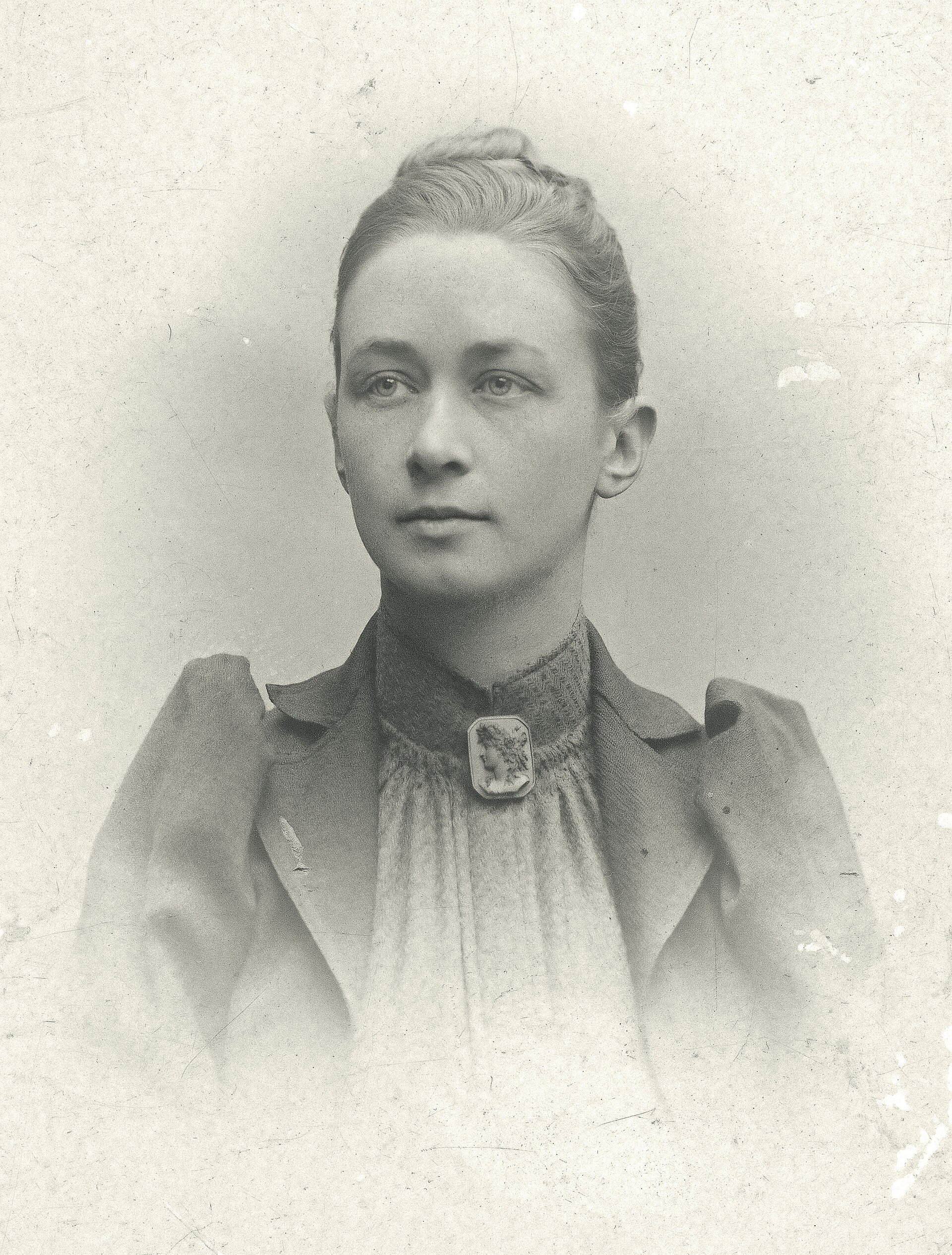
Studio portrait photograph by an unknown photographer. A version was published in Svenskt Portrattgalleri in 1901, and Moderna Museet gives the photographer as unknown, per the Commons file page. The identification as af Klint comes from that publication and the Commons file record; the original is not seen here. Public domain (Swedish photograph, pre-1923).
Commons file; photographer unknown; version published 1901| Worked as | Painter, Draughtswoman, Medium |
|---|---|
| Born | 26 October 1862 · Karlberg Palace, Solna, Sweden |
| Died | 21 October 1944 · Stockholm area, after a traffic accident (Danderyd or... |
| Nationality | Swedish |
| Movement | Early abstraction |
| Sources | 15 cited |
| Last verified |
About this page Last verified · 15 sources cited
On this page 13 sections
ContentsClose
Hilma af Klint was a trained Stockholm painter of landscapes, portraits and botanical studies who, from 1906, made large abstract pictures that she said were given to her by spirit guides and meant for a temple that was never built. She wrote that the abstract work should stay unseen until twenty years after her death. Her nephew and heir, Erik af Klint, kept to that, and then went on to found the Hilma af Klint Foundation in January 1972 to own the abstract work. The Foundation still owns it.
That ownership is the thing most readers miss. Almost nothing of her abstract work is on the market. The Art Newspaper reported in October 2026 that only two abstract paintings (as against works on paper) had ever sold at auction before, both more than thirty years ago, according to Bukowskis's head of art, and that the Foundation sold the work now at Bukowskis in Stockholm when it deaccessioned it in 1995. The auction record for any work by her stood, as of that report, at USD 165,825 for a 1931 watercolour. The sale of a 1920 abstract oil on 19 November 2026, estimated at SEK 6m to SEK 8m, is four days after this page was staged and its result is not known here.
The second thing to know is that the Foundation has spent several years in a fight over what her wishes meant. SVT reported in January 2026 that its chairman, her great-grandnephew Erik af Klint, had argued that the statutes allow the works to be shown only to people who seek spiritual knowledge, and that the Stockholm County Administrative Board had found exhibitions consistent with the statutes. The Foundation has since published a notice that the chairman and a board member settled and that the legal proceedings have ended; the notice quotes the chairman as saying the works must continue to be shared with the world. This page records the numbers, the dispute and the dates, and says where each count comes from, because the sources do not agree with each other.
Images
Chronology
- 1862
Born 26 October at Karlberg Palace, Solna.1
- 1882-1887
Studies at the Royal Academy of Fine Arts, Stockholm, after the Technical School; receives a studio at the Academy.1
- 1891
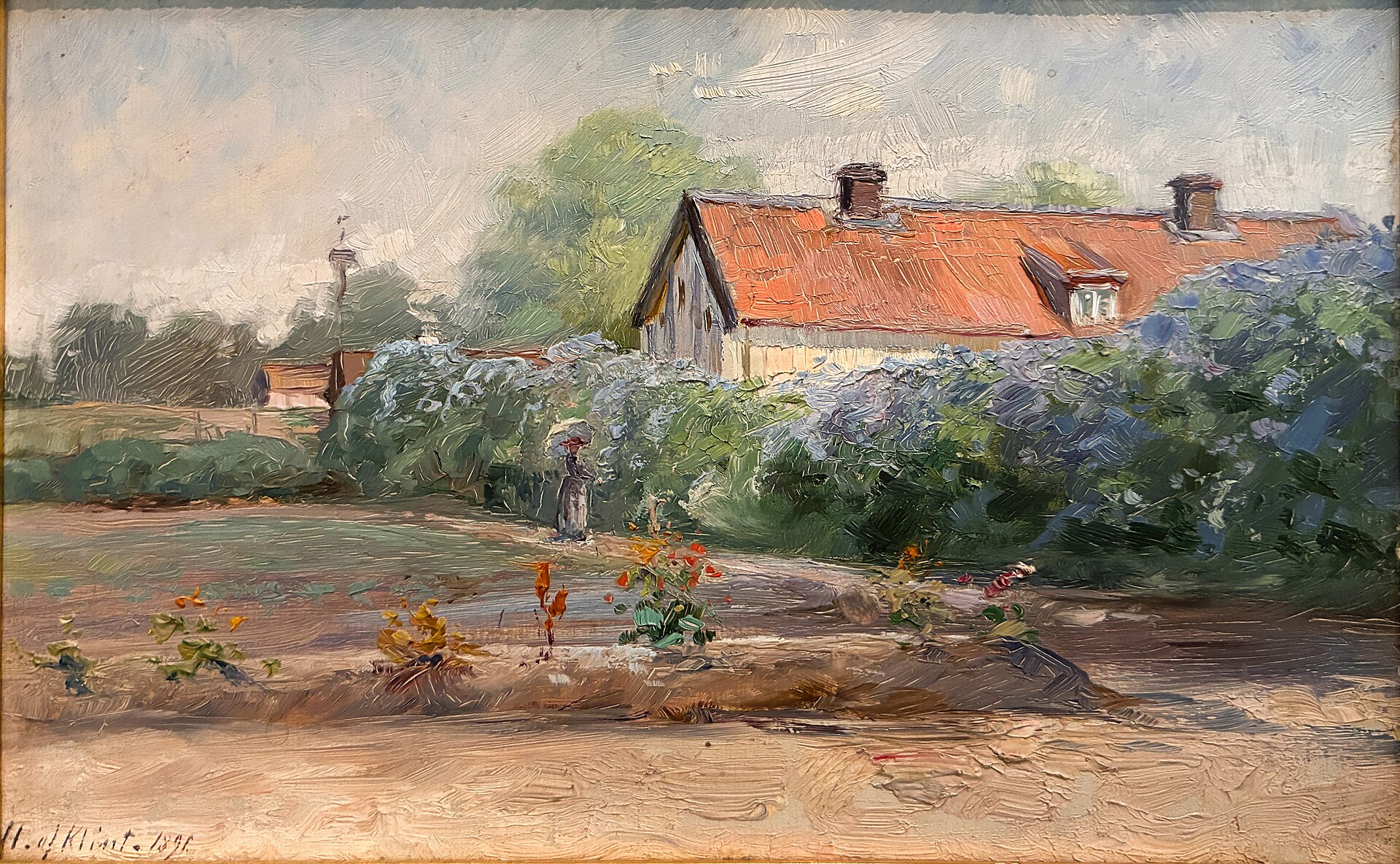
Signs and dates a small oil of a farmhouse, now in the Ostergotland museum, Linkoping.1
- 1896
Earliest automatic drawing in her practice, per Wikipedia; The Five sittings recorded in notebooks (the Uppsala thesis says notebooks from 1892).114
- 1906
Begins The Paintings for the Temple after the instruction conveyed at the sittings; Wikipedia says she was 44.111
- 1906-1908
Paints 111 paintings between November 1906 and April 1908, per the Lenbachhaus text.11
- 1907
The Ten Largest: ten tempera pictures on paper mounted on canvas, 322 by 239 cm each, on the four stages of life.12
- 1908
Meets Rudolf Steiner in July, per the Lenbachhaus text, who advises her to keep the paintings hidden for fifty years.11
- 1912-1915
Second phase of the Temple series after the gap that began in 1908.114
- 1916-1917
The Parsifal Series and The Atom Series.3
- 1920
Series on geometric forms; the geometric series ends in March 1920 (Bukowskis release). Wikipedia places a meeting with Peggy Kloppers-Moltzer at Dornach around this year.13
- 1928
Included in the exhibition at the World Conference on Spiritual Science, London, after initially being excluded.1
- 1944
Dies 21 October after a traffic accident, leaving the abstract work to her nephew Erik with a twenty-year bar on showing it.1314
- 1945
The anthroposophist Olof Sundstrom orders the paintings; the catalogue later follows his order.3
- 1972
Erik af Klint establishes the Hilma af Klint Foundation in January.2
- 1986
First showing of the abstract work in the sources read: The Spiritual in Art, LACMA.146
- 1989-1990
Moderna Museet show organised by Ake Fant, 26 December 1989 to 18 February 1990.14
- 1995
The Foundation sells the 1920 painting Ser III No. 5 to a private collector.5
- 2013
Moderna Museet retrospective, 16 February to 26 May; 55th Venice Biennale.1
- 2018
Foundation and Moderna Museet sign a long-term cooperation agreement in February; the Guggenheim show opens 12 October.113
- 2019
Guggenheim show closes 23 April with more than 600,000 visitors; The Power of the Spleen (1931) sells at Stockholms Auktionsverk for USD 165,825, the record as of October 2026.135
- 2022
Seven-volume catalogue raisonne listed by Wikipedia as published 27 December 2022; the Foundation page announces the first volume for autumn 2020 and a slipcase for autumn 2021, so the set was issued in stages.13
- 2024
In December the chairman blocks a proposed Zwirner partnership that most trustees supported.8
- 2026
15 January: SVT reports the Stockholm County Administrative Board found exhibitions consistent with the statutes; the Foundation later posts an undated notice that the chairman and a board member have settled; Bukowskis offers Ser III No. 5 on 19 November.91056
The market
The abstract work does not trade. Louise Wrede of Bukowskis told the Art Newspaper that the Foundation's control has left it almost entirely beyond the public art market, and that only two abstract paintings have sold at auction, both over thirty years ago. The paper also reports a 1910 watercolour on paper, Vid ankdammen, selling for GBP 40,640 at Christie's in March against an estimate of GBP 6,000 to 8,000 (hammer or premium not stated). The representational work, the late watercolours and some works that left the Foundation in the early 1990s are what appears. The first test of the abstract market in decades is Bukowskis on 19 November 2026; its result is not in this record.
| Date | Sale | Work | Result | Note |
|---|---|---|---|---|
| 19 November 2026 (scheduled) | Bukowskis, Stockholm (Modern Art and Design, 18-19 November) | Ser III No. 5, dated 18 January 1920, oil and graphite on canvas, 38.5 x 29 cm | Hammer Pending: estimate SEK 6,000,000 to 8,000,000 With premium Pending SEK | Deaccessioned by the Foundation in 1995; same private family since; LACMA 1986. Result not known when this page was staged on 15 November 2026. |
Hammer is the price at which the bidding stopped; with premium adds the fee the house charges the buyer on top. Hammer price and buyer's premium in the glossary.
Recorded without a public price
- 2019 · The Power of the Spleen, 1931, watercolour on paper · Stockholms Auktionsverk, Stockholm · Not stated in the source The auction record as of The Art Newspaper's 20 October 2026 report: USD 165,825. The report does not say whether this is hammer or includes premium, and gives no kronor price.
Where to see the work
| Institution | City | Holdings | Note |
|---|---|---|---|
| Moderna Museet | Stockholm | A Hilma af Klint Room with about a dozen works on continuous display, from the Foundation's collection. | Under the long-term agreement of February 2018. |
| Guggenheim Museum Bilbao | Bilbao | The Ten Largest (1907), on view in Gallery 209 at the time the museum's page was read. | Owned by the Hilma af Klint Foundation, not by the museum; the page is undated. |
| Ostergotlands museum | Linkoping | Farmhouse (Bondgard), oil on wood, 1891, 13 x 20 cm, inventory OM.B.001007. | The only museum holding of a representational work identified by inventory number in the sources. |
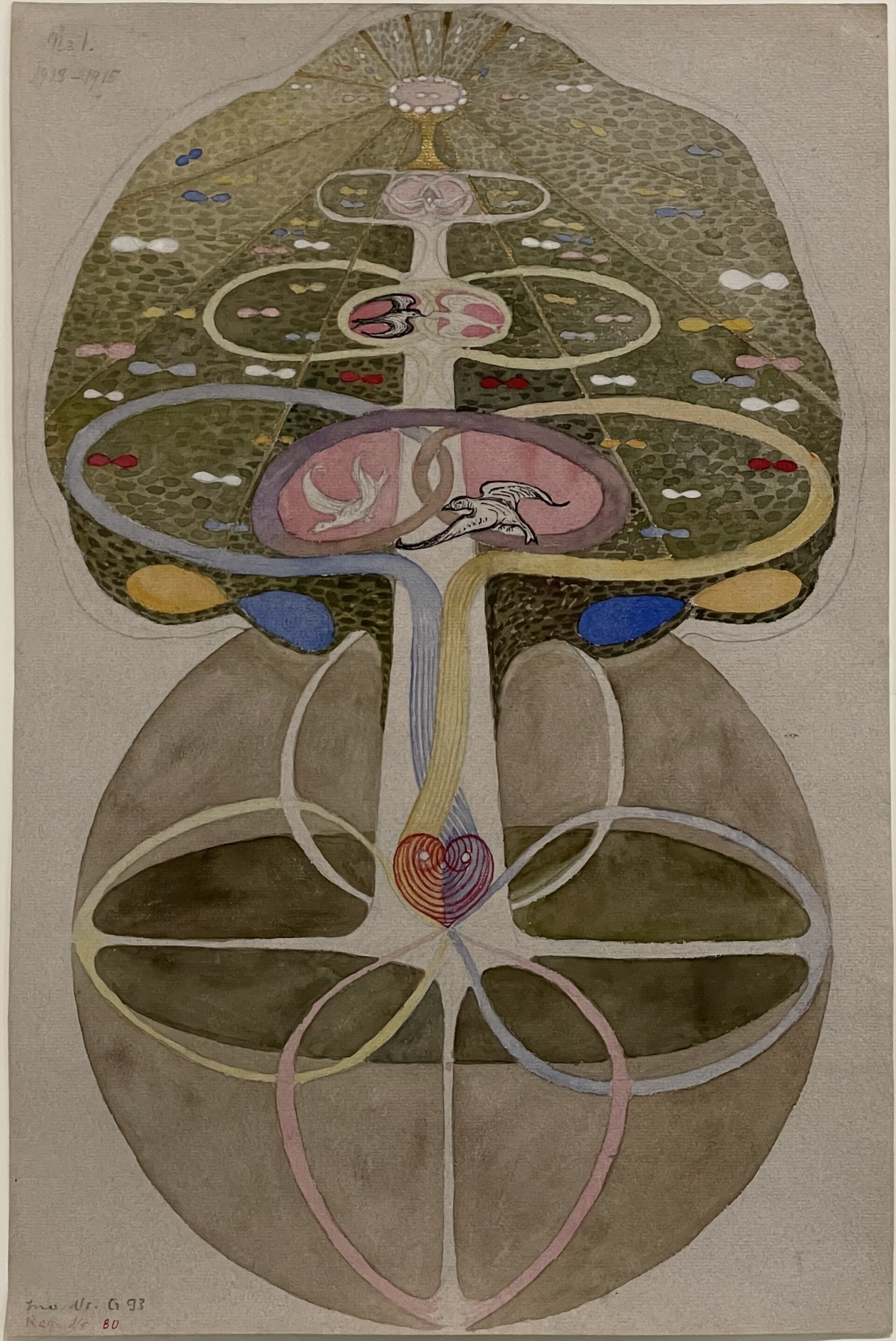
| Glenstone | Potomac, Maryland | Tree of Knowledge No. 1 and No. 2 (1913-1915), photographed at Glenstone in 2023 per the Commons file titles. | Holding rests on Commons titles and a Commons category; not confirmed on an institutional page. |
| Grand Palais | Paris | Exhibition 'Hilma af Klint, les peintures du Temple (1906-1915)', 2026. | Temporary show; the title is from a Commons file name; dates not read. |
Forgeries and misattributions
- No documented forgery found.
- No forgery, false attribution or disputed work was found in any source opened. Her abstract work was kept in the Foundation's hands until 1986 and is catalogued against a single numbering run from 1945. Not applicable. The risk to a buyer is not a fake but a work that the Foundation did not release: check provenance back to the Foundation and its 1990s sales. The one lot with that chain in the sources is Ser III No. 5.563
The essay
Chapter 1A conventional painter first
She was born at Karlberg Palace in Solna, the fourth child of Captain Victor af Klint of the Swedish navy and Mathilda Sonntag.
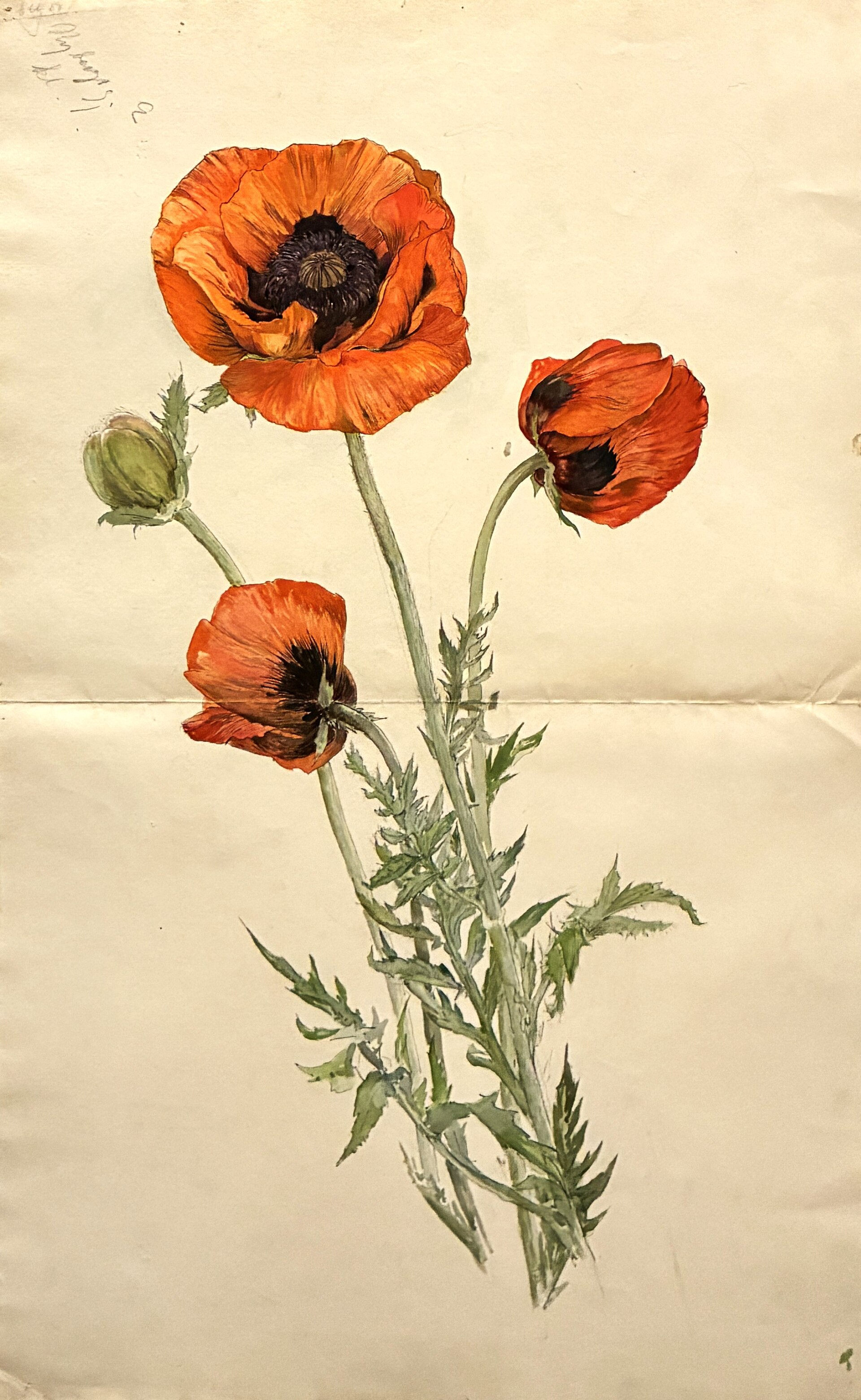
She was born at Karlberg Palace in Solna, the fourth child of Captain Victor af Klint of the Swedish navy and Mathilda Sonntag. The family spent summers at Hanmora on Adelso in Lake Malaren. She studied at the Technical School in Stockholm (now Konstfack), then at the Royal Academy of Fine Arts from 1882 to 1887, working in portraiture, botanical drawing and landscape, and left with honours and a studio in the Academy's Atelier Building.
This period matters for the page because it is the part of her output that is on the market. The Foundation's catalogue raisonne devotes its seventh volume to landscapes, portraits and miscellaneous work from 1886 to 1940, and says the number of illustrations in that volume cannot be fixed because many of these works were sold to private buyers; as of early 2020 the publisher was still looking for more. A small oil of a farmhouse signed and dated 1891, 13 by 20 cm, is in the Ostergotland museum in Linkoping. Her representational work went through ordinary Stockholm channels. The abstract work did not.
Chapter 2The Five and the notebooks
Her involvement with spiritualist practice began early.
Her involvement with spiritualist practice began early. Wikipedia dates her first experiments to 1879; an Uppsala student thesis by Birgit Stattin Norinder, drawing on Ake Fant's 1989 biography, says she joined spiritualist circles at seventeen, belonged to the Spiritualist Literature Society for three years and to the Edelweiss Society for a couple of years, and adds that she was possibly also connected to the Rosicrucians; the thesis offers no evidence for that last point and it stays unproven here, although the Lenbachhaus text says the sittings opened before an altar with a triangle, a cross and a central rose, which it calls a Rosicrucian symbol, and Wikipedia says she was drawn to the philosophy of Christian Rosenkreuz. The Lenbachhaus text also says she tried spiritism at seventeen but left within a year or so as not serious enough, joined the Theosophical Society in 1889 and stayed to 1915 or 1916, joined the Edelweiss Society in 1896 and became a member of the Anthroposophical Society in 1920; the sources differ on how long the early circles held her. She belonged to the Theosophical Society and later to the Anthroposophical Society in Stockholm, according to the same thesis, which is a tertiary source and should be replaced by a membership record.
The group she worked with called itself The Five (De Fem). Its documented core was Anna Cassel, Cornelia Cederberg, Sigrid Hedman and Mathilda Nilsson, with af Klint as the fifth; the Foundation describes them as women who acted as mediums and saw themselves as receivers of messages about the development of humanity. The thesis puts the sittings in notebooks from 1892 and names the guides recorded there as Gregor, Georg, Amaliel, Ananda, Clemens and Esther, with the senior beings called the High Masters. The method was psychography (a medium guided between letters on a table) and automatic drawing, which Wikipedia dates in her practice to 1896. Belief is the right grade for all of this: it is documented that she and her friends believed they were receiving instruction, and that they recorded it. Whether anything was received is not a question a catalogue can settle.
The notebooks are the evidence. Counts differ by source: Wikipedia gives more than 150 notebooks in one place and 125 diaries in another, and the Lenbachhaus text gives 124 notebooks and cites page 8 of notebook HaK 555. No source opened here gives a page total.
Chapter 3Amaliel and the Temple commission
In the early 1900s she was told, through the sittings, that she was called to make paintings for a temple.
In the early 1900s she was told, through the sittings, that she was called to make paintings for a temple. The others in The Five did not feel able to take on the task; she did. The Lenbachhaus text names the spirit Amaliel as the giver of the task and says she accepted at once; she painted 111 paintings between November 1906 and April 1908, roughly one every five days. The Foundation says she claimed the paintings came to her mediumistically and that they illustrate a message to humanity she believed came from the High Masters.
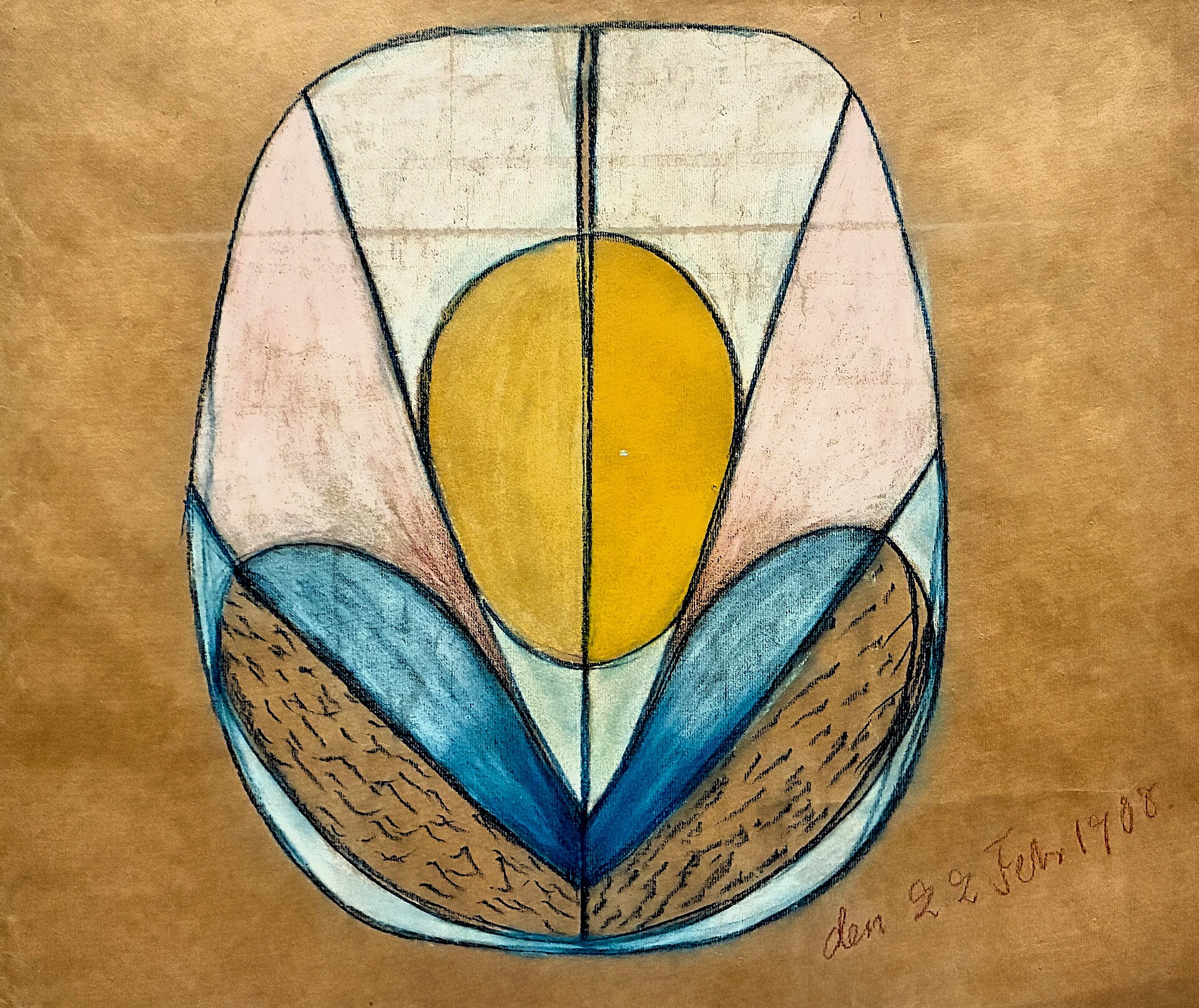
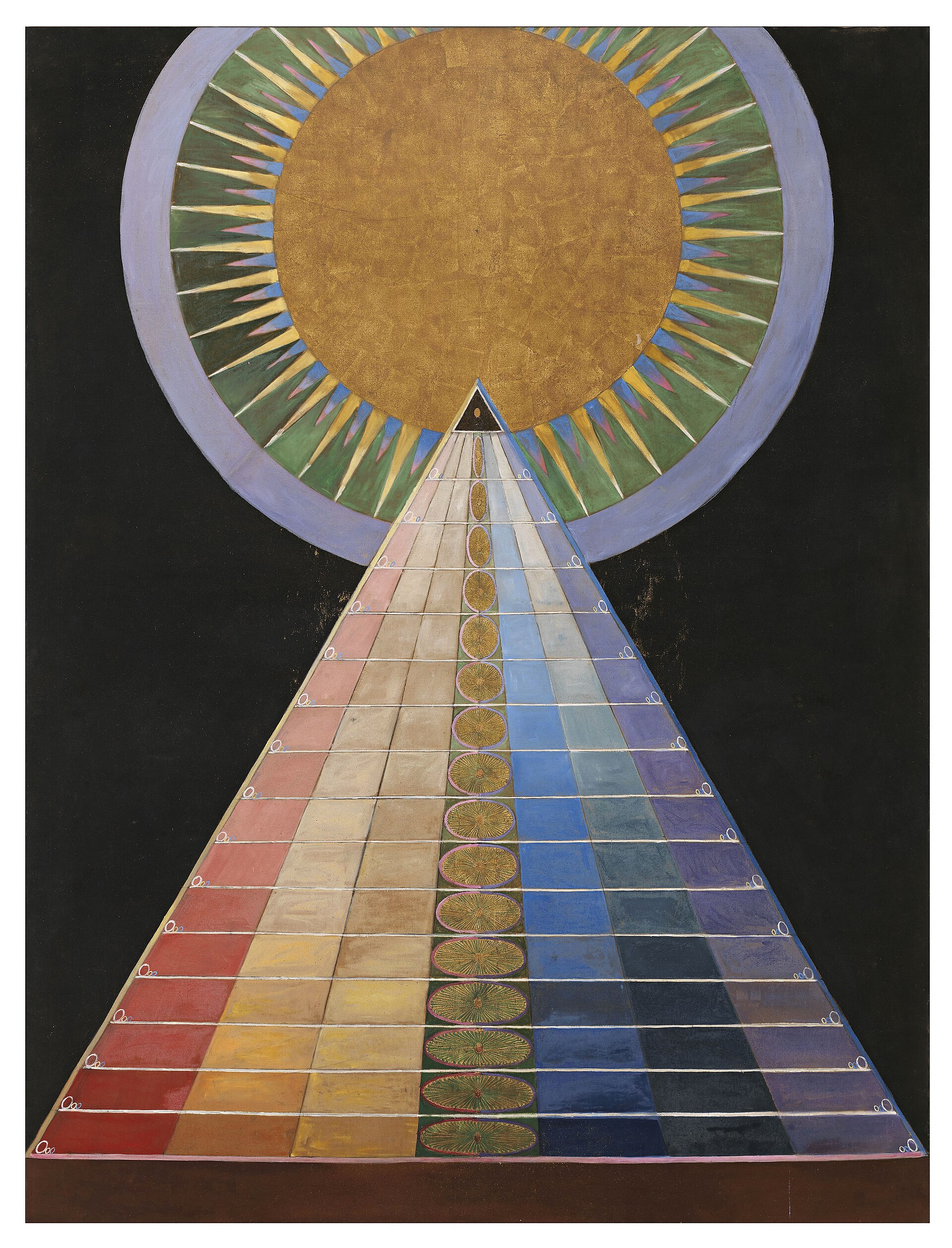
The series, The Paintings for the Temple, was made in two phases, 1906 to 1908 and 1912 to 1915, with a gap in between. The size of the series is itself contested: Wikipedia counts 196 paintings in several sub-series and the Lenbachhaus text counts 193. Both figures are one writer's count. The authoritative figure is in the seven-volume catalogue raisonne, volume 2 of which is titled The Paintings for the Temple (1906-1915), and this page did not have that volume.
What a temple was for is a question without a document. No building plan from her hand was found in the sources read; the idea of a building to hold the paintings returned after her death as a project of other people, discussed below.
Chapter 4The Ten Largest
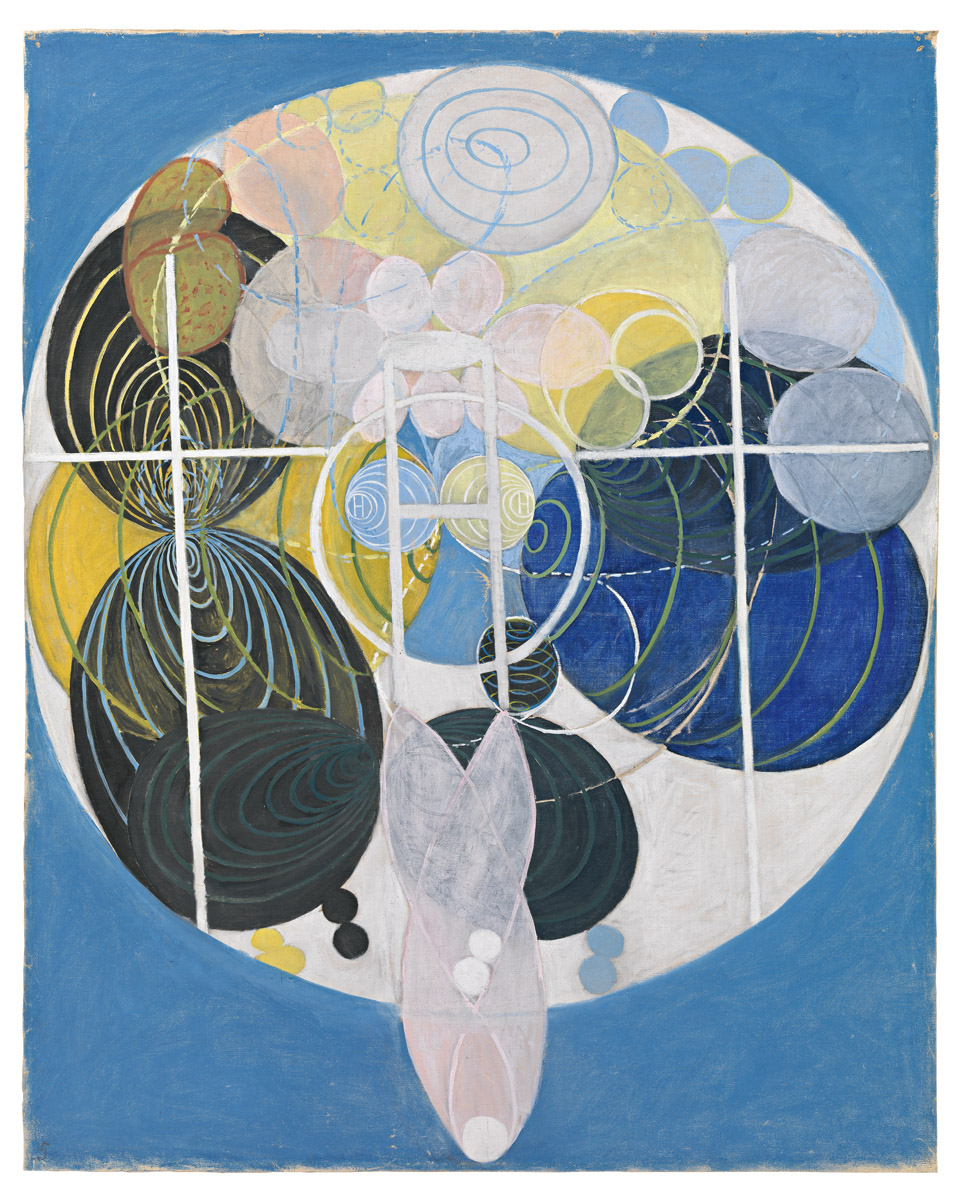
The Ten Largest (1907) are the best-known part of the Temple series: ten pictures in tempera on paper mounted on canvas, 322 by 239 cm each, on the four stages of life, Childhood, Youth, Adulthood...
The Ten Largest (1907) are the best-known part of the Temple series: ten pictures in tempera on paper mounted on canvas, 322 by 239 cm each, on the four stages of life, Childhood, Youth, Adulthood and Old Age. The Guggenheim Bilbao says she made them very quickly, probably partly on her studio floor because of their size, and that Cornelia Cederberg and Gusten Andersson assisted her. Her guides, the same page says, told her to make ten paradisaically beautiful paintings. Childhood is on blue, Youth on bright orange, Adulthood on a purplish tone and Old Age on ochre.
The assistants are a labour point that the standard account leaves out. The page names Cederberg, who was a member of The Five, and Andersson, and does not say what each painted. Daniel Birnbaum has argued that Anna Cassel probably contributed to the Temple paintings, per Wikipedia. The Foundation, the catalogue and the museum labels all attribute the series to af Klint alone. Whether the hand in any given picture is hers is not a question the published sources answer.
Chapter 5Steiner, and what the sources say about the meetings
Rudolf Steiner's reaction is the best-known episode and the least settled.
Rudolf Steiner's reaction is the best-known episode and the least settled. The Lenbachhaus text says that when they met in July 1908 Steiner did not understand the message of the paintings and advised her to keep them hidden for fifty years. Wikipedia places the meeting in 1908 (and says that around 1920, in Dornach, she met the eurythmist Peggy Kloppers-Moltzer, not Steiner), and says Steiner paid special attention only to the Primordial Chaos group and called it the best, and that fifty more years would be needed to decipher the paintings. The Uppsala thesis puts meetings around 1908, 1910 and 1914 in Sweden, and says the last, at which she showed the Temple paintings, was not the positive experience she hoped for. Those three accounts do not agree on the dates and none is a primary source. They agree that the 1908 meeting went badly for her hopes, but they do not agree on what Steiner said: Wikipedia also quotes a notebook entry in which she wrote that Steiner told her the work would be detrimental to let disappear and could be used and useful. The thesis says he did not give her the support she hoped for. The thesis also says she went several times to the Goetheanum in Dornach in later life, without dates.
Wikipedia adds that she stopped painting for four years afterwards. That does not sit easily with the Temple series' own chronology, which has its gap from 1908 to 1912. Whether the two are the same gap is not established.
The later work shows the Anthroposophical connection more plainly. After 1915 she made The Parsifal Series (1916 to 1917), The Atom Series, geometric series (to 1920) and, in the 1920s, watercolours on plants and trees, catalogued as volumes 4 to 6 of the raisonne. Her 1928 showing was at the World Conference on Spiritual Science in London; Wikipedia says she was originally left out and was added after Peggy Kloppers-Moltzer insisted. That is the only exhibition of the abstract work in her lifetime that the sources name; Wikipedia adds that she exhibited only a handful of times, mostly at spiritual conferences.
Chapter 6The will and the twenty years
She died on 21 October 1944 after a traffic accident, aged 81, and was buried at Galarvarvskyrkogarden in Stockholm.
She died on 21 October 1944 after a traffic accident, aged 81, and was buried at Galarvarvskyrkogarden in Stockholm. Her will left everything to her nephew Erik af Klint (1901 to 1981), who was her only heir. The condition, in every account read, is that the abstract work was not to be shown until twenty years after her death. Wikipedia says she left more than 1,200 paintings and 125 diaries and decided late in life to destroy her correspondence. The Foundation says the numbering of the abstract works follows a register set up in 1945 by the anthroposophist Olof Sundstrom.
The Foundation publishes the will and its statutes as PDFs. This page did not read either, so the exact wording of the twenty-year clause is a gap, recorded below. The thesis calls the will carefully considered and says af Klint thought the world was not ready for the pictures. The Lenbachhaus text gives Steiner's fifty years as the contrast with her own twenty. The art press says the work was hidden until twenty years after her death and began to appear publicly in the 1980s.
There is a gap in the record between 1964, when the embargo ran out, and 1986. Wikipedia says the boxes were opened at the end of the 1960s, and that her paintings were offered to Moderna Museet in 1970 and the museum declined them. Barnebys says Erik founded the Foundation in 1972 after the museum declined to accept the works. The Foundation says it was established in January 1972. The Art Newspaper says Johan af Klint's father donated thousands of drawings and paintings to a foundation bearing her name in the 1970s. Frieze is reported in search results as naming Pontus Hulten as the director who turned them down; that page was blocked and is not relied on here.
Chapter 7Return, 1986 to 2019
The first showing of the abstract work after her death that the sources read describe is The Spiritual in Art: Abstract Painting 1890-1985 at the Los Angeles County Museum of Art in 1986, where her...
The first showing of the abstract work after her death that the sources read describe is The Spiritual in Art: Abstract Painting 1890-1985 at the Los Angeles County Museum of Art in 1986, where her work hung with that of Kandinsky, Malevich, Picabia and Delaunay. Wikipedia says Ake Fant introduced her work internationally at a Nordic conference in Helsinki in 1984. Fant's 1989 exhibition at Moderna Museet, titled Occult Painter and Abstract Pioneer, ran from 26 December 1989 to 18 February 1990. The thesis argues the 1989 show raised the question whether an artist involved with the occult could be regarded as an artist, and that Moderna's 2013 retrospective, titled A Pioneer of Abstraction, accepted her as one.
The Moderna Museet retrospective ran from 16 February to 26 May 2013 and toured; she was also in the Central Pavilion of the 55th Venice Biennale that year. The Guggenheim in New York showed Paintings for the Future from 12 October 2018 to 23 April 2019. The museum's own release of 22 April 2019 said more than 600,000 people had attended, the highest figure for a single exhibition in its history, that the catalogue had sold more than 30,000 copies and that af Klint products made up 42 per cent of Guggenheim Store sales since October 2018. Later shows: Centre Pompidou's Women in Abstraction (2021), Tate Modern (20 April to 3 September 2023, with Mondrian), MoMA (2025) and the Grand Palais in Paris (2026), all per Wikipedia, which is not a primary source for any of them.
The claim that she was the first abstract painter is a later reading made for her by museums and writers; no source read records her making it herself. Her own Temple series is dated 1906 to 1915; the claims for Kandinsky and Malevich are a separate argument and this page does not rule on priority.
Chapter 8Who owns what, and who decides
The Foundation is a non-profit established by Erik af Klint in January 1972.
The Foundation is a non-profit established by Erik af Klint in January 1972. Its statutes require it to preserve and manage her legacy and to support research on her; it owns the abstract works, including paintings, sketches, sketchbooks and notebooks, and does not run a museum. In February 2018 it signed a long-term cooperation agreement with Moderna Museet, which keeps a Hilma af Klint Room with about a dozen works on continuous display. The Foundation's postal address is c/o Moderna Museet.
Control of the Foundation has been disputed. In 2017 the Art Newspaper reported that a planned exhibition centre in Jarna, south of Stockholm, which a group of anthroposophists had planned, with a Snohetta rendering of the facade and an estimated cost of EUR 6m to 7.5m, was at a standstill. The paper said the artist's family held that the group distorted her link to anthroposophy, and quoted her grand-nephew Johan af Klint saying no works would go on loan to it; a board member, Ulf Wagner, said the Foundation could preserve works but not sell them to finance a venue.
By 2024 the dispute was inside the board. Barnebys, reporting Dagens Nyheter and the Guardian, says the statutes bar the sale of the Temple paintings and let other works be sold to fund preservation, and require a majority of board members to belong to the Anthroposophical Society. Barnebys reports that in December 2024 the chairman, Erik af Klint (the artist's great-grandnephew), blocked a proposed partnership with David Zwirner that a majority of trustees supported, and that he called it a hostile takeover when he told the Guardian. It reports that he then filed lawsuits against the trustees, alleging unauthorised deals and financial mismanagement, and petitioned the Stockholm District Court to remove the board; these are his allegations as reported, and this page does not assess them. SVT, in January 2026, described his position as wanting the works shown only to people seeking spiritual knowledge and kept in a temple for anthroposophists. Barnebys quotes him, in 2025: "When a religion ends up in a museum, it is dead." Board spokesman Varg Gyllander called the claim that only a few people may see the work a gross misinterpretation of the statutes.
On 15 January 2026 SVT reported that the Stockholm County Administrative Board had finished its supervision and found against the chairman: exhibitions are consistent with the statutes, and paintings may be sold only if needed to secure the Foundation's finances and not lightly. A separate statement on the Foundation's site, undated, says a settlement has been reached between the chairman and board member Juhani Selvani, that the legal proceedings end and that the board agrees on a common reading of the statutes, with exhibitions to continue. The notice quotes Erik af Klint as saying the works must continue to be shared with the world, and says the board now shares an understanding of the statutes and that exhibitions will continue. Whether the sale policy changed under that settlement is not in either source.
Chapter 9The market
The abstract work is not on the open market by design.
The abstract work is not on the open market by design. Bukowskis's head of art, Louise Wrede, is quoted by the Art Newspaper saying the Foundation's control means the abstract paintings have stayed almost entirely beyond the reach of the public art market. The auction record per the same report is USD 165,825 for The Power of the Spleen, a 1931 watercolour on paper sold at Stockholms Auktionsverk in 2019; the report gives no kronor figure and does not say whether the sum includes the buyer's premium.
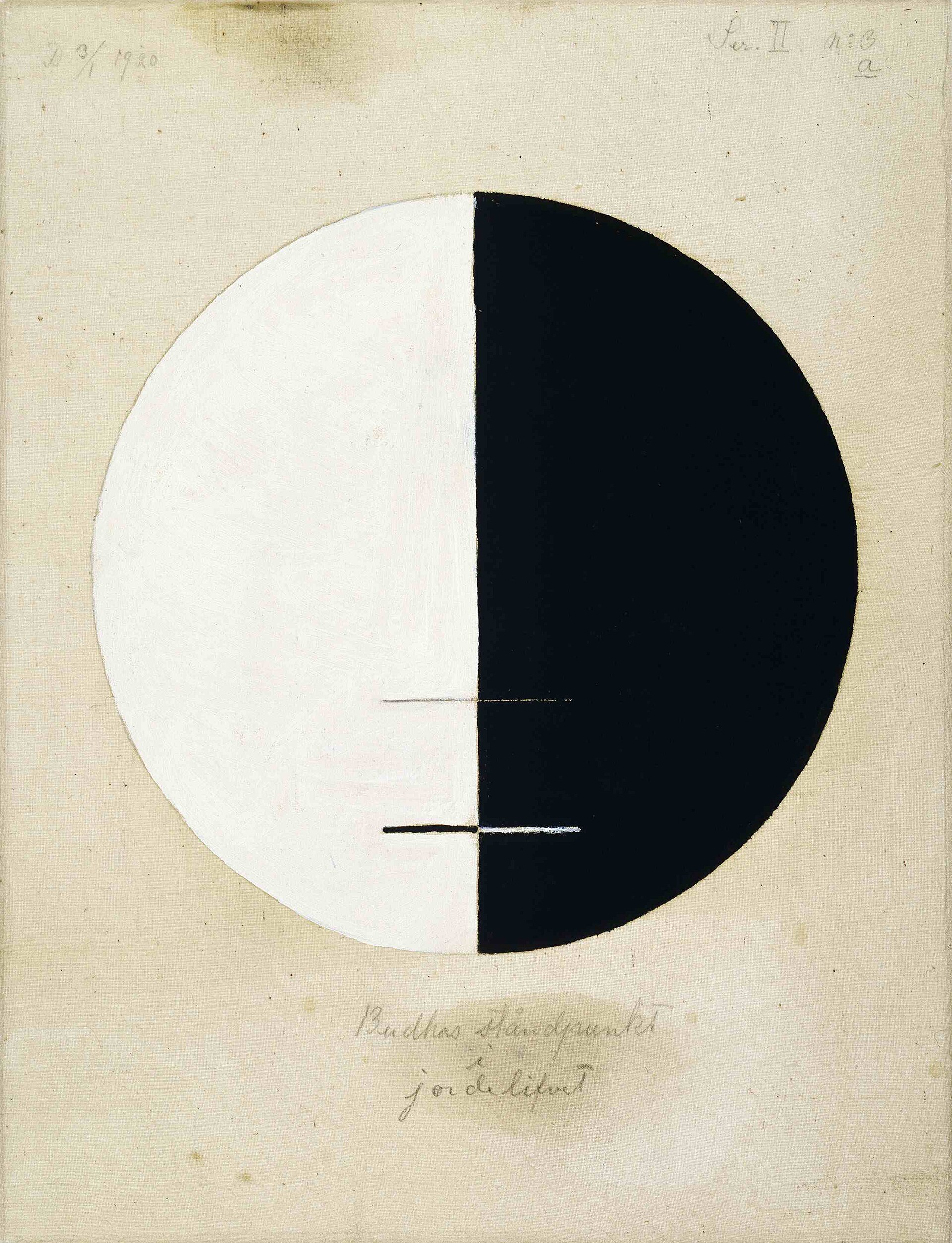
The lot that may change that is Ser III No. 5, oil and graphite on canvas, 38.5 by 29 cm, dated 18 January 1920, in Bukowskis's Modern Art and Design sale of 18 to 19 November 2026, estimate SEK 6m to SEK 8m. A private collector bought it in 1995 when the Foundation sold it, in the early 1990s clearing of a few works according to the press release, and it has stayed with that family. It was shown at LACMA in 1986. At an estimate of USD 600,000 to 800,000 it would, if sold at the low estimate, already be about three and a half times the record. This page cannot say whether it did.
Chapter 10What is happening now
The Foundation's catalogue raisonne appeared in seven volumes with Bokforlaget Stolpe and the Axel and Margaret Ax:son Johnson Foundation, with introductions by Daniel Birnbaum and Kurt Almqvist...
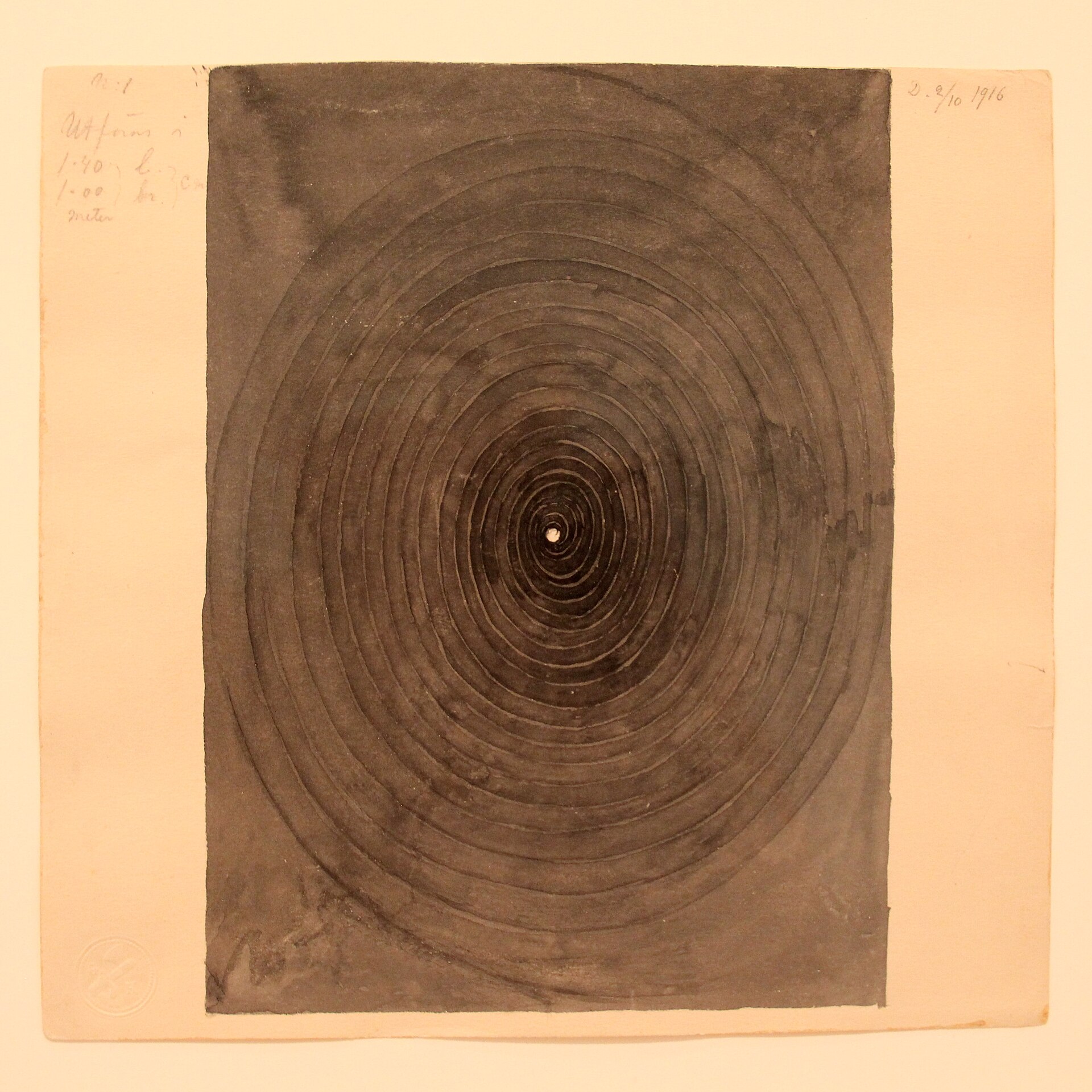
The Foundation's catalogue raisonne appeared in seven volumes with Bokforlaget Stolpe and the Axel and Margaret Ax:son Johnson Foundation, with introductions by Daniel Birnbaum and Kurt Almqvist: Spiritualistic Drawings (1896 to 1905), The Paintings for the Temple, The Blue Books, Parsifal and The Atom, Geometric series, Late Watercolours (1922 to 1941), and Landscapes, Portraits and miscellaneous (1886 to 1940). Wikipedia gives its publication date as 27 December 2022. The paintings in the Stolpe edition follow the order Sundstrom gave them in 1945.
The record is moving on three fronts as of this page: the Bukowskis sale, the Foundation's settlement, and the Grand Palais show in Paris in 2026.
What is documented
Technique
The surviving work
- What is accepted
- No standing 'accepted' figure is published on the Foundation's pages. The press and museums give between 1,000 and 1,300 abstract paintings, watercolours and drawings (Uppsala thesis; Lenbachhaus; Das Goetheanum). The seven-volume catalogue raisonne is the authoritative count and this page did not have a total from it.
- What is contested
- The Temple series is counted as 196 (Wikipedia) or 193 (Lenbachhaus); the notebooks as more than 150, 125 or 124. Authorship inside the Temple series is not formally disputed, but Daniel Birnbaum has argued that Anna Cassel probably contributed (per Wikipedia), and Cornelia Cederberg and Gusten Andersson are named as assistants on The Ten Largest.
- Who rules on attribution
- No authentication board. In practice the Hilma af Klint Foundation, which owns the abstract work and issued the catalogue raisonne, decides, and its board has itself been in dispute (see the narrative).
Catalogue raisonne
- Hilma af Klint: Catalogue Raisonne, 7 vols (Stockholm: Bokforlaget Stolpe with the Axel and Margaret Ax:son Johnson Foundation for Public Benefit, issued 2020-2022; Wikipedia lists 27 December 2022). Introductions by Daniel Birnbaum and Kurt Almqvist. Volume numbers follow the Foundation's listing order, although its own text calls the Temple volume the first. Vol. 1 Spiritualistic Drawings 1896-1905; vol. 2 The Paintings for the Temple 1906-1915; vol. 3 The Blue Books; vol. 4 Parsifal and The Atom 1916-1917; vol. 5 Geometric series and other works 1917-1920; vol. 6 Late Watercolours 1922-1941; vol. 7 Landscapes, Portraits and miscellaneous 1886-1940. The Foundation says vol. 7 has no fixed total because many works were sold privately.31
- Ake Fant, Ockult malarinna och abstrakt pionjar (Stockholm: Moderna Museet, 1989). The 1989 biography and exhibition catalogue cited by the Uppsala thesis; the first scholarly account. Not read directly.14
Questions about Hilma af Klint
Who was Hilma af Klint?
Painter; Draughtswoman; Medium. 1862-1944.
When did Hilma af Klint live?
Born 26 October 1862, Karlberg Palace, Solna, Sweden; died 21 October 1944, Stockholm area, after a traffic accident (Danderyd or Djursholm; Wikipedia gives both).
How are fakes and misattributions of Hilma af Klint detected?
No documented forgery found. No forgery, false attribution or disputed work was found in any source opened. Her abstract work was kept in the Foundation's hands until 1986 and is catalogued against a single numbering run from 1945.
Where can you see work by Hilma af Klint?
Moderna Museet (Stockholm); Guggenheim Museum Bilbao (Bilbao); Ostergotlands museum (Linkoping); Glenstone (Potomac, Maryland); Grand Palais (Paris).
What does the market for Hilma af Klint look like?
The abstract work does not trade. Louise Wrede of Bukowskis told the Art Newspaper that the Foundation's control has left it almost entirely beyond the public art market, and that only two abstract paintings have sold at auction, both over thirty years ago.
What is still unresolved about Hilma af Klint?
What does the will say, word for word? The Foundation publishes it as a PDF; this page read only descriptions of the twenty-year clause.
Open questions
- What does the will say, word for word? The Foundation publishes it as a PDF; this page read only descriptions of the twenty-year clause. Whether the clause is a condition of the bequest or an instruction is not established here.
- Why were the works offered to Moderna Museet in 1970 and refused? Wikipedia gives the date and the refusal; Barnebys and the thesis give different timings; no source opened records Moderna's reasons. A Frieze review is reported to name the director but was blocked.
- How many works are there? No total from the Foundation, and published figures run from over 1,000 to about 1,300 for the abstract work. The catalogue raisonne would settle it and was not read.
- What did Steiner say and when? Three secondary accounts disagree on the dates (1908, 1910, 1914, 1920) and on whether he advised fifty years, and none gives a primary source.
- Which works did the Foundation sell in the early 1990s, and who bought them? The press release says 'a few'; the Art Newspaper dates this sale to 1995; neither names the others.
- When was the Foundation settlement made, and on what terms? The Foundation's page is undated and states no terms. Whether the Temple paintings stay unsellable under the board's common reading is unreported.
- Who painted what inside the Temple series? Cederberg, Andersson and Cassel are named in the secondary literature; no catalogue entry assigns hands.
Sources
- 1Wikipedia, 'Hilma af Klint' (; for biography, exhibitions and the 2018 agreement; with the Foundation's and Moderna Museet's own pages). en.wikipedia.org/wiki/...
- 2Hilma af Klint Foundation, 'The Foundation'. hilmaafklint.se/the-foundation
- 3Hilma af Klint Foundation, 'Hilma af Klint Catalogue Raisonne' (volume list, Sundstrom order, Erik af Klint as sole heir). hilmaafklint.se/hilma-af-klint-catalogue-raisonne
- 4Hilma af Klint Foundation, 'Hilma af Klint' (biography and series dates). hilmaafklint.se/hilma-af-klint
- 5The Art Newspaper, 20 October 2026, on Ser III No. 5 at Bukowskis. theartnewspaper.com/2026/...
- 6Bukowskis press release via TT, October 2026 (in Swedish), on Ser III No. 5. via.tt.se/pressmeddelande/...
- 7The Art Newspaper, 12 April 2017, 'Museum for pioneer of abstraction Hilma af Klint is stuck in limbo'. theartnewspaper.com/2017/...
- 8Barnebys, 'Hilma af Klint's legacy caught in a bitter power struggle' (secondary, citing Dagens Nyheter and the Guardian; replace with those). barnebys.com/blog/...
- 9SVT Kultur, 15 January 2026, on the County Administrative Board decision (in Swedish). svt.se/kultur/...
- 10Hilma af Klint Foundation, 'The Conflict within the Hilma af Klint Foundation is over' (undated). hilmaafklint.se/the-conflict-within-the-hilma-af-klint-fo...
- 11Lenbachhaus, Munich, 'Hilma af Klint: painted for the future and the future is now' (blog). lenbachhaus.de/blog/...
- 12Guggenheim Museum Bilbao, 'The Ten Largest, 1907'. guggenheim-bilbao.eus/en/...
- 13Guggenheim Museum press release, 22 April 2019, via Art & Object. artandobject.com/news/...
- 14Birgit Stattin Norinder, 'Hilma af Klint. diva-portal.org/smash/...
- 15Das Goetheanum, 'Spiritually Seeking', 8 May 2025. dasgoetheanum.com/en/...
Last verified