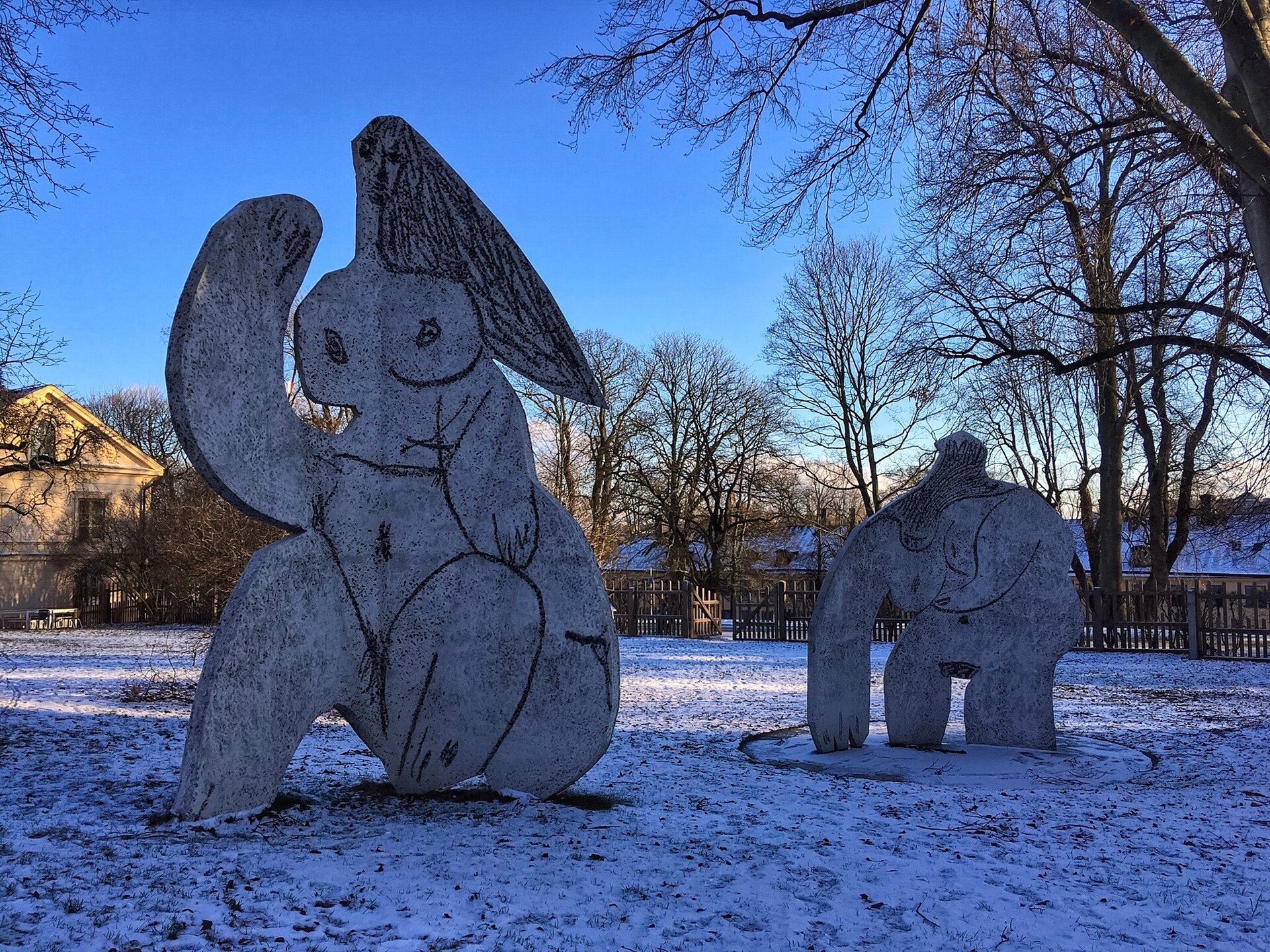
The museum's Skeppsholmen building, photographed in February 2018.
Public domainOn this page 17 sections
ContentsClose
The collection's real strength is depth rather than a single trophy: roughly 140,000 items, with a photography holding of about 100,000 images that the museum itself, not unreasonably, calls incomparable in a Swedish context, built on a founding core of Swedish and Nordic twentieth-century art plus French modernism and American postwar art, later widened by two targeted acquisition pushes toward women artists and toward a broader, less Europe-and-America-centred contemporary Swedish scene. Only a fraction of the holding is ever on display, which is also why the museum's own description of itself leans so heavily on curated thematic re-hangs rather than a fixed permanent-collection route.
| Kind | Museum |
|---|---|
| Founded | 1958 (current Skeppsholmen building by Rafael Moneo inaugurated 1998) |
| City and country |  Stockholm, Sweden Stockholm, Sweden |
| Address | Exercisplan 4, Skeppsholmen, Stockholm, Sweden |
| Website | modernamuseet.se |
| Status | Open, confirmed |
| Record last verified |
Visiting
- Hours
- MondayClosed
- Tuesday10:00 to 20:00
- Wednesday10:00 to 18:00
- Thursday10:00 to 18:00
- Friday10:00 to 20:00Free Friday from 18:00
- Saturday10:00 to 18:00
- Sunday10:00 to 18:00
- Closed
- Monday.
- Admission
- AdultSEK 170cheaper when bought online in advance
- ReducedSEK 140
- Group (15+ people)SEK 140per person
- 18 and underFreefree, as is Klubb Moderna membership
Free entry: Free Friday, 18:00-20:00, every week- Do I need to book?
- No, walk-in is normal; online tickets are cheaper and recommended for popular temporary shows
- Address
- Exercisplan 4, Skeppsholmen, Stockholm, Sweden MapWalk About ten minutes from Kungstradgarden, twenty from T-Centralen or Gamla Stan, via Blasieholmen and the bridge onto Skeppsholmen
Bus Bus 65 stops at the museum on Skeppsholmen
Ferry The Djurgarden ferry from Slussen calls at Skeppsholmen
Metro Blue Line to Kungstradgarden (about ten minutes on foot) or Red Line to Ostermalmstorg (about fifteen minutes) - Website
- modernamuseet.se
- Telephone
- +46 8 5202 3500
Before you go how long, access, photography, bags, eating, shop
- How long to allow
- Two to three hours to cover the collection galleries, a temporary exhibition and the outdoor sculpture park
- Access
- Parking for disabled visitors is provided outside the main entrance and the entrance facing the water; the building descends in stages toward the water, which the architect designed as the route used for both artwork and staff access
- Photography
- Not separately confirmed on the pages fetched for this record; not stated as restricted for the permanent collection
- Bags
- Not separately confirmed on the pages fetched for this record
- Eating
- Restaurangen Moderna Museet, table bookings taken for parties over ten
- Shop
- The Moderna Museet Shop sells posters, gifts, catalogues and more than 3,000 book titles
Prices and hours change. We take them from the institution's own pages and print the day we read them, and you can check the current position at the source we used. Confirm before you travel.
What is inside
Swedish and Nordic Art
The museum is the central national collection for twentieth and twenty-first century Swedish art, and holds the largest bodies of work by Oyvind Fahlstrom, Vera Nilsson, Siri Derkert and Dick Bengtsson, among other Swedish artists.
International Art
Key works by Pablo Picasso, Liubov Popova, Salvador Dali, Meret Oppenheim, Robert Rauschenberg, Donald Judd and Irving Penn, built up from a founding core of French-oriented modernism and American art of the 1950s and 60s, later widened to include more women artists and art from outside Europe and North America.
Photography
About 100,000 photographs from the birth of the medium in the 1840s to the present, a collection that began when the Friends of Fotografiska Museet donated their holdings to Nationalmuseum in 1971; the photography department became part of Moderna Museet in 1973.
Drawings and Prints
Some 25,000 watercolours, drawings and prints drawn from the same three founding traditions as the painting collection - Swedish and Nordic work, French-oriented modernism, and American postwar art - and shown in rotation rather than as a fixed display, since only a fraction of the holding can be on view at any time.
Moving Images (The Mini Cinema)
About 400 art videos and films from the collection, shown in a dedicated screening space the museum calls the Mini Cinema.
The sculpture park
An outdoor display on Skeppsholmen of large-scale sculpture from the collection, including permanent works by Alexander Calder, by Jean Tinguely and Niki de Saint Phalle, and a concrete piece by Picasso realised with the Norwegian engineer Carl Nesjar.
What to see first
The Dying Dandy
Nils DardelA 1918 painting that is one of the most reproduced images from the Swedish collection and appears repeatedly in the museum's own promotional material as the face of its holdings.4
Ma gouvernante / My Nurse
Meret OppenheimA 1936-1967 sculpture the museum itself singles out when introducing the collection, made by an artist whose work anchors the later widening of the collection toward women Surrealists.4
Monogram
Robert RauschenbergA signature combine so central to the collection that the museum built a long-running exhibition, running 23 November 2024 to 31 December 2026, around this single work and its context.1
Dejeuner sur l'herbe
Pablo Picasso, realised in concrete with Carl NesjarA permanent 1962 outdoor sculpture in the sculpture park, one of the few Picasso-designed public sculptures anywhere and part of what makes the Skeppsholmen grounds themselves a destination.11
The Four Elements
Alexander CalderA 1961 sculpture standing permanently in the museum's outdoor sculpture park on Skeppsholmen.11
Le Paradis fantastique
Jean Tinguely and Niki de Saint PhalleA 1966 collaborative sculpture group in the sculpture park, tied to the pair's landmark 1966 exhibition 'She - A Cathedral' at the museum.11
Blumengarten (Utenwarf)
Emil NoldeThe painting at the centre of a six-year Nazi-looted-art restitution dispute with the heirs of Otto Nathan and Bertha Deutsch, bought by the museum in good faith in 1967 and settled in September 2009 by a sale to a private collector with a five-year loan back to Stockholm - the case the museum's own provenance page points to as the reason it now researches its high-priority works systematically.9
Stockholm Slides
Carsten HollerA large slide installation fixed to the museum's own facade at the end of 2025, timed to coincide with a major late-period Picasso exhibition and running as an outdoor work through 18 October 2026.5
Exhibitions on now
- On now3 Oct 2026 to 28 Feb 2027Confirmed , 7 weeks ago
Past exhibitions here
A building designed not to compete with the island
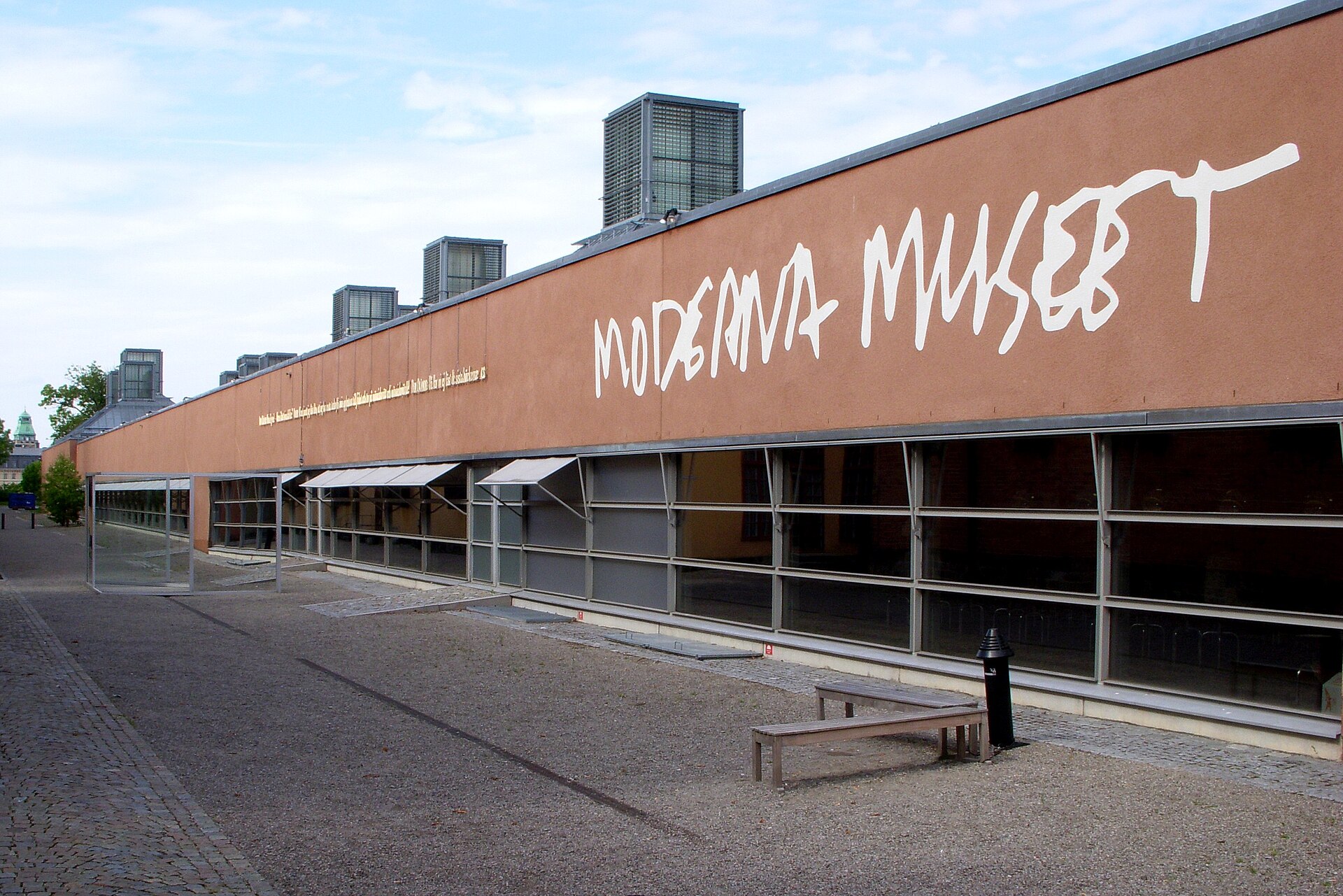
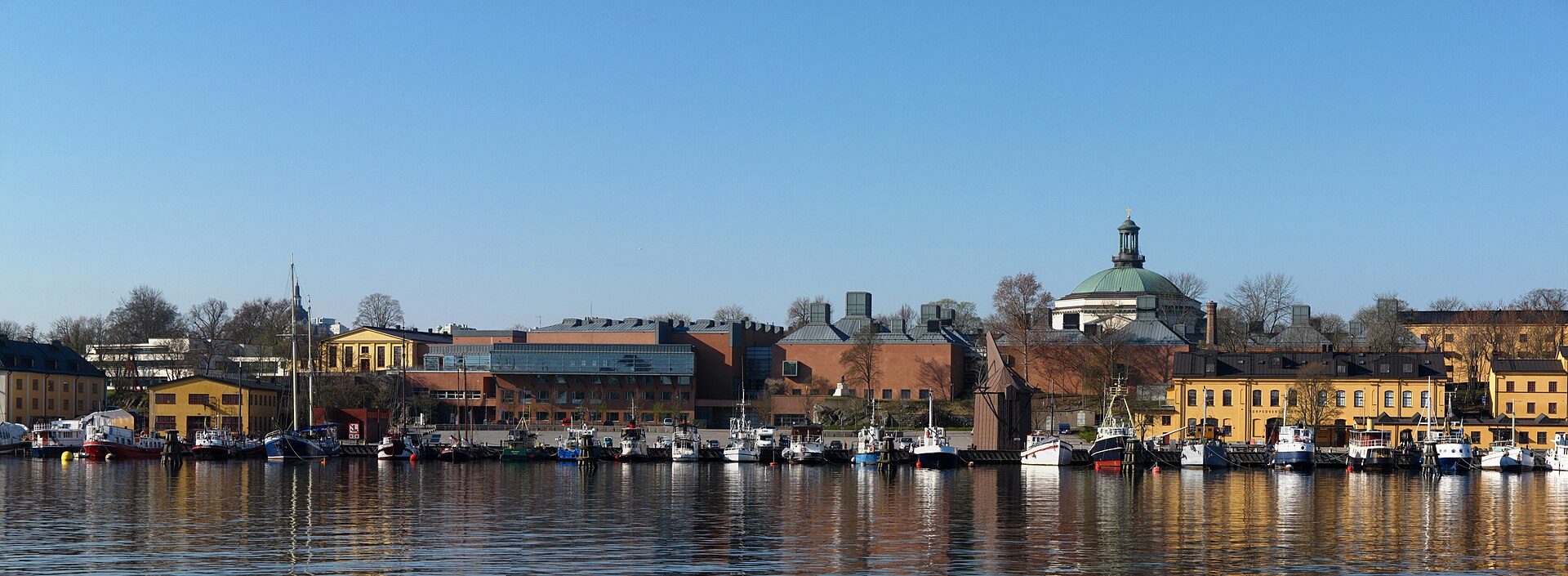
The Moderna Museet building that stands on Skeppsholmen today is not the one the museum opened in. It opened in 1958 in a former naval drill hall on the same small island in central Stockholm, and stayed there for forty years while the collection outgrew it. In 1990-91 the museum and the Swedish Centre for Architecture and Design ran a joint design competition that drew 211 entries plus five invited international architects funded by the Eddie Figge Foundation; on 10 April 1991 the Spanish architect Rafael Moneo was announced the winner with a scheme called 'Telemachos'. Construction ran from 1994, while the museum relocated temporarily to a former tram shed on Birger Jarlsgatan, to completion in 1997, and King Carl XVI Gustaf and Queen Silvia inaugurated the new building on 12 February 1998.
Moneo's own account of the project, published on his firm's site, describes a deliberate refusal of the waterfront-icon approach: rather than building a conspicuous structure facing the sea, as Frank Gehry did at almost exactly the same moment for the Guggenheim Bilbao, Moneo grouped the new museum's volumes near the 250-metre Tyghuset barracks building so as to read as an extension of what was already on the island rather than a competing landmark. The halls are lit by skylights that determine their shape, and the building steps down in stages toward sea level, where both artwork and staff enter. The museum totals about 20,000 square metres and shares the site with the 6,000-square-metre Swedish Centre for Architecture and Design, now called ArkDes, on a project that cost about EUR 49.1 million. A few years after opening, the new building was found to have a damp and mould problem serious enough that plans were drawn up to evacuate the collection; the museum closed for repairs in 2002-2003 and reopened, refurbished, on 14 February 2004.
From a drill hall to a national museum
The idea of a dedicated museum for twentieth-century art in Stockholm had circulated for decades before it happened. Discussions date back to 1908, when the Nationalmuseum's storage of new acquisitions was already a recognised problem. It was the curator Otte Skold, working with the Friends of Moderna Museet (formed in 1953), who pushed the project through; the museum opened in the old drill hall on 9 May 1958, and Skold died only months later. Its first exhibition, arranged while the hall was still being rebuilt around it, was Picasso's Guernica together with its 93 preparatory sketches - shown, by the museum's own account, under a roofless hall covered in tarpaulins because the building work had not finished.
Pontus Hulten took over as director in 1960 and ran the museum for thirteen years that are still treated as its defining era: theme shows such as 'Movement in Art' (1961), '4 Americans' (1962), 'American Pop Art' (1965) and 'She - A Cathedral', the 1966 collaboration between Niki de Saint Phalle, Jean Tinguely and Per Olof Ultvedt; solo exhibitions for Claes Oldenburg, Andy Warhol and Edward Kienholz; and happenings including '5 New York Evenings' in 1964 with Robert Rauschenberg, John Cage and Merce Cunningham among the participants. The single event that changed the collection's scale was the winter 1963-64 exhibition 'Onskemuseet' (the Museum of Our Wishes), built around works the Friends group argued the museum ought to own; it prompted a one-off SEK 5 million government grant that let the museum buy internationally, over vocal opposition from parts of the Swedish art world at the time, and brought in works by Kirchner, Max Ernst, Giacomo Balla, de Chirico, Miro, Dali, Mondrian and Picasso in one move. Later gifts added further depth: a Rolf de Mare donation of Braque and Leger paintings, Grace and Philip Sandblom's gift including Picasso's Spring, and the 1989 Gerhard Bonnier donation, which alone brought in works by Picasso, Leger, Mondrian, Chagall, Miro, Giacometti, Gris, Dubuffet, Laurens and Yves Klein.
Three founding traditions, then a deliberate widening
The museum describes its own collection as originally built on three pillars - Swedish and Nordic art, French-oriented modernism, and American art of the 1950s and 60s - which by its own account has since been extended in two later, targeted pushes. One added twentieth-century women artists specifically, bringing in Louise Bourgeois, Dorothea Tanning, Judy Chicago and Susan Hiller. The other, in 2021, used a SEK 25 million government allocation intended to support the Swedish arts sector during the covid-19 pandemic; the museum called the resulting programme 'Swedish Acquisitions 2021', and it added 373 works made between 1962 and 2021 by 169 living artists aged from 27 to 91, based in Sweden, elsewhere, and in Sapmi, shown afterward in two exhibitions titled 'Insights' and 'Matches'.
The collection as it stands today runs to roughly 140,000 items across media: about 6,000 paintings, sculptures and installations; 25,000 watercolours, drawings and prints; 400 art videos and films; and, easily the largest single category, some 100,000 photographs. The photography holding traces to a specific 1971 donation - the Friends of Fotografiska Museet gave their collection to Nationalmuseum, and the resulting department transferred into Moderna Museet in 1973 - and the museum calls it, without much competition, incomparable in a Swedish context.
The 1993 roof theft
On 8 November 1993, thieves broke in through the roof and took eight paintings - six by Picasso and two by Braque - reported at the time to be worth more than GBP 40 million combined. Six of the Picassos and one of the two Braques were later recovered; by the accounts consulted for this record, one Braque has not been. It remains the most serious single security failure in the museum's history and, together with the mould problem discovered only a few years after the new building opened, one of two episodes that complicate the institution's own preferred narrative of a smoothly ascending national collection.
Provenance work that the museum itself calls unfinished
The clearest case of the museum's provenance history is the Emil Nolde painting Blumengarten (Utenwarf), from 1917. Moderna Museet bought it in good faith at a Swiss gallery auction in 1967, without at the time knowing it had been in the collection of Otto Nathan and Bertha Deutsch, a Frankfurt couple who fled Nazi Germany in 1939. The Deutsch heirs filed a restitution claim in 2003 under the 1998 Washington Principles; the museum initially referred the matter to the Swedish government, and negotiations stalled for years, with both the museum and Sweden's Culture Minister at one point citing a DM 31,000 payment the heirs had already received from West German authorities in 1962 as grounds to resist the claim. Pressure built only after the heirs appealed directly to the Culture Minister in March 2009 and the case surfaced at the Prague Holocaust Era Assets Conference that June; a settlement followed on 9 September 2009 under which an undisclosed private European collector bought the painting outright, with Moderna Museet keeping it on a five-year loan and the same collector separately loaning the museum another Expressionist work for five years, all financial terms kept confidential. Observers who followed the case at the time noted that the settlement read as a response to international pressure rather than as a resolution reached on the merits, and that the revenue-sharing arrangement between museum and collector was never made public enough to assess.
The museum's own current position, stated on its provenance and restitution page, is that from 2021 to 2026 it has run an intensified programme of 'special provenance' research, compiling documentation on a defined set of high-priority works under both the Washington Principles and the 2009 Terezin Declaration, with a named curator, Annika Gunnarsson, taking correspondence on the subject. The museum states the programme is under way; it does not publish which works are on the priority list or what, if anything, the research has found so far, so a reader cannot yet check the results against the claim.
An institution mid-reorganisation
Moderna Museet has changed its own admission policy on nearly a ten-year cycle without much continuity: entry to the collection became free in 2005, the charge was reintroduced in 2007, removed again on 1 February 2016, held free through 31 December 2022, and reinstated from 2023 when, by the museum's own account, all Sweden's national museums were required to resume charging. The prices current on the museum's own site as of this record's research are 170 SEK for an adult and 140 SEK reduced, still free for visitors 18 and under and every Friday evening from 18:00 to 20:00.
A larger structural change is under way at government level. In 2024 the Swedish government decided to fold two other bodies, Statens konstrad (the Public Art Agency) and ArkDes (the architecture and design museum that has shared Moneo's Skeppsholmen building with Moderna Museet since 1998), into the Moderna Museet organisation; that merger took effect on 1 January 2026. At almost the same moment the museum is changing directors: Gitte Orskou, in the post since September 2019, is leaving in August 2026, and Tone Hansen - previously director of MUNCH in Oslo and, before that, of Henie Onstad Kunstsenter - takes over in September 2026. A reader visiting in the second half of 2026 is arriving at an institution that has just absorbed two other public bodies and is changing its director in the same year, a combination the museum's own announcements describe but do not yet explain the operational consequences of.
What is on view now
As of this record's research, the museum's collection displays include 'The Subterranean Sky', a survey of Surrealism from the collection running from 26 October 2024 to 17 January 2027; 'The Art of Collecting', on the collection's expansion, running 11 October 2025 to 9 May 2027; and 'Monogram', built around the museum's Rauschenberg holdings, running 23 November 2024 to 31 December 2026. Temporary exhibitions on view include 'Will You Be Profitable, My Friend?', on Swedish art from 1945 to 1979 (13 June 2026 to 19 September 2027), 'House of Nisaba: New Stories of Painting' (14 May to 30 August 2026), Brassai's 'The Secret Signs of Paris' (28 March to 4 October 2026), and a solo show of the Swedish artist Anna Casparsson, 'The Isle of Bliss' (25 April to 27 September 2026). Outdoors, Carsten Holler's slide installation 'Stockholm Slides', fixed to the building's own facade at the end of 2025, remains up through 18 October 2026, installed to coincide with a major exhibition of Picasso's late work. The sculpture park on Skeppsholmen, with its permanent Calder, Tinguely-de Saint Phalle and Picasso-Nesjar pieces, is open with the grounds regardless of what is showing inside.
What visitors say
Visitor commentary is consistent on two points: the setting is a large part of the draw, and the temporary exhibition program is what visitors remember by name. Reviews repeatedly cite the walk or ferry ride onto Skeppsholmen and the outdoor sculpture park as highlights in themselves, and single out specific loan and thematic shows (Andy Warhol, Yayoi Kusama and Olafur Eliasson have all been named favourably in visitor write-ups) rather than the permanent collection generally. A recurring complaint runs the other way: some visitors describe parts of the twentieth-century and contemporary galleries as demanding without much wall text to help a non-specialist, and a minority find admission for special exhibitions poor value against what they saw.
What is praised, what is criticised
- Praised: the walk or ferry crossing onto Skeppsholmen and the outdoor sculpture park with its Calder, Tinguely-de Saint Phalle and Picasso-Nesjar pieces
- Praised: headline temporary exhibitions, with Warhol, Kusama and Eliasson shows named specifically in visitor write-ups
- Praised: free admission for visitors 18 and under and during Free Friday evenings
- Criticised: some contemporary and abstract galleries are described as hard to engage with for visitors without background in twentieth-century art history and without much wall text
- Criticised: a minority of reviewers weigh the separate charge for temporary exhibitions against the size of the show and find it poor value
Ratings on other platforms
Google: 4.3 from 2,288 ratings, read 21 August 2026
TripAdvisor: 4.2 from 1,829 ratings, read 21 August 2026
A platform average is a tertiary source: it moves, it is not audited, and we quote no visitor's words.
Questions about Moderna Museet
Where is Moderna Museet?
Exercisplan 4, Skeppsholmen, Stockholm, Sweden.
How much does it cost to visit?
Adult: SEK 170; Reduced: SEK 140; Group (15+ people): SEK 140; 18 and under: free. As confirmed 21 August 2026.
When is it open?
Monday closed; Tuesday 10:00-20:00; Wednesday 10:00-18:00; Thursday 10:00-18:00; Friday 10:00-20:00; Saturday 10:00-18:00; Sunday 10:00-18:00. Closed: Monday. As confirmed 21 August 2026.
How do you get there?
Walk: About ten minutes from Kungstradgarden, twenty from T-Centralen or Gamla Stan, via Blasieholmen and the bridge onto Skeppsholmen; Bus: Bus 65 stops at the museum on Skeppsholmen; Ferry: The Djurgarden ferry from Slussen calls at Skeppsholmen; Metro: Blue Line to Kungstradgarden (about ten minutes on foot) or Red Line to Ostermalmstorg (about fifteen minutes).
What should you see first?
The Dying Dandy (Nils Dardel); Ma gouvernante / My Nurse (Meret Oppenheim); Monogram (Robert Rauschenberg); Dejeuner sur l'herbe (Pablo Picasso, realised in concrete with Carl Nesjar); The Four Elements (Alexander Calder); Le Paradis fantastique (Jean Tinguely and Niki de Saint Phalle).
What we could not confirm
- The museum's 2021-2026 intensified provenance research programme is stated but its results are not published; which works are on the priority list, and what the research found, is not disclosed on the pages checked for this record.
- The operational consequences of folding Statens konstrad and ArkDes into Moderna Museet from 1 January 2026, together with a change of museum director in September 2026, are announced but not yet explained by the museum itself.
- Sources consulted for this record differ on the fate of the second painting stolen in the 1993 roof theft: six Picassos and one Braque are reported recovered, and this record could not confirm the status of the remaining Braque from a source it fetched directly.
Images
Sources
- 1Moderna Museet, Stockholm start page (hours, admission, current exhibitions) modernamuseet.se/en/stockholm/
- 2Moderna Museet, About Moderna Museet modernamuseet.se/en/stockholm/about/
- 3Moderna Museet, Contact Moderna Museet modernamuseet.se/en/stockholm/about/contact/
- 4Moderna Museet, The Collection modernamuseet.se/en/stockholm/the-collection/
- 5Moderna Museet, History modernamuseet.se/en/stockholm/the-collection/history/
- 6Moderna Museet, Provenance and restitution modernamuseet.se/en/stockholm/the-collection/provenance-and-restitution/
- 7Moderna Museet, Find us modernamuseet.se/stockholm/en/visit-the-museum/prepare-your-visit/find-us/
- 8Rafael Moneo Arquitecto, Moderna Museet and Arkitekturmuseet in Stockholm rafaelmoneo.com/en/projects/moderna-museet-and-arkitekturmuseet-in-stockholm/
- 9Centre du droit de l'art, Blumengarten - Deutsch Heirs and Moderna Museet Stockholm plone.unige.ch/art-adr/cases-affaires/blumengarten-2013-deutsch-heirs-and-moderna-museet-stockholm
- 10Ronald Jones, 'The Moderna Exhibition 2006', Frieze, 6 May 2006 frieze.com/article/moderna-exhibition-2006
- 11Wikipedia, 'Moderna Museet' (, used only for the 1993 theft and the sculpture park works) en.wikipedia.org/wiki/Moderna_Museet
- 12Wikimedia Commons, File:Moderna Museet (26566025668).jpg, licensing and file history commons.wikimedia.org/wiki/File:Moderna_Museet_(26566025668).jpg
- 13TripAdvisor, Moderna Museet Stockholm attraction page ( rating; direct fetch bot-blocked with , figure read via search result snippet naming this URL) tripadvisor.com/Attraction_Review-g189852-d208275-Reviews-Moderna_Museet_Stockholm-Stockholm.html
.jpg)