Helene Schjerfbeck
 1862-1946
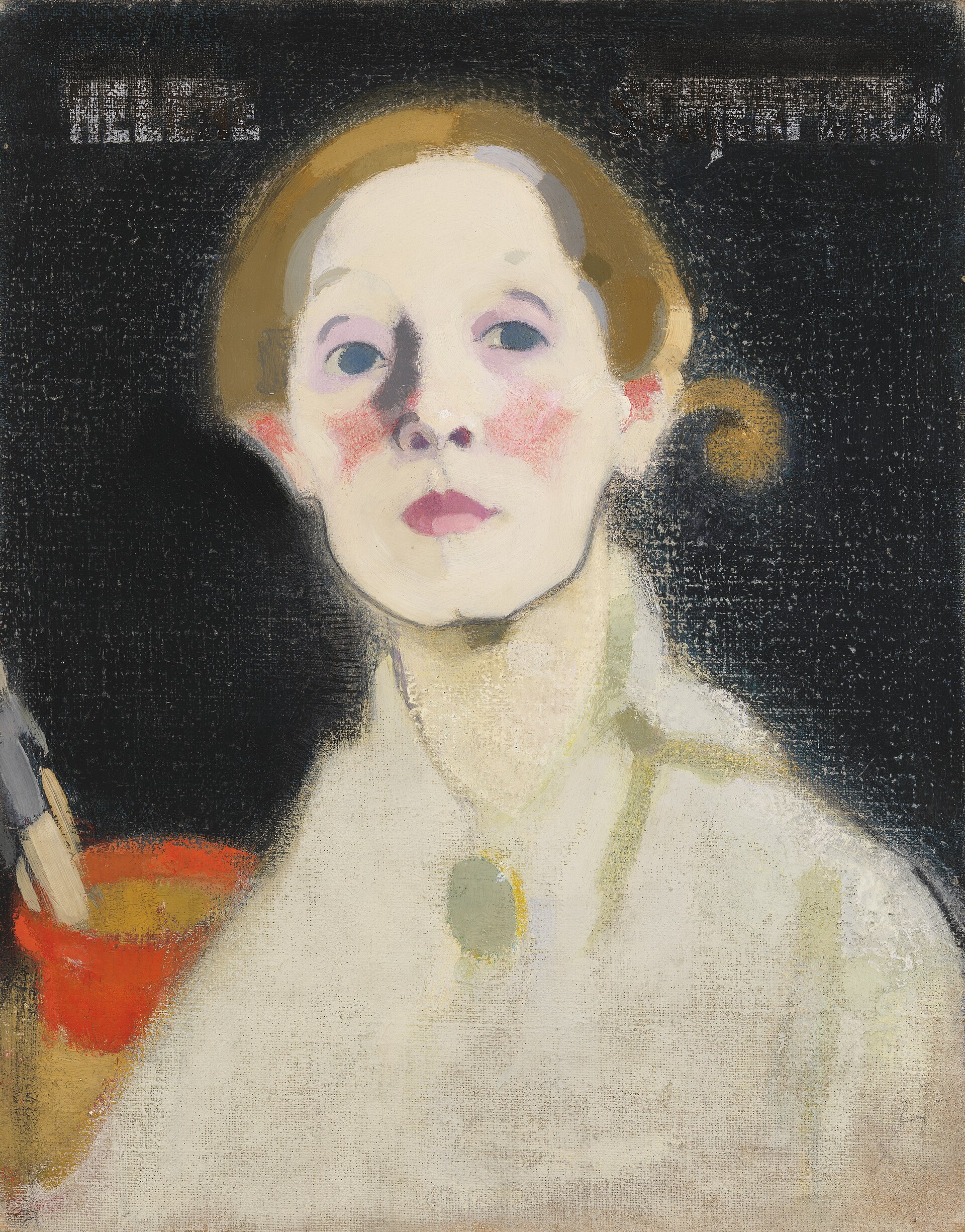
Self-Portrait, Black Background, 1915, oil on canvas, Finnish National Gallery / Ateneum (Herman and Elisabeth Hallonblad Collection). Painted by her and signed with her name lettered across the top, so the identification is secure. One of about forty self-portraits.
Finnish National Gallery / Ateneum Art Museum (CC0 on Commons)| Full name | Helena Sofia Schjerfbeck |
|---|---|
| Worked as | Painter, Draughtswoman, Lithographer |
| Born | 10 July 1862 · Helsinki, Grand Duchy of Finland |
| Died | 23 January 1946 · Saltsjobaden, Sweden |
| Nationality | Finnish (Grand Duchy of Finland under the Russian Empire at her birth) |
| Movement | Finnish naturalism and Nordic modernism |
| Sources | 24 cited |
| Last verified |
About this page Last verified · 24 sources cited
On this page 13 sections
ContentsClose
Helene Schjerfbeck (1862-1946) is the Finnish painter who made about forty self-portraits across her career, more than twenty of them in her last two years, and ended by reducing her own face to a few charcoal lines. The standard account makes her a lonely invalid in a railway town. The Finnish National Gallery's own biographer says that story was set going by her first biographer, Einar Reuter, with her help, and that the record of her life does not support it.
What a reader checking or buying her needs is plainer. The catalogue raisonne of 2012 lists 730 works, not counting works untraced or destroyed. The earlier numbering in Reuter's monograph runs past 980, and the same self-portrait on a Sotheby's page carries three different numbers, 904, 464 and 668, one for each of Reuter's book, the 1992 catalogue and the 2012 catalogue. The largest holding is the Ateneum in Helsinki, 212 works in the museum's 2012 count. No authentication board, foundation or society was found; the one documented ruling, in 2019, was made by the Ateneum's curator and conservator, and Finnish National Gallery experts examined the canvases in the 2018 forgery case.
The second thing biographies skip is the dealer. From about 1937 or 1938 Gosta Stenman handled almost all her sales, in Finland and in Sweden, and one scholar argues he deliberately held paintings back and sold lithographs to feed demand. That is why the late market is thin and why no higher price than GBP 3,044,500, paid for Dancing Shoes in 2008, was found in the sources read.
Images
Chronology
- 1862
- 1866
A fall at four injures her hip and leaves a lifelong limp.114
- 1873
Enters the drawing school of the Finnish Art Society at eleven.114
- 1880
Wounded Warrior in the Snow is bought by the Finnish Art Society and she receives a 1,500 mark Senate travel grant.18
- 1883
Fete juive, a Sukkot scene, wins her entry to the Paris Salon.1523
- 1887
Goes to St Ives, Cornwall, in July and stays until March 1888 on a 1,500 mark grant.1
- 1888
Paints The Convalescent, shown at the Salon as Premiere verdure and bought by the Finnish Art Society.2
- 1892
Spends three months in St Petersburg; in 1894 she goes on to Vienna and Florence, copying for the Finnish Art Society's collection.115
- 1902
Moves with her mother to Hyvinkaa after resigning her teaching post; her doctor had recommended the place.115
- 1912
In September Gosta Stenman visits Hyvinkaa and leaves with twelve paintings.1
- 1914
Stenman opens his gallery; Einar Reuter buys his first Schjerfbeck through him.1
- 1915
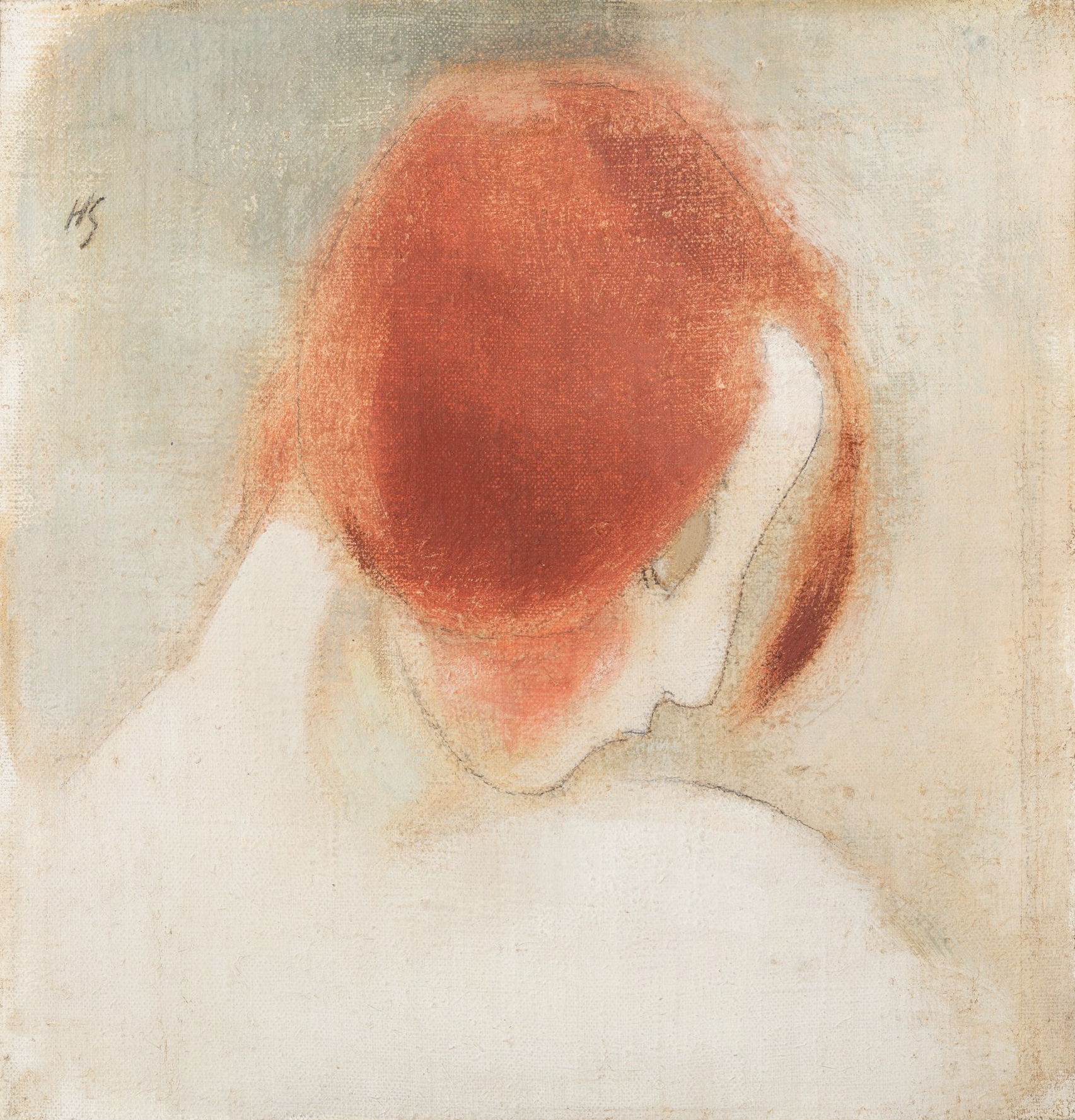
Paints Self-Portrait, Black Background and The Red-Haired Girl II.147
- 1917
First solo exhibition at Stenman's salon in September, 159 works; Reuter's short biography appears as H. Ahtela.1
- 1922
Granted a state artist's pension of 3,000 marks a year.1
- 1923
Her mother dies; she later settles in Tammisaari.1
- 1927
Stenman commissions new versions of earlier pictures, among them a second Convalescent.1
- 1937
Stenman holds a large Stockholm exhibition; a contract giving him sales is probably in effect from 1937 or 1938.81
- 1938
Begins the lithographs for Stenman, including The Convalescent and Silk Shoes.1
- 1944
Moves to the Saltsjobaden spa hotel in Sweden at Stenman's urging.1
- 1946
Dies in Saltsjobaden on 23 January.1
- 1951
Reuter's full biography, The struggle for beauty, is published; Swedish translation follows in 1953.1
- 1954
Memorial exhibition at Kunsthalle Helsinki.1
- 2001
My Mother (1909) sells for EUR 886,000 in Helsinki, against 100,000 marks in 1982.17
- 2008
Dancing Shoes makes GBP 3,044,500 at Sotheby's London, her auction record.6
- 2012
Ateneum anniversary exhibition and the catalogue raisonne of 730 works.81
- 2018
Helsinki District Court convicts the Galerie Vision owners in the Seppa forgery case.12
- 2019
A previously unknown painting, The Girl from Barosund, is accepted by the Ateneum.10
- 2023
The Metropolitan Museum buys The Lace Shawl, the first Schjerfbeck in an American museum.1614
- 2025
The Met opens Seeing Silence on 5 December, running to 5 April 2026.15
The market
Her record is GBP 3,044,500 for Dancing Shoes at Sotheby's London in May 2008, against an estimate of GBP 500,000 to 700,000. It has not been beaten in the sources read. The next steps down are The Red-Haired Girl II at GBP 1,205,000 in 2016, Girl with Blonde Hair at GBP 869,000 in December 2015, Lemons in a Wooden Bowl at GBP 533,000 and, in Helsinki, My Mother at EUR 886,000 in 2001. A 2020 column by the art-market expert Pauliina Littorin calls her the best name to buy among Finnish painters, with the highest price and a narrow supply, and also warns that fakes appear in every decade.
Late works on paper trade far lower. A charcoal self-portrait of 1944 hammered at SEK 520,000 in June 2022, under its low estimate of SEK 600,000, and a 1945 Convalescent in charcoal and watercolour hammered at SEK 5,600,000 on 11 December 2025 against SEK 7,000,000 to 9,000,000. Both fell below estimate.
None of the sources separates hammer from premium for the Sotheby's lots. Bukowskis states hammer prices. Where a source gives only a result, the row below says so. The Taloustaito column adds that her prices pulled away from other Finnish painters in the 1980s boom, with a record for the painting Kirje in 1986, and that in the 1990s few works came to auction, partly because of resale royalties. Because she died in 1946, copyright ran out at the end of 2016 under life plus 70 years. A 2022 Sotheby's lot of a small self-portrait carried an estimate of GBP 600,000 to 800,000 and an irrevocable bid; the result was not found.
| Date | Sale | Work | Result | Note |
|---|---|---|---|---|
| 11 December 2025 | Bukowskis, Stockholm | The Convalescent (signed HS, dated -45), watercolour and charcoal, 36 x 50 cm, lot 765A | Hammer SEK 5,600,000 (about EUR 503,000) With premium not stated SEK | Estimate SEK 7,000,000-9,000,000. Below estimate. Provenance: Gosta Stenman (no. 5662); Christie's London March 1989; private collection. Cited as Reuter 981, 1992 no. 494, 2012 no. 711. |
| 9 June 2022 | Bukowskis, Stockholm | Sjalvportratt (Self-portrait, 1944), charcoal on paper, 20.5 x 18.5 cm, lot 526 | Hammer SEK 520,000 (about EUR 46,700) With premium not stated SEK | Estimate SEK 600,000-800,000. Below the low estimate. Provenance: Gosta Stenman; Galleri Axlund; Ingemar Dahlberg. Reuter 951, 2012 no. 697. |
| 2017-11 | Hagelstam, Helsinki (Classic T110) | Portrait of the actor Matti Kiianlinna (1926) | Hammer not stated With premium reported as EUR 445,000 in a collector's journal; premium treatment unknown EUR | Tertiary source only; the Hagelstam result sheet was not found. |
| 2016-05 | Sotheby's London, 19th Century European Paintings | The Red-Haired Girl II (1915), oil and graphite on canvas, 37 x 36 cm (Sotheby's; Commons gives 37.5 x 36.5) | Hammer not stated in sources read With premium price reported as GBP 1,205,000 (EUR 1,574,934) GBP | Estimate GBP 500,000-700,000. Three determined bidders; acquired by the Gosta Serlachius Fine Arts Foundation. Date from the news column; the lot day was not read. |
| 2015-12 | Sotheby's London | Girl with Blonde Hair (1916) | Hammer not stated in sources read With premium price reported as GBP 869,000 (EUR 1,193,219) GBP | Estimate GBP 500,000-700,000; sold to a European institution. The same release reports Lemons in a Wooden Bowl at GBP 533,000, acquired by the Reitz Foundation, estimate GBP 300,000-500,000. |
| 2008-05 (inferred from the ArtDaily listing dated 31 May 2008; Sotheby's gives May 2008) | Sotheby's London, The Scandinavian Sale | Dancing Shoes (Tanssiaiskengat; Balskorna), lot 219, oil on canvas, 55 x 64.5 cm | Hammer not stated in sources read With premium price reported as GBP 3,044,500; whether it includes buyer's premium is not stated GBP | Estimate GBP 500,000-700,000; hotly contested. Provenance: Nikolai and Olga Kiseleff, Helsinki; Nadine Topelius; Georg Topelius. Exhibited Finnish Art Society 1882 no. 47. Record for her and for any Finnish artist at auction at the time. |
| 2 December 2001 | Bukowski-Horhammer, Helsinki | Aitini (My Mother, 1909), oil on canvas, 81 x 83.5 cm | Hammer not stated in the source With premium price reported as EUR 886,000 (FIM 5.2 million); opening bid EUR 336,000 EUR (converted from FIM in the source) | The same picture was sold at Bukowskis Helsinki in 1982 for FIM 100,000, according to the house's managing director. Bought into a Stockholm private collection after competition from a Finnish museum. |
| 2001-02 | Christie's London, Impressionist winter sale | Portinvartijan tytar (The Doorkeeper's Daughter), painted in the late 1920s | Hammer not stated in the source With premium 'over three million markka' reported; the December 2001 article gives the same sale as EUR 500,000 (FIM 3 million) FIM | Expected to reach about FIM 1.5 million. A third picture, from the work Halytys, failed to sell on a bid of just over FIM 1 million. |
Hammer is the price at which the bidding stopped; with premium adds the fee the house charges the buyer on top. Hammer price and buyer's premium in the glossary.
Where to see the work
| Institution | City | Holdings | Note |
|---|---|---|---|
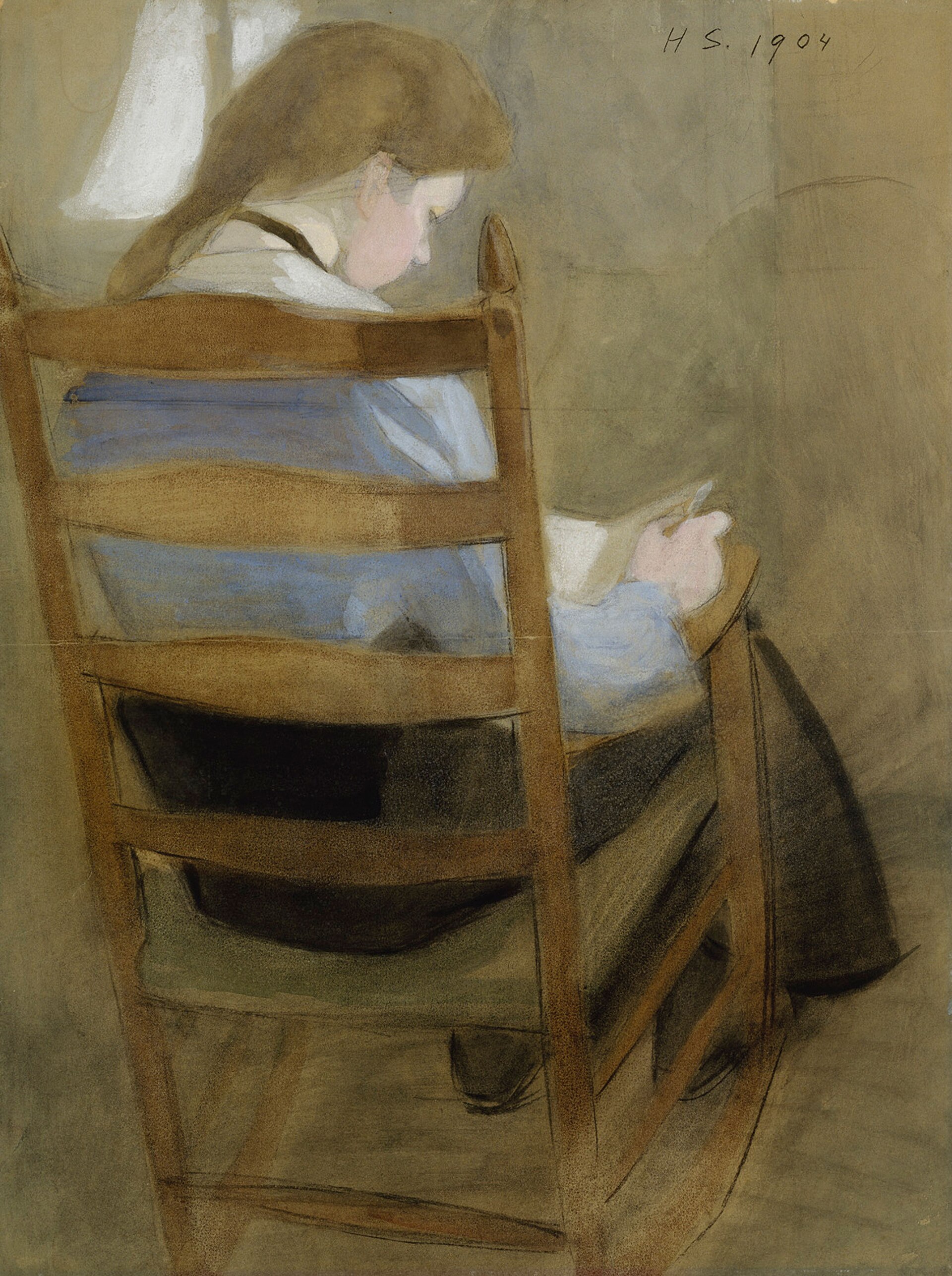
| Ateneum Art Museum (Finnish National Gallery) | Helsinki | 212 works in the 2012 count: Wounded Warrior in the Snow (A I 221), The Convalescent (1888), Self-Portrait, Black Background (1915), Girl Reading (1904, A III 2055), Einar Reuter III (1919-20), five sketchbooks and a hundred sketches from the Friends of the Ateneum, and the late self-portraits. | Commons carries FNG images under a CC0 tag; sketchbooks are published online. |
| Finnish National Gallery archive collections | Helsinki | Gosta Stenman Archive, her letters to Stenman, eight letters to Martha Neiglick-Platonoff (1944-45), Carl Appelberg's photograph collection, Reuter's manuscript for the biography. | The best place to check a provenance claim that runs through Stenman. |
| Gosta Serlachius Fine Arts Foundation | Finland (town not read in a source) | The Red-Haired Girl II (1915), bought at Sotheby's in 2016. | Named as the buyer in the 2016 Sotheby's report; the museum was not consulted. |
| Signe and Ane Gyllenberg Foundation | Helsinki | Fete juive (1883) and her letters to Dora Estlander. | Fete juive is on the foundation's Commons record. |
| The Metropolitan Museum of Art | New York | The Lace Shawl (1920), accession 2023.98, bought 2023; the Met's 2025-26 exhibition borrowed nearly sixty works. | The first Schjerfbeck in an American museum; the Met's own record is not open access. |
| Riihimaki Art Museum | Riihimaki | Factory Girls on the Way to Work (1921-22), the verso of which carries an unfinished self-portrait. | Holding named in Lahelma; not checked at the museum. |
| Society of Swedish Literature in Finland | Helsinki | Her letters to Maria Wiik, 1907-1928, SLSA 1297. | The correspondence quoted most in the literature. |
Forgeries and misattributions
- Galerie Vision and Veli Seppa, Helsinki
- AFP reported on 1 November 2018 that the Helsinki District Court sentenced the two owners of a gallery to four and five years, with EUR 13 million ordered at first instance, for selling forged works under famous names, Schjerfbeck among them; that over 220 canvases went to the Finnish National Gallery for verification, most found forged and mostly the work of Veli Seppa; and that Seppa admitted in court to painting and signing at least one of them (a Leger). Yle reported that Seppa received a suspended sentence in 2017. Finnish Wikipedia (tertiary; replace with the court record) says the Court of Appeal changed the terms in February 2021 to three years and four years three months with multi-million compensation, so the EUR 13 million is the first-instance figure, and says many fakes remain in circulation. Finnish National Gallery experts examined the canvases (AFP); the court's written reasoning on the fake Leger called it incredibly weak and childish. Specific tells on fake Schjerfbecks were not found in published sources.121113
- Markkinaomena (Market Apple), reportedly sold 2008
- Finnish Wikipedia states that a Helsinki collector paid EUR 350,000 in 2008 for a Seppa forgery titled Markkinaomena and that Seppa forged Schjerfbeck from at least the early 1990s. The figure is from that tertiary page only. A genuine Market Apple of 1927 is catalogued by Lahelma as in a private collection and was shown at Venice in 1956. Not stated. Which composition the fake imitated was not established.131
- Jouni Ranta, dealer
- Yle reported on 28 August 2019 that Jouni Ranta was sentenced in 2005 to just over two years in prison without parole, which he has served, and that he told Iltalehti he traded forgeries for 30 years; he wrote about it in the book Vilpiton mieli with Marko Erola. English Wikipedia says he sold about sixty Schjerfbeck counterfeits, a claim not checked at a primary source. Not stated in the sources read; Ranta's own account is public.1120
- Forged certificates
- A 2020 Finnish trade column states that counterfeits under her name have been sold in every decade, sometimes with forged certificates of authenticity, and advises checking authenticity before any significant purchase. Not stated.19
- Not a forgery: a stolen self-portrait
- Lahelma notes that a self-portrait long assumed to be the one she described in 1921 was later stolen from the Eskilstuna art museum, and that an unfinished self-portrait of the same year on the back of Factory Girls on the Way to Work is the likelier candidate. Not applicable; no date, recovery or register entry was found.1
- Her own versions and transcriptions
- Autograph repetitions of The Convalescent, Costume Picture and The Woodcutter, and her El Greco and Cimabue transcriptions (Madonna and Child, after Cimabue, 1932), are genuine and often under near-identical titles. They are a source of mismatched records, not of fakes. Match by catalogue number, medium, size and provenance, not title.12
The essay
Chapter 1Seven hundred and thirty works and three numbering systems
The figure to use is 730. Marja Lahelma, writing for the Finnish National Gallery in 2023, says the 2012 catalogue raisonne lists 730 works by Schjerfbeck, not counting those untraced or destroyed.
The figure to use is 730. Marja Lahelma, writing for the Finnish National Gallery in 2023, says the 2012 catalogue raisonne lists 730 works by Schjerfbeck, not counting those untraced or destroyed. Yle repeated the number in 2019 when it reported a previously unknown picture, The Girl from Barosund, new to the 730 known works. The catalogue is Helene Schjerfbeck. 150 Years, edited by Leena Ahtola-Moorhouse and Anu Utriainen for the Ateneum in 2012, in Finnish, Swedish and English editions. Alanen's 2012 account of the Ateneum press text calls the raisonne a work to be published with the exhibition; whether it is the same volume as the exhibition catalogue, or a second one, was not settled in the sources read.
Auction houses cite three numbers for one object. A 1944 charcoal self-portrait is no. 951 in Reuter's 1953 listing and no. 697 in the 2012 catalogue. The Convalescent watercolour of 1945 is Reuter 981, 1992 catalogue no. 494 and 2012 no. 711. An oil-on-board self-portrait is Reuter 904, 1992 no. 464 and 2012 no. 668. A Reuter number above 980 against a total of 730 in 2012 means the two lists do not have the same scope, and no source read says what the difference is.
The Ateneum itself holds 212 works in the museum's 2012 count, and describes the collection as the largest and most comprehensive in the world. Its 2016 note gives 'more than 200'.
Chapter 2A prodigy bought by her own country at seventeen
She was born in Helsinki on 10 July 1862.
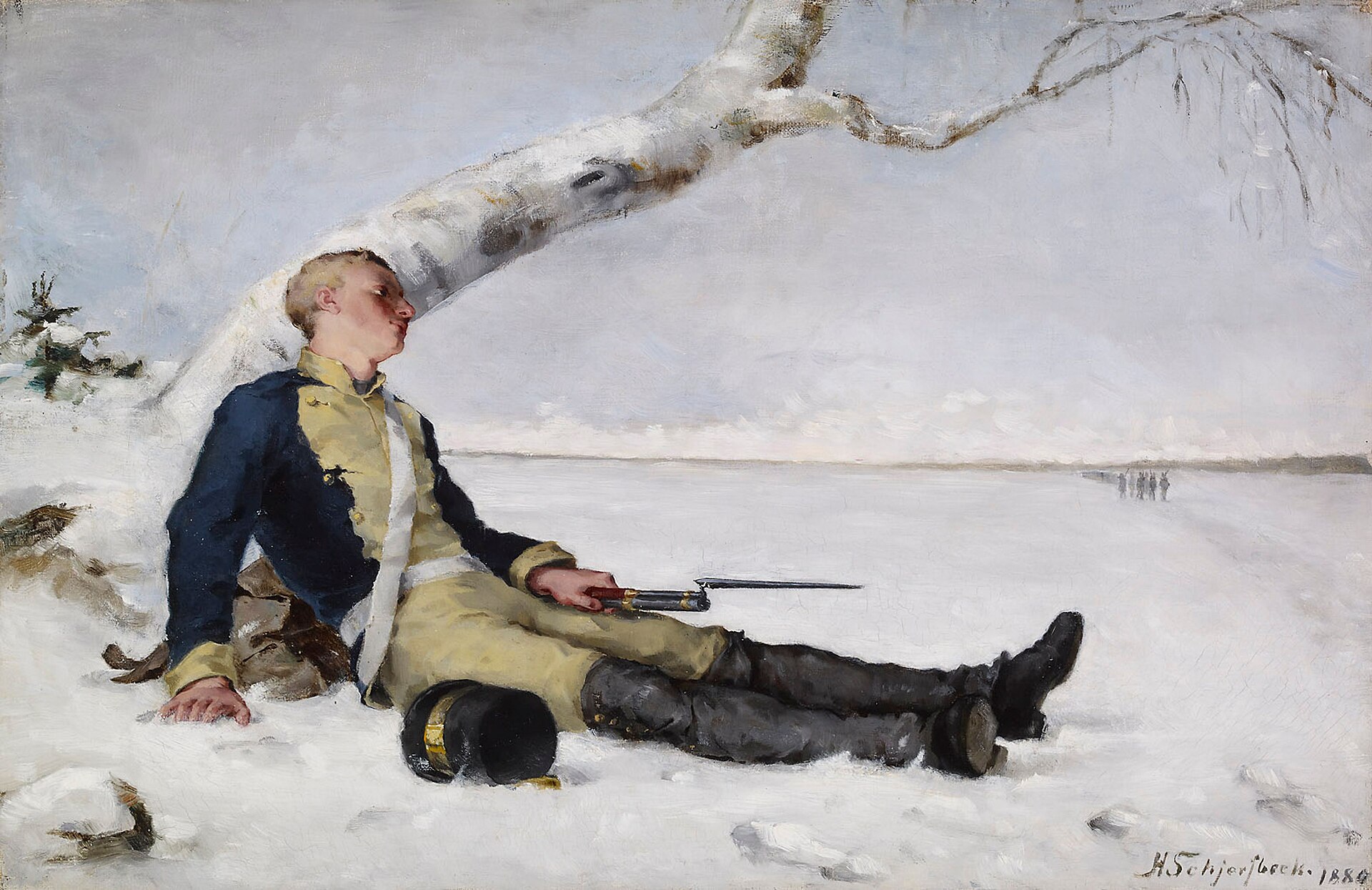
She was born in Helsinki on 10 July 1862. A fall at four left her with a hip injury and a lasting limp. At eleven she entered the drawing school of the Finnish Art Society on a scholarship. In 1880 her Wounded Warrior in the Snow, a wounded soldier left in the snow beneath a birch, was bought by the Society and now hangs in the Ateneum as accession A I 221. The Imperial Senate then gave her a travel grant of 1,500 marks for study abroad.
The money mattered because it was national policy. Lahelma writes that Finland was seeking to strengthen its status among European nations and treated a strong artistic tradition as part of the mission, so the Senate paid for training abroad. A later application brought 2,000 marks, enough for a summer and a winter in France, and another grant of 1,500 marks took her to St Ives. In 1892 she spent three months in St Petersburg and in 1894 took leave from teaching to go to Vienna and Florence. Lahelma says the official purpose was to paint copies of important works for the Finnish Art Society's collection, and the Met says the Society sent her to copy Holbein, Velazquez, Fra Angelico, Fra Filippo Lippi and Giorgione. A state artist's pension of 3,000 marks a year followed in 1922.
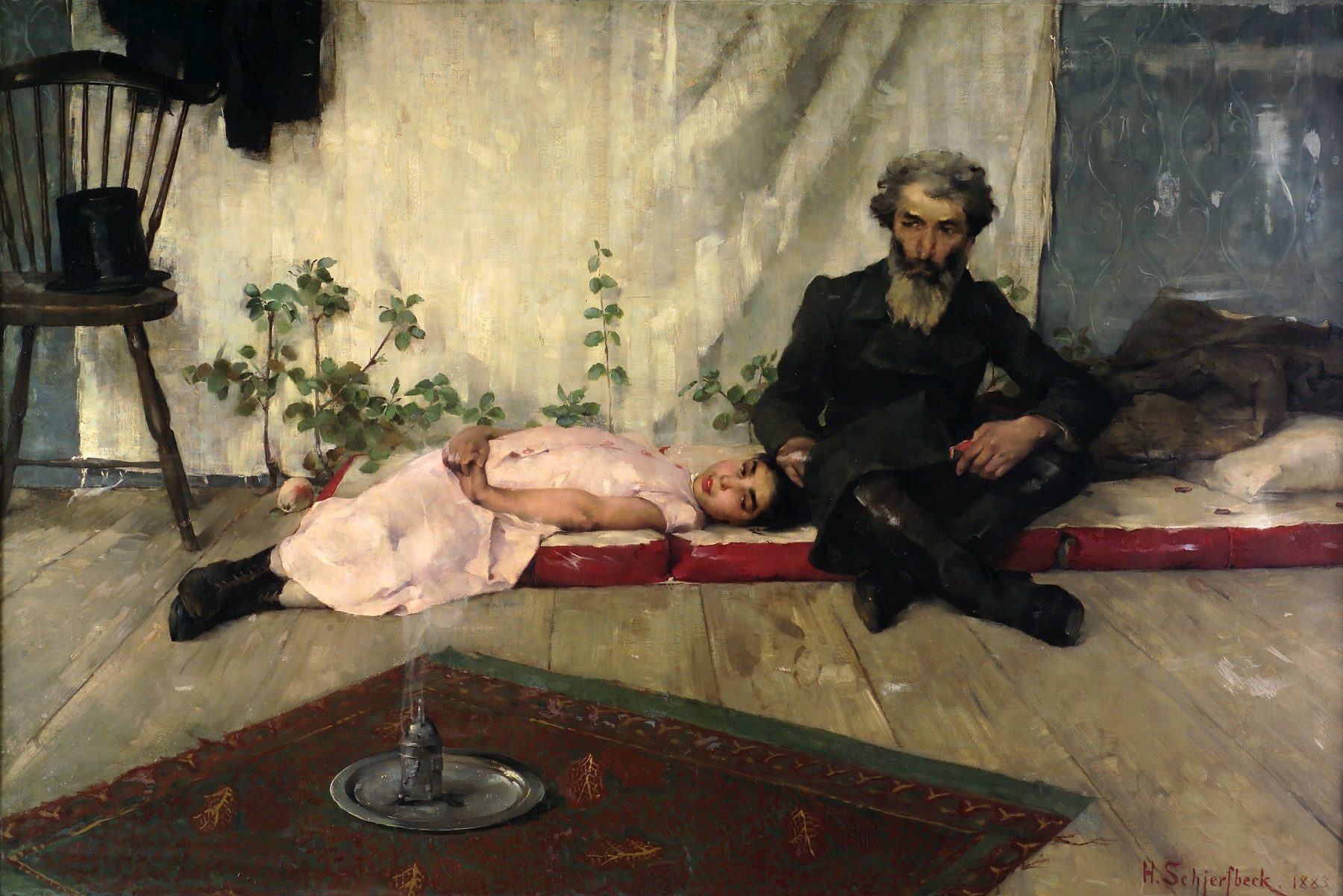
In Paris she worked in women's studios and then at the Academie Colarossi with her friend Helena Westermarck. Fete juive, a Sukkot scene of 1883 painted in the Helsinki studio she shared with Maria Wiik, got her into the Salon that year. Its height is given as 115 cm on Commons and 118 cm in the Ateneum text quoted by Alanen.
Chapter 3The Convalescent, painted once and repeated for fifty-seven years
She painted The Convalescent in St Ives in Cornwall in 1888, where she had gone in July 1887 at the invitation of Marianne Preindlsberger, wife of the English painter Adrian Stokes.
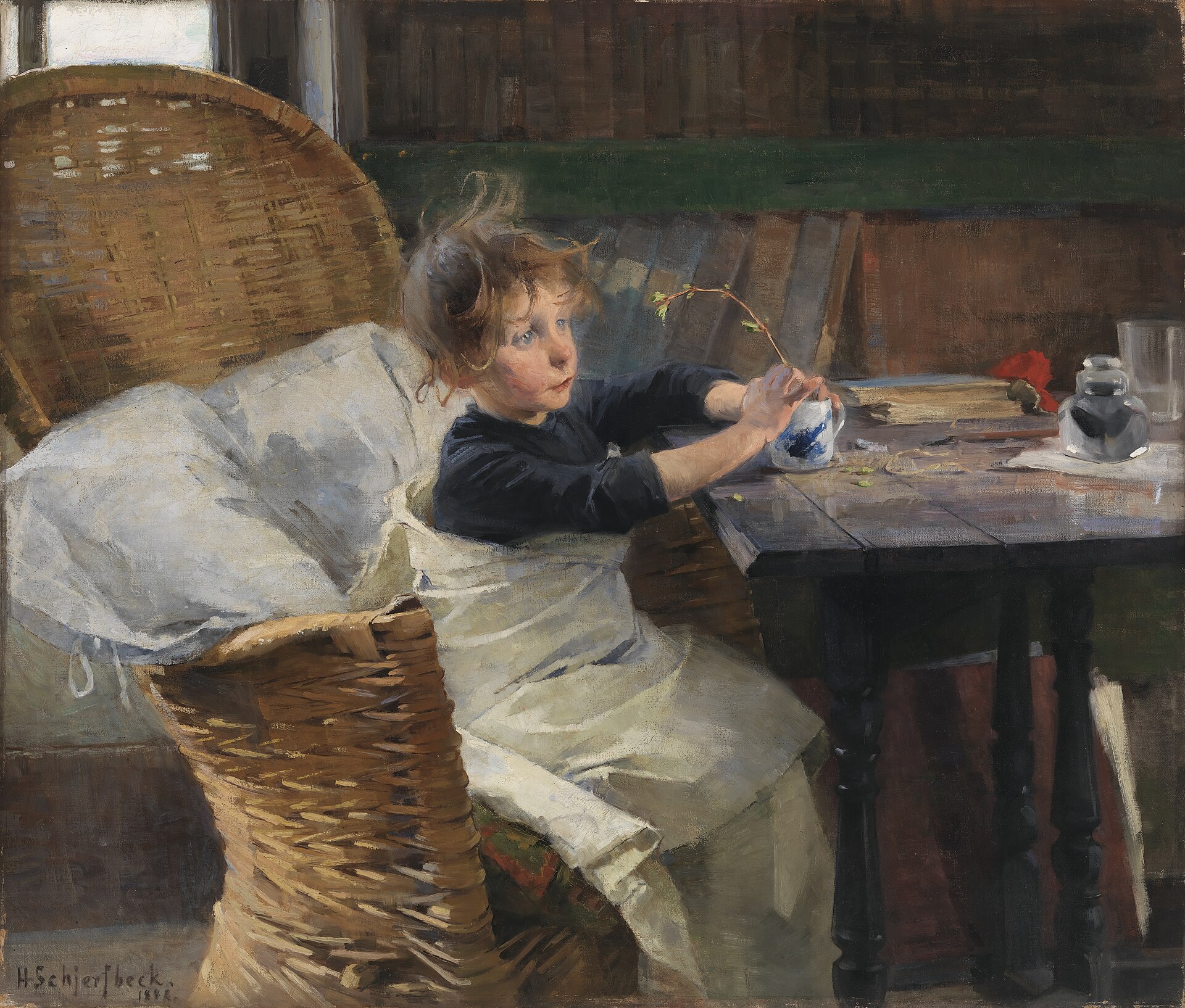
She painted The Convalescent in St Ives in Cornwall in 1888, where she had gone in July 1887 at the invitation of Marianne Preindlsberger, wife of the English painter Adrian Stokes. It was shown at the Paris Salon that year as Premiere verdure, the first greenery, and the Finnish Art Society bought it. The sitter was a lively girl of about six, but the picture shows her frail and still, holding a budding twig.
She came back to it. Bukowskis, in its December 2025 catalogue, says she returned to the motif nine times and names among the later works an oil of 1927 in her stripped late manner, a charcoal and watercolour drawing the same year, a black chalk drawing of 1938 that served as the prototype for a lithograph, and the charcoal and watercolour of 1945. Lahelma dates the 1927 oil to Stenman's commission of that year and says she cropped the composition so the picture is only the girl, much smaller than the original and limited to black, white and brown with a touch of pale green. The 1888 canvas is in the Ateneum. Every other version is a separate object under almost the same title, which is how auction records go wrong.
Chapter 4What the picture was about, and what later readers made of it
In its own time the subject was ordinary.
In its own time the subject was ordinary. Lahelma notes the sick child was a popular motif and typically read as a symbol of the fragility of life: Krohg's Sick Girl of 1880 to 1881 gave the child a withering rose, Munch's Sick Child of 1885 to 1886 made the same subject the centre of his first big success, and Schjerfbeck's child holds a green sprig. Krohg's child holds a withering rose, a plain sign of decay, while Schjerfbeck's holds a budding sprig, which Lahelma reads as a symbol of hope and as a more optimistic rendering than the Norwegians'. Lahelma adds that the topic may have had personal resonance, since Schjerfbeck had lost three siblings very young.
A second reading is argued, not documented. The essay Bukowskis prints with the 2025 lot states that the painting has been interpreted as a self-portrait made a year after her fiance broke off the engagement, with the artist seeing herself from both the child's and the adult's side. The essay is unsigned in the lot page text read. Lahelma records the engagement itself: the suitor, probably an older Englishman met in Brittany, ended it when he learned her father had died of tuberculosis, and his identity has not been established. The link between that event and this child is an interpretation, and she left no known sentence saying so.
Chapter 5Hyvinkaa: the models who had to look away
In 1902, after resigning her teaching post, she moved with her mother to Hyvinkaa, a railway town about 50 kilometres north of Helsinki.
In 1902, after resigning her teaching post, she moved with her mother to Hyvinkaa, a railway town about 50 kilometres north of Helsinki. Lahelma says her doctor recommended the place for its dry inland air and she had already spent two summers there; the Met says she went to care for her mother. She stayed until the mid 1920s. Her contact with the art world came by post. She took French art magazines including L'Art et les Artistes, received The Studio from her friend Maria Wiik, read Julius Meier-Graefe's Impressionisten in 1916 and wrote to Wiik in the same year that she was now completely modern.
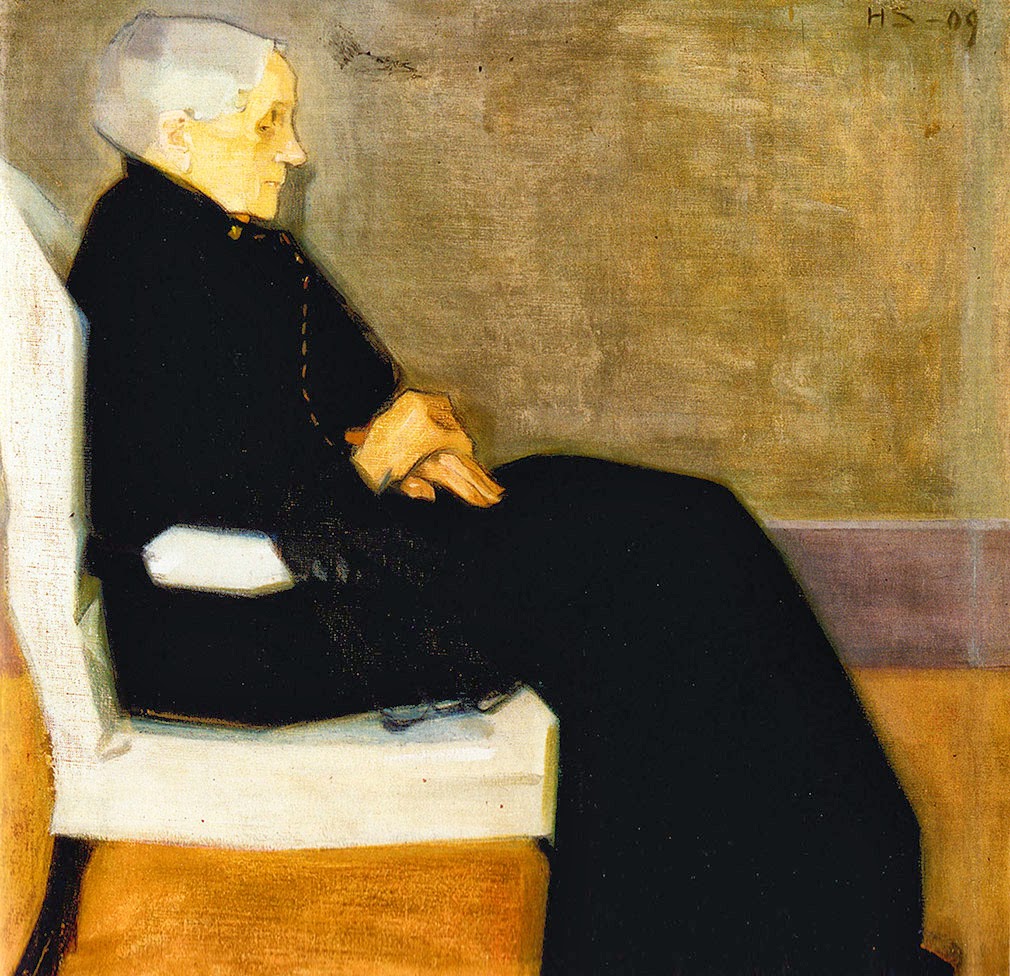
The Met's account of her sitters is exact. She told her models to look away while she painted, demanded their silence and refused to show them the end result. Many portraits omit the sitter's name, and the Met suggests she suppressed identities on purpose. A name does survive here and there: the Commons description of the Sotheby's image says the model for Girl with Blonde Hair (1916) was Impi Tamlander, a neighbour in Hyvinkaa. Her mother, who had no interest in her daughter's vocation, was co-opted as a model and sat for My Mother in 1909, a picture that made EUR 886,000 in a Helsinki sale in 2001.
Chapter 6Scraping, sanding and killing the tone
The technical signature is subtraction. Schjerfbeck built layers and removed them.
The technical signature is subtraction. Schjerfbeck built layers and removed them. Lahelma finds the earliest scraped works in St Ives in 1888 to 1890, a fisher boy, fishing boats and a street, made at Adrian Stokes's informal evening classes, and judges them probably done under his instruction. By Fragment of 1904 she scratched and scraped to imitate the look of a faded fresco. By Red Apples of 1915 she was laying on thick oil with a palette knife and still scraping to reveal what lay beneath. The Met says she sanded and scratched through layers of paint, sometimes exposing the weave of the canvas.
The tool is called sgraffito in the review by Bridget Alsdorf: a flat blade or stylus drawn through the top layer to show those below. Her friend Helena Westermarck called it ruthless. Alsdorf reports that technical analysis by the Met conservators Charlotte Hale and Silvia Centeno shows how vigorously she scratched, scraped and rubbed The Lace Shawl of 1920, which the Met bought in 2023 as accession 2023.98, the first Schjerfbeck in an American museum collection. Her stated aim, in a letter to Wiik of 1927, was to kill the tone, like Degas, who she said bleached his pastels in the sun for a dead tone.
None of the sources read publishes a pigment study or a list of diagnostic tells for authentication. Lahelma says collaboration with the Finnish National Gallery's conservators has yielded new knowledge of her materials and methods, but the findings are not set out in the book.
Chapter 7Gosta Stenman controlled the supply
In September 1912 the young journalist Gosta Stenman went to Hyvinkaa to buy from an artist he had seen in exhibitions.
In September 1912 the young journalist Gosta Stenman went to Hyvinkaa to buy from an artist he had seen in exhibitions. She was reluctant to sell. He left with twelve paintings, among them Costume Picture I and The Woodcutter I, and told her plainly he was buying to resell. In 1914 he opened Stenmans konstsalong, and in September 1917 he held her first solo show there, 159 works across her whole career. Einar Reuter, who had bought his first Schjerfbeck through Stenman in 1914, published a short biography as H. Ahtela that summer.
From the late 1930s, Lahelma writes, Stenman handled almost all her sales from Stockholm. Their contract is undocumented in detail, probably running from 1937 or 1938 to her death, and she told him in 1937 she had sold to no one else for some years. He paid generously and supplied her materials. She complained he paid too much. Lahelma cites Camilla Hjelm's argument that Stenman bought practically everything she made and deliberately held paintings back while selling lithographs, so that high demand and low supply raised the prices. The lithographs of 1938 and 1939, including The Convalescent and Silk Shoes, were received as new works and not as reproductions. Stenman's large Stockholm exhibition of 1937 was enthusiastically received, according to the Ateneum, and Swedish solo shows followed almost every year.
Chapter 8Remaking her own pictures, and the Madonnas after other painters
In 1927 Stenman commissioned new versions of her earlier work.
In 1927 Stenman commissioned new versions of her earlier work. She no longer had the originals, which had gone to museums and collectors, so she traced photographs and reproductions onto tracing paper and enlarged them with a grid. By the end of 1927 she had finished new versions of The Convalescent, Sjundby Manor and The Death of Wilhelm von Schwerin. Earlier she had already made three variations of Costume Picture in 1908 to 1909 and five versions of The Woodcutter in 1910 to 1911. A catalogue entry that gives only a title is therefore not enough to identify a picture.
From 1928 she also reinterpreted other painters. Angel Fragment, the first of several El Greco transcriptions, was bought by the industrialist Jalo Sihtola, who in 1931 commissioned a second work and gave her freedom to choose. She chose Madonna and Child, after Cimabue, of 1932, in black, white and grey with golden brown halos. She worked from black-and-white reproductions and had seen only one original El Greco in her life, plus one she thought might be a forgery. Her faith is documented in outline: Lahelma reports she always identified as a Christian in a general sense, was opposed to established religion, and after her mother's death in 1923 engaged more intensively with religious questions. The Madonnas are the visible result, argued by Lahelma as a search for spirituality and not a doctrinal programme.
Chapter 9Saltsjobaden: about forty self-portraits, half of them in two years
In early 1944 she gave in to Stenman and moved to Sweden by air, her first flight.
In early 1944 she gave in to Stenman and moved to Sweden by air, her first flight. He placed her in the spa hotel at Saltsjobaden outside Stockholm, where she had a large room, yellow roses and visiting nurses. She died there on 23 January 1946. Lahelma counts about forty self-portraits known across her career, over twenty from the last two years. The Met's release says twenty of the forty were painted in Sweden.
Stenman pushed her to paint herself and sent her books on self-portraits, including one on Kathe Kollwitz that she liked. She told a correspondent that artists who made themselves more beautiful were boring. The late works, Self-Portrait with Red Spot of 1944 and the 1945 series, are not the plain diary of decay they look like. Lahelma shows she kept recycling earlier images and alternated two formats, and The Last Self-Portrait of 1945 is a few charcoal lines floating on white paper. The earlier Self-Portrait, Black Background of 1915, with her name lettered across the top, is set by Lahelma beside Munch's 1895 lithograph Self-Portrait with Skeleton Arm.
Chapter 10Reuter's myth and its correction
Reuter's Finnish biography of 1951 carries the subtitle The struggle for beauty, with a Swedish translation two years later, and it is the source of the image of a fragile hermit.
Reuter's Finnish biography of 1951 carries the subtitle The struggle for beauty, with a Swedish translation two years later, and it is the source of the image of a fragile hermit. Lahelma writes that this image stigmatised understanding of her art for decades, that Reuter apparently believed claiming she made modernist works without seeing Cezanne or Picasso made her appear more original, and that Schjerfbeck was partly responsible herself by presenting illness and isolation to the press. Her letters show a woman reading, subscribing, ordering fashion from Paris and exhibiting in Finland, Sweden, Norway, Russia and Germany.
The record of her reputation is uneven. After her death a memorial exhibition at Kunsthalle Helsinki in 1954, a North American tour of about forty cities arranged by Stenman's widow Bertha, and the 1956 Venice Biennale gave her a European peak, then international interest declined from the 1960s. The Ateneum retrospective of 1992 travelled in reduced form to Washington and New York. The breakthrough came with the 2007 to 2008 exhibition in Hamburg, The Hague and Paris, which drew about 350,000 visitors. The Royal Academy mounted an exhibition in 2019, and the Metropolitan Museum's Seeing Silence from 5 December 2025 to 5 April 2026, with nearly sixty works.
Chapter 11Fakes, a counterfeit apple and a stolen self-portrait
Schjerfbeck is a forger's name. A Taloustaito column of 2020 says counterfeits have been sold under her name in every decade, sometimes with forged certificates of authenticity.
Schjerfbeck is a forger's name. A Taloustaito column of 2020 says counterfeits have been sold under her name in every decade, sometimes with forged certificates of authenticity. AFP reported on 1 November 2018 that the Helsinki District Court sentenced the two owners of a Helsinki gallery to four and five years, with EUR 13 million ordered in the first-instance judgment, and that investigators sent over 220 canvases to the Finnish National Gallery, most found forged and mostly the work of Veli Seppa, who admitted in court to painting and signing at least the Leger. AFP names Schjerfbeck among the signatures used. Finnish Wikipedia, a tertiary source to be replaced with the court record, says the Court of Appeal changed the terms in February 2021 and that Seppa forged her from at least the early 1990s.
Detection details for her fakes were not found in any source read. The only court reasoning found concerns a fake Leger. A genuine Market Apple of 1927 exists, privately owned and shown at Venice in 1956, and which composition the fake imitated was not established. The record of a real theft is separate: Lahelma says a self-portrait of about 1921 was stolen from the Eskilstuna art museum, and no date or recovery was found.
Chapter 12Where the paper is
The archive is in Finnish public hands. The Gosta Stenman Archive, her letters to him, and her letters to Martha Neiglick-Platonoff written in Sweden in 1944 and 1945 are in the Finnish National...
The archive is in Finnish public hands. The Gosta Stenman Archive, her letters to him, and her letters to Martha Neiglick-Platonoff written in Sweden in 1944 and 1945 are in the Finnish National Gallery's archive collections. Letters to Maria Wiik from 1907 to 1928 are at the Society of Swedish Literature in Finland as SLSA 1297, those to Dora Estlander at the Signe and Ane Gyllenberg Foundation in Helsinki, and Wiik and Westermarck manuscripts are at the Abo Akademi library in Turku. The Ateneum's sketchbooks are published online.
What happened to the estate is not recorded in the sources read. She died in Sweden and Stenman followed her in 1947. The Ateneum names bequests from Nanny and Yrjo Kaunisto and from Ester and Jalo Sihtola, a gift of five sketchbooks and a hundred sketches from the Friends of the Ateneum in 2011, and the Gosta and Bertha Stenman Donation. How her unsold work passed to heirs, to Reuter or to the market is an open question.
What is documented
Technique
The surviving work
- What is accepted
- 730 works, per the 2012 catalogue raisonne as reported by Lahelma (2023) and Yle (2019), excluding untraced and destroyed works. One genuine addition is on record since: The Girl from Barosund (1885-90), accepted by the Ateneum in 2019, which the Yle report says was not among the 730.
- What is contested
- No list of rejected works was found. Reuter's 1953 numbering reaches at least no. 981 against 730 in 2012, but the scope of the two lists is not explained in any source read. Forgeries sold under her name are documented but no attribution removal is.
- Who rules on attribution
- No authentication board, foundation or society was found. In the one documented case the Ateneum's curator Anna-Maria von Bonsdorff and its conservator Kirsi Hiltunen examined a new work in person and judged it genuine. For the 2018 forgery case, the Finnish National Gallery's experts examined over 220 canvases. A Helene Schjerfbeck society or committee was not found in any source read.
Catalogue raisonne
- Leena Ahtola-Moorhouse and Anu Utriainen (eds), Helene Schjerfbeck. 150 Years (Helsinki: Finnish National Gallery / Ateneum Art Museum, 2012). Finnish, Swedish and English editions; the series volume number (given elsewhere as Ateneum Publications vol. 66) was not verified, and it may be one volume or an exhibition catalogue plus a separate raisonne. The current catalogue of works, 730 entries; its numbers appear as 'no. 668', 'no. 697' and 'no. 711' on lot pages.814
- Leena Ahtola-Moorhouse (ed.), Helene Schjerfbeck, exhibition catalogue (Helsinki: Ateneum, 1992), with a catalogue of works. Earlier numbering, for example no. 464 and no. 494. Published in English for the Washington and New York showing.421
- H. Ahtela (Einar Reuter), Helena Schjerfbeck (Helsinki, 1953; Finnish first edition 1951; earlier short book 1917). Reuter's catalogue numbers, for example 904, 951 and 981, are still cited on lot pages. Compiled by a friend and her first biographer, who owned works.4231
Questions about Helene Schjerfbeck
Who was Helene Schjerfbeck?
Painter; Draughtswoman; Lithographer. 1862-1946.
When did Helene Schjerfbeck live?
Born 10 July 1862, Helsinki, Grand Duchy of Finland; died 23 January 1946, Saltsjobaden, Sweden.
How are fakes and misattributions of Helene Schjerfbeck detected?
Galerie Vision and Veli Seppa, Helsinki. AFP reported on 1 November 2018 that the Helsinki District Court sentenced the two owners of a gallery to four and five years, with EUR 13 million ordered at first instance, for selling forged works under famous names, Schjerfbeck among them; that over 220 canvases went to the Finnish National Gallery for verification, most found forged and mostly the work of Veli Seppa; and that Seppa admitted in court to painting and signing at least one of them (a Leger). Yle reported that Seppa received a suspended sentence in 2017.
Where can you see work by Helene Schjerfbeck?
Ateneum Art Museum (Finnish National Gallery) (Helsinki); Finnish National Gallery archive collections (Helsinki); Gosta Serlachius Fine Arts Foundation (Finland (town not read in a source)); Signe and Ane Gyllenberg Foundation (Helsinki); The Metropolitan Museum of Art (New York); Riihimaki Art Museum (Riihimaki).
What does the market for Helene Schjerfbeck look like?
Her record is GBP 3,044,500 for Dancing Shoes at Sotheby's London in May 2008, against an estimate of GBP 500,000 to 700,000. It has not been beaten in the sources read.
What is still unresolved about Helene Schjerfbeck?
What is the scope difference between Reuter's 1953 numbering, which runs past no. 980, and the 730 works of the 2012 catalogue, and how many of the 730 are paintings and how many drawings?
Open questions
- What is the scope difference between Reuter's 1953 numbering, which runs past no. 980, and the 730 works of the 2012 catalogue, and how many of the 730 are paintings and how many drawings?
- Is there any body that issues opinions on a work offered to the market, or does the Ateneum examine only when asked? No foundation, board or society was found.
- What did Stenman actually pay her per picture, and what did he sell them for? Lahelma says he paid generously, and Hjelm argues he held supply back, but no price list was read.
- Which composition did Seppa's forged Markkinaomena imitate, and what features exposed it? No technical report on the fakes was found.
- When was the self-portrait stolen from Eskilstuna, and has it been recovered?
- How did her unsold works pass at death in 1946, to Stenman, to Reuter, to relatives or to the Ateneum, and what tax or probate values were recorded? The estate is not described in any source read.
- What was the hammer price of Dancing Shoes in 2008, and what did the Sotheby's 2022 self-portrait with an estimate of GBP 600,000-800,000 make?
- Did the Hagelstam and Bukowskis Helsinki sales ever exceed the 2008 Sotheby's price in euros, and where is a primary result sheet for the EUR 445,000 Kiianlinna portrait?
Sources
- 1Marja Lahelma, 'Helene Schjerfbeck - An Artist's Life', FNG Research 1/2023 (Finnish National Gallery / Ateneum, online book, 167 pp). Read in full from the PDF; page references are to the PDF. Scholarly secondary source published by the holding museum. fngresearch.journal.fi/issue/...
- 2Bukowskis, Important Winter Sale Autumn 2025, lot 765A, Helene Schjerfbeck, 'The Convalescent' (signed HS and dated -45, watercolour and charcoal, 36 x 50 cm), 11 December 2025; lot page with provenance, literature and catalogue numbers. bukowskis.com/en/...
- 3Bukowskis, Important Spring Sale Spring 2022, lot 526, Helene Schjerfbeck, 'Sjalvportratt' (Self portrait, 1944, charcoal on paper, 20.5 x 18.5 cm), 9 June 2022; lot page with provenance and catalogue numbers. bukowskis.com/en/...
- 4Sotheby's London, European & British Art Part I, 13 July 2022, lot 13, Helene Schjerfbeck, 'Self-Portrait' (oil on board, 30 x 25.5 cm); lot page with provenance, exhibition history and three catalogue numbers. Result hidden behind a log-in. sothebys.com/en/...
- 5Sotheby's London, The Scandinavian Sale (L08104), lot 219, Helene Schjerfbeck, 'Tanssiaiskengat; Balskorna (dancing shoes)', oil on canvas, 55 x 64.5 cm; lot page with provenance, estimate GBP 500,000-700,000, condition report. Result hidden behind a log-in. sothebys.com/en/...
- 6ArtDaily, 'New Record Set at Sotheby's for Artist Helen Schjerfbeck at $5.3 Million', 31 May 2008 (Sotheby's press material). Reports GBP 3,044,500 against an estimate of GBP 500,000-700,000. artdaily.com/news/...
- 7ArtDaily, 'Finnish artists Helene Schjerfbeck and Albert Edelfelt command strong prices at Sotheby's' (Sotheby's press material; listed in ArtDaily's 26 May 2016 news column). Reports The Red-Haired Girl II, Girl with Blonde Hair and Lemons in a Wooden Bowl. artdaily.com/news/...
- 8Ateneum Art Museum, exhibition page 'Helene Schjerfbeck' (1 June - 14 October 2012), in Finnish. States the collection holds 212 works, announces the catalogue raisonne, and records Stenman's 1937 Stockholm exhibition. ateneum.fi/nayttelyt/...
- 9Ateneum Art Museum, news item 'Helene Schjerfbeck to start the new Artists of the Ateneum book series', published 8 September 2016. States the Ateneum holds the world's largest Schjerfbeck collection, more than 200 works. ateneum.fi/en/...
- 10Yle, 'Girl from Barosund' news item, 8 November 2019 (in Finnish). Reports that 730 earlier known works are listed and that a newly surfaced painting was judged genuine by curator Anna-Maria von Bonsdorff and conservator Kirsi Hiltunen. yle.fi/a/...
- 11Yle, 'Mies vaaransi yli sata taulua, taidekauppias myi vaarennoksia 30 vuotta', 28 August 2019 (in Finnish). Names Schjerfbeck among signatures on the sold forgeries; records Ranta's 2005 sentence and Seppa's 2017 suspended sentence. yle.fi/a/...
- 12ArtDaily / AFP, 'Finnish couple jailed over 13 mn euro art forgery scam', 1 November 2018. Helsinki District Court; over 220 canvases sent to the Finnish National Gallery for verification, the majority found forged and mostly the work of Veli Seppa. artdaily.com/news/...
- 13Finnish Wikipedia, 'Veli Seppa' (accessed 19 November 2026). Source for the EUR 350,000 sale of a forged 'Markkinaomena' in 2008. fi.wikipedia.org/wiki/...
- 14Bridget Alsdorf, 'Tell Me Your Worst', The New York Review of Books, 29 March 2026 (review of the Metropolitan Museum exhibition). Source for sgraffito, the Lace Shawl technical analysis by Charlotte Hale and Silvia Centeno, and the quotations from her letters. nybooks.com/online/...
- 15The Metropolitan Museum of Art, press release 'The Met Announces First Major U.S. Exhibition of Works by Finnish Painter Helene Schjerfbeck', 14 November 2025. Read in a browser; the Met site blocks plain requests. metmuseum.org/press-releases/...
- 16The Metropolitan Museum of Art, Open Access collection API, object 894279, Helene Schjerfbeck, 'The Lace Shawl', 1920, oil on canvas, 58 x 36.5 cm, accession 2023.98, Mary Trumbull Adams and Rogers Funds, 2023. collectionapi.metmuseum.org/public/...
- 17MTV Uutiset, 'Ennatyshinta Schjerfbeckin maalauksesta', 2 December 2001 (in Finnish). Reports 'Aitini' (My Mother, 1909) at Bukowski-Horhammer, Helsinki. mtvuutiset.fi/artikkeli/...
- 18MTV Uutiset, 'Schjerfbeckin tyosta lahes 3 Mmk', 7 February 2001 (in Finnish). Reports Portinvartijan tytar at Christie's London. mtvuutiset.fi/artikkeli/...
- 19Pauliina Littorin (PhD in philosophy and art-market expert, per the column's byline), 'Kaikki haluavat Schjerfbeckin', Taloustaito, 21 August 2020 (in Finnish). Source for the 1986 record sale of 'Kirje' (not checked elsewhere), resale royalties in the 1990s and forgeries every decade. taloustaito.fi/vapaalla/...
- 20English Wikipedia, 'Helene Schjerfbeck' (accessed 19 November 2026). Its Royal Academy dates are not used on this page. en.wikipedia.org/wiki/...
- 21Johannes Reponen, reference journal entry, 29 November 2017: 'Portrait of actor Matti Kiianlinna [1926] by Helene Schjerfbeck, sold for EUR 445,000 at Hagelstam Classic T110 auction'. johannesreponen.com/reference-journal/...
- 22Wikimedia Commons, Category:Paintings by Helene Schjerfbeck and per-file pages; licence read from .LicenseShortName for every plate on this page (Public domain or CC0). commons.wikimedia.org/wiki/...
- 23Antti Alanen, Film Diary, 'Helene Schjerfbeck 150 (an exhibition)', June 2012 (blog; reproduces the Ateneum press text). Source for Fete juive data and the three-language 2012 catalogue. anttialanenfilmdiary.blogspot.com/2012/...
- 24Ateneum Art Museum, news item 'The first English-language biography of Helene Schjerfbeck published on the FNG Research website', 2023. Places the Lahelma biography inside the Ateneum's Schjerfbeck research project. ateneum.fi/en/...
Last verified