Charles Rennie Mackintosh
 Scottish · 1868-1928
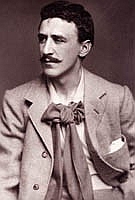
Photographed by James Craig Annan in 1893, when Mackintosh was twenty-five and still an assistant at Honeyman and Keppie, seven years before The Four's showing in Vienna. The identification is secure and unchallenged in the sources consulted; the file was sourced by its Commons uploader from the Charles Rennie Mackintosh Society's own site.
Charles Rennie Mackintosh Society, via Wikimedia Commons| Worked as | Architect, Interior Designer, Furniture Designer, Watercolourist |
|---|---|
| Born | 7 June 1868 · Townhead, Glasgow, Scotland |
| Died | 10 December 1928 · Bayswater, London, England |
| Nationality | Scottish |
| Movement | Glasgow Style (Art Nouveau) |
| Sources | 28 cited |
| Last verified |
About this page Last verified · 28 sources cited
On this page 12 sections
ContentsClose
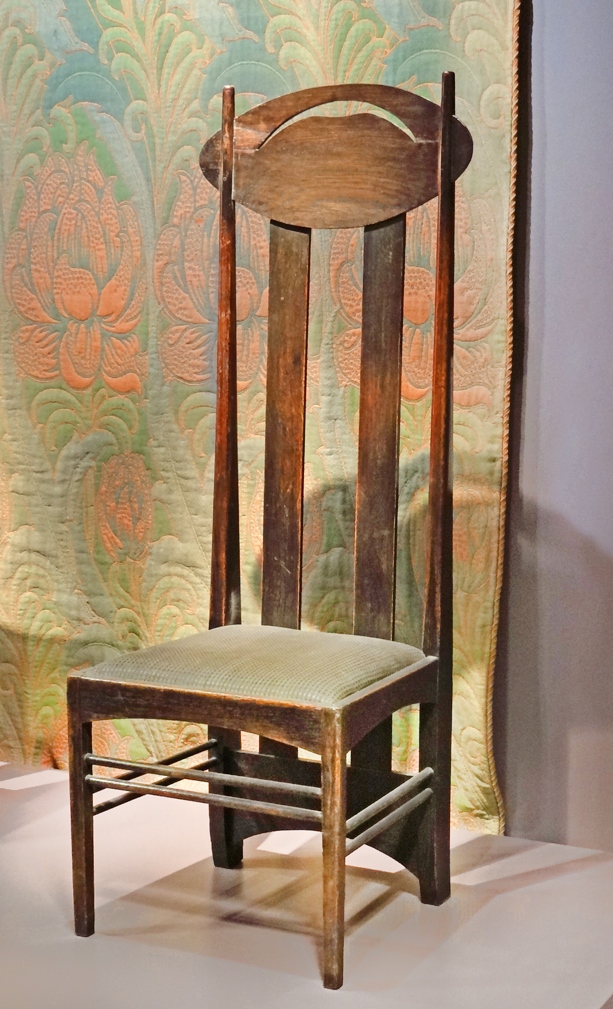
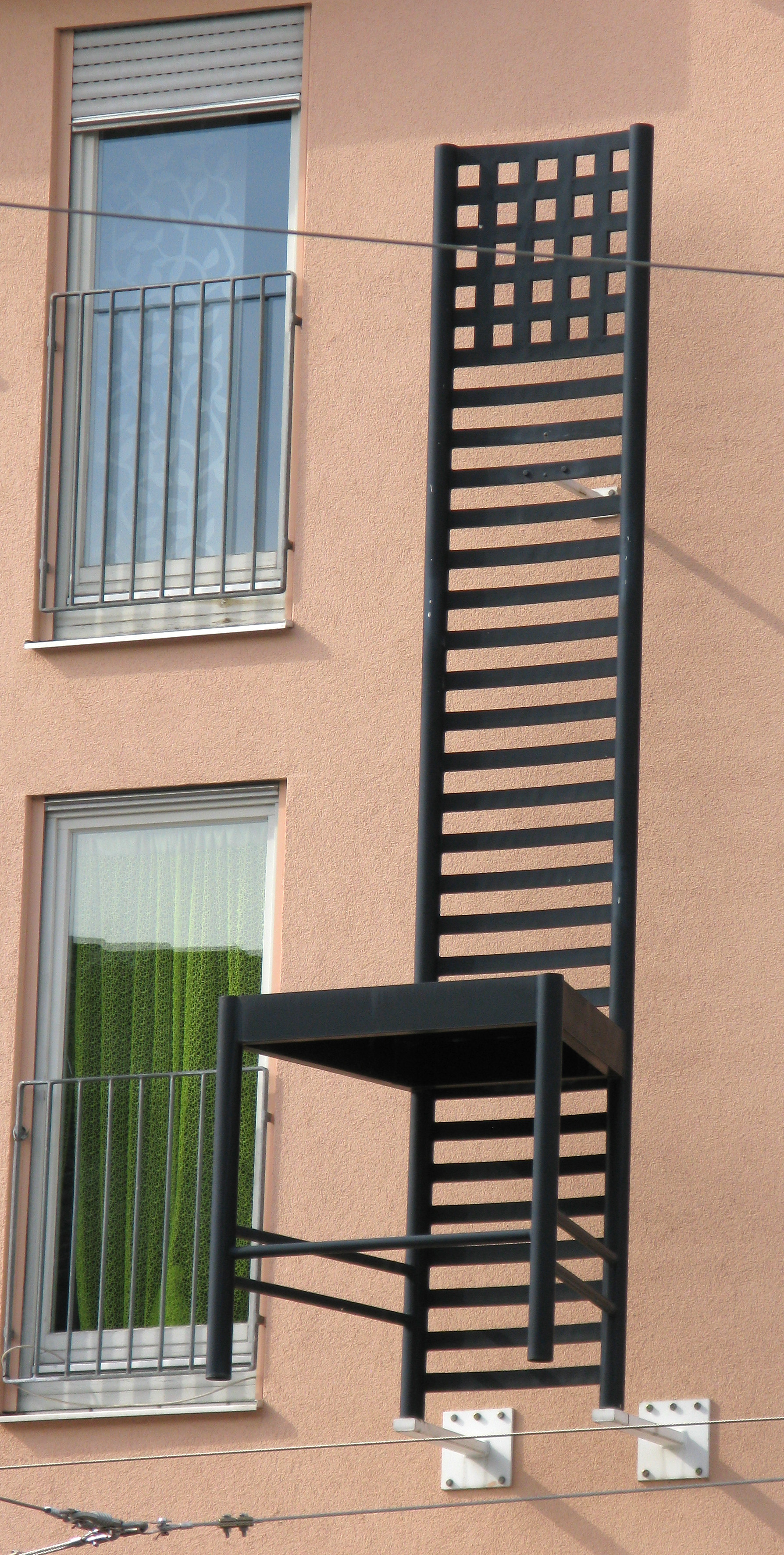
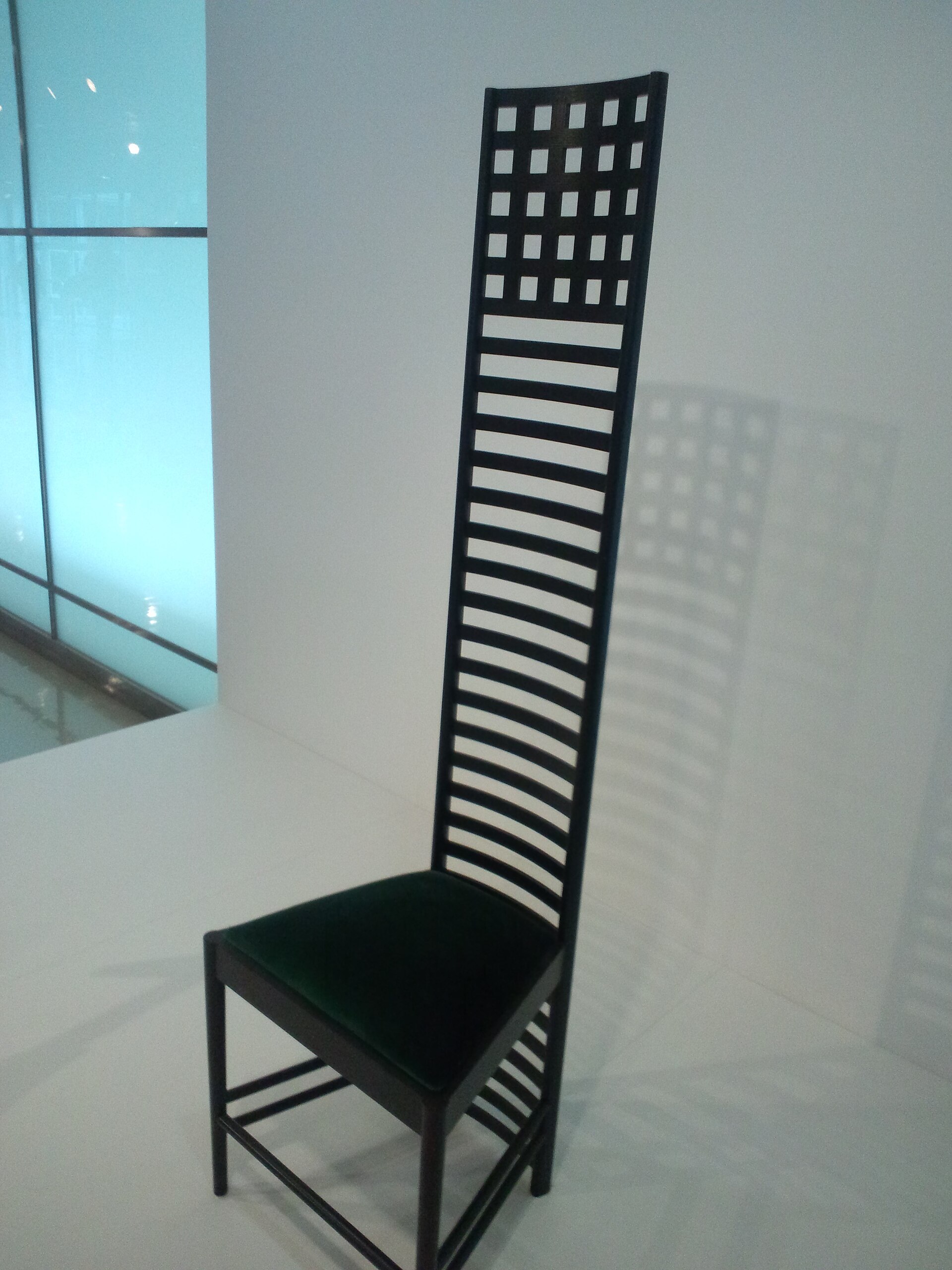
Charles Rennie Mackintosh is remembered for a handful of Glasgow buildings and a chair so tall and narrow it is barely furniture at all: the Glasgow School of Art, the Willow Tea Rooms, Hill House, and the ladder-back silhouette now licensed worldwide. The name carries more weight today than it ever did while he was alive to answer for it.
What most readers do not know is how short the working life behind that reputation actually was, and how it ended. Mackintosh's entire built career runs from about 1896 to 1913, seventeen years, after which he resigned his partnership, largely stopped practising architecture, and spent his last fifteen years as a working watercolourist instead. He was better known in Vienna and Munich in 1900 than in his own country, and the popular idea of him as a lone genius erases the two women, Margaret Macdonald and her sister Frances, and the architect Herbert MacNair, who built the Glasgow Style alongside him. His single most photographed building has now burned twice and stands, in 2026, an unrestored shell whose own governing board says a full rebuild is not currently affordable.
A second thing worth knowing before approaching this market: since 1973 an Italian manufacturer has produced authorised reissues of his best-known chairs in different material from the originals, and most of what is sold or displayed under his name today is that reissue, not a Blackie-era or Cranston-era original. Distinguishing the two is not a footnote here; it is close to the whole practical question for anyone buying, and this page treats it that way.
Images
Chronology
- 1868
Born 7 June at Townhead, Glasgow.1
- 1884
Apprenticed to the Glasgow architect John Hutchison while attending evening classes at the Glasgow School of Art.1
- 1889
Joined the Glasgow practice of Honeyman and Keppie as a draughtsman and designer.1
- 1890
Won the Alexander Thomson Travelling Studentship and toured Italy.19
- 1892
Met Margaret Macdonald at the Glasgow School of Art; The Four begin working together under Francis Newbery.1
- 1896
Wins the competition to design a new building for the Glasgow School of Art.19
- 1897-1899
- 1900
Marries Margaret Macdonald on 22 August; the couple travel to Vienna in October to install their room at the Eighth Secession exhibition, opening 3 November; Mackintosh made a corresponding member of the Secession.1328
- 1901
Becomes a partner; the firm is renamed Honeyman, Keppie and Mackintosh.1
- 1902-1904
Hill House designed and built for the publisher Walter Blackie at Helensburgh.1
- 1903
The Willow Tea Rooms open at 217 Sauchiehall Street for Catherine Cranston.11
- 1904
Commissioned by Cranston to redesign her own house, Hous'hill, including its White Bedroom.20
- 1905
The Hill House drawing-room writing desk built by Alex Martin to Mackintosh's design.10
- 1907-1909
West wing and library of the Glasgow School of Art built; the heavily glazed library proves too cold to use as designed on opening and radiators are fitted afterward.4
- 1913
Resigns from Honeyman, Keppie and Mackintosh; attempts an independent practice.1
- 1914
Moves with Margaret to Walberswick, Suffolk.1
- 1915
Arrested and briefly held on suspicion of being a German spy.1
- 1916-1920
Remodels 78 Derngate, Northampton, for Wenman Bassett-Lowke, his only executed English commission.116
- 1920
Sells the Mackintoshes' own Glasgow home and its furniture to William Davidson.26
- 1923
Moves to Port Vendres, France, and works chiefly as a watercolourist.1
- 1927
Returns to London through illness; diagnosed with tongue cancer.1
- 1928
Dies 10 December in Bayswater, London, aged 60; ashes scattered over the Mediterranean at Port Vendres.1
- 1933
Hous'hill's contents, including the White Bedroom furniture, dispersed at the J. and R. Edmiston sale, Glasgow, 13 May.18
- 1945
William Davidson's sons donate the Mackintosh house contents to the University of Glasgow.26
- 1973
The Charles Rennie Mackintosh Society founded; Cassina begins licensed reissues of his furniture under its I Maestri programme.625
- 1981
The Mackintosh House opens at the Hunterian, reassembling the couple's Southpark Avenue interiors.26
- 1990
Glasgow's year as European City of Culture accelerates the popular Mackintosh revival.1
- 1996-1997
The Metropolitan Museum of Art mounts the first Mackintosh retrospective to reach the United States, touring to Chicago and Los Angeles.1
- 1999
The Charles Rennie Mackintosh Society becomes owner and custodian of Queen's Cross Church.6
- 2002
The Hill House writing desk sold at Christie's, 6 November, and jointly acquired by Glasgow City Council and the National Trust for Scotland for a total cost of 996,650 pounds.1013
- 2009
Clydesdale Bank issues a 100-pound note bearing Mackintosh's portrait, 15 December.1
- 2014
Fire at the Glasgow School of Art on 23 May destroys the library and much of the west wing.9
- 2018
A second fire on 15 June guts roughly ninety per cent of the Mackintosh Building's interior.9
- 2019
The Hill House Box, a 165-tonne chainmail-clad steel shelter, opens on 7 June, Mackintosh's 151st birthday; a further US touring retrospective opens at the Walters Art Museum in October.1227
- 2020
A 78 Derngate bedside cabinet makes a hammer price of 250,000 pounds at Lyon and Turnbull, 2-3 November.1617
- 2024
The National Trust for Scotland acquires Mackintosh at the Willow (the former Willow Tea Rooms), 19 January.11
- 2025
The Hill House writing desk returns to Hill House on loan from Kelvingrove, 9 May; the watercolour Bouleternere makes 150,200 pounds at Lyon and Turnbull, 17 April.1015
- 2026
Mackintosh at the Willow is renamed The Mackintosh Tearooms in February; in July the Glasgow School of Art's board says a 265 million pound full restoration of the Mackintosh Building is unaffordable.911
The market
Mackintosh's market does not compress into one trend. His most elaborate surviving piece of furniture, the Hill House drawing-room writing desk, was jointly acquired by public bodies in 2002 for a total cost approaching a million pounds, while a single well-provenanced tea-room chair can still be bought for well under fifty thousand dollars. Later objects from the 78 Derngate commission and the Port Vendres watercolours trade in their own separate bands. Across every category, the clearest single signal available to a buyer is the price gap between a documented period original and a Cassina-era or later reissue, which routinely differs by one to two orders of magnitude for a visually similar object.
| Date | Sale | Work | Result | Note |
|---|---|---|---|---|
| 6 November 2002 | Christie's, King Street, London | Writing desk, Hill House drawing room (the 'kimono desk') | Hammer not separately published in the sources consulted With premium not separately published; total acquisition cost GBP 996,650 GBP | Jointly acquired by Glasgow City Council and the National Trust for Scotland, with a GBP 106,043 grant from the Art Fund toward the total and further support from the National Lottery Fund. The sources consulted give only the total cost of acquisition, not a hammer price separated from a buyer's premium. |
| 7 November 2019 | Wright, Chicago (International Style: The Boyd Collection, lot 101) | Ladderback chair, Willow Tea Rooms, Glasgow, c. 1903 | Hammer not separately published; single 'result' figure reported With premium USD 47,500 (result, as reported by the auction house) USD | Estimate USD 15,000-20,000. Provenance: commissioned directly from Mackintosh by Catherine Cranston; Sotheby's London, 27 October 2009, lot 9; Collection of Michael and Gabrielle Boyd. |
| 2 November 2020 | Lyon and Turnbull, Edinburgh (Decorative Arts: Design Since 1860) | Bedside cabinet, 78 Derngate, c. 1916, for Wenman Bassett-Lowke | Hammer GBP 250,000 With premium reported elsewhere as approximately USD 325,000 including buyer's premium GBP (hammer); USD (reported total) | Estimate GBP 10,000-15,000 (reported elsewhere as USD 13,000-19,500). The pair to an example in the Victoria and Albert Museum; made circa 1916 with input from interned German craftspeople on the Isle of Man. The sources consulted report the hammer price in sterling and the final price including premium in dollars, and this page has not been able to reconcile the two into one currency. |
| 17 April 2025 | Lyon and Turnbull, Edinburgh (Design Since 1860) | Bouleternere, watercolour, 1925 (Port Vendres period) | Hammer not stated in the source consulted With premium GBP 150,200 (price including buyer's premium) GBP | Provenance and exhibition history beyond the sale itself could not be independently confirmed from the source consulted; the earlier claimed Christie's Edinburgh (1989) and Taffner Collection (2012) provenance and a Metropolitan Museum 1996-1997 exhibition history are struck pending a verified citation. |
Hammer is the price at which the bidding stopped; with premium adds the fee the house charges the buyer on top. Hammer price and buyer's premium in the glossary.
Recorded without a public price
- 2017 · Side chair, White Bedroom, Hous'hill (not a Hill House chair; a comparable Cranston commission) · Sotheby's, New York (Important Design, lot 13) · not stated in the source consulted Estimate USD 100,000-150,000. One of only two known examples, the other in the Musee d'Orsay. Provenance runs through Edward Arthur Gamble (1919), the J. and R. Edmiston sale of 13 May 1933, private descent, and a Christie's London sale of 8 November 2001 before this offering. The price realised is not disclosed in the lot page consulted.
Where to see the work
| Institution | City | Holdings | Note |
|---|---|---|---|
| The Hunterian, University of Glasgow (the Mackintosh House) | Glasgow | Reconstructed principal interiors of the Mackintoshes' own Southpark Avenue home, opened 1981; over 80 pieces of Mackintosh's own furniture | His only surviving domestic interior in Glasgow. |
| Glasgow School of Art (the Mackintosh Building) | Glasgow | The building that made his reputation | Fire-damaged in 2014 and again in 2018; an unrestored shell as of 2026, with a full rebuild costed at GBP 265 million and described by the School's own board as currently unaffordable. |
| The Hill House, National Trust for Scotland | Helensburgh, Argyll and Bute | The house and its original furniture and fittings, including the returned drawing-room writing desk (on loan from Kelvingrove since May 2025) | Enclosed since June 2019 inside the chainmail-clad Hill House Box while conservators address a century of water damage. |
| The Mackintosh Tearooms (formerly Mackintosh at the Willow) | Glasgow | The 1903 Willow Tea Rooms interior, restored 2014-2018 and reopened as a visitor attraction | Acquired by the National Trust for Scotland in January 2024; renamed February 2026. |
| 78 Derngate | Northampton, England | The remodelled 1916-1920 Bassett-Lowke house, open as a visitor attraction since 2003 | Mackintosh's only executed commission in England. |
| Queen's Cross Church | Glasgow | Mackintosh's only executed church design | Headquarters of the Charles Rennie Mackintosh Society, which has been custodian of the building since 1999. |
| Victoria and Albert Museum | London | Chairs from the Argyle Street and Willow Tea Rooms commissions and from the 1916-1920 Bassett-Lowke commission | |
| Glasgow Museums, Kelvingrove | Glasgow | A major holding of Mackintosh furniture, panelling and fittings, including Hous'hill and Hill House-related pieces | Displays Mackintosh alongside the wider Glasgow Style collection. |
The essay
Chapter 1Who he actually was, and what the standard account gets wrong
The popular Mackintosh is a solitary visionary, ahead of his time and unappreciated by a philistine Glasgow.
The popular Mackintosh is a solitary visionary, ahead of his time and unappreciated by a philistine Glasgow. Both halves of that sentence need qualifying. He was not solitary: from his student years at the Glasgow School of Art he worked as one of a group of four, with his future wife Margaret Macdonald, her sister Frances Macdonald, and Frances's future husband Herbert MacNair, and the decorative programme of his major interiors is inseparable from Margaret's own work as a designer in her own right. He was recognised in his own time, just not primarily at home: the Vienna Secession made him a corresponding member in 1900, and his work travelled to Turin and Moscow while London and even Glasgow remained comparatively cool.
A smaller but persistent error is worth clearing up on its own terms. The line most often quoted as summing up his personal creed, that there is hope in honest error and none in the icy perfection of the mere stylist, is not his. It was written by the English architect J. D. Sedding and Mackintosh adopted it as a personal motto, which is a different and less tidy fact than the one usually repeated. Getting the authorship of a maker's own supposed words wrong is exactly the kind of small, checkable error this page exists to catch.
Chapter 2Training, Honeyman and Keppie, and The Four
Mackintosh apprenticed to the Glasgow architect John Hutchison from 1884 while attending evening classes at the Glasgow School of Art, where he studied under the school's director Francis Newbery and...
Mackintosh apprenticed to the Glasgow architect John Hutchison from 1884 while attending evening classes at the Glasgow School of Art, where he studied under the school's director Francis Newbery and won a series of student prizes, including the Alexander Thomson Travelling Studentship in 1890, which funded an architectural tour of Italy. In 1889 he joined the established Glasgow practice of Honeyman and Keppie as a draughtsman and designer, becoming a partner in 1901, when the firm was renamed Honeyman, Keppie and Mackintosh.
He met Margaret Macdonald at the Glasgow School of Art around 1892. Newbery is credited with bringing Mackintosh, Margaret, her sister Frances, and Frances's eventual husband Herbert MacNair together as a working group. Mackintosh married Margaret on 22 August 1900; MacNair had married Frances the previous year. The four exhibited and worked as a unit under the name The Four for most of the 1890s, and the decorative vocabulary they developed together, not Mackintosh's alone, is what came to be called the Glasgow Style.
Chapter 4Margaret Macdonald: collaborator, not decoration
Margaret Macdonald designed independently before her marriage and continued to after it; the couple's joint showing at the Eighth Vienna Secession exhibition in 1900 listed her as an exhibitor...
Margaret Macdonald designed independently before her marriage and continued to after it; the couple's joint showing at the Eighth Vienna Secession exhibition in 1900 listed her as an exhibitor alongside Mackintosh, not as an appendage to him. She is credited with much of the decorative scheme at Hill House and with the White Bedroom furniture Mackintosh designed for Catherine Cranston's own house, Hous'hill, and the enamelled and leaded-glass panel on the writing desk Mackintosh made for Hill House's drawing room may be her work rather than his, on the current curatorial reading of the National Trust for Scotland and Glasgow Life Museums, who describe it only as a piece she may have designed.
Mackintosh said as much himself. In a 1927 letter to Margaret, quoted in later scholarship on the couple, he wrote: "You must remember that in all my architectural efforts you have been half if not three-quarters of them." That is Mackintosh's own dated statement of the division of credit, not a modern re-reading of it, and this page takes it at that weight.
Chapter 5The Tree of Life, Lethaby, and what evidence there actually is for something more
Mackintosh's own architectural lectures quoted directly from W.
Mackintosh's own architectural lectures quoted directly from W. R. Lethaby's 1891 book Architecture, Mysticism and Myth, which argued that a tree serves both as a symbol of the universe and as a basic form of building construction. That is a documented citation in Mackintosh's own hand, not a later reader's inference, and its physical result is checkable: a carved relief of two figures flanking a central tree sits above the Glasgow School of Art's entrance, a further tree motif appears in the oval glass insets of its ground-floor doors, the library's leaf-carved balusters and shelving play on the idea of a tree of knowledge, and at Queen's Cross Church the roof trusses carry a tree-of-life emblem while the east window works in a T-shaped tree of knowledge.
How far beyond that documented citation any programme extends is exactly where named scholars disagree in degree, and this page keeps the levels separate. Timothy Neat has argued, in a dedicated study of meaning in Mackintosh and Macdonald's work, that specific early watercolours such as The Harvest Moon (1892-93) and Winter carry a charge drawn from Rosicrucian and Theosophical writing, reading particular motifs, a divided moon, a golden seed, paired female figures, against passages in Helena Blavatsky. That is Neat's own interpretive argument, resting on a resemblance between a motif and a text rather than on any statement by Mackintosh himself, and it is presented here as his proposal, not as settled fact about the paintings' intent.
Membership is the one point on this subject that can be stated as an actual documented negative rather than an open question. The Mackintoshes were close friends of Patrick and Anna Geddes, and Geddes had personally tutored the Theosophist Annie Besant in the 1870s, a real and traceable connection to that milieu. Even so, the scholar Janice Helland, in her study of Frances and Margaret Macdonald's studios, finds there is no evidence that Mackintosh or Margaret actually became Theosophists, despite their documented interest in the Celtic Revival and in Maurice Maeterlinck's writing. That absence of documented membership, set against a real interest in the surrounding ideas, is the finding this page records, rather than a gap filled by inference from friendship and shared reading.
Chapter 6The Glasgow School of Art: the building that made his name, twice destroyed
Mackintosh won the competition to design a new building for the Glasgow School of Art in 1896 and it was built in two phases, the east wing from 1897 to 1899 and the west wing, including the...
Mackintosh won the competition to design a new building for the Glasgow School of Art in 1896 and it was built in two phases, the east wing from 1897 to 1899 and the west wing, including the celebrated double-height library, from 1907 to 1909. The library's window bays carried so much glazing that on its opening in autumn 1909 the space proved too cold to use as designed, and radiators had to be fitted afterward, an unglamorous practical failure inside what is usually described only as a masterpiece.
The building has now burned twice. A fire on 23 May 2014 destroyed the library and much of the west wing, along with, by the School's own account, around 97 items of furniture from its Recognised Collection. A second fire on 15 June 2018, during the building's restoration, gutted roughly ninety per cent of the interior. As of a July 2026 report from the School's own board of governors, a full and faithful rebuild is costed at around 265 million pounds and is described in the board's own words as unaffordable; the insurance claim over the second fire has only recently settled and scaffolding erected in 2018 has yet to come down. The building most associated with Mackintosh's reputation is, at the time this page was written, an unrestored shell with no funded rebuilding timetable.
Chapter 7Willow Tea Rooms, Hous'hill, and the client who let him decorate everything
Catherine Cranston commissioned Mackintosh repeatedly across more than a decade, starting with the Argyle Street Tea Rooms around 1897 and continuing through Buchanan Street and Ingram Street to the...
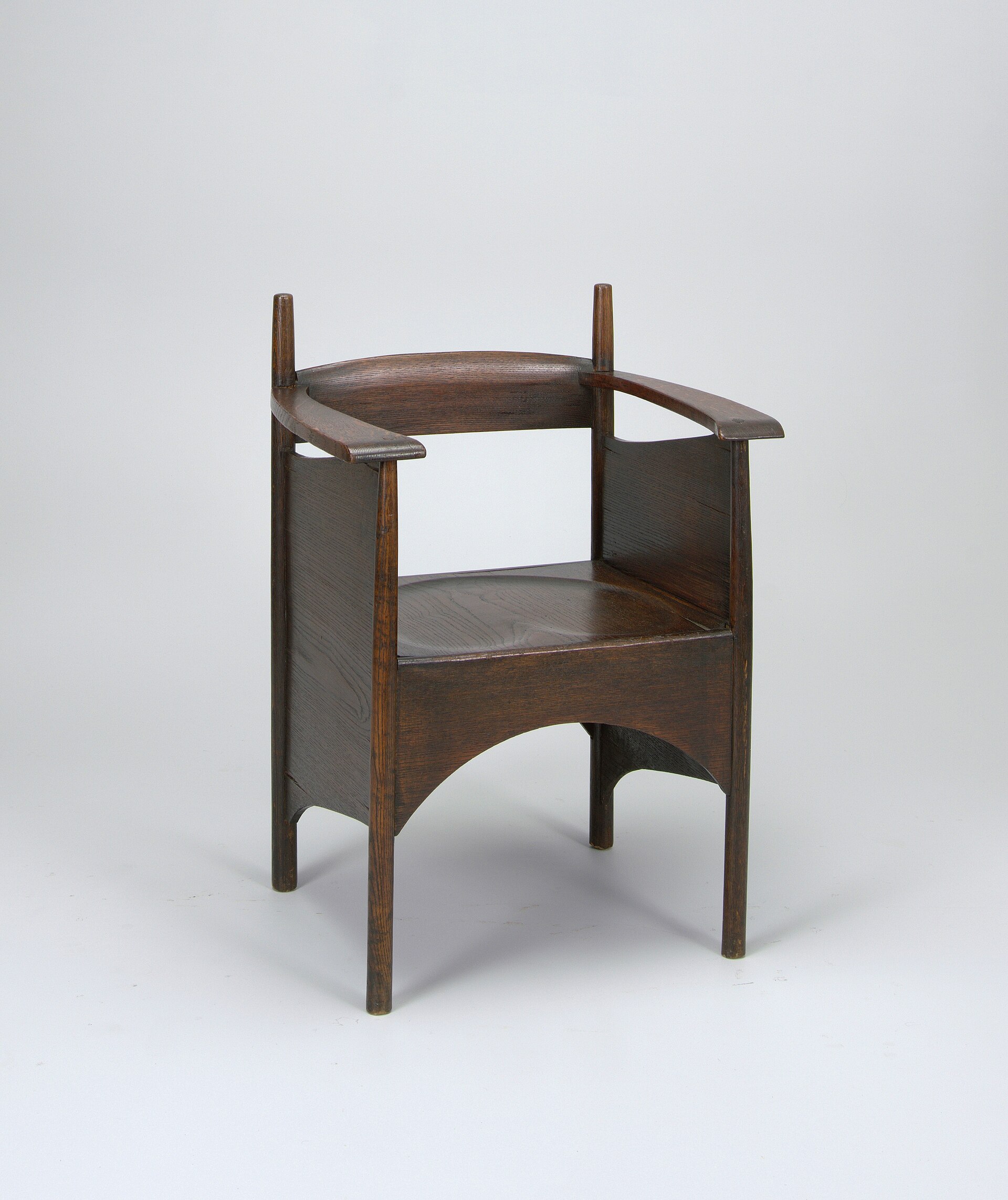
Catherine Cranston commissioned Mackintosh repeatedly across more than a decade, starting with the Argyle Street Tea Rooms around 1897 and continuing through Buchanan Street and Ingram Street to the Willow Tea Rooms at 217 Sauchiehall Street, opened in 1903 and his most complete surviving public interior: he and Margaret Macdonald designed the building down to the furniture, the leaded glass, the menu cards and the waitresses' dress. In 1904 Cranston gave Mackintosh a further, private commission, to redesign her own house, Hous'hill, at Nitshill; its White Bedroom repeated a device used at Hill House the previous year, furniture painted almost entirely white and set against a single black-painted chair for contrast.
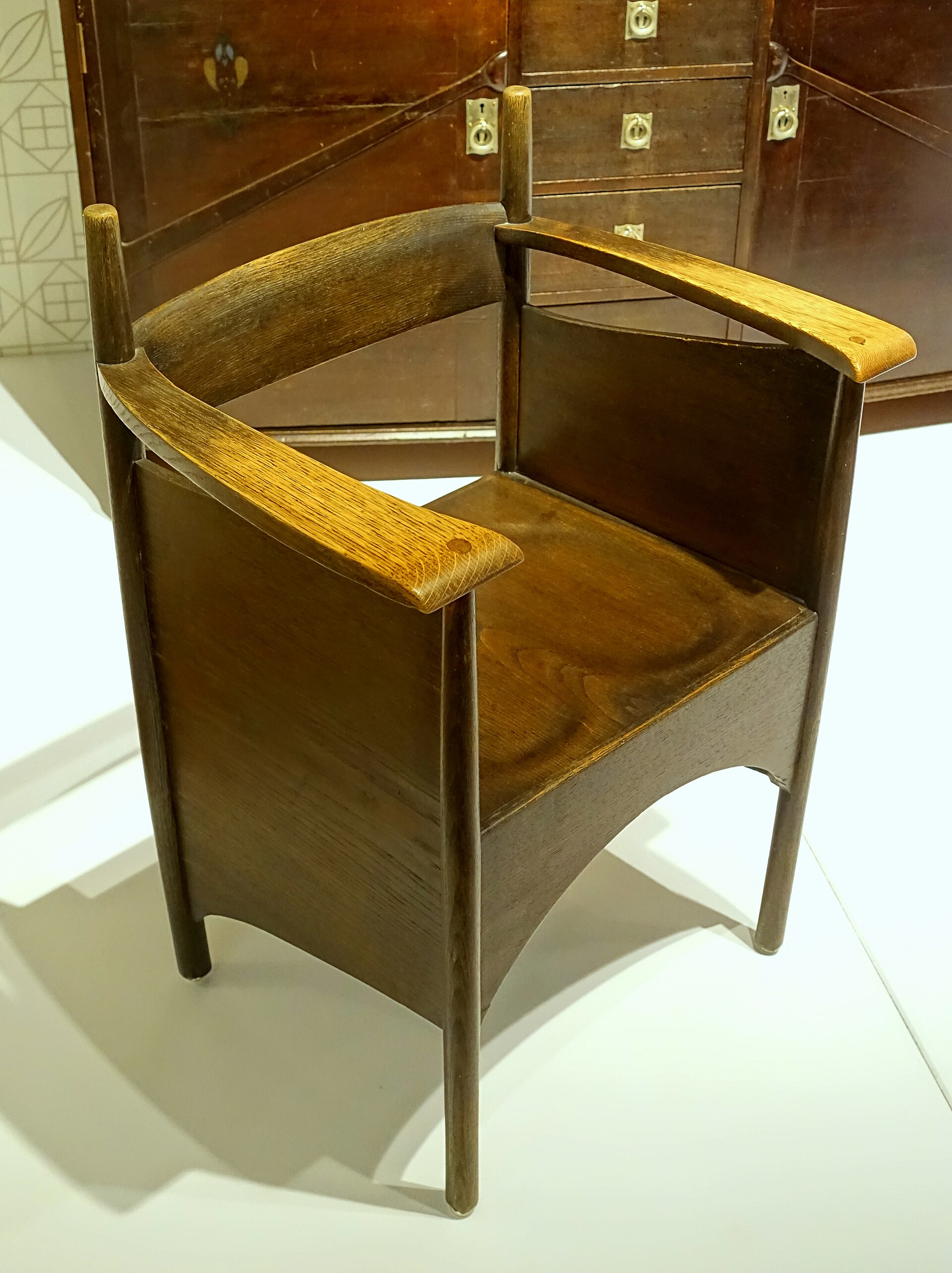
Hous'hill's contents were dispersed at the auctioneers J. and R. Edmiston in Glasgow on 13 May 1933 when the house was sold, and the White Bedroom pieces were scattered with them. Only two examples of the White Bedroom side chair are known to survive today, one in the Musee d'Orsay in Paris and the other in a private collection, sold at Christie's London in 2001 and offered again at Sotheby's in 2017. Cranston's tea rooms and her own house therefore hold a genuinely separate, and separately documented, body of Mackintosh furniture from the Blackie commission at Hill House, a distinction routinely lost in casual and dealer writing that groups every tall dark chair under his name into one undifferentiated category.
Chapter 8Hill House: the commission built from the inside out
The publisher Walter Blackie commissioned Mackintosh in 1902, introduced through Talwin Morris, the art director of Blackie's own firm, Blackie and Son.
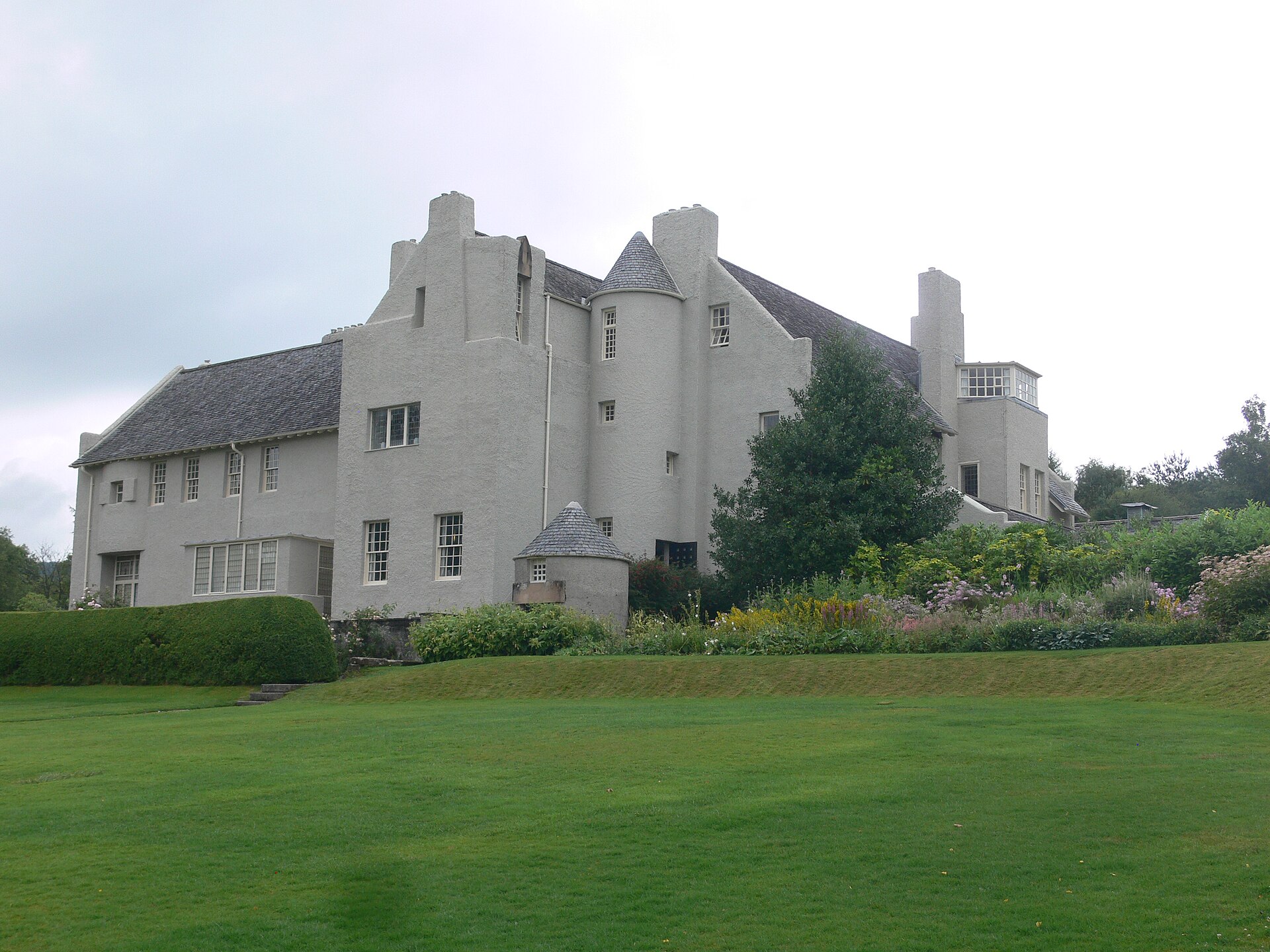
The publisher Walter Blackie commissioned Mackintosh in 1902, introduced through Talwin Morris, the art director of Blackie's own firm, Blackie and Son. Blackie later recalled that Mackintosh would not show him exterior elevations until the internal arrangement of rooms had been settled, and that Blackie's preference for grey rough-cast walls over the red brick more typical of the area was accommodated. The drawing-room writing desk, built in 1905 by the Glasgow cabinetmaker Alex Martin from Mackintosh's design, is ebonised mahogany inlaid with mother-of-pearl, ivory and glass and is nicknamed the kimono desk for its shape; Mackintosh liked it enough to have a replica made for his own use.
Hill House passed from the Blackie family in 1953 through a private owner, then the Royal Incorporation of Architects in Scotland from 1972, to the National Trust for Scotland in 1982. Mackintosh's own experimental Portland cement render has been absorbing water for more than a century, and since 7 June 2019, chosen deliberately as Mackintosh's 151st birthday, the house has stood inside the Hill House Box, a 165-tonne steel frame wrapped in 32.4 million chainmail rings designed by Carmody Groarke, built at a cost of around 4.5 million pounds and intended, on the Trust's own 2019 estimate, to remain in place for seven to ten years while the walls dry out and a permanent repair is designed. On that timetable the Box could still be standing at the time this page was written, or due to come down within the following few years; the Trust's public reporting does not commit to a single date either way.
Chapter 9Vienna, the Continent, and a reputation built somewhere Mackintosh never lived
The Viennese patron Fritz Waerndorfer visited Glasgow in June 1900 and recommended Mackintosh's work to the Secession vice-president Josef Hoffmann; a formal invitation followed in July from the...
The Viennese patron Fritz Waerndorfer visited Glasgow in June 1900 and recommended Mackintosh's work to the Secession vice-president Josef Hoffmann; a formal invitation followed in July from the Secession's president, Carl Moll. The Mackintoshes married on 22 August 1900 and travelled to Vienna in mid-October to install their room, the concluding tenth exhibit of the Eighth Secession exhibition, its white walls and frieze set against furniture one Viennese reviewer described as grey-black throughout. The critic Berta Zuckerkandl, writing in the Wiener Allgemeine Zeitung on 4 November 1900, called the room 'a picture, perhaps puzzling to many of us but nonetheless effusing the authenticity of a distinct vision of beauty'; the Wiener Rundschau, at the start of December, called it 'the most advanced yet of all experiments in the field of modern interior decoration.' Mackintosh was made a corresponding member of the Secession, and his work went on to be shown in Turin in 1902 and Moscow in 1903.
Set against that reception, his standing in his own country during the same years was modest. He depended through most of his working life on a small number of patrons willing to give him a whole commission rather than a single building, chiefly Blackie and Cranston, and never built up the broad domestic client base his Continental reputation might suggest. The gap between how Vienna and Munich received him and how Glasgow and London did is not a matter of national temperament in the abstract; it is a documented, dated asymmetry, visible in the difference between a corresponding Secession membership in 1900 and a British architectural career that stopped succeeding within the following decade.
Chapter 10Decline, war suspicion, and the end of the built career
The profitability of Honeyman, Keppie and Mackintosh declined through the early 1910s and Mackintosh resigned the partnership in 1913, attempting unsuccessfully to establish an independent practice.
The profitability of Honeyman, Keppie and Mackintosh declined through the early 1910s and Mackintosh resigned the partnership in 1913, attempting unsuccessfully to establish an independent practice. He and Margaret moved to Walberswick in Suffolk in 1914, where in 1915 he was arrested and briefly held on suspicion of being a German spy, apparently on the strength of his Scottish accent and his correspondence with contacts in Vienna, a genuinely strange episode for a man whose reputation on the Continent rested on exactly those Viennese contacts.
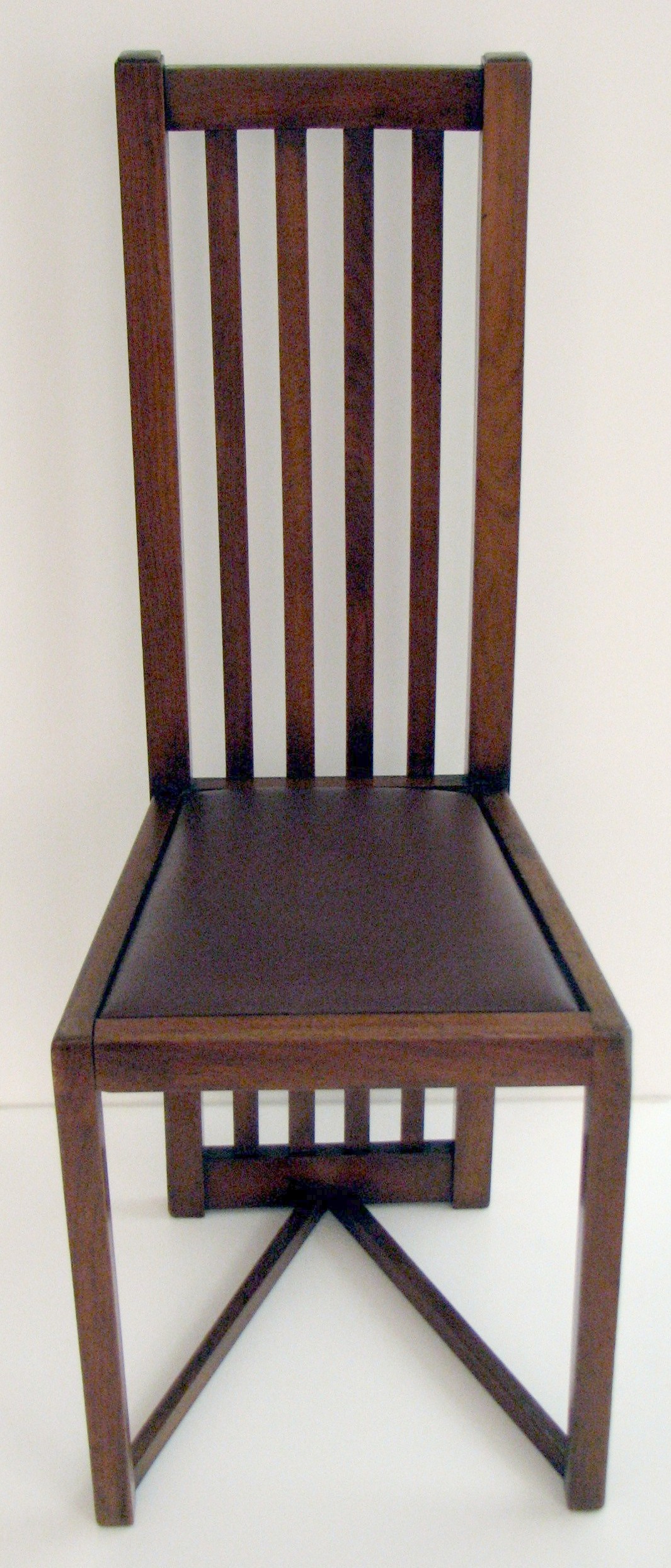
His one further substantial commission, and his only executed work in England, was the 1916 to 1920 remodelling of 78 Derngate in Northampton for the toy manufacturer Wenman Bassett-Lowke. It is materially and stylistically distinct from the Glasgow years: mahogany rather than ebonised oak, a sharper, more geometric ornament, and, for some pieces, German craftspeople interned on the Isle of Man doing the actual joinery from Mackintosh's drawings. In 1920 the Mackintoshes sold their own Glasgow home, at what had been Florentine Terrace and was later renamed Southpark Avenue, complete with its Mackintosh-designed furniture, to William Davidson, closing out Mackintosh's working presence in the city where his reputation had been made.
Chapter 11Port Vendres: the last years as a watercolourist
In 1923 the Mackintoshes moved to Port Vendres on the French Mediterranean coast, where Charles worked for roughly the next four years almost entirely as a watercolourist of landscape, architecture...
In 1923 the Mackintoshes moved to Port Vendres on the French Mediterranean coast, where Charles worked for roughly the next four years almost entirely as a watercolourist of landscape, architecture and botanical subjects, a genuine change of medium and subject rather than architecture continued by other means. Bouleternere, a watercolour of a nearby village painted in 1925, is representative of this period and has since become one of his more valuable works at auction.
Illness forced his return to London in 1927. He was diagnosed with tongue cancer; treatment was arranged with the help of friends including Jessie Newbery. He died on 10 December 1928 at a nursing home in Bayswater, aged 60, was cremated at Golders Green, and, in keeping with his wishes, had his ashes scattered over the Mediterranean at Port Vendres.
Chapter 12Forgotten, then found: the shape of the revival
After William Davidson's death in 1945, his sons donated the Mackintosh-designed contents of the Southpark Avenue house to the University of Glasgow.
After William Davidson's death in 1945, his sons donated the Mackintosh-designed contents of the Southpark Avenue house to the University of Glasgow. The principal rooms were reassembled inside a purpose-built annexe to the Hunterian Art Gallery and opened to the public in 1981 as the Mackintosh House, holding more than eighty pieces of his own furniture; it remains his only surviving domestic interior in Glasgow.
The revival had already begun by then in institutional form: the Charles Rennie Mackintosh Society was founded in 1973 to promote conservation and public understanding of his work, and became the owner and custodian of Queen's Cross Church, his only executed church design, in 1999. In the same founding year for the Society, 1973, the Italian manufacturer Cassina began licensed reissues of his furniture under what became its I Maestri programme, building on a licensing method the company had used since the mid-1960s for Le Corbusier's designs. Glasgow's year as European City of Culture in 1990 is widely credited with turning that institutional revival into a popular one. The Metropolitan Museum of Art mounted the first Mackintosh retrospective to reach the United States, running from 21 November 1996 to 16 February 1997 before touring to the Art Institute of Chicago and the Los Angeles County Museum of Art. Clydesdale Bank put his portrait on a 100-pound note issued 15 December 2009. A further American touring retrospective, described by its organisers as the first in a generation, ran from the Walters Art Museum in October 2019 through the Frist Art Museum, the Museum of the American Arts and Crafts Movement and the Richard H. Driehaus Museum into 2021, this time framing him inside the wider Glasgow Style circle rather than in isolation.
Chapter 13The reissue problem: telling a Cassina from a Blackie-period original
Cassina's own account of its Mackintosh licence describes the chair as the focal point of its I Maestri collection's Mackintosh offering, and design-industry reporting consulted for this page states...
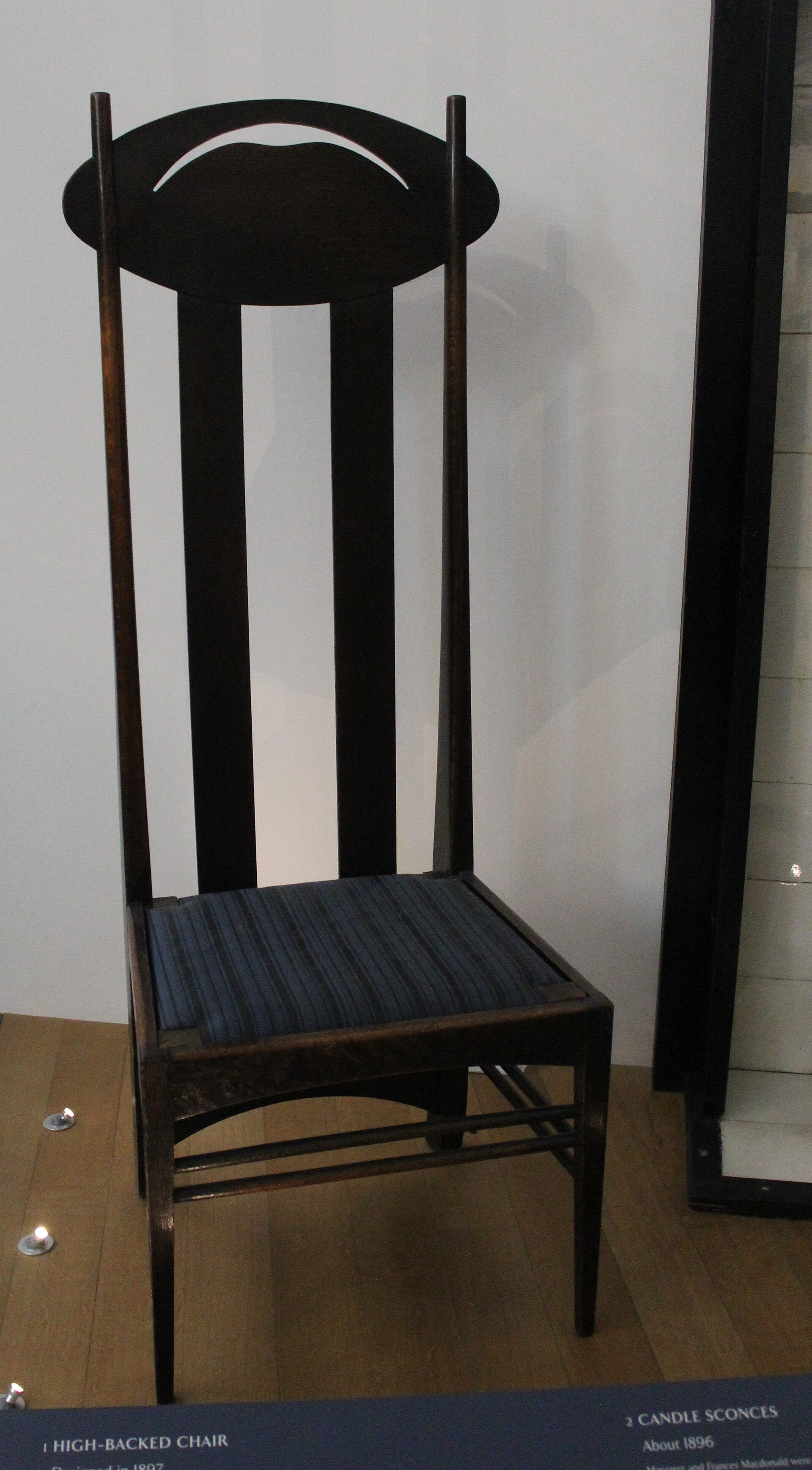
Cassina's own account of its Mackintosh licence describes the chair as the focal point of its I Maestri collection's Mackintosh offering, and design-industry reporting consulted for this page states that the current Hill House 1 reissue is made in black-stained ash rather than the ebonised oak of the 1902 to 1905 originals; this page has not itself confirmed that material distinction against a conservator's wood-identification report and flags it for verification rather than treating it as settled science. What can be stated with more confidence is that Cassina's authorised production carries a manufacturer's stamp and model number, and that the absence of any mark on a chair offered without independent provenance removes one of the few checks available to a buyer, without by itself proving age.
The practical risk sits in secondary and tertiary listings that give a Mackintosh design date without a manufacture date, letting a 1970s or later reissue read, at a glance, like a period piece. Price is the clearest available signal: reissues and later remakes of the tea-room and Hill House chairs trade at auction in the low thousands of dollars, while a documented Blackie-era or Cranston-era original with an unbroken chain of ownership sits one to two orders of magnitude higher, as the market results below show.
Chapter 14The market: from a few hundred dollars to a million-pound desk
Mackintosh's market spans several genuinely different kinds of object, and the results do not compress into a single trend line.
Mackintosh's market spans several genuinely different kinds of object, and the results do not compress into a single trend line. His most elaborate surviving piece of furniture, the ebonised mahogany writing desk from Hill House's drawing room, was acquired jointly by Glasgow City Council and the National Trust for Scotland at a Christie's sale on 6 November 2002 for a total cost of 996,650 pounds, with a 106,043-pound grant from the Art Fund toward it; the sources consulted here do not separately publish the hammer price against the buyer's premium for that sale. At the other end, a single Willow Tea Rooms ladderback chair with a documented Cranston-to-Sotheby's-to-private-collection provenance made 47,500 US dollars at Wright in Chicago on 7 November 2019, more than double its 15,000 to 20,000 dollar estimate.
Later Mackintosh objects trade differently again. A bedside cabinet from the 1916 to 1920 Bassett-Lowke commission at 78 Derngate, the pair to an example in the Victoria and Albert Museum, made a hammer price of 250,000 pounds at Lyon and Turnbull on 2 to 3 November 2020 against an estimate of only 10,000 to 15,000 pounds, with a final price including premium reported in the region of 325,000 US dollars, a currency inconsistency across the sources consulted that this page has not been able to resolve into a single clean sterling figure. A late watercolour from the Port Vendres years, Bouleternere of 1925, made 150,200 pounds including premium at the same house on 17 April 2025. Between those points, the White Bedroom side chair from Hous'hill, a documented original from a different but comparable Cranston commission, carried a 100,000 to 150,000 US dollar estimate at Sotheby's in 2017; the price actually realised is not stated in the source consulted.
What is documented
Technique
The surviving work
- What is accepted
- There is no single accepted-works count of the kind a painter's catalogue raisonne would give. The Mackintosh Architecture project at the University of Glasgow (Pamela Robertson, Principal Investigator, 2010-2014) catalogues 350 architectural projects and over 1200 drawings by Mackintosh and the wider practice of Honeyman & Keppie / Honeyman, Keppie & Mackintosh during his years there, 1889-1913, without separating a smaller list of works securely by his own hand from the practice's broader output.
- What is contested
- Furniture and decorative art carry no equivalent raisonne. The live numerical question in this material is not how many works are accepted against how many are claimed, as with an Old Master, but how many surviving or offered chairs described as Mackintosh's are Blackie-era or Cranston-era originals against how many are Cassina-era (1973 onward) or later authorised and unauthorised reissues; no comprehensive published audit answering that question was located for this page.
- Who rules on attribution
- No single body rules on new attributions. Architectural projects are checked against the firm's own job books and the Mackintosh Architecture catalogue; furniture and decorative art attributions are checked against Billcliffe's published catalogue and the curatorial records of the Hunterian and Glasgow Museums, and, for anything that might be a modern remake rather than a period piece, against Cassina's own manufacturer's marks and model numbers since 1973.
Catalogue raisonne
- Mackintosh Architecture: The Catalogue, University of Glasgow (Pamela Robertson, Principal Investigator, 2010-2014; Joseph Sharples, Chief Researcher; Nicky Imrie, Post-Doctoral Researcher) An online catalogue raisonne of the architectural drawings and projects of the practice during Mackintosh's years there, 1889-1913: 350 projects, over 1200 drawings, 300-plus client and colleague biographies. Covers the firm's whole output rather than isolating works securely by Mackintosh's own hand, and does not extend to furniture or decorative art.2
- Roger Billcliffe, Mackintosh Furniture Cited as the standard published reference for the furniture designs in modern auction-house literature (for example Wright, lot 101, 2019). This page has not independently examined the volume and flags it for direct citation and page-checking by a future editor.19
Questions about Charles Rennie Mackintosh
Who was Charles Rennie Mackintosh?
Architect; Interior Designer; Furniture Designer; Watercolourist. 1868-1928.
When did Charles Rennie Mackintosh live?
Born 7 June 1868, Townhead, Glasgow, Scotland; died 10 December 1928, Bayswater, London, England.
Where can you see work by Charles Rennie Mackintosh?
The Hunterian, University of Glasgow (the Mackintosh House) (Glasgow); Glasgow School of Art (the Mackintosh Building) (Glasgow); The Hill House, National Trust for Scotland (Helensburgh, Argyll and Bute); The Mackintosh Tearooms (formerly Mackintosh at the Willow) (Glasgow); 78 Derngate (Northampton, England); Queen's Cross Church (Glasgow).
What does the market for Charles Rennie Mackintosh look like?
Mackintosh's market does not compress into one trend. His most elaborate surviving piece of furniture, the Hill House drawing-room writing desk, was jointly acquired by public bodies in 2002 for a total cost approaching a million pounds, while a single well-provenanced tea-room chair can still be bought for well under fifty thousand dollars.
What is still unresolved about Charles Rennie Mackintosh?
Whether the Glasgow School of Art's Mackintosh Building will be rebuilt at all: the School's own board called a 265 million pound faithful reinstatement unaffordable in July 2026 and has committed to no funded timetable.
Open questions
- Whether the Glasgow School of Art's Mackintosh Building will be rebuilt at all: the School's own board called a 265 million pound faithful reinstatement unaffordable in July 2026 and has committed to no funded timetable.
- What proportion of the furniture currently sold, exhibited or described as Mackintosh's is a Blackie-era or Cranston-era original against a Cassina-era (1973 onward) or other later reissue. No comprehensive published audit answering this was located for this page.
- Which specific decorative elements attributed to Mackintosh at Hill House and Hous'hill, particularly gesso and glass work, are Margaret Macdonald's unassisted design rather than joint work; current institutional descriptions consulted hedge with language such as 'may have been designed by' rather than stating it outright.
- Whether the material claimed for Cassina's current Hill House 1 reissue (black-stained ash, against the ebonised oak of the 1902-1905 originals) has been confirmed by a conservator's wood-identification report, or rests only on design-industry reporting, as the sources consulted for this page suggest.
- Whether any record survives of Mackintosh's own library or reading beyond his documented citation of Lethaby in his lectures; the SYMBOLIC_PROGRAMME test of a library as evidence could not be applied further than that single citation with the sources available here.
- What the Hill House writing desk actually made at its 2002 Christie's sale, hammer separated from buyer's premium; the only figure located in the sources consulted is the total acquisition cost to the two purchasing public bodies.
Sources
- 1Wikipedia, 'Charles Rennie Mackintosh'. en.wikipedia.org/wiki/...
- 2Mackintosh Architecture (University of Glasgow), 'About the Project' essay. mackintosh-architecture.gla.ac.uk/catalogue/...
- 3Mackintosh Architecture, catalogue entry for the room designed for the Eighth Exhibition of the Vienna Secession, 1900. mackintosh-architecture.gla.ac.uk/catalogue/...
- 4Mackintosh Architecture, catalogue entry M134, The Glasgow School of Art (library). mackintosh-architecture.gla.ac.uk/catalogue/...
- 5Charles Rennie Mackintosh Society, 'Charles Rennie Mackintosh, Josef Hoffmann, Glasgow, Vienna and joint forces for Modernity'. crmsociety.com/charles-rennie-mackintosh-josef-hoffmann-g...
- 6Charles Rennie Mackintosh Society, 'About the CRM Society'. crmsociety.com/crm-society/...
- 7Charles Rennie Mackintosh Society, 'Books'. crmsociety.com/about-mackintosh/...
- 8TheArtStory.org, 'Charles Rennie Mackintosh'. theartstory.org/artist/...
- 9The Art Newspaper, 'Glasgow School of Art says GBP265m needed to restore destroyed Mackintosh building is unaffordable', 23 July 2026. theartnewspaper.com/2026/...
- 10National Trust for Scotland, 'Mackintosh writing desk returns to the Hill House', 9 May 2025. nts.org.uk/stories/...
- 11National Trust for Scotland, 'Mackintosh at the Willow joins the Trust', 11 January 2024 (including its February 2026 renaming note). nts.org.uk/stories/...
- 12National Trust for Scotland, 'Opening the Hill House Box', 4 June 2019. nts.org.uk/stories/...
- 13Art Fund, acquisition record for the Hill House writing desk. artfund.org/our-purpose/...
- 14Helensburgh Advertiser, 'Mackintosh writing desk returns to Hill House in Helensburgh'. helensburghadvertiser.co.uk/news/...
- 15STV News, 'Charles Rennie Mackintosh watercolour painting of French village fetches GBP150,000 at auction'. news.stv.tv/scotland/...
- 16Antique Collecting, 'Charles Rennie Mackintosh cabinet makes GBP250K'. antique-collecting.co.uk/2020/...
- 17Antiques and The Arts Weekly, 'Mackintosh Cabinet Brings $325,000 For Lyon and Turnbull'. antiquesandthearts.com/mackintosh-cabinet-brings-325000-f...
- 18Sotheby's, Important Design, lot 13, 2017. sothebys.com/en/...
- 19Wright, 'International Style: The Boyd Collection', lot 101, 7 November 2019. wright20.com/auctions/...
- 20VictorianWeb, 'The White Bedroom at Hous'hill, Glasgow, by Charles Rennie Mackintosh'. victorianweb.org/art/...
- 21Wikiquote, 'Charles Rennie Mackintosh' (for the Sedding motto and its citation to Pamela Robertson, Charles Rennie Mackintosh: the architectural papers, 1990). en.wikiquote.org/wiki/...
- 22Alan Senior, 'The Symbolic Art of Charles Rennie Mackintosh', Quest Magazine, Theosophical Society in America, May-June 2002. Secondary; relays and cites Thomas Howarth, Charles Rennie Mackintosh and the Modern Movement (1977, for the MacNair quotation and the 1927 letter to Margaret Macdonald), Timothy Neat, Part Seen, Part Imagined (1994, for the interpretive readings of specific watercolours), and Janice Helland, The Studios of Frances and Margaret Macdonald (1996, for the finding that no evidence shows the Mackintoshes became Theosophists). This page has not independently examined Howarth, Neat or Helland and flags all three for direct citation by a future editor. theosophical.org/publications/...
- 23Wikipedia, 'Glasgow School'. en.wikipedia.org/wiki/...
- 24Cassina, 'Charles Rennie Mackintosh' designer biography page. cassina.com/ww/...
- 25Cassina, 'iMaestri Collection'. cassina.com/en/...
- 26The Hunterian, University of Glasgow, 'The Mackintosh House'. gla.ac.uk/hunterian/...
- 27American Federation of Arts, 'First US Touring Retrospective in a Generation for Charles Rennie Mackintosh Opens October 2019'. amfedarts.org/first-us-touring-retrospective-in-a-generat...
- 28Klimt-Database (Belvedere/partners), 'Charles Rennie Mackintosh', network entry for Vienna 1900, for the claim that Mackintosh was made a corresponding member of the Vienna Secession following the Eighth Exhibition. Secondary; no primary Secession-archive citation was located for this specific point. klimt-database.com/en/...
Last verified