Giovanni Antonio Canal, called Canaletto
Venetian · 1697-1768
Last verified 15 September 2026 · 35 sources cited
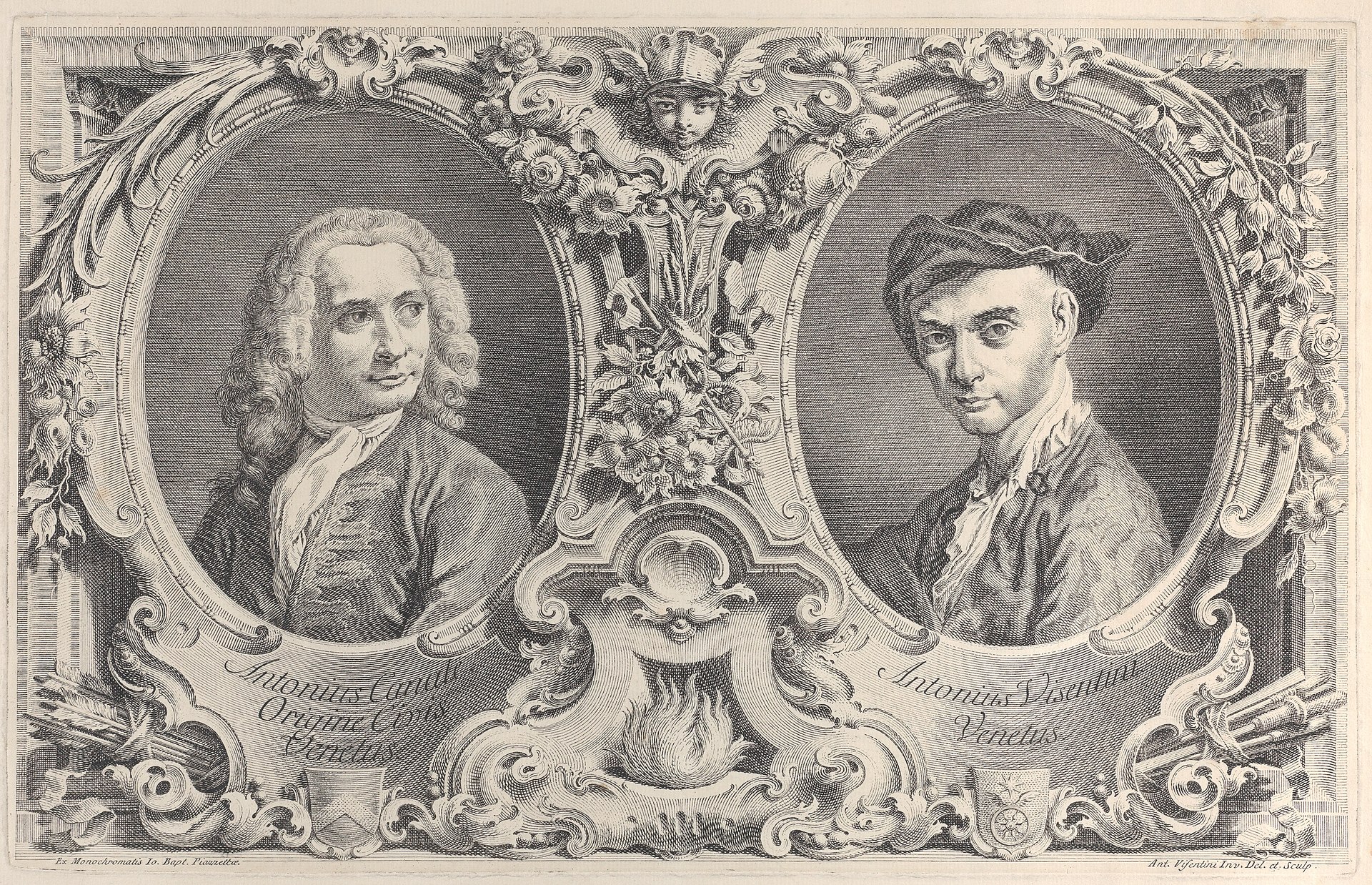
Antonio Maria Visentini after Giovanni Battista Piazzetta, Portraits of Canaletto and Visentini, etching, 1735, from the Prospectus Magni Canalis Venetiarum. Canaletto is the sitter on one side, Visentini the other. This is as secure as a likeness of Canaletto gets, and it should be understood for what it is: a printed frontispiece, made in the artist's lifetime, for a volume published by his own agent Joseph Smith, engraved after a portrait by a leading Venetian painter by a colleague who worked with him for years, and captioned with his name by its own publisher. It is not a painting and it is not a self-portrait. No securely identified painted portrait of Canaletto is widely accepted; the supposed self-portrait is contested, and the only other candidate offered by an institution is a small sketching figure in the middle distance of the Dulwich Walton Bridge, identified from an early catalogue of the patron's collection rather than from any likeness.
The Metropolitan Museum of Art, New York, 1991.1206.6, Gift of David and Elizabeth Tunick, 1991| Full name | Giovanni Antonio Canal |
|---|---|
| Worked as | Painter, Draughtsman, Etcher, Scene painter |
| Born | 18 October 1697 · Venice |
| Died | 19 April 1768 · Venice |
| Nationality | Venetian |
| Movement | Venetian veduta painting |
| Last verified | 15 September 2026 |
On this page 13 sections
Canaletto is the most instantly recognisable painter of the eighteenth century and the hardest to pin down as a body of work. He painted the same twenty or thirty Venetian viewpoints over and over for forty years, for a market of foreign visitors who all wanted the same picture. The consequence is that the central question about almost any Canaletto is not whether it is by him. It is which one it is, and whether the hand that finished it was his.
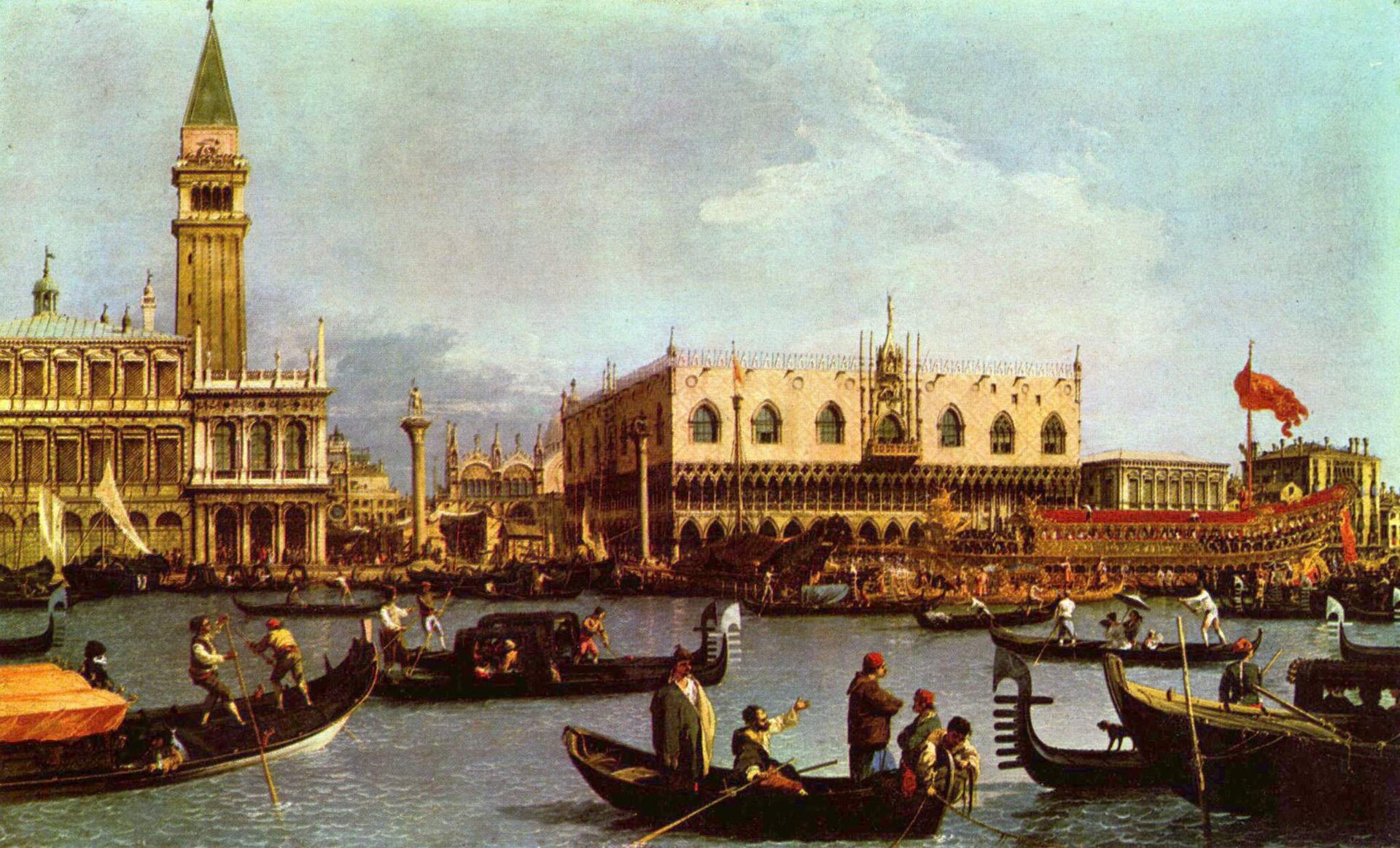
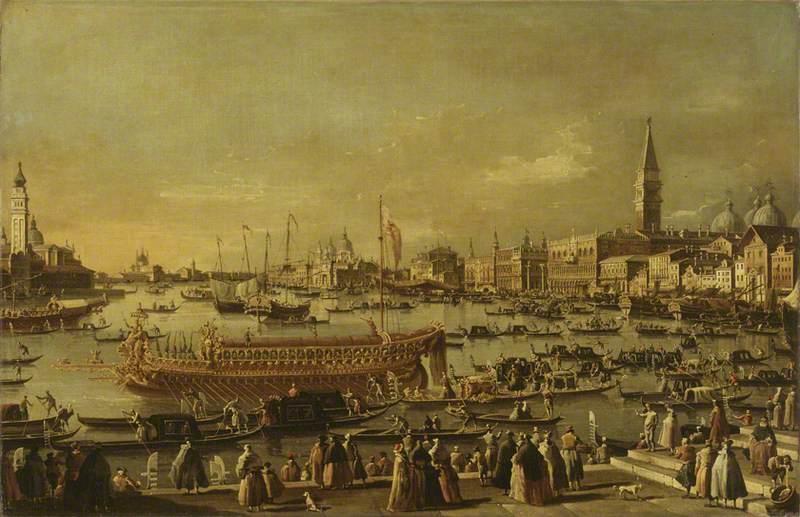
The single subject that shows this most clearly is the return of the Bucintoro, the Doge's state barge, to the Molo on Ascension Day. Versions under Canaletto's name are located in the Royal Collection, the National Gallery in London, Philadelphia, Dulwich, the Pushkin, Barcelona, Woburn, Holkham, a Milanese private collection and the canvas that took the artist's auction record in 2025 - ten of them - with further copies after him in the Wallace Collection and the National Trust. They are not replicas of one another. They differ in size by a factor of more than four, in date by nearly thirty years, and in the figures on the water, which he painted last and never twice the same. Telling them apart is a matter of provenance, of the engraved plates his agent published, of measured dimensions, of the alterations visible under infrared, and of the catalogue number a picture carries in Constable and Links.
The other thing a reader should know is what those festival pictures are pictures of. The Ascension Day scene is not a harbour view. It is the Sposalizio del Mare, the annual rite in which the head of the Venetian state cast a ring blessed by the Patriarch into the Adriatic and declared that Venice was married to the sea in sign of true and perpetual dominion. Canaletto sold that ceremony to Englishmen as a souvenir, and the National Gallery says so plainly of its own pair: they were designed to appeal to wealthy foreign visitors. Both things are true at once, and the record is better for holding them together than for choosing one.
Images
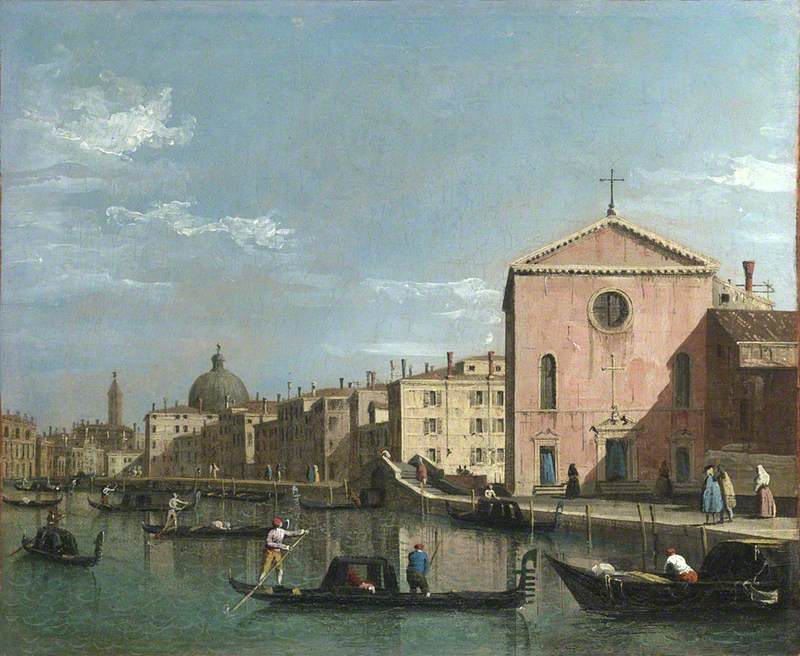
Chronology
- 1697
Born in Venice on 18 October, son of the theatrical scene painter Bernardo Canal. Baptised at San Lio.22
- 1718
Working as a scene painter and designing opera scenery in Venice.22
- 1719-20
In Rome with his father; the two paint scenery for two Alessandro Scarlatti operas at the Teatro Capranica during the carnival of 1720. The trip is generally taken as the point at which he turned to view painting.622
- 1725
Alessandro Marchesini writes to the Lucchese collector Stefano Conti in July recommending him: like Carlevarijs, but with the sun shining in it. A letter of the same year explains a delay by the difficulty and cost of obtaining Prussian blue.16
- c. 1725
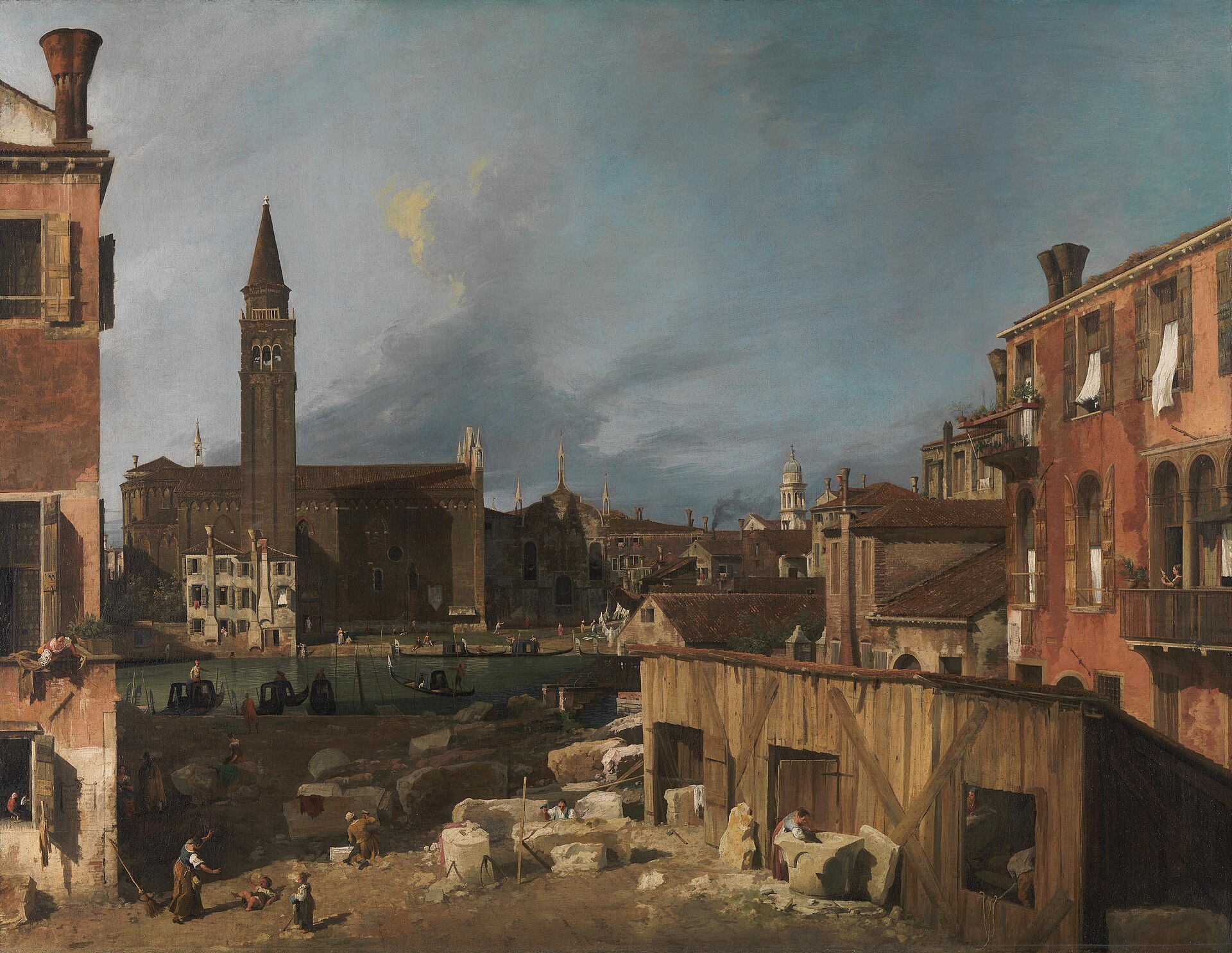
Paints The Stonemason's Yard, now National Gallery NG127, one of the early pictures for local patrons that are usually judged his finest.7
- 1729
On 5 March the engraver and dealer Anton Maria Zanetti the elder writes to Arthur Pond itemising the canvas and priming he has supplied to Canaletto - documentary evidence that the painter worked on commercially prepared supports.1
- c. 1729-35
Joseph Smith acts as his agent, effectively controlling his output and his prices.2122
- 1731
John Russell, 4th Duke of Bedford, commissions a series of Venetian views on his Grand Tour. Twenty-one of the twenty-four hang in the dining room at Woburn Abbey.1
- 1735
Visentini's Prospectus Magni Canalis Venetiarum published, engraved after Canaletto for Smith. Its frontispiece carries the paired portraits of Canaletto and Visentini after Piazzetta - the closest thing to a lifetime likeness of the painter.16
- c. 1735
Paints Venice: The Feast Day of Saint Roch, National Gallery NG937, showing the Doge and the ambassadors leaving San Rocco after the mass of 16 August held annually for the ending of the plague of 1576.9
- 1738-42
Bernardo Bellotto works closely with him during what the National Gallery calls Canaletto's cold period; an almost wintry light stays with Bellotto for the rest of his career.6
- 1742
Visentini's plates reissued complete in three parts, thirty-eight engravings after Canaletto, as Urbis Venetiarum Prospectus. The compositions are now public across Europe.5
- 1744
Smith appointed British Consul in Venice; he holds the post until 1760.21
- 1746
Arrives in England at the end of May. Lodges with a cabinetmaker named Wiggan on Silver Street, now Beak Street, in Soho.1
- 1747
Paints Westminster Bridge, with the Lord Mayor's Procession on the Thames. Analysis finds no copper blue in it: the water is painted with the blue-green earths he brought from Venice.1
- 1748-49
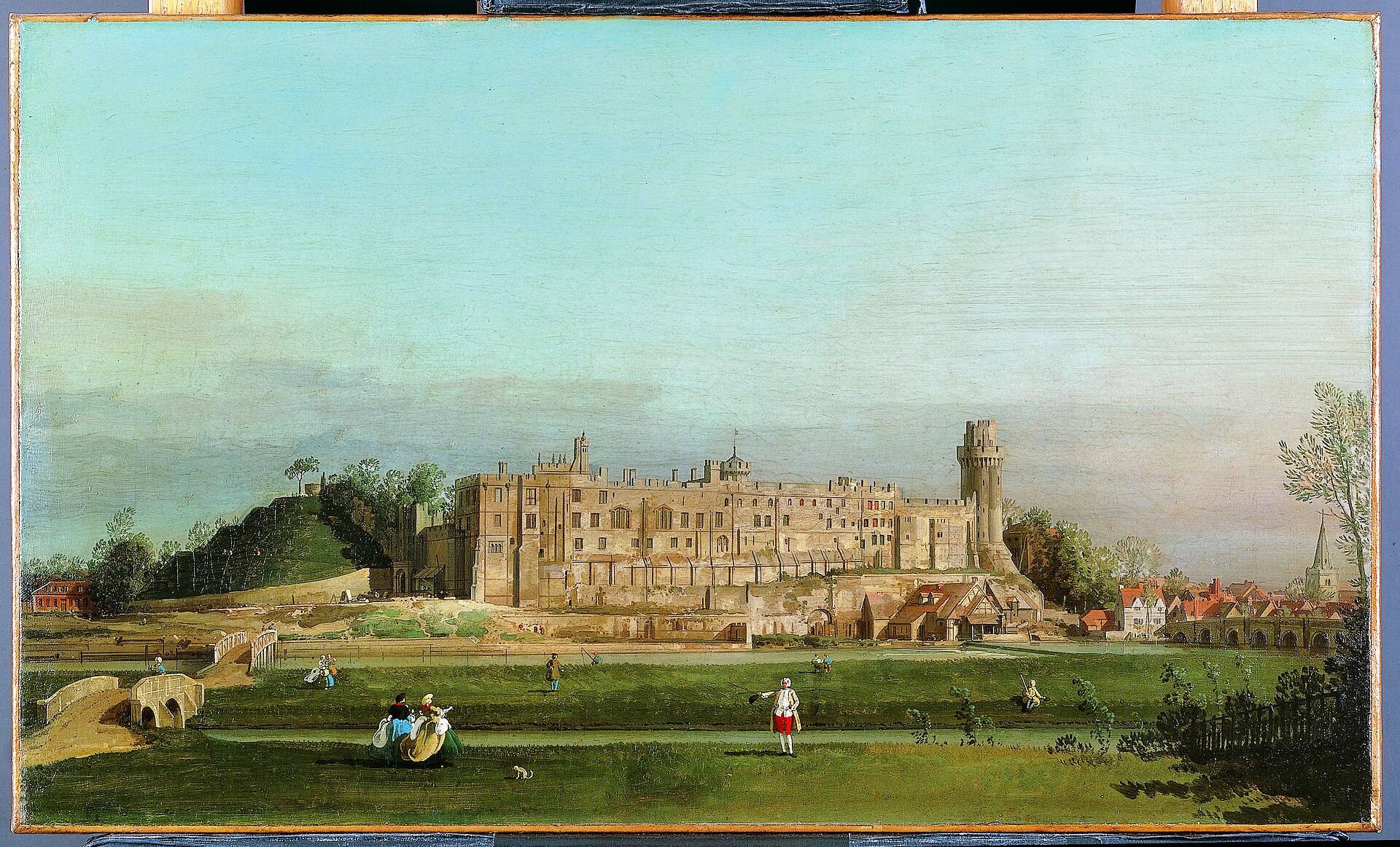
Paints Warwick Castle for the Yale picture, with pentimenti in the footbridge and the village behind visible under infrared.1
- 1749
Vertue's enthusiasm turns: something about the man, he writes, is obscure or strange, and the work is not as well done as the Venetian pictures already in English collections.1
- 1749
Advertises in July inviting any gentleman to come to his house to see a view of St James's Park, with viewing hours specified, for fifteen days. He advertises again in 1751. The device is a response to the rumour that he is not the real Canaletto.22
- 1750-51
Returns to Venice for eight months. The Royal Collection's two Somerset House terrace views are painted in this interval, on Venetian canvas with red earth grounds, English subjects made in Italy.1
- 1754
Paints A View of Walton Bridge for Thomas Hollis, now Dulwich DPG600, and inscribes the back that it was done in London that year for the first and last time with the greatest attention. A figure sketching in the middle distance is identified as the painter himself in an early catalogue of Hollis's collection.11
- 1755
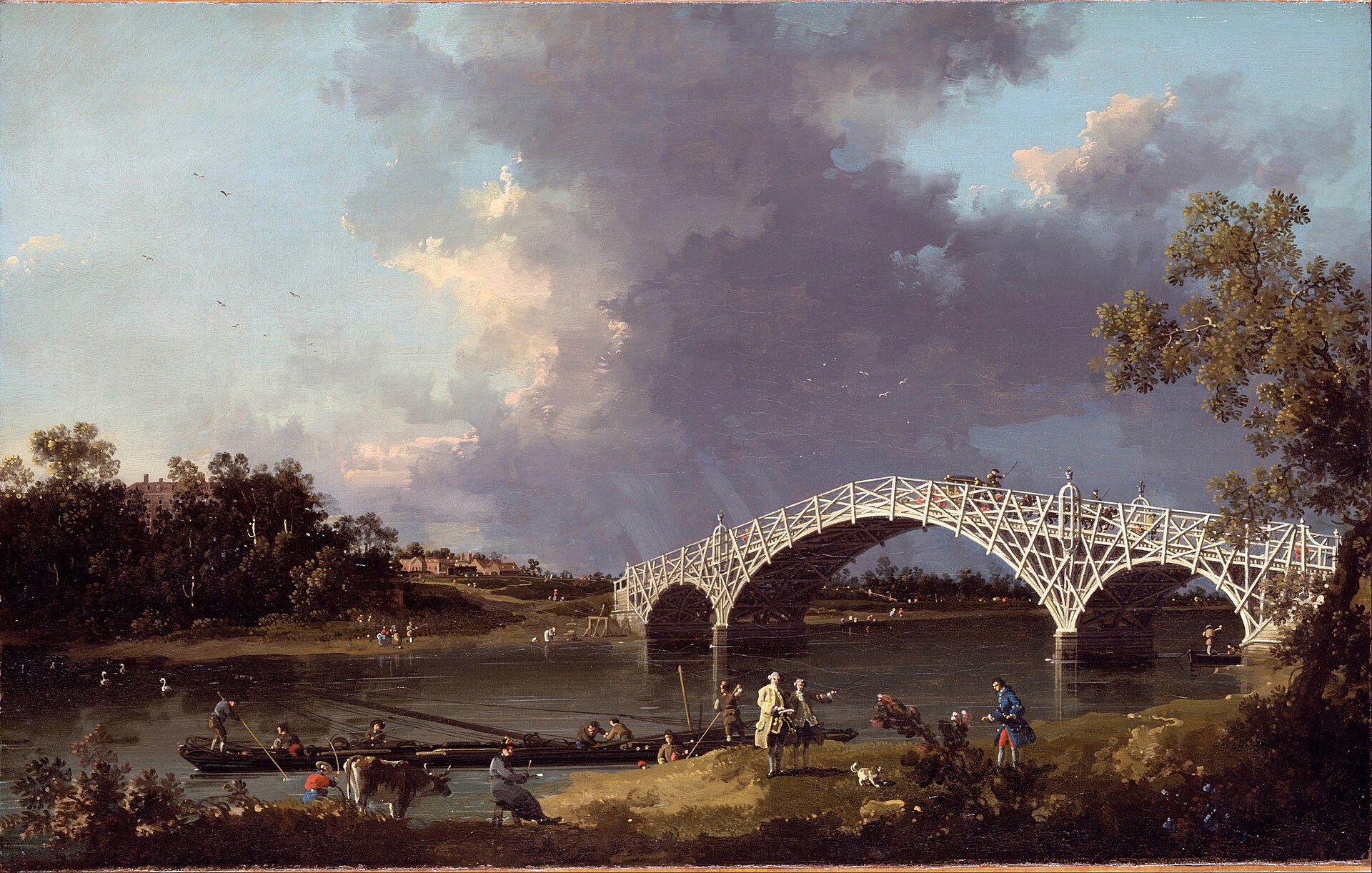
Paints the Yale Old Walton Bridge, his last English picture. Its water is blue verditer, lead white and bone black - a copper blue, not the Venetian green earth.1
- 1755-56
Returns to Venice. The sources disagree on the year: the technical literature gives nine years from May 1746, Wikipedia gives 1755, Dulwich gives 1756.11122
- 1760
Paints the Bucintoro at the Molo on Ascension Day now at Dulwich, DPG599, 58.3 by 101.8 cm, inscribed on the reverse. It is the latest dated version of the subject.34
- 1762
George III buys the bulk of Joseph Smith's collection for 20,000 pounds - reported as 10,000 for the art and 10,000 for the library of some 15,000 volumes. The Canaletto element is the foundation of the Royal Collection's holding.1321
- 1763
Elected to the Venetian Academy and appointed prior of the Collegio dei Pittori.22
- 1768
Dies in Venice on 19 April.22
- 1770
Joseph Smith dies in Venice on 6 November and is buried on the Lido. His second collection, formed after the 1762 sale, is dispersed at auction over thirteen days in January and February 1773.21
- 1798
French troops burn the upper works of the 1729 Bucintoro to recover the gold; the metal is said to have taken four hundred mules to carry away. The hull is armed by the Austrians as a guard ship, then used as a prison hulk, and broken up in the Arsenale in 1824.2426
- 1962
W. G. Constable's catalogue raisonne published by the Clarendon Press in two volumes, presenting over a thousand paintings by or attributed to Canaletto.20
- 1976
Second edition, revised by J. G. Links, adding more than a hundred paintings and drawings and a rewritten etchings chapter.1820
- 1989
Third edition, with Links as acknowledged co-author. Links organises the Metropolitan Museum's Canaletto exhibition the same year.18
- 1998
Links publishes Canaletto: A Supplement to the Catalogue Raisonne, with the Walpole and Schulenburg discoveries and new attributions to and from Bellotto, Visentini and Marieschi.19
- 2010-11
Charles Beddington's Venice: Canaletto and His Rivals shown at the National Gallery and the National Gallery of Art, Washington, placing Canaletto among Carlevarijs, Marieschi, Bellotto and Guardi.6
- 2016
Sperber and Stenger publish the technical study of six English paintings at the Yale Center for British Art, establishing that the English work reflects changed materials and method rather than decline.1
- 2017
Canaletto and the Art of Venice at the Queen's Gallery. Rosie Razzall reports infrared evidence of ruled pencil planning under the ink of the drawings and concludes he did not trace a projected image.1215
- 2025
Venice, the Return of the Bucintoro on Ascension Day sells at Christie's London on 1 July for 27.5 million pounds hammer, 31,935,000 pounds with premium - the artist's auction record.3132
The market
Two facts govern this market. Prime autograph supply is very small, because the best of it is in the Royal Collection or in English houses that have held it since the eighteenth century. And demand is unusually well informed, because the compositions repeat: buyers price a version, not a subject. Size, condition, provenance and catalogue position do the work that a signature does elsewhere.
The clearest demonstration is the pair of Walpole canvases. They hung together at 10 Downing Street in 1736, were sold by Walpole's grandson in 1751 for about thirty-five pounds each, were separated in Paris in 1993, and then sold twelve and thirty-two years later for eight-figure sums. Between the 1993 sale and the 2025 sale nothing whatever happened to the object: Sir Oliver Millar found the pair in a 1736 manuscript catalogue and Links published the finding in 1998. Provenance research, not restoration and not fashion, moved the number.
Below the autograph market sits a large trade in versions, copies and pictures catalogued as after, follower of, studio of or school of Canaletto. That ladder is a price structure rather than a description, and the distance from its top rung to its bottom is now four orders of magnitude.
| Date | Sale | Work | Result | Note |
|---|---|---|---|---|
| 13 June 1751 | Langford's | 'the Doge marrying the Sea, it's Companion Ditto' - the picture that took the artist's record in 2025 | Hammer GBP 34 13s 0d With premium No buyer's premium existed GBP | Sold by George Walpole, 3rd Earl of Orford, first day of the sale. The pendant was lot 64 at GBP 35 15s 6d. Both to Raymond for Sampson Gideon. Press reporting of the 2025 sale renders the figure as '34.13', which is thirty-four pounds thirteen shillings, not 34.13 decimal. |
| 1992-04 | Christie's, London | London: The Old Horse Guards from St James's Park | Hammer Not established With premium Not established GBP / USD | Bought by Andrew Lloyd Webber and now at Tate Britain on long-term loan from the Andrew Lloyd Webber Foundation. The result circulates as USD 17.8 m and as GBP 9.2 m. Those cannot both be the same figure on the same basis and neither is labelled hammer or premium. The Washington Post's contemporary report of 16 April 1992 blocks automated retrieval and was read only through search summaries; an editor should read it and settle the split. |
| 15 December 1993 | Ader Tajan, Paris | Venice, the Return of the Bucintoro on Ascension Day | Hammer FRF 66,000,000 With premium Not published in the sources consulted FRF | The franc figure is the only firm one; later reporting converts it to GBP 7.5 m, USD 11.6 m and USD 10.24 m, which cannot all be conversions of the same number on the same basis. No source states whether it is hammer or total. The Walpole provenance was unknown at the time. |
| 7 July 2005 | Sotheby's, London | Venice, the Grand Canal, looking North-East from Palazzo Balbi to the Rialto Bridge - the pendant | Hammer Not separated in the sources consulted With premium GBP 18.6 m as reported GBP | Against an estimate of GBP 6-8 m. Held the artist's auction record for twenty years. The Art Newspaper describes GBP 18.6 m as the price with fees; contemporary trade reporting presents it as the price the winning bidder paid. This record does not choose between them. |
| 1 July 2025 | Christie's, London | Venice, the Return of the Bucintoro on Ascension Day, c. 1731-32, 86 x 138 cm | Hammer GBP 27.5 m With premium GBP 31,935,000 GBP | Old Masters evening sale, estimate in excess of GBP 20 m, house guarantee later backed by a third party, five bidders from Asia, Europe and North America. Artist auction record. Dollar equivalents of 43.7, 43.8, 43.81 and 43.9 m and euro figures of 37.2 and 37.8 m circulated depending on conversion date; only the two sterling figures are fixed, and nearly all coverage quotes the premium-inclusive number alone. |
Hammer is the price at which the bidding stopped; with premium adds the fee the house charges the buyer on top. Hammer price and buyer's premium in the glossary.
Where to see the work
| Institution | City | Holdings | Note |
|---|---|---|---|
| Royal Collection Trust | London and Windsor | The largest and finest collection of Canaletto's work in existence, by the Trust's own statement, formed by George III's purchase of Consul Joseph Smith's collection in 1762. Reported as 53 paintings and 140 drawings, and elsewhere as roughly 50 paintings, 150 drawings and 15 etchings. | Includes RCIN 404417, the Bacino di San Marco on Ascension Day of about 1733-4, painted for Smith and engraved by Visentini; the Somerset House terrace pair of 1750-51, English subjects painted on Venetian canvas; and the Hampton Court Grand Canal view of 1726-27 in which Smith had Canaletto repaint his own remodelled house in 1751. The drawings are the core of the camera obscura argument. |
| National Gallery | London | Seventeen works catalogued under Canaletto's name, plus the Bellotto and the two follower pictures. | NG127 The Stonemason's Yard, about 1725, the Beaumont Gift of 1823 passed to the Gallery in 1828 and the first Canaletto to enter the collection. NG937 The Feast Day of Saint Roch, about 1735. NG4453 and NG4454, the Ascension Day and Regatta pair of about 1740, bequeathed by Lord Revelstoke in 1929, in their original eighteenth-century English frames. NG2514, Bellotto at about sixteen. NG1885 and NG1886, the follower's pair with the false inscriptions on the back. The three Santa Croce pictures in one building are the best demonstration of the version problem anywhere. |
| Gallerie dell'Accademia | Venice | The quaderno, a notebook of 140 pages of sketches which supplied the raw material for paintings of the 1730s. | The primary evidence in the camera obscura question. Steadman's superimposition work is done against these sheets. |
| Ca' Rezzonico, Museo del Settecento Veneziano | Venice | View of the Grand Canal from Ca' Balbi towards Rialto, and Rio dei Mendicanti. | The museum states these are the only two views by Canaletto on public display anywhere in Venice - the reason being that essentially the whole output went abroad. They were part of a group of four owned by the Princes of Liechtenstein; the other two are in the Thyssen-Bornemisza Museum, Madrid. |
| Museo Correr | Venice | The box camera obscura, inventory Cl. XXIX sn. 30, stamped A. CANAL. | Recorded by the museum as made, or perhaps simply owned, by Canaletto. Steadman accepts that Canaletto used a camera but argues this box is too small to have produced the Accademia sketches, for which a tent or booth instrument would have been needed. |
| Woburn Abbey | Bedfordshire | Twenty-four Venetian views commissioned by John Russell, 4th Duke of Bedford, on his Grand Tour of 1731. Twenty-one hang in the dining room. | The largest surviving group in private hands and the best place to see what the mature colour system does at scale. Sperber and Stenger note that seeing so many together in a domestic room emphasises their tonal repetition, which is itself the point: the mixtures were fixed by the late 1720s and the following decade's pictures can look formulaic. |
| Dulwich Picture Gallery | London | DPG600, A View of Walton Bridge, 1754, 48.7 x 76.4 cm, presented by Miss E. Murray Smith in 1917. DPG599, The Bucintoro at the Molo on Ascension Day, 1760, 58.3 x 101.8 cm. | Both are inscribed on the reverse. The Walton Bridge inscription, transcribed by John Disney before an 1850 relining hid it, records the commission from Thomas Hollis and the claim that the picture was made for the first and last time with the greatest attention. The 1760 Bucintoro is the latest dated version of the subject. |
| Yale Center for British Art | New Haven | Six English paintings of 1746-55, including Westminster Bridge with the Lord Mayor's Procession (1747), Warwick Castle (1748-49), the two Somerset House terrace views (about 1750), St Paul's Cathedral (about 1754) and Old Walton Bridge (1755). | The technically best-published group of Canalettos anywhere. Cross sections, XRF, SEM-EDX, FTIR and Raman results for all six are in the public literature. |
| The Wallace Collection | London | P513, Venice: the Bacino di San Marco on Ascension Day, catalogued as after Canaletto, 1763-83. | Worth seeing precisely because it is not by him. It shows what the eighteenth century's own reproduction industry produced from a Canaletto composition. |
Forgeries and misattributions
- The National Gallery's inscribed pair, NG1885 and NG1886
- Two small views, S. Simeone Piccolo and the Grand Canal facing Santa Croce, both after 1738, bought by the Gallery in 1860 and catalogued as by a Follower of Canaletto. NG1886 measures 38.8 x 46.3 cm. Conservation uncovered inscriptions on the back of each canvas stating that they are genuine works by Canaletto; the one on NG1886 reads original del Canaletto. On quality, not chemistry. The Gallery's position is that the inscriptions were presumably added by an unscrupulous artist or owner and that the paintings were clearly produced by someone imitating Canaletto's style, rather crudely, lacking his refinement. The lesson generalises: refinement in Canaletto is measurable - the two-stage incising and ruled outlining of the architecture, the dotted touch in the crowds, the use of pure unmixed Naples yellow for metallic highlights - and a copyist working from a Visentini engraving has none of that information available.158
- The London dealers' copies, 1740s
- Edward Dayes, writing at the turn of the nineteenth century, records that the picture-dealing trade in London denied that the man then working in the city was the painter of the Venetian pictures, and that when he was provoked into painting something to prove it they said the new work was not in the same style. Dayes says the campaign injured him badly and nearly unhinged him. It was not detected at the time; Canaletto's counter-move was the 1749 and 1751 newspaper advertisements inviting the public into his house to watch him work. Dayes states the dealers' motive plainly: to drive him out of the country so that he could not detect the copies they had made from his works, which were in great repute. If Dayes is right, the imposture rumour was itself a forgery-protection operation.122
- Bellotto's signature
- Bernardo Bellotto, his nephew and assistant, signed himself Canaletto once he was working outside Italy. Vertue eventually traced the London imposture rumour to exactly this. Not a forgery in intent, and the more damaging for it, because a Bellotto signed Canaletto is a genuine signature on a picture by the wrong man. The separators are geography first - Bellotto never returned to Italy after the mid-1740s, so the German, Austrian and Polish views are his whatever the signature says - then the cooler, silvery, almost wintry light and steely greys, the vivid blue skies, the Dutch interest in massed cloud and cast shadow, the observed rather than formulaic foliage, and the thick, broad strokes in cloud and water.146
- The legitimate copy trade, and why the line is not clean
- The Wallace Collection's P513 is a version of the Ascension Day subject catalogued as after Canaletto and dated 1763-83. The National Gallery describes its own follower pictures as belonging to a burgeoning Venetian market of the 1730s and 1740s that served visitors who could not afford Canaletto's prices. Michele Marieschi, the only serious rival of those decades, sold at about half Canaletto's price. Nothing needed detecting; these were sold as what they were. The forgery only appears when someone writes on the back. That is the structural point about this artist: the same object can be an honest period souvenir or a fake depending on a later inscription and a later seller, and the modern saleroom vocabulary - after, follower of, studio of, circle of, school of - is a price ladder built on top of that ambiguity.56
The essay
The version problem is the subject
Canaletto worked for the Grand Tour. His buyers were British and Irish travellers who wanted a view of Venice to hang at home, and they wanted the famous views. He supplied them, in quantity, for four decades. That commercial fact is the origin of every attribution difficulty attached to his name.
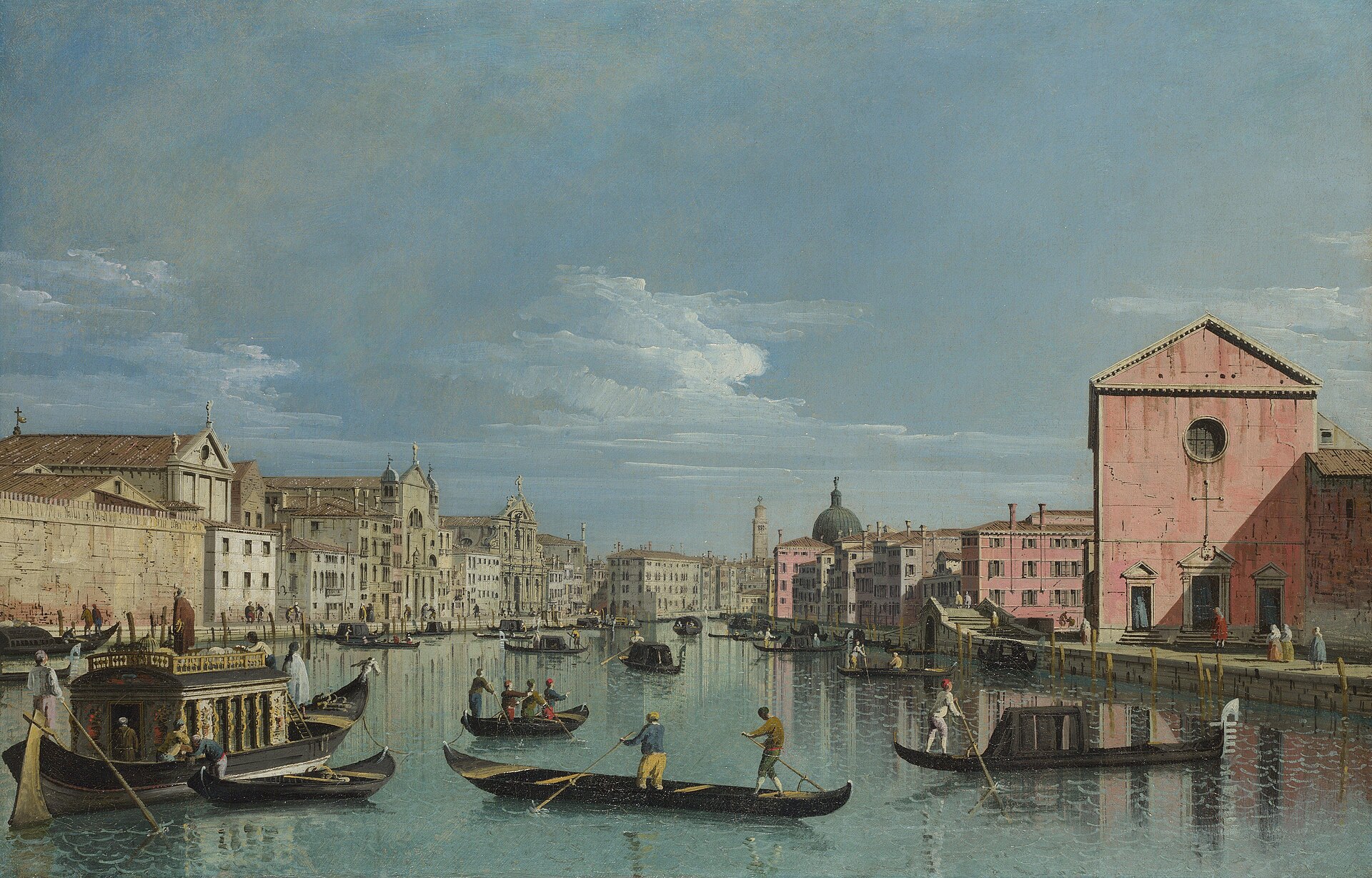
A painter who invents a new composition for each commission leaves a corpus in which each picture is its own evidence. A painter who repeats a composition twenty times leaves a corpus in which the pictures are evidence about each other, and in which a copy, a studio version, a nephew's variant and an autograph repetition can all sit in the same room looking broadly alike. The National Gallery in London owns the demonstration: three pictures of the upper Grand Canal facing Santa Croce, one by Bellotto at about sixteen, one by an unidentified follower with a false inscription on the back, and the composition itself circulating in Antonio Visentini's engraving after Canaletto.
So the specialist's first question is never is this a Canaletto. It is: which of the located versions is this, where has it been, what does it measure, and what does the paint film show that a copyist could not have known to put there.
How a specialist separates ten Bucintoros
Provenance first. The strongest documentary position any Canaletto can occupy is to have come out of Consul Joseph Smith's collection into the Royal Collection in 1762. Smith was the artist's own agent and his principal patron; the pictures passed directly from painter to patron to king and have not left. Nothing in the field beats an unbroken line of that kind. A picture with a documented English house behind it - Woburn, Holkham, Warwick - is next. A picture whose history begins at a twentieth-century dealer is at the bottom, whatever it looks like.
Then the plates. Smith commissioned Visentini to engrave Canaletto's Grand Canal views on copper. The first part appeared in 1735 as the Prospectus Magni Canalis Venetiarum; the complete three-part issue of 1742 carried thirty-eight plates. Those plates are dated, published, and fix a composition at a moment. A painting that corresponds to a plate can be placed against it; a painting that departs from it has either preceded it or been altered, and either answer is informative. The plates were also how the compositions escaped. They spread Canaletto's designs across Europe and gave every copyist in Venice a template.
Then the tape measure. The located Ascension Day pictures run from 58.3 by 101.8 centimetres at Dulwich to 182 by 259 in the Milanese picture. Size is the cheapest discriminator in the field and the one most often omitted from press reports.
Then the water. Boats and figures went on last, over a finished architectural backdrop, a habit that goes back to his training in the theatre, where the set is painted before the characters walk onto it. The staffage is therefore the least constrained part of any Canaletto and the part that varies most between versions. The National Gallery describes the crowd in its Ascension Day picture as built up in places from careful dots of paint. Those dots are a signature of touch, and they are what a copyist working from an engraving cannot reproduce, because the engraving does not record them.
Then the changes of mind. Infrared reflectography of the English pictures at Yale shows him lowering a roof, shifting the dome and towers of St Paul's to the right, flattening the pitch of Walton Bridge, enlarging a foreground house, moving a footbridge at Warwick and rebuilding a village. A copy has no reason to contain a correction. A prime version usually does.
Then the number. Every serious catalogue entry cites Constable, as revised by Links. The number is not a certificate, and pictures have moved in and out of the numbering at every revision, but it is the shared coordinate system, and a picture offered without one is being offered without an address.
Consul Smith, and why his provenance is the strongest in the field
Joseph Smith went to Venice about 1700 as a merchant banker, made money, bought the Palazzo Balbi on the Grand Canal in 1740 and had Visentini remodel its facade in the Palladian taste. He was appointed British Consul in Venice in 1744 and held the post to 1760. Long before that he had become the hinge between Venetian painters and British buyers.
From about 1729 to 1735 he acted as Canaletto's agent, and for years effectively controlled the artist's output and his prices. He commissioned the engravings that advertised the work, he pushed the painter towards the subjects the tourists wanted, and he is credited with encouraging the move to London in 1746. He was not a disinterested collector. He was a dealer with a house on the Grand Canal and a consular title, and the difference matters when reading his taste.
In 1762 George III bought the bulk of his collection. The sum usually given is 20,000 pounds; The Art Newspaper reports it as 10,000 pounds for the art and a further 10,000 for the library of some 15,000 volumes, which became the King's Library and is now in the British Library. The Canaletto element of the purchase is variously reported as 53 paintings and 140 drawings, or as roughly 50 paintings, 150 drawings and 15 etchings. The Royal Collection's own catalogue does not put a number on it in the text consulted here, but states without qualification that the result is the largest and finest collection of Canaletto's work in existence.
That is why the provenance is the strongest in the field, and the reason is not prestige. It is that the chain is short. Painter to agent to king, with the agent living in the city where the pictures were made and the king's household keeping records ever since. Almost every other Canaletto has at least one undocumented decade in it. Smith went on collecting after 1762; his second collection was dispersed at auction over thirteen days in January and February 1773. He died in Venice on 6 November 1770 and is buried on the Lido.
What the Bucintoro pictures are pictures of
Ascension Day in Venice was the Festa della Sensa, and its centre was the Sposalizio del Mare. The Doge was rowed out of the lagoon in the Bucintoro, the Patriarch pronounced a nuptial blessing, and the Doge cast a blessed ring into the Adriatic with the words Desponsamus te, mare, in signum veri perpetuique dominii - we wed thee, sea, in sign of true and perpetual dominion. It was a marriage rite performed by a head of state on behalf of a city, with a bishop officiating and a ring. Venice was asserting a legal claim to the Adriatic in the form of a sacrament.
The origin the Republic told about itself has two strands and the sources do not agree on the dates. One traces the rite to the sailing of a fleet on Ascension Day about the year 1000, under Doge Pietro II Orseolo, to assert Venetian power along the Istrian and Dalmatian coast. The other traces it to Pope Alexander III, who is said to have given Doge Sebastiano Ziani a gold ring and told him that he and his successors should marry the sea every year - the papal gift being thanks for Venetian support against the Emperor Frederick Barbarossa, Pope and Emperor having been reconciled at San Marco. The Royal Collection catalogue puts that reconciliation on Ascension Day 1177; the National Gallery dates the treaty to 1178; the standard reference account puts the codification of the rite at 1173 and the papal ring at 1176. This record does not choose between them, and a reader should treat any single confident date for the origin of the Sensa with suspicion.
What the two strands have in common is the point of the ceremony. One version makes the claim naval and the other makes it papal, and both make it permanent. The rite was not commemorative. It was renewed annually because the dominion it asserted had to be reasserted annually.
The Sensa also carried a fair. The marquee of the Ascension market stands in the Piazzetta in the Royal Collection picture, and the catalogue notes that the market was clearly regarded as an integral part of the festival. The state liturgy and the commercial fair were the same event. A painter selling that event to foreign buyers was working inside the logic of the thing he painted, not against it.
The barge itself
The Bucintoro was a ritual object, not a ship. Four principal vessels are identified, of 1311, 1526, 1606 and the last, built from 1727 to 1729, which is the one in Canaletto's pictures. It ran about 35 metres long and over 8 metres high, carried some 90 guests, and needed 168 oarsmen and about 40 further crew. Its gilded wooden allegorical sculpture was by Antonio Corradini, with Justice at the bow holding sword and scales - the Republic putting its own claim to just government at the front of the boat that married the sea. When Canaletto first painted it the vessel was two or three years old. He was recording a new object, not an antiquity.
In 1798, after the Republic fell, French troops burned the carved upper works to recover the gold; the recovered metal is reported to have taken four hundred mules to carry off. The hull was armed with cannon by the Austrians and used to guard the entrance to the lagoon, then served as a prison hulk, and was broken up in 1824 in the Arsenale where it had been built. Nothing of the 1729 barge survives intact. The ceremony itself ended with Napoleon's arrival in 1797 after more than six centuries and was revived, as a civic pageant with the mayor in the Doge's place, in 1965.
The rest of the Venetian year
The festival subjects Canaletto painted are not an assortment of picturesque occasions. They are the state's own calendar.
The National Gallery's Basin of San Marco on Ascension Day and A Regatta on the Grand Canal were painted as a pair and the Gallery describes them as two ceremonial scenes: the Wedding of the Sea, and the regatta that commemorates a naval victory against Dalmatia around the year 1000. The Gallery's Feast Day of Saint Roch of about 1735 shows the Doge in his gold, ermine-lined robe leaving the church of San Rocco with the state dignitaries and the foreign ambassadors after the mass of 16 August, held every year for the saint's part in ending the plague of 1576. Behind them the Scuola Grande di San Rocco has pictures hung on its facade, the feast-day exhibition being itself a fixture of the day.
The same plague produced the other great votive fixture, the Redentore. The Senate vowed a church if the pestilence lifted; Palladio built it on the Giudecca; it was consecrated in 1592, and the Doge crossed to it annually over a bridge of boats on the third Sunday of July. Venice governed by anniversary. Its rulers spent the year discharging vows and re-enacting foundational events, and the ducal person was the instrument by which the state kept its promises to God and to the sea.
Underneath all of it sits the city's account of its own origin. Venice had no Roman past and no apostolic see, so it acquired one: in 828 or 829 two Venetian merchants took the body of Saint Mark out of Alexandria, hidden under pork so that Muslim customs officials would not search it. A legend, traceable to the thirteenth-century chronicler Martino da Canal, supplied the justification retrospectively - an angel had told the evangelist, on the lagoon, that his body would one day rest there. Edward Muir's Civic Ritual in Renaissance Venice is the standard modern account of what that machinery was for, and it treats the acquisition of the relic as a political act as much as a pious one. The Republic presented itself as divinely intended, constitutionally perfect and permanent. The vedute that Englishmen carried home were, among other things, the last export edition of that self-portrait.
A caution is owed here, because it would be easy to overstate. There is no documented iconographic programme behind Canaletto's festival pictures - no contract specifying an allegorical scheme, no letter in which he explains a meaning. What is documented is the subject matter, the state rites it depicts, and the commercial purpose. The National Gallery, cataloguing its own pair, says they were made when Canaletto was at his most commercially successful and were designed to appeal to wealthy foreign visitors. A veduta painted for the tourist trade is a veduta painted for the tourist trade. The interest lies in what the tourist trade was selling, which was a state liturgy, and in the fact that within fifty years the state, the barge and the rite were all gone and the pictures were the record.
What he actually belonged to, and what he did not
Canaletto's documented affiliations are professional and parochial, not ideological. He was baptised at San Lio and buried there. He was apprenticed to his father Bernardo Canal, a theatrical scene painter, and worked in the opera houses. In 1763, five years before his death, he was elected to the Venetian Academy and appointed prior of the Collegio dei Pittori, the painters' professional college. There is no recorded library, no confessor of record, no society membership and no stated position on anything in the sources consulted for this page.
The absence is worth stating explicitly because of what was happening around him. Freemasonry reached Italy in the 1720s and 1730s - a lodge at Girifalco in 1723, Lord Charles Sackville's lodge at Florence before August 1732, an English-speaking lodge in Rome from 1733 - and Clement XII condemned the craft in the bull In eminenti apostolatus of 28 April 1738 on pain of excommunication, with Benedict XIV reiterating the condemnation in 1751. A lodge was founded in Venice in 1746. Its documented associates are Giacomo Casanova, Carlo Goldoni and Francesco Griselini; the Inquisition moved in 1755, Casanova was arrested and the lodge dissolved.
Neither Canaletto nor Joseph Smith appears in that documented membership, and no evidence connecting either of them to a lodge was found in preparing this page. Canaletto was in London for the whole life of the 1746 Venice lodge. Claims of a masonic Consul Smith circulate; this record carries none of them, because a rumour is not a register. If a reader wants the eighteenth-century secret societies of Venice, they are documented, and these two men are not in them.
Trained on a stage, not in a studio
He was apprenticed to his father as a painter of theatrical scenery and was designing opera sets by 1718. In 1719 he went to Rome, where he and his father worked on scenery for two Alessandro Scarlatti operas at the Teatro Capranica during the carnival of 1720. The Roman trip is generally taken as the moment he turned to view painting.
The training is not biographical decoration. It is the technical foundation of everything he did afterwards. A stage set is built by perspective construction, ruled and measured, and it is finished before anyone stands in front of it. Canaletto painted his architecture first, in blocked colour, then refined it with incised lines and ruled outlining, then put the boats and the people in at the end. The order of operations is the scene painter's order.
His earliest work looks nothing like the pictures that made him famous. Before about 1727 he worked with violent contrasts of deep shadow and radiant sunlight, highlights laid straight onto a dark red ground. The change to the even, silvery light of the tourist pictures was a deliberate technical decision taken around 1730, and it is visible in cross section: he began laying a cool grey or beige imprimatura over the warm Venetian ground, which gave him a midtone surface and let him paint shadows as mixed, applied shapes instead of letting the ground show through. David Bomford and Gabriele Finaldi attribute the shift from a fitful, glittering sun to a steady silver light to exactly that underlayer.
The technique, in enough detail to be diagnostic
No carbon underdrawing has been found. Infrared reflectography of the Yale pictures identified no graphite, ink or black chalk beneath the paint, and microscopy found nothing either. He appears to have blocked his compositions in directly in paint, probably working from the highly finished drawings he made in quantity. That is itself a diagnostic point: a picture by Canaletto that shows a transferred or squared underdrawing is asking a question.
The sequence is consistent from about 1730. Imprimatura; then the sky blocked in with a rough reserve left for the prominent foreground forms; then the middle ground; then the foreground. Buildings were established in the blocking-out stage by shadow in one colour and highlight in another. Architectural detail was then carried over the sky paint to cut a crisp edge to a roofline. A second, thicker layer gave surface texture to masonry, pavement and cloud.
Then the refining, which is where the pictures are won. Edges and architectural details were incised into the blocking-in layer with a point while the paint was still wet. Outlining in black, frequently run along a straight edge, was laid over the incisions; the incisions guided circles and arches; ornament was sometimes scratched in freehand. Distant buildings were outlined in a softer grey to push them back. The two-stage process of incising and then outlining is the most reliable technical marker of the great Venetian decade.
It is also the marker that vanishes. In England, from 1746, he abandoned incision almost entirely, keeping only the compass for the arches of Westminster Bridge and the dome of St Paul's, and collapsed two steps into one by outlining alone. Two views of Greenwich Hospital make the point exactly: the one painted in Venice before 1746 is incised throughout, the one painted in London a few years later achieves the same effect with black outlining and no incision at all.
Figures and boats went on last, over the finished backdrop, in touches and dots. It is in these final passages that his pigment choices become deliberate to the point of fussiness. A man's gold waistcoat at Yale is yellow ochre, but the sparkle on his buttons is pure Naples yellow, a different and brighter pigment used unmixed rather than ochre lightened with white, precisely so that it reads as metal. The same pure Naples yellow picks out the top of the dome of St Paul's in the distance and pulls the eye to it.
The camera obscura question
The Museo Correr in Venice holds a small wooden box camera obscura, inventory Cl. XXIX sn. 30, of the eighteenth century, in wood, glass and mirror, 22.5 by 38 by 24.2 centimetres closed, with A. CANAL stamped on the protective cover. The museum's own wording is careful: it was made, or perhaps simply owned, by Canaletto. The object exists and the inscription exists; the ownership is an attribution, not a document.
Philip Steadman, who has worked on this longer than anyone, accepts that Canaletto used a camera but rejects the Correr box as the instrument that produced the sketches. It is too small. The Gallerie dell'Accademia holds a quaderno of 140 pages of sketches which supplied the raw material for paintings of the 1730s, and to make those Steadman argues he would have needed a large tent or booth camera that he worked inside; his reconstructions of eighteenth-century tent cameras produce technically comparable sketches without difficulty. Digitally superimposing the sketches on photographs taken from Canaletto's viewpoints shows them to be extremely accurate - and shows, in the same operation, that he then raised domes, adjusted building heights, rotated facades and combined more than one station point into a single composition.
The Royal Collection reached the position from the other end. Examining the drawings for the 2017 exhibition at the Queen's Gallery, Rosie Razzall, its curator of prints and drawings, reported infrared evidence of careful preliminary pencil work under the ink, planned out with a ruler, and concluded that he was not tracing a projected image.
The two findings are compatible and together they settle the useful part of the question. He used an optical device to get his angles honest and then overrode it wherever composition required. The Royal Collection's own catalogue entry for its Ascension Day picture lists the overrides: the Campanile shortened to fit the canvas, so that four staircase windows that should be visible are not; the western dome of San Marco reduced and shifted eastwards until the Doge's Palace largely hides it; the Palazzo Ducale itself much reduced in width. Anyone who calls Canaletto a camera is describing a painter who moved the basilica.
England, 1746 to 1755, and the accusation that he was an impostor
He arrived at the end of May 1746 and stayed about nine years, with an eight-month return to Venice in 1750-51. The usual explanation is that the War of the Austrian Succession had cut off the flow of Grand Tourists and he followed his market to its source; Vertue records that Jacopo Amigoni, newly back in Venice, tempted him with the prospects to be made of views of the Thames, and Charles Beddington has argued that a specific commission from George Garnier to paint the new Westminster Bridge is what actually brought him. He lodged with a cabinetmaker named Wiggan on Silver Street, now Beak Street, in Soho.
George Vertue, the great chronicler of the London art world, welcomed him at first as much esteemed and expected the English views to satisfy as the Venetian ones had. By 1749 he had turned: something about the man, he wrote, was obscure or strange, and the work was not as well done as the Venetian pictures already in English collections. The rumour hardened into the claim that the man in Soho was not the real Canaletto at all, or that an unknown assistant had painted the pictures in Venice. Vertue later corrected the identity charge himself and traced the confusion to Bernardo Bellotto's use of the same name.
There was more to it than confusion. Hogarth's generation of English painters regarded foreign talent as a threat to their livelihood, and the patriotic mood shaded into hostility to foreign artists. There were also imitators of Canaletto in London with a direct financial interest in discrediting him. Edward Dayes, writing at the turn of the nineteenth century, gives the trade version: the dealers denied that this was the man who had painted the Venetian pictures, and when he sat down and painted something to prove it they said the new pictures were not in the same style. Dayes says the campaign nearly unhinged him, and that its purpose was to drive him out of the country so that he could not detect the copies they had been making from his work.
His answer was to open the studio. In July 1749 he advertised, inviting any gentleman who cared to come to his house to see a picture by him, a view of St James's Park, and specifying the hours - nine to three and four to seven - for fifteen days from publication. He advertised again in 1751. It is one of the most unusual documents in eighteenth-century British art dealing: a painter of the first rank publishing office hours to prove that he is himself.
He went on signing the point. On the back of the Dulwich View of Walton Bridge of 1754, uncovered before an 1850 relining hid it again and transcribed by John Disney at the time, he wrote that it was done in London in the year 1754, for the first and last time, with the greatest possible attention, at the instance of Signor Cavaliere Hollis, his most esteemed patron - and signed it Antonio Canal, called Canaletto. The Dulwich Bucintoro of 1760, painted after his return to Venice, is inscribed on the reverse in the same spirit. Canaletto did not habitually sign pictures. He signed when he was being doubted.
What England did to the paint
The received opinion for two centuries was that the English pictures are inferior. Giuseppe Fiocco in 1929 called the change an obvious and lamentable retrogression and said the figures had become mere bundles of coloured wool. Constable, who compiled the catalogue raisonne, wrote that the imaginative element of the better work was almost consistently absent. Roxane Sperber and Jens Stenger tested that opinion against six Yale pictures spanning 1746 to 1755 and found something more specific than decline.
The ground changed. In Venice he used commercially primed canvas with a warm red or orange ground, which from about 1730 he covered with a cool imprimatura. In London he bought English commercial canvas, which came with a cool grey double ground, two layers separated by a size layer, and simply used it as it came. He never once, in any picture examined, applied a red imprimatura to an English canvas to get his old surface back. The diffuse, even light of the English views is that grey ground doing its work.
There is a forensic detail here worth having. The black in the commercial grounds is carbon black; the black in his own paint is bone black, which contains phosphorus. An elemental analysis can therefore tell the colourman's preparation from the painter's palette in the same cross section - and the Royal Collection's pair of Somerset House terrace views, painted during the 1750-51 return to Venice, carry rough red earth grounds with a light imprimatura on top, English subjects on Venetian canvas.
The pigments changed, and not by choice. His Venetian water and foliage depend on an intensely coloured green earth, the glauconite mineral quarried near Verona. England did not have it in quantity, and what could be had was duller and semi-transparent in oil. He compensated by introducing blue verditer, a copper blue, into the greens and the water, with yellow earths and vermilion to vary the tone. The test is clean: copper is present in the water of the Yale Old Walton Bridge of 1755 and absent from the water of the Yale Westminster Bridge of 1747, which was painted with the blue-green earths he brought with him. On that evidence Westminster Bridge is the commission that got him across the Channel, painted out of a Venetian paintbox before it ran dry.
The handling changed. No incision, larger brushes, more visible changes of mind. Sperber and Stenger read that as a man working without the small workshop he had in Venice - where the incised lines around every window in a picture like A Regatta on the Grand Canal may well have been instructions to an assistant about where to paint. Edward Edwards in 1808 says William James had been a pupil or assistant to Canaletto in London, but nothing establishes that he painted. Canaletto seems to have been poorly integrated into the London art world and to have worked largely alone.
Bernardo Bellotto, who also signed himself Canaletto
Bellotto, 1722 to 1780, was his nephew, his pupil and from the mid-1730s his most important assistant. Working outside Italy - in Dresden, Vienna, Munich and finally Warsaw - he called himself Canaletto, and the confusion that produced was already doing damage in London in the 1740s, when it fed the rumour that the man in Soho was an impostor. It is the single largest structural source of misattribution in the field, and it is not a modern problem: the nephew was signing his uncle's name in his uncle's lifetime.
Where each was working. This is the first discriminator and the most useful. Canaletto was in Venice to 1746, in England from 1746 to about 1755, and in Venice again to his death in 1768. Bellotto left Italy in the mid-1740s and never came back. A Venetian view painted after 1746 by a hand this good is Canaletto or a copyist. A view of Dresden, Pirna, Vienna or Warsaw is Bellotto whatever it is signed.
Light and palette. Bellotto is cooler. He tends to a silvery, almost wintry light and a colder palette, with steely greys, and a greater sense of mass. The National Gallery links that permanent characteristic to the period from 1738 to 1742 when he was working closely with his uncle during Canaletto's own cold phase. Against the coolness he sets skies of an unusually vivid blue.
Foliage, cloud and shadow. Bellotto's landscape has an almost Dutch interest in massed cloud, cast shadow and rich foliage. Canaletto's foliage is a formula; Bellotto's is observed.
Touch. Thick, broad strokes for cloud and for the texture of water, against Canaletto's finer, more mechanical refinement in the same years.
The National Gallery's NG2514, Venice: The Grand Canal facing Santa Croce of about 1738, is the textbook case and it is instructive about how the confusion actually arises. Bellotto was about sixteen. He was making his own version of one of his uncle's most saleable compositions, working from a drawing of his own in Darmstadt which was itself based on a Canaletto design at Windsor. He kept the burchiello on the left. He changed the figures and boats in the foreground. That is exactly the procedure that generates a family of near-identical Venetian views under one name - and the alteration of the staffage is exactly where the two hands separate. The picture came to the Gallery in the Salting Bequest of 1910 as a Canaletto, spent most of the twentieth century catalogued as the work of a follower, and is now given to Bellotto.
The catalogue raisonne, and what its numbers mean
W. G. Constable's Canaletto: Giovanni Antonio Canal, 1697-1768 appeared from the Clarendon Press in 1962, the product of more than forty years of work, in two volumes: volume one the life and work, volume two the catalogue. It presented over a thousand paintings by or attributed to Canaletto, together with the drawings and the etchings. That figure is the first thing to understand about the numbering. Constable's catalogue is not a list of accepted works. It is a census of everything then circulating under the name, sorted.
Constable handed the work to J. G. Links in 1969. Links, 1904 to 1997, is one of the genuine oddities of art history: a London furrier who ran the family business Calman Links all his life, was a director of the Hudson's Bay Company and furrier to the Queen, served as an RAF wing commander, and became the acknowledged authority on Canaletto in his spare time. Constable, impressed by his seriousness, invited him to revise the second edition. He was consulted when pictures surfaced.
The editions are: Constable alone, 1962; revised by Links, 1976, adding references to everything published since 1962 and more than a hundred added paintings and drawings, with a rewritten etchings chapter; a further revised edition in 1989, on which Links appears as acknowledged co-author, and in which year he organised the Metropolitan Museum's Canaletto exhibition; and Canaletto: A Supplement to the Catalogue Raisonne, Pallas Athene, London 1998, fifty-five pages with a frontispiece and 148 illustrations.
The Supplement is the volume that shows what the numbering is for. Its contents are resurfaced and previously unknown paintings, fresh documentary material, essays, newly discovered associations with Sir Robert Walpole and with Marshal Schulenburg, some unrecorded early paintings of the Piazza, and - the important phrase - new attributions to and from Bellotto, Visentini and Marieschi. Pictures move both ways at every revision. A Constable number tells you where a picture stood in the numbering when that edition closed, not what it is.
The concrete case is the picture that now holds the artist's auction record. Constable catalogued the two Walpole canvases as replicas, under 216(a) and 216(b) and under 340 and 340(c). Links acknowledged the error and corrected it in the 1998 Supplement at pages xvii and 22-3. Thirty-six years passed between the error and its correction, and in that time the composition was Constable 340.
The copies, the studio versions and the outright fakes
Canaletto's success created an industry. His prices were high; the demand was seasonal, large and undiscriminating; and the compositions were public property once Visentini had engraved them. A market in cheaper versions followed as a matter of arithmetic. Michele Marieschi, the only rival to threaten him in the 1730s and 1740s, worked faster and sold at about half Canaletto's price. Below Marieschi came the copyists.
The National Gallery's NG1885 and NG1886, a pair of small views of San Simeone Piccolo and of the Grand Canal facing Santa Croce, bought by the Gallery in 1860, are the clearest documented case of the trade. Conservation uncovered inscriptions on the back of each canvas asserting that they are genuine works by Canaletto; NG1886 reads original del Canaletto. The Gallery's position is unambiguous: the inscriptions were presumably added by an unscrupulous artist or owner, the pictures were clearly produced by someone imitating the style, and rather crudely. They belong to a burgeoning Venetian market of the 1730s and 1740s serving visitors who could not afford Canaletto's price but wanted something to take home.
Three points follow, and they still apply. First, a written attribution on the reverse of a Venetian view is a red flag rather than a reassurance, because Canaletto did not routinely inscribe his pictures and the people who did had a motive. Second, the giveaway was not chemistry but quality: the Gallery convicts on refinement, and refinement in Canaletto is a measurable thing - the two-stage incising and outlining of the architecture, the dotted touch in the crowds, the exact use of Naples yellow where a copyist would lighten an ochre. Third, the fakes were contemporary. There is no clean line in this material between period copies made for a legitimate cheap market and forgeries made to deceive; the same picture becomes one or the other depending on what is written on the back of it and who is selling it.
Above the copies sit the ambiguous categories that carry the money today. The Wallace Collection's P513, Venice: the Bacino di San Marco on Ascension Day, is catalogued as after Canaletto and dated between 1763 and 1783. A picture like that is not a fraud and was never presented as one; it is the eighteenth century's own reproduction technology. The saleroom terms - after, follower of, studio of, circle of, school of - are a price ladder rather than a description, and the gap between the top and the bottom of it is now four orders of magnitude.
The market
Two facts govern the Canaletto market. Supply of prime autograph material is very small, because the best of it is locked in the Royal Collection and in English houses that have held it since the eighteenth century. And demand is unusually well informed, because the compositions repeat, so buyers price a version rather than a subject.
The record is instructive. The 2005 Sotheby's price for the Grand Canal view stood for twenty years and was broken in 2025 by its own pendant, at Christie's, at 27.5 million pounds hammer and 31,935,000 pounds with the buyer's premium. Between the same picture's sale in Paris in 1993 and its sale in London in 2025 nothing happened to the object. What changed was that Sir Oliver Millar found the pair in a 1736 manuscript catalogue of the pictures at 10 Downing Street, and Links published the finding in the 1998 Supplement. Provenance research moved the price. That is the whole thesis of this market in one picture.
Note also what is not published. The 1993 Paris result is firm only in francs; the sterling and dollar equivalents given for it in later reporting are mutually inconsistent, and no source consulted states whether the franc figure is hammer or total. The 1992 Christie's sale of the Old Horse Guards to Andrew Lloyd Webber circulates as 17.8 million dollars and as 9.2 million pounds, which cannot both be the same figure on the same basis, and neither is labelled. Almost all coverage of the 2025 sale quotes the premium-inclusive number alone.
How the reputation moved
In his lifetime the reputation was made in England and damaged in England. The Venetian years produced the pictures everyone wants; the London years produced the accusation of imposture, the newspaper advertisements, and a body of work that Fiocco and Constable both read as decline. He returned to Venice, was elected to the Academy in 1763, held office in the painters' college, and went on painting until the year he died, working from old sketches but still producing new compositions.
The correction has come in two waves and both are recent. Charles Beddington's Canaletto in England: A Venetian Artist Abroad at the Yale Center for British Art and Dulwich in 2006-7 put the English pictures back on the table; his Venice: Canaletto and His Rivals at the National Gallery and Washington in 2010-11 put Canaletto back among Carlevarijs, Marieschi, Bellotto and Guardi rather than above them. The technical wave followed: the Yale and Institute for the Preservation of Cultural Heritage study of 2016 showed that the English work is not a decline but a documented change of materials and method in a new city with a smaller studio and no green earth.
The pictures themselves have outlived the thing they recorded. The Republic ended in 1797, the barge burned in 1798, the rite lapsed until 1965, the church of Santa Croce in the Grand Canal views was demolished in 1810. What Englishmen bought as a souvenir of a living city turned out to be the last full description of a state that was about to disappear. That is not what Canaletto was paid for, and it is what he produced.
What is documented
Technique
The surviving work
- What is accepted
- There is no published count of accepted autograph works and no body has ever issued one. What exists is the numbering: Constable's 1962 catalogue presented over a thousand paintings by or attributed to Canaletto, together with the drawings and etchings, and the 1976 revision added more than a hundred paintings and drawings. Anyone quoting a round number of accepted Canalettos is quoting nothing.
- What is contested
- The boundary has moved at every revision and moves both ways. Links's 1998 Supplement explicitly carries new attributions to and from Bellotto, Visentini and Marieschi, along with resurfaced and previously unknown paintings and unrecorded early views of the Piazza. The best-documented single reversal concerns the picture that now holds the artist's auction record: Constable catalogued the two Walpole canvases as replicas under 216(a) and 216(b) and under 340 and 340(c), and Links acknowledged the error and corrected it in the Supplement at pages xvii and 22-3, thirty-six years later. In the other direction, the National Gallery's NG2514 entered as a Canaletto in the Salting Bequest of 1910, spent most of the twentieth century as the work of a follower, and is now given to Bellotto at about sixteen.
- Who rules on attribution
- No active authority. There is no authentication board, no foundation and no certificate. Attribution rests on the Constable and Links numbering as the shared coordinate system, on museum technical departments, and on individual scholars. Charles Beddington - independent scholar and London dealer, curator of Canaletto in England at the Yale Center for British Art and Dulwich in 2006-7 and of Venice: Canaletto and His Rivals at the National Gallery and Washington in 2010-11 - is the most visible living specialist. J. G. Links, who occupied that position from 1969 until his death in 1997, was a furrier by trade.
Catalogue raisonne
- W. G. Constable, Canaletto: Giovanni Antonio Canal, 1697-1768, 2 vols, Oxford, Clarendon Press, 1962. The foundation, more than forty years in the making. Volume I life and work, volume II the catalogue. Over a thousand paintings by or attributed to the artist, plus drawings and etchings. It is a sorted census of everything then circulating under the name, not a list of accepted works, and Constable's own view of the English pictures - that the imaginative element of the better work was almost consistently absent - is now regarded as a misreading.120
- W. G. Constable, revised by J. G. Links, Canaletto: Giovanni Antonio Canal, 1697-1768, 2nd edn, 2 vols, Oxford, Clarendon Press, 1976. 723 pp, 232 plates. Constable handed the work to Links in 1969. This edition brings in everything published since 1962, adds more than a hundred paintings and drawings, and rewrites the etchings chapter.1820
- W. G. Constable and J. G. Links, Canaletto: Giovanni Antonio Canal, 1697-1768, 3rd edn, 1989. Links appears as acknowledged co-author. The same year he organised the Metropolitan Museum's Canaletto exhibition. This edition plus the 1998 Supplement is the current state of the catalogue.18
- J. G. Links, Canaletto: A Supplement to the Catalogue Raisonne, London, Pallas Athene, 1998. 55 pp, frontispiece, 148 illustrations. The volume that shows what the numbering is for. Resurfaced and previously unknown paintings, new documentary material, essays, newly discovered associations with Sir Robert Walpole and Marshal Schulenburg, unrecorded early paintings of the Piazza, and new attributions to and from Bellotto, Visentini and Marieschi. Carries the correction of the Walpole pair at pp. xvii and 22-3.1933
Questions about Giovanni Antonio Canal, called Canaletto
Who was Giovanni Antonio Canal, called Canaletto?
Painter; Draughtsman; Etcher; Scene painter. 1697-1768.
When did Giovanni Antonio Canal, called Canaletto live?
Born 18 October 1697, Venice; died 19 April 1768, Venice.
How are fakes and misattributions of Giovanni Antonio Canal, called Canaletto detected?
The National Gallery's inscribed pair, NG1885 and NG1886. Two small views, S. Simeone Piccolo and the Grand Canal facing Santa Croce, both after 1738, bought by the Gallery in 1860 and catalogued as by a Follower of Canaletto.
Where can you see work by Giovanni Antonio Canal, called Canaletto?
Royal Collection Trust (London and Windsor); National Gallery (London); Gallerie dell'Accademia (Venice); Ca' Rezzonico, Museo del Settecento Veneziano (Venice); Museo Correr (Venice); Woburn Abbey (Bedfordshire).
What does the market for Giovanni Antonio Canal, called Canaletto look like?
Two facts govern this market. Prime autograph supply is very small, because the best of it is in the Royal Collection or in English houses that have held it since the eighteenth century.
What is still unresolved about Giovanni Antonio Canal, called Canaletto?
How many paintings are now accepted as autograph? Constable catalogued over a thousand as by or attributed to Canaletto in 1962 and Links added more than a hundred works in 1976, but no edition and no scholar has published a figure for the autograph corpus, and there is no body that could issue one.
Open questions
- How many paintings are now accepted as autograph? Constable catalogued over a thousand as by or attributed to Canaletto in 1962 and Links added more than a hundred works in 1976, but no edition and no scholar has published a figure for the autograph corpus, and there is no body that could issue one.
- Exactly how many Canalettos did George III buy in 1762? The Royal Collection's own publication asserts primacy without a number; 53 paintings and 140 drawings is reported in one place and roughly 50 paintings, 150 drawings and 15 etchings in another. The Trust's catalogue would settle it.
- Did the Correr box camera belong to Canaletto? The museum itself hedges - made, or perhaps simply owned, by him - and Steadman rules it out as the instrument that made the Accademia sketches. Whether the A. CANAL stamp records ownership, manufacture or a later dealer's optimism is not established.
- How did he transfer his compositions to canvas? No carbon underdrawing has been found by infrared or microscopy in any picture examined. Whether he used a non-carbon medium such as red chalk, worked from finished drawings by eye, or did something else entirely remains open.
- When did he leave England? The technical literature gives nine years from the end of May 1746; Wikipedia gives 1755; Dulwich gives 1756. The difference matters for dating the last English pictures.
- When did the Sensa originate? Three incompatible datings circulate for the papal strand alone - 1173, 1176, 1177 and 1178 all appear in institutional and reference sources - alongside the separate year 1000 tradition. No source consulted reconciles them.
- Was the 1992 Old Horse Guards result USD 17.8 m or GBP 9.2 m, and which of those is hammer? Both figures circulate and neither is labelled. The Washington Post's contemporary report blocks automated retrieval.
- Was the GBP 18.6 m paid for the pendant at Sotheby's in 2005 hammer or premium-inclusive? The Art Newspaper describes it as with fees; contemporary trade reporting presents it as the price the winning bidder paid.
- What did William James actually do in Canaletto's London studio? Edward Edwards wrote in 1808 that he had been a pupil or assistant. Nothing establishes whether he painted or only prepared materials.
- Is the sketching figure in the Dulwich Walton Bridge a self-portrait? Dulwich states it is, on the authority of an early catalogue of Thomas Hollis's collection. It is a small staffage figure, not a likeness, and no independent portrait exists against which to test it.
Sources
- 1Roxane Sperber and Jens Stenger, 'Canaletto's Colour: The inspiration and implications of changing grounds, pigments and paint application in the artist's English period', British Art Studies, Issue 2, April 2016. Peer-reviewed technical study of six paintings at the Yale Center for British Art, with cross sections, XRF, SEM-EDX, FTIR and Raman. The single most important source for the technique, the English period, the Vertue and Dayes testimony and the workshop question. Read in full. britishartstudies.ac.uk/issues/...
- 2Philip Steadman, 'Canaletto's Venetian Sketches and the Camera Obscura', DMJournal No. 2, Drawing Matter, 13 December 2023. drawingmatter.org/dmj-canalettos-venetian-sketches-and-th...
- 3Museo Correr, Venice, camera obscura attributed to Antonio Canal, inventory Cl. XXIX sn. 30, object record published via Google Arts and Culture. Museum record read through the Google Arts and Culture mirror; the Fondazione Musei Civici catalogue entry should be substituted. artsandculture.google.com/asset/...
- 4National Gallery, London, catalogue entry for NG2514, Bernardo Bellotto, 'Venice: The Grand Canal facing Santa Croce', about 1738. nationalgallery.org.uk/paintings/...
- 5National Gallery, London, catalogue entry for NG1886, Follower of Canaletto, 'Venice: The Grand Canal facing Santa Croce', with the series note for 'Two Views across the Grand Canal' covering NG1885 and NG1886 and the inscriptions uncovered in conservation. nationalgallery.org.uk/paintings/...
- 6National Gallery, London, press release for 'Venice: Canaletto and His Rivals', June 2010, curated by Charles Beddington with Dawson Carr. Carries the Marchesini quotation of July 1725, Bellotto's cold period of 1738-42, Marieschi's pricing, and Beddington's exhibition record. nationalgallery.org.uk/about-us/...
- 7National Gallery, London, catalogue entry for NG127, Canaletto, 'The Stonemason's Yard', about 1725. nationalgallery.org.uk/paintings/...
- 8National Gallery, London, catalogue entry for NG4453, Canaletto, 'Venice: The Basin of San Marco on Ascension Day', about 1740, with the series note for 'Two Venetian Ceremonial Scenes'. nationalgallery.org.uk/paintings/...
- 9National Gallery, London, catalogue entry for NG937, Canaletto, 'Venice: The Feast Day of Saint Roch', about 1735. nationalgallery.org.uk/paintings/...
- 10National Gallery, London, artist page for Canaletto, recording seventeen works in the collection. nationalgallery.org.uk/artists/...
- 11Dulwich Picture Gallery, collection record for DPG600, Canaletto, 'A View of Walton Bridge', 1754, with the full transcription of the inscription on the reverse and the identification of the figures. dulwichpicturegallery.org.uk/explore/...
- 12Royal Collection Trust, publication page for Lucy Whitaker and Rosie Razzall, 'Canaletto and the Art of Venice', 2017. Source of the Trust's own statement that the Royal Collection holds the largest and finest collection of Canaletto's works in existence. The Trust's press release and collection pages block automated retrieval and were not read. rct.uk/collection/...
- 13The Art Newspaper, Donald Lee, 'Royal Collection highlights the man who made Canaletto famous', 18 May 2017. Gives the 1762 purchase as GBP 10,000 for the art and an identical sum for the library of 15,000 volumes, and Smith's agency as 1729-35. theartnewspaper.com/2017/...
- 14The Courtauldian, 'Canaletto's Eternal Venice', 16 July 2019, for the figures of 53 paintings and 140 drawings by Canaletto in the 1762 sale. Student publication; tertiary. Flagged for replacement with the Royal Collection Trust catalogue. courtauldian.com/single-post/...
- 15Cadogan Tate, 'Royal Collection Trust: Canaletto did not trace his drawings', 18 April 2017, reporting Rosie Razzall, curator of prints and drawings at Royal Collection Trust, on the infrared examination of the drawings for the 2017 Queen's Gallery exhibition. Trade news report of the Trust's findings; secondary. Flagged for replacement with the Trust's own publication. cadogantate.com/art-services/...
- 16The Metropolitan Museum of Art, object record 1991.1206.6, Antonio Maria Visentini after Giovanni Battista Piazzetta, 'Portraits of Canaletto and Visentini', etching, first state of three, 1735, from the series Prospectus Magni Canalis Venetiarum. Canaletto and Visentini named as sitters by the Museum. metmuseum.org/art/...
- 17Ca' Rezzonico, Museo del Settecento Veneziano, Fondazione Musei Civici di Venezia, gallery page for the Portego dei dipinti, stating that its two Canalettos are the only two views by the master in the public collections of Venice. carezzonico.visitmuve.it/en/...
- 18Dictionary of Art Historians, entry for J. G. Links (1904-1997), for his biography, the handover from Constable in 1969, the 1976 and 1989 editions, and the 1989 Metropolitan exhibition. arthistorians.info/linksj
- 19Publisher and bookseller description of J. G. Links, 'Canaletto: A Supplement to the Catalogue Raisonne', Pallas Athene, London 1998, ISBN 9780952998617, for the contents, the Walpole and Schulenburg discoveries and the new attributions to and from Bellotto, Visentini and Marieschi. Bookseller record standing in for the volume itself; an editor should verify against a copy. abebooks.com/9780952998617/...
- 20Bookseller bibliographic description of W. G. Constable, revised by J. G. Links, 'Canaletto: Giovanni Antonio Canal, 1697-1768', 2nd edn, Clarendon Press, Oxford 1976, 2 vols, 723 pp, 232 plates, and of the 1962 first edition's scope of over a thousand paintings. Bookseller record; flagged for verification against the volumes. mullenbooks.com/pages/...
- 21Wikipedia, 'Joseph Smith (art collector)', for the consulship dates, the Palazzo Balbi, the agency of about 1729-35, the Visentini engravings, the 1762 sale and the 1773 dispersal of the second collection. Tertiary; flagged for replacement with Frances Vivian, Il console Smith mercante e collezionista. en.wikipedia.org/wiki/...
- 22Wikipedia, 'Canaletto', for the birth and death dates, the training, the Rome trip, the 1749 advertisement, the Venetian Academy and the collection figures. Tertiary; flagged for replacement with Links, Canaletto and his Patrons (1977) and Beddington, Canaletto in England (2006). en.wikipedia.org/wiki/...
- 23Wikipedia, 'Old Horse Guards', for the picture's date, size, speculative production and present location at Tate Britain on long-term loan from the Andrew Lloyd Webber Foundation. Tertiary. en.wikipedia.org/wiki/...
- 24Wikimedia Commons file description for the Royal Collection Ascension Day picture, reproducing the Royal Collection catalogue text on the Festa della Sensa, the two origin traditions, the 1728-9 Bucintoro and Corradini, the Ascension market marquee and the topographical distortions in the painting. Transcription of the Royal Collection entry; flagged for replacement with the Trust's own catalogue for RCIN 404417, which blocks automated retrieval. commons.wikimedia.org/wiki/...
- 25Wikipedia, 'Marriage of the Sea ceremony', for the Latin formula, the Patriarch's nuptial benediction, the Orseolo and Ziani traditions, the end of the rite in 1797 and its revival in 1965. Tertiary; flagged for replacement with Edward Muir, Civic Ritual in Renaissance Venice (1981). en.wikipedia.org/wiki/...
- 26Wikipedia, 'Bucentaur', for the four vessels, the dimensions, crew and guest capacity of the 1727-29 barge, Corradini's sculpture, the burning of the upper works in 1798 and the breaking up in 1824. Tertiary; flagged for replacement with the Museo Storico Navale catalogue. en.wikipedia.org/wiki/...
- 27Wikipedia, 'Saint Mark's relics', for the theft from Alexandria in 828-829, the concealment under pork, the praedestinatio legend traceable to Martino da Canal, the apparitio, and the citation of Edward Muir's Civic Ritual in Renaissance Venice on the political function of the relic. Tertiary; flagged for replacement with Muir and with Patrick Geary, Furta Sacra. en.wikipedia.org/wiki/...
- 28Wikipedia, 'Festa del Redentore', for the plague of 1576, the Senate's vow, Palladio's church on the Giudecca consecrated in 1592, and the annual crossing on the third Sunday of July. Tertiary. en.wikipedia.org/wiki/...
- 29Wikipedia, 'Freemasonry in Italy', for the first Italian lodges and their dates, the Venice lodge of 1746 and its documented associates Casanova, Goldoni and Griselini, and its dissolution in 1755 after the Inquisition's intervention. Tertiary; flagged for replacement with a scholarly history of Italian Freemasonry. en.wikipedia.org/wiki/...
- 30Wikipedia, 'In eminenti apostolatus', for the date of 28 April 1738, Clement XII's authorship, the prohibition and the penalty of excommunication. Tertiary. en.wikipedia.org/wiki/...
- 31The Art Newspaper, 'New world record for Canaletto as view of Venice sells for GBP 31.9m', 1 July 2025. Carries the hammer and premium split, the 1751 and 1993 sale figures, the bidder count and the sale totals. theartnewspaper.com/2025/...
- 32Artnet News, 'This Serene Canaletto Is Now One of the Italian Master's Most Expensive Works', giving GBP 27.5 m hammer against GBP 31.935 m with fees, and the companion analysis piece on the guarantee. Artnet blocks automated retrieval; these figures are carried over from Iconotheca's own record for the picture and should be re-read directly by an editor. news.artnet.com/market/...
- 33Sotheby's, Old Master Paintings Evening Sale, London, 7 July 2005, lot 47, the pendant 'Venice, The Grand Canal, looking North-East from Palazzo Balbi to the Rialto Bridge'. The printed provenance, literature and catalogue note, including the 1736 Downing Street manuscript, the 1751 lot descriptions and prices, the 1993 Ader Tajan details, and the Constable and Links catalogue numbers 216(a), 216(b), 340, 340(c) with the correction at Supplement pp. xvii and 22-3. sothebys.com/en/...
- 34Wikidata Q19660334, structured record for 'The Bucintoro at the Molo on Ascension Day', Dulwich Picture Gallery DPG599, 1760, 58.3 x 101.8 cm, queried directly through the Wikidata entity API. Tertiary; the Dulwich collection page for DPG599 could not be located during this pass and should be substituted. wikidata.org/wiki/...
- 35The Washington Post, 'Composer Buys Old Master', 16 April 1992, on Andrew Lloyd Webber's purchase of the Canaletto London view at Christie's. The Post blocks automated retrieval; the USD 17.8 m figure was read only through search-engine summaries and has not been verified against the article. washingtonpost.com/archive/...

Last verified 15 September 2026