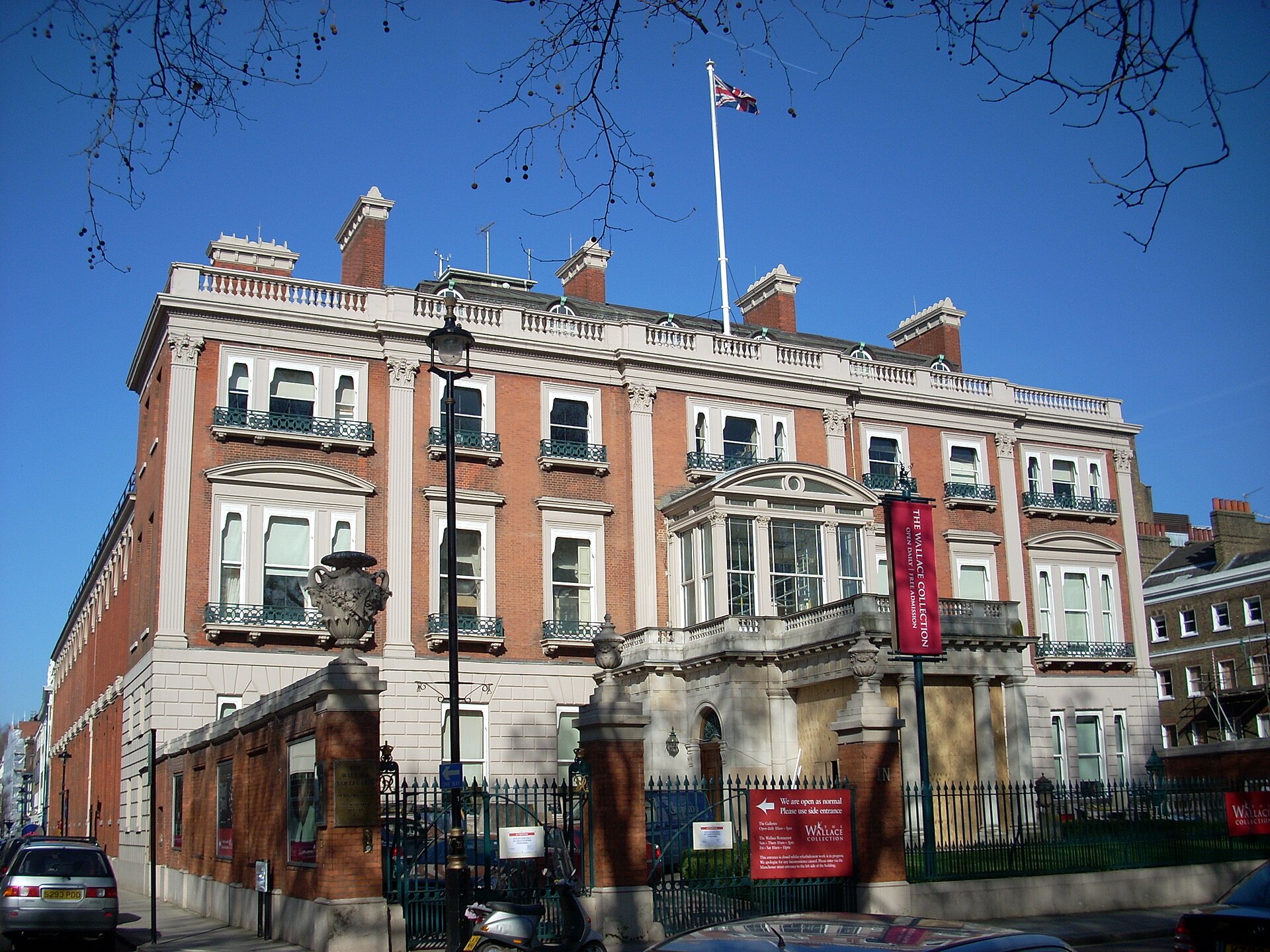
The red-brick Hertford House on Manchester Square with the Wallace Collection banner on its forecourt railings and a sign reading 'We are open as normal'. The sign and the banner identify the building as the museum.
Simon Burchell, CC BY-SA 4.0Wallace Collection
Museum · The Wallace Collection · Founded 1897
Open, admission and hours confirmed 24 November 2026 · 14 sources
On this page 15 sections
ContentsClose
Five main departments under one roof: paintings from the fourteenth to the late nineteenth century, French eighteenth-century furniture and porcelain, sculpture, medieval and Renaissance works, and arms and armour. The tertiary count on Wikipedia, which the museum does not publish in the pages we read, gives the house five Rembrandts, nine Rubens, nineteen Bouchers and eight Watteaus. It was assembled by four Marquesses of Hertford and Sir Richard Wallace and given whole to the nation, and it is still shown in the house of the people who made it.
| Local name | The Wallace Collection |
|---|---|
| Kind | Museum |
| Founded | Bequeathed to the nation in 1897; opened to the public on 22 June 1900 in Hertford House, built 1776 |
| City and country |  London, United Kingdom |
| Address | Hertford House, Manchester Square, London W1U 3BN, United Kingdom |
| Website | wallacecollection.org |
| Status | Open, confirmed |
| Record last verified |
Visiting
- Hours
- Daily10:00 to 17:00Open seven days a week
- Closed
- Closed 24, 25 and 26 December each year. The 16th-Century Gallery is closed 10:00 to 13:00 on 25 November 2026. East Galleries I and II are closed 8 to 11 February 2027. The museum warns that parts of the building may close at short notice.
- Admission
- Permanent collection, everyoneFreeFree and unticketed; come and go during opening hours, no queue for entry. Temporary exhibitions are ticketed and charged (Winston Churchill: The Painter, 23 May to 29 November 2026: 'Admission charge, members go free', no figure given on the page read, so none is recorded). Concessions for disabled visitors and free tickets for carers are offered.
Free entry: The permanent collection is free every day- Tickets
- wallacecollection.org/whats-on/exhibitions-di... The museum's own ticket page.
- Do I need to book?
- No. Entry to the main collection is free and unticketed. Exhibitions need a ticket, and the restaurant takes reservations for the set lunch and a la carte menu between 12:00 and 14:30.
- Address
- Hertford House, Manchester Square, London W1U 3BN, United Kingdom MapTube Bond Street (Central, Jubilee and Elizabeth lines), 7 minute walk, step-free by lift at the Marylebone Lane entrance; Marble Arch 10 minutes; Oxford Circus 12; Baker Street 13
Bus Routes 2, 10, 12, 13, 30, 74, 82, 94, 113, 137 and 274 stop nearby; all are wheelchair accessible
Rail Marylebone station is a 10 to 15 minute walk; Paddington 20 to 25 minutes
Car No visitor parking on site; metered street parking nearby until 18:30; Blue Badge bays on Manchester Square - Website
- wallacecollection.org
- Telephone
- +44 20 7563 9500
- [email protected]
Before you go how long, access, photography, bags, eating, shop
- How long to allow
- The museum publishes no recommended length of visit; entry is free and you can come and go during opening hours.
- Access
- Step-free entrance up a sloped driveway with automatic side doors; wheelchairs from the front desk (call ahead to reserve); magnifying glasses and torches at the Welcome Desk; portable folding seats from the Landing; trained assistance dogs welcome throughout; a sensory map and a free audio app with audio description and BSL video; quietest on weekdays 10:00 to 11:00 and 16:00 to 17:00, busiest on Saturdays 12:00 to 15:00.
- Photography
- The visitor guidance page does not mention photography. Filming is not allowed inside the Churchill exhibition during opening hours.
- Bags
- Free lockers on the Lower Ground Floor. Large bags over 56 x 25 x 45 cm, large umbrellas, folding bicycles, scooters and balloons are not allowed in; rucksacks may have to be worn on the front; the museum reserves the right to search any bag, and faces must be visible, with hoods and helmets removed.
- Eating
- The Wallace Restaurant in the glazed courtyard, 10:00 to 17:00, last orders 16:30, walk-ins welcome subject to space; telephone +44 20 7563 9505
- Shop
- A museum shop on site and online; [email protected]
Prices and hours change. We take them from the institution's own pages and print the day we read them, and you can check the current position at the source we used. Confirm before you travel.
What is inside
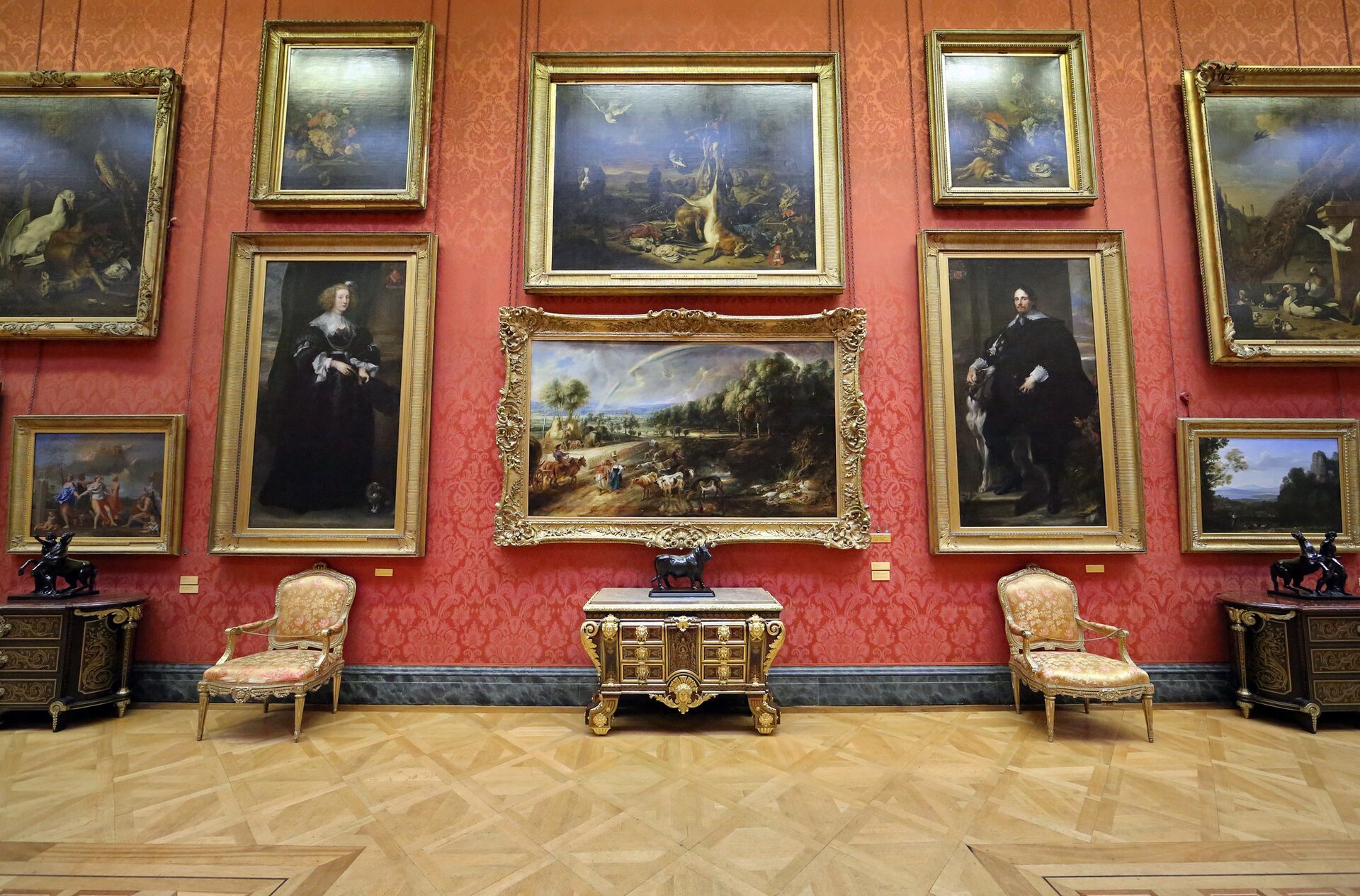
Photograph by Musicartgeek · CC BY-SA 3.0 The Great Gallery
The long picture gallery hung with Old Masters on red damask walls: Rubens's Rainbow Landscape, portraits by Van Dyck, and cabinet furniture standing under the paintings.
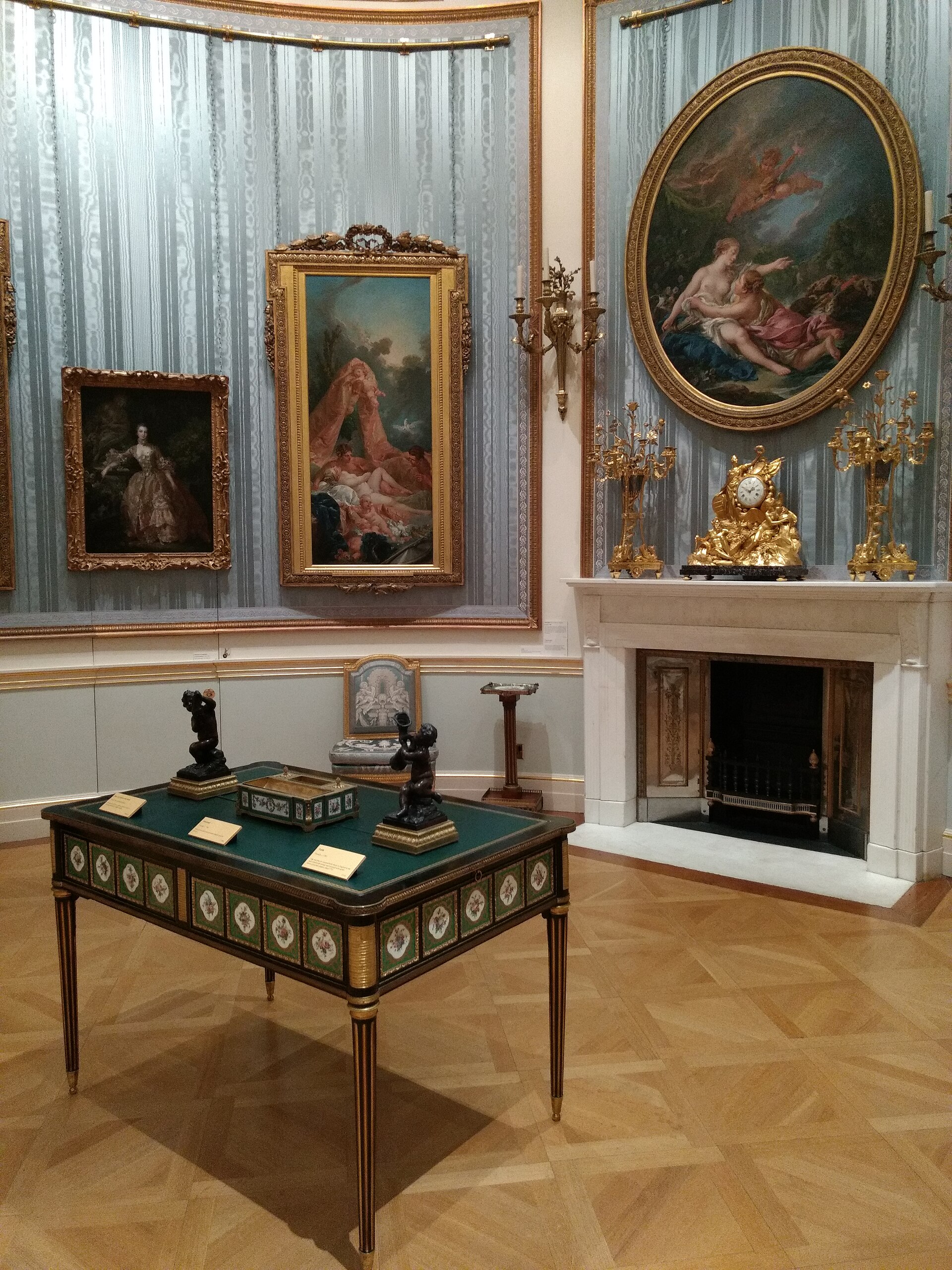
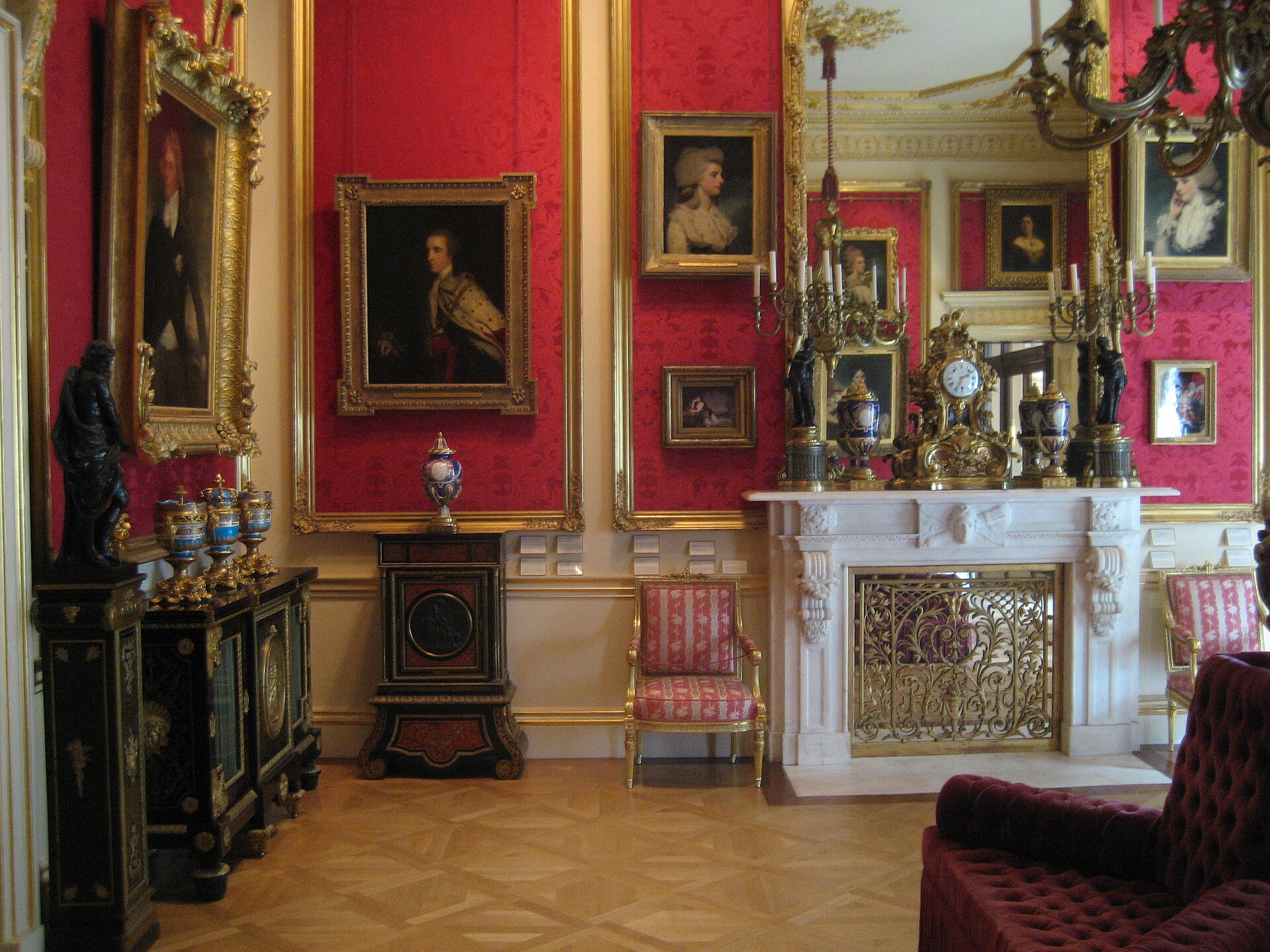
Photograph by Philafrenzy · CC BY-SA 4.0 The Oval Drawing Room and the French rooms
The rooms where eighteenth-century French paintings and decorative arts are shown together, as in the plate: Boucher canvases on pale silk-effect walls, a Sevres-mounted writing table, a gilt clock and candelabra. The museum names the Oval Drawing Room among its busiest rooms.
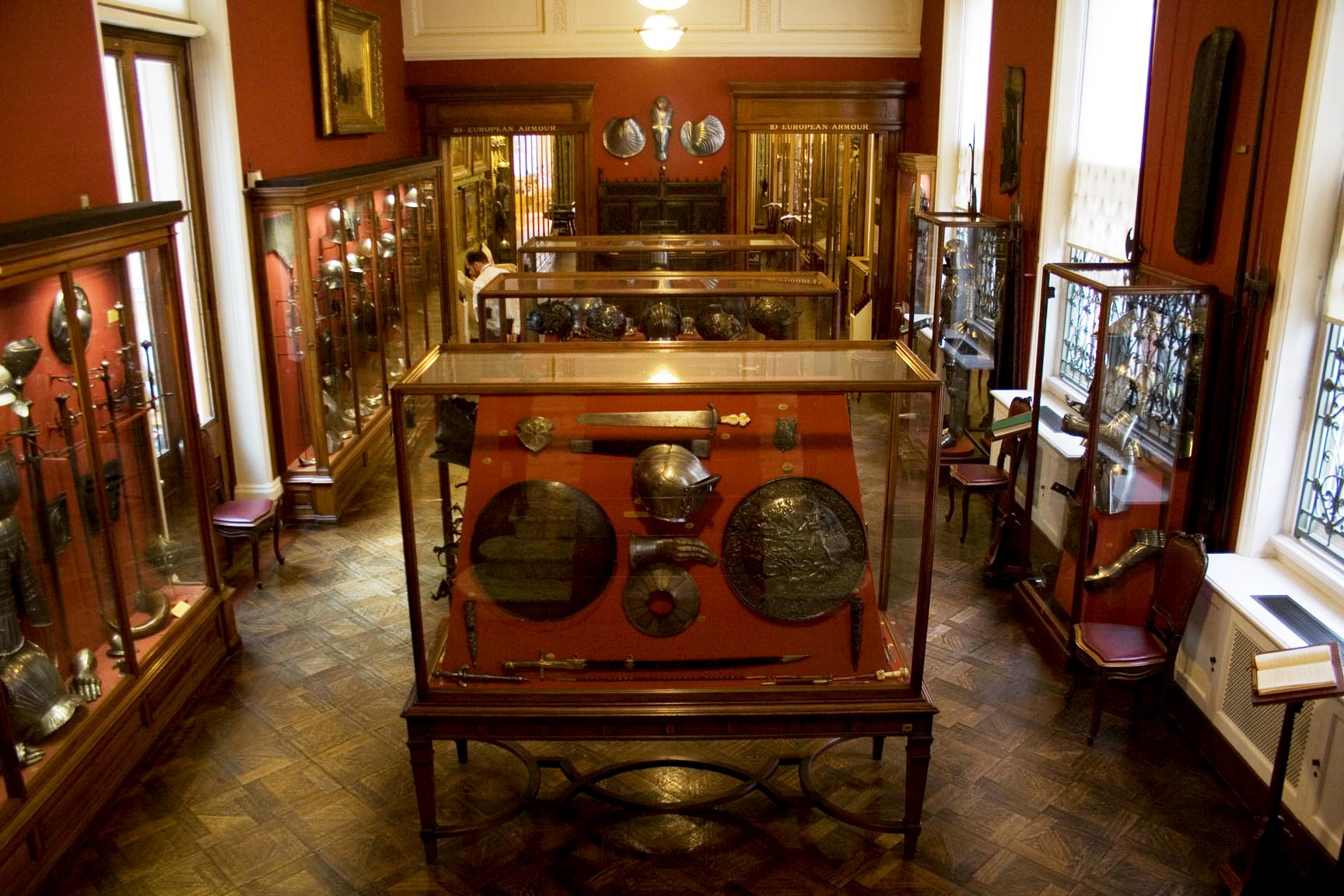
Photograph by M.chohan · CC BY-SA 4.0 The European Armouries
Three rooms of medieval and Renaissance armour and weapons, among them armour for man and horse made at Landshut about 1480, the armour of Sir Thomas Sackville made in the Royal Workshop at Greenwich about 1587, and a jewelled dagger of about 1615. The museum names the armouries as usually the quietest part of the building.
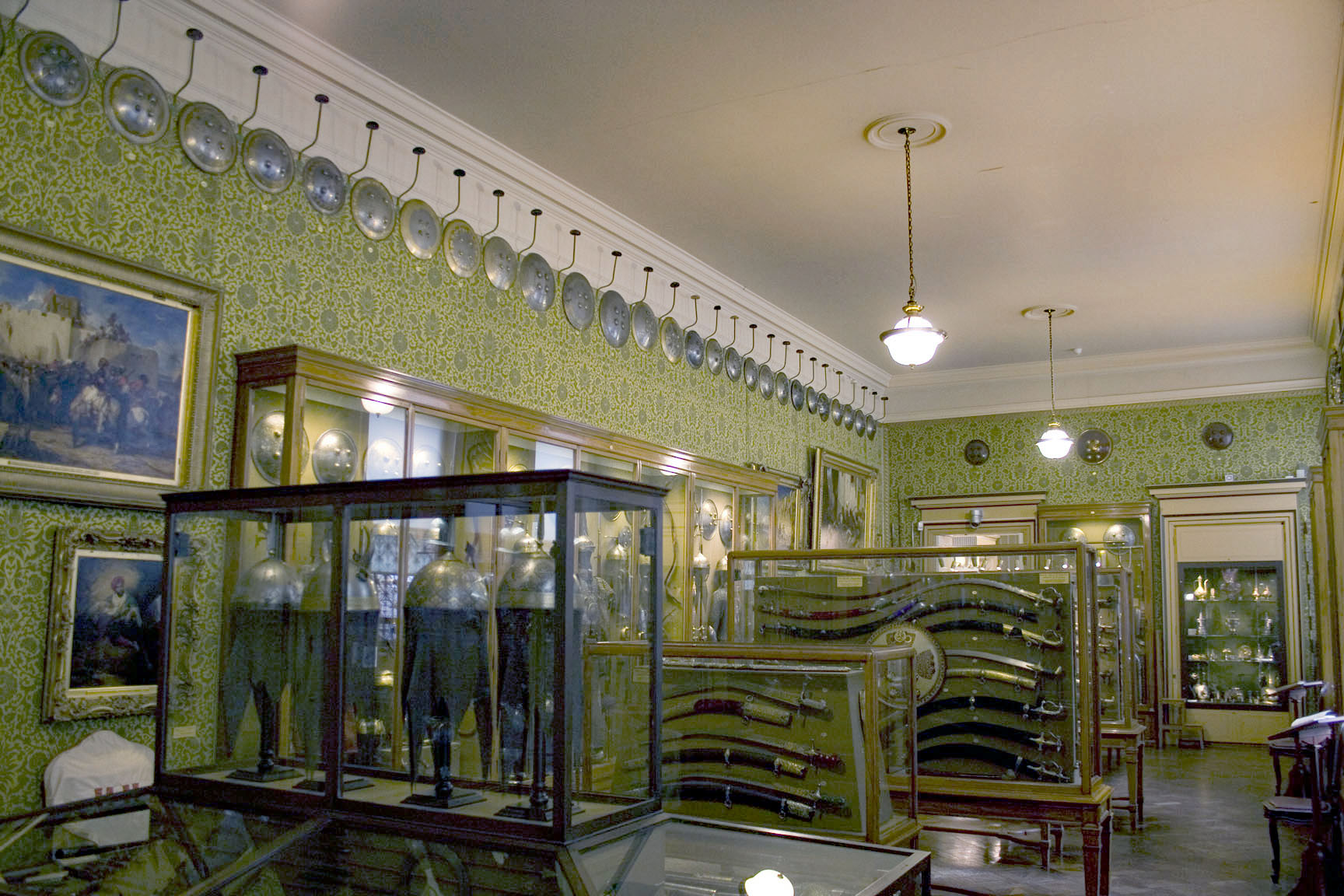
Photograph by M.chohan · CC BY-SA 4.0 The Oriental Armoury
Asian arms and armour, collected for the most part by the fourth Marquess in the 1860s (the dating is Wikipedia's) and shown on green wall coverings with a row of shields along the cornice. The museum runs an in-depth online story on the arms and armour of the Sikh Empire.
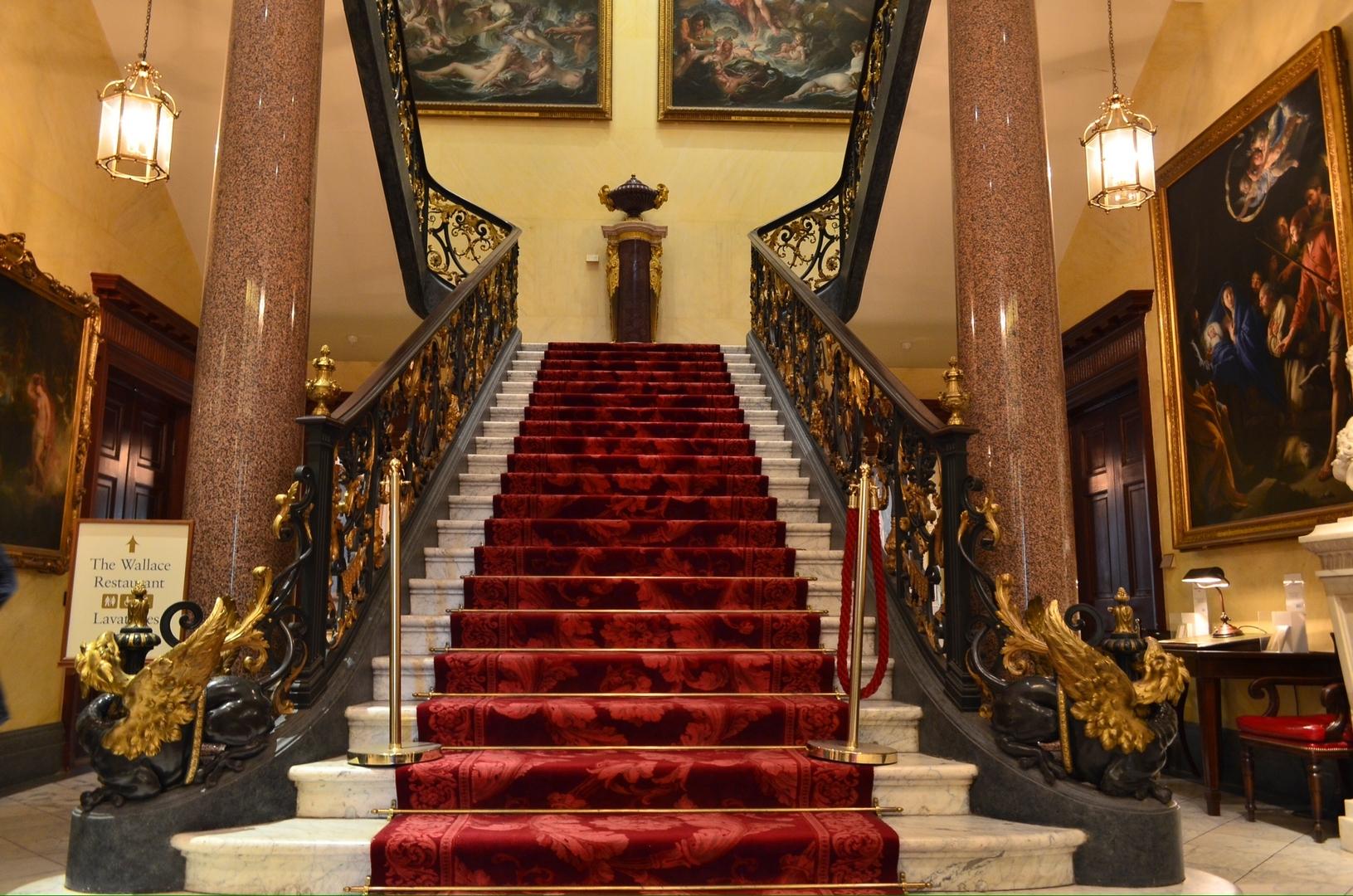
Photograph by M.chohan · CC BY-SA 4.0 The Front Hall and staircase
The entrance hall and the staircase with its gilt and black balustrade, red-carpeted flight and large paintings. The Information Desk sits on the right of the entrance vestibule, and signs here point to the restaurant.
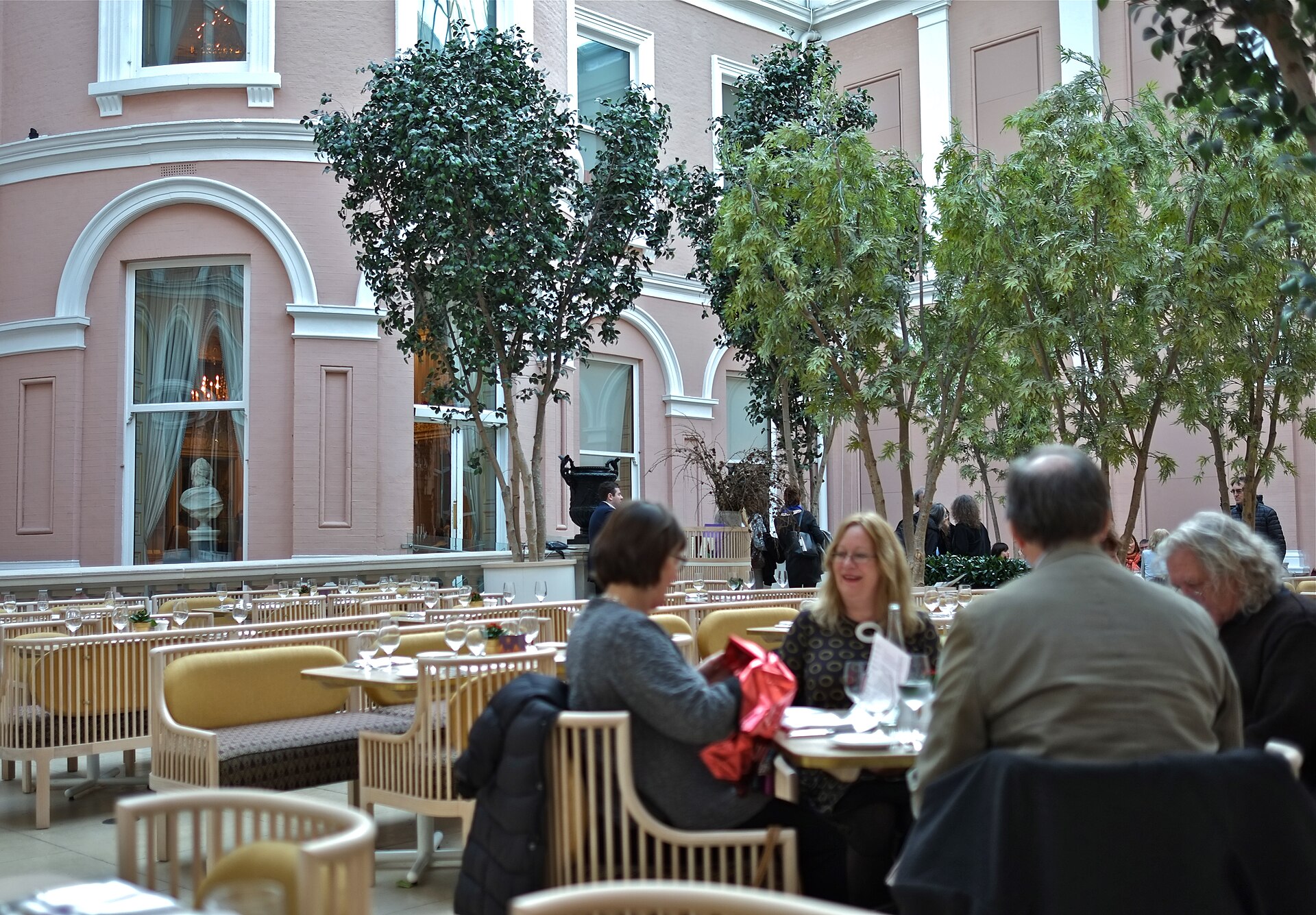
Photograph by Anthony O'Neil · CC BY-SA 2.0 The courtyard and the Wallace Restaurant
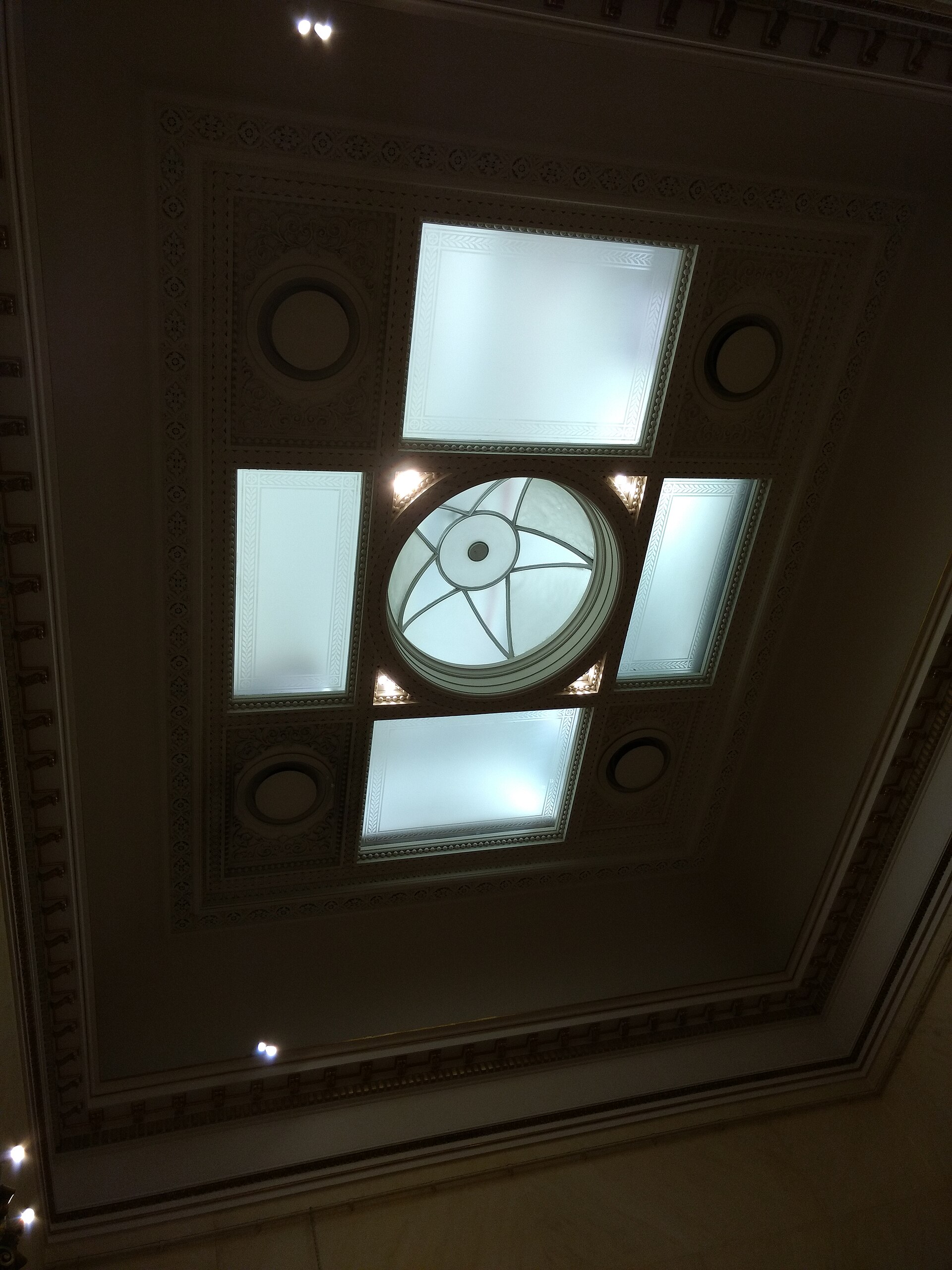
The former inner courtyard, glazed over in the redevelopment of 2000 and now the restaurant, planted with trees and lit from above. It is where the museum serves lunch, coffee, cake and afternoon tea.
The exhibition galleries and the Housekeeper's Room
A basement exhibition space opened in 2000 and tripled in size in June 2018 holds the ticketed shows; one-room free displays rotate through the Housekeeper's Room. As of 24 November 2026 the main show is Winston Churchill: The Painter, with free displays of Rachel Kneebone's porcelain sculpture and of Cosimo I de' Medici.
What to see first
The Laughing Cavalier
Frans Hals, 1624The museum's best-known portrait and the one every visitor asks about. Time Out's reviewer joked in 2024 that it is neither laughing nor a cavalier.9
The Swing (Les hasards heureux de l'escarpolette)
Jean-Honore Fragonard, 1767The Rococo picture the museum lists on its paintings page beside the Hals, and the subject of a conservation project the museum describes on its site.9
The Rainbow Landscape
Peter Paul Rubens, c. 1638A landscape the museum lists among its painting highlights and offers as a click-and-zoom view online. Wikipedia places it in the Great Gallery among Van Dyck portraits.9
The Lady with a Fan
Diego Velazquez, c. 1638 to 1639Listed by the museum among its painting highlights, beside the Hals and the Rembrandt.9
Titus, the Artist's Son
Rembrandt van RijnRembrandt's portrait of his son, listed among the museum's painting highlights; Wikipedia counts five Rembrandts in the collection.9
Armour for Man and Horse
Landshut, c. 1480A full armour for horse and rider, listed among the arms and armour highlights of what the museum calls one of the finest collections of its kind in the world.9
Chest-of-drawers
Jean-Henri RiesenerThe museum holds one of the most important groups of Riesener furniture anywhere and runs a dedicated website on it; this piece is on its decorative-arts highlights list.9
Console table
Andre-Charles BoulleListed among the museum's decorative-arts highlights, and one of the pieces behind its claim to one of the finest collections of eighteenth-century French decorative arts.9
Trophy Head
Asante (Ghana)A sculpture highlight attributed by the museum to the Asante of Ghana, and a reminder that the building holds more than European art. How such objects reached London is a question this archive treats as open.9
Pair of Flint-Lock Pistols of King Louis XIV of France
FranceListed among the arms and armour highlights, and royal French by its own title.9
A house built for a duke, lived in by an embassy
Hertford House was not designed as a museum, and not for the Hertfords. It was built in 1776 for George Montagu, fourth Duke of Manchester, and was first called Manchester House. Wikipedia, whose building history we label tertiary, records that it served as the Spanish Embassy from 1791 to 1795 and that the second Marquess of Hertford took the lease in 1797. The museum's own history places the family in residence from that year. The house hosted the Allied Sovereigns' Ball in 1814 and was let to the French Embassy from 1836 to 1851.
The point worth holding is how little of this was grand. The third Marquess preferred his other London houses. The fourth Marquess, who built the collection, lived mostly in Paris and used Hertford House largely as a place to store pictures rather than to show them. The museum's history states that he stored much of the collection at Hertford House rather than displaying it. The house became a place to look at the art only after he died.
Four Marquesses, one heir and a siege
The collection did not come from one eye. The museum's history of the collection gives the order: the first and second Marquesses bought some paintings, among them Canaletto, Reynolds and Gainsborough; the third was the first of the family to show real interest in art and bought Dutch paintings, French furniture and Sevres porcelain; and the fourth, who lived mostly in Paris and died in 1870, built the core, including most of the paintings, the porcelain, the furniture and the non-European arms and armour.
Richard Wallace then inherited what was not entailed. In 1871 he took over the lease of Hertford House and was knighted for his charitable work during the Siege of Paris. In 1872 he brought the inherited works to London and added medieval, Renaissance and European arms and armour; Wikipedia names the collections of Nieuwerkerke and Samuel Rush Meyrick among those he bought. He then altered the house between 1872 and 1875 to display the collection, moving in himself in 1875. In the early 1870s he lent more than 2,000 works to the opening exhibition of the Bethnal Green Museum, which the museum calls very popular.
The bequest that kept everything where it was
Wallace died in Paris in 1890. His widow, Lady Wallace, went on living at Hertford House with her secretary John Murray Scott, and when she died in 1897 she bequeathed the works of art on the ground and first floors to the British nation. Wikipedia puts the bequest at about 5,500 works. Objects from the Chateau de Bagatelle were excluded from it and sold separately, with a Christie's sale in 1913.
The conversion of the house took three years. Galleries replaced the stables, the coach-houses, the smoking room and some private rooms on the first floor, and the museum opened to the public on 22 June 1900. The government had bought the lease from Scott and the freehold from the Portman Estate. The result is what the museum's own collection page calls a setting designed to evoke the lives and tastes of its founders.
Lady Wallace's will required the bequest to be kept together and kept separate from other works. For 119 years that was read as a ban on lending. The Art Newspaper recorded in 2019 that the Charity Commission, after consulting the culture department, had granted an order under which the trustees could lend and borrow, on the finding that doing so served the charity's interests. The chairman said the argument for an unmoved display had once outweighed collaboration and no longer did The article named projects then under discussion, among them a Fragonard show built around The Swing and a Frans Hals show that would bring the Laughing Cavalier together with his other portraits. A visitor in 2026 therefore sees a collection that has only recently begun to travel.
What the building looks like now: the redevelopment of 2000 and the exhibition floor
Two changes to the building matter to a visitor. In 2000 the inner courtyard was glazed over and became the restaurant, and the Porphyry Court was roughly doubled in size and given a pair of staircases, according to Wikipedia, which does not name the architect and we do not either. The same year a basement exhibition space opened, and The Art Newspaper records that in June 2018 it was tripled in size, which is why a ticketed exhibition can now sit under a free collection. The museum describes its programme as built on or around the collection itself, with rolling free displays in the Housekeeper's Room.
As of 24 November 2026 the programme is Winston Churchill: The Painter, from 23 May to 29 November 2026, a ticketed major retrospective of the paintings of Sir Winston Churchill, with a themed afternoon tea in the restaurant; and two free displays, Metamorphoses by the sculptor Rachel Kneebone in porcelain, and Cosimo I de' Medici: Art and Dynasty. The exhibition closes in five days, and the free collection around it does not change.
How to spend two hours
Start on the first floor. The Great Gallery is the museum's argument for itself: Old Masters on crimson silk, the Rubens rainbow landscape at the centre, Van Dyck portraits beside it and French cabinet furniture below. Then walk through the small French rooms, where Boucher and Fragonard hang above Sevres-mounted tables and Riesener's furniture. The Swing is the painting most people come for. Then go down to the armouries, which the museum itself says are usually the quietest part of the building, and the Oriental Armoury, whose green walls and rows of shields are unlike any other room in London.
If you can choose the day, choose a weekday. The museum says mornings from 10:00 to 11:00 and the last hour from 16:00 to 17:00 are the calmest, and Saturdays between 12:00 and 15:00 the busiest. Lockers are free in the Lower Ground Floor and the courtyard restaurant is where to rest, with the usual warning that there can be short queues for both the shop and the restaurant on busy days. The museum's free audio app is called Bloomberg Connects.
House rules, in the museum's own words
Hertford House is also a security regime, and the museum is direct about it. Visitors are asked not to touch objects, frames, sculptures or furniture, to keep any part of the body or belongings behind barriers, not to smoke or vape in the building or the entrance courtyard, not to run, and not to eat or drink in the galleries. The museum reserves the right to inspect any bag, parcel or item entering or leaving the house, and refusal may mean no admission. Bags larger than 56 by 25 by 45 centimetres, folding bicycles, adult skateboards and scooters, e-bikes, helium balloons, floral arrangements and large umbrellas are not allowed in, and free lockers on the Lower Ground Floor take the rest. A rucksack may have to be worn on the front to protect the collection.
Faces must be visible: hoods, helmets or anything intended to conceal the face come off on entry, with exceptions at security's discretion for religious or medical coverings. CCTV runs throughout and the museum operates a zero-tolerance policy on aggressive behaviour. None of this is unusual for a national museum, but it is more than a visitor expecting a quiet house will have planned for, and it is the single most practical thing to know before arriving with luggage.
The people who run it and what they say about themselves
The Wallace Collection is a non-departmental public body of the Department for Culture, Media and Sport and a charity exempt from registration. Its director is Dr Xavier Bray, supported by a board of trustees appointed by the Prime Minister. It describes itself as a free museum in central London, open seven days a week from 10:00 to 17:00. Its stated aim is to share the collection with as broad an audience as possible, and the access page backs the claim with detail most museums leave to a leaflet: the sensory map, the quiet times, a named list of loan equipment.
The museum also publishes in-depth online stories, among them one on the Sikh Empire and its arms and armour. We saw the list of those stories in the site's navigation and did not read their texts, so we say no more than that they exist.
What visitors say
We cite no platform average and reproduce no visitor prose; what follows comes from the museum's own statements and one named review. We could not read a platform aggregate, so this is not a summary of visitor opinion. What the museum says about itself is that it is free, central and a house rather than an institution; what it admits is that Saturdays from noon to three are crowded, that the restaurant and shop queue, that parts of the building can close at short notice and that exhibitions are charged for. Time Out's 2024 listing is warm and records no complaint.
What is praised, what is criticised
- Praised: entry to the permanent collection is free, every day, with no ticket and no queue
- Praised: the setting: a lived-in London town house where paintings, furniture and porcelain are shown as a salon would have been, not as a sequence of white cubes
- Praised: the range packed into one building: Old Master paintings, French royal furniture and Sevres, and one of the finest armouries in the country
- Praised: quiet corners, especially the armouries and weekday mornings, which the museum itself recommends
- Criticised: Saturday between noon and three is the busiest time, and the restaurant, shop, front hall and Oval Drawing Room are named by the museum as the crowded points
- Criticised: the temporary exhibitions are charged for while the collection is free, and the Churchill show asks for a ticket
- Criticised: bag and security rules are strict: size limits, searches, rucksacks worn on the front, faces visible, and parts of the museum closing at short notice
- Criticised: for nearly a century and a quarter the collection could not lend, because Lady Wallace's 1897 bequest was read as forbidding it; the ban was lifted by a Charity Commission order only in 2019
Questions about Wallace Collection
Where is Wallace Collection?
Hertford House, Manchester Square, London W1U 3BN, United Kingdom.
How much does it cost to visit?
Permanent collection, everyone: free. As confirmed 24 November 2026.
When is it open?
Daily 10:00-17:00. Closed: Closed 24, 25 and 26 December each year. The 16th-Century Gallery is closed 10:00 to 13:00 on 25 November 2026. As confirmed 24 November 2026.
How do you get there?
Tube: Bond Street (Central, Jubilee and Elizabeth lines), 7 minute walk, step-free by lift at the Marylebone Lane entrance; Marble Arch 10 minutes; Oxford Circus 12; Baker Street 13; Bus: Routes 2, 10, 12, 13, 30, 74, 82, 94, 113, 137 and 274 stop nearby; all are wheelchair accessible; Rail: Marylebone station is a 10 to 15 minute walk; Paddington 20 to 25 minutes; Car: No visitor parking on site; metered street parking nearby until 18:30; Blue Badge bays on Manchester Square.
What should you see first?
The Laughing Cavalier (Frans Hals, 1624); The Swing (Les hasards heureux de l'escarpolette) (Jean-Honore Fragonard, 1767); The Rainbow Landscape (Peter Paul Rubens, c. 1638); The Lady with a Fan (Diego Velazquez, c. 1638 to 1639); Titus, the Artist's Son (Rembrandt van Rijn); Armour for Man and Horse (Landshut, c. 1480).
What we could not confirm
- How the gold Asante trophy head in the sculpture highlights came to London is not stated on any page we read; the museum's own provenance page for the object should be read before anything is said about it.
- The price of a ticket for Winston Churchill: The Painter, and for later exhibitions, is behind the booking page and was not read.
- Visitor numbers for the last two financial years: we found a figure in press summaries but not in a document we could open.
- No aggregate platform rating was read; the Tripadvisor page refused our fetch.
- Whether the museum will lend more of the Great Gallery pictures now that the 2019 order allows it.
Images
Sources
- 1The Wallace Collection, Visit: hours, free entry, closure notices for 25 November 2026 and February 2027, address, restaurant. Fetched 24 November 2026. wallacecollection.org/visit/
- 2The Wallace Collection, Contact Us: address, telephone +44 (0)207 563 9500, enquiries email, departmental numbers. Fetched 24 November 2026. wallacecollection.org/contact-us/
- 3The Wallace Collection, Getting Here: tube, bus, rail, car and bicycle access. Fetched 24 November 2026. wallacecollection.org/visit/getting-here/
- 4The Wallace Collection, Access: step-free entry, loan equipment, quiet and busy times, assistance dogs, lockers, free audio app. Fetched 24 November 2026. wallacecollection.org/visit/access/
- 5The Wallace Collection, Visitor Guidance: bag sizes, searches, face coverings, rules in the galleries. Fetched 24 November 2026. wallacecollection.org/visit/visitor-guidance/
- 6The Wallace Collection, Food and Drink: the Wallace Restaurant in the glazed courtyard, hours, reservations, telephone. Fetched 24 November 2026. wallacecollection.org/visit/food-and-drink/
- 7The Wallace Collection, History of the Collection: the Marquesses of Hertford, Sir Richard Wallace, Lady Wallace and the bequest of 1897, conversion and opening in 1900. Fetched 24 November 2026. wallacecollection.org/collection/history-collection/
- 8The Wallace Collection, About Us: status as a non-departmental public body, director, trustees, the gift of 1897. Fetched 24 November 2026. wallacecollection.org/about-us/
- 9The Wallace Collection, The Collection and its Paintings, Sculpture, Arms and Armour and Decorative Arts pages: the museum's own highlight lists. Fetched 24 November 2026. wallacecollection.org/explore/collection/paintings/
- 10The Wallace Collection, Exhibitions and Displays and Winston Churchill: The Painter (23 May to 29 November 2026, admission charge, members free). Fetched 24 November 2026. wallacecollection.org/whats-on/exhibitions-displays/winston-churchill-the-painter/
- 11Fetched 24 November 2026; used only for dates and counts the museum's pages did not give. en.wikipedia.org/wiki/Wallace_Collection
- 12The Art Newspaper, 'Where there's a will there's a way: the Wallace Collection lifts loan restrictions', 24 September 2019. theartnewspaper.com/2019/09/24/where-theres-a-will-theres-a-way-the-wallace-collection-lifts-loan-restrictions
- 13Time Out London, Wallace Collection, review by Eddy Frankel, page dated 17 October 2024. Fetched 24 November 2026; read through a summarising fetch, so nothing is quoted from it except the joke about the Laughing Cavalier. timeout.com/london/museums/wallace-collection
- 14Wikimedia Commons, Category:Exterior of the Wallace Collection and Category:Interior of the Wallace Collection: plates on this page, licence of each read per file from the Commons API on 24 November 2026. commons.wikimedia.org/wiki/Category:Exterior_of_the_Wallace_Collection