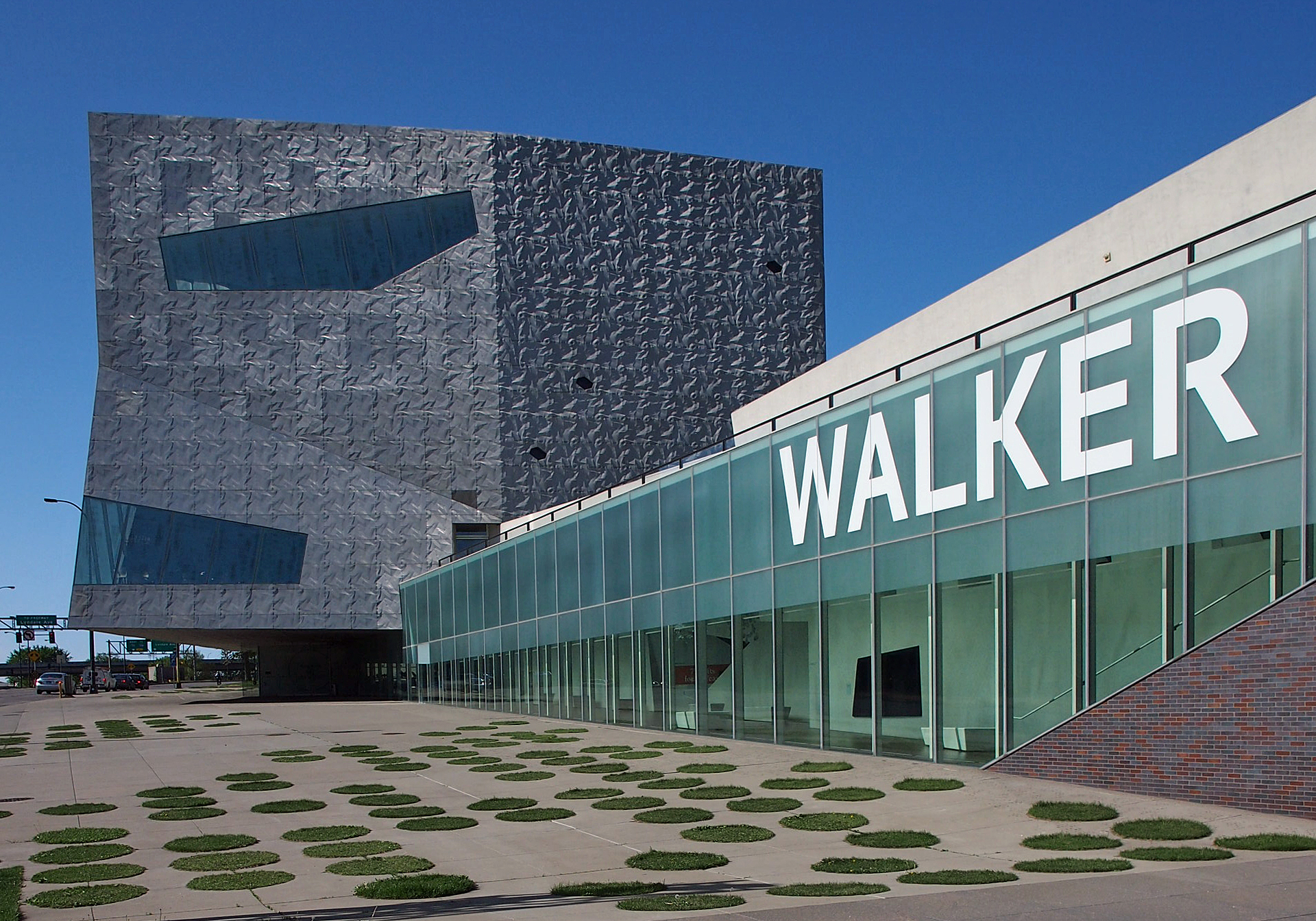
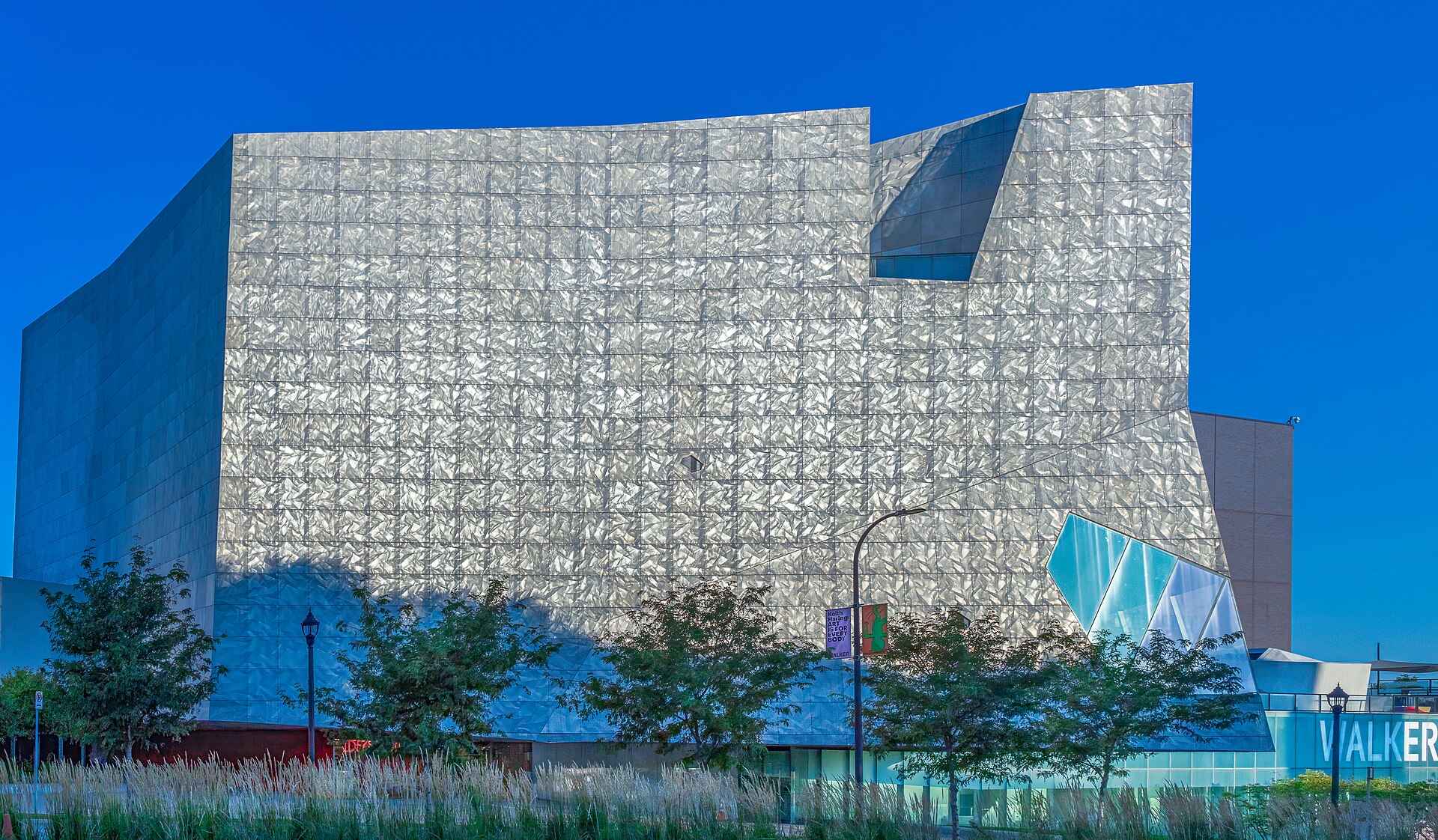
The crumpled aluminum mesh skin of the 2005 expansion, with WALKER lettered above the glazed lobby of the two-story addition. This is the Minneapolis contemporary art museum at 725 Vineland Place, a separate institution from the Minneapolis Institute of Art across town and from the Minneapolis Sculpture Garden it programs next door.
Photograph by McGhiever · CC BY-SA 4.0Walker Art Center
Museum · Founded 1927
Open, admission and hours confirmed 28 September 2026 · 31 sources
On this page 16 sections
ContentsClose
The Walker's roughly 16,000 works by nearly 5,000 artists are built around the present tense rather than an encyclopedic survey: strength in Minimalism, Arte Povera and Pop sits beside archives that most museums of this size do not attempt, including the Jasper Johns and Robert Motherwell print archives, some 500 Fluxus works, a near complete run of Joseph Beuys multiples, and the roughly 4,300-object Merce Cunningham Dance Company Collection. The museum's Long-Range Acquisition Plan is rewritten roughly every five years; the version adopted in 2024 organizes new collecting around embodiment, diaspora and migration, and ecological entanglement, and between 2023 and 2025 the museum deaccessioned duplicate holdings to raise its acquisition endowment by about 25 percent.
| Kind | Museum |
|---|---|
| Founded | The Walker Art Galleries opened to the public on 21 May 1927, on land and a collection given by the lumber magnate T. B. Walker; the institution reopened under its present name, Walker Art Center, on 4 January 1940 |
| City and country |  Minneapolis, United States Minneapolis, United States |
| Address | 725 Vineland Place, Minneapolis, MN 55403, United States |
| Website | walkerart.org |
| Status | Open, confirmed |
| Record last verified |
Visiting
- Hours
- Monday-TuesdayClosed
- Wednesday10:00 to 17:00
- Thursday10:00 to 21:00Extended evening hours; free admission from 5pm under Free Thursday Nights
- Friday-Sunday10:00 to 17:00
- Closed
- Monday and Tuesday, every week. 4 July, Thanksgiving Day, Christmas Eve and Christmas Day. The Minneapolis Sculpture Garden keeps separate hours, 6am to midnight daily year round, and does not close when the museum building does.
- Admission
- AdultUSD 18
- Senior, 65 and overUSD 16
- Student, with IDUSD 12
- Youth, 18 and underFreeFree at all times
- Walker memberFreeFree; membership is sold separately and is not a ticket tier
- EBT cardholderFreeFree, through the museum's own EBT admission access program
- Citizen or member of a federally recognized Tribal NationFreeFree at all times
- Active duty military, and up to five family membersUSD 9$9 the rest of the year; free from Armed Forces Day in May through Labor Day, under the national Blue Star Museums program. The 2026-08-13 pass on this record recorded only the free summer window and omitted the standard $9 price; corrected 2026-09-28 against the museum's own current price table.
Free entry: Free Thursday Nights, every Thursday, 5pm to close, free for all visitors. Free First Saturday, the first Saturday of every month, all day, with free educator-led tours. Sensory Friendly Sundays, the second Sunday of the month, galleries open at 11am following a dedicated quiet session. The adjacent Minneapolis Sculpture Garden charges no admission at any time and keeps its own hours, separate from the museum building- Tickets
- secure.walkerart.org/events The museum's own ticket page.
- Do I need to book?
- No for general admission, which can be bought at the door; timed online tickets are recommended for Free Thursday Nights and Free First Saturday, when capacity is limited and demand is highest
- Address
- 725 Vineland Place, Minneapolis, MN 55403, United States MapMetro Transit bus Routes 4 and 25 and the E Line stop within a few minutes of the museum; the closest stops are Lyndale and Vineland, about a two minute walk, and Oak Grove and 15th Street, about three minutes on foot
Car and parking An underground parking ramp is entered from Vineland Place, with accessible spaces on the P1 level; metered street parking runs along Vineland Place, and four hour metered spaces are reserved on that street for vehicles carrying disability plates
On foot and by bicycle The Irene Hixon Whitney Bridge carries pedestrians over Interstate 94 from Loring Park into the campus. Bicycle racks stand at the Vineland Place entrance and at the corner of Groveland and Hennepin. The Minneapolis Sculpture Garden, which the Walker programs but does not own, borders the museum along Vineland Place and is reached on the same walk - Website
- walkerart.org
- Telephone
- +1 612-375-7600
- [email protected]
Before you go how long, access, photography, bags, eating, shop
- How long to allow
- The museum publishes no suggested duration. The building holds 65,000 square feet of exhibition space split across the 1971 and 2005 wings, and a visitor who also wants to walk the adjacent Minneapolis Sculpture Garden should budget time for it separately, since the garden is a different piece of ground with its own hours and is not part of a single ticketed circuit
- Access
- All entrances and galleries are wheelchair accessible; manual wheelchairs are available free at the Visitor Services desk on a first come basis, capped at a 250 pound capacity. Elevators reach Galleries 1, 3, 4, 6 and 7 from the Main Lobby, and platform lifts rated to 750 pounds reach Galleries 2 and 5. Assistive listening devices, sensory packs, American Sign Language interpretation, Braille and large print materials are available, the last three with two weeks notice, through [email protected] or 612-375-7564
- Photography
- Personal, non-commercial photography without flash, tripods or monopods is allowed throughout the galleries and public spaces; a paid permit is required for professional shoots, and individual loaned works may carry their own restriction
- Bags
- Coats, backpacks and umbrellas must be checked at the lockers or coatroom near the entrance; bags larger than 11 by 17 inches are not allowed in the galleries
- Eating
- The Cafe, on the ground floor with views into the Minneapolis Sculpture Garden, serves coffee, pastries, sandwiches and salads during gallery hours, with a 10 percent discount for Walker members. The space has changed operator more than once since the 2005 expansion opened it: Doug Flicker's Esker Grove from December 2016, Cardamom under chefs Daniel del Prado and Shawn McKenzie from July 2021, and its current operation under the museum's own Cafe branding
- Shop
- Idea House 3, the Walker's design shop, sells furniture, lighting, tableware and books by more than 50 emerging and established designers, and continues the museum's design program into retail
Prices and hours change. We take them from the institution's own pages and print the day we read them, and you can check the current position at the source we used. Confirm before you travel.
What is inside
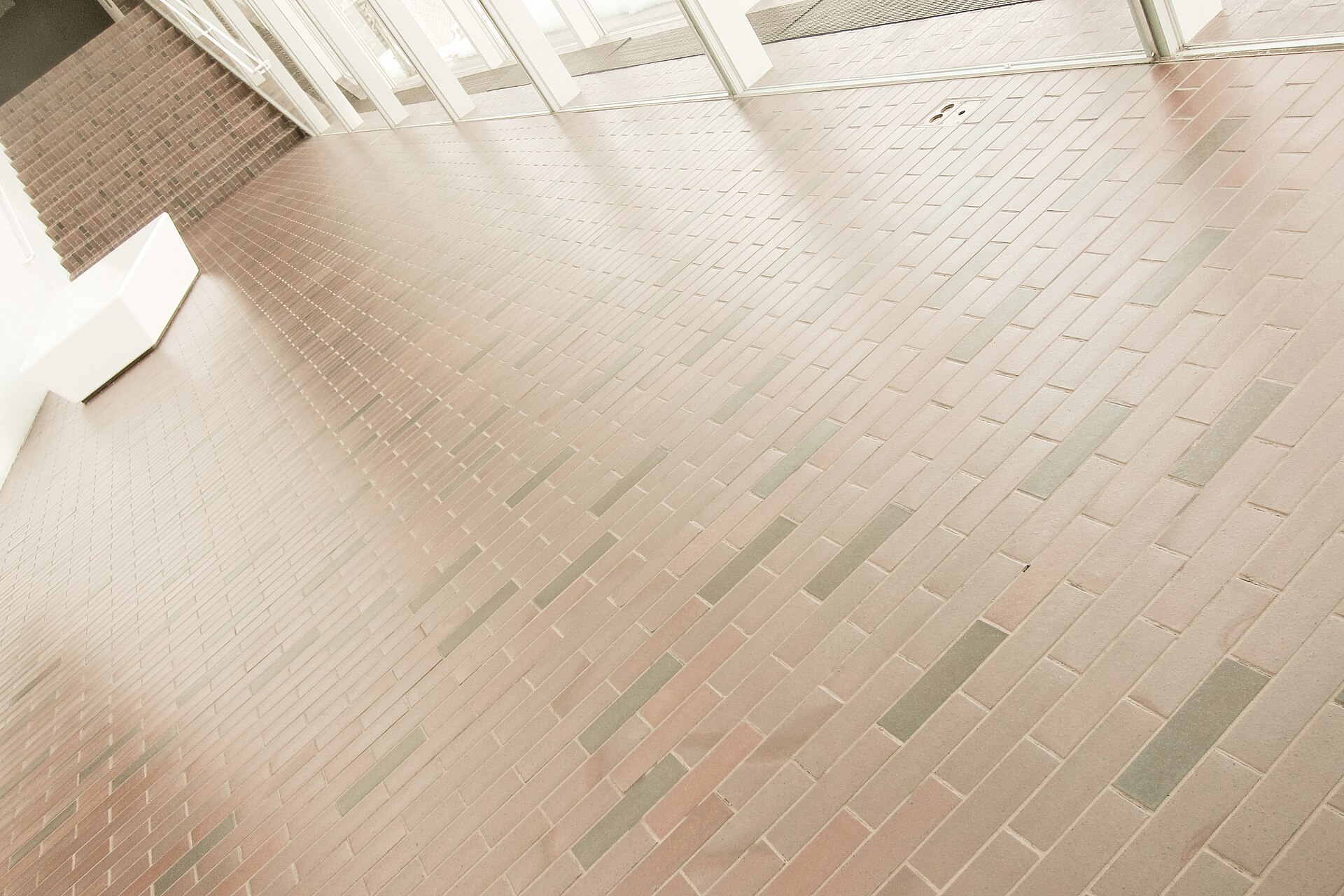
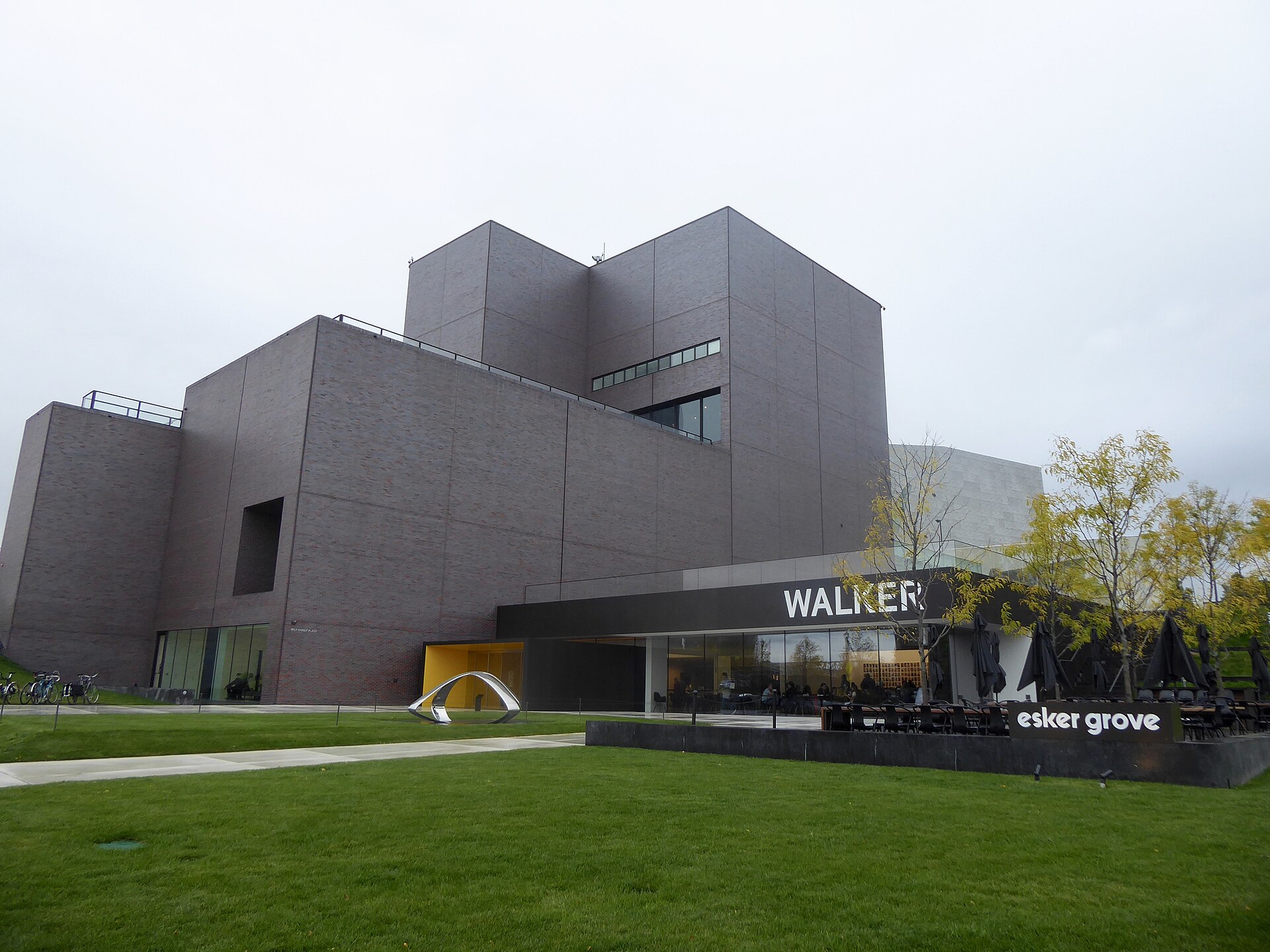
Photograph by Sharon Mollerus · CC BY 2.0 The Edward Larrabee Barnes building of 1971
The museum's original modern building: a helix of seven boxlike, columnless galleries in plum spotted brown brick, wrapped around a central circulation core, with white walls, terrazzo and brick floors, and ceilings as high as 17.5 feet. Architectural critics at the time rated it among the finest buildings then built anywhere for showing contemporary art, and it won a national American Institute of Architects award. Three outdoor terraces, which Barnes called pedestals, still carry rotating sculpture off Gallery 6.
The Herzog & de Meuron expansion of 2005
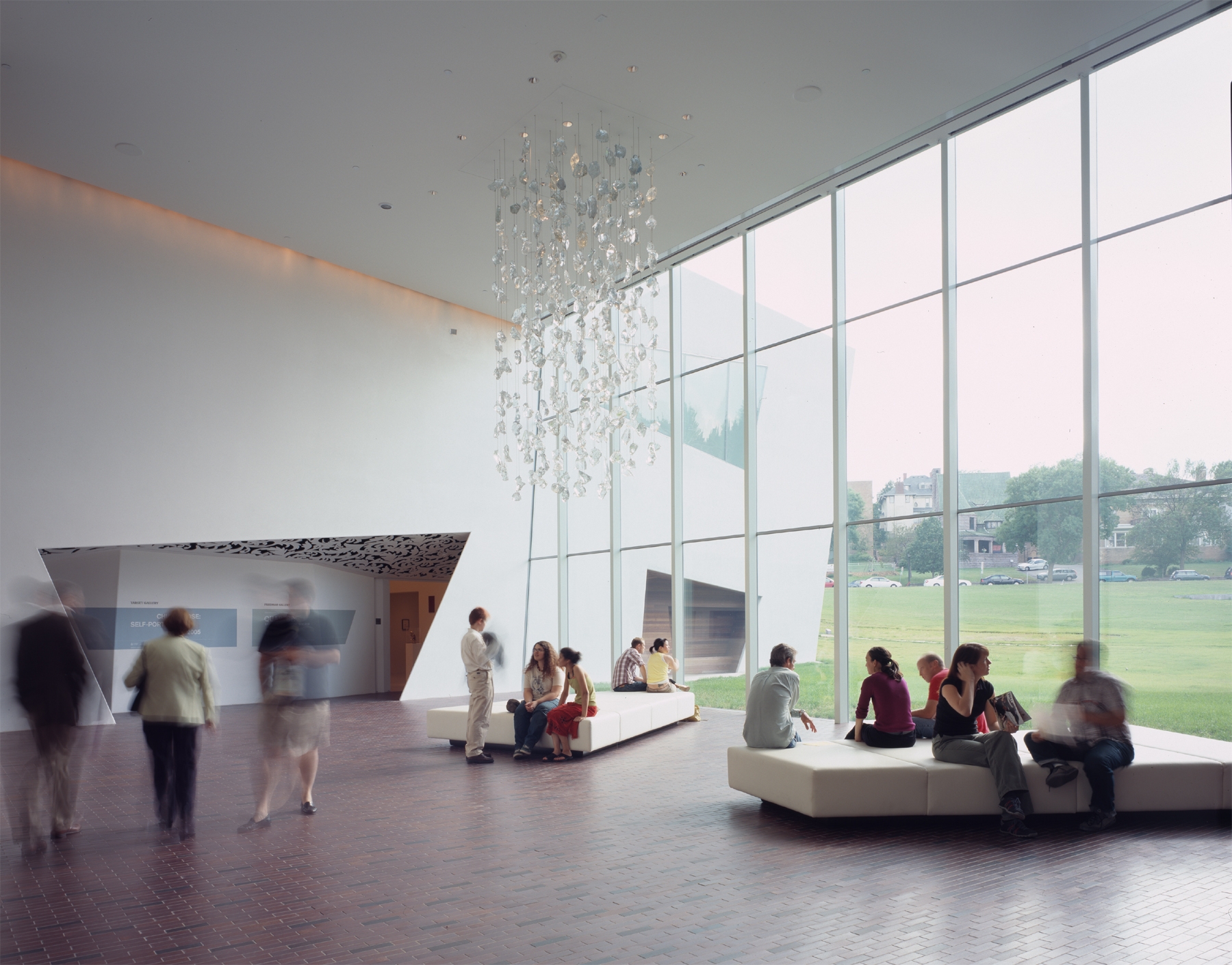
A 92 million dollar addition, the Swiss firm's first completed public building in the United States, nearly doubling the museum's size behind a shimmering, crumpled aluminum mesh skin wrapped over a cubic tower. It added Galleries 4 through 7, the Cargill Lounge, and a two story glazed lobby conceived as a town square, open to the street rather than closed off from it.
The William and Nadine McGuire Theater
A 385-seat, European-style box theater opened with the 2005 expansion, built for dance, music and theater rather than lectures. It carries forward the Walker's five decade relationship with the Merce Cunningham Dance Company, which began with a 1963 engagement and an early full residency in 1969, ran through eight further residencies and three commissions, and culminated in the 2017 exhibition Merce Cunningham: Common Time.
The Bentson Mediatheque
A small screening room off the main lobby, home to the Ruben/Bentson Moving Image Collection, begun in 1973 with a 10,000 dollar gift from Evelyn Ruben and now numbering several hundred titles in film and video from the 1890s to the present. A visitor chooses a title from a touchscreen and watches it free, on the spot, without booking or a ticket.
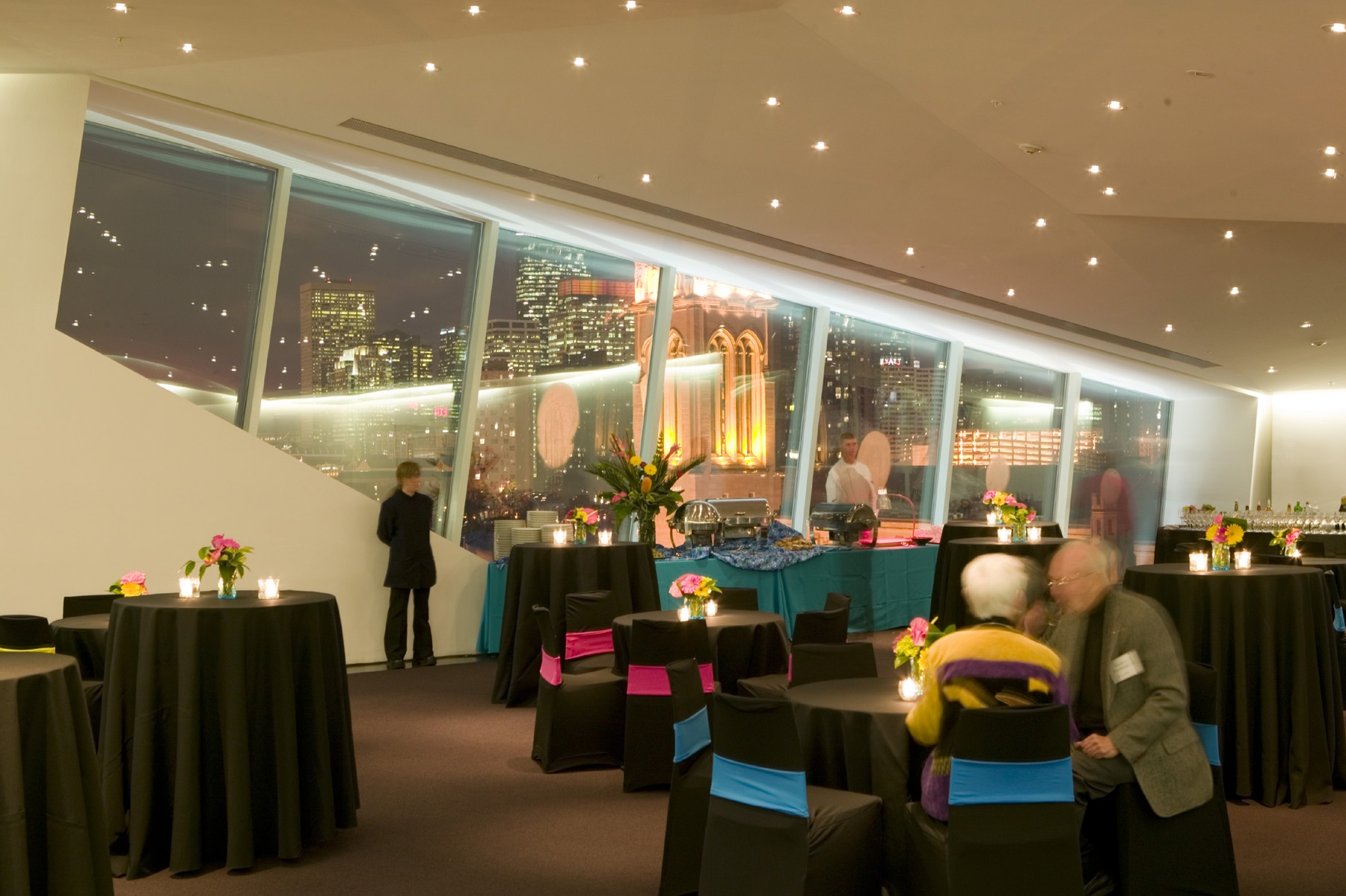
Photograph by Wac-pr · CC BY-SA 3.0 The Skyline Room and rooftop terrace
An event space on the top level of the 2005 tower, glazed on one side toward the Minneapolis skyline, used for members' previews, private events and public programs rather than for standing exhibitions. It is one of the few points in the building where the city itself, rather than the collection, is what is on view.
The Design Studio and Idea House 3
The Walker's design department, whose exhibitions have run from De Stijl and the design process at Herman Miller under curator Mildred Friedman in the 1970s and 1980s to Graphic Design: Now in Production in 2012 and Designs for Different Futures in 2020. Idea House 3, its adjoining shop, sells furniture, lighting, tableware and objects by more than 50 designers, and is one of the few museum shops in the country where visitors are invited to sit in the chairs on display.
This Must Be the Place: the current collection installation
The visual arts collection's present hang, in Galleries 4 through 6 from June 2024 through March 2028, organized around the idea of home in four sections titled Kith and Kin, The City, The Land, and Light, Water, Space. It hangs Franz Marc's Die grossen blauen Pferde and Edward Hopper's Office at Night alongside recent acquisitions by Njideka Akunyili Crosby and Jennifer Packer.
What to see first
Die grossen blauen Pferde (The Large Blue Horses)
Franz Marc, 1911An Expressionist landmark of the Blue Rider group, bought by the T. B. Walker Foundation in 1942 and in the collection for more than eighty years; it is the single painting visitors most often ask for directions to, and it anchors the current collection reinstallation.8
Office at Night
Edward Hopper, 1940Hopper sold it directly to the Walker in 1948, out of a purchase exhibition called New Paintings to Know and Buy. Its ambiguous, half-lit office scene has drawn more critical rereading, including on gender and workplace power, than almost any other single painting in the building.9
Sixteen Jackies
Andy Warhol, 1964Silkscreened from wire service photographs of Jacqueline Kennedy taken in the days around the 1963 assassination, and bought by the museum in 1968; it sits at the center of the Walker's deep Pop and Warhol holdings.10
Spoonbridge and Cherry
Claes Oldenburg and Coosje van Bruggen, 1985 to 1988The 50-plus foot fountain sculpture that is the single most photographed object associated with the Walker, though it stands in the adjacent Minneapolis Sculpture Garden rather than inside the museum building; the Walker programs the garden but the ground itself belongs to the Minneapolis Park and Recreation Board.11
The Merce Cunningham Dance Company Collection
Acquired 2011, from the Cunningham Dance FoundationAbout 4,300 objects spanning 150 dances, including decor and costumes made for Cunningham by Robert Rauschenberg, Jasper Johns, Frank Stella and Andy Warhol among others; it is the reason a dance archive, rather than a museum of visual art alone, now holds a significant body of work by several of those artists.12
The Fluxus holdings and the Joseph Beuys multiples
Various artists, chiefly 1960s to 1970sRoughly 500 Fluxus works, including pieces by Yoko Ono, Nam June Paik and Ben Vautier, gathered alongside a near complete run of Joseph Beuys's editioned multiples, assembled as a coherent research collection rather than as scattered single buys.6
The Herzog & de Meuron building itself
Herzog & de Meuron, completed 2005The Swiss firm's first completed building in the United States, and the reason the museum's silhouette changed after more than thirty years under Barnes's brick tower; the crumpled aluminum mesh skin was designed to read differently by daylight and under floodlight after dark.5
Exhibitions on now
Past exhibitions here
From a lumber baron's gallery to a public art center
Thomas Barlow Walker made his money in Minnesota and California timber, and from the 1860s he began collecting: paintings, jades, ceramics, whatever caught him. He opened the Walker Art Gallery on Hennepin Avenue in 1879, generally reckoned the first public art gallery west of the Mississippi, and in 1916 he bought land south of downtown Minneapolis with the idea of giving both the site and the collection to the city, on condition the city build a public gallery, library and science center on it. The negotiation stalled, and rather than wait he built the Walker Art Galleries himself, opening them on the current site on 21 May 1927 and endowing a foundation before his death the following year to keep them running. The pivot from one man's gallery to a public art center came more than a decade later, after the Minnesota Arts Council and Federal Arts Project money renovated the building and started an art school for children and adults alongside it; the renamed Walker Art Center reopened on 4 January 1940, and the institution dates its modern identity from that day rather than from 1927.
Two buildings, thirty four years apart
Two buildings, thirty four years apart, make up what stands on Vineland Place now. Edward Larrabee Barnes's building of 1971 is a helix of seven boxlike, columnless galleries in plum-spotted brown brick, wound around a central circulation core, with white walls, terrazzo and brick floors underfoot and ceilings running as high as 17.5 feet. It won an American Institute of Architects award and was rated by architectural critics of the day among the best buildings then built anywhere for showing contemporary art. In 2005 Herzog & de Meuron, in their first completed public building in the United States, nearly doubled the museum's size with a 92 million dollar addition wrapped in crumpled aluminum mesh, adding four more galleries, the 385-seat McGuire Theater, the Cargill Lounge and a glazed two-story lobby the architects described as a town square rather than a conventional entrance. The two buildings do not pretend to be one: the brick tower and the silver one sit against each other rather than blending, and a visitor who only knows the museum from a single photograph is usually looking at just one of the two.
A collection built for the present tense
The collection itself runs to roughly 16,000 works by nearly 5,000 artists, and it is built for the present rather than as an encyclopedic survey of art history. Strength in Minimalism, Arte Povera and Pop sits beside research holdings few museums this size attempt: the Jasper Johns and Robert Motherwell print archives, some 500 Fluxus works by artists including Yoko Ono, Nam June Paik and Ben Vautier, and a near complete run of Joseph Beuys's editioned multiples. Two paintings bought early anchor the galleries even now: Franz Marc's Die grossen blauen Pferde, bought in 1942, and Edward Hopper's Office at Night, which Hopper sold to the Walker directly in 1948. Andy Warhol's Sixteen Jackies, bought in 1968, sits inside a deeper Pop holding than the single canvas suggests. The current visual arts installation, This Must Be the Place, runs in Galleries 4 through 6 from June 2024 to March 2028 and groups the collection around the idea of home rather than by school or period, putting Marc and Hopper beside recent acquisitions by Njideka Akunyili Crosby and Jennifer Packer.
Performance, film and the Cunningham years
Performance and film are not an add-on department here; they are close to half of what the institution actually does. The Walker's relationship with the Merce Cunningham Dance Company runs from a 1963 engagement through an early full residency in 1969, one of the first of its kind anywhere in the country, on through eight further residencies and three commissions over the following decades. In 2011 the museum accepted the entire Cunningham Dance Foundation archive: roughly 4,300 objects across 150 dances, including decor and costumes made for Cunningham by Robert Rauschenberg, Jasper Johns, Frank Stella and Andy Warhol among others, conserved with Andrew W. Mellon Foundation support and shown in the 2017 exhibition Merce Cunningham: Common Time. Film has its own separate lineage: the Ruben/Bentson Moving Image Collection began in 1973 with a 10,000 dollar gift from Evelyn Ruben and now runs to several hundred titles, free to watch on demand in the Bentson Mediatheque off the main lobby, without a ticket or a booking.
The Sculpture Garden next door, and where the Walker's own ground ends
Version safety matters as much for buildings as for objects, and it matters here specifically. The Walker Art Center is the museum building at 725 Vineland Place; the Minneapolis Sculpture Garden next door, eleven acres and roughly 40 works including Claes Oldenburg and Coosje van Bruggen's Spoonbridge and Cherry, is a separate piece of ground owned by the Minneapolis Park and Recreation Board that the Walker programs but does not own. The distinction is not academic: in 2017, ahead of the garden's reopening after a renovation, Sam Durant's sculpture Scaffold, a composite of the design of several historical American gallows including the one used to hang 38 Dakota men at Mankato in 1862, drew protest from Dakota community members who had not been consulted before it went up. The Walker announced its removal within days, and mediation with Dakota elders followed; the sculpture was dismantled in early June 2017. Contemporary reporting described a plan to burn the wood ceremonially at Fort Snelling that was later called off, and a September 2017 report that Dakota leaders intended to bury the material instead. No later public confirmation of the final outcome has been found for this page, and that gap is recorded rather than papered over.
A museum that argues with itself
The institution's more recent friction is closer to home and less visible to a visitor walking through the galleries. In early 2024, unionized gallery assistants at the Walker said a standing-only policy had been newly and strictly enforced after years in which staff could take a stool during a shift on the building's hard terrazzo floors; workers, some of them older or disabled, called it an unannounced hardship, while museum management said the requirement had long been part of the job description and that it was working with the union representing the staff on the concerns raised. The dispute did not settle: in fall 2024 the Walker began restructuring its Visitor and Gallery Experience teams, and when that process finished at the end of March 2025 the roles of the Walker Worker Union's president, Michelle Maser, and its secretary, Gabi Bruner, were both eliminated. About 100 current and former workers, union representatives and supporters rallied outside the museum on 10 April 2025 accusing it of union busting, and the union said more than half of its 94-person bargaining unit had turned over in the previous year; the Walker denied the claims, said it remained in full compliance with the collective bargaining agreement, and said the changes were not a substantive staff reduction. The union's five-year contract was reported at the time as due to expire in January 2026, with negotiations expected that summer; no later public reporting on the outcome of those negotiations, or on Maser's and Bruner's reinstatement requests, has been found for this page as of this re-confirmation. Both things can be true of the same institution: a building that critics rated among the finest of its generation for showing contemporary art, holding an Expressionist masterpiece bought before the Second World War and an archive that keeps a choreographer's whole working life intact, run day to day by workers who were still, more than a year on, arguing with their employer about their union.
What visitors say
We reproduce no visitor review prose here and rely instead on the museum's own published figures, a tertiary aggregate rating, and what named journalism has reported about the institution in recent years. The consistent thread in visitor commentary is enthusiasm for the free, adjacent Minneapolis Sculpture Garden and for well curated touring exhibitions, set against periodic disappointment when whole galleries are between shows or hold installation work that reads as sparse against the admission price. Inside the institution rather than in front of it, 2024 brought a dispute between management and unionized gallery staff over a standing only policy, and by April 2025 that friction had widened into a rally accusing the museum of union busting after a Visitor and Gallery Experience restructuring eliminated the union president's and union secretary's roles; as of this re-confirmation in September 2026, no later published resolution of that dispute has been found, and it belongs on a page that treats the museum as a workplace and not only as a destination.
What is praised, what is criticised
- Praised: the adjacent, free, 11 acre Minneapolis Sculpture Garden and Spoonbridge and Cherry in particular, which many visitors describe as inseparable from a Walker visit even though it is a separate site with its own hours
- Praised: the contrast between Edward Larrabee Barnes's 1971 brick galleries and the Herzog & de Meuron aluminum mesh tower of 2005, cited repeatedly as architecture worth the trip on its own
- Praised: well organized, well hung touring and special exhibitions, named as the reason to plan a specific visit rather than a general one
- Praised: free general access on Thursday evenings and the first Saturday of the month, flagged by budget minded visitors as the way to see the museum without paying full admission
- Criticised: galleries closed for reinstallation or standing empty between exhibitions on the day of a visit, with no discount offered against the standard admission price
- Criticised: special exhibition spaces that some visitors find sparsely hung relative to the size of the rooms and the cost of the ticket
- Criticised: wayfinding and interpretive labeling inside the building, which a number of visitors describe as harder to follow than at comparable American museums
- Criticised: a 2024 labor dispute in which unionized gallery assistants said stools they had long been permitted were withdrawn and a standing only policy enforced; the museum says the policy restates a longstanding job requirement, and workers say it was applied as a new and disputed hardship
- Criticised: an April 2025 rally by about 100 current and former workers and supporters accusing the museum of union busting, after a Visitor and Gallery Experience restructuring completed that March eliminated the roles of the Walker Worker Union's president, Michelle Maser, and its secretary, Gabi Bruner, both of whom say they were targeted for their union activity; the museum denies union busting and says the restructuring was not a substantive staff reduction
Ratings on other platforms
Tripadvisor: 3.9 from 526 ratings, read 13 August 2026
A platform average is a tertiary source: it moves, it is not audited, and we quote no visitor's words.
Questions about Walker Art Center
Where is Walker Art Center?
725 Vineland Place, Minneapolis, MN 55403, United States.
How much does it cost to visit?
Adult: USD 18; Senior, 65 and over: USD 16; Student, with ID: USD 12; Youth, 18 and under: free; Walker member: free. As confirmed 28 September 2026.
When is it open?
Monday-Tuesday closed; Wednesday 10:00-17:00; Thursday 10:00-21:00; Friday-Sunday 10:00-17:00. Closed: Monday and Tuesday, every week. 4 July, Thanksgiving Day, Christmas Eve and Christmas Day. As confirmed 28 September 2026.
How do you get there?
Metro Transit bus: Routes 4 and 25 and the E Line stop within a few minutes of the museum; the closest stops are Lyndale and Vineland, about a two minute walk, and Oak Grove and 15th Street, about three minutes on foot; Car and parking: An underground parking ramp is entered from Vineland Place, with accessible spaces on the P1 level; metered street parking runs along Vineland Place, and four hour metered spaces are reserved on that street for vehicles carrying disability plates; On foot and by bicycle: The Irene Hixon Whitney Bridge carries pedestrians over Interstate 94 from Loring Park into the campus. Bicycle racks stand at the Vineland Place entrance and at the corner of Groveland and Hennepin. The Minneapolis Sculpture Garden, which the Walker programs but does not own, borders the museum along Vineland Place and is reached on the same walk.
What should you see first?
Die grossen blauen Pferde (The Large Blue Horses) (Franz Marc, 1911); Office at Night (Edward Hopper, 1940); Sixteen Jackies (Andy Warhol, 1964); Spoonbridge and Cherry (Claes Oldenburg and Coosje van Bruggen, 1985 to 1988); The Merce Cunningham Dance Company Collection (Acquired 2011, from the Cunningham Dance Foundation); The Fluxus holdings and the Joseph Beuys multiples (Various artists, chiefly 1960s to 1970s).
What we could not confirm
- The museum's own reporting gives combined annual attendance across the museum building and the Minneapolis Sculpture Garden at around 700,000, without a figure for the museum building alone, which makes it hard to say how many of those visits ever go inside.
- The final disposition of Scaffold, the Sam Durant sculpture removed after Dakota objections in 2017, is not clearly stated on the museum's own current pages; contemporary reporting describes a plan to burn the wood at Fort Snelling that was called off, followed by a September 2017 report that Dakota leaders intended to bury it instead, and no later public confirmation of what was finally done has been found for this page.
Images
Sources
- 1Walker Art Center, Plan Your Visit: full hours by day, admission tiers and free categories, address, parking and transit directions, ticket URL, and general phone number. Fetched 13 August 2026. walkerart.org/visit/
- 2Walker Art Center, Contact page: general phone number and general email address, cross checked against the Plan Your Visit page. Fetched 13 August 2026. walkerart.org/about/contact/
- 3Walker Art Center, Mission and History: T. B. Walker's 1879 private gallery, the 1916 land purchase, the 1927 opening of the Walker Art Galleries, the 1939-1940 transition with Federal Arts Project support, the 4 January 1940 reopening as Walker Art Center, and the museum's current mission statement. Fetched 13 August 2026. walkerart.org/about/mission-history/
- 4Walker Art Center, Building and Campus: the 1971 Barnes building's materials and gallery dimensions, the 2005 Herzog & de Meuron expansion including the McGuire Theater, Cargill Lounge and Skyline Room, and the scale and history of the adjacent Minneapolis Sculpture Garden. Fetched 13 August 2026. walkerart.org/about/building-campus/
- 5Docomomo US/Minnesota, 'Minneapolis Modernism: The Story of the Walker Art Center': Barnes's helical plan, gallery volumes and ceiling heights, materials, and contemporary architectural criticism of the 1971 building. Fetched 13 August 2026. docomomo-us-mn.org/walker-art-center.html
- 6Walker Art Center, The Walker Collection: roughly 16,000 works by nearly 5,000 artists, the collection's emphasis on Minimalism, Arte Povera and Pop, the Jasper Johns and Robert Motherwell print archives, Fluxus and Joseph Beuys holdings, the Long-Range Acquisition Plan cycle and its 2024 priorities, and the 2023-2025 deaccessioning and endowment increase. Fetched 13 August 2026. walkerart.org/art-artists/visual-arts/walker-collection/
- 7Walker Art Center, 'This Must Be the Place: Inside the Walker's Collection': the June 2024 to March 2028 reinstallation in Galleries 4 through 6, its four thematic sections, and the works and curators named. Fetched 13 August 2026. walkerart.org/whats-on/this-must-be-the-place-inside-the-walkers-collection/
- 8Walker Art Center collection record, Die grossen blauen Pferde (The Large Blue Horses) by Franz Marc: medium, dimensions, accession number 1942.1, and the 1942 gift credit from the T. B. Walker Foundation. Fetched 13 August 2026. walkerart.org/collections/artwork/die-grossen-blauen-pferde-the-large-blue-horses/
- 9Walker Art Center collection record, Office at Night by Edward Hopper: medium, dimensions, accession number 1948.21, and the 1948 gift credit from the T. B. Walker Foundation. Fetched 13 August 2026. walkerart.org/collections/artwork/office-at-night/
- 10Walker Art Center collection record, Sixteen Jackies by Andy Warhol: medium, dimensions, accession number 1968.2, and the 1968 Art Center Acquisition Fund credit. Fetched 13 August 2026. walkerart.org/collections/artworks/sixteen-jackies
- 11Walker Art Center collection record, Spoonbridge and Cherry by Claes Oldenburg and Coosje van Bruggen: medium, dimensions, accession number 1988.385, the 1988 gift credit from Frederick R. Weisman, and the sculpture's location in the Minneapolis Sculpture Garden. Fetched 13 August 2026. walkerart.org/collections/artwork/spoonbridge-and-cherry/
- 12Walker Art Center, Merce Cunningham Dance Company Collection: the 2011 acquisition from the Cunningham Dance Foundation, the roughly 4,300-object scope across 150 dances, the visual artists who designed decor and costumes, and the 2017 exhibition Merce Cunningham: Common Time. Fetched 13 August 2026. walkerart.org/art-artists/visual-arts/merce-cunningham-dance-company-collection/
- 13Walker Art Center, Ruben/Bentson Moving Image Collection: the 1973 founding gift from Evelyn Ruben, the collection's scope from the 1890s to the present, and free public access through the Bentson Mediatheque. Fetched 13 August 2026. walkerart.org/art-artists/moving-image/ruben-bentson-moving-image-collection/
- 14Wikipedia, 'Walker Art Center': general institutional history, the sequence of directors including Martin Friedman, Kathy Halbreich, Olga Viso and Mary Ceruti, the 2012 Internet Cat Video Festival, and a summary account of the 2017 Scaffold controversy. Fetched 13 August 2026. en.wikipedia.org/wiki/Walker_Art_Center
- 15Wikidata, Walker Art Center (Q1851516): English label, coordinates, official website, and instance-of classification, used to confirm this is the correct entity before any research began. Fetched 13 August 2026. wikidata.org/wiki/Q1851516
- 16Zoe Jackson, 'Walker Art Center's gallery guides agitate for right to sit on the job', The Minnesota Star Tribune, 4 April 2024: the standing-only policy dispute, statements from AFSCME local president Michelle Maser and gallery assistant Kei Scully, and the museum's own statement on job expectations and ADA accommodation. Read in the raw page text on 13 August 2026; no sentence from this article is reproduced verbatim on this page. startribune.com/tensions-at-walker-art-center-over-policy-requiring-gallery-workers-to-stay-on-feet/600356276
- 17CBS News Minnesota, 'Walker To Take Down Structure Inspired By Mass Hanging Of Dakota Tribe Members', 27 May 2017: what Scaffold was, its planned installation for the 3 June 2017 Sculpture Garden reopening, the protests of 26-27 May 2017, and the Walker's announcement that the sculpture would be removed. Fetched 13 August 2026. cbsnews.com/minnesota/news/walker-to-remove-hanging-structure/
- 18MPR News, ''Scaffold' sculpture's wood to be buried, Dakota official says', 1 September 2017: reporting that the initial plan to burn the sculpture's wood at Fort Snelling had been called off and that Dakota leaders were reported to intend burial of the material instead. Fetched 13 August 2026. mprnews.org/story/2017/09/01/scaffold-sculpture-wood-to-be-buried-dakota-official
- 19Walker Art Center press release, 'Chefs/Restaurateurs Daniel del Prado and Shawn McKenzie to Partner with Walker Art Center on New Museum Restaurant Cardamom to Open July 15': the 15 July 2021 opening of Cardamom, replacing Esker Grove, which closed 11 July 2021. Fetched 13 August 2026. walkerart.org/press-releases/chefs-restaurateurs-daniel-del-prado-and-shawn-mckenzie-to-partner-with-walker-art-center-on-new-museum-restaurant-cardamom-to-open-july-15/
- 20Walker Art Center, Dining: the current ground floor cafe, its menu, hours, and the Walker member discount. Fetched 13 August 2026. walkerart.org/visit/dining/
- 21Walker Art Center, Accessibility: wheelchair loan policy, accessible parking, elevator and lift access by gallery number, assistive listening and sensory services, and the accessibility contact. Fetched 13 August 2026. walkerart.org/visit/accessibility/
- 22Walker Art Center, Visitor Guidelines: the photography policy including the flash, tripod and professional-permit rules, and the bag and coat check policy. Fetched 13 August 2026. walkerart.org/visit/visitor-guidelines/
- 23Walker Art Center, Free Thursday Nights: confirmation that admission is free every Thursday from 5 to 9pm. Fetched 13 August 2026. walkerart.org/visit/free-thursday-nights/
- 24Tripadvisor, Walker Art Center listing: aggregate rating and review count, and the recurring praise and complaint themes visible in the review summary. Read 13 August 2026. tripadvisor.com/Attraction_Review-g43323-d134875-Reviews-Walker_Art_Center-Minneapolis_Minnesota.html
- 25Wikimedia Commons, Category:Walker Art Center: the source category for every plate used on this page. commons.wikimedia.org/wiki/Category:Walker_Art_Center
- 26Walker Art Center, Plan Your Visit: re-confirmation pass, 28 September 2026. Hours, admission tiers, free days, Free Thursday Nights, Free First Saturday and Sensory Friendly Sundays all unchanged from the 13 August 2026 pass. Read in the raw page text via the in-app browser; identified that the active-duty-military tier carries a standard $9 price outside the Blue Star Museums free summer window (Armed Forces Day in May through Labor Day), which the 13 August 2026 pass had not recorded. walkerart.org/visit/
- 27Walker Art Center, Contact page: re-confirmation pass, 28 September 2026. Phone number, email address and mailing address all unchanged from the 13 August 2026 pass. walkerart.org/about/contact/
- 28Alicia Eler, 'Walker Art Center workers rally against "union busting"', Star Tribune (The Minnesota Star Tribune), 11 April 2025: a rally of about 100 current and former Walker employees, union representatives and supporters after a Visitor and Gallery Experience restructuring eliminated the roles of Walker Worker Union president Michelle Maser and union secretary Gabi Bruner; the union's allegation that over half its 94-person bargaining unit had turned over in the prior year; and the museum's on-record denial of union busting and of any substantive staff reduction. No sentence from this article is reproduced verbatim on this page. startribune.com/walker-art-center-workers-rally-against-union-busting/601328357
- 29MPR News, 'Union rally targets Walker Art Center', 11 April 2025: corroborating account of the same 10 April 2025 rally, the restructuring completed in March 2025, and the Walker's response. Fetched 28 September 2026. mprnews.org/story/2025/04/11/union-rally-targets-walker-art-center
- 30Walker Art Center, 'This Must Be the Place: Inside the Walker's Collection': re-confirmed still on view, 20 June 2024 through 12 March 2028, in Galleries 4, 5 and 6, still featuring Die grossen blauen Pferde and Office at Night as named visitor favorites. Fetched 28 September 2026. walkerart.org/whats-on/this-must-be-the-place-inside-the-walkers-collection/
- 31Walker Art Center collection record, Die grossen blauen Pferde (The Large Blue Horses) by Franz Marc: re-confirmed still catalogued in the Walker's own collection database, accession number 1942.1, with no note of deaccession, loan or removal. Fetched 28 September 2026. walkerart.org/collections/artwork/die-grossen-blauen-pferde-the-large-blue-horses/