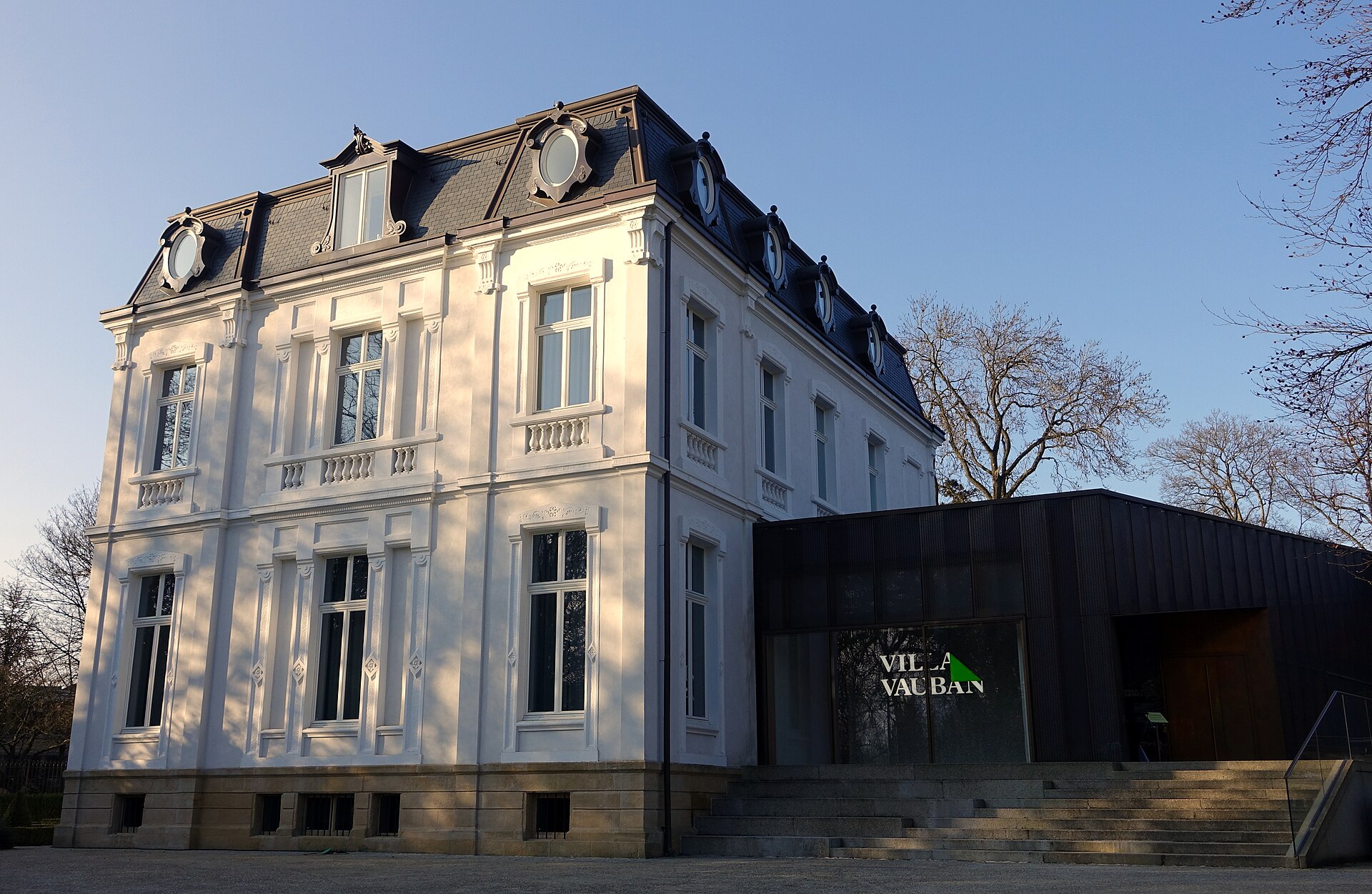
The 1873 villa and its 2010 entrance pavilion, with the museum's name on the glazed facade.
Photograph by Daderot, CC0Villa Vauban
Museum · Villa Vauban - Musee d'Art de la Ville de Luxembourg · Founded 1959
Open, admission and hours confirmed 5 September 2026 · 13 sources
On this page 16 sections
ContentsClose
Villa Vauban's strength is depth within a narrow, coherent slice of European taste: seventeenth-century Dutch genre and landscape painting and nineteenth-century French history and landscape painting, as collected by three individual Luxembourg bourgeois donors between the 1850s and 1903, rather than a museum-built survey. Its Canaletto vedute and its Delacroix Young Turk are the pieces most often singled out by visitors and by the museum's own director, and the Nencini marbles are the collection's rare sculptural highlight within a holding otherwise dominated by paintings and works on paper.
| Local name | Villa Vauban - Musee d'Art de la Ville de Luxembourg |
|---|---|
| Kind | Museum |
| Founded | 1959 |
| City and country |  Luxembourg, Luxembourg Luxembourg, Luxembourg |
| Address | 18, avenue Emile Reuter, L-2420 Luxembourg, Luxembourg |
| Website | villavauban.lu/le-musee |
| Status | Open, confirmed |
| Record last verified |
Visiting
- Hours
- Monday10:00 to 18:00
- TuesdayClosed
- Wednesday10:00 to 18:00
- Thursday10:00 to 18:00
- Friday10:00 to 21:00Free entry from 18:00
- Saturday10:00 to 18:00
- Sunday10:00 to 18:00
- Closed
- Tuesday. 1 November, 25 December and 1 January.
- Admission
- AdultEUR 5Standard rate
- Youth under 21FreeFree entry
- Students under 26FreeFree entry with a valid student card
- Age 21-26 / Carte jeunes holders / seniors 60+EUR 3Reduced rate
- Disabled visitorsFreeFree entry
- Groups, 10 or more peopleEUR 3Per person; a guide costs an additional 100 EUR
- Card and press holdersFreeFree entry with museeskaart, LuxembourgCard, Amis des Musees Luxembourg, ICOM, Kulturpass or a press card
Free entry: Every Friday, 18:00 to 21:00- Do I need to book?
- No advance booking required for individual visitors
- Address
- 18, avenue Emile Reuter, L-2420 Luxembourg, Luxembourg MapTram T1 line, stop Stareplaz/Etoile
Bike share Vel'oh docking stations 16 (Amelie) and 11 (Winston Churchill)
Parking Monterey, Hamilius and Glacis car parks nearby - Website
- villavauban.lu/le-musee
- Telephone
- +352 4796 4900
- [email protected]
Before you go how long, access, photography, bags, eating, shop
- How long to allow
- About 90 minutes to see the permanent collection and a current temporary exhibition together, per visitor reports
- Access
- A lift serves the museum's lower exhibition level as an alternative to the stairs, per visitor reports; disabled visitors are admitted free of charge
- Photography
- Not specified in the sources checked for this page
- Bags
- Not specified in the sources checked for this page
- Eating
- No on-site cafe, according to visitor reports
- Shop
- Exhibition catalogues sold on site, 10 to 15 EUR
Prices and hours change. We take them from the institution's own pages and print the day we read them, and you can check the current position at the source we used. Confirm before you travel.
What is inside
Dutch Golden Age Room
Seventeenth-century Dutch landscapes, portraits, genre scenes and still lifes by Jan Brueghel the Younger, Gerrit Dou, Jan van Goyen, Adam Pynacker, David Teniers the Younger, Jacob van Ruisdael, Adriaen van de Velde and Philips Wouwerman, together with small-format portraits by Frans Pourbus the Younger and by Jean-Louis-Ernest Meissonier.
Italian Subjects Room
Marble sculptures by Lorenzo Nencini shown with two views of Venice by Giovanni Antonio Canal (Canaletto), Guillaume Bodinier's Young Neapolitan Women and a landscape near Sorrento by Oswald Achenbach.
French Nineteenth-Century Room
Eugene Delacroix's Young Turk, a portrait by William Adolphe Bouguereau, and landscapes by Camille Corot, Jules Dupre and Gustave Courbet.
Large-Format Room
Jan Steen's Epiphany, shown with Paul Delaroche's A Mother's Joy on loan from the Dutch royal collections, both scaled larger than the Dutch cabinet pictures elsewhere in the museum.
Seascape Gallery and Changing Display Room
A beach scene by Eugene Isabey anchors the museum's dedicated marine-painting room, next to a separate room kept for a rotating display of recent acquisitions and donations.
Sculpture Gallery, 2010 extension
A dedicated sculpture gallery within the new wing's eleven exhibition rooms, built over the foundation line of the 1739 fortress wall that survives at the lower level.
What to see first
Young Turk
Eugene DelacroixThe collection's best-known single painting, an Orientalist study anchoring the French nineteenth-century room and singled out by the museum's own director as one of its proudest holdings.5
Epiphany
Jan SteenGiven its own Large-Format Room alongside a Delaroche loan, indicating its standing within the Dutch holdings.5
A Mother's Joy
Paul DelarocheShown on loan from the Dutch royal collections beside the Steen, one of the few loan works integrated into the permanent hang.5
Two views of Venice
Giovanni Antonio Canal (Canaletto)Vedute paintings that anchor the Italian Subjects Room and are repeatedly named by visitors as a highlight of the visit.5
Marble sculptures
Lorenzo NenciniThe collection's principal sculptural highlight, shown alongside the Canaletto vedute in the Italian room.5
Young Neapolitan Women
Guillaume BodinierRepresents the Grand Tour strand of Italian genre painting that a nineteenth-century Luxembourg banking family collected as a matter of course.5
Landscape near Sorrento
Oswald AchenbachA German painter's view of the Bay of Naples, extending the Italian-subjects room beyond native Italian and French artists.5
Beach scene
Eugene IsabeyAnchors the museum's dedicated seascape gallery and represents its French marine-painting holdings.5
Dutch genre and landscape group
Gerrit Dou, Jan van Goyen, David Teniers the Younger and Jacob van RuisdaelThe core of the Pescatore bequest's seventeenth-century Dutch holdings, the collection's original nineteenth-century foundation.4
Exhibitions on now
- Opening soon28 Nov 2026 to 23 May 2027Confirmed , 6 weeks ago
Past exhibitions here
- Closed4 Jul to 11 Oct 2026Confirmed · check before you travel
- Closed4 Jul to 11 Oct 2026Confirmed · check before you travel
- Closed4 Jul to 11 Oct 2026Confirmed · check before you travel
A banker's villa above the vanished ramparts
Villa Vauban stands on ground that was once part of the Luxembourg fortress, on a bastion built under the direction of Sebastien Le Prestre de Vauban, the military engineer of Louis XIV, in the late seventeenth century. When the fortress was dismantled after 1867 under the Treaty of London, the cleared land around the old ramparts was sold off for private building, and it was on one of these plots that the Alsatian glove manufacturer Gabriel Mayer commissioned the city architect Jean-Francois Eydt to design a neoclassical villa, completed in 1873. A section of the eighteenth-century fortress wall, built to Vauban's plans in 1739, survives underneath the building and is visible today in the museum's lower level.
Mayer did not keep the house long. In 1874 it passed to the steel manufacturer Charles Joseph de Gargan and his wife Emilie Pescatore, and in 1912 to their daughter Anne-Marie de Gargan and her husband, the industrialist Norbert Le Gallais. During the German occupation of Luxembourg in the Second World War the villa was seized and used to house offices of the occupying administration's agricultural ministry. After the war it briefly served as a private residence again, for Henriette Pescatore and for Pierre Werner, later Luxembourg's prime minister, before the City of Luxembourg purchased the property in 1949 for five million francs. Between 1952 and 1959 the building housed the Court of Justice of the European Coal and Steel Community, one of the institutional forerunners of the European Union, before the city converted it into its municipal art museum in 1959. It served one further, unrelated function between 1991 and 1995, as the official residence of Grand Duke Jean and Grand Duchess Josephine Charlotte while the Grand Ducal Palace was being renovated.
Three bourgeois collectors, one municipal museum
The paintings inside the villa did not originate with the building. They came to the City of Luxembourg through three separate bequests made across half a century by members of the city's banking and merchant bourgeoisie, and it is this ancestry, rather than any single founding donor, that gives the collection its character. Jean-Pierre Pescatore (1793-1855) made his fortune first as a tobacco merchant and then as a Paris banker, and used it to assemble a collection dominated by seventeenth-century Dutch painting alongside contemporary French history painting, sculpture and drawings, in the pattern typical of a wealthy nineteenth-century collector of his generation. Leo Lippmann (1808-1883), a banker who served as Luxembourg's consul general in Amsterdam, built a collection weighted toward established nineteenth-century history painting and gave it to his home city in 1878. The third body of work reached the city later still: it had belonged to the pharmacist Jodoc Frederic Hochhertz, who died in 1786, and passed by inheritance to Eugenie Dutreux-Pescatore (1810-1902), who bequeathed it to Luxembourg City in 1903. Its eighteenth-century history paintings, still lifes and portraits are the oldest material in the collection by date of manufacture, even though they were the last of the three legacies to arrive.
None of these three collectors ever saw their paintings hanging in what is now Villa Vauban. The bequests were assembled, and in Pescatore's case first displayed, well before the city acquired the villa in 1949, and it took the 1959 conversion of the building into a museum to bring the three legacies under one roof. The result is a collection whose logic is that of private bourgeois taste in the late eighteenth and nineteenth centuries, rather than a survey built to an encyclopaedic plan, and the museum's own displays present the material that way, organised by the kind of paintings a prosperous Luxembourg banker of the period wanted on his walls.
The 2010 rebuild: a fortress wall under a brass-clad extension
By the early 2000s the villa's exhibition space, at roughly 350 square metres, could not hold the collection and support temporary exhibitions at the same time. In 2002 the City of Luxembourg commissioned the architect Philippe Schmit, of the Luxembourg firm then known as Diane Heirend and Philippe Schmit, to restore the historic building and add a new wing. The work was completed in 2010 and the museum reopened on 1 May of that year with an exhibition co-organised with the Rijksmuseum in Amsterdam.
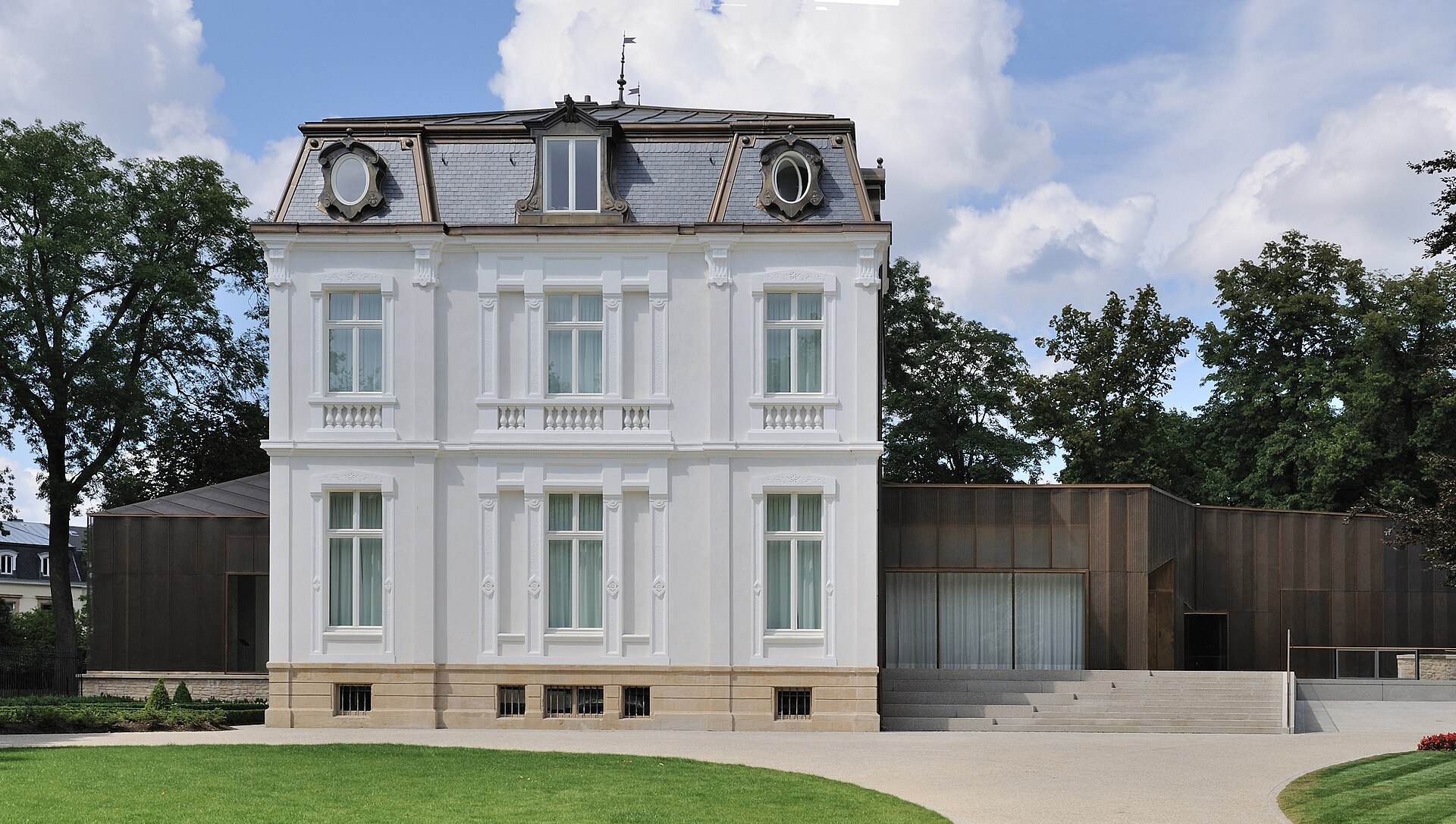
The extension roughly quadrupled the museum's exhibition area to about 1,200 square metres by building two new levels behind the villa, the lower one sunk below the level of the surrounding park so that its foundations sit on the fortress wall Vauban's engineers built in 1739. Its street-facing skin is a folded, perforated screen of translucent red brass that reflects the park rather than standing apart from it. Inside, eleven new exhibition rooms are arranged as offset flights of galleries in daylight and artificial light, their circulation threaded through a sculpture gallery, a children's workshop, a loggia looking into the park, a half-height cabinet room and a lower gallery passage, connected to the old villa through a shared entrance hall. The architects finished the interior surfaces of the new rooms in hammer-roughened concrete, etched glass and oak flooring, in deliberate contrast with the enfilade of plain white rooms a conventional gallery extension would have produced. The building won the TECU Architecture Award in 2010 and the Prix luxembourgeois d'architecture in 2011.
A room-by-room walk through three centuries
The museum's permanent display, shown under the title A Stroll Through Art, arranges the three founding bequests and later acquisitions into a sequence of themed rooms rather than a single chronological run. A Dutch Golden Age room gathers seventeenth-century landscapes, portraits, genre scenes and still lifes by Jan Brueghel the Younger, Gerrit Dou, Jan van Goyen, Adam Pynacker, David Teniers the Younger, Jacob van Ruisdael, Adriaen van de Velde and Philips Wouwerman, together with small-format portraits by Frans Pourbus the Younger and by Jean-Louis-Ernest Meissonier, whose own work otherwise belongs to the French nineteenth-century rooms.
An Italian subjects room turns to the Grand Tour material that a Luxembourg banking family, like its counterparts across Europe, collected as a matter of course: marble sculptures by Lorenzo Nencini stand alongside two views of Venice by Giovanni Antonio Canal, known as Canaletto, Guillaume Bodinier's Young Neapolitan Women and a landscape near Sorrento by the German painter Oswald Achenbach. A French nineteenth-century room holds the collection's best-known single painting, Eugene Delacroix's Young Turk, alongside a portrait by William Adolphe Bouguereau and landscapes by Camille Corot, Jules Dupre and Gustave Courbet. A large-format room is built around Jan Steen's Epiphany and, on loan from the Dutch royal collections, Paul Delaroche's A Mother's Joy, both scaled for a room the smaller Dutch cabinet pictures could not fill. A dedicated seascape gallery centres on a beach scene by Eugene Isabey, and the museum keeps one further room for a changing display drawn from recent acquisitions and donations, distinct from the temporary exhibitions mounted in the 2010 extension's own galleries.
A municipal museum, not a national one
Villa Vauban belongs to the City of Luxembourg, not to the Grand Duchy, and it is administered together with the Letzebuerg City Museum, a few streets away, as the 2 Musees de la Ville de Luxembourg, sharing a combined admission ticket. This distinguishes it sharply from Luxembourg's two national art institutions: the Musee d'Art Moderne Grand-Duc Jean, generally known as Mudam, which holds contemporary art under national rather than municipal administration, and the National Museum of History and Art, whose collections run from archaeology and decorative arts through to the twentieth century. Villa Vauban's own holdings stop, by the accident of its founding bequests, at the end of the nineteenth century, and its identity rests specifically on the private taste of three Luxembourg bourgeois collectors rather than on any national mandate to survey art history.
Guy Thewes, who has directed the 2 Musees de la Ville de Luxembourg since 2018, has himself described the collection in modest terms relative to a major national gallery, while still expressing pride in what it holds. That is a fair account of how the museum presents itself: it does not claim encyclopaedic coverage or a roster of the most famous names in European painting, and its own promotional material leans instead on the intimacy of a bourgeois villa collection shown inside the villa-owning class's own kind of house.
What visitors and critics say
Public reviews are consistent about what the museum offers and what it does not. On TripAdvisor, where Villa Vauban holds a rating of 4.1 out of 5 from 149 reviews, visitors repeatedly single out the setting inside the historic villa and the surrounding municipal park, the combined ticket that also admits to the Letzebuerg City Museum, and an immersive introductory video installation that projects moving detail from the paintings before visitors reach the galleries themselves. Staff are described as friendly and helpful across multiple independent reviews. Visitors typically report spending around ninety minutes to see the permanent collection and a current temporary exhibition together.
The same reviews are candid about the collection's limits. More than one visitor notes that, because Luxembourg City's own art patrimony is comparatively young and modest, the museum holds relatively few paintings by internationally famous names, a point the museum's own director has acknowledged in the press rather than disputed. Practical complaints include the absence of an on-site cafe and, from at least one visitor, unusually sensitive proximity alarms near the paintings that were triggered by close reading of wall labels rather than by touching the works. No published claim of contested ownership, looting or restitution has been identified against any of the museum's three founding bequests in the sources checked for this page.
What visitors say
Reviewers and press coverage consistently describe Villa Vauban as a small, well-presented municipal collection best experienced together with its park setting and the combined ticket to the neighbouring Letzebuerg City Museum. The same sources are candid that the collection, shaped by three private nineteenth-century bequests rather than a national acquisitions programme, includes few internationally famous names, a limitation the museum's own director has acknowledged rather than disputed.
What is praised, what is criticised
- Praised: The setting inside the historic villa and the surrounding municipal park, combined with free or shared admission to the Letzebuerg City Museum next door
- Praised: An immersive introductory video installation that projects moving detail from the paintings before visitors reach the galleries themselves
- Praised: Friendly and helpful staff, noted across multiple independent reviews
- Criticised: No on-site cafe
- Criticised: A modest number of internationally famous names, since the museum's founding bequests reflect one city's nineteenth-century bourgeois taste rather than a national survey
- Criticised: Proximity alarms near the paintings reported by at least one visitor as unusually sensitive to close reading of wall labels
Ratings on other platforms
TripAdvisor: 4.1 from 149 ratings, read 5 September 2026
A platform average is a tertiary source: it moves, it is not audited, and we quote no visitor's words.
Questions about Villa Vauban
Where is Villa Vauban?
18, avenue Emile Reuter, L-2420 Luxembourg, Luxembourg.
How much does it cost to visit?
Adult: EUR 5; Youth under 21: free; Students under 26: free; Age 21-26 / Carte jeunes holders / seniors 60+: EUR 3; Disabled visitors: free. As confirmed 5 September 2026.
When is it open?
Monday 10:00-18:00; Tuesday closed; Wednesday 10:00-18:00; Thursday 10:00-18:00; Friday 10:00-21:00; Saturday 10:00-18:00; Sunday 10:00-18:00. Closed: Tuesday. 1 November, 25 December and 1 January. As confirmed 5 September 2026.
How do you get there?
Tram: T1 line, stop Stareplaz/Etoile; Bike share: Vel'oh docking stations 16 (Amelie) and 11 (Winston Churchill); Parking: Monterey, Hamilius and Glacis car parks nearby.
What should you see first?
Young Turk (Eugene Delacroix); Epiphany (Jan Steen); A Mother's Joy (Paul Delaroche); Two views of Venice (Giovanni Antonio Canal (Canaletto)); Marble sculptures (Lorenzo Nencini); Young Neapolitan Women (Guillaume Bodinier).
What we could not confirm
- The museum's own published material does not describe what happened to the Pescatore, Lippmann and Hochhertz-Dutreux paintings during the villa's seizure and use by the German occupation administration in the Second World War.
- No source checked for this page details the display history of the Pescatore bequest between his death in 1855 and the collection's move into Villa Vauban in 1959.
- The exact terms and duration of the Paul Delaroche loan from the Dutch royal collections are not stated on the museum's own site.
Images
Sources
- 1Villa Vauban, Le musee (visit page) villavauban.lu/le-musee/
- 2Villa Vauban, General information (hours, admission, contact, transport) villavauban.lu/en/the-museum/general-informations/
- 3Villa Vauban, Location and building villavauban.lu/en/the-museum/lieu-et-batiment/
- 4Villa Vauban, Collection of Old Master Paintings villavauban.lu/en/collection/la-collections-dart-de-la-villa/
- 5Villa Vauban, A stroll through art (permanent display, room by room) villavauban.lu/en/exhibition/une-promenade-a-travers-lart/
- 6Ville de Luxembourg, Villa Vauban - Musee d'Art de la Ville vdl.lu/en/visiting/art-and-culture/museums-and-exhibition-venues/villa-vauban-musee-dart-de-la-ville
- 7Dezeen, Villa Vauban extension by Philippe Schmit, Joe Mills, 3 July 2010 dezeen.com/2010/07/03/villa-vauban-by-philippe-schmit-architects/
- 8Wikipedia, Villa Vauban () en.wikipedia.org/wiki/Villa_Vauban
- 9Wikidata, Q2223322 () wikidata.org/wiki/Q2223322
- 10TripAdvisor, Villa Vauban attraction reviews (, aggregate rating and visitor consensus) tripadvisor.com/Attraction_Review-g190356-d2336449-Reviews-Villa_Vauban-Luxembourg_City.html
- 11Delano (Paperjam Group), Stroll through art at Villa Vauban delano.lu/article/delano_stroll-through-art-villa-vauban
- 12Wikimedia Commons, Category: Villa Vauban, Musee d'art de la Ville de Luxembourg, and file pages for images used on this page commons.wikimedia.org/wiki/Category:Villa_Vauban,_Mus%C3%A9e_d%27art_de_la_Ville_de_Luxembourg
- 13Villa Vauban, homepage (current exhibitions, museum shop) villavauban.lu/en/