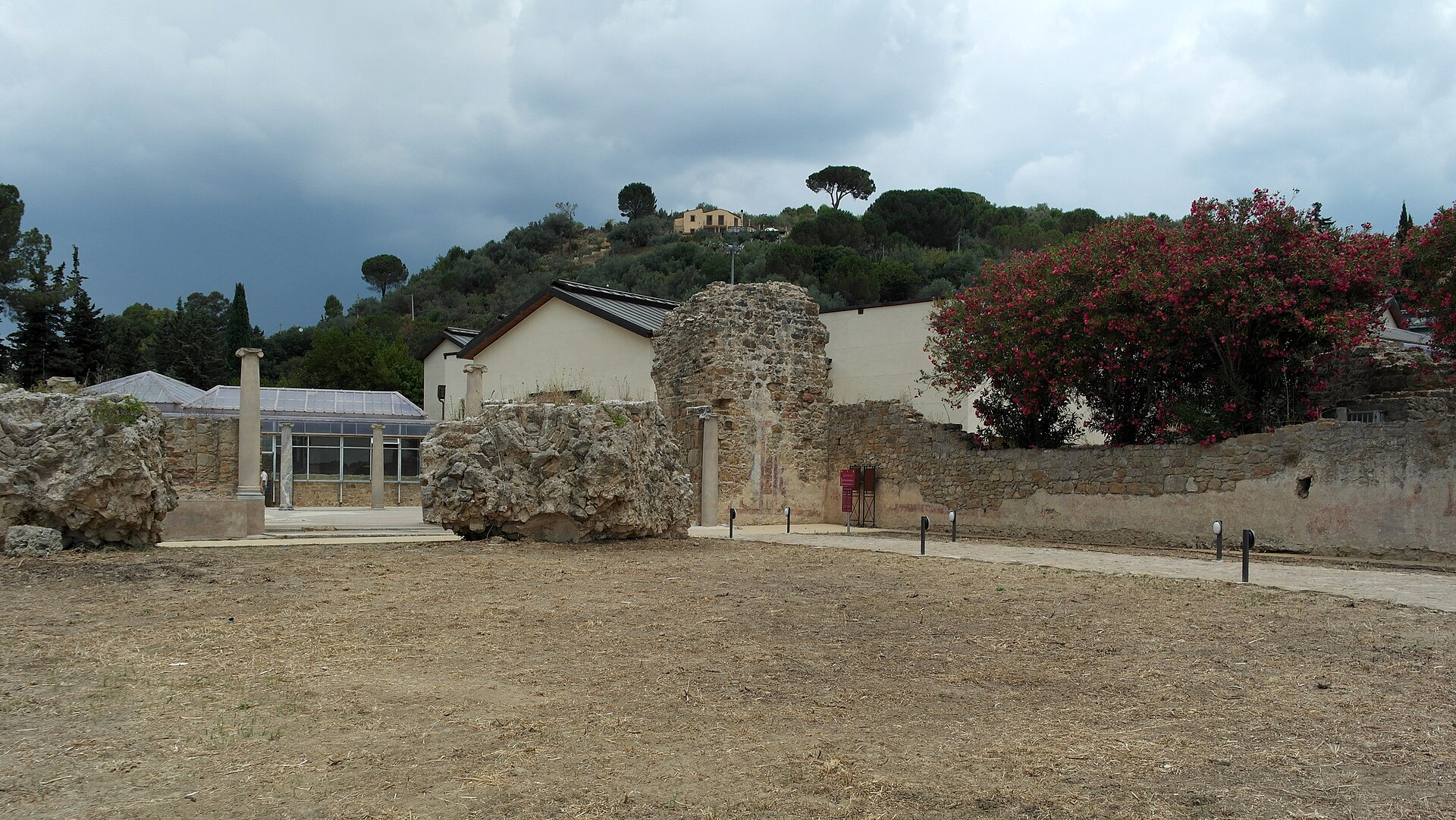
The excavated site of Villa Romana del Casale near Piazza Armerina, Sicily, seen from outside the modern protective structure.
Photograph by trolvag · CC BY-SA 3.0Villa Romana del Casale
Site · Founded early 4th century AD
Open, admission and hours confirmed 24 September 2026 · 13 sources
On this page 13 sections
ContentsClose
The villa's strength is not one masterpiece but the near-total survival of a single decorative program: roughly 3,500 square metres of 4th-century mosaic floor spread across almost all of its forty-eight rooms, corridors and courts, laid by a workshop whose fine, small-tessera, polychrome technique points scholars toward North African origin. UNESCO's own inscription language, calling these the finest Roman mosaics preserved in their original setting anywhere in the ancient world, is not a marketing line but the specific reason the site was listed in 1997. Few other Roman sites let a visitor walk a documented sequence of narrative, mythological and sporting scenes, room after room, on the actual floor a 4th-century household lived over.
| Kind | Site |
|---|---|
| Founded | early 4th century AD |
| City and country |  Piazza Armerina, Italy Piazza Armerina, Italy |
| Address | Strada Provinciale 90, Contrada Casale, 94015 Piazza Armerina (EN), Italy |
| Website | villaromanadelcasale.it |
| Status | Open, confirmed |
| Record last verified |
Visiting
- Hours
- Every day09:00 to 19:00Last entry at 18:00
- Every day, 10 May to 14 September20:00 to 22:30Summer evening opening, last entry at 22:30, separate 7 EUR ticket
- Admission
- Adult (Intero)EUR 14All visitors over 25, including visitors over 65. During some 2026 temporary exhibitions the regional park authority's English ticketing page lists a higher combined fee (17 EUR full, 10 EUR reduced, including a 3 EUR exhibition supplement); the villa's own Italian-language prices page states 14 EUR as the standing full-price fee outside those exhibitions.
- Young adult, 18 to 24EUR 7
- Minors, teachers and visitors with disabilitiesFreeFree admission
- Evening entry, 10 May to 14 SeptemberEUR 7Separate ticket for the summer evening opening, 20:00 to 22:30, last entry at closing
Free entry: First Sunday of every month. 8 March, Festa delle Donne (women only). 10 March, in memory of Sebastiano Tusa. 25 April, Festa della Liberazione. 2 June, Festa della Repubblica. 4 November, Giornata dell'Unita Nazionale e delle Forze Armate- Tickets
- villaromanadelcasale.it The museum's own ticket page.
- Do I need to book?
- No, tickets are bought at the on-site ticket office; no advance reservation is required
- Address
- Strada Provinciale 90, Contrada Casale, 94015 Piazza Armerina (EN), Italy MapShuttle A seasonal shuttle (navetta) links the site to Piazza Armerina town; most visitors arrive by car, tour coach or organised day trip, since the villa has no direct rail connection
Car On-site pay-and-display parking for cars, motorcycles and camper vans - Website
- villaromanadelcasale.it
- Telephone
- +39 0935 680036
- [email protected]
Before you go how long, access, photography, bags, eating, shop
- How long to allow
- Two to three hours to see the mosaics properly
- Access
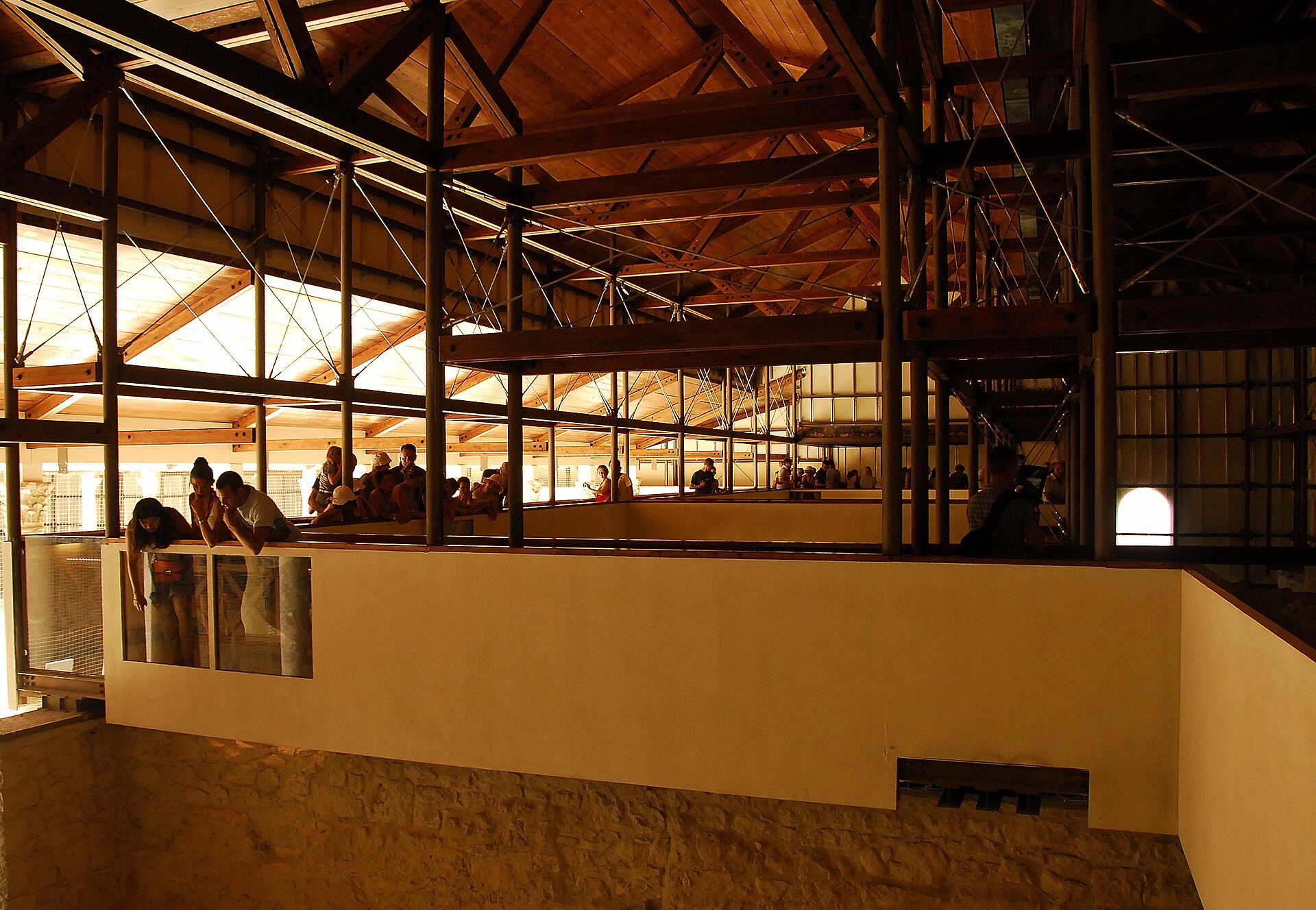
- An elevated walkway carries visitors over most of the mosaic floors rather than at floor level; the official site does not publish a separate accessibility statement, though minors, teachers and visitors with disabilities are admitted free
- Photography
- Not specified on the official visitor pages consulted
- Bags
- Not specified on the official visitor pages consulted
- Eating
- A cafe and kiosks operate near the site entrance and car park
Prices and hours change. We take them from the institution's own pages and print the day we read them, and you can check the current position at the source we used. Confirm before you travel.
What is inside
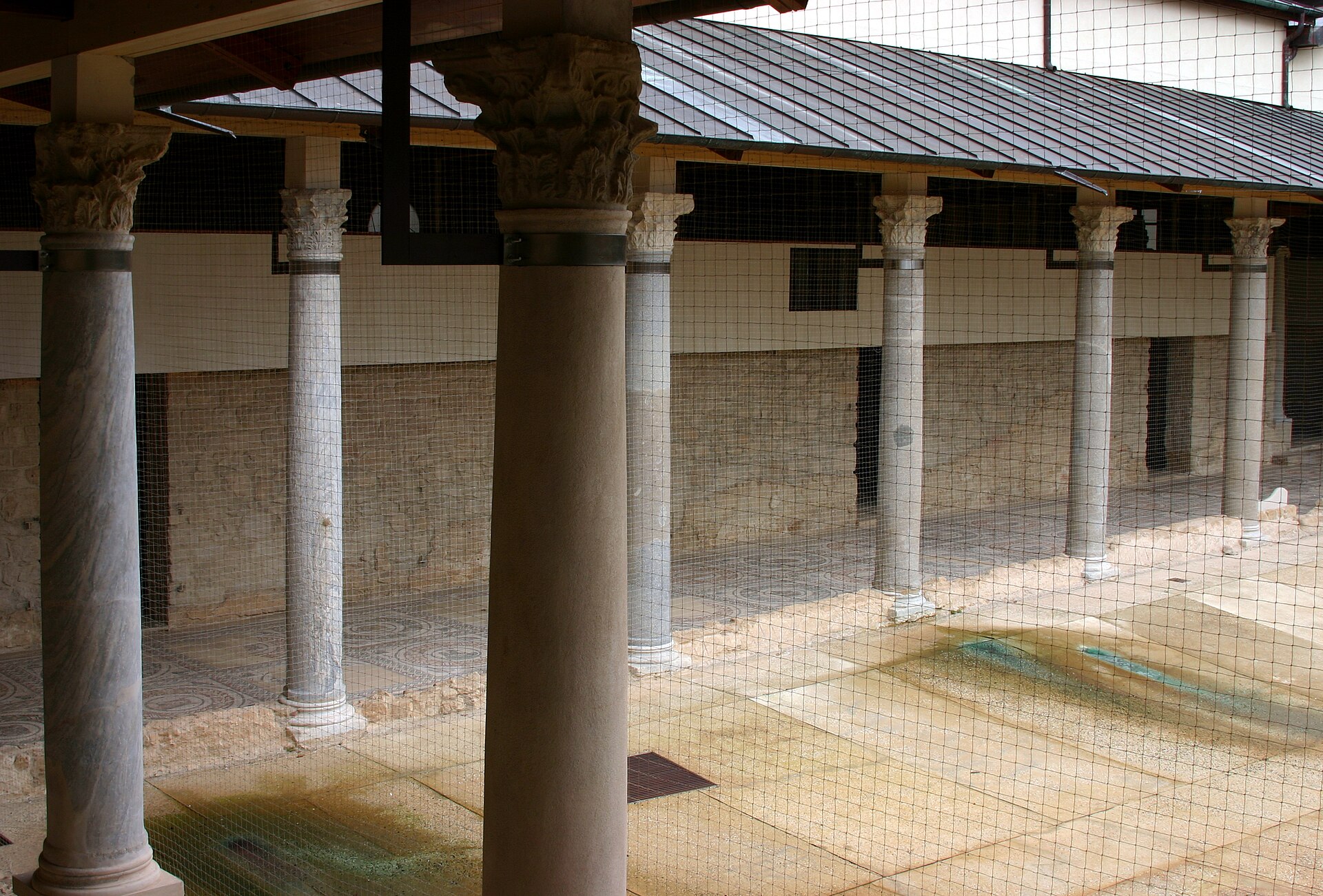
Photograph by José Luiz · CC BY-SA 4.0 The Peristyle
The villa's formal reception court: a marble-columned quadrangular courtyard whose surrounding floor mosaics are bordered with medallions of wild-animal heads. Guests were received here before being taken through to the Basilica, the villa's throne room.
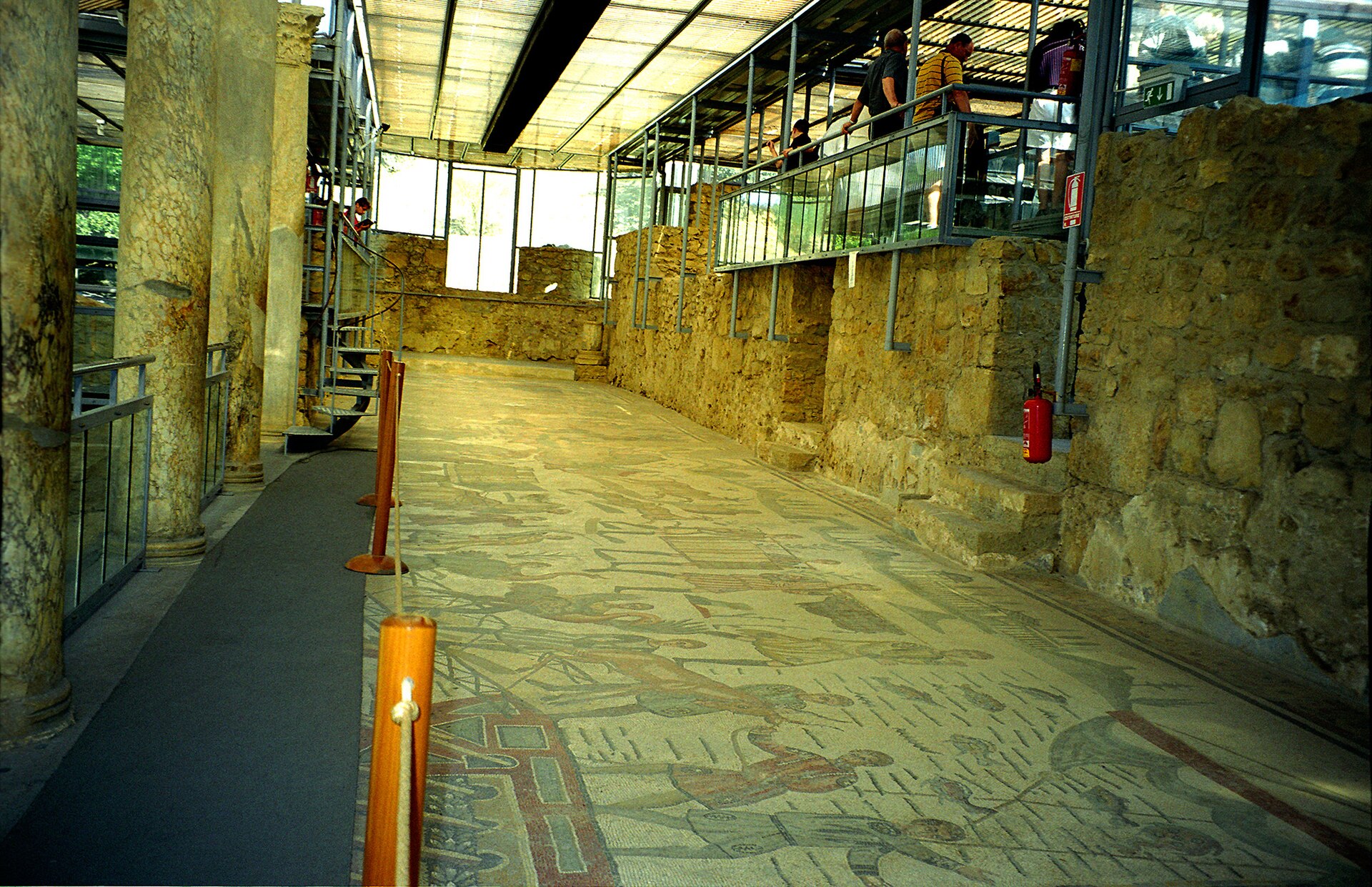
Photograph by Jerzy Strzelecki · CC BY-SA 3.0 Ambulacro della Grande Caccia (Corridor of the Great Hunt)
A roughly 60-metre corridor linking the peristyle to the private apartments, its floor a single continuous mosaic of the capture, caging and shipping of exotic animals, elephants, tigers, leopards, ostriches and a griffin, for the beast-shows of the Roman arena. The scene runs from the port of Carthage to an unloading port, and is read by archaeologists as a display of the owner's rank through sponsorship of these spectacles.
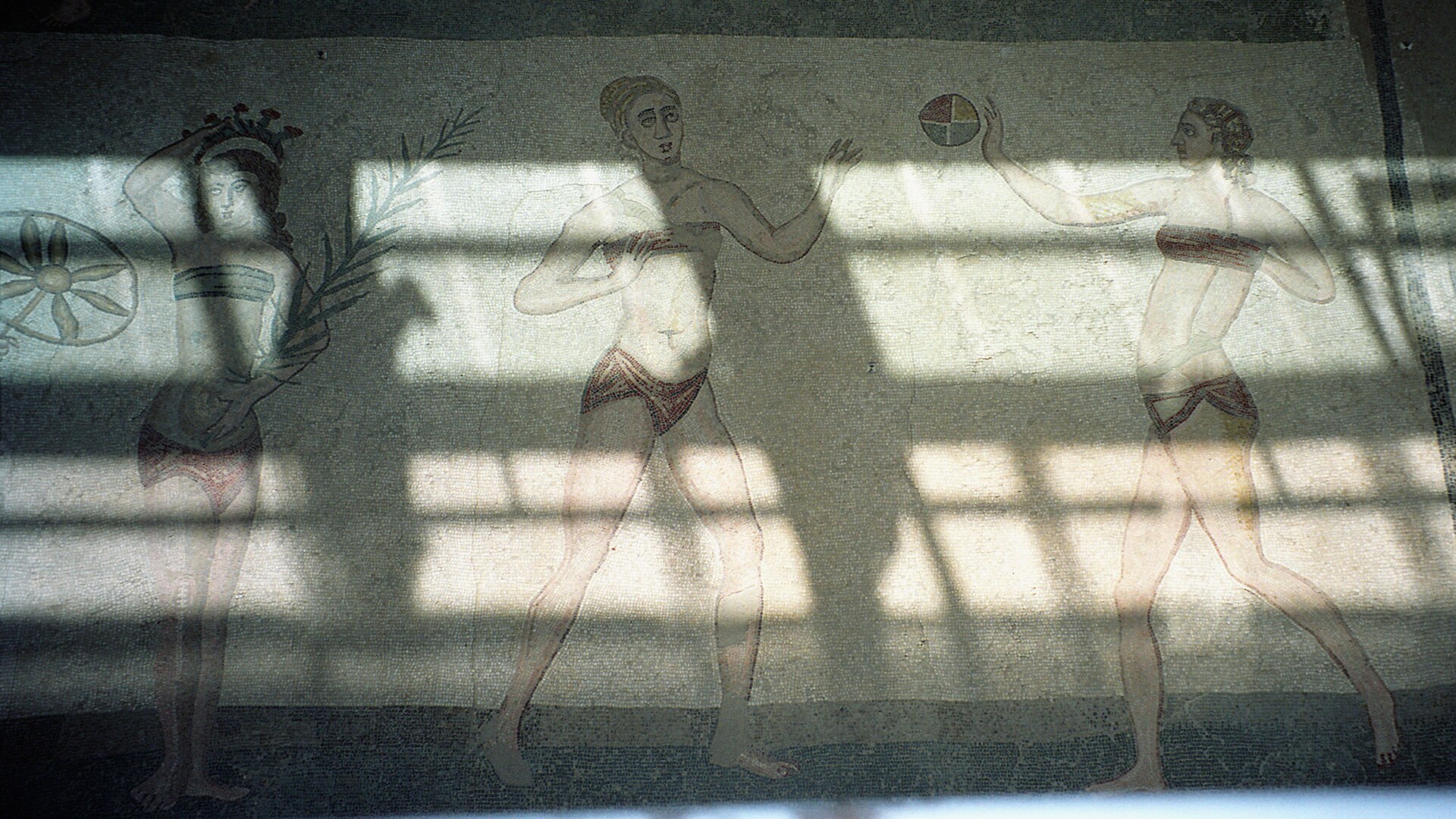
Photograph by Jerzy Strzelecki · CC BY-SA 3.0 Sala delle Dieci Ragazze (Room of the Ten Girls, the Bikini Girls room)
A small room off the south end of the Great Hunt corridor. Its mosaic shows female athletes dressed for sport, not swimming, competing in running, discus and weight-lifting and receiving a victor's crown and palm from a herald. It is one of the very few surviving depictions of women's athletics from antiquity.
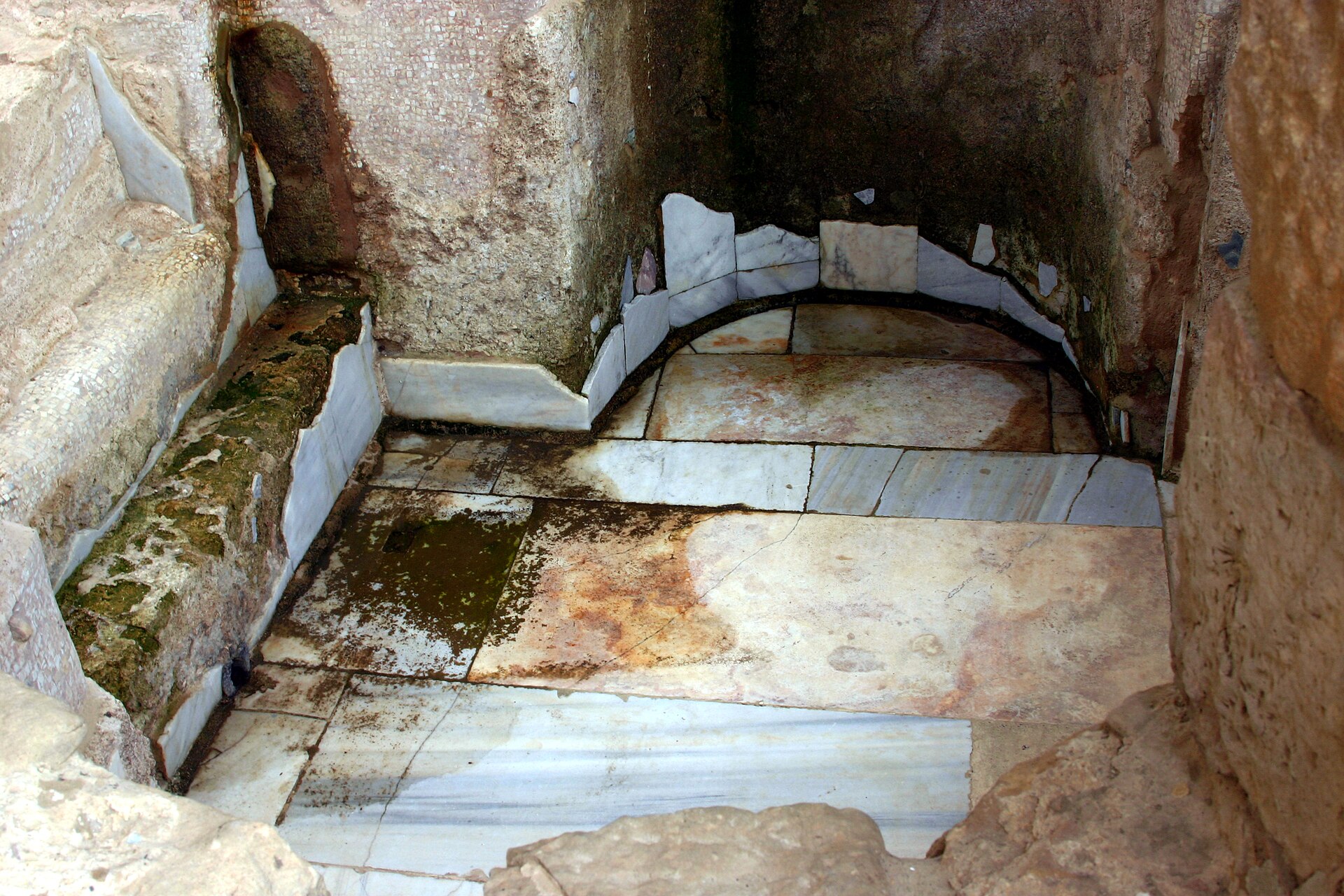
Photograph by José Luiz · CC BY-SA 4.0 The thermal baths (frigidarium, tepidarium, caldarium)
A self-contained bath suite north of the main entrance, reached through the palaestra with its Circus Maximus chariot-race mosaic. The octagonal frigidarium held cold plunge pools in radiating apses; the tepidarium's exposed brick piers and flues, which once carried the hot-air heating, are still visible.
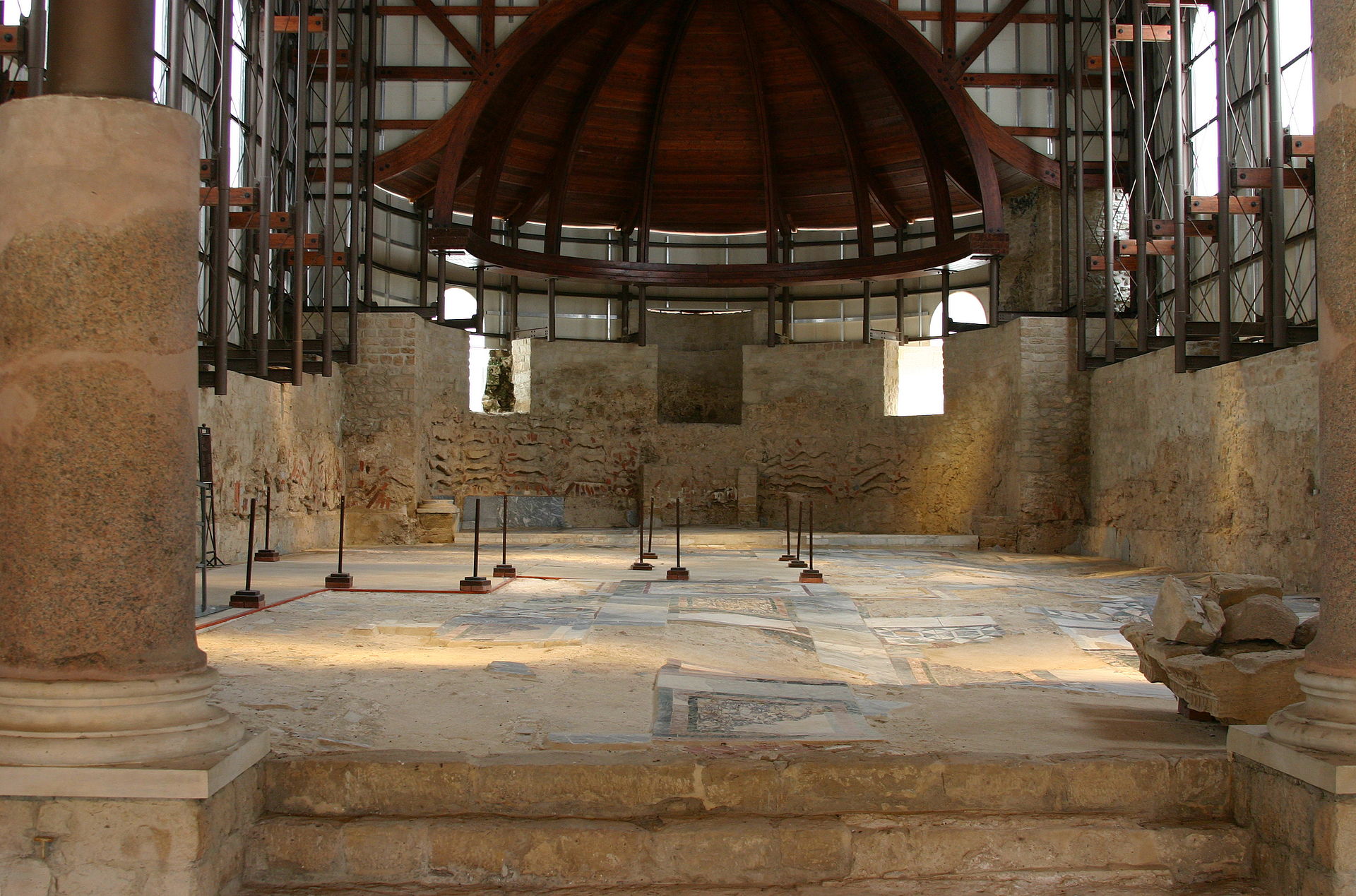
Photograph by José Luiz · CC BY-SA 4.0 The Basilica
The villa's grandest formal room, entered from the peristyle and originally floored in opus sectile (cut coloured marble panels rather than mosaic tesserae), with an apse at one end. Its scale and position mark it as the villa's audience or throne room, the space where an owner of this rank would have received clients and dependents.
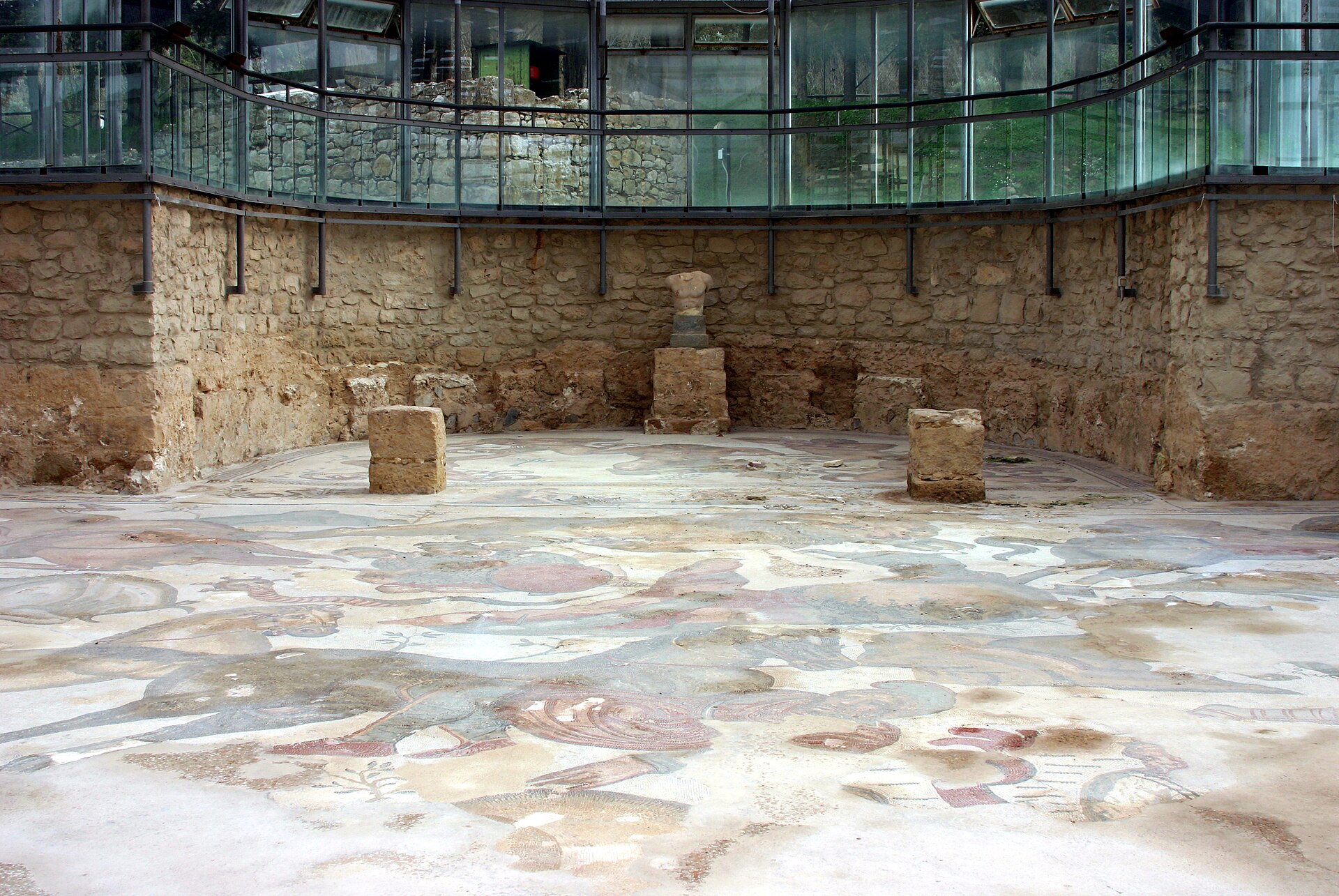
Photograph by José Luiz · CC BY-SA 4.0 The triapsidal Triclinium
A three-lobed formal dining room reached from the Xystus, its floor given over to the Labours of Hercules: large, dramatic figures of Hercules battling the monsters of his mythic labours, culminating in a scene read as his apotheosis, alongside Dionysiac imagery appropriate to a dining room.
What to see first
The Great Hunt (Ambulacro della Grande Caccia)
Unattributed, workshop probably North AfricanThe single largest mosaic in the villa and among the largest hunting mosaics to survive from antiquity: a continuous 60-metre narrative of the capture and shipment of exotic beasts for the Roman arena, generally read as advertising the owner's wealth and rank through his sponsorship of public games.7
The Bikini Girls mosaic, Sala delle Dieci Ragazze
UnattributedOne of the very few surviving images of Roman women in competitive sport: ten athletes in a subligaculum and strophium, ancient athletic wear rather than swimwear, running, throwing the discus, lifting weights and receiving a winner's wreath and palm.6
The Labours of Hercules, the triapsidal Triclinium
UnattributedLarge-scale, dramatically composed figures of Hercules against the monsters of his labours, built for a formal dining room and generally read alongside its Dionysiac imagery as a statement of the owner's culture and status to his guests.7
The Circus Maximus mosaic, the Palaestra
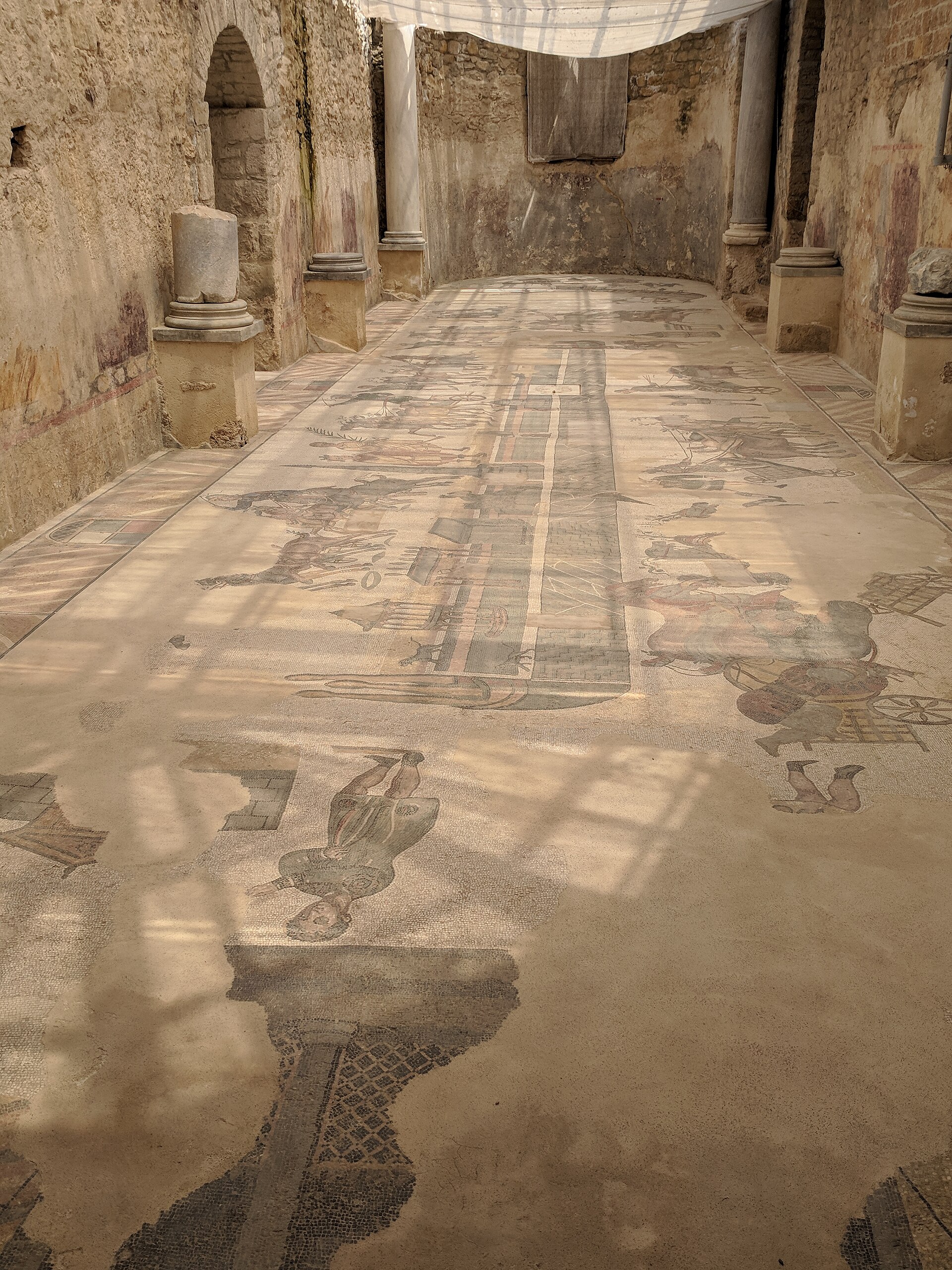
UnattributedA bird's-eye view of a chariot race at Rome's Circus Maximus, the four racing factions distinguishable by colour, composed from the vantage point of the imperial box, an elite visual privilege reproduced on the floor of a private bathhouse.8
The Little Hunt (Piccola Caccia)
UnattributedA dining-room mosaic of a private hunt in four registers: hunters on foot and horseback taking boar, deer and hare, a sacrifice offered to Diana at an altar, and a banquet of the day's catch under a canopy, a fuller narrative of aristocratic leisure than the grander Great Hunt next door.11
Ulysses and Polyphemus, the Vestibule of Polyphemus
UnattributedA well-preserved illustration of Odyssey Book IX: Ulysses, in his red cloak, offers wine to the cyclops Polyphemus as the first move in the plan to blind him and escape, set in what was probably the owner's own private study.12
Orpheus and the animals, the Diaeta of Orpheus
UnattributedOrpheus beneath a tree, playing a lyre to charm a ring of animals of every kind toward him, framed by a continuous laurel border, in a room angled for summer dining that was probably used for music as well as meals.13
The animal-head mosaics of the Peristyle
UnattributedThe medallion border running the full length of the villa's main reception courtyard, a lighter, almost decorative counterpoint to the narrative scenes in the rooms around it, and the mosaic every visitor crosses first.8
A hunting lodge, or a senator's country seat
Nobody who has excavated Villa Romana del Casale has been able to name its owner with certainty, and the argument matters, because the answer changes what every mosaic in the villa is understood to mean. The case for an imperial owner rests on the details: a set of Tetrarchic military insignia at the entrance, the probable early-4th-century date of the mosaics themselves, and three officials in the Great Hunt corridor wearing the pileus Pannonicus, a felt cap that appears on imperial portraits of the period. In 1952 the art historian H. P. L'Orange used that headgear to argue the villa belonged to Maximian, Diocletian's co-emperor, reading the villa as an imperial hunting lodge built to project the authority of the Tetrarchy in a province far from Rome. Other scholars have proposed Maxentius instead, or an unnamed imperial procurator managing crown land on the emperor's behalf.
Against this, a growing body of scholarship reads the villa as the country seat of a private citizen rather than a ruler: a member of the senatorial aristocracy wealthy enough to build on an imperial scale without being an emperor at all. One name repeatedly proposed is Lucius Aradius Valerius Proculus, consul in 340 CE, twice prefect of Rome, and governor of Sicily from 327 to 331 CE, a career that would put him in the right place at the right time with the right resources. The Great Hunt corridor, on this reading, still signals status, but the status of a great landowner sponsoring beast-shows in Rome, not of an emperor recording his own reign. Today most specialists lean toward some version of the aristocratic owner, while conceding that the imperial theory has never been disproved and that no inscription at the site names anyone at all. The villa's own decorative program was built to be read as a statement of rank; two and a half centuries later, what exact rank it was built to state is still argued from the same floor.
Buried by a landslide, found twice over
The villa was built in the first quarter of the 4th century AD over the remains of an earlier, simpler villa rustica, and stayed in use, with additions and repairs, for roughly a century and a half. A settlement grew up around the ruined complex in the medieval period; it was destroyed during the reign of the Norman king William I, around 1160 to 1161. Not long after, a landslide covered the site in as much as ten metres of mud, and the villa disappeared from view for around seven centuries. That accident of geology is the reason anything survives at all: buried ground is not weathered, looted for building stone or ploughed, and the mosaics that would otherwise have been lost to seven hundred years of exposure came through largely intact.
The rediscovery was slow and repeated rather than sudden. Fragments were noted in the 19th century, but the first professional excavation was Paolo Orsi's in 1929, followed by Giuseppe Cultrera's work between 1935 and 1939. The excavation that actually uncovered the villa in the form visitors see today was directed by Gino Vinicio Gentili between 1950 and 1960; it was Gentili's campaign that exposed most of the mosaic floors and prompted the first protective shelter to be built over them. Andrea Carandini led further excavation in the 1970s, and work by the University of Rome, La Sapienza has continued into the present, most notably a 2004 excavation of the medieval settlement that had briefly occupied the ruins before the landslide buried them both. The site has therefore been excavated in layers twice: once by archaeologists digging down through a medieval village to reach a Roman villa, and once, seven centuries earlier, by the mudslide that made the whole sequence possible to find.
Forty-eight rooms in mosaic
The published plan of the villa counts forty-eight named rooms, corridors and courts, and mosaic floors survive, in whole or in part, in almost all of them: a documented 3,500 square metres of tessellated floor in total, laid mostly in the first quarter of the 4th century by a workshop whose skilled, small-scale, polychrome technique points most scholars toward North African origin. A monumental three-arched entrance leads into a horseshoe-shaped forecourt with a fountain, then to the baths complex on the north side, and from there through an atrium into the peristyle, the marble-columned courtyard that is the hinge of the whole design and the space through which every other wing is reached.
The mosaics are not uniform in subject. Some are narrative on a grand scale: the Great Hunt corridor, already described, and the Basilica's lost opus sectile floor of cut coloured marble rather than tesserae, reserved for the villa's most formal room. Others are domestic in scale but no less pointed. Off the north side of the peristyle, a dining room carries the Little Hunt, a four-register scene of hunters on foot and horseback taking boar, deer and hare, a sacrifice offered to Diana at a roadside altar, and finally a canopied picnic of the day's catch, a complete narrative of aristocratic leisure in miniature, and one the villa's own decorators clearly meant to be read as the modest counterpart to the Great Hunt across the courtyard, hence its name. The bathhouse's palaestra carries a chariot race at Rome's Circus Maximus, composed from the raised vantage point of the imperial box, an image of a spectacle most of the villa's visitors would only ever have watched, not sponsored.
The private apartments carry the most personal imagery. In the Vestibule of Polyphemus, reached off the Great Hunt corridor in what was probably the owner's own study, Ulysses in his red cloak offers wine to the cyclops Polyphemus, the opening move of the plan to blind him, a scene from Odyssey Book IX chosen, on the evidence of where it was placed, for a room meant for private reading and thought rather than public reception. Nearby, the Diaeta of Orpheus, a room angled for the cooler light of a summer afternoon, shows Orpheus beneath a tree playing a lyre to charm a ring of animals, framed by a continuous laurel border, in a space that was probably used for music as well as dining. And off the south end of the Great Hunt corridor, in the Sala delle Dieci Ragazze, is the mosaic every visitor is brought to see last or first: ten female athletes in what modern eyes read as bikinis but which are recognisably ancient sportswear, running, throwing weights and receiving a winner's crown, one of a small handful of surviving depictions of Roman women in competitive sport. Across the whole villa, the floors add up to something closer to an illustrated library than a decorative scheme, myth, spectacle, sport and private philosophy laid in stone and glass under a single roof.
A World Heritage Site, and an argument about its roof
UNESCO inscribed Villa Romana del Casale on the World Heritage List on 7 December 1997, under criteria (i), (ii) and (iii), covering a core property of 8.92 hectares with a 10.37-hectare buffer zone. The Committee's own justification calls it 'the supreme example of a luxury Roman villa, which graphically illustrates the predominant social and economic structure of its age,' and singles out the mosaics as 'exceptional for their artistic quality and invention as well as their extent,' language UNESCO's own description sharpens further: these are described as the finest Roman mosaics in situ anywhere in the ancient world, not merely a fine regional example of them.
Protecting that floor has been argued over for as long as it has been visible. Gentili's 1950s excavation was followed quickly by a first shelter, since none of the exposed tesserae could survive open weather twice. That structure and its successors, up to the wood-and-transparent-panel roof and raised walkway system in place today, have drawn a specific, recurring criticism from architects and conservators: a covering built to keep rain and ultraviolet light off the mosaics also cuts the natural light that let their colour read as the original workshop intended, so that the same intervention which saved the floors from a second slow ruin is blamed for dulling them in the process. No replacement design has settled that argument, and the walkway that lets today's visitors walk the full 48-room circuit without setting foot on a single tessera is itself part of the same unresolved trade-off between access, conservation and legibility.
What the visitor numbers say
Annual visitor figures published for the site have moved with events well beyond its own gates: 352,220 visitors in 2018 and 317,935 in 2019, a collapse to 77,721 in 2020 as international travel stopped, a partial recovery to 101,842 in 2021, and 227,371 in 2022 as travel resumed. Those swings track the pandemic more than anything about the villa itself, and the underlying pattern, a World Heritage site drawing a broad international public every normal year, has not changed.
What visitors report once they arrive is consistent across thousands of reviews: the scale of the mosaic coverage is the thing nobody expects until they see it, room after room rather than a curated handful, and the accredited on-site guides are repeatedly named as the difference between an impressive walk-through and an intelligible one. The complaints are equally consistent and mostly practical rather than substantive: the heat inside the covered walkways in the middle of a Sicilian summer day, the site's distance from any town centre, and the quality of the food sold at the kiosks by the car park. None of it touches the mosaics themselves, which remain, on the evidence of both the scholarship and the visitor record, the reason the villa is on the list at all.
What visitors say
Visitors consistently describe the villa as one of the finest surviving collections of Roman mosaic anywhere, praising the sheer extent of floor covered and the quality of the on-site guiding, while flagging the summer heat, the remote location and the food and drink sold just outside the gate as the real friction points of a visit.
What is praised, what is criticised
- Praised: the scale and completeness of the mosaic floors, which cover almost every room rather than a handful of highlights
- Praised: the knowledgeable, enthusiastic accredited guides, repeatedly credited with making the iconography legible
- Praised: the Bikini Girls and Great Hunt mosaics specifically, and the option of an evening visit once the day's heat has dropped
- Criticised: the heat inside the covered walkways at midday in summer, with visitors advised to go early or take the evening slot instead
- Criticised: the remote, car-dependent location, well outside Piazza Armerina's own centre
- Criticised: pigeon droppings and general upkeep, a recurring maintenance complaint
- Criticised: the food and drink sold at kiosks just outside the entrance, repeatedly described as poor value
Ratings on other platforms
TripAdvisor: 4.7 from 4,968 ratings, read 24 September 2026
A platform average is a tertiary source: it moves, it is not audited, and we quote no visitor's words.
Questions about Villa Romana del Casale
Where is Villa Romana del Casale?
Strada Provinciale 90, Contrada Casale, 94015 Piazza Armerina (EN), Italy.
How much does it cost to visit?
Adult (Intero): EUR 14; Young adult, 18 to 24: EUR 7; Minors, teachers and visitors with disabilities: free; Evening entry, 10 May to 14 September: EUR 7. As confirmed 24 September 2026.
When is it open?
Every day 09:00-19:00; Every day, 10 May to 14 September 20:00-22:30. As confirmed 24 September 2026.
How do you get there?
Shuttle: A seasonal shuttle (navetta) links the site to Piazza Armerina town; most visitors arrive by car, tour coach or organised day trip, since the villa has no direct rail connection; Car: On-site pay-and-display parking for cars, motorcycles and camper vans.
What should you see first?
The Great Hunt (Ambulacro della Grande Caccia) (Unattributed, workshop probably North African); The Bikini Girls mosaic, Sala delle Dieci Ragazze (Unattributed); The Labours of Hercules, the triapsidal Triclinium (Unattributed); The Circus Maximus mosaic, the Palaestra (Unattributed); The Little Hunt (Piccola Caccia) (Unattributed); Ulysses and Polyphemus, the Vestibule of Polyphemus (Unattributed).
What we could not confirm
- Who owned the villa. The imperial theory, first argued by H. P. L'Orange in 1952 from Tetrarchic military headgear worn by figures in the Great Hunt mosaic, names Maximian; other scholars have proposed Maxentius or an unnamed imperial land manager. A rival, now more widely favoured, theory names a wealthy senatorial aristocrat, with Lucius Aradius Valerius Proculus, governor of Sicily from 327 to 331 CE, the most frequently proposed candidate. No inscription at the site names anyone, and the question is unresolved.
- The exact building chronology. The villa is generally dated to the first quarter of the 4th century AD and is known to have been occupied for roughly a century and a half with later repairs and additions, some possibly following the earthquake of AD 365, but the precise sequence and dating of its three main construction phases is not settled among excavators.
- Whether the current protective roof and elevated walkway strike the right balance between conservation and legibility. Architects have criticised the structure, in place since the mid-20th century in successive rebuilt forms, for casting shadows that dull the mosaics' original colour and vivacity, a criticism aimed at the very intervention that keeps the floors from weathering a second time.
Images
Sources
- 1Villa Romana del Casale, official site of the Parco Archeologico di Morgantina e della Villa Romana del Casale, home page and ticket information, read 2026-09-24. villaromanadelcasale.it/
- 2Villa Romana del Casale, official site, opening hours for the villa and connected sites, read 2026-09-24. villaromanadelcasale.it/orari-tutti-siti/
- 3Villa Romana del Casale, official site, contact and address information, read 2026-09-24. villaromanadelcasale.it/contatti/
- 4Parco Archeologico di Morgantina e della Villa Romana del Casale, Regione Siciliana, English-language ticketing page for Villa Romana del Casale, read 2026-09-24. parchiarcheologici.regione.sicilia.it/morgantina-villa-romana-casale/en/biglietti/villa-romana-del-casale/
- 5UNESCO World Heritage Centre, 'Villa Romana del Casale,' World Heritage List entry 832, inscription justification and statistics, read 2026-09-24. whc.unesco.org/en/list/832/
- 6Wikipedia, 'Villa Romana del Casale,' consulted for excavation chronology, ownership debate and dating ( source), read 2026-09-24. en.wikipedia.org/wiki/Villa_Romana_del_Casale
- 7Expedition Magazine, Penn Museum, 'The Villa del Casale of Piazza Armerina,' read 2026-09-24. penn.museum/sites/expedition/the-villa-del-casale-of-piazza-armerina/
- 8Lonely Planet, 'Villa Romana del Casale' attraction page, read 2026-09-24. lonelyplanet.com/italy/sicily/central-sicily/attractions/villa-romana-del-casale/a/poi-sig/1408603/1320267
- 9TripAdvisor, 'Villa Romana del Casale,' aggregate rating and visitor reviews, read 2026-09-24. tripadvisor.com/Attraction_Review-g580232-d793511-Reviews-Villa_Romana_del_Casale-Piazza_Armerina_Province_of_Enna_Sicily.html
- 10Wikimedia Commons, Category:Villa del Casale (Piazza Armerina), infobox statistics including annual visitor figures ( source), read 2026-09-24. commons.wikimedia.org/wiki/Category:Villa_del_Casale_(Piazza_Armerina)
- 11Photo Archive, Rene Seindal, 'Room of the Little Hunt, Villa Romana del Casale,' read 2026-09-24. sights.seindal.dk/italy/sicily/piazza-armerina/villa-romana-del-casale/room-of-the-little-hunt/
- 12SmartEducation UNESCO Sicilia, 'The myth of Ulysses and Polyphemus,' read 2026-09-24. smarteducationunescosicilia.it/en/piazza-armerina/the-myth-of-ulysses-and-polyphemus/
- 13The Silk Route, 'Sicily: Villa Romana del Casale,' read 2026-09-24. the-silk-route.co.uk/sicilyVillaRomana.htm