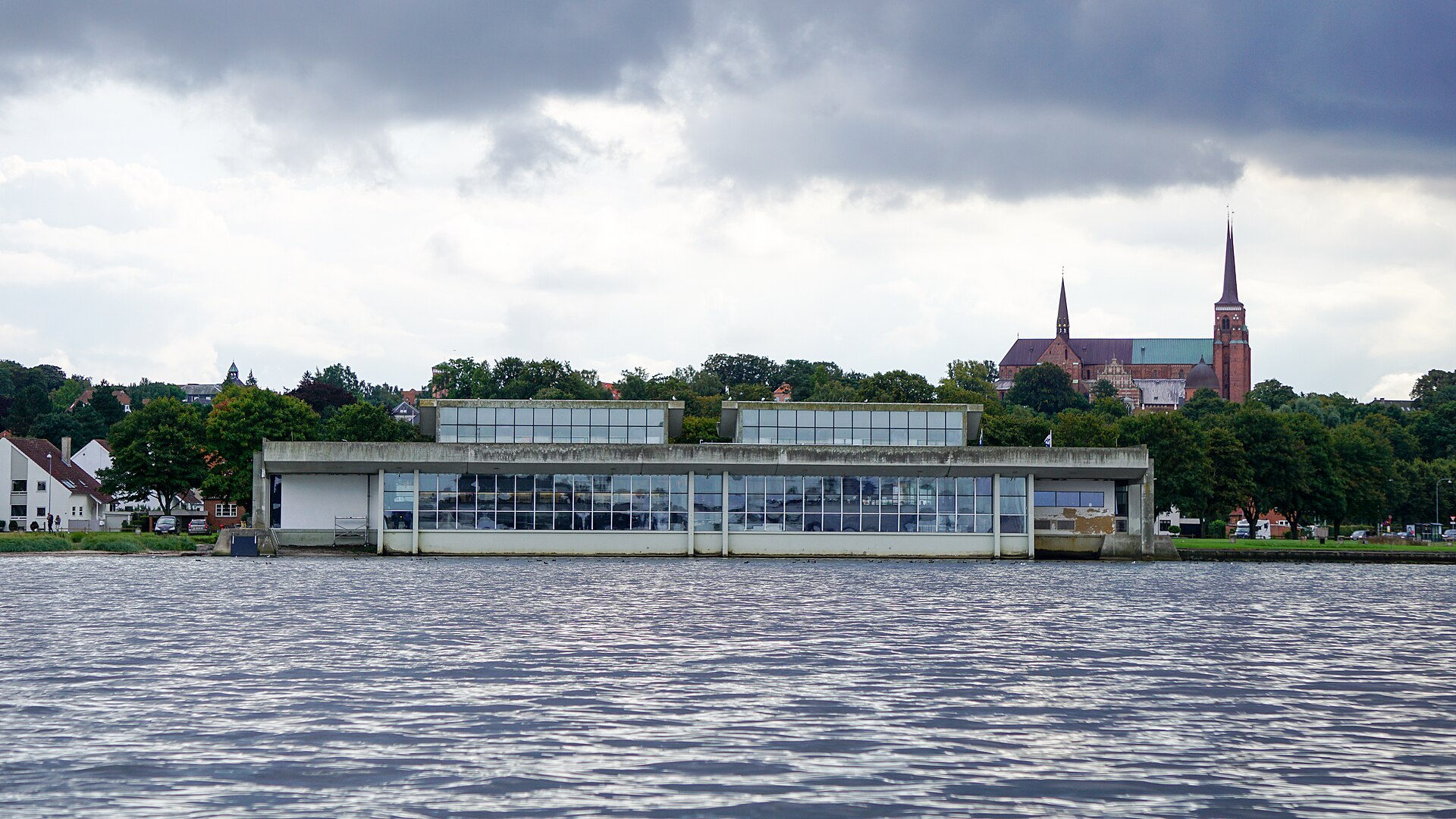
The Viking Ship Museum's harbourside building seen from Roskilde Fjord, with the Viking Ship Hall's long glazed wall facing the water.
Photograph by Jami430, released CC BY-SA 4.0Viking Ship Museum
Museum · Vikingeskibsmuseet · Founded 1969
Open, admission and hours confirmed 26 August 2026 · 22 sources
On this page 17 sections
ContentsClose
The museum's holding of five original Viking-age ships in one place, recovered from a single, precisely dated excavation, has no equal: it is the reason the site is the reference point for Nordic Viking-age shipbuilding rather than one venue among several. That strength is compounded by what the museum has built around the original find rather than simply displayed alongside it: a working boatyard that has reconstructed all five ships at full scale, in several cases more than once, using experimental archaeology to test what the surviving timbers actually imply about hull shape, materials and sailing performance, and a maritime archaeology unit that carries the same evidentiary standard into wrecks far outside the Viking Age, from a 1801 warship to the largest medieval cog yet found. Few maritime museums pair an unmatched original find with an active, publicly visible reconstruction and research programme in the same way.
| Local name | Vikingeskibsmuseet |
|---|---|
| Kind | Museum |
| Founded | 1969 |
| City and country |  Roskilde, Denmark Roskilde, Denmark |
| Address | Vindeboder 12, 4000 Roskilde, Denmark |
| Website | vikingeskibsmuseet.dk |
| Status | Open, confirmed |
| Record last verified |
Visiting
- Hours
- Every day, 1 May - 18 October (summer season)10:00 to 17:00Viking Ship Hall; the boatyard and daily sailing trips keep the same hours
- Every day, 19 October - 30 April (winter season)10:00 to 16:00Viking Ship Hall; the boatyard is open weekdays only in winter, and sailing trips and the Climb Aboard exhibition are closed for the season
- Admission
- Adult, summer season (1 May - 18 Oct)DKK 16510 DKK cheaper bought online
- Adult, winter season (19 Oct - 30 Apr)DKK 13010 DKK cheaper bought online
- Children (0-17 years)Freefree entry year round; under 14 must be with an adult
- Family ticket, summer seasonDKK 3102 adults plus children aged 0-17; 20 DKK cheaper bought online
- Family ticket, winter seasonDKK 2402 adults plus children aged 0-17
- Student, with valid student ID, summer seasonDKK 105
- Student, with valid student ID, winter seasonDKK 80
- Groups, minimum 25 adults, per person, summer seasonDKK 140
- Groups, minimum 25 adults, per person, winter seasonDKK 110
- Season pass, 1 yearDKK 200unlimited admission for a year
- Friends Association membership, 1 yearDKK 350includes free admission
- Boat Guild membership, 1 yearDKK 750includes free admission
- Tickets
- vikingeskibsmuseet.dk/en/visit-the-museum/ope... The museum's own ticket page.
- Do I need to book?
- General admission needs no advance booking. Sailing trips, guided tours, workshops and group visits can be booked online in advance.
- Address
- Vindeboder 12, 4000 Roskilde, Denmark MapCar About 40 minutes from Copenhagen via route 21 (Holbaekmotorvejen) or 45 minutes via the E20. Free car park at Museum Island, with EV charging points, though it can fill in the summer season.
Train Most regional trains on Zealand and InterCity trains from Jutland stop at Roskilde Station, about a 20-25 minute walk from the museum.
Bus Route 203 runs between Roskilde Station and the museum. - Website
- vikingeskibsmuseet.dk
- Telephone
- +45 46 300 200
- [email protected]
Before you go how long, access, photography, bags, eating, shop
- How long to allow
- A few hours covers the Viking Ship Hall, the boatyard and the Museum Harbour together. Visitors adding a fjord sailing trip, which runs daily from 1 May to 30 September, should allow the better part of a day.
- Access
- The museum was given Denmark's Accessibility Label in several disability categories in 2009. Wheelchair users and one accompanying person receive free admission. Museum Island is wheelchair accessible, though the boatyard's surface is gravel and wood chippings. The Viking Ship Hall itself has stairs and, as of the museum's own account, no lift or stairlift; wheelchair users can reach the rear entrance, from which three of the five original ships, the In the Wake of the Vikings exhibition, the Children's Shipyard and an accessible toilet are reachable, while two of the ships, the cinema, the Climb Aboard exhibition and the museum shop require stairs. The museum states this changes with the new building, planned to make the site fully accessible. Accessible toilets are at the Viking Ship Hall and Cafe Knarr; accessible parking is in the main car park; trained assistance dogs are welcome throughout.
- Photography
- Hand-held cameras with a normal flash are welcome throughout unless stated otherwise, and the museum states the same terms apply to any photograph of its ships taken elsewhere.
- Bags
- Free lockers in the basement of the Viking Ship Hall, for a refundable 10 DKK deposit.
- Eating
- Cafe Knarr, on Museum Island overlooking the wooden boats, serving salads, sandwiches, lunch dishes, homemade cakes and organic drinks with a Viking-inspired menu.
- Shop
- The museum shop, in the Viking Ship Hall, selling Nordic design, books, games and jewellery.
Prices and hours change. We take them from the institution's own pages and print the day we read them, and you can check the current position at the source we used. Confirm before you travel.
What is inside
The Viking Ship Hall
The museum's oldest building, opened in 1969 and designed by architect Erik Christian Sorensen as a showcase around the five original Skuldelev ships, each displayed on a steel cradle that follows its excavated hull. A wall of glass overlooks Roskilde Fjord behind the ships. The hall also holds a cinema showing a film of the 1962 excavation and space for temporary exhibitions.
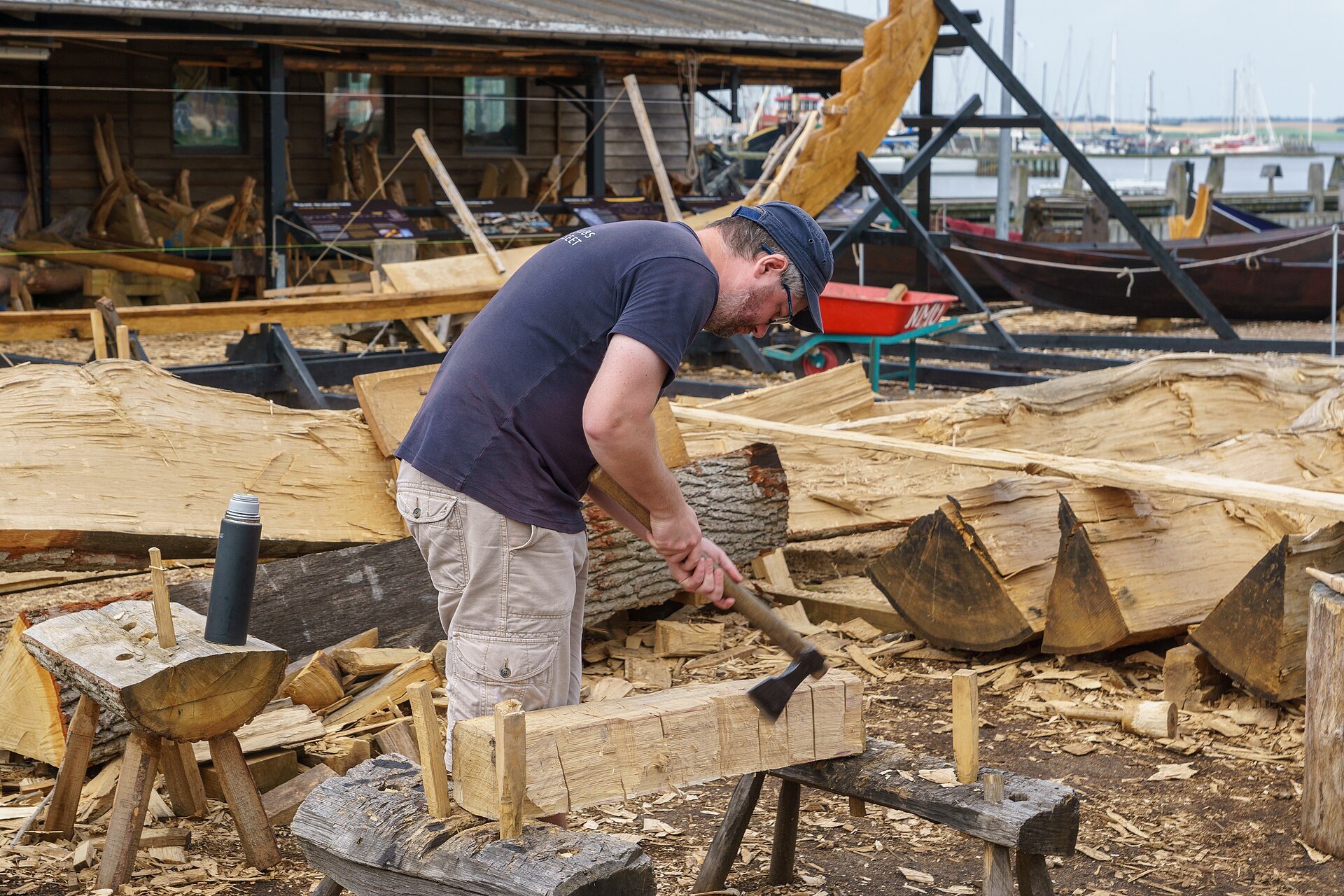
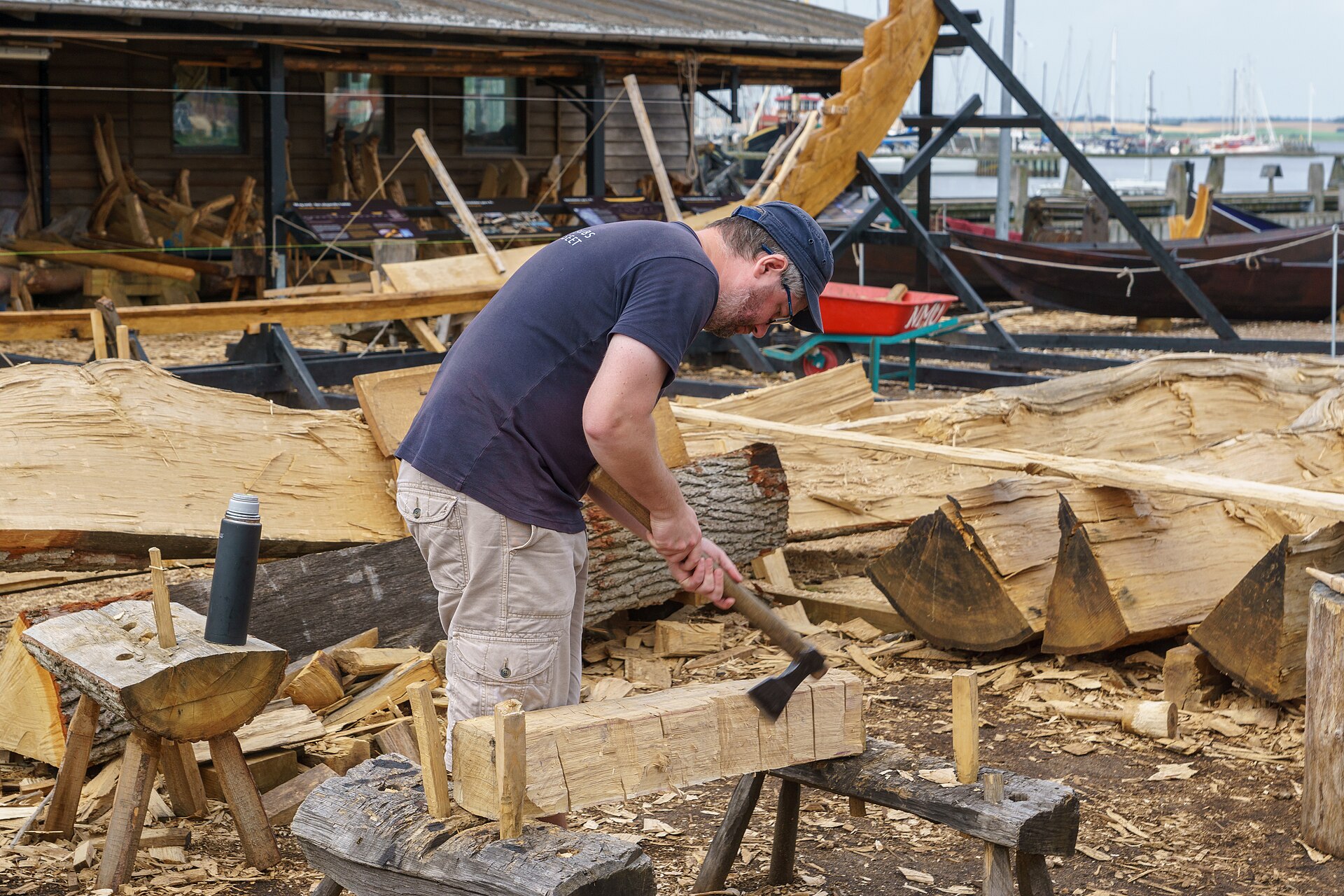
Photograph by Colin · CC BY-SA 4.0 The Boatyard (Shipyard Hall)
On the middle of Museum Island, where the museum's own boatbuilders reconstruct Viking ships and traditional Nordic wooden boats using copies of Viking-age tools, working in the open through the summer and moving into the winter shipyard for maintenance and smaller projects in winter. The Shipyard Hall carries an exhibition of the boatbuilders' own tools, faithful copies of archaeological finds.
The Museum Harbour
The harbour on Museum Island berths the museum's sailing reconstructions of the five Skuldelev ships, among them the ocean-going trader Ottar, the longship Sea Stallion from Glendalough, the coastal traders Roar Ege and Estrid Byrding, the small longship Helge Ask and the two rebuilds of the fishing boat, Kraka Fyr and Skjoldungen, moored alongside the wider boat collection of more than 40 traditional Nordic vessels. Daily sailing trips depart from here from 1 May to 30 September.
The Hamlet (Children's Village)
A room on the lower level of the Viking Ship Hall built for the museum's youngest visitors, where children can play with Viking-age toys, cook at a fireplace, pack a merchant's chest and handle reproduction trade goods and materials, developed with the association Friends of the Viking Ship Museum and built largely from recycled materials.
Climb Aboard
An immersive exhibition built around two ship reconstructions long moored at the Hall's indoor jetty, combining a projected horizon, changing light and a soundscape recorded aboard the Sea Stallion and Ottar on their own voyages, with barrels, chests and below-deck spaces visitors can explore. The exhibition carries a warning that its lighting may trigger seizures in visitors with photosensitive epilepsy.
In the Wake of the Vikings (special exhibition)
The museum's account of its own history since 1962, built around four themes: the excavation and conservation of the Skuldelev ships; the maritime archaeology the find set in motion, including underwater survey across Danish waters; the building of the five reconstructions from timber and model to sailing ship; and the trial voyages that tested them at sea. It shows excavation film, footage of the Sea Stallion in a 2007 gale on the Irish Sea, and objects raised from wrecks around Denmark, including material from the 17th-century warship Dannebroge.
What to see first
Skuldelev 1
Built in the Sognefjord area, western NorwayA large ocean-going cargo ship of heavy pine, repeatedly repaired with oak near the Oslofjord and eastern Denmark. Its rounded hull gave it the loading capacity and seaworthiness to trade across the North Sea, the Baltic and the North Atlantic; the museum reads its likely owners as a chieftain or a group of merchants working the ship together.7
Skuldelev 2
Built near Dublin, Ireland, dendrochronologically dated to about 1042The great longship of the find, a purpose-built warship able to carry 65-70 men at speed under a huge sail while remaining light enough to row with 60 oars. Its Dublin-felled oak ties a ship sunk in a Danish fjord directly to the Viking-age shipyards of Ireland.8
Skuldelev 3
Built in Denmark, around 1040, of Danish oakThe best preserved of the five ships, with roughly 75 percent of the hull surviving, including a stem found completely intact. A small, sturdy coastal trader with a 4-tonne hold, built for owners moving goods, and themselves, along the Danish coast and into the Baltic.9
Skuldelev 5
Built in Denmark, around 1030One of the smallest longships in a Viking-age war fleet, and unusually built from a mix of new and reused timber, repaired not long before it was sunk in the barrier; traces of a shield-rack and carved decoration survive along its sheerstrake.10
Skuldelev 6
Built in the Sognefjord area, western Norway, around 1030A fishing boat from the same place and time as Skuldelev 1, later widened by a plank on each side and its rowlocks altered, a conversion the museum reads as adapting it for coastal transport rather than fishing.11
The 1962 excavation of the Skuldelev barrier
National Museum of Denmark and the team that became the Viking Ship MuseumA cofferdam was driven into Roskilde Fjord and pumped down centimetre by centimetre over a month so all five wrecks could be exposed without drying out; the ships were recorded in place by the then-new photogrammetric method and salvaged into roughly 1,500 airtight plastic bags, a total of more than 4 kilometres of packaging, over twelve weeks ending 28 September 1962.6
Helge Ask
Built at the Viking Ship Museum's boatyard, launched 1991The museum's reconstruction of Skuldelev 5, recreating the small longship as excavated, moored in the Museum Harbour and one of the vessels used in the museum's sailing trials.12
The Sea Stallion from Glendalough
Built at the Viking Ship Museum's boatyard, launched 2004The reconstruction of Skuldelev 2, built with a 112 square-metre sail and rowed by a crew of 60. In 2007-2008 it sailed to Dublin, close to where the original ship was felled almost a thousand years earlier, and back, a voyage the museum's Climb Aboard exhibition and In the Wake of the Vikings both draw on for recorded sound and film.12
The Dannebroge wreck
Identified by the museum's maritime archaeologists, announced April 2026The wreck of the Danish-Norwegian blockship Dannebroge, which exploded and sank in six hours during the Battle of Copenhagen on 2 April 1801 under attack from a British fleet commanded by Horatio Nelson, was located 15 metres down in Copenhagen harbour during archaeological survey ahead of the Lynetteholm artificial island. Excavation leader Otto Uldum matched the timber dimensions and dendrochronological dating to the ship's known 1772 construction date.19
Svaelget 2, the world's largest known medieval cog
Built around 1410, planking from Pomeranian oak, frames from Netherlandish timberFound by the museum's maritime archaeologists in the Sound during the same Lynetteholm seabed survey, this roughly 28-metre, 300-tonne-capacity cargo ship is, on the museum's account, the largest cog yet discovered anywhere, evidence of the trade networks that carried salt, timber, bricks and other bulk goods across Northern Europe in the 15th century.20
Exhibitions on now
The building on Roskilde Fjord
The Viking Ship Museum stands on the shore of Roskilde Fjord, a short walk from Roskilde's medieval cathedral, and it is built to be read from the water as much as from the land. Its oldest structure, the Viking Ship Hall, opened in 1969 to a design by the Danish architect Erik Christian Sorensen: a raw, low concrete building whose long glazed wall turns the fjord itself into the backdrop for the five ships inside, connecting them, as the museum's own account puts it, to the water they were built to cross. An extension, Museum Island, followed in 1997, adding the harbour, the boatyard where shipwrights still work in view of visitors, Cafe Knarr and the museum's school service, and gathering the wider collection of traditional Nordic wooden boats at the water's edge.
The institution itself is older than either building. Its origin traces to 1962, the year archaeologists began raising the five Viking-age ships that had been found sunk in the fjord, and the museum that grew up to hold, conserve and explain them was built directly around that find. Denmark's national responsibility for maritime archaeology in the waters east of the Great Belt sits with the museum for the same reason: the Skuldelev ships turned a single excavation into a standing institution for underwater archaeology, boatbuilding and the history of Nordic seafaring from the Stone Age to the Middle Ages.
A barrier across the fjord, and its five ships
The ships were not lost by accident. In the late Viking Age, a defensive barrier was built across Roskilde Fjord at its narrowest point, off the village of Skuldelev, to control the sea approach to Roskilde, then one of Denmark's great royal and ecclesiastical towns. Three worn-out ships were deliberately towed to the channel, loaded with stones and sunk; roughly twenty years later two more were added to reinforce the line. The five vessels were not a matched fleet but working ships nearing the end of their lives, chosen for the purpose because they were expendable, which is precisely what makes them, together, an unusually broad cross-section of Viking-age shipbuilding: an ocean trader, a longship built for war, a coastal trader, a smaller longship and a fishing boat, representing types built in Norway and in Denmark across roughly half a century.
A thousand years later, in the early 1950s, local knowledge of stones and timber in the channel drew the attention of the National Museum of Denmark, and after preliminary diving investigations the ships were confirmed as a Viking-age find of national importance, setting up the 1962 excavation that the museum itself now calls a miracle from Roskilde Fjord.
Raising the ships, 1962
The excavation was, on the museum's own account, a race against the material itself. An iron cofferdam roughly 2,500 square metres in area was driven into the fjord bed around the site, and from 6 July 1962 the water inside it was pumped down only a few centimetres at a time, so the stones filling the ships would not crush their own softened, waterlogged timbers as their buoyancy was lost. Sprinklers, at the height of the work nineteen of them, kept every exposed surface wet, and excavators worked lying on narrow wooden bridges above the wrecks, using garden hoses rather than metal trowels to avoid marking the fragile wood, since even a soft brush proved harsher than a controlled jet of water.
Because traditional measured drawing would have taken too long over a find this size, the team adopted the then-new photogrammetric method, recording the ships in place with stereo cameras before a single timber was lifted, a decision that let each ship be reassembled accurately once conserved. Salvage began once each section was documented: timbers were packed, ship by ship, into some 1,500 airtight plastic bags totalling more than 4 kilometres of packaging, then trucked daily to the National Museum's conservation workshop at Brede, north of Copenhagen. The last mud-buried fragments, including the 14-metre keelson of Skuldelev 2, were recovered from an adjoining hole in the channel bed by a small specialist team working through October. By 17 October 1962, after twelve weeks of work, the pumps were switched off and the fjord reverted to open water, its five ships gone to conservation and, eventually, to the new Hall built to hold them.
The five ships
Skuldelev 1 is a heavy-planked ocean-going trader built of pine in the Sognefjord area of western Norway and repeatedly repaired in oak nearer the Oslofjord and eastern Denmark before it was sunk; its rounded hull gave it the capacity and seaworthiness for open-water trade across the North Sea, the Baltic and the North Atlantic, and the museum reads it as a chieftain's or a merchant partnership's ship. Skuldelev 2 is the find's great longship, felled from Dublin-area oak around 1042 and built to carry 65-70 warriors at speed under sail or 60 oars, the kind of ship celebrated in skaldic verse as a chieftain's own vessel. Skuldelev 3, the best preserved of the five at roughly 75 percent of its original hull, is a small, sturdy Danish-oak coastal trader with a 4-tonne hold, built for an owner moving goods, or himself, along the coast and into the Baltic. Skuldelev 5, one of the smallest longships built for a war fleet, was patched with a mix of new and reused timber not long before it went into the barrier, and still carries traces of a shield-rack and carved decoration along its top strake. Skuldelev 6 began as a Norwegian fishing boat from the same district and period as Skuldelev 1, later widened by a plank on each side with its rowlocks altered, a conversion the museum reads as putting it to coastal transport rather than fishing in its final years.
The boatyard and the reconstructions
Since Roar Ege, the first reconstruction of the coastal trader Skuldelev 3, was built at the museum's own boatyard in 1982-83, all five Skuldelev ships have been rebuilt at full scale, several of them more than once: the longship as the Sea Stallion from Glendalough, the ocean trader as Ottar, the coastal trader twice, as Roar Ege and later Estrid Byrding, the small longship as Helge Ask, and the fishing boat twice, as Kraka Fyr and Skjoldungen. The work is built on experimental archaeology rather than invention: hull shapes come from the surviving timbers, missing sections are inferred from other Viking-age ship finds, period ship imagery and the clinker-built Nordic boat tradition that descends from them directly, and the boatbuilders read tool marks on the original wood to reproduce the axes, planes and technique used a thousand years earlier. The museum is explicit that the reconstructions are proposals rather than certainties, refined with each new build and each trial voyage. The best known of them, the Sea Stallion, sailed from Roskilde to Dublin and back in 2007-2008, close to where its original oak was felled, a voyage that tested the ship's real sailing performance at sea rather than in a controlled trial and that both the In the Wake of the Vikings and Climb Aboard exhibitions now draw on for recorded sound and film.
What is on show today
The five original ships remain the centre of a visit, displayed in the Hall on cradles that follow each excavated hull, with a cinema showing the excavation film and, since its recent installation, the special exhibition In the Wake of the Vikings, built around the excavation, the underwater archaeology it set in motion, the reconstructions and the sailing trials that followed. Two ship reconstructions long moored at the Hall's own indoor jetty now carry Climb Aboard, an immersive installation of projected horizon, changing light and recorded sound from the Sea Stallion's and Ottar's own voyages, letting visitors below deck and into cargo among barrels and chests; the museum warns its lighting can trigger photosensitive epilepsy. Children have their own room, the Hamlet, on the Hall's lower level, built for playing rather than reading labels: a fireplace to cook at, a merchant's chest to pack, reproduction trade goods to handle. Outside, the boatyard puts the museum's own shipwrights on public view, building and maintaining the reconstructions with reproduction Viking-age tools in an open shipyard hall, while the Museum Harbour berths the finished reconstructions alongside a wider collection that has grown past 40 traditional Nordic vessels, several of them, like the fishing and freight boats among the museum's holdings, built at the same yard.
Beyond the Viking Age
The museum's remit runs well past its own name. As the institution holding national responsibility for underwater archaeology in eastern Danish waters, its maritime archaeologists work wherever construction or the sea itself exposes historic wrecks, and two recent finds made during seabed survey for the Lynetteholm artificial island off Copenhagen show the range of that work. In April 2026 the team announced it had located the wreck of Dannebroge, the Danish-Norwegian blockship that exploded and sank within six hours of the opening shots of the Battle of Copenhagen on 2 April 1801, fought against a British fleet under Horatio Nelson; excavation leader Otto Uldum matched the surviving timber dimensions and dendrochronological dating to the ship's documented 1772 construction with what he called near-total certainty. Months earlier, in December 2025, the same survey turned up Svaelget 2, a roughly 28-metre, 300-tonne-capacity medieval cargo ship built around 1410 from Pomeranian oak planking and Netherlandish-cut frames, which the museum describes as the largest cog yet found anywhere and reads as direct evidence of the bulk trade in salt, timber, bricks and food that bound the medieval North Sea and Baltic together. Both finds sit outside the Viking Age by centuries, and both were made by the same maritime archaeology unit the Skuldelev excavation created in 1962.
A new museum on the way, and visiting today
The museum is, by its own account, in transition. An architectural competition won in January 2024 by Lundgaard and Tranberg Architects, working with Marianne Levinsen Landscape and Christoffer Harlang Architects, set out plans for a new wooden exhibition building on the highest ground of the museum site, engineered to protect the five original ships against fjord water levels up to 3.8 metres above normal sea level; construction is planned for 2026-2028, with the ships due to move into the new building in 2028 and the current Viking Ship Hall then transformed, preserving some 90 percent of its concrete and 80 percent of its brick, into a public cafe, event space and changing-exhibition hall by 2030. Financing has come chiefly from the Villum Foundation, the Augustinus Foundation and the Aage and Johanne Louis-Hansen Foundation together with Roskilde Municipality and the Danish state, with the museum's own account noting further foundations were still in discussion for the remaining cost as of the project's public announcement. The museum states plainly that it will stay open throughout the build.
For now, a visit runs on the seasons: the Viking Ship Hall, boatyard and harbour keep longer hours and full activity from 1 May to 18 October, with the boatyard cutting back to weekdays and sailing trips and Climb Aboard closing for the winter from 19 October to 30 April. Every ticket at every season includes the Hall, the boatyard and the Museum Harbour together, with sailing trips, group visits and workshops booked separately online.
What visitors say
Visitors consistently single out the museum's hands-on register as what sets it apart from a conventional ship-in-a-case museum: the chance to handle reproduction Viking-age tools and materials, watch the boatyard's shipwrights work, and, in season, row and sail a reconstructed Nordic boat on Roskilde Fjord. The most common reservation is that a visit built narrowly around the five original hulls in the Hall itself can feel short unless the boatyard, harbour and a sailing trip are added in, and that the admission price feels high against nearby Roskilde attractions for that narrower visit.
What is praised, what is criticised
- Praised: the boatyard, where visitors can watch and talk to shipwrights building and maintaining the reconstructions with Viking-age tools
- Praised: the chance to row and sail one of the traditional wooden boats on Roskilde Fjord during the summer season
- Praised: the knowledge and enthusiasm of the guides and craftspeople on the floor
- Praised: the range of children's and family activities, from the Hamlet to guided tours of the boatyard and the five ships
- Criticised: the admission price, which a number of visitors call high next to other Roskilde attractions such as the cathedral
- Criticised: the size of the core exhibition if a visit is limited to the Viking Ship Hall alone, which some visitors find shorter than the two to three hours they expected
- Criticised: handling of a cancelled boat excursion and a refund, in at least one detailed account of poor customer service
- Criticised: limited seating and audio clarity for older visitors during some talks and demonstrations
Ratings on other platforms
TripAdvisor: 4.3 from 2,104 ratings, read 26 August 2026
A platform average is a tertiary source: it moves, it is not audited, and we quote no visitor's words.
Questions about Viking Ship Museum
Where is Viking Ship Museum?
Vindeboder 12, 4000 Roskilde, Denmark.
How much does it cost to visit?
Adult, summer season (1 May - 18 Oct): DKK 165; Adult, winter season (19 Oct - 30 Apr): DKK 130; Children (0-17 years): free; Family ticket, summer season: DKK 310; Family ticket, winter season: DKK 240. As confirmed 26 August 2026.
When is it open?
Every day, 1 May - 18 October (summer season) 10:00-17:00; Every day, 19 October - 30 April (winter season) 10:00-16:00. As confirmed 26 August 2026.
How do you get there?
Car: About 40 minutes from Copenhagen via route 21 (Holbaekmotorvejen) or 45 minutes via the E20. Free car park at Museum Island, with EV charging points, though it can fill in the summer season; Train: Most regional trains on Zealand and InterCity trains from Jutland stop at Roskilde Station, about a 20-25 minute walk from the museum; Bus: Route 203 runs between Roskilde Station and the museum.
What should you see first?
Skuldelev 1 (Built in the Sognefjord area, western Norway); Skuldelev 2 (Built near Dublin, Ireland, dendrochronologically dated to about 1042); Skuldelev 3 (Built in Denmark, around 1040, of Danish oak); Skuldelev 5 (Built in Denmark, around 1030); Skuldelev 6 (Built in the Sognefjord area, western Norway, around 1030); The 1962 excavation of the Skuldelev barrier (National Museum of Denmark and the team that became the Viking Ship Museum).
What we could not confirm
- The New Viking Ship Museum project has a public timeline through 2030, but the museum's own account states some of the financing for the new building was, at the time of the project's announcement, still being sought from additional foundations; the final funding picture is not established on the sources checked here.
- Skuldelev 2's oak was felled near Dublin around 1042, which the museum reads as evidence of a Dublin-built warship reaching Danish waters, without the sources checked here identifying which fleet or command it originally served.
- The museum states the current Viking Ship Hall has no lift or stairlift and that access to two of the five original ships and other spaces requires stairs; whether interim accessibility improvements are planned before the 2028-2030 transformation is not stated on the sources checked here.
Images
Sources
- 1Viking Ship Museum, Plan your visit: opening hours, prices, transport and practical information vikingeskibsmuseet.dk/en/visit-the-museum/opening-hours-and-admission
- 2Viking Ship Museum, Contact vikingeskibsmuseet.dk/en/contact
- 3Viking Ship Museum, About us / Information about the museum vikingeskibsmuseet.dk/en/about-us
- 4Viking Ship Museum, Mission, vision and values vikingeskibsmuseet.dk/en/about-us/mission-vision-and-values
- 5Viking Ship Museum, The five Viking ships (exhibition overview) vikingeskibsmuseet.dk/en/visit-the-museum/exhibitions/the-five-viking-ships
- 6Viking Ship Museum, The excavation of the 5 Skuldelev Ships vikingeskibsmuseet.dk/en/visit-the-museum/exhibitions/the-five-viking-ships/the-excavation
- 7Viking Ship Museum, Skuldelev 1 - The ocean-going trader vikingeskibsmuseet.dk/en/visit-the-museum/exhibitions/the-five-viking-ships/skuldelev-1
- 8Viking Ship Museum, Skuldelev 2 - The great longship vikingeskibsmuseet.dk/en/visit-the-museum/exhibitions/the-five-viking-ships/skuldelev-2
- 9Viking Ship Museum, Skuldelev 3 - The coastal trader vikingeskibsmuseet.dk/en/visit-the-museum/exhibitions/the-five-viking-ships/skuldelev-3
- 10Viking Ship Museum, Skuldelev 5 - The small longship vikingeskibsmuseet.dk/en/visit-the-museum/exhibitions/the-five-viking-ships/skuldelev-5
- 11Viking Ship Museum, Skuldelev 6 - The fishing vessel vikingeskibsmuseet.dk/en/visit-the-museum/exhibitions/the-five-viking-ships/skuldelev-6
- 12Viking Ship Museum, The five reconstructions / The recreated ships vikingeskibsmuseet.dk/en/visit-the-museum/exhibitions/the-five-reconstructions
- 13Viking Ship Museum, Visit The Hamlet - A Window to the Viking World vikingeskibsmuseet.dk/en/visit-the-museum/activities/visit-the-hamlet-a-window-to-the-viking-world
- 14Viking Ship Museum, Visit the boatyard vikingeskibsmuseet.dk/en/visit-the-museum/activities/visit-the-boatyard
- 15Viking Ship Museum, In the Wake of the Vikings (special exhibition) vikingeskibsmuseet.dk/en/visit-the-museum/exhibitions/in-the-wake-of-the-vikings
- 16Viking Ship Museum, Climb Aboard (exhibition) vikingeskibsmuseet.dk/en/visit-the-museum/exhibitions/climb-aboard
- 17Viking Ship Museum, A New Museum / New Viking Ship Museum on the Way vikingeskibsmuseet.dk/en/a-new-museum
- 18Viking Ship Museum, The boat collection vikingeskibsmuseet.dk/en/professions/the-boat-collection
- 19Viking Ship Museum, Flagship Dannebroge Found 225 Years After Battle of Copenhagen, published 02/04-2026 vikingeskibsmuseet.dk/en/news/flagship-dannebroge-found-225-years-after-battle-of-copenhagen
- 20Viking Ship Museum, Archaeologists reveal a medieval super ship: it's the World's largest cog, published 22/12-2025 vikingeskibsmuseet.dk/en/news/archaeologists-reveal-a-medieval-super-ship-its-the-worlds-largest-cog
- 21TripAdvisor, Viking Ship Museum, Roskilde - aggregate rating and review themes, tripadvisor.com/Attraction_Review-g189544-d245516-Reviews-Viking_Ship_Museum-Roskilde_West_Zealand_Zealand.html
- 22Wikidata, Viking Ship Museum (Q1458032), identity and coordinate cross-check wikidata.org/wiki/Q1458032