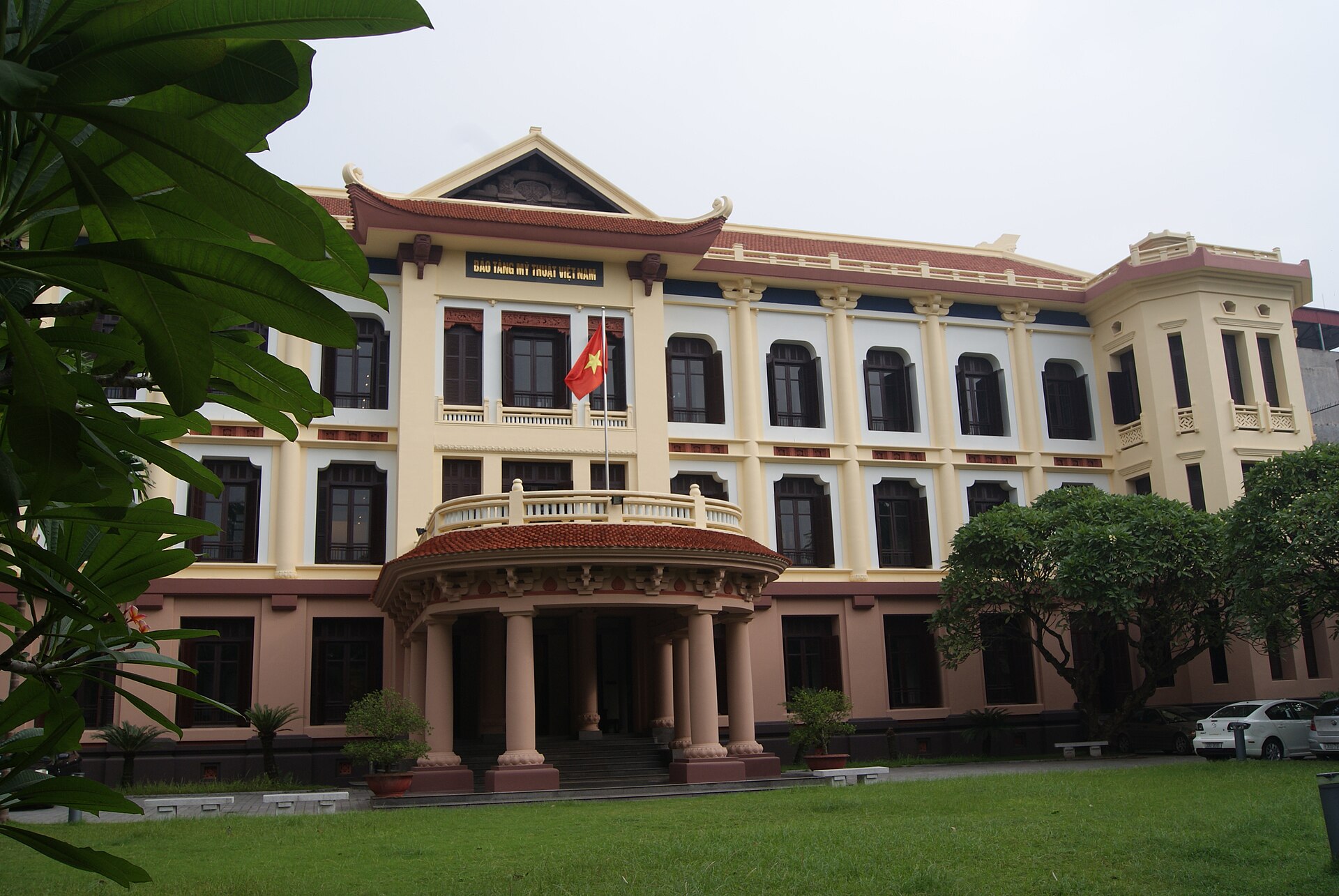
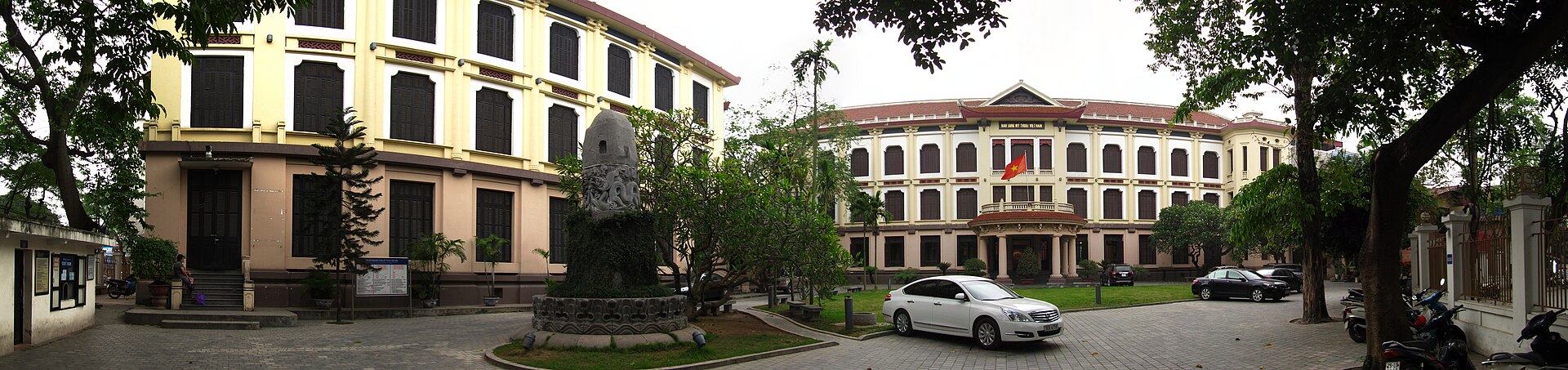
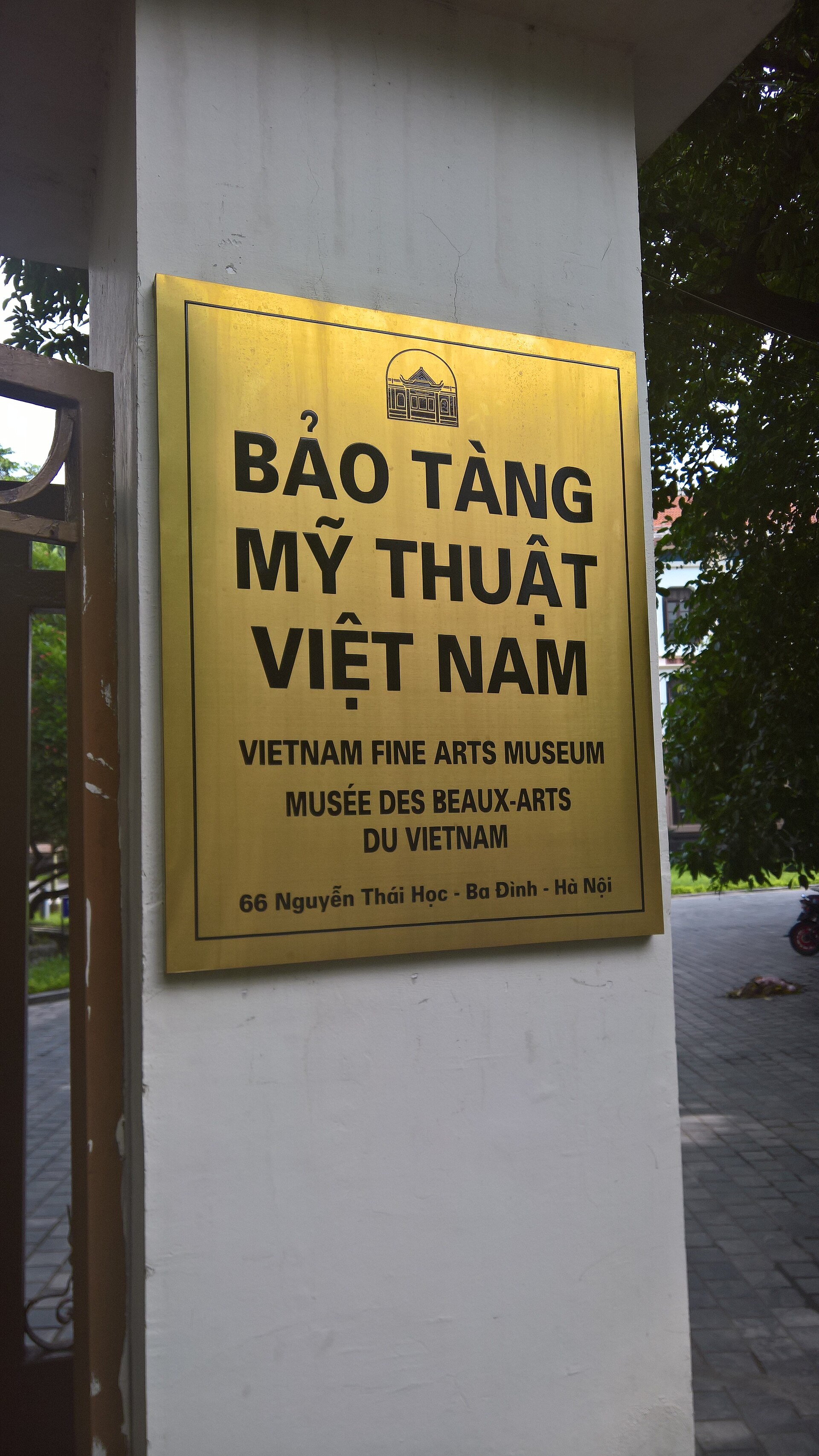
The museum's facade at 66 Nguyen Thai Hoc, Ba Dinh District, Hanoi, a former French colonial girls' boarding school converted for museum use in the 1960s.
Smuconlaw · CC BY-SA 3.0Vietnam National Museum of Fine Arts
Museum · Bao tang My thuat Viet Nam · Founded 1966
Open, admission and hours confirmed 24 August 2026 · 10 sources
On this page 15 sections
ContentsClose
The museum's real strength is coverage rather than depth in any single period: it is the one place in Vietnam that puts Dong Son bronzes, Cham temple sculpture, dynastic wood carving, Indochina College-era oil and lacquer painting and Dong Ho and Hang Trong folk prints under a single roof, arranged so a visitor can walk the whole span of Vietnamese art history in one route. Its lacquer painting holdings, running from Nguyen Gia Tri's Standing Screen through the Party-era lacquer narrative paintings of Nguyen Sang and Duong Bich Lien, are widely regarded as the most complete public collection of the medium's mid-20th-century development anywhere. Its Cham and dynastic wood sculpture, by contrast, competes directly with the holdings of Vietnam's national history and archaeology museums rather than standing out as a comparative strength.
| Local name | Bao tang My thuat Viet Nam |
|---|---|
| Kind | Museum |
| Founded | 1966 |
| City and country |  Hanoi, Vietnam Hanoi, Vietnam |
| Address | 66 Nguyen Thai Hoc, Ba Dinh, Hanoi, Vietnam |
| Website | vnfam.vn/en |
| Status | Open, confirmed |
| Record last verified |
Visiting
- Hours
- Tue-Sun08:30 to 17:00
- Closed
- Monday.
- Admission
- AdultVND 40,000
- College and university student (Vietnamese institution ID required)VND 20,000
- Child, age 6-16VND 10,000
- Child under 6, and disabled visitorsFreefree
- Do I need to book?
- No standing-ticket reservation; group guided tours (up to 25 people, 150,000 VND per group) are booked in advance through the Department of Exhibition and Education
- Address
- 66 Nguyen Thai Hoc, Ba Dinh, Hanoi, Vietnam Map
- Website
- vnfam.vn/en
- Telephone
- +84 24 3823 3084
- [email protected]
Before you go how long, access, photography, bags, eating, shop
- How long to allow
- One and a half to two hours for the permanent galleries; reviewers who go deeper into every room report closer to three
- Access
- Free admission for visitors with disabilities is stated on the museum's own price list; no further accessibility detail is published on the site
- Photography
- Not stated on the museum's own site
- Bags
- Not stated on the museum's own site
- Eating
- On-site cafe/snack-bar with indoor and outdoor seating, open daily 07:00 to 22:30, overlooking the museum's architecture
- Shop
- A small museum shop sells postcards, prints and gifts; visitor reviews describe the range as limited and the print quality as inconsistent
Prices and hours change. We take them from the institution's own pages and print the day we read them, and you can check the current position at the source we used. Confirm before you travel.
What is inside
Prehistory and Early History Fine Arts
Opens with a cast of the carved human and animal faces from the Dong Noi grotto in Hoa Binh province, then moves through decorated Phung Nguyen, Dong Dau, Go Mun, Sa Huynh and Oc Eo pottery and Dong Son bronze drums, jars and weapons, before giving way to sandstone Cham sculpture of the 7th to 14th centuries: elephants, the god Shiva, the goddess Uma, dancing apsaras, garudas and temple lions recovered from central Vietnam.
Art from the 11th to the 19th Century AD
Wood and lacquered-wood temple and pagoda sculpture from the Ly, Tran, Le and Nguyen dynasties, including a pair of dragon-carved temple doors dated 1262, dynastic portrait statues such as Queen Trinh Thi Ngoc Truc and a royal couple identified as King Ly Nam De and his queen, folk woodcarvings such as Mahouts and Wrestlers, and the museum's best-known single object, a 17th-century lacquered-wood statue of the thousand-armed Bodhisattva Avalokiteshvara.
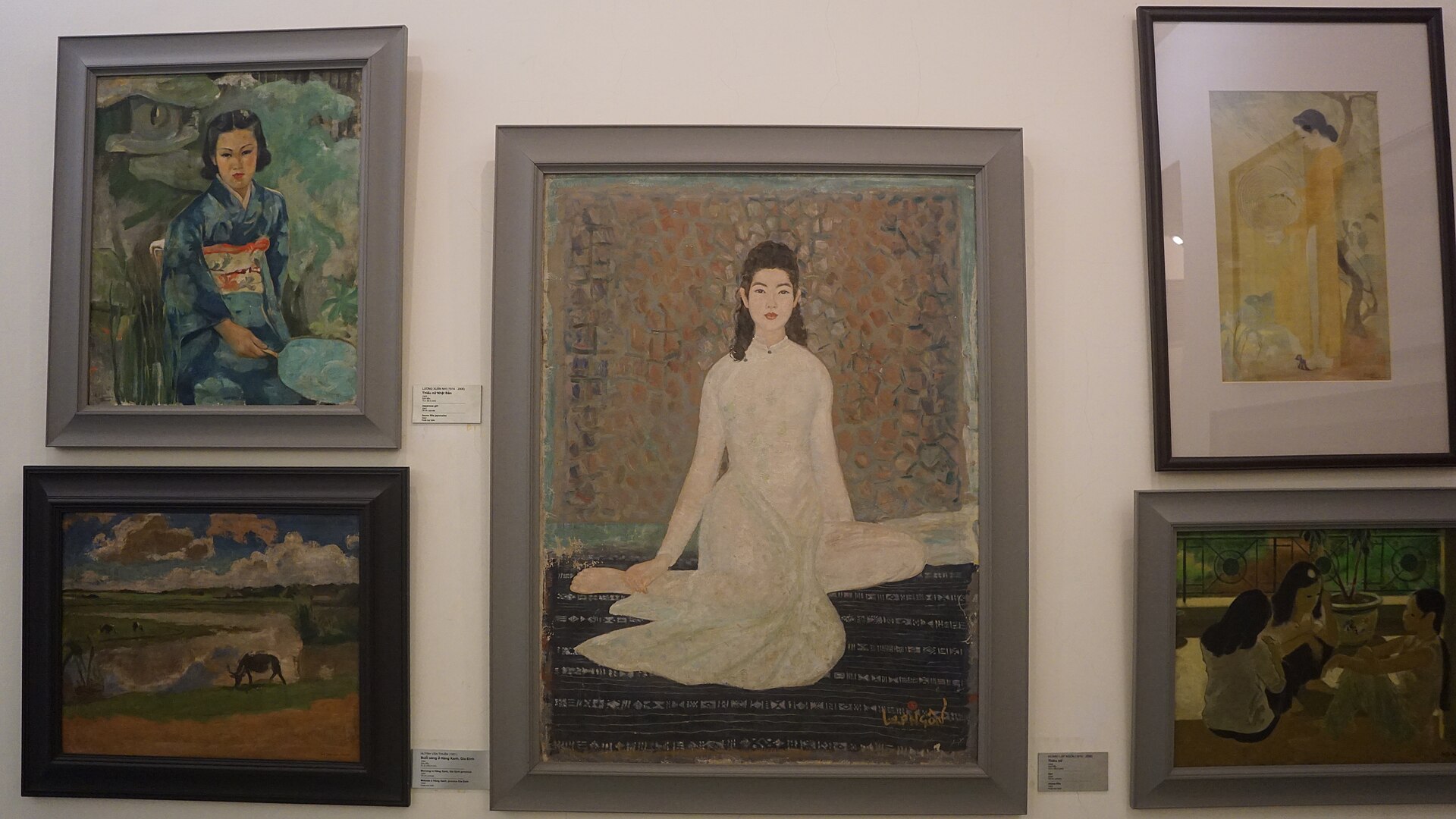
Photograph by Z3144228 · CC BY-SA 4.0 Art from the Early 20th Century AD to the Present Day
The modern collection built substantially from graduates and teachers of the Indochina College of Fine Arts and its successor, the Vietnam University of Fine Arts: lacquer, oil, silk, gouache and woodcut works by Nguyen Gia Tri, To Ngoc Van, Tran Van Can, Nguyen Phan Chanh, Nguyen Do Cung, Bui Xuan Phai, Nguyen Tu Nghiem, Nguyen Sang, Duong Bich Lien and others, alongside sculpture and a recently expanded Contemporary Arts Gallery covering work made from 1980 onward.
Traditional Applied Art
Craft objects from Vietnam's ethnic-minority communities, drawn together to show shared decorative techniques across different materials: a mother-of-pearl and ivory inlaid wooden cabinet made by Kinh craftsmen, woven basketry, and costume from the Cham, Pa Then and Xo Dang (Kon Tum) peoples.
Folk Art
The museum's dedicated folk-painting collection, built around the three surviving Vietnamese woodblock-print traditions: Dong Ho prints such as Rooster and Hen, Sow and Sow and Piglets; Hang Trong prints including Carp Beholding the Moon and White Tiger; and Kim Hoang prints, alongside folk sculpture in wood and stone.
What to see first
Little Sister Thuy (Em Thuy)
Tran Van CanAn oil portrait of the painter's young niece, among the best-known Vietnamese paintings of the 20th century and one of the museum's nine bao vat quoc gia (National Treasures). It was restored in 2004 by the Australian conservator Caroline Fry with support from Asialink and the Australia Council for the Arts, a conservation partnership the museum's own site was still citing in an August 2026 account of a diplomatic visit built around the picture.1
Statue of the Bodhisattva Avalokiteshvara
Unknown Vietnamese carver, 17th centuryA lacquered-wood statue of the thousand-armed, thousand-eyed Bodhisattva, a National Treasure and, by the museum's own placement of it in the ground-floor rear gallery of Building A, one of the two objects a Tripadvisor reviewer singled out as worth the entire admission price on its own.5
Standing Screen (Landscape)
Nguyen Gia TriA multi-panel lacquer screen by the painter most credited with turning Vietnamese lacquer painting into a fine-art medium; a National Treasure and the work the museum's own homepage was using to represent its collection in August 2026.4
Uncle Ho in the Viet Bac Resistance Base
Duong Bich LienA lacquer portrait of Ho Chi Minh set during the First Indochina War-era resistance base in the Viet Bac region, a National Treasure and one of the museum's principal images of the wartime leadership.4
Giong
Nguyen Tu NghiemA lacquer painting of Thanh Giong, the legendary boy-hero of early Vietnamese myth who defeats an invading army and ascends to heaven on his horse; a National Treasure by one of the Indochina College's most abstracted modern painters.4
Queen Trinh Thi Ngoc Truc
Unknown Vietnamese carverA lacquered-wood dynastic portrait statue, a National Treasure, and one of the museum's group of donor and royal-consort statues carried over from temple and pagoda worship into museum display.4
Party Admission Ceremony on the Dien Bien Phu Battlefield
Nguyen SangA lacquer painting of soldiers being admitted to the Communist Party during the decisive 1954 battle, a National Treasure and one of the museum's central works of war-era socialist-realist lacquer painting.4
Two Young Women and a Child
To Ngoc VanAn oil painting by one of the Indochina College of Fine Arts' first generation of Vietnamese-trained painters, and a National Treasure; To Ngoc Van later became the college's own director before his death on the Dien Bien Phu campaign in 1954.4
A Pair of Dragon Doors
Unknown Tran-dynasty carverWooden temple doors carved with dragon motifs and dated 1262, among the oldest datable objects in the museum's collection and a National Treasure.4
Past exhibitions here
- Closed24 Jul to 30 Jul 2026Confirmed · check before you travel
A colonial boarding school turned national museum
The museum occupies a building put up in 1937 as a Catholic boarding school for the daughters of French colonial officials, one of the institutional buildings France raised in this part of Hanoi in the same decade as the Indochina College of Fine Arts a short walk away. The site was picked out for conversion in 1963 by the painter Nguyen Do Cung, who would become the new museum's first director, though the government order to the Ministry of Culture to turn the building into a place to collect, exhibit and preserve Vietnamese art from prehistory to the present had already gone out the year before, in 1962. The building was renovated with Vietnamese architectural elements added to the French shell, and the Vietnam National Fine Arts Museum opened to the public in 1966.
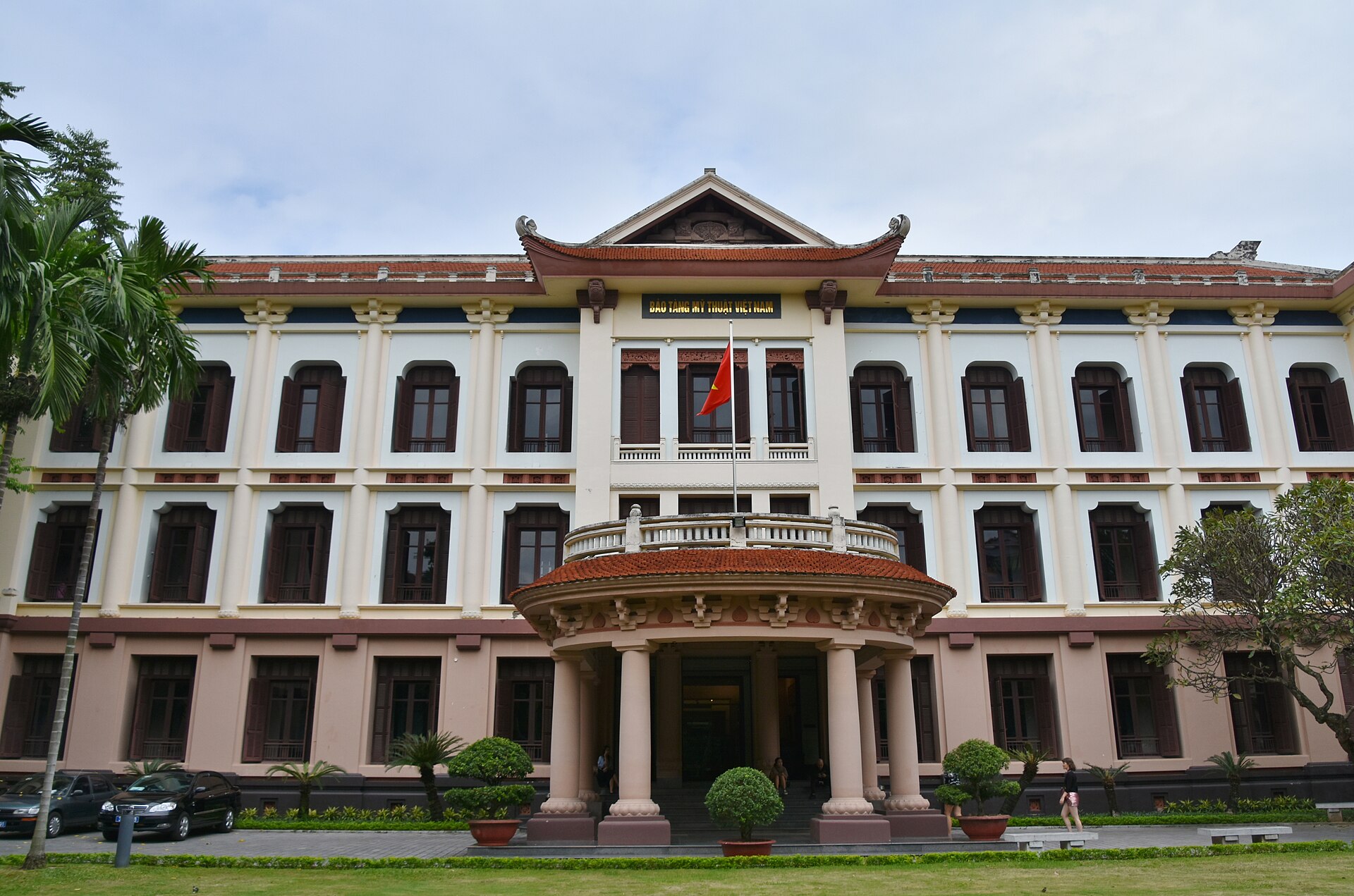
Growth came in stages after that. Building B went up behind the original structure in 1977 to give the museum a second exhibition block; in the 1990s the museum expanded the original Building A again, this time to make room for a new ancient-art display; and a further gallery was carved into the basement of Building B to hold the ceramics collection. The museum's own figures put the whole site at 4,737 square metres, of which around 3,000 square metres is exhibition space split across the two buildings on Nguyen Thai Hoc street, with a second site on Hoang Cau street in Dong Da district, several kilometres away, holding the museum's storage rooms and its conservation centre. Photographs of the Nguyen Thai Hoc facade show a three-storey cream stucco building with a colonnaded, porte-cochere entrance under a red tiled, upward-curving roof, a French Beaux-Arts frame carrying Vietnamese roof forms of the kind Hanoi's colonial-era architects used across the 1930s.
What the museum holds
The museum's own account puts its holdings at around 20,000 objects, of which roughly 18,000 are kept in storage at the Hoang Cau site and about 2,000 are on display at Nguyen Thai Hoc at any one time. The storage system there covers 1,000 square metres across eight separate stores, organised by material and period: ancient sculpture, modern sculpture, oil painting, lacquer painting, paper and silk, traditional arts, ancient ceramics, and a dedicated store for Cu Lao Cham ceramics recovered from a well-known shipwreck site off the central coast. Conservation has its own institutional history at the museum: a decoration and restoration team set up in 1972 was reorganised several times before becoming a formal Conservation Centre in 2006, and the centre now conserves objects for outside institutions as well as its own collection, including the Independence Palace, the Ho Chi Minh Historical Site, and museums in Quang Ninh and Laos, and has run joint training workshops with the Goethe Institute Hanoi and the Dresden Academy of Fine Arts.
The museum is a member of the International Council of Museums, the Asia-Europe Museum Network and the Vietnamese Museum Network, and it both sends its own collection abroad on loan and hosts incoming exhibitions; its own account lists past exchanges with institutions in the United States, France, Britain, Spain, Russia, Germany, Italy, Japan, Korea, Singapore and elsewhere. Roughly a tenth of the roughly 20,000-object collection, by the museum's own account, was built up through field-collecting expeditions the museum ran across the country from soon after its founding, gathering ancient artefacts, sculpture, paintings and graphic art from excavation sites, from art exhibitions, and directly from artists and private collectors; the museum's public materials describe this process in general terms without an object-by-object acquisition record.
The nine National Treasures
Vietnam's National Treasure designation, bao vat quoc gia, is a government listing of objects judged to be of exceptional historical, cultural or scientific value, and the Vietnam National Fine Arts Museum holds nine of them, more than any other institution devoted to fine art in the country. They span the museum's whole chronological range rather than clustering in one gallery: a pair of 1262 dragon-carved temple doors and a 17th-century lacquered-wood statue of the thousand-armed Bodhisattva Avalokiteshvara represent the museum's oldest holdings, a lacquered-wood dynastic portrait statue of Queen Trinh Thi Ngoc Truc represents its royal and temple sculpture, and six modern paintings carry the rest: Nguyen Gia Tri's lacquer screen Landscape, To Ngoc Van's oil painting Two Young Women and a Child, Tran Van Can's Little Sister Thuy, Nguyen Sang's Party Admission Ceremony on the Dien Bien Phu Battlefield, Duong Bich Lien's Uncle Ho in the Viet Bac Resistance Base, and Nguyen Tu Nghiem's Giong.
The concentration of six National Treasures in 20th-century painting is itself a statement about how the museum sees its own collection: the objects it has put forward for the country's highest heritage listing are overwhelmingly the founding generation of Vietnamese modern art rather than the older devotional sculpture, even though the sculpture includes pieces centuries older. Little Sister Thuy carries the clearest recent public story of the nine: the museum's own account of an August 2026 visit by the Australian ambassador describes the picture's 2004 restoration by the Australian conservator Caroline Fry, working with Asialink and the Australia Council for the Arts, as a continuing point of pride and of bilateral cultural cooperation more than two decades on.
From the Indochina College to the modern collection
A large part of what makes the museum's 20th-century holdings coherent rather than a general survey is a single institutional lineage: the Indochina College of Fine Arts, founded in Hanoi under French rule with the painter Victor Tardieu as its first principal, and its direct successor, the Vietnam University of Fine Arts. The museum's own figures put the share of works in its Modern Collection made by painters, sculptors, lecturers and students of that school, across its whole history, at around 60 per cent. Nguyen Do Cung, the museum's first director, was himself a graduate of the college's fifth cohort, and the museum describes his own training as the direct source of the collecting and display priorities that shaped the museum in its early years. A special exhibition running to 22 November 2025, timed to the college's own centenary, drew on both institutions' collections to trace this line from Tardieu through Vietnamese-trained successors including To Ngoc Van, Tran Van Can, Nguyen Phan Chanh, Nguyen Gia Tri, Nguyen Sang and Nguyen Tu Nghiem, with a Victor Tardieu Award created for outstanding graduation work by the university's current students.
The museum's own account of its 20th-century displays, and independent description of the collection, both point to a heavy emphasis on the two wars against France and the United States as subject matter in this part of the museum: portraits of Ho Chi Minh, battlefield and resistance scenes, and paintings of soldiers, wounded veterans and the women who supported them from the home front recur across the modern galleries. This is a fair description of what is on the walls rather than a criticism unique to this museum among Vietnam's state collections, but it is worth a visitor knowing going in: several Tripadvisor reviewers who otherwise rated the museum well specifically noted that the modern rooms can feel repetitive on this theme, in a way the older sculpture and folk-print rooms do not.
The permanent galleries
The permanent display is organised into six chronological and thematic sections spread across the two buildings: Prehistory and Early History Fine Arts, which runs from Hoa Binh-culture cave carvings through Dong Son bronzes to Cham stone sculpture; Art from the 11th to the 19th Century AD, covering dynastic temple and pagoda sculpture and carving; Art from the Early 20th Century AD to the Present Day, the Indochina College-descended modern and contemporary collection; Traditional Applied Art, covering ethnic-minority craft in wood, textile and shell; Folk Art, built around the Dong Ho, Hang Trong and Kim Hoang woodblock-print traditions; and a dedicated Vietnamese Ceramic Art display running from the 11th to the 20th century. Since 2011 the museum has also run a Creative Space for Children, an open activity area offering discovery boxes, guided tours and workshops tied to the permanent and temporary displays, with regular, special, summer, Children's Day and Mid-Autumn programmes through the year. A separate Virtual Art Exhibition Space and a nine-language Smart Guide app, iMuseum VFA, extend the museum's own displays online and on visitors' phones respectively.
Visiting today
The museum is open Tuesday to Sunday, 8:30am to 5pm, and closed on Monday. Adult admission is 40,000 Vietnamese dong, with reduced rates of 20,000 dong for holders of a Vietnamese higher-education student card and 10,000 dong for children aged 6 to 16, and free entry for children under 6 and for visitors with disabilities. A guided group tour, in Vietnamese, English or Chinese, costs 150,000 dong per group of up to 25 people and is booked in advance through the museum's Department of Exhibition and Education; the Smart Guide app is a separate paid option, in nine languages, at 50,000 dong for adults and 30,000 dong for students. An on-site cafe with indoor and outdoor seating is open daily from 7am to 10:30pm, considerably longer hours than the galleries themselves, and several reviewers name it, alongside the building, as one of the better reasons to linger. The museum sits a short walk from the Temple of Literature, and several long-standing Hanoi residents quoted in visitor reviews describe it as their own favourite museum in the city, a detail worth setting against reviewers who found the modern-art rooms repetitive: the disagreement runs less along tourist-versus-local lines than along how much weight a given visitor puts on the older sculpture rooms against the war-era painting galleries.
What visitors say
Visitors consistently describe the museum as a far more complete survey of Vietnamese art history than they expected going in, covering prehistoric artefacts, Cham sculpture, dynastic temple statuary, lacquer and oil painting and folk woodblock prints in one building, at a low admission price, inside a well-kept French colonial structure that is itself part of the appeal. The recurring complaint is not with the art but with how it is shown: the split between two buildings with front and back sections is easy to get lost in, gallery lighting throws glare onto glass cases, and the museum shop is small and underwhelming.
What is praised, what is criticised
- Praised: the breadth of the collection in one visit, from prehistoric pottery and Cham sculpture through dynastic temple statuary to modern lacquer, oil and silk painting and folk prints
- Praised: the restored French colonial building itself, repeatedly named by reviewers as one of the best reasons to go
- Praised: the low admission price set against the depth of what is on show
- Praised: the calm, uncrowded galleries with benches to rest on, and the on-site cafe
- Criticised: navigation between the two exhibition buildings and their front and back sections is confusing, and reviewers report missing whole galleries as a result
- Criticised: gallery lighting causes glare and reflections on glass display cases that make some works hard to see
- Criticised: the museum shop is small, with a limited range and postcard prints reviewers describe as blurry
- Criticised: some visitors find the collection smaller than they expect of a national art museum, and note that the modern galleries lean heavily on similar war-with-France-and-America subject matter
Ratings on other platforms
Tripadvisor: 4.3 from 1,149 ratings, read 24 August 2026
A platform average is a tertiary source: it moves, it is not audited, and we quote no visitor's words.
Questions about Vietnam National Museum of Fine Arts
Where is Vietnam National Museum of Fine Arts?
66 Nguyen Thai Hoc, Ba Dinh, Hanoi, Vietnam.
How much does it cost to visit?
Adult: VND 40000; College and university student (Vietnamese institution ID required): VND 20000; Child, age 6-16: VND 10000; Child under 6, and disabled visitors: free. As confirmed 24 August 2026.
When is it open?
Tue-Sun 08:30-17:00. Closed: Monday. As confirmed 24 August 2026.
What should you see first?
Little Sister Thuy (Em Thuy) (Tran Van Can); Statue of the Bodhisattva Avalokiteshvara (Unknown Vietnamese carver, 17th century); Standing Screen (Landscape) (Nguyen Gia Tri); Uncle Ho in the Viet Bac Resistance Base (Duong Bich Lien); Giong (Nguyen Tu Nghiem); Queen Trinh Thi Ngoc Truc (Unknown Vietnamese carver).
What we could not confirm
- The museum's public materials describe its post-1966 field-collecting expeditions in general terms only; no object-by-object acquisition record for individual works, including several of the nine National Treasures, is published on the museum's own site.
- No online catalogue of the roughly 18,000 objects held in storage at the museum's Hoang Cau site is published; only the approximately 2,000 objects on permanent display at Nguyen Thai Hoc are individually described.
Images
Sources
- 1Vietnam National Fine Arts Museum, official site, home page (news, current exhibitions, contact) vnfam.vn/en/
- 2Vietnam National Fine Arts Museum, official site, Visit page (hours, admission, guided tours, Smart Guide, cafe) vnfam.vn/en/visiting
- 3Vietnam National Fine Arts Museum, official site, About Us page (mission, history, organisation, conservation) vnfam.vn/en/about
- 4Vietnam National Fine Arts Museum, official site, National Treasures collection page vnfam.vn/en/collections/5ab4a9f3833508001d4c5be7
- 5Vietnam National Fine Arts Museum, official site, Art from the 11th to the 19th Century AD display page vnfam.vn/en/displays/5ab4ad3f833508001d4c5bf0
- 6Wikimedia Commons, Category:Vietnam National Museum of Fine Arts commons.wikimedia.org/wiki/Category:Vietnam_National_Museum_of_Fine_Arts
- 7Wikipedia, Vietnam National Museum of Fine Arts en.wikipedia.org/wiki/Vietnam_National_Museum_of_Fine_Arts
- 8Wikidata, Q3654706, Vietnam National Museum of Fine Arts wikidata.org/wiki/Q3654706
- 9Tripadvisor, Vietnam Fine Arts Museum (Bao Tang My Thuat Viet Nam), rating and visitor reviews tripadvisor.com/Attraction_Review-g293924-d311048-Reviews-Fine_Arts_Museum_Bao_Tang_My_Thuat-Hanoi.html
- 10Vietnam Tourism Board, Vietnam National Fine Arts Museum: A must-see destination in Hanoi vietnam.travel/things-to-do/vietnam-national-fine-arts-museum-must-see-destination-hanoi