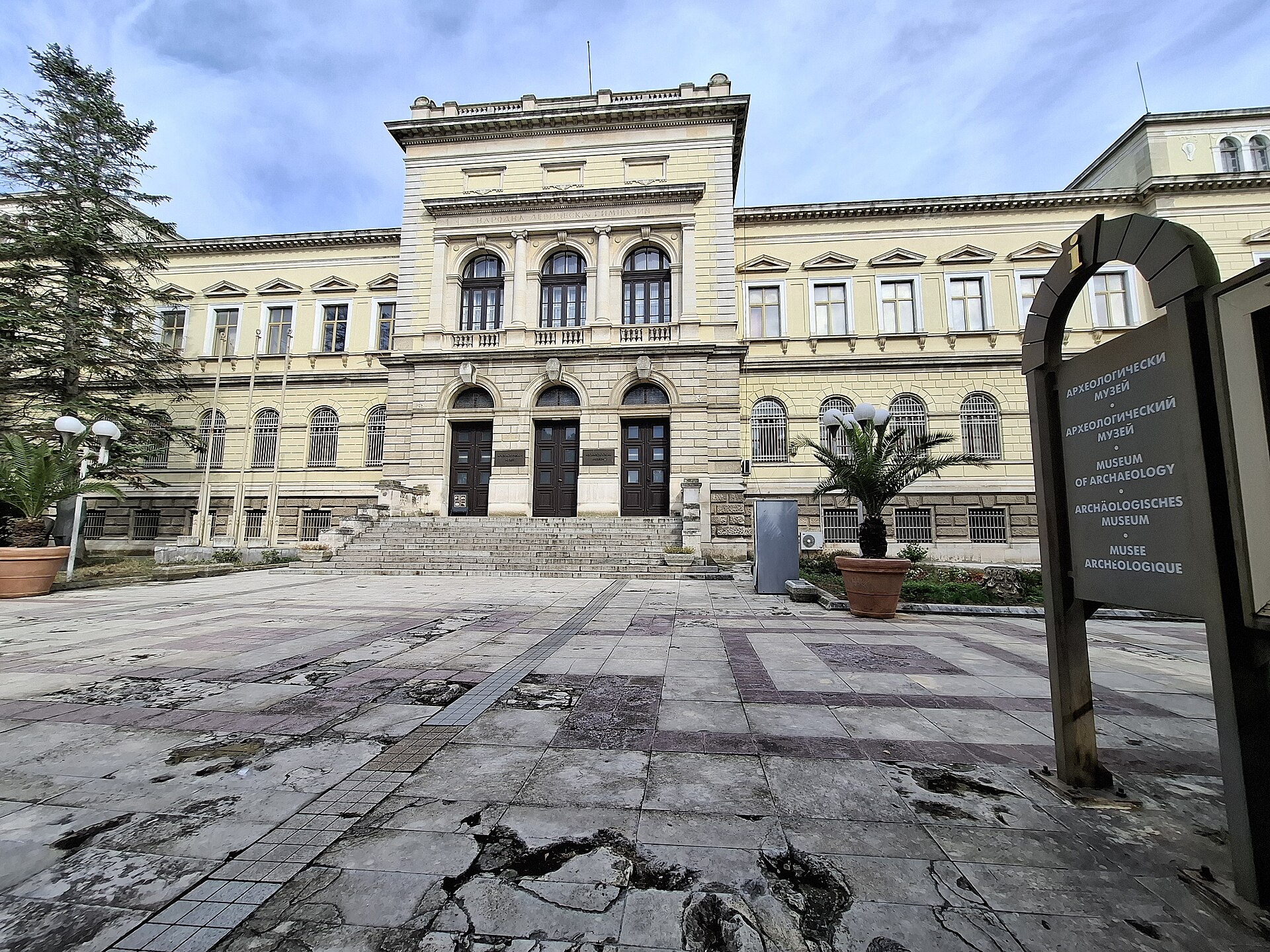
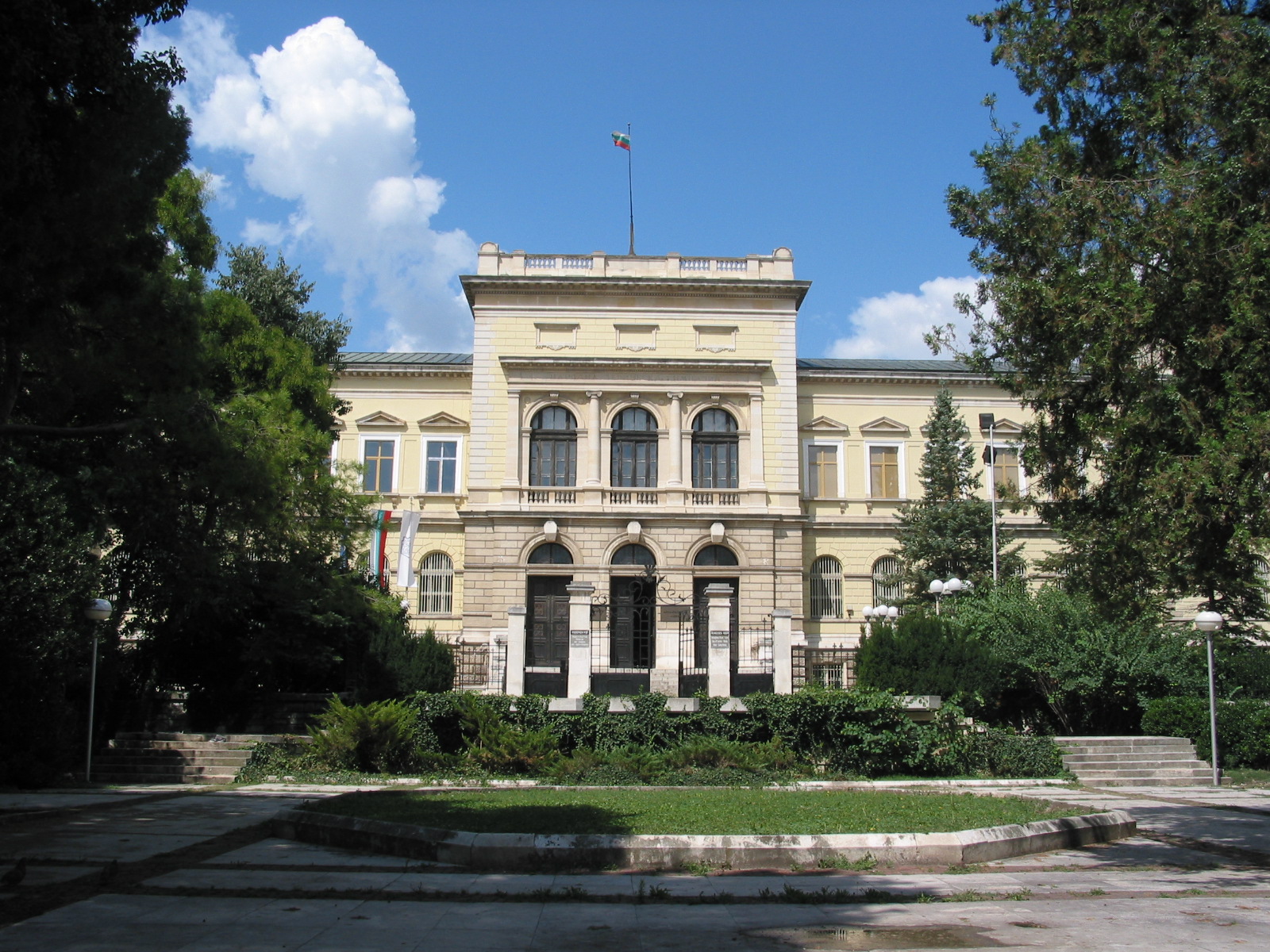
The main entrance of the Varna Archaeological Museum, in the former Girls' High School building on Maria Luiza Boulevard.
CC0Varna Archaeological Museum
Museum · Arheologicheski muzey Varna · Founded 1887
Open, admission and hours confirmed 6 September 2026 · 14 sources
On this page 14 sections
ContentsClose
The museum's defining strength is depth in a single find of world importance, the Varna Necropolis gold, backed by a genuinely large secondary collection rather than a single-room treasury. Three dedicated halls, a coin cabinet visitors rate against the best in the region, a large icon collection, and a continuous run of material from the Palaeolithic to Ottoman rule mean the building rewards several hours rather than a quick look at the gold cases alone.
| Local name | Arheologicheski muzey Varna |
|---|---|
| Kind | Museum |
| Founded | 1887 (collection founded by Karel and Herman Skorpil); first public exhibition opened 11 June 1906 |
| City and country |  Varna, Bulgaria Varna, Bulgaria |
| Address | 41 Maria Luiza Boulevard, 9000 Varna, Bulgaria |
| Website | museumvarna.com/ekspozitsii/arheologicheski-muzey |
| Status | Open, confirmed |
| Record last verified |
Visiting
- Hours
- Tue-Sat10:00 to 17:00October-April (closed Sunday and Monday in this period)
- Mon-Sun10:00 to 17:00May-September, open every day
- Closed
- Sunday and Monday, but only in the October-April season.
- Admission
- AdultEUR 1019.56 BGN
- SchoolchildrenEUR 47.82 BGN
- Children under 7Freefree
- Archaeology-department studentsEUR 59.78 BGN, entry to the Archaeology department specifically
- Group of 15+ adultsEUR 815.65 BGN per person
Free entry: Days set by order of the Ministry of Culture or Varna Municipality; specific dates are not published on the museum's prices page- Do I need to book?
- No advance booking on the museum's own site; tickets are sold at the museum. The Regional History Museum does not sell tickets online and warns against third-party sites claiming otherwise
- Address
- 41 Maria Luiza Boulevard, 9000 Varna, Bulgaria MapWalking A short walk from Varna Cathedral (the Cathedral of the Assumption of the Virgin) in the city centre
- Website
- museumvarna.com/ekspozitsii/arheologicheski-muzey
- Telephone
- +359 52 681030
- [email protected]
Before you go how long, access, photography, bags, eating, shop
- How long to allow
- One to two hours to see the highlights; several visitors report three to four hours to read the bilingual Bulgarian/English panels across both exhibition floors
- Access
- Not detailed on the museum's own visit pages. The building is a converted 1890s school arranged over a basement and two upper floors around an internal courtyard, linked by a central staircase, so step-free access between floors is not confirmed
- Photography
- Not stated on the museum's own site
- Bags
- Not stated on the museum's own site
- Eating
- A cafeteria is listed among the museum's visitor facilities
- Shop
- A gift shop is listed among the museum's visitor facilities
Prices and hours change. We take them from the institution's own pages and print the day we read them, and you can check the current position at the source we used. Confirm before you travel.
What is inside
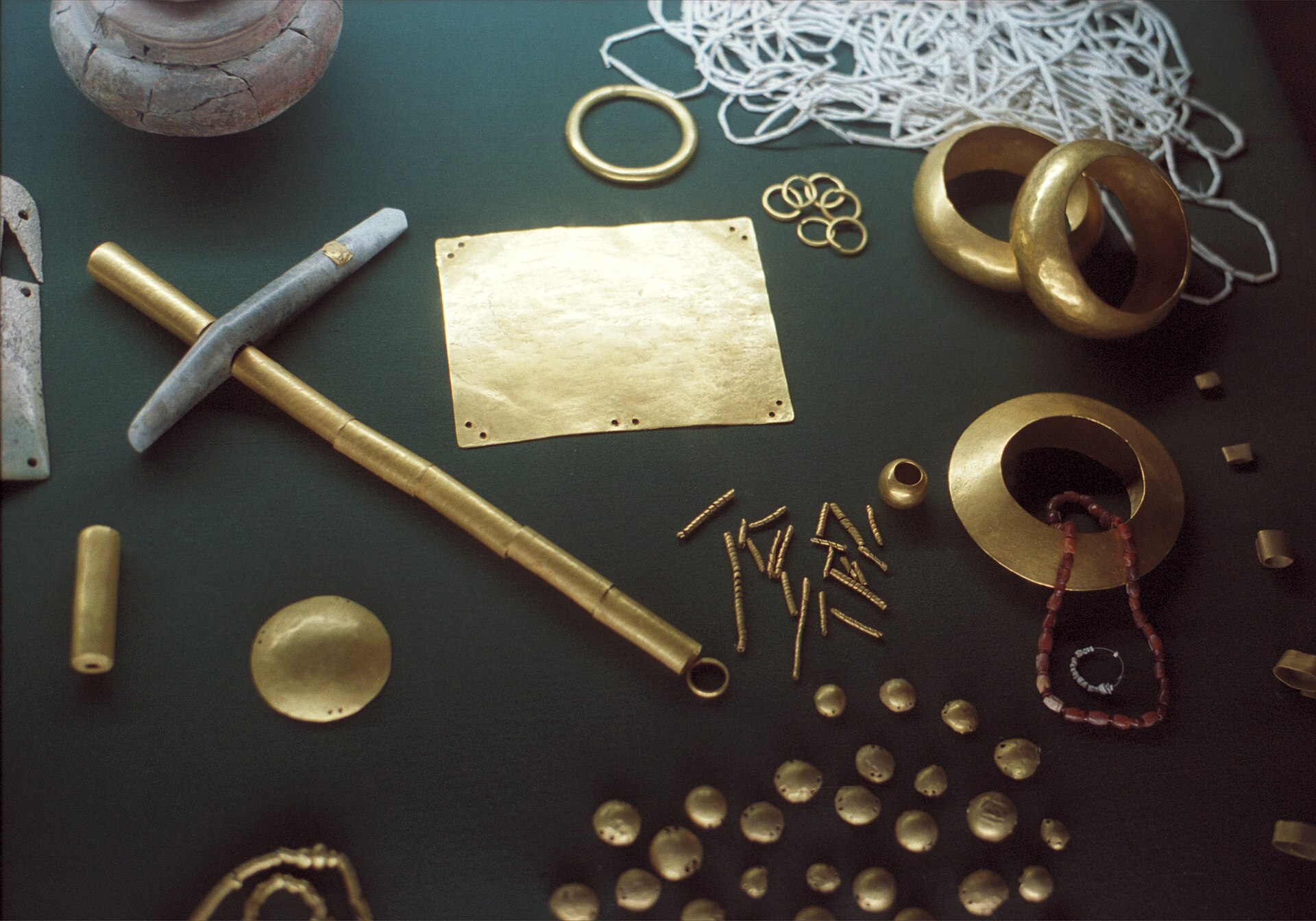
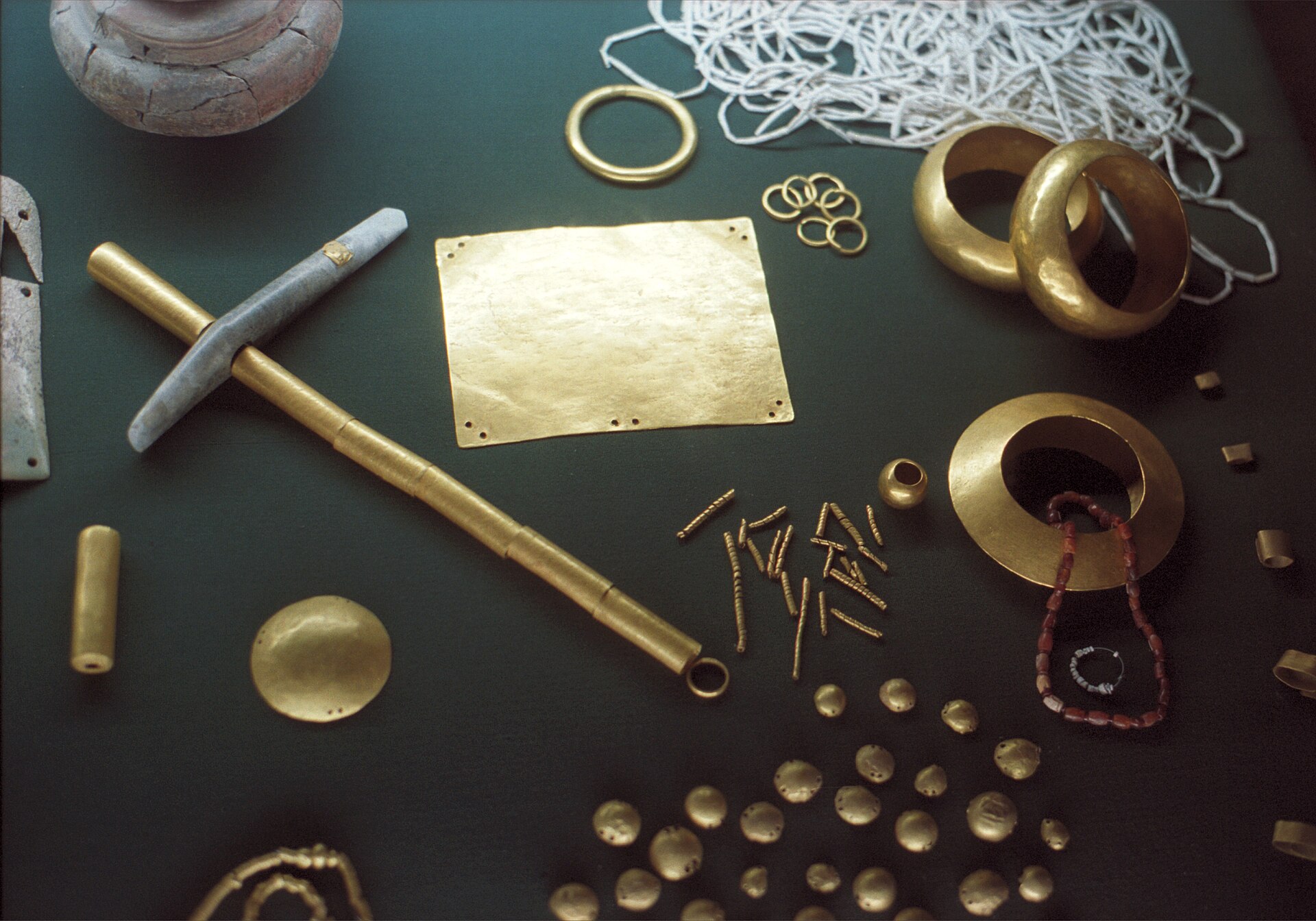
Photograph by Zde · CC BY-SA 4.0 Prehistoric halls: the Gold of Varna
Three ground-floor halls hold the Varna Necropolis treasure: about 3,000 gold objects weighing roughly 6 kilograms, recovered from a Chalcolithic cemetery found accidentally in 1972 during construction work in Varna's western industrial zone and radiocarbon-dated to about 4600-4200 BC. The cases display beads, appliques, rings, bracelets, pectorals, diadems, three gold sceptres from separate high-status graves, and gold bull-shaped plaques.
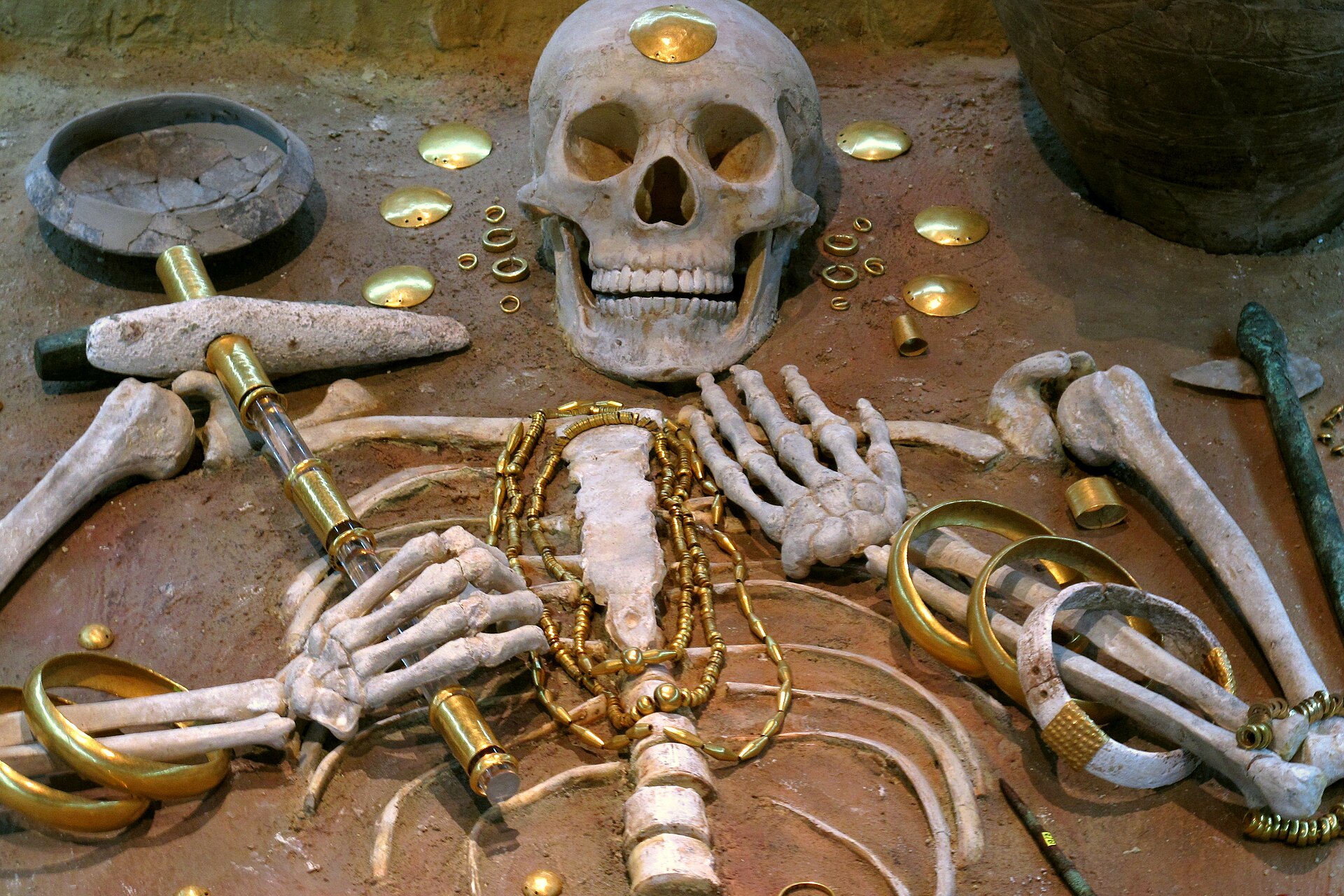
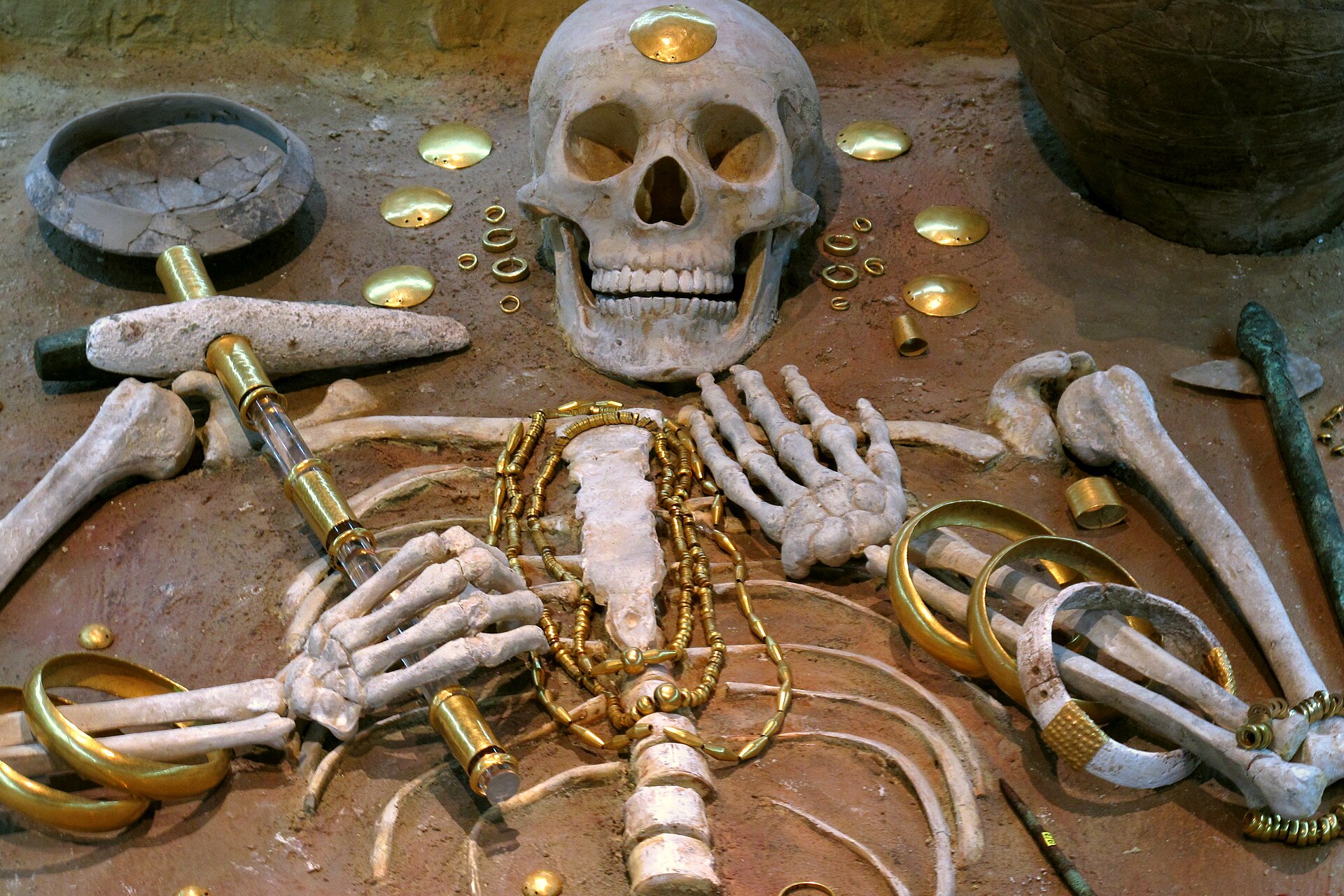
Photograph by Gabriele Burchielli from Seville, Spain and Italy · CC BY 2.0 Grave 43
A dedicated case reconstructs Grave 43, the single richest Chalcolithic burial known anywhere: it held more gold than has been recovered from every other site of its era combined. First read as a chieftain's grave, current museum scholarship attributes it instead to a metalworker.
Thracian, Ancient Greek and Roman halls
Ground-floor rooms continue the chronological sequence with Thracian, ancient Greek and Roman material from the wider Varna region: pottery, tools, weapons, funerary sculpture, and several relief carvings of the Thracian Rider votive type alongside one free-standing sculpture of a horseman that visitors note as the only true sculpture-in-the-round among them.
Medieval Bulgaria and Byzantine hall
Upper-floor galleries cover medieval Bulgaria and the Byzantine period: mosaics, coins, everyday objects and finds from Bulgaria's medieval towns and monasteries.
Icon collection
A permanent exposition of roughly 900 medieval and Bulgarian National Revival icons, spanning the 16th to the 19th centuries, in dedicated upper-floor rooms.
Numismatic (coin) collection
A coin cabinet spanning Greek, Roman, Byzantine and later Bulgarian and Ottoman issues; visitors who have seen comparable museums elsewhere in the region describe it as one of the strongest holdings in the building.
Underwater and maritime archaeology
A section on underwater and maritime finds from the Black Sea coast and Varna Lake. The museum's own research staff list underwater and experimental archaeology among their fields of work, and visitors describe a dedicated display on the theme, though the museum's own site gives no separate room-by-room account of it.
What to see first
The Varna Necropolis gold treasure
Chalcolithic Varna culture, unknown goldsmithsAbout 3,000 gold objects weighing roughly 6 kilograms, radiocarbon-dated to 4600-4200 BC and widely described as the oldest processed gold yet found anywhere in the world.7
Grave 43
Chalcolithic Varna cultureThe richest single Chalcolithic burial known: it held more gold than has been recovered from the rest of the world for its period combined. Current museum research reads it as a metalworker's grave rather than a ruler's.7
The gold sceptres
Chalcolithic Varna cultureThree sceptre-like gold-sheathed maces, found in three separate high-status graves, read by archaeologists as insignia of authority nearly two thousand years before Egypt's First Dynasty.7
Gold bull-shaped plaques
Chalcolithic Varna cultureSmall bull-form gold appliques from the necropolis graves, among the earliest surviving representations of cattle in worked gold anywhere.7
The icon collection
Bulgarian icon painters, 16th-19th centuryAround 900 medieval and National Revival icons, one of the museum's largest holdings outside the prehistoric galleries, tracing Bulgarian Orthodox painting across four centuries.6
The numismatic collection
Various mints, antiquity to the Ottoman periodA coin collection spanning Greek, Roman, Byzantine, Bulgarian and Ottoman issues, singled out by visitors who have compared it favourably with archaeological museums elsewhere in the region.13
Thracian Rider reliefs and a free-standing horseman
Roman-period workshops in the Varna regionSeveral votive reliefs of the Thracian Rider (Heros) type are shown alongside a rare fully sculpted horseman, letting a visitor compare the common relief format against the one full sculpture in the group.13
The 1892-1898 Girls' High School building itself
Architect Petko MomchilovA late Baroque/Neo-Renaissance civic building, arranged over a basement and two floors around an internal courtyard, built for education and repurposed for the museum's collection after 1945.12
A girls' school built for a different purpose entirely
The building a visitor walks into today at 41 Maria Luiza Boulevard was not built to hold antiquities. It went up between 1892 and 1898 as a Girls' High School, in a late Baroque style attributed to the architect Petko Momchilov, arranged over a basement and two upper floors around an internal courtyard. It only became state property in 1945, after which the Regional History Museum's own account describes relocating its collection into the building around 1950 and opening a new exposition there in 1952. Other tertiary sources describe the museum occupying only part of the building for decades afterward, with full use of the whole structure dated as late as 1993; the museum's own published history does not reconcile that gap, and this record does not attempt to invent a smooth account where the sources disagree.
What is not in dispute is the scale of the result. The Archaeological Museum today holds roughly 2,150 square metres of exhibition space, corridors and a central staircase connecting galleries that run from the Palaeolithic, about 100,000 years before the present, through to the Ottoman period and the Bulgarian National Revival. It is one of the largest museums of its kind in Bulgaria, and its own displayed history traces the institution itself back further than the building: to an archaeological collection founded in 1887 by the brothers Karel and Herman Skorpil, Czech-born scientists credited as founders of Bulgarian archaeology and museum practice, with the collection's first public exhibition opening on 11 June 1906.
The Varna Necropolis: the oldest worked gold anywhere in the world
The museum's reputation rests on a find made by accident. In 1972, an excavator operator digging a trench during construction work in Varna's western industrial zone struck a Chalcolithic cemetery that would turn out to hold the earliest large body of worked gold yet discovered anywhere on earth. Radiocarbon dating carried out in 2006 places the graves at roughly 4600 to 4200 BC, some two thousand years before the gold of Egypt's First Dynasty and well over a thousand years before the earliest Mesopotamian gold work.
The necropolis produced around 3,000 gold objects weighing a combined 6 kilograms or so, a quantity that exceeds, by the museum's own account and by the wider archaeological literature on the site, the combined weight and number of every other gold find from anywhere in the world dated to the same five-thousand-to-four-thousand-BC millennium. Three ground-floor halls are given over to the material: beads, appliques, rings, bracelets, pectorals and diadems, three gold sceptres recovered from three separate high-status graves and read as insignia of authority, and small gold plaques shaped as bulls, among the earliest surviving gold representations of cattle known.
Grave 43, and who it actually belonged to
One burial dominates even this treasure. Grave 43 held more gold than has been recovered from the rest of the world combined for its period, and it was read for years as the grave of a chieftain or a prince, the richest man of the fifth millennium BC anywhere on the planet. The museum's own current scholarship has moved away from that reading: it now attributes the burial instead to a metalworker, the person whose skill produced the gold rather than a ruler who merely commanded it. The museum's own site does not fully spell out the evidential basis for that reattribution on its public pages, and this record notes that as an open question rather than treating either reading as settled beyond dispute.
From the Stone Age to Ottoman rule: what fills the rest of the building
The prehistoric halls are not the whole visit. Ground-floor rooms continue chronologically into Thracian, ancient Greek and Roman material drawn from the wider Varna region: pottery, tools, weapons, funerary sculpture, and a group of reliefs of the Thracian Rider, a Roman-period votive image repeated across the northeastern Balkans, shown here alongside one rare free-standing sculpture of a horseman rather than a flat relief.
Upper floors move into medieval Bulgaria and the Byzantine world, with mosaics, coins and everyday objects from Bulgaria's medieval towns and monasteries, and into a permanent exposition of around 900 medieval and Bulgarian National Revival icons spanning the 16th to the 19th centuries. A coin cabinet running from Greek and Roman issues through Byzantine, Bulgarian and Ottoman coinage sits alongside these, and visitors who have compared it with archaeological museums elsewhere in the region single it out as one of the museum's strongest holdings. A further section addresses underwater and maritime archaeology from the Black Sea coast and Varna Lake; the museum's own research staff list underwater and experimental archaeology among their working fields, though the museum's public-facing pages give no dedicated room-by-room account of that material to check the display against.
Visiting: hours, admission and getting in
The Archaeological Museum keeps different hours by season on its own site: 10:00 to 17:00, Tuesday to Saturday, from October to April, closed on Sunday and Monday in that period; and 10:00 to 17:00 every day from May to September. Adult admission is 10 euros (19.56 lev), schoolchildren pay 4 euros (7.82 lev), children under 7 enter free, and groups of 15 or more adults pay a reduced 8 euros (15.65 lev) each. The museum's own site states that free-entry days are set by order of the Ministry of Culture or Varna Municipality without publishing the specific dates. There is no advance online ticketing through the museum's own site; tickets are bought at the museum itself.
The building sits on Maria Luiza Boulevard, a short walk from Varna's cathedral in the city centre. A one-day technical-maintenance closure of the Archaeological Museum specifically, and not the wider Regional History Museum group, was announced by the museum for Wednesday 9 September; the notice itself is evidence the museum is operating on its normal published schedule around that date rather than any indication of an extended closure.
What visitors say, and what remains unresolved
On TripAdvisor, the museum holds a rating of 4.5 out of 5 from 454 reviews as read on 6 September 2026, with the overwhelming majority of ratings in the Excellent and Good bands. Visitors who have seen comparable archaeological museums elsewhere in Europe rate Varna's bilingual labelling and historical context especially highly; the most common complaint is heat and air conditioning in the exhibition rooms in summer, with a smaller number of visitors finding some period descriptions thin.
Two points remain genuinely open on the evidence gathered for this record rather than resolved by any single source: the museum's own institutional history gives 1887 as the founding of the underlying archaeological collection and 1906 as the date of its first public exhibition, while its account of when the museum came to occupy its current 1892-1898 building runs from a stated relocation around 1950 to a separately reported date of full occupancy in 1993, with no source reconciling the interval. Neither figure is invented here; both are reported as the sources state them, side by side.
What visitors say
Visitors consistently describe the museum as far larger and more comprehensive than they expected, built around the Varna Necropolis gold but rewarding a longer visit for the coin collection, the icon collection, and the walk from the Stone Age through Ottoman rule. The most repeated complaints are about the building rather than the collection: the exhibition rooms can run hot in summer, and a minority of visitors find some period descriptions thin.
What is praised, what is criticised
- Praised: The bilingual Bulgarian and English information panels; one 2025 visitor who had seen the archaeological museums in Thessaloniki and Heraklion wrote that Varna's panels may be even better, for both individual items and their historical context
- Praised: The range of the permanent collection in one building: a 2025 visitor called the coin collection world class and also praised the icon collection and the Greek, Thracian and Roman holdings, adding that there is also a very cool exhibit on underwater archaeology
- Praised: Helpful, English-speaking staff, noted by a 2025 visitor who was also given free entry on production of a disability ID
- Criticised: Room temperature and air conditioning: a July 2026 visitor wrote that the only thing that pulled the visit down was that it was very hot in the room, and that the air conditioning did not seem optimal
- Criticised: Some object labelling: one August 2024 visitor found the historical descriptions not very good and the visit a little monotonous, calling it a museum like many others
Ratings on other platforms
TripAdvisor: 4.5 from 454 ratings, read 6 September 2026
A platform average is a tertiary source: it moves, it is not audited, and we quote no visitor's words.
Questions about Varna Archaeological Museum
Where is Varna Archaeological Museum?
41 Maria Luiza Boulevard, 9000 Varna, Bulgaria.
How much does it cost to visit?
Adult: EUR 10; Schoolchildren: EUR 4; Children under 7: free; Archaeology-department students: EUR 5; Group of 15+ adults: EUR 8. As confirmed 6 September 2026.
When is it open?
Tue-Sat 10:00-17:00; Mon-Sun 10:00-17:00. Closed: Sunday and Monday, but only in the October-April season. As confirmed 6 September 2026.
How do you get there?
Walking: A short walk from Varna Cathedral (the Cathedral of the Assumption of the Virgin) in the city centre.
What should you see first?
The Varna Necropolis gold treasure (Chalcolithic Varna culture, unknown goldsmiths); Grave 43 (Chalcolithic Varna culture); The gold sceptres (Chalcolithic Varna culture); Gold bull-shaped plaques (Chalcolithic Varna culture); The icon collection (Bulgarian icon painters, 16th-19th century); The numismatic collection (Various mints, antiquity to the Ottoman period).
What we could not confirm
- Whether Grave 43 is correctly read as a metalworker's burial rather than a ruler's, and what evidence underlies the museum's current attribution; the museum's public pages assert the reattribution without laying out the argument for it.
- When the museum came to occupy the whole of its current 1892-1898 building: the museum's own account describes a relocation into the building around 1950 with a new exposition opened in 1952, while other tertiary accounts date full occupancy of the building to 1993, and no source reconciles the gap.
Images
Sources
- 1Varna Regional History Museum, Archaeological Museum visit page museumvarna.com/ekspozitsii/arheologicheski-muzey/
- 2Varna Regional History Museum, Prices and tickets museumvarna.com/en/prices-and-tickets/
- 3Varna Regional History Museum, homepage museumvarna.com/en/
- 4Varna Regional History Museum, Temporary Closure Notice: Archaeological Museum museumvarna.com/en/temporary-closure-notice-archaeological-museum/
- 5Varna Regional History Museum, Archaeological Museum exposition page (EN) museumvarna.com/en/exposures/archaeological-museum/
- 6Wikipedia, Varna Archaeological Museum () en.wikipedia.org/wiki/Varna_Archaeological_Museum
- 7Wikipedia, Varna Necropolis () en.wikipedia.org/wiki/Varna_Necropolis
- 8Wikimedia Commons, Category:Varna Archaeological Museum commons.wikimedia.org/wiki/Category:Varna_Archaeological_Museum
- 9Wikimedia Commons file page: Varna Archaeological Museum, main entrance.jpg commons.wikimedia.org/wiki/File:Varna_Archaeological_Museum,_main_entrance.jpg
- 10Wikimedia Commons file page: VarnaArchMuseum.JPG commons.wikimedia.org/wiki/File:VarnaArchMuseum.JPG
- 11Wikimedia Commons file page: Gold treasure, 4600-4200 BC, AM Varna, Varm24.jpg commons.wikimedia.org/wiki/File:Gold_treasure,_4600-4200_BC,_AM_Varna,_Varm24.jpg
- 12Wikimedia Commons file page: Grave 43 (Varna Archaeology Museum) (36755886415).jpg; and Visit Varna (Varna Municipality), Archaeological Museum page (, building history) visit.varna.bg/en/arhaeological_museum.html
- 13TripAdvisor, Archelogical museum (Varna) reviews, read 2026-09-06 () tripadvisor.com/Attraction_Review-g295392-d1095828-Reviews-Varna_Archaeological_Museum-Varna_Varna_Province.html
- 14WhichMuseum, Varna Archaeological Museum (, cross-check on prices and hours) whichmuseum.com/museum/varna-archaeological-museum-7693


