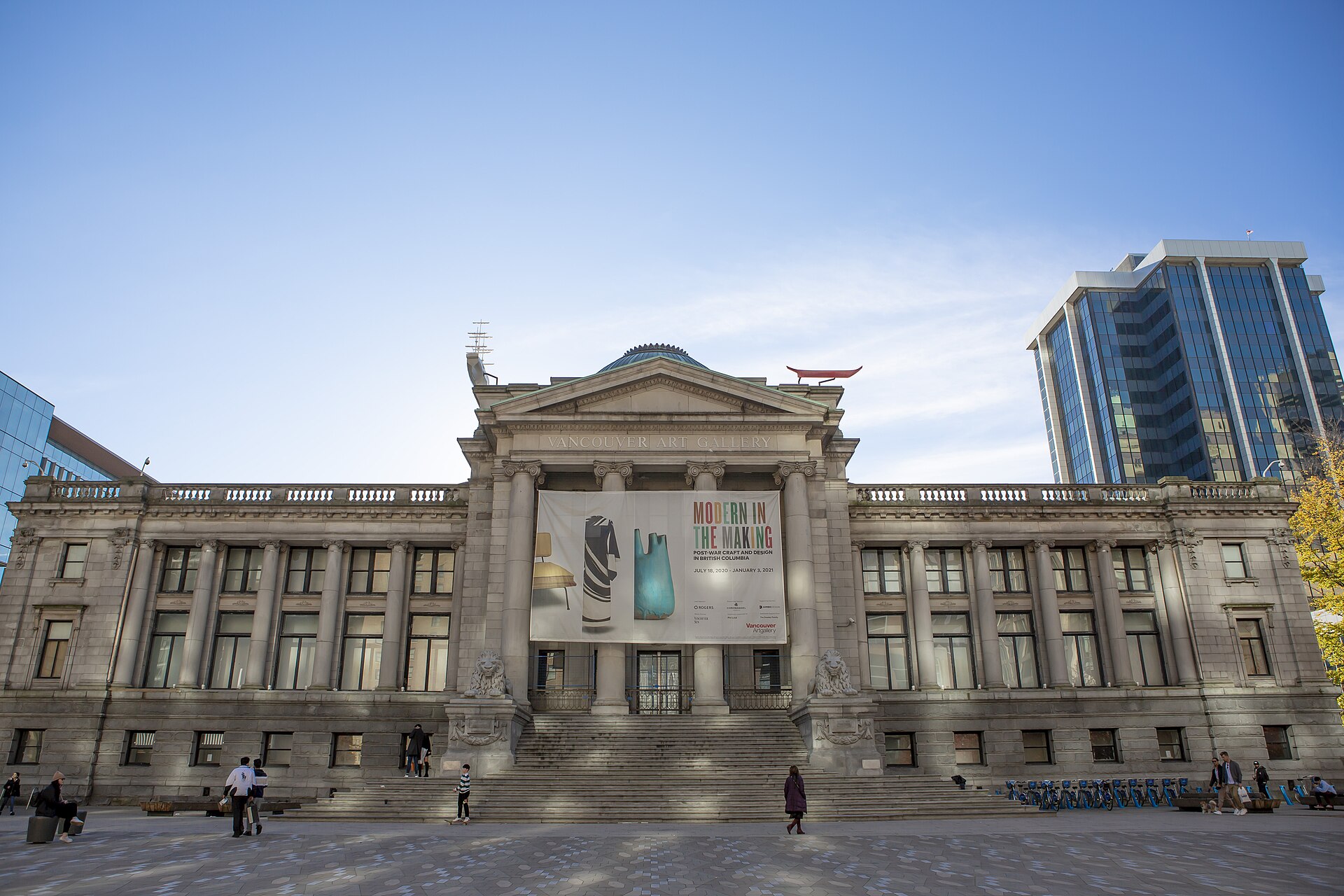
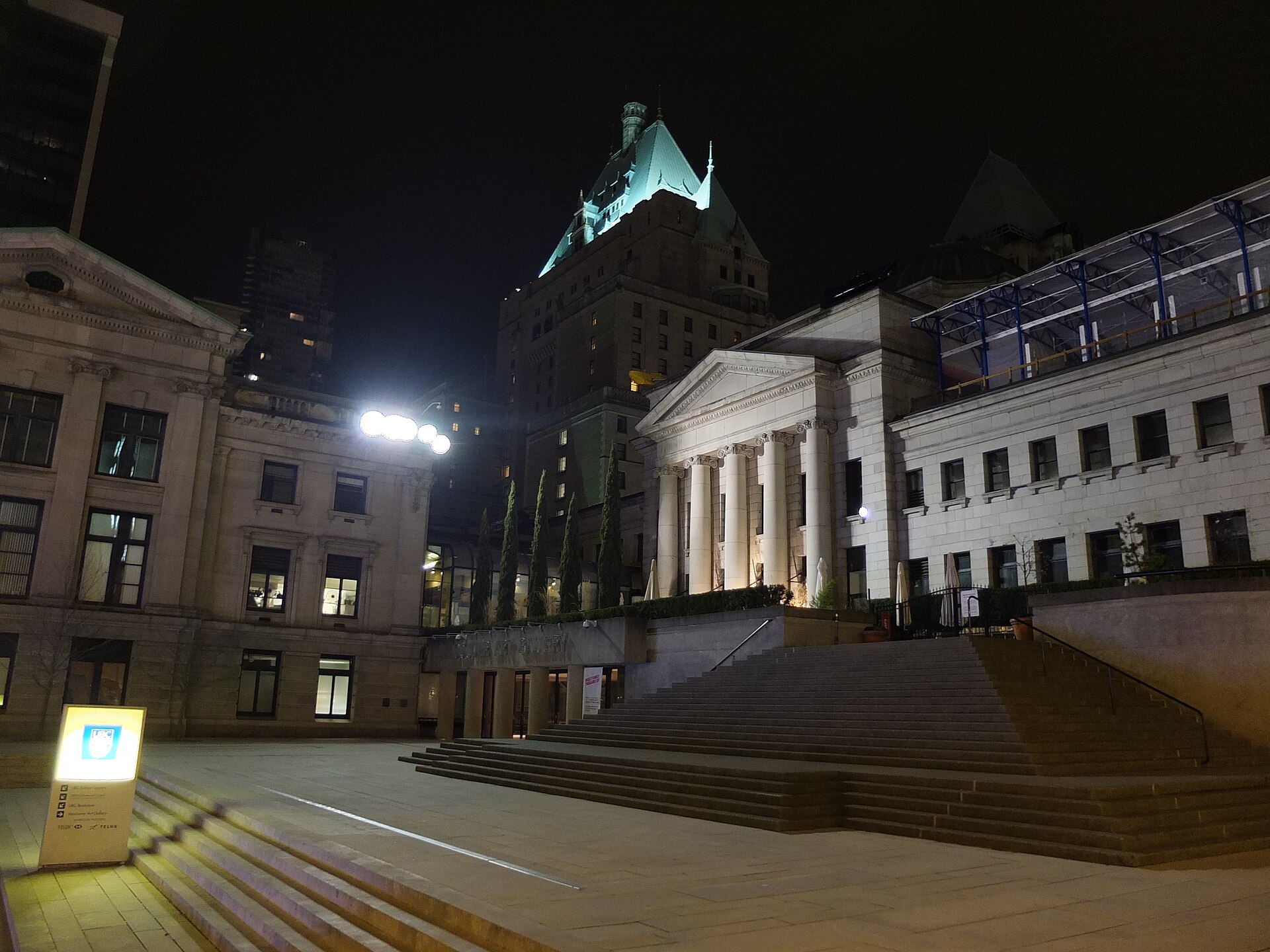
The former provincial courthouse on Robson Square that has housed the Vancouver Art Gallery since 1983, its Ionic colonnade and lettered frieze clearly identifying the building, photographed in 2020
GoToVan · CC BY 2.0Vancouver Art Gallery
Museum · Founded 1931
Open, admission and hours confirmed 15 September 2026 · 12 sources
On this page 16 sections
ContentsClose
The gallery's real strength is depth in a small number of areas rather than breadth across many: nowhere else holds as much Emily Carr, nowhere else assembles the Vancouver School photoconceptualists as a coherent group with the international peers they are now shown against, and its Northwest Coast Indigenous holdings are substantial enough to be shown as an ongoing collection rather than a single period room. It is a regional museum in the honest sense of that phrase, built mostly around art made in or closely tied to British Columbia, with the Asian art and international conceptual holdings as later, more deliberately added extensions of that core rather than an attempt to be encyclopedic.
| Kind | Museum |
|---|---|
| Founded | 1931 |
| City and country |  Vancouver, Canada Vancouver, Canada |
| Address | 750 Hornby Street, Vancouver, BC V6Z 2H7, Canada |
| Website | vanartgallery.bc.ca |
| Status | Open, confirmed |
| Record last verified |
Visiting
- Hours
- Monday10:00 to 17:00
- TuesdayClosed
- Wednesday-Thursday10:00 to 17:00
- Friday10:00 to 20:00Extended evening hours; Free First Friday Nights run 4pm-8pm on the first Friday of the month
- Saturday-Sunday10:00 to 17:00
- Closed
- Tuesday.
- Admission
- Gallery MembersFreeFree
- General admission, BC residentCAD 29Requires proof of BC residency at the desk
- General admission, non-BC residentCAD 35No senior concession; standard adult rate for all visitors from outside British Columbia
- Youth (13-18)FreeFree
- Child (12 and under)FreeFree
- CaregiverFreeFree entry for an attendant accompanying a visitor with disabilities
- Indigenous PeoplesFreeFree for anyone who self-identifies at the admissions desk
- Annual Access PassCAD 58Twelve months of unlimited general admission
- Group admission (10 or more)CAD 25Group rate, $4 off regular adult admission; 3 days advance booking required for groups of 10-30
Free entry: Free First Friday Nights, presented by BMO: free general admission on the first Friday of every month, 4pm to 8pm- Tickets
- tickets.vanartgallery.bc.ca The museum's own ticket page.
- Do I need to book?
- No, but online advance booking is recommended to guarantee a same-day entry time; groups of 10 or more need at least three days' notice
- Address
- 750 Hornby Street, Vancouver, BC V6Z 2H7, Canada MapSkyTrain Canada Line: Vancouver City Centre and Granville stations are both a two to four minute walk; Burrard station on the Expo Line is about four minutes away
Parking Underground parkades at Robson Square (Howe and Nelson) and at Howe and Georgia; the gallery has no dedicated visitor lot of its own - Website
- vanartgallery.bc.ca
- Telephone
- +1 604-662-4700
- [email protected]
Before you go how long, access, photography, bags, eating, shop
- How long to allow
- One and a half to three hours depending on how many of the four public floors have exhibitions installed
- Access
- Street-level wheelchair access at both the Hornby Street and Robson Street entrances; wheelchairs are available first-come first-served or can be reserved ahead by phone; service animals are permitted throughout
- Photography
- Personal, non-flash photography is generally permitted in the permanent galleries; specific loan exhibitions can carry their own no-photography restriction, posted at the gallery entrance
- Bags
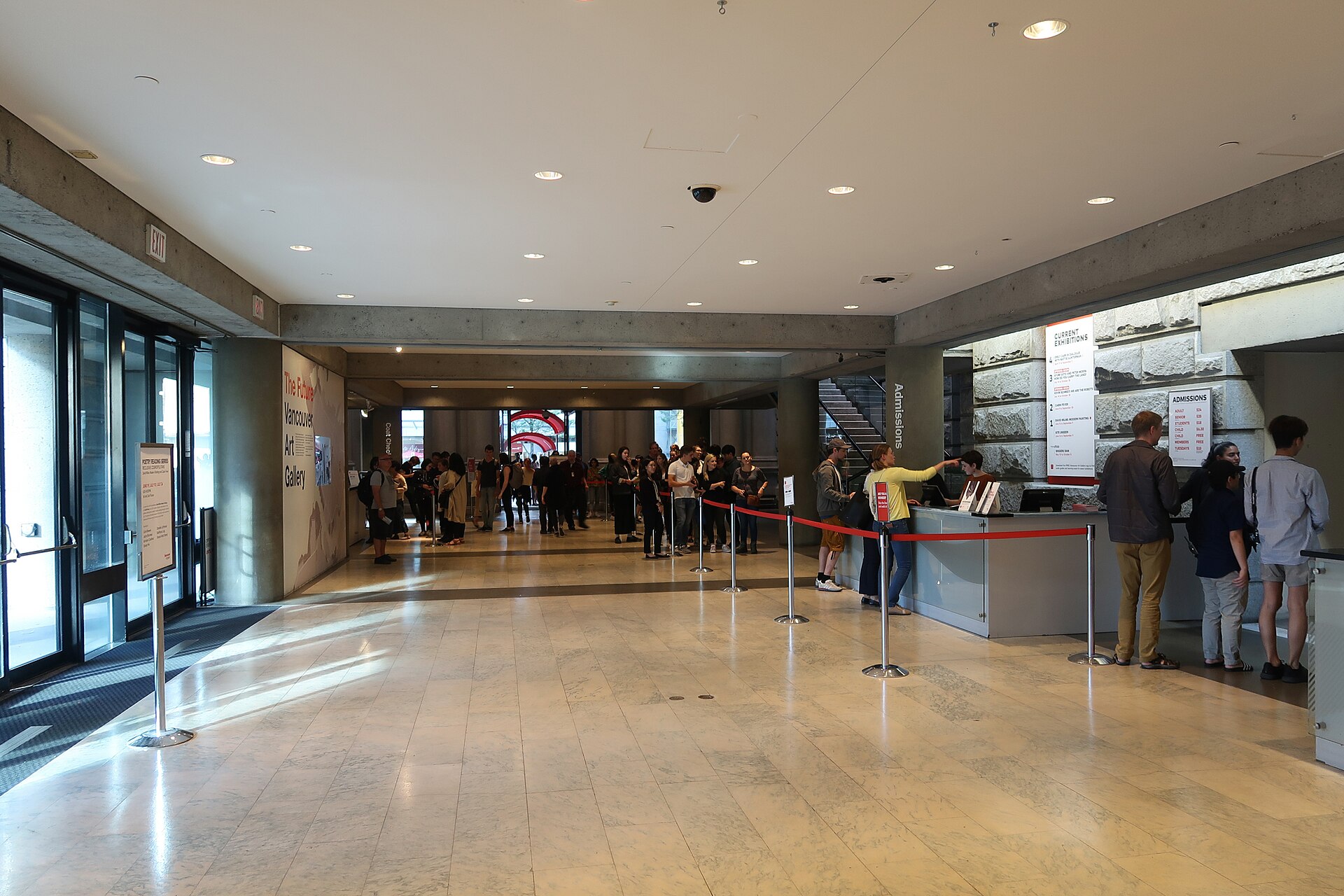
- Free lockers near the lobby replace a staffed coat check; backpacks and other large bags are not permitted in the galleries and must be locked up on arrival
- Eating
- 1931 Gallery Bistro, a rooftop-facing restaurant operated inside the building, open for lunch and seasonal patio service
- Shop
- The Gallery Store sells books, prints and design objects tied to current exhibitions; the Gallery also runs an Art Rental and Sales Showroom where visitors can rent or buy original work
Prices and hours change. We take them from the institution's own pages and print the day we read them, and you can check the current position at the source we used. Confirm before you travel.
What is inside
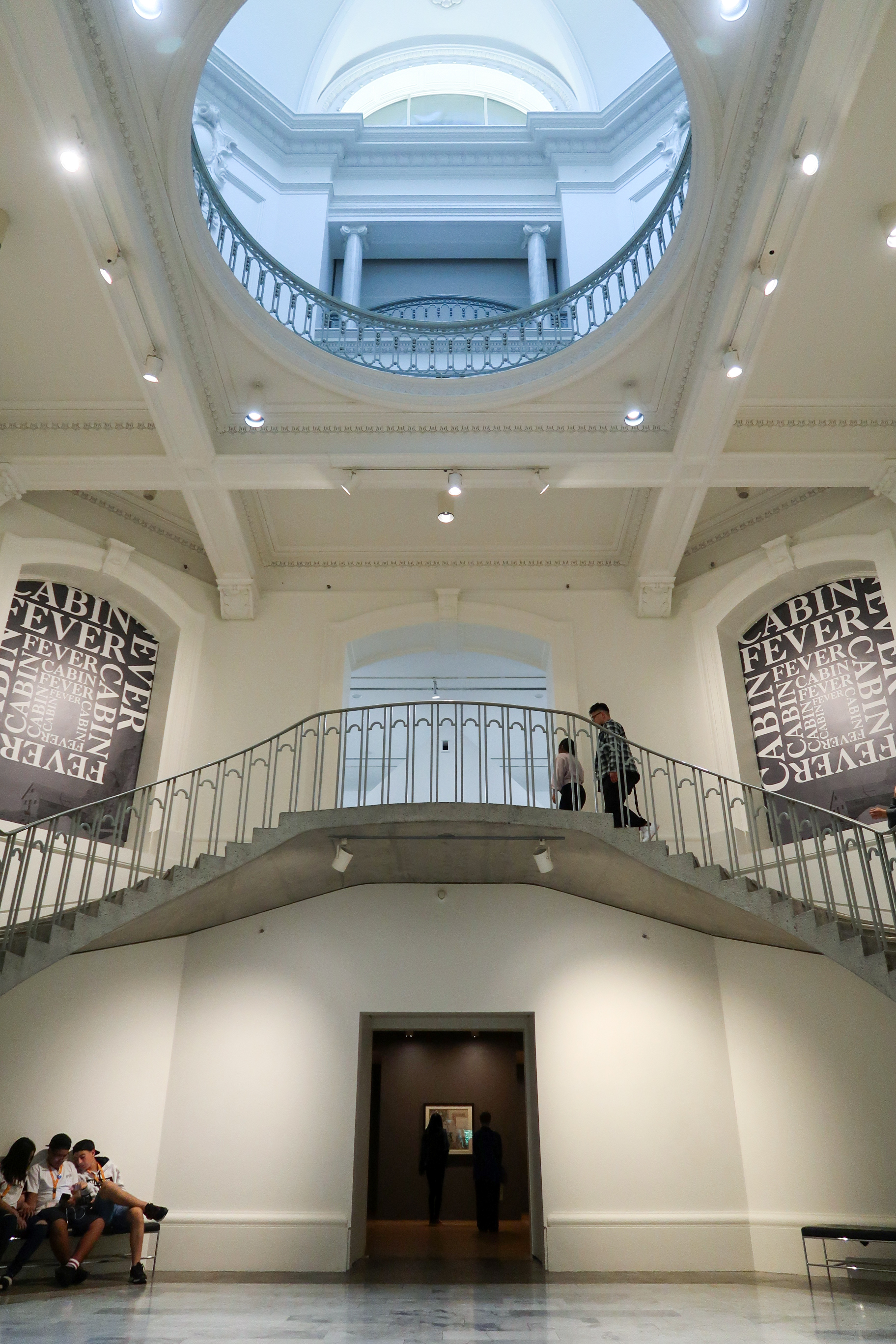
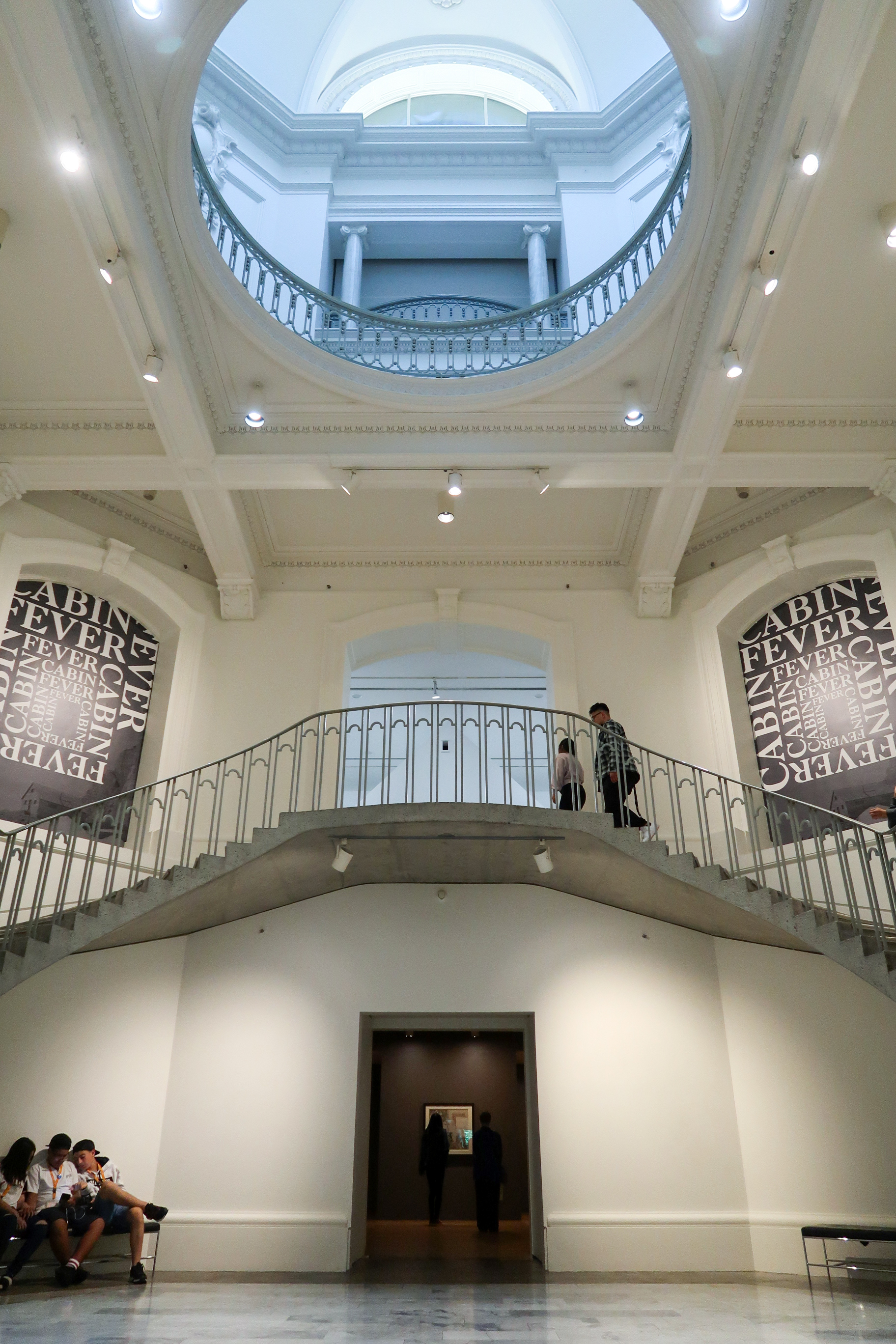
Photograph by Wpcpey · CC BY-SA 4.0 The Rotunda
The domed entrance hall at the building's historic core, with twin curved marble staircases rising around an open oval void beneath Francis Rattenbury's 1911 skylight dome; used on its own as a site for large hung works and installations rather than as a corridor
Vancouver and BC Art
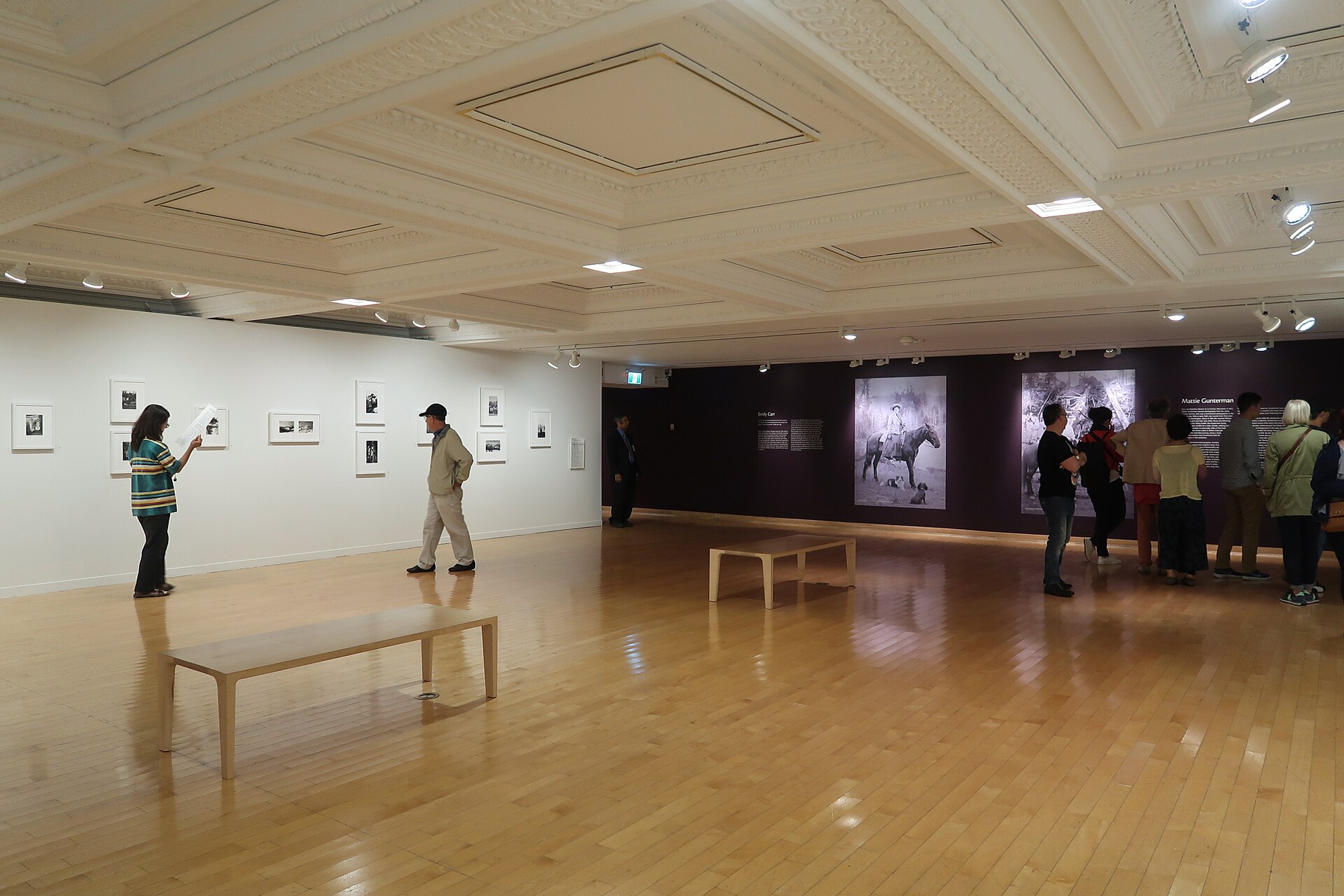
A century of art made in and around the province, from nineteenth-century mountain and coastal landscape painting through to recent photo-based work; this is where the gallery's Emily Carr holdings sit alongside Lawren Harris and other Group of Seven painters who helped bring Carr's work into the collection
Indigenous Art
Historic and contemporary work by Northwest Coast and other First Nations, including nineteenth-century Haida, Kwakwaka'wakw, Nuu-chah-nulth, Nuxalk and Tlingit carving, masks and regalia, shown alongside contemporary artists such as Brian Jungen, Rebecca Belmore and Lawrence Paul Yuxweluptun who work directly with and against that historic material
Photoconceptualism
One of the strongest photo-based collections in North America, built around the so-called Vancouver School: Jeff Wall, Rodney Graham, Ian Wallace, Stan Douglas, Dana Claxton and Marian Penner Bancroft, shown together with international figures including Cindy Sherman, Thomas Ruff and Andreas Gursky
Contemporary Asian Art
Work built up through the gallery's Institute of Asian Art, established in 2014, spanning contemporary Chinese, Japanese and South Asian artists including Eikoh Hosoe, Mariko Mori, Fiona Tan and Jin-me Yoon, tied to the gallery's Centre for Global Asias research program
International Conceptual Art archive
Archival and object holdings of international conceptual practice from the 1960s onward, including material connected to Dan Graham and Robert Smithson and the gallery's Lawrence Weiner archive, a research-oriented counterpart to the more visitor-facing floors
What to see first
The Emily Carr collection
Emily CarrThe gallery holds the largest group of Carr's paintings and works on paper anywhere, built from her own 1945 bequest of 157 works and grown since; only the National Gallery of Canada rivals it in depth6
Totem Poles, Kitseukla
Emily CarrPart of the founding 1931 gift that established the Carr holdings, and among the first works the gallery ever owned, so it marks the start of the collection as much as it documents its subject6
The Rotunda dome and twin staircases
Francis Rattenbury, restored by Arthur Erickson ArchitectsThe single most photographed space in the building, a survival of the 1911 provincial courthouse deliberately kept open and undivided through the 1983 conversion instead of being partitioned into more gallery floor space6
The Photoconceptualism galleries
Jeff Wall, Rodney Graham, Ian Wallace, Stan Douglas and othersAssembles the artists who made Vancouver's own postwar photography and film-based practice internationally influential, alongside the international names their work is now shown against4
Northwest Coast Indigenous carving and regalia
Haida, Kwakwaka'wakw, Nuxalk and other Northwest Coast makersIncludes totem poles, masks and carved pieces from a 2015 bequest of 37 works by American collector George Gund III, shown as living practice rather than as an ethnographic sideline to the painting galleries6
The entrance lions
Carved from Nelson Island granite, installed 1910A pair of stone lions has flanked the Hornby Street steps since the building opened as a courthouse; one was damaged by a 1942 dynamite blast and the repaired join is still visible up close6
The new collection floor
Vancouver Art Gallery curatorial departmentOpened in March 2026, this is the gallery's first dedicated, long-term collection floor in more than two decades, giving the permanent holdings a fixed home rather than rotating them through whatever space a touring show leaves free5
Exhibitions on now
- On now6 Feb to 8 Nov 2026Confirmed · check before you travel
- On now14 May 2026 to 10 Jan 2027Confirmed , 7 weeks ago
- Opening soon11 Dec 2026 to 2 May 2027Confirmed , 7 weeks ago
Past exhibitions here
- Closed22 Oct 2025 to 12 Oct 2026Confirmed · check before you travel
- Closed28 Mar to 27 Sep 2026Confirmed · check before you travel
- Closed24 May to 5 Jul 2025Confirmed · check before you travel
- Closed31 May to 1 Sep 2014Confirmed · check before you travel
A courthouse before it was a gallery
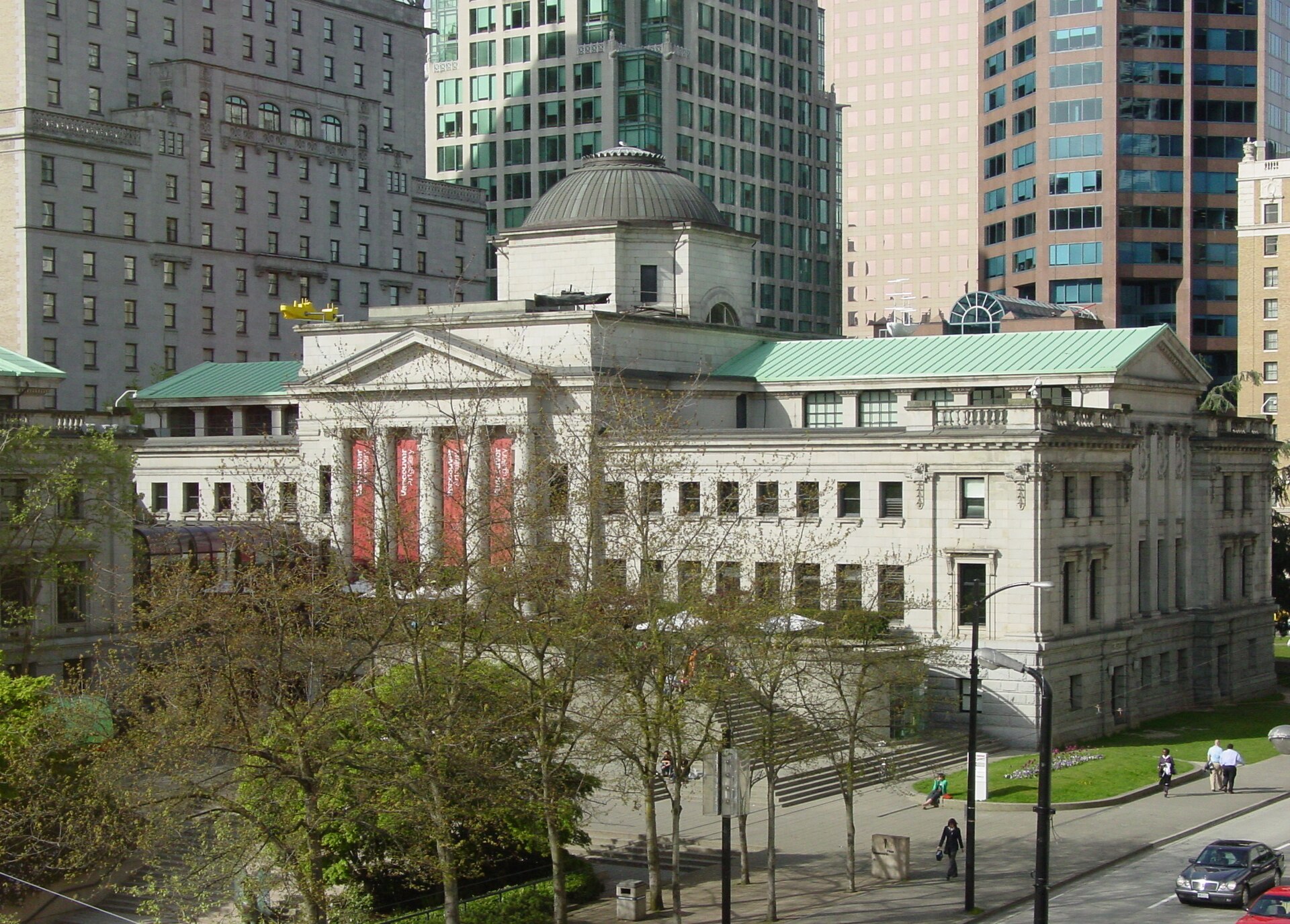
The building at 750 Hornby Street was not built to hold art. Francis Rattenbury, the English-born architect who had already designed British Columbia's legislature and the Empress Hotel in Victoria, won a 1905 competition to design a new provincial courthouse for Vancouver, and construction ran from 1906 until the building opened in 1911. It is a full neoclassical set piece: Ionic columns, a central dome, formal porticos, and marble brought in from as far as Alaska, Tennessee and Vermont. A pair of granite lions, carved from stone quarried on Nelson Island, has flanked the entrance steps since 1910; one lion's rear section was damaged by a dynamite blast in November 1942 and repaired by stonecutters John Whitworth and Herbert Ede, and the join where the new stone meets the old is still visible to anyone who looks closely.
The courthouse was declared a National Historic Site of Canada in 1980, three years before it stopped being a courthouse at all. When the province built a new law courts complex nearby, the old building became available, and the Vancouver Art Gallery, outgrowing its previous home a few blocks away, moved in. Arthur Erickson, the architect responsible for the wider Robson Square redevelopment the gallery now sits within, led a 20 million dollar conversion completed in October 1983, which produced roughly 41,400 square feet of exhibition space while deliberately keeping the domed rotunda and its twin marble staircases open rather than dividing them into more gallery floor.
From a rented room to the Carr bequest
The Vancouver Art Gallery Association was formed in April 1931 and opened its first gallery that October, in a modest Art Deco building on West Georgia Street designed by the local firm Sharp and Thompson and built for about 40,000 dollars. It held four rooms, a sculpture hall and a lecture space, respectable for a young city but not built to last as a public collection grew.
The building that changed the gallery's trajectory was not this one but its 1951 expansion, undertaken specifically to house the estate of Emily Carr, who had died in 1945 and left 157 paintings and works on paper to the province of British Columbia. Lawren Harris, a member of the Group of Seven who had corresponded with Carr for years and encouraged her painting directly, led the fundraising for the enlargement himself, and architect Ross Lort remodelled the building in the International Style to take the bequest. That original Carr gift is still the core of a collection that has since grown to more than 250 of her works, making the gallery, together with the National Gallery of Canada, home to the largest holdings of her painting anywhere. The move to the former courthouse in 1983 gave that collection, and everything acquired since, the room it had outgrown twice already.
What the collection actually holds
The roughly 12,000-object collection is formally owned by the City of Vancouver, and about half of it is work by artists from Western Canada, which is a deliberate mandate rather than an accident of donation. Alongside the Carr and Group of Seven material, the gallery has built out in several directions that a first-time visitor may not expect from a regional museum: a strong Indigenous Northwest Coast holding built through gifts including a 2015 bequest of 37 pieces from American collector George Gund III; one of the most significant international photo-based art collections in North America, anchored by the Vancouver-based artists loosely grouped as the Vancouver School; a Contemporary Asian Art program running through the gallery's Institute of Asian Art since 2014; and an archive-heavy conceptual art holding that includes material connected to Dan Graham, Robert Smithson and a dedicated Lawrence Weiner archive.
That range is one reason the gallery opened its first dedicated, long-term collection floor in more than two decades in March 2026, giving the permanent holdings a fixed space of their own rather than rotating them into whatever galleries a touring exhibition has not claimed that season, which had been the more usual arrangement for years.
The gallery that was not built
For two decades the Vancouver Art Gallery has also been the story of a building it does not have. Planning for a larger, purpose-built home began in 2004, with the proposed site moving from Larwill Park to the Plaza of Nations and back to Larwill Park again by 2013. The Swiss firm Herzog and de Meuron was announced as architect in 2014, and by 2023 the gallery had raised more than 340 million dollars of a planned 400 million dollar budget, including a 100 million dollar gift from the Audain Foundation. Ground was broken in September 2023 and site work began in spring 2024, but construction paused within months once it became clear the design could not be built inside its budget: costs had risen toward 600 million dollars, and in December 2024 the gallery scrapped the Herzog and de Meuron design outright and parted ways with the firm.
The fenced Larwill Park site sat idle through the summer of 2025 before being converted, in October 2025, into a temporary pay parking lot pending a restart, an outcome the city and gallery both describe as strictly interim. A new architectural team, the Vancouver firm Formline Architecture and Urbanism working with Toronto's KPMB Architects, was named in September 2025 to design a smaller, ground-hugging building rooted more explicitly in Indigenous design principles than the original scheme, with a new conceptual design expected sometime in 2026 and no firm construction timeline yet announced. None of this affects the courthouse building on Hornby Street, which remains the gallery's only home for the foreseeable future and is not itself under any redevelopment threat.
A public reckoning over authenticity
The gallery's public record is not free of an episode it would rather have handled differently. In 2015 it acquired ten oil sketches attributed to J.E.H. MacDonald, a founding member of the Group of Seven, as a gift. Questions about their authenticity followed quickly from outside experts, and the gallery commissioned scientific testing from the Canadian Conservation Institute, but for years declined to make the results public. Journalists, including the Globe and Mail's Marsha Lederman and, in a pointed 2018 opinion column, Gary Mason, pressed the gallery on the silence directly, arguing that a public institution asking donors to fund an ambitious new building had an obligation to be forthcoming about a live authenticity question in its own collection rather than let it sit unresolved. The gallery eventually confirmed the sketches were forgeries, and rather than quietly deaccessioning them, it built the discovery into a 2023-24 exhibition, J.E.H. MacDonald? A Tangled Garden, that examined the episode in public. It is the kind of reversal this publication treats as worth recording exactly because it happened in the open, after criticism, rather than because the institution volunteered it first.
Visiting the gallery today
Whatever comes of the Larwill Park project, the working gallery a visitor reaches today is the 1911 courthouse on Hornby Street, two minutes from Vancouver City Centre and Granville SkyTrain stations, open all seven days of the week and until 8pm on Fridays. A typical visit runs from ninety minutes to three hours depending on how many of the four public floors have exhibitions installed at the time, since one or more can be closed for reinstallation between shows without the admission price changing. The rotunda, the Carr rooms and the new dedicated collection floor are the parts of the visit least likely to be affected by that turnover, because they are closer to being permanent fixtures of the building than any single loan exhibition is.
What visitors say
Visitors consistently praise the building itself, the Emily Carr rooms and the on-site restaurant, and just as consistently complain about value for money: at 3.4 out of 5 on Tripadvisor and 4.3 on Google, the gallery sits well below other major Vancouver attractions on both platforms. The recurring frustration in reviews read for this page is scale and price together rather than either alone: general admission for a visitor from outside British Columbia is 35 Canadian dollars with no senior concession, and multiple reviewers describe arriving to find one of the gallery's public floors closed for reinstallation between shows, or a heavily promoted exhibition not yet open, while still being charged the full rate. A second, narrower complaint concerns hanging: one visitor who came specifically to see the Carr paintings found them crowded three-high on a single wall rather than spread at eye level across the room.
What is praised, what is criticised
- Praised: The building itself: the former courthouse, its Rattenbury facade and Erickson-era rotunda, cited by visitors as worth the visit independent of what is on the walls
- Praised: The Emily Carr paintings, named by reviewers as the reason they came even when they did not personally respond to her style
- Praised: The 1931 Gallery Bistro, singled out even by visitors otherwise disappointed with the exhibitions as the best part of their visit
- Praised: Individual touring and temporary exhibitions, described by more than one visitor as well curated even where they wished for more of the permanent collection alongside them
- Criticised: General admission price for non-BC residents (35 CAD, no senior rate) measured against the amount of gallery space open on the day, especially when a floor is closed for reinstallation between exhibitions but the full admission price still applies
- Criticised: The gallery's multi-year silence, criticised in the press at the time, over what conservation testing had found about the authenticity of a set of J.E.H. MacDonald oil sketches it had acquired, before the matter was finally resolved as forgery and made the subject of its own 2023-24 exhibition
- Criticised: Uneven hanging density in places, with at least one detailed visitor account of Carr canvases stacked two and three high on a single wall rather than spaced at eye level
Ratings on other platforms
Google: 4.3 from 9,257 ratings, read 13 August 2026
Tripadvisor: 3.4 from 1,362 ratings, read 13 August 2026
A platform average is a tertiary source: it moves, it is not audited, and we quote no visitor's words.
Questions about Vancouver Art Gallery
Where is Vancouver Art Gallery?
750 Hornby Street, Vancouver, BC V6Z 2H7, Canada.
How much does it cost to visit?
Gallery Members: free; General admission, BC resident: CAD 29; General admission, non-BC resident: CAD 35; Youth (13-18): free; Child (12 and under): free. As confirmed 15 September 2026.
When is it open?
Monday 10:00-17:00; Tuesday closed; Wednesday-Thursday 10:00-17:00; Friday 10:00-20:00; Saturday-Sunday 10:00-17:00. Closed: Tuesday. As confirmed 15 September 2026.
How do you get there?
SkyTrain: Canada Line: Vancouver City Centre and Granville stations are both a two to four minute walk; Burrard station on the Expo Line is about four minutes away; Parking: Underground parkades at Robson Square (Howe and Nelson) and at Howe and Georgia; the gallery has no dedicated visitor lot of its own.
What should you see first?
The Emily Carr collection (Emily Carr); Totem Poles, Kitseukla (Emily Carr); The Rotunda dome and twin staircases (Francis Rattenbury, restored by Arthur Erickson Architects); The Photoconceptualism galleries (Jeff Wall, Rodney Graham, Ian Wallace, Stan Douglas and others); Northwest Coast Indigenous carving and regalia (Haida, Kwakwaka'wakw, Nuxalk and other Northwest Coast makers); The entrance lions (Carved from Nelson Island granite, installed 1910).
What we could not confirm
- Whether the gallery's long-planned larger building at Larwill Park will proceed on any fixed timeline: as of late 2025 a new architectural team had been named but no construction date, and the site was being used as a temporary parking lot
- Whether the results of the Canadian Conservation Institute's testing on the J.E.H. MacDonald sketches, and the gallery's own account of how they entered the collection, have been published in full rather than summarized secondhand through press coverage
Images
Sources
- 1Vancouver Art Gallery, "Visit" (hours, admission, contact, facilities), accessed 2026-08-13 vanartgallery.bc.ca/visit/
- 2Vancouver Art Gallery, "Self-Guided Visits" (transit and parking), accessed 2026-08-13 vanartgallery.bc.ca/self-guided-visits/
- 3Vancouver Art Gallery, "History", accessed 2026-08-13 vanartgallery.bc.ca/history/
- 4Vancouver Art Gallery, "The Collection", accessed 2026-08-13 vanartgallery.bc.ca/the-collection/
- 5My VanCity, "A New Chapter for the Collection: Vancouver Art Gallery Opens First Dedicated Collection Floor in More Than Two Decades", 29 March 2026 myvancity.ca/2026/03/29/a-new-chapter-for-the-collection-vancouver-art-gallery-opens-first-dedicated-collection-floor-in-more-than-two-decades/
- 6Wikipedia, "Vancouver Art Gallery", accessed 2026-08-13 (; building history, architects, collection figures) en.wikipedia.org/wiki/Vancouver_Art_Gallery
- 7Wikidata, "Vancouver Art Gallery" (Q371960), accessed 2026-08-13 (; identity and coordinates) wikidata.org/wiki/Q371960
- 8Kate Taylor, "At the Vancouver Art Gallery's climate show, a tough assignment: no preaching allowed", The Globe and Mail, 29 May 2026 theglobeandmail.com/culture/art-and-architecture/article-vancouver-art-gallery-future-geographies-review/
- 9Gary Mason, "Vancouver Art Gallery needs to come clean about authenticity of Group of Seven art", The Globe and Mail, 19 January 2018 theglobeandmail.com/opinion/vancouver-art-gallery-needs-to-come-clean-about-authenticity-of-group-of-seven-art/article37674055/
- 10Kenneth Chan, "Construction site of new Vancouver Art Gallery reverts to parking lot", Daily Hive, 17 October 2025 dailyhive.com/vancouver/vancouver-art-gallery-construction-site-parking-lot
- 11Tripadvisor, "Vancouver Art Gallery" reviews and rating, read 2026-08-13 ( rating; visitor reviews read in full for reception section) tripadvisor.com/Attraction_Review-g154943-d186962-Reviews-Vancouver_Art_Gallery-Vancouver_British_Columbia.html
- 12Google Search knowledge panel for "Vancouver Art Gallery", read 2026-08-13 ( rating) google.com/search?q=Vancouver+Art+Gallery+google+reviews+rating