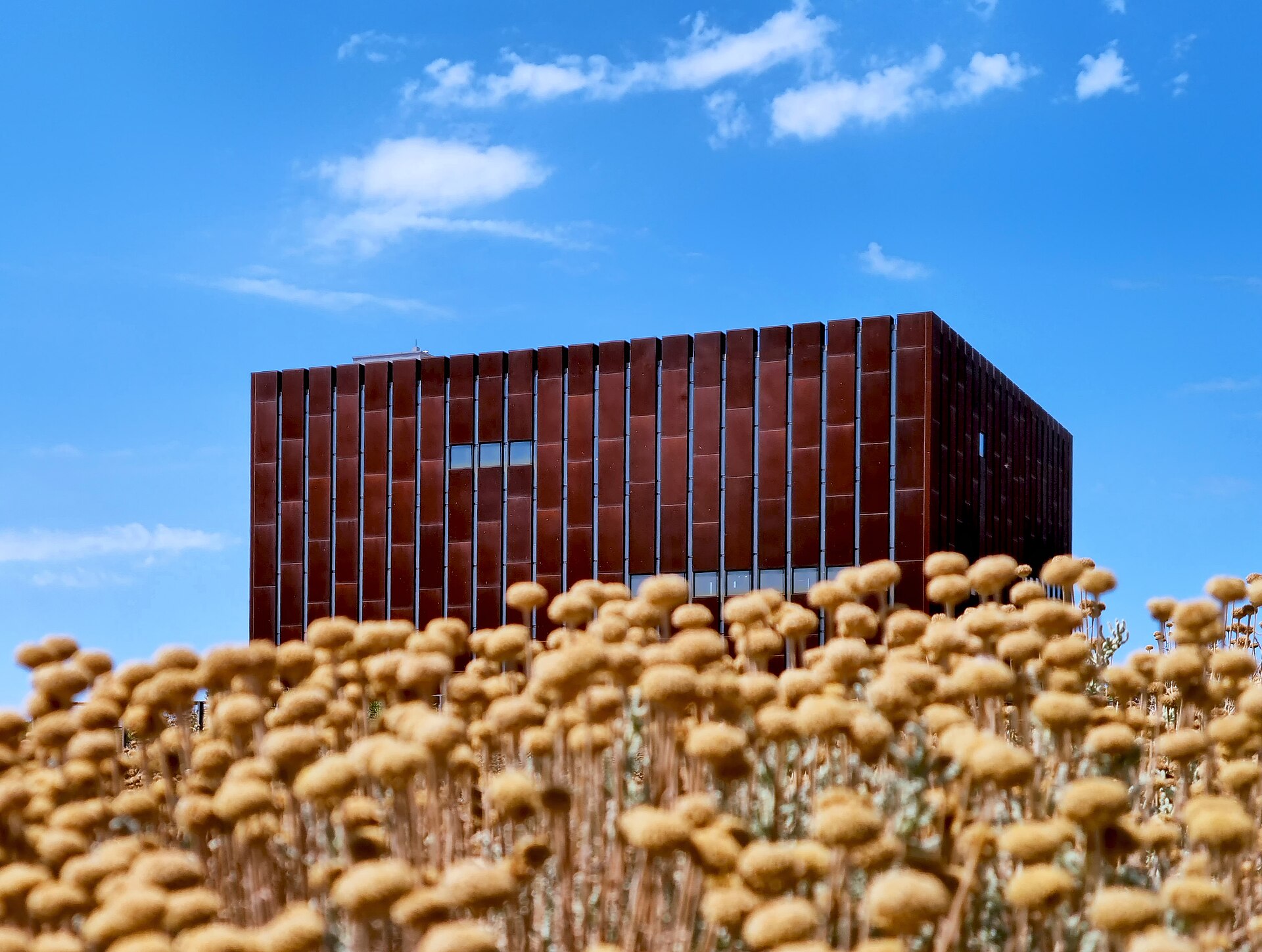
The corten-steel cube of the Museum of Troy rising over a field of dried wildflowers on a clear day. Photograph by Ail Subway, CC BY-SA 4.0.
Ail Subway, CC BY-SA 4.0, via Wikimedia CommonsTroy Museum
Museum · Troya Muzesi · Founded 2018
Open, admission and hours confirmed 27 September 2026 · 15 sources
On this page 14 sections
ContentsClose
The museum's real strength is regional breadth rather than depth in any one Troy excavation season: it draws together the Troad's tumuli, its Hellenistic and Roman cities, and Troy's own nine archaeological layers into a single building, backed by transfers from three older Turkish state collections and one contested American loan. What it does not have is equally deliberate: most of the gold Schliemann took out of the region is in Moscow, not Canakkale, and the museum's Lost Heritage room makes that gap part of the exhibition rather than an omission from it.
| Local name | Troya Muzesi |
|---|---|
| Kind | Museum |
| Founded | 2018 |
| City and country |  Canakkale, Turkey Canakkale, Turkey |
| Address | Tevfikiye Koyu, Truva Alti Sokak No:12, 17100 Canakkale, Turkey |
| Website | muze.gov.tr/muze-detay?SectionId=TRO01&DistId=TRO |
| Status | Open, confirmed |
| Record last verified |
Visiting
- Hours
- Daily, summer season (1 May to 1 October)08:30 to 20:00Ticket office closes at 19:30. Confirmed directly on the museum's own Ministry of Culture and Tourism page.
- Daily, winter season (1 October to 1 May)08:30 to 17:30Ticket office closes at 17:00. This figure is corroborated identically across two independent Ministry-linked museum directories, but was not itself visible on the museum's own page at the date this record was checked, which showed only the currently active summer hours.
- Closed
- Open every day of the year, per the museum's own page..
- Admission
- Combined ticket, Troy Museum and the Troy archaeological site (foreign visitors)EUR 27One ticket covers both the museum and the ancient city; set on the Ministry of Culture and Tourism's own DOSIM price list for state museums and sites, which lists the Canakkale Troya Muzesi and Canakkale Troya Orenyeri together under a single Euro figure for foreign visitors.
- Turkish citizens holding a MuzekartFreeThe DOSIM list marks the museum as valid on Muzekart, the Ministry's annual museum pass; holders enter free. The pass itself, not a per-visit ticket, is the relevant purchase for Turkish residents, and its own price (around 200 TL for the 2026 pass year per secondary reporting) is separate from the museum's own gate price.
- Children, 0-8FreeReported as free on a Turkish museum directory aggregator, not independently verified against the Ministry's own price table, which does not itemise age bands. Treat as likely but unconfirmed at the primary source.
- Tickets
- dosim.ktb.gov.tr/TR-218202/muze-ve-oren-yeri-... The museum's own ticket page.
- Do I need to book?
- No advance timed ticket is described on the museum's own page. Turkish state museums generally sell both at the gate and through the Ministry's own e-bilet system, but this research did not find an e-bilet link specific to Troy Museum to confirm that route applies here.
- Address
- Tevfikiye Koyu, Truva Alti Sokak No:12, 17100 Canakkale, Turkey MapCar The museum stands in Tevfikiye village, about 800 m (2,600 ft) east of the Troy archaeological site itself, roughly 30 km from central Canakkale. The 1915 Canakkale Bridge across the Dardanelles, opened in 2022, cuts the drive from Istanbul to around four to five hours by removing the old car-ferry crossing.
On foot One reviewer noted the museum sits in a separate location from the ancient city rather than at its gate, so the two are visited as two stops rather than one continuous walk; most visitors drive or are driven between them. - Website
- muze.gov.tr/muze-detay?SectionId=TRO01&DistId=TRO
- Telephone
- +90 286 217 6740
- [email protected]
Before you go how long, access, photography, bags, eating, shop
- How long to allow
- Tripadvisor's own listing gives a duration of two to three hours, and several visitors recommend closer to three, wearing comfortable shoes; the museum is arranged over four levels plus a rooftop terrace and rewards a slow walk rather than a quick pass-through.
- Access
- Concrete ramps connect all floors rather than a single lift-only route, repeatedly noted by visitors as a genuine, usable accommodation rather than a token one.
- Photography
- No explicit photography rule is stated on the museum's own page. Amateur photography is visibly widespread in visitor accounts and even the museum's own official Flickr account documents its galleries in detail, which suggests general photography is permitted, though this is an inference rather than a confirmed posted rule.
- Bags
- Not specified in the sources gathered for this record.
- Eating
- A cafe is listed among the museum's visitor amenities by a Turkish museum directory; not independently confirmed on the Ministry's own page.
- Shop
- A museum shop is listed among the same amenities, on the same aggregator basis.
Prices and hours change. We take them from the institution's own pages and print the day we read them, and you can check the current position at the source we used. Confirm before you travel.
What is inside
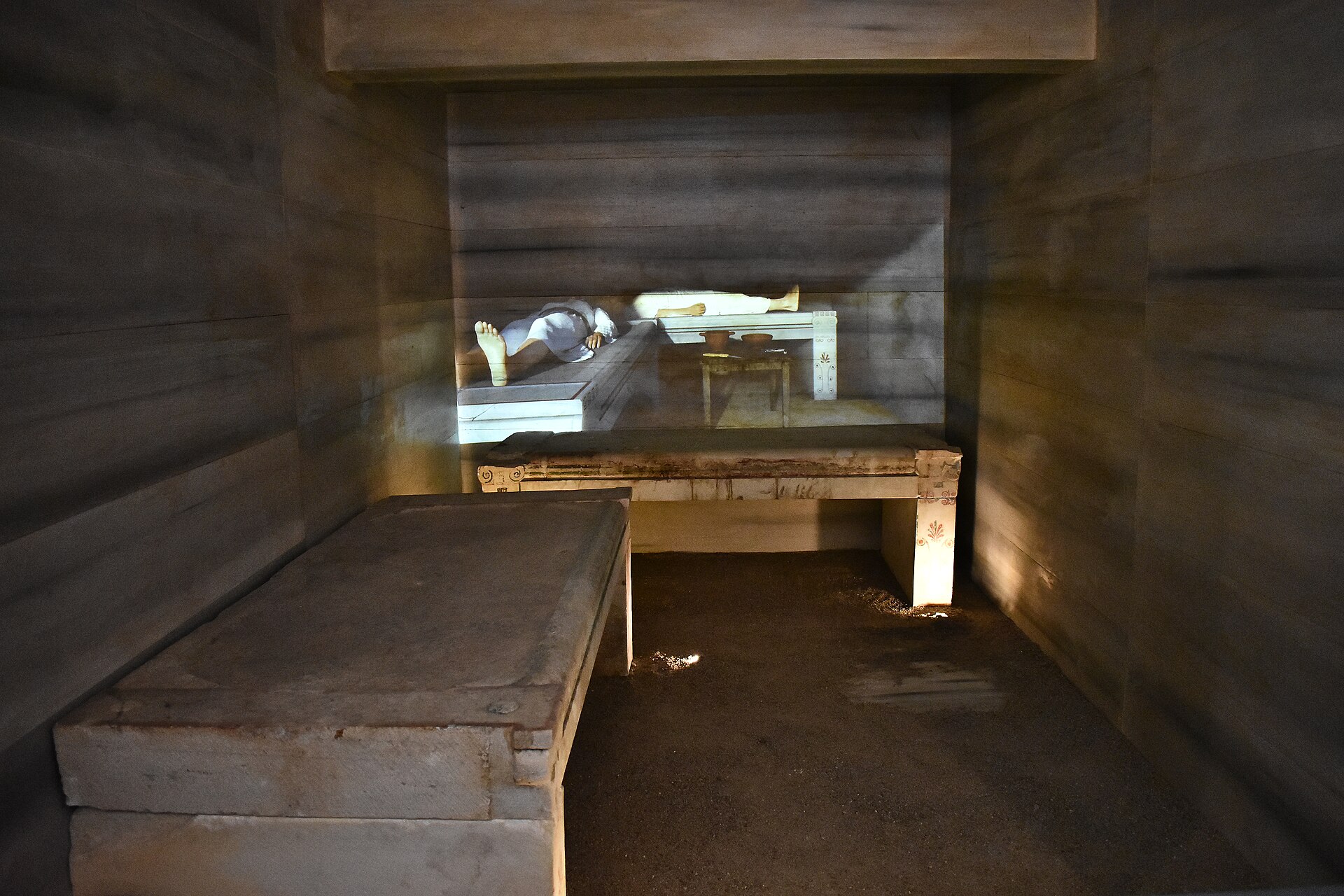
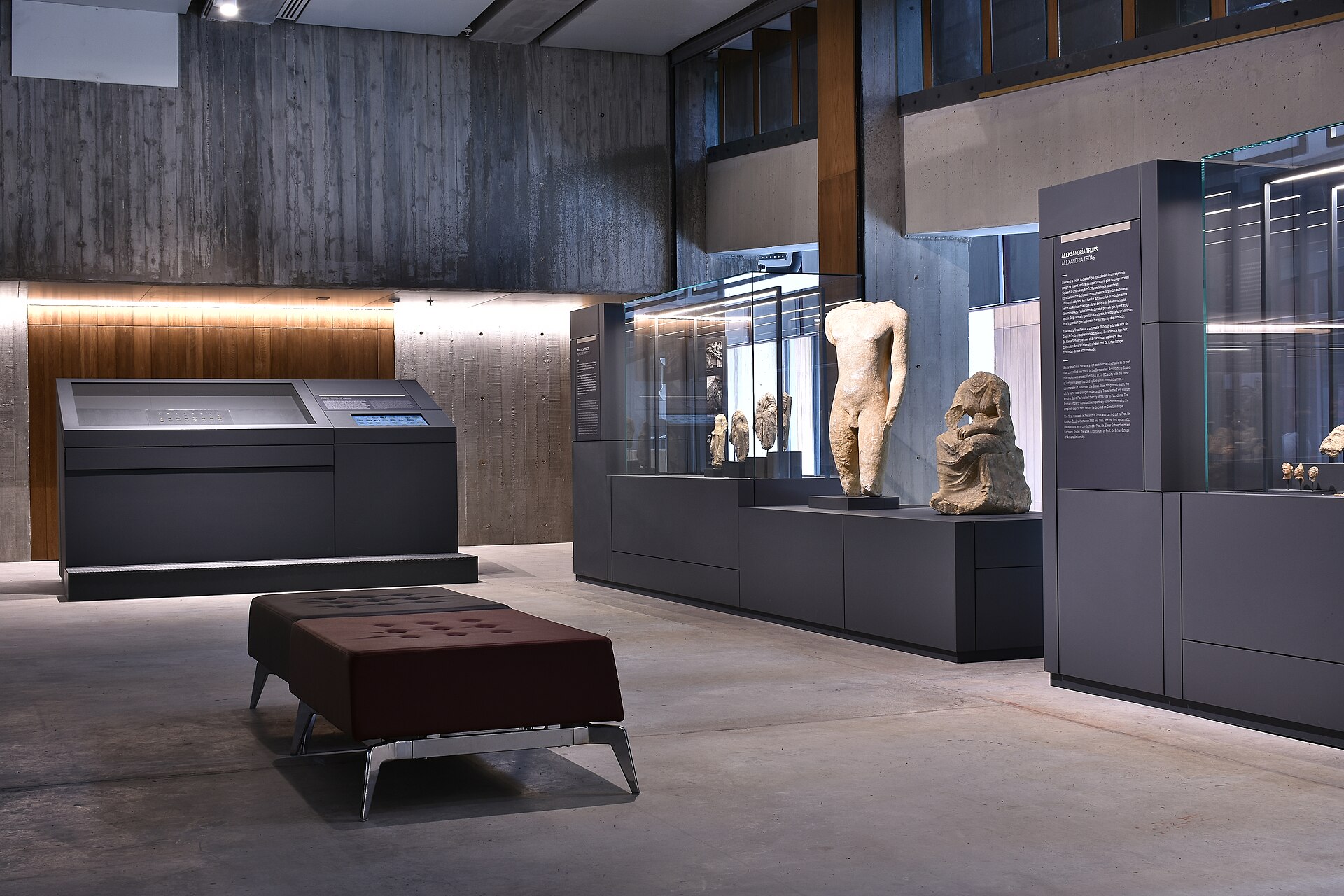
Photograph by Troya Müzesi from Çanakkale, Türkiye · CC BY-SA 2.0 Ground level (Level Z) - Cities of the Troad
The entry level sets Troy inside the wider Troad region rather than treating it as an isolated site: finds from the ancient cities of Assos, Alexandria Troas, Lampsakos, Parium and Thymbra, from the island of Tenedos (Bozcaada) and Imbros, and from the region's Bronze and Iron Age burial mounds. The Dedetepe tumulus is given a reconstructed chamber of its own, its painted marble banqueting couches rebuilt at full scale so a visitor stands inside the burial rather than looking at its contents in a case; the Dardanos tumulus contributes gold diadems and wreaths of the fourth and third centuries BC, terracotta figurines and a marble copy of the Cnidian Aphrodite. Small, everyday objects fill the level's cases too: tear-catcher bottles, glass and terracotta perfume vessels, jewellery, coins, bone tools and inscribed milestones, the material that a site as famous as Troy tends to crowd out of its own story.
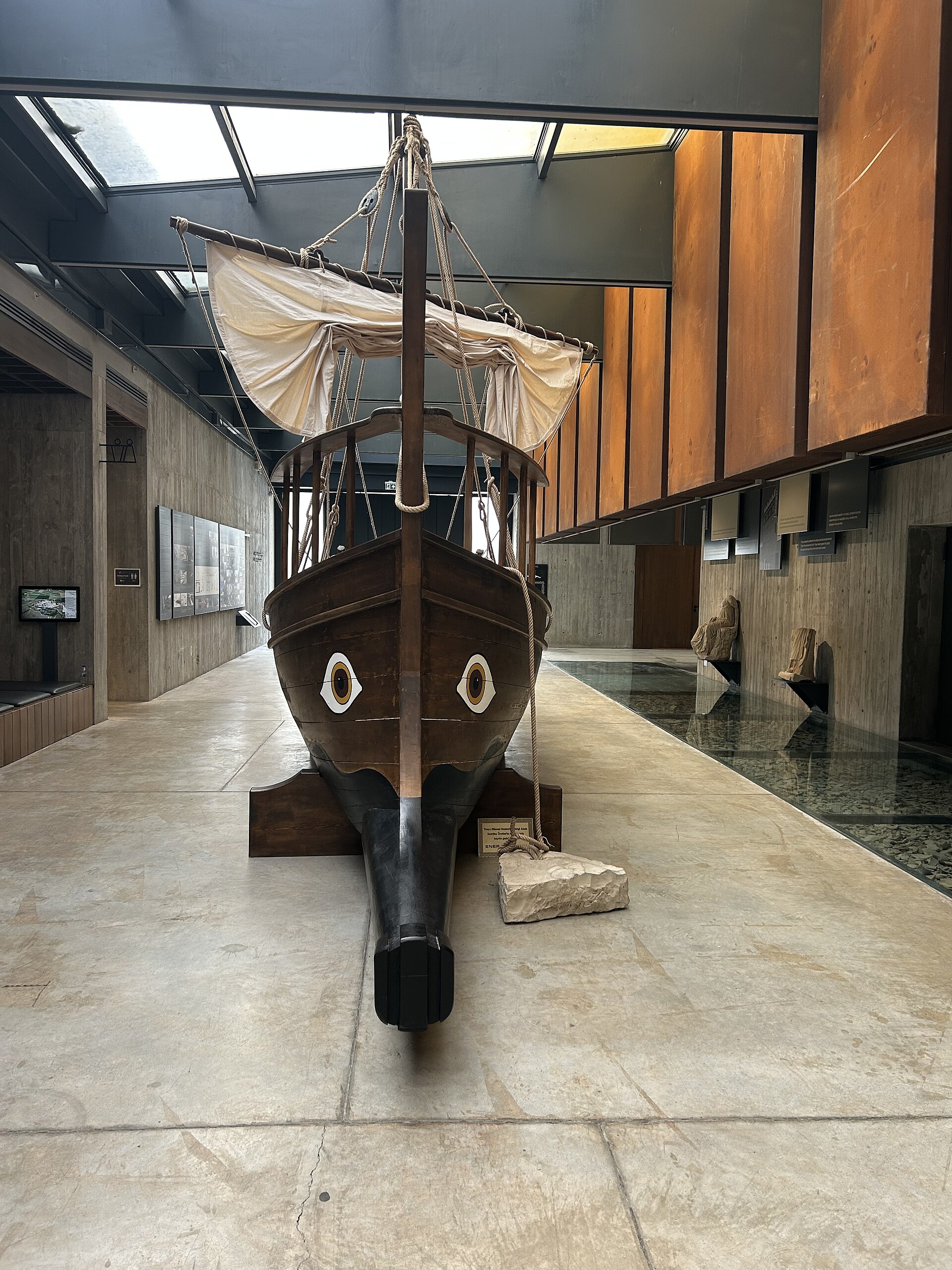
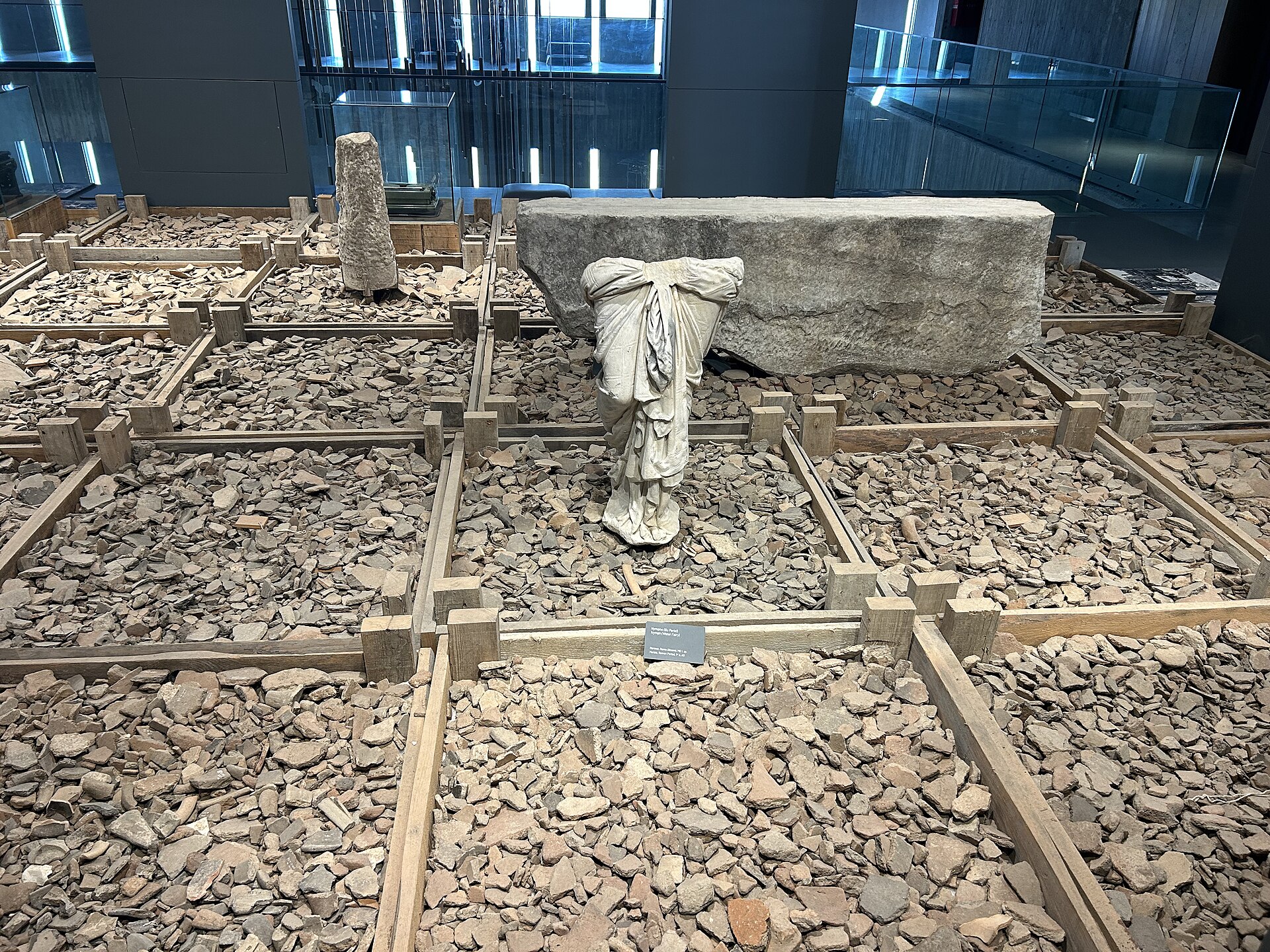
Photograph by Emirhan Sağdır · CC BY-SA 4.0 Level 1 - The Layers of Troy
This floor is organised by Troy's own excavated layers, Troy I through VII, rather than by object type, walking a visitor through daily life at the site across some two thousand years: weaving equipment, domestic pottery, and the region's maritime trade, illustrated with reconstructed vessels and ship models. A fragment described as the oldest known painted vessel fragment from the site anchors the pottery sequence, and a rare Bronze Age hieroglyphic Luwian seal, from a culture positioned between the Mycenaean world and the Hittites of central Anatolia, is one of the level's more specialist highlights. The presentation leans on dioramas and projected figures going about ordinary tasks, aimed as much at making the layers legible to a first-time visitor as at showing individual objects.
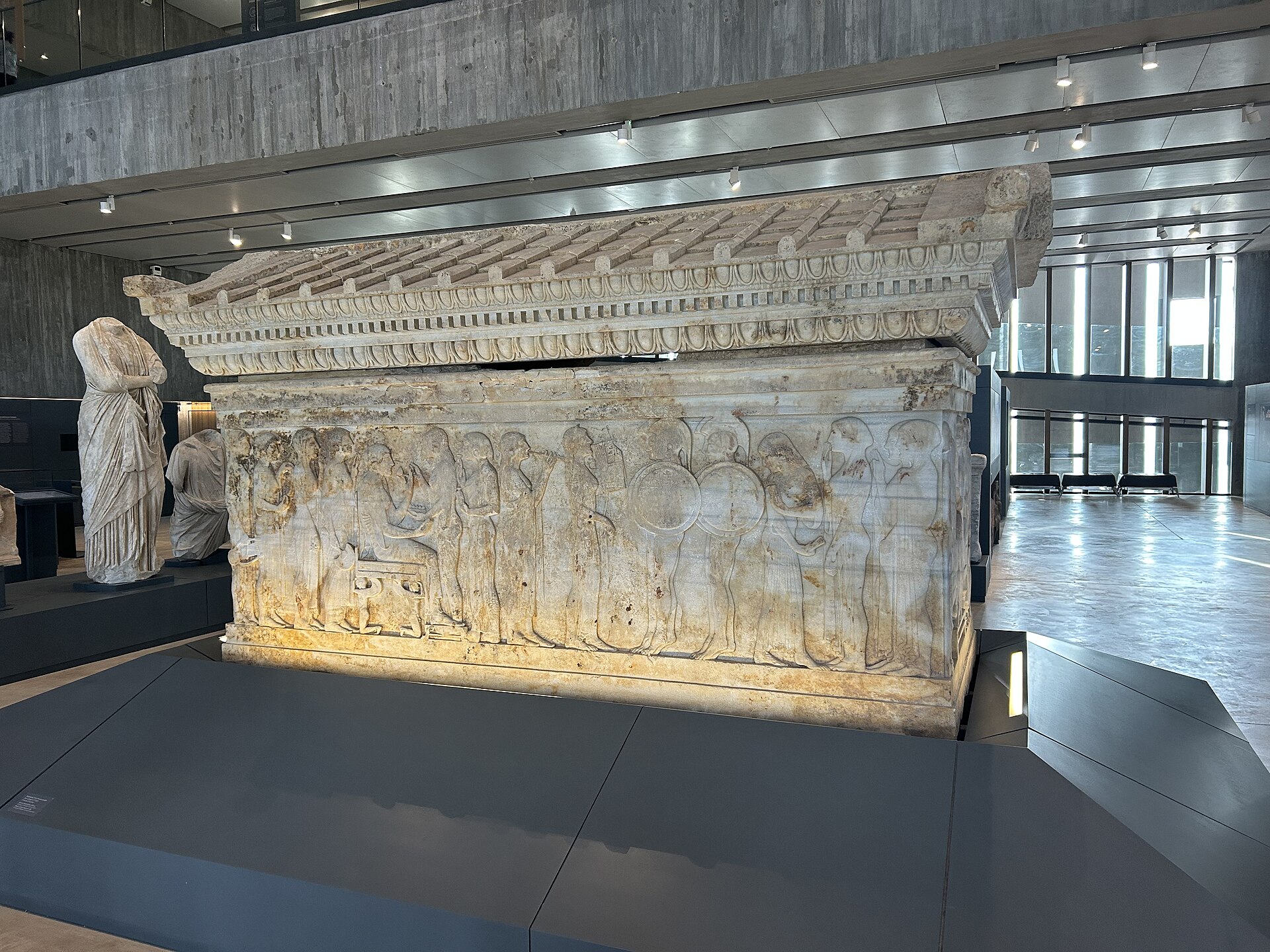
Photograph by Emirhan Sağdır · CC BY-SA 4.0 Level 2 - The Ancient World
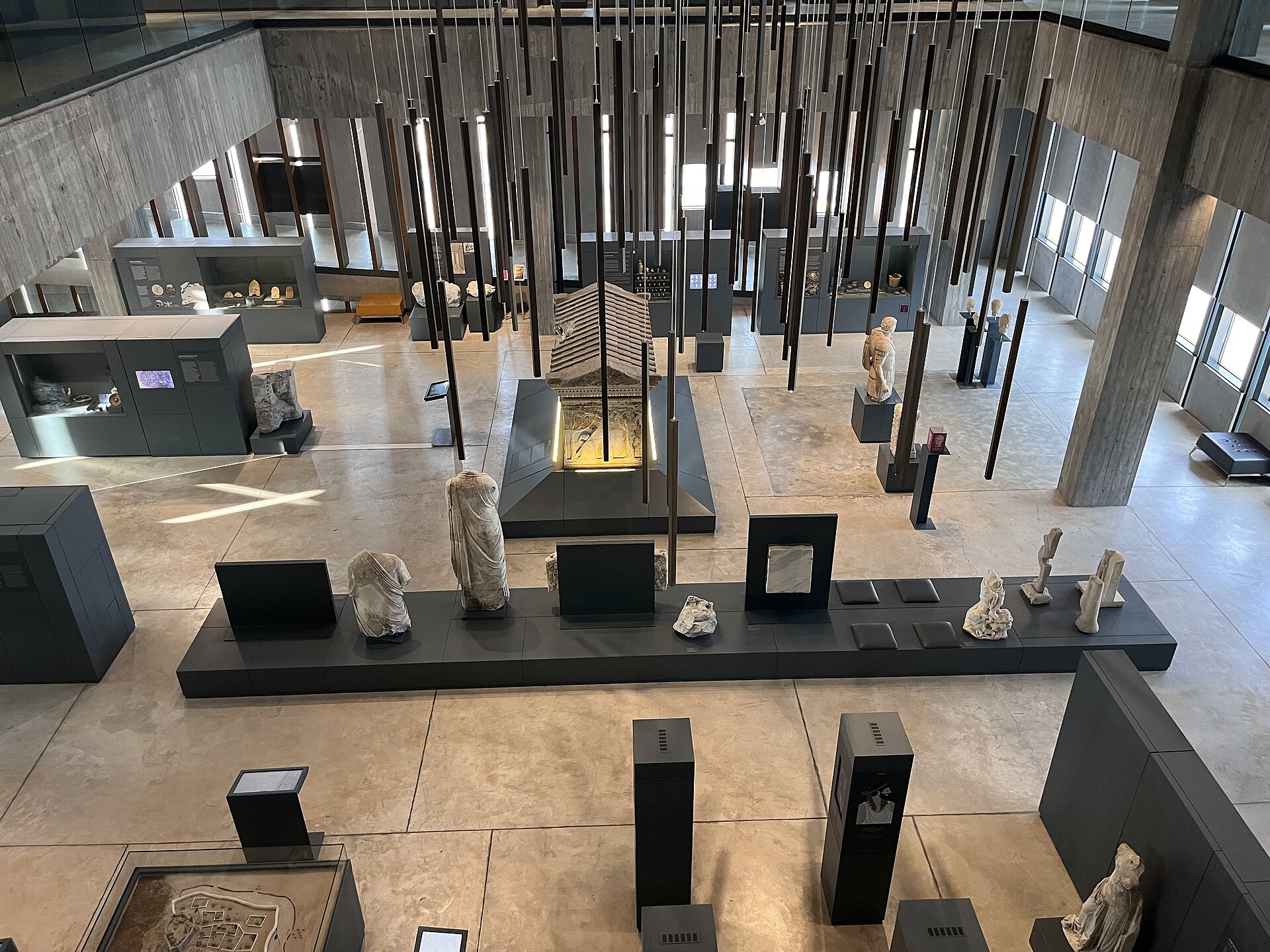
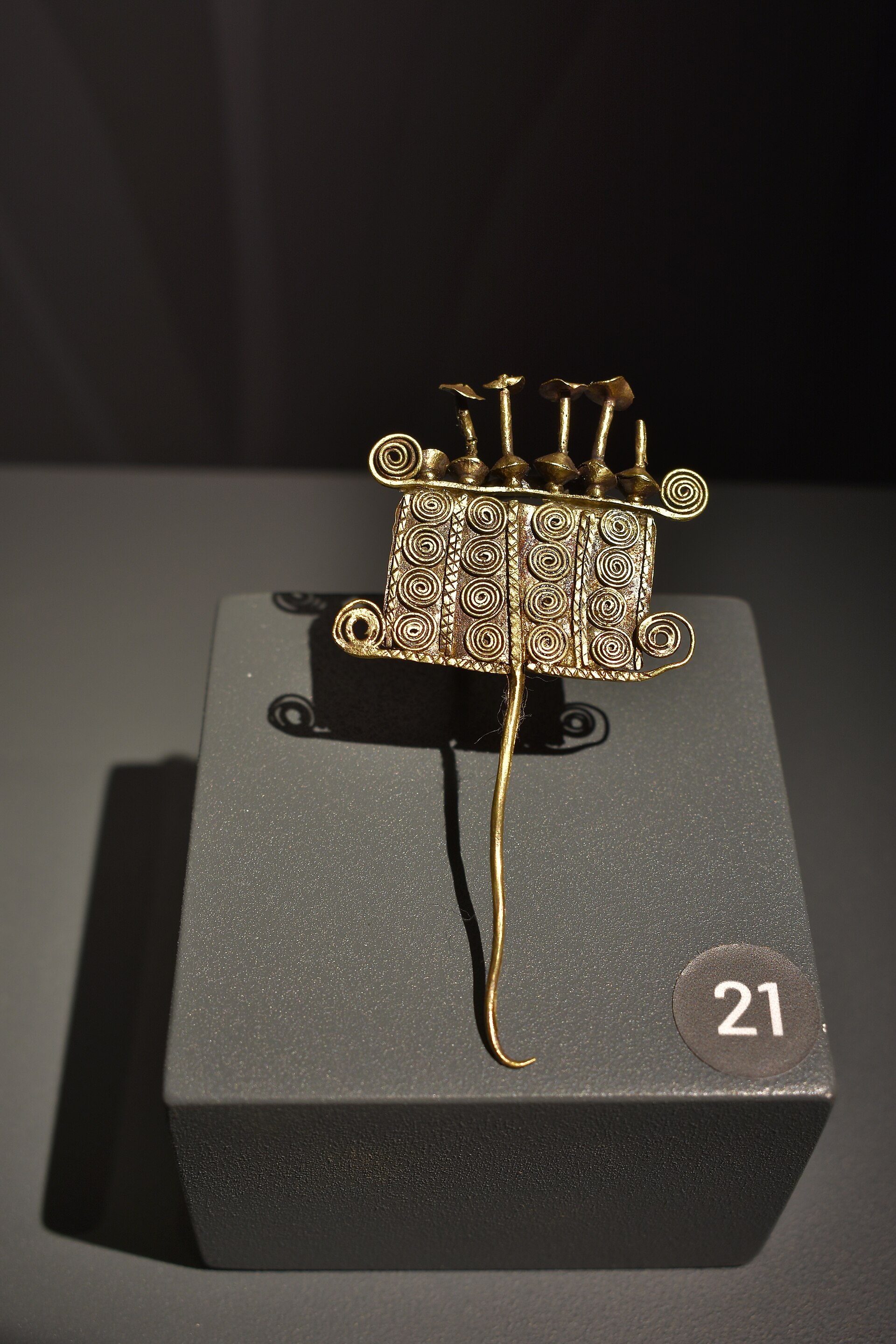
The floor covers the transition from the Bronze to the Iron Age and the Hellenistic and Roman cities that followed in the Troad, and it holds the museum's best-known single objects. The Altikulac sarcophagus, a fourth-century BC painted marble Graeco-Persian sarcophagus, carries a deer hunt with dogs and boar in relief on one long side and Persian soldiers spearing a Greek warrior on the other; it is shown close enough to read the relief's toolmarks. A cuirassed statue of the emperor Hadrian, recovered from the Odeon at Troy, and the museum's Troy Gold group, jewellery of around 2400 BC returned to Turkey on indefinite loan from the University of Pennsylvania Museum in 2012, are the level's other set pieces. A statue of the sea-god Triton, found at the site in 2012, is also shown on this floor.
Level 3 - History of the Excavations, and the Lost Heritage room
The top level turns from the objects to the people who dug them up: Frank Calvert, who first identified the mound at Hisarlik as Troy and pointed Heinrich Schliemann to it; Schliemann himself; Wilhelm Dorpfeld, who corrected much of Schliemann's stratigraphy after his death; and Manfred Korfmann, whose late-twentieth-century campaigns established the site's true size. A dedicated Lost Heritage room addresses what excavation removed from Turkey rather than what it left behind: a wall of empty display cases is captioned to say the objects that belong in them are elsewhere, and a multimedia presentation reconstructs, without a single original object in the room, what the treasure Schliemann called Priam's looked like. No verified photograph of this level's interior was found on Wikimedia Commons at the time of writing; it is described here from written sourcing only. The floor gives onto the museum's rooftop terrace, an open view over the Trojan plain toward the Dardanelles that several visitors singled out as the best place to end a visit.
What to see first
Polyxena sarcophagus
Unknown Anatolian workshop, c. 500-490 BCFound at the Kizoldun tumulus near Biga in 1994, its marble relief on all four sides shows female musicians, warriors, and the ritual killing of Priam's daughter Polyxena at the tomb of Achilles; visitor accounts single out how legible the carving still is, down to the modelling of Hecuba's face.6
Altikulac sarcophagus
Unknown Graeco-Persian workshop, 4th century BCA painted marble sarcophagus carrying a deer hunt on one long side and a battle between Persian soldiers and a Greek warrior on the other, read by scholars as a record of Persian authority over the Troad in the period; it is the level 2 gallery's centrepiece.7
Troy Gold group
Unknown Trojan goldsmiths, c. 2400 BCRings, pendants, a necklace and bracelet acquired by the University of Pennsylvania Museum in 1966 on an uncertain purchase history, later shown by metallurgical analysis to be consistent with an origin at or near Troy, and returned to Turkey on an indefinite loan agreed in 2012 rather than under a settled ownership finding.10
Cuirassed statue of Hadrian
Roman workshop, 2nd century ADRecovered from the Odeon at Troy, the site's Roman-period concert hall, and shown on Level 2 alongside the Altikulac sarcophagus as evidence that Troy remained a functioning Roman city centuries after the events Homer describes.6
Statue of Triton
Unknown workshop, Hellenistic or Roman dateA sculpture of the Greek sea god found at the Troy site itself in 2012, six years before the museum opened; it is one of the more recent finds on display rather than a piece with a long prior exhibition history elsewhere.3
Dedetepe tumulus burial chamber (reconstructed)
Unknown, 4th-3rd century BC funerary architectureRather than displaying the tomb's contents in a case, the museum rebuilt the chamber itself at scale, with painted marble couches, so a visitor stands inside a Hellenistic Troad burial rather than reading a label about one.6
Bronze Age Luwian hieroglyphic seal
Unknown Luwian seal-cutter, Bronze AgeLuwian was spoken across a swathe of western Anatolia between the Hittite and Mycenaean worlds; a legible sealstone from that culture found at Troy is a rare direct link between the site and the wider Bronze Age political geography the Iliad half-remembers.6
Dardanos tumulus gold diadems and wreaths
Unknown Hellenistic goldsmiths, 4th-3rd century BCFunerary gold from one of the Troad's other major tumuli, shown alongside the tomb's terracotta figurines and its marble copy of the Cnidian Aphrodite, giving the region's elite burial culture a second, independent example beside Dedetepe.6
The oldest known painted vessel fragment from Troy
Unknown Trojan potter, early Bronze AgeAnchors the Level 1 pottery sequence at the earliest point the museum can date with confidence, and is presented explicitly as a superlative rather than one sherd among many, which is why it is picked out here rather than left to a case label.6
The Lost Heritage multimedia room
Museum-produced installation, 2018Not an object but a deliberate absence: empty cases captioned to say what belongs in them is elsewhere, built around the fact that most of the gold Schliemann removed from Troy in breach of his excavation permit's fifty-fifty division with the Ottoman government ended up, after further removal from Berlin by Soviet forces in 1945, in the Pushkin State Museum of Fine Arts in Moscow, with further pieces at the Hermitage in St Petersburg. It is the single clearest statement on the site of the museum's own view of its incomplete collection.11
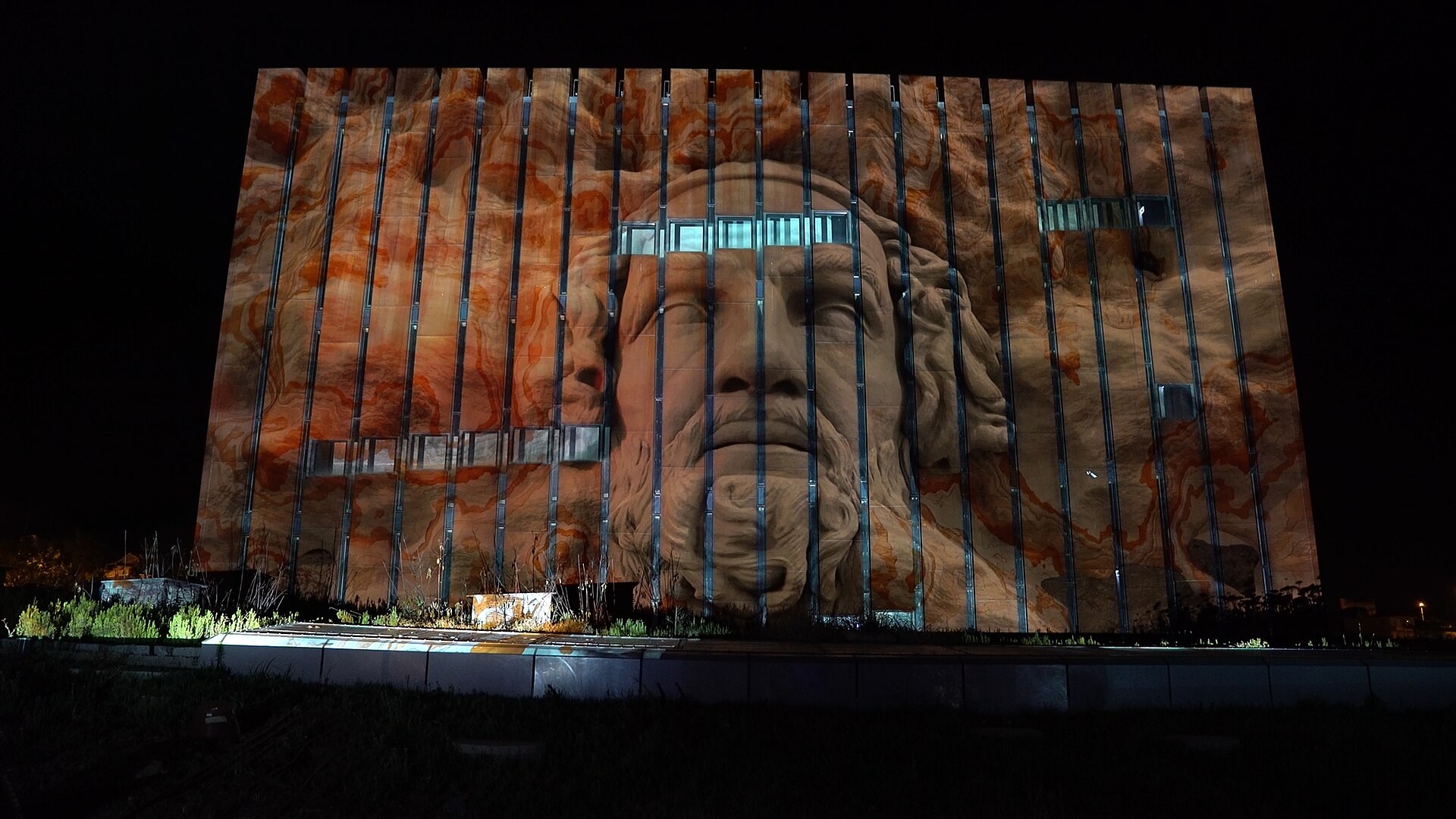
A cube built to look excavated, not built
The Ministry of Culture and Tourism ran a national design competition for a new Troy museum in 2011, and the Istanbul practice Yalin Architectural Design, led by the architect Omer Selcuk Baz, won it with a single, blunt idea: a cube of rusting Corten steel, 32 metres on a side, conceived as an object that looked as if it had itself been dug out of the ground rather than built on top of it. The steel is left to weather on purpose. Over months and years it darkens to the same red-brown as the broken pottery and turned earth of an active excavation, so the building's skin ages in public the way the site fifty metres away has aged for three thousand years. The cube's height was set to match the depth of Troy's own nine archaeological layers, and its supporting functions, plant, storage, laboratories, are buried underground on a single service floor so nothing breaks the cube's geometry from outside.
Construction did not go smoothly. Work began in 2013, stopped in 2015, and did not resume until 2017, a two-year gap that is not explained in any of the sources gathered for this record. The museum opened to visitors on 10 October 2018, in a year the Ministry had already declared the Year of Troy, but its formal inauguration, with President Recep Tayyip Erdogan presiding, did not take place until 18 March 2019, five months later. Both dates are reported as the museum's opening by different sources and this record does not resolve which one the institution itself now treats as its anniversary. The total build cost is put at around 45 million Turkish lira, roughly 8 million US dollars at the time, for an 11,000 square metre building holding around 2,000 square metres of exhibition space across four floors and a roof terrace, entered by a 12-metre ramp that carries a visitor underground before the exhibition itself begins to rise around them.
Forty thousand objects, four floors, and what actually made it onto them
The museum's own holdings run past 40,000 catalogued objects, most of them never on display at once; roughly 2,000 are shown at any time across the building's seven thematic sections. Very little of that material was excavated specifically for this museum. The bulk of it was transferred in from the older Canakkale Archaeological Museum, which the new building was built to supersede, with further pieces reassigned from the Istanbul Archaeology Museums and from the Museum of Anatolian Civilizations in Ankara, both of which had held Troad material for decades as the region's only nearby state museums. A smaller, more contested group arrived from further away: in 2012 the University of Pennsylvania Museum of Archaeology and Anthropology agreed to an indefinite loan to Turkey of 24 gold jewellery pieces, dating to around 2400 BC, that it had bought in 1966 on a purchase history the museum itself later called uncertain. Metallurgical analysis commissioned by Penn corroborated a Troy-region origin without settling it outright, and the loan was structured as an act of collaboration rather than a resolved restitution, in exchange for future loans and research cooperation running the other way.
That assembly history matters for how the museum reads on a walk-through. It is not the record of one dig, curated by the people who excavated it, but a single building absorbing a century and a half of finds, ownership disputes, and competing prior custodians into one narrative sequence. The seven sections it settled on, cities of the Troad, the layers of Troy itself, the transition from bronze to iron, the classical and Roman Troad, the site's excavation history, and a room built around what is missing rather than what is present, are as much an argument about how to tell that story honestly as they are a floor plan.
The layers of Troy, walked in order
The building's vertical route is designed to mirror the archaeological one. A visitor descends the entrance ramp below ground level, then rises through the cube's four floors in roughly the order the layers themselves were laid down, ending at a rooftop that looks out over the real landscape the objects came from. The ground level, called Level Z in the museum's own numbering, widens the frame beyond Troy itself to the Troad region as a whole: finds from Assos, Alexandria Troas, Lampsakos, Parium and Thymbra, from the island of Tenedos and from Imbros, and from regional burial mounds including the Dardanos and Dedetepe tumuli, the latter rebuilt at full scale as a walk-in chamber rather than displayed as a case of grave goods.
Level 1 follows Troy's own excavated strata, numbered I through VII by the archaeologists who dug them, and organises its cases around daily life at each stage rather than around object type: weaving, pottery production, and the maritime trade that the site's position on the Dardanelles made possible, illustrated with reconstructed vessels. A fragment described by the museum as the oldest known painted pottery from the site sits at the start of that sequence, and a Bronze Age hieroglyphic Luwian seal, from a language and culture positioned between the Hittite and Mycenaean worlds, is one of the floor's more specialist objects. Level 2 moves the story from the Bronze Age's end into the Iron Age and then the Hellenistic and Roman cities that grew up on the same ground; this is where the Altikulac sarcophagus, the cuirassed statue of Hadrian recovered from Troy's Roman-era Odeon, the Troy Gold jewellery, and a statue of Triton found at the site in 2012 are shown together, the floor most visitor reviews single out by name.
Level 3, the top floor, turns from artefacts to archaeologists: Frank Calvert, the British-American who first identified the Hisarlik mound as Troy's likely site and steered Heinrich Schliemann toward it; Schliemann himself; Wilhelm Dorpfeld, who spent years correcting the stratigraphy Schliemann's own digging had scrambled; and Manfred Korfmann, whose late-twentieth-century excavations more than tripled the site's known extent. From there the route opens onto the rooftop terrace, a view over the Trojan plain toward the Dardanelles that closes the visit on the landscape rather than on one more case.
Schliemann, the treasure, and what the museum says about what is missing
Heinrich Schliemann excavated at Hisarlik under an Ottoman permit that required him to divide his finds equally with the Ottoman government. In 1873 he instead removed a hoard of gold and silver objects, later called Priam's Treasure after the Trojan king of the Iliad although it in fact predates the Trojan War era by more than a thousand years, smuggling the bulk of it out of the Ottoman Empire by way of the harbour at Kumkale rather than declaring it. He later returned some material to the Ottoman authorities in exchange for permission to keep digging, which is the route by which a portion of the Troad's excavated gold ended up in what is now the Istanbul Archaeology Museums rather than abroad. The larger share went to Germany, where Schliemann gave it to the Royal Museums in Berlin. It stayed there until the closing weeks of the Second World War, when Soviet forces took Berlin and a museum official, Wilhelm Unverzagt, arranged for the treasure's transfer to Moscow rather than leave it to the fighting. The Soviet Union denied holding it for decades; the Pushkin State Museum of Fine Arts did not publicly acknowledge possession until 1994, with further pieces held at the Hermitage in St Petersburg. Russia's position since a 1998 law has been that the material constitutes compensation for wartime destruction of Russian cultural property, a claim Germany and Turkey both dispute; the treasure remains in Moscow and St Petersburg with no resolution in sight.
The Troy Museum's own response to that history is a dedicated Lost Heritage room on its top floor, built around absence rather than presence. Display cases stand empty, captioned to explain that the objects that would fill them are elsewhere, and a multimedia presentation reconstructs digitally what the missing treasure looked like, since the museum holds none of the originals to show. It is a more direct acknowledgement of an unresolved dispute than most museums make inside their own walls, and it is worth noting as a genuinely unusual curatorial choice rather than glossing over it: a national museum that structures a whole room around what it does not have, instead of simply not mentioning the gap.
A cube that divides its own visitors
The building has collected real institutional recognition since it opened: a Special Commendation in the 2020 European Museum of the Year Awards, a Special Award the same year from the European Museum Academy, formalised as the 2020/2021 EMA Special Mention Award, making Troy the first Turkish museum to hold both distinctions together, plus a shared Building Award at Turkey's 2019 Turgut Cansever International Architecture Awards and a shared prize in the constructed-designs category of the 2020 National Architecture Exhibition, whose jury praised the building's solid, sturdy geometry for connecting the shared memories and epic legends of the site to a contemporary architectural language rather than competing with Troy's own topography.
Visitors are not unanimous about that geometry. A number of accounts describe the rusted cube as a deliberate, successful metaphor, timeworn on purpose, echoing the broken ceramics found nearby, and one visitor's review explicitly pushes back against having seen the building dismissed elsewhere as an ugly metal box, arguing instead that the rust blends with the surrounding grasses and stones and reads as a solemn, contemporary fortress. That the defence exists at all is evidence the criticism does too, even though this record does not reproduce either verdict's exact wording. A second recurring complaint is more practical than aesthetic: at 27 euros for the combined museum and site ticket, one reviewer called the price proud and said it left them less enthusiastic than comparable sites in Italy and Greece, a figure that matches the Ministry's own published foreign-visitor price exactly rather than reading as an exaggeration.
Getting there and what a visit costs
The museum sits in Tevfikiye village, about 800 metres east of the Troy archaeological site itself, roughly 30 kilometres from central Canakkale; more than one visitor has been surprised to find the museum and the ancient city are two separate stops rather than one combined gate, and plans a visit accordingly. The 1915 Canakkale Bridge across the Dardanelles, the world's longest suspension bridge when it opened in 2022, replaced a car-ferry crossing and cut the drive from Istanbul to around four or five hours. The Ministry's own price list sets combined admission to the museum and the archaeological site at 27 euros for foreign visitors, with the museum accepting Muzekart, the Ministry's own annual pass, for free entry by Turkish citizens; the museum is open every day of the year, 08:30 to 20:00 with the ticket office closing at 19:30 during the summer season from 1 May to 1 October, and 08:30 to 17:30 with the ticket office closing at 17:00 in winter. Tripadvisor's own listing puts a typical visit at two to three hours, though several reviewers recommend closer to three and comfortable shoes, given the building's four floors plus a rooftop terrace are connected by ramps rather than a single quick route.
What visitors say
Visitors consistently treat the museum as the necessary second half of a Troy visit rather than an optional add-on, and several reviewers say plainly that it was the more impressive of the two stops. The architecture is the one subject every account has an opinion on: the corten-steel cube divides visitors between those who read the rust as a deliberate metaphor for excavated time, in dialogue with the broken pottery inside, and at least one visitor who has evidently seen it dismissed elsewhere as an ugly metal box and felt moved to argue the opposite in their own review. Where the museum's own installation invites a harder judgement is the Lost Heritage room: it is built around an absence, the gold Schliemann took out of the Ottoman Empire and that ended up, after further seizure from Berlin in 1945, in Moscow rather than Canakkale, and the room does not pretend that absence is resolved.
What is praised, what is criticised
- Praised: the narrative, non-case-by-case exhibition design, in which different periods of Troy are told as a continuous story rather than as objects simply arranged behind glass, repeatedly singled out as more successful than a conventional archaeological museum hang
- Praised: genuine step-free circulation, with ramps connecting all four levels rather than a single accessible route grafted onto stairs, and multiple reviewers noting it as a real accommodation rather than a token one
- Praised: the rooftop terrace's 360-degree view over the Trojan plain, treated by several visitors as the natural, unplanned conclusion to the museum route rather than an afterthought
- Praised: the building's suitability for children, described as engaging without being tiring, helped by interactive digital displays and a Trojan-horse selfie cutout near the entrance
- Criticised: the admission price, which one visitor called a proud 27 euros and said left them less enthusiastic than comparable sites in Italy or Greece, in a currency and figure that matches the Ministry's own foreign-visitor price exactly
- Criticised: the architecture itself, which is not universally loved: a defending reviewer explicitly references having seen the building called an ugly metal box by others before making their own case for it, which this record treats as evidence the criticism exists even though it is not quoted directly here
- Criticised: the museum's physical separation from the Troy archaeological site itself, roughly 800 metres and a walk or a short drive apart rather than at the site's own gate, which at least one visitor flagged as a surprise worth planning around
Ratings on other platforms
Tripadvisor: 4.7 from 126 ratings, read 27 September 2026
A platform average is a tertiary source: it moves, it is not audited, and we quote no visitor's words.
Questions about Troy Museum
Where is Troy Museum?
Tevfikiye Koyu, Truva Alti Sokak No:12, 17100 Canakkale, Turkey.
How much does it cost to visit?
Combined ticket, Troy Museum and the Troy archaeological site (foreign visitors): EUR 27; Turkish citizens holding a Muzekart: free; Children, 0-8: free. As confirmed 27 September 2026.
When is it open?
Daily, summer season (1 May to 1 October) 08:30-20:00; Daily, winter season (1 October to 1 May) 08:30-17:30. Closed: Open every day of the year, per the museum's own page. As confirmed 27 September 2026.
How do you get there?
Car: The museum stands in Tevfikiye village, about 800 m (2,600 ft) east of the Troy archaeological site itself, roughly 30 km from central Canakkale. The 1915 Canakkale Bridge across the Dardanelles, opened in 2022, cuts the drive from Istanbul to around four to five hours by removing the old car-ferry crossing; On foot: One reviewer noted the museum sits in a separate location from the ancient city rather than at its gate, so the two are visited as two stops rather than one continuous walk; most visitors drive or are driven between them.
What should you see first?
Polyxena sarcophagus (Unknown Anatolian workshop, c. 500-490 BC); Altikulac sarcophagus (Unknown Graeco-Persian workshop, 4th century BC); Troy Gold group (Unknown Trojan goldsmiths, c. 2400 BC); Cuirassed statue of Hadrian (Roman workshop, 2nd century AD); Statue of Triton (Unknown workshop, Hellenistic or Roman date); Dedetepe tumulus burial chamber (reconstructed) (Unknown, 4th-3rd century BC funerary architecture).
What we could not confirm
- Two different opening dates are reported for the museum, 10 October 2018 for the public opening and 18 March 2019 for the formal presidential inauguration, and this record could not establish which date the museum itself treats as its founding anniversary.
- The two-year construction halt between 2015 and 2017 is reported in multiple sources without an explanation for the pause.
- One travel feature states that part of Priam's Treasure is held in Warsaw in addition to Moscow's Pushkin Museum and the Hermitage in St Petersburg; the Wikipedia-sourced account of the treasure's post-war history names only Moscow, St Petersburg and Istanbul. This record follows the better-corroborated Moscow/St Petersburg/Istanbul account and flags the Warsaw claim as unresolved rather than including it as fact.
- No verified photograph of the Level 3 excavation-history and Lost Heritage interior, or of the rooftop terrace, was found on Wikimedia Commons at the time of writing; that level is described from written sourcing only.
Images
Sources
- 1Republic of Turkey Ministry of Culture and Tourism, muze.gov.tr, Troya Muzesi museum-detail page: opening hours, address, phone, email, open-daily status. Read 27 September 2026. muze.gov.tr/muze-detay?SectionId=TRO01&DistId=TRO
- 2Ministry of Culture and Tourism, DOSIM (revolving-fund) museum and site price list: Canakkale Troya Muzesi / Canakkale Troya Orenyeri listed together at EUR 27 for foreign visitors, Muzekart valid. Read from raw fetched HTML, not only a summarising pass, 27 September 2026. dosim.ktb.gov.tr/TR-218202/muze-ve-oren-yeri-ucretleri.html
- 3Wikipedia, Troy Museum: opening date, architecture competition and firm, building dimensions, construction timeline, exhibition sections, named objects including the Statue of Triton, artifact-transfer sources, director, awards. Read 27 September 2026. en.wikipedia.org/wiki/Troy_Museum
- 4ArchDaily, 'Museum of Troy / Yalin Architectural Design': design concept, competition history, area, materials, design team and curators. Read 27 September 2026. archdaily.com/911479/museum-of-troy-yalin-architectural-design
- 5Yalin Mimarlik, official project page for the Museum of Troy: architects' own description, site area, construction area, programme, design-team and consultant credits, awards list including the 2019 Turgut Cansever award and 2020 National Architecture Award. Read 27 September 2026. yalin-mimarlik.com/en/projeler/troya-muzesi
- 6Turkish Archaeological News, 'Troy Museum': level-by-level description of Level Z, Level 1, Level 2 and Level 3, named objects including the Altikulac sarcophagus, Polyxena sarcophagus, Dedetepe and Dardanos tumulus finds, the Luwian seal, the Lost Heritage room, and visitor-information figures. Read 27 September 2026. turkisharchaeonews.net/museum/troy-museum
- 7Forbes, John Oseid, 'Ancient Troy Now Easier Than Ever To Reach And Explore', 26 November 2024: first-person walk-through of the museum level by level, the 1915 Canakkale Bridge and its effect on travel time from Istanbul, and the Lost Heritage wall text. Read as raw fetched article text via an in-app browser after a direct fetch was blocked, 27 September 2026. forbes.com/sites/johnoseid/2024/11/26/ancient-troy-now-easier-than-ever-to-reach-and-explore/
- 8Daily Sabah, 'Troy Museum receives European Museum Academy Special Award': the 2020/2021 EMA Special Mention Award, the 2020 EMYA special commendation, the 18 March 2019 formal inauguration by President Erdogan, and the museum's approximately 2,000 objects on display. Read 27 September 2026. dailysabah.com/arts/troy-museum-receives-european-museum-academy-special-award/news
- 9STIRworld, 'From the Iliad to the Museum of Troy': the architects' 'locus' design philosophy, jury language describing the building's geometry, visitor circulation and ramp sequence, and the 2020 Turkish National Architecture Exhibition Building Category Prize. Read 27 September 2026. stirworld.com/see-features-from-the-iliad-to-the-museum-of-troy
- 10Penn Museum, press release, 'Penn Museum Strengthens Partnership with Turkey, Agrees to Indefinite Term Loan of Troy Gold': the 2012 agreement, the 24 gold objects dated to around 2400 BC, the 1966 acquisition and its uncertain purchase history, and the metallurgical analysis supporting a Troy-region origin. Read 27 September 2026. penn.museum/about/press-room/press-releases/penn-museum-strengthens-partnership-with-turkey-agrees-to-indefinite-term-loan-of-troy-gold
- 11Wikipedia, Priam's Treasure: Schliemann's 1873 removal of the hoard in breach of his excavation permit, its later history in Berlin, the 1945 Soviet removal to Moscow via Wilhelm Unverzagt, the Pushkin Museum's 1994 disclosure, the Hermitage holdings, and Russia's 1998-law justification for retention. Read 27 September 2026. en.wikipedia.org/wiki/Priam%27s_Treasure
- 12Praise and criticism on this record are written in-house from those accounts, not quoted from them. tripadvisor.com/Attraction_Review-g17310009-d15350479-Reviews-Troya_Muzesi-Tevfikiye_Canakkale_Province_Turkish_Aegean_Coast.html
- 13Turkish Museums (turkishmuseums.com), Troy Museum Canakkale detail page: admission-category breakdown, contact details, and a visitor-amenities list including cafe, shop, cloakroom, parking and audio guide. Secondary aggregator, used only where corroborated or clearly labelled as such. Read 27 September 2026. turkishmuseums.com/museum/detail/2021-troy-museum-canakkale/2021/4
- 14Queried 27 September 2026. commons.wikimedia.org/wiki/Category:Troy_Museum
- 15Read 27 September 2026. wikidata.org/wiki/Q5994097