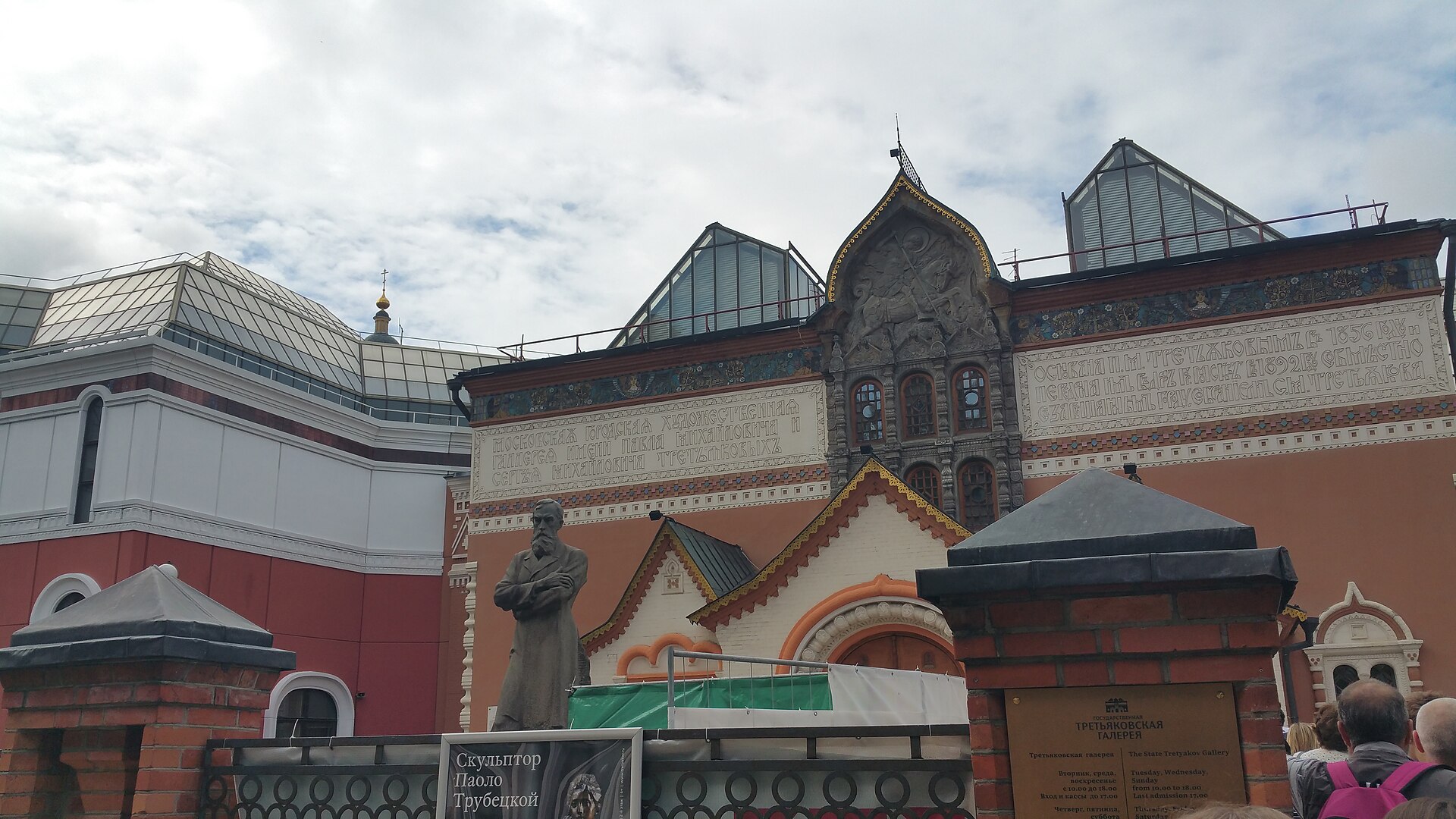
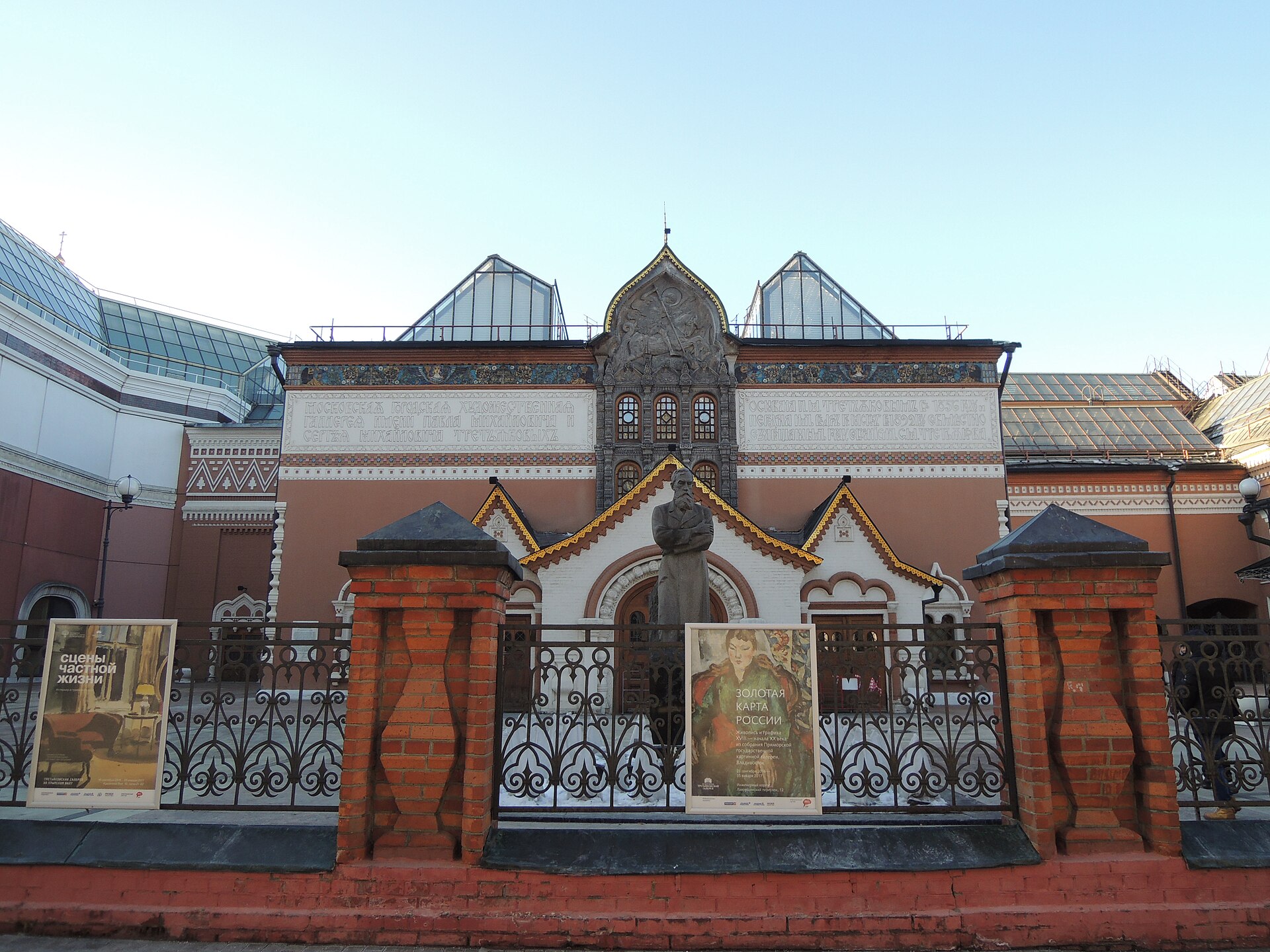
The main entrance facade of the Tretyakov Gallery on Lavrushinsky Lane, designed after drawings by Viktor Vasnetsov and built 1902-1904, with Pavel Trubetskoy's statue of Pavel Tretyakov in the forecourt
Sergey A. Demidov · CC BY 4.0Tretyakov Gallery
Museum · Gosudarstvennaya Tretyakovskaya Galereya · Founded 1856
Open, admission and hours confirmed 24 September 2026 · 19 sources
On this page 17 sections
ContentsClose
The historic building's strength is chronological completeness in a single national tradition rather than range across cultures: it is, by its own design, a history of Russian painting from its pre-Petrine icon origins to the eve of the Soviet period, told in one continuous, ordered sequence. Its deepest holdings are the Peredvizhniki generation, Repin, Surikov, Kramskoy and Savrasov, whose work defined 19th-century Russian Realism, and the pre-Mongol and medieval icon collection built up by Tretyakov himself from the 1870s onward, including works associated with the circle of Andrei Rublev; the collection's other long-term icon loan, the Our Lady of Vladimir, was transferred to the Russian Orthodox Church in April 2026 and is no longer part of what a visitor sees here. Few museums anywhere hold a comparably deep run of Russian portraiture, history painting and landscape from a single family's founding collection, expanded by a century of Soviet and post-Soviet state acquisition on top of it.
| Local name | Gosudarstvennaya Tretyakovskaya Galereya |
|---|---|
| Kind | Museum |
| Founded | 1856 |
| City and country |  Moscow, Russia Moscow, Russia |
| Address | 10 Lavrushinsky Lane, Moscow, 119017, Russia |
| Website | tretyakovgallery.ru |
| Status | Open, confirmed |
| Record last verified |
Visiting
- Hours
- Sun, Tue, Wed, Thu, Fri, Sat10:00 to 21:00last entry 20:00
- Closed
- Monday.
- Admission
- AdultRUB 700Full-price entry to the permanent exhibition in the historic building
- Reduced category (not itemised on the source page)RUB 400The museum's own visit page lists this figure under Other categories without naming the eligible group; confirm eligibility in the ticket purchase flow
- Reduced category (not itemised on the source page)RUB 350Same source line as above; category not itemised on the page
- Free category (not itemised on the source page)FreeSame source line as above; category not itemised on the page
- Tickets
- tretyakovgallery.ru/tickets/afisha The museum's own ticket page.
- Do I need to book?
- Not stated as mandatory; the museum sells both online e-tickets through its own site and box-office tickets
- Address
- 10 Lavrushinsky Lane, Moscow, 119017, Russia MapMetro Tretyakovskaya, Novokuznetskaya and Polyanka stations are all a short walk away
- Website
- tretyakovgallery.ru
- Telephone
- +7 495 957 07 27
- [email protected]
Before you go how long, access, photography, bags, eating, shop
- How long to allow
- The permanent display alone fills 62 halls on two floors, arranged chronologically from pre-Mongol icons to the early 20th century; it is more than can be covered in a single quick pass
- Access
- The museum publishes a dedicated Accessible Museum programme with separate guidance for wheelchair users, visually impaired and blind visitors, deaf and hard-of-hearing visitors, visitors with autism spectrum disorder, and organised groups of disabled visitors
- Shop
- The Gallery operates its own online and on-site shop, linked from the main museum website
Prices and hours change. We take them from the institution's own pages and print the day we read them, and you can check the current position at the source we used. Confirm before you travel.
What is inside
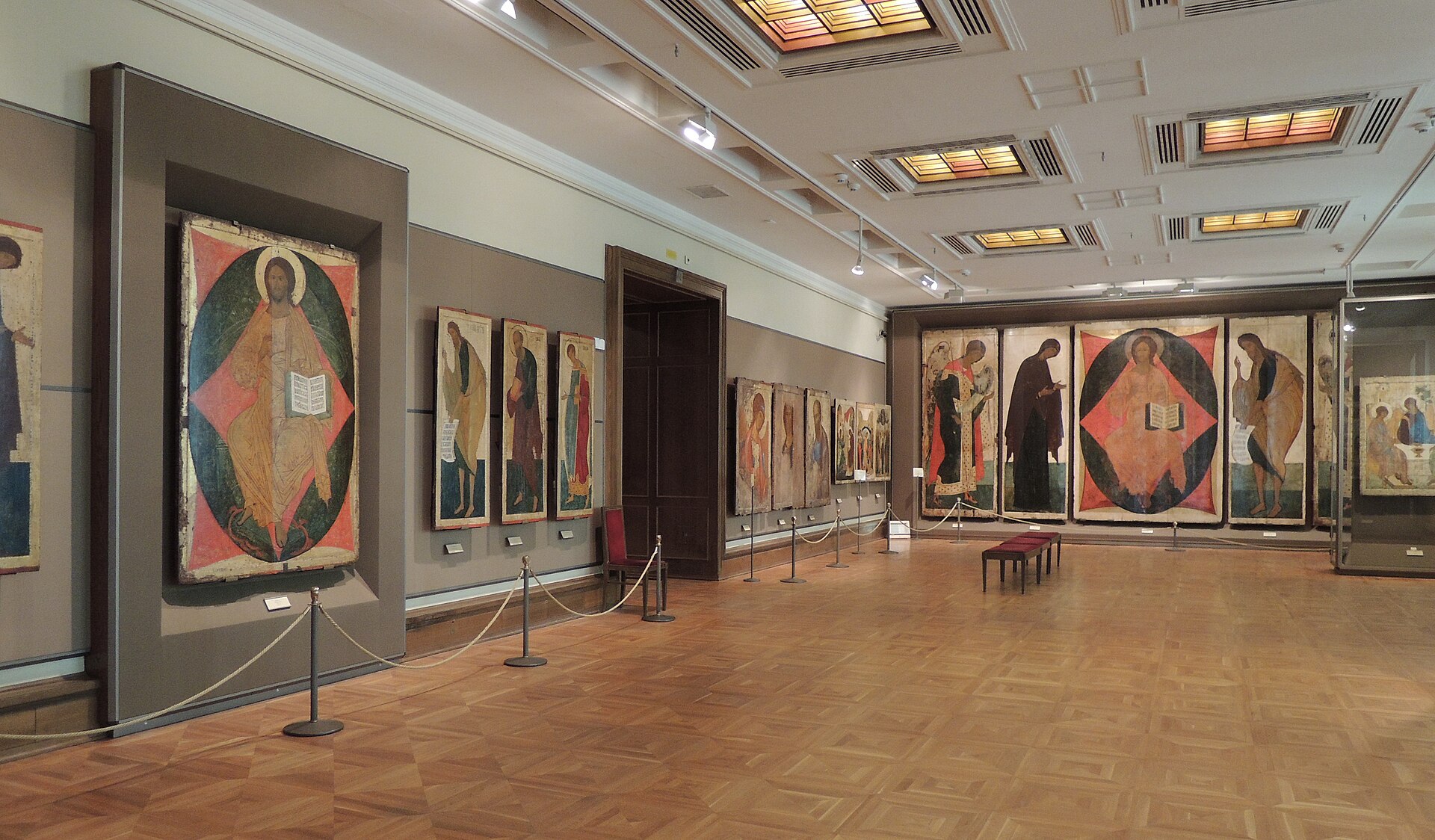
Photograph by Shakko · CC BY-SA 4.0 Old Russian icon painting, 12th-17th centuries
The oldest halls in the building, holding rare pre-Mongol icons and works by Dionisiy among others; the collection began here in 1876 when Pavel Tretyakov bought icons from Ivan Silin's collection
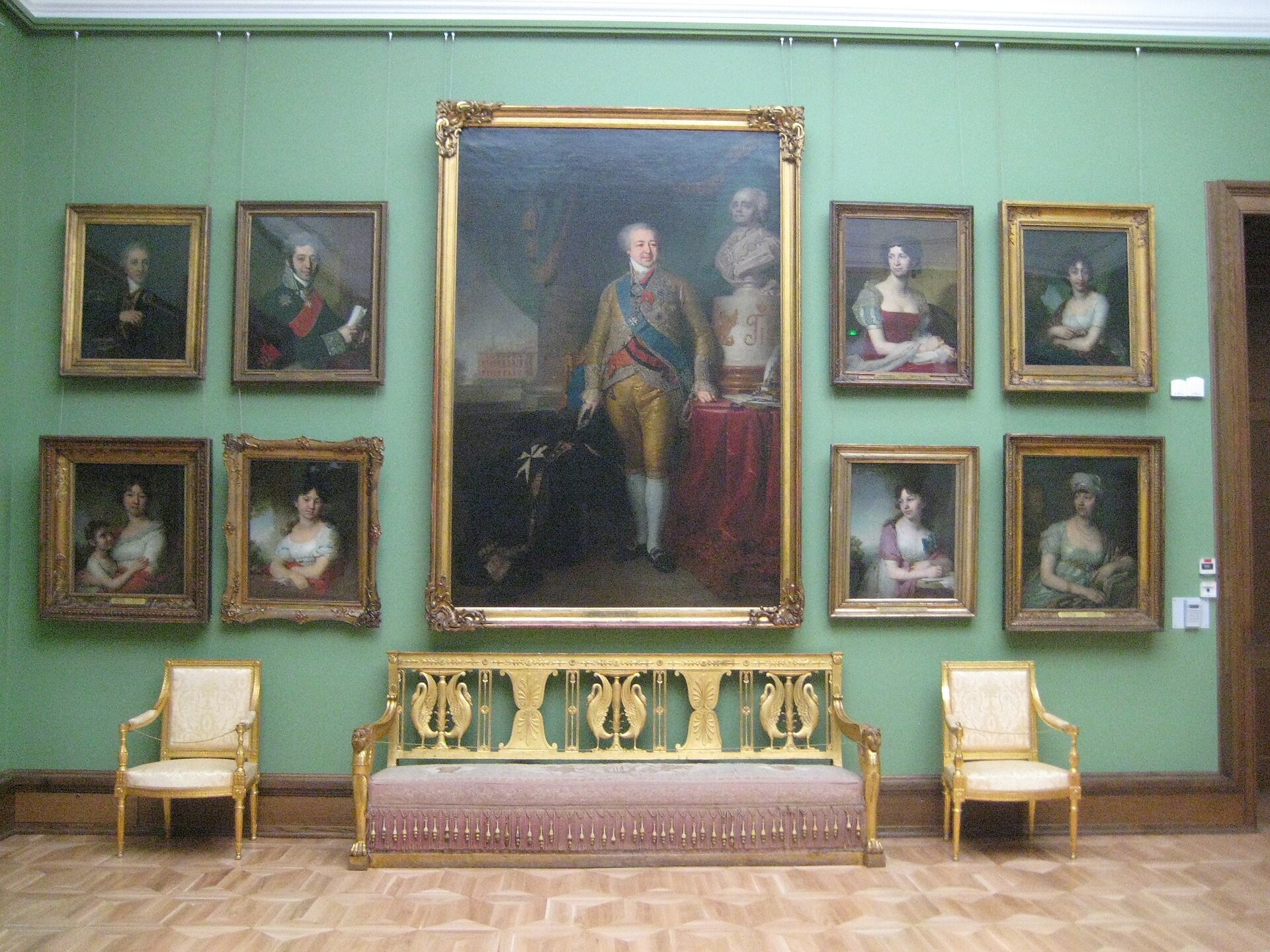
Photograph by Shakko · CC BY-SA 3.0 18th-century portraiture
Formal portraits by Fyodor Rokotov, Dmitry Levitsky and Vladimir Borovikovsky, the founding generation of Russian secular painting under Catherine the Great and Paul I
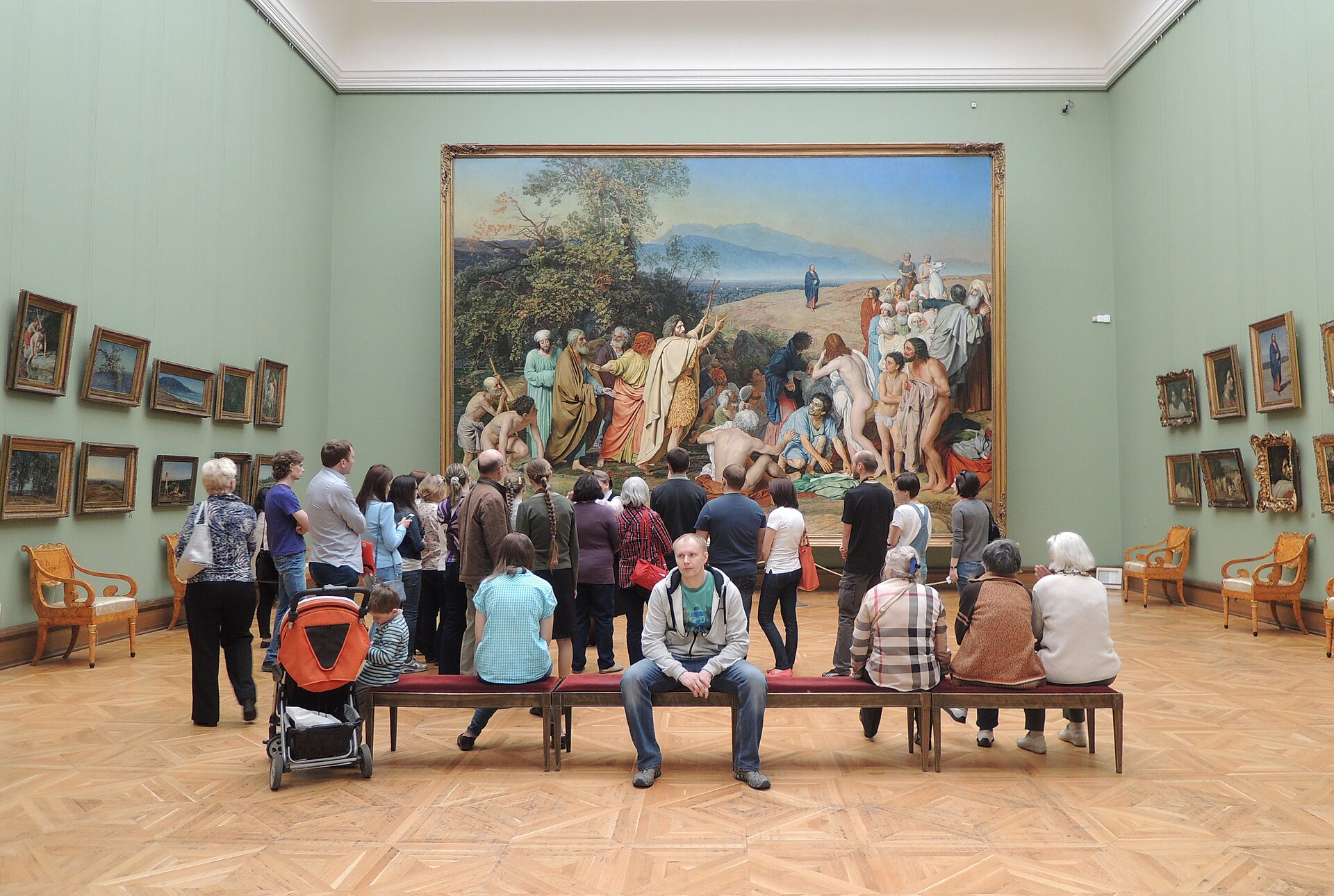
Public domain The Ivanov room, first half of the 19th century
A hall built around a single canvas: Alexander Ivanov's The Appearance of Christ to the People, on which he worked from 1837 to 1857; a dedicated room for it was completed in 1932, alongside Kiprensky's Portrait of Alexander Pushkin and Bryullov's Horsewoman
The Peredvizhniki halls, second half of the 19th century
The core of the collection: Kramskoy, Repin, Surikov and Savrasov, the Wanderers who broke from the Imperial Academy to paint Russian life and history on their own terms, including Surikov's Boyarynya Morozova
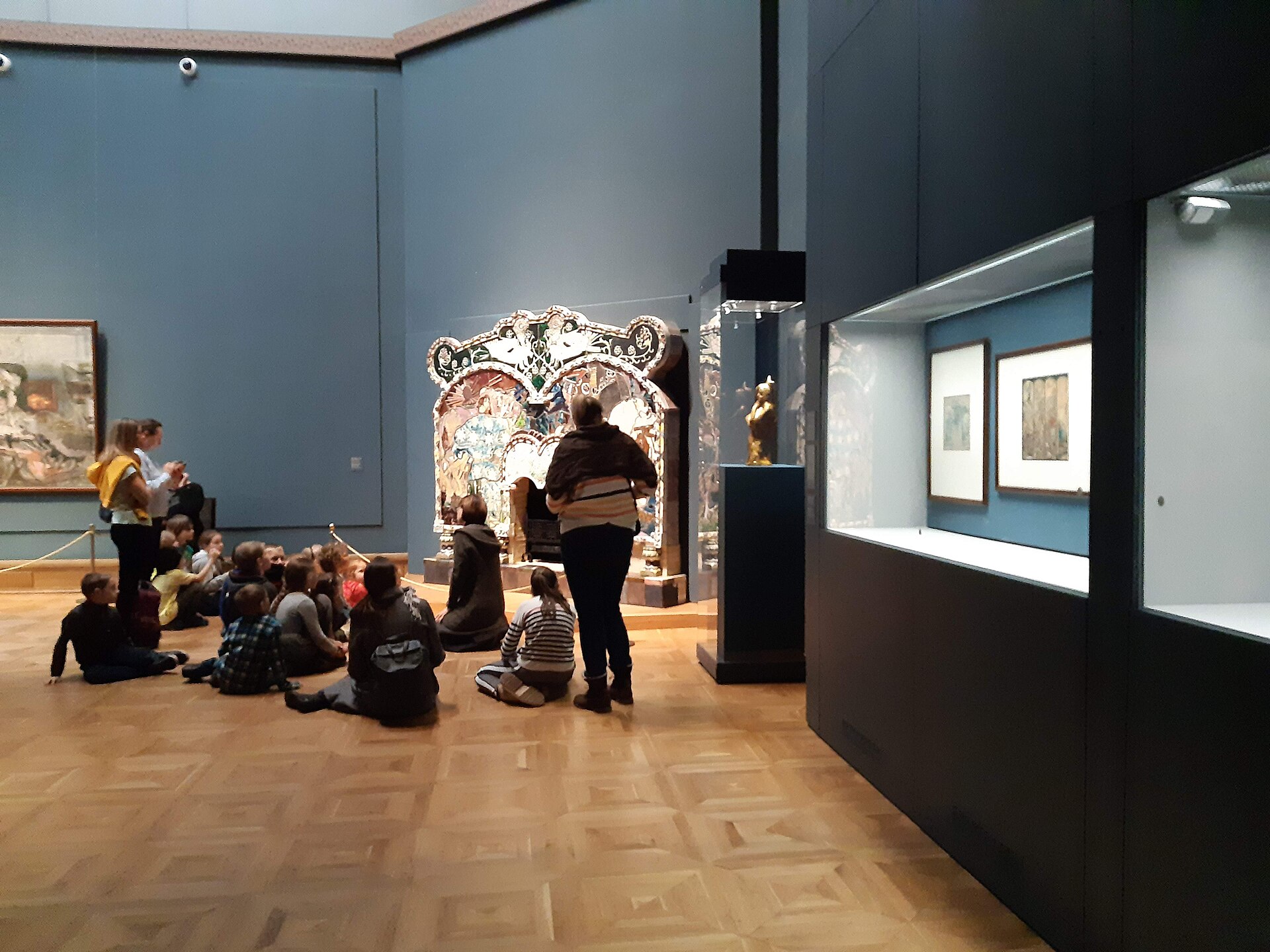
Photograph by shakko · CC BY-SA 4.0 Turn of the 19th-20th centuries
Mikhail Vrubel's Symbolist and Art Nouveau work, shown around his ceramic fireplace installation, alongside Viktor Vasnetsov's folkloric and historical canvases including The Bogatyrs
The Museum-Church of St. Nicholas in Tolmachy
A working Orthodox church attached to the gallery, closed in 1929 and returned to services in 1993. It held the Byzantine early-12th-century Our Lady of Vladimir icon for decades, but Meduza reported that the icon was transferred, on the Russian president's order, from the gallery's custody to the Russian Orthodox Church's Cathedral of Christ the Saviour in April 2026; a reader visiting today should not expect to find it in this room
What to see first
The Rooks Have Come
Alexei Savrasov, 1871A thaw scene of rooks nesting by a village church, praised on first exhibition for its unusual 'poetic mood' and regarded by art historians as a founding work of the Russian lyrical landscape tradition15
Portrait of an Unknown Woman
Ivan Kramskoy, 1883An unidentified sitter in a fur-trimmed coat, seated in an open carriage on the Anichkov Bridge in St Petersburg; Kramskoy never named her in his letters or diaries, and her identity has never been established by art historians16
Boyarynya Morozova
Vasily Surikov, 1887The Old Believer noblewoman Feodosia Morozova, arrested in 1671 for rejecting Patriarch Nikon's reforms to Russian Orthodox practice; one of the largest and most crowded history paintings in the collection17
The Bogatyrs (Three Heroes)
Viktor Vasnetsov, 1881-1898The three legendary warriors of Kievan Rus, Ilya Muromets, Dobrynya Nikitich and Alyosha Popovich, painted by the same artist who designed the gallery's own facade19
The Appearance of Christ to the People
Alexander Ivanov, 1837-1857A twenty-year undertaking, given its own purpose-built room in the gallery in 19322
Ivan the Terrible and His Son Ivan on 16 November 1581
Ilya Repin, 1885Depicts the tsar cradling the son he has just fatally struck; attacked in 1913 and again in 2018, and returned to display in December 2024 in a purpose-built, climate-controlled case after a restoration that ran nearly seven years8
Portrait of Alexander Pushkin
Orest Kiprensky, 1827One of the best-known portraits of the poet, bought by the gallery in 19162
Exhibitions on now
- On now9 Jul to 8 Nov 2026Confirmed · check before you travel
Past exhibitions here
- Closed12 Jun to 11 Oct 2026Confirmed · check before you travel
The house that became a museum
The Tretyakov family bought a house on Lavrushinsky Lane, in the merchant district of Zamoskvorechye south of the Moscow Kremlin, in 1851. They were not yet collectors of note; the family fortune came from textiles. In 1856 Pavel Tretyakov, then in his mid-twenties, bought his first two paintings by Russian artists, Nikolai Shilder's Temptation and Vasily Khudyakov's Skirmish with Finnish Smugglers. That purchase is the date the gallery counts as its founding; the museum's own visit page lists 2026 exhibitions explicitly framed as marking the 170th anniversary of that purchase.
What began as pictures hung in the family's own living rooms grew, by the museum's own account, through several building campaigns during Tretyakov's lifetime, starting in 1872 as the collection outgrew domestic space. Tretyakov's ambition was narrow and specific: not a general art museum, but a gallery of Russian national painting, at a time when Russian art was still treated in St. Petersburg's imperial circles as a provincial cousin to French and Italian painting. In August 1892 he gave the entire collection, building included, to the city of Moscow. He was made an honorary citizen of Moscow in 1896; he died on 4 (16) December 1898, and his wife died three months after him.
Vasnetsov's facade and the building's growth
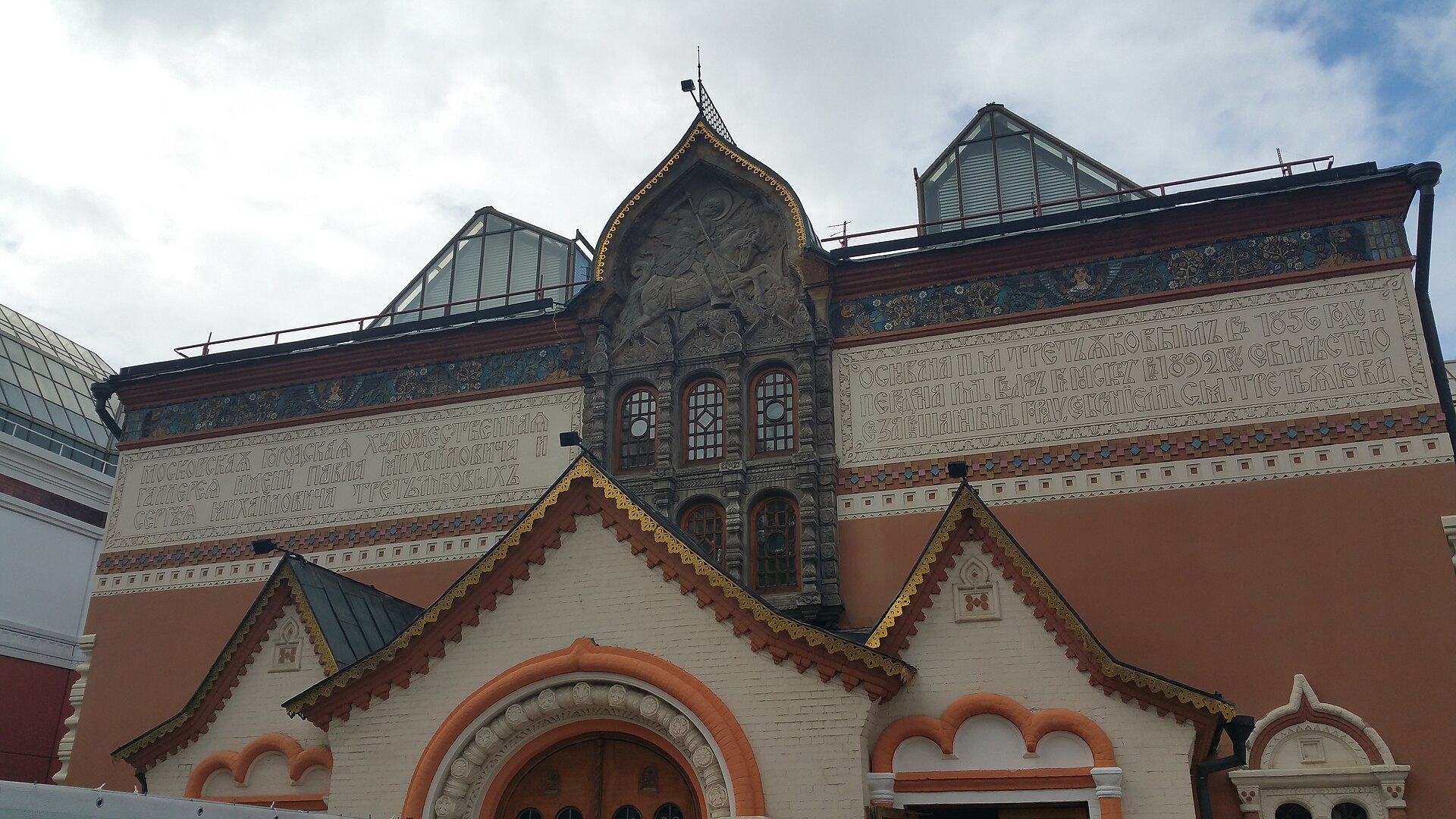
The building a visitor sees on Lavrushinsky Lane today is not the house Tretyakov bought. Between 1902 and 1904, the street-facing part of the complex was rebuilt to a design based on drawings by the painter Viktor Vasnetsov, worked up by the architect Vasily Bashkirov. The result, a fairy-tale reading of old Russian church and boyar architecture in ceramic tile, whitewash and pointed gables, became the emblem of the institution: it is the image printed on the gallery's own tickets and used across its branding. It has nothing to do with the paintings inside, which are almost entirely 19th-century in style; it is a piece of turn-of-the-century Russian Revival architecture wrapped around a Realist and Peredvizhniki collection.
The complex kept growing after Vasnetsov's facade. A new exposition block, generally called the Shchusev building after the architect Alexei Shchusev who then directed the gallery, was completed in 1936 on the building's north side. Between 1986 and 1995 the whole complex underwent a general reconstruction that closed off internal courtyards to gain exhibition space, added roughly ten more halls, and reopened with an updated permanent display in April 1995. The historic building today occupies 62 halls across two floors, organised chronologically, and is a federally protected cultural heritage monument.
Nationalisation, war and the Krymsky Val split
The gift Tretyakov made to the city in 1892 did not settle the collection's ownership for good. On 3 June 1918 the Bolshevik government's Council of People's Commissars issued a decree declaring the gallery state property of the Russian Federative Soviet Republic. Through the 1920s the gallery absorbed several other Moscow collections of Russian painting as the new Soviet state consolidated museum holdings by decree, including part of the Rumyantsev Museum's collection in 1925 and, after Ilya Ostroukhov's death in 1929, part of the collection of his own museum of icon painting, while the gallery's own holdings of Western European art were transferred out to Moscow's museum of Western art. Any complete account of provenance for works acquired through this period has to reckon with nationalisation and forced transfer as the route by which a meaningful share of the collection arrived, not only private purchase and gift.
The building itself came under direct threat in the Second World War. From the first weeks after the German invasion in June 1941, staff began the enormous task of dismantling and evacuating the collection; a seventeen-wagon train carried the most valuable works out of Moscow to Novosibirsk, in Siberia, while the building itself was damaged by bombing and restoration work began even before the war ended. The gallery reopened in Moscow on 17 May 1945, a week after Victory Day, with more than 2,500 works back on display.
The historic building's relationship with its sister site is its own piece of institutional history. In 1964 the Soviet state approved a design for a new National Art Gallery of the USSR on Krymsky Val, completed in 1983 and merged into the Tretyakov Gallery's administration as what is now called the New Tretyakov. The merger coincided with the closure of the Lavrushinsky Lane building for reconstruction for the better part of a decade, so through the 1980s the Krymsky Val building was, for a period, the only Tretyakov Gallery site open to the public. The two buildings now divide the collection by date: this building holds Russian art from the 12th century to the early 20th, Krymsky Val holds the 20th century onward, including the Russian avant-garde. Visitor confusion between the two, evident in reviews left for each site, is a direct legacy of that administrative history rather than poor signage at either building.
What the historic building holds
The permanent display runs in strict chronological order across two floors. It opens with the oldest material in the collection: pre-Mongol icons from the 12th and 13th centuries, including work associated with Dionisiy, gathered from purchases Tretyakov himself began making in the 1870s from collectors such as Ivan Silin. The icon halls lead toward the Museum-Church of St. Nicholas in Tolmachy, a working Orthodox church folded into the museum building, closed under Soviet rule in 1929 and returned to services in 1993; it displays the Our Lady of Vladimir icon, one of the most venerated images in Russian Orthodoxy, in a room that functions as both gallery and place of worship.
The 18th-century halls hold the formal portraiture of Fyodor Rokotov, Dmitry Levitsky and Vladimir Borovikovsky, the generation that established secular Russian portrait painting under Catherine the Great. The first half of the 19th century is anchored by a single room built around Alexander Ivanov's The Appearance of Christ to the People, twenty years in the making, alongside Orest Kiprensky's 1827 portrait of Alexander Pushkin and Karl Bryullov's Horsewoman. The core of the building, in both scale and reputation, is the run of halls devoted to the Peredvizhniki, the Wanderers who broke from the Imperial Academy of Arts in the 1860s to paint Russian landscape, everyday life and history outside academic convention: Savrasov, Kramskoy, Repin, Surikov and their circle. The chronological sequence closes at the turn of the 20th century with Mikhail Vrubel's Symbolist and Art Nouveau work, shown around his own ceramic fireplace installation, and Viktor Vasnetsov's folkloric and historical canvases, the same artist whose drawings shaped the building's own facade.
The 2018 attack on Repin's Ivan the Terrible and the security question it raised
On 25 May 2018, shortly before closing, a man later identified in court as Igor Podporin struck Ilya Repin's 1885 canvas Ivan the Terrible and His Son Ivan with a metal barrier pole, tearing the painting in three places. According to The Moscow Times and RFE/RL, which each named Podporin and covered his 30 April 2019 sentencing, a Moscow court found him guilty of damaging a work of major cultural value and sentenced him to two and a half years in a penal colony; he had admitted to damaging the painting but said he was motivated by a belief that it falsified Russian history. It was the second attack on the same canvas: The Moscow Times reported that an icon painter had slashed it with a knife in 1913, an attack Repin himself blamed at the time on the growing influence of modern art movements on public taste.
The gallery built a dedicated on-site conservation workshop for the restoration, which ran for nearly seven years, working on a specially designed table that the museum has described as having no parallel elsewhere. Conservators repaired the tears and, in the process, recovered original colour that had been altered by earlier overpainting and varnish. The canvas returned to public display on 16 December 2024, no longer in an ordinary frame but in what the museum calls a specially designed, climate-controlled, vandal-proof case; the current display also documents the restoration itself as part of the object's history rather than concealing it. The episode remains the most direct evidence on the record of a security gap at the historic building, and the display now built around the picture is the institution's own answer to it.
A museum under political pressure
In February 2023 the Russian Ministry of Culture removed Zelfira Tregulova, the gallery's director since 2015, from her post. The Moscow Times reported that Tregulova learned of her own dismissal from news coverage rather than from the ministry directly, and that days earlier the ministry had forwarded her a visitor complaint alleging the gallery's exhibitions showed 'signs of a destructive ideology' and demanding the gallery do more to promote 'spiritual and moral values.' The Art Newspaper's account of the same complaint quoted it as saying the gallery did not correspond to 'traditional Russian spiritual and moral values,' language drawn from a presidential decree on state cultural policy issued in November 2022. The ministry's official explanation was that Tregulova's contract had simply expired. She was replaced by Yelena Pronicheva, previously head of Moscow's Polytechnic Museum; The Art Newspaper reported that her own academic background is in comparative politics rather than art history. CIMAM's Museum Watch Committee, in a statement issued the following month, situated the appointment within what it described as a broader pattern of authorities favouring cultural managers over field experts in museum leadership, and noted Pronicheva's profile as a state administrator rather than an art historian, contrasting it with Tregulova's career as an art historian and curator. No source consulted for this record reconciles the ministry's stated reason with the sequence of events reported around it; both accounts are given here because neither has been withdrawn.
Visiting the historic building today
The building is open six days a week, Sunday and Tuesday through Saturday, from 10:00 to 21:00 with last entry at 20:00; it is closed on Monday. A standard adult ticket to the permanent exhibition costs 700 rubles at the museum's own box office and website, with additional reduced-price and free categories priced at 400, 350 and 0 rubles on the same page, though the page does not itemise which visitor group qualifies for which figure. The gallery also runs a paid loyalty programme, Tretyakov Gallery Friends, offering members line-skipping access to exhibitions. The nearest metro stations are Tretyakovskaya, Novokuznetskaya and Polyanka, all within a short walk of the Lavrushinsky Lane entrance. For a reader planning the visit around a single object, current exhibitions run alongside the permanent collection and sometimes require a separate or combined ticket, so checking the specific show dates before travelling is worth the two minutes it takes on the museum's own site.
What visitors say
The only reception data found for this record is a single tertiary aggregate: Tripadvisor lists the historic building at 4.7 out of 5 from 5,965 ratings, read 13 August 2026. No outlet publishing named, dated reviews of the visit itself, and no independent survey, was found in this research pass, so this record does not characterise visitor sentiment beyond that aggregate figure.
What is praised, what is criticised
- Praised: The breadth of the permanent collection, Russian painting from 12th-century icons to the early 20th century gathered in one building, as set out on the museum's own visit page
- Praised: A published Accessible Museum programme with separate guidance for wheelchair users, visually impaired and blind visitors, deaf and hard-of-hearing visitors, visitors with autism spectrum disorder, and organised groups of disabled visitors, confirmed on the museum's own site
- Criticised: The split between this historic building and the New Tretyakov on Krymsky Val, which holds a later part of the collection under the same institutional name -- a legacy of the two buildings' own administrative history (the 1983 merger and the near-decade closure of this building that followed it) rather than a signage problem, per the gallery's own history page
- Criticised: The museum's own ticket page lists four price points, 700, 400, 350 and 0 rubles, without naming which visitor category qualifies for either reduced tier or the free tier
Ratings on other platforms
Tripadvisor: 4.7 from 5,965 ratings, read 13 August 2026
A platform average is a tertiary source: it moves, it is not audited, and we quote no visitor's words.
Questions about Tretyakov Gallery
Where is Tretyakov Gallery?
10 Lavrushinsky Lane, Moscow, 119017, Russia.
How much does it cost to visit?
Adult: RUB 700; Reduced category (not itemised on the source page): RUB 400; Reduced category (not itemised on the source page): RUB 350; Free category (not itemised on the source page): free. As confirmed 24 September 2026.
When is it open?
Sun, Tue, Wed, Thu, Fri, Sat 10:00-21:00. Closed: Monday. As confirmed 24 September 2026.
How do you get there?
Metro: Tretyakovskaya, Novokuznetskaya and Polyanka stations are all a short walk away.
What should you see first?
The Rooks Have Come (Alexei Savrasov, 1871); Portrait of an Unknown Woman (Ivan Kramskoy, 1883); Boyarynya Morozova (Vasily Surikov, 1887); The Bogatyrs (Three Heroes) (Viktor Vasnetsov, 1881-1898); The Appearance of Christ to the People (Alexander Ivanov, 1837-1857); Ivan the Terrible and His Son Ivan on 16 November 1581 (Ilya Repin, 1885).
What we could not confirm
- The Ministry of Culture attributed director Zelfira Tregulova's February 2023 departure to the expiry of her contract; The Moscow Times and other outlets reported it followed a Ministry-forwarded visitor complaint about the gallery's compliance with state-mandated 'traditional values.' No source consulted here reconciles the two accounts.
- The museum's own site describes five building campaigns on Lavrushinsky Lane during Tretyakov's lifetime, starting in 1872, but documents only the 1902-1904 Vasnetsov facade and the 1936 Shchusev block in any detail; the other three are referenced only in aggregate.
- The museum's ticket page lists four price points, 700, 400, 350 and 0 rubles, but does not name which visitor category each reduced or free price applies to; this should be confirmed directly with the museum before publishing a category-labelled price list.
- The Our Lady of Vladimir icon, long displayed in the gallery's Church of St. Nicholas in Tolmachy, was transferred to the Russian Orthodox Church in April 2026 per Meduza's reporting. This record does not know whether the museum's own site has yet updated its description of that room, or what, if anything, now fills the case.
Images
Sources
- 1State Tretyakov Gallery, official visit page for the historic building (Lavrushinsky Lane 10): hours, ticket prices, address, current exhibitions and collection overview tretyakovgallery.ru/for-visitors/museums/istoricheskoe-zdanie/?lang=en
- 2State Tretyakov Gallery, official History of the Gallery timeline tretyakovgallery.ru/about/history/
- 3State Tretyakov Gallery, official Contacts page tretyakovgallery.ru/about/contacts/
- 4State Tretyakov Gallery, official Frequently Asked Questions page tretyakovgallery.ru/about/faq/
- 5Wikimedia Commons file page for the lead photograph of the Lavrushinsky Lane facade commons.wikimedia.org/wiki/File:20180711_Main_building_of_Tretyakov_Gallery_-_exterior_01.jpg
- 6Tripadvisor, State Tretyakov Gallery listing: aggregate rating, review count and visitor comments, read 13 August 2026 tripadvisor.com/Attraction_Review-g298484-d300237-Reviews-State_Tretyakov_Gallery-Moscow_Central_Russia.html
- 7The Moscow Times, 'Head of Russia's Tretyakov Gallery Replaced After Culture Ministry Standoff,' 9 February 2023 themoscowtimes.com/2023/02/09/head-of-russias-tretyakov-gallery-replaced-after-culture-ministry-standoff-a80183
- 8The Moscow Times, 'Repin Painting Returns to Moscow's Tretyakov Gallery Nearly 7 Years After Vandal Attack,' 16 December 2024 themoscowtimes.com/2024/12/16/repin-painting-returns-to-moscows-tretyakov-gallery-nearly-7-years-after-vandal-attack-a87343
- 9Wikipedia, 'Tretyakov Gallery' ( source, used only for the WWII evacuation route to Novosibirsk and the architect of record for the 1902-1904 facade) en.wikipedia.org/wiki/Tretyakov_Gallery
- 10The Art Newspaper, 'Moscow museum director removed after complaint against institution's lack of traditional Russian spiritual and moral values,' 9 February 2023 (used for the verbatim 'traditional Russian spiritual and moral values' quotation and for Pronicheva's academic background) theartnewspaper.com/2023/02/09/moscow-museum-director-removed-after-complaint-against-institutions-lack-of-traditional-russian-spiritual-and-moral-values
- 11CIMAM (International Committee for Museums and Collections of Modern Art) Museum Watch Committee, 'Signs of Troubling Times: Recent Developments at the State Tretyakov Gallery,' 13 March 2023 cimam.org/news-archive/signs-of-troubling-times-recent-developments-at-the-state-tretyakov-gallery/
- 12The Moscow Times, 'Restoring Repin: Criminal Sentenced As Work Continues,' updated 30 April 2019 (names Igor Podporin and his sentence) themoscowtimes.com/2019/04/30/restoring-repin-criminal-sentenced-as-work-continues-a64362
- 13RFE/RL, 'Russian Sentenced For Vandalizing Iconic Painting Of Ivan The Terrible,' 30 April 2019 (names Igor Podporin and his sentence) rferl.org/a/russian-sentenced-to-2-1-2-years-for-vandalizing-iconic-painting-of-ivan-the-terrible/29912342.html
- 14Meduza, 'Putin orders transfer of 2 medieval icons from Tretyakov Gallery to Russian Orthodox Church, patriarch says,' 6 April 2026 meduza.io/en/news/2026/04/06/putin-orders-transfer-of-2-medieval-icons-from-tretyakov-gallery-to-russian-orthodox-church-patriarch-says
- 15Wikipedia, 'The Rooks Have Come Back' ( source, used only for the painting's contemporary critical reception) en.wikipedia.org/wiki/The_Rooks_Have_Come_Back
- 16Wikipedia, 'Portrait of an Unknown Woman' ( source, used only for the sitter's unestablished identity and the setting depicted) en.wikipedia.org/wiki/Portrait_of_an_Unknown_Woman
- 17Wikipedia, 'Boyarynya Morozova' ( source, used only for the subject's Old Believer identity and 1671 arrest) en.wikipedia.org/wiki/Boyarynya_Morozova
- 18Wikipedia, 'The Appearance of Christ Before the People' ( source, used only for the painting's date range and dimensions) en.wikipedia.org/wiki/The_Appearance_of_Christ_Before_the_People
- 19Wikipedia, 'Viktor Vasnetsov' ( source, used only to corroborate that Vasnetsov designed the gallery's own facade) en.wikipedia.org/wiki/Viktor_Vasnetsov
