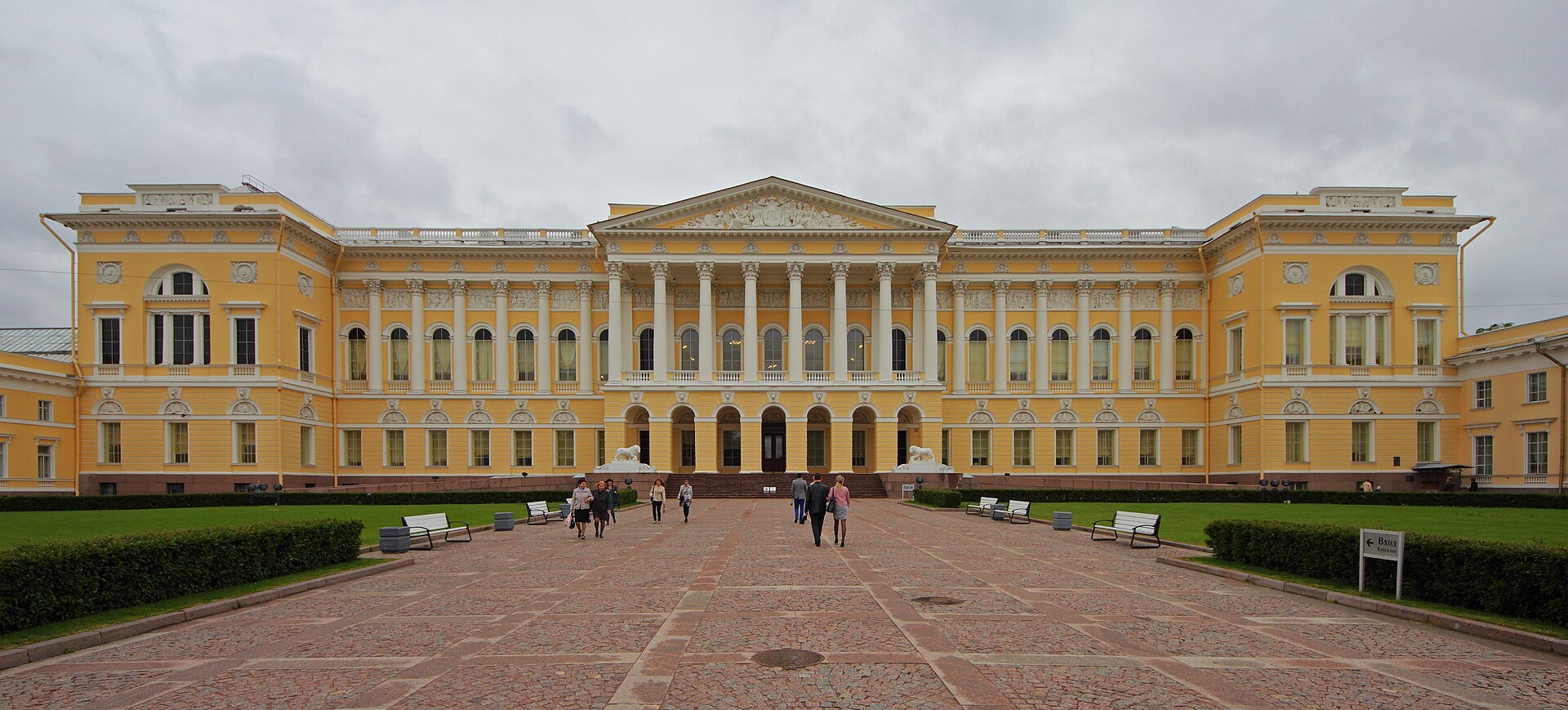
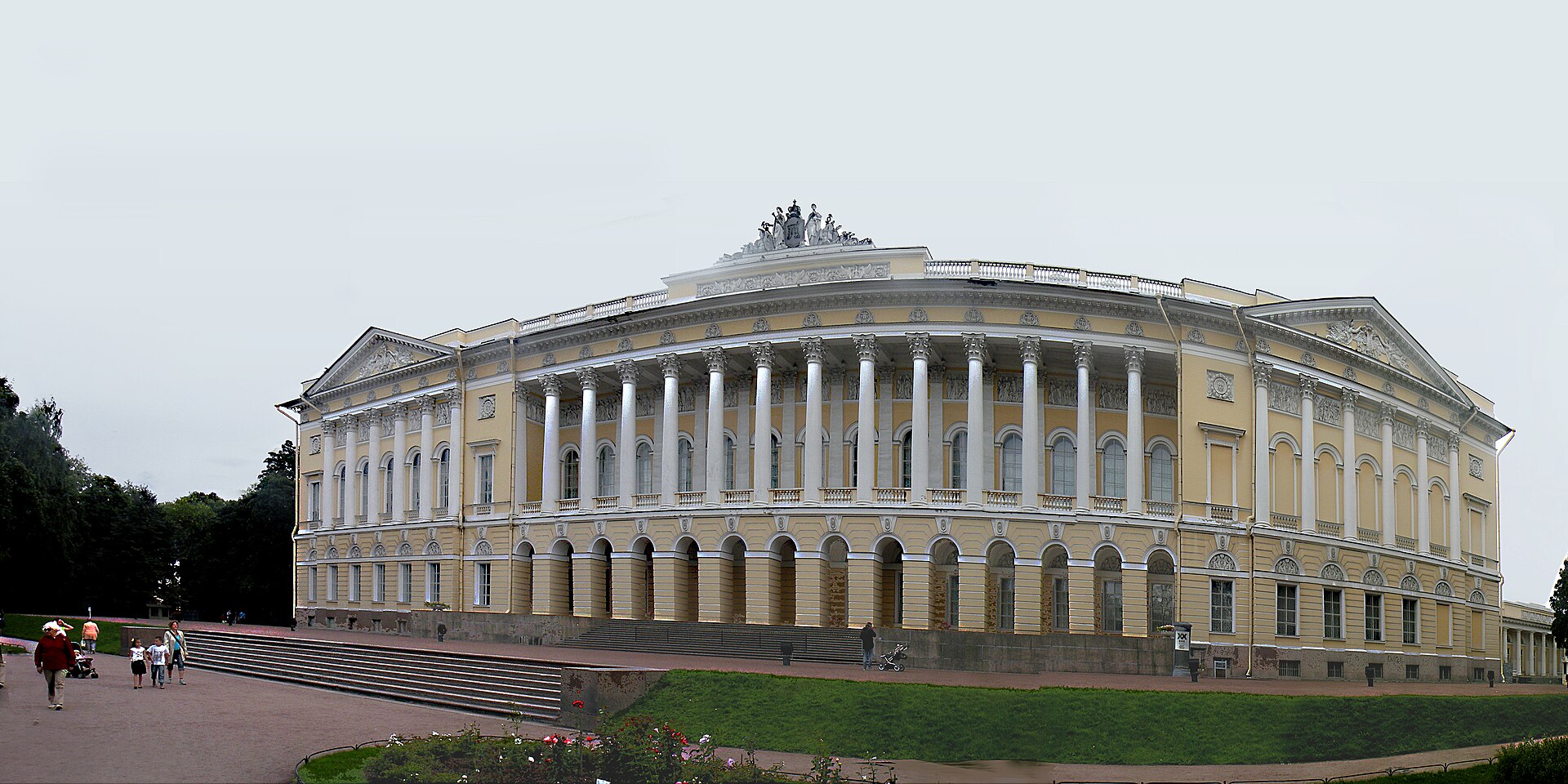
The Mikhailovsky Palace on Arts Square, Saint Petersburg, designed by Carlo Rossi and completed in 1825; it has been the main building of the Russian Museum since 1898. Photographed May 2012 at coordinates matching this building.
A.Savin, CC BY-SA 3.0The Russian Museum
Museum · Gosudarstvennyi Russkii muzei · Founded 1895
Open, admission and hours confirmed 25 August 2026 · 11 sources
On this page 17 sections
ContentsClose
The Russian Museum's case for itself is completeness rather than any single masterpiece: it is the only museum built specifically to hold the full run of Russian art in one place, from medieval icons through to the Soviet avant-garde, in a country where most comparable holdings are split between Moscow's Tretyakov Gallery and Saint Petersburg's own Hermitage, whose collecting has always been international rather than national. Its strongest ground is the 19th century - the Bryullov, Repin, Aivazovsky and Kuindzhi canvases that most visitors come to see - and the roughly 6,000-strong Old Russian icon collection that opens the chronological display. Its avant-garde holdings, built almost entirely from post-1917 nationalisations rather than purchase, are a secondary but genuine strength, concentrated in the Benois Wing.
| Local name | Gosudarstvennyi Russkii muzei |
|---|---|
| Kind | Museum |
| Founded | 1895 |
| City and country |  Saint Petersburg, Russia Saint Petersburg, Russia |
| Address | 4 Inzhenernaya Street, Saint Petersburg, Russia |
| Website | en.rusmuseum.ru |
| Status | Open, confirmed |
| Record last verified |
Visiting
- Hours
- Monday, Wednesday-Sunday10:00 to 20:00Mikhailovsky Palace, the museum's main building
- Closed
- Tuesday.
- Admission
- Adult, complex entrance ticket (Mikhailovsky Palace, first and second floor permanent collection, plus the temporary Peredvizhniki exhibition)RUB 700Booked by date and half-hour time slot on the museum's own ticketing site; each slot is capped (observed at 80 to 100 tickets per half-hour on 25 August 2026). Price, what is bundled, and the ticket type itself vary by building (Mikhailovsky Palace, the Benois Wing, the Marble Palace, St Michael's Castle and the Stroganov Palace are ticketed separately) and by which temporary exhibition is running, so this figure describes one specific ticket, not a flat museum-wide entry fee.
- Tickets
- ticket.rusmuseum.ru/?lang=en The museum's own ticket page.
- Do I need to book?
- Not required to enter, but the museum sells only timed, dated tickets through its own site, and popular routes sell out: a complex ticket covering the Mikhailovsky Palace's two floors plus a Bryullov-anniversary exhibition was capped at 80 to 100 tickets per half-hour slot when checked on 25 August 2026.
- Address
- 4 Inzhenernaya Street, Saint Petersburg, Russia MapMetro Gostiny Dvor or Nevsky Prospekt stations, both about a 10-minute walk from the Mikhailovsky Palace
- Website
- en.rusmuseum.ru
- Telephone
- +7 812 595-42-48
Before you go how long, access, photography, bags, eating, shop
- How long to allow
- Independent travel guides recommend at least half a day for the Mikhailovsky Palace's permanent collection alone. The museum's other buildings keep their own hours and, in most cases, their own ticket, so covering more than one branch in a single day means planning around two separate opening schedules.
- Access
- The museum publishes a building-by-building accessibility page rating entrances, internal routes, toilets and parking as available, partially available or not available for each of its buildings.
- Photography
- Not stated on the museum's current English-language visitor pages at the time of this research; ask at the ticket office on arrival.
- Bags
- Not stated on the museum's current English-language visitor pages at the time of this research.
- Eating
- Not confirmed from the museum's own site during this research.
- Shop
- Not confirmed from the museum's own site during this research.
Prices and hours change. We take them from the institution's own pages and print the day we read them, and you can check the current position at the source we used. Confirm before you travel.
What is inside
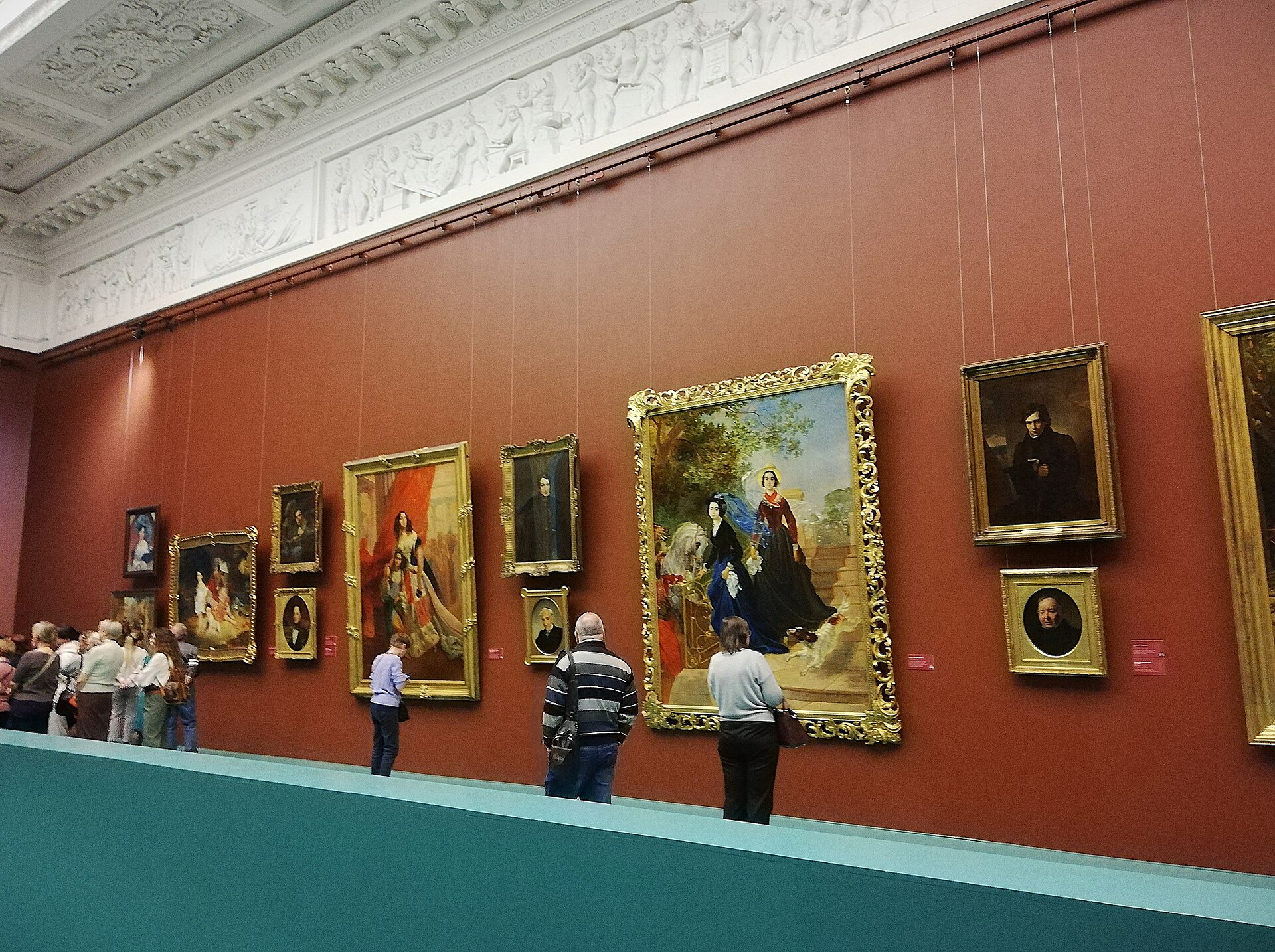
Photograph by Александровы АГ · CC BY-SA 4.0 The Mikhailovsky Palace - permanent collection
The museum's main building and its founding collection, arranged chronologically across the palace's state rooms: an Old Russian art section of roughly 6,000 icons from the 12th to 17th centuries, 18th-century portraiture and academic painting, and the 19th-century halls holding the museum's best-known paintings, including work by Karl Bryullov, Ivan Aivazovsky, Ilya Repin and Arkhip Kuindzhi. A separate permanent display covers Russian folk art of the 17th to 21st centuries.
The Benois Wing
Built onto the Mikhailovsky Palace in 1919 to the design of Leon Benois and used to extend the museum's exhibition space, the wing now carries the 20th-century and contemporary end of the collection, including the avant-garde generation - Kazimir Malevich, Wassily Kandinsky, Natalia Goncharova and Marc Chagall entered the collection through nationalisations after 1917 - and rotating loan exhibitions.
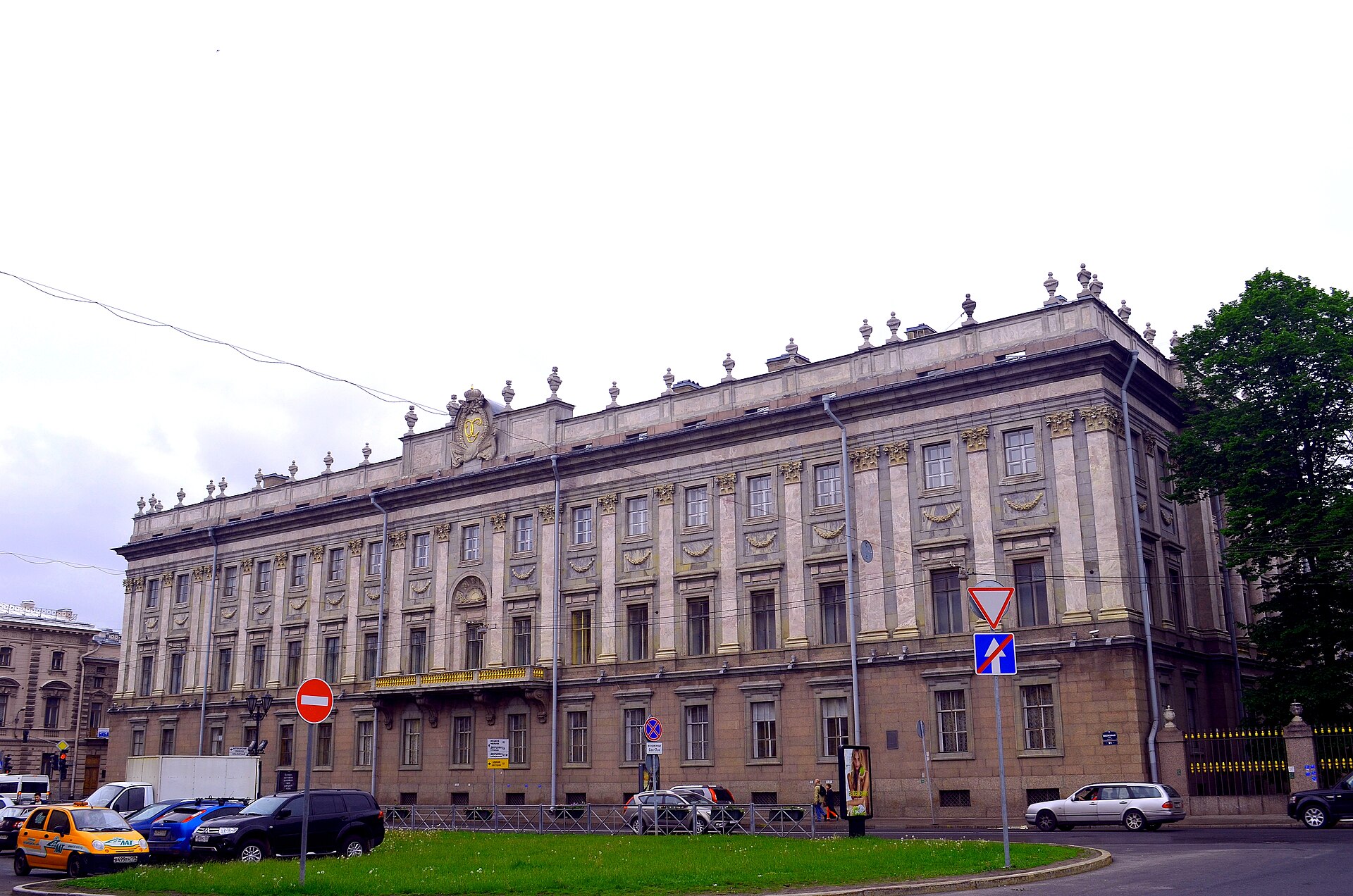
Photograph by GAlexandrova · CC BY-SA 4.0 The Marble Palace
A separate branch on Millionnaya Street, designed by Antonio Rinaldi in the 1770s and 1780s and altered by Alexander Bryullov in the 1840s. It holds the permanent Peter and Irene Ludwig gift of 20th-century Western and Soviet art and hosts the museum's temporary exhibitions of glass and contemporary work.
St Michael's (Engineers') Castle
The moated former residence of Emperor Paul I, a short walk from the Mikhailovsky Palace, houses the museum's permanent exhibition of Russian historical portraiture from the 17th to the 19th centuries, drawn from the Russian Museum's own holdings and other national collections.
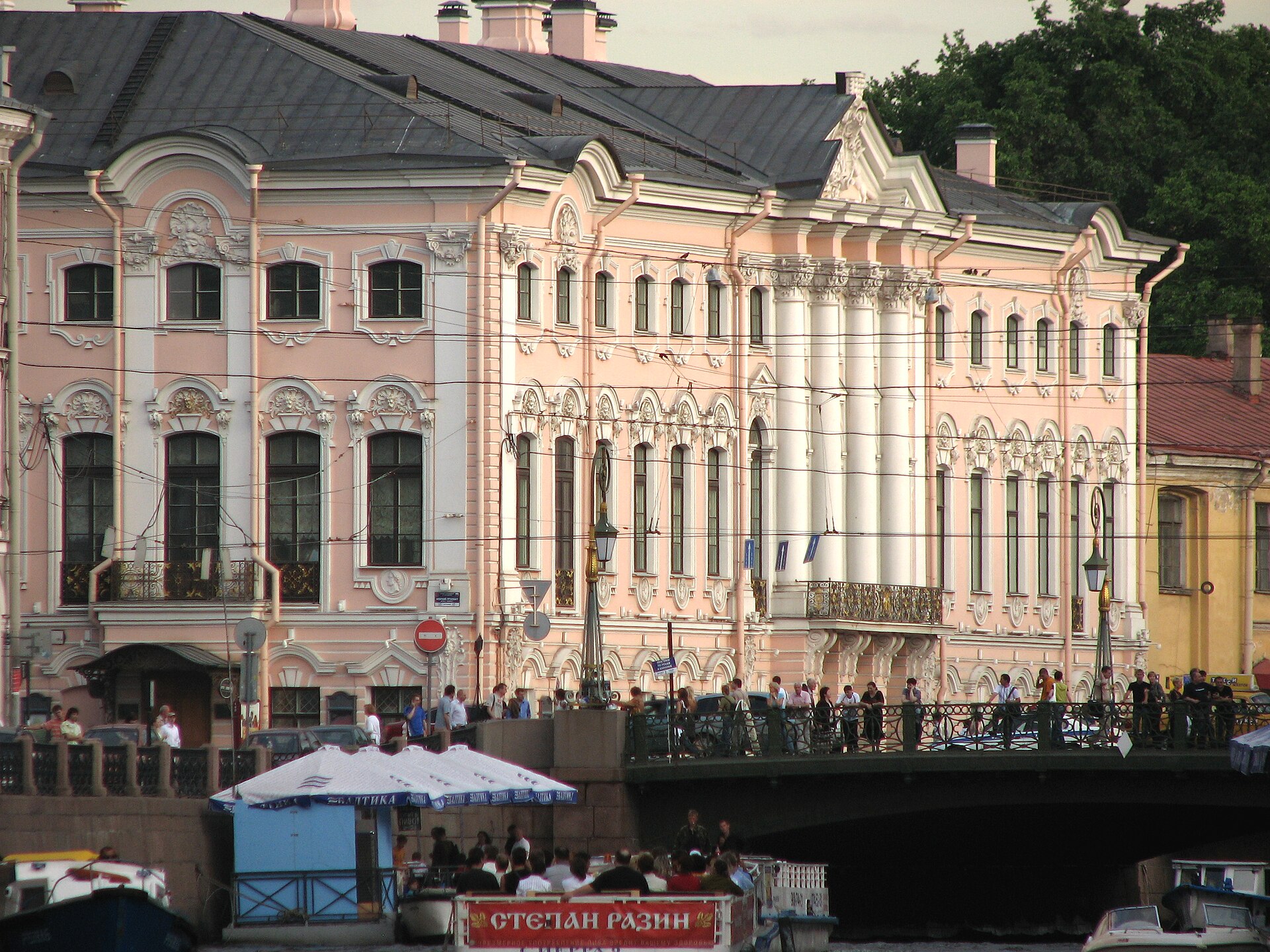
Photograph by Kor!An · CC BY-SA 3.0 The Stroganov Palace
An 18th-century Rastrelli palace on Nevsky Prospekt, used by the museum mainly for temporary exhibitions of decorative arts, glass and applied art rather than a fixed permanent display.
What to see first
The Last Day of Pompeii
Karl BryullovA monumental 1830-33 history painting that made Bryullov's international reputation and remains the single work most identified with the museum's 19th-century halls.5
The Ninth Wave
Ivan AivazovskyAivazovsky's 1850 seascape of shipwreck survivors clinging to wreckage at dawn is one of the most reproduced Russian paintings and a fixture of the permanent collection.5
Barge Haulers on the Volga
Ilya RepinRepin's 1870-73 group portrait of exhausted labourers hauling a barge upriver, a founding image of Russian Realism and social subject matter.5
Reply of the Zaporozhian Cossacks to Sultan Mehmed IV
Ilya RepinAn 1880-91 group scene of Cossacks composing a defiant, mocking letter, one of Repin's largest and most popular canvases.5
Moonlit Night on the Dnieper
Arkhip KuindzhiAn 1880 landscape whose luminous painted moonlight was famous enough in its own day to draw queues and be exhibited alone, lit, behind a curtain.5
Ceremonial Sitting of the State Council on 7 May 1901
Ilya RepinA large 1903 group portrait of the imperial State Council, painted with studio assistants from individual sittings, documenting the late-Tsarist state on the eve of its collapse.6
The Angel with Golden Hair
Unknown Novgorod icon painterA 12th-century icon fragment and one of the earliest and best-known works in the museum's roughly 6,000-piece Old Russian icon collection.4
Suprematist compositions, including Black Circle and Red Square
Kazimir MalevichCore works of Malevich's Suprematism, entering the collection through the nationalisations that followed 1917 and now anchoring the museum's avant-garde holdings in the Benois Wing.4
Exhibitions on now
- On now5 Aug to 2 Nov 2026Confirmed · check before you travel
Past exhibitions here
A grand duke's palace on Arts Square
The Russian Museum's main building was not built as a museum. Carlo Rossi designed it in the 1820s as the Saint Petersburg residence of Grand Duke Michael Pavlovich, the youngest son of Emperor Paul I, and construction began on 26 June 1819 on land near St Michael's Castle. Rossi's brief went well beyond the palace itself: he laid out a whole Empire-style ensemble around it, connecting a new square and a new street to the Grand Duke's name, with the palace as the compositional centre, flanked by two symmetrical wings - the Ladies-in-Waiting wing to the west and the Riding Hall wing to the east - and served by stables, a laundry house and a private garden running down to the Moika River.
After Michael Pavlovich's death the palace passed to his widow and then, in the second half of the 19th century, to Grand Duchess Catherine Mikhailovna, who lived there until her own death on 30 April 1894. It was her heirs' decision to sell the palace that put it, for the first time, on the market - and within a year that sale would end its life as a private residence altogether.
The state buys the palace and founds the country's first museum of Russian art
In January 1895 Emperor Nicholas II decided that the state should acquire the Mikhailovsky Palace rather than let it pass to a private buyer. On 13 April 1895 (25 April by the New Style calendar) he signed a decree founding a new institution, in his father's name: "The foundation of a special institution which will be entitled 'The Emperor Alexander III Russian Museum' and the assignment of the Mikhailovsky Palace with all its wings, services and the garden, specially acquired by the state for this purpose." Grand Duke George Mikhailovich became the museum's first director; Professor Mikhail Botkin headed the construction committee; the Academy of Arts architect Vasily Svinin carried out the conversion.
The change from ducal residence to public gallery was not cosmetic. The committee heightened doorways and passages on the lower floor, removed intercommunicating doors, stoves, fireplaces and mirrors that had no place in a museum, merged small private rooms into continuous exhibition halls, stripped out the wooden attic storeys, and built a new entrance vestibule while restoring the bas-reliefs above it. Where Rossi's original decoration served the new plan - the ceiling moldings and paintings on the piano nobile, the inlaid floors, some of the fireplaces - the committee kept it; where it did not, as in the old Dancing Room and the Big Theatre, only the room's original size and door positions survived the rebuilding, and new skylights meant filling in the windows entirely. The Committee's final inspection of the completed work took place on 28 February 1898, and the museum opened to the public the following month. It was, and remains, distinct in kind from its much larger neighbour: where the Hermitage collects internationally, the Russian Museum was founded to hold Russian art alone, and its opening collection was assembled from the Hermitage, the Alexander Palace and the Imperial Academy of Arts. After the 1917 revolution, nationalised private collections - including early Russian avant-garde painting - were added to it, reshaping what the museum could show of the 20th century.
Five buildings across the city, not one museum under one roof
A visitor arriving expecting a single building will need to recalibrate. The Mikhailovsky Palace, joined to the Benois Wing that was added onto it in 1919 to Leon Benois's design, is the largest and best-known part of the museum, but it is only the anchor of a wider complex spread across central Saint Petersburg, each part keeping its own address, its own opening hours and, in most cases, its own ticket. The Marble Palace on Millionnaya Street, built by Antonio Rinaldi in the 1770s and 1780s and altered by Alexander Bryullov in the 1840s, is a branch in its own right. So is St Michael's (Engineers') Castle, the moated former residence of Paul I on Sadovaya Street. So is the Stroganov Palace on Nevsky Prospekt, an 18th-century Rastrelli building used mainly for temporary shows of decorative art. The museum also administers Peter the Great's log cabin on the Petrovskaya Embankment, Peter I's Summer Palace, and two formal gardens - the Summer Garden and the Mikhailovsky Garden - as outdoor sculpture grounds attached to the main site. The practical consequence, visible on the museum's own booking site, is that a single day's ticket does not admit a visitor to more than one of these buildings; anyone planning to see both the Mikhailovsky Palace and, say, the Marble Palace is planning two separate visits.
From icons to the Soviet avant-garde
The collection's chronological range is the museum's own case for itself. It opens with Old Russian icon painting: around 6,000 icons from the 12th to the 17th centuries, including a 12th-century Novgorod fragment known as The Angel with Golden Hair, one of the earliest and most reproduced objects in the museum's holdings. From there the permanent display in the Mikhailovsky Palace moves through 18th-century portraiture and academic painting into the 19th-century rooms that hold the paintings most visitors come to see: Karl Bryullov's The Last Day of Pompeii, Ivan Aivazovsky's The Ninth Wave, Ilya Repin's Barge Haulers on the Volga and his Reply of the Zaporozhian Cossacks to Sultan Mehmed IV, and Arkhip Kuindzhi's Moonlit Night on the Dnieper, a landscape famous enough in its own century that it was once exhibited alone, under a spotlight, behind a curtain. A separate permanent exhibition covers Russian folk art from the 17th to the 21st centuries, roughly 1,500 objects arranged chronologically across peasant and regional craft traditions.
The 20th century, largely housed in the Benois Wing, tells a different kind of story. The nationalisation of private collections after 1917 brought Suprematist and avant-garde painting into a museum that had opened in 1898 without any of it, including Kazimir Malevich's Suprematist compositions such as Black Circle and Red Square, alongside work by Wassily Kandinsky, Natalia Goncharova and Marc Chagall. Across the whole institution, secondary sources put total holdings above 400,000 objects spanning painting, sculpture, decorative art, drawing and folk craft, though the museum's own current English-language pages do not publish a headline figure for this research to confirm directly.
Censorship in 2023, and a wider freeze since 2022
Not every recent chapter has been about acquisition. Russia's invasion of Ukraine in February 2022 was followed, within weeks, by a culture ministry moratorium on loans from Russian museums abroad, in force from 3 March 2022, and by Western institutions and the European Museum Forum suspending cooperation with Russian museums and museum professionals in turn - a freeze that cut off exactly the kind of international loan traffic a museum of this scale would ordinarily take part in.
Domestically, the museum drew sharper and more specific criticism the following year. In July 2023 the Russian Museum was due to open Klin Novikova (Novikov's Wedge), a retrospective of more than 80 works by the artist Timur Novikov and the New Academy circle he founded. The exhibition was fully mounted when, on 19 July, the day before its scheduled opening, newly appointed director Alla Manilova - a Kremlin-connected former deputy culture minister who had taken over the museum in April that year - cancelled the opening. The museum's press service blamed technical shortcomings: a lack of glass display cases for costumes, and too few works from the museum's own Novikov holdings. The show reopened a week later, on 26 July, running through 25 September, but not unchanged: a velvet phallus on a donkey costume from a Novikov theatrical production was covered, and a print by the artist Olga Tobreluts depicting Adam and Eve was withdrawn from the exhibition entirely over its nudity. Tobreluts called the museum's actions barbarism; the museum's own curator, Alexander Borovsky, told The Art Newspaper there was no political issue and that the changes were purely technical, noting that the Hermitage, the Tretyakov Gallery and the Moscow Museum of Contemporary Art had all shown Novikov's work before without incident. Other commentators read the episode as part of a broader tightening of cultural censorship inside Russia since 2022. This publication records the episode because it happened at this museum, under its own director, and was reported with her institution named - not because it is unique to Russian museums, and not as a verdict on the individual works themselves.
Busier than before the war
Isolation from Western museums has not translated into empty galleries. The Art Newspaper's annual worldwide attendance survey recorded 3.6 million visitors to the Russian Museum in 2024, an increase of close to a quarter on the year before and roughly half again on 2019 attendance, placing the museum among the ten most-visited art museums on earth for that year - ahead of institutions such as Mexico City's National Anthropology Museum and level with the Hermitage itself, which recorded a similar 3.6 million but remained further below its own pre-pandemic, pre-war numbers. Later reporting put 2025 attendance above 5 million, more than double the museum's 2019 figure. The pattern reported across Russia's federal museums generally is the same: a fall in Western tourism after 2022, offset and then overtaken by domestic demand, with international air links to the West still curtailed but visitor numbers recovering regardless.
Planning a visit
The Mikhailovsky Palace, the museum's main building and the one that holds the collection described above, keeps the same hours every open day: 10:00 to 20:00 on Monday and from Wednesday to Sunday, closed on Tuesdays. Tickets are sold online, by date and half-hour arrival slot, through the museum's own booking site rather than at a flat walk-up price; slots for popular routes are capped and can sell out, a constraint visible directly on the booking page rather than asserted by any guidebook. Independent travel guides recommend allowing at least half a day for the Mikhailovsky Palace alone, and given that the museum's other buildings are ticketed and timed separately, a visitor wanting to see more than one branch should plan for more than one visit. The museum publishes its own building-by-building accessibility ratings, covering entrances, internal routes, toilets and parking for each site, rather than a single blanket accessibility statement for the whole institution.
What visitors say
Visitors consistently rate the Russian Museum highly and describe it as a calmer, more manageable counterpart to the Hermitage a few streets away - a single coherent survey of Russian art from medieval icons to the 20th century, in a palace whose own decorated state rooms are part of the display. The most common practical complaint is not about the art itself but about scale and logistics: the museum is not one building but several separate palaces around the city, each keeping its own hours and usually its own ticket, and first-time visitors who plan for only the Mikhailovsky Palace often do not realise the Benois Wing, the Marble Palace, St Michael's Castle and the Stroganov Palace are ticketed and timed separately.
What is praised, what is criticised
- Praised: The breadth of Russian art on view in one visit, from 12th-century icons through to the 20th-century avant-garde
- Praised: The Mikhailovsky Palace's own Rossi-designed state rooms, kept largely as built rather than converted into neutral gallery boxes
- Praised: Lighter crowds and shorter queues than the Hermitage, even during peak summer travel dates
- Criticised: The museum's five separately ticketed buildings scattered across the city, which visitors say makes planning more than one branch in a day genuinely difficult
- Criticised: The museum's own 2023 handling of a retrospective of Timur Novikov and the New Academy: newly appointed director Alla Manilova cancelled the exhibition's opening a day before it was due to open, citing technical shortcomings; it reopened a week later with a costume's exposed genitals covered and a print by Olga Tobreluts withdrawn entirely, which the artist called barbarism and which several critics linked to a wider tightening of cultural censorship in Russia since 2022
Ratings on other platforms
Tripadvisor: 4.7 from 3,309 ratings, read 25 August 2026
A platform average is a tertiary source: it moves, it is not audited, and we quote no visitor's words.
Questions about The Russian Museum
Where is The Russian Museum?
4 Inzhenernaya Street, Saint Petersburg, Russia.
How much does it cost to visit?
Adult, complex entrance ticket (Mikhailovsky Palace, first and second floor permanent collection, plus the temporary Peredvizhniki exhibition): RUB 700. As confirmed 25 August 2026.
When is it open?
Monday, Wednesday-Sunday 10:00-20:00. Closed: Tuesday. As confirmed 25 August 2026.
How do you get there?
Metro: Gostiny Dvor or Nevsky Prospekt stations, both about a 10-minute walk from the Mikhailovsky Palace.
What should you see first?
The Last Day of Pompeii (Karl Bryullov); The Ninth Wave (Ivan Aivazovsky); Barge Haulers on the Volga (Ilya Repin); Reply of the Zaporozhian Cossacks to Sultan Mehmed IV (Ilya Repin); Moonlit Night on the Dnieper (Arkhip Kuindzhi); Ceremonial Sitting of the State Council on 7 May 1901 (Ilya Repin).
What we could not confirm
- Whether the museum currently offers a free-admission day (several third-party travel sites describe one on the first Wednesday of the month) could not be confirmed on the museum's own English-language pages during this research; check the Russian-language ticket rules page directly before publishing this as fact.
- Discounted admission categories (students, pensioners, large families) are referenced in general terms on the museum's own ticket rules page, citing Russian Ministry of Culture Order No. 737 of 22 June 2011, but specific discounted prices in rubles were not shown during the booking flow used for this research and so are not reported here.
- A general contact email for the museum ([email protected]) appears on multiple secondary listings but could not be verified on the museum's own current English-language site during this research; the phone numbers given above were confirmed directly on the museum's own pages.
- Photography, bag and cloakroom policy, and cafe/shop details were not stated on the museum's current English-language visitor pages at the time of this research.
Images
Sources
- 1The State Russian Museum, official website, home page, read 25 August 2026 en.rusmuseum.ru
- 2The State Russian Museum, official website, 'The Mikhailovsky Palace' visit page (hours, address, phone numbers, and the palace's history sections 'Foundation and Opening' and 'Transforming the Palace into a Museum'), read 25 August 2026 en.rusmuseum.ru/museums/mikhailovsky-palace/
- 3The State Russian Museum, official online ticketing site, Mikhailovsky Palace ticket listing and booking flow, read 25 August 2026 ticket.rusmuseum.ru/?lang=en
- 4Wikipedia, 'Russian Museum', source, read 25 August 2026 en.wikipedia.org/wiki/Russian_Museum
- 5Wikipedia, 'Collections of the Russian Museum', source, read 25 August 2026 en.wikipedia.org/wiki/Collections_of_the_Russian_Museum
- 6Russia Beyond, '25 must-see masterpieces of the Russian Museum', read 25 August 2026 rbth.com/arts/333858-petersburg-russian-museum-paintings
- 7Tripadvisor, 'State Russian Museum' listing, aggregate rating 4.7 of 5 from 3,309 reviews, read 25 August 2026 tripadvisor.com/Attraction_Review-g298507-d301191-Reviews-State_Russian_Museum-St_Petersburg_Northwestern_District.html
- 8Anny Shaw, 'Cancelled St Petersburg show honouring Timur Novikov finally opens - with censorship', The Art Newspaper, 15 August 2023 theartnewspaper.com/2023/08/15/st-petersburg-show-honouring-timur-novikov-finally-openswith-censorship
- 9'St. Petersburg's Russian Museum Cancels Opening of Works by Timur Novikov', The Moscow Times, 20 July 2023 themoscowtimes.com/2023/07/20/st-petersburgs-russian-museum-cancels-opening-of-works-by-timur-novikov-a81905
- 10'The world's most-visited museums 2024: normality returns - for some', The Art Newspaper, 1 April 2025 theartnewspaper.com/2025/04/01/the-worlds-most-visited-museums-2024-
- 11'Cultural loans and partnerships with Russia halted over war in Ukraine', Museums Association, March 2022 museumsassociation.org/museums-journal/news/2022/03/cultural-loans-and-partnerships-with-russia-halted-over-war-in-ukraine/