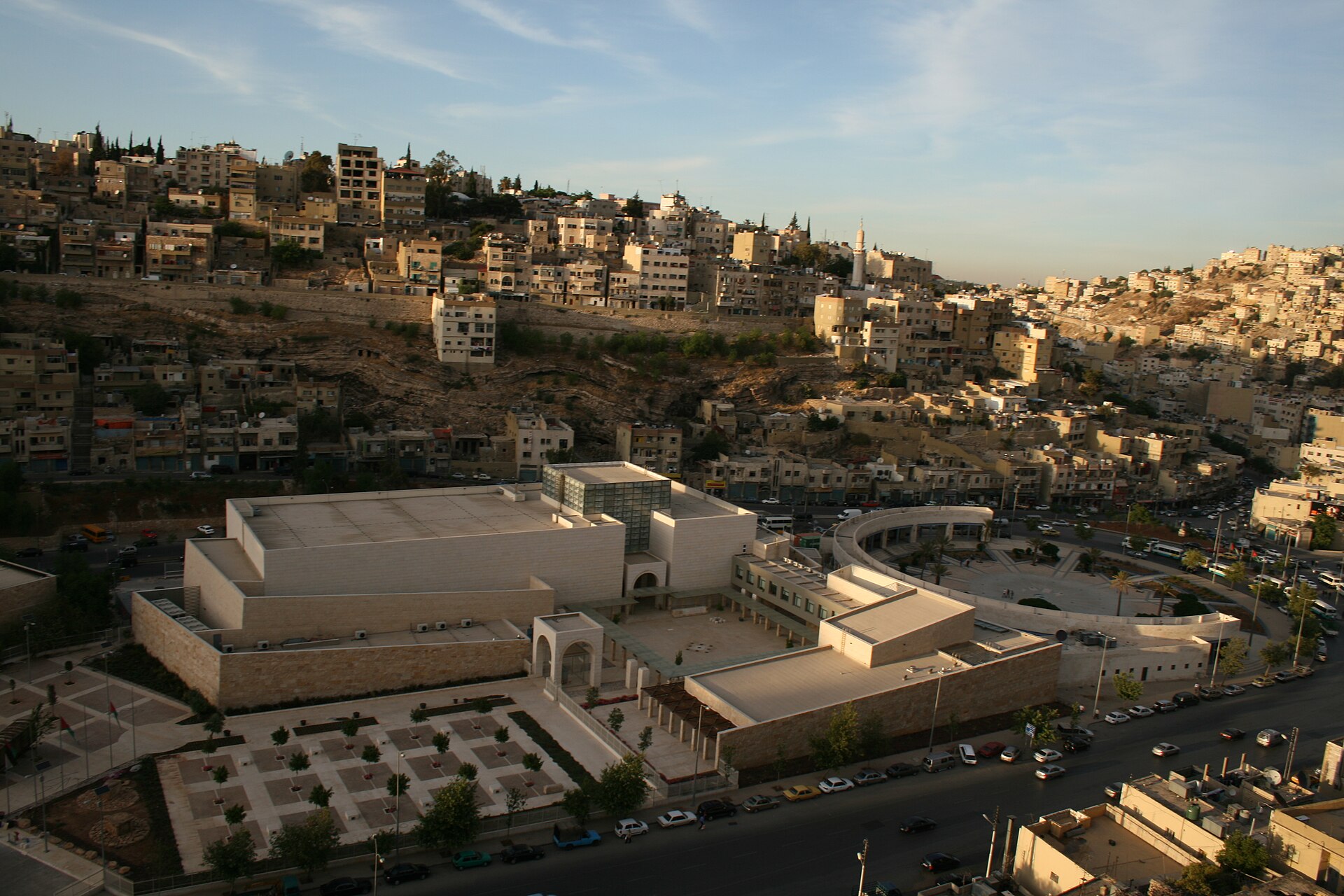
The Jordan Museum building in the Ras al-Ain district of Amman, photographed in 2011 during construction of the surrounding area and catalogued on Wikimedia Commons as depicting this museum.
Freedom's Falcon, CC BY-SA 3.0The Jordan Museum
Museum · Al-Mathaf Al-Urduni · Founded 2014
Open, admission and hours confirmed 3 September 2026 · 15 sources
On this page 13 sections
ContentsClose
The museum's comparative advantage is depth in two narrow, high-value fields: the Pre-Pottery Neolithic B period, through the Ain Ghazal statues and related plastered-skull material, and Second Temple-period Judaean manuscript culture, through the Copper Scroll and accompanying parchment fragments. Its broader chronological sweep from the Stone Age through the Ottoman period is standard national-museum coverage, useful chiefly as connective tissue between those two peaks and as an orientation for visitors moving on to Jerash, Petra or the Amman Citadel.
| Local name | Al-Mathaf Al-Urduni |
|---|---|
| Kind | Museum |
| Founded | 2014 |
| City and country |  Amman, Jordan Amman, Jordan |
| Address | Ali Bin Abi Talib Street, Ras al-Ain, Amman 11183, Jordan |
| Website | jordanmuseum.jo/en |
| Status | Open, confirmed |
| Record last verified |
Visiting
- Hours
- Sat-Thu09:00 to 17:00
- Fri15:00 to 18:00
- Closed
- Tuesday. New Year's Day (reported closed 1 January 2026 by a visitor).
- Admission
- Foreign visitorJOD 5Standard adult entrance fee for non-Jordanians; payable by cash or international bank card
- Jordan Pass holderFreeNot included: multiple visitor accounts note The Jordan Museum, unlike Petra and Jerash, is not covered by the Jordan Pass and must be paid separately
- Do I need to book?
- No advance booking reported as required; timed tickets are not mentioned by any source consulted
- Address
- Ali Bin Abi Talib Street, Ras al-Ain, Amman 11183, Jordan MapWalking A short walk from Hussein Mosque and the Al-Balad downtown district; several visitors describe it as an easy add-on to a walking tour of the Citadel and Roman Theatre area
Bus Served by the Amman Bus Rapid Transit line running through Ras al-Ain, per Wikipedia's account of the museum's setting next to the Greater Amman Municipality headquarters - Website
- jordanmuseum.jo/en
- Telephone
- +962 6 4629317
- [email protected]
Before you go how long, access, photography, bags, eating, shop
- How long to allow
- Accounts vary widely: some visitors report finishing the permanent galleries in under half an hour, others plan two to three hours, particularly if visiting the interactive Islamic-science floor with children
- Access
- Listed by the Jordan Tourism Board as accessible for people with disabilities
- Photography
- General photography is permitted through most of the museum, but one visitor account reports photography of the Dead Sea Scrolls display specifically is not allowed
- Bags
- Not documented in sources consulted
- Eating
- No cafe or refreshment area on site, per visitor accounts; nearby restaurants in Ras al-Ain and downtown Amman are within walking distance
- Shop
- Interactive terminals let visitors print their name transliterated into ancient scripts as a souvenir, per a 2025 visitor account; no dedicated museum shop is described in the sources consulted
Prices and hours change. We take them from the institution's own pages and print the day we read them, and you can check the current position at the source we used. Confirm before you travel.
What is inside
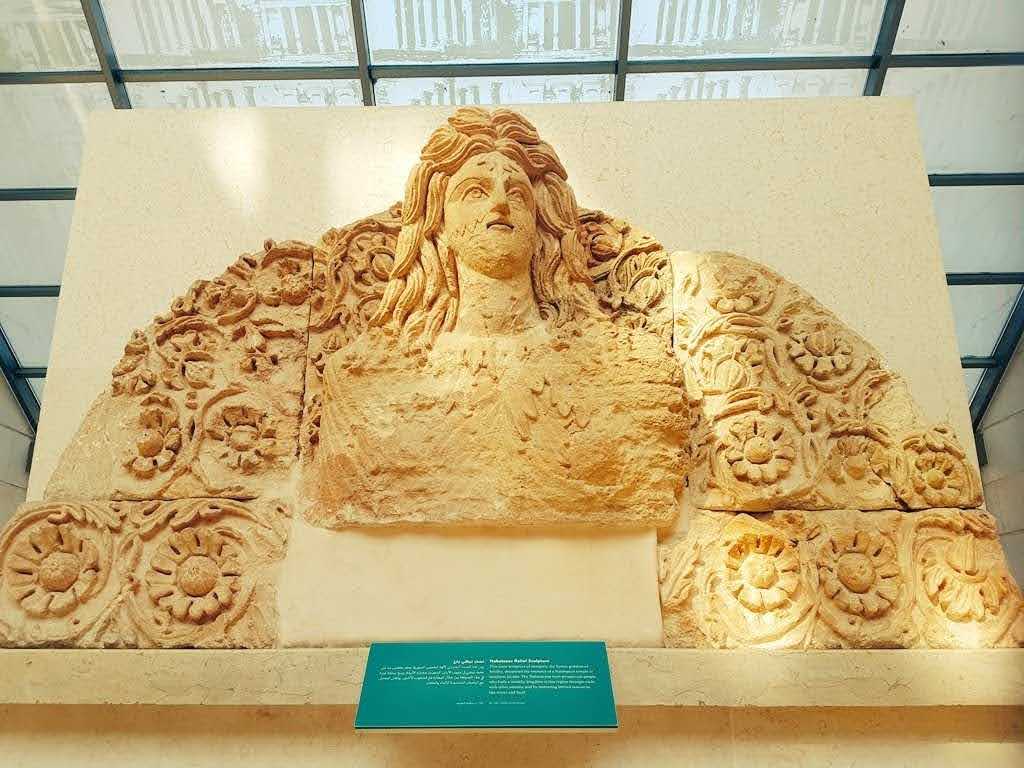
Photograph by Kariman Mango · CC BY-SA 4.0 Entrance Hall
The orientation space visitors pass through first, featuring the Vegetation (Vegetal) Goddess relief from the Nabataean temple at Khirbet al-Tannur and the Al-Muwaqqar Capital, according to the museum's own chapter breakdown as recorded by Art Destination Jordan
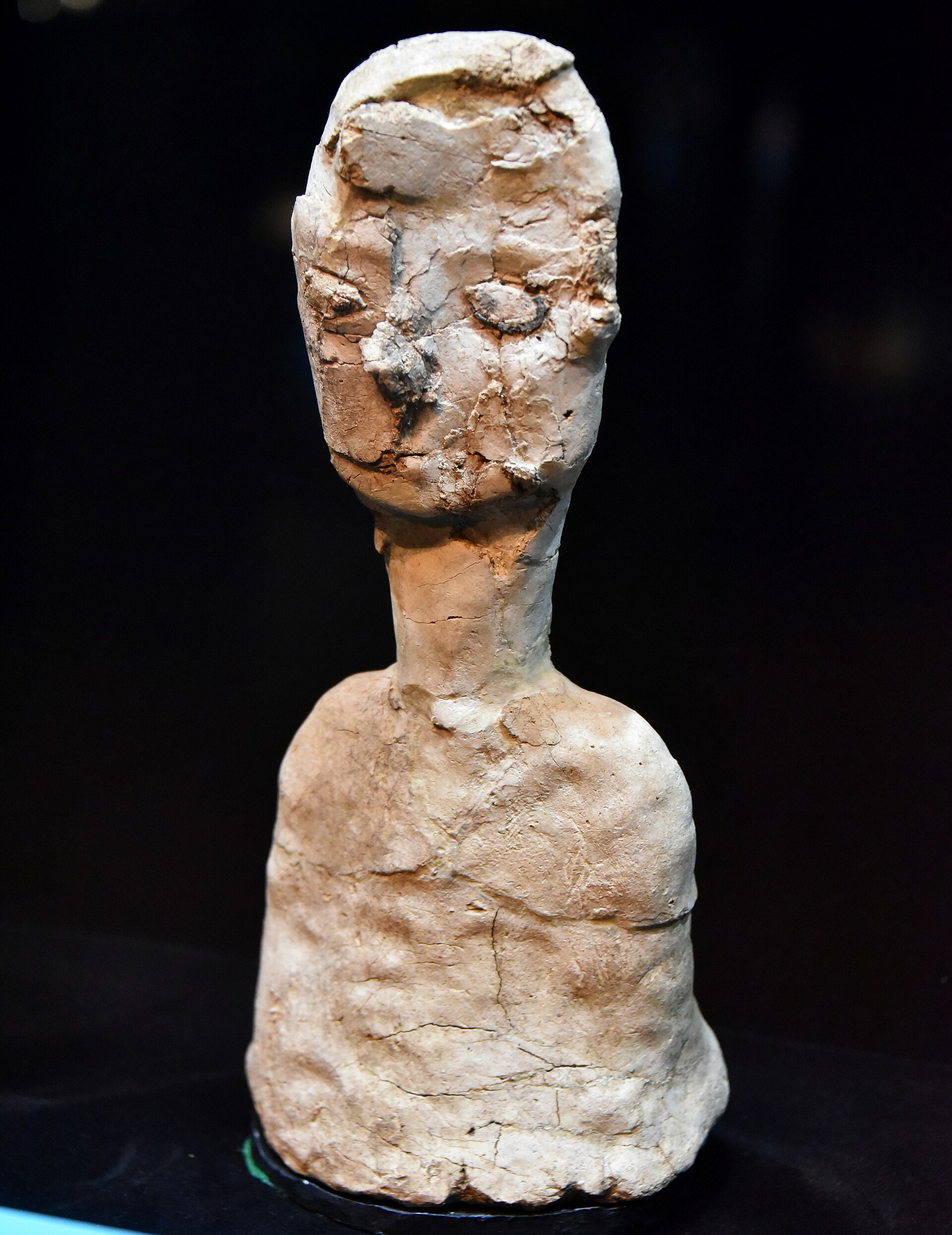
Photograph by Neuroforever · CC BY-SA 4.0 Ain Ghazal Statues Gallery
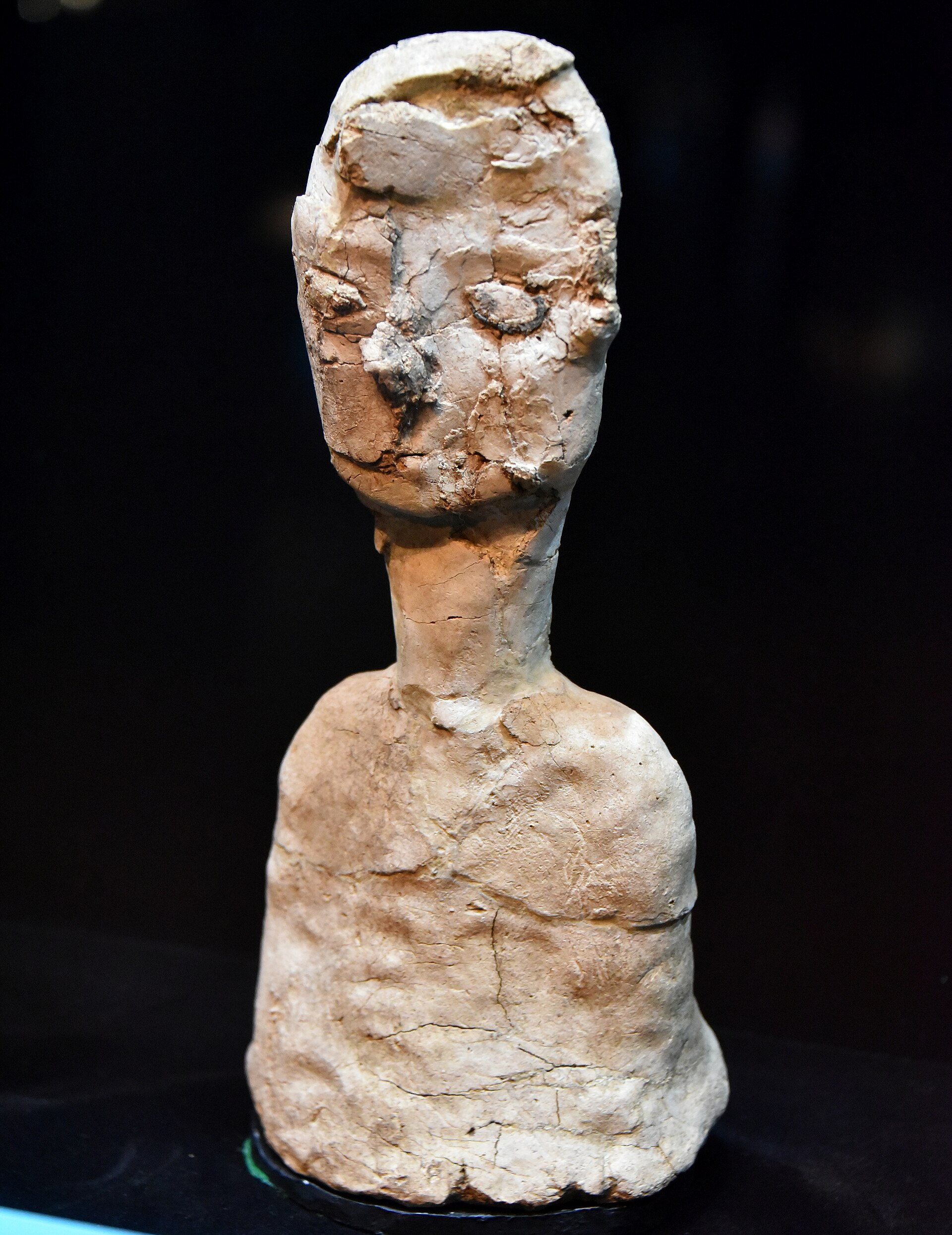
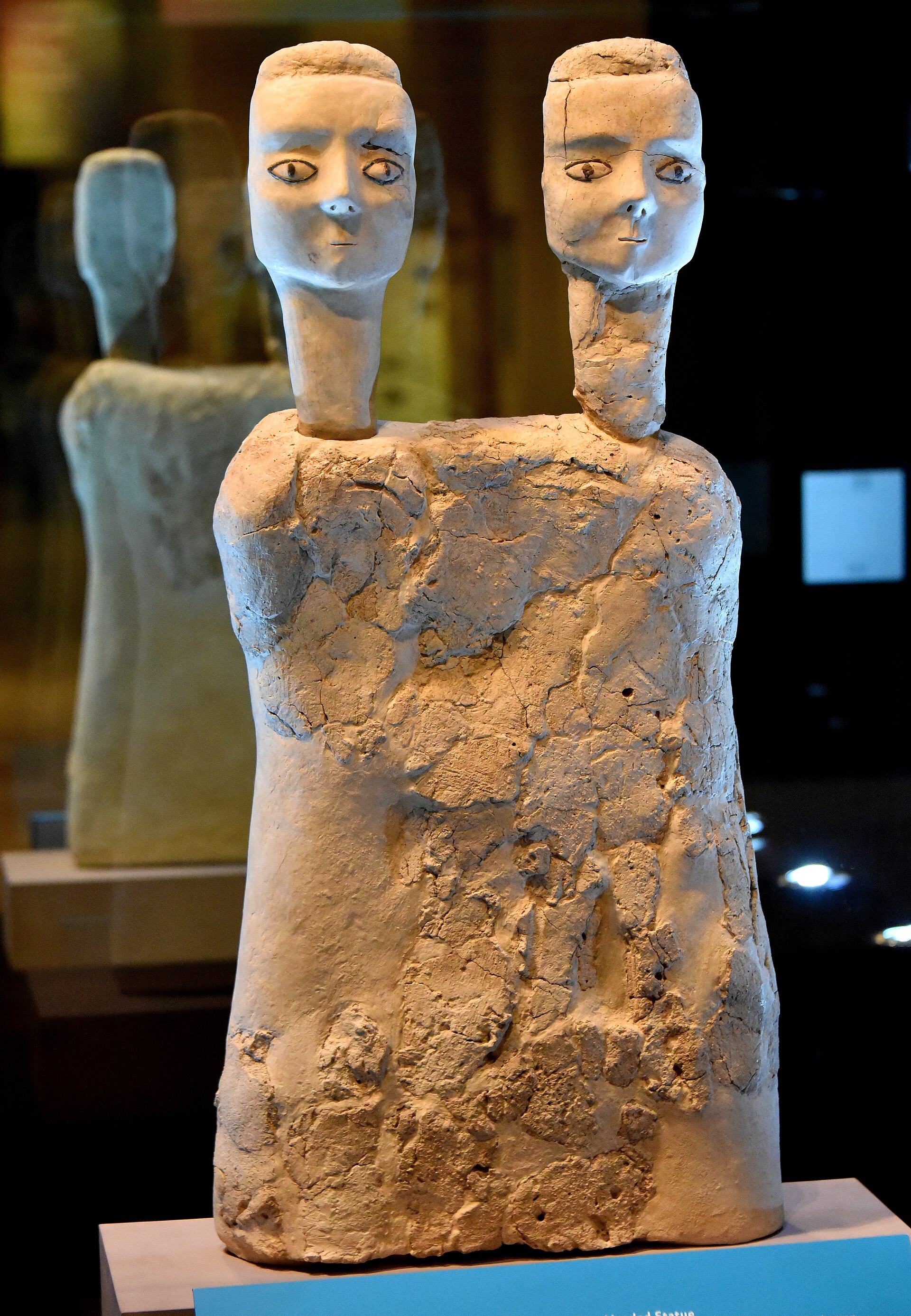
A dedicated hall for the Neolithic lime-plaster and reed statues excavated at the Ain Ghazal site on Amman's outskirts in 1983 and 1985 - among the earliest large-scale human figures yet found, dated by Art Destination Jordan's cataloguing to roughly 8,700-8,500 years ago, with individual figure captions on Wikimedia Commons placing specific statues around 7700-7500 BCE
Stone Ages and Nomadic Culture Halls
Material spanning roughly 12,500 BC through the Late Chalcolithic, followed by a section on Bedouin material culture and rock inscriptions, per the museum's chapter list as recorded by Art Destination Jordan
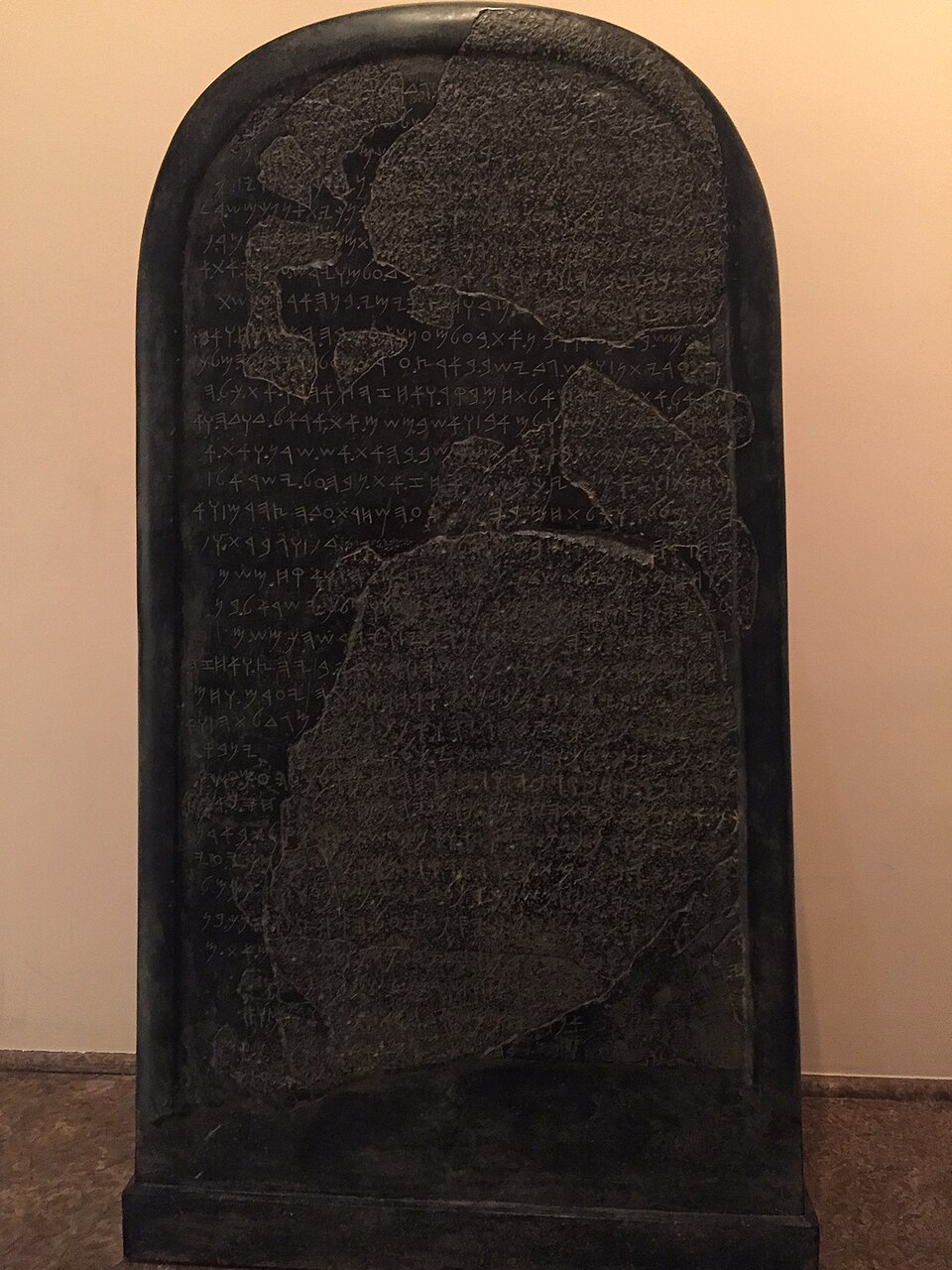
Photograph by Mervat Salman · CC BY-SA 4.0 Bronze and Iron Ages Hall
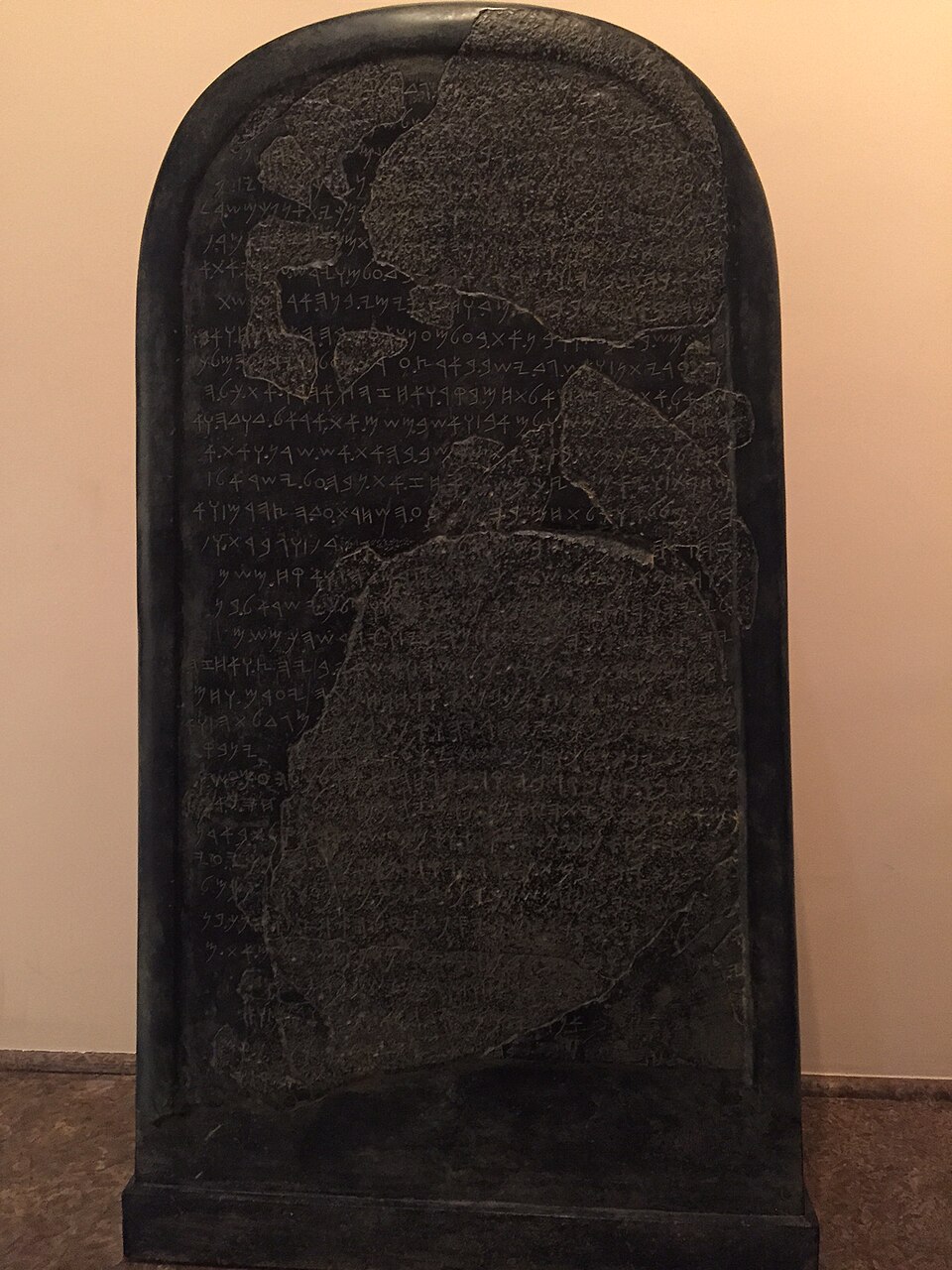
Artefacts from roughly 3600 BC to 332 BC, including the Balu'a Stele with its Egyptian-style hieroglyphic inscription and a cast of the Mesha Stele - the museum's own reproduction, made by the Louvre, of the 9th-century BC Moabite inscription whose original stands in Paris
Hellenistic, Nabataean, Roman and Byzantine Halls
Material from Iraq al-Amir and Qasr al-Abd for the Hellenistic period (3rd-1st century BC), a Nabataean hall drawing on multiple sites, then Roman-period material to the 4th century CE and Byzantine-period material up to the Muslim conquest of 636 CE, per the museum's own chapter breakdown
Photograph by Neuroforever · CC BY-SA 4.0 Dead Sea Scrolls Hall
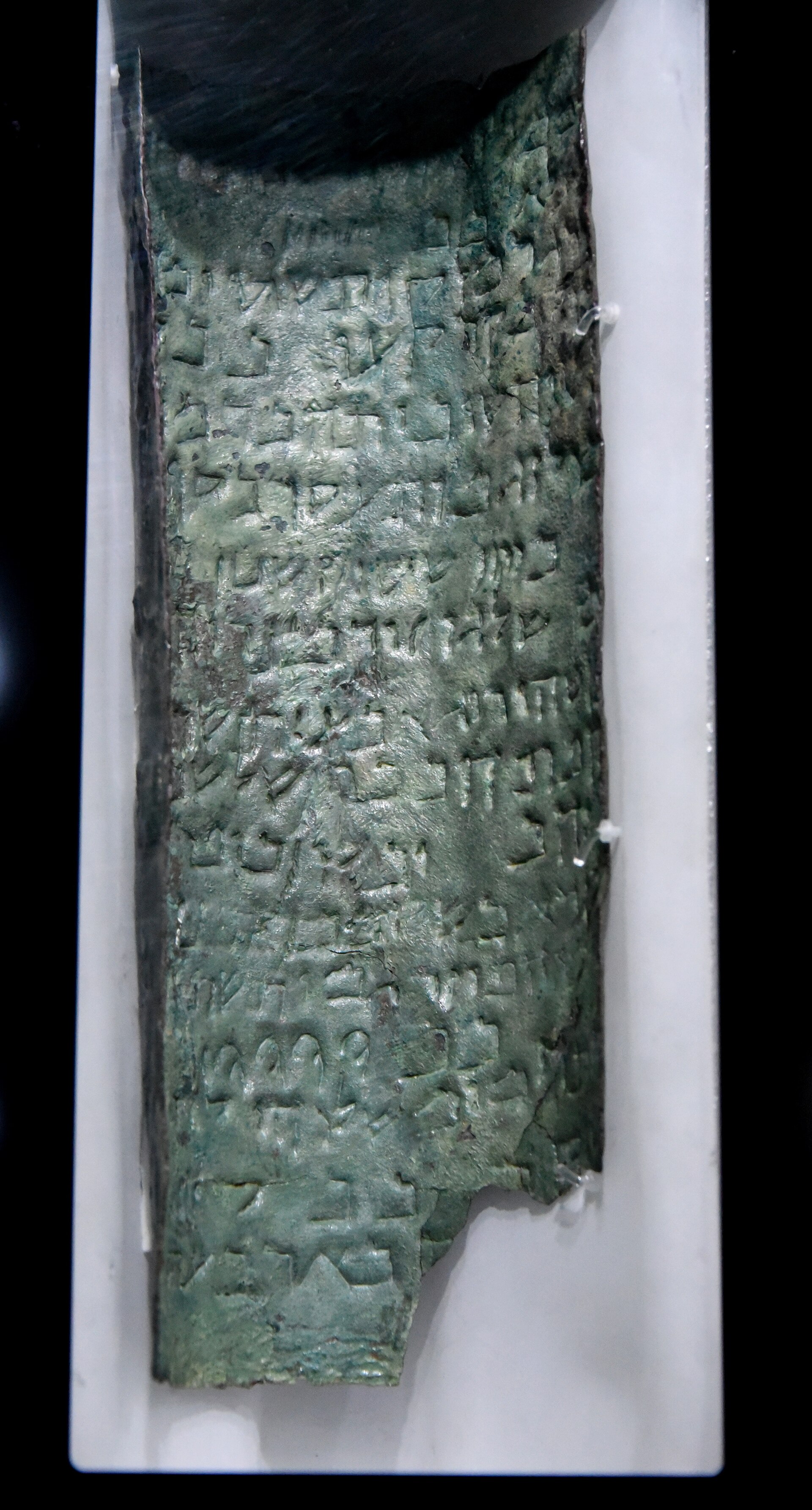
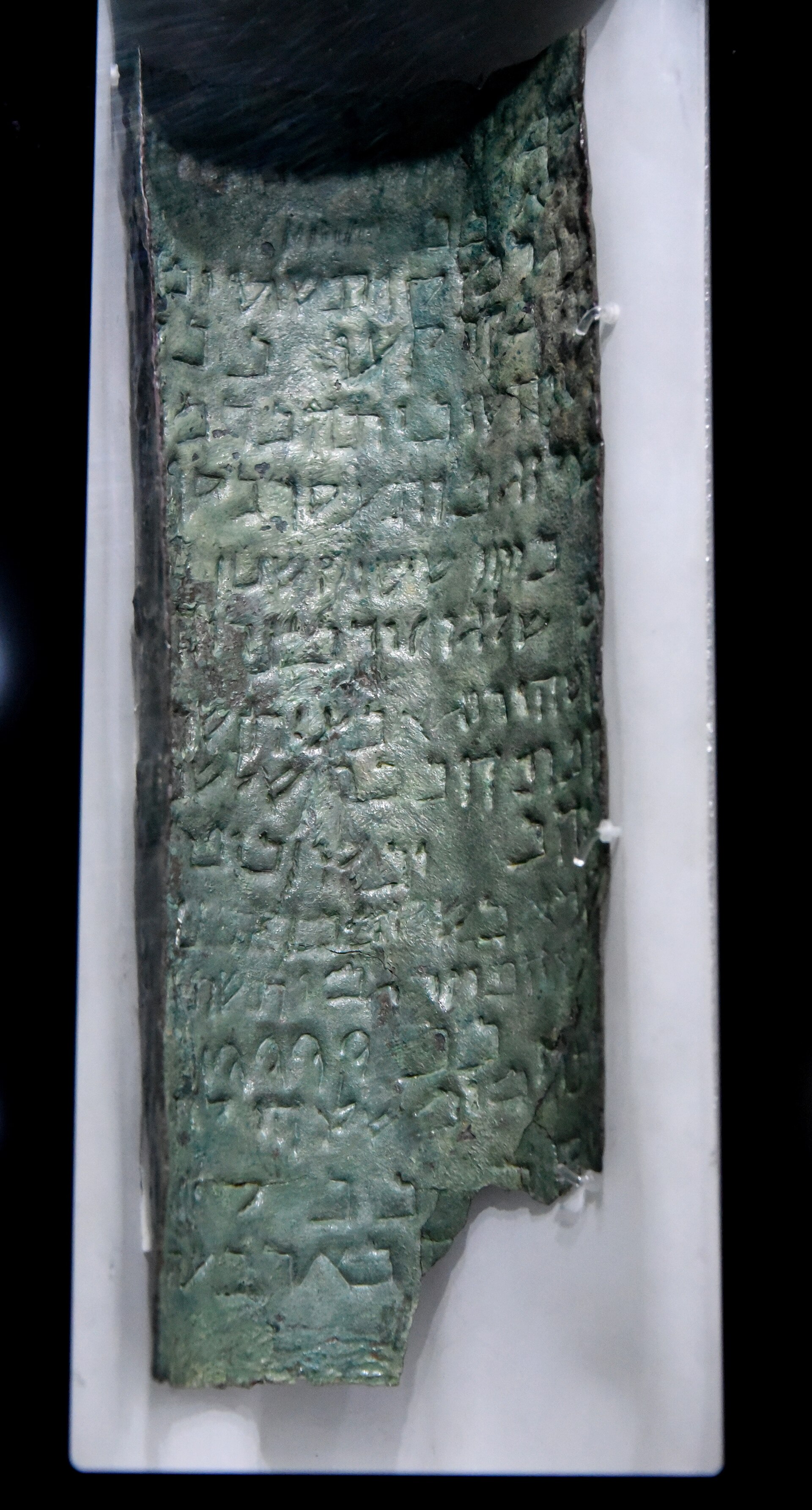
A climate-controlled hall built around two sections of the original Copper Scroll from Qumran Cave 3 - the only Dead Sea Scroll made of metal, inscribed on copper sheeting in the 1st century CE - alongside parchment and papyrus fragments including a Pesher Isaiah scroll and other texts from Qumran Cave 1 and Cave 4, spanning the 3rd century BC to the 1st century AD in Hebrew, Aramaic, Greek and Nabataean
Golden Age of Muslim History exhibition
An interactive upper-floor exhibition on roughly 1,000 years of scientific and technological achievement in the Islamic world, aimed particularly at school-age visitors; described by multiple 2025-2026 visitor accounts as playful and hands-on
What to see first
The Ain Ghazal statues
Unknown Neolithic craftworkers, Ain GhazalLime-plaster and reed figures excavated on Amman's outskirts in 1983 and 1985, among the oldest known large-scale human statues in the world; the Jordan Tourism Board dates them to roughly 9,700 years old, while Art Destination Jordan's more detailed cataloguing places the two votive deposits at about 8,700 and 8,500 years ago5
The Copper Scroll
Unknown scribe, Qumran communityThe only Dead Sea Scroll inscribed on metal rather than parchment or papyrus; two of its original copper strips, listing hidden caches of treasure, moved here in 2013 from the old Jordan Archaeological Museum on the Citadel and are shown in their own climate-controlled case12
Dead Sea Scrolls parchment and papyrus fragments
Unknown scribes, Qumran communityFragments including a Pesher Isaiah commentary and material from Qumran Caves 1 and 4, among the oldest surviving copies of biblical books and related religious writing, shown alongside the Copper Scroll11
The Mesha Stele (replica)
Cast produced by the Musee du Louvre, after the original commissioned by King Mesha of Moab, 9th century BCA faithful cast of the basalt inscription describing King Mesha's building works and military campaigns; the original stands in the Louvre in Paris, and the Jordan Museum is explicit that its own piece is a Louvre-made reproduction, not the stone itself10
The Balu'a Stele
Unknown, ancient MoabA basalt stele carved with an Egyptian-style hieroglyphic inscription and relief figures, one of the few Iron Age monumental inscriptions from Jordan on public display2
The Vegetation (Vegetal) Goddess relief
Unknown Nabataean sculptor, Khirbet al-Tannur templeA Nabataean cult relief from the temple complex at Khirbet al-Tannur, positioned in the entrance hall as one of the first objects a visitor meets7
Plastered Neolithic skulls and related Ain Ghazal material
Unknown Neolithic craftworkers, Ain GhazalCompanion material to the statues from the same Pre-Pottery Neolithic B culture, illustrating funerary practice at the site alongside the figural statues8
A museum built to replace one that had outgrown its hill
The Jordan Museum opened in Amman's Ras al-Ain district in 2014, after construction that began in 2009, according to Wikipedia's account of the institution. It was designed by the Jordanian architect Jafar Tukan (1938-2014) and, per the museum's own chapter-by-chapter description of its galleries as recorded by the reference site Art Destination Jordan, was inaugurated in 2013 ahead of a fuller public opening the following year - a soft-launch-then-formal-opening sequence common to large national museum projects, though the sources consulted here describe the two dates without reconciling them into a single official account. A joint committee headed by Queen Rania oversaw the project, which was conceived to meet international standards of climate control and object preservation that its predecessor could not.
That predecessor was the Jordan Archaeological Museum, established in 1951 on top of Amman's Citadel hill, which by the early 2000s had become too small to hold Jordan's growing archaeological collection. The Jordan Museum absorbed much of that collection - including, notably, the Dead Sea Scrolls material that had been displayed on the Citadel - while the old museum itself continues to operate separately at its original site, a fact worth stating plainly because the two institutions share enough of a name, and enough overlapping subject matter, that they are easy to conflate. This record concerns only the newer, larger institution in Ras al-Ain: The Jordan Museum, Wikidata identifier Q24521524, whose coordinates and English-language label were verified directly against Wikidata before any of the research below was undertaken.
The building itself spans close to 10,000 square metres, according to both Wikipedia and Art Destination Jordan, and sits adjacent to the Greater Amman Municipality headquarters, reachable on foot from the Citadel, the Roman Theatre and the downtown Al-Balad district, and served by the city's Bus Rapid Transit line through Ras al-Ain.
Two headline collections: Ain Ghazal and the Dead Sea Scrolls
Two holdings dominate every account of the museum consulted for this record, tourism-board listing and visitor review alike. The first is the group of statues excavated at Ain Ghazal, a Neolithic site on Amman's outskirts, during excavation seasons in 1983 and 1985. The figures are built from a reed armature covered in lime plaster, left flat because they were shaped lying on the ground, with facial features emphasised and eyes sometimes picked out in bitumen sourced from the Dead Sea. Sources differ on the precise age by a few centuries - the Jordan Tourism Board rounds the group to roughly 9,700 years old, while Art Destination Jordan's cataloguing of the two separate votive deposits places them at approximately 8,700 and 8,500 years ago, with individual object captions on Wikimedia Commons dating specific figures to about 7700-7500 BCE - but every source agrees the figures rank among the oldest large-scale human statues ever recovered anywhere. They were found buried in pairs of pits beneath the floors of long-abandoned houses, arranged with a consistent east-west orientation that, per Art Destination Jordan's account, suggests deliberate ritual placement rather than casual disposal; their exact purpose - ancestor figures, fertility images, something else - remains unresolved in the sources consulted, and this record does not resolve it either.
The second is the Dead Sea Scrolls material, most famously the Copper Scroll: two surviving strips of a scroll made from roughly 99 percent copper rather than parchment, inscribed in the 1st century CE with what reads as a list of hidden treasure caches, discovered in 1952 at the back of Cave 3 at Qumran by an archaeologist rather than by the Bedouin discoverers credited with most of the other scrolls. Wikipedia's Copper Scroll article confirms the piece moved to The Jordan Museum in 2013 from its former home at the Jordan Archaeological Museum on the Citadel, and describes it as cut into 23 strips, kept in a dedicated climate-controlled case. Alongside it, the museum shows parchment and papyrus fragments spanning the 3rd century BC to the 1st century AD in Hebrew, Aramaic, Greek and Nabataean, including a Pesher Isaiah commentary scroll and material from Qumran Caves 1 and 4, all recovered from excavations carried out, per Art Destination Jordan's account, while the West Bank was administered by the Hashemite Kingdom of Jordan.
The collection, gallery by gallery
Beyond its two best-known holdings, the museum organises its permanent display chronologically across a sequence of named halls, following the chapter structure recorded by Art Destination Jordan. Visitors enter through an Entrance Hall built around the Vegetation Goddess relief from the Nabataean temple complex at Khirbet al-Tannur and the Al-Muwaqqar Capital. From there the galleries move through the Stone Ages (roughly 12,500 BC to the Late Chalcolithic), a section on Bedouin nomadic material culture and rock inscriptions, then a Bronze and Iron Ages hall (roughly 3600 to 332 BC) that includes the Balu'a Stele - carved with an Egyptian-style hieroglyphic inscription - and the museum's cast of the Mesha Stele. A Hellenistic-period section draws on material from Iraq al-Amir and Qasr al-Abd, followed by a dedicated Nabataean hall, then Roman-period material running to the 4th century CE and Byzantine-period material to the Muslim conquest of 636 CE. The Dead Sea Scrolls hall follows. Wikipedia's summary additionally describes a Modern Jordan Gallery covering the Great Arab Renaissance through to the establishment of the present kingdom, and a Living History Gallery on rural, urban and Bedouin ways of life, traditional dress and food preparation - sections not itemised in Art Destination Jordan's chapter list, a discrepancy this record notes rather than resolves. Separately, an upper-floor exhibition on the Golden Age of Muslim History presents roughly 1,000 years of scientific and technological achievement through interactive, hands-on displays that multiple 2025 and 2026 visitor accounts single out as especially engaging for children.
What is genuine and what is a reproduction
Because two of the museum's most-discussed objects sit on opposite sides of that line, it is worth stating plainly which is which. The Copper Scroll strips and the accompanying parchment and papyrus Dead Sea Scroll fragments on display are the originals, moved here from the Citadel museum in 2013; this is confirmed independently by Wikipedia's Copper Scroll article and by Art Destination Jordan's gallery description. The Mesha Stele, by contrast, is explicitly a cast: Art Destination Jordan states directly that the piece on display is a replica produced by the Louvre, where the original 9th-century BC basalt inscription - commissioned by King Mesha of Moab and rediscovered in the 19th century - is held and exhibited. Visitors expecting to see the original Moabite Stone itself will not find it in Amman; what they will find is a faithful cast made by the institution that holds the real object.
Visiting today
The museum's own website currently displays a notice that it is going through redevelopment and directs enquiries to email or to its social media accounts rather than to a working visit-information page, a state confirmed by fetching the site directly. In the absence of that primary source, this record draws its practical details from the Jordan Tourism Board's official listing and from Royal Jordanian's own tourism guide, cross-checked against one another: both give the museum's phone number as +962 6 4629317, and the tourism board lists hours of Saturday to Thursday, 9:00am to 5:00pm, Friday 3:00pm to 6:00pm, closed Tuesdays, with wheelchair accessibility noted. A live Tripadvisor listing checked on the day of writing showed the museum open, corroborating that it continues to operate rather than having quietly closed behind an outdated website. Admission for foreign visitors is 5 Jordanian dinars as of autumn 2025, payable by cash or card; several visitor accounts specifically flag that, unlike Petra or Jerash, the museum is not included in the Jordan Pass and must be paid for separately. There is no cafe on site, and photography, while generally permitted, is reported as restricted around the Dead Sea Scrolls case specifically. One visitor recorded the museum closed on New Year's Day 2026, a single dated data point rather than a general holiday-closure policy this record can confirm from the sources at hand.
Reported visit lengths vary sharply: some accounts describe finishing the permanent galleries in under half an hour, while others recommend two to three hours, particularly for families making use of the interactive Islamic-science floor. That spread likely reflects how much of the museum a given visitor chooses to linger over rather than any inconsistency in the collection itself, but it is passed on here rather than smoothed into a single house estimate.
What visitors say
Visitors consistently describe The Jordan Museum as a well-organised, modern introduction to Jordanian history that rewards a stop either before or after seeing the archaeological sites it draws from - the Citadel, Jerash, the Dead Sea caves - and as a comfortable, air-conditioned break from the heat. The most frequently mentioned reason to go is the pairing of the Ain Ghazal statues and the Dead Sea Scrolls, both cited far more often than any other holding. A recurring qualification is that the chronological displays end well before the present day for at least some visitors, even though the museum's own programme describes a later, modern-history section, and that the museum is smaller and quicker to see than its scale on paper suggests.
What is praised, what is criticised
- Praised: Bilingual Arabic-English labelling throughout, called out repeatedly as thorough and easy to follow
- Praised: Modern, interactive presentation - QR codes, touchscreens and a name-transliteration terminal are mentioned by name in multiple 2025-2026 accounts
- Praised: The upper-floor Golden Age of Muslim History exhibition, described as engaging for children and adults alike
- Praised: A quiet, uncrowded galleries experience even at central Amman locations, noted by several 2025-2026 visitors
- Criticised: No cafe or refreshment area inside the museum, so visitors are advised to plan around that
- Criticised: Photography of the Dead Sea Scrolls display specifically is reported as not permitted, unlike the rest of the museum
- Criticised: Not included in the Jordan Pass, which several visitors flag as an unwelcome surprise given the pass covers Jordan's other major sites
- Criticised: At least one 2026 visitor found the chronological narrative stopped at the Byzantine period and felt short of a two-to-three-hour visit, finishing in under thirty minutes
Ratings on other platforms
Tripadvisor: 4.4 from 662 ratings, read 3 September 2026
A platform average is a tertiary source: it moves, it is not audited, and we quote no visitor's words.
Questions about The Jordan Museum
Where is The Jordan Museum?
Ali Bin Abi Talib Street, Ras al-Ain, Amman 11183, Jordan.
How much does it cost to visit?
Foreign visitor: JOD 5; Jordan Pass holder: free. As confirmed 3 September 2026.
When is it open?
Sat-Thu 09:00-17:00; Fri 15:00-18:00. Closed: Tuesday. New Year's Day (reported closed 1 January 2026 by a visitor). As confirmed 3 September 2026.
How do you get there?
Walking: A short walk from Hussein Mosque and the Al-Balad downtown district; several visitors describe it as an easy add-on to a walking tour of the Citadel and Roman Theatre area; Bus: Served by the Amman Bus Rapid Transit line running through Ras al-Ain, per Wikipedia's account of the museum's setting next to the Greater Amman Municipality headquarters.
What should you see first?
The Ain Ghazal statues (Unknown Neolithic craftworkers, Ain Ghazal); The Copper Scroll (Unknown scribe, Qumran community); Dead Sea Scrolls parchment and papyrus fragments (Unknown scribes, Qumran community); The Mesha Stele (replica) (Cast produced by the Musee du Louvre, after the original commissioned by King Mesha of Moab, 9th century BC); The Balu'a Stele (Unknown, ancient Moab); The Vegetation (Vegetal) Goddess relief (Unknown Nabataean sculptor, Khirbet al-Tannur temple).
What we could not confirm
- Whether the museum's own inauguration should be dated to 2013 (per Art Destination Jordan's gallery-chapter description) or 2014 (per Wikipedia's account of its official opening) is not resolved by the sources consulted; both dates appear in reputable secondary accounts without either explaining the other.
- Wikipedia's summary describes a Modern Jordan Gallery and a Living History Gallery that do not appear in Art Destination Jordan's twelve-chapter breakdown of the permanent display; whether these are later additions, differently named sections, or a discrepancy between sources was not resolved.
- The museum's own website (jordanmuseum.jo) was under redevelopment at the time of research, with no working visit-information, hours or fees pages; the practical details in this record are drawn from the Jordan Tourism Board and Royal Jordanian instead and should be re-verified once the museum's own site returns.
Images
Sources
- 1Wikidata, Q24521524 (The Jordan Museum), entity data wikidata.org/wiki/Q24521524
- 2Wikipedia, "The Jordan Museum" en.wikipedia.org/wiki/The_Jordan_Museum
- 3The Jordan Museum, official website (redevelopment notice) jordanmuseum.jo/en
- 4Wikimedia Commons, File:Jordan Museum.JPG, file information and licence metadata commons.wikimedia.org/wiki/File:Jordan_Museum.JPG
- 5Jordan Tourism Board, "The Jordan Museum" listing, museums.visitjordan.com museums.visitjordan.com/en/Museum/5
- 6Royal Jordanian, "The Jordan Museum", Explore Jordan guide rj.com/en/explore-jordan/contemporary-heritage/contemporary-heritage-inside-amman/the-jordan-museum
- 7Art Destination Jordan (universes.art), "The Jordan Museum", gallery overview universes.art/en/art-destinations/jordan/amman/museums/jordan-museum
- 8Art Destination Jordan (universes.art), "Ain Ghazal Statues" universes.art/en/art-destinations/jordan/amman/museums/jordan-museum/ain-ghazal-statues
- 9Art Destination Jordan (universes.art), "The building" universes.art/en/art-destinations/jordan/amman/museums/jordan-museum/building
- 10Art Destination Jordan (universes.art), "Mesha Stele" universes.art/en/art-destinations/jordan/amman/museums/jordan-museum/bronze-iron-ages/mesha-stele
- 11Art Destination Jordan (universes.art), "Dead Sea Scrolls" universes.art/en/art-destinations/jordan/amman/museums/jordan-museum/dead-sea-scrolls
- 12Wikipedia, "Copper Scroll" en.wikipedia.org/wiki/Copper_Scroll
- 13Tripadvisor, "The Jordan Museum" attraction page and visitor reviews tripadvisor.com/Attraction_Review-g293986-d3973096-Reviews-The_Jordan_Museum-Amman_Amman_Governorate.html
- 144traveler.me, "The Jordan Museum: the country's main historical exhibition" 4traveler.me/en/travel/amman-petra-and-wadi-rum/jordan-museum
- 15Wikimedia Commons, Category:Jordan Museum and associated file imageinfo/ (licence verification for all plates) commons.wikimedia.org/wiki/Category:Jordan_Museum
