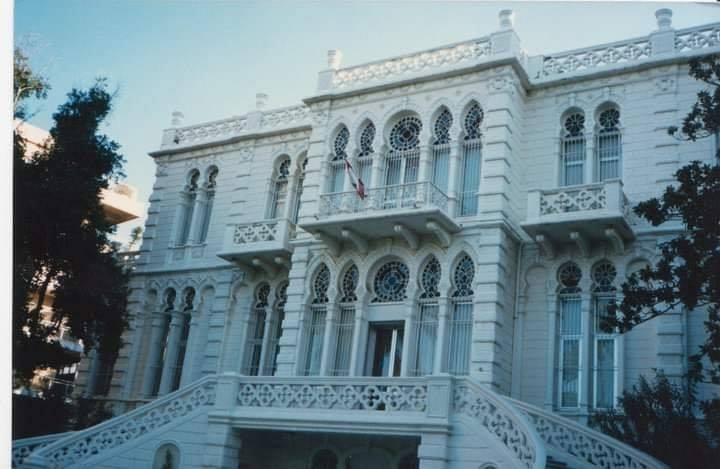
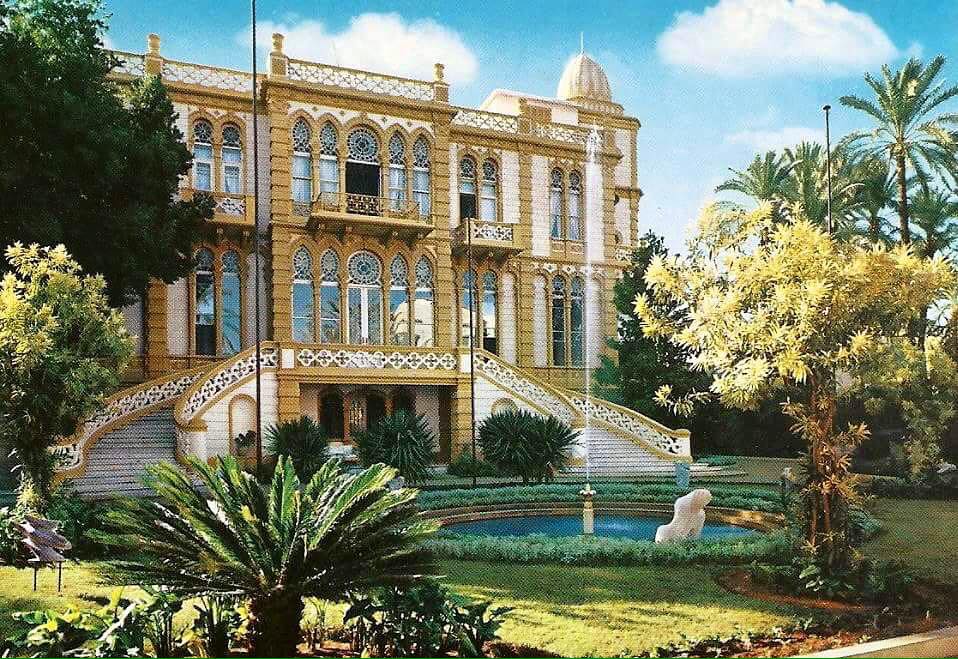
The Sursock Museum's front facade, photographed in 1963.
Public domainSursock Museum
Museum · Musee Sursock (Nicolas Ibrahim Sursock Museum) · Founded 1961
Open, admission and hours confirmed 31 August 2026 · 18 sources
On this page 15 sections
ContentsClose
The museum's real strength is depth rather than breadth: rather than a broad survey collection assembled by outside acquisition, its modern and contemporary holdings were built directly out of six decades of the institution's own Salon d'Automne exhibitions, so the collection and the museum's own exhibition history are effectively the same document. That makes it the single most complete institutional record of twentieth-century Lebanese painting and sculpture, strongest precisely where it is narrowest - Beirut and Mount Lebanon artists from the 1930s through the 1980s - rather than as a general modern-art museum competing on international names.
| Local name | Musee Sursock (Nicolas Ibrahim Sursock Museum) |
|---|---|
| Kind | Museum |
| Founded | 1961 |
| City and country |  Beirut, Lebanon Beirut, Lebanon |
| Address | Greek Orthodox Archbishopric Street, Achrafieh (Rmeil), Beirut, Lebanon |
| Website | sursock.museum |
| Status | Open, confirmed |
| Record last verified |
Visiting
- Hours
- Wed-Sun10:00 to 18:00Galleries
- Closed
- Monday. Tuesday.
- Admission
- General admissionFreeFree of charge; the museum's own visit page states no entry fee, and multiple visitor accounts describe a voluntary donation rather than a ticket price
Free entry: Every open day; the museum charges no general admission fee- Do I need to book?
- No advance booking for individual visitors; school groups and organised group tours must be booked in advance by email
- Address
- Greek Orthodox Archbishopric Street, Achrafieh (Rmeil), Beirut, Lebanon Map
- Website
- sursock.museum
- Telephone
- +961 1 202 001
Before you go how long, access, photography, bags, eating, shop
- How long to allow
- Not stated by the museum; visitor accounts describe a collection spread across several levels (two collection-gallery floors, an underground exhibition hall and a basement library), typically covered in one to two hours
- Access
- All galleries and facilities are wheelchair accessible, per the museum's own visit page
- Photography
- Non-flash still photography is permitted in the galleries for personal use only
- Eating
- A restaurant operates on the museum's esplanade; the museum store additionally functions as a small retail outlet
- Shop
- Museum Store, open Tuesday to Sunday, 10:00 to 18:00
Prices and hours change. We take them from the institution's own pages and print the day we read them, and you can check the current position at the source we used. Confirm before you travel.
What is inside
Collection Galleries, Level 1
The core of the modern and contemporary art collection: predominantly Lebanese painting, works on paper, sculpture and mixed media from the late 1800s to the early 2000s, much of it acquired through six decades of the museum's own Salon d'Automne exhibitions.
Collection Galleries, Level 2
A second run of galleries used for the museum's rotating presentations of its own holdings; as of 2026 given over to Becoming Icon, curated by Yasmine Chemali (17 July 2025 to 20 June 2027). Previously the site of the Ten Stories from the Sursock Museum Collection rehang (2018-2020), which grouped the collection by theme rather than chronology.
Oriental Collection
Islamic and late-Ottoman-era objects, together with textiles, carpets and icons, built up substantially through gifts following two exhibitions the museum itself hosted: Icones melkites (1969) and Art islamique dans les collections privees libanaises (1974). The museum's own online catalogue of this department is still incomplete.
Fouad Debbas Collection
A dedicated photography archive of more than 30,000 images of the Middle East - Lebanon, Syria, Palestine, Egypt and Turkey - dating from 1830 to the 1960s, including photographs, postcards, stereoscopic views, albumen prints, etchings and books, assembled by the collector Fouad Cesar Debbas (1930-2001) and now held by the museum.
Library and Archives
A research library of roughly 4,000 books, publications and periodicals with a searchable catalogue, plus archives of exhibition documentation, press clippings, institutional records and artist dossiers - including Nicolas Sursock's own personal archive and donated records from the Chahine Gallery and the critic Amal Traboulsi. Open to the public Wednesday to Saturday, 13:00 to 18:00; the archives themselves require an appointment.
Salon Arabe
The best-preserved room of Nicolas Sursock's original 1912 residence, kept as a period interior rather than converted to gallery space. Its carved wooden wall and ceiling panelling was imported from Damascus in the 1920s; original mansion tiling also survives on the museum's first floor.
Underground exhibition hall
A 650-square-metre hall for temporary exhibitions, built beneath the garden in the 2008-2014 expansion designed by Jean-Michel Wilmotte and Jacques Aboukhaled, which took the building from 1,500 to 8,500 square metres and added a 168-seat auditorium alongside storage and conservation facilities.
What to see first
Hommage au tapis volant
Aref el RayessAcrylic on canvas, 1965; won the Sursock Museum Grand Prize at the museum's own 5th Salon d'Automne, one of the acquisitions that built the modern collection directly out of the museum's exhibition history.5
Enfantine
Shafic AbboudOil on canvas, 1964; Grand Prize winner at the 4th Salon d'Automne and a key early work by one of the artists the museum's own 1961 opening exhibition helped launch.5
Portrait of Chaker Kanaan
Daoud CormOil on canvas on wood, late 19th century; a rare late-Ottoman-period portrait in the collection by one of Lebanon's earliest academically trained painters.5
Mount Tamalpais
Etel AdnanOil on canvas, 1985; a landscape by the Beirut-born painter and writer whose international reputation grew substantially in the decades after this work entered the collection.5
The North Wind or Composition
Seta ManoukianAcrylic on canvas, 124 x 175 cm, 1982; singled out by the museum's own Ten Stories rehang as representative of the fragmented, expressive strand of Lebanese painting that emerged around the civil war years.8
Works in the Playing with Form section
Saloua Raouda ChoucairThe museum's own Ten Stories rehang devoted a section to Choucair, the pioneering Lebanese abstract sculptor and painter whose work the museum has held and shown since the 1960s Salon d'Automne years.8
The Fouad Debbas photographic archive
Various photographers and studios, 1830-1960sMore than 30,000 images of the late Ottoman and Mandate-era Middle East, one of the largest holdings of its kind connected to a Lebanese institution and a primary source for the region's urban and social history.7
The Salon Arabe woodwork
Damascene craftsmen, 1920sHand-carved wall and ceiling panelling imported from Damascus in the 1920s and kept in situ; the clearest surviving fragment of Nicolas Sursock's original 1912 house inside a building otherwise converted to galleries.4
Past exhibitions here
The villa Nicolas Sursock built
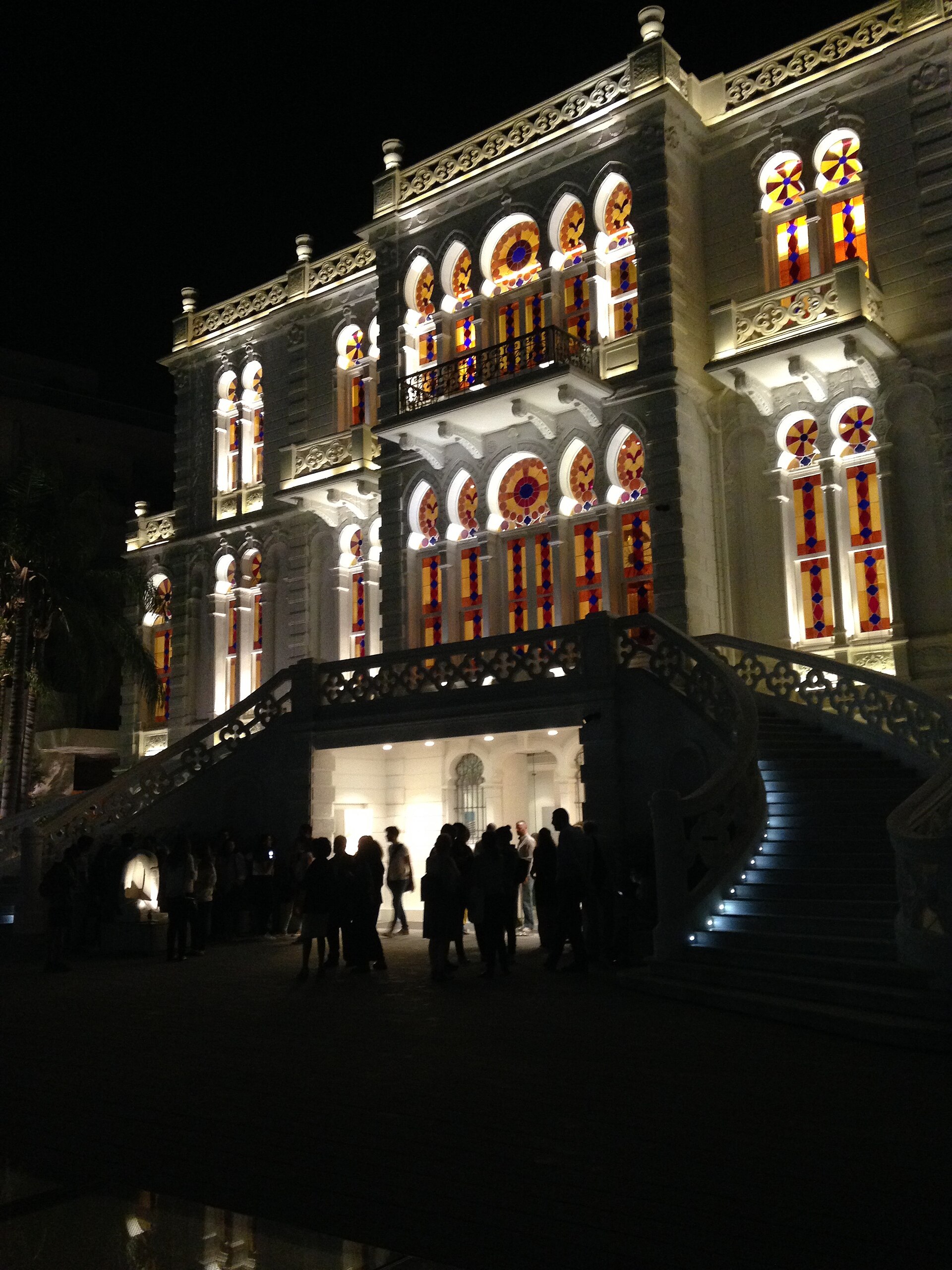
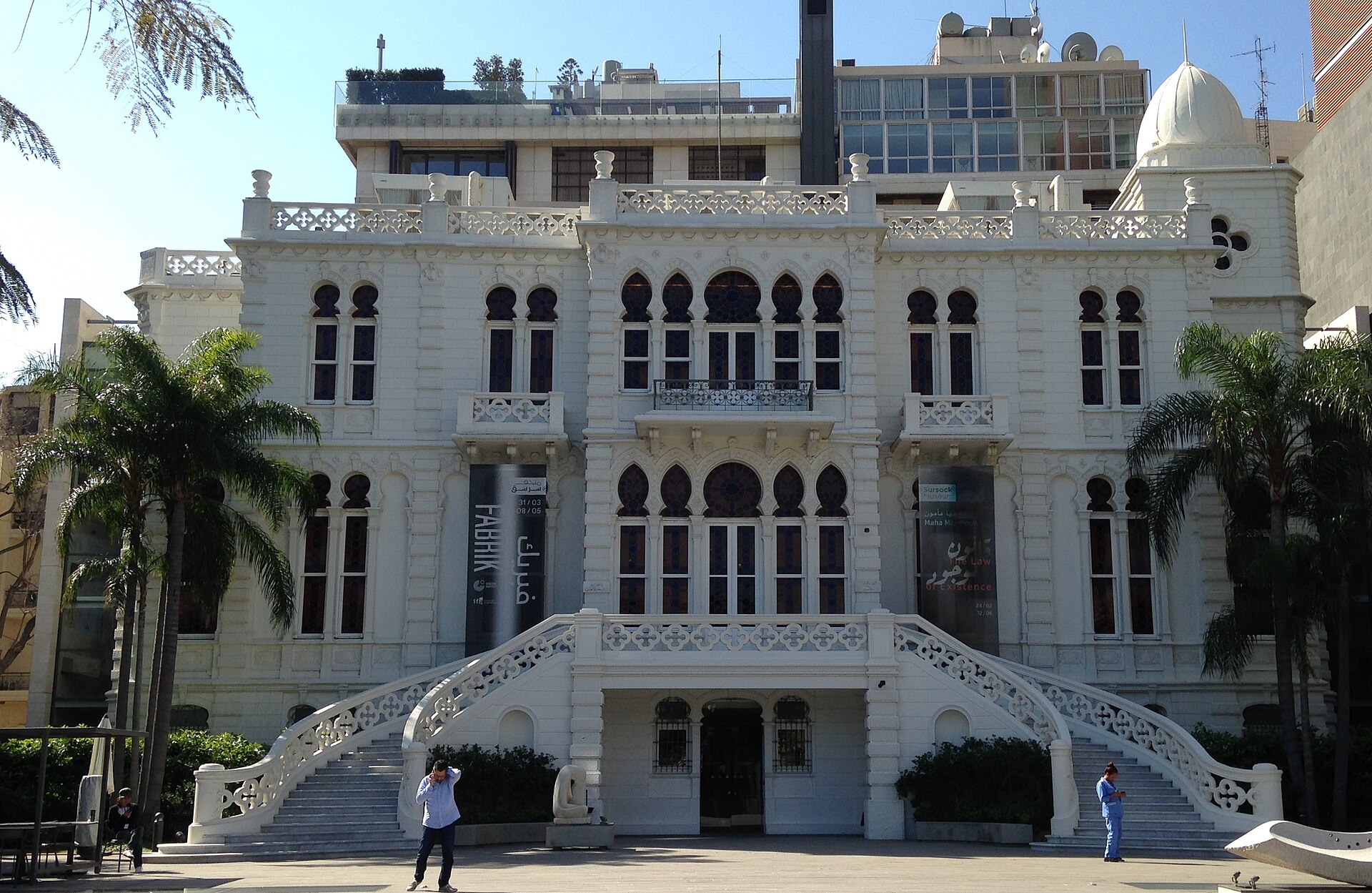
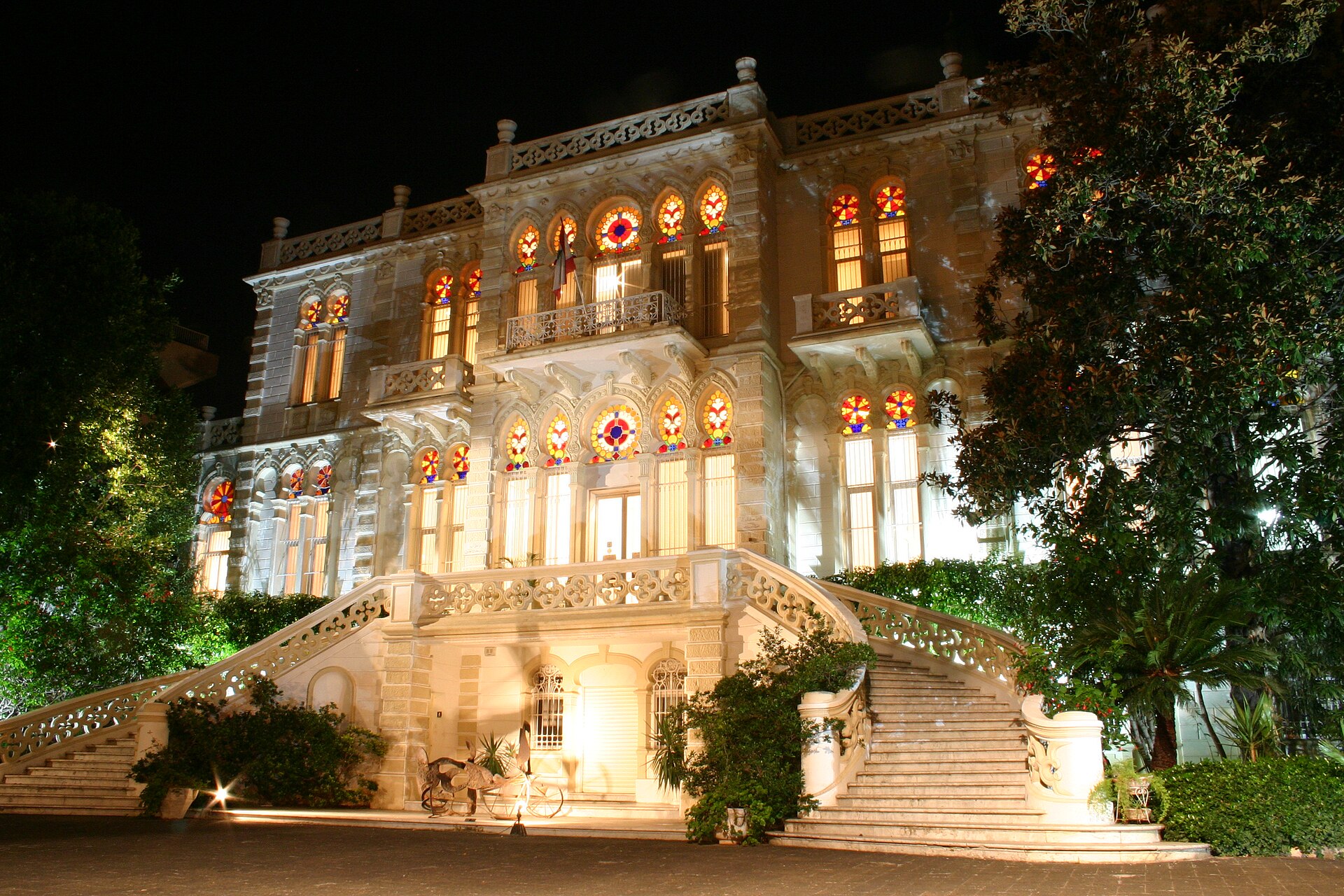
The building the museum occupies was raised in 1912 as the private residence of Nicolas Ibrahim Sursock, a member of one of Beirut's wealthiest merchant families, on Rue Sursock in the Rmeil district of Achrafieh, a street lined with other grand houses the same handful of families built in the same decades. The architecture mixes Venetian and Ottoman elements that were fashionable among Beirut's elite at the turn of the century: arched windows, small rose-window forms and white stone facades set against the dark lanes around it, features still visible on the restored exterior today. It survives as one of only a handful of villas of that generation still standing in the city, most of the rest lost to a mostly unregulated real-estate market over the following century.
Sursock never lived to see the house become a museum in the form it takes today. He died in 1952 having stipulated in his will that his estate be constituted as a waqf, an Islamic-law charitable trust adapted here to a non-Muslim family, dedicated to establishing an institution that would support Lebanese and international art. That instruction is the legal root of everything that followed: the villa was not sold, subdivided or simply inherited, it was committed by its owner to a specific public purpose before his death, which is why it could survive as a single institution through the decades of upheaval that came after.
From presidential guesthouse to public museum
The transfer of Sursock's wishes into an operating museum took nine years, and for part of that gap the building was used for something close to the opposite of what he had asked. Between 1953 and 1957, President Camille Chamoun's government converted the villa into a palais d'hotes, a state guesthouse used to receive visiting foreign dignitaries rather than the public. Later accounts of the museum's own history note this directly as a use of the palace against the wishes of the man who had left it expressly to become an art museum, not a venue for hosting politicians and diplomats.
The museum as such opened on 18 November 1961 under its first director, Amine Beyhum, inaugurated with the first edition of the Salon d'Automne, an open-call juried exhibition modelled on the nineteenth-century French salon of the same name. That first Salon, and the many editions that followed through the 1960s, became the museum's main channel for building its own permanent collection: prizewinning works from the Salon were acquired directly into the museum's holdings, among them paintings by Shafic Abboud, Etel Adnan and Saloua Raouda Choucair, then largely unknown Lebanese artists whose international reputations were built substantially in the decades after the museum first showed and bought their work.
War, expansion and the modern museum
Unlike much of Beirut's cultural infrastructure, the museum's own account states that it remained open through most of the Lebanese Civil War (1975-1990), a period in which the surrounding city was repeatedly fought over and much of its heritage housing stock was damaged or abandoned. That continuity of operation through the war years is part of why the institution is treated locally as more than a building: it kept functioning as a public space for art through the period when Beirut had the fewest of them.
In 2008 the museum closed for a major expansion, reopening on 8 October 2015 after a project designed by the architects Jean-Michel Wilmotte and Jacques Aboukhaled. The renovation took the museum from roughly 1,500 to 8,500 square metres by excavating four new floors beneath the garden, adding a 650-square-metre hall for temporary exhibitions, a 168-seat auditorium, a research library and dedicated storage and conservation facilities - infrastructure the original 1912 house never had and that turned a historic villa with galleries into something closer to a full contemporary museum operation, without demolishing or materially altering the surviving parts of the original building above ground.
The port explosion and a three-year restoration
On 4 August 2020, the ammonium nitrate explosion at the Port of Beirut, roughly two kilometres from the museum, wrecked much of the building. Contemporary reporting put the damage at around 70 percent of the structure: the museum's arched windows and stained glass were shattered, wooden panelling and walls were damaged, and 57 artworks in the collection were harmed, including a painting by Kees van Dongen among the pieces later restored. Some original fabric dating to 1912 could not be replaced at all.
The museum did not have the resources to repair itself alone. Lebanon's currency and banking collapse, which had begun before the blast, left the museum's own account stating that it operated without a single reliable source of income for two years afterward, and the museum's own materials describe zero official support from the Lebanese state itself during the rebuilding, according to the renovation's architect. The rebuild - reported variously at roughly two to three million US dollars depending on the source - was funded instead by a mix of international donors, most prominently a one-million-euro commitment from the Italian government made in May 2021, together with UNESCO and the French Ministry of Culture. UNESCO formally completed its rehabilitation project on the building, and the museum reopened to the public on 26 May 2023, drawing roughly 4,000 visitors on its first day back. UNESCO subsequently granted the museum enhanced protected status under the 1954 Hague Convention in 2024, alongside 33 other Lebanese cultural sites, during the further regional conflict of that year.
What the collection holds today
The museum organises its permanent holdings into several distinct departments rather than one continuous chronological hang. The modern and contemporary art collection is the core of the institution: works on canvas and paper, sculpture and mixed media by predominantly Lebanese artists from the late 1800s to the early 2000s, including Shafic Abboud, Etel Adnan, Assadour, Daoud Corm, Paul Guiragossian, Hussein Madi, Jamil Molaeb, Omar Onsi and Aref el Rayess, much of it acquired directly out of the Salon d'Automne exhibitions the museum itself ran for decades. A separate Oriental Collection holds Islamic and late-Ottoman-period objects together with textiles, carpets and icons, built up largely through gifts following two exhibitions the museum hosted in 1969 and 1974; the museum's own online catalogue of this department remains incomplete.
Alongside the paintings sits the Fouad Debbas Collection, a photography archive of more than 30,000 images of Lebanon, Syria, Palestine, Egypt and Turkey dating from 1830 to the 1960s - photographs, postcards, stereoscopic views and albumen prints assembled by the collector Fouad Debbas and now held and gradually being catalogued by the museum. The building itself contributes a further exhibit: the Salon Arabe, the one room of Nicolas Sursock's 1912 house kept as a period interior rather than converted into gallery space, its hand-carved wall and ceiling panelling imported from Damascus in the 1920s.
Money, priorities and what the museum's own record says
The museum does not present its recovery as uncomplicated, and its own materials are unusually candid about the trade-off the rebuilding represented. At the 2023 reopening its director, Karina Helou, addressed the scepticism directly, acknowledging that in a country in economic and political crisis some people see spending on art as a misplaced priority against more urgent needs; reporting from the reopening quoted a visitor making the same point about the contrast between a restored museum and unrepaired homes nearby. That is a real and recorded tension rather than an invented one, and it sits alongside a separate, longer-running local complaint that large private events held on the museum's forecourt bring noise and traffic to a dense residential district with little parking.
Financially, the museum's own account states that it operated without a stable source of income for the first two years after the blast, and reports that revenue then grew by 242 percent between 2023 and August 2025, evidence the institution reads as recovery rather than a fully resolved position. The museum continues to run its own fundraising campaign, branded Restore, Rebuild, Preserve, for work beyond the completed structural repair. Set against that financial history, the museum today functions as a fully operating public institution: general admission is free, its permanent departments are open on their published schedule, and its temporary exhibition programme is booked with shows running into 2027.
What visitors say
Visitors consistently describe the museum as a beautiful, carefully restored historic building - Venetian and Ottoman in style - that houses a genuinely deep collection of Lebanese modern art built up over more than sixty years, and rate the free admission as exceptional value for a museum of this quality. The dominant note across recent reviews is relief and pride that the institution survived the 2020 port explosion and reopened intact.
What is praised, what is criticised
- Praised: the restored 1912 building itself - its facade, staircase and the surviving Salon Arabe woodwork
- Praised: the depth and coherence of the Lebanese modern art collection, built directly out of the museum's own Salon d'Automne exhibition history rather than assembled by outside purchase
- Praised: free admission, with only a voluntary donation requested
- Criticised: some visitors and commentators have questioned why millions of dollars in international restoration funding went to rebuilding the museum while housing, water systems and other basic infrastructure in the surrounding blast-hit neighbourhoods went comparatively unfunded - a tension the museum's own director acknowledged publicly at the 2023 reopening rather than dismissed
- Criticised: residents in the surrounding Achrafieh streets have complained that large private events held on the museum's forecourt generate noise and traffic congestion in a dense district with little parking
Ratings on other platforms
Tripadvisor: 4.4 from 256 ratings, read 31 August 2026
A platform average is a tertiary source: it moves, it is not audited, and we quote no visitor's words.
Questions about Sursock Museum
Where is Sursock Museum?
Greek Orthodox Archbishopric Street, Achrafieh (Rmeil), Beirut, Lebanon.
How much does it cost to visit?
General admission: free. As confirmed 31 August 2026.
When is it open?
Wed-Sun 10:00-18:00. Closed: Monday. Tuesday. As confirmed 31 August 2026.
What should you see first?
Hommage au tapis volant (Aref el Rayess); Enfantine (Shafic Abboud); Portrait of Chaker Kanaan (Daoud Corm); Mount Tamalpais (Etel Adnan); The North Wind or Composition (Seta Manoukian); Works in the Playing with Form section (Saloua Raouda Choucair).
What we could not confirm
- The museum's own online catalogue of the Oriental Collection and the Fouad Debbas Collection is stated by the museum to be incomplete, so individual objects in those departments beyond the small number illustrated on its own website cannot currently be verified or catalogued further from public sources.
- Published accounts of the cost of the 2020-2023 restoration diverge, with figures reported at both approximately two million and approximately three million US dollars across different outlets; the museum's own public materials do not give a single reconciled total.
Images
Sources
- 1Sursock Museum, official website, home page (current exhibitions listing) sursock.museum/
- 2Sursock Museum, official website, Plan Your Visit (hours, admission, contact, accessibility, photography policy) sursock.museum/content/plan-your-visit
- 3Sursock Museum, official website, History sursock.museum/content/history
- 4Sursock Museum, official website, Architecture sursock.museum/content/architecture
- 5Sursock Museum, official website, Modern and Contemporary Art sursock.museum/content/modern-and-contemporary-art
- 6Sursock Museum, official website, Oriental Collection sursock.museum/content/oriental-collection
- 7Sursock Museum, official website, The Fouad Debbas Collection sursock.museum/content/fouad-debbas-collection
- 8Sursock Museum, official website, Ten Stories from the Sursock Museum Collection sursock.museum/content/ten-stories-sursock-museum-collection
- 9Sursock Museum, official website, Help Rebuild Your Museum (restoration funding and revenue figures) sursock.museum/content/help-rebuild-your-museum
- 10Wikipedia, Sursock Museum en.wikipedia.org/wiki/Sursock_Museum
- 11Mia Alberti, "Beirut's Sursock Museum reopens three years after 2020 port blast", Al Jazeera, 6 June 2023 aljazeera.com/features/2023/6/6/beiruts-sursock-museum-reopens-three-years-after-2020-port-blast
- 12Mohamed Abi Samra, "The Sursocks of Beirut: A wasted fortune and a museum rebuilt from a deadly port blast", Al Majalla, 11 September 2023 en.majalla.com/node/299381/culture-social-affairs/sursocks-beirut-wasted-fortune-and-museum-rebuilt-deadly-port
- 13Tripadvisor, Nicolas Sursock Museum reviews and aggregate rating, read 31 August 2026 tripadvisor.com/Attraction_Review-g294005-d3292161-Reviews-Nicolas_Sursock_Museum-Beirut.html
- 14Wikimedia Commons, Category:Sursock Museum commons.wikimedia.org/wiki/Category:Sursock_Museum
- 15Wikimedia Commons, File:Sursock Museum.jpg (licence and description) commons.wikimedia.org/wiki/File:Sursock_Museum.jpg
- 16Wikimedia Commons, File:Sursock house.jpg (licence and description) commons.wikimedia.org/wiki/File:Sursock_house.jpg
- 17Wikidata, Q287360 (Sursock Museum entity data) wikidata.org/wiki/Special:EntityData/Q287360.json
- 18Sursock Museum, official website, Library and Archives sursock.museum/content/library-and-archives

