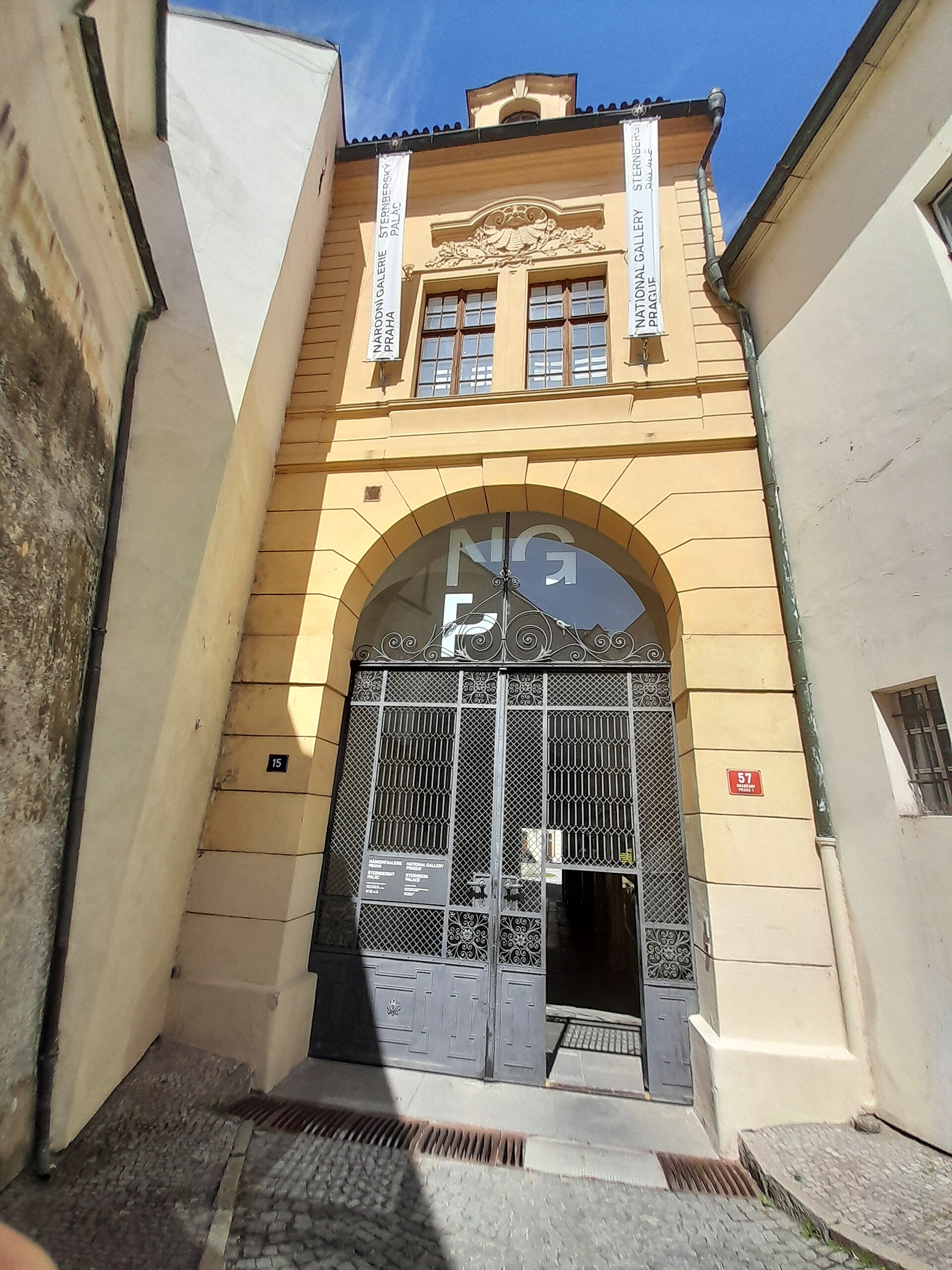
The street-facing entrance facade of Sternberg Palace on Hradcanske namesti, with National Gallery Prague banners over the gate.
CC0Sternberg Palace
Museum · Sternbersky palac · Founded 1947
Open, admission and hours confirmed 6 September 2026 · 15 sources
On this page 14 sections
ContentsClose
Sternberg Palace holds the National Gallery Prague's deepest concentration of pre-1800 European painting outside the medieval holdings at the Convent of St Agnes: an almost encyclopaedic run of German and Austrian Baroque and Renaissance art anchored by Durer's Feast of the Rose Garlands, alongside a substantial Netherlandish holding, smaller Italian, French, Spanish and English groups, and a rare collection of Russian Orthodox icons formed by the Byzantinist Nikodim Kondakov. Its strength lies in breadth across schools and centuries within a single building rather than depth in any one artist beyond Durer.
| Local name | Sternbersky palac |
|---|---|
| Kind | Museum |
| Founded | 1947 |
| City and country |  Prague, Czech Republic Prague, Czech Republic |
| Address | Hradcanske namesti 15, 118 00 Prague 1 - Hradcany, Czech Republic |
| Website | ngprague.cz |
| Status | Open, confirmed |
| Record last verified |
Visiting
- Hours
- Tue-Sun10:00 to 18:00
- Closed
- Monday. Selected public holidays each year (e.g. 1 January) - see the NGP opening-hours page for the current list.
- Admission
- AdultCZK 180Sternberg Palace (Old Masters II) single-site ticket
- ReducedCZK 100students and seniors
- School groupsCZK 60groups of 10+, ages 16 and over
- Under 16Freefree entry to permanent exhibitions
- Old Masters I and II joint ticketCZK 300combined with Schwarzenberg Palace across the square; 200 CZK reduced, 100 CZK school groups
- 10-Day PassCZK 750one entry to each NGP permanent exhibition within 10 days
- Tickets
- ngprague.cz/en/about/admission The museum's own ticket page.
- Do I need to book?
- Not required for individual visitors; tickets are sold on site and can also be booked online through NGP's own admission page
- Address
- Hradcanske namesti 15, 118 00 Prague 1 - Hradcany, Czech Republic MapMetro Line A to Malostranska or Hradcanska, then an uphill walk to Hradcanske namesti (Hradcany Square)
Tram Line 22 or 23 to Prazsky hrad, Brusnice or Pohorelec, then a short walk - Website
- ngprague.cz
- Telephone
- +420 224 301 122
- [email protected]
Before you go how long, access, photography, bags, eating, shop
- How long to allow
- About one to two hours for the permanent collection, spread over three floors reached by a monumental staircase from the courtyard; several visitors report staying much longer
- Access
- Not wheelchair accessible - stairs lead from the courtyard up to the exhibition floors
- Bags
- A cloakroom is provided for coats and larger bags
- Eating
- A small cafe on the ground floor, near the garden
- Shop
- A small museum shop selling National Gallery Prague publications and art books
Prices and hours change. We take them from the institution's own pages and print the day we read them, and you can check the current position at the source we used. Confirm before you travel.
What is inside
Sculpture and Antiquity
Ancient Greek and Roman antiquities open the display, alongside a small sculpture room that several visitors single out as a strong introduction to the Old Masters II collection.
Italian Painting, 14th-16th century
Early Italian panel painting from Sienese, Florentine, Venetian and Paduan workshops, including Lorenzo Monaco's Lamentation of Christ (1408) and Agnolo Bronzino's portrait Eleonora of Toledo (1572); much of this material entered the collection through Archduke Franz Ferdinand of Austria.
German, Austrian and Central European art, 15th-18th century
The palace's single strongest holding, running from the Rudolphine court through the reign of Joseph II. It includes Albrecht Durer's Feast of the Rose Garlands (1506), Hans Baldung Grien's Beheading of Saint Dorothy (1516), Hans Raphon's large Passion altarpiece, and Johann Spillenberger's bronze Diana and Callisto (1676).
Netherlandish, Flemish and Dutch Painting, 15th-18th century
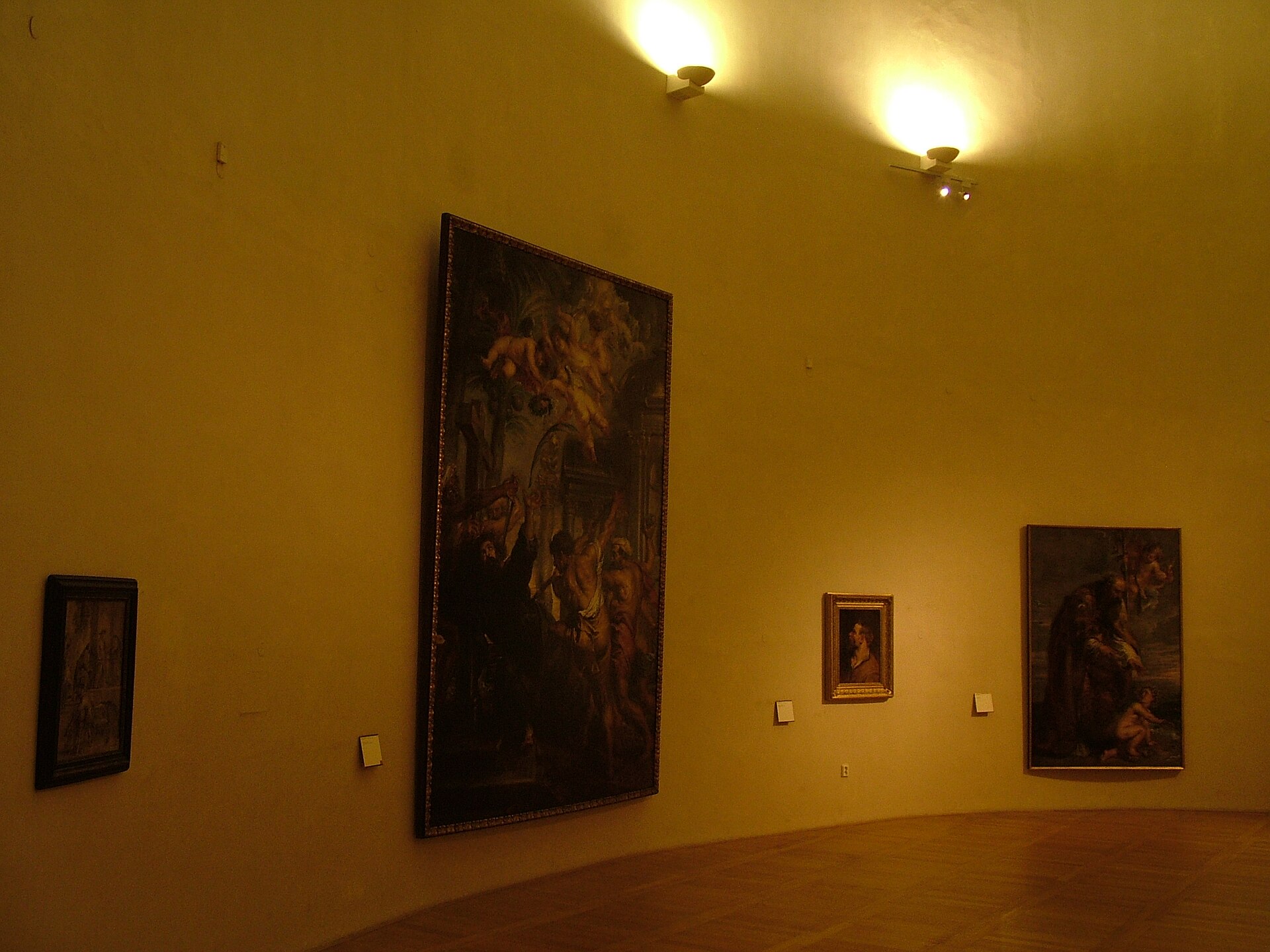
An unusually substantial run of Dutch and Flemish work: Herri met de Bles and Pieter Brueghel the Younger's Adoration of the Magi, Rubens, van Dyck, Frans Hals, Gerard ter Borch and Rachel Ruysch's Still Life with Flowers and Fruit (1682).
French, Spanish and English Painting
A smaller but carefully chosen group including El Greco's Praying Christ (1595-97), Jusepe Ribera, Francisco Goya and Bartolome Esteban Murillo, together with French portraiture by Simon Vouet and Pierre Mignard.
Russian Icons
A rare collection of Russian Orthodox icons assembled by the Byzantine-art historian Nikodim Kondakov, displayed within Old Masters II rather than as a separate department.
The Garden
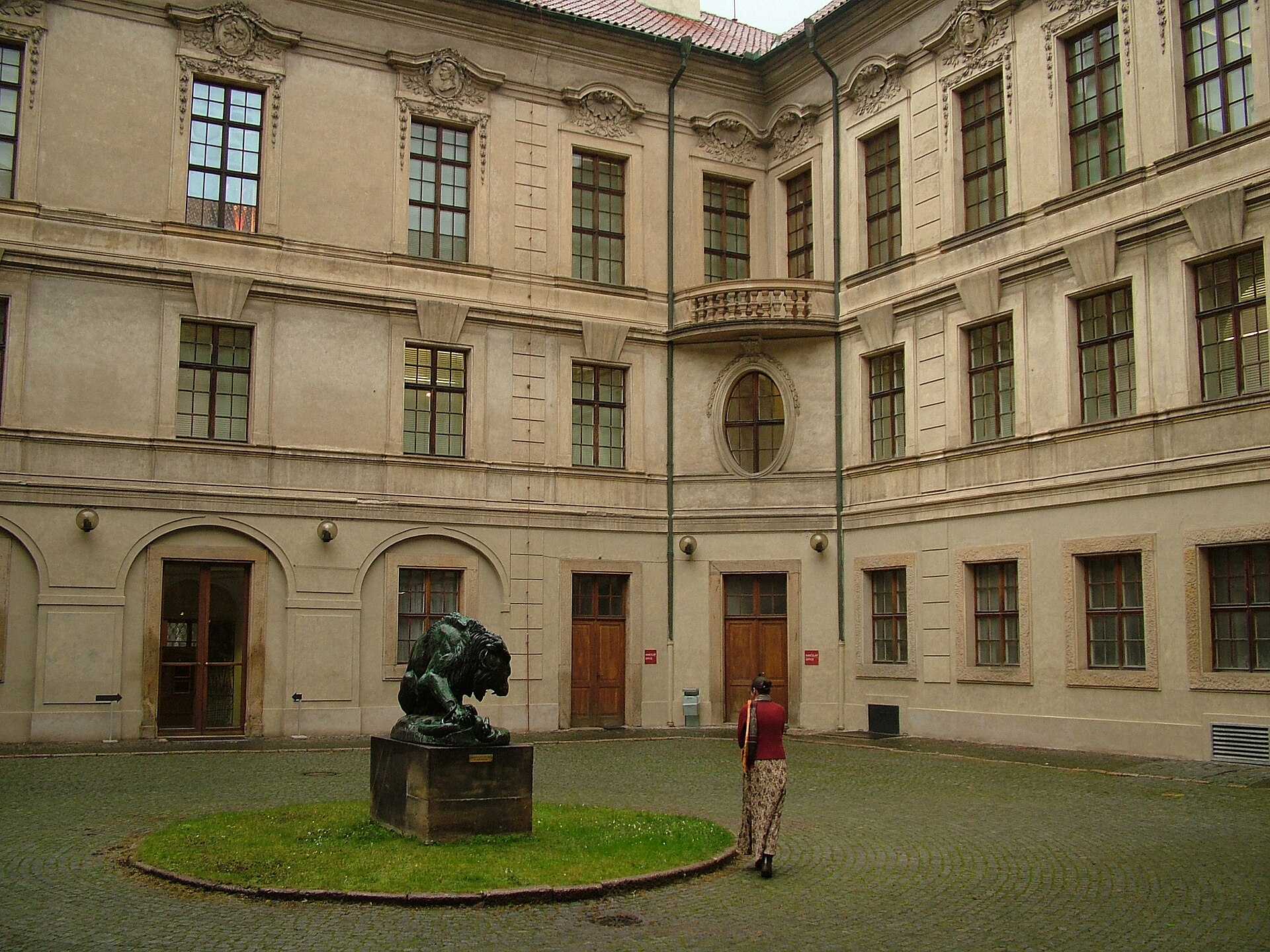
An elevated Baroque garden on the palace's west side, above the Deer Moat, open seasonally from April to September. It has a pond, a stork sculpture by Jan Lauda and a bronze lion attacking a boa constrictor by Antoine-Louis Barye; its present layout dates only to the National Gallery's 1947 remaking of the grounds, not to the Baroque original.
What to see first
The Feast of the Rose Garlands
Albrecht DurerPainted in Venice in 1506 for a community of German merchants at the church of St Bartholomew, it shows the Virgin bestowing a rose garland on Emperor Maximilian I while the infant Christ crowns the pope; Durer painted himself into the scene as an onlooker. A century later Rudolf II bought it for a large sum and had it carried to Prague by four men; the panel survived the 1631 Saxon and 1648 Swedish sacks of the imperial collections before the Czechoslovak state bought it back from a Prague monastery in the 1930s.14
Praying Christ
El GrecoDated 1595-97, it is the best-known Spanish picture in the collection and one of the works most often singled out by visitors on the upper floor.11
Eleonora of Toledo
Agnolo BronzinoA 1572 court portrait representative of the Italian holding built up largely from Archduke Franz Ferdinand of Austria's collection.11
The Beheading of Saint Dorothy
Hans Baldung GrienA 1516 panel that anchors the German section of Old Masters II.7
The Adoration of the Magi
Pieter Brueghel the YoungerPart of the palace's substantial Flemish and Dutch holding, spanning the 15th to 18th centuries.7
The Crucifixion (Passion altarpiece)
Hans RaphonA large, rare survival: it is described as the only fully preserved retable of the Passion of Christ in a public collection in the Czech Republic.15
Still Life with Flowers and Fruit
Rachel RuyschA 1682 still life representing the Dutch Golden Age painters in the collection.7
Diana and Callisto
Johann SpillenbergerA 1676 bronze sculpture that stands out among the largely two-dimensional German and Austrian holding.11
Collection of Russian icons
Various, formerly assembled by Nikodim KondakovA rare grouping of Russian Orthodox icons within Old Masters II, unusual for a Central European Old Masters collection.6
A Baroque palace built for a Bohemian count
Sternberg Palace stands on Hradcanske namesti, facing the main gate of Prague Castle, on a site that had carried two Gothic houses since the mid-1300s. The palace itself was built after 1698 for Count Vaclav Vojtech of Sternberk, whose family name it still carries. Its architect is formally disputed: Giovanni Battista Alliprandi is the name most often given, with Domenico Martinelli and Jan Santini Aichel also proposed, and Johann Bernhard Fischer von Erlach and Christoph Dientzenhofer occasionally speculated. Sternberg died in 1708 with the building only partly finished, and its southern wing stood incomplete for well over a century until Jan Novotny finally closed it off between 1835 and 1842.
The result is a building whose main facade is visibly split into two sections, a legacy of the two older Gothic houses it replaced. It is two storeys tall, arranged as four wings around a central courtyard, and built in a mixed Renaissance and Baroque style rather than a single unified design. Very little of the original Baroque interior survives; what a visitor walks through today is a layering of decorative schemes from different periods, reworked most recently for the museum's own display.
From a private art society to a national museum
Sternberg Palace was not built as a museum, and it did not become the National Gallery's home until the 20th century. In the early 19th century - sources disagree on the exact year, giving either 1811 or 1814 - the building was bought by the Society of Patriotic Friends of Art, an aristocratic Czech association that had recently been evicted from Czernin Palace when the Austrian imperial government requisitioned that building as a military hospital. While the Society owned Sternberg Palace it lent part of the building to the Bohemian National Museum, which kept its own collections there from 1821 to 1847, and the palace served as a working space for Czech scholars including Pavel Josef Safarik, Karel Borivoj Presl, Vaclav Hanka and Antonin Manes.
The Society sold the palace in 1871 and moved to the mansion of Joseph Porges von Portheim. From 1872 the building housed the Ernestinum, a shelter for the mentally disabled run by the Saint Anna Association of Ladies and Girls, until that association left Prague in 1918; the palace then served as a military school until 1945. Only after the Second World War, in a renovation carried out from 1946 to 1947, did Sternberg Palace become the seat of the newly constituted National Gallery Prague - the starting point this record uses for the museum's founding date, as distinct from the building's own construction a quarter of a millennium earlier.
The 1991 Picasso theft
Sternberg Palace's most dramatic modern incident came in the disordered early years after the Velvet Revolution. President Vaclav Havel's amnesty of 1 January 1990 had released a large share of Czechoslovakia's prison population, security had not caught up with a newly open border across which stolen art could be moved west, and the palace's raised garden had no electronic security system. On the night of 6 May 1991, three men freed under the amnesty scaled the garden wall from the street, broke into the palace through an unguarded door, and stole four paintings by Pablo Picasso: Mandolin and Glass of Pernod (1911), Still Life with a Goblet (1922), Port of Cadaques (1910) and Absinthe and Cards (1912), together contemporaneously valued at around 1.5 billion Czechoslovak koruna. The thieves fled by car before the doorman raised the alarm, then tried to sell the paintings on the international black market - a move that eventually drew police attention. Investigators recovered three of the four paintings from one thief's apartment and the fourth from a railway station locker, and all four were returned to the palace.
A restitution scare and a pandemic-era rehang
Because Sternberg Palace had been owned by the Saint Anna Association of Ladies and Girls before nationalisation, the National Gallery raised its own concern, as Czech restitution law worked through the courts, that the building might be handed back to a successor of that charitable association. The claim did not succeed: reporting from January 2014 confirmed that properties held by the National Gallery, including Sternberg Palace, fell outside the restitution process.
The palace closed during the Covid-19 pandemic, and a planned repair programme during that closure was not completed as intended. It reopened in late 2020 with a new permanent exhibition, the current Old Masters II, deliberately built around the same tradition of exhibiting masterpieces that the Society of Patriotic Friends of Art had followed when it ran the building in the 19th century.
What is on display: Old Masters II
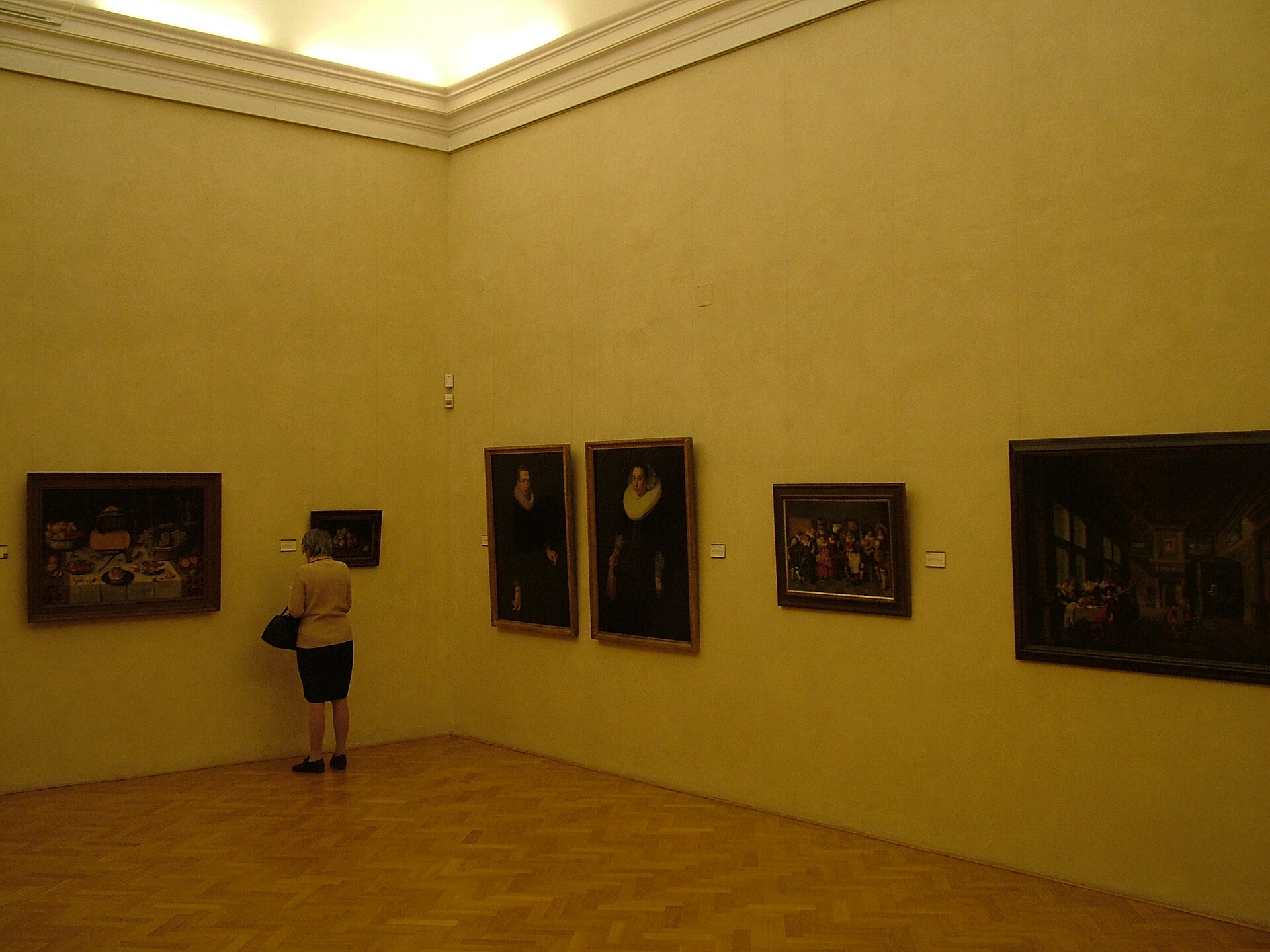
Old Masters II is the second half of the National Gallery's chronological survey of European painting before 1800, continuing across Hradcanske namesti from Old Masters I at Schwarzenberg Palace. Where the Schwarzenberg display marks the starting point of that journey, Sternberg Palace in practice covers the greater span of history and, by several visitor accounts, the more substantial collection. Its particular strengths are an almost encyclopaedic run of German and Austrian art from the Rudolphine era through the reign of Joseph II, an unusually large body of Dutch and Flemish painting from the 15th to the 18th centuries, and smaller but carefully chosen groups of Italian, French, Spanish and English work. Religious subjects dominate, reflecting both the period and the nature of the holdings, though portraits, still lifes and landscapes appear as the visitor moves through the rooms.
The single work every account of the palace leads with is Albrecht Durer's Feast of the Rose Garlands, bought to Prague at great expense by Rudolf II a century after it was painted and one of the treasures of his art-obsessed court. Around it sit Hans Baldung Grien's Beheading of Saint Dorothy, Hans Raphon's rare Passion altarpiece - the only fully preserved retable of its kind in a Czech public collection - and, from the Netherlandish rooms, Pieter Brueghel the Younger, Rubens, van Dyck, Frans Hals and Rachel Ruysch. El Greco's Praying Christ and Agnolo Bronzino's portrait of Eleonora of Toledo represent the smaller Italian and Spanish holdings, and a rare collection of Russian Orthodox icons, assembled by the Byzantinist Nikodim Kondakov, sits inside the same display rather than in a department of its own.
The building today
A visit starts in the compact central courtyard, from which a monumental staircase leads up to the exhibition floors; the collection is arranged over three levels, and several visitors recommend starting at the top and working down. The surviving architectural features - high ceilings, stucco work and generous windows - are treated as a backdrop rather than a rival attraction, and some rooms keep a domestic scale that suits smaller paintings better than a conventional museum hall would. The building is not wheelchair accessible: stairs are the only way from the courtyard to the galleries. There is a cloakroom for coats and larger bags, a small shop selling National Gallery publications, and a small cafe near the garden. The elevated Baroque garden on the west side, overlooking the Deer Moat, is open seasonally from April to September and holds a pond, a stork sculpture by Jan Lauda and a bronze lion attacking a boa constrictor by Antoine-Louis Barye; its present form was laid out only in 1947, when the palace passed to the National Gallery, and does not reproduce the original Baroque garden.
What visitors say
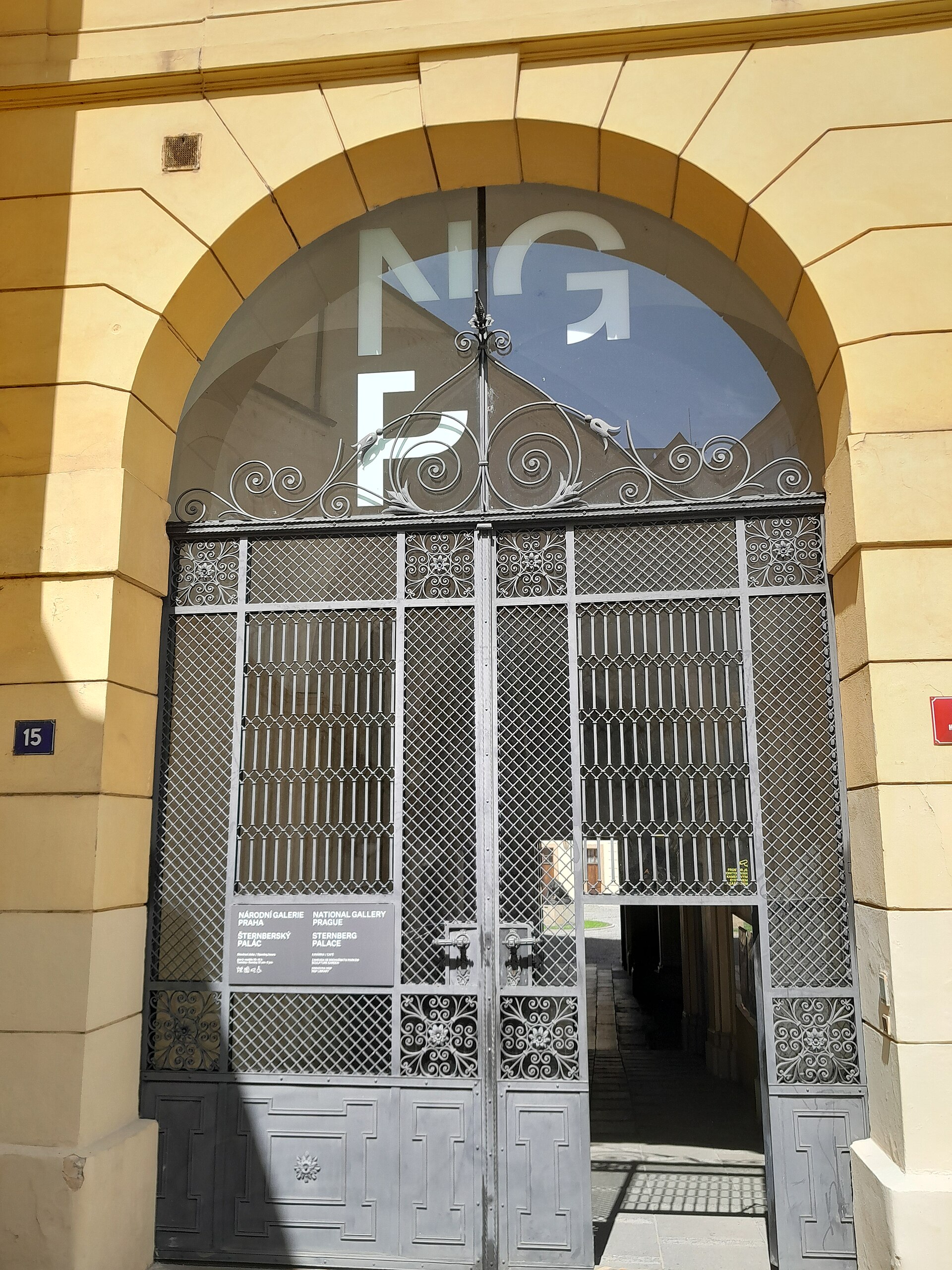
Visitors consistently describe Sternberg Palace as a quiet, uncrowded counterpart to the tourist traffic at Prague Castle a few steps away, and are frequently surprised by the depth of the Old Masters collection once inside - several call it more rewarding than the companion display at Schwarzenberg Palace. The building's low-key, easy-to-miss entrance down a side passage off Hradcanske namesti comes up again and again, as does the modern three-floor layout with glass bridges between levels.
What is praised, what is criticised
- Praised: The range and quality of the Old Masters holding - Durer, El Greco, Rubens, Hals and the Flemish and Dutch rooms in particular are called out as stronger than expected for a palace that is not on the main tourist circuit
- Praised: A calm, unhurried visit with clear labelling, in contrast to the crowds at Prague Castle itself
- Criticised: The entrance is hard to find - low-key signage down a side lane means some visitors nearly miss the museum entirely
- Criticised: An August 2026 visitor reported being shouted at by two staff members for pointing near the paintings, calling for better training in dealing with the public
Ratings on other platforms
Tripadvisor: 4.2 from 200 ratings, read 6 September 2026
A platform average is a tertiary source: it moves, it is not audited, and we quote no visitor's words.
Questions about Sternberg Palace
Where is Sternberg Palace?
Hradcanske namesti 15, 118 00 Prague 1 - Hradcany, Czech Republic.
How much does it cost to visit?
Adult: CZK 180; Reduced: CZK 100; School groups: CZK 60; Under 16: free; Old Masters I and II joint ticket: CZK 300. As confirmed 6 September 2026.
When is it open?
Tue-Sun 10:00-18:00. Closed: Monday. Selected public holidays each year (e.g. 1 January) - see the NGP opening-hours page for the current list. As confirmed 6 September 2026.
How do you get there?
Metro: Line A to Malostranska or Hradcanska, then an uphill walk to Hradcanske namesti (Hradcany Square); Tram: Line 22 or 23 to Prazsky hrad, Brusnice or Pohorelec, then a short walk.
What should you see first?
The Feast of the Rose Garlands (Albrecht Durer); Praying Christ (El Greco); Eleonora of Toledo (Agnolo Bronzino); The Beheading of Saint Dorothy (Hans Baldung Grien); The Adoration of the Magi (Pieter Brueghel the Younger); The Crucifixion (Passion altarpiece) (Hans Raphon).
What we could not confirm
- The palace's architect is formally unresolved: Alliprandi is the name most commonly given, but Martinelli and Santini Aichel remain live candidates and no consensus attribution exists.
- The year the Society of Patriotic Friends of Art bought the palace is reported inconsistently across sources as either 1811 or 1814; English Wikipedia's own text separately states 'the early 1880s' for the same purchase, which is inconsistent with the Society's confirmed departure from the building in 1871 and has not been used in this record.
- Secondary sources describe the floor-by-floor arrangement of Old Masters II inconsistently with each other; this record groups the collection by period and school rather than asserting a specific floor plan that could not be confirmed against the museum's own site.
Images
Sources
- 1National Gallery Prague, 'Sternberg Palace' (building page) ngprague.cz/en/about/buildings/sternberg-palace
- 2National Gallery Prague, 'Buildings and opening hours' ngprague.cz/en/about/page/buildings-and-opening-hours
- 3National Gallery Prague, 'Admission and booking' ngprague.cz/en/about/admission
- 4National Gallery Prague, 'Opening Hours' (holiday closures and free days) ngprague.cz/en/about/page/opening-hours
- 5National Gallery Prague, 'Contacts' ngprague.cz/en/about/contact
- 6National Gallery Prague, 'Collection of Old Masters' ngprague.cz/en/about/collections/collection-of-old-masters
- 7National Gallery Prague, 'Old Masters II' (exhibition page) ngprague.cz/en/event/408/old-masters-ii
- 8Wikipedia, 'Sternberg Palace' en.wikipedia.org/wiki/Sternberg_Palace
- 9Wikidata, Q1291597 'Sternberg Palace' wikidata.org/wiki/Q1291597
- 10Prague City Tourism, 'National Gallery in Prague - Sternberg Palace' prague.eu/en/objevujte/national-gallery-in-prague-sternberg-palace-sternbersky-palac/
- 11Svoboda & Williams (Feelhome), 'Sternberg Palace' feelhome.cz/en/all-about-housing/prague/article/320-sternberg-palace
- 12Tripadvisor, 'Palac Sternbergow' visitor reviews tripadvisor.com/Attraction_Review-g274707-d318567-Reviews-Palac_Sternbergow-Prague_Bohemia.html
- 13Wikimedia Commons, Category:Sternbersky palac (image licensing and verification) commons.wikimedia.org/wiki/Category:%C5%A0ternbersk%C3%BD_pal%C3%A1c
- 14Radio Prague International, 'Exhibition marks 500 years since painting of The Feast of the Rose Garlands' (Pavla Horakova, 2006, with curator Olga Kotkova) english.radio.cz/exhibition-marks-500-years-painting-feast-rose-garlands-8617206
- 15Prague Experience, 'Sternberg Palace Art Gallery' visitor guide pragueexperience.com/places.asp?PlaceID=1601