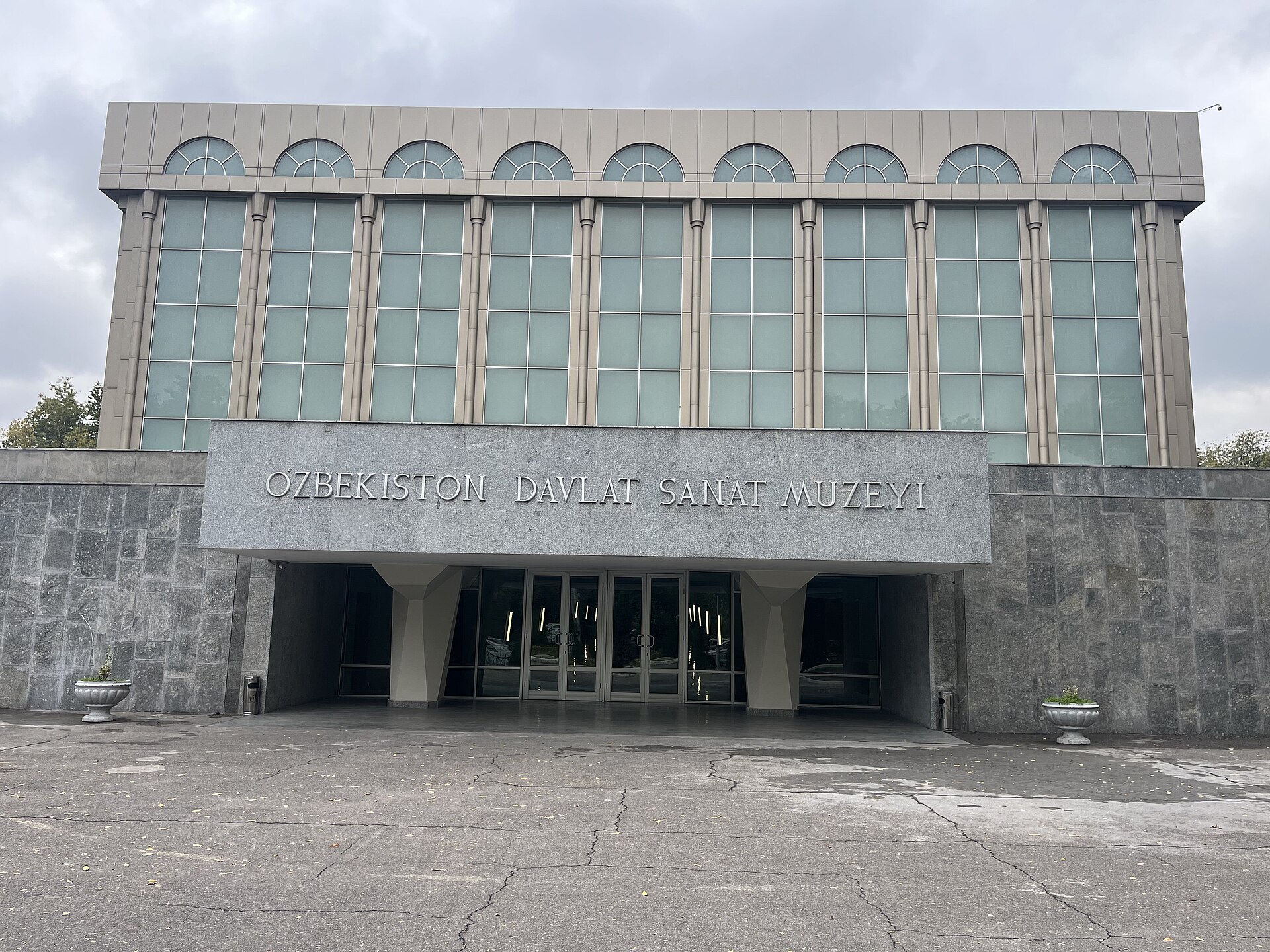
The main facade of the State Art Museum of Uzbekistan in Tashkent, with the Uzbek-language name inscribed above the entrance.
Oqsaqol, CC BY-SA 4.0State Art Museum of Uzbekistan
Museum · O'zbekiston Davlat san'at muzeyi · Founded 1918
Open, admission and hours confirmed 26 August 2026 · 10 sources
On this page 14 sections
ContentsClose
The museum's real strength is depth in Central Asian applied art - suzani, ikat silk weaving, carpets and jewelry drawn from nationalized private collections in 1918 - paired with a genuinely broad, if thinner, survey collection of Russian and Western painting built up through transfers from Moscow and Leningrad museums in the 1920s. Its 20th-century Uzbek painting holdings, built deliberately from the 1930s onward, are the most complete record of the formation of a national Uzbek school of painting held in any one collection.
| Local name | O'zbekiston Davlat san'at muzeyi |
|---|---|
| Kind | Museum |
| Founded | 1918 |
| City and country |  Tashkent, Uzbekistan Tashkent, Uzbekistan |
| Address | 16 Amir Temur Avenue, Tashkent 100060, Uzbekistan |
| Website | stateartmuseum.uz |
| Status | Open, confirmed |
| Record last verified |
Visiting
- Hours
- Tue-Sun09:00 to 18:00
- Closed
- Monday.
- Admission
- AdultUZS 30,000tertiary figure, museum's own site does not publish prices
- Student / schoolchildUZS 15,000tertiary figure
- Child under 7Freefree, tertiary figure
- Do I need to book?
- Not specified on the museum's own site
- Address
- 16 Amir Temur Avenue, Tashkent 100060, Uzbekistan MapMetro Amir Temur Xiyoboni station, about a ten minute walk
- Website
- stateartmuseum.uz
- Telephone
- +998 71 236 74 36
- [email protected]
Before you go how long, access, photography, bags, eating, shop
- How long to allow
- Two to three hours to see all four departments
Prices and hours change. We take them from the institution's own pages and print the day we read them, and you can check the current position at the source we used. Confirm before you travel.
What is inside
National Applied Art of Uzbekistan
Architectural decor, embroidered suzani and wall hangings, hand-woven silk ikat fabrics (shayi/adras) from Bukhara and Margilan, carpets, copper-stamped metalwork, gold-thread needlework and jewelry drawn from the museum's founding collections of nationalized Central Asian craft.
Fine Arts of Uzbekistan
Painting and graphic art tracing the formation of a national school from the early twentieth century into the Soviet period and independence, including artists collected by the museum from the 1930s onward such as Usto Mumin, Pavel Benkov and Ural Tansikboyev.
Russian and Western Art
Portraits, genre scenes and history painting by Russian artists of the 18th to 20th centuries alongside a room of Russian icons, plus Western European decorative and fine art from Italy, Spain, Germany, the Netherlands, France and England, including 17th-century Flemish and Dutch cabinet pictures.
Far Eastern Art
Bronze, porcelain, ivory carving, musical instruments and stone sculpture from China, Japan, Korea, India and Iran, assembled as the museum's department of foreign Oriental art.
What to see first
Bather
Andrei BelloliA 19th-century Russian academic nude, part of the museum's holdings of pre-revolutionary Russian painting.5
Portrait of Princess A. A. Obolenskaya
Vasily TropininAn 1845 portrait by one of the leading Russian portraitists of the early 19th century, and one of the works the museum's own site names among its prize holdings.1
Falcon Hunt
Nikolay KarazinAn Orientalist hunting scene by an artist who worked extensively in Russian Turkestan, tying the Russian collection to the region the museum stands in.3
The Catholic Preacher
Konstantin MakovskyA 1870 genre scene by a leading Russian Academician; also singled out by the museum's own site as a highlight of the collection.1
Monkeys as Barbers
David Teniers the YoungerA 1659 Flemish cabinet picture, part of the small holding of Western European Old Masters that anchors the Russian and Western Art department.3
Portrait of an Unmarried Tatar Girl
Pavel BenkovA 1924-28 portrait by a founding figure of the Uzbek painting school, whose work the museum began collecting as it built a national fine-art holding from the 1930s.1
My Song
Ural TansikboyevA 1972 landscape by one of Soviet Uzbekistan's most honoured painters, representing the museum's 20th-century Uzbek holdings; the artist also has his own dedicated Commons category tied to this museum.1
Suzani wall embroidery
Unrecorded maker, UzbekistanA large 1970s-80s embroidered wall hanging from the applied-art department; this piece and a group of Bukharan and Margilan silk shayi textiles from the museum's own holdings were shown on loan at the Savitsky Museum in Nukus.5
From a grand duke's collection to a national museum
The State Art Museum of Uzbekistan traces its founding to 1918, when the new Soviet administration in Tashkent opened a museum built around roughly a hundred works confiscated from the private collection of Grand Duke Nikolai Konstantinovich of Russia, a grandson of Tsar Nicholas I who had been exiled to Tashkent decades earlier, together with other nationalized private holdings of paintings, drawings, sculpture, furniture and porcelain. It opened first as the Museum of the People's University, was renamed the Central Arts Museum, became the Tashkent Art Museum in 1924, and took its present name, the Museum of Arts of Uzbekistan, in 1935.
The collection grew quickly in its first years. Between 1920 and 1924 it received 116 works of Russian and Ukrainian art transferred from collections in Moscow and Leningrad, including portraits by Vladimir Borovikovsky, Karl Bryullov, Ilya Repin, Vasily Tropinin and Nikolai Yaroshenko. Alongside these came roughly 250 paintings by Russian and other artists who had worked in Central Asia before the revolution, among them Nikolay Karazin. From the 1930s the museum began deliberately building a collection of Uzbek painting, acquiring work by Usto Mumin, Pavel Benkov and other founders of the modern Uzbek school, a policy that continued through the Soviet decades with painters such as Ural Tansikboyev. The museum's own account of its holdings today puts the collection at more than 100,000 items and groups of objects.
A Soviet modernist cube on Amir Temur Avenue
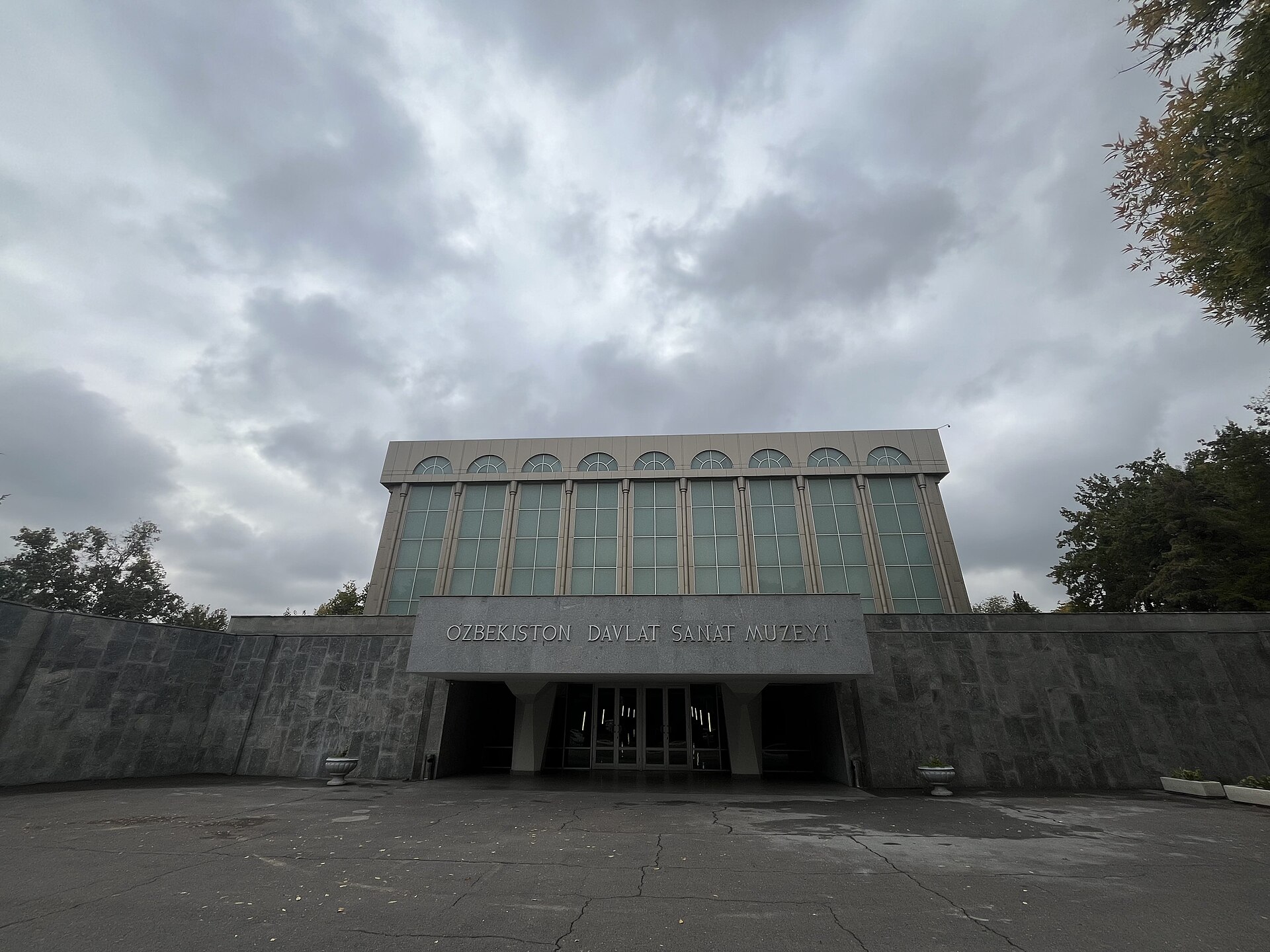
The museum has not always stood where it stands now. Until 1935 it occupied the former palace of Grand Duke Nikolai Konstantinovich; it then moved into the People's House, a building badly damaged in the destructive Tashkent earthquake of 1966 and demolished in 1974. Its replacement, built between 1967 and 1974 to designs by the Soviet architects I. Abdulov, A. K. Nikiforov and S. A. Rosenblum, is the building the museum occupies today at 16 Amir Temur Avenue: a monumental cube divided by a metal-framed grid, faced in aluminium and polished grey marble at street level and glazed above in a bronze-toned glass intended to control the daylight reaching the galleries inside. The building was renovated in 1997.
In July 2026 the UNESCO World Heritage Committee inscribed the State Museum of Arts of Uzbekistan, alongside nine other Tashkent buildings from the 1960s to the early 1990s, as part of the World Heritage listing Tashkent Modernist Architecture. Modernity and Tradition in Central Asia - the first time twentieth-century architecture anywhere in Central Asia has been recognised on the List. The other inscribed buildings include the State Museum of the History of Uzbekistan, the Peoples' Friendship Palace and the Alisher Navoi Palace of Arts, giving the museum's own building formal recognition as a landmark of the same late-Soviet modernism its neighbours represent.
Four departments under one roof
The permanent collection is organised into four curatorial departments. National Applied Art of Uzbekistan holds architectural decor, embroidered suzani, hand-woven silk shayi and adras fabrics from Bukhara and Margilan, carpets, copper-stamped metalwork and gold-thread needlework and jewelry, much of it drawn from the nationalized private collections that founded the museum in 1918. Fine Arts of Uzbekistan traces the formation of a national school of painting and graphic art from the early twentieth century through independence, anchored by the artists the museum began collecting from the 1930s. Russian and Western Art spans Russian portraiture, genre and history painting of the 18th to 20th centuries, a dedicated room of Russian icons, and a smaller holding of Western European painting and decorative art from Italy, Spain, Germany, the Netherlands, France and England, including seventeenth-century Flemish and Dutch cabinet pictures. Far Eastern Art, the museum's department of foreign Oriental art, gathers bronze, porcelain, ivory carving, musical instruments and stone sculpture from China, Japan, Korea, India and Iran.
What is on the walls
The Russian and Western department holds the museum's best-known individual paintings: Andrei Belloli's academic nude Bather; Vasily Tropinin's 1845 Portrait of Princess A. A. Obolenskaya; Nikolay Karazin's Orientalist hunting scene Falcon Hunt; Konstantin Makovsky's 1870 genre painting The Catholic Preacher; and a small Flemish cabinet picture, Monkeys as Barbers, painted by David Teniers the Younger in 1659. The Uzbek fine-art rooms carry the museum's own foundational acquisitions of the national school, including Pavel Benkov's 1924-28 Portrait of an Unmarried Tatar Girl and Ural Tansikboyev's 1972 landscape My Song, painted by two of the artists the museum has collected in depth since the 1930s. In applied art, a group of Bukharan and Margilan silk shayi weavings and a large embroidered wall suzani represent the museum's own textile holdings; a number of these pieces were shown on loan at the Savitsky Museum in Nukus, a reminder that the museum's collection travels even though its building does not.
A collection that was not always safe
The museum's holdings were the subject of a serious theft case uncovered in the early 2010s. The alarm was first raised in 2012, when the Italian embassy in Tashkent questioned the authenticity of a painting attributed to the Italian Renaissance painter Paolo Veronese. The investigation that followed found that three former senior museum employees had, between 1999 and 2014, replaced originals with copies and sold the genuine paintings to unknown buyers, working through roughly 25 works from the museum's holdings of European art. On 12 December 2014, a court in Tashkent sentenced the museum's former senior curator, Mirfaizi Usmanov, to nine years and three months in prison; the former head of the museum's restoration laboratory, Bakhtiyor Botirov, and a restorer, Abdurakhmon Muranov, each received eight-year sentences. It is the reason a number of paintings a visitor sees on the walls today are acknowledged copies rather than the originals the museum once held, and visitors who ask about individual works sometimes still hear the story.
Visiting today, and a new museum taking shape nearby
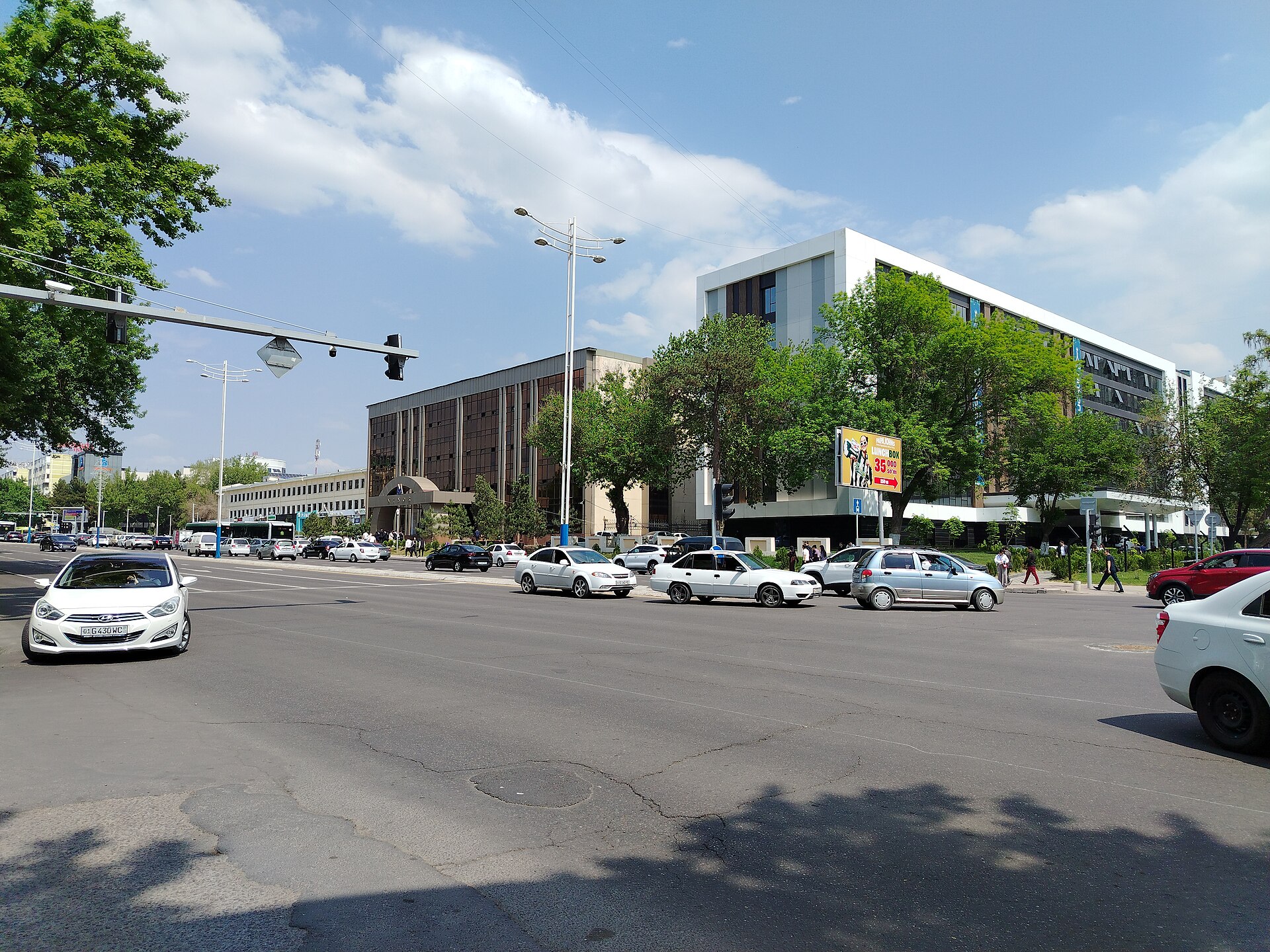
The museum opens Tuesday to Sunday, 09:00 to 18:00, and is closed on Mondays, on its own published schedule. It sits on Amir Temur Avenue in central Tashkent, a short walk from the Amir Temur Xiyoboni metro station. Visitors consistently describe a visit of two to three hours to cover all four departments, and most reviews single out the applied-art rooms - suzani, carpets, jewelry - as the section not to miss, alongside a recurring complaint about thin labelling in some galleries.
The museum is not the only art institution taking shape in Tashkent. Since 2020, Uzbekistan's Art and Culture Development Foundation has been developing plans for a large new building on a site nearby, between the Abul Qasim Madrasah, the Peoples' Friendship Palace and the Alisher Navoi monument, with an architectural concept by the Japanese architect Tadao Ando and exhibition design by the German studio Atelier Brueckner. Early reporting in 2020 described the project as a new building for the State Art Museum itself; when construction broke ground in August 2025, the same foundation was presenting it under a different name, the National Museum of Uzbekistan, intended to show both the country's national holdings and newly acquired work, and due to open in March 2028. What relationship the finished National Museum of Uzbekistan will have to the State Art Museum's own collection and its landmark 1974 building on Amir Temur Avenue has not been stated publicly in the sources available for this page, and is worth checking again as the new building nears completion.
What visitors say
Visitors consistently describe a large, wide-ranging collection spread over several floors that rewards two to three hours, and single out the Uzbek applied-art rooms - suzani, carpets, jewelry - as the strongest section. The most repeated complaint is thin object labelling and a number of paintings that are acknowledged copies standing in for originals, some lost in the 2014 theft case, with a handful of visitors also noting poor lighting in individual rooms and early closing cutting a visit short.
What is praised, what is criticised
- Praised: The depth and quality of the Uzbek textile and applied-art rooms, especially the suzani and carpets
- Praised: The range of the collection across Central Asian, Russian, European and East Asian art in one building
- Praised: Helpful, engaged front-of-house staff
- Criticised: Sparse wall text and object labelling in several rooms
- Criticised: A number of displayed paintings are acknowledged copies rather than the originals, a legacy of the 1999-2014 theft case
- Criticised: Uneven lighting in some galleries and hours that visitors say cut a full visit short
Ratings on other platforms
Tripadvisor: 4 from 76 ratings, read 26 August 2026
A platform average is a tertiary source: it moves, it is not audited, and we quote no visitor's words.
Questions about State Art Museum of Uzbekistan
Where is State Art Museum of Uzbekistan?
16 Amir Temur Avenue, Tashkent 100060, Uzbekistan.
How much does it cost to visit?
Adult: UZS 30000; Student / schoolchild: UZS 15000; Child under 7: free. As confirmed 26 August 2026.
When is it open?
Tue-Sun 09:00-18:00. Closed: Monday. As confirmed 26 August 2026.
How do you get there?
Metro: Amir Temur Xiyoboni station, about a ten minute walk.
What should you see first?
Bather (Andrei Belloli); Portrait of Princess A. A. Obolenskaya (Vasily Tropinin); Falcon Hunt (Nikolay Karazin); The Catholic Preacher (Konstantin Makovsky); Monkeys as Barbers (David Teniers the Younger); Portrait of an Unmarried Tatar Girl (Pavel Benkov).
What we could not confirm
- How the new Tadao Ando-designed National Museum of Uzbekistan, which broke ground in August 2025 for a 2028 opening, relates institutionally to the State Art Museum of Uzbekistan and its collection has not been stated in the sources available for this page.
- The exact number and identity of the paintings replaced with copies in the 1999-2014 theft case, beyond the approximately 25 European works reported by RFE/RL, has not been published.
Images
Sources
- 1State Art Museum of Uzbekistan, official website stateartmuseum.uz
- 2Wikidata, State Art Museum of Uzbekistan (Q4146885) wikidata.org/wiki/Q4146885
- 3Wikipedia, Museum of Arts of Uzbekistan en.wikipedia.org/wiki/Museum_of_Arts_of_Uzbekistan
- 4Orexca.com, The State Museum of Arts, Tashkent orexca.com/uzbekistan/tashkent/museum_art.htm
- 5Wikimedia Commons, Category:State Art Museum of Uzbekistan and linked file pages commons.wikimedia.org/wiki/Category:State_Art_Museum_of_Uzbekistan
- 6RFE/RL Uzbek Service, Uzbek Museum Employees Convicted Of Faking Paintings, Selling Originals, 12 December 2014 rferl.org/a/tashkent-museum-employees-sentenced-for-fraud/26739137.html
- 7Gazeta.uz, Ten buildings of Tashkent modernism added to UNESCO World Heritage List, 26 July 2026 gazeta.uz/en/2026/07/26/tashkent-modernism-unesco/
- 8Tripadvisor, State Art Museum of Uzbekistan, Tashkent tripadvisor.com/Attraction_Review-g293968-d26145740-Reviews-State_Art_Museum_of_Uzbekistan-Tashkent_Tashkent_Province.html
- 9Sputnik8.com, State Museum of Arts of Uzbekistan sputnik8.com/ru/tashkent/sights/museum-of-arts-of-uzbekistan/info
- 10Dezeen, Interlinked geometric shapes form Tadao Ando-designed National Museum of Uzbekistan, 27 August 2025 dezeen.com/2025/08/27/tadao-ando-national-museum-of-uzbekistan-geometric-shapes/