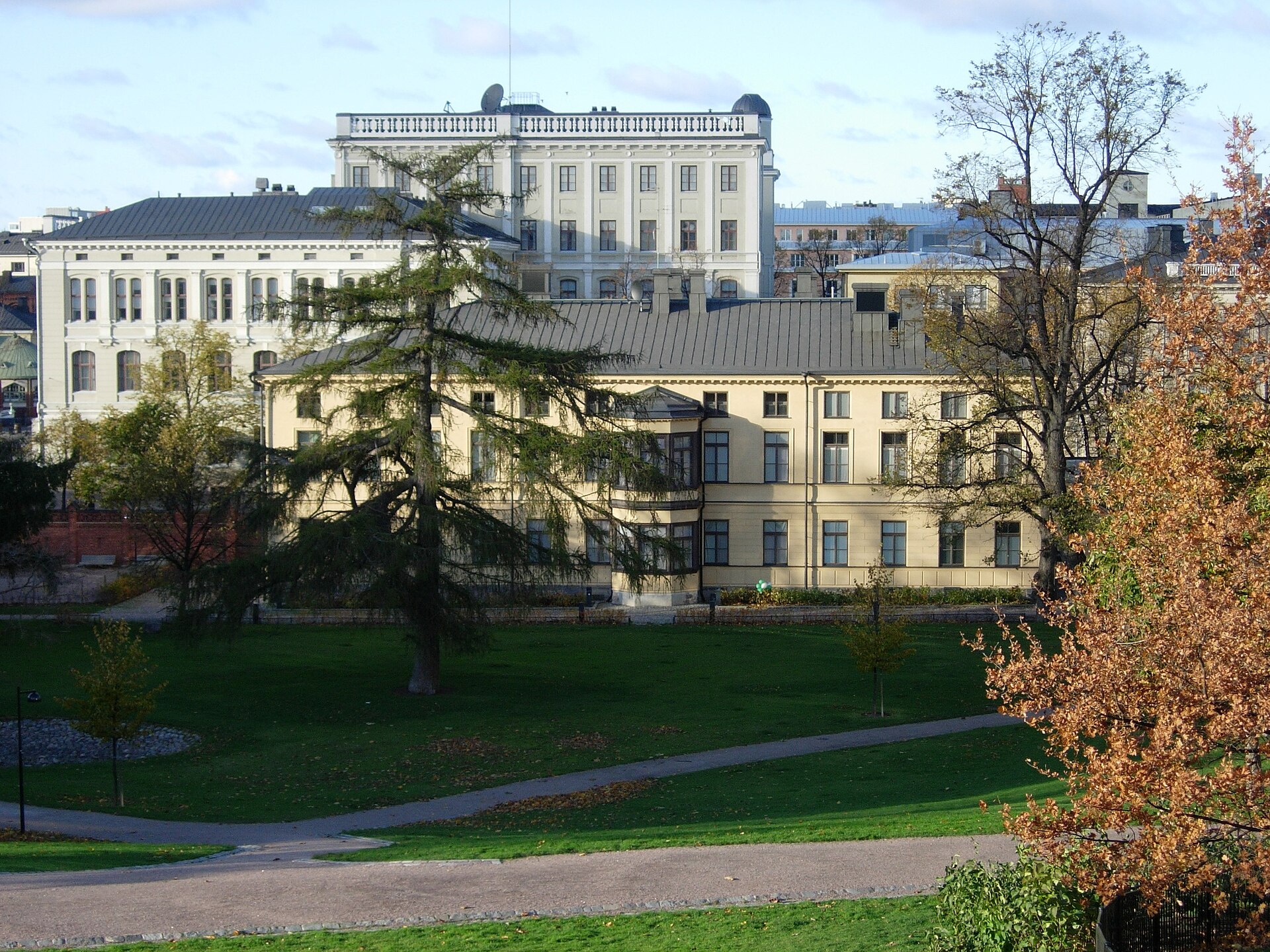
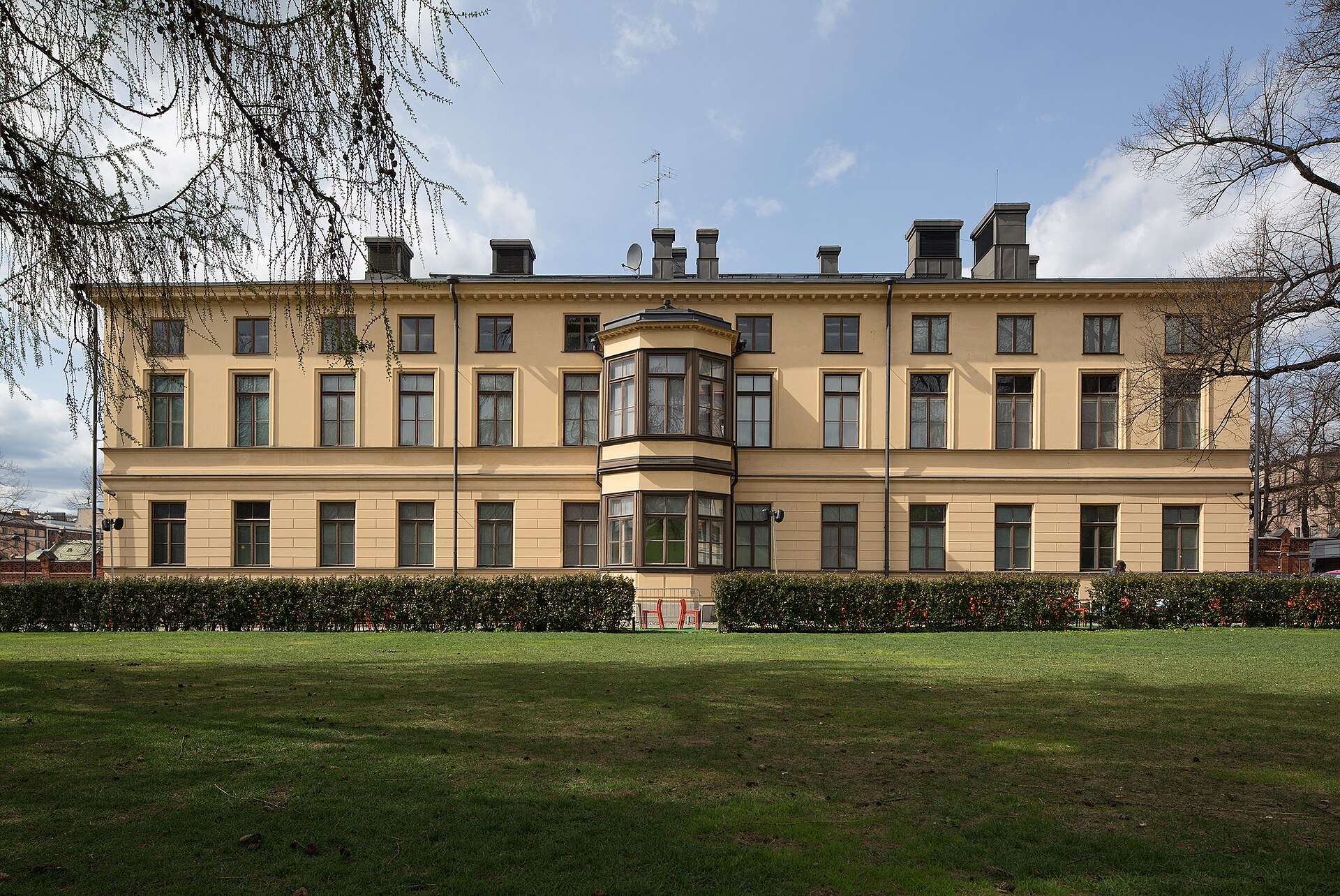
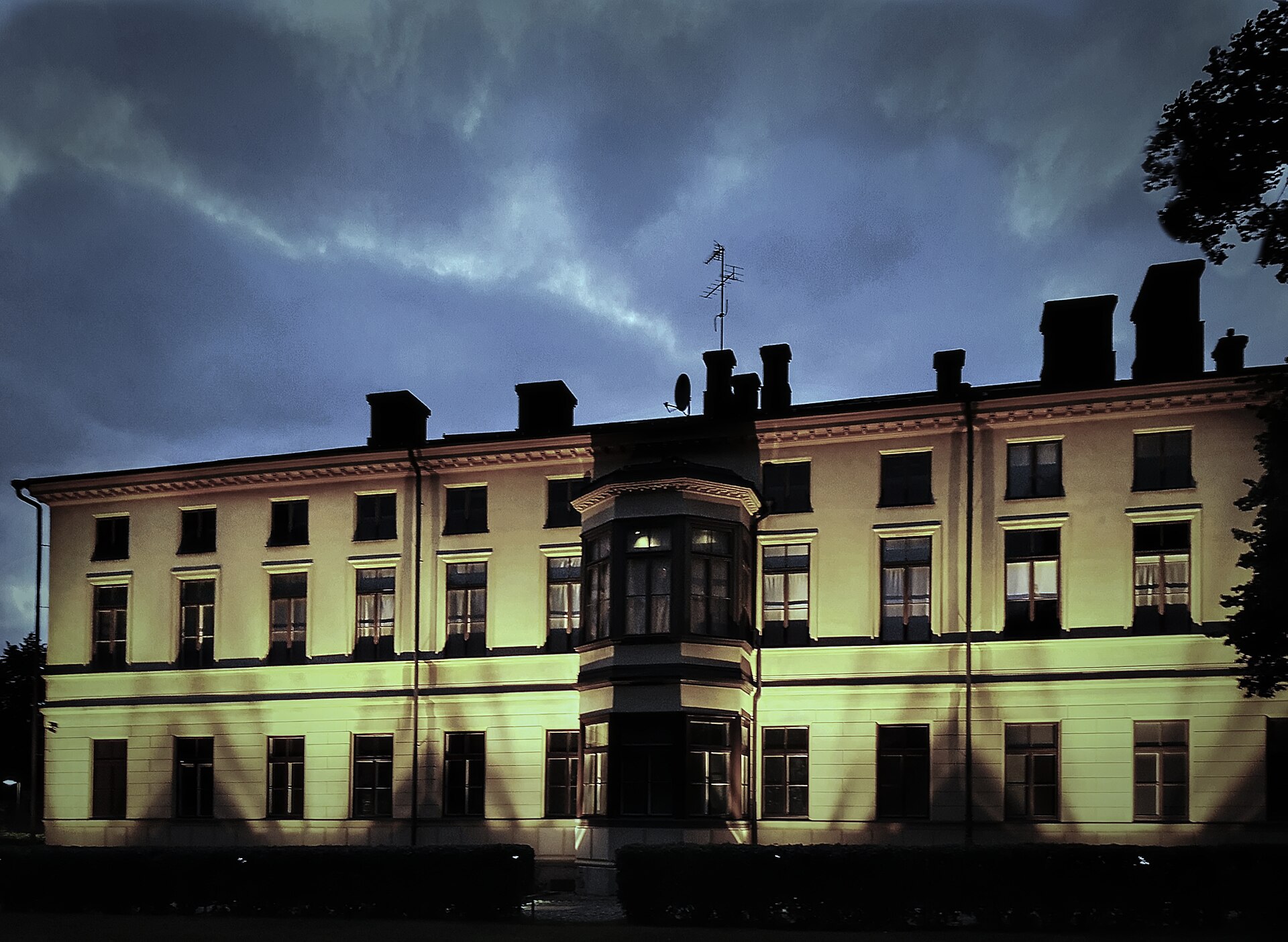
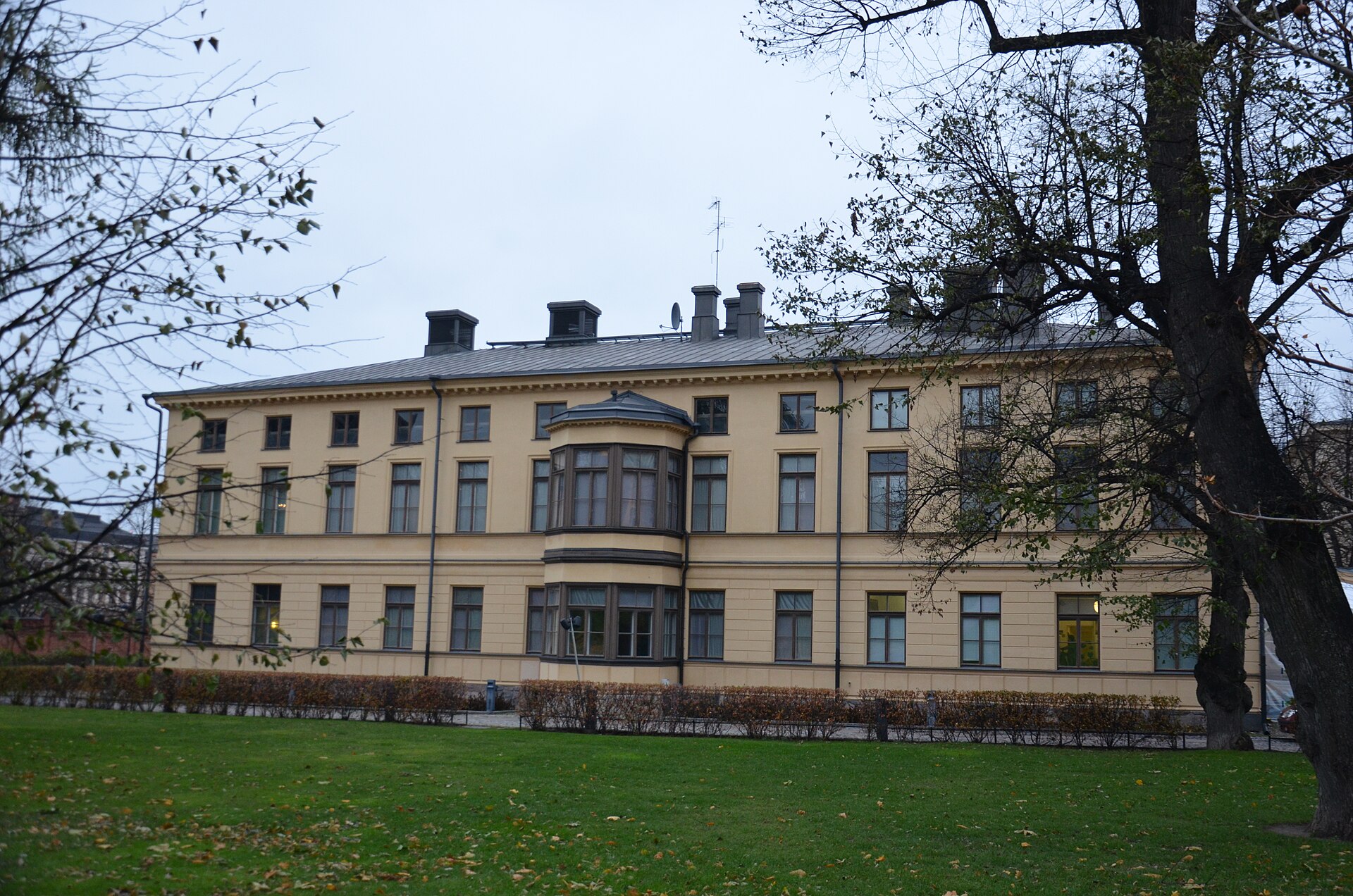
The Sinebrychoff Art Museum's Bulevardi 40 facade, completed in 1842 to a design by architect Jean Wiik.
Samuli Lintula · Photograph by Samulili · CC BY 2.5Sinebrychoff Art Museum
Museum · Sinebrychoffin taidemuseo · Founded 1921
Open, admission and hours confirmed 28 September 2026 · 17 sources
On this page 14 sections
ContentsClose
The Sinebrychoff Art Museum holds the largest and most valuable collection of old European art in Finland, drawn together from ten founding collections rather than assembled by a single curatorial programme: the Paul and Fanny Sinebrychoff collection at its core, with further paintings from the Klinckowstrom, Linder, Aspelin-Haapkyla, Gohle, Antell and Sihtola donations. Its roughly 6,500 objects run from fourteenth-century Italian panels and Russian and Byzantine icons through Dutch and Flemish seventeenth-century painting to Italian, French and Spanish Old Masters, with about 4,000 prints and drawings and a strong decorative-arts holding in porcelain, silver, glass, clocks and furniture. Its single Rembrandt, its pair of Tiepolos and its two Cranachs give it a depth in pre-1850 European painting that no other Finnish museum attempts to match.
| Local name | Sinebrychoffin taidemuseo |
|---|---|
| Kind | Museum |
| Founded | 1921 |
| City and country |  Helsinki, Finland Helsinki, Finland |
| Address | Bulevardi 40, 00120 Helsinki, Finland |
| Website | sinebrychoffintaidemuseo.fi/en |
| Status | Open, confirmed |
| Record last verified |
Visiting
- Hours
- Tue, Thu, Fri11:00 to 18:00
- Wed10:00 to 20:00Extended evening opening.
- Sat-Sun10:00 to 17:00
- Closed
- Monday.
- Admission
- Standard, at the museumEUR 21Covers the ticketed temporary exhibitions on the ground floor and in the cellar. The second-floor Old Masters collection and the Paul and Fanny Sinebrychoff house museum are free at all times regardless of this ticket.
- Standard, bought onlineEUR 19No online booking fee.
- DiscountedEUR 1318-24 year olds, students, pensioners, the unemployed, conscripts and non-military conscripts.
- Under 18FreeFree.
- Museum Card holdersFreeFree entry with a valid Finnish Museum Card.
Free entry: Last Friday of every month, 15:00-18:00, all exhibitions free. The second-floor Old Masters collection and the house museum, free at all times, any day- Tickets
- sinebrychoffintaidemuseo.fi/en/how-do-i-buy-t... The museum's own ticket page.
- Do I need to book?
- No advance booking required for individual visitors; groups and guided tours should book ahead.
- Address
- Bulevardi 40, 00120 Helsinki, Finland MapTram Line 6 to the Hietalahdentori stop, next to the main entrance
Bus Lines 20 and 30 to the Bulevardi stop - Website
- sinebrychoffintaidemuseo.fi/en
- Telephone
- +358 294 500 460
- [email protected]
Before you go how long, access, photography, bags, eating, shop
- How long to allow
- Visitors' own accounts on Tripadvisor commonly describe covering the ground-floor and cellar temporary exhibition, the second-floor Old Masters collection, and the house museum together in about ninety minutes to two hours.
- Access
- A step-free accessible entrance is at the side of the building on the corner of Sinebrychoff Park, opposite the Southpark restaurant, with a doorbell for staff assistance. A lift reaches every exhibition floor. The museum accepts the EU Disability Card. Wheelchairs, walking frames and portable folding chairs can be borrowed at the ticket office or accessible entrance, and induction loops are fitted at the ticket office and the seminar room.
- Photography
- Photography and video for personal, non-commercial use, including sharing on social media, is allowed through most of the museum. Individual works are separately marked where photography is not permitted, and flash, selfie sticks and tripods are not allowed.
- Bags
- Lockable storage lockers are near the accessible entrance and in the basement, along with an unattended cloakroom in the basement. Small bags may be carried into the exhibition spaces; larger bags must be left in storage.
- Eating
- The museum has no cafe of its own. The adjoining Southpark restaurant, reached from the same courtyard, serves weekday lunches and a weekend brunch.
- Shop
- A museum shop on the first floor sells exhibition-related merchandise, products based on the collection, art books and gifts.
Prices and hours change. We take them from the institution's own pages and print the day we read them, and you can check the current position at the source we used. Confirm before you travel.
What is inside
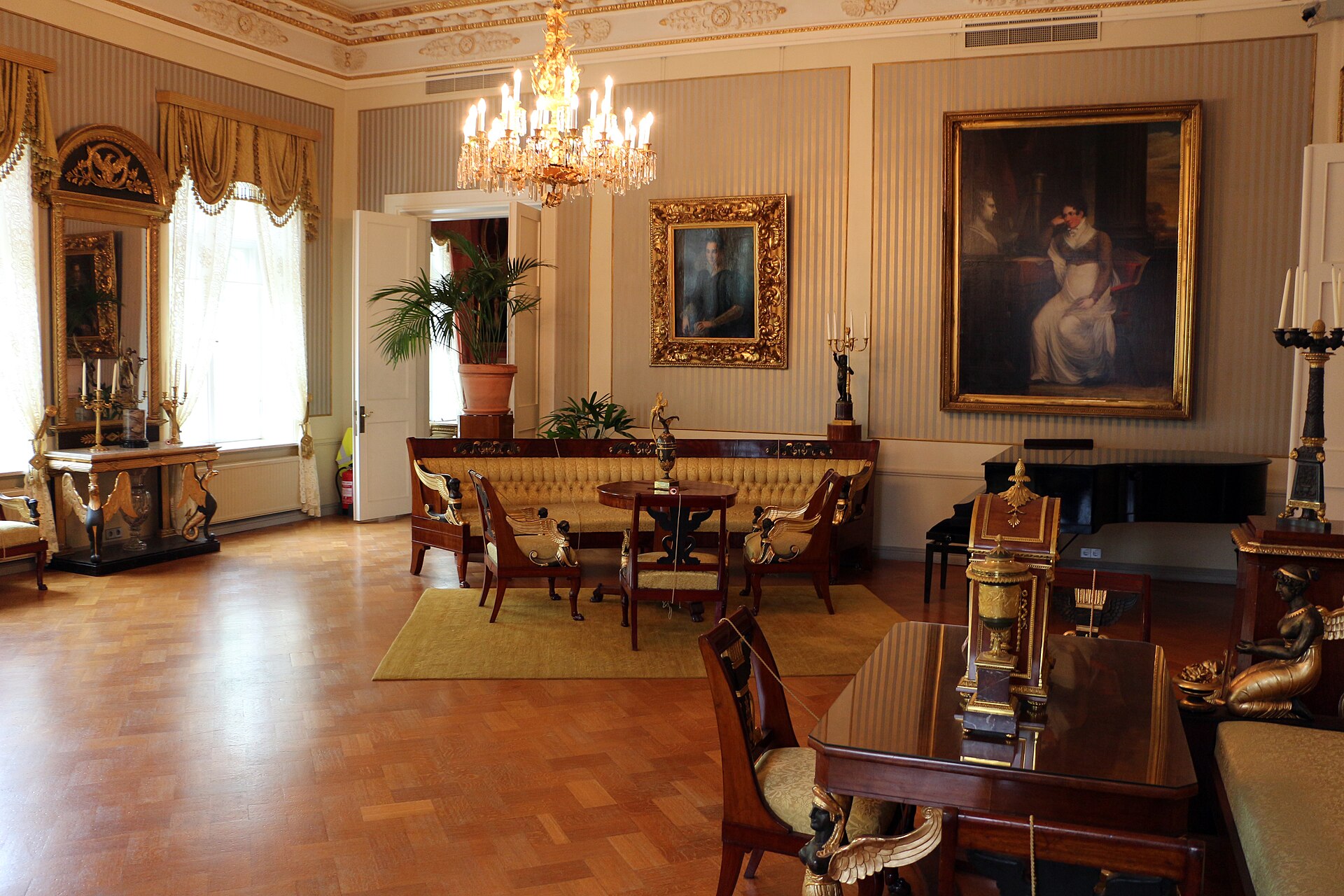
Photograph by Sailko · CC BY 3.0 Empire Hall
A period reception room on the second floor, furnished in the Empire style the Sinebrychoff family used, with gilded and dark-wood furniture, mirrors and decorative objects surviving from the family's own occupancy of the house. Part of the free permanent house museum.
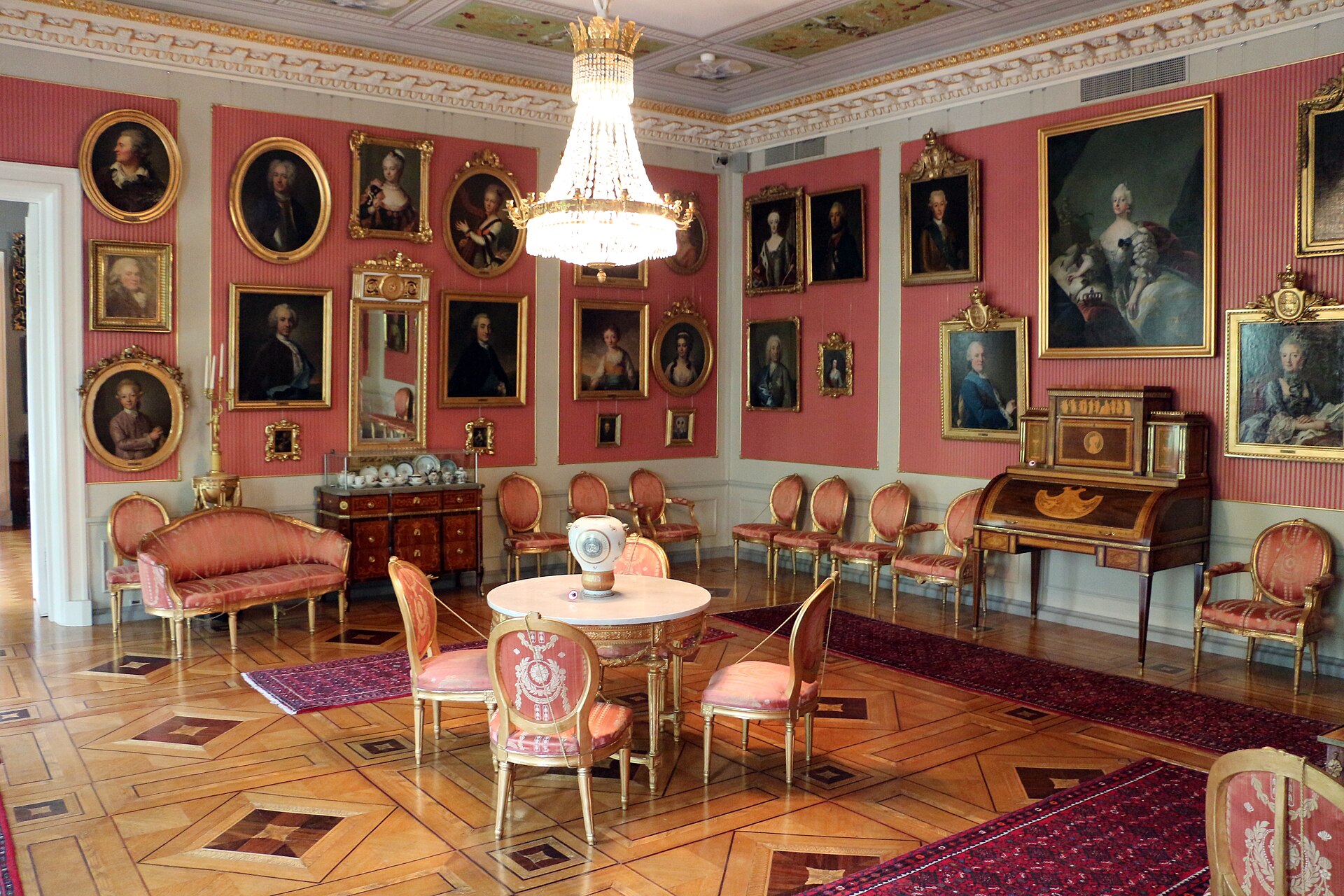
Photograph by Sailko · CC BY 3.0 Gustavian Hall
A second period room, furnished in the lighter Gustavian style. It reflects Paul Sinebrychoff's particular interest in Swedish seventeenth and eighteenth-century decorative arts, shown alongside portraits and miniatures from the same period.
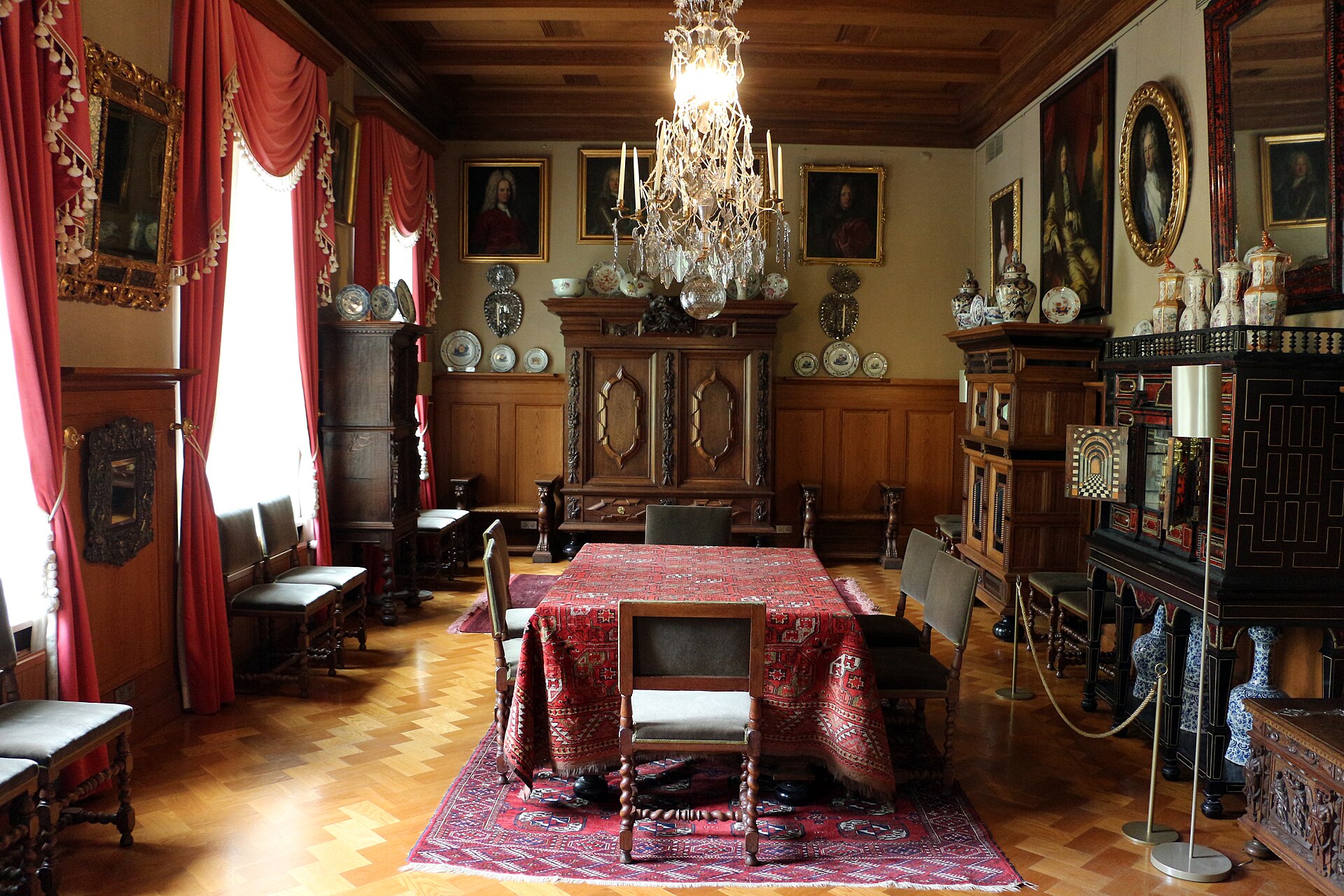
Photograph by Sailko · CC BY 3.0 Dining room
The family's preserved dining room, laid with silverware and porcelain from the service Fanny Sinebrychoff assembled. Part of the house museum's sequence of domestic rooms rather than a gallery display.
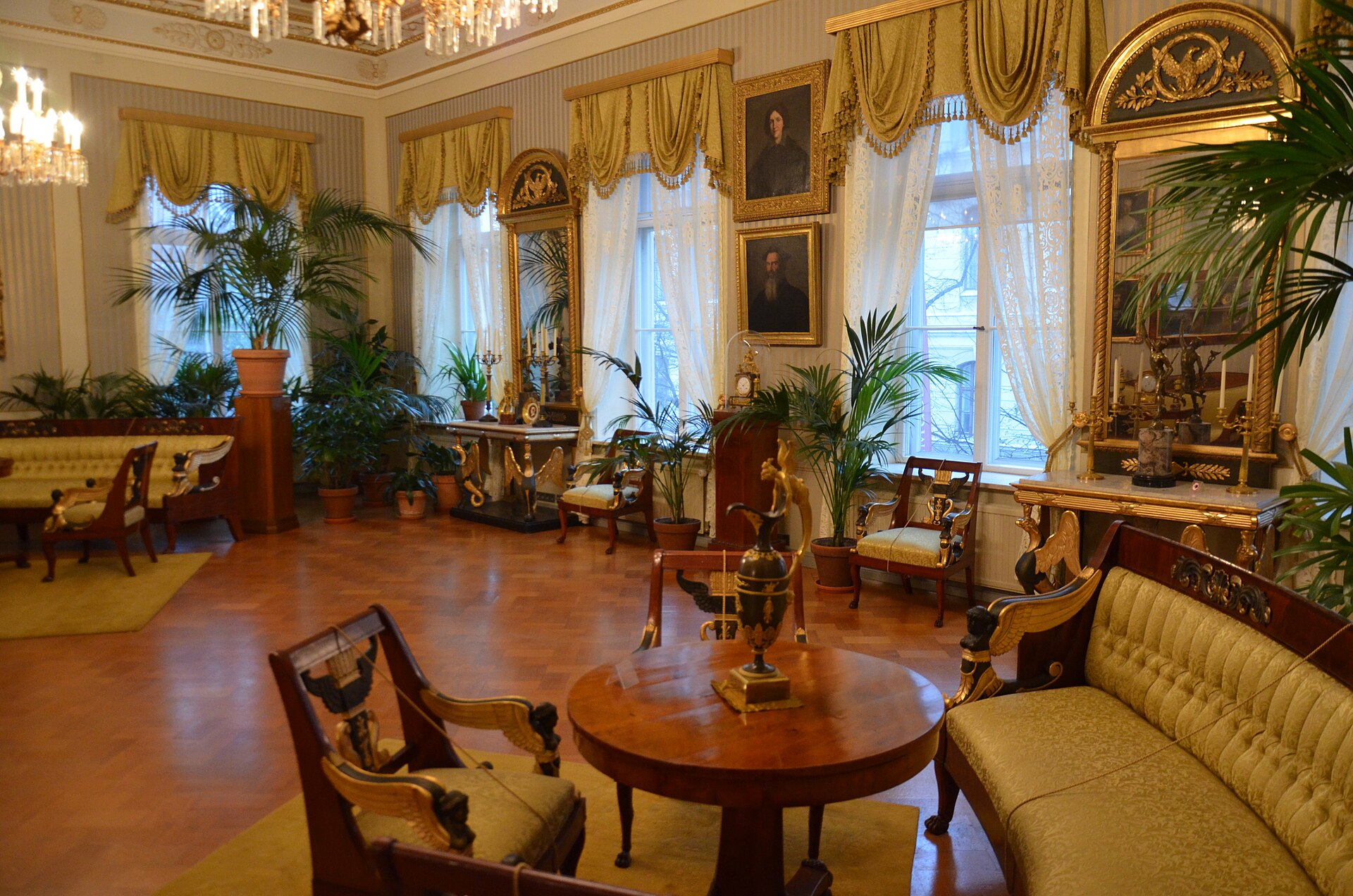
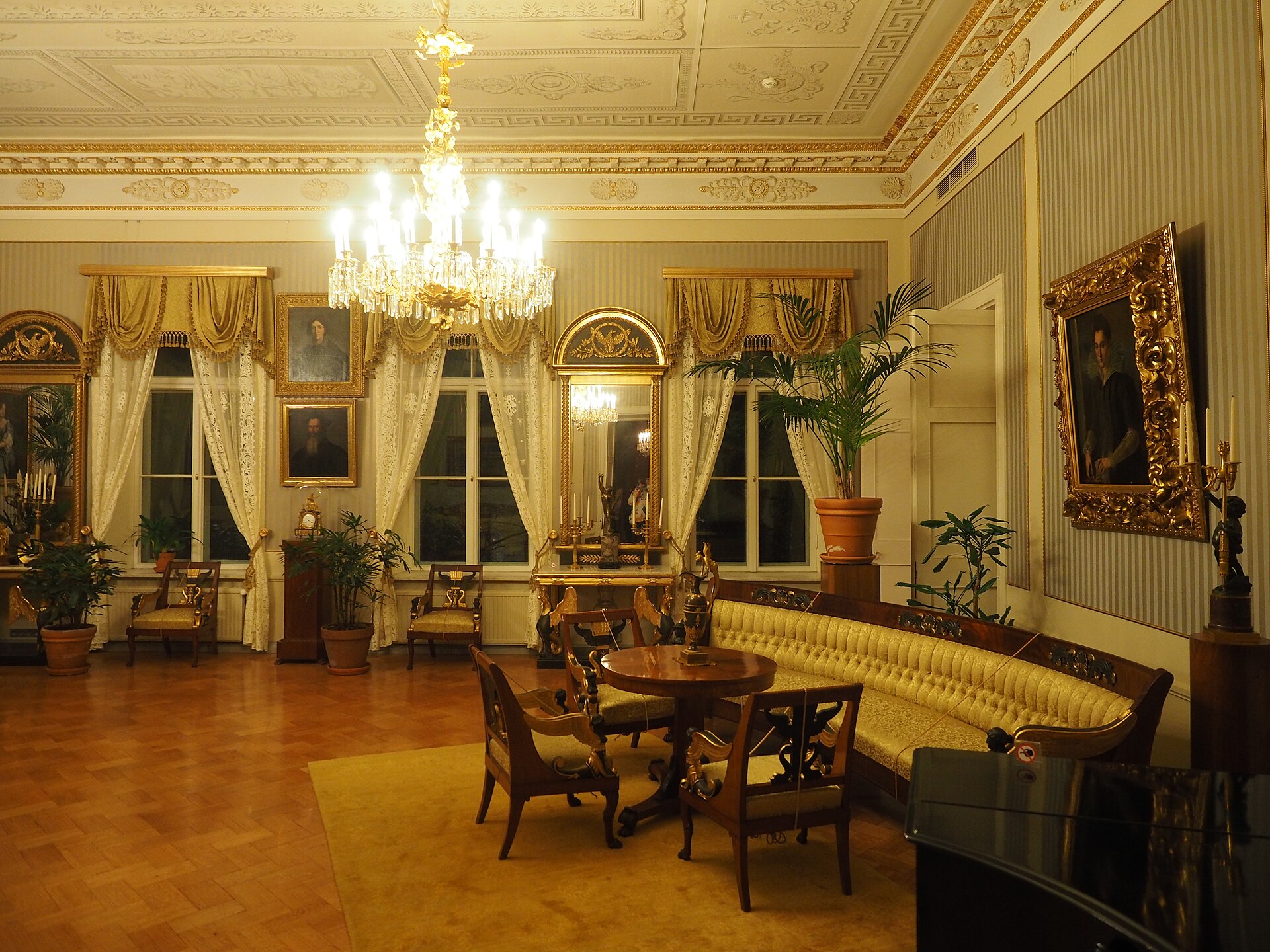
Photograph by Boberger · CC BY-SA 4.0 Corner salon
A further reception room on the house museum floor, continuing the sequence of period interiors furnished largely as the Sinebrychoffs themselves used them.
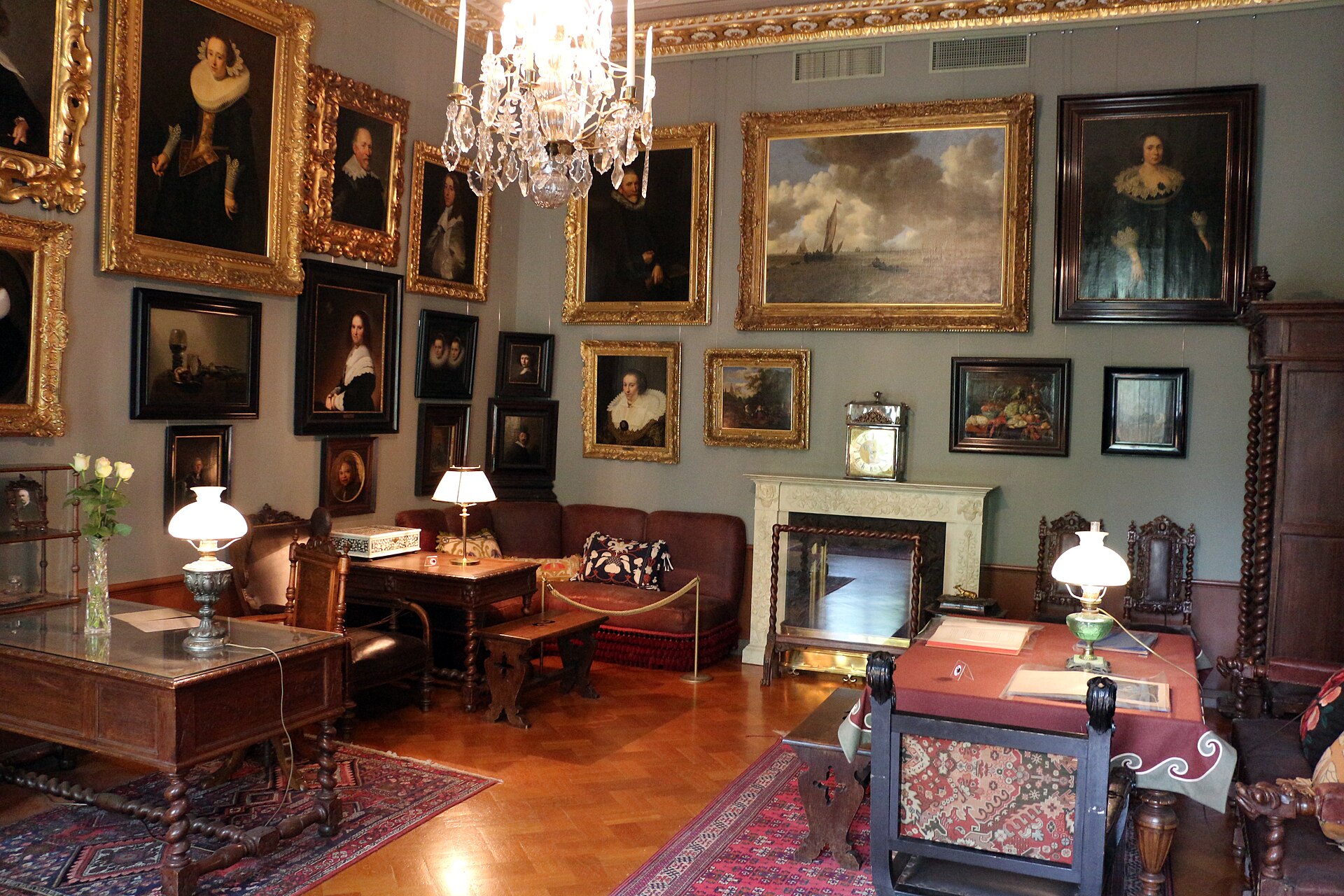
Photograph by Sailko · CC BY 3.0 Paul Sinebrychoff's study
Paul Sinebrychoff's own study, hung with part of the collection's Dutch and Flemish seventeenth-century paintings, including small portraits and still lifes, reflecting his personal taste as a collector rather than a chronological curatorial hang.
Old Masters collection exhibition, second floor
The museum's standing display of its Old Masters holdings, titled Gems of the Collection - from Cranach to Rembrandt, arranged thematically rather than chronologically: paintings of Christ's childhood and Passion, scenes of everyday and festive life, mythological subjects, portraiture, and Russian, Byzantine and Cretan icons from the fifteenth to seventeenth centuries. This is where the collection's best-known paintings hang, including the museum's Rembrandt, its two Cranachs, the Tiepolo father-and-son pair, and its Riberas and Bassanos. No free-licence photograph of this specific installation has been verified, so it is described here in text only.
Ground-floor and cellar temporary exhibitions
Rotating loan and thematic exhibitions, ticketed separately from the free permanent floor above. Recent examples include a monographic exhibition of Jacopo Bassano (2024-2025), an exhibition on Anna Sinebrychoff, and earlier shows on Giovanni Battista and Giovanni Domenico Tiepolo and on Linnaeus and natural history in art. No free-licence photograph of a specific temporary installation has been verified, so it is described here in text only.
What to see first
Monk Reading
Rembrandt van RijnA late, signed Rembrandt of 1661 and the only painting by Rembrandt in the whole of Finland, acquired through the collection of Chamberlain Hjalmar Linder. The Rembrandt Research Project removed it from the artist's own hand in its catalogue, an attribution scholars including Peter C. Sutton have disputed; the museum continues to exhibit and catalogue it as an autograph work.6
Portrait of a Young Woman
Lucas Cranach the ElderA 1525 panel from the O. W. Klinckowstrom fine arts collection, one of two Cranachs on display alongside his Lucretia of 1530. Both carry the winged-serpent device Cranach used as his workshop monogram.6
The Rape of the Sabine Women
Giovanni Battista TiepoloPainted 1718-1719 and displayed with his son Giovanni Domenico Tiepolo's The Greeks Sacking Troy (1773-1775). Together the two paintings are the museum's clearest statement of the eighteenth-century Venetian history-painting tradition, father answered by son across half a century.6
John the Baptist Gathering Flowers for His Parents
Jacopo BassanoAn unusual subject for a small sixteenth-century Venetian panel, and one of the museum's more recent acquisitions. Conservation research found that the brown passages of sky and drapery were originally painted in a blue smalt pigment that has discoloured to brown over time, a technical finding that changes how the picture's original colour scheme is understood.6
Ecce Homo
Jusepe de RiberaA 1644 Passion subject by the Spanish-Neapolitan painter, hung among the museum's thematic group of paintings on the life and suffering of Christ.6
Madonna and Child Enthroned
the Goodhart MasterA fourteenth-century Italian panel, one of the two oldest paintings in the collection alongside a Madonna and Child of about 1420-1440 attributed to Scolaio di Giovanni. Between them they mark the early edge of a collection whose focus otherwise runs from the Renaissance to the mid-nineteenth century.6
Connoisseurs at a Gallery
Hieronymus Francken IIA small 1623 panel from the Baron O. W. Klinckowstrom collection, gifted in 1851, showing a picture gallery hung floor to ceiling with paintings. Almost every painting depicted within the painting has been individually identified by scholars, making it a documented record of an actual seventeenth-century collection as well as a picture in its own right.10
Ulysses Discovers Achilles Hidden Among the Daughters of King Lycomedes
Angelica KauffmanPainted 1786-1789, this is one of only a few works in the museum's Old Masters collection made by a woman artist, in a field of collecting otherwise dominated by male painters and male collectors.6
A brewer's fortune and a townhouse on Bulevardi
The Sinebrychoff family's wealth, and the house the museum now occupies, both begin with Nikolai Sinebrychoff (1786-1848), a Russian-born businessman who obtained the exclusive right to distil spirits in Helsinki in 1817 and to brew beer in 1819. The brewery he founded that year is still trading today, under Carlsberg Group ownership, as the oldest brewery in the Nordic countries. In 1842 Nikolai completed a grand townhouse at what is now Bulevardi 40: the ground floor held the brewery's offices and servants' quarters, while the family's own apartments on the floor above were fitted with ceiling paintings, stucco work and French wallpaper, and with a bathroom and indoor toilet that were unusually modern conveniences for Helsinki in 1842. Nikolai himself never lived in the house; he preferred his residence on Suomenlinna and left the Bulevardi townhouse to his brother's family.
Anna, and then Paul and Fanny: four decades of collecting
The nephew who inherited the business and the house began the family's art collection, and it was his wife who kept both the company and the collection going after he died in 1883. Anna Sinebrychoff (1830-1904) became majority shareholder and chair of the board of the brewery on her husband's death, ran the business for two decades, and lived in the Bulevardi house for more than fifty years, active in Helsinki's civic and charitable life throughout. Her son, Paul Sinebrychoff (1859-1917), married the actress Fanny Grahn in 1883, the same year his father died, and became head of the company himself in 1904. Over the following years Paul and Fanny built the family's private holdings into a serious collection of European art: by the time of their donation it comprised roughly 900 objects, including about 100 Old Master paintings and about 350 portrait miniatures, together with antique furniture, silverware and porcelain. In 1921 they bequeathed the entire collection, and the house that held it, to the Finnish state. The museum describes it as the largest single art donation ever made in Finland. The house opened as a museum the same year, on 27 November 1921, with its front rooms kept exactly as Fanny had left them.
What is inside: Old Masters, miniatures, and a lived-in house
The Sinebrychoff Art Museum holds the largest and most valuable collection of old European art in Finland, roughly 6,500 objects in all, drawn from the fourteenth century to the 1850s. Its best-known single work is Rembrandt's Monk Reading, the only painting by Rembrandt anywhere in Finland, shown alongside two panels by Lucas Cranach the Elder, a pair of history paintings by the Venetian father and son Giovanni Battista and Giovanni Domenico Tiepolo, and paintings by Jusepe de Ribera and Jacopo Bassano. Beyond the paintings, the museum's holdings run to around 4,000 prints and drawings and a substantial body of decorative art: porcelain, silver, glass, clocks and antique furniture, much of it still standing in the rooms the Sinebrychoffs furnished with it. The second floor keeps that domestic arrangement intact as a house museum, room by room, rather than redisplaying the objects as a gallery hang: an Empire hall, a Gustavian hall, a dining room, a corner salon and Paul Sinebrychoff's own study, each still furnished as a room rather than labelled as a case of objects.
A museum interrupted: war, industry, and two restorations
The museum's history since 1921 has not been continuous. It closed in 1939 at the outbreak of the Second World War, and the building was damaged in the wartime bombing of Helsinki before being leased out for industrial use, housing the Helsinki University of Technology's chemistry laboratory for a period after the war. In 1959 and 1960 the Sinebrychoff company itself funded the restoration of the historic rooms, timed to the brewery's 140th anniversary, and the museum reopened on 22 January 1960. The Finnish state purchased the whole building in 1975, and a further renovation between 1978 and 1980 reopened the picture galleries under state ownership. A more recent, more exacting restoration followed in 2002, when curators used black-and-white photographs taken in 1912 to reconstruct the original arrangement of the rooms; the museum reopened in its present form in February 2003.
One of three: the Sinebrychoff inside the Finnish National Gallery
The Sinebrychoff Art Museum's parent organisation traces back to the Finnish Art Society, founded in 1846; the origins of the national collection it eventually formed lie in the art collection of Baron Otto Wilhelm Klinckowstrom, bought after his death in 1850 by the future Tsar Alexander II and given to the Society. The Society's own gallery building, the Ateneum, opened in 1887. The Sinebrychoff collection joined this wider institutional family only gradually: after its 1960 reopening it operated under the National Art Museum from 1990, the same year the Museum of Contemporary Art was established as a companion body; Kiasma, that museum's own building, opened in 1998. In 2014 the whole structure was reorganised as the Finnish National Gallery, an independent public foundation running the Ateneum Art Museum, the Museum of Contemporary Art Kiasma and the Sinebrychoff Art Museum as its three museum units. Of the three, only the Sinebrychoff specialises in art from before 1850: the Ateneum covers Finnish and international art of the nineteenth and twentieth centuries, and Kiasma covers the contemporary. A national collection built around Old Masters, and built entirely from private donations rather than state acquisition, is an unusual profile for a Nordic capital, and the Sinebrychoff is the only museum in Finland that specialises in old European art.
Visiting today
The museum keeps regular weekly hours, Tuesday, Thursday and Friday from 11:00 to 18:00, Wednesday until 20:00, and weekends from 10:00 to 17:00, closed on Mondays. The second-floor Old Masters collection and the house museum are free to enter at any time; a ticket is needed only for the changing exhibitions on the ground floor and in the cellar. The building has a step-free accessible entrance at the corner facing Sinebrychoff Park, a lift to every exhibition floor, and accepts the EU Disability Card. There is a museum shop on the first floor, but no cafe of its own; the adjoining Southpark restaurant, reached from the same courtyard, serves lunch on weekdays and brunch at weekends.
What visitors say
Visitors consistently single out the second-floor house museum as the reason to come: the sense of walking through the Sinebrychoff family's own rooms, furnished as they lived in them, rather than through a conventional picture gallery. The Old Masters collection is repeatedly described as small enough to see properly in a single visit but strong enough, headed by the Rembrandt and the two Tiepolos, to hold its own against much larger national galleries. Staff are consistently described as helpful, and the museum's central but quiet location on Bulevardi, a short walk from the railway station, is frequently mentioned as a point in its favour.
What is praised, what is criticised
- Praised: The preserved period rooms of the house museum, kept as the family's own home rather than converted into conventional gallery space.
- Praised: The Old Masters paintings, especially the museum's single Rembrandt and its Tiepolos, singled out even by visitors who otherwise rate the Ateneum more highly.
- Praised: Helpful, knowledgeable staff at the ticket office and in the exhibition rooms.
- Praised: The building and its garden setting, and the ease of reaching it by tram from the city centre.
- Criticised: Some changing exhibitions in the cellar and ground floor are lit too dimly for a few visitors to see the works comfortably.
- Criticised: Explanatory films and some digital guide content default to Finnish and Swedish before English subtitles appear, which slows the experience for English-speaking visitors.
- Criticised: A lower public profile than Helsinki's other national museums, which some visitors feel the collection does not deserve.
Ratings on other platforms
Tripadvisor: 4.4 from 233 ratings, read 28 September 2026
A platform average is a tertiary source: it moves, it is not audited, and we quote no visitor's words.
Questions about Sinebrychoff Art Museum
Where is Sinebrychoff Art Museum?
Bulevardi 40, 00120 Helsinki, Finland.
How much does it cost to visit?
Standard, at the museum: EUR 21; Standard, bought online: EUR 19; Discounted: EUR 13; Under 18: free; Museum Card holders: free. As confirmed 28 September 2026.
When is it open?
Tue, Thu, Fri 11:00-18:00; Wed 10:00-20:00; Sat-Sun 10:00-17:00. Closed: Monday. As confirmed 28 September 2026.
How do you get there?
Tram: Line 6 to the Hietalahdentori stop, next to the main entrance; Bus: Lines 20 and 30 to the Bulevardi stop.
What should you see first?
Monk Reading (Rembrandt van Rijn); Portrait of a Young Woman (Lucas Cranach the Elder); The Rape of the Sabine Women (Giovanni Battista Tiepolo); John the Baptist Gathering Flowers for His Parents (Jacopo Bassano); Ecce Homo (Jusepe de Ribera); Madonna and Child Enthroned (the Goodhart Master).
What we could not confirm
- The Rembrandt Research Project excluded Monk Reading (1661) from Rembrandt's own hand in its catalogue, an attribution scholars including Peter C. Sutton have not accepted; the museum still exhibits and catalogues it as autograph. Source: CODART.
- A small Flemish double portrait, Two Sisters (c. 1610-1615), was bought as a work by Cornelis de Vos and later reattributed to Frans Pourbus the Younger; recent scholarship has rejected that attribution too, and the painting is currently catalogued as by an unidentified Flemish artist. Source: CODART.
Images
Sources
- 1Sinebrychoff Art Museum, official site, homepage sinebrychoffintaidemuseo.fi/en/
- 2Sinebrychoff Art Museum, Opening hours, tickets and getting here sinebrychoffintaidemuseo.fi/en/opening-hours-tickets-and-getting-here/
- 3Sinebrychoff Art Museum, About us sinebrychoffintaidemuseo.fi/en/about-us/
- 4Sinebrychoff Art Museum, The story of the museum sinebrychoffintaidemuseo.fi/en/the-story-of-the-museum/
- 5Sinebrychoff Art Museum, Our collections sinebrychoffintaidemuseo.fi/en/our-collections/
- 6Sinebrychoff Art Museum, Gems of the collection - from Cranach to Rembrandt (collection exhibition) sinebrychoffintaidemuseo.fi/en/exhibitions/gems-of-the-collection-from-cranach-to-rembrandt/
- 7Sinebrychoff Art Museum, Paul and Fanny Sinebrychoff House Museum sinebrychoffintaidemuseo.fi/en/exhibitions/house-museum/
- 8Sinebrychoff Art Museum, Arrival and accessibility sinebrychoffintaidemuseo.fi/en/arrival-and-accessibility/
- 9Sinebrychoff Art Museum, On a museum visit sinebrychoffintaidemuseo.fi/en/on-a-museum-visit/
- 10CODART, The Dutch and Flemish collection in the Sinebrychoff Art Museum codart.nl/feature/curators-collection/the-dutch-and-flemish-collection-in-the-sinebrychoff-art-museum/
- 11Apollo Magazine, Imogen Tedbury, review of the Jacopo Bassano exhibition, 25 November 2024 apollo-magazine.com/jacopo-bassano-venetian-painter-finland-sinebrychoff-exhibition-review/
- 12Wikipedia, Sinebrychoff Art Museum (, identity and history cross-check only) en.wikipedia.org/wiki/Sinebrychoff_Art_Museum
- 13Wikipedia, Finnish National Gallery (, identity and history cross-check only) en.wikipedia.org/wiki/Finnish_National_Gallery
- 14Wikidata, Q1393952 (, coordinates cross-check only) wikidata.org/wiki/Q1393952
- 15Tripadvisor, Sinebrychoff Art Museum listing ( rating and reviews) tripadvisor.com/Attraction_Review-g189934-d199910-Reviews-Sinebrychoff_Art_Museum-Helsinki_Uusimaa.html
- 16Sinebrychoff Art Museum, Anna Sinebrychoff - Ahead of Her Time (exhibition page) sinebrychoffintaidemuseo.fi/en/exhibitions/anna-sinebrychoff-ahead-of-her-time/
- 17Sinebrychoff Art Museum, The Sinebrychoff Brewing Family (exhibition page) sinebrychoffintaidemuseo.fi/en/exhibitions/the-sinebrychoff-brewing-family/