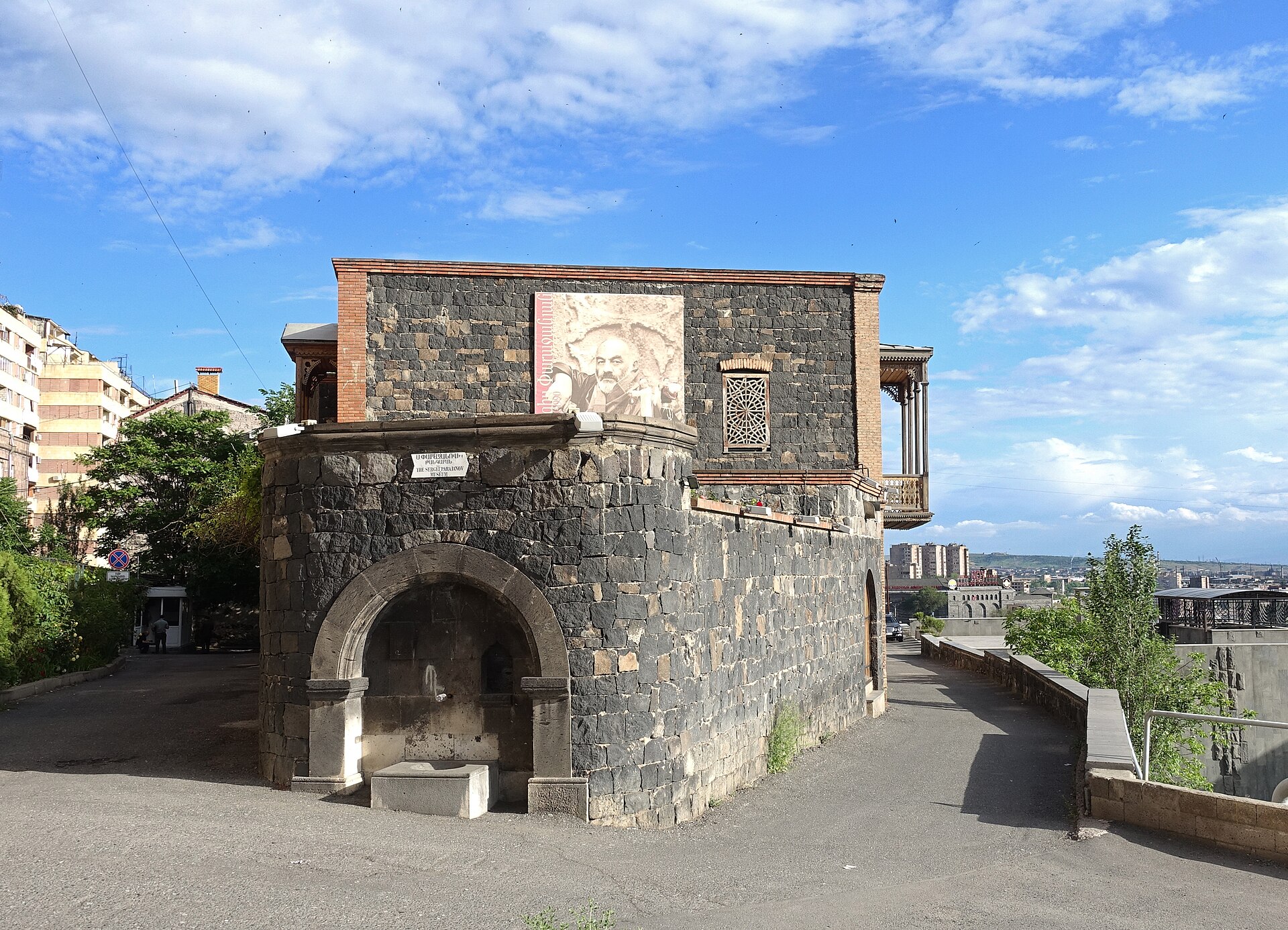
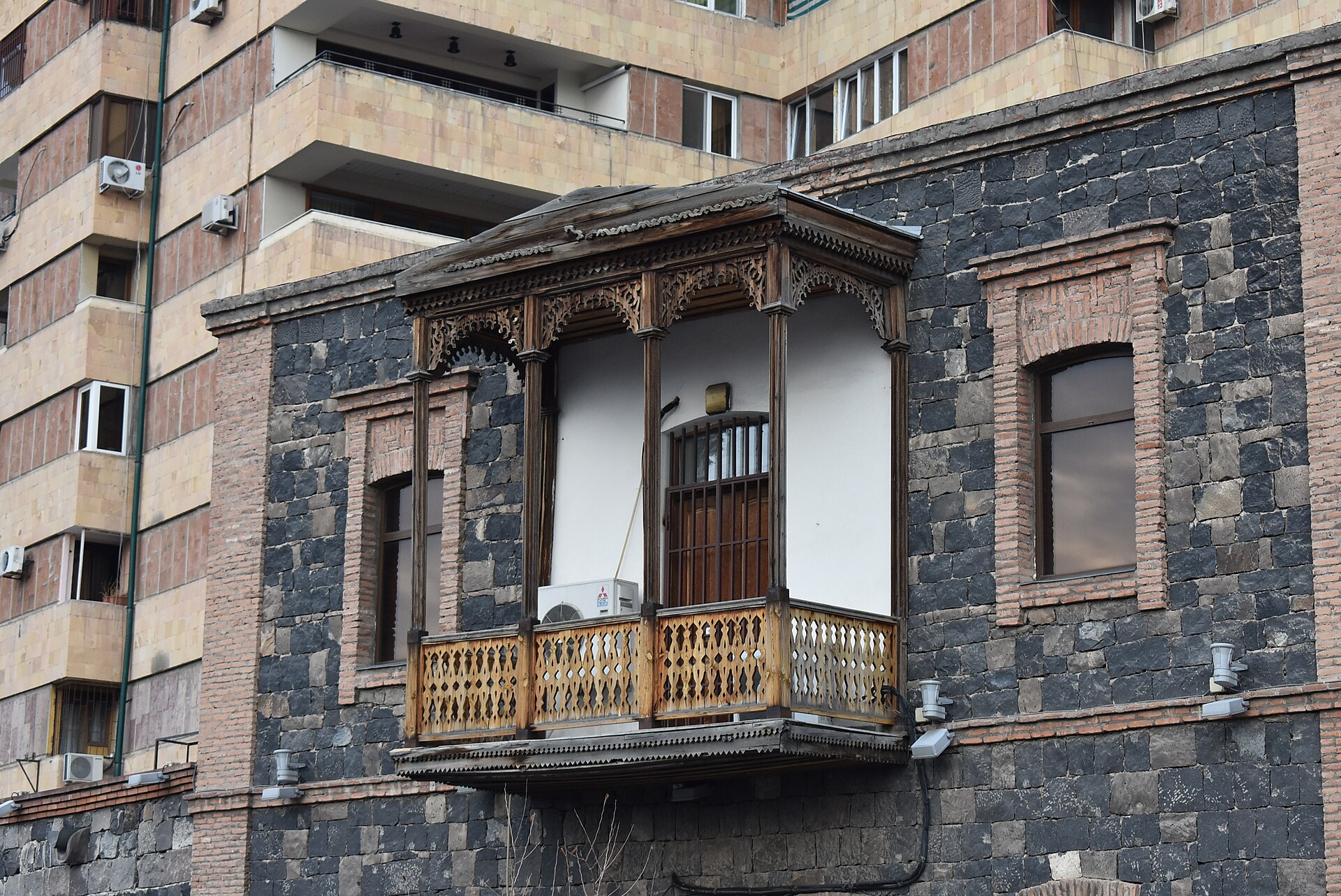
The museum building in Dzoragyugh, showing the stone facade, the arched drinking fountain, the wall portrait mural and the traditional carved wooden balcony
Photo: Tiia Monto, CC BY-SA 3.0 · Photograph by KulmalukkoSergei Parajanov Museum
Museum · Sergey Parajanovi Tangaran · Founded 1988
Open, admission and hours confirmed 30 August 2026 · 18 sources
On this page 14 sections
ContentsClose
The museum's strength is depth on a single artist rather than breadth: it is the only place in the world holding Parajanov's own collages, assemblages and prison-era work in quantity, material that exists nowhere else because he made almost all of it for himself rather than for a market, gallery system or commission. Where an encyclopaedic museum can be judged against a canon, this one has to be judged on its own terms, as the physical residue of one man's second career, forced on him after the Soviet state made continuing his first, filmmaking, impossible.
| Local name | Sergey Parajanovi Tangaran |
|---|---|
| Kind | Museum |
| Founded | 1988 |
| City and country |  Yerevan, Armenia Yerevan, Armenia |
| Address | Parajanov Street, Building 1, Dzoragyugh, Yerevan 0015, Armenia |
| Website | parajanovmuseum.am |
| Status | Open, confirmed |
| Record last verified |
Visiting
- Hours
- Daily10:30 to 18:00Last entry at 17:15
- Admission
- Adult (resident or non-resident)AMD 1,500The museum's own tickets page lists a single per-person price; it does not distinguish resident from non-resident rates despite headings for both
- Free entry categoriesFreeOn presentation of ID: members of official state delegations, accredited diplomats, ICOM members, museum workers, World War II and USSR-conflict participants with disabilities, and journalists
- Tickets
- parajanovmuseum.am/en/tickets The museum's own ticket page.
- Do I need to book?
- No ticket booking is required for individual entry; guided tours, audio guides and group film screenings are arranged in advance through the museum
- Address
- Parajanov Street, Building 1, Dzoragyugh, Yerevan 0015, Armenia MapOn foot 15 to 20 minutes from Republic Square or the Cascade, through the Dzoragyugh quarter above the Hrazdan Gorge
Bus or minibus Services marked for the Dzoragyugh or Cascade stops leave a short walk to the museum
Taxi About 5 to 10 minutes from the city centre, roughly 500 to 1000 AMD - Website
- parajanovmuseum.am
- Telephone
- +374 10 53 84 73
- [email protected]
Before you go how long, access, photography, bags, eating, shop
- How long to allow
- Visitor accounts vary widely: some walk the compact permanent display in under half an hour, others report lingering over the collages for two hours or more; a travel guide's own estimate is 1.5 to 2 hours
- Shop
- A museum shop sells clothing (T-shirts, hoodies) and the museum's own publications, including its Parajanov photo and essay books
Prices and hours change. We take them from the institution's own pages and print the day we read them, and you can check the current position at the source we used. Confirm before you travel.
What is inside
Biographical Hall
Family photographs and early works, tracing Parajanov's life before the museum's own founding
Dolls Hall
Ground-floor room devoted to Parajanov's handmade dolls, built from fabric, buttons and found objects
Collage Hall
A second-floor hall of flat and three-dimensional collages assembled from shells, lace, china, mirror glass and other salvaged materials
Film Hall
Sketches Parajanov made for his own cinema productions, alongside film stills and props used on set
Prison Works Hall
Drawings, collages and small sculptures made during his 1973-1977 imprisonment, from confiscated and improvised materials
Memorial Rooms
Two recreated rooms, a bedroom and a dining room, furnished with interior fittings and personal belongings brought from Parajanov's home in Tbilisi
What to see first
Fellini's Letter
Sergei ParajanovA 1980 collage built around a real letter Federico Fellini sent Parajanov, set into paper, postcard, lace, feathers, brocade and foil; one of several works that turn correspondence from fellow filmmakers into the raw material of art rather than an archival keepsake kept apart from it3
Weeping Gioconda
Sergei ParajanovA 1977 paper collage made in the labour camp, reworking the Mona Lisa from cut reproductions; the frame was added only after his release, and it stands among the clearest examples of him remaking a canonical image from nothing but paper and glue3
Inventory of Confiscated Belongings
Sergei ParajanovA series of four 1977 collages built from birchbark, tin cans, magazine clippings and tulle, made to itemise what the camp authorities had taken from him; the title turns an administrative act of confiscation into the subject of the work itself3
Variation with Shell on the Theme of Pinturicchio and Rafael
Sergei ParajanovTwo versions (1988 and 1989) of a three-dimensional collage in a wooden frame built up with seashells, mother-of-pearl, peacock feather, clockwork and artificial pearls around clippings from Renaissance reproductions; the second version, subtitled Repentance, is dedicated to his friend Vasili Katanyan3
Life and Death of General Radko
Sergei ParajanovA 1983 assemblage built inside a wooden coffin, combining a photograph, playing cards, military epaulettes, a medal, banknotes and dried pomegranates; one of the largest and most theatrical of his three-dimensional pieces3
Suitcase of My Childhood, Turned into an Elephant
Sergei ParajanovA 1984 assemblage that reshapes a leather suitcase and holster, studded with nail-driven wooden balls, into the form of an elephant; a plain example of the transformation-by-collage that runs through the whole collection3
Self-Portrait Against the Background of Haghpat
Sergei ParajanovA 1963 oil on canvas, one of the few conventional paintings in the collection and made a decade before his arrest, useful for showing what his hand looked like before collage became his main medium3
The Last Supper
Sergei ParajanovA 1973 collage combining a painted photo reproduction with a strip of cardiogram tape, lace and glass fragments from a Christmas ornament; made in the same year as his arrest, it is dated right at the hinge between his free and imprisoned years3
A house built for a man who never moved in
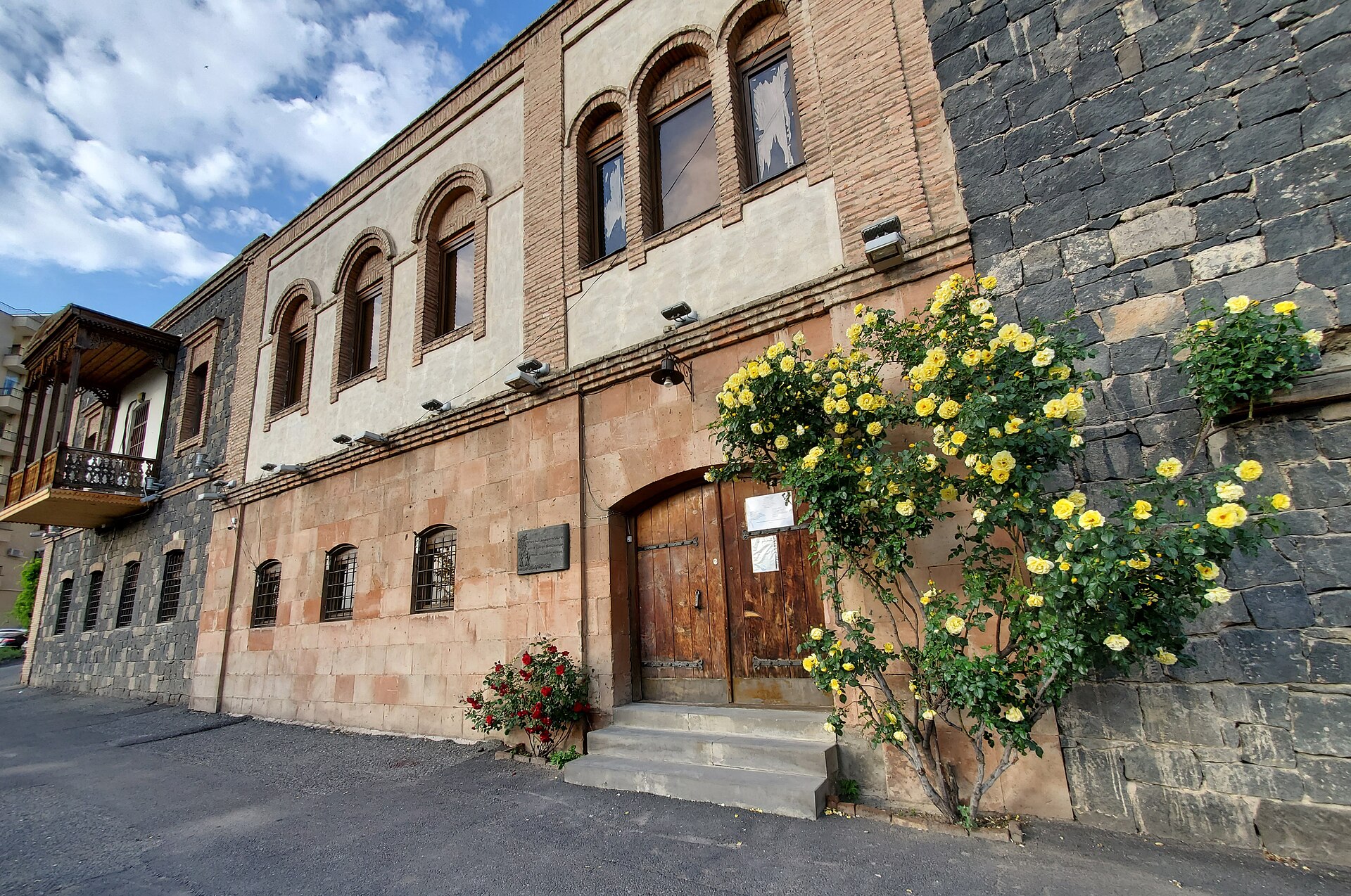
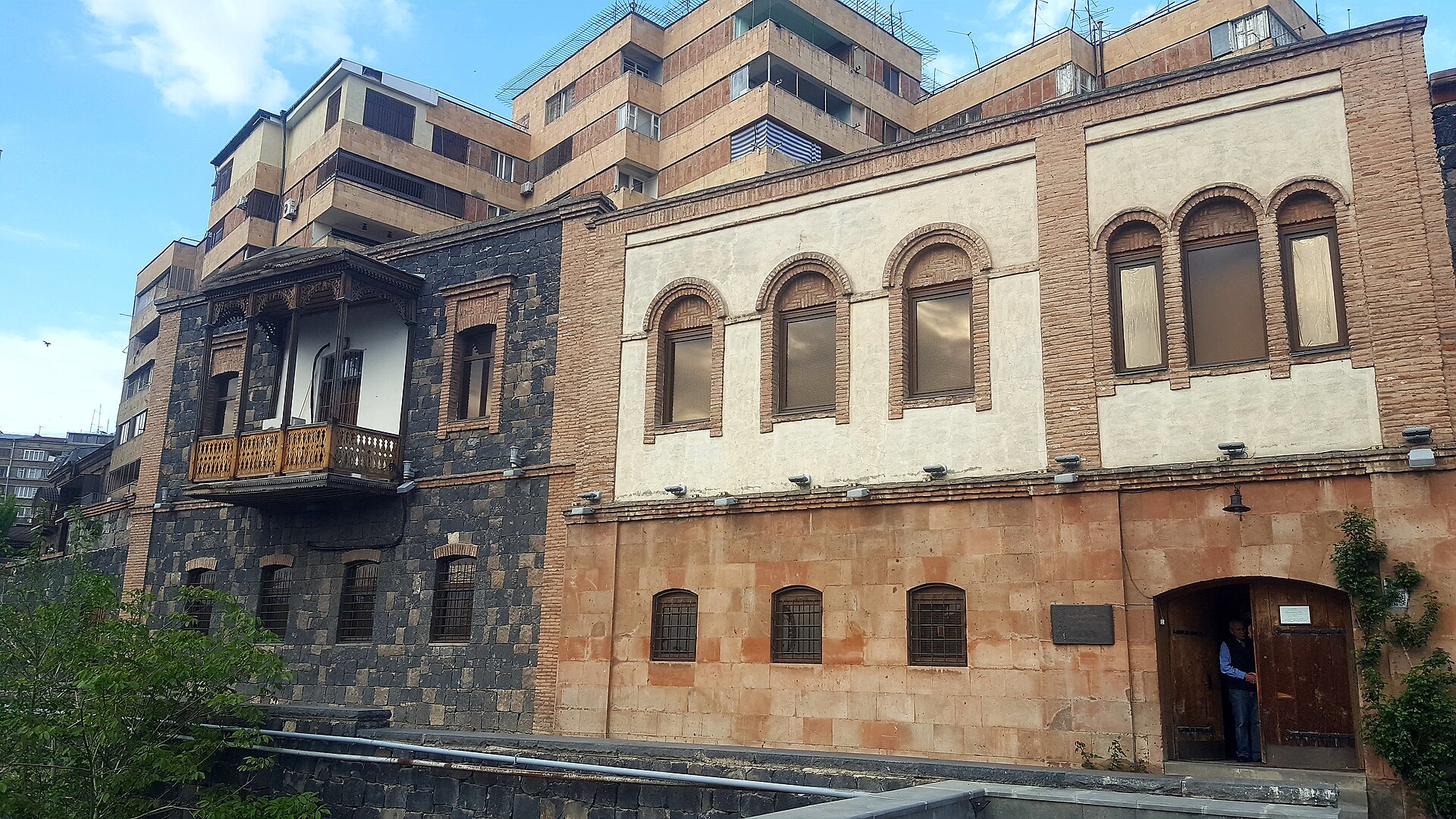
The Sergei Parajanov Museum sits on a hillside above the Hrazdan Gorge in Dzoragyugh, a historic quarter near the centre of Yerevan, in a two-storey stone house with a traditional carved wooden balcony. The idea for it came in 1988, when Parajanov's friend Zaven Sargsyan organised an exhibition of his work at Yerevan's Museum of Folk Art. Parajanov attended, and told the audience that his creativity belonged to no single nation, though he considered himself a man of three homelands: Georgia, where he was born and trained; Ukraine, which gave him love and recognition; and Armenia, where his family's roots lay and where, he said, he wanted to live out his life. Sargsyan took the words to the Armenian government, which agreed within days to grant premises for an artist's residence and museum. Two sites were offered. Parajanov chose the one being built in Dzoragyugh over a more central address on Abovian Street, drawn to the two-storey house rising in the ethnographic quarter, where he pictured peacocks in the courtyard and guests admiring them.
The 1988 Spitak earthquake halted construction, and it did not resume until 1990, by which point Parajanov had been diagnosed with the lung cancer that killed him on 20 July 1990. He never lived in the house built for him. It opened as a museum in June 1991, one year after his death, under Sargsyan as founding director, a post he held for close to three decades. The building the museum now occupies is not a repurposed home with a biography of its own before Parajanov, in the way many house-museums are; it was designed and built to hold his work and never had another use.
Prison as workshop
In December 1973 Parajanov was arrested in Kiev on charges that included homosexuality, sodomy and pornography, and later reported as rape and pornography distribution; he acknowledged his sexual orientation while denying the rape charge. Soviet officials had watched him for some time: the Ukrainian KGB had already flagged his support for the dissident writer Ivan Dzyuba and his open criticism of the government. He was sentenced to five years in a hard-labour camp and served four of them, released in December 1977 after Western intellectuals, among them Louis Aragon, Elsa Triolet and John Updike, lobbied on his behalf.
He kept working inside the camp, on whatever materials came to hand: paper, ball-point pen, birchbark, tin cans, dried flowers, magazine clippings, aluminium bottle caps, a torn photograph, even nail enamel used as paint. Around 800 drawings, collages and small doll-like sculptures survive from those four years, a number the museum's guards worked against at the time by confiscating materials and mocking the effort, until word of his reputation reached Moscow. The wing of the museum devoted to this period does not soften the conditions it describes: a series called Inventory of Confiscated Belongings turns the camp's own paperwork into the subject of the art, and a doll made in these years is labelled simply for the actress and muse Lilia Brik, worked in hessian, plastic buttons and thread. In January 2024, Ukraine's National Rehabilitation Commission reviewed the original criminal case and archival record and concluded the prosecution had been politically motivated; it acquitted Parajanov of the charges brought against him fifty years earlier, timed, Ukrainian officials noted, just ahead of what would have been his hundredth birthday.
Collage as autobiography
What the museum holds is not a collection assembled by curators after the fact but the working output of one man's second career, taken up once Soviet surveillance made it impossible for him to direct films after his release. The core of it, by the museum's own count, is 1,766 exhibits: flat and three-dimensional collages, assemblages, sketches for films, hats, dolls and personal belongings, alongside a kept archive of his letters (other sources describe the total collection as 1,400, 1,755 or 1,763 pieces; the museum's own materials do not reconcile the different counts, and this page repeats each as given). The materials are domestic and salvaged rather than an artist's traditional supplies: seashells, lace, mother-of-pearl, china fragments, brass plates, walnut shells, playing cards, clock parts, feathers and fabric scraps recur across the work. A three-dimensional collage dedicated to his friend Vasili Katanyan builds a wooden frame out of shell fragments, artificial pearls and a peacock feather around clippings from Renaissance reproductions of Pinturicchio and Raphael; an assemblage called Life and Death of General Radko is built inside an actual wooden coffin, packed with a photograph, playing cards, military epaulettes and dried pomegranates. The technique is the same one visible in the visual density of his films, especially The Colour of Pomegranates, carried over from the screen into physical objects once the screen was no longer available to him.
Some of what is on the walls is correspondence rather than collage in the conventional sense: a 1980 work built around a real letter from Federico Fellini folds the letter itself into paper, postcard, lace and foil, so the archive object and the artwork are the same physical thing. The museum's fond of letters also holds correspondence with Andrei Tarkovsky and Mikhail Vartanov, documentary material rather than display pieces, kept alongside the more finished collages.
Eight rooms, arranged by a life
The permanent display runs across eight halls organised more by period and material than by conventional museum taxonomy. A biographical hall opens with family photographs and early work; a ground-floor hall is given to the dolls; a second-floor hall, lit for the purpose, holds the collages; a separate hall gathers sketches and props from his films; and a dedicated hall holds the prison-era drawings and collages described above. Two further rooms are memorial reconstructions rather than galleries: a bedroom and a dining room refitted with furniture, fittings and personal effects brought from Parajanov's home in Tbilisi, an attempt to place a fragment of his actual domestic life inside the museum built for his art. None of the interior rooms could be shown here with a verified free-licence photograph; the free-licence images available for this page are all of the building's exterior, and no substitute has been used for what could not be confirmed.
A small museum with an outsized guest list
For a museum built around one artist's own studio output, its reach has been wide. It has sent exhibitions of Parajanov's work to roughly fifty to sixty-seven venues abroad, depending on which of the museum's own published counts is used, including Cannes, Rome, Tokyo, Moscow, Paris, London, Los Angeles, Tehran, Istanbul, Brussels and Montreal. Visitors named in the museum's own account of famous guests include the filmmakers Wim Wenders and Atom Egoyan, the writers Paulo Coelho and Yevgeni Yevtushenko, and, less comfortably for a museum dedicated to an artist persecuted by the Soviet state, sitting heads of state including Vladimir Putin and Aleksandr Lukashenko, whose visits the museum records without further comment. The museum also functions as a working cultural institution rather than a static display: it hosts events tied to the Yerevan International Film Festival, runs a shop selling its own publications and branded clothing, and works with a dedicated charitable foundation, Friends of Art, established in 2021 to support the acquisition, study and preservation of Parajanov's work.
What a visit is like now
The museum keeps no closed day and opens every morning at 10:30, with last entry at 17:15 ahead of a 18:00 close. A single adult ticket costs 1,500 AMD, with free entry on presentation of ID for accredited diplomats, ICOM members, museum staff, journalists and disabled veterans of the Second World War and Soviet-era conflicts. Guided tours and ten-language audio guides are available for an additional fee, and group film screenings can be booked for parties of five or more. Visitor accounts of how long to allow vary sharply, from under half an hour to two hours or more spent over the collages, which says as much about the compactness of the building as about the density of what is inside it. What recurs across visitor accounts, almost regardless of how long they stayed, is a sense of intimacy: this is consistently described as feeling like a private house rather than an institution, filled with a single mind's handwork rather than a collection built by acquisition, and that is the part of the experience Ruth's brief for pages like this one asks a reader to be told before they book the trip.
What visitors say
Visitors consistently describe the museum as one of the most memorable stops in Yerevan: small, intimate and built around Parajanov's own hand-made collages, dolls and prison-era works rather than any single canonical masterpiece. Most reviewers connect what they see directly to his biography, especially the years of imprisonment, and describe leaving with a strong emotional impression rather than a checklist of objects seen.
What is praised, what is criticised
- Praised: the warm, homely atmosphere of the rooms and the sense of stepping into a private world rather than a formal gallery
- Praised: the collages and assemblages themselves, made from shells, lace, buttons, china and other everyday materials
- Praised: the way the display ties the art directly to Parajanov's life story, including the years of imprisonment
- Praised: the views over Yerevan and the Hrazdan Gorge from the museum's hillside courtyard
- Criticised: a minority of visitors find the visit short for the price, describing a museum they moved through in well under an hour and did not connect with
- Criticised: a few reviewers describe some of the folk-craft pieces and dolls as crude or unsettling rather than fine art, leaving what one called a strange, sad, depressive-melancholic impression alongside the more common enthusiasm
Ratings on other platforms
Tripadvisor: 4.7 from 601 ratings, read 30 August 2026
A platform average is a tertiary source: it moves, it is not audited, and we quote no visitor's words.
Questions about Sergei Parajanov Museum
Where is Sergei Parajanov Museum?
Parajanov Street, Building 1, Dzoragyugh, Yerevan 0015, Armenia.
How much does it cost to visit?
Adult (resident or non-resident): AMD 1500; Free entry categories: free. As confirmed 30 August 2026.
When is it open?
Daily 10:30-18:00. As confirmed 30 August 2026.
How do you get there?
On foot: 15 to 20 minutes from Republic Square or the Cascade, through the Dzoragyugh quarter above the Hrazdan Gorge; Bus or minibus: Services marked for the Dzoragyugh or Cascade stops leave a short walk to the museum; Taxi: About 5 to 10 minutes from the city centre, roughly 500 to 1000 AMD.
What should you see first?
Fellini's Letter (Sergei Parajanov); Weeping Gioconda (Sergei Parajanov); Inventory of Confiscated Belongings (Sergei Parajanov); Variation with Shell on the Theme of Pinturicchio and Rafael (Sergei Parajanov); Life and Death of General Radko (Sergei Parajanov); Suitcase of My Childhood, Turned into an Elephant (Sergei Parajanov).
What we could not confirm
- The museum's own published figures for the total size of the collection are inconsistent across its own materials and closely related sources (1,400, 1,755, 1,763 and 1,766 exhibits have each been given), and nothing seen for this page reconciles the difference.
- How many of the roughly 800 works Parajanov made during his 1973-1977 imprisonment survive today, and how many were lost or destroyed by camp authorities at the time, is not stated in the sources consulted for this page.
- Ukraine's 2024 rehabilitation commission found the original 1973 prosecution politically motivated and cleared Parajanov of the charges; none of the sources seen for this page say whether this finding carries any formal legal effect in Armenia, where the museum operates, or is limited to Ukraine's own criminal record.
Images
Sources
- 1Sergey Parajanov Museum, tickets and visiting information page parajanovmuseum.am/en/tickets
- 2Sergey Parajanov Museum, About Museum page parajanovmuseum.am/en/about-museum
- 3Sergey Parajanov Museum, Gallery page (artwork list with materials and dates) parajanovmuseum.am/en/gallery
- 4Wikipedia, Sergei Parajanov Museum en.wikipedia.org/wiki/Sergei_Parajanov_Museum
- 5Wikidata, Q7453721 (Sergei Parajanov Museum) wikidata.org/wiki/Q7453721
- 6Wikimedia Commons, Category:Sergei Parajanov Museum commons.wikimedia.org/wiki/Category:Sergei_Parajanov_Museum
- 7Sergey Parajanov Museum entry, Mus.am (hall-by-hall layout of the permanent exhibition) sergey-parajanov.mus.am/en/
- 8Parajanov-Vartanov Institute, Sergei Parajanov Museum information page parajanov.com/museum_info/
- 9Tripadvisor, Parajanov Museum, Yerevan (rating, review count and visitor reviews) tripadvisor.com/Attraction_Review-g293932-d3224240-Reviews-Parajanov_Museum-Yerevan.html
- 10Kupi.com, Sergei Paradjanov Museum guide (transport and typical visit length) kupi.com/en-ae/explore/armenia/yerevan/sergei-parajanov-museum
- 11Visit Yerevan (official city tourism site), Sergey Parajanov Museum listing visityerevan.am/places/details/701/en/
- 12Wikipedia, Sergei Parajanov (biography: arrest, imprisonment, release, three homelands, death) en.wikipedia.org/wiki/Sergei_Parajanov
- 13The Armenian Report, "Ukraine Clears Sergei Parajanov of 'Homosexuality' Charges Posthumously", 10 January 2024 thearmenianreport.com/post/ukraine-clears-sergei-parajanov-of-homosexuality-charges-posthumously
- 14Armenian Wikipedia, Sergey Parajanovi tangaran (confirms Armenian-language name of the museum) hy.wikipedia.org/wiki/%D5%8D%D5%A5%D6%80%D5%A3%D5%A5%D5%B5_%D5%93%D5%A1%D6%80%D5%A1%D5%BB%D5%A1%D5%B6%D5%B8%D5%BE%D5%AB_%D5%A9%D5%A1%D5%B6%D5%A3%D5%A1%D6%80%D5%A1%D5%B6
- 15Wikimedia Commons file page, File:Sergei Parajanov Museum.jpg (licence CC BY-SA 3.0, author Tiia Monto) commons.wikimedia.org/wiki/File:Sergei_Parajanov_Museum.jpg
- 16Wikimedia Commons file page, File:Sergei Parajanov museum, Yerevan.jpg (licence CC BY-SA 4.0, author Eema97) commons.wikimedia.org/wiki/File:Sergei_Parajanov_museum,_Yerevan.jpg
- 17Wikimedia Commons file page, File:Parajanov Museum Yerevan.jpg (licence CC BY-SA 4.0, author Yerevantsi) commons.wikimedia.org/wiki/File:Parajanov_Museum_Yerevan.jpg
- 18Wikimedia Commons file page, File:Sergei Parajanov museum balcony.jpg (licence CC BY-SA 4.0, author Yerevantsi) commons.wikimedia.org/wiki/File:Sergei_Parajanov_museum_balcony.jpg


