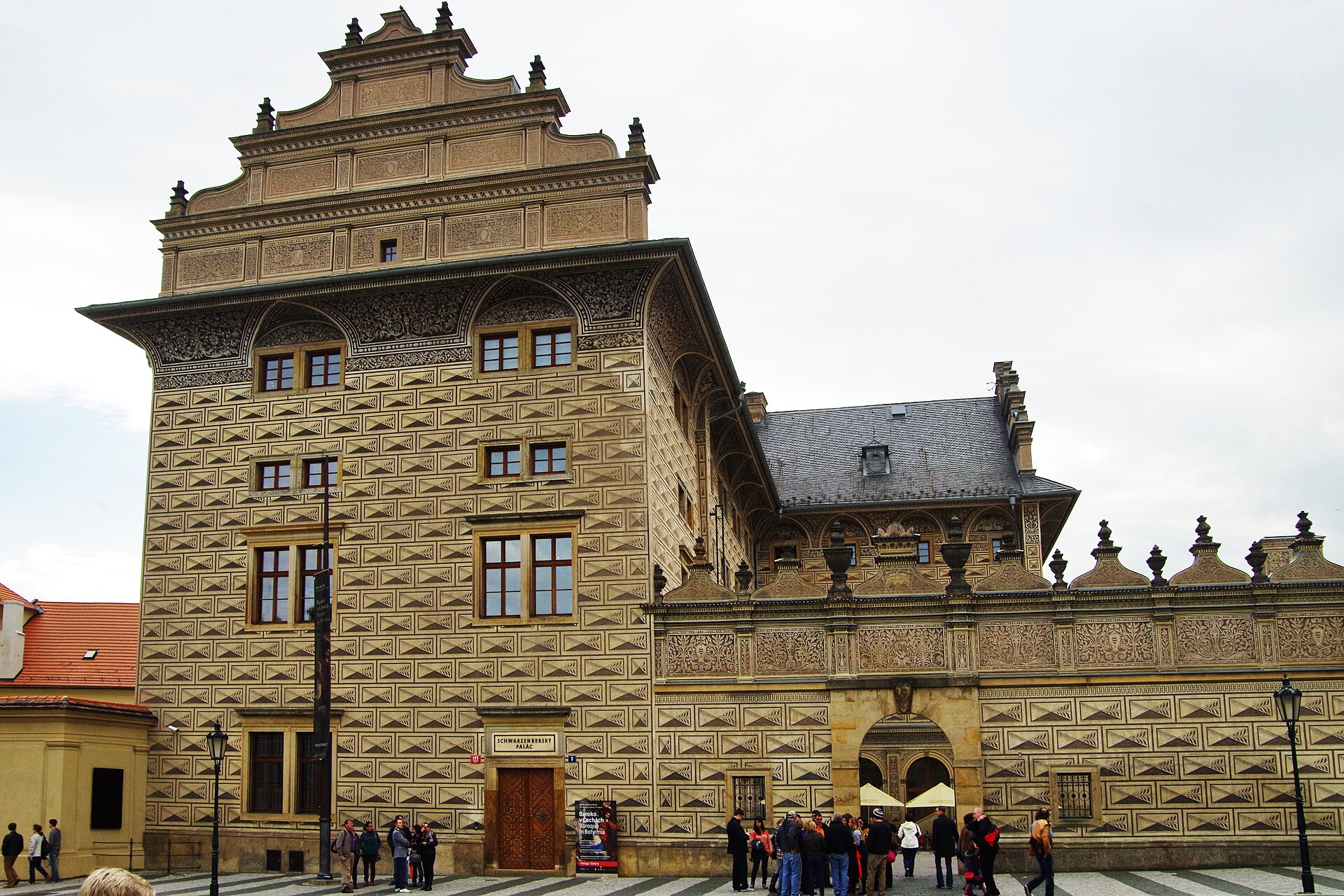
A wide view of the palace's sgraffito facade from Hradcanske namesti.
Balou46, CC BY-SA 3.0Schwarzenberg Palace
Museum · Schwarzensky palac · Founded 1545
Open, admission and hours confirmed 26 August 2026 · 13 sources
On this page 16 sections
ContentsClose
Schwarzenberg Palace is where the National Gallery Prague shows the imperial core of its Old Masters holding: paintings and sculpture that trace to Rudolf II's Prague Kunstkammer, anchored by Durer's Feast of the Rosary and by the court artists, Adriaen de Vries and Hans von Aachen chief among them, who actually worked in the city under Rudolf. Bohemian Baroque painting and sculpture, an Italian terracotta collection, and the building's own surviving Renaissance ceilings extend that core into local production and into the fabric of the palace itself. It complements rather than duplicates Sternberg Palace across the square, which holds the National Gallery's separate Old Masters II display, and the two are sold on one ticket precisely because neither collection alone tells the fuller story.
| Local name | Schwarzensky palac |
|---|---|
| Kind | Museum |
| Founded | Built 1545 to 1567 as a Renaissance residence for the Lobkowicz family; passed to the Schwarzenberg family in the early 18th century; acquired by the National Gallery Prague in 2002 and reopened as a gallery in 2007 after a five year restoration |
| City and country |  Prague, Czech Republic Prague, Czech Republic |
| Address | Hradcanske namesti 2, 118 00 Prague 1, Czech Republic |
| Website | ngprague.cz/en/about/buildings/schwarzenberg-palace |
| Status | Open, confirmed |
| Record last verified |
Visiting
- Hours
- Tue-Sun10:00 to 18:00Standard opening hours, confirmed directly on NGP's own building page
- Closed
- Monday.
- Admission
- Basic (adult)CZK 250Permanent exhibitions at Schwarzenberg Palace
- ReducedCZK 140Students, seniors and other reduced categories as defined by NGP's own price list
- School groups (16+, minimum 10 people)CZK 60Per person
- Visitors under 16FreeFree entry to all short-term and permanent exhibitions
- Joint ticket, Old Masters I (Schwarzenberg) and Old Masters II (Sternberg)CZK 300Basic rate; reduced rate is 200 CZK, school groups 100 CZK. Sold only at the NGP ticket desks in Schwarzenberg and Sternberg Palaces. This ticket covers two separate buildings, not Schwarzenberg alone
Free entry: No dedicated free-admission day for Schwarzenberg Palace is published on NGP's own admission page; entry is free year round for visitors under 16- Tickets
- ngprague.cz/en/about/admission The museum's own ticket page.
- Do I need to book?
- No booking is described as required on NGP's own pages read for this record; tickets are sold at the palace's own desk and through NGP's online admission page
- Address
- Hradcanske namesti 2, 118 00 Prague 1, Czech Republic MapMetro Line A, Malostranska or Hradcanska station, then a walk up through Hradcany
Tram Tram 22 (also 23), stops Prazsky hrad, Brusnice or Pohorelec, all a short walk from Hradcanske namesti - Website
- ngprague.cz/en/about/buildings/schwarzenberg-palace
- Telephone
- +420 224 301 122
- [email protected]
Before you go how long, access, photography, bags, eating, shop
- How long to allow
- Not published in the sources read for this record. Tripadvisor reviewers describe the building's layout as confusing enough that a visit without a plan can run long; the collection spans three floors of paintings and sculpture plus an attic arms and armour display
- Access
- The palace has step-free access, lifts, wheelchair-accessible toilets, and one wheelchair available for loan to visitors, per NGP's own accessibility page
- Photography
- Not published in the sources read for this record
- Bags
- Not published in the sources read for this record
- Eating
- Not confirmed on NGP's own pages read for this record; Tripadvisor reviewers mention a cafe on site favourably, which is a visitor report rather than an NGP statement
- Shop
- Not published in the sources read for this record
Prices and hours change. We take them from the institution's own pages and print the day we read them, and you can check the current position at the source we used. Confirm before you travel.
What is inside
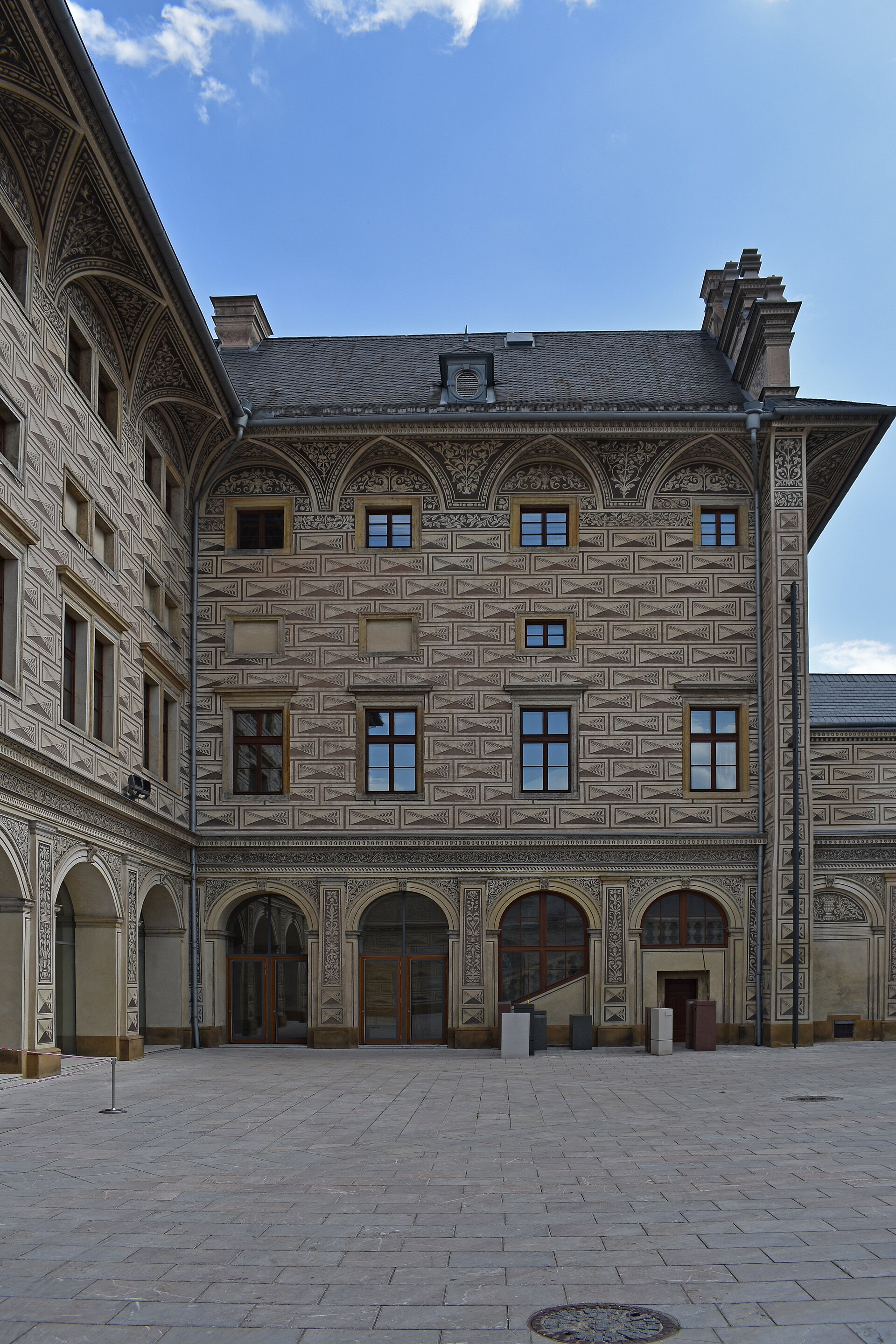
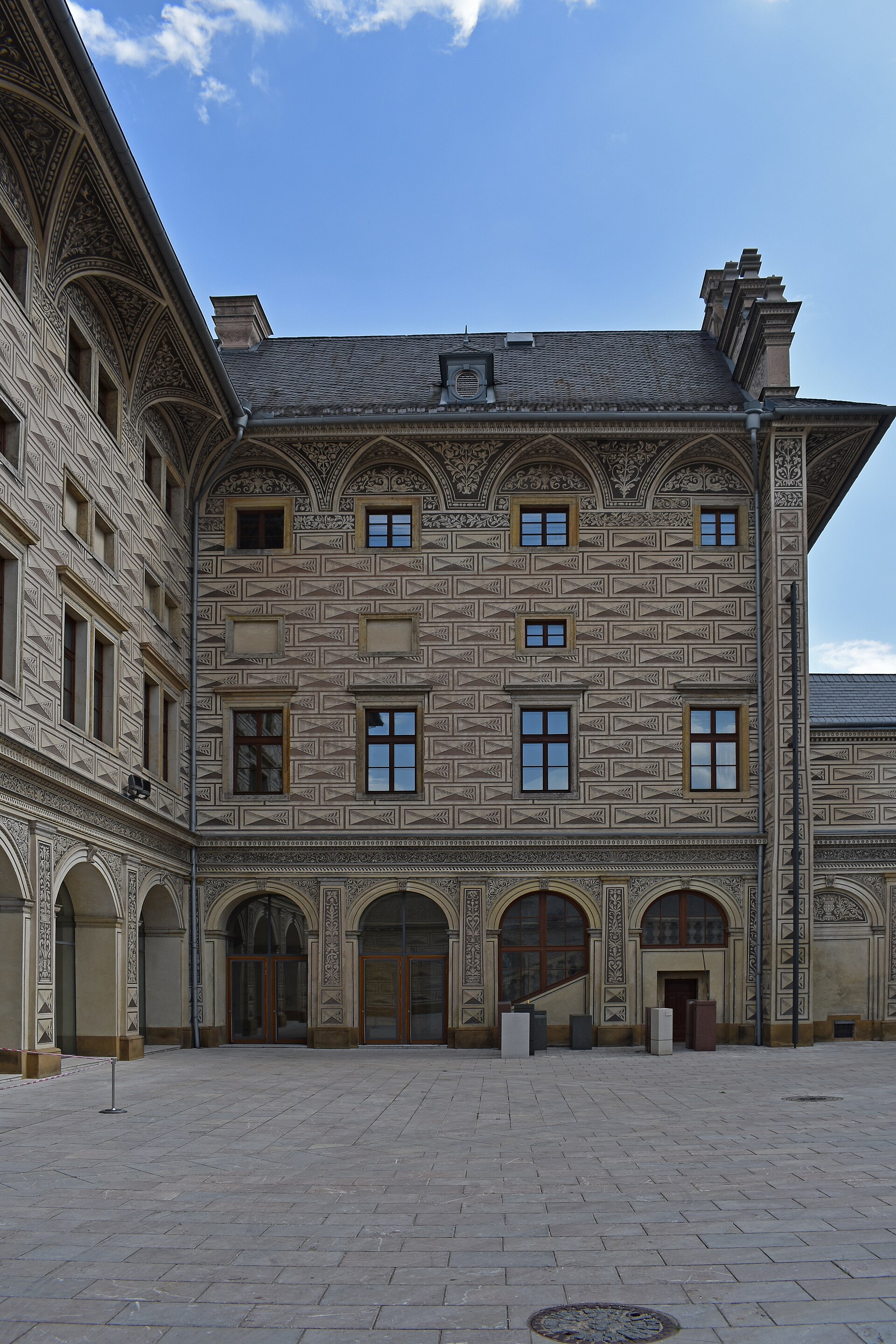
Photograph by Ymblanter · CC BY-SA 4.0 Courtyard and ground floor
The original entrance from Hradcanske namesti through the inner courtyard has been restored as the visitor entrance. The ground floor holds three rooms used for temporary and occasional exhibitions and two rooms set aside as Graphic Cabinets for works on paper.
Old Masters: Renaissance and Mannerist painting
The Old Masters permanent exhibition occupies the upper floors with paintings and sculpture from the 16th to 18th centuries, built around works that trace to Emperor Rudolf II's Kunstkammer, including Albrecht Durer, Lucas Cranach, Hans Holbein, Jan Gossaert, El Greco, Peter Paul Rubens, Bartholomaeus Spranger, Hans von Aachen and Adriaen de Vries.
Second floor: the painted-ceiling halls
Four halls on the second floor preserve their original sheet ceilings, painted around 1580 with Renaissance mythological scenes including the fall of Phaeton, Jupiter and Juno, and the rape of the Sabine women. NGP's own building page describes them as a rare surviving document of Renaissance figurative ceiling painting in Prague.
Bohemian Baroque: painting, sculpture and terracottas
A dedicated section of the Old Masters display concentrates on Baroque production in the Bohemian lands, with paintings by Karel Skreta and Petr Brandl and sculpture by Matthias Bernard Braun. Alongside the permanent hang, the palace has run a exhibition of Italian terracottas, Clay Sculptures: Italian Masters of the 15th to 19th Centuries, drawn from NGP's own holdings.
Attic: arms and armour
The top floor, a legacy of the building's decades as home to Prague's Military History Institute before the National Gallery took possession in 2002, displays historic weapons, armour and firearms. Multiple visitor accounts and an architectural guide to the building both describe this attic display; NGP's own building page, which covers the painting and sculpture galleries in detail, does not itself catalogue it.
What to see first
The Feast of the Rosary
Albrecht DurerA large altarpiece Durer painted in Venice in 1506 for the city's German merchant community; it later entered Emperor Rudolf II's Prague Kunstkammer and is treated by the National Gallery itself as the single work that anchors the historical importance of its Old Masters collection.5
Marching Horse
Adriaen de VriesA bronze by the Hague-born sculptor who trained under Giambologna and worked at Rudolf II's Prague court from 1593; the piece is presented as originating in the emperor's Wunderkammer and demonstrates the dynamic, naturalistic modelling associated with de Vries.11
Suicide of Lucretia
Hans von AachenA Mannerist nude by Rudolf II's court painter, cited for its combination of refined modelling and openly erotic charge, characteristic of the imperial Prague school von Aachen led.11
Christ at Prayer
El GrecoA devotional half-length Christ by the Cretan-born, Spanish-trained painter, one of the non-Bohemian Old Masters named specifically among the artists on display in the Schwarzenberg Palace hang.4
Portraits of Cosimo I de' Medici and Eleanor of Toledo
Attributed to Agnolo Bronzino or his circleCourt portraiture associated with the Florentine Mannerist Bronzino, cited among the palace's Renaissance holdings; the attribution as reported is to Bronzino or his workshop rather than confirmed as an autograph pair.11
Bohemian Baroque paintings
Karel Skreta and Petr BrandlThe two painters NGP's own exhibition text names as anchoring its account of Baroque painting production in the Bohemian lands, shown alongside the international Old Masters holdings.4
Baroque sculpture
Matthias Bernard BraunSculpture by Braun, the leading Baroque sculptor working in Bohemia, is named directly in NGP's own description of the palace's Baroque section.4
The four painted-ceiling halls
Unknown Renaissance painters, circa 1580Not a portable work but part of the fabric of the building: four second-floor rooms keep their original painted sheet ceilings from around 1580, showing mythological scenes including Phaeton and the rape of the Sabine women, described by NGP as a rare surviving record of Renaissance figurative ceiling painting.1
Clay Sculptures: Italian Terracottas, 15th to 19th centuries
Various Italian sculptorsA dedicated exhibition drawn from NGP's own holdings of Italian terracotta sculpture spanning four centuries, staged inside the Schwarzenberg Palace rather than as a portable loan show.1
Arms and armour
Various, formerly Military History Institute holdingsA legacy of the building's decades as a military museum: the attic floor displays historic weapons, armour and firearms, repeatedly singled out by visitors as an unexpected complement to the paintings below.9
Exhibitions on now
- Opening soon20 Oct 2026 to 31 Jan 2027Confirmed , 2 weeks ago
A Renaissance palace built for a fallen favourite
Schwarzenberg Palace stands on Hradcanske namesti, the square that opens onto Prague Castle from the west, and its site was occupied before the palace itself: four medieval houses stood there, one of them the workshop of a fourteenth century court painter, until a fire swept through Hradcany in 1541 and destroyed them. Jan the Younger Popel of Lobkowicz built the Renaissance residence that replaced them, commissioning the North Italian architect Agostino Galli; construction ran from the mid 1540s and the building was complete by 1567.
Lobkowicz did not keep it long. In 1593 Emperor Rudolf II confiscated the palace after its owner was imprisoned on charges of betrayal and fraud, and the building passed through a succession of noble owners over the following century: to Petr Vok of Rosenberg, then to the Svamberk family, then to the House of Eggenberg. The Schwarzenberg family, whose name the building has carried ever since, acquired it through marriage in the early eighteenth century and held it until 1948, when the Communist state took the family's Czechoslovak property. Under Schwarzenberg ownership the residential wings were substantially rebuilt by the architects Anton Erhard Martinelli and Antonin Haffenecker, giving the interior much of the form it still has.
Sgraffito and the face of Hradcany
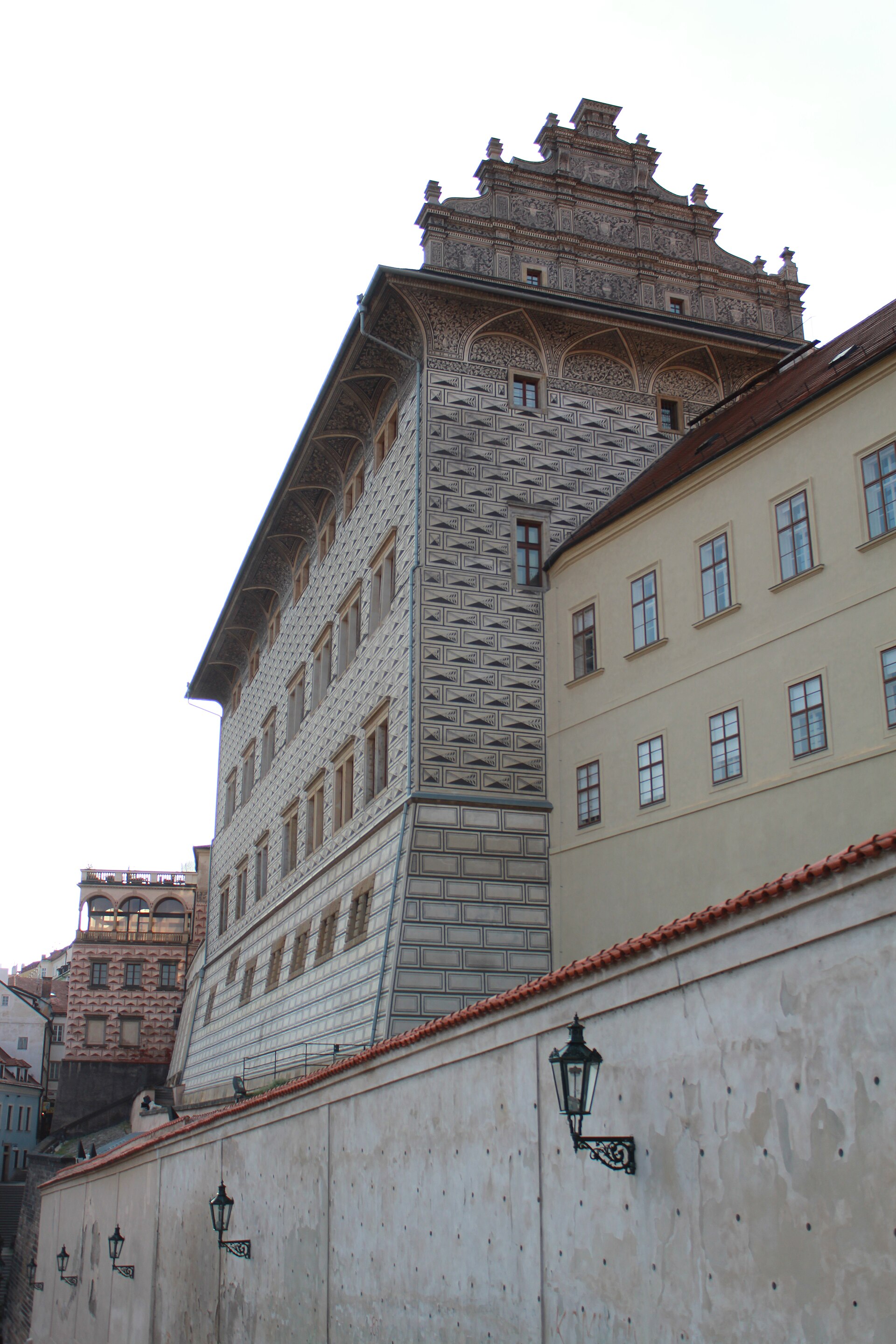
The palace's most recognisable feature was not part of Galli's original design in the form visitors see it today. The sgraffito that covers roughly seven thousand square metres of the exterior, scored into wet plaster to leave a pattern of raised, shadowed cuboid blocks that make the flat facade read as rough-cut stone, received its present form between 1870 and 1874, to a design by the architect Josef Schulz. It was restored again in the 1950s. The effect is one of the reasons Schwarzenberg Palace is routinely named, alongside the Royal Summer House in the Castle gardens, as one of the two most complete Renaissance buildings surviving in Prague.
A smaller detail rewards a closer look: a sundial set into one of the palace's chimneys, visible from Nerudova street below the Castle, is flanked by sgraffito figures of a rooster for day and an owl for night, and carries the Latin inscription Hora ruit, the hour rushes on. It is a private, decorative touch on a building whose main facade was built to be read from across the square.
From barracks and battle relics to a national collection
The twentieth century gave the palace a very different working life from the one it has now. It was leased to the National Technical Museum around 1908 to 1910, then converted to military use: a military museum operated in the building through the Second World War, and the palace was damaged during the Prague Uprising in May 1945 as fighting reached Hradcany. After the war it passed to the Military History Institute, which held it for decades as the Military History Museum, filling the upper floor with the weapons, armour and firearms that remain on show today as a residue of that period.
The National Gallery Prague acquired the palace from the Ministry of Defence in 2002. A five year restoration followed, and the building reopened to the public as a National Gallery department in 2007, with its Old Masters exhibition opening the following March. The rehang has been refined since: NGP's own building page now dates the current Renaissance and Baroque display to 2019, run alongside the complementary Old Masters II display across Hradcanske namesti in Sternberg Palace, a separate National Gallery building with its own collection and its own opening dates. The two are sold on a single joint ticket but they are not the same exhibition, and a work reported at one should not be assumed to hang in the other; several of the palace's most frequently searched-for paintings, including Rembrandt's only canvas held anywhere in the Czech Republic, in fact hang in Sternberg Palace rather than here.
What is inside: the Old Masters
The permanent exhibition inside Schwarzenberg Palace is built around a genuinely imperial inheritance. A core of the paintings and sculpture on display trace back to the Kunstkammer, the cabinet of art and marvels, assembled in Prague by Rudolf II at the turn of the seventeenth century, when the city was briefly the seat of the Holy Roman Emperor and a magnet for artists working in his service. Albrecht Durer's Feast of the Rosary, painted in Venice in 1506 for that city's German merchant community before it entered Rudolf's collection, is treated by the National Gallery as the anchor of the whole Old Masters holding: a large, densely populated altarpiece that shows Durer working at the scale and ambition of the Venetian painters around him.
The sculptors and painters who actually worked at Rudolf's Prague court are represented in depth. Adriaen de Vries, the Hague-born bronze caster trained under Giambologna in Florence, joined the imperial court in 1593 and is shown here with a bronze Marching Horse whose free, dynamic modelling is characteristic of his style. Hans von Aachen, Rudolf's court painter, appears with a Mannerist Suicide of Lucretia. Bartholomaeus Spranger, another of the emperor's painters, is named among the artists on display alongside them. Set against this Prague school are the international Old Masters that give the collection its wider reach: El Greco, represented by a devotional Christ at Prayer; Peter Paul Rubens; Hans Holbein; Lucas Cranach; Jan Gossaert; and portraiture associated with the Florentine Mannerist Agnolo Bronzino, reported among the palace's holdings, though the attribution as described in the sources for this record is to Bronzino or his circle rather than confirmed as autograph.
Bohemian Baroque and the painted ceilings
Where the Rudolfine material gives the collection its imperial weight, a dedicated section of the same permanent display turns to art made in the Bohemian lands themselves across the following two centuries. Karel Skreta and Petr Brandl, the two painters the National Gallery's own account of the exhibition names directly, anchor this material; the Baroque sculptor Matthias Bernard Braun, whose figures still stand across Prague's bridges and squares, represents the period's sculpture. The palace has also hosted Clay Sculptures, an exhibition of Italian terracotta figures spanning the fifteenth to nineteenth centuries and drawn from the National Gallery's own holdings rather than borrowed for the occasion, extending the building's range from painting and bronze into modelled clay.
The building itself contributes to this material rather than merely housing it. Four rooms on the second floor keep their original painted sheet ceilings, close to five hundred years old, showing figures from classical mythology: the fall of Phaeton, Jupiter and Juno, and the rape of the Sabine women among them. The National Gallery's own description of the building calls the set a rare surviving document of Renaissance figurative ceiling painting in Prague, and unlike the portable collection around them, these four ceilings cannot be lent elsewhere or rehung; they are read in place, as part of the rooms Galli's masons built in the 1560s.
Arms, armour and an unexpected attic
One further collection sits above the painting galleries and is easy for a visitor to miss on a first pass through the building. The palace's attic, the floor that once held the Military History Institute's working collection when the building served as a military museum through the middle of the twentieth century, still displays historic weapons, armour and firearms. It is not part of NGP's own published account of the Old Masters exhibition, which concentrates on the painting and sculpture floors below, but it is repeatedly described by visitors and by architectural guides to the building as a genuine part of what is on show, and it is the clearest surviving trace inside the palace of the decades it spent as a museum of a very different kind.
Visiting today, and a gallery under scrutiny
Schwarzenberg Palace keeps standard National Gallery Prague hours, Tuesday to Sunday from ten in the morning to six in the evening, closed on Mondays. Basic admission to the palace's own permanent exhibitions is 250 CZK, reduced to 140 CZK for eligible visitors, with entry free for everyone under sixteen; a joint ticket covering both Old Masters displays, at Schwarzenberg and at Sternberg Palace across the square, costs 300 CZK basic or 200 CZK reduced and is sold only at the ticket desks in those two buildings. The building has step-free access, lifts and wheelchair-accessible toilets, with a loan wheelchair available on request.
The wider institution the palace belongs to has had a difficult 2026. In March, the Czech culture minister dismissed Alicja Knast, the National Gallery Prague's director general since 2021, citing a need for stronger ambition and professional development; Knast said she learned of her dismissal from ministry staff rather than from the minister directly, and pointed to visitor numbers of over half a million a year and continuing international collaboration as evidence the gallery was performing well. A month earlier the minister had dissolved the gallery's advisory Guarantee Board, the body that might otherwise have had a say in such a decision. Olga Kotkova, the director of NGP's Old Masters collection, the same collection that fills Schwarzenberg Palace, took over as interim leadership while the ministry decided on a permanent successor. None of the reporting read for this record ties the dispute to Schwarzenberg Palace specifically, or suggests any change to its hours, admission or exhibitions, but it is the governance context the building currently sits inside, and a reader planning a return visit in the coming years should expect the gallery's leadership, and potentially its programming, to be in some flux.
What visitors say
Visitors consistently rate Schwarzenberg Palace highly for the combination of a distinctive Renaissance building and a strong Old Masters collection shown without the crowds that fill Prague Castle just outside its door. The building itself, with its sgraffito facade and painted ceilings, is repeatedly called as much a reason to visit as the art inside it.
What is praised, what is criticised
- Praised: The depth and range of the Old Masters collection, with visitors singling out works by Durer, Rubens and other named Old Masters
- Praised: The relative quiet of the galleries compared with the crowds on Hradcanske namesti and at Prague Castle immediately outside
- Praised: The sgraffito facade, the original painted ceilings and the restored courtyard, treated by many visitors as attractions in their own right alongside the paintings
- Praised: The value of the joint Old Masters ticket covering both Schwarzenberg and Sternberg Palaces
- Criticised: A confusing internal layout, with one reviewer describing the building as a rabbit warren to navigate
- Criticised: The absence of guided tours or audio guides, which some visitors say makes the paintings and sculpture harder to place in context without prior reading
- Criticised: At least one visitor reported a negative encounter with gallery staff
Ratings on other platforms
Tripadvisor: 4.2 from 182 ratings, read 26 August 2026
A platform average is a tertiary source: it moves, it is not audited, and we quote no visitor's words.
Questions about Schwarzenberg Palace
Where is Schwarzenberg Palace?
Hradcanske namesti 2, 118 00 Prague 1, Czech Republic.
How much does it cost to visit?
Basic (adult): CZK 250; Reduced: CZK 140; School groups (16+, minimum 10 people): CZK 60; Visitors under 16: free; Joint ticket, Old Masters I (Schwarzenberg) and Old Masters II (Sternberg): CZK 300. As confirmed 26 August 2026.
When is it open?
Tue-Sun 10:00-18:00. Closed: Monday. As confirmed 26 August 2026.
How do you get there?
Metro: Line A, Malostranska or Hradcanska station, then a walk up through Hradcany; Tram: Tram 22 (also 23), stops Prazsky hrad, Brusnice or Pohorelec, all a short walk from Hradcanske namesti.
What should you see first?
The Feast of the Rosary (Albrecht Durer); Marching Horse (Adriaen de Vries); Suicide of Lucretia (Hans von Aachen); Christ at Prayer (El Greco); Portraits of Cosimo I de' Medici and Eleanor of Toledo (Attributed to Agnolo Bronzino or his circle); Bohemian Baroque paintings (Karel Skreta and Petr Brandl).
What we could not confirm
- Which specific work or works are shown as Bronzino or circle-of-Bronzino portraits was not confirmed against NGP's own catalogue in the sources read for this record; the attribution reported here comes from a third-party art-travel account rather than the museum's own wall text
- How the National Gallery Prague's 2026 leadership dispute, including the dismissal of director Alicja Knast and the dissolution of the gallery's Guarantee Board, will affect Schwarzenberg Palace's own programming was not addressed in any source read for this record
Images
Sources
- 1National Gallery Prague, Schwarzenberg Palace building page ngprague.cz/en/about/buildings/schwarzenberg-palace
- 2National Gallery Prague, Admission and booking ngprague.cz/en/about/admission
- 3National Gallery Prague, Contact ngprague.cz/en/about/contact
- 4National Gallery Prague, Old Masters exhibition page ngprague.cz/en/event/407/old-masters
- 5National Gallery Prague, Collection of Old Masters ngprague.cz/en/about/collections/collection-of-old-masters
- 6National Gallery Prague, Accessibility ngprague.cz/en/about/accessibility
- 7Wikipedia, Schwarzenberg Palace (Prague) () en.wikipedia.org/wiki/Schwarzenberg_Palace_(Prague)
- 8Wikipedia, National Gallery Prague () en.wikipedia.org/wiki/National_Gallery_Prague
- 9A View On Cities, Schwarzenberg Palace, Prague aviewoncities.com/prague/schwarzenberg-palace
- 10Prague City Tourism, National Gallery Prague - Schwarzenberg Palace prague.eu/en/objevujte/national-gallery-prague-schwarzenberg-palace-schwarzenbersky-palac/
- 11Finestre sull'Arte, Prague's National Gallery, the charm of an eclectic capital through its masterpieces finestresullarte.info/en/travelnotebooks/2963v_prague-s-national-gallery-the-charm-of-an-eclectic-capital-through-its-masterpieces.php
- 12Tripadvisor, Schwarzenbersky Palac reviews and rating () tripadvisor.com/Attraction_Review-g274707-d610975-Reviews-Schwarzenbersky_Palac-Prague_Bohemia.html
- 13Brno Daily, Culture Minister Dismisses Director of Prague National Gallery brnodaily.com/2026/03/20/culture/culture-minister-dismisses-director-of-prague-national-gallery/