Sarnath Museum
Museum · Founded 1910
Open, admission and hours confirmed 18 September 2026 · 16 sources
On this page 14 sections
ContentsClose
Sarnath's strength is depth from a single findspot rather than breadth across cultures or periods. Nowhere else holds a comparable run of Gupta-period Buddha sculpture excavated from one site, and the museum's Mauryan and Kushan-period material, above all the Lion Capital, gives it objects of a rank almost no other site museum in India can match. What it does not have is range outside that lane: the Hindu sculpture in the Trimurti and Ashutosh galleries is a secondary layer produced once later structures were raised over the Buddhist ones, and the collection has almost nothing from after the 12th century, when building activity at the site itself appears to stop. A visitor after a single unmissable object should come for the Lion Capital. A visitor after a coherent single-site sequence of early Indian Buddhist sculpture will find it here more completely than almost anywhere else.
| Kind | Museum |
|---|---|
| Founded | 1910 |
| City and country |  Sarnath, India Sarnath, India |
| Address | Sarnath, Varanasi, Uttar Pradesh 221007, India |
| Website | sarnathmuseumasi.org/index.html |
| Status | Open, confirmed 18 September 2026 |
| Record last verified | 18 September 2026 |
Visiting
- Hours
- Sat-Thu10:00 to 17:00The museum's own surviving visitor page and Wikidata both give 9:00 AM instead of 10:00 AM; see notes_for_editor
- Closed
- Friday.
- Admission
- Museum entry, all visitorsINR 5Ticket for the museum building itself, separate from the archaeological park ticket
- Archaeological park - Indian/SAARC/BIMSTEC, cashINR 25Covers the Dhamek Stupa and the excavated monastery remains outside the museum
- Archaeological park - Indian/SAARC/BIMSTEC, card or onlineINR 20
- Archaeological park - foreign nationals, cashINR 300
- Archaeological park - foreign nationals, card or onlineINR 250
- Children under 15FreeFree museum entry, per the museum's own visitor notice; the current ASI Sarnath Circle fee page does not separately restate this exemption
- Tickets
- asisarnathcircle.in/visitorinformation.php The museum's own ticket page.
- Do I need to book?
- No booking required for general entry. Tickets are sold at the counter for cash or can be bought online/by card through ASI's ticketing portal.
- Address
- Sarnath, Varanasi, Uttar Pradesh 221007, India MapAir Lal Bahadur Shastri International Airport (VNS), Varanasi
Rail Varanasi Junction (BSB), about 12 km away
Road About 10 km north of central Varanasi by taxi or auto-rickshaw, roughly 30 minutes - Website
- sarnathmuseumasi.org/index.html
- Telephone
- 0542-2595095
- [email protected]
Before you go how long, access, photography, bags, eating, shop
- How long to allow
- About an hour for the five galleries and two verandahs; visitors who linger over the Lion Capital and the Gupta-period Buddha gallery often stay longer.
- Access
- A visitor review (TripAdvisor, September 2022) describes the galleries as wheelchair-friendly and well arranged. ASI has not published a formal accessibility statement for the building itself.
- Photography
- Cameras are permitted in most galleries; mobile phones are not, and flash photography is prohibited throughout to protect the sculpture. Visitor reports differ on how strictly this is enforced, with some describing a blanket no-photography rule on the day they visited.
- Bags
- A free cloakroom is available at the entrance. Baggage passes through an X-ray screening machine, per ASI Sarnath Circle's visitor rules for the wider protected site.
- Eating
- A cafeteria is listed among the facilities at ASI Sarnath Circle's ticketed sites; it is not confirmed whether this is inside the museum building itself or elsewhere in the protected area.
- Shop
- A publication counter selling ASI guidebooks and site literature, and a separate museum shop, are both listed in the navigation of the museum's own (now largely defunct) website.
Prices and hours change. We take them from the institution's own pages and print the day we read them, and you can check the current position at the source we used. Confirm before you travel.
What is inside
Tathagata gallery
The northernmost of the five galleries, given over to images of the Buddha himself across several centuries and styles, from serene meditative figures to standing and teaching poses.
Triratna gallery
Images of Buddhist deities and the objects associated with them, forming the museum's second gallery moving south from the entrance.
Trimurti gallery
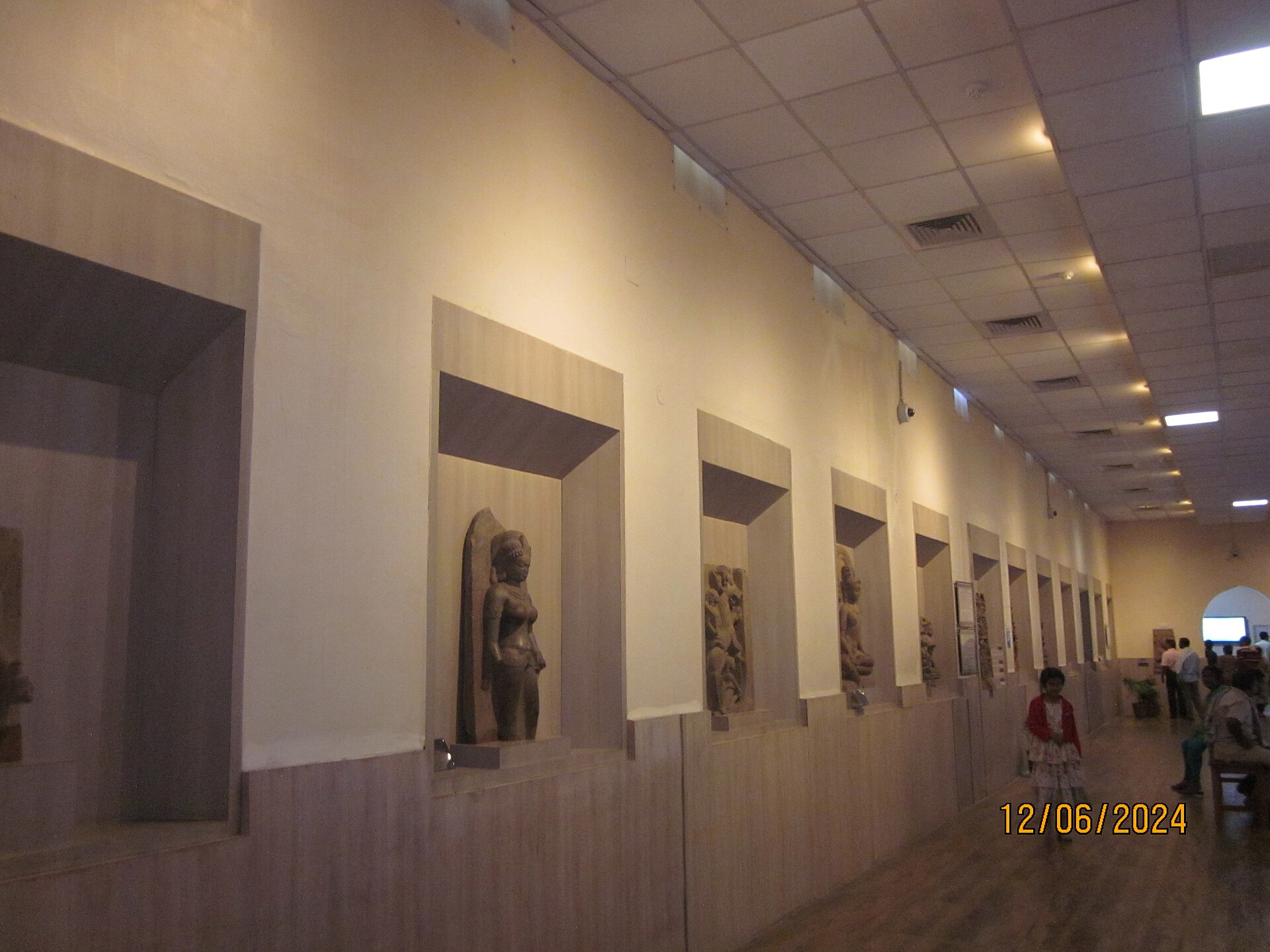
A Yaksha figure and Brahmanical sculpture standing alongside the Buddhist collection: images of the Trimurti (Brahma, Vishnu and Mahesh), Surya, Saraswati and Mahishasuramardini.
Ashutosh gallery (Shiva gallery)
The southernmost gallery, devoted to Brahmanical deities in a range of forms: Vishnu, Ganesh, Kartikeya, Agni, Parvati, the Navagrahas (nine planetary deities), Bhairava, and a colossal relief of Andhakasuravadha.
Shakyasimha gallery
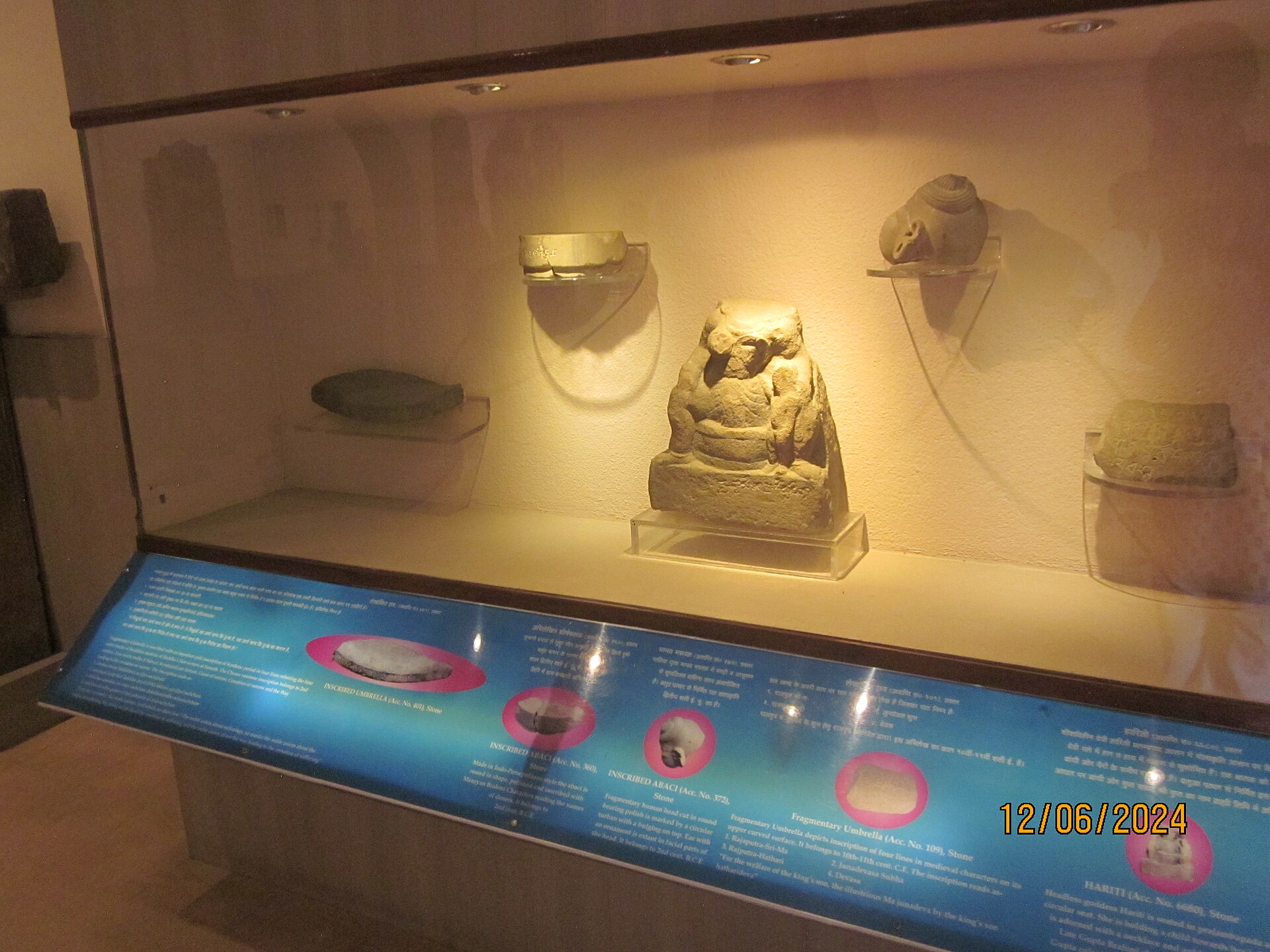
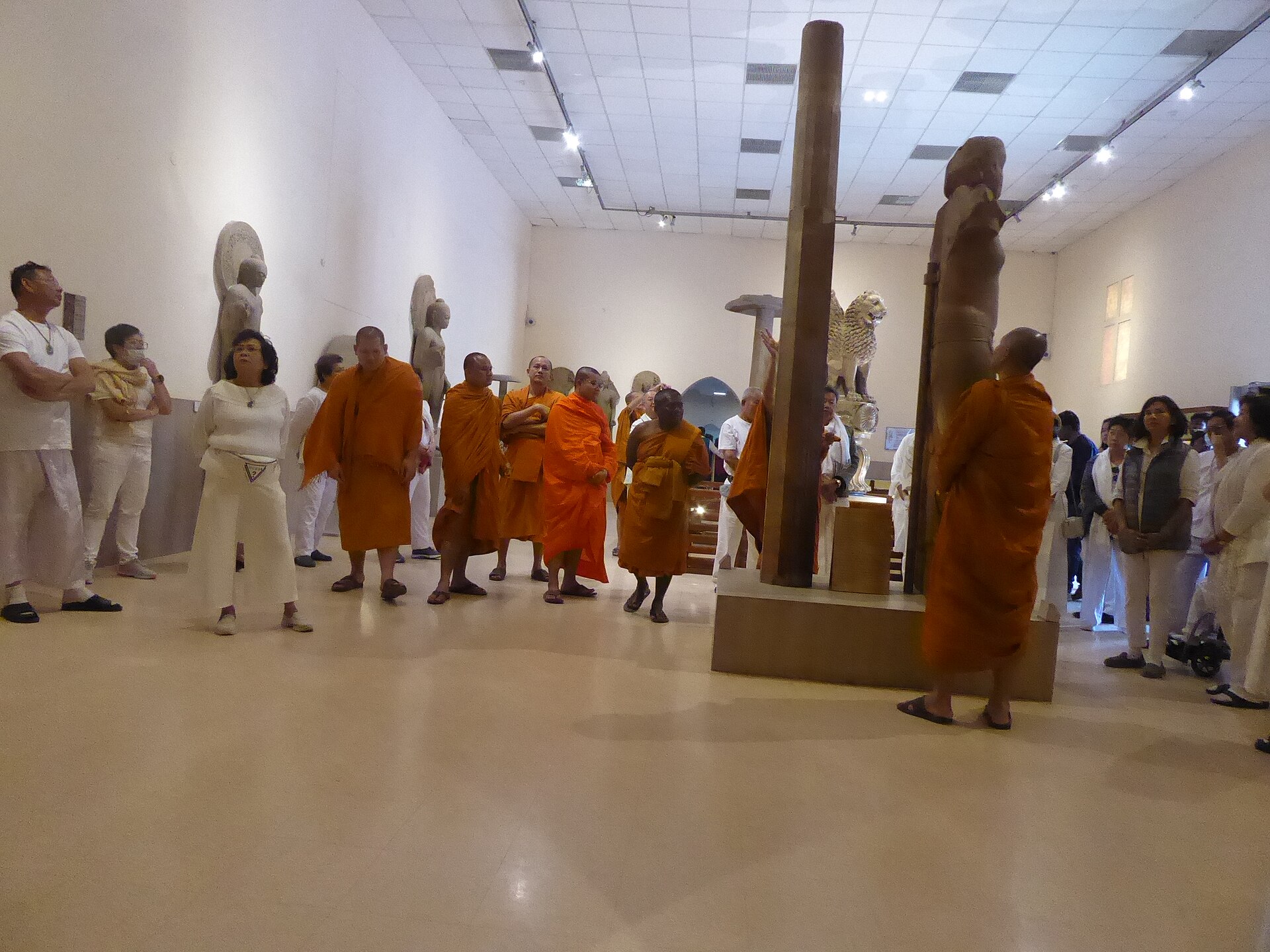
The museum's principal room and the reason most visitors come: the Lion Capital of Ashoka, together with the colossal red-sandstone standing Bodhisattva dedicated by the monk Bala, its octagonal shaft and its stone umbrella.
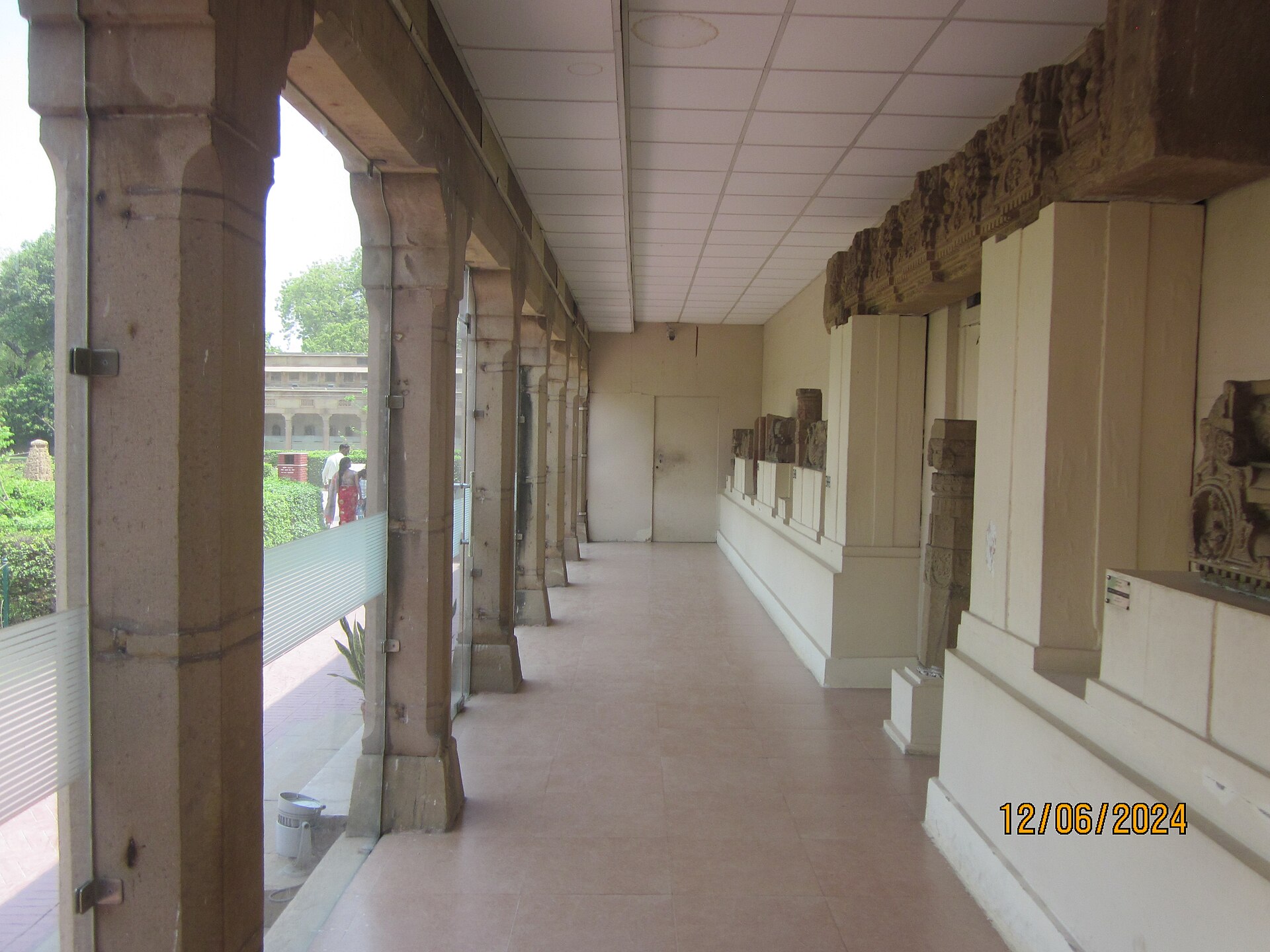
Vastumandana and Shilparatna verandahs
Two verandahs running alongside the galleries, displaying architectural fragments taken from the site: lintels, door jambs, face stones, and a large lintel carved with the Shantivadina Jataka.
What to see first
The Lion Capital of Ashoka
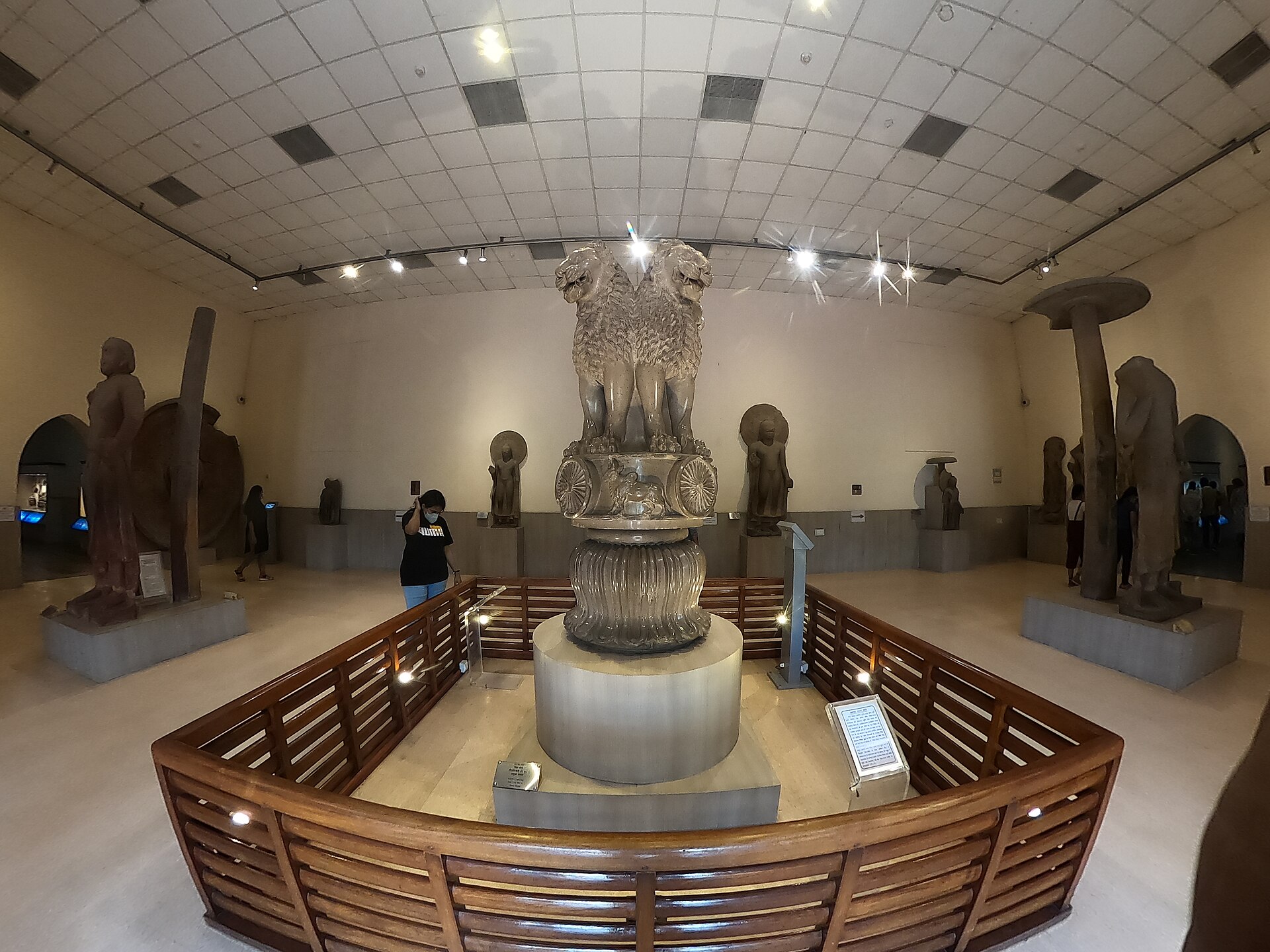
Mauryan court workshop, reign of AshokaCarved from a single sandstone block around the mid-3rd century BCE and excavated by F.O. Oertel in the 1904-05 season, the four back-to-back lions on their wheel-and-animal abacus were adopted, without the inverted lotus base, as India's state emblem in December 1947. It is the object every other highlight in the museum stands in relation to.8
Buddha Preaching His First Sermon (Dharmacakra)
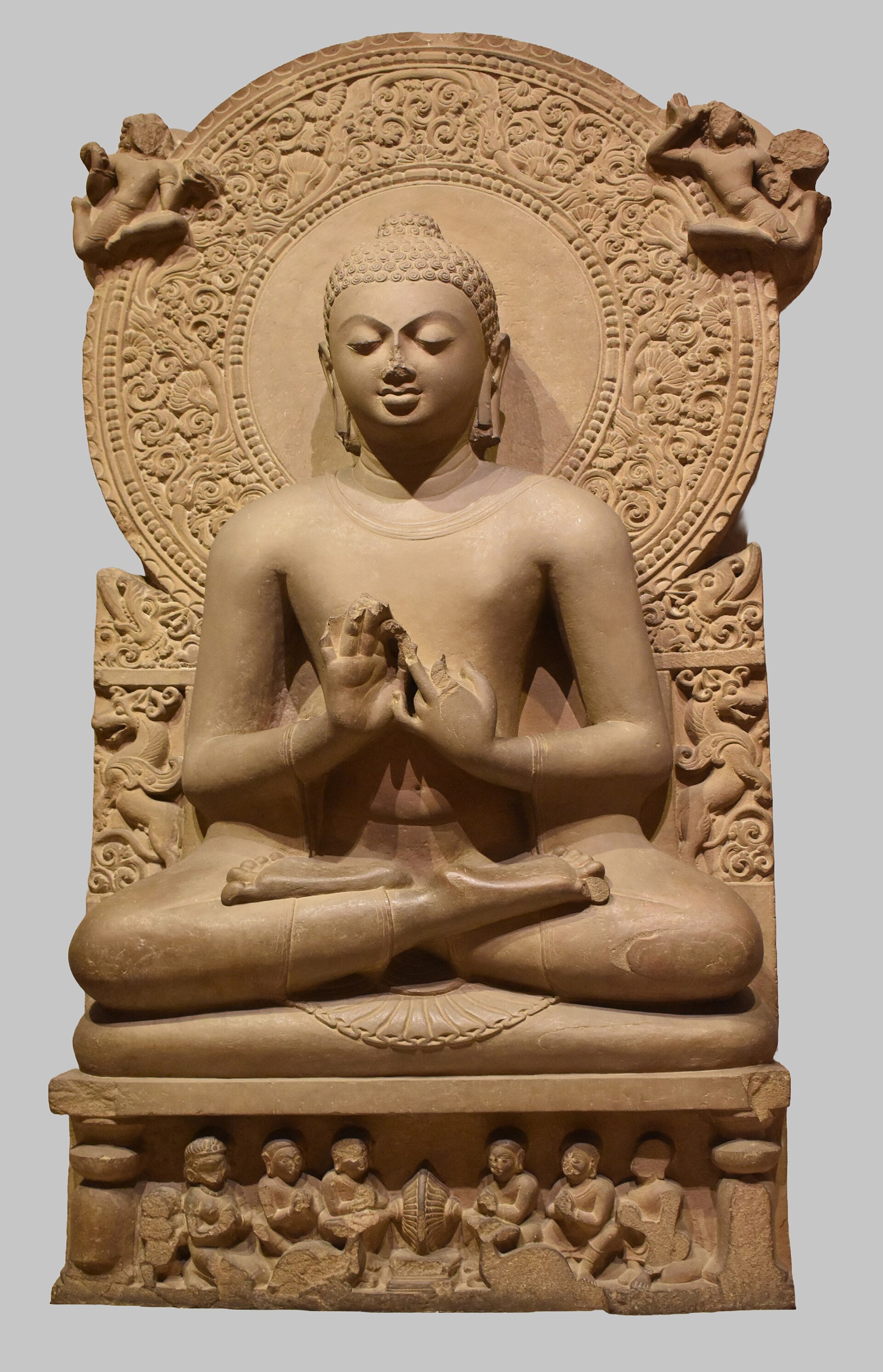
Gupta-period sculptor, 5th century CEThe museum's best-known Buddha image, carved in the characteristic Sarnath red sandstone with the wheel of the law shown in relief on the pedestal, flanked by kneeling disciples. It is one of the images most often reproduced to represent Gupta-era Buddhist sculpture generally.6
The Bodhisattva dedicated by the monk Bala
Kushan-period workshop, dated by inscription to Year 3 of KanishkaA colossal standing red-sandstone Bodhisattva under a stone umbrella, its inscription one of the fixed points scholars use to anchor the chronology of Kanishka's reign, conventionally placed at around 127 CE onward.9
Kumaradevi's inscription
Commissioned by Queen Kumaradevi, wife of the Gahadavala king GovindachandraA 12th-century record of the construction of the Dharmachakra-Jina-Vihara at Sarnath, and direct evidence that a Buddhist monastery was still being built and endowed at the site centuries after the period usually treated as the end of Indian Buddhism's institutional life.10
Railing pillars and fragments from the Ashokan-period stupa enclosure
Mauryan and Sunga-period craftsmen, 3rd-1st century BCECarved stone railing sections among the earliest datable material in the collection, predating almost everything else on display and tying the museum's holdings directly to the earliest phase of construction at the site.7
The Gupta-period Buddha gallery as a group
Multiple Gupta-period sculptors, 5th-6th century CEThe single largest coherent body of material in the museum: dozens of standing and seated Buddha images in abhayamudra, dharmacakra and bhumisparsha poses, giving Sarnath the deepest holding anywhere of Gupta Buddhist sculpture from one findspot.7
The Shantivadina Jataka lintel and the verandah architectural fragments
Unrecorded temple and monastery masonsA large carved lintel telling the Shantivadina Jataka, displayed with door jambs and face stones in the two verandahs, the part of the museum most visitors walk past on the way to the galleries proper even though it carries some of the finest narrative relief carving in the building.6
The building and what it was built to hold
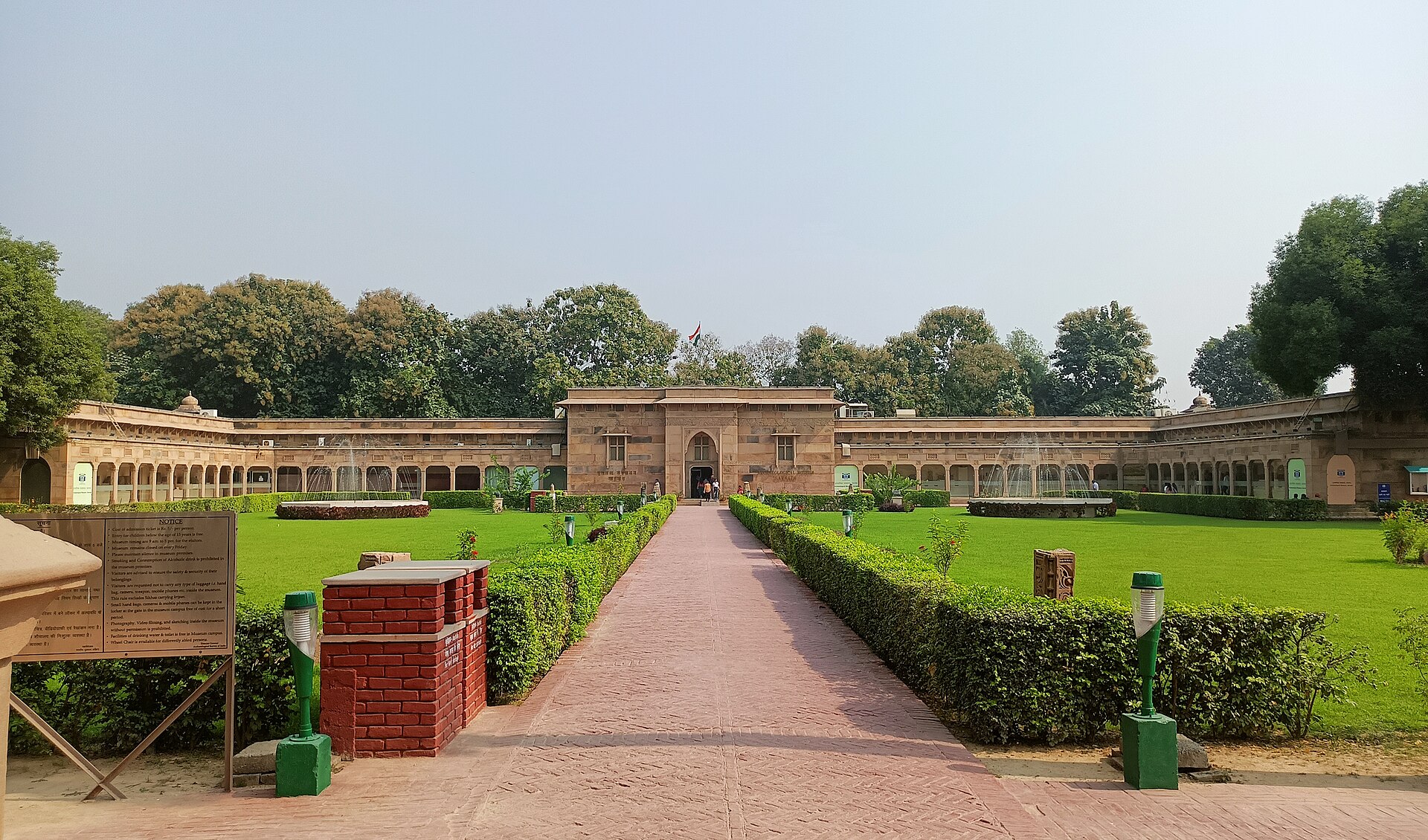
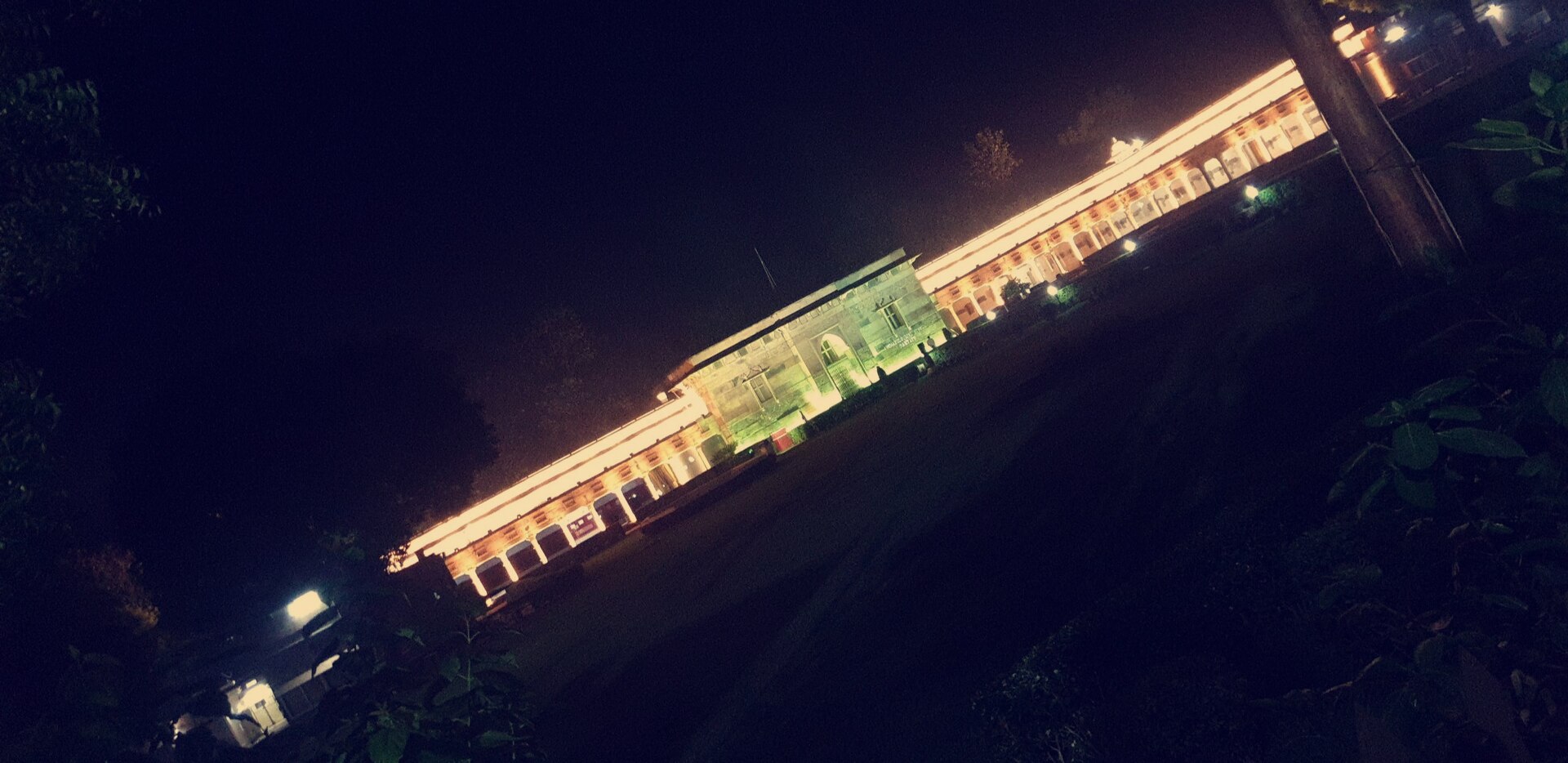
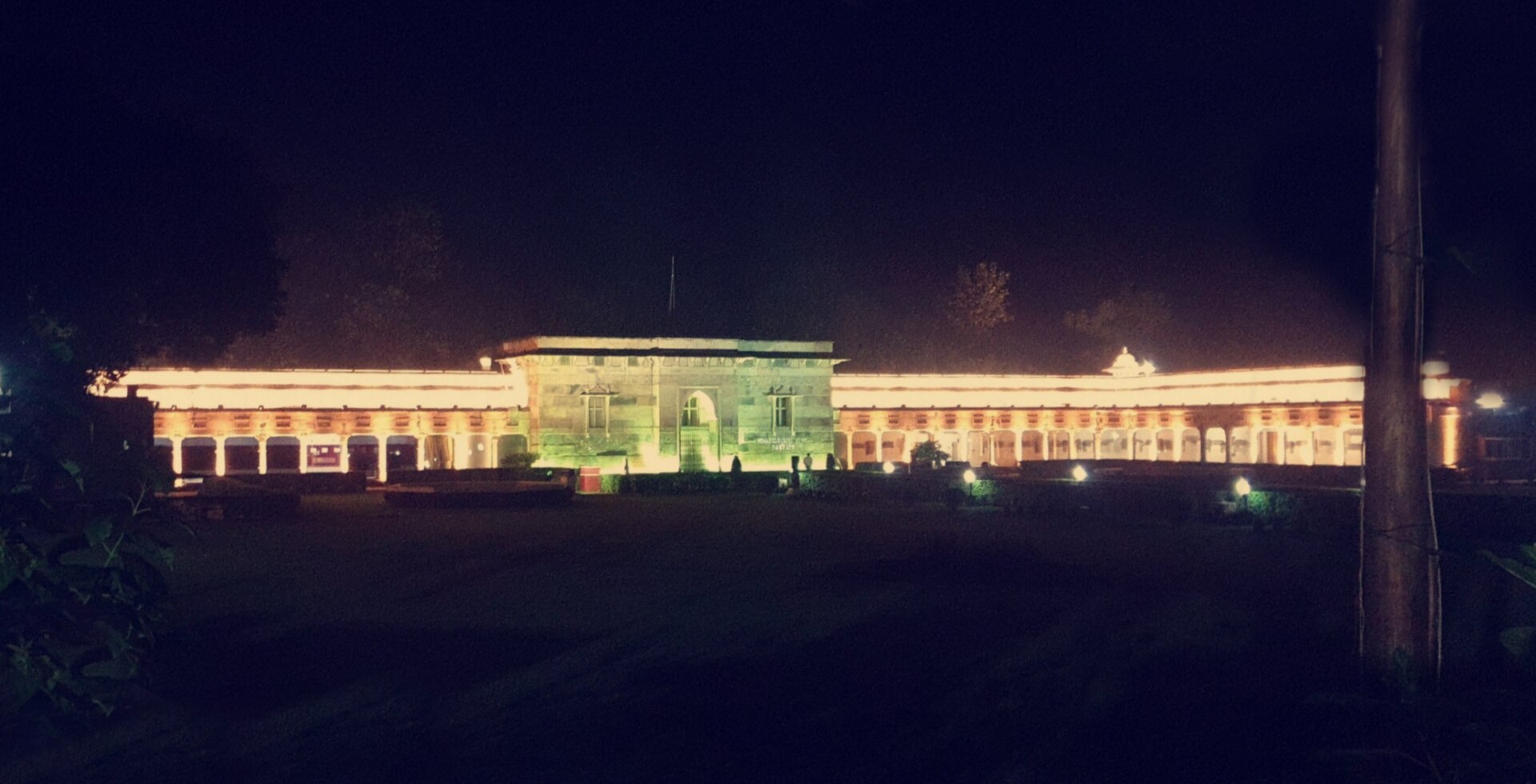
The decision to build a museum at Sarnath was taken in 1904, pushed through by Sir John Marshall, then Director General of Archaeology in India, once it became clear that the excavations underway at the site were producing more sculpture than anywhere had room to keep. James Ramson, at the time the consulting architect to the Government of India, drew the plans; the building was finished in 1910. Its layout is deliberately half of a Sangharam, a monastery, in plan, a decision that ties the container to the contents: almost everything inside came out of the ground at a site that was itself a working Buddhist monastic complex for well over a thousand years. It is, by the museum's own account and by every independent listing checked for this record, the oldest site museum the Archaeological Survey of India operates anywhere in the country, predating the site museums built later at other major excavations across the subcontinent.
A site museum of this kind exists to do one job: keep the objects a particular excavation produced within reach of the ground they came from, rather than scattering them to a national collection in Delhi or Kolkata. Sarnath is the reason that model exists at all. Everything on display in the five galleries and two verandahs was found within the immediate archaeological zone around the Dhamek Stupa, most of it during the systematic excavation campaigns of the early twentieth century.
The excavations behind the collection
Alexander Cunningham, the founding father of Indian archaeology in British service, worked the site as early as 1835-36, before the Archaeological Survey of India existed in its later form. The find that made a museum unavoidable came much later: in the 1904-05 winter season, the engineer F.O. Oertel excavated west of the site's Main Shrine, roughly 584 feet southwest of the Dhamek Stupa, and recovered the Ashokan pillar capital that would eventually become India's national emblem. Excavation continued at Sarnath for decades afterward, and the museum's holdings grew accordingly: by the counts given on the museum's own surviving pages and repeated by independent guides, the collection now runs to around 6,832 sculptures, architectural fragments, inscriptions and other antiquities, spanning from the 3rd century BCE to the 12th century CE.
That span matters as much as the count. Few Buddhist sites anywhere in India offer a single-findspot sequence running continuously from the Mauryan period through the Gupta age and into the medieval Gahadavala period without a long gap in the middle. Sarnath's collection is unusual for having exactly that continuity, because the site itself never stopped being built on, rebuilt, and added to for most of that period.
The Lion Capital of Ashoka
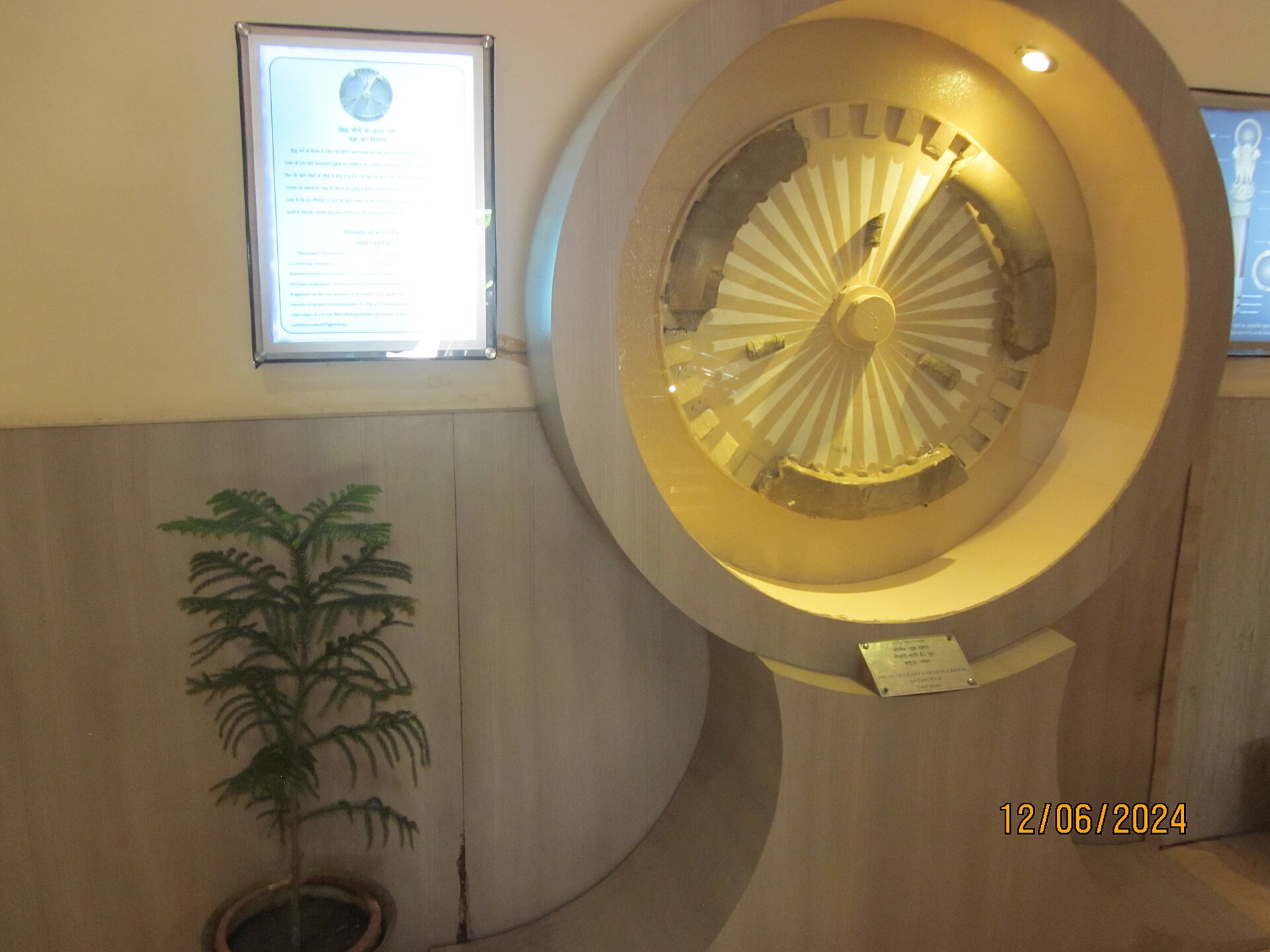
The single object the museum exists to protect is the Lion Capital, carved from one block of sandstone to a height of about 2.1 metres, with an abacus roughly 86 centimetres across. Four Asiatic lions stand back to back on the abacus, which is carved in relief with four 24-spoke wheels alternating with four animals, a lion, an elephant, a bull and a galloping horse, read as representing the cardinal directions. Below the lions sits an inverted lotus bell in the Persepolitan style, with sixteen petals. The capital was damaged before Oertel's team found it: two of the lions lost their jaws, never recovered, and the whole piece had fractured across the neck just above the lotus. None of that damage is disguised in its current display; the capital is shown broadly as it was recovered.
In July 1947, with independence weeks away, Jawaharlal Nehru proposed taking the wheel from the capital's abacus for the new national flag and the four lions, without the lotus base beneath them, for the state emblem. The Constituent Assembly formally adopted the design on 11 December 1947. The angle from which the standard photograph of the capital is taken is the angle reproduced on Indian currency, passports and government letterheads ever since, which means most people who recognise the emblem instantly have never seen, and would not immediately recognise, the object itself sitting in its case in the Shakyasimha gallery, lotus base and all. The original fragments of the pillar the capital once crowned remain on the excavation site itself, under a protective glass enclosure, separate from the museum building.
Five galleries and two verandahs
The museum's five galleries run roughly north to south. Tathagata, the northernmost, holds Buddha images across several centuries and postures. Triratna follows with Buddhist deities and the ritual objects associated with them. Trimurti breaks from the Buddhist material to show a Yaksha figure and Brahmanical sculpture, Brahma, Vishnu and Mahesh together as the Trimurti, plus Surya, Saraswati and Mahishasuramardini, a reminder that Sarnath's excavated ground produced Hindu as well as Buddhist material once later structures were built over the older Buddhist ones. Ashutosh, the southernmost gallery and named for a form of Shiva, extends that theme with Vishnu, Ganesh, Kartikeya, Agni, Parvati, the nine Navagraha deities, Bhairava and a colossal relief of Andhakasuravadha.
Shakyasimha, the fifth gallery, is where the museum concentrates its most important holdings: the Lion Capital itself, and beside it the colossal red-sandstone standing Bodhisattva dedicated by the monk Bala, shown with its original octagonal shaft and stone umbrella still intact. Two verandahs, named Vastumandana and Shilparatna, run alongside the gallery block and hold the architectural material that does not fit a gallery case: carved lintels, door jambs, face stones, and a large lintel carved with the Shantivadina Jataka, one of the stories of the Buddha's previous lives.
A queen's inscription and the story of medieval revival
The standard account of Indian Buddhism gives it a long decline after the Gupta period and treats the medieval centuries as a story of contraction. Sarnath's own museum holds direct evidence against the simplest version of that story: an inscription commissioned by Kumaradevi, a Buddhist wife of the Gahadavala king Govindachandra and a member of the Pithipati family associated with Bodh Gaya, records the construction of the Dharmachakra-Jina-Vihara at Sarnath in the 12th century CE. The same inscription refers to incursions by the 'wicked Turushkas', placing the monastery's construction against a backdrop of real military pressure on the region rather than a settled, peaceful patronage climate. Govindachandra had at least two Buddhist queens, Kumaradevi and Vasantadevi, which the inscription itself is part of the evidence for. A twelfth-century royal court still building and endowing a named monastery at Sarnath complicates any account that treats institutional Buddhism in North India as already finished by that date.
Sarnath today: a UNESCO landscape and a working museum
On 25 July 2026, at the 48th session of the World Heritage Committee held in Busan, South Korea, UNESCO inscribed the Ancient Buddhist Site of Sarnath on the World Heritage List, India's 45th site and Uttar Pradesh's fourth, after the Taj Mahal, Agra Fort and Fatehpur Sikri. The inscription covers the protected archaeological areas at Sarnath, the Chaukhandi Stupa and the excavated remains around the Dhamek and Dharmarajika stupas, recognising the site as the place where, according to Buddhist tradition, the Buddha delivered his first sermon after his enlightenment and met his first disciples. The listing is for the archaeological landscape rather than the museum building as such, but the museum sits inside that same protected zone and holds the portable material the listed monuments produced when they were excavated; a visit to one without the other leaves out most of what either has to explain.
Day to day, the museum still runs on the older, more ordinary rhythm any ASI site museum does: a modest separate entry ticket for the museum itself, a larger and more complicated ticket structure for the surrounding archaeological park that varies by cash or card and by nationality, opening most days of the week and closed on Fridays. The museum's own dedicated website has, since at least the past few years, fallen into disrepair as an information source, its homepage overtaken by unrelated content, though scattered pages from its original build survive intact elsewhere on the same domain. The practical, current answers on hours, fees and contact now sit with the Archaeological Survey of India's Sarnath Circle, the administrative body that runs the museum alongside the rest of the protected site, and with the Ministry of Tourism's own Incredible India portal.
What visitors say
Visitors consistently rank Sarnath Museum among the most rewarding stops on a Varanasi itinerary, driven almost entirely by the experience of standing in front of the original Lion Capital rather than a photograph or a replica of it. Complaints are procedural rather than curatorial: a strict no-mobile-phones rule inside the galleries frustrates visitors used to photographing what they see, and a minority of reviewers note that some open-cased pieces show wear from repeated touching. Very little is said, positively or negatively, about anything at the museum outside the Lion Capital and the Gupta Buddha galleries.
What is praised, what is criticised
- Praised: The Lion Capital of Ashoka itself, repeatedly singled out as the most affecting single object in the building
- Praised: The density and condition of the Gupta-period Buddha sculpture galleries
- Praised: A free cloakroom/left-luggage service at the entrance
- Praised: Clear, well-lit display cases and, per at least one reviewer, wheelchair-friendly arrangement of the galleries
- Criticised: A blanket ban on mobile phones inside the galleries, inconsistently enforced against a separate, more permissive rule on cameras
- Criticised: Visible wear on a small number of open-set pieces from repeated handling by visitors over the years
- Criticised: Almost no on-site interpretive signage at the excavated monastic remains outside, so visitors who skip the museum miss most of the context for what they are looking at in the park
Ratings on other platforms
TripAdvisor: 4.3 from 330 ratings, read 18 September 2026
A platform average is a tertiary source: it moves, it is not audited, and we quote no visitor's words.
Questions about Sarnath Museum
Where is Sarnath Museum?
Sarnath, Varanasi, Uttar Pradesh 221007, India.
How much does it cost to visit?
Museum entry, all visitors: INR 5; Archaeological park - Indian/SAARC/BIMSTEC, cash: INR 25; Archaeological park - Indian/SAARC/BIMSTEC, card or online: INR 20; Archaeological park - foreign nationals, cash: INR 300; Archaeological park - foreign nationals, card or online: INR 250. As confirmed 18 September 2026.
When is it open?
Sat-Thu 10:00-17:00. Closed: Friday. As confirmed 18 September 2026.
How do you get there?
Air: Lal Bahadur Shastri International Airport (VNS), Varanasi; Rail: Varanasi Junction (BSB), about 12 km away; Road: About 10 km north of central Varanasi by taxi or auto-rickshaw, roughly 30 minutes.
What should you see first?
The Lion Capital of Ashoka (Mauryan court workshop, reign of Ashoka); Buddha Preaching His First Sermon (Dharmacakra) (Gupta-period sculptor, 5th century CE); The Bodhisattva dedicated by the monk Bala (Kushan-period workshop, dated by inscription to Year 3 of Kanishka); Kumaradevi's inscription (Commissioned by Queen Kumaradevi, wife of the Gahadavala king Govindachandra); Railing pillars and fragments from the Ashokan-period stupa enclosure (Mauryan and Sunga-period craftsmen, 3rd-1st century BCE); The Gupta-period Buddha gallery as a group (Multiple Gupta-period sculptors, 5th-6th century CE).
What we could not confirm
- Museum hours are reported inconsistently across sources actually fetched for this record: the Ministry of Tourism's Incredible India portal gives 10:00 AM to 5:00 PM, while the museum's own surviving 'Planning a visit' page and Wikidata (sourced from the same official site before its homepage changed) give 9:00 AM to 5:00 PM, and one independent travel guide gives 9:00 AM to 6:00 PM. All agree on closure every Friday. The next recheck should confirm the current figure directly with ASI Sarnath Circle rather than by document review alone.
- It is not confirmed whether the Rs 5 museum ticket and the Rs 25/20/300/250 archaeological-park tickets are sold as a single combined transaction or strictly separately; sources describe both a standalone museum ticket and a park ticket without stating whether one is required to buy the other.
- The museum's own domain, sarnathmuseumasi.org, now serves a homepage and blog with content unrelated to the museum (including generic travel-blog and non-museum commercial material) alongside surviving original static pages such as its 'Planning a visit' page. Whether ASI Sarnath Circle still controls this domain, or whether it has lapsed to a third party while old cached pages remain reachable, should be established before it is relied on again as a primary source.
- The architect's name is given in the Wikipedia article on the museum as 'James Ramson, the then consulting Architect to the Government of India'; no independent primary source for this exact spelling was located in this research pass.
Images
Sources
- 1Wikimedia Commons, Category:Sarnath Museum commons.wikimedia.org/wiki/Category:Sarnath_Museum
- 2Wikimedia Commons, File:Sarnath Museum Front.jpg (licence and description metadata) commons.wikimedia.org/wiki/File:Sarnath_Museum_Front.jpg
- 3Sarnath Museum (ASI), 'Planning a visit' (surviving static page on sarnathmuseumasi.org) sarnathmuseumasi.org/planning-a-visit.html
- 4Archaeological Survey of India, Sarnath Circle - Visitor Information asisarnathcircle.in/visitorinformation.php
- 5Archaeological Survey of India, Sarnath Circle - Contact Us asisarnathcircle.in/contactus.php
- 6Incredible India (Ministry of Tourism, Government of India) - Sarnath Museum incredibleindia.gov.in/en/uttar-pradesh/varanasi/sarnath-museum
- 7Wikipedia - Sarnath Museum en.wikipedia.org/wiki/Sarnath_Museum
- 8Wikipedia - Lion Capital of Ashoka en.wikipedia.org/wiki/Lion_Capital_of_Ashoka
- 9Wikipedia - Kanishka (Bala Bodhisattva, Sarnath, Year 3 of Kanishka) en.wikipedia.org/wiki/Kanishka
- 10Wikipedia - Gahadavala dynasty (Kumaradevi's Sarnath inscription) en.wikipedia.org/wiki/Gahadavala_dynasty
- 11UNESCO - 'Ancient Buddhist Site of Sarnath inscribed on UNESCO World Heritage List' unesco.org/en/articles/ancient-buddhist-site-sarnath-inscribed-unesco-world-heritage-list
- 12The Hindu - 'Sarnath recognised as UNESCO World Heritage Site: Full list of India's sites, criteria for inclusion' thehindu.com/news/national/sarnath-unesco-world-heritage-site-uttar-pradesh-varanasi-full-list/article71271536.ece
- 13Casual Walker - 'Sarnath Archaeological Museum, Varanasi, Uttar Pradesh: India's Oldest Site Museum' casualwalker.com/sarnath-archaeological-museum-varanasi-uttar-pradesh-indias-oldest-site-museum-showcasing-lion-capital-of-ashoka-indias-national-emblem-3rd-century-buddhist-sculpture/
- 14TripAdvisor - Archaeological Museum, Varanasi (aggregate rating and reviews) tripadvisor.com/Attraction_Review-g297685-d3912765-Reviews-Archaeological_Museum-Varanasi_Varanasi_District_Uttar_Pradesh.html
- 15TripAdvisor - Archaeological Museum, Varanasi (individual review detail) tripadvisor.com/ShowUserReviews-g297685-d3912765-r629799022-Archaeological_Museum-Varanasi_Varanasi_District_Uttar_Pradesh.html
- 16Wikidata - Q1567294 (Sarnath Museum) wikidata.org/wiki/Q1567294
