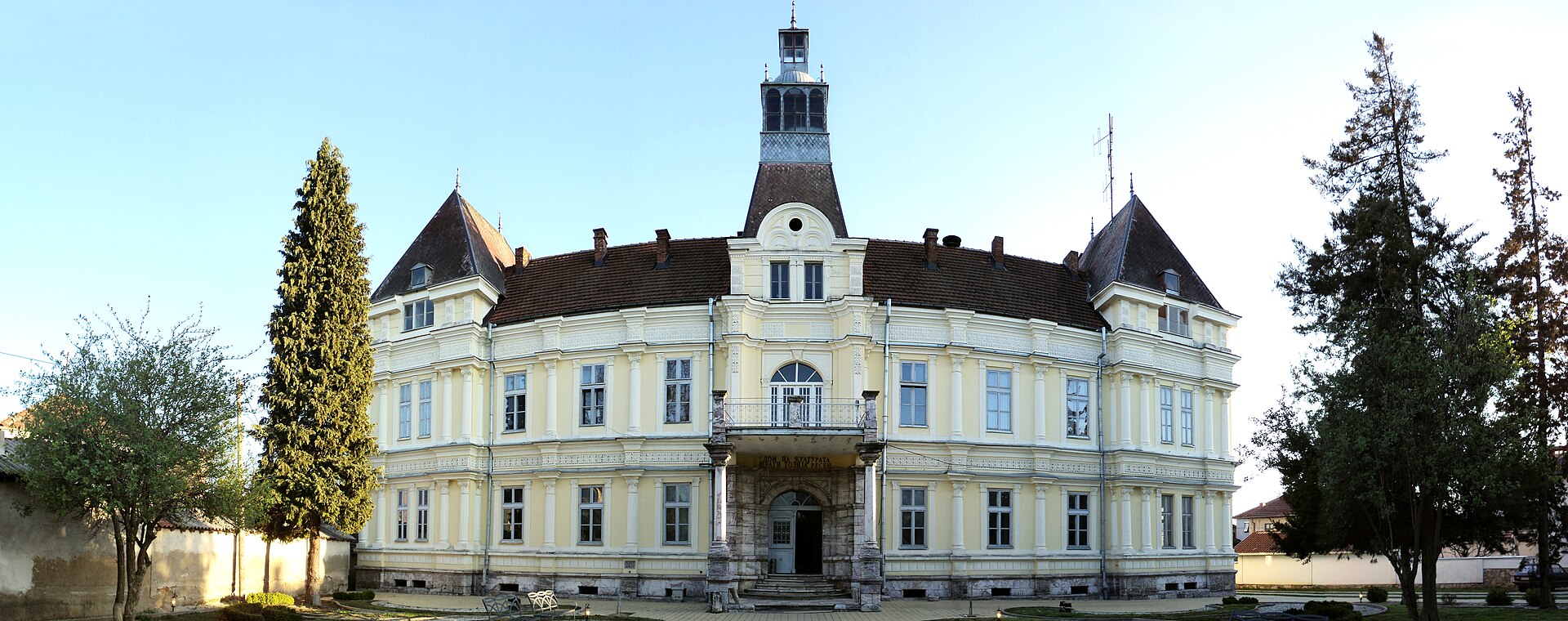
A panoramic view of the Saraj's front facade, showing the symmetrical block, the two corner turrets and the central lantern tower that gives the building its silhouette above Resen. Photographed in daylight from the garden in front of the building.
Photograph by Photo Balkan · CC BY-SA 3.0Saraj Resen
Museum · Resenski Saraj · Founded 1909
Open, admission and hours confirmed 28 September 2026 · 16 sources
On this page 13 sections
ContentsClose
A small, mixed municipal holding rather than a conventional single-subject museum: a modest branch of the Museum of Macedonia built mostly from Golem Grad and Lake Prespa material, a partial basilica mosaic, fresco fragments and two dugout boats; one painter's donated body of work, formed because Keraca Visulcheva chose this specific building rather than because the institution set out to collect her; an active, UNESCO-recognised annual ceramic colony that keeps adding to its own holding every August; and a working 31,000-volume public library that predates the culture house built around it. The building itself, more than any single object inside it, is what the sources gathered here treat as the actual reason to visit.
| Local name | Resenski Saraj |
|---|---|
| Kind | Museum |
| Founded | 1909 |
| City and country | Resen, North Macedonia |
| Address | 29 Noemvri 47, 7310 Resen, North Macedonia |
| Website | web.archive.org/web/20260912152107/http://www.domnakulturataresen.mk |
| Status | Open, confirmed |
| Record last verified |
Visiting
- Hours
- Mon-Fri08:00 to 16:00Administrative/office hours from a business-directory listing. No dedicated visitor opening-hours page was located for the institution; confirm by phone before a special trip, particularly for a weekend visit or for the ceramics room specifically.
- Admission
- Museum collection (Museum of Macedonia branch)FreeFree entry, per a visitor's first-person account. No official, dated price list was located for the museum.
- Keraca Visulcheva galleryFreeFree entry, per the same account.
- Resen Ceramic Colony exhibitionMKD 50Roughly one euro, collected inside rather than at the door, per a visitor's account. No official, dated price list was located; treat this figure as indicative rather than current.
- Do I need to book?
- Not stated by any source read for this record. The building functions as a walk-in municipal culture house rather than a ticketed museum.
- Address
- 29 Noemvri 47, 7310 Resen, North Macedonia MapBus Resen's bus station has daily connections to Ohrid and Bitola; the Saraj is a short walk from the town centre.
Car The E-65 highway runs through Resen, connecting it to Ohrid to the west and Bitola to the east. The nearest airport is Ohrid Airport, about 44.5 km away. - Website
- web.archive.org/web/20260912152107/http://www.domnakulturataresen.mk
- Telephone
- +389 47 232 579
- [email protected]
Before you go how long, access, photography, bags, eating, shop
- How long to allow
- Likely well under an hour for the museum corridor, the Visulcheva gallery and the ceramics room, on the evidence of how the collection is described; add time if the library reading room happens to be open to browse.
- Access
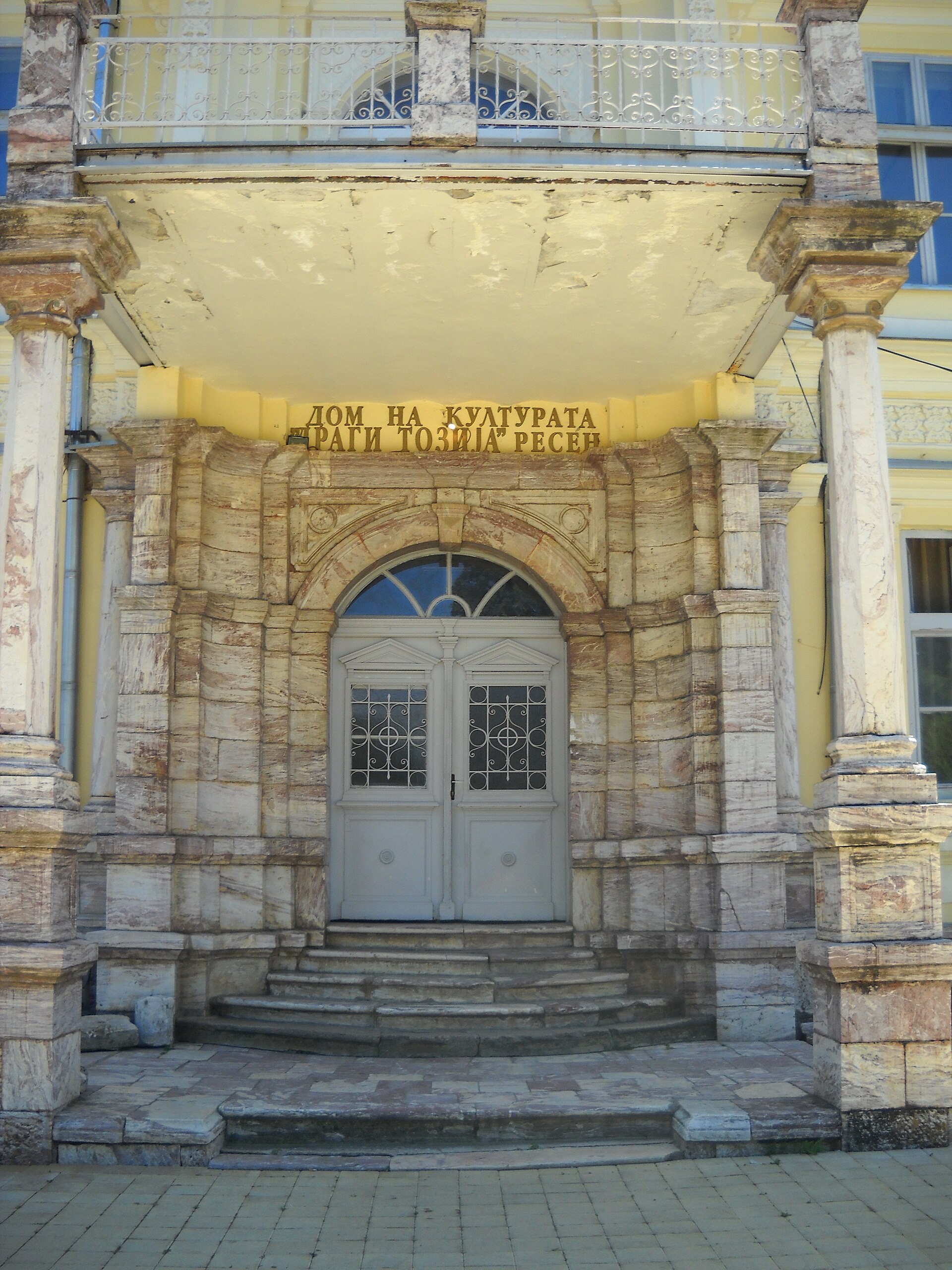
- Not stated by any source read for this record. The main entrance is reached by a flight of stone steps (see the entrance photograph); no ramp or alternative accessible route is described in any source gathered here.
- Photography
- Not stated by any source read for this record.
- Bags
- Not stated by any source read for this record.
- Eating
- Not stated by any source read for this record.
- Shop
- A small ceramic souvenir can reportedly be bought at the ceramics exhibition, per a visitor's own account. No dedicated shop or gift counter is described by any source.
Prices and hours change. We take them from the institution's own pages and print the day we read them, and you can check the current position at the source we used. Confirm before you travel.
What is inside
House of Culture Dragi Tozija - Museum of Macedonia branch collection
A small branch collection of the Museum of Macedonia in Skopje, held mostly in the first-floor corridors rather than in dedicated galleries. It centres on material from Golem Grad, the uninhabited island in Lake Prespa: a partially rescued floor mosaic from the island's ruined Early Christian basilica, fresco fragments, and two dugout boats each carved from a single tree trunk. The institution also runs the building's exhibition and events programme, including touring shows from other institutions.
Keraca Visulcheva gallery
A permanent installation of paintings, pastels and watercolours by the painter Keraca Visulcheva (1911-2004), who by her own account decided to donate her work here after driving past the building and liking it. Sources disagree on the exact number on display, giving either 36 or 38 works.
Resen Ceramic Colony gallery
Work produced on site every August by visiting ceramicists at the Resen Ceramic Colony, founded in 1973 and recognised by the International Academy of Ceramics, a body under UNESCO's umbrella. Pieces from each year's gathering stay in the building afterward, so the display grows by an annual addition rather than through acquisition.
Photograph by Dandarmkd · CC BY-SA 4.0 City Library
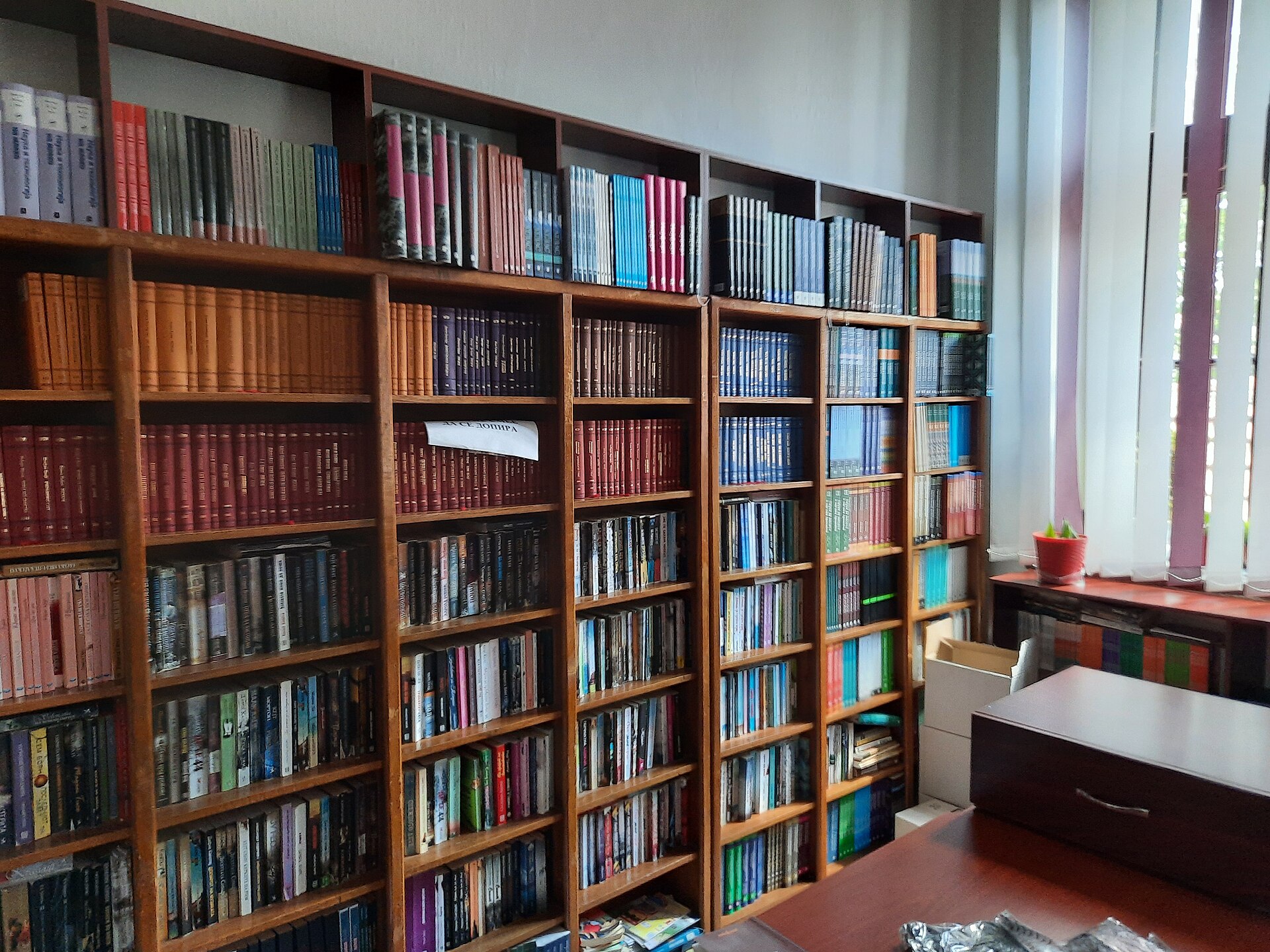
Resen's public lending library, occupying the ground floor of the building's right wing and holding a stated 31,000 volumes. A library has operated inside the Saraj continuously since the 1940s, predating the culture house that now shares the building with it by decades.
What to see first
The Golem Grad basilica mosaic fragment
Unknown, Early Christian workshop, Golem GradA partially rescued floor mosaic recovered from the ruined basilica on Golem Grad, the uninhabited island in Lake Prespa that carries the lake's only such site; one of the few pieces of the island's monastic-period material culture to have left the island for public display at all.10
Two dugout boats from Lake Prespa
Unknown, traditional Prespa boatbuildersA pair of wooden boats, each hollowed from a single tree trunk, displayed in the museum's first-floor corridor: a working lake craft rather than a showpiece, and part of the same small run of Golem Grad and Prespa material that otherwise mostly sits in Skopje.10
The Keraca Visulcheva donated paintings
Keraca Visulcheva (1911-2004)A body of work the painter gave to this specific building by choice rather than through any institutional acquisition, after, by her own account, driving past it and deciding she wanted her paintings there. Sources differ on the exact count on display, giving 36 (SDK.mk) or 38 (MARH) works.5
The Resen Ceramic Colony's annual works
International Academy of Ceramics members, a rotating group meeting each August since 1973Pieces made on site every summer by visiting ceramicists and kept in the building afterward. The colony is one of a small number worldwide recognised by the International Academy of Ceramics, a body under UNESCO's umbrella, which makes the holding a living, still-growing one rather than a fixed historical collection.1
The City Library's 31,000-volume collection
Resen City Library, holdings assembled since the 1940sA working public library that has occupied the same wing of the building since before Yugoslavia's administration handed the Saraj over to cultural use, and is still an open lending library today rather than a closed archive kept for show.1
The main entrance portico
Not named by any source read for this recordA marble, Corinthian-columned porch with the institution's own name, Dom na kulturata Dragi Tozija Resen, carved into the stone above the door: the single point on the building where its Ottoman-era construction and its present municipal use are stated on the same surface.15
The central lantern tower
Not named by any source read for this recordThe tower that gives the Saraj its silhouette above Resen's low rooftops, and, on the evidence of the building's own restoration history, the single most failure-prone part of the structure: its original wooden frame was replaced in steel profile in 1982 after decades of wear, and the roof beneath it needed further emergency repair in 2021.1
A bey builds himself a Versailles, and starts a revolution instead
Ahmed Niyazi Bey was not a hereditary grandee posted to a quiet province; he was a career Ottoman army officer from a landowning Albanian family in Resen (Ottoman Resne), trained at the War Academy in Istanbul, and by the time the Saraj went up he was already the man the Committee of Union and Progress had placed in his own hometown to recruit for it. In the summer of 1908 he took his chasseur battalion into the hills above Resen rather than answer a recall to Istanbul, an act of open mutiny against Sultan Abdulhamid II that historians credit, together with a parallel move by Ismail Enver Bey, with starting the Young Turk Revolution. The line that follows his name in the Ottoman parliament's own anthem still runs Yasasin Niyazi, yasasin Enver: long live Niyazi, long live Enver.
The palace itself came out of a smaller story: a postcard of Versailles, sent by a friend in Paris, that Niyazi liked enough to want a house built after it. Construction began in 1905, three years before the revolution he would go on to lead, and the exterior was finished in 1909, the year after it. He did not get to enjoy either achievement for long, and sources disagree sharply on what killed him and where. The Saraj's own Wikipedia article gives 1912, in Durres, of unstated causes; a separate and considerably more detailed English Wikipedia biography of Niyazi himself records that he was shot dead by four unidentified gunmen on the docks at Vlore in April 1913, while waiting to board a ferry to Istanbul, with rumour at the time blaming everything from a personal vendetta to a rival faction inside his own revolutionary committee. No source read for this record resolves the conflict, so it is recorded here rather than silently settled one way.
Thirteen years and two sets of numbers: what actually rose between 1905 and 1922
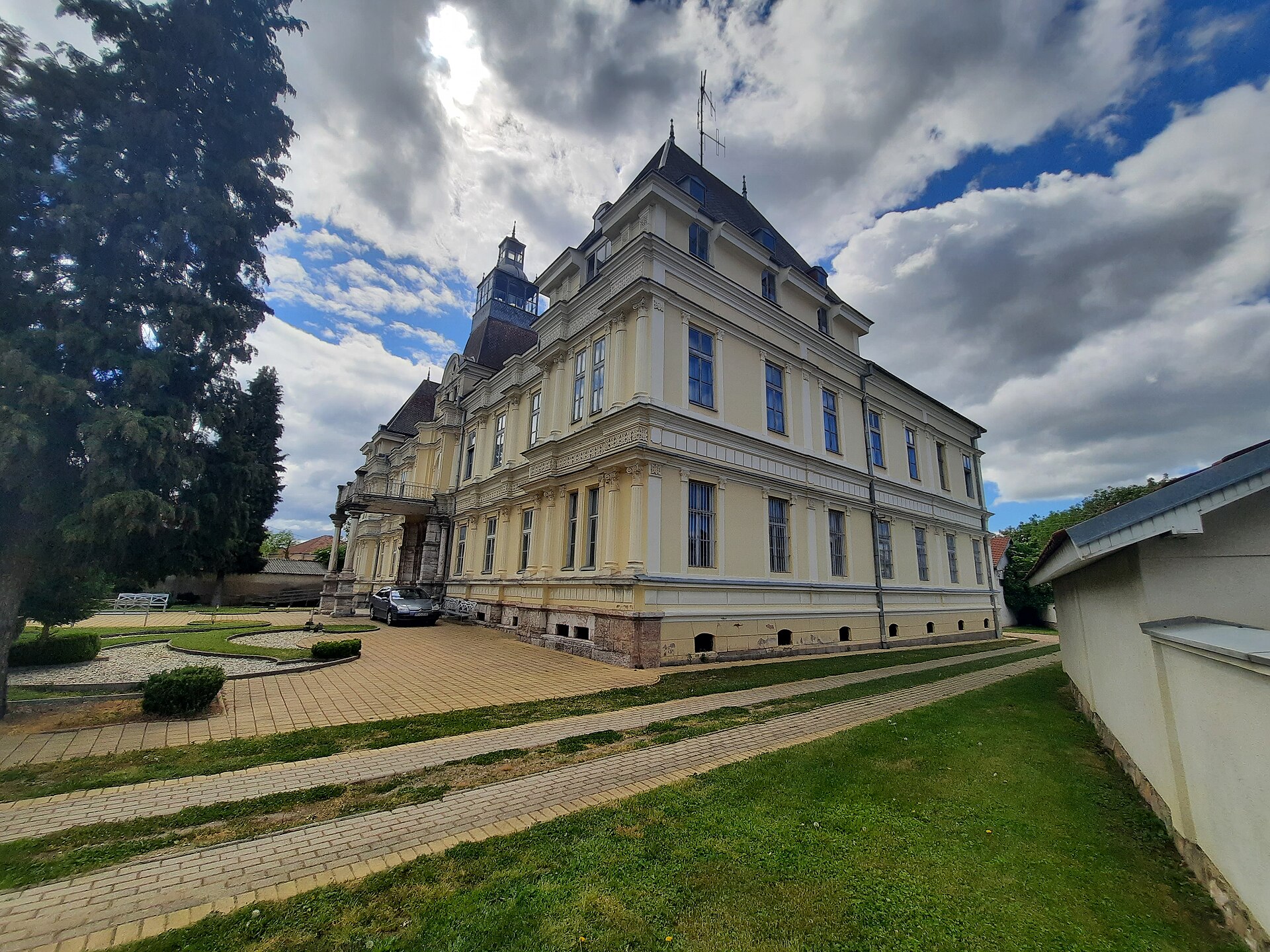
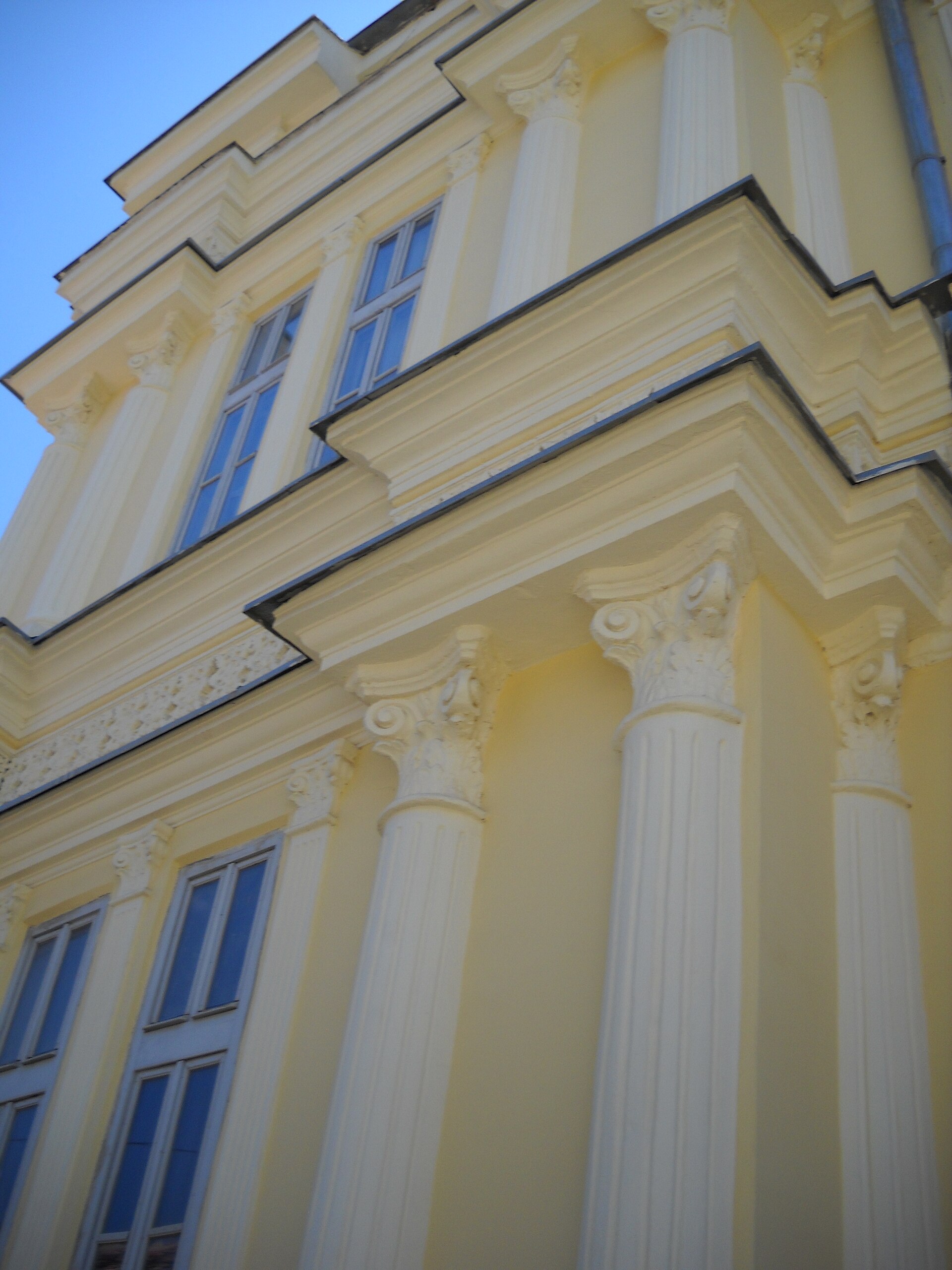
What actually finished rising over the following thirteen years is, on the published accounts, a symmetrical neoclassical block with a taller central section under a lantern tower, two flanking wings, and a plan running basement, ground floor, first floor and attic. Two architectural descriptions disagree on the numbers: English Wikipedia's description gives a central tower 35 metres high, a total floor area of 7,800 square metres, and exterior walls 60 to 105 centimetres thick; a 2022 profile of the building published by MARH, a Macedonian architecture site, gives the same building 4,800 square metres and walls 40 to 85 centimetres thick. Both accounts describe the same construction method: fired-brick bearing walls set in lime mortar, marble sourced from the nearby village of Plochine, steel-profile floor systems with brick infill in the corridors and halls, and timber beams elsewhere. The roof was timber until 1982, when it was rebuilt in steel profile after decades of wear had already begun to tell.
Interior work continued past Niyazi's death, through the Balkan Wars and the First World War, and was not finished until 1922, a full decade after the man who commissioned the building was gone.
From city hall to culture house
Once Ottoman rule in Macedonia ended, the Saraj stopped being anyone's private residence and became, in quick succession, a seat of Serbian and then Yugoslav administration, an occupation headquarters during the Second World War, Resen's city hall, and a city library. The library function stuck: a public library has operated inside the building since the 1940s and is still there today, run alongside everything else that has since moved in. The building's life as a dedicated cultural institution formally begins in 1978, with the founding of the municipal House of Culture named for Dragi Tozija, a partisan fighter and later official from Resen. That house of culture now functions as a branch of the Museum of Macedonia in Skopje, and it is the institution that runs the building day to day.
Four institutions, one roof, and the winter it nearly lost that roof too
Four things share the building today, by every account read for this record: the House of Culture Dragi Tozija itself, which holds a small branch collection of the Museum of Macedonia together with the building's exhibition and events programme; the Keraca Visulcheva gallery, a permanent installation the Bulgarian-Macedonian painter (1911-2004) donated after, by her own account, driving past the building and deciding she liked it enough to give it her work; the Resen Ceramic Colony, an annual gathering of ceramicists founded in 1973 and recognised by the International Academy of Ceramics, a body under UNESCO's umbrella, whose members' pieces stay in the building after each edition; and the city library, with a stated holding of over 31,000 volumes.
The museum branch's own material is smaller than any of that, and mostly comes from a single, unusual place: Golem Grad, also known as Snake Island or Pelican Island, a 20-hectare island a few kilometres from the Greek and Albanian border in Lake Prespa, reachable only by boat and uninhabited since a small monastic community left it in the mid-20th century. The island was not opened to tourists at all until August 2008, which makes the partially rescued mosaic and the fresco fragments in the Saraj's corridors a rare way to see any of it without hiring a boat; today the island is better known, if anything, for the roughly one thousand Hermann's tortoises living on it in a heavily skewed sex ratio than for the ruined basilica the mosaic came from.
By 2021 the building itself was in serious trouble. A March 2021 report quoted the institution's own director, Vasko Vasilevski, describing the water-damaged attic as looking like a horror film, with rotted beams, missing tiles and birds entering through the gaps, and stating plainly that the institution lacked the staff to maintain the building at all. The Ministry of Culture allocated roughly 2.4 million denars, about 40,000 euro, for a first phase of roof reconstruction that year, run through the Bitola Museum and Institute and completed by the end of 2021, with a second phase continuing into 2022; this followed an earlier partial repair in 2005 funded by the World Bank, and the original 1982 replacement of the wooden roof structure. No source read here states that the building closed to visitors during any of this work.
Visiting the Saraj today
Entry to the museum collection and the Visulcheva gallery is free, and entry to the ceramics display has carried a nominal fee, around 50 denars, roughly one euro, according to a visitor's own account of a recent visit; the same account describes a modest, informal presentation, with most objects simply standing in the corridors of the first floor rather than formally mounted, and notes that the ceramics fee was only made clear after the exhibit had already been viewed. No dedicated visiting-hours page was located for the institution; a business-directory listing gives administrative hours of Monday to Friday, 08:00 to 16:00, which should be confirmed by phone before a special trip. The institution's own telephone number is also inconsistent across sources current at different points: an archived capture of the institution's own website, itself current as recently as September 2026, gives +389 47 232 579 and a mobile of +389 78 342 031; an older Wikivoyage listing and a current business-directory listing both give +389 47 551 021 instead. The building remains an active venue regardless of any of that: a paired exhibition by the painters Borche Bogoevski and Tatjana Ristovska opened there on 18 September 2026, ten days before this record was researched.
What visitors say
We publish no visitor-review prose and no unverified aggregate score, so this draws on the named accounts read for this record. What is consistently praised is the building itself, an architecturally unusual French-neoclassical palace with little equivalent elsewhere in North Macedonia, and, inside it, the Keraca Visulcheva collection, which more than one account treats as an unexpected highlight in an otherwise modest institution. What is consistently noted as a shortcoming is the building's condition and the display's informality: a 2021 report captured the institution's own director describing a water-damaged attic that had gone unmaintained for lack of staff, and a visitor's own account from inside the museum describes objects simply standing in the corridors rather than being formally mounted or labelled, with the ceramics room's entry fee only made clear after the exhibit had already been seen.
What is praised, what is criticised
- Praised: The building itself: an architecturally unusual French-neoclassical palace, repeatedly described as one of the most distinctive structures in North Macedonia and the primary reason travel guides list Resen as worth stopping in.
- Praised: The Keraca Visulcheva collection, described in a visitor's own account as a genuinely unexpected highlight inside the building.
- Praised: Free entry to the core museum collection and the Visulcheva gallery.
- Criticised: The building's physical condition before the 2021-22 roof restoration was severe enough that the institution's own director compared the water-damaged attic to a horror film and said the institution lacked the staff to maintain it.
- Criticised: The display is informal rather than curated: a visitor's own account describes most museum objects as simply standing in the first-floor corridors rather than being properly mounted or labelled.
- Criticised: The ceramics exhibition's entrance fee is not clearly signposted, according to the same account, which reports being told payment was required only after the display had already been viewed.
Ratings on other platforms
Travel2Macedonia: 3.9 from 10 ratings, read 28 September 2026
A platform average is a tertiary source: it moves, it is not audited, and we quote no visitor's words.
Questions about Saraj Resen
Where is Saraj Resen?
29 Noemvri 47, 7310 Resen, North Macedonia.
How much does it cost to visit?
Museum collection (Museum of Macedonia branch): free; Keraca Visulcheva gallery: free; Resen Ceramic Colony exhibition: MKD 50. As confirmed 28 September 2026.
When is it open?
Mon-Fri 08:00-16:00. As confirmed 28 September 2026.
How do you get there?
Bus: Resen's bus station has daily connections to Ohrid and Bitola; the Saraj is a short walk from the town centre; Car: The E-65 highway runs through Resen, connecting it to Ohrid to the west and Bitola to the east. The nearest airport is Ohrid Airport, about 44.5 km away.
What should you see first?
The Golem Grad basilica mosaic fragment (Unknown, Early Christian workshop, Golem Grad); Two dugout boats from Lake Prespa (Unknown, traditional Prespa boatbuilders); The Keraca Visulcheva donated paintings (Keraca Visulcheva (1911-2004)); The Resen Ceramic Colony's annual works (International Academy of Ceramics members, a rotating group meeting each August since 1973); The City Library's 31,000-volume collection (Resen City Library, holdings assembled since the 1940s); The main entrance portico (Not named by any source read for this record).
What we could not confirm
- Ahmed Niyazi Bey's death: the Saraj's own Wikipedia article gives 1912 in Durres of unstated causes; a separate, more detailed English Wikipedia biography of Niyazi gives April 1913, shot by four unidentified gunmen at the docks in Vlore. Neither source read for this record resolves the conflict, and both are cited here rather than one being silently picked.
- The building's own dimensions are given differently by two sources read here: 35 metres and 7,800 square metres with 60-105 cm walls (English Wikipedia's description section) against 4,800 square metres and 40-85 cm walls (MARH, a Macedonian architecture site, which does not state a height). This record states the discrepancy rather than choosing one figure.
- The number of Keraca Visulcheva works on permanent display is given as 36 (SDK.mk) or 38 (MARH); no source read here reconciles the two counts.
- The institution's telephone number differs by source and apparently by date: an archived capture of the institution's own website, current as of September 2026, gives +389 47 232 579; an older Wikivoyage listing (last updated 2016 on the relevant entry) and a current business-directory listing both give +389 47 551 021 instead. This record follows the institution's own, more recently confirmed site and records the older number here rather than discarding it.
- The institution's own domain, domnakulturataresen.mk, resolved as recently as 12 September 2026 (Wayback Machine capture) to the institution's own website; by the date this record was researched, 28 September 2026, the same domain resolved instead to an unrelated vehicle-booking system on a different host, confirmed independently via Google's DNS-over-HTTPS resolver and not a local resolver fault. This record uses an archived capture of the site rather than the live domain; see notes_for_editor.
- No official, dated price list was located for the museum, gallery or ceramics exhibition. The admission figures in this record come from a single, undated visitor account and should be treated as indicative rather than current.
Images
Sources
- 1English Wikipedia, Saraj (Resen). Description, history and current-use sections: construction 1905-1922, dimensions, materials, roof restorations of 1982 and 2005, and the building's present use by the House of Culture Dragi Tozija, the Resen Ceramic Colony, the Keraca Visulceva Gallery and the city library. en.wikipedia.org/wiki/Saraj_(Resen)
- 2English Wikipedia, Ahmed Niyazi. Full biography of the building's patron: Albanian landowning family, Ottoman military career, recruitment for the Committee of Union and Progress at Resne, role in the 1908 Young Turk Revolution and the 1909 countercoup, and death in April 1913 at Vlore, Albania (shot on the docks by four unidentified gunmen). Used for the biographical narrative and flagged in open_questions against source 1's differing death date and place. en.wikipedia.org/wiki/Ahmed_Niyazi
- 3Macedonian Wikipedia, Dom na kultura "Dragi Tozija" - Resen. Founding of the house of culture in 1978, its location in the ground floor of the building's right wing, its director history and its integration with the city library. mk.wikipedia.org/wiki/%D0%94%D0%BE%D0%BC_%D0%BD%D0%B0_%D0%BA%D1%83%D0%BB%D1%82%D1%83%D1%80%D0%B0_%E2%80%9E%D0%94%D1%80%D0%B0%D0%B3%D0%B8_%D0%A2%D0%BE%D0%B7%D0%B8%D1%98%D0%B0%E2%80%9C_-_%D0%A0%D0%B5%D1%81%D0%B5%D0%BD
- 4Wikidata, Saraj Resen (Q3133611). Verified by label match and by claims: instance of art museum, location Resen Municipality, coordinates 41.08833 / 21.01611, inception 1909, official website domnakulturataresen.mk, no dissolved-date claim. wikidata.org/wiki/Q3133611
- 5MARH (Macedonian architecture site), "Resenski Saraj", published 4 July 2022. Architectural profile: construction period 1905-1909, patron, French neo-Renaissance styling, wall thickness, marble source (Plochine), floor and roof construction, and current institutional use including a stated 38 works by Keraca Visulcheva on display. marh.mk/resenski_saraj/
- 6Sakam Da Kazham (SDK.mk), "Sarajot na Nijazi beg vo Resen star eden vek, po 39 godini dobi drzhavni pari za tselosna sanatsija", published 21 March 2021. Pre-restoration condition report quoting director Vasko Vasilevski directly on the water-damaged attic and the institution's lack of maintenance staff, the Ministry of Culture's roughly 2.4 million denar roof-funding allocation, and a stated count of 36 Visulcheva works on display. sdk.mk/index.php/magazin/sarajot-na-nijazi-beg-vo-resen-star-eden-vek-po-39-godini-dobi-drzhavni-pari-za-tselosna-sanatsija/
- 7Sakam Da Kazham (SDK.mk), "Noviot pokriv e lek za Sarajot na Nijazi-beg vo Resen", published 7 November 2021. Roof-restoration completion report: project run through the Bitola Museum and Institute, first phase completed by year-end 2021 with a second phase continuing into 2022, and confirmation that the building remained open to visitors as the Dragi Tozija culture centre throughout. sdk.mk/index.php/kultura/noviot-pokriv-e-lek-za-sarajot-na-nijazi-beg-vo-resen/
- 8Nova Makedonija, "Resenskiot saraj", published 4 December 2021. Feature on the building's architecture and post-war administrative history: Serbian and then Yugoslav administration after the Balkan Wars, occupation use in the Second World War, and post-war use as Resen's city hall before becoming a cultural institution. novamakedonija.com.mk/zivot/kultura/%D1%80%D0%B5%D1%81%D0%B5%D0%BD%D1%81%D0%BA%D0%B8%D0%BE%D1%82-%D1%81%D0%B0%D1%80%D0%B0%D1%98/
- 9Nova Makedonija, "Umetnicite Bogoevski i Ristovska so samostojni izlozhbi vo Resen", published 16 September 2026. Announces a paired exhibition by painters Borche Bogoevski and Tatjana Ristovska opening at the House of Culture Dragi Tozija (the Saraj) on 18 September 2026. Used as the primary evidence that the venue is open and actively operating, in place of the institution's own dead website; see open_status.note and notes_for_editor. novamakedonija.com.mk/zivot/kultura/umetnicite-bogoevski-i-ristovska-so-samostojni-izlozhbi-vo-resen/
- 10My Macedonia Blog, "Resen" (sightseeing / south-west Macedonia section; undated personal travel blog). First-person visitor account of the Saraj: free entry to the museum and the Visulcheva gallery, a 50-denar fee for the ceramics exhibition made clear only after viewing, an informal first-floor display, two dugout boats, a partially rescued Golem Grad basilica mosaic, and the story of Visulcheva donating her work after driving past the building. Fetched as raw HTML and read directly, not only summarised. mymacedoniablog.com/sightseeing/south-west-macedonia/resen/
- 11Travel2Macedonia, "Resen museum" tourist-attraction page. Description, coordinates, and a visitor rating of 3.9 out of 5 from 10 reviews on the site's own review system. travel2macedonia.com/tourist-attraction/resen-museum
- 12ABV.mk business directory, "Dom na kultura - Dragi Tozija OU", Resen listing. Address (29 Noemvri 47, Resen), telephone numbers (047 551 021 and 078 342 031), and stated administrative hours Monday-Friday 08:00-16:00. abv.mk/details/dom-na-kultura---dragi-tozija-ou-resen
- 13Internet Archive Wayback Machine capture of the institution's own website, domnakulturataresen.mk, contact page, captured 8 June 2026. Institution's own stated address (29 Noemvri 47, 7310 Resen), telephone +389 47 232 579, mobile +389 78 342 031, and email [email protected]. A separate capture of the homepage, dated 12 September 2026, confirms the same site was still live and unchanged sixteen days before this record was researched; see notes_for_editor for the live domain's current, unrelated content. web.archive.org/web/20260608112148/http://domnakulturataresen.mk/index.php/contact-from
- 14English Wikivoyage, "Resen". Getting-in and getting-around information (bus station, E-65 highway, nearest airport at Ohrid) and a "See" listing for the Saraj, updated September 2016 on the relevant entry, giving an older telephone number cross-checked in open_questions. en.wikivoyage.org/wiki/Resen
- 15Wikimedia Commons, Category:Saraj Resen, and the individual file pages used for the images in this record (Resne - Niyazi Bey Sarayi (Panorama).jpg, Resenski saraj 2021 (1).jpg, Saraj, Resen 05.jpg and 06.jpg, and Gradska biblioteka Resen (1).jpg for the library wing). Licence (LicenseShortName) and author fields read per file via the Commons API; all five are CC BY-SA (3.0 or 4.0) with a named Commons user as author. Each candidate was also downloaded and viewed by eye to confirm it shows this building before being used. commons.wikimedia.org/wiki/Category:Saraj_Resen
- 16English Wikipedia, Golem Grad. Description of the island the museum's Golem Grad material comes from: 20 hectares, also known as Snake Island or Pelican Island, uninhabited since a small monastic community left in the mid-20th century, reachable only by boat, opened to tourists in August 2008, and home to roughly 1,000 Hermann's tortoises. en.wikipedia.org/wiki/Golem_Grad