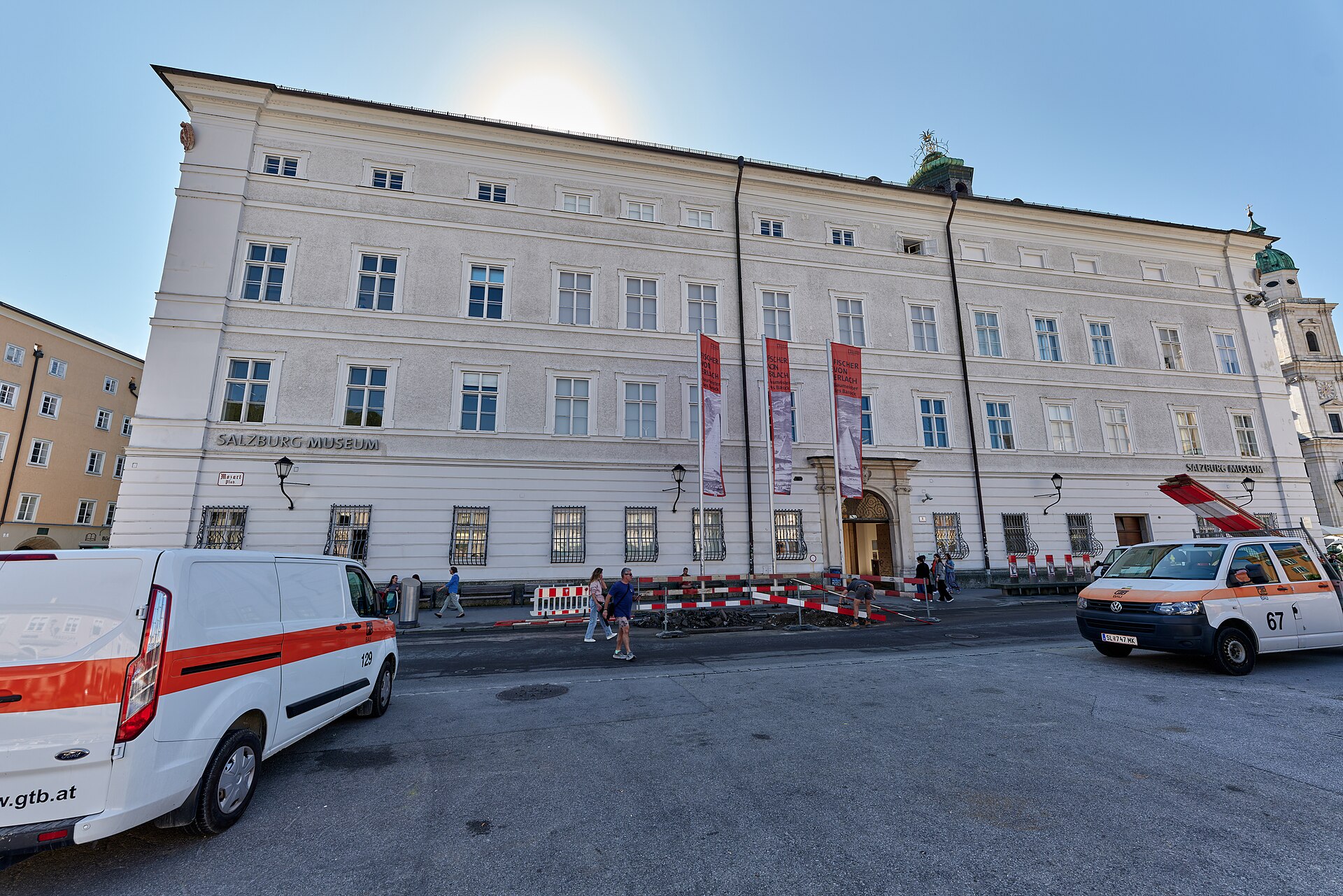
The Neue Residenz, home to the Salzburg Museum, photographed on Mozartplatz in September 2023, weeks before the building closed for its current renovation. SALZBURG MUSEUM lettering is visible on the facade banners at street level.
Photograph by Leonhard Lenz, CC0Closed to visitors - not permanently
Salzburg Museum is currently closed. Not open and not permanently closed. The museum's own Neue Residenz visitor-info page states plainly that the building is currently closed for renovation (Derzeit wegen Umbau geschlossen); its own houses-overview page confirms Neue Residenz does not appear among the locations currently receiving visitors. The closure began at the end of October 2023, announced by museum director Martin Hochleitner, who stated exhibition operation was not possible under construction conditions; the museum's other seven houses, accounting for the large majority of its visitor numbers, stayed open throughout.
Expected to reopen: Renovation of the Neue Residenz targeted for completion in autumn 2026; the new Belvedere Salzburg branch, sharing the same building, targeted to open in the first half of 2027 · a target, not yet confirmed
Closure confirmed from the institution's own page. We re-check this page on a schedule and will update it, from the institution's own announcement, the moment it reopens.
On this page 14 sections
ContentsClose
The Salzburg Museum's real strength is depth in things that are recognisably of Salzburg rather than breadth across art history generally: Gothic panel painting and sculpture that stayed in or returned to the region, a nineteenth and twentieth-century painting collection built almost entirely around Salzburg-connected artists, folk-culture holdings anchored by a genuine seventeenth-century farmhouse room, and the Sattler Panorama, a unique surviving document of exactly how the city looked in 1829. The Sammlung Rossacher is the one substantial exception, a collection of international Baroque design sketches with no inherent Salzburg subject matter that entered the museum only because its private collectors happened to be based in the city. Taken together the holdings read less like a comprehensive regional survey and more like the accumulated record of what generations of Salzburg citizens, from the 1834 founders onward, individually judged worth saving.
| Kind | Museum |
|---|---|
| Founded | 1834, as the Vaterlaendisches Museum der Stadt Salzburg, a citizens' collection founded by Vinzenz Maria Suess; carried the name Salzburger Museum Carolino Augusteum from 1850; renamed Salzburg Museum in 2007 when the collection moved into the Neue Residenz |
| City and country |  Salzburg, Austria Salzburg, Austria |
| Address | Neue Residenz, Mozartplatz 1, 5010 Salzburg, Austria |
| Website | salzburgmuseum.at |
| Status | Closed temporarily, confirmed |
| Record last verified |
Visiting
- Hours (pre-closure)
- Monday to Sunday (pre-closure schedule)09:00 to 17:00Last published pre-closure hours, archived 21 October 2023, entry until 30 minutes before closing. The Neue Residenz has not kept this or any visiting schedule since it closed for renovation at the end of October 2023; nothing about the building is bookable today.
- 31 December (pre-closure schedule)09:00 to 14:00Pre-closure special hours, archived 21 October 2023.
- 1 January (pre-closure schedule)11:00 to 17:00Pre-closure special hours, archived 21 October 2023.
- Closed
- 1 November, 24 and 25 December (pre-closure closed days).
- Admission (pre-closure)
- AdultEUR 9Last price published on the museum's own Neue Residenz page before the November 2023 closure, archived 21 October 2023. Not a current, payable price; the building is not selling tickets while closed.
- Youth (16 to 26)EUR 4Pre-closure figure, archived 21 October 2023.
- Children (6 to 15)EUR 3Pre-closure figure, archived 21 October 2023.
- Children under 6FreeFree, pre-closure figure.
- Family (2 adults and children)EUR 18Pre-closure figure, archived 21 October 2023.
- Groups (adults) and seniorsEUR 7Pre-closure figure, archived 21 October 2023.
- School classes, no guideFreeFree, pre-closure figure.
- Visitors with a disability (with ID)FreeFree, pre-closure figure.
Free entry: Salzburger Museumsverein members: free entry at all times (pre-closure figure)- Do I need to book?
- Not applicable. The building takes no bookings and sells no tickets while the renovation is under way.
- Address
- Neue Residenz, Mozartplatz 1, 5010 Salzburg, Austria Map
- Website
- salzburgmuseum.at
- Telephone
- +43 662 620808-0
- [email protected]
Before you go how long, access, photography, bags, eating, shop
- How long to allow
- Not established for the closed building. Before the closure the museum's own pre-closure admission structure, with a Mediaguide included free of charge, matched a self-guided visit of an hour or more rather than a timed slot.
- Access
- Not published for the current closed state in the sources read for this record.
- Photography
- Not published for the current closed state in the sources read for this record.
- Bags
- Not published for the current closed state in the sources read for this record.
- Eating
- Not published for the current closed state in the sources read for this record.
- Shop
- Not published for the current closed state in the sources read for this record.
The museum is closed (see above). These are the figures published before the closure, kept here for a visitor planning ahead rather than presented as bookable today, and you can check the current position at the source we used. We will re-confirm them once it reopens.
What is inside
Kunst bis 1800 (Fine Art to 1800)
Gothic sculpture and panel painting form the backbone of this department, running through outstanding paintings from the eighteenth-century golden age of the Archbishopric of Salzburg. Named works include Rueland Frueauf the Elder and Hans Traut's Heilige Maria im Aehrenkleid of around 1495 and Johann Michael Rottmayr's Christus unter den Schriftgelehrten of 1697. The museum states it actively collects Salzburg townscapes and Gothic sculpture that left the city after the Napoleonic Wars.
Kunst ab 1800 (Fine Art from 1800)
Painting and sculpture from around 1800 to the present, kept deliberately anchored to Salzburg subjects and Salzburg-connected artists rather than built as a general survey. Holdings run from nineteenth-century local painters such as Pezolt, Stief, Fischbach and Mayburger through founder-generation and classical-modernist figures including Hans Makart and Anton Faistauer, whose Stillleben mit Aepfeln of around 1913 is among the museum's own cited examples, up to recent acquisitions and an actively expanding holding of work by women artists.
Sammlung Rossacher
Around 139 oil sketches, 164 drawings and 42 sculptors' models of Baroque design, most from the Italian Roman circle, assembled by the art historian and dealer Kurt Rossacher and his wife Else between the 1950s and 1970s and given to the city and state of Salzburg in 1970. Artists represented include Peter Paul Rubens, Luca Giordano, Paul Troger, Johann Michael Rottmayr, Martino Altomonte and Carlo Innocenzo Carlone. The collection ran as its own Barockmuseum from 1973 before being folded into the Salzburg Museum in 2012.
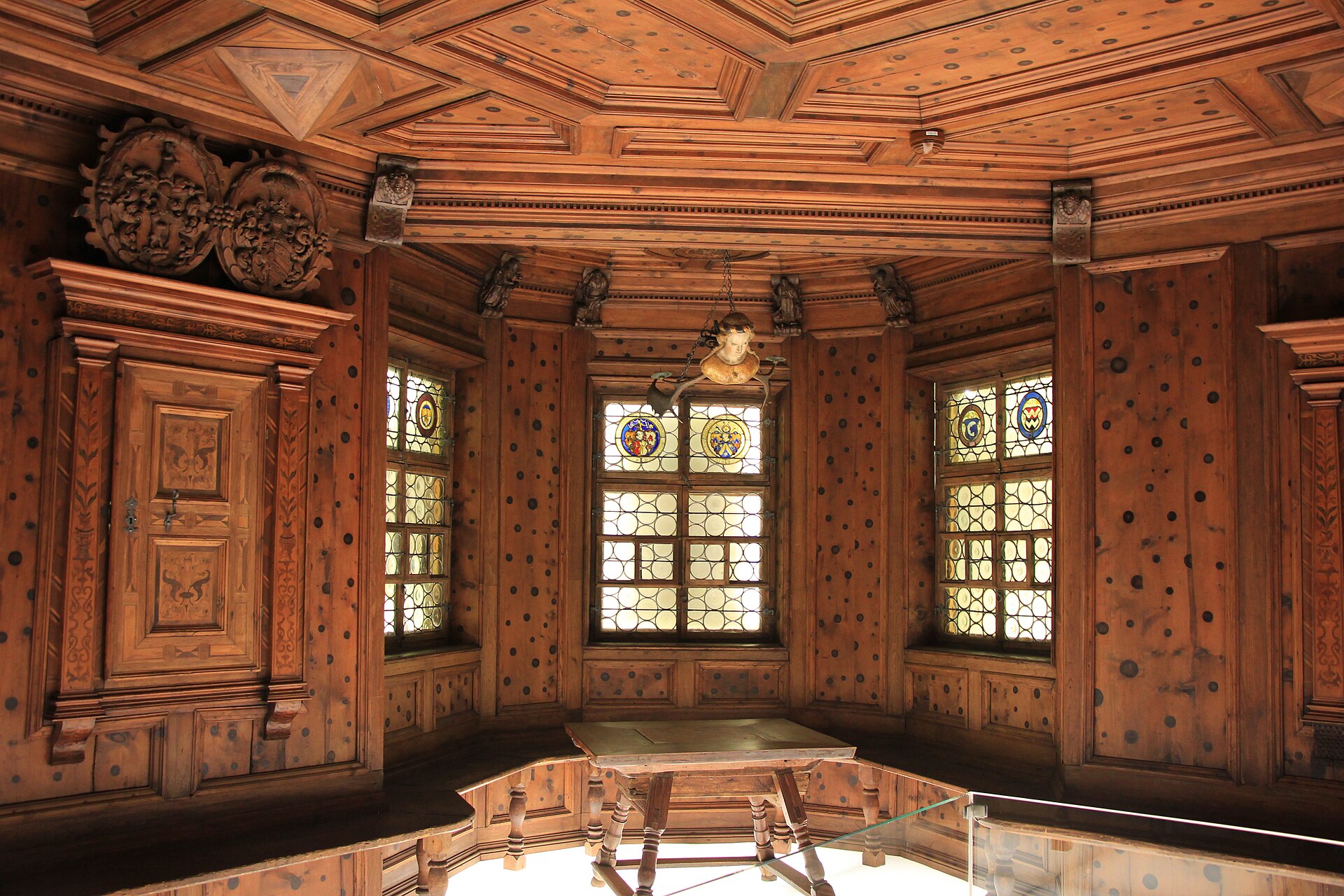
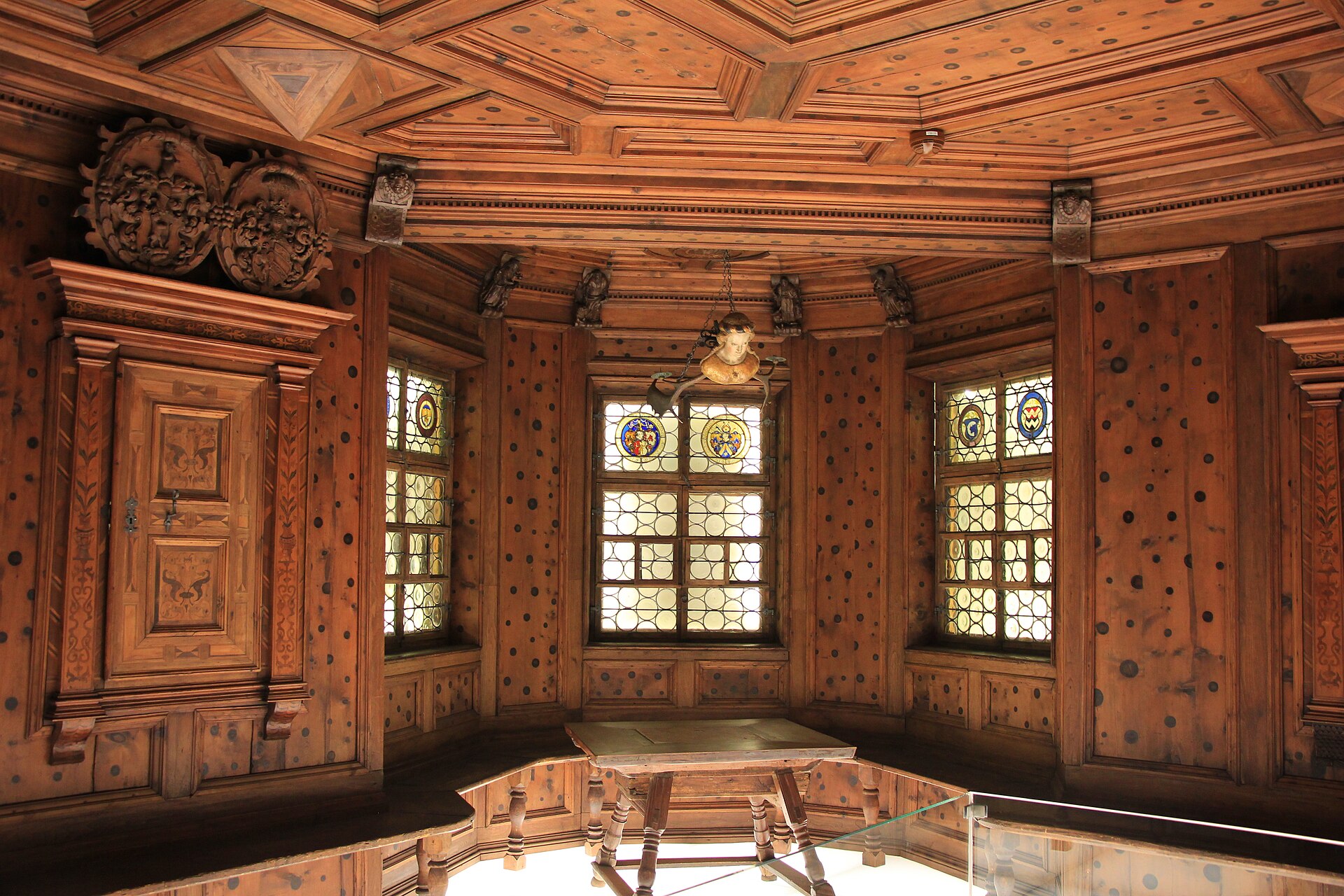
Photograph by Karl Gruber · CC BY-SA 4.0 Salzburg einzigartig - Geschichte(n) aus Stadt und Land (permanent city and regional-history galleries)
The museum's own history and folk-culture galleries, built around the Goldegger Stube, an authentic wood-panelled farmhouse parlour dated 1606, moved to the museum in 1883 and reinstalled here in May 2016 on the building's first floor. Around the Stube the exhibition sets folk-costume, mask and craft holdings, including Schnabelperchten figures, Goldhauben headdresses and a rotating display of nativity cribs, against the wider civic and regional history collection built up since 1834.
Panorama Museum (Sattler Panorama)
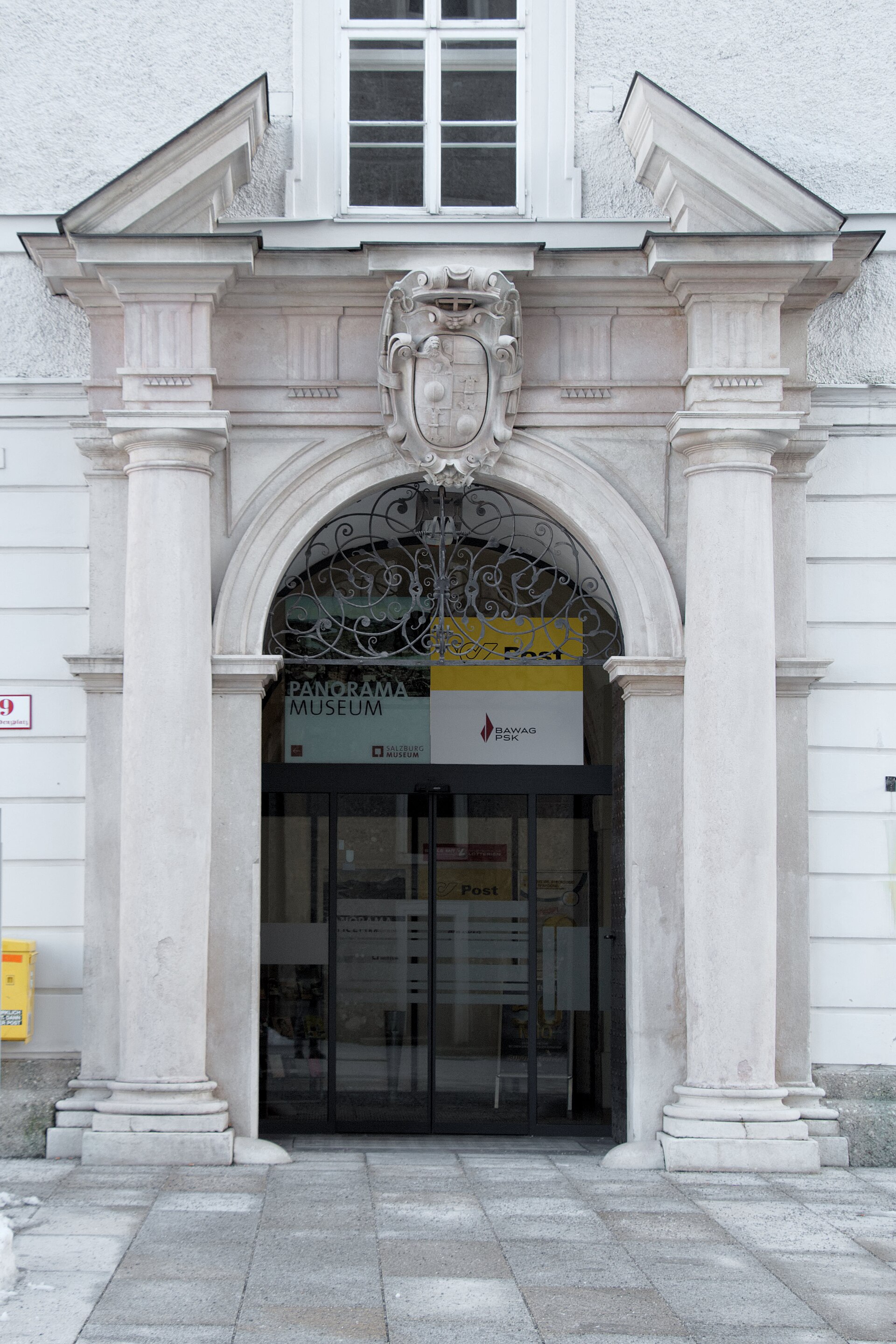
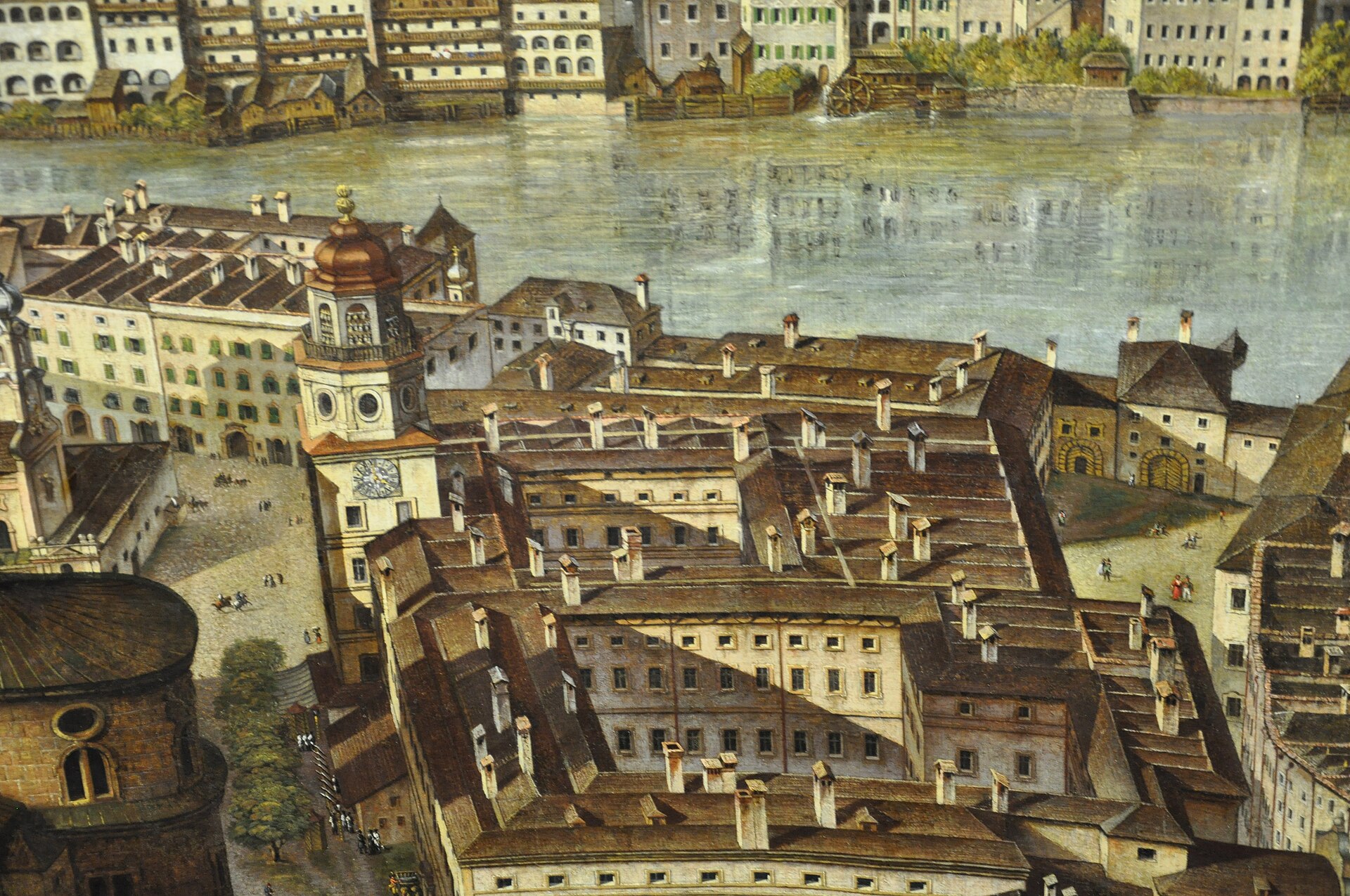
Until early 2026 this building's Residenzplatz-facing annex, built on the site of the former post office, held the Sattler Panorama: a 360-degree view of Salzburg painted by Johann Michael Sattler between 1825 and 1829, 25.5 metres around and 4.9 metres high, the only surviving nineteenth-century travelling city panorama known anywhere. Public since October 2005, the painting was moved out to the Orangerie at Schloss Mirabell in 2026 as the current construction phase reached this part of the building; the sources read for this record do not say whether it returns here once the Neue Residenz reopens.
What to see first
Sattler Panorama
Johann Michael Sattler and familyThe only surviving nineteenth-century travelling city panorama in the world, a 360-degree painted view of Salzburg completed in 1829 that the Sattler family exhibited across Europe for a decade before it settled permanently in the city it depicts15
Goldegger Stube
Unrecorded Pongau builders and carvers, 1606A complete wood-panelled farmhouse room of 1606, brought into the collection in 1883 and one of the museum's most consistently popular exhibits, now staging the folk-costume and nativity-crib holdings around it14
Heilige Maria im Aehrenkleid
Rueland Frueauf the Elder and Hans TrautA tempera panel of around 1495 representing the peak of late-Gothic panel painting in the collection, part of the department the museum describes as its strongest holding of Gothic sculpture and panel painting5
Christus unter den Schriftgelehrten
Johann Michael RottmayrA 1697 oil painting by the leading Austrian Baroque fresco painter of his generation, representative of the outstanding eighteenth-century Archbishopric-era paintings the fine-art-to-1800 department is built around5
Oil sketch for the high altar of the Chiesa Nuova, Rome
Peter Paul RubensA preparatory sketch for one of Rubens's most important Roman commissions, the altarpiece of Santa Maria in Vallicella, held in the Sammlung Rossacher alongside sketches by Giordano, Troger and Rottmayr7
Portrait of Therese von Heffter with her daughter Marie
Barbara KrafftPainted around 1810 by an artist who lived and worked in Salzburg from 1804 to 1821 and who is separately known for painting the posthumous 1819 portrait of Mozart that shaped how the composer is pictured to this day6
Stillleben mit Aepfeln
Anton FaistauerA still life of around 1913 by a leading figure of Austrian classical modernism whose work anchors the museum's post-1800 collection alongside Hans Makart and the nineteenth-century Salzburg landscape painters6
Exhibitions on now
- On now18 Apr to 1 Nov 2026Confirmed · check before you travel
A citizens' museum, founded 1834
The Salzburg Museum traces itself to 1834, when a group of Salzburg citizens led by Vinzenz Maria Suess formed the Vaterlaendisches Museum der Stadt Salzburg, the patriotic museum of the city of Salzburg, to keep local antiquities and military relics from being sold or scattered out of the region. Salzburg had only recently lost its centuries-old status as an independent prince-archbishopric and had been absorbed first into Bavaria and then into the Austrian Empire, and the founding collection was explicitly a local response to that loss of identity, gathered by townspeople rather than commissioned by a court or a church. Following the political upheavals of 1848 the museum became the city's official museum, and in 1850 the Salzburg municipality secured the patronage of Caroline Auguste, the widowed empress of Franz I, adding her name to the institution's own: for the following 157 years it was known as the Salzburger Museum Carolino Augusteum. The Carolino Augusteum name persisted through multiple changes of building and fortune until the museum's 2007 move into the Neue Residenz, when it was simplified to the name it carries today.
Bombed in 1944, and a six-decade search for a permanent home
The museum's building at the time was hit directly during American bombing raids on Salzburg in October 1944, one of a series of Allied attacks that killed hundreds of the city's residents and destroyed large parts of the historic centre; the museum building itself was largely wrecked in a subsequent attack. Most of the collection survived only because it had already been evacuated to sixteen locations around the region, including salt mines used for exactly this kind of wartime storage, though the sources read for this record note that objects still in transit or storage were lost to looting as the war ended in 1945. What followed was decades of provisional arrangements, with the museum's offices and displays scattered around Salzburg while the city and state argued over where a rebuilt museum should permanently sit. That argument was not settled until the early 2000s, when the state committed the Neue Residenz on Mozartplatz, previously a government and postal building, to the museum. The Panorama Museum opened there on 26 October 2005 and the full museum followed on 1 June 2007, at which point the institution dropped the Carolino Augusteum name it had carried since 1850. The renovation that made this possible was not without its own friction: Salzburg's heritage-protection authority formally disputed the repainted colour of the historic facade, a reminder that this building's protected status constrains even its custodians. The 2007 opening won the Austrian Museum Prize the same year, and the museum went on to win the European Museum of the Year Award in 2009, a rare distinction for an Austrian regional museum and one that marked the Neue Residenz years as the institution's most stable and internationally recognised period since the war.
A civic collection built from acquired collections
What the Neue Residenz held, before the current closure, was less a single unified survey than a set of formerly independent collections absorbed one at a time into a common civic museum. The fine-art holdings to 1800 and from 1800 onward grew from the founding nineteenth-century civic collection and from later purchases deliberately weighted toward Salzburg subjects and Salzburg-connected artists rather than a general art-historical survey; the museum's own acquisition policy still states a preference for Salzburg townscapes and for Gothic sculpture that left the region after the Napoleonic Wars. The Sammlung Rossacher, more than three hundred Baroque oil sketches, drawings and sculptors' models built by the private collector Kurt Rossacher and his wife Else between the 1950s and 1970s, ran for decades as its own separate Barockmuseum in the Orangerie at Mirabell before being folded into the Salzburg Museum's main holdings in 2012. The city and regional history galleries built around the seventeenth-century Goldegger Stube, and the applied-art and everyday-culture holdings spanning ceramics, sacred silverwork and modern industrial design, follow the same pattern: a museum whose collection is largely the sum of what previous private and civic collectors in Salzburg chose to keep together rather than what a single acquisitions committee assembled to fill a plan.
Closed since 2023: what the renovation is actually doing
The Neue Residenz closed to visitors at the end of October 2023 for what the museum's director, Martin Hochleitner, described at the time as a full general renovation of the building's heating, plumbing and electrical infrastructure, stating plainly that ordinary exhibition operation was not possible under the resulting construction conditions. The state of Salzburg, which owns the building, is using the closure to expand the museum at the same time: the works add a new multifunctional underground space beneath one of the building's inner courtyards, additional exhibition space that the state government put at roughly 1,300 square metres in a November 2024 update, and a new underground link connecting the existing Salzburg Museum galleries to a newly built wing for Belvedere Salzburg, a permanent branch of Vienna's Oesterreichische Galerie Belvedere. The museum's own account is careful to note that this construction closure affects only the Neue Residenz: the toy museum, the fortress museum and the museum's other branch locations, together accounting for the large majority of the institution's total visitor numbers, remained open throughout, and parts of the closed building's own collection have continued to appear in guest exhibitions at partner venues around Salzburg and at the Keltenmuseum Hallein under the banner Salzburg Museum - Gastspiel.
Two museums under one roof
What reopens will not be a restored version of the old museum but a new institutional arrangement: the Salzburg Museum and Belvedere Salzburg are planned to operate as two independent museums, each with its own collection, its own curatorial profile and its own research focus, sharing the renovated Neue Residenz building under what the state government's own announcement calls a cooperation model without precedent elsewhere in Europe. Belvedere Salzburg is planned to present highlights from the Vienna Belvedere's own collection alongside works chosen for their Salzburg connections, spanning some eight hundred years of art history, in space built specifically for that purpose within the same walls the Salzburg Museum has occupied since 2007. The renovation of the existing building is currently targeted for completion in autumn 2026, with the joint reopening, Belvedere Salzburg's public debut alongside the Salzburg Museum's return, targeted for the first half of 2027; both dates are stated by the state government and the museum as targets rather than confirmed commitments, and the closure has already run longer than the roughly three years originally estimated when it began in 2023.
What visitors say
Before the 2023 closure, reviewers consistently treated the Salzburg Museum as a solid, efficient introduction to the city's history rather than a headline destination in its own right, best value when folded into the Salzburg Card rather than paid for alone. The Sattler Panorama and the musical-instrument and coffee-house-culture displays drew the most specific praise; the general run of the permanent galleries was more often called competent than compelling. Since the closure, the dominant visitor complaint has simply become the closure itself: travellers arriving with an old guidebook or map find the building shut, with no walk-up alternative on site.
What is praised, what is criticised
- Praised: The Sattler Panorama was repeatedly singled out as the standout single object, with reviewers specifically noting the restored painting and the view over the old town from its display level
- Praised: Interactive elements covering Salzburg's musical and coffee-house history were called out as more engaging than the museum's more conventional historical displays
- Praised: Visitors holding a Salzburg Card considered the museum good value as one stop among several, even where they would not have paid the standalone admission price
- Criticised: Several reviewers described the permanent exhibition as disjointed, sometimes finishing a visit in under an hour and judging it less essential than the city's other museums
- Criticised: Since the November 2023 closure, visitors following older guides or maps arrive to find the Neue Residenz shut, with reviews from the closure period noting there is no alternative access to this building's own collection on site
- Criticised: The renovation's 2005-2007 predecessor project drew a formal dispute with Salzburg's heritage-protection authority over the repainted facade colour, an illustration that even approved work on this protected building has not gone unchallenged
Ratings on other platforms
TripAdvisor: 3.9 from 336 ratings, read 13 August 2026
A platform average is a tertiary source: it moves, it is not audited, and we quote no visitor's words.
Questions about Salzburg Museum
Where is Salzburg Museum?
Neue Residenz, Mozartplatz 1, 5010 Salzburg, Austria.
How much does it cost to visit?
Adult: EUR 9; Youth (16 to 26): EUR 4; Children (6 to 15): EUR 3; Children under 6: free; Family (2 adults and children): EUR 18. As confirmed 14 September 2026.
When is it open?
Monday to Sunday (pre-closure schedule) 09:00-17:00; 31 December (pre-closure schedule) 09:00-14:00; 1 January (pre-closure schedule) 11:00-17:00. Closed: 1 November, 24 and 25 December (pre-closure closed days). As confirmed 14 September 2026.
What should you see first?
Sattler Panorama (Johann Michael Sattler and family); Goldegger Stube (Unrecorded Pongau builders and carvers, 1606); Heilige Maria im Aehrenkleid (Rueland Frueauf the Elder and Hans Traut); Christus unter den Schriftgelehrten (Johann Michael Rottmayr); Oil sketch for the high altar of the Chiesa Nuova, Rome (Peter Paul Rubens); Portrait of Therese von Heffter with her daughter Marie (Barbara Krafft).
What we could not confirm
- Whether the Sattler Panorama returns to the Neue Residenz once the renovation completes, or stays permanently at the Orangerie at Schloss Mirabell where it moved in 2026, is not stated in any source read for this record
- No source read for this record gives a total, disclosed budget figure for the current 2023-2027 renovation and Belvedere Salzburg construction; a cost figure of 19.1 million euros that surfaces in some search results describes the museum's earlier, unrelated 2005-2007 move into the Neue Residenz and has deliberately not been repeated here as a figure for the current works
- The exact floor plan and gallery names Salzburg Museum will use on reopening, and whether wings such as the Goldegger Stube installation return to the same rooms, are not published in any source read for this record
Images
Sources
- 1Salzburg Museum, official Haeuser (locations) overview, showing current open/closed status of every house salzburgmuseum.at/haeuser/
- 2Salzburg Museum, Neue Residenz visitor-info page, stating the building is currently closed for renovation salzburgmuseum.at/besucherinfo/oeffnungszeitenpreise/neue-residenz/
- 3Salzburg Museum, 'Ueber das Salzburg Museum' (history, founding, name changes, WWII damage, awards) salzburgmuseum.at/ueber-das-salzburg-museum/
- 4Salzburg Museum, contact page (phone, email, postal address) salzburgmuseum.at/ueber-uns/kontakt/
- 5Salzburg Museum, collection page 'Kunst bis 1800' salzburgmuseum.at/sammlung/kunst-bis-1800/
- 6Salzburg Museum, collection page 'Kunst ab 1800' salzburgmuseum.at/sammlung/kunst-ab-1800/
- 7Salzburg Museum, collection page 'Sammlung Rossacher' salzburgmuseum.at/sammlung/sammlung-rossacher/
- 8Salzburg Museum, collection page 'Angewandte Kunst und Alltagskultur' salzburgmuseum.at/sammlung/angewandte-kunst-und-alltagskultur/
- 9Salzburg Museum, collection page 'Fotografie' salzburgmuseum.at/sammlung/fotografie/
- 10Salzburg Museum, construction-projects page on Belvedere Salzburg (English) salzburgmuseum.at/en/construction-projects/belvederesalzburg/
- 11Land Salzburg, state government press release, 12 November 2024, 'Neue Residenz wird zum einzigartigen und offenen Kulturareal' service.salzburg.gv.at/lkorrj/detail?nachrid=70586
- 12salzburg.ORF.at, 9 September 2023, 'Salzburg Museum wird geschlossen' salzburg.orf.at/stories/3223462/
- 13Wayback Machine archive, 21 October 2023, of the Salzburg Museum's own Neue Residenz hours-and-prices page, the last pre-closure version web.archive.org/web/20231021151250/https://www.salzburgmuseum.at/besucherinfo/oeffnungszeitenpreise/neue-residenz/
- 14Salzburg-Geschichte-Kultur.at, 'Goldegger Stube' salzburg-geschichte-kultur.at/goldegger-stube/
- 15Wikipedia (German), 'Sattler-Panorama' (; dimensions, exhibition history, 2026 move to the Orangerie) de.wikipedia.org/wiki/Sattler-Panorama
- 16WWII bombing dates, European Museum of the Year 2009, branch list) en.wikipedia.org/wiki/Salzburg_Museum
- 17Wikipedia (English), 'Barbara Krafft' (; her posthumous 1819 Mozart portrait and her 1804-1821 Salzburg residency) en.wikipedia.org/wiki/Barbara_Krafft
- 18derStandard.at, 'Sanierung der Salzburger Residenz nahezu fertig' (on the building's earlier, 2005-2007 renovation and move-in, including the facade-colour dispute with the heritage authority) derstandard.at/story/2084962/sanierung-der-salzburger-residenz-nahezu-fertig
- 19TripAdvisor, Salzburg Museum listing ( aggregate rating) tripadvisor.com/Attraction_Review-g190441-d2093679-Reviews-Salzburg_Museum-Salzburg_Austrian_Alps.html
- 20Wikidata, Q2215920 (; identity confirmation, coordinates, official website) wikidata.org/wiki/Q2215920