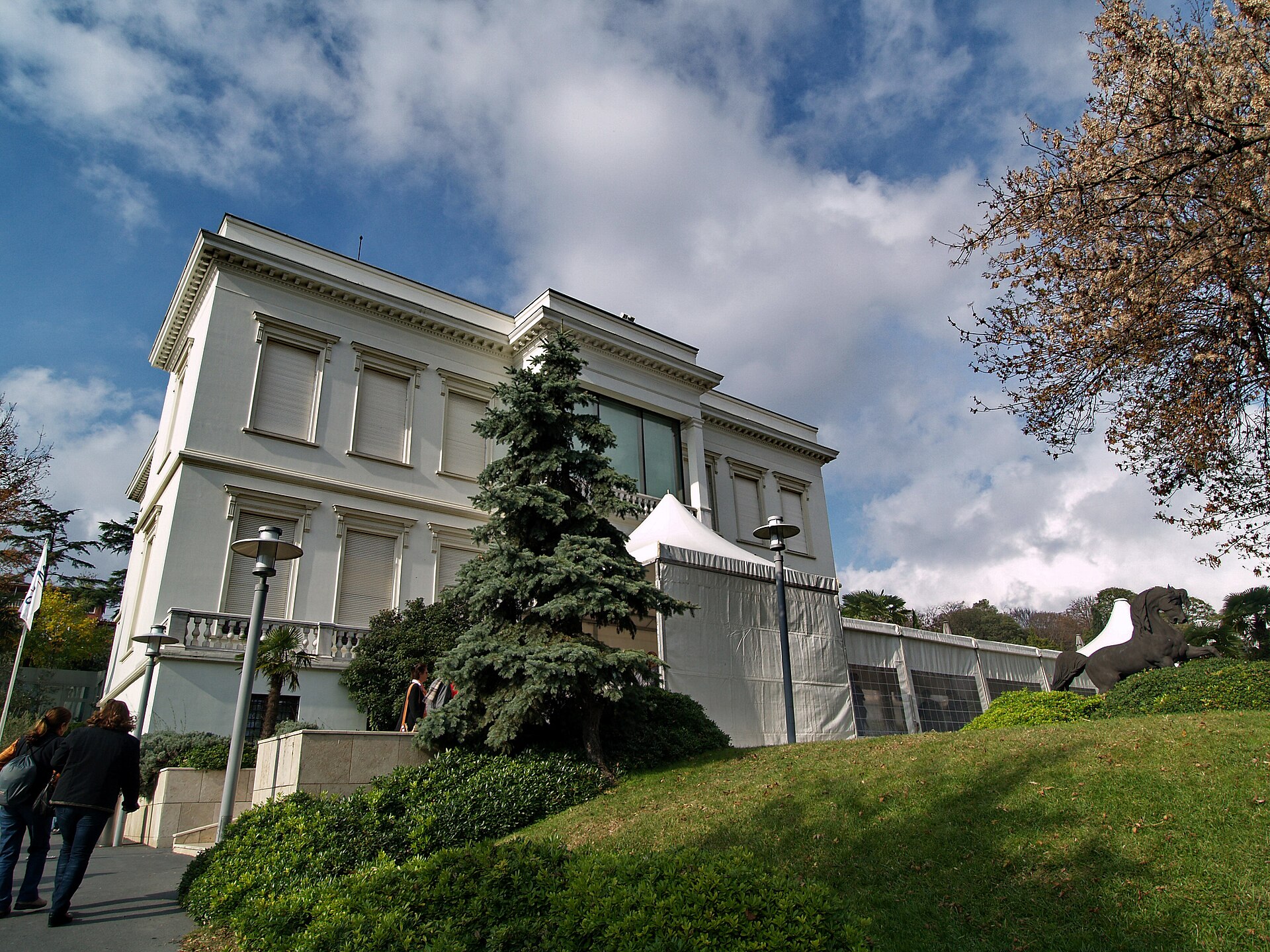
The Atli Kosk, the main building of the Sakip Sabanci Museum in Emirgan, seen from the garden slope.
Edal, CC BY-SA 3.0Sakip Sabanci Museum
Museum · Sakip Sabanci Muzesi · Founded 2002
Open, admission and hours confirmed 15 November 2026 · 17 sources
On this page 15 sections
ContentsClose
The strength is the pairing of the two founding collections. The Arts of the Book and Calligraphy Collection gives a long run of Korans, albums, panels and imperial documents from the fourteenth to the twentieth century, while the Painting Collection that Sakip Sabanci began in the 1970s as its continuation follows Turkish painting from Western influenced Ottoman work to the Republican generation. The museum's collection pages show ten listed items for each collection and do not state totals, except for the 22 archaeological stone pieces; Wikipedia's figures of nearly 400 calligraphy pieces and more than 320 paintings are tertiary and unconfirmed by the museum.
| Local name | Sakip Sabanci Muzesi |
|---|---|
| Kind | Museum |
| Founded | 2002 |
| City and country |  Istanbul, Turkey |
| Address | Emirgan, Sakip Sabanci Caddesi No:42, 34467 Sariyer, Istanbul, Turkey |
| Website | sakipsabancimuzesi.org |
| Status | Open, confirmed |
| Record last verified |
Visiting
- Hours
- Tue-Sun10:00 to 18:00Ticket office and last entry 17:30
- Closed
- Monday. First days of Ramadan. Eid Qurban. 1 January.
- Admission
- AdultTRY 450
- DiscountedTRY 330Students over 18, teachers, visitors aged 65 and above and listed member and employee groups; ID required
- StudentTRY 225Students over 14; student ID checked on ticket delivery
- Children 12 and underFreefree
- Visitors with disabilities and one companionFreefree
Free entry: Every Tuesday, 10:00 to 18:00- Tickets
- sakipsabancimuzesi.org/en/visit The museum's own ticket page.
- Do I need to book?
- Not required as far as the visit page states; online tickets are valid only on the date of the visit and all sales are final
- Address
- Emirgan, Sakip Sabanci Caddesi No:42, 34467 Sariyer, Istanbul, Turkey MapBus Emirgan-Cinaralti stop on the coast road: lines 22, 22RE, 25E, 40, 40T, 42T, EL1, EL2, 59RH
Ferry Emirgan Pier, with services to Istinye, Kanlica, Kandilli, Anadoluhisari, Bebek, Arnavutkoy and Cengelkoy
Car Museum car park for 30 vehicles; ISPARK areas along the coast road when it is full - Website
- sakipsabancimuzesi.org
- Telephone
- +90 212 277 22 00
- [email protected]
Before you go how long, access, photography, bags, eating, shop
- How long to allow
- The museum publishes no suggested visit length
- Access
- Wheelchairs, passageways, lifts and accessible toilets are available; visitors with disabilities enter free with a companion
- Photography
- The museum's visit page states no rule
- Bags
- The museum's visit page states no rule
- Eating
- MSA's Restaurant, with a Bosphorus view
- Shop
- SSM Store, design products inspired by art, with an online shop
Prices and hours change. We take them from the institution's own pages and print the day we read them, and you can check the current position at the source we used. Confirm before you travel.
What is inside
Atli Kosk ground floor: the Family Rooms
Preserved rooms showing nineteenth century Ottoman elite taste, among them the Pink Room, the Blue Room and the Dining Room, with Ai Weiwei's porcelain installation Pillar. The museum's furniture and decorative arts collection lists gilded mirrors, consoles, crystal chandeliers, French tapestries, silk upholstered furniture, Sevres style vases, French mantel clocks and bronze sculptures.
Atli Kosk upper floor: Arts of the Book and Calligraphy
Korans and prayer books by renowned calligraphers, albums, large wall panels, illuminated documents bearing Ottoman imperial ciphers and calligraphers' tools, from the fourteenth to the twentieth century, with QR codes on labels linking to digital manuscripts and Kutlug Ataman's video installation.
The Painting Collection
Turkish painting from Ottoman work under Western influence to the Republican generation, with Aivazovsky, Osman Hamdi Bey, Halil Pasa, Nazmi Ziya Guran, Sevket Dag, Abdulmecid Efendi, Fikret Mualla and Ibrahim Calli among the named artists. The museum lists it as a collection exhibition and its page does not say which room holds it.
Temporary exhibition galleries
The modern galleries annex opened beside the house in 2002 hosts the international exhibitions. The current Yoko Ono show uses Gallery -2 and Gallery -3.
The garden
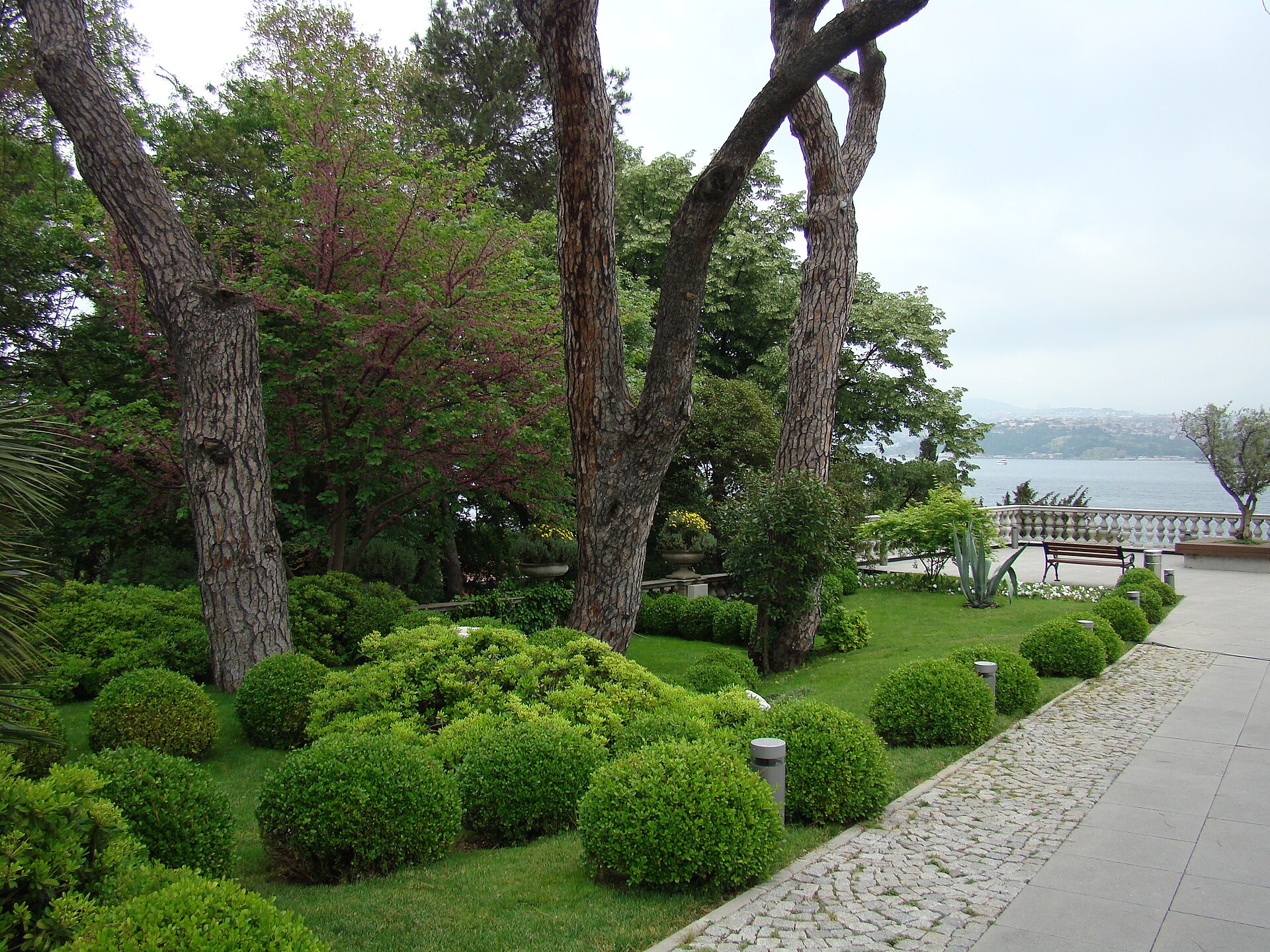
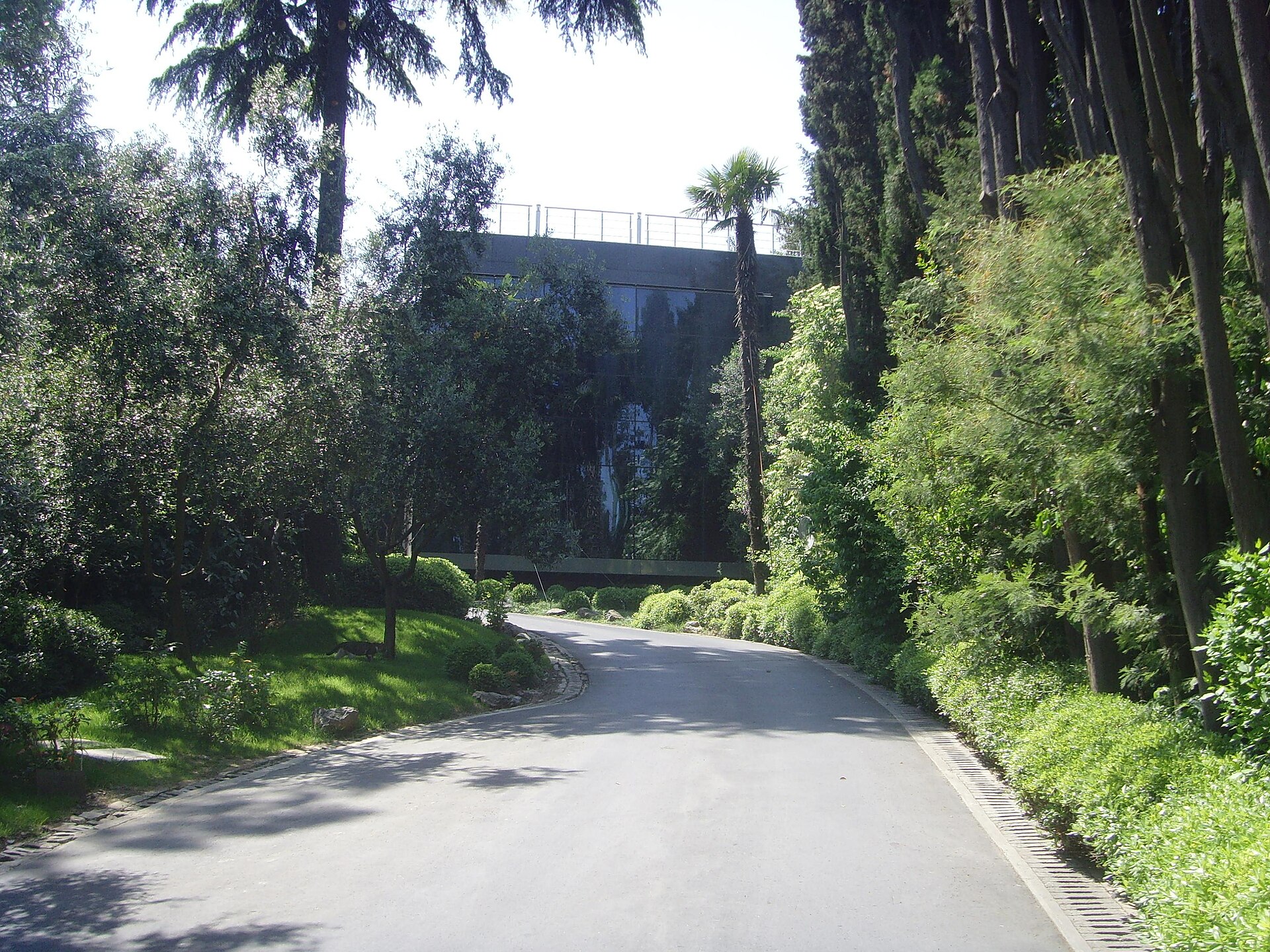
Anish Kapoor's granite sculpture Double, two bronze horses at the entrance, a group of 22 stone archaeological pieces (mostly Late Antique marble capitals, a Cybele altar, a gigantomachy column drum and an eleventh century Byzantine architrave) and a Bosphorus view.
What to see first
Hilye-i Serif
Mehmed Sefik (d. 1880 per the museum listing)The museum features it in its calligraphy collection selection; Sotheby's separately singles out a mirrored celi sulus inscription by Mehmed Sefik dated 1869-70.5
Koran
Hafiz Osman Efendi (1642-1698)Listed by the museum among the notable Korans in the calligraphy collection, by one of the calligraphers the Scribbled Exercises exhibition also names.5
Calligraphic album
Seyh Hamdullah (d. 1520 per the museum listing)Listed among the museum's notable works; the albums form one of the collection's main groups, with Ottoman albums mainly of the sixteenth to nineteenth century.5
The Tempest
Ivan Aivazovsky (1817-1900)Named first among the museum's selected paintings, by a foreign artist whom Sotheby's records among those who worked at the Ottoman court.6
Hodja Reading the Koran
Osman Hamdi Bey (1842-1910)One of two works by Osman Hamdi Bey that the museum highlights from its Painting Collection.6
Bostanci Sea Baths
Halil Pasa (1852-1939)One of four Halil Pasa works the museum highlights, and a view of the Bosphorus coast of Istanbul.6
Pillar
Ai WeiweiA porcelain installation in the ground floor of the Atli Kosk, created 2006 to 2007 according to the museum.3
Double
Anish KapoorA granite sculpture now permanent in the garden after the 2013 to 2014 Kapoor exhibition.3
Yoko Ono: Insound and Instructure
Yoko OnoThe current temporary exhibition, 67 works across more than seventy years, running to 27 December 2026.7
Past exhibitions here
A mansion on the Bosphorus shore
The Sakip Sabanci Museum stands in Emirgan, on the European shore of the Bosphorus in the Sariyer district of Istanbul, at Sakip Sabanci Caddesi 42. It is run by Sabanci University and is built around one house, the Atli Kosk, which the museum's own history page describes as combining traces of a family's everyday life with an art collection. The name means roughly the Horse Mansion, after the bronze horses that stand at its entrance.
The museum's page on the building gives the founding chain in a few lines. Prince Mehmed Ali Hasan of the Khedival family of Egypt commissioned the house, and the Italian architect Edoardo De Nari designed it. The page dates the commission to 1925 and the completion to 1927. The house passed to the prince's sons in 1945 and was bought by the businessman Haci Omer Sabanci in 1951. The two bronze horses were installed in 1955 and 1956.
Wikipedia gives a fuller earlier history of the site, in which an older mansion passed through several pasha and khedive families from 1848 before the present house was built after the Republic was founded. That earlier chain is a tertiary summary and it gives no construction year, so this page uses the museum's own dates for the house and leaves the earlier owners to the open questions below.
From family home to museum
Wikipedia records that Sakip Sabanci's family lived in the house from 1969 to 1999. Sotheby's, in its museum profile, says that in 1998 Sakip Sabanci left the property, its original furnishings and his calligraphy and painting collections to Sabanci University, and that the museum opened in 2002 with a modern galleries annex next to the house. Wikipedia describes the 1998 arrangement differently, as a 49 year lease of the mansion to the university together with its furnishings and collections. The two descriptions cannot both be the whole legal picture, and the page records both rather than choosing one.
The result is a museum with a double character. One half is a private house of the late Ottoman and early Republican period, with its Family Rooms kept as they were lived in. The other half is a working exhibition institution with temporary galleries, a conservation department, lectures, seminars, concerts and educational programmes, as Sotheby's lists them.
What the permanent collections are
The museum's collections page names four holdings. The first is the Arts of the Book and Calligraphy Collection, which runs from the fourteenth to the twentieth century and includes Korans and prayer books by renowned calligraphers, albums of verses and sayings, large wall panels, illuminated official documents bearing the imperial ciphers of Ottoman sultans, and calligraphers' tools in silver, coral, ivory, bone and tortoise shell. The collection began, the museum says, with a calligraphic panel bought in the reign of Sultan Mahmud II, who ruled from 1808 to 1839.
The second is the Painting Collection, begun by Sakip Sabanci in the 1970s as the continuation of the calligraphy collection. It follows Turkish painting from Ottoman work under Western influence to the more intellectual approach of the Republican generation. The museum highlights Ivan Aivazovsky, Osman Hamdi Bey, Halil Pasa, Nazmi Ziya Guran, Sevket Dag, Abdulmecid Efendi, Fikret Mualla and Ibrahim Calli among others.
The third is Furniture and Decorative Arts, which includes the Atli Kosk Family Rooms. The museum describes it as reflecting the Westernisation of the late Ottoman world through Baroque, Rococo, Neoclassical and Empire styles. It started with the family of Prince Mehmed Ali Hasan and was expanded by the Sabanci family. The fourth is a small Archaeological Artifacts Collection of 22 stone objects shown in the garden, mostly marble column capitals of Late Antiquity, with a Cybele altar, a gigantomachy column drum and an eleventh century Byzantine architrave.
Moving through the house and the grounds
The museum's page on the Atli Kosk lays out the route. On the ground floor are the preserved Family Rooms, which show nineteenth century Ottoman elite taste, among them the Pink Room, the Blue Room and the Dining Room, and Ai Weiwei's porcelain installation Pillar. The upper floor holds the Arts of the Book and Calligraphy Collection, where QR codes on the labels link to digital versions of the manuscripts, and a video installation by Kutlug Ataman, Mesopotamian Dramaturgies: Water, no. 5, which the collection page calls the only digital work in the collection.
The garden carries Anish Kapoor's granite sculpture Double and the two bronze horses at the entrance. Istanbul.com adds that one horse dates from 1864 and is by a French sculptor, and that the other is a replica of one of the four bronze horses taken from Sultanahmet Square in 1204; the museum's own page does not repeat those claims. The grounds look over the Bosphorus and the museum invites visitors to walk them for the sculptures, fountains and columns as much as for the view.
Frommer's, in an undated and visibly old entry, says the three decorated rooms were left much as the family last used them. The temporary exhibitions use the galleries on the lower levels; the Yoko Ono show is spread across Gallery -2, Gallery -3, the garden and the calligraphy gallery in the house.
Exhibitions that made the museum's name
Wikipedia lists the shows that carried the museum beyond its permanent collection: Picasso in Istanbul in 2005 and 2006, which it says drew more than 250,000 visitors, then Rodin in 2006, Genghis Khan and His Heirs in 2006 and 2007, Salvador Dali in 2008 and 2009, a Rembrandt and his contemporaries show in 2012 with works from the Rijksmuseum, then Anish Kapoor in 2013 and 2014 and Joan Miro in 2014 and 2015. Time Out and Frommer's name some of the same artists. The attendance figure is Wikipedia's and carries a maintenance tag saying the article leans on sources close to the museum, so it should be read as tertiary.
As of the date this page was read, the museum's exhibitions list shows four entries. Yoko Ono: Insound and Instructure runs from 25 June to 27 December 2026 and the museum calls it the most comprehensive exhibition of her work ever presented in Turkey; it comprises 67 works spanning more than seventy years and was first shown at MUSAC in Leon, Spain, from 8 November 2025 to 17 May 2026. Scribbled Exercises, Practice Pages has been open since 9 June 2026 and shows practice sheets by Ottoman calligraphers from the sixteenth to the twentieth century, drawn from the museum's collection and the Kubbealti Academy Cultural and Arts Foundation. The Painting Collection and the Calligraphy Collection are listed as standing displays.
Planning the visit
The museum is open Tuesday to Sunday from 10:00 to 18:00 and closed on Mondays; the ticket office and last entry are at 17:30. It also closes on the first days of Ramadan, on Eid Qurban and on 1 January. Admission is free on Tuesdays between 10:00 and 18:00. On other days an adult ticket is 450 Turkish lira, the discounted ticket is 330 lira and the student ticket for visitors over 14 is 225 lira. Children aged 12 and under, people with disabilities and one companion each, ICOM cardholders and Sabanci University students and staff enter free. Online tickets are valid only on the day of the visit and all sales are final.
The nearest bus stop is Emirgan-Cinaralti on the coast road, served by lines including 22, 22RE, 25E, 40, 40T and 42T, and ferries call at Emirgan Pier. The museum car park holds 30 vehicles and the gate closes to cars when it is full. The museum says wheelchairs, passageways, lifts and accessible toilets are available. It has a restaurant, MSA's Restaurant, and a shop, the SSM Store. Its visit page gives no rule on photography or bags, so the page does not state one.
What visitors say
Visitors rate the museum very highly overall: on the aggregates read for this page, Google and Tripadvisor both stand at 4.7. What they most often say they enjoy is the setting, meaning the old mansion, its garden and the Bosphorus view, along with the calligraphy and the range of painting from classical to modern. They also describe a calm, uncrowded visit on weekdays and later in the day, and polite staff. The recurring reservations are about price and the cafe, and a small share of ratings are low.
What is praised, what is criticised
- Praised: The mansion, garden and Bosphorus setting
- Praised: The Ottoman calligraphy collection and the range of art on show
- Praised: A calm and uncrowded atmosphere on weekdays and later in the day
- Praised: Polite and welcoming staff
- Criticised: Mixed comments on the cafe and on the admission price in a machine generated summary on WhichMuseum (tertiary)
- Criticised: About 3 percent of Google ratings are one or two stars (197 of 6,048)
- Criticised: The site is described as a little out of the way of the usual tourist circuit
Ratings on other platforms
Google: 4.7 from 6,048 ratings, read 15 November 2026
Tripadvisor: 4.7 from 604 ratings, read 15 November 2026
A platform average is a tertiary source: it moves, it is not audited, and we quote no visitor's words.
Questions about Sakip Sabanci Museum
Where is Sakip Sabanci Museum?
Emirgan, Sakip Sabanci Caddesi No:42, 34467 Sariyer, Istanbul, Turkey.
How much does it cost to visit?
Adult: TRY 450; Discounted: TRY 330; Student: TRY 225; Children 12 and under: free; Visitors with disabilities and one companion: free. As confirmed 15 November 2026.
When is it open?
Tue-Sun 10:00-18:00. Closed: Monday. First days of Ramadan. As confirmed 15 November 2026.
How do you get there?
Bus: Emirgan-Cinaralti stop on the coast road: lines 22, 22RE, 25E, 40, 40T, 42T, EL1, EL2, 59RH; Ferry: Emirgan Pier, with services to Istinye, Kanlica, Kandilli, Anadoluhisari, Bebek, Arnavutkoy and Cengelkoy; Car: Museum car park for 30 vehicles; ISPARK areas along the coast road when it is full.
What should you see first?
Hilye-i Serif (Mehmed Sefik (d. 1880 per the museum listing)); Koran (Hafiz Osman Efendi (1642-1698)); Calligraphic album (Seyh Hamdullah (d. 1520 per the museum listing)); The Tempest (Ivan Aivazovsky (1817-1900)); Hodja Reading the Koran (Osman Hamdi Bey (1842-1910)); Bostanci Sea Baths (Halil Pasa (1852-1939)).
What we could not confirm
- How Sabanci University holds the museum: Sotheby's says Sakip Sabanci left the property and collections to the university in 1998, while Wikipedia describes a 49 year lease signed in 1998. No museum page read for this venue settles it.
- The house's earlier history: Wikipedia traces a mansion on the site back to 1848 and several pasha and khedive owners, but the museum's own page gives only the 1925 commission and 1927 completion by Edoardo De Nari for Prince Mehmed Ali Hasan.
- The horse sculptures: Istanbul.com says one dates from 1864 and the other copies a horse taken from Sultanahmet Square in 1204, Wikipedia names Louis-Joseph Daumas, and the museum says only that they were installed in 1955 and 1956.
- Total holdings: the museum does not publish how many calligraphy works or paintings it holds.
Images
Sources
- 1Sakip Sabanci Museum, Information and Transportation (visiting days, fees, accessibility, transport) sakipsabancimuzesi.org/en/visit
- 2Sakip Sabanci Museum, home page (open today, address, phone, current exhibitions) sakipsabancimuzesi.org/en
- 3Sakip Sabanci Museum, Atli Kosk page sakipsabancimuzesi.org/page/atli-kosk-open
- 4Sakip Sabanci Museum, Collections sakipsabancimuzesi.org/en/collections-and-research/collections
- 5Sakip Sabanci Museum, The Arts of the Book and Calligraphy collection sakipsabancimuzesi.org/en/collections-and-research/collections/340
- 6Sakip Sabanci Museum, Painting Collection sakipsabancimuzesi.org/en/collections-and-research/collections/341
- 7Sakip Sabanci Museum, Yoko Ono: Insound and Instructure sakipsabancimuzesi.org/en/exhibitions-and-events/exhibition/78
- 8Sakip Sabanci Museum, Scribbled Exercises, Practice Pages sakipsabancimuzesi.org/en/exhibitions-and-events/exhibition/77
- 9Wikipedia, Sakip Sabanci Museum () en.wikipedia.org/wiki/Sak%C4%B1p_Sabanc%C4%B1_Museum
- 10Sotheby's, About the Museum: Sakip Sabanci Museum sothebys.com/en/museums/sak%C4%B1p-sabanc%C4%B1-museum
- 11Istanbul.com, Sakip Sabanci Museum istanbul.com/en/travel/sakip-sabanci-museum
- 12Time Out Istanbul, Sakip Sabanci Museum listing timeout.com/istanbul/museums/sakip-sabanci-museum
- 13Frommer's, Sakip Sabanci Museum (Terry Richardson, undated) frommers.com/destinations/istanbul/attractions/sakip-sabanci-museum/
- 14Wanderlog, Sakip Sabanci Museum (Google and Tripadvisor aggregates, ) wanderlog.com/place/details/1288/sak%C4%B1p-sabanc%C4%B1-museum
- 15WhichMuseum, Sakip Sabanci Museum () whichmuseum.co.uk/museum/sakip-sabanci-museum-sariyer-24325
- 16Sakip Sabanci Museum, Exhibitions list sakipsabancimuzesi.org/en/exhibitions
- 17Wikimedia Commons, File:Sakip-Sabanci-Museum.jpg (Edal, CC BY-SA 3.0) commons.wikimedia.org/wiki/File:Sakip-Sabanci-Museum.jpg
