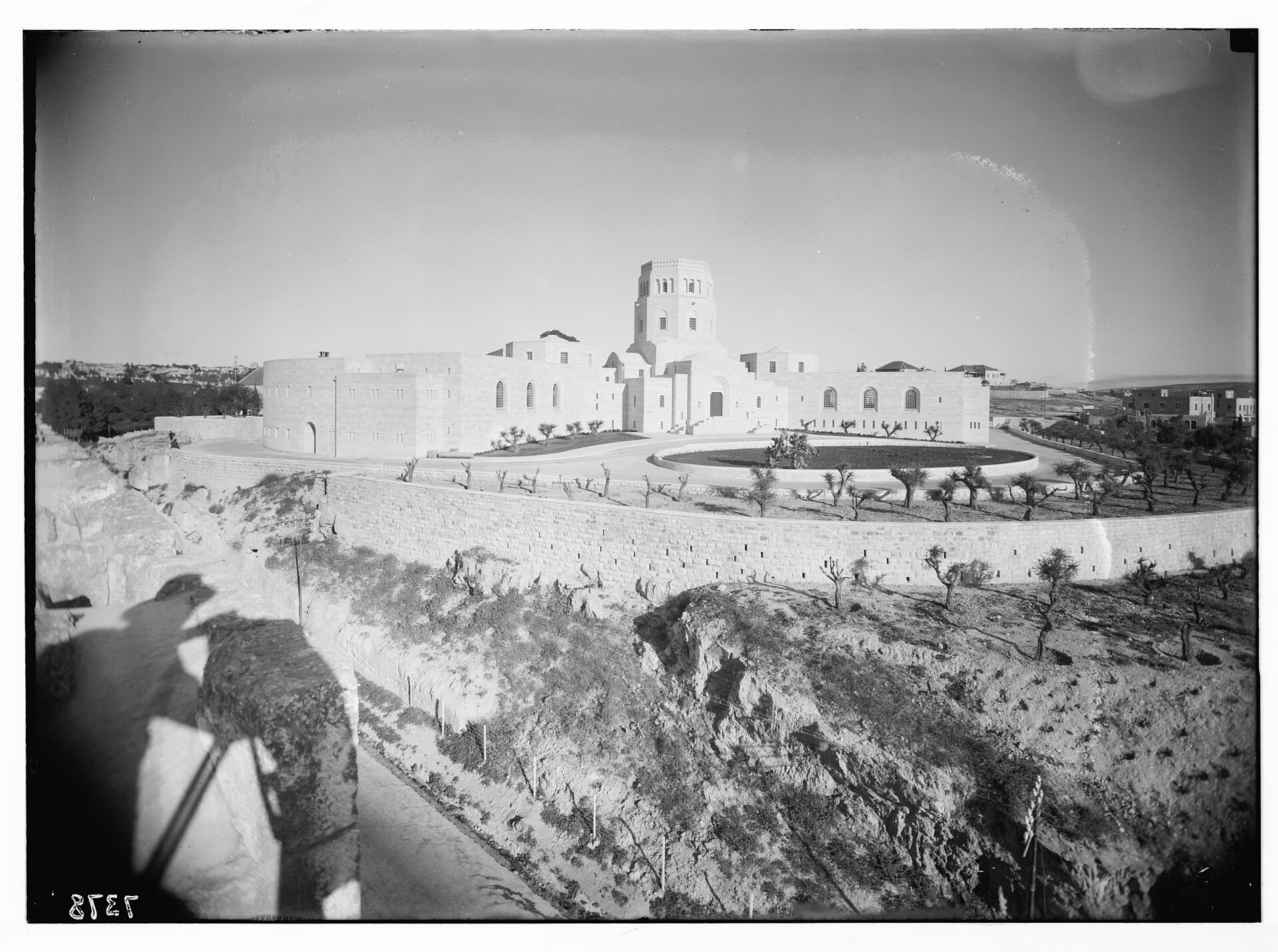
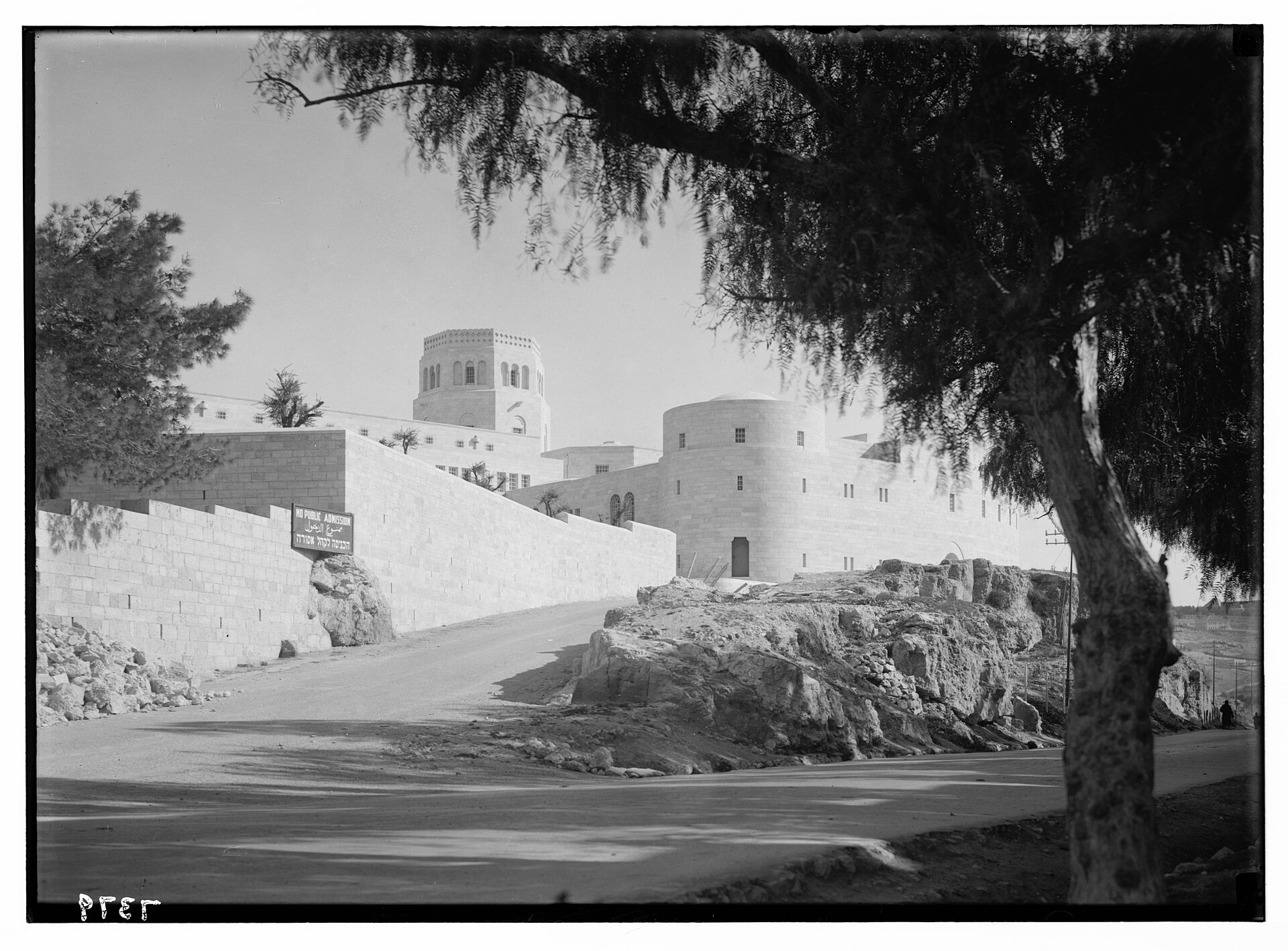
The Rockefeller Museum photographed from the north-east corner of the Old City wall, a Mandate-period Matson Collection photograph taken not long after the museum opened.
Public domainRockefeller Museum
Museum · Palestine Archaeological Museum · Founded 1930
Open, admission and hours confirmed 27 September 2026 · 12 sources
On this page 14 sections
ContentsClose
The Rockefeller's strength is exactly the material Breasted set out to keep in the country: excavation finds from Mandate-era digs across Palestine that were never divided and shipped abroad, arranged chronologically from the Paleolithic and Neolithic through the Bronze and Iron Ages, the Classical, Byzantine, Crusader and Islamic periods, and into the Ottoman era. Two holdings set it apart from any other collection of the region's archaeology. It has the largest surviving body of decorative stucco and stonework removed from Hisham's Palace at Khirbat al-Mafjar near Jericho, the single richest site of early Islamic Umayyad ornament in the Levant, and it holds the material record, in wood, stone and gold, of a British-run excavation programme across sites including Megiddo, Lachish, Samaria and Beit She'an that shaped how the whole region's ancient chronology was first written.
| Local name | Palestine Archaeological Museum |
|---|---|
| Kind | Museum |
| Founded | Cornerstone laid 19 June 1930; opened to the public as the Palestine Archaeological Museum on 13 January 1938 |
| City and country |  Jerusalem, Israel Jerusalem, Israel |
| Address | 27 Sultan Suleiman Street, Jerusalem, Israel |
| Website | imj.org.il/en/wings/archaeology/rockefeller-archaeological-museum |
| Status | Open, confirmed |
| Record last verified |
Visiting
- Hours
- Hebrew-language tour: Thursdays10:00 to 13:00Booked through tod.org.il; includes the round-trip shuttle.
- Hebrew-language tour: Fridays09:30 to 12:30Booked through tod.org.il; includes the round-trip shuttle.
- English-language tour: fixed calendar dates only09:30 to 12:30Not a weekly slot. Dates published as of this writing: 22 Oct, 13 Nov, 26 Nov, 11 Dec, 24 Dec 2026; check tod.org.il before travelling, as the published dates roll forward month to month.
- Independent or walk-in visitNot possible under the current arrangement. There is no public entrance in use and no parking at the site; entry is only through the organized shuttle tour above.
- Admission
- Guided tour, adult (includes shuttle and museum entry)ILS 110The only ticket available; there is no separate walk-in admission. Price and 2026 tour dates confirmed current on the operator's own booking page.
- Guided tour, senior citizenILS 100Same tour and shuttle, reduced rate for senior citizens.
- Tickets
- tod.org.il/en/event/treasures-of-the-rockefel... The museum's own ticket page.
- Do I need to book?
- Yes, mandatory. There is no independent walk-in access; entry is only through the pre-booked, shuttle-linked guided tour run by the Tower of David Museum with the Israel Antiquities Authority and the Israel Museum.
- Address
- 27 Sultan Suleiman Street, Jerusalem, Israel MapShuttle (mandatory) The only way in under the current visiting model. Tour-goers meet a dedicated shuttle at the Nahal Tsofim car park beside the Givat Hamivtar light-rail stop and are driven to the museum and back on the tour's own fixed schedule. The organizers state plainly that arriving on foot or by private car will not get a visitor in, and that there is no parking at the site itself.
Light rail The Jerusalem Light Rail's Givat Hamivtar stop is the shuttle's own meeting point and is the organizers' recommended way to reach the car park by public transport.
City bus (pre-closure) A Tripadvisor review from 2019 records city bus route 1, which circles the Old City walls, stopping close to the museum entrance. That route is not usable to enter the museum itself under the current shuttle-only tour arrangement. - Website
- imj.org.il/en/wings/archaeology/rockefeller-archaeological-museum
- Telephone
- +972-2-6282251
Before you go how long, access, photography, bags, eating, shop
- How long to allow
- About three hours door to door, including the round-trip shuttle from Givat Hamivtar. Both the Hebrew and English tour listings run a fixed 09:30-12:30 or 10:00-13:00 slot rather than a self-timed visit.
- Access
- Not published by the current organizers beyond one practical note: the historic building has stone thresholds throughout and no lift, and visitors who have difficulty standing for a long period are advised to bring a light, foldable chair for the guided stops.
- Photography
- Not stated by the current tour organizers; not otherwise confirmed.
- Bags
- Not stated by the current tour organizers; not otherwise confirmed.
- Eating
- None on site. Visitor reviews from before the 2023 closure describe only a staff canteen belonging to the former Department of Antiquities next door, not a public museum cafe, and the current shuttle-tour format includes no on-site amenities.
- Shop
- None reported, before or after the 2023-2025 closure.
Prices and hours change. We take them from the institution's own pages and print the day we read them, and you can check the current position at the source we used. Confirm before you travel.
What is inside
Entrance hall and tower
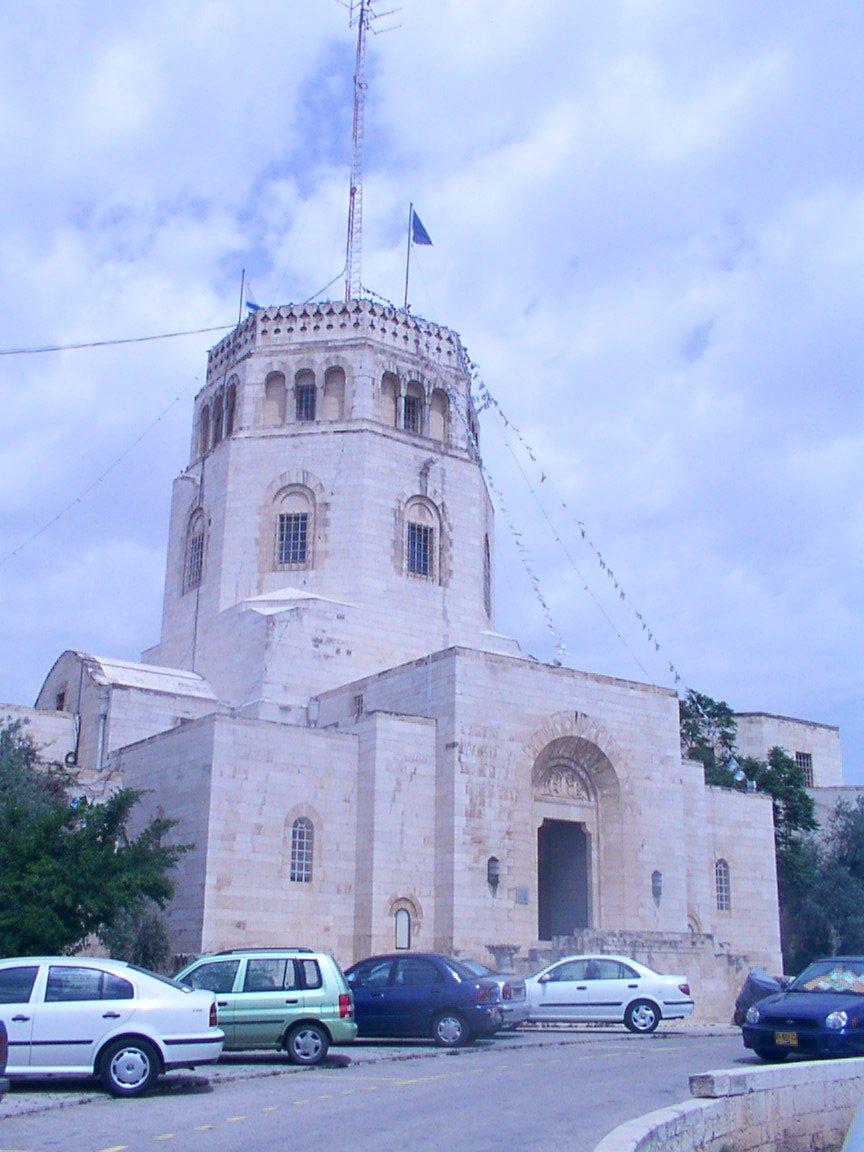
Eric Gill's ten carved stone relief panels frame the entrance, each showing a different people who occupied the land, alongside his trilingual English, Hebrew and Arabic lettering. The hexagonal tower above, the tallest point on this stretch of the old city wall, served as an Israeli paratroop lookout post during the fighting for East Jerusalem in June 1967.
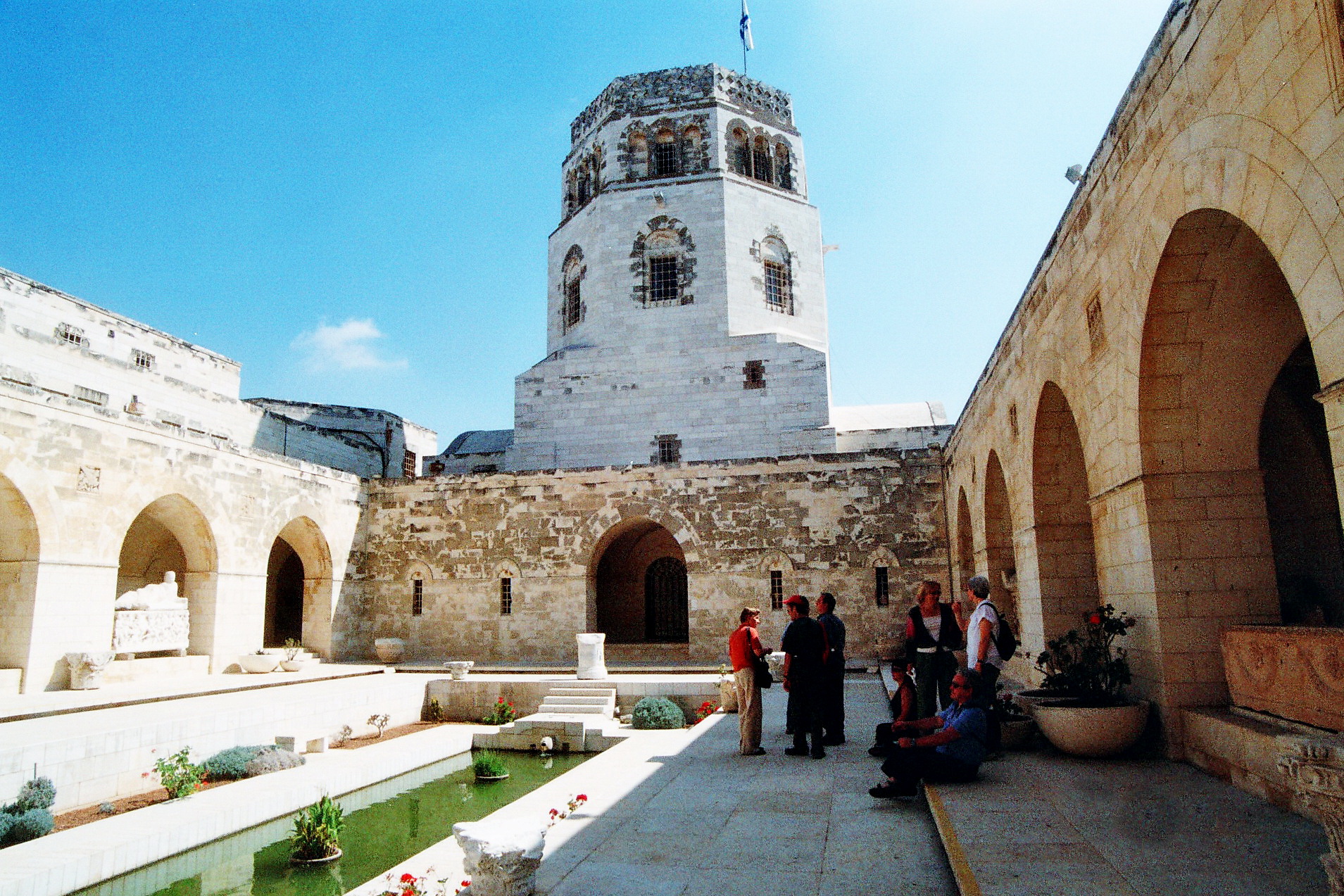
Photograph by israel zeller ישראל זלר · CC BY 2.5 Harrison's courtyard
An arcaded court built around a sunken reflecting pool and lined with blue and green Armenian ceramic tiles that visitors and critics have compared to the Alhambra in Granada since the building opened. An ancient pine tree associated in local Arab legend with the scribe Ezra stood here for close to three hundred years, until it died in 1998.
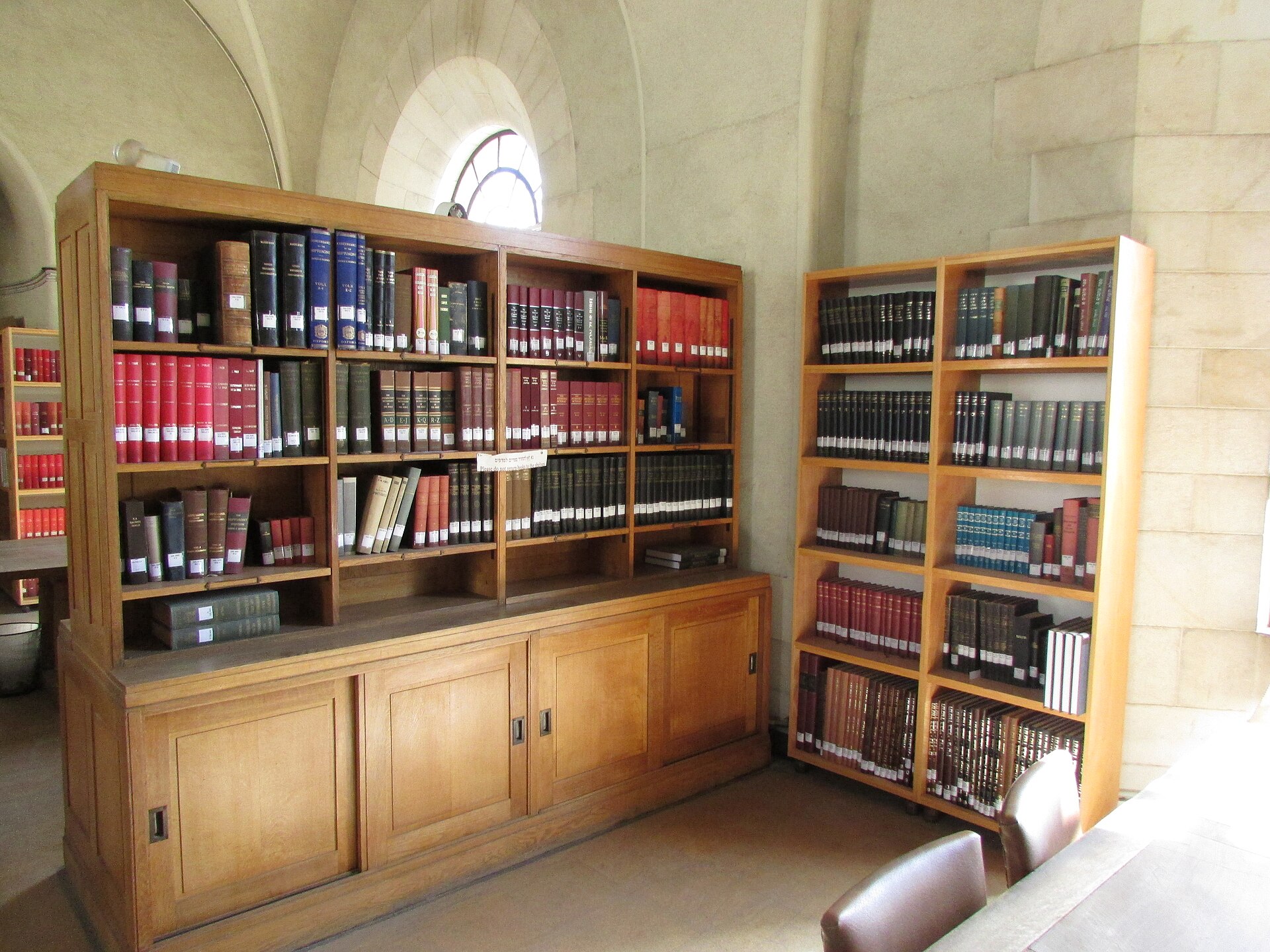
Photograph by יעקב · CC BY-SA 4.0 The library and reading room
A two-storey reading room lined with leather-bound volumes stamped with the Rockefeller family's own bookplate. It is the room where early Dead Sea Scroll fragments were laid out, matched and first read by the international scholarly team working here between 1947 and 1967.
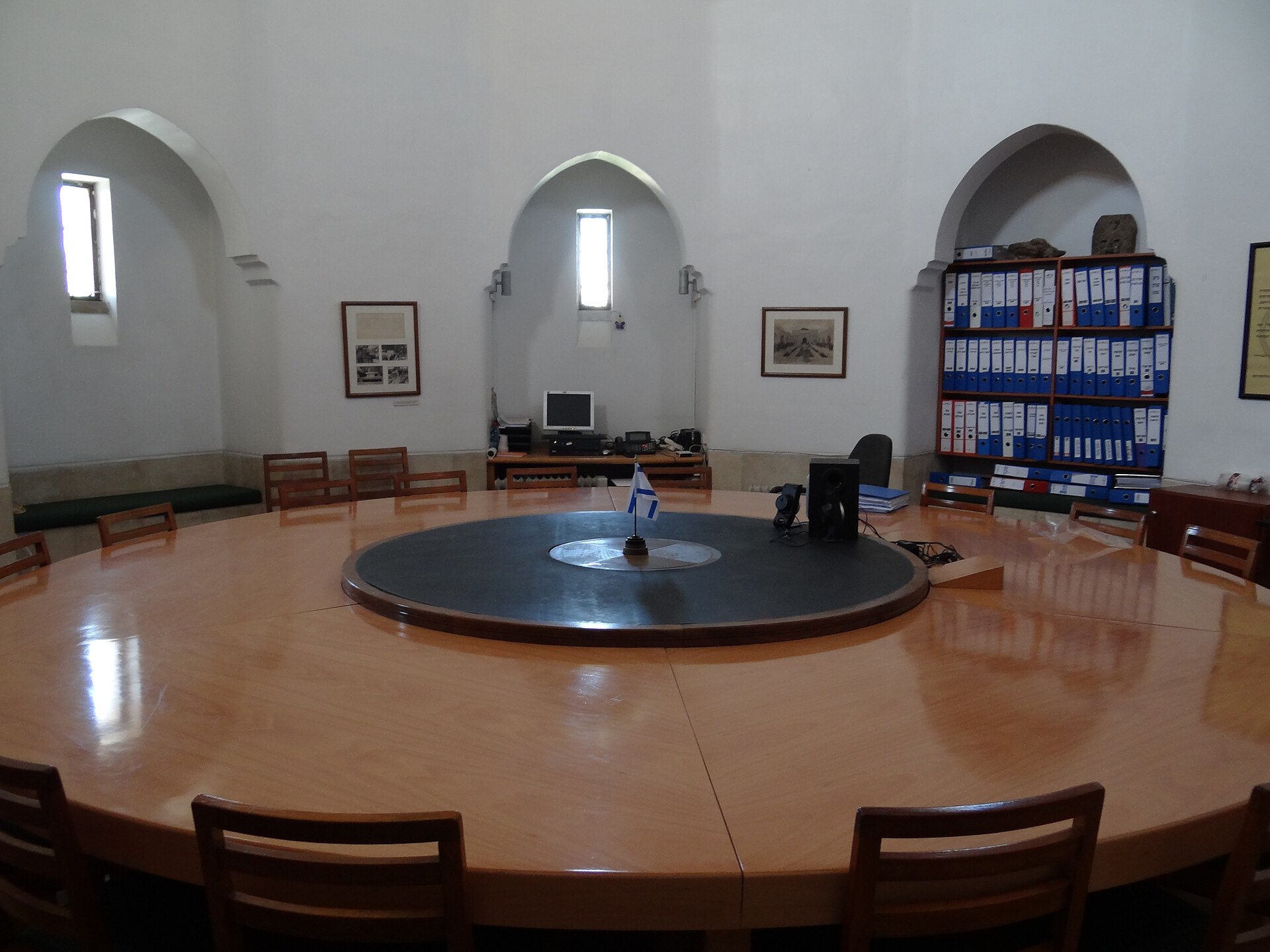
Photograph by Hanay · CC BY-SA 3.0 The round conference room
A circular chamber, formerly the director's office, ringed by a carved stone inscription band. It has served since 1967 as a meeting room for the Israel Antiquities Authority, whose head office occupied the building for decades after the Six-Day War.
North gallery: prehistoric to Iron Age
Chronological displays running from Paleolithic and Neolithic stone tools through the Bronze and Iron Ages, including the roughly nine-thousand-year-old Neolithic statue from Jericho, the colossal statue of Ramesses III found at Beth Shean, Bronze and Iron Age gold jewellery, and a surviving Lachish ostracon written in the last days of the Kingdom of Judah.
South gallery: Classical to Ottoman
Displays running from the Classical and Byzantine periods through the Crusader, Islamic and Ottoman eras, including Umayyad stucco carved for Hisham's Palace at Jericho, eighth-century wooden ceiling panels from the Al-Aqsa Mosque, twelfth-century Crusader marble lintels from the Church of the Holy Sepulchre, and synagogue mosaics and inscriptions from Roman and Byzantine Galilee.
What to see first
Pre-Pottery Neolithic statue from Jericho
Unknown, Pre-Pottery Neolithic B cultureAt roughly nine thousand years old it is among the oldest surviving representations of a human face found anywhere, evidence of the settled ritual life of one of the world's earliest walled towns.1
Colossal statue of Ramesses III, from Beth Shean
Egyptian, New KingdomOne of very few Egyptian royal statues ever found still standing at its original findspot in Canaan, and physical proof of the New Kingdom Egyptian garrison that once held the site.1
Stucco decoration from Hisham's Palace, Khirbat al-Mafjar
Umayyad workshop, 8th centuryThe largest surviving body of carved Umayyad-era plaster ornament from anywhere in the Levant, removed from the palace's reception hall during Mandate-period excavation and still the museum's signature Islamic holding.8
Carved wooden ceiling panels from the Al-Aqsa Mosque
Umayyad workshop, 8th centuryUmayyad wood carving of a kind that almost never survives above ground anywhere, taken from the mosque's roof structure and now one of the museum's rarest holdings.1
Crusader marble lintels from the Church of the Holy Sepulchre
Crusader workshop, 12th centuryRare surviving large-scale Crusader figural relief sculpture from Jerusalem itself, carved for the church at the centre of the Crusader kingdom.1
A Lachish letter (ostracon)
Unknown scribe, Kingdom of Judah, c. 588-586 BCEA first-hand military dispatch written on pottery in the final days before Lachish fell to Babylon, part of the same 1935 find divided between this museum and the British Museum.1
Menorah lintel from the Eshtemoa synagogue
Unknown, 3rd century CEA carved stone lintel bearing a seven-branched menorah, among the earliest surviving examples of that motif carved directly onto a synagogue building.9
Mosaic pavement from the Yafia synagogue
Unknown, 4th century CEA floor mosaic from a Galilean synagogue near Nazareth, part of the museum's record of Jewish communal life under Byzantine rule.9
A museum meant to keep finds in the country that yielded them
The idea began with an American Egyptologist. James Henry Breasted, director of the University of Chicago's Oriental Institute, visited Mandatory Palestine in 1925 and judged that the country needed a proper museum of its own archaeology rather than continuing to see its finds shipped abroad for display, the practice that had filled European collections for a century. Breasted approached the philanthropist John D. Rockefeller Jr., who agreed to fund the building outright with a gift of two million dollars. Rockefeller himself never visited the finished museum.
The British Mandate government chose a hillside site just outside the Old City walls, at the corner where the Via Dolorosa meets Sultan Suleiman Street, and laid the cornerstone on 19 June 1930 in a ceremony attended by the Mufti of Jerusalem, Amin al-Husseini, among other local dignitaries. Construction ran slower than planned once builders uncovered fifth-century BCE tombs on the site that had to be excavated before work could continue. The British architect Austen St Barbe Harrison designed a white limestone building that set Eastern and Western forms side by side rather than favouring one; the sculptor Eric Gill carved ten stone relief panels for the entrance depicting successive civilisations of the region and cut the trilingual English, Hebrew and Arabic lettering that still runs through the building. The Palestine Archaeological Museum, as it was then named, opened to the public on 13 January 1938, an occasion overshadowed by the murder of the British archaeologist James Leslie Starkey on his way to the opening ceremony.
Land that already had an owner
The museum stands on a site with its own, older history that the building's later signage has not always acknowledged. The property was known as Karm al-Sheikh, and part of it had been the eighteenth-century manor of Sheikh Muhammad al-Khalili, an Islamic scholar and mufti; the British Mandate authorities purchased the land from the Khalili family before construction began. The Palestinian anthropologist Ali Qleibo, who traces his descent to al-Khalili, argues, as Jerusalem Story records, that the matter is one of restitution and family history rather than politics: the museum administration's own offices, on his account, occupy what was once his family's house, and no plaque or display inside credits that ownership. Qleibo's demand is narrow and specific, that the building's history before 1930 be named on the site itself, not that the museum close or the collection move.
Jerusalem Story also records that Israeli authorities raised the Israeli flag at the museum's entrances after 1967 and renamed it for its American donor rather than for its Ottoman and Mandate history, a choice that, in East Jerusalem, reads to Palestinian visitors as a claim of ownership the building's own location does not straightforwardly support. Neither side disputes the underlying facts; what is unsettled is whether that history belongs on a wall inside a museum that receives visitors from across the world, and the museum's own current operators, a coalition of the Tower of David Museum, the Israel Antiquities Authority and the Israel Museum, have not added it.
Twelve trustees, a nationalisation and a war
The British Mandate government ran the museum until the Mandate itself ended in 1948, at which point, per the founding trust deed, an international board of twelve trustees was appointed on 20 April 1948 specifically so the collection would not fall under the control of any single successor government, a precaution drawn directly from the political uncertainty of the moment. Jordan, which held East Jerusalem and the West Bank after the 1948 war, administered the site under that trustee structure until 1966, when King Hussein nationalised the museum outright as part of a wider assertion of Jordanian sovereignty over the annexed territory.
That arrangement lasted less than a year. During the Six-Day War in June 1967 an Israeli paratroop brigade captured the museum, using its hexagonal tower, the tallest structure on that stretch of the old city wall, as a lookout point during the fighting for East Jerusalem. Israel folded the museum's administration into the Israel Museum, which it had opened in West Jerusalem four years earlier, and the building became, and remained for decades, the head office of the Israel Antiquities Authority as well as a public museum. The building's Mandate-era name, the Palestine Archaeological Museum, dropped out of official use; the donor's name, already the informal one in English since 1938, became the only one used.
The scrolls that left
From their discovery beginning in 1947 until 1967, the Rockefeller housed the single most consequential archive to pass through its rooms, the Dead Sea Scrolls, and its own library and reading room were where early fragments were laid out, matched and first deciphered by the international team working under the Mandate and then Jordanian administration. After the 1967 war Israel moved the core of the collection across the city to the purpose-built Shrine of the Book at the Israel Museum, while part of the wider find, including the Copper Scroll, had already gone to the Jordan Museum in Amman during the Jordanian period. Ownership of the scrolls has been contested ever since between Israel, Jordan and the Palestinian Authority, and no international body has settled it.
The same custody question resurfaced in a different form in January 2024, when the Israel Antiquities Authority's director, Eli Eskozido, shared footage of antiquities removed from Gaza during the war that began in October 2023, an act Jerusalem Story reports as a breach of international law on moving cultural property out of occupied territory; the IAA stated at the time that it had no intention of transferring those Gaza finds to the Rockefeller. The museum that Breasted proposed to keep excavated material inside the country rather than see it shipped abroad has spent much of its history instead adjudicating exactly which authority inside the country gets to hold it.
Locked for two years, reopened one shuttle at a time
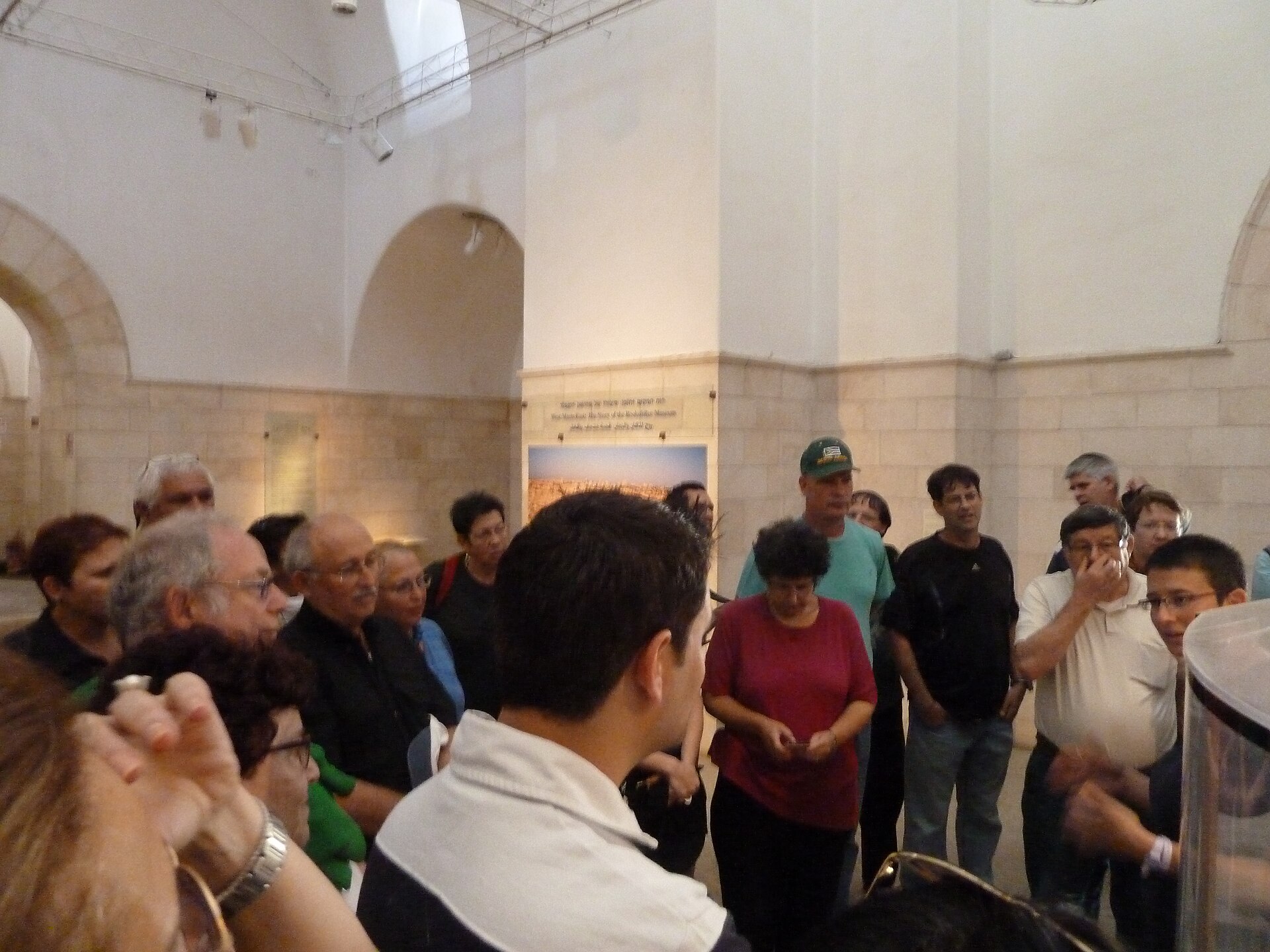
The Rockefeller closed to the general public in the second half of 2023; the Israel Antiquities Authority relocated its headquarters staff out of the building around the same time, and the war that began that October kept the site shut for what the museum's own current tour listing calls nearly two years. It reopened in July 2025, but not to walk-in visitors. Access today is by a paid, guided tour only, organized by the Tower of David Museum together with the Israel Antiquities Authority and the Israel Museum; there is no public entrance in use and no parking at the site itself. Visitors instead meet a shuttle at the Nahal Tsofim car park beside the Givat Hamivtar light-rail stop, are driven to the museum and back on a fixed schedule, and are told plainly by the organizers that arriving independently, on foot or by private car, will not get them in.
A Tripadvisor review written in October 2025, after the reopening, is candid about what that visit now shows: the guide told the reviewer's group that the display is limited because the exhibits collected decades ago are, in places, no longer in position, and that funding for the museum's own maintenance has lapsed, so the current display cannot represent the full archaeological record the collection holds. The building's future is, as of this writing, genuinely undecided. Haaretz reported in September 2025 that an interministerial committee was weighing competing plans for the site, ranging from continued heritage use under the Tower of David or the Antiquities Authority to conversion into a hotel, and that Elad, a settler organization active at archaeological sites across East Jerusalem, has also been named as a possible operator; the Israeli heritage watchdog Emek Shaveh has publicly opposed handing the building to Elad.
The building itself
Harrison designed the Rockefeller as a hexagon built around two diagonal wings, one holding the library and reading room, the other an auditorium, so the plan reads clearly from the air or from the entrance path alike. The exterior is faced in pale Jerusalem limestone and combines round-arched Mediterranean forms with Islamic geometric ornament and Turkish walnut doors, a deliberate mixing of regional traditions rather than a European style dropped onto a Jerusalem hillside. At the centre sits Harrison's courtyard, an arcaded space built around a sunken reflecting pool and lined with Armenian ceramic tiles whose blue and green glazes echo the courts of the Alhambra in Granada, a comparison visitors and critics have drawn since the building opened. An ancient pine tree stood in what became the rear courtyard for close to three hundred years, tied by local Arab legend to the scribe Ezra, until it died in 1998.
What visitors say
Across more than a decade of visitor reviews the same two things recur: the building itself, especially Harrison's tiled inner courtyard, is consistently called the best part of the visit, and the collection is praised as a manageable, well-labelled walk through the whole span of the region's archaeology rather than an overwhelming one. Since the July 2025 reopening as a guided, shuttle-only tour, reviewers have added a third, more mixed note: the visit is no longer free or self-paced, and the guides themselves tell visitors that reduced maintenance funding means only part of the historic collection is currently on view.
What is praised, what is criticised
- Praised: the hexagonal Mandate-era building itself and Harrison's Armenian-tiled inner courtyard, named in review after review as the best part of the visit
- Praised: trilingual (English, Hebrew and Arabic) object labels and a collection organized so that the whole span from the Stone Age to the Ottoman period can be seen in under an hour without feeling exhausting
- Criticised: display cases, lighting and signage that multiple reviewers call outdated, with some cases poorly lit or, in places, missing individual object labels entirely
- Criticised: since the July 2025 reopening, a mandatory paid guided tour reachable only by organized shuttle, replacing what had previously been a free, self-paced walk-in visit, with guides telling visitors the display is reduced from what the collection used to show because maintenance funding lapsed during the closure
Ratings on other platforms
Tripadvisor: 4.2 from 129 ratings, read 27 September 2026
A platform average is a tertiary source: it moves, it is not audited, and we quote no visitor's words.
Questions about Rockefeller Museum
Where is Rockefeller Museum?
27 Sultan Suleiman Street, Jerusalem, Israel.
How much does it cost to visit?
Guided tour, adult (includes shuttle and museum entry): ILS 110; Guided tour, senior citizen: ILS 100. As confirmed 27 September 2026.
When is it open?
Hebrew-language tour: Thursdays 10:00-13:00; Hebrew-language tour: Fridays 09:30-12:30; English-language tour: fixed calendar dates only 09:30-12:30; Independent or walk-in visit closed. As confirmed 27 September 2026.
How do you get there?
Shuttle (mandatory): The only way in under the current visiting model. Tour-goers meet a dedicated shuttle at the Nahal Tsofim car park beside the Givat Hamivtar light-rail stop and are driven to the museum and back on the tour's own fixed schedule. The organizers state plainly that arriving on foot or by private car will not get a visitor in, and that there is no parking at the site itself; Light rail: The Jerusalem Light Rail's Givat Hamivtar stop is the shuttle's own meeting point and is the organizers' recommended way to reach the car park by public transport; City bus (pre-closure): A Tripadvisor review from 2019 records city bus route 1, which circles the Old City walls, stopping close to the museum entrance. That route is not usable to enter the museum itself under the current shuttle-only tour arrangement.
What should you see first?
Pre-Pottery Neolithic statue from Jericho (Unknown, Pre-Pottery Neolithic B culture); Colossal statue of Ramesses III, from Beth Shean (Egyptian, New Kingdom); Stucco decoration from Hisham's Palace, Khirbat al-Mafjar (Umayyad workshop, 8th century); Carved wooden ceiling panels from the Al-Aqsa Mosque (Umayyad workshop, 8th century); Crusader marble lintels from the Church of the Holy Sepulchre (Crusader workshop, 12th century); A Lachish letter (ostracon) (Unknown scribe, Kingdom of Judah, c. 588-586 BCE).
What we could not confirm
- Whether the Tower of David-organized guided tour becomes permanent public access to the Rockefeller or is a stopgap ahead of the interministerial committee's decision on the building's future.
- Whether the building's pre-1930 ownership by the al-Khalili family will ever be acknowledged in the museum's own displays.
- What, precisely, has changed in the physical display since the pre-2023 closure; the current tour's own guides describe a reduced collection but no published inventory compares before and after.
Images
Sources
- 1Wikipedia, 'Rockefeller Archeological Museum', fetched 2026-09-27. en.wikipedia.org/wiki/Rockefeller_Archeological_Museum
- 2Wikidata, item Q1430185 (Rockefeller Museum), fetched 2026-09-27. wikidata.org/wiki/Q1430185
- 3Tower of David Jerusalem Museum, 'Treasures of the Rockefeller - in English' tour listing, fetched 2026-09-27. tod.org.il/en/event/treasures-of-the-rockefeller-in-en/
- 4Tower of David Jerusalem Museum, 'Treasures of the Rockefeller' (Hebrew-language tour) listing, fetched 2026-09-27. tod.org.il/en/event/architecture-and-archaeology-tour-at-the-rockefeller-museum/
- 5The Times of Israel, 'Jerusalem's cursed antiquity museum reopens its doors amid rumors it may become a hotel', fetched 2026-09-27. timesofisrael.com/jerusalems-cursed-antiquity-museum-reopens-its-doors-amid-rumors-it-may-become-a-hotel/
- 6Haaretz Magazine, 'Jerusalem's Rockefeller Museum: A Cultural Powerhouse Facing an Uncertain Future', 2025-09-21, fetched 2026-09-27. haaretz.com/magazine/2025-09-21/ty-article-magazine/.premium/jerusalems-rockefeller-museum-a-cultural-powerhouse-facing-an-uncertain-future/00000199-5301-dc75-a1d9-574d13750000
- 7Jerusalem Story, 'How Will Israel Renovate Rockefeller Museum of Antiquities?', fetched 2026-09-27. jerusalemstory.com/en/blog/israel-renovate-rockefeller-museum-will-its-palestinian-history-finally-be-acknowledged
- 8Bein Harim Tours, 'Rockefeller Archaeological Museum - Jerusalem', fetched 2026-09-27. beinharimtours.com/rockefeller-archaeological-museum/
- 9The Jerusalem Post, 'A Jerusalem gem: Rediscovering the Rockefeller Museum's treasures in Israel's capital', fetched 2026-09-27. jpost.com/israel-news/culture/article-887122
- 10Tripadvisor, 'Rockefeller Archeological Museum' attraction page (rating, review count and visitor reviews read in full), fetched 2026-09-27. tripadvisor.com/Attraction_Review-g293983-d320844-Reviews-Rockefeller_Archeological_Museum-Jerusalem_Jerusalem_District.html
- 11iTravelJerusalem, 'Rockefeller Archaeological Museum', fetched 2026-09-27. itraveljerusalem.com/attraction/rockefeller-archaeological-museum
- 12Enjoying Israel, 'Rockefeller Archaeological Museum', fetched 2026-09-27. enjoyingisrael.com/attractions/5704/rockefeller-archaeological-museum