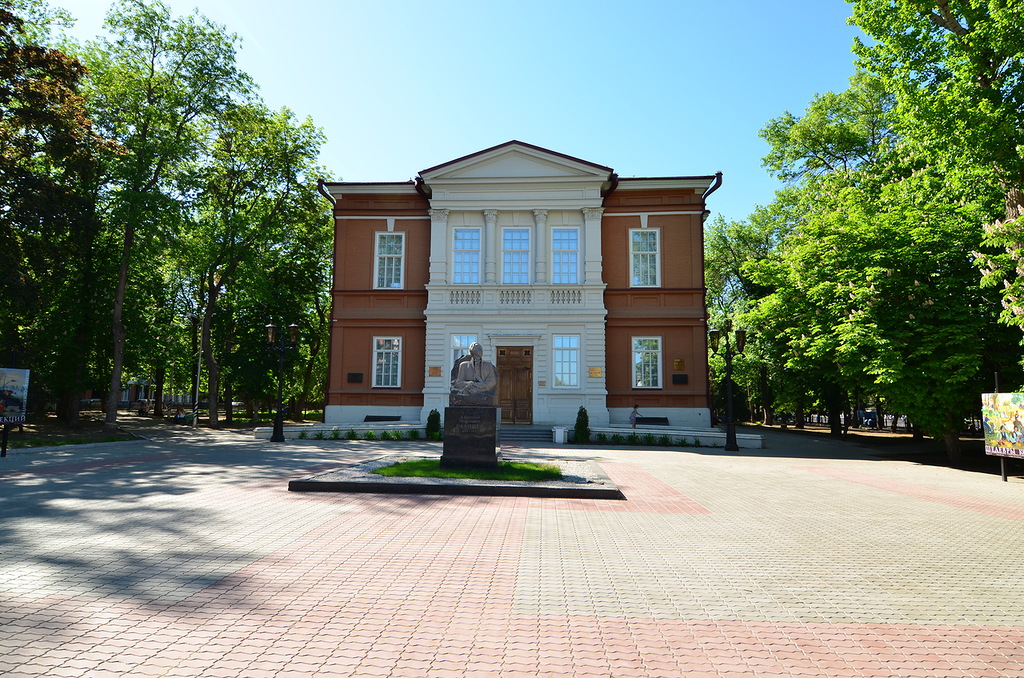
The two-storey red and white historic building of the Radishchev Museum at ul. Radishcheva 39, seen from the square with the Radishchev bust in front of it. Photograph by TrustedExpert, 2012, CC BY-SA 3.0.
TrustedExpert, CC BY-SA 3.0, via Wikimedia CommonsRadishchev Art Museum
Museum · Saratov State Art Museum named after A. N. Radishchev · Founded 1885
Open, admission and hours confirmed 20 November 2026 · 21 sources
On this page 15 sections
ContentsClose
The collection's strength is range under one roof in a provincial city: the early Hermitage and Academy gift, Bogolyubov's French and German landscape painting, the Galkin-Vraskoy bequest, Soviet-era transfers from the Tretyakov Gallery and the Russian Museum, and a body of Russian avant-garde and Saratov painters tied to the branches in the region.
| Local name | Saratov State Art Museum named after A. N. Radishchev |
|---|---|
| Kind | Museum |
| Founded | 29 June 1885 (Old Style) |
| City and country |  Saratov, Russia |
| Address | ul. Radishcheva 39, Saratov, Russia (historic building; further buildings at Radishcheva 41 and Pervomayskaya 75) |
| Website | radmuseumart.ru |
| Status | Open, confirmed |
| Record last verified |
Visiting
- Hours
- Tue, Wed, Sat, Sun10:00 to 18:00Ticket desk break 13:00-13:35; last entry one hour before closing
- Thu, Fri12:00 to 20:00Ticket desk break 15:00-15:35; last entry one hour before closing
- Closed
- Closed Mondays. Sanitary day on the last Tuesday of each month, which the museum says may be moved. Holiday hours are set by order of the director and not listed on the hours page.
- Admission
- Full, permanent exhibitionRUB 270Radishcheva 39, 41 and Pervomayskaya 75
- Reduced, permanent exhibitionRUB 160Russian citizens with documents: pupils aged 7 to 18, students and pensioners
- Free categoryFreeCitizens of the Russian Federation and the Eurasian Economic Union in the categories on the museum's list, including everyone under 18
- Guided tour of the permanent exhibition, mixed groupRUB 350250 rubles for reduced and free categories; needs an entry ticket. Temporary exhibitions are priced case by case by order of the director; the Chagall show is announced at 400 to 600 rubles
Free entry: First Wednesday of the month: students enter the permanent exhibition free with a student card. Under 18 and preschool children: free entry to the permanent exhibition with a birth certificate (guided tours not included)- Tickets
- radmuseumart.tn-cloud.ru The museum's own ticket page.
- Do I need to book?
- No booking rule is stated in the pages read; tickets can be bought online through the museum's ticket site and the rules ask visitors to print or save them because mobile internet may be limited
- Address
- ul. Radishcheva 39, Saratov, Russia (historic building; further buildings at Radishcheva 41 and Pervomayskaya 75) MapTrolleybus and bus From the railway station the museum names trolleybus 1 or bus 284; from other districts trolleybus 5 or buses 11 and 33; get off at the stop Radishcheva
- Website
- radmuseumart.ru
- Telephone
- +7 8452 26-28-55
- [email protected]
Before you go how long, access, photography, bags, eating, shop
- How long to allow
- The museum does not state a visit length on the pages we read
- Access
- The museum links an accessible-environment page and a version of the site for visually impaired visitors; the rules admit guide dogs and wheelchairs. We did not read details of step-free access
- Photography
- Amateur photography without flash or tripods, except beside objects marked no photography; photography and filming are forbidden in temporary exhibition halls
- Bags
- Coats go to the cloakroom (same hours as the museum) and items above 30 by 40 by 15 cm, umbrellas, tripods and bottled liquids to the cloakroom or lockers; metal-detector line at entry; shoe covers expected
- Eating
- Not mentioned in the pages we read
- Shop
- Not mentioned in the pages we read
Prices and hours change. We take them from the institution's own pages and print the day we read them, and you can check the current position at the source we used. Confirm before you travel.
What is inside
Old Russian and religious art, ground floor
A separate hall of thirteenth to eighteenth century icons and religious objects, with a Muromsky iconostasis and a twelfth century enkolpion cross. The museum's collection pages also list Russian religious art of the eighteenth to early twentieth century in painting, watercolour, engraving, tempera, applied art, silver and sculpture.
Western European art, ground floor
A suite of five halls arranged by country: Italy as the largest, then Holland, Flanders and France with porcelain, ending in a small hall of Barbizon school works. Named holdings include Vasari's Triumph of Bacchus, Castiglione, Lanfranco, Ricci, Corot, Daubigny, Troyon and Monticelli.
Memorial halls for Bogolyubov
Three rooms on the founder and the artists and supporters around him; the museum's Bogolyubov graphics collection is listed separately in its catalogue pages.
Russian art, second floor
A ring of rooms around the central staircase covering the eighteenth century, the first and second halves of the nineteenth century and the turn of the twentieth, with a separate Art Nouveau hall.
Radishcheva 41 (former stock exchange)
Rotating exhibitions and studio rooms for children's classes; currently the Chagall exhibition Under One Sky.
Pervomayskaya 75 (former women's gymnasium)
Rotating exhibitions from the museum, other museums, private collections and contemporary artists, in the part of the building that is open; part has been closed for restoration since 2008.
What to see first
Triumph of Bacchus
Giorgio VasariTransferred from the Hermitage in 1885 at Bogolyubov's request according to Russian Wikipedia, and named by the museum as a key Italian work; Vokrug Sveta says later research reattributed it to Vasari.15
Madonna with Child and Angels (tondo)
Pietro Perugino, as named by Vokrug SvetaOne of the three European works the 2006 Vokrug Sveta article singles out; we found no museum page naming it, so treat the attribution as that article's.17
Chateau de Pierrefonds
Camille Corot, as named by Vokrug SvetaDescribed in the same article as a standout of the French holdings that grew from Bogolyubov's gift of Barbizon-circle painting.17
The Galkin-Vraskoy bequest
Mikhail Galkin-Vraskoy, collectorReconstructed from about 133 inventory numbers after losses; it includes a Lampi portrait of Catherine II, a Vernet harbour, an early Aivazovsky and a van Goyen landscape.9
The Muromsky iconostasis and the enkolpion cross
Old Russian workshops; the cross is dated to the twelfth centuryAnchors the ground-floor hall of Old Russian art in the permanent exhibition.10
The Russian avant-garde holdings
Malevich, Tatlin, Exter, Rozanova, Kandinsky, Chagall and othersThe museum's own page lists 33 artists and 14 groups; it is one of the museum's named collection areas, though not every work is on view at any time.19
Happy Dream
Salvatore AlbanoA marble statue the museum names in the Italian section beside sixteenth century wedding chests and Neapolitan porcelain.8
Marc Chagall: Under One Sky
Marc Chagall, lent by the Bashmakov Gallery111 graphic works from his years abroad, including illustrations for Dead Souls and the Bible, on view at Radishcheva 41 until 17 February 2027.11
A museum founded by a painter living in Paris
The Saratov State Art Museum named after A. N. Radishchev opened on 29 June 1885 (Old Style) on Theatre Square in Saratov, on the Volga. The museum calls itself the first publicly accessible museum in a Russian provincial city, and English Wikipedia adds that it opened seven years before the Tretyakov Gallery and fifteen before the Russian Museum. Admission was meant to be free from the start, and the museum reports that it had 62,000 visitors in its first year.
The founder was Alexei Bogolyubov (1824-1896), a marine and landscape painter who studied at the Naval Corps and the Academy of Arts and from 1873 lived for almost a quarter of a century in Paris. He was the grandson of the writer Alexander Radishchev. The museum says the idea of a museum in his native Saratov came to him in the 1850s and that he decided to give the city his own collection. Russian Wikipedia dates his formal offer to 1877. The city was slow to supply a building: by the museum's account, official inertia delayed the matter by eight years, and construction on Theatre Square did not begin until May 1883.
The name was itself contested. Radishchev was remembered as a political dissident, and the museum's page on Bogolyubov says that court circles objected to a museum carrying a revolutionary's name and that obtaining the highest permission for it was not easy. English Wikipedia describes the choice as a direct challenge to the authorities and says Bogolyubov had to fight a legal battle for it. Emperor Alexander III approved the building design and gave paintings, and K. P. Pobedonostsev helped organise the project, according to Russian Wikipedia.
Bogolyubov did not live to see the second half of his plan. He founded a drawing school to stand beside the museum as its teaching arm, and in his will he left the museum and the school all his property and a capital of 200,000 rubles. The school opened in February 1897, after his death in 1896.
The building on Theatre Square
The historic building at ul. Radishcheva 39 was designed by the St. Petersburg architect I. V. Shtrom, with A. M. Salko supervising construction, and was built between 1883 and 1885. It is a two-storey stone building and a federal heritage site. The museum gives its total area as 2,790 square metres, of which 1,400 are exhibition space. The permanent exhibition page notes that Shtrom also designed some of the display cases, several of which are still in use, and that the halls now have a new hanging system, new lighting and cases styled after nineteenth century ones.
The building has been through a long structural repair. In an August 2006 article in Vokrug Sveta, the art historian Sergei Khachaturov described a restoration begun in 2000 that worked from the top down, with concrete slabs and a new foundation slab, largely by hand. It had been planned to finish in 2005 and was still under way. While it lasted, much of the collection was in storage and part of the display was housed in the former women's gymnasium across the square. The museum's own account of the building does not list a restoration, and the date the work ended is not stated in the pages we read. What is documented is the result: a permanent exhibition in the historic building that the museum dates from 25 April 2013.
On 5 April 2012 the building's Grand Hall hosted a round table in which Prime Minister Vladimir Putin met directors of major Russian museums, an event the museum's history page records and which Russian Wikipedia says included a tour of the storage rooms. Since 1998 the museum has been on the state register of particularly valuable objects of the cultural heritage of the peoples of the Russian Federation, listed by presidential decree no. 30 of 15 January 1998, as the museum's own visitor rules state.
From provincial gift to Soviet museum
Early growth came from state museums. According to Russian Wikipedia, the Hermitage transferred Vasari's Triumph of Bacchus and a John the Baptist by Rombouts in 1885 at Bogolyubov's request, and works also came from the Academy of Arts. By 1917 the museum held 6,738 art objects and a library of about 4,000 volumes. A critic writing in 1918 judged that it lacked a clear identity and compared it to an old woman's chest of mixed keepsakes, a line that Russian Wikipedia preserves and that fairly describes how a gift-built collection reads.
The Soviet decade brought both enlargement and loss. Acquisitions in 1926-1928 came from the Tretyakov Gallery, the Otradino estate, the Russian Museum and Leningrad funds, which made the museum by the late 1920s one of the country's largest holdings of Russian and Western European art. The directors of the period fared unevenly. Alexei Skaldin led the museum until 1923. Vadim Butenko (1877-1931) led it until 1928, was arrested in 1930 in the so-called Academic Affair and died while working on the White Sea-Baltic canal, according to Russian Wikipedia. Two staff members, K. I. Rudolfi and K. N. Papa-Afanasopulo, were dismissed in 1931.
The Galkin-Vraskoy bequest shows how fragile a collection's paperwork can be. Mikhail Galkin-Vraskoy (1834-1916), a former Saratov governor, left his collection to the museum, and it arrived in Saratov on 21 May 1916. Between 1920 and 1933 many of its objects were transferred to other museums and institutions: the paintings fell from 30 to 17 and the sculptures from 14 to 5, and some objects are now of unknown location. The first page of the inventory book naming the donor went missing, and the staff reconstructed the collection from letters, lists and a copy of the will, publishing a reconstructed catalogue for the centenary of his death in 2016.
Later markers are few in the sources read. The museum was awarded the Order of the Red Banner of Labour in 1985, and works from it were shown in Duisburg in 1980. Tamara Grodskova directed it in 1977-1987 and again in 1999-2016. The museum's own history page says development was neglected in the 1990s and that a new stage began with the twenty-first century.
What the collection holds
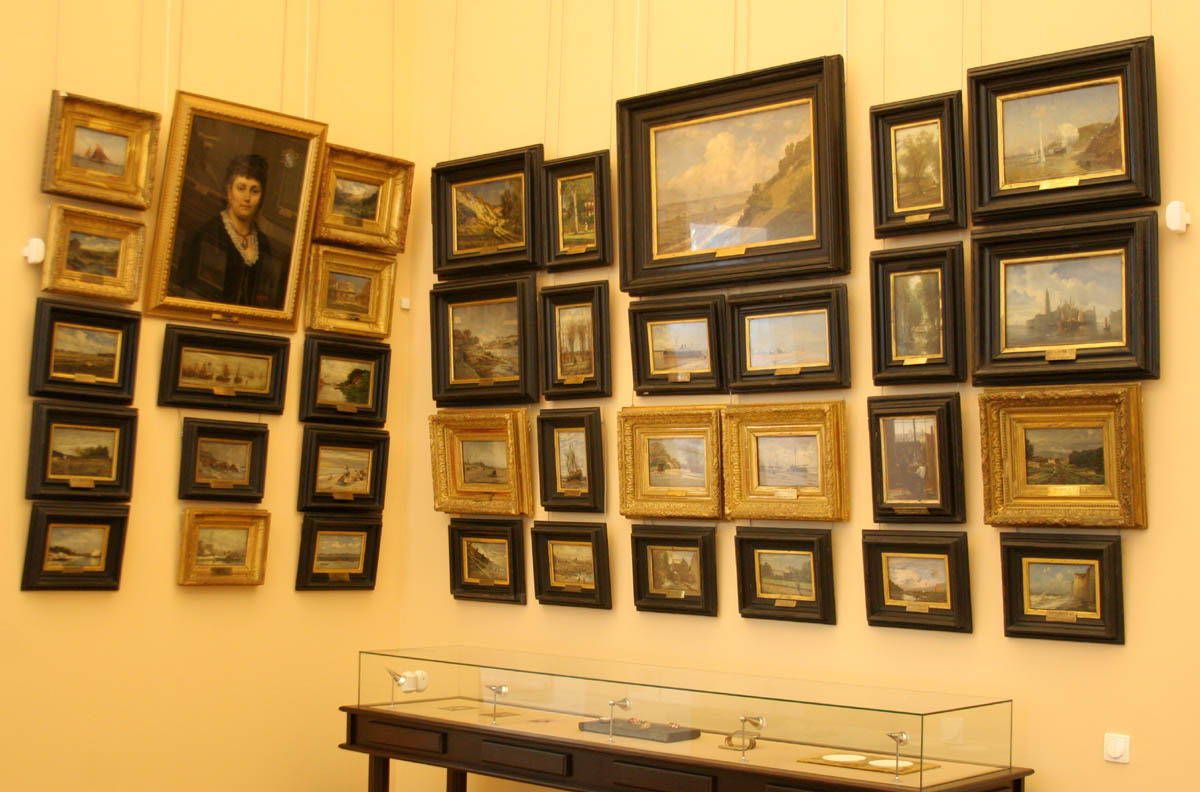
The museum states that it holds more than 30,000 storage units, while some reference works give about 34,000, and the permanent exhibition shows more than 1,500 objects. The display is organised on two floors. On the ground floor a separate hall covers Old Russian and religious art of the thirteenth to eighteenth centuries, with icons, a Muromsky iconostasis and a twelfth century enkolpion cross. A suite of five halls then covers Western European art from the fifteenth to the middle of the nineteenth century, arranged by country: Italy as the largest, then Holland, Flanders and France with porcelain, and a small last hall of Barbizon school works. Three memorial halls are devoted to Bogolyubov and the artists and supporters around him.
The Western collection rests on two foundations. One was the gift selected in 1885: about 30 Old Master paintings with sculpture and applied art chosen from the Hermitage and the Academy of Arts, which the museum calls still very important. The other was Bogolyubov's own gift of contemporary European painting, landscapes by the Dusseldorf painters Andreas and Oswald Achenbach and works by French artists close to the Barbizon school, among them Corot, Daubigny, Troyon and Monticelli. Russian Wikipedia claims that this makes the museum's nineteenth century Western painting the third most important in Russia after the Hermitage and the Pushkin Museum; that is a Wikipedia assertion we have not been able to check against a museum or independent source. The Italian section names Vasari's Triumph of Bacchus, Castiglione's Creation of the World, Lanfranco's Repentance of the Apostle Peter and a Marco Ricci landscape, with a marble Happy Dream by Salvatore Albano and sixteenth century wedding chests. The Dutch works are mostly small seventeenth century pictures on oak panel covering nearly every genre except mythology, and the Flemish ones are larger and Baroque.
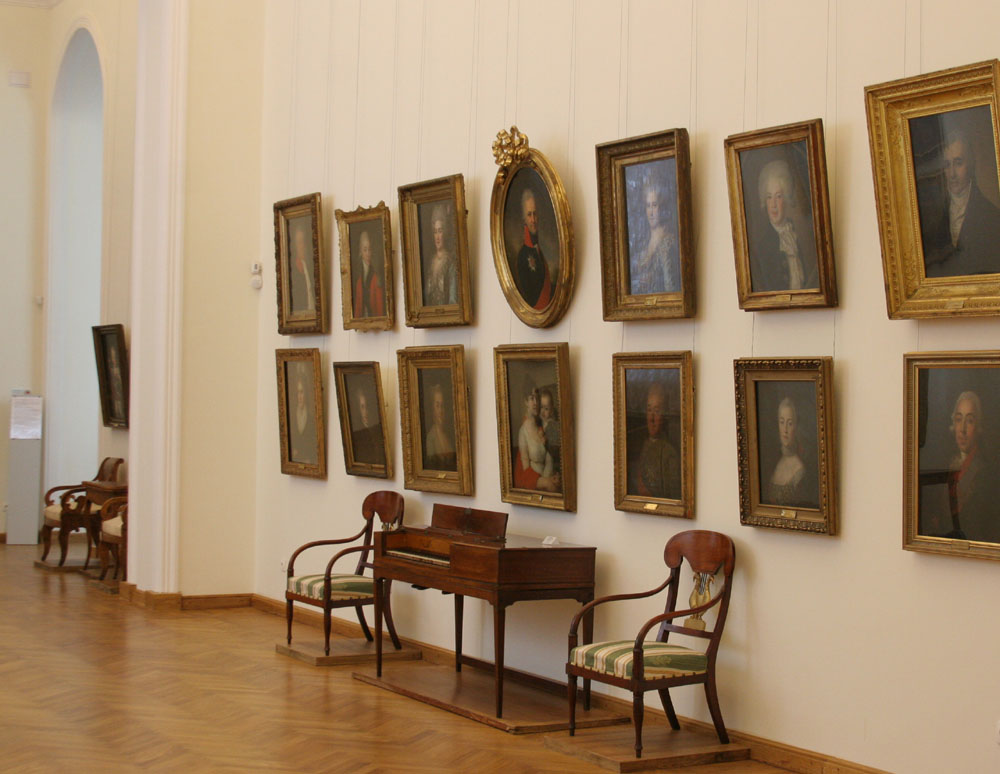
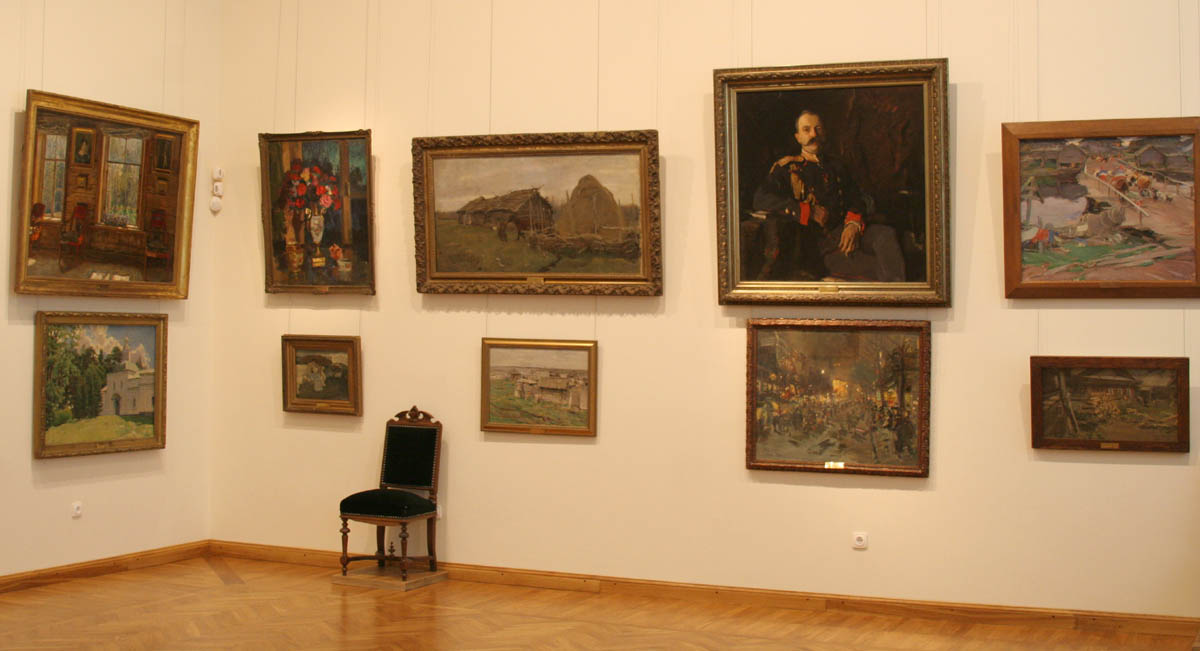
A ring of rooms around the central staircase on the second floor covers Russian art from the eighteenth century to the turn of the twentieth, with a separate Art Nouveau hall. The museum's collection pages list Rokotov, Levitsky and Borovikovsky for the eighteenth century, Tropinin, Kiprensky and Bryullov for the first half of the nineteenth, and Repin, Polenov, Shishkin, Kuindzhi, Surikov and Levitan among the Peredvizhniki. The avant-garde pages list 33 artists, including Malevich, Tatlin, Exter, Rozanova, Stepanova, Kandinsky, Chagall, Lentulov, Falk and Konchalovsky, and fourteen groups from the Jack of Diamonds to the Society of Easel Painters, together with a section on the Saratov avant-garde. The page itself carries no work counts or acquisition notes, so a visitor should not assume all of it hangs at any one time; in the 2006 Vokrug Sveta account the symbolist and avant-garde works were in storage during the restoration.
Three buildings in Saratov and five branches
The museum is not one address. Besides the historic building at Radishcheva 39 there is the former stock exchange at Radishcheva 41, built in 1889-1890 to a design by F. I. Shuster and completed in 1904 by A. M. Salko. It passed to the museum in 2016-2017, has 1,593 square metres and now hosts rotating exhibitions and children's studios. The third building is the former women's gymnasium at Pervomayskaya 75, built in 1914-1915, a federal heritage site transferred to the museum in 1992, with 5,262 square metres. The museum says that part of it has been closed for restoration since 2008 and that the open part shows rotating exhibitions from its own and other collections and from private collectors and contemporary artists.
Five branches extend the museum beyond the centre. The Borisov-Musatov estate museum at Volskaya 33 and the Pavel Kuznetsov house museum at Oktyabrskaya 56, both in Saratov, were opened as museum units in 2000 and mostly host temporary shows. The Balakovo Art Gallery has been a branch since 1977, and the Petrov-Vodkin memorial museum and picture gallery in Khvalynsk and the Engels Picture Gallery joined in late 2002. The Engels gallery's permanent show, Masterpieces of Russian Art of the Twentieth Century, includes Lentulov, Falk, Konchalovsky and Mashkov. Each branch has its own hours and price sheet.
Current programming shows how the three buildings divide the work. As of the pages read on 20 November 2026, the historic building holds Fleet Must Be!, a joint project with the Central Naval Museum in St. Petersburg running from 6 September 2026 to 14 March 2027 with marine paintings by Aivazovsky and Bogolyubov. Radishcheva 41 holds Marc Chagall: Under One Sky, 111 graphic works from his years abroad lent by the Bashmakov Gallery in St. Petersburg, from 17 October 2026 to 17 February 2027, at 400 to 600 rubles. The Borisov-Musatov estate shows Eugene Ciceri's landscape prints from 20 October to 6 December 2026 and the Kuznetsov house shows Alexei Arapov's Dawn from 23 October to 13 December 2026.
Planning a visit
The museum is closed on Mondays. At the Saratov buildings it is open Tuesday, Wednesday, Saturday and Sunday from 10:00 to 18:00 and Thursday and Friday from 12:00 to 20:00, with the ticket desk closing one hour before the museum and a short desk break around the middle of the day. The last Tuesday of each month is a sanitary day, which the museum says may be moved with notice on its site and social media. Entry to the permanent exhibition costs 270 rubles at the full rate and 160 rubles at the reduced rate, with a free category. These are the figures on the museum's current price list and they differ from the 100 to 200 rubles still printed on the permanent exhibition's own listing page, so trust the price list. Temporary exhibitions are priced case by case by order of the director. A guided tour of the permanent exhibition in a mixed group costs 350 rubles, or 250 for reduced and free categories.
Foreign visitors should read the small print. The reduced rate applies to citizens of the Russian Federation showing documents, for pupils aged 7 to 18, students and pensioners. The free categories on the museum's list apply to citizens of the Russian Federation and the Eurasian Economic Union. The price list does not say that any other nationality qualifies for either, so a visitor from elsewhere should expect to pay the full rate. Children under 18 and preschool children enter the permanent exhibition free with a birth certificate, and students enter free on the first Wednesday of each month.
The rules ask visitors to leave coats in the cloakroom, whose hours match the museum's, and to use shoe covers. Bags above 30 by 40 by 15 centimetres, umbrellas, tripods and bottled liquids go to the cloakroom or the lockers, and visitors pass a metal-detector line to enter. Amateur photography is allowed without flash or tripods, except beside objects marked with a no-photography sign, and the rules forbid photography and filming in temporary exhibition halls. Audio guide devices are allowed on the displays. From the railway station the museum recommends trolleybus 1 or bus 284 to the stop Radishcheva.
What visitors and critics say
Public ratings are high and thin. Wanderlog, which relays them, lists the museum at 4.8 from 714 reviews on Google and 4.8 from 195 on Tripadvisor as read on 20 November 2026. We did not fetch those platforms directly, so the figures are second-hand and tertiary. Yandex Maps and a Tripadvisor page could not be opened by our tools, and a Russian-language catalogue page we found had too few reviews to give a score.
Criticism that survives in printed form is mostly about what visitors cannot see. Khachaturov's 2006 article in Vokrug Sveta praised the museum's centrepieces, naming Vasari's Triumph of Bacchus, which he says was reattributed to the artist after later research, Corot's Chateau de Pierrefonds and a Perugino tondo, and the Kuznetsov holdings, but dwelt on a restoration that had overrun its 2005 target, a collection mostly in storage, and a Borisov-Musatov house with few exhibits. That is twenty years old, and the museum now dates a permanent exhibition in the main building from 2013. The museum's own statement that part of Pervomayskaya 75 has been closed for restoration since 2008 suggests that the building problem has not entirely gone away.
Two smaller frictions are visible in the museum's own papers. The permanent exhibition's page still quotes ticket prices well below the current list, and the foreigner's position on discounts is nowhere stated in plain terms. The museum's own text accepts, in its history page, that the 1990s were a period of neglect. Beyond those the sources we could read are silent, and we will not invent a consensus from review sites we did not read.
What visitors say
Visitors rate the museum very high on the aggregates we could reach, but the sources we could read say little about what individual visitors praise. The documented complaints are structural: a long restoration of the historic building, part of a second building closed since 2008, much of the collection in storage in 2006, and price and eligibility information that is inconsistent between pages.
What is praised, what is criticised
- Praised: The collection's range from Old Russian icons through Italian and Dutch painting to the Russian avant-garde, as named in the museum's pages and in Vokrug Sveta
- Praised: A historic building designed to hold the collection, whose halls the museum says have new hanging, lighting and period-style display cases
- Praised: Rotating exhibitions in the other buildings, such as the 2026 Chagall graphics show
- Criticised: Vokrug Sveta in 2006: the restoration overran its 2005 target and most of the collection, including the avant-garde, was in storage
- Criticised: The museum's own statement that part of the Pervomayskaya 75 building has been closed for restoration since 2008
- Criticised: The permanent exhibition's page quotes 100 to 200 rubles while the current price list says 270 rubles at the full rate, and the price list does not say whether reduced or free rates apply to visitors outside Russia and the Eurasian Economic Union
Ratings on other platforms
Google, relayed by Wanderlog: 4.8 from 714 ratings, read 20 November 2026
Tripadvisor, relayed by Wanderlog: 4.8 from 195 ratings, read 20 November 2026
A platform average is a tertiary source: it moves, it is not audited, and we quote no visitor's words.
Questions about Radishchev Art Museum
Where is Radishchev Art Museum?
ul. Radishcheva 39, Saratov, Russia (historic building; further buildings at Radishcheva 41 and Pervomayskaya 75).
How much does it cost to visit?
Full, permanent exhibition: RUB 270; Reduced, permanent exhibition: RUB 160; Free category: free; Guided tour of the permanent exhibition, mixed group: RUB 350. As confirmed 20 November 2026.
When is it open?
Tue, Wed, Sat, Sun 10:00-18:00; Thu, Fri 12:00-20:00. Closed: Closed Mondays. Sanitary day on the last Tuesday of each month, which the museum says may be moved. As confirmed 20 November 2026.
How do you get there?
Trolleybus and bus: From the railway station the museum names trolleybus 1 or bus 284; from other districts trolleybus 5 or buses 11 and 33; get off at the stop Radishcheva.
What should you see first?
Triumph of Bacchus (Giorgio Vasari); Madonna with Child and Angels (tondo) (Pietro Perugino, as named by Vokrug Sveta); Chateau de Pierrefonds (Camille Corot, as named by Vokrug Sveta); The Galkin-Vraskoy bequest (Mikhail Galkin-Vraskoy, collector); The Muromsky iconostasis and the enkolpion cross (Old Russian workshops; the cross is dated to the twelfth century); The Russian avant-garde holdings (Malevich, Tatlin, Exter, Rozanova, Kandinsky, Chagall and others).
What we could not confirm
- When the restoration of the closed part of Pervomayskaya 75 will be finished, and what the museum plans to show there
- Whether the permanent exhibition, listed by the museum to 31 December 2026, will be extended, rehung or replaced after that date
- Whether the Vasari attribution and the Perugino tondo are described on a museum page; we found them only in a 2006 magazine article and Wikipedia
- When the restoration of the main building ended, which the museum does not state in the pages we read
- The Yandex Maps and Tripadvisor scores read directly, which our tools could not open
Images
Sources
- 1Saratov Radishchev Museum, opening hours and location page, read 2026-11-20 radmuseumart.ru/visitors/opening-hours/
- 2Saratov Radishchev Museum, tickets page, read 2026-11-20 radmuseumart.ru/visitors/tickets/
- 3Saratov Radishchev Museum, official price list for Radishcheva 39, 41 and Pervomayskaya 75 (PDF), read 2026-11-20 radmuseumart.ru/visitors/tickets/PDF/%D0%A0%D0%B0%D0%B4%D0%B8%D1%89%D0%B5%D0%B2%D0%B0,%2039,%2041,%20%D0%9F%D0%B5%D1%80%D0%B2%D0%BE%D0%BC%D0%B0%D0%B9%D1%81%D0%BA%D0%B0%D1%8F%2075.pdf
- 4Saratov Radishchev Museum, visitor information page (phones, email, buses), read 2026-11-20 radmuseumart.ru/visitors/
- 5Saratov Radishchev Museum, buildings, collections and branches page, read 2026-11-20 radmuseumart.ru/museum/
- 6Saratov Radishchev Museum, history page, read 2026-11-20 radmuseumart.ru/museum/history/
- 7Saratov Radishchev Museum, page on A. P. Bogolyubov, read 2026-11-20 radmuseumart.ru/museum/bogolubov/
- 8Saratov Radishchev Museum, European art collection page, read 2026-11-20 radmuseumart.ru/collection/foreign-art/index.php
- 9Saratov Radishchev Museum, M. N. Galkin-Vraskoy collection page, read 2026-11-20 radmuseumart.ru/collection/galkin-vraskoy/
- 10Saratov Radishchev Museum, permanent exhibition 'Through the Halls of the Radishchev Museum', read 2026-11-20 radmuseumart.ru/calendar/exibitions/484/
- 11Saratov Radishchev Museum, announcement of the Chagall exhibition 'Under One Sky', read 2026-11-20 radmuseumart.ru/news/announcements/53937/
- 12Saratov Radishchev Museum, announcement of the exhibition 'Fleet Must Be!', read 2026-11-20 radmuseumart.ru/news/announcements/52692/
- 13Saratov Radishchev Museum, visitor rules 2026 (PDF, order no. 284 of 1 December 2025), read 2026-11-20 radmuseumart.ru/visitors/rules/RULES2026.pdf
- 14Saratov Radishchev Museum, list of categories admitted free (PDF), read 2026-11-20 radmuseumart.ru/visitors/tickets/PDF/24.08.2026-3.pdf
- 15Russian Wikipedia, Saratov State Art Museum named after A. N. ru.wikipedia.org/wiki/%D0%A1%D0%B0%D1%80%D0%B0%D1%82%D0%BE%D0%B2%D1%81%D0%BA%D0%B8%D0%B9_%D1%85%D1%83%D0%B4%D0%BE%D0%B6%D0%B5%D1%81%D1%82%D0%B2%D0%B5%D0%BD%D0%BD%D1%8B%D0%B9_%D0%BC%D1%83%D0%B7%D0%B5%D0%B9_%D0%B8%D0%BC%D0%B5%D0%BD%D0%B8_%D0%90._%D0%9D._%D0%A0%D0%B0%D0%B4%D0%B8%D1%89%D0%B5%D0%B2%D0%B0
- 16English Wikipedia, Radishchev Art Museum (), read 2026-11-20 en.wikipedia.org/wiki/Radishchev_Art_Museum
- 17Sergei Khachaturov, 'Plemyannik Ermitazha, Tretyakovki starshiy brat', Vokrug Sveta, 11 August 2006, read 2026-11-20 vokrugsveta.ru/vs/plemyannik-ermitazha-tretyakovki-starshii-brat-id575540/
- 18Wanderlog, Saratov attractions list (relays Google and Tripadvisor scores; ), read 2026-11-20 wanderlog.com/explore/9916/saratov
- 19Saratov Radishchev Museum, Russian avant-garde collection page, read 2026-11-20 radmuseumart.ru/avangard/
- 20Saratov Radishchev Museum, Russian religious art collection page, read 2026-11-20 radmuseumart.ru/ReligiousArt2/
- 21Wikimedia Commons, File:MuseumSaratov.jpg (licence and author), read 2026-11-20 commons.wikimedia.org/wiki/File:MuseumSaratov.jpg
