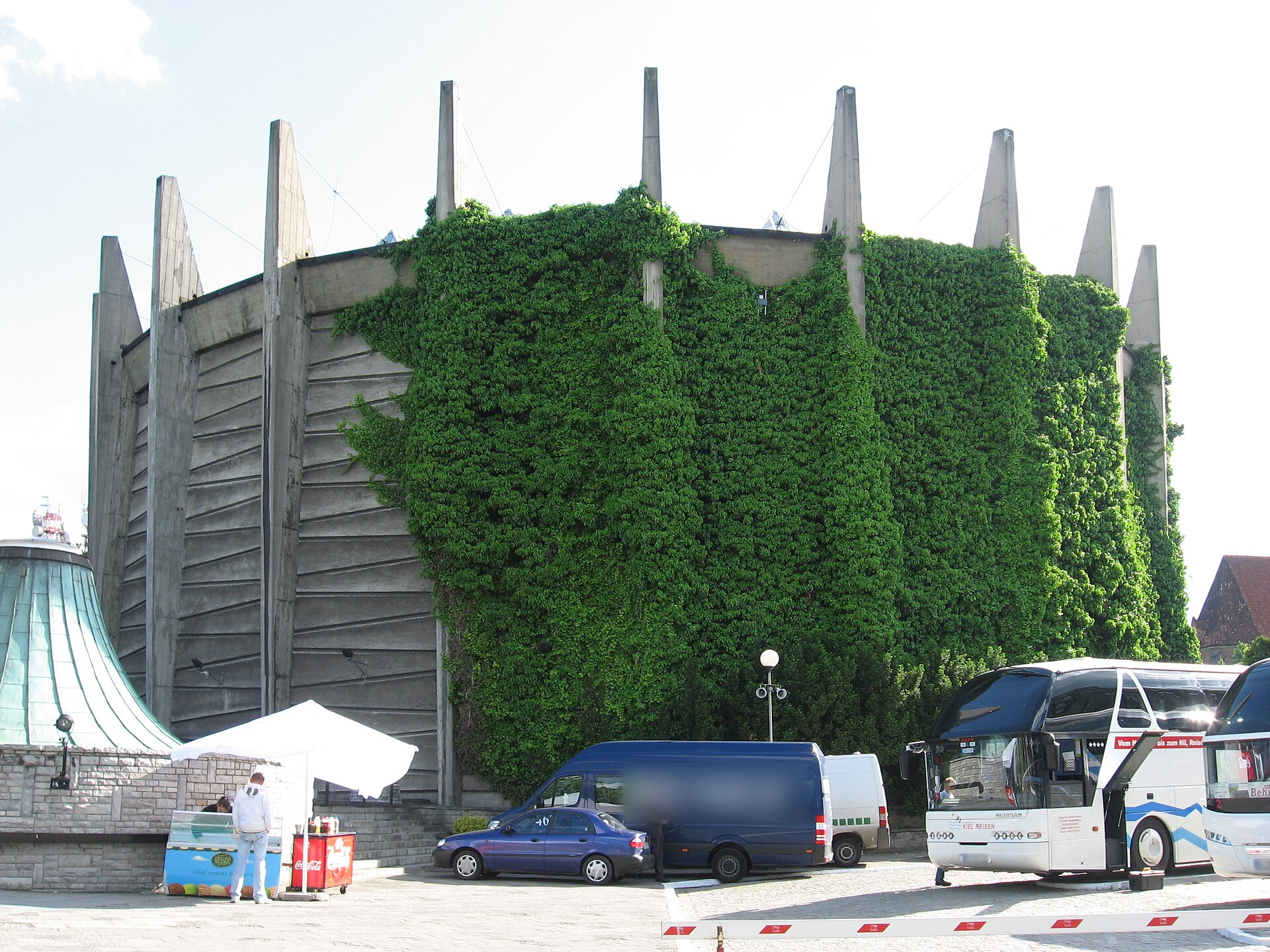
The rotunda on ulica Purkyniego in Wroclaw, built to hold the panorama after its 1946 move from Lwow and opened in 1985.
Public domainRaclawice Panorama
Museum · Panorama Raclawicka · Founded 1980
Open, admission and hours confirmed 28 September 2026 · 15 sources
On this page 15 sections
ContentsClose
The museum holds exactly one work, which is the point: Poland's oldest preserved panorama painting and one of the few 19th-century cycloramas still displayed anywhere in its intended form, in a purpose-built rotunda, with the original faux-terrain staging rather than a flattened modern reproduction. Its strength is depth on a single object rather than breadth across a collection, backed since 2021 by a proper introductory exhibition on the uprising it depicts and on how the painting itself was made, damaged, hidden and restored.
| Local name | Panorama Raclawicka |
|---|---|
| Kind | Museum |
| Founded | 1980 |
| City and country |  Wroclaw, Poland Wroclaw, Poland |
| Address | ul. J. E. Purkyniego 11, 50-155 Wroclaw, Poland |
| Website | panoramaraclawicka.pl |
| Status | Open, confirmed |
| Record last verified |
Visiting
- Hours
- Every day08:30 to 19:00Summer season, 1 April to 31 October
- Tue-Fri09:30 to 16:00Winter season, 1 November to 31 March
- Sat09:30 to 17:00Winter season
- Sun09:30 to 16:00Winter season
- Closed
- Monday, winter season only (1 November to 31 March). 1 January, 6 January, 3-5 April 2026, 31 October, 1 November, 24-26 December, 31 December.
- Admission
- RegularPLN 50Adult, single timed viewing
- DiscountPLN 35Students, pensioners, teachers and disability-benefit recipients, on documentation
- FamilyPLN 35Per person, 1-2 guardians with children aged 7-18
- School groupPLN 10Per adult in a group of 10 or more pupils
- Children under 7FreeFree
- Tickets
- bilety.mnwr.pl/?lang=en The museum's own ticket page.
- Do I need to book?
- No booking needed for individuals; timed tickets for a fixed viewing slot go on sale online, or at the desk, from seven days before the visit date until sold out. Groups of 25 or more arranging an after-hours viewing must call ahead.
- Address
- ul. J. E. Purkyniego 11, 50-155 Wroclaw, Poland MapTram Lines 2, 4, 10, 16 and 33 stop at Urzad Wojewodzki (Provincial Office), a short walk from the rotunda
Bus Line A stops at the same Urzad Wojewodzki (Provincial Office) stop - Website
- panoramaraclawicka.pl
- Telephone
- +48 71 344 16 61
- [email protected]
Before you go how long, access, photography, bags, eating, shop
- How long to allow
- The panorama session itself is a fixed 30 minutes on the central viewing platform. Touring the small rotunda's multimedia exhibition on the uprising and the painting's own history first, plus the entrance-hall shop, makes for closer to an hour in total.
- Access
- The 2021 modernisation adapted the whole building for visitors with disabilities and added commentary in Polish Sign Language alongside spoken audio-description.
- Photography
- Photography and video-filming are permitted free of charge from the viewing platform, without a tripod or flash.
- Shop
- The 2021 modernisation rebuilt the entrance hall around a new museum shop and a redesigned ticket office.
Prices and hours change. We take them from the institution's own pages and print the day we read them, and you can check the current position at the source we used. Confirm before you travel.
What is inside
Entrance hall
Ticket office and museum shop, rebuilt in the 2021 modernisation along with the building's heating, wiring and fire-safety systems and full step-free accessibility.
Small rotunda
A multimedia introduction added in 2021: spatial mapping and screens covering Tadeusz Kosciuszko, the 1794 uprising, and how the painting itself was made and later saved.
The approach
A darkened corridor and spiral stairway carry visitors up from the small rotunda to the viewing platform, withholding the painting until the group reaches the top.
Great rotunda (viewing platform)
The 360-degree canvas itself, 15 metres high and 114 metres around, seen from a central platform where painted distance meets a real foreground of soil, broken fencing and cannon carriages; four themed routes (the artistic process, historical Lwow, the panoramic circuit, and a children's route) are offered through the recorded commentary.
What to see first
Bartosz Glowacki smothering the cannon fuse
Painted principally by Jan StykaThe panorama's best-known single moment: the peasant Wojciech Bartosz, a scythe-armed volunteer from Rzedowice, presses his cap over the touch-hole of a captured Russian gun. Kosciuszko himself promoted him on the field and renamed him Glowacki; the Krakow Grenadiers, the unit formed from his fellow scythemen, take their place in Polish military memory from this scene.12
The scythemen's charge on the Russian battery
Team of eight painters under Styka and Wojciech KossakThe central action of the whole canvas: peasant volunteers armed with war-scythes overrunning a line of Russian artillery, the set piece the rotunda's circular architecture and the faux-terrain foreground both exist to sell.8
Tadeusz Kosciuszko directing the field
Jan StykaStyka painted the commander himself into the action rather than as a static portrait; it is the figure every visitor is guided to find first.7
The captured Cossack standard
Team of eight painters under Styka and Wojciech KossakA white-and-yellow Cossack banner shown falling into Polish hands, one of several smaller trophy-scenes staged around the main charge that a 30-minute circuit rewards a visitor for finding.12
General Zajaczek's line on the Polish left flank
Team of eight painters under Styka and Wojciech KossakThe painting shows more than one command post; the fighting on the left flank under Jozef Zajaczek is where the Russian force under General Tormasov is driven back, giving the whole battle its shape rather than showing a single charge in isolation.7
The faux terrain
Rotunda installation, following the original Lwow designReal soil, dried grass, broken carts and disused cannon carriages are built up from the platform's edge to the base of the canvas, blending three-dimensional objects into painted distance without a visible seam; it is the technical device that makes an 1894 cyclorama still read as immersive.8
A painting built for an anniversary, in a city that would later lose it
The Raclawice Panorama was conceived in Lwow (now Lviv, Ukraine) by the painter Jan Styka to mark the hundredth anniversary of the Battle of Raclawice, the opening engagement of the 1794 Kosciuszko Uprising against Russian rule. Styka brought in the battle-painter Wojciech Kossak and a team of eight artists in total; the canvas itself, 15 metres high and 114 metres around, was woven to order in Brussels, while the iron rotunda built to hold it in Lwow's Stryjski Park was designed by Ludwik Ramult and fabricated in Vienna. The building went up in July 1893; the painting itself, remarkably, was finished in nine months, and opened to the public on 5 June 1894 as part of Lwow's General National Exhibition.
It was an immediate popular success, drawing some 75,000 visitors a year in its first decades, and its early guest list ran to Emperor Franz Joseph I of Austria, who called it impressive, and Archduke Charles, who reportedly named it the most beautiful panorama he had ever seen. For half a century it belonged to Lwow.
War, a crate of rat poison, and forty years in the dark
The Lwow rotunda was badly damaged by bombing in 1944, its roof and floor destroyed. The canvas itself survived, rolled and stored through the war in improvised conditions, packed at one point in a wooden crate lined with rat poison to keep vermin off it. When the postwar border moved and Lwow became Soviet territory, the painting was evacuated westward with part of the Ossolineum collection and reached Wroclaw in 1946.
It did not go on display. A painting commemorating an armed Polish rising against Russia was, in the words the museum's own history page uses, politically incorrect under the new communist government, and its explicit and implicit anti-Russian content kept it in storage and improvised care, including stretches in school gymnasiums, for nearly four decades. Partial conservation was attempted in 1949-50, 1956-57 and 1970-73, none of it decisive, while successive volunteer committees pushed for a proper building without success.
Solidarity builds it a home
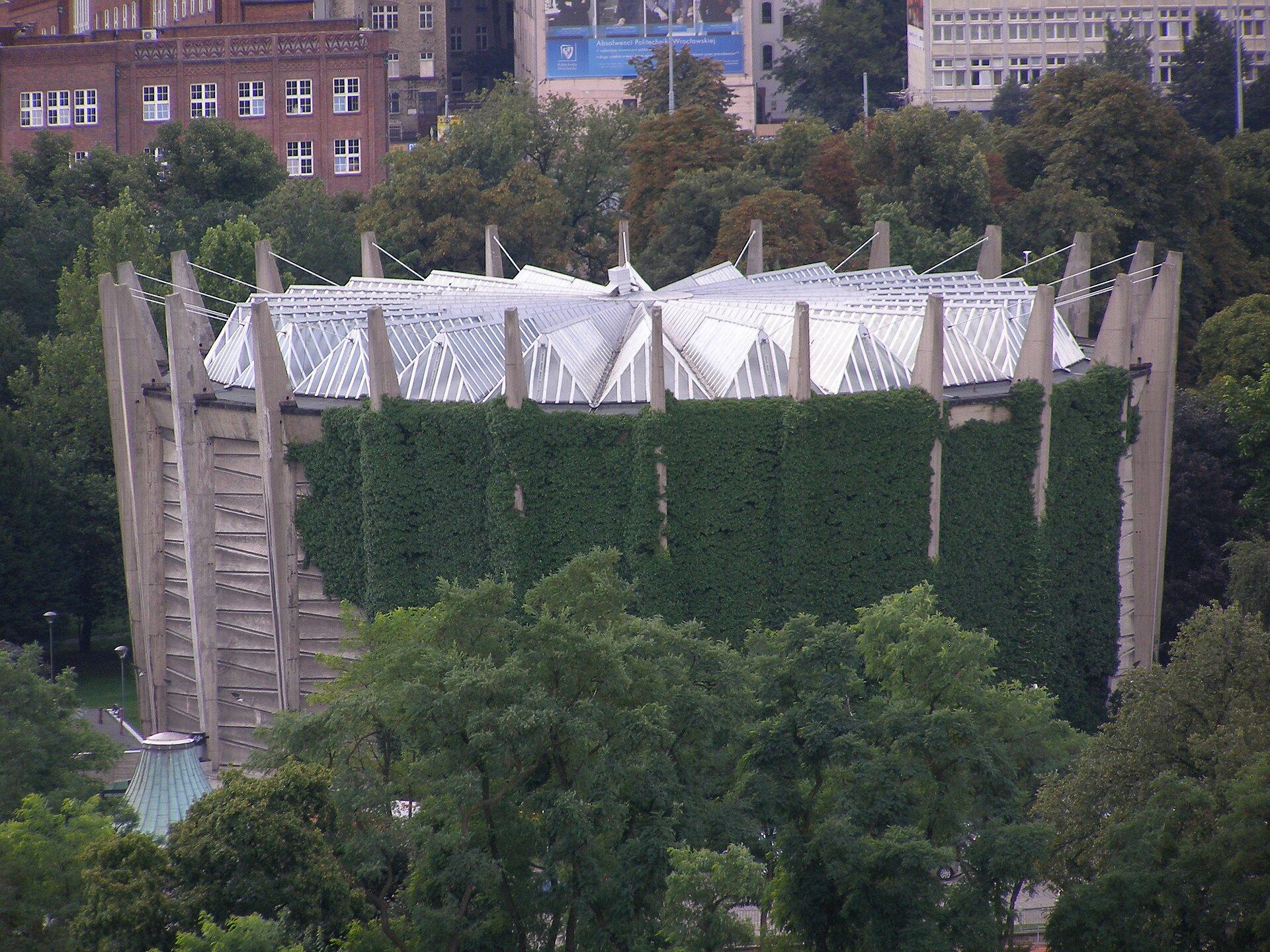
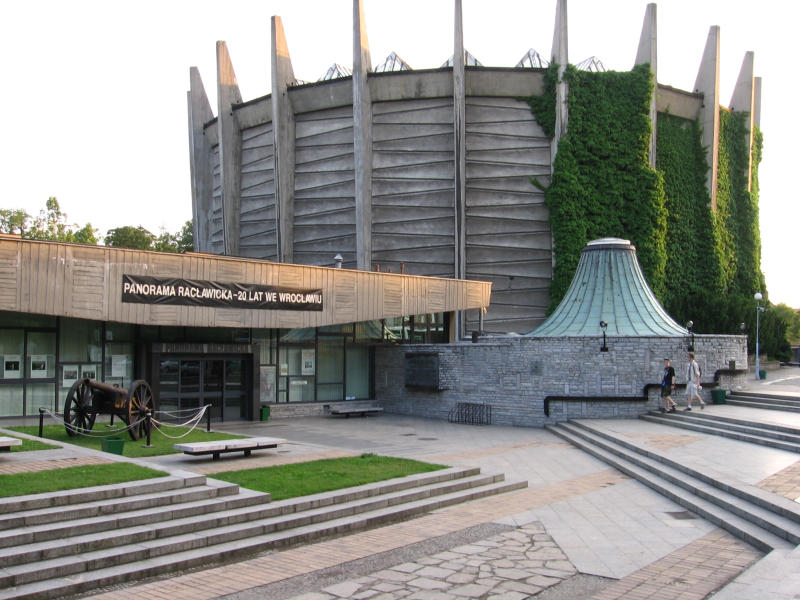
Permission to build a purpose-made rotunda in Wroclaw followed the political opening of August 1980, and the building on what is now ulica Purkyniego went up over the following years. It opened to the public on 14 June 1985, the painting's first public showing under Polish rule since before the war, and it became one of the city's principal visitor attractions almost immediately.
A comprehensive conservation campaign ran from 1977 to 1984, carried out largely by specialist teams working at the Royal Castle in Warsaw: seam repairs by linen patching, synthetic-resin adhesives, and a final matte varnish, before the canvas travelled to Wroclaw to be rehung inside its new rotunda.
What the canvas actually shows
The painting stages the Battle of Raclawice, fought on 4 April 1794 between Kosciuszko's mixed force of regulars and scythe-armed peasant volunteers and a Russian army under General Alexander Tormasov, around the villages of Raclawice, Dziemierzyce and Janowiczki. Styka painted Kosciuszko and the peasant hero Bartosz Glowacki himself; other hands, including Tadeusz Popiel, filled in the trees and peasant cottages that give the landscape its texture. The painting's best-known moment shows Glowacki, then still known by his birth name Wojciech Bartosz, smothering the fuse of a captured Russian cannon with his cap, an act for which Kosciuszko promoted him on the spot; his fellow scythemen went on to form the Krakow Grenadiers.
Beyond that central charge, the canvas shows fighting on the Polish left flank under General Jozef Zajaczek, a captured Cossack standard, and Cossack units being driven from the field, spread around the full circuit so that no single viewing angle shows the whole battle. A built foreground of real soil, dried grass, broken fencing and disused cannon carriages runs from the platform's edge to the base of the canvas, and it is this faux terrain, combined with overhead lighting and the painting's own perspective, that removes the visible seam between the physical and the painted.
The rotunda in Lwow today
The original 1893 building in Stryjski Park still stands, though nothing about its current use points back to the panorama. Its brick walls were replaced with glass after 1944 bomb damage, and it now houses sports halls used by local students; only the dome still shows Ramult's original design, and the museum's own account of the building says recognising it as the former panorama pavilion takes some imagination. The two rotundas, one converted to a gymnasium in a park in Lviv, the other rebuilt as a museum in Wroclaw, are what is left of a single 1894 commission.
A painting used, suppressed, and argued over ever since
The panorama's politics have never been incidental to it. It was commissioned as an unambiguous act of Polish national memory at a moment when Poland did not exist as a state, and its forty-year suppression in communist Wroclaw was itself a political reading of the same image: a government uneasy with a large public painting of Poles defeating a Russian army chose to keep it out of sight rather than argue with it. Academic writing on the painting since, notably a 2012 analysis in Performer, the journal of the Grotowski Institute, treats a visit to the rotunda less as an art-history circuit than as a staged national ritual, the dark approach and the sudden reveal built to make history physical rather than simply illustrated.
The reading is not uncontested. Critics writing from outside the nationalist frame have argued the painting mythologises a rising whose own leader's promises of land reform for the serfs who fought at Raclawice were only partly kept, so that a scene of peasants winning a battle for Poland sits over a history in which those same peasants did not fully win their own freedom. The museum's own presentation does not dwell on that argument; it belongs to the surrounding literature rather than the wall text.
Rebuilt again, in 2021
The most recent change to the building was not conservation of the painting but a renovation of the museum around it, completed in July 2021 at a cost of 29.6 million zloty, most of it European Union and Polish state funding. The work rebuilt the entrance hall around a new shop and ticket desk, added the small rotunda's multimedia introduction, fitted a high-pressure water-mist fire system in place of the old sprinklers, and brought the whole building up to current accessibility standards, including commentary in Polish Sign Language. None of it touched the canvas itself, which has not had a major conservation campaign since the 1977-1984 restoration that first brought it to Wroclaw.
What visitors say
Visitors consistently describe the panorama as a must-see for anyone in Wroclaw, Polish or foreign, and single out the immersive effect of the 360-degree canvas and the multilingual recorded commentary as what makes a single painting worth a dedicated visit. The most common complaint is timing: the fixed half-hour session and the crowds on the platform during busy periods leave some visitors feeling rushed against a painting with far more in it than half an hour allows.
What is praised, what is criticised
- Praised: The illusion created where the physical foreground blends into the painted canvas, which reviewers repeatedly call more convincing in person than photographs suggest
- Praised: The recorded multilingual commentary, which explains individual scenes as the platform slowly rotates or as visitors walk the circuit
- Criticised: The fixed 30-minute viewing slot, which a number of visitors feel is too short to take in a painting 114 metres around
- Criticised: Crowding on the platform during peak season, which can make it hard to get close to the rail for the scenes on the busier side of the canvas
Ratings on other platforms
Google: 4.8 from 27,844 ratings, read 28 September 2026
TripAdvisor: 4.5 from 2,055 ratings, read 28 September 2026
A platform average is a tertiary source: it moves, it is not audited, and we quote no visitor's words.
Questions about Raclawice Panorama
Where is Raclawice Panorama?
ul. J. E. Purkyniego 11, 50-155 Wroclaw, Poland.
How much does it cost to visit?
Regular: PLN 50; Discount: PLN 35; Family: PLN 35; School group: PLN 10; Children under 7: free. As confirmed 28 September 2026.
When is it open?
Every day 08:30-19:00; Tue-Fri 09:30-16:00; Sat 09:30-17:00; Sun 09:30-16:00. Closed: Monday, winter season only (1 November to 31 March). 1 January, 6 January, 3-5 April 2026, 31 October, 1 November, 24-26 December, 31 December. As confirmed 28 September 2026.
How do you get there?
Tram: Lines 2, 4, 10, 16 and 33 stop at Urzad Wojewodzki (Provincial Office), a short walk from the rotunda; Bus: Line A stops at the same Urzad Wojewodzki (Provincial Office) stop.
What should you see first?
Bartosz Glowacki smothering the cannon fuse (Painted principally by Jan Styka); The scythemen's charge on the Russian battery (Team of eight painters under Styka and Wojciech Kossak); Tadeusz Kosciuszko directing the field (Jan Styka); The captured Cossack standard (Team of eight painters under Styka and Wojciech Kossak); General Zajaczek's line on the Polish left flank (Team of eight painters under Styka and Wojciech Kossak); The faux terrain (Rotunda installation, following the original Lwow design).
What we could not confirm
- Sources consulted name the eight contributing painters and record who painted the two principal figures, Kosciuszko and Glowacki, but do not set out which artist was responsible for each remaining section of the 114-metre canvas.
- No source consulted names the architect or contractor of the current Wroclaw rotunda (completed 1985); Ludwik Ramult, credited in every source, designed the earlier Lwow building, not this one.
Images
Sources
- 1National Museum in Wroclaw, Panorama of the Battle of Raclawice - Information (opening hours, admission prices, booking, accessibility, photography rules) mnwr.pl/en/branches/panorama-of-the-battle-of-raclawice/information/
- 2National Museum in Wroclaw, contact details for the Panorama of the Battle of Raclawice branch (address, phone, email) mnwr.pl/en/contact/contacts-to-branches/panorama-of-the-battle-of-raclawice/
- 3National Museum in Wroclaw, history of the Panorama of the Battle of Raclawice mnwr.pl/en/branches/panorama-of-the-battle-of-raclawice/history/
- 4National Museum in Wroclaw, Modernisation of the buildings of the Panorama of the Battle of Raclawice (2021 renovation, funding, scope) mnwr.pl/en/modernisation-of-the-panorama-of-the-battle-of-raclawice/
- 5National Museum in Wroclaw, Rotunda w parku Stryjskim we Lwowie (fate of the original Lwow rotunda, in Polish) mnwr.pl/rotunda-w-parku-stryjskim-we-lwowie/
- 6National Museum in Wroclaw, ticketing detailed information for the Panorama of the Battle of Raclawice mnwr.pl/en/branches/panorama-of-the-battle-of-raclawice/tickets-detailed-information/
- 7National Museum in Wroclaw digital collection, object record for the Raclawice Panorama painting (dimensions, inventory number, depicted figures) muzeumcyfrowe.mnwr.pl/obiekt/panorama-raclawicka
- 8Wikipedia, Raclawice Panorama en.wikipedia.org/wiki/Panorama_Raclawicka
- 9Wikidata, Q1753248 (Raclawice Panorama) wikidata.org/wiki/Q1753248
- 10Mila Szczecina, Marek Pieniazek and Victor Adorjan, 'The Panorama Raclawicka: a Battleground for Identity', Performer, journal of the Grotowski Institute, 2012 grotowski.net/performer/performer-5/panorama-raclawicka-battleground-identity
- 11Wanderlog, Raclawice Panorama listing ( aggregate of Google and TripAdvisor ratings) wanderlog.com/place/details/36189/rac%C5%82awice-panorama
- 12visitWroclaw.eu, Panorama of Raclawice (address, public transport, visit description; for facts not otherwise sourced) visitwroclaw.eu/en/atrakcje/panorama-of-raclawice/
- 13Wikimedia Commons, File:Building of the Raclawicka Panorama.jpg (public domain) commons.wikimedia.org/wiki/File:Building_of_the_Rac%C5%82awicka_Panorama.jpg
- 14Wikimedia Commons, File:Wroclaw Panorama Raclawicka.jpg (CC BY-SA 3.0, Andrzej Otrebski) commons.wikimedia.org/wiki/File:Wroclaw_Panorama_Raclawicka.jpg
- 15Wikimedia Commons, File:RotundaPanoramyRaclawickiej.jpg (public domain) commons.wikimedia.org/wiki/File:RotundaPanoramyRaclawickiej.jpg


