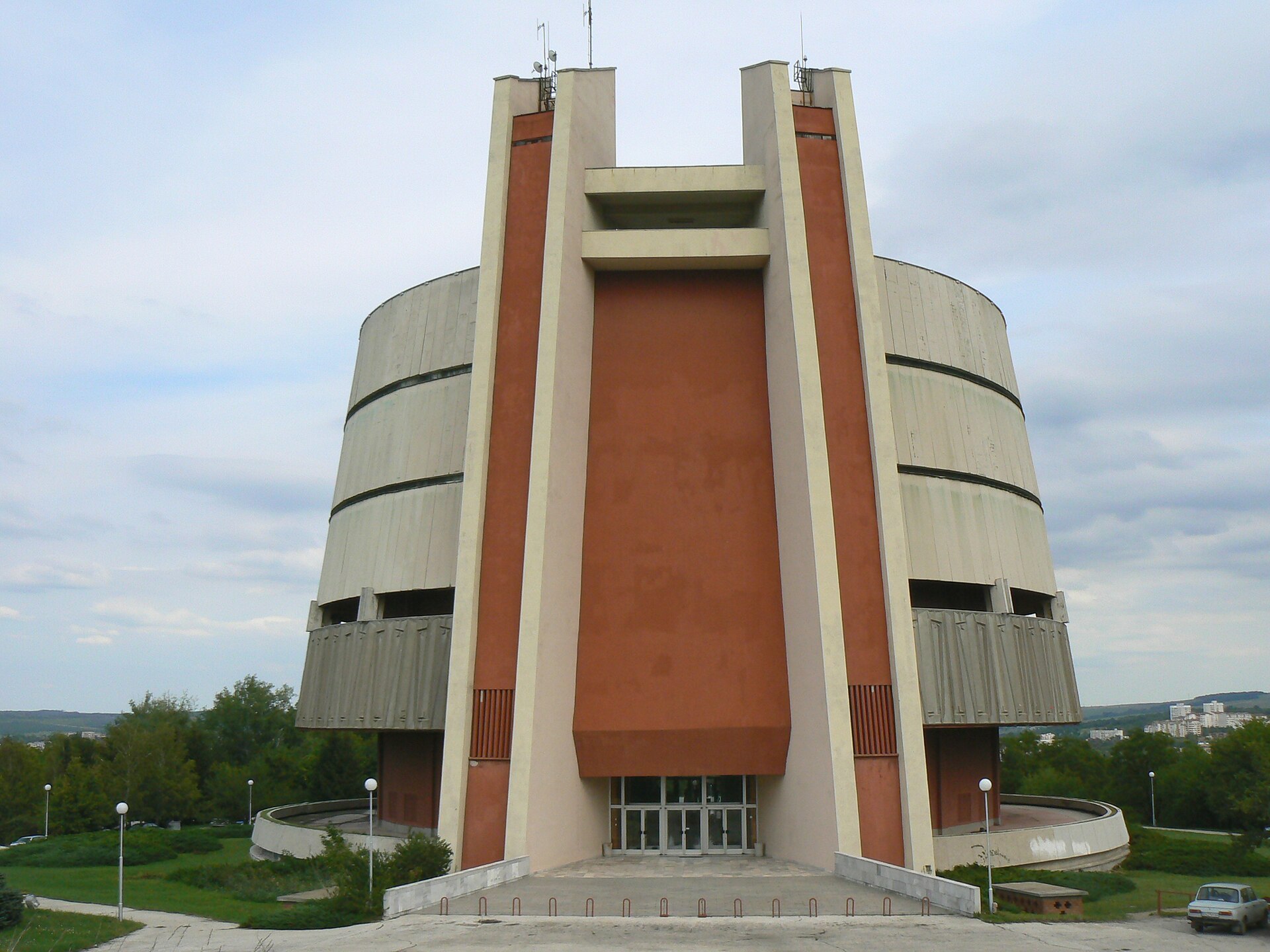
The rotunda of the Panorama, its four raised concrete piers reading as bayonets either side of the recessed entrance bay, photographed from the approach in Skobelev Park.
Public domainPleven Panorama
Museum · Panorama "Plevenska epopeya 1877 g." · Founded 1977
Open, admission and hours confirmed 28 September 2026 · 7 sources
On this page 14 sections
ContentsClose
The Pleven Panorama's strength is narrow and specific rather than broad: it holds Bulgaria's example of the large-format, hand-painted circular battle panorama, a form associated with the Soviet military-art tradition and, on the museum's own account, produced by the same Moscow studio lineage as the Borodino Panorama in Moscow. Nothing else in Bulgaria attempts the same technique at the same scale on the evidence in the sources read for this record. Its value sits less in a conventional object collection, though it does hold a supporting gallery of period busts, lithographs, weapons and uniforms, than in the single sustained artistic and architectural effort to put a visitor physically inside one specific hour of the Siege of Plevna, on the actual ground where that hour happened.
| Local name | Panorama "Plevenska epopeya 1877 g." |
|---|---|
| Kind | Museum |
| Founded | Groundbreaking 19 January 1977; opened 10 December 1977, the centenary of the liberation of Pleven |
| City and country |  Pleven, Bulgaria Pleven, Bulgaria |
| Address | Skobelev Park, Pleven 5804, Bulgaria |
| Website | panorama-pleven.com/museum/panorama |
| Status | Open, confirmed |
| Record last verified |
Visiting
- Hours
- April-September (summer season)09:00 to 17:30Published as two sessions, 09:00-12:00 and 12:30-17:30, with a midday break between them. The museum's own hours page does not name a weekly closed day.
- October-March (winter season)09:00 to 16:30Published as two sessions, 09:00-12:00 and 12:30-16:30, with a midday break between them. The museum's own hours page does not name a weekly closed day.
- Closed
- No weekly closed day is published in the source; the hours page states only the daily midday break between sessions..
- Admission
- Adult (citizens)EUR 5.11
- Citizens over 65EUR 2.56
- StudentsEUR 1.53
- People with disabilities; children from orphanages and social homesFreeFree
- Children under 7FreeFree
- Family ticket, two parents plus up to three children aged 7-18EUR 9.20
- Family ticket, one parent plus up to three children aged 7-18EUR 5.11
- Guided talk in a foreign languageEUR 10.23Additional service, not a base entry tier
- Guided talk in Bulgarian with translationEUR 7.16Additional service, not a base entry tier
- Photography without flashEUR 5.11Additional service, not a base entry tier; matches traveler accounts of paying at the entrance for permission to photograph
- Video with a camera or phoneEUR 25.56Additional service, not a base entry tier
- Information in a foreign languageEUR 5.11Additional service, not a base entry tier
Free entry: Free entry on the last Tuesday of every month- Do I need to book?
- Not stated as required on the museum's own page. Viewing is guided rather than self-paced, on traveler accounts.
- Address
- Skobelev Park, Pleven 5804, Bulgaria Map
- Website
- panorama-pleven.com/museum/panorama
- Telephone
- 064/830-251
- [email protected]
Before you go how long, access, photography, bags, eating, shop
- How long to allow
- Not published by the museum. Traveler accounts describe a single guided pass through the introductory, panorama, diorama and final halls, typically well under two hours.
- Access
- Not published in the sources read for this record. Traveler accounts describe a number of steps connecting the building's internal levels, calling them shallow rather than difficult, but no formal accessibility statement was found on the museum's own site.
- Photography
- The museum's own current price list charges separately for photography without flash (5.11 EUR) and for video with a camera or phone (25.56 EUR). Traveler accounts independently describe paying a small fee at the entrance for permission to photograph inside, or otherwise being unable to.
- Bags
- Not published in the sources read for this record.
- Eating
- Not published in the sources read for this record.
- Shop
- Not published in the sources read for this record.
Prices and hours change. We take them from the institution's own pages and print the day we read them, and you can check the current position at the source we used. Confirm before you travel.
What is inside
Introductory Hall
Six paintings setting the historical scene before the fighting at Pleven: 'The Ottoman Yoke', the April Uprising of 1876, a rally held in Saint Petersburg in defence of the Bulgarian people, the Samara banner (a flag sewn for Bulgarian volunteer units and one of the most reproduced symbols of the 1877-78 war), and the Battle of Shipka. The museum credits the paintings to N. V. Ovechkin, the Moscow artist who led the whole painting collective.
Panorama Hall
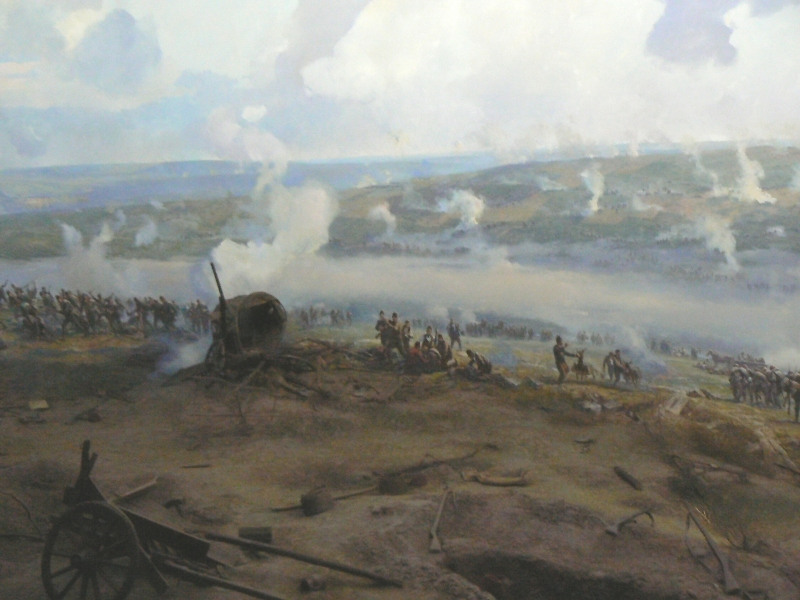
The hand-painted 360-degree canvas that gives the museum its name, viewed from a raised central platform: 'The Third Assault on Pleven, 11-12 September 1877'. It shows the most critical moment of the fighting at the Green Hills, around 16:30 on 11 September, when General Mikhail Skobelev's column stormed the Kovanlak redoubt, the stronger of two key Ottoman fortifications south of Pleven, then broke into the centre of the Ottoman defence; the Issa Aga redoubt fell an hour later. The painted canvas is reported at 115 metres long and 15 metres high, with a sculpted foreground roughly 12 metres deep blending real earthworks, weapons and equipment into the painted horizon.
Diorama Hall
A smaller staged scene, 'The Last Battle for Pleven in the Valley of the Vit River, 10 December 1877', built the same way as the Panorama Hall but on a smaller scale: sculpted foreground objects blending into a painted backdrop. It depicts the Ottoman army's attempt to break the Russian blockade line at its sixth sector, by the bridge over the Vit river seven kilometres west of Pleven, and its defeat by the Russian grenadier corps under General I. S. Ganetsky, the action that forced Osman Pasha's surrender the same day.
Final Hall
Two paintings closing the story: 'The Capitulation of Osman Pasha', the moment the defeated Ottoman commander's army surrendered at Pleven, described by the museum as the turning point of the whole war; and 'The Winter Crossing of the Balkans', the campaign that followed and led to the liberation of Sofia and Plovdiv, the capture of the fortified Sheynovo camp, the armistice signed at Edirne on 31 January 1878, and the Treaty of San Stefano on 3 March 1878.
Relics and Portrait Gallery
A gallery of busts of military commanders and lithographs of the Russo-Turkish War of 1877-78 from the late 19th and early 20th centuries, displayed alongside period weapons and military uniforms, on the museum's own description of the exposition beyond the painted halls.
What to see first
The 360-degree panorama, 'The Third Assault on Pleven, 11-12 September 1877'
Nikolai Vasilievich Ovechkin leading a collective of 13 Russian and Bulgarian artists, from the M. B. Grekov Military Artists' Studio, MoscowThe centrepiece the building exists to hold: a hand-painted circular canvas, reported at 115 by 15 metres, with a sculpted foreground that blends real objects into the painted battlefield so the viewer stands inside the scene.1
The diorama, 'The Last Battle for Pleven in the Valley of the Vit River, 10 December 1877'
Depicts the action that actually forced Osman Pasha's surrender, on the day of the capitulation itself, using the same blended-foreground technique as the main panorama at a smaller scale.1
'The Ottoman Yoke'
N. V. Ovechkin and the painting collectiveOpens the Introductory Hall's sequence, setting the political situation in Bulgaria before the 1877-78 war.1
The April Uprising of 1876
N. V. Ovechkin and the painting collectiveDepicts the 1876 uprising whose suppression turned European opinion toward Bulgaria and helped bring Russia into the war a year later.1
Rally in Saint Petersburg in defence of the Bulgarian people
N. V. Ovechkin and the painting collectiveRepresents the Russian public sympathy that the museum credits with helping drive Russia's entry into the war.1
The Samara banner
N. V. Ovechkin and the painting collectiveA scene built around one of the most widely reproduced physical relics of the 1877-78 war, the flag sewn in Samara for the Bulgarian volunteer corps.1
The Battle of Shipka
N. V. Ovechkin and the painting collectiveCovers the other decisive engagement of the war, fought at the Shipka Pass, as background to the Pleven story the rest of the museum tells.1
'The Capitulation of Osman Pasha'
N. V. Ovechkin and the painting collectiveThe museum's own description names this the turning point of the entire Russo-Turkish War of 1877-78.1
'The Winter Crossing of the Balkans'
N. V. Ovechkin and the painting collectiveCloses the narrative with the campaign that led to the liberation of Sofia and Plovdiv and the war's end at San Stefano.1
Gallery of busts, lithographs, weapons and uniforms
The museum's own collection of period military relics and portraiture from the Russo-Turkish War of 1877-78, shown alongside the painted halls rather than as a separate exhibition.1
A building shaped like a fortress on the battlefield it commemorates
The Panorama sits inside Skobelev Park, on the Green Hills south of Pleven, on the ground where some of the heaviest fighting of the Third Assault took place on 11-12 September 1877. It is, on the account one researcher heard from the museum's own guide, the only structure permitted inside that park, because the valley itself holds the remains of tens of thousands of the war's dead, a figure put at seventy to eighty thousand in that account. The building was raised for the centenary of the war: ground was broken on 19 January 1977 and it opened on 10 December 1977, the hundredth anniversary of the liberation of Pleven.
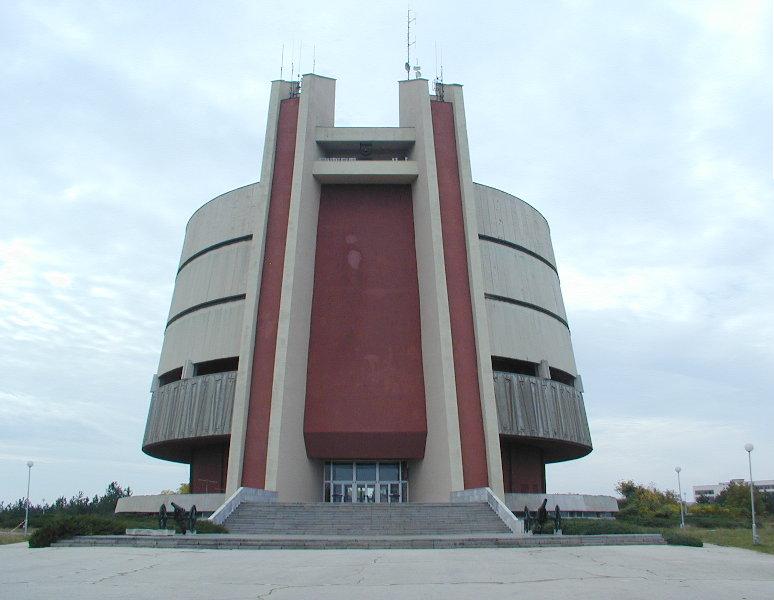
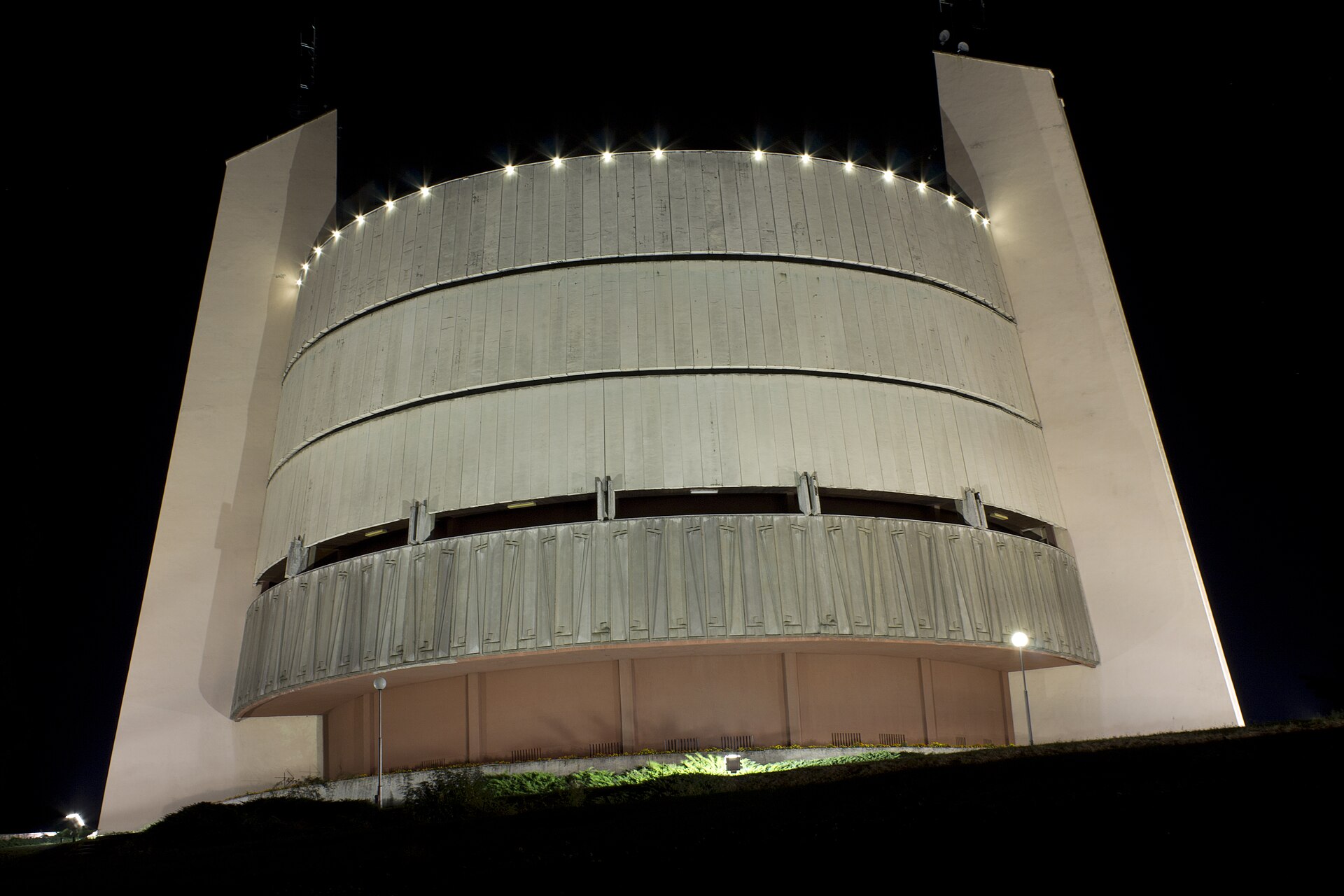
Its shape reads as deliberate: four tall, raised concrete piers stand either side of a recessed entrance bay, an arrangement that has been read as four bayonets guarding the drum-shaped gallery they frame. That drum, clad in vertical concrete ribs and banded by dark horizontal seams, is the rotunda that holds the painted panorama itself, raised above the entrance level on a broad plinth reached by an open stair. Two preserved 1877-pattern field guns stand either side of that stair on the approach.
How a hand-painted circular battle scene was made
A panorama, as a form, is a single continuous painting wrapped around the inside of a cylindrical room and viewed from a platform at its centre, so that the horizon painted on the wall appears to continue unbroken in every direction; a sculpted foreground of real and cast objects usually sits between the viewing platform and the canvas, blended into the paint so the join is not obvious. The Pleven panorama was painted by a collective of thirteen artists, eleven Russian and two Bulgarian, led by Nikolai Vasilievich Ovechkin, an artist from the M. B. Grekov Military Artists' Studio in Moscow, the same tradition of Soviet military panorama painting that produced the Borodino Panorama in Moscow, which one account describes this work as conceived alongside.
The painted canvas itself is reported at 115 metres long and 15 metres high, wrapped around the drum, with a sculpted foreground extending roughly 12 metres out from the base of the painting toward the viewing platform, built up from real trench timbers, gun carriages, spent shell casings and other period material set into the ground so it appears to run directly into the paint.
What the panorama depicts: the Third Assault on Pleven
The scene chosen for the main canvas is a specific hour of a specific day: around 16:30 on 11 September 1877, during the Third Assault on Pleven, the climax of the five-month siege that is the wider subject of the whole museum. At that hour a Russian column under General Mikhail Dmitrievich Skobelev stormed the Kovanlak redoubt, then the stronger of two key Ottoman fortifications on the high ground south of the city, and broke into the centre of the Ottoman defensive line; the neighbouring Issa Aga redoubt fell roughly an hour later. The siege itself, part of the wider Russo-Turkish War of 1877-78, had opened in July 1877 and would not end until Osman Pasha's surrender that December, after Ottoman forces under his command were finally cut off and defeated attempting to break out along the Vit river.
The panorama's foreground figures, on the description carried by the museum and repeated in outside accounts, include an attacking Russian regiment under fire, a field doctor and nurse tending casualties, and Ottoman cavalry counter-attacking into the smoke, all built to read as a continuation of the painted crowd behind them rather than as a separate diorama in front of a backdrop.
Four more halls: introduction, diorama, finale and relics
The panorama is the building's centrepiece but not its whole content. A visit is arranged in sequence: an Introductory Hall of six paintings sets the political and military background before Pleven, covering the Ottoman period in Bulgaria, the April Uprising of 1876, a solidarity rally held in Saint Petersburg, the Samara banner sewn for the Bulgarian volunteer corps, and the separate Battle of Shipka. After the panorama itself comes a Diorama Hall, built the same way at a smaller scale, depicting the actual battle of 10 December 1877 in the valley of the Vit river, when Ottoman forces trying to break the Russian blockade near a bridge seven kilometres west of Pleven were defeated by a Russian grenadier corps under General Ivan Stepanovich Ganetsky, the action that led directly to Osman Pasha's surrender that same day.
A Final Hall closes the sequence with two paintings, the capitulation of Osman Pasha's army at Pleven, described by the museum itself as the turning point of the whole war, and the winter crossing of the Balkans that followed, the campaign that liberated Sofia and Plovdiv, took the fortified camp at Sheynovo, and led to the armistice signed at Edirne on 31 January 1878 and the Treaty of San Stefano on 3 March 1878. Around and beneath the painted halls the museum also displays a gallery of busts of military commanders, lithographs of the war from the late nineteenth and early twentieth centuries, and period weapons and uniforms.
A memorial built in a satellite state, and how it tells its own story
The Panorama opened in December 1977, while Bulgaria was a member of the Warsaw Pact and closely aligned with the Soviet Union; the artists who painted it came from the same Moscow military-art tradition responsible for Soviet-era panoramas elsewhere, including the Borodino Panorama the museum's own account links it to. Against that background, one outside account, a 2021 podcast episode built around a visit and interview with a museum guide, records the guide's own claim that the building was funded by public donation and built with volunteer labour rather than commissioned as a state ideological project, a distinction the guide drew explicitly against monuments like the Buzludzha Monument, the Bulgarian Communist Party's own memorial complex elsewhere in the country.
That claim comes from what a museum staff member told a visiting journalist, not from an independently sourced institutional history, and nothing in the sources read for this record either confirms or contradicts it in more detail. No restitution claim, acquisition controversy or comparable dispute over the collection or the building surfaced in any source read for this record.
Visiting today
The museum publishes seasonal hours rather than a single year-round timetable: summer, April to September, it receives visitors 09:00 to 12:00 and again 12:30 to 17:30; winter, October to March, the afternoon session runs 12:30 to 16:30 instead. Its own hours page names no weekly closed day, only the daily midday break between the two sessions. Entry is priced in euros on the museum's current list: 5.11 euros for an adult, 2.56 euros for visitors over 65, 1.53 euros for students, and family tickets at 9.20 euros for two parents with up to three children aged 7 to 18 or 5.11 euros for one parent with up to three children in the same age range; children under 7, people with disabilities, and children from orphanages and social homes enter free, and entry is free for everyone on the last Tuesday of each month. Separate charges apply for a guided talk in a foreign language, for a Bulgarian-language talk with translation, and for photography or video inside, a detail independently confirmed by traveler accounts describing a small fee paid at the entrance for permission to take photographs. The museum's own news feed shows it staging a battle re-enactment on 16 September 2026 for the 149th anniversary of the Third Assault, evidence of an actively operating institution rather than one merely still listed as open.
What visitors say
Visitors consistently say the panorama itself is the reason to come: several travelers independently call standing on the central platform and watching the painted horizon merge into the sculpted foreground a 'wow moment', and more than one notes the scale only really registers in person. The building's exterior draws a different, more mixed reaction: reviewers who praise the interior's upkeep separately describe the concrete exterior as looking dated or run down.
What is praised, what is criticised
- Praised: The panorama painting and its scale, called a genuine 'wow moment' by more than one visitor viewing it from the central platform
- Praised: The guided tour and the guides' knowledge of the 1877-78 war, with one reviewer naming a specific guide, Violeta, for a warm welcome
- Praised: The setting inside Skobelev Park, built on the actual battlefield of the fighting it depicts
- Criticised: The number of internal steps connecting the building's levels, flagged by more than one reviewer as a difficulty for visitors with walking trouble, though they describe the steps themselves as shallow
- Criticised: The worn, dated look of the exterior concrete, contrasted by reviewers with a well-kept interior
- Criticised: Viewing is guided rather than self-directed, with an extra charge for an English-language guide and a separate charge just to photograph inside
Ratings on other platforms
TripAdvisor: 4.4 from 109 ratings, read 28 September 2026
A platform average is a tertiary source: it moves, it is not audited, and we quote no visitor's words.
Questions about Pleven Panorama
Where is Pleven Panorama?
Skobelev Park, Pleven 5804, Bulgaria.
How much does it cost to visit?
Adult (citizens): EUR 5.11; Citizens over 65: EUR 2.56; Students: EUR 1.53; People with disabilities; children from orphanages and social homes: free; Children under 7: free. As confirmed 28 September 2026.
When is it open?
April-September (summer season) 09:00-17:30; October-March (winter season) 09:00-16:30. Closed: No weekly closed day is published in the source; the hours page states only the daily midday break between sessions. As confirmed 28 September 2026.
What should you see first?
The 360-degree panorama, 'The Third Assault on Pleven, 11-12 September 1877' (Nikolai Vasilievich Ovechkin leading a collective of 13 Russian and Bulgarian artists, from the M. B. Grekov Military Artists' Studio, Moscow); The diorama, 'The Last Battle for Pleven in the Valley of the Vit River, 10 December 1877'; 'The Ottoman Yoke' (N. V. Ovechkin and the painting collective); The April Uprising of 1876 (N. V. Ovechkin and the painting collective); Rally in Saint Petersburg in defence of the Bulgarian people (N. V. Ovechkin and the painting collective); The Samara banner (N. V. Ovechkin and the painting collective).
What we could not confirm
- Which Commons photographs, if any, show the Diorama Hall, the Introductory Hall or the Final Hall specifically rather than the main Panorama Hall; the museum's own photo gallery captions distinguish the halls, but no independently rights-cleared photograph on Wikimedia Commons could be matched with confidence to one specific hall for this record, so none was attached to an individual 'inside' entry.
- Whether a step-free or otherwise accessible route exists inside the building; traveler accounts describe internal steps between levels but no formal accessibility statement was found on the museum's own site.
- The full detail behind the museum guide's claim, reported by Museum Archipelago in 2021, that construction was funded by public donation and volunteer labour rather than state commissioning; no independent institutional history confirming or contradicting that account was found.
Images
Sources
- 1Regional Military Historical Museum - Pleven, official site, Panorama "Plevenska epopeya 1877 g." page panorama-pleven.com/museum/panorama/
- 2Wikipedia, "Pleven Panorama" en.wikipedia.org/wiki/Pleven_Panorama
- 3Wikidata, Q2023134, Pleven Panorama wikidata.org/wiki/Q2023134
- 4Wikimedia Commons, Category:Pleven Panorama commons.wikimedia.org/wiki/Category:Pleven_Panorama
- 5Wikimedia Commons, File:Pleven-Panorama-outside.JPG, licence and author metadata commons.wikimedia.org/wiki/File:Pleven-Panorama-outside.JPG
- 6Tripadvisor, "Pleven Epopee 1877" attraction page and reviews tripadvisor.com/Attraction_Review-g303649-d1867030-Reviews-Pleven_Epopee_1877-Pleven_Pleven_Province.html
- 7Museum Archipelago, episode 92, "The Pleven Panorama Museum Transports Visitors Through Time, But Not Space", Ian Elsner, 3 May 2021 museumarchipelago.com/92
