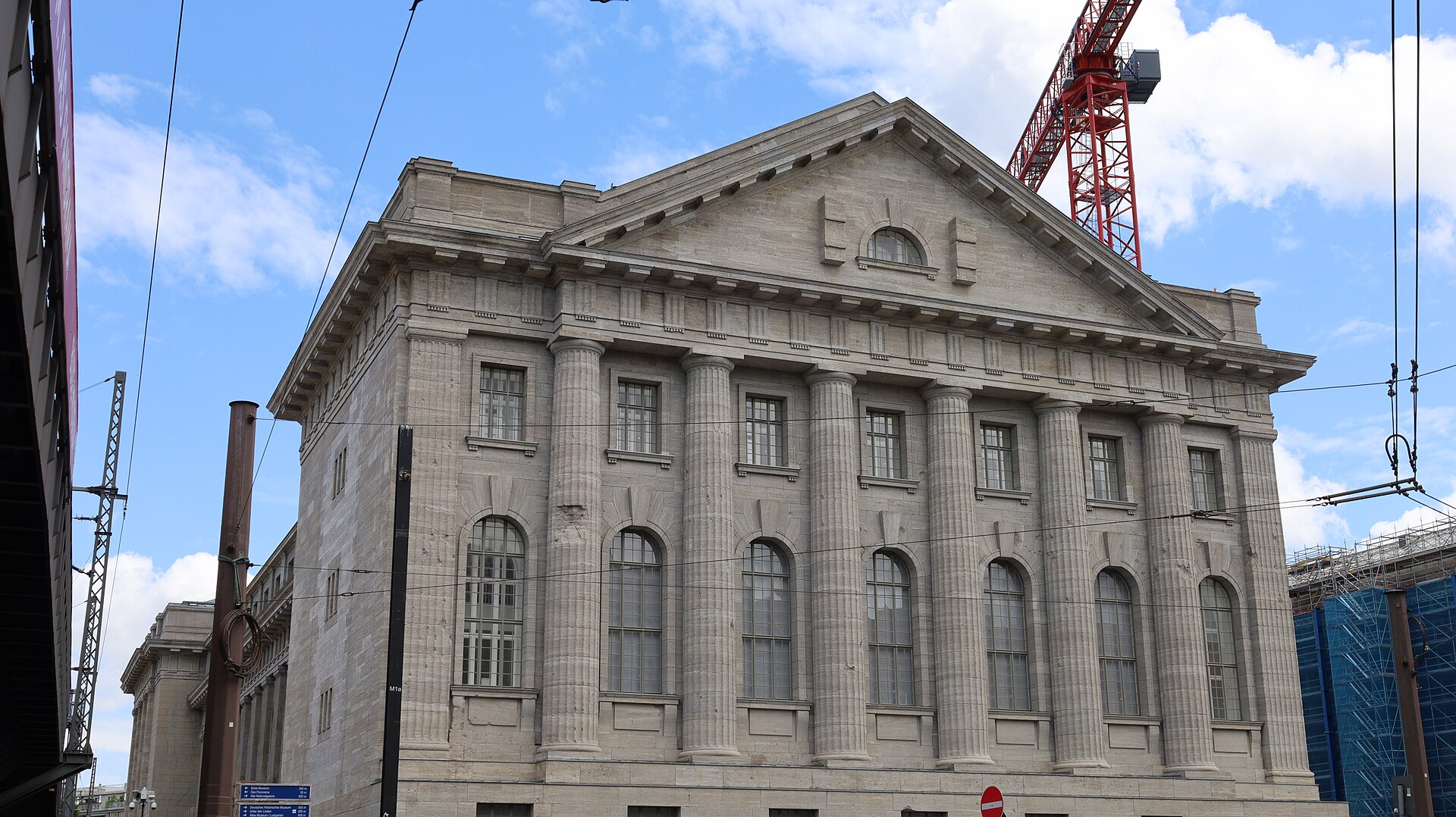
The Am Kupfergraben colonnade facade photographed in June 2026, mid-refurbishment, with a construction crane visible behind the pediment. Vetted by eye before use; dated within weeks of this page's research date.
Photograph by RoyZuoMedia · CC BY-SA 4.0Closed to visitors - not permanently
Pergamon Museum is currently closed. Not open and not permanently closed. The museum has been completely closed to visitors since 23 October 2023 for a comprehensive structural refurbishment (Grundinstandsetzung) of the whole building, part of the wider Museumsinsel Masterplan under way since 2013. The museum's own refurbishment page and its own 'The Pergamonmuseum returns' announcement both state the closure and the phased reopening directly.
Expected to reopen: The museum's own announcement states the North Wing and the central building (the Antikensammlung's Hellenistic halls, including the Pergamon Altar itself, and the Museum fuer Islamische Kunst) reopen on 4 June 2027; the South Wing, home to the Vorderasiatisches Museum's Ishtar Gate and Processional Way, is not expected before 2037, and a planned fourth wing plus an underground Archaeological Promenade connecting the Museum Island buildings extend beyond that. A German Wikipedia account of the wider Masterplan states the museum is expected to remain mostly closed for 14 to 20 years from the 2023 closure, that is, until 2037 to 2043, and gives a cost history for the whole project rising from an estimated 250 million EUR in 2000 to about 1.507 billion EUR by 2023, with the timeline extended from an original five years to at least 24. · a target, not yet confirmed
Closure confirmed from the institution's own page. We re-check this page on a schedule and will update it, from the institution's own announcement, the moment it reopens.
On this page 15 sections
ContentsClose
Three collections under one roof, none of them viewable in full as of this research date: the Antikensammlung's classical antiquities, centred on the Pergamon Altar itself; the Vorderasiatisches Museum's ancient Near Eastern material, including the Ishtar Gate, the Processional Way of Babylon and the Market Gate of Miletus; and the Museum fuer Islamische Kunst, including the Mshatta Facade, the Aleppo Room and the Alhambra Dome. The museum's own reopening announcement treats the North Wing and central building, the Antikensammlung and the Islamic art collection, as the first phase back, targeted for 4 June 2027; the Vorderasiatisches Museum's largest reconstructed monuments stay in the South Wing, not expected before 2037.
| Local name | Pergamonmuseum |
|---|---|
| Kind | Museum |
| Founded | 1930 |
| City and country |  Berlin, Germany Berlin, Germany |
| Address | Museumsinsel, 10178 Berlin, Germany |
| Website | smb.museum/en/museums-institutions/pergamonmuseum/home |
| Status | Closed temporarily, confirmed |
| Record last verified |
Visiting
- Hours (pre-closure)
- All daysClosed to visitors. The museum has been shut since 23 October 2023 for structural refurbishment; no visiting hours currently apply and the museum's own pages publish a reopening date instead of hours.
- Closed
- Every day, until at least 4 June 2027 for the North Wing and central building only.
- Admission (pre-closure)
- Museumsinsel-Ticket (day ticket, other Museum Island museums)EUR 24the general Museum Island day ticket the museum's own prices page currently publishes; it does not admit to the Pergamon Museum itself while the building is closed, and the museum states individual Pergamon tickets are expected to go on sale in December 2026 ahead of the June 2027 partial reopening
- Under 18Freefree admission policy stated across Staatliche Museen zu Berlin sites; not separately confirmed for the closed Pergamon Museum
- Do I need to book?
- Not applicable while the museum is closed. The museum states group tours titled 'Highlights of the Pergamonmuseum' can be booked now for visits starting 8 June 2027, with capacity limited, and that individual tickets for the reopened North Wing are expected on sale from December 2026.
- Address
- Museumsinsel, 10178 Berlin, Germany MapS-Bahn Hackescher Markt or Friedrichstrasse, both a walk across Museum Island
Bus Lustgarten stop, on Museum Island - Website
- smb.museum/en/museums-institutions/pergamonmuseum/home
- Telephone
- +49 30 266424242
Before you go how long, access, photography, bags, eating, shop
- How long to allow
- Not applicable while closed. During the closure the museum offers virtual tours, an online collection, 3D models including a detailed scan of the Pergamon Altar, podcasts and films through its own website.
- Access
- Not published in the sources read for this record while the museum is closed.
- Photography
- Not published in the sources read for this record.
- Bags
- Not published in the sources read for this record.
- Eating
- Not applicable while the museum building is closed.
- Shop
- Not applicable while the museum building is closed.
The museum is closed (see above). These are the figures published before the closure, kept here for a visitor planning ahead rather than presented as bookable today, and you can check the current position at the source we used. We will re-confirm them once it reopens.
What is inside
The Pergamon Altar and the Antikensammlung's Hellenistic halls (North Wing and central building)
Before the October 2023 closure, and again from the stated 4 June 2027 reopening, the central building holds the Pergamon Altar itself, the object the whole museum is named for: a monumental Hellenistic altar structure with a 113-metre sculptural frieze depicting the battle of gods and giants, excavated at Pergamon in present-day Turkey in the 1870s and 1880s. The museum states a detailed 3D scan of the altar was made and is offered as a virtual substitute during the closure.
The Museum fuer Islamische Kunst (North Wing)
On the museum's own account of the 2027 reopening, this collection occupies two full floors of the North Wing, including the Mshatta Facade, 450 carved stone blocks from the facade of an 8th-century early Islamic caliph's palace in present-day Jordan, reassembled in a larger room than it occupied before the closure, alongside the Aleppo Room and the Alhambra Dome.
The Vorderasiatisches Museum and the Ishtar Gate (South Wing)
Before the closure this wing held the Ishtar Gate and the Processional Way of ancient Babylon, along with the Market Gate of Miletus, among the most reproduced reconstructed monuments in any museum anywhere. The museum's own refurbishment page assigns this collection to the South Wing, whose renovation is not expected to finish before 2037, a full decade after the North Wing reopens; in the meantime the museum states the Vorderasiatisches Museum is presenting a selection of highlights in the North Wing's main hall from 2027, and currently shows a separate exhibition, Built Community, at the James-Simon-Galerie.
PERGAMON. Masterpieces from the Ancient Metropolis, with a 360-degree panorama by Yadegar Asisi
The museum's current, separate, publicly ticketed offering during the closure: original objects from the ancient city of Pergamon shown alongside a large-scale 360-degree panoramic artwork by the artist Yadegar Asisi reconstructing the ancient metropolis, at a temporary exhibition space on Museum Island rather than inside the closed Pergamon Museum building itself.
What to see first
The Pergamon Altar
Hellenistic, excavated at Pergamon (present-day Turkey) in the 1870s and 1880sThe object the entire museum is named for and built to hold: a monumental altar structure with a continuous 113-metre frieze of gods fighting giants. Currently inaccessible in the closed central building; the museum's own account names its planned return, inside the reopened Hellenistic halls, as the centrepiece of the stated 4 June 2027 partial reopening.3
The Ishtar Gate and the Processional Way of Babylon
Neo-Babylonian, reign of Nebuchadnezzar II, 6th century BCA reconstructed monumental blue-glazed gate and processional route from ancient Babylon, among the most recognisable reconstructed monuments held in any museum. Assigned by the museum's own refurbishment page to the South Wing, whose renovation is not due to finish before 2037, meaning this object will be inaccessible for years after the North Wing itself reopens.2
The Market Gate of Miletus
Roman, 2nd century ADA reconstructed monumental Roman gate from the ancient city of Miletus in present-day Turkey, held with the Vorderasiatisches Museum's other reconstructed architecture and, on the evidence read for this page, also subject to the South Wing's later reopening timeline.6
The Mshatta Facade
Early Islamic, 8th century, Umayyad caliphate450 carved stone blocks from the facade of a caliph's palace in present-day Jordan, described by the museum's own reopening announcement as a masterpiece of 8th-century Islamic stonemasonry and named specifically as part of the June 2027 North Wing reopening, to be reassembled in a larger room than before.3
The Aleppo Room and the Alhambra Dome
Ottoman-era Syrian domestic interior (Aleppo Room) and Islamic architectural fragment (Alhambra Dome)Named among the Museum fuer Islamische Kunst's holdings returning to display across two floors of the North Wing from June 2027, alongside the Mshatta Facade.3
The Soviet dispersal of 1945 to 1958
Not a single object; a provenance episode affecting a large share of the collectionAt the end of the Second World War the Red Army removed unattended museum objects from Berlin, some as war booty and some by outright theft on the account read for this page; most were returned to East Germany by 1958, but significant parts of the collection remain today in museums in Moscow and Saint Petersburg. This is documented on Wikipedia (tertiary) rather than on the museum's own fetched pages, and deserves a primary citation from the museum's own provenance material.6
Exhibitions on now
- Opening soon21 Oct 2026 to 18 Apr 2027Confirmed , 7 weeks ago
Closed since October 2023, and the reason matters for how long
The Pergamon Museum has been completely closed to visitors since 23 October 2023, for what the museum's own site calls a comprehensive structural refurbishment, Grundinstandsetzung, of the whole building. This is not a short conservation closure. It is part of the Museumsinsel Masterplan, a rebuilding programme covering the whole of Museum Island that has been under way since 2013, and the Pergamon Museum's own share of it is being carried out in two full construction phases: the North Wing and the central building first, the South Wing, home to the Vorderasiatisches Museum, second, with work on that second phase already under way since the October 2023 closure date. A museum this large does not reopen all at once, and this one least of all.
A building rebuilt once already before this closure
The Pergamon name has covered two different buildings on this site. A first museum, designed by Fritz Wolff, opened here on 18 December 1901 to house the Pergamon Altar newly arrived from Anatolia. It proved too small and structurally inadequate within a decade, and a second, much larger building was commissioned by Kaiser Wilhelm II, designed from 1906 by Alfred Messel and, after Messel's death in 1909, completed to a revised plan by Ludwig Hoffmann; construction ran from 1910 to 1930, with contributions from several other architects and archaeologists along the way. The building a visitor would have entered in October 2023 was, in other words, already a replacement for an earlier Pergamon Museum found wanting within a decade of opening.
What the Second World War did, and where parts of the collection still are
At the end of the war the Red Army removed unattended museum objects from Berlin, some as declared war booty and some, on the account read for this page, simply taken. Most of what was removed was returned to East Germany by 1958. Not all of it: significant parts of the collection remain today in museums in Moscow and Saint Petersburg, a dispersal this desk could source only through a tertiary account and could not verify against the museum's own current provenance material, which is itself hard to search while the museum's collection database is disrupted by the closure. It is exactly the kind of gap this archive exists to record rather than pass over quietly, and it deserves a primary source on the next research pass.
The numbers behind the closure
The wider Museumsinsel Masterplan's own published cost and schedule figures explain why a single museum closure can run so long. A 2000 estimate put the whole programme's cost at 250 million EUR; by 2023 the figure had grown to about 1.507 billion EUR. The Pergamon Museum's own share was originally planned to take about five years; the current published expectation, on the account read for this page, is at least 24 years from start to full completion, with the museum expected to be mostly closed for 14 to 20 years from the October 2023 shutdown, that is, until sometime between 2037 and 2043. Measured against that record, the museum's own stated 4 June 2027 date for a partial reopening is a real, specific commitment, and it is also a single date inside a project whose own numbers show exactly how far such commitments have moved before.
What comes back first, in 2027, and what does not
The museum's own reopening announcement is specific about what returns and what does not. On 4 June 2027, the North Wing and the central building reopen: the Antikensammlung's Hellenistic halls, including the Pergamon Altar itself in a central hall built for it, and the entire Museum fuer Islamische Kunst collection across two full floors of the North Wing, among it the Mshatta Facade's 450 carved stone blocks, reassembled in a larger room than before, the Aleppo Room and the Alhambra Dome. The Vorderasiatisches Museum, whose Ishtar Gate, Processional Way and Market Gate of Miletus are arguably as internationally famous as the Pergamon Altar itself, does not come back with them. Its collection lives in the South Wing, whose own renovation the museum's page does not expect to finish before 2037, a full decade later; in the interim the Vorderasiatisches Museum is showing a selection of highlights inside the North Wing's main hall and, right now, a separate exhibition called Built Community at the James-Simon-Galerie nearby.
What there is to do now
The Pergamon Museum building itself admits nobody. What stands in for it is a temporary, separately ticketed exhibition on Museum Island, PERGAMON. Masterpieces from the Ancient Metropolis, pairing original objects with a large 360-degree panorama by the artist Yadegar Asisi reconstructing the ancient city; the museum's own online ticket shop sells individual tickets for it. Beyond that, the museum offers virtual tours, an online collection database, 3D models including a detailed scan of the Pergamon Altar, podcasts and films through its own website. For a future visit, the museum states individual tickets for the reopened North Wing are expected on sale from December 2026, and a limited group tour product, Highlights of the Pergamonmuseum, can already be booked now for dates starting 8 June 2027.
What visitors say
The museum publishes no visitor prose and no platform rating on its own pages, and in any case cannot be visited at all as of this research date, so this section rests entirely on the museum's own account of the closure and on tertiary reporting of the wider Masterplan's cost and schedule. What the museum's own pages present with confidence, a specific 4 June 2027 reopening date for part of the building, sits inside a project whose own published numbers show a long history of both cost and schedule growing far beyond original estimates: from a 2000 estimate of 250 million EUR to about 1.507 billion EUR by 2023, and from an original five-year timeline to at least 24 years. A single confident date from an institution with that specific track record is treated here as a real commitment worth reporting, not as a settled fact.
What is praised, what is criticised
- Praised: the museum's own transparency about the closure: a dedicated refurbishment page states plainly what is closed, what phase the work is in, and gives a specific date for partial reopening rather than a vague holding statement
- Praised: the range of substitutes offered during the closure: a standalone panorama exhibition with original objects, a separate Vorderasiatisches Museum show at the James-Simon-Galerie, and virtual tools including a detailed 3D scan of the Pergamon Altar itself
- Praised: the decision to reopen the North Wing in a single phase with two full floors newly given to the Museum fuer Islamische Kunst, rather than trickling the building open room by room
- Criticised: the scale of the overrun on the wider Museumsinsel Masterplan that this closure is part of: a cost estimate of 250 million EUR in 2000 had grown to about 1.507 billion EUR by 2023, and an original five-year project timeline has grown to at least 24 years, on the German Wikipedia account read for this page
- Criticised: the South Wing, and with it the Ishtar Gate, the Processional Way and the Market Gate of Miletus, three of the most famous objects associated with this museum's name internationally, will remain closed for a full decade after the North Wing itself reopens in 2027, with a stated target of 2037 that this desk treats as unconfirmed given the project's own history
- Criticised: significant parts of the collection removed by the Red Army at the end of the Second World War remain in Russian museums today and are not addressed in the closure-period material this desk could fetch from the museum's own site
Questions about Pergamon Museum
Where is Pergamon Museum?
Museumsinsel, 10178 Berlin, Germany.
How much does it cost to visit?
Museumsinsel-Ticket (day ticket, other Museum Island museums): EUR 24; Under 18: free. As confirmed 21 August 2026.
When is it open?
All days closed. Closed: Every day, until at least 4 June 2027 for the North Wing and central building only. As confirmed 21 August 2026.
How do you get there?
S-Bahn: Hackescher Markt or Friedrichstrasse, both a walk across Museum Island; Bus: Lustgarten stop, on Museum Island.
What should you see first?
The Pergamon Altar (Hellenistic, excavated at Pergamon (present-day Turkey) in the 1870s and 1880s); The Ishtar Gate and the Processional Way of Babylon (Neo-Babylonian, reign of Nebuchadnezzar II, 6th century BC); The Market Gate of Miletus (Roman, 2nd century AD); The Mshatta Facade (Early Islamic, 8th century, Umayyad caliphate); The Aleppo Room and the Alhambra Dome (Ottoman-era Syrian domestic interior (Aleppo Room) and Islamic architectural fragment (Alhambra Dome)); The Soviet dispersal of 1945 to 1958 (Not a single object; a provenance episode affecting a large share of the collection).
What we could not confirm
- Whether the 4 June 2027 partial reopening date, stated plainly and specifically by the museum's own announcement, should be read as firm given the wider Masterplan's documented history of schedule slippage (an original five-year project now running at least 24 years). This page treats it as a real but unconfirmed target (open_status.reopening.firm: false) rather than a settled fact, and that editorial judgement should be revisited nearer the date.
- The precise current location and present-day status of the parts of the collection the Red Army removed in 1945 and that were not returned by 1958. This page sources the claim to a tertiary account (Wikipedia) only; a primary citation from the museum's own provenance research material, or from the Russian institutions named as current holders, should replace it.
- Whether the Market Gate of Miletus is definitely assigned to the South Wing (2037) rather than the North Wing (2027) reopening; this page infers South Wing placement from its association with the Vorderasiatisches Museum but did not find an explicit museum statement confirming which wing will show it first.
- An exact street address for the Pergamon Museum. This page uses the general Museumsinsel, 10178 Berlin location; no fetched source gave a precise street address, and one should be added on the next pass.
- A specific admission price for the current PERGAMON. Masterpieces from the Ancient Metropolis panorama exhibition; the museum's own ticket shop was not reachable in a form that gave a number during this research pass.
Images
Sources
- 1Staatliche Museen zu Berlin, Pergamonmuseum, Plan Your Visit: confirmation that the museum is completely closed since 2013-initiated construction with full closure from 2023, the 4 June 2027 partial reopening, the current PERGAMON. Das Panorama alternative exhibition with individual tickets, the 'Highlights of the Pergamonmuseum' group tour bookable now for visits from 8 June 2027, and individual tickets for the reopened museum expected from December 2026. Read from the raw HTML on 7 August 2026. smb.museum/en/museums-institutions/pergamonmuseum/plan-your-visit/
- 2Staatliche Museen zu Berlin, Pergamonmuseum, Refurbishment: the Museumsinsel Masterplan begun 2013, the two-phase construction (North Wing and central building first, South Wing housing the Vorderasiatisches Museum from 23 October 2023), the 4 June 2027 North Wing reopening date, what reopens then (Antikensammlung's Hellenistic halls including the Pergamon Altar, the Museum fuer Islamische Kunst including the Mshatta Facade, the Aleppo Room and the Alhambra Dome, and Vorderasiatisches Museum highlights in the North Wing's main hall), and the South Wing's expected 2037 reopening plus a further planned fourth wing and underground Archaeological Promenade. Read from the raw HTML on 7 August 2026. smb.museum/en/museums-institutions/pergamonmuseum/refurbishment/
- 3Staatliche Museen zu Berlin, whats-new announcement, 'The Pergamonmuseum returns: Opening on June 4th 2027': the specific reopening date and what reopens with it. Read from search-result and page-summary content on 7 August 2026; the museum's own dedicated announcement page states this directly. smb.museum/en/whats-new/detail/the-pergamonmuseum-returns-opening-on-june-4th-2027/
- 4Staatliche Museen zu Berlin, Pergamonmuseum, Home: current closure notice, the PERGAMON. Masterpieces from the Ancient Metropolis with a 360-degree panorama by Yadegar Asisi exhibition as the current visitable alternative, and the three named collections (Antikensammlung, Vorderasiatisches Museum, Museum fuer Islamische Kunst) with the Pergamon Altar and the Market Gate of Miletus named among the holdings. Read from the raw HTML on 7 August 2026. smb.museum/en/museums-institutions/pergamonmuseum/home/
- 5Staatliche Museen zu Berlin, museum-wide overview page describing the closure period's virtual offerings: virtual tours, online collection, 3D models including a detailed scan of the Pergamon Altar, podcasts and films. Read from the raw HTML on 7 August 2026. smb.museum/museen-einrichtungen/pergamonmuseum/
- 6Wikipedia, 'Pergamon Museum': construction 1910 to 1930 under Alfred Messel (from 1906) and, after his 1909 death, Ludwig Hoffmann, by order of Kaiser Wilhelm II; the Pergamon Altar, the Market Gate of Miletus and the Ishtar Gate and Processional Way of Babylon as named holdings; the Red Army's removal of unattended objects at the end of WWII, most returned to East Germany by 1958 with significant parts still held in Moscow and Saint Petersburg museums; and the October 2023 closure with an expected 14-to-20-year mostly-closed period (2037 to 2043) and North Wing reopening expected 2027. en.wikipedia.org/wiki/Pergamon_Museum
- 7Staatliche Museen zu Berlin, general prices and tickets page: the 24 EUR Museumsinsel-Ticket (Museum Island day ticket) as the currently published general admission figure for the other Museum Island museums. Read from the raw HTML on 7 August 2026. smb.museum/en/plan-your-visit/prices-tickets/
- 8Wikipedia (German), 'Pergamonmuseum': the first Pergamon Museum building by Fritz Wolff, opened 18 December 1901; the second building's construction history and additional architects (Wilhelm Wille, Walter Andrae, German Bestelmeyer, Ernst Kuehnel); the Masterplan's cost history (250 million EUR estimated in 2000 rising to about 1.507 billion EUR by 2023) and schedule history (original five years, now at least 24). de.wikipedia.org/wiki/Pergamonmuseum