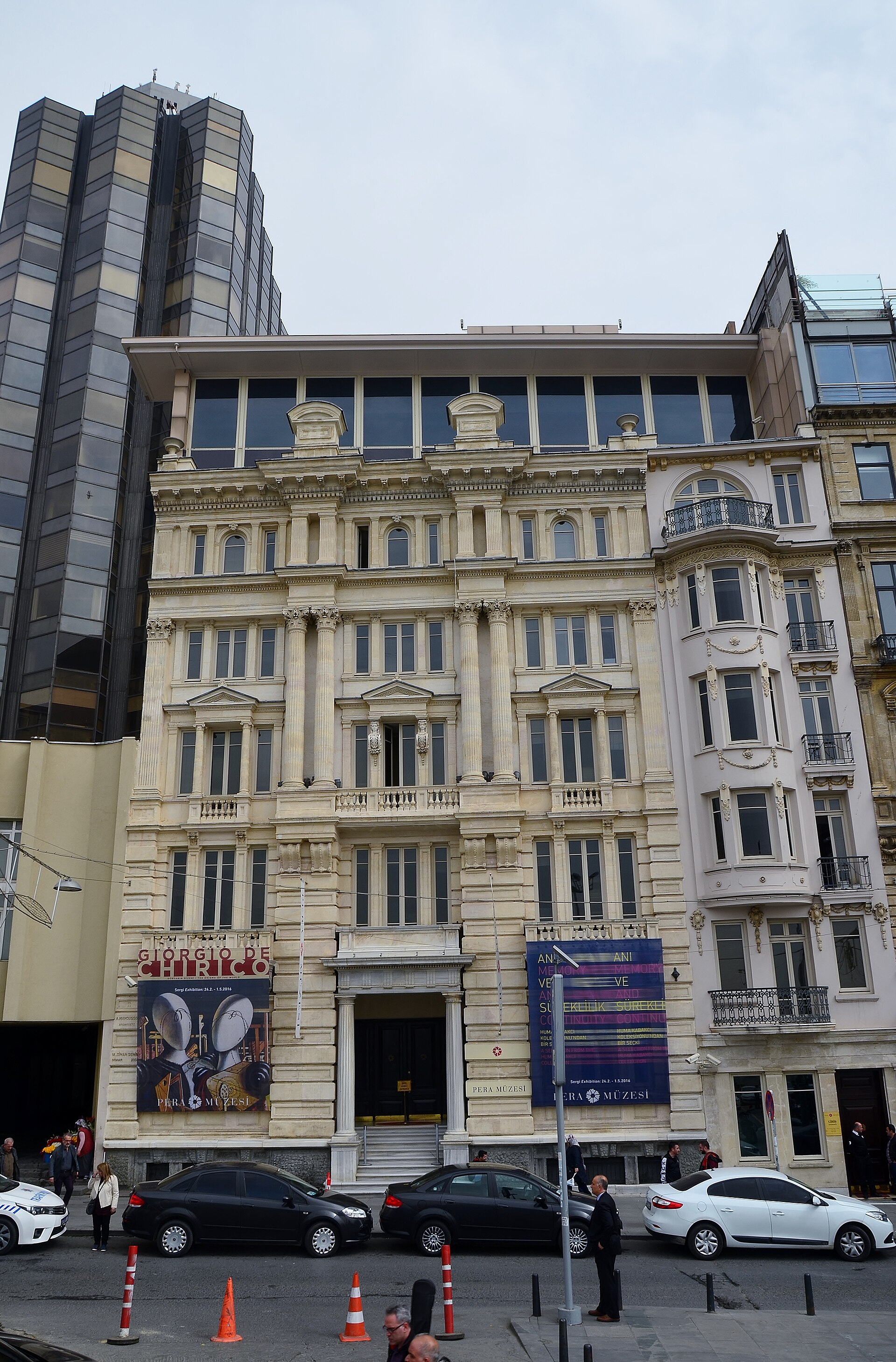
The former Hotel Bristol (1893), restored as Pera Museum; the neoclassical facade by Achille Manoussos was kept intact through every later conversion of the building.
CeeGee · CC BY-SA 4.0Pera Museum
Museum · Pera Muzesi · Founded 2005
Open, admission and hours confirmed 9 September 2026 · 14 sources
On this page 15 sections
ContentsClose
Pera Museum is not a general survey museum. Its strength is a tightly focused, family-formed body of material on the late Ottoman world seen from three angles at once: how European and Ottoman painters pictured the empire and its diplomatic relationships (the Orientalist Painting Collection); how ordinary commercial and civic life in Anatolia was measured across four millennia (the Weights and Measures Collection); and how one regional decorative craft, Kutahya tilework, adapted and survived into the twentieth century (the Kutahya Tiles and Ceramics Collection). The building itself, a former grand hotel restored rather than replaced, is part of the same argument: that the late Ottoman and early Republican periods in this part of Istanbul are worth preserving in detail rather than as a single generic heritage backdrop.
| Local name | Pera Muzesi |
|---|---|
| Kind | Museum |
| Founded | 2005 |
| City and country |  Istanbul, Turkey Istanbul, Turkey |
| Address | Mesrutiyet Caddesi No. 65, 34430 Tepebasi - Beyoglu, Istanbul, Turkey |
| Website | peramuseum.org |
| Status | Open, confirmed |
| Record last verified |
Visiting
- Hours
- Tue-Thu, Sat10:00 to 19:00
- Fri10:00 to 22:00Long Friday; free entry 18:00-22:00
- Sun12:00 to 18:00
- Closed
- Monday. The first day of religious holidays. New Year's Day (1 January).
- Admission
- AdultTRY 300
- ConcessionTRY 15012 years old or younger, students, teachers, 60 years and over
- GroupTRY 200per person, minimum 10 people
- Free admissionFreeFriends of Pera Museum, disabled visitors plus one companion, children aged 12 or under, ICOM cardholders, members of the press
Free entry: Every Friday 18:00-22:00 (Long Fridays). Every Wednesday for students (Young Wednesdays)- Do I need to book?
- No advance booking for individual visitors; self-guided school-group visits need a reservation
- Address
- Mesrutiyet Caddesi No. 65, 34430 Tepebasi - Beyoglu, Istanbul, Turkey MapMetro M2 (Yenikapi - Haciosman) line to Sishane station, about six minutes on foot
Bus Nearest stop is Tepebasi-Beyoglu, on Tarlabasi Boulevard - Website
- peramuseum.org
- Telephone
- +90 212 334 99 00
- [email protected]
Before you go how long, access, photography, bags, eating, shop
- How long to allow
- One to two hours for the three permanent collections, longer with a current loan exhibition
- Access
- Wheelchair accessible throughout; elevators serve every floor; wheelchair-accessible restrooms; free admission for disabled visitors and one companion
- Photography
- Not stated on the museum's own visit page
- Bags
- Not stated on the museum's own visit page
- Eating
- Pera Cafe, ground floor, styled as an art deco cafe in reference to the former Bristol Hotel (1893); salads, sandwiches, pasta and pastries, with themed menus tied to temporary exhibitions
- Shop
- The Artshop, ground floor, open since the museum's opening in 2005; exhibition catalogues and designed objects
Prices and hours change. We take them from the institution's own pages and print the day we read them, and you can check the current position at the source we used. Confirm before you travel.
What is inside
Orientalist Painting Collection (Sevgi and Erdogan Gonul Gallery)
Long-term thematic rotations of European and Ottoman painting from the 17th to the early 20th century, including the museum's five Osman Hamdi Bey works and ambassadorial portraits by Antoine de Favray and Fausto Zonaro
Anatolian Weights and Measures Collection
Permanent display drawn from a holding of nearly 10,000 instruments used for weighing, measuring length and measuring volume across Anatolia, from prehistory to the early Turkish Republic
Kutahya Tiles and Ceramics Collection
Permanent display of a selection from more than 800 tiles, plates and vases from the Anatolian town of Kutahya, mainly 18th to 20th century
Upper-floor temporary exhibition galleries
Three of the museum's five floors rotate through loan exhibitions organised with partners including Tate Britain, the Victoria and Albert Museum, the State Russian Museum and the Maeght Foundation
Pera Film
The museum's own cinema programme: classic and independent features, animation and documentary, often scheduled alongside the current temporary exhibition
What to see first
The Tortoise Trainer
Osman Hamdi Bey, 1906The museum's signature holding and the single work most visitors come to see; first shown at the 1906 Paris Salon as L'homme aux Tortues, it is usually read as an allegory of the slow pace of Ottoman reform7
Two Musician Girls
Osman Hamdi BeyOne of only five Osman Hamdi Bey paintings the collection holds, in the manner of French academic painting rather than the artist's better-known Orientalist register7
Girl with Pink Cap
Osman Hamdi BeyA portrait from within the artist's own circle of family and friends, part of the group of five works the museum treats as summing up his practice7
Kokenoglu Riza Efendi
Osman Hamdi BeyThe second of Osman Hamdi Bey's portraits of people close to him held by the museum7
Portrait of Charles Gravier, Comte de Vergennes, French Ambassador, in Turkish Attire
Antoine de Favray, second half of the 18th centuryShows the French ambassador to the Ottoman court seated cross-legged in Ottoman dress; paired with a companion portrait of his wife, and discussed in a 2017 Apollo Magazine review as evidence of how European envoys adopted Ottoman court manners for their own portraiture8
The Daughter of the English Ambassador Riding in a Palanquin
Fausto Zonaro, 1896Records a specific documented event: the daughter of British ambassador Sir Philip Currie, in London bridal fashion, carried to her wedding by Ottoman guards in fezzes8
The Genovefa Story plate series
Minas Avramidis, Kutahya, 1910-1915Ceramic plates by a Kutahya master illustrating a devotional legend that circulated through a Karamanlidika serial and a widely seen chromolithograph, examined in the museum's own Extraordinary Minas research project14
Anatolian Weights and Measures Collection
Assembled by Suna and Inan Kirac from the 1980sAlmost 10,000 instruments for weighing, measuring length and measuring volume, spanning prehistoric Anatolia to the early Turkish Republic, covering land measurement, commerce, architecture, jewellery-making, shipping and pharmacy5
Exhibitions on now
- On now29 Sep 2026 to 31 Jan 2027Confirmed , 5 weeks ago
The Bristol Hotel and its afterlife as a museum
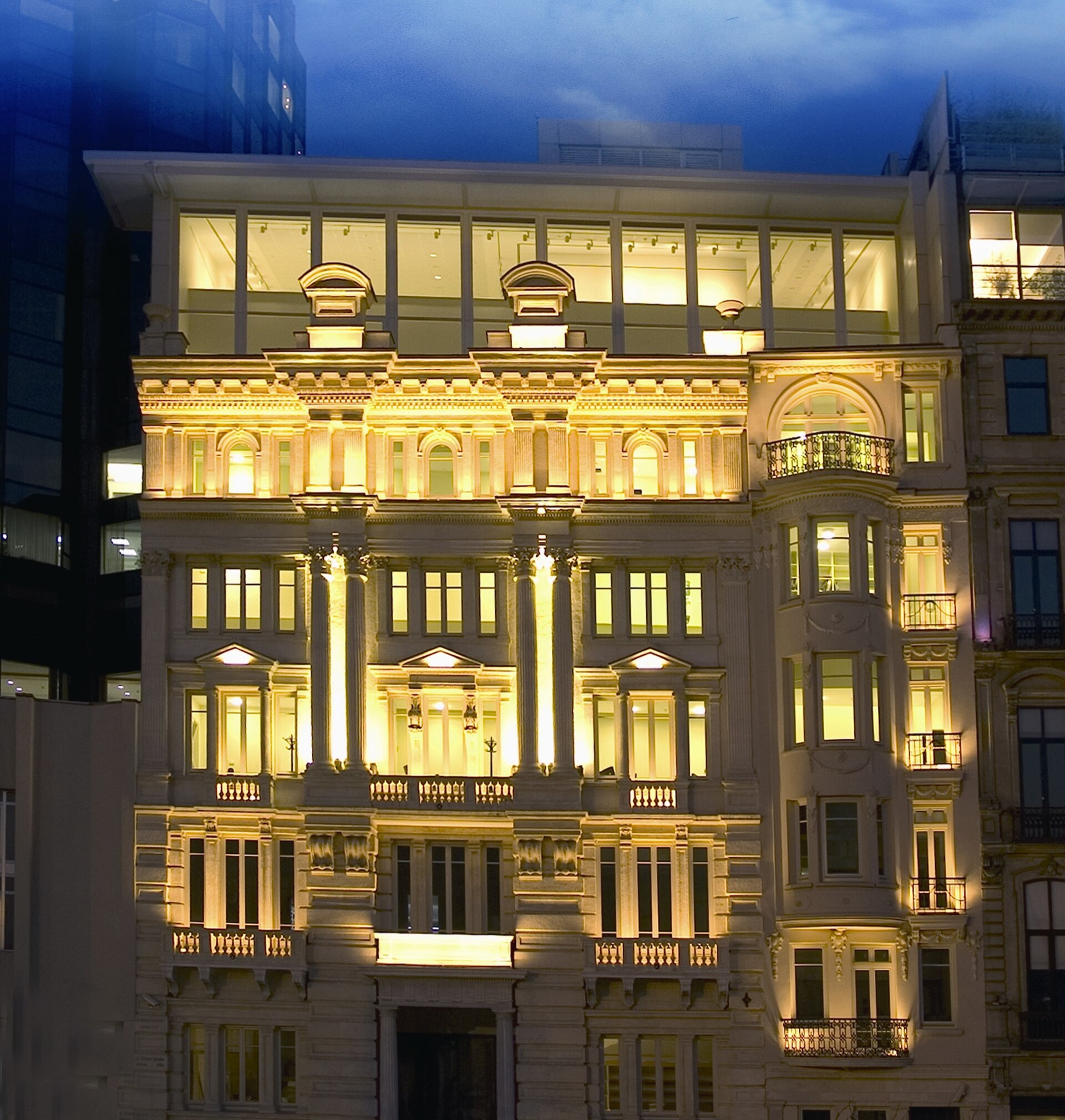
The building on Mesrutiyet Caddesi in the old Tepebasi quarter of Beyoglu was not built to hold paintings. It was built as the Hotel Bristol, completed in 1893 to a design by the architect Achille Manoussos, in the same neoclassical idiom favoured along this stretch of what was then called the Grande Rue de Pera. The land and the building belonged to the Armenian Catholic Patriarchate. For nearly ninety years it operated as one of the city's principal hotels, with a large lobby, marble stairs, a lift, comfortable suites and a spacious dining hall with separate table seating, and it hosted a succession of well-known managers, among them Logothetti, Adampoulos, Djiras and Hadjira. In the early 1930s, as the demographic composition of the district shifted, Omer Lutfi Bengu bought the hotel and ran it until the 1980s, by which point it could no longer compete with newer establishments. After Bengu's death in 1983 his heirs put the property up for sale. It passed first to Yildiz Lastikcilik, a rubber manufacturer, and then to Esbank, a national bank, which commissioned the architect Dogan Hasol to redesign it as its headquarters; the hotel and an adjoining five-storey residential building were combined into a single lot, though the facades facing Mesrutiyet Caddesi were kept intact. Esbank occupied the building until 2002. The following year the Suna and Inan Kirac Foundation engaged the restorer and architect Sinan Genim to convert it into a museum, a renovation that preserved Manoussos' original facade while rebuilding the interior as a modern, fully equipped exhibition space across five floors. Pera Museum opened to the public on 8 June 2005. The Pera Cafe on the ground floor, decorated in reference to the old Bristol Hotel, is the clearest surviving echo of the building's first life.
The Suna and Inan Kirac Foundation
The museum exists because of a family foundation with a wider brief than art. Suna Kirac, Inan Kirac and Ipek Kirac established the Suna and Inan Kirac Foundation on 27 October 2003, with education, healthcare and culture as its three declared fields. In education it has funded scholarships and grants for more than three hundred disadvantaged students, from primary school through postgraduate study. In healthcare it has focused on neurodegenerative disease, working with Harvard Medical School and Bogazici University and launching the Bogazici University Suna and Inan Kirac Foundation Neurodegeneration Research Laboratory in 2005, alongside a recurring series of international conferences on the subject. In culture, alongside the museum, the Foundation ran a project between 2005 and 2007, funded by the Getty Foundation, to digitise the roughly 20,000 manuscripts of the Millet Manuscript Library, assembled by the Ottoman intellectual Ali Emiri Efendi; a later phase extended the work to cataloguing and conservation. The museum and the Istanbul Research Institute are the Foundation's two standing cultural institutions, and both draw on collections the Kirac family had already been assembling privately since the 1980s, well before either institution existed.
The Orientalist Painting Collection
The largest and best-known of the three permanent collections gathers European and Ottoman painting from the seventeenth century to the early twentieth, organised around the long encounter between the Ottoman Empire and the West. It is shown in long-term thematic rotations in the Sevgi and Erdogan Gonul Gallery rather than as a single fixed hang, so which paintings are on the wall in a given season varies, but the core group is stable. Among the European painters represented are Jean-Baptiste Vanmour, Antoine de Favray, Fausto Zonaro, Jean-Leon Gerome, George Engelhardt Schroder and Luigi Mayer, alongside Ottoman painters who trained in this same visual language, chief among them Osman Hamdi Bey, an Ottoman administrator, archaeologist and painter whose five works in the collection are treated by the museum as a group that, taken together, sums up the range of his practice. The best known of the five, and the single work most visitors come to see, is The Tortoise Trainer, dated 1906 and first shown that year at the Paris Salon of the Societe des Artistes Francais under the title L'homme aux Tortues. It shows a man in the dress of a wandering dervish, holding a reed flute and a drum, watching a group of tortoises eat greenery in front of a lancet window in the upper room of the Green Mosque in Bursa; the figure is modelled on the artist himself, and the scene is usually read as an allegory of the slow pace of Ottoman reform. The other four works in the group move in different directions: Two Musician Girls, in the manner of French academic painting; Shepherd Mustafa Pasha Complex in Gebze, a landscape in a freer brushwork; and two portraits from within Osman Hamdi's own circle, Girl with Pink Cap and Kokenoglu Riza Efendi. The collection's diplomatic material is just as pointed. Antoine de Favray's portrait of Charles Gravier, Comte de Vergennes, the French ambassador to the Sublime Porte, shows him seated cross-legged on a low divan in Ottoman dress, a companion portrait showing his wife Annette in the same idiom; both were discussed in a 2017 Apollo Magazine review of the collection display Intersecting Worlds: Ambassadors and Painters as evidence of how comfortably eighteenth-century European envoys adopted Ottoman court manners for their own portraits. Fausto Zonaro's The Daughter of the English Ambassador Riding in a Palanquin, of 1896, records a specific and documented event: the daughter of the British ambassador Sir Philip Currie, dressed in contemporary London bridal fashion, being carried to her church wedding in a palanquin by Ottoman guards wearing the fez, a single scene that folds together two different worlds without resolving them.
Anatolian Weights and Measures
The Anatolian Weights and Measures Collection is the odd one out among the three permanent holdings, in that it is not an art collection at all. Suna and Inan Kirac began assembling it as early as the 1980s, and it now holds close to ten thousand objects used to measure weight, length and volume across the civilisations that occupied Anatolia, from the prehistoric period through the Classical world, the era of the Anatolian principalities, the Ottoman Empire and into the early Turkish Republic. The instruments come from every field that needed them: land measurement, commerce, architecture, jewellery-making, shipping and the dispensing of medicine. Displayed together, the collection turns a subject that could easily be treated as a footnote to economic history into a continuous material record of how people in this particular part of the world agreed, generation after generation, on how much something weighed or how far apart two points stood.
Kutahya Tiles and Ceramics
The third permanent collection, also begun by the Kirac family in the 1980s, holds more than eight hundred tiles, plates, vases and related ceramic pieces from Kutahya, the Anatolian town that succeeded Iznik as the Ottoman Empire's principal centre of tile production and remained important from the eighteenth through the twentieth century. Only a limited selection is on view at any one time, chosen to give a sense of the range of the wider collection and of Kutahya's decorative vocabulary of floral and figural motifs on white and turquoise grounds. The Foundation's research into the collection has gone beyond display: a dedicated exhibition and catalogue, Extraordinary Minas, examined the work of the Kutahya master Minas Avramidis, who was active from the 1910s and whose ceramic plate series illustrating the Genovefa Story, a devotional narrative of faith and loyalty that circulated in the late Ottoman period through a Karamanlidika serial and a widely seen chromolithograph by Sotiris Christidis, is held in the Foundation's own Kutahya archive. The project traced how Minas and other Kutahya masters dispersed to Athens, Thessaloniki and Jerusalem in the second quarter of the twentieth century, carrying the craft's tradition and its innovations with them.
Temporary exhibitions, Pera Film and the wider programme
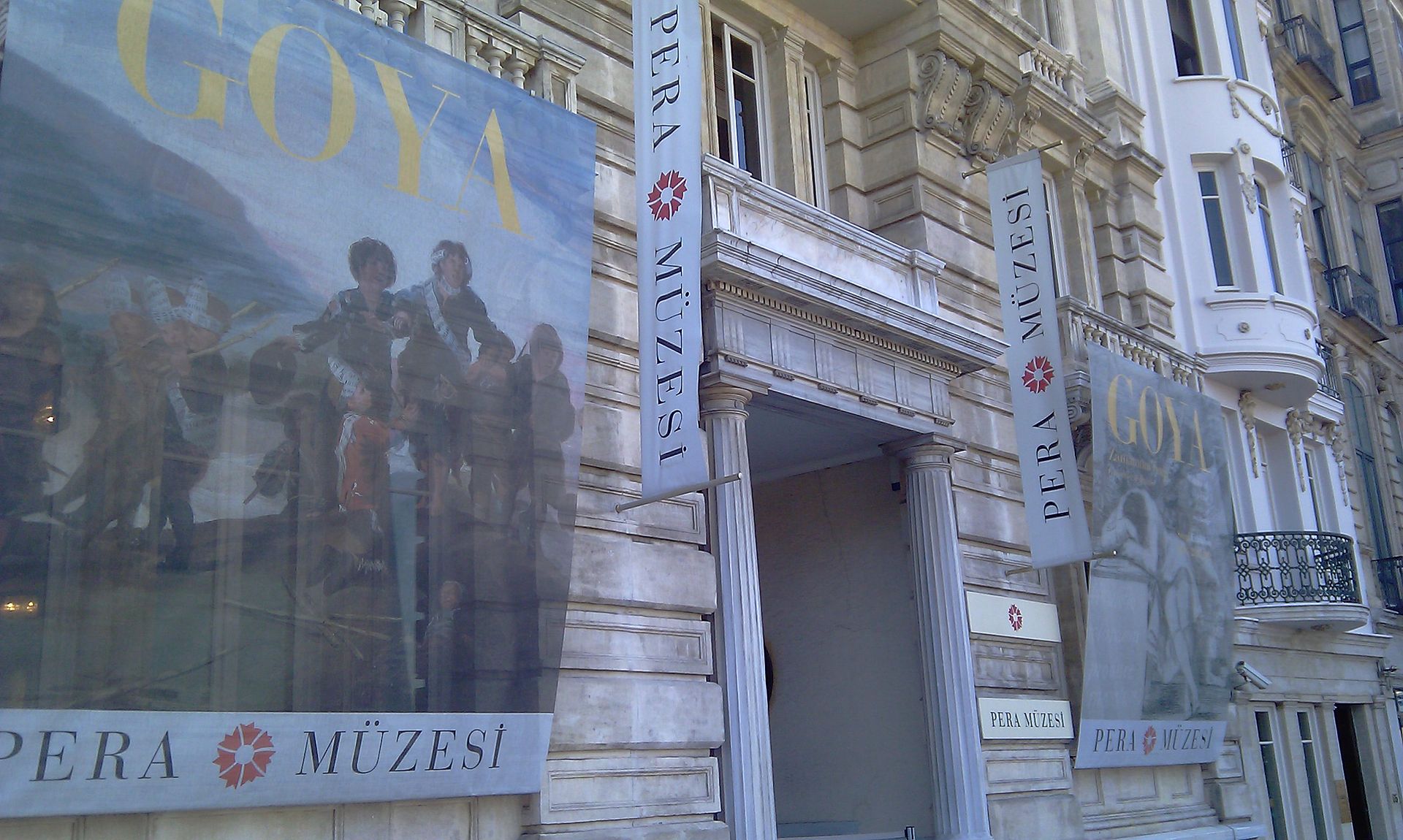
Only two of the museum's five floors are given over permanently to the collections described above; the remaining floors rotate through loan exhibitions organised with international partners, among them Tate Britain, the Victoria and Albert Museum, the State Russian Museum in St Petersburg, the JPMorgan Chase Collection, the New York School of Visual Arts and the Maeght Foundation. Artists shown at Pera Museum through these partnerships have included Rembrandt, Goya, Picasso, Marc Chagall, Frida Kahlo, Diego Rivera, Andy Warhol, Alberto Giacometti, Giorgio de Chirico, Joan Miro, Fernando Botero, Niko Pirosmani, Henri Cartier-Bresson, Josef Koudelka, Cecil Beaton and Sergey Parajanov, and every temporary exhibition is accompanied by its own catalogue and a linked programme of talks and workshops. Pera Film, the museum's own cinema, runs a parallel schedule of screenings, from classic and independent features to animation and documentary, and frequently times its programme to match the theme of whatever exhibition is upstairs. The ground floor also holds the Pera Cafe, styled after the art deco cafes of old Pera and serving food and pastries, and the Artshop, which has operated since the museum opened and sells exhibition catalogues and designed objects.
What visitors say
Visitors and critics describe a small museum that punches above its footprint: five compact floors combining three well-labelled permanent collections with a changing programme of loan exhibitions from major international partners. The Tortoise Trainer draws visitors on its own, and the quiet, uncrowded galleries are repeatedly cited as a relief from the crowds of Istanbul's nearby headline sights.
What is praised, what is criticised
- Praised: Clear English-language labelling and free audio guides
- Praised: A compact, easy-to-tour five-floor layout, with the ground-floor cafe and shop singled out as worth the stop on their own
- Praised: The quality of loan and thematic exhibitions drawn from international partner institutions
- Criticised: Several visitors note that only two of the five floors hold the permanent collection, describing the museum as a worthwhile but not obligatory stop rather than a must-see destination
Ratings on other platforms
Tripadvisor: 4.5 from 338 ratings, read 9 September 2026
A platform average is a tertiary source: it moves, it is not audited, and we quote no visitor's words.
Questions about Pera Museum
Where is Pera Museum?
Mesrutiyet Caddesi No. 65, 34430 Tepebasi - Beyoglu, Istanbul, Turkey.
How much does it cost to visit?
Adult: TRY 300; Concession: TRY 150; Group: TRY 200; Free admission: free. As confirmed 9 September 2026.
When is it open?
Tue-Thu, Sat 10:00-19:00; Fri 10:00-22:00; Sun 12:00-18:00. Closed: Monday. The first day of religious holidays. As confirmed 9 September 2026.
How do you get there?
Metro: M2 (Yenikapi - Haciosman) line to Sishane station, about six minutes on foot; Bus: Nearest stop is Tepebasi-Beyoglu, on Tarlabasi Boulevard.
What should you see first?
The Tortoise Trainer (Osman Hamdi Bey, 1906); Two Musician Girls (Osman Hamdi Bey); Girl with Pink Cap (Osman Hamdi Bey); Kokenoglu Riza Efendi (Osman Hamdi Bey); Portrait of Charles Gravier, Comte de Vergennes, French Ambassador, in Turkish Attire (Antoine de Favray, second half of the 18th century); The Daughter of the English Ambassador Riding in a Palanquin (Fausto Zonaro, 1896).
What we could not confirm
- The museum's collection pages describe when the Weights and Measures and Kutahya collections were formed (the 1980s onward) but do not publish object-by-object acquisition provenance for individual pieces.
- Photography policy and bag-storage arrangements for visitors are not stated on the museum's own visit page.
Images
Sources
- 1Pera Museum, Visit page (hours, admission, contact, transport) peramuseum.org/home/visit
- 2Pera Museum, About Us page (history, founders, architects) peramuseum.org/home/about
- 3Pera Museum, Collections page peramuseum.org/collection
- 4Pera Museum, Orientalist Painting Collection page peramuseum.org/collection/orientalist-painting-collection/15
- 5Pera Museum, Anatolian Weights and Measures Collection page peramuseum.org/Collection/Anatolian-Weights-and-Measures-Collection/16
- 6Pera Museum, Kutahya Tiles and Ceramics Collection page peramuseum.org/Collection/Kutahya-Tiles-and-Ceramics-Collection/17
- 7Pera Museum, The Tortoise Trainer, artwork page peramuseum.org/artwork/the-tortoise-trainer/15/92
- 8Sarah Jilani, 'A picture of past diplomacy in Istanbul's Pera Museum', Apollo Magazine, 26 January 2017 apollo-magazine.com/picture-past-diplomacy-istanbul-pera-museum/
- 9Wikimedia Commons, Category:Pera Museum commons.wikimedia.org/wiki/Category:Pera_Museum
- 10Wikipedia, Pera Museum (, identity and founding date only) en.wikipedia.org/wiki/Pera_Museum
- 11Tripadvisor, Pera Museum attraction page, aggregate rating () tripadvisor.com/Attraction_Review-g293974-d3539275-Reviews-Pera_Museum-Istanbul.html
- 12Tripadvisor, 'Good but limited museum', review by mschoenmd, 1 May 2013 () tripadvisor.com/ShowUserReviews-g293974-d3539275-r159331659-Pera_Museum-Istanbul.html
- 13Daily Sabah, 'Time to Discover Pera Museum's Permanent Collections', 18 August 2017 dailysabah.com/arts-culture/2017/08/18/time-to-discover-pera-museums-permanent-collections
- 14Pera Museum, Extraordinary Minas exhibition page peramuseum.org/exhibition/extraordinary-minas/1313