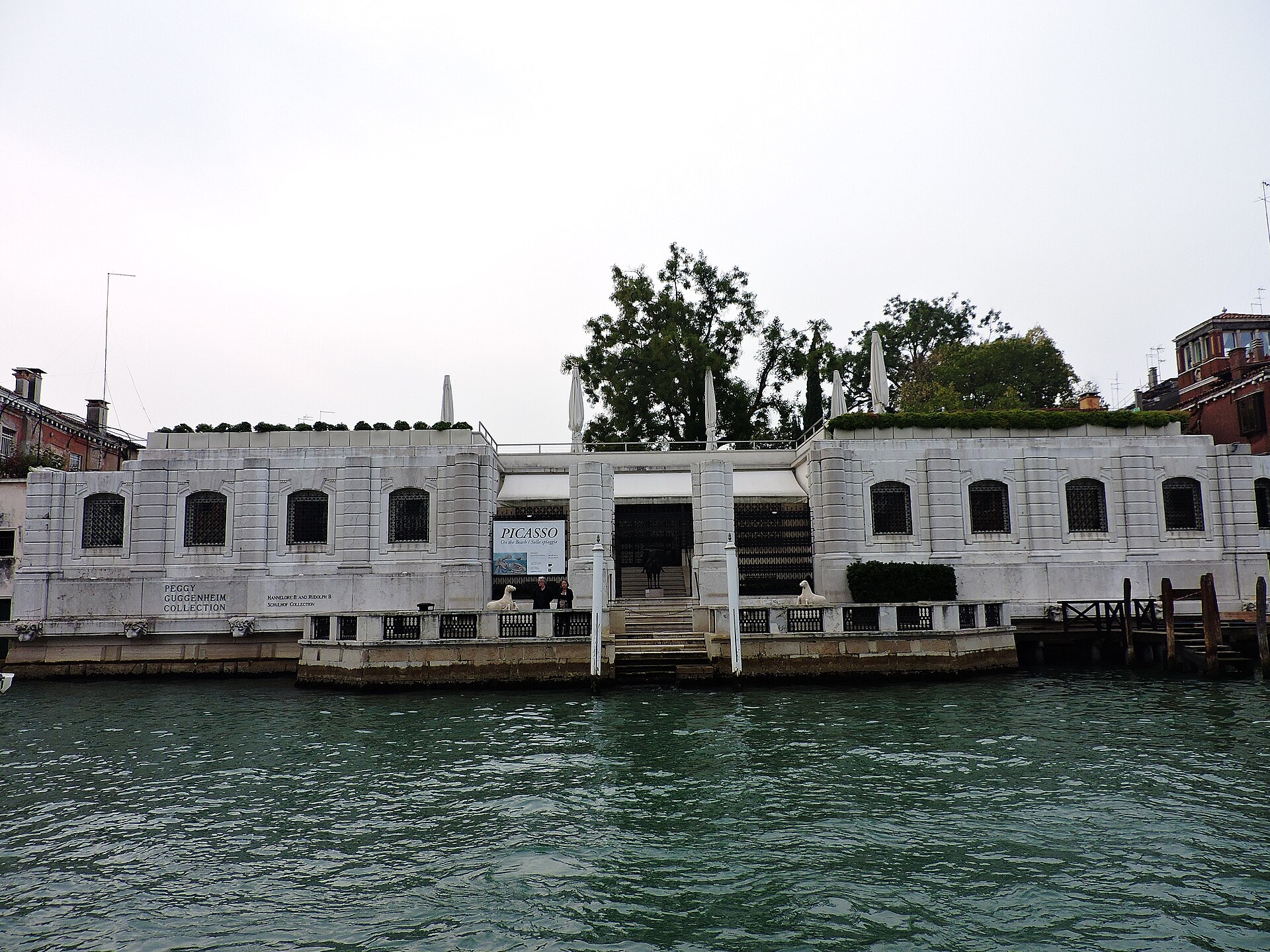
Palazzo Venier dei Leoni, the single-storey, flat-roofed Istrian stone building housing the Peggy Guggenheim Collection, seen from the Grand Canal with the museum's sign visible.
Dimitris Kamaras · Photograph by Dimitris Kamaras from Athens, Greece · CC BY 2.0Peggy Guggenheim Collection
Museum · Collezione Peggy Guggenheim · Founded 1948
Open, admission and hours confirmed 26 August 2026 · 9 sources
On this page 16 sections
ContentsClose
The collection's strength is chronological and personal rather than encyclopaedic: roughly a decade, 1938 to 1946, of Peggy Guggenheim's own eye, bought in real time and mostly from the artists or their immediate dealers rather than assembled retrospectively. That gives it unusual depth in early Abstract Expressionism, Surrealism and Cubism relative to its size, and an ownership record that is close to as clean as provenance gets in a museum of this age - most works have one collector, Guggenheim herself, standing between the artist's studio and the current display.
| Local name | Collezione Peggy Guggenheim |
|---|---|
| Kind | Museum |
| Founded | Palazzo Venier dei Leoni bought by Peggy Guggenheim in 1948; the sculpture garden and house opened seasonally to the public from 1949-1951; given to the Solomon R. Guggenheim Foundation in 1976 and opened as a year-round public museum from 1980 |
| City and country |  Venice, Italy Venice, Italy |
| Address | Palazzo Venier dei Leoni, Dorsoduro 701, I-30123 Venice, Italy |
| Website | guggenheim-venice.it/en |
| Status | Open, confirmed |
| Record last verified |
Visiting
- Hours
- Daily10:00 to 18:00Ticket office closes at 17:00
- Closed
- Tuesday. 25 December.
- Admission
- AdultEUR 17Standard admission
- Senior, over 70EUR 14Also covers FAI, Touring Club Italiano, COOP-card, Cinemapiu and several partner-museum-pass holders
- Reduced, students under 26 / ages 10-18EUR 9Valid student ID required; also covers school groups and several professional and card-holder categories
- Under 10FreeFree
Free entry: Thursdays, 2 to 6 pm: free for Venice residents and those born in Venice, and for students at Venetian universities and vocational schools. Disabled visitors and one accompanying companion, free at all times. Guggenheim members and patrons, free at all times- Tickets
- guggenheim-venice.it/en/visit The museum's own ticket page.
- Do I need to book?
- No, tickets can be bought online or at the museum ticket office
- Address
- Palazzo Venier dei Leoni, Dorsoduro 701, I-30123 Venice, Italy MapVaporetto Accademia or Salute stop, both a short walk along the Grand Canal
On foot Dorsoduro district, between the Accademia bridge and the Salute basilica - Website
- guggenheim-venice.it/en
- Telephone
- +39 041 2405 411
- [email protected]
Before you go how long, access, photography, bags, eating, shop
- How long to allow
- TripAdvisor's own listing gives two to three hours; the house is small enough that visitors consistently note it can feel crowded relative to its size at busy times
- Access
- Not detailed on the pages consulted for this file beyond general visitor-services information; not confirmed further
- Photography
- Not stated on the pages consulted for this file; not confirmed
- Bags
- Large bags, backpacks and suitcases are not permitted inside; lockers are provided
- Eating
- Cafe on site, per the museum's own visitor-services listing
- Shop
- Museum shop on site
Prices and hours change. We take them from the institution's own pages and print the day we read them, and you can check the current position at the source we used. Confirm before you travel.
What is inside
Peggy Guggenheim's personal collection (the former living rooms)
The core of the museum: the roughly 300-piece collection Peggy Guggenheim assembled between 1938 and 1946, hung through what were her own reception rooms and bedroom on the single completed floor of the palazzo. Cubism, Futurism, Metaphysical painting, European Abstraction and Surrealism are all represented, alongside the Abstract Expressionists she championed early, principally Jackson Pollock.
The sculpture garden
The garden Peggy Guggenheim opened to the public in 1949, originally to show sculpture during that year's Venice Biennale, now permanent. It holds Marino Marini's The Angel of the City on the canal-facing terrace, and is also where Peggy Guggenheim is buried, alongside her dogs, in a corner of the garden she used in life.
The Schulhof Collection
Postwar American and European art from the collection of Hannelore B. and Rudolph B. Schulhof, given to the museum to extend the story past the point where Peggy Guggenheim's own active collecting stopped in the 1940s.
African, Oceanic and pre-Columbian art
A smaller, later strand of Peggy Guggenheim's own collecting: in 1959 she bought what she called in her memoirs 'twelve fantastic artifacts' from Africa, Oceania and the Americas from the New York dealer Julius Carlebach, and expanded the group through the 1960s. It sits apart from the European and American modernism that makes up most of the museum and is easy for a visitor focused on the paintings to miss.
Temporary exhibition galleries
The museum mounts a temporary exhibition most years alongside the permanent collection; through 2026 this is Peggy Guggenheim in London: The Making of a Collector, on Peggy Guggenheim's Guggenheim Jeune gallery, which ran in London from 1938 and prefigured the Venice collection by roughly a decade.
What to see first
Alchemy
Jackson Pollock, 1947One of Pollock's first fully poured paintings; Peggy Guggenheim gave Pollock a monthly stipend and a New York exhibition before almost any other institution would show him, and this collection is a direct record of that early patronage.4
The Moon Woman
Jackson Pollock, 1942An earlier, figurative Pollock from the same patronage relationship, useful in the same rooms as Alchemy for showing how fast his painting changed under Guggenheim's support.4
On the Beach
Pablo Picasso, 1937Bought as part of Guggenheim's 1938-1940 London and Paris buying campaign, when she resolved, in her own words, to buy a picture a day.4
The Attirement of the Bride
Max Ernst, 1940Painted by the man who became Guggenheim's second husband in the same period she was buying his work as a collector rather than as a spouse; the personal and curatorial relationship are hard to separate in this collection more than in most.4
Bird in Space
Constantin BrancusiOne of Brancusi's serial variations on the same subject, bought directly from the artist; a separate cast from the version whose ownership history after 1928 is unresolved in this archive's own Brancusi record, a reminder that Brancusi made the same composition repeatedly and that provenance has to be checked cast by cast, not by title.4
The Empire of Light
Rene MagritteA day-and-night composition from Magritte's recurring series of the same title and idea, part of the Surrealist holdings that anchor the collection alongside the Ernsts.4
The Angel of the City
Marino Marini, 1948A bronze horse and rider on the canal-facing terrace, installed by Guggenheim herself; the rider's phallus is a detachable bronze piece, and Guggenheim wrote in her own memoirs that she removed it when nuns or more conservative visitors were expected, then screwed it back in afterward.5
Twelve artifacts from Africa, Oceania and the Americas
VariousBought from the New York dealer Julius Carlebach in 1959 and expanded through the 1960s, this is Peggy Guggenheim's own late, lesser-known departure from the European and American modernism that defines the rest of the collection.6
Exhibitions on now
- On now25 Apr to 19 Oct 2026Confirmed · check before you travel
- Opening soon14 Nov 2026 to 29 Mar 2027Confirmed , 7 weeks ago
Past exhibitions here
- Closed30 Apr to 16 Sep 2013Confirmed · check before you travel
An unfinished palace on the Grand Canal
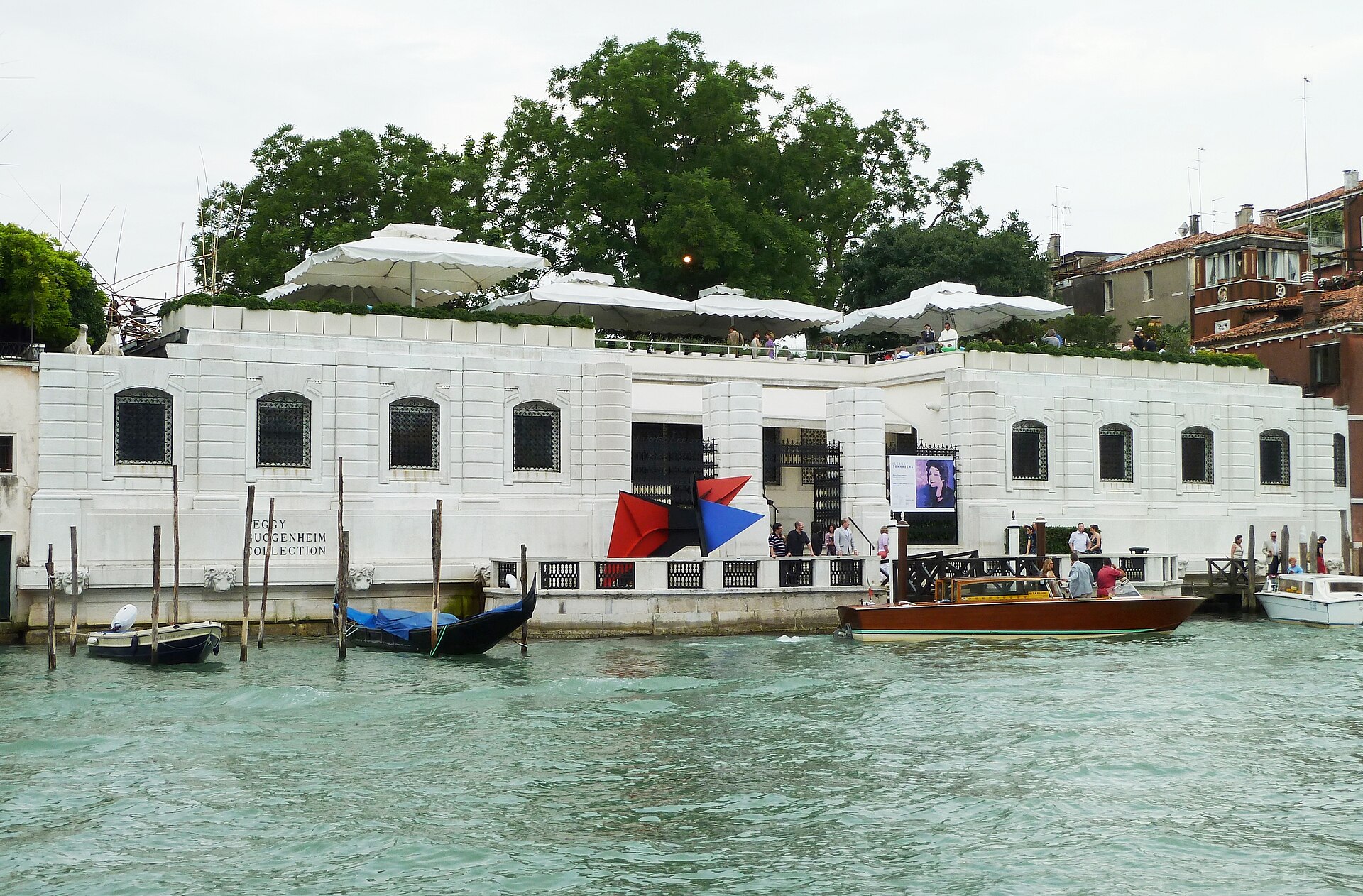
The building that now holds the collection was never completed. In 1749 the architect Lorenzo Boschetti designed a palazzo for the Venier family on the Grand Canal, meant to combine the styles of Palladio and Longhena on a scale to match the family's ambitions. It was never built past a single low floor. Two explanations for the abandonment circulate: that the rival Corner family, whose own palazzo stands across the canal, worked to block completion so as not to be overshadowed, or more plainly that the Venier heirs ran out of money finishing a project their father's will had obliged them to start. Either way, the result is the building's most distinctive feature today - a single-storey, flat-roofed structure with a rusticated Istrian stone facade, unlike anything else on the Grand Canal, which is why Venetians still sometimes call it the Palazzo Nonfinito, the unfinished palace.
The palazzo passed through several owners before Peggy Guggenheim. The Marchesa Luisa Casati, a collector and famous eccentric in her own right, lived there from 1910 until financial ruin forced her to sell in 1924. Guggenheim bought the palazzo in 1948, moved in, and began showing sculpture in the garden the following year, timed to the 1949 Venice Biennale; from 1951 she opened the house itself to the public on a seasonal basis, afternoons through the spring, summer and early autumn.
A collection assembled ahead of the building that would house it
Guggenheim had already built almost the entire collection before she owned Palazzo Venier dei Leoni. Her curatorial career began in 1938 with the gallery Guggenheim Jeune in London, where she gave Kandinsky his first British solo show. When a plan for a London museum fell through, she moved to Paris in 1939 and set herself, in her own account, a regime of buying one picture a day, working through a list of artists the critic Herbert Read had drawn up for her. She kept buying as the war closed in: she bought Fernand Leger's Men in the City on the day Nazi Germany invaded Norway, and acquired Brancusi's Bird in Space as German forces were closing on Paris itself, wartime prices and departing collectors and dealers making available, in a matter of months, an inventory that would normally have taken a decade to assemble. She moved part of the collection to Grenoble in 1940 to keep it out of reach of the Nazi campaign against what the regime called degenerate art, fled Paris days before the German occupation, and in July 1941 escaped France for New York with her children, her former husband Laurence Vail, and the artist Max Ernst, who married her within months of their arrival.
From a private house to a public institution
Guggenheim ran a gallery in New York, Art of This Century, through the 1940s before settling permanently in Venice with the collection already formed. The Venice house functioned as her home and as an increasingly public collection for nearly three decades: seasonal openings from 1951, a fixture of the Biennale years, until her death in 1979. She is buried in the garden, in the corner she had used as a sculpture court since 1949, alongside the dogs she kept there. In 1976, three years before her death, she gave the palazzo and its roughly 300-piece collection outright to the Solomon R. Guggenheim Foundation, the body her uncle Solomon had endowed to run the Guggenheim Museum in New York; the Foundation opened the collection to the public year-round from 1980, the point at which a private house with visiting hours became, administratively, a museum.
What has been added since
What visitors see today is not only what Peggy Guggenheim bought. The Foundation has added the Hannelore B. and Rudolph B. Schulhof Collection of postwar American and European art, extending the story past the point in the 1940s where Guggenheim's own active buying largely stopped, and the museum runs a temporary exhibition programme alongside the permanent rooms - through 2026 a show on Guggenheim's own London gallery, which functions as this institution's account of its own prehistory. A smaller and less remarked strand is Guggenheim's own 1959 purchase, from the New York dealer Julius Carlebach, of what she called twelve fantastic artifacts from Africa, Oceania and the Americas, a group she kept adding to through the 1960s and which sits outside the European-and-American-modernism story the rest of the museum tells.
A collector's own taste, still on display as she left it
Because the museum is still substantially the house Peggy Guggenheim lived in, some of what is on view records her own judgment as directly as it records the artists'. Marino Marini's bronze Angel of the City stands on the canal-facing terrace exactly where Guggenheim placed it in 1948: a horse and rider with the rider's arms flung open and, cast as a separate bronze piece that screws in and out, an erect phallus. Guggenheim wrote in her own memoirs that she detached it when nuns passed by on the canal during religious processions, or when she had to receive visitors she judged too conservative for it, and reattached it afterward. It is a small, literal instance of a pattern that runs through the whole collection: what is shown, and how, in this particular museum was for most of its history one woman's decision, made in her own house, and the building still reads that way.
A cleaner provenance than most, with one honest caveat
Set against museums built on inherited dynastic collections or on colonial-era acquisition, this collection's ownership history is unusually direct: Guggenheim bought almost all of it herself, from artists or from named dealers, in a documented few years, and gave it to a named foundation by a signed deed. That directness is also the source of the one caveat worth stating plainly rather than smoothing over: a substantial part of the buying happened in Paris in 1939 and 1940, as war approached and then arrived, when artists, dealers and collectors were selling amid an emergency that depressed prices and narrowed everyone's choices. Guggenheim's own account frames this as opportunism she was proud of - buying a picture a day while others panicked - and nothing in the sources consulted for this record suggests any purchase was made under duress from the seller's side in the way a forced Nazi-era sale would be. But the wartime market conditions that let her build a world-class collection in roughly two years are part of how that collection came to exist, and are worth stating alongside the results.
What visitors say
Visitors rate the collection highly and consistently describe it as more intimate and personal than a conventional museum, precisely because it is still installed in a private house rather than purpose-built galleries; the recurring qualifier is that the house is small relative to the crowds it now draws.
What is praised, what is criticised
- Praised: The quality and concentration of the Cubist, Surrealist and early Abstract Expressionist material is repeatedly singled out as unusually strong for the museum's physical size
- Praised: The garden and the canal-front terrace, including Marini's Angel of the City, are named as a highlight distinct from the paintings
- Criticised: The house's small scale means the rooms can feel crowded at busy times, a complaint distinct from anything about the art itself
- Criticised: The strict bag policy, which excludes backpacks and larger bags from the galleries, is noted by visitors as more restrictive than they expected
Ratings on other platforms
TripAdvisor: 4.5 from 8,703 ratings, read 7 August 2026
A platform average is a tertiary source: it moves, it is not audited, and we quote no visitor's words.
Questions about Peggy Guggenheim Collection
Where is Peggy Guggenheim Collection?
Palazzo Venier dei Leoni, Dorsoduro 701, I-30123 Venice, Italy.
How much does it cost to visit?
Adult: EUR 17; Senior, over 70: EUR 14; Reduced, students under 26 / ages 10-18: EUR 9; Under 10: free. As confirmed 26 August 2026.
When is it open?
Daily 10:00-18:00. Closed: Tuesday. 25 December. As confirmed 26 August 2026.
How do you get there?
Vaporetto: Accademia or Salute stop, both a short walk along the Grand Canal; On foot: Dorsoduro district, between the Accademia bridge and the Salute basilica.
What should you see first?
Alchemy (Jackson Pollock, 1947); The Moon Woman (Jackson Pollock, 1942); On the Beach (Pablo Picasso, 1937); The Attirement of the Bride (Max Ernst, 1940); Bird in Space (Constantin Brancusi); The Empire of Light (Rene Magritte).
What we could not confirm
- The wartime market conditions in Paris in 1939-1940, in which Guggenheim built most of the core collection, depressed prices and narrowed choices for sellers as the German advance continued; the sources consulted for this record do not identify any individual purchase as a forced or distressed sale, but the general circumstance is part of the collection's formation and is stated here rather than left unmentioned.
- Some later sources describe unresolved disagreement over the exact placement or permanence of Peggy Guggenheim's grave in the garden; this record states that she is buried there, per the museum's own account, without adjudicating that dispute, which was not resolved in the sources consulted.
Images
Sources
- 1Peggy Guggenheim Collection, Visit (museum's own site) guggenheim-venice.it/en/visit/
- 2Peggy Guggenheim Collection, Discounted and free admission (museum's own site) guggenheim-venice.it/en/visit/discounted-and-free-admission/
- 3Peggy Guggenheim Collection, About Peggy (museum's own site) guggenheim-venice.it/en/art/in-depth/peggy-guggenheim/about-peggy/
- 4Wikipedia, Peggy Guggenheim Collection () en.wikipedia.org/wiki/Peggy_Guggenheim_Collection
- 5The Art Newspaper, Marino Marini rises to the occasion at the Peggy Guggenheim Collection, 29 January 2018 theartnewspaper.com/2018/01/29/marino-marini-rises-to-the-occasion-at-the-peggy-guggenheim-collection
- 6Peggy Guggenheim Collection, homepage, Art from Africa in the Peggy Guggenheim Collection (museum's own site) guggenheim-venice.it/en/
- 7Wikipedia, Palazzo Venier dei Leoni () en.wikipedia.org/wiki/Palazzo_Venier_dei_Leoni
- 8TripAdvisor, Peggy Guggenheim Collection, aggregate rating () tripadvisor.com/Attraction_Review-g187870-d196473-Reviews-Peggy_Guggenheim_Collection-Venice_Veneto.html
- 9Wikidata Q1049033, Peggy Guggenheim Collection (, identity and coordinates) wikidata.org/wiki/Q1049033