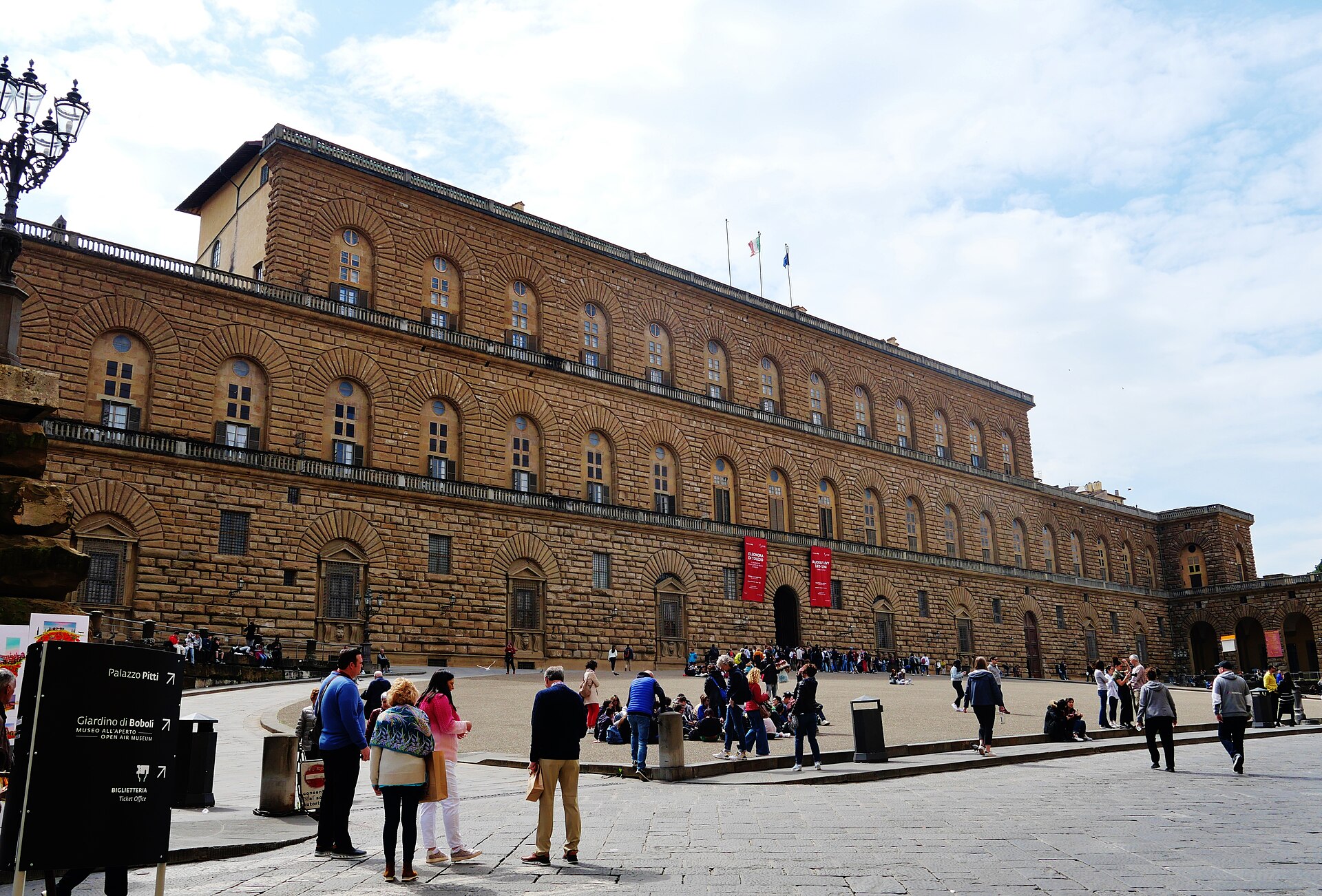
The rusticated stone facade of Palazzo Pitti seen from the piazza, with visitors gathered at the entrance.
Zairon · CC BY 4.0On this page 14 sections
ContentsClose
The palace's strength is that it was a residence before it was a museum, occupied by three different ruling dynasties across nearly four centuries, so its holdings were assembled by the taste of whoever was living there rather than by a single acquisitions policy. That gives the Palatine Gallery its distinctive, unchronological hang and gives the complex as a whole a range - Renaissance devotional painting, Baroque court silver, 19th-century Macchiaioli landscape, 20th-century stage costume - that a purpose-built museum with a coherent collecting mandate would not have assembled on purpose.
| Kind | Museum |
|---|---|
| Founded | Construction begun in the mid-1400s for Luca Pitti; bought by the Medici in 1549-1550 as a Grand Ducal residence; opened as a public museum complex through the 20th century after the 1919 gift to the Italian state |
| City and country |  Florence, Italy Florence, Italy |
| Address | Piazza de' Pitti 1, 50125 Firenze, Italy |
| Website | uffizi.it/en/pitti-palace |
| Status | Open, confirmed |
| Record last verified |
Visiting
- Hours
- Tuesday to Sunday08:15 to 18:30Last admission 17:30; ticket office closes 17:15
- Closed
- Monday. 1 January. 8 December. 25 December.
- Admission
- Palazzo Pitti only, same-dayEUR 16Unchanged. Palatine Gallery, Modern Art Gallery, Costume and Fashion Museum, Treasury of the Grand Dukes, Museum of Russian Icons, Palatine Chapel
- Palazzo Pitti only, advance reservationEUR 19Unchanged
- Palazzo Pitti, reducedEUR 3EU citizens 18-25; other reduced categories apply, see the museum's own price list
- Palazzo Pitti and Boboli Gardens combined, same-dayEUR 22Boboli Gardens cannot be visited on the Palazzo-Pitti-only ticket
- Palazzo Pitti and Boboli Gardens combined, advance reservationEUR 25Unchanged
- 5-day pass: Uffizi + Palazzo Pitti + Boboli GardensEUR 40Single admission with priority to all three; the Uffizi must be visited first, on a booked day and time, before Palazzo Pitti and Boboli can be entered without further booking, any time inside the 5-day window
- 5-day pass with the Vasari CorridorEUR 58Corridor access is allowed only on the day of the Uffizi visit
Free entry: Free admission applies to the standard Italian state-museum categories (under-18s, and other published exemptions); the museum's own price page should be checked for the current list rather than assumed- Tickets
- uffizi.it/en/tickets The museum's own ticket page.
- Do I need to book?
- No for same-day tickets, but advance online booking is recommended and carries a small premium (19 EUR vs 16 EUR at the door)
- Address
- Piazza de' Pitti 1, 50125 Firenze, Italy MapOn foot South bank of the Arno, a 10-minute walk from the Ponte Vecchio and the Uffizi
- Website
- uffizi.it/en/pitti-palace
- Telephone
- +39 055 0354135
- [email protected]
Before you go how long, access, photography, bags, eating, shop
- How long to allow
- TripAdvisor's own listing gives one to two hours; visitors covering the Palatine Gallery, the Treasury, the Costume Gallery and the Boboli Gardens in one day generally report three to four hours
- Access
- Not detailed on the pages consulted for this file beyond the general 'wheelchair accessible' flag on the CoopCulture listing; not confirmed further
- Photography
- Not stated on the pages consulted for this file; not confirmed
- Bags
- Free cloakroom for items within 55x40x20 cm; from 11 May 2026 a EUR 2.00 charge applies to bulky items such as suitcases and trolleys
- Eating
- Not confirmed on the pages consulted for this file
- Shop
- Not confirmed on the pages consulted for this file
Prices and hours change. We take them from the institution's own pages and print the day we read them, and you can check the current position at the source we used. Confirm before you travel.
What is inside
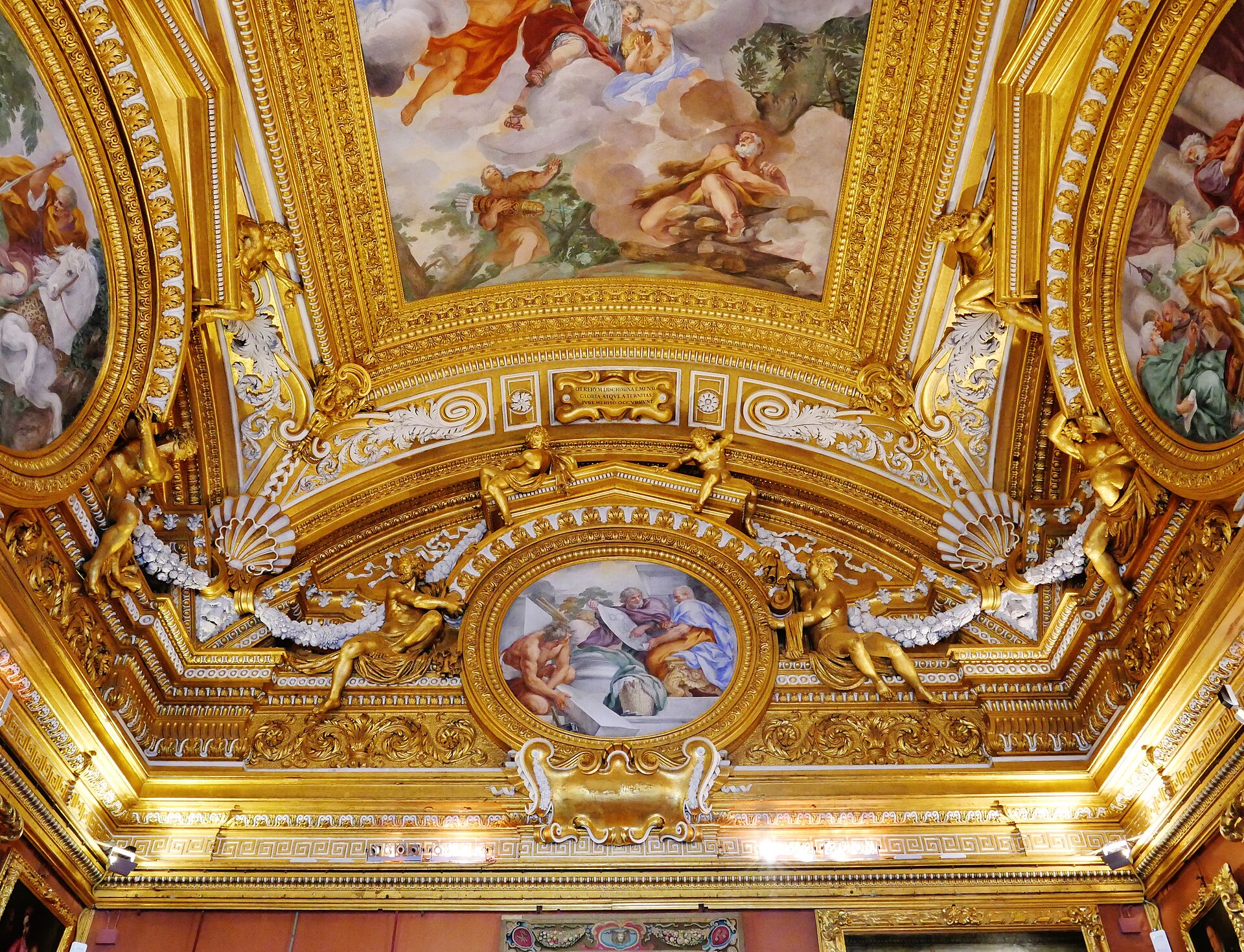
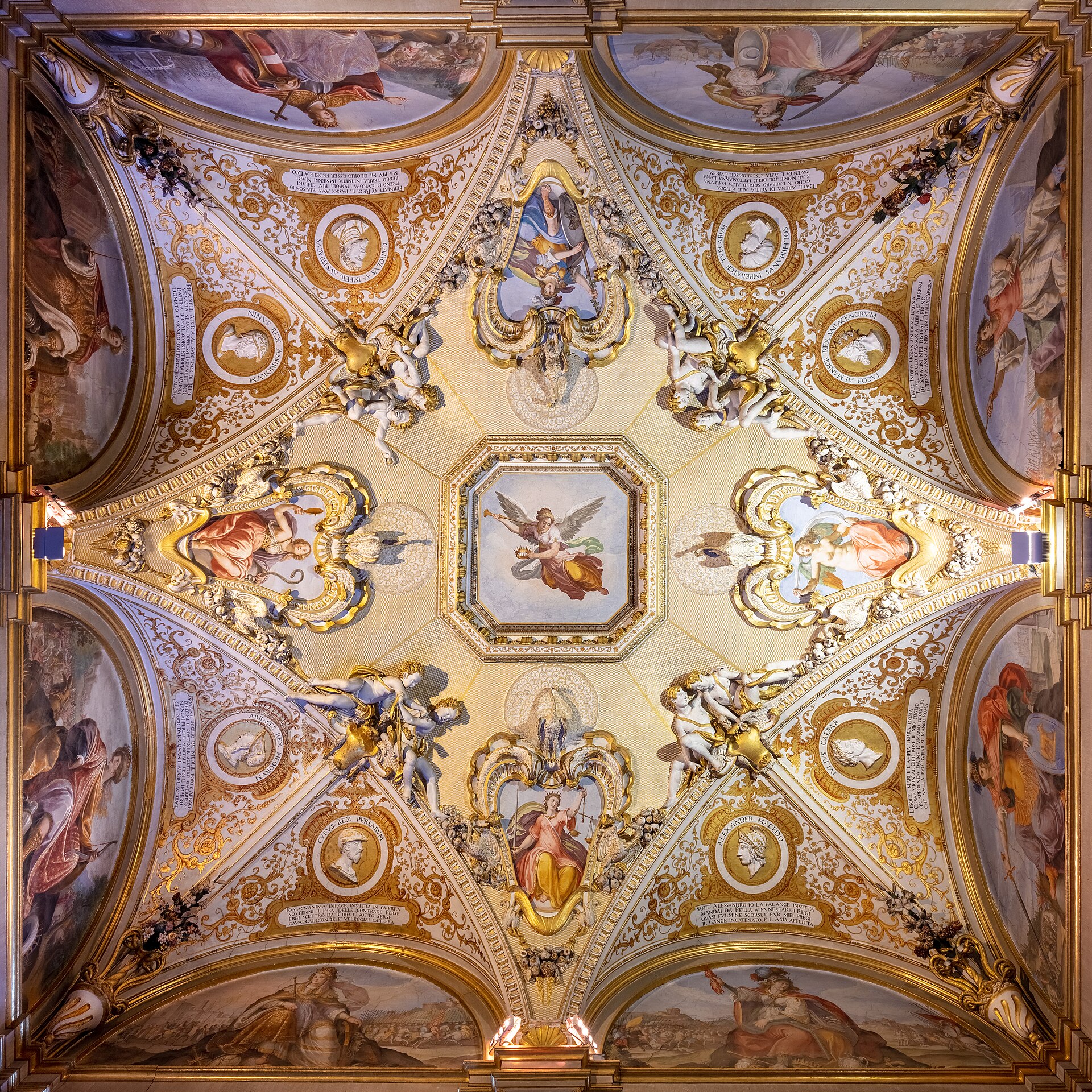
Photograph by Zairon · CC BY 4.0 The Palatine Gallery (Galleria Palatina, first floor)
Around 500 paintings, mostly Renaissance and Baroque, still hung according to 17th and 18th-century decorative taste rather than in chronological or school order. Holds the largest concentration of Raphael paintings anywhere, including Maddalena Doni, La Velata and the Madonna della Seggiola, alongside Titian portraits. The frescoed ceremonial rooms, named for planets - the Sala di Saturno, the Sala della Stufa and others - are part of what is on display, not just a setting for it.
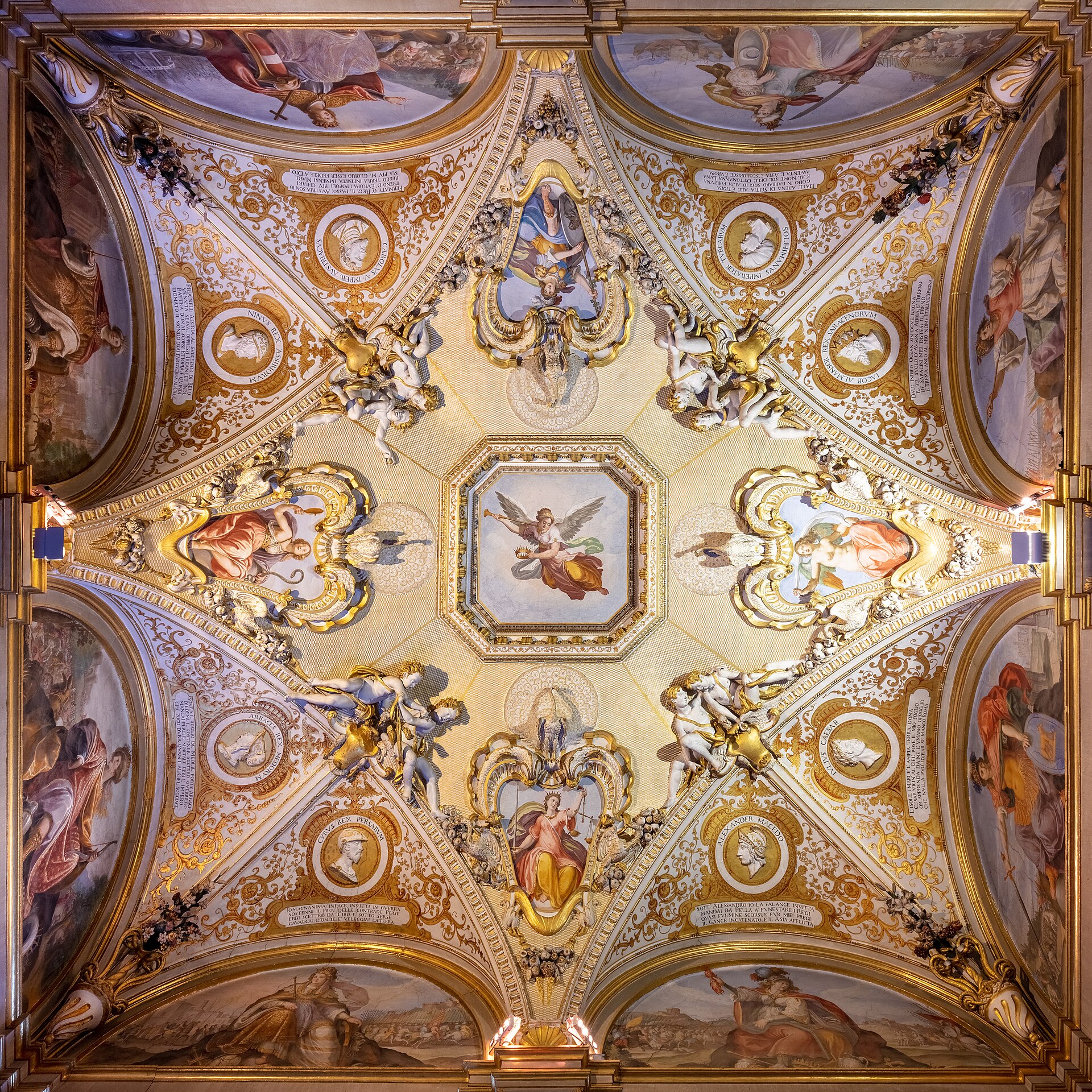
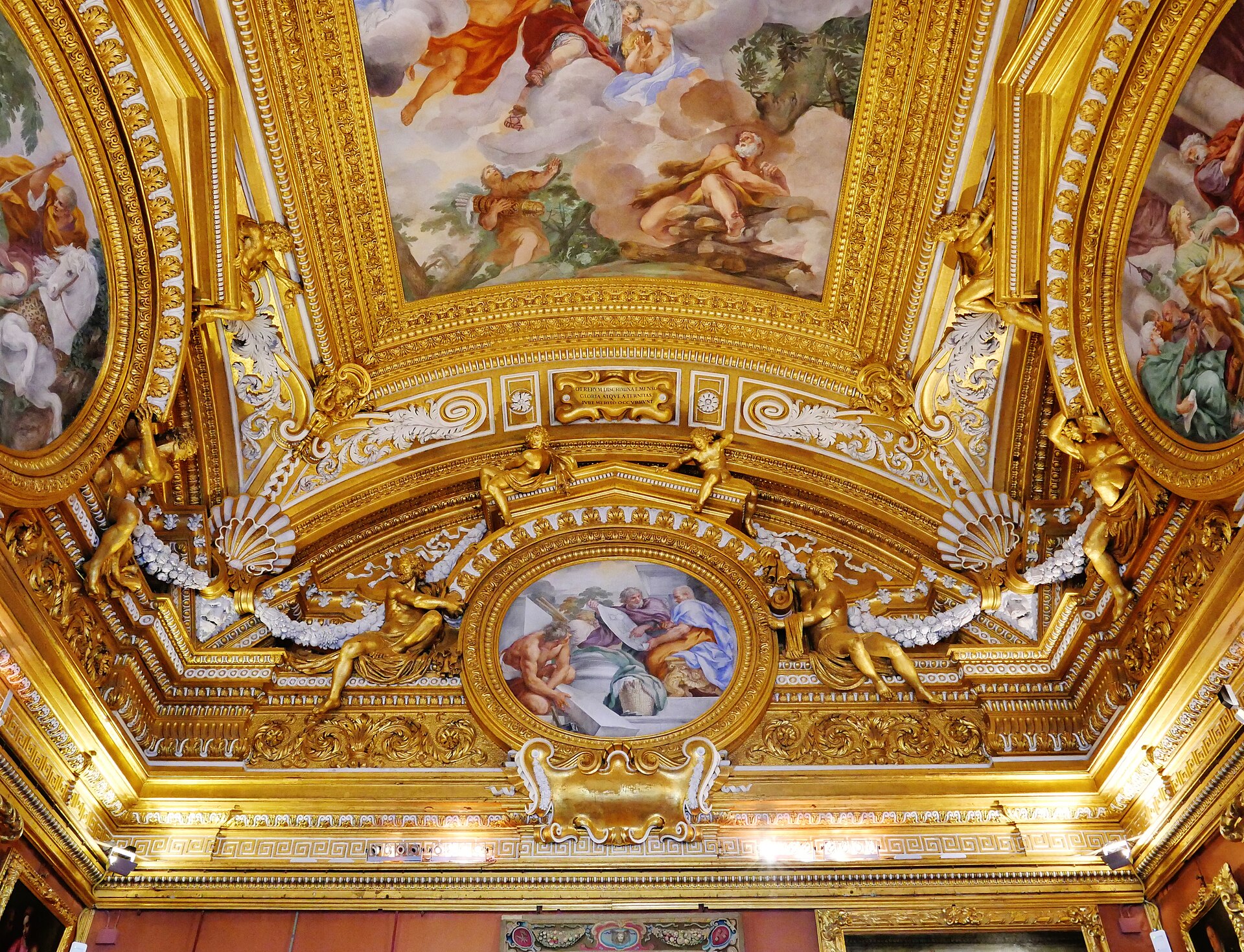
Photograph by Diego Delso · CC BY-SA 4.0 The Sala della Stufa
A room built between 1627 and 1641 as an open loggia, later enclosed and converted into a heated 'stove' room using techniques adapted from Roman baths, and frescoed accordingly. It is one of the smaller state rooms on the Palatine Gallery circuit and is often passed quickly, though its ceiling is among the more elaborate in the apartment.
The Treasury of the Grand Dukes (ground and mezzanine floors)
Formerly the Museo degli Argenti (Silver Museum), in rooms frescoed for the 1637 wedding of Grand Duke Ferdinando II de' Medici and Vittoria della Rovere. Holds the Medici's own collection of semi-precious stone vases, rock crystal and ivories; the Salzburg Treasure of silverware brought to Florence by Grand Duke Ferdinand III of Habsburg-Lorraine; jewellery from the 17th to the 20th centuries; and porcelain from Chinese, Japanese, Sevres and Vienna manufacture. No verifiable free-licence photograph of this room's interior was located; described from the museum's own published account.
The Museum of Costume and Fashion (Palazzina della Meridiana)
In an adjoining wing begun in 1776 and completed in 1830, Italy's first state museum dedicated to the history of fashion, opened in 1983. Rotating displays run from the 18th century to the present, including stage costumes worn in 20th-century film, theatre and opera productions. Its most striking permanent holding is not couture at all: the restored funeral garments of Cosimo I de' Medici, his wife Eleonora di Toledo, and their son Garzia, recovered when the Medici tombs were opened.
The Gallery of Modern Art (second floor)
Thirty rooms, once inhabited by the Habsburg-Lorraine family, covering painting and sculpture from the late 18th century to the early 20th, Neoclassical and Romantic work through Symbolism. Its strongest holding is the Macchiaioli school, built mainly from the collection of the critic Diego Martelli, including the Maremma landscapes of Giovanni Fattori, the movement's leading figure.
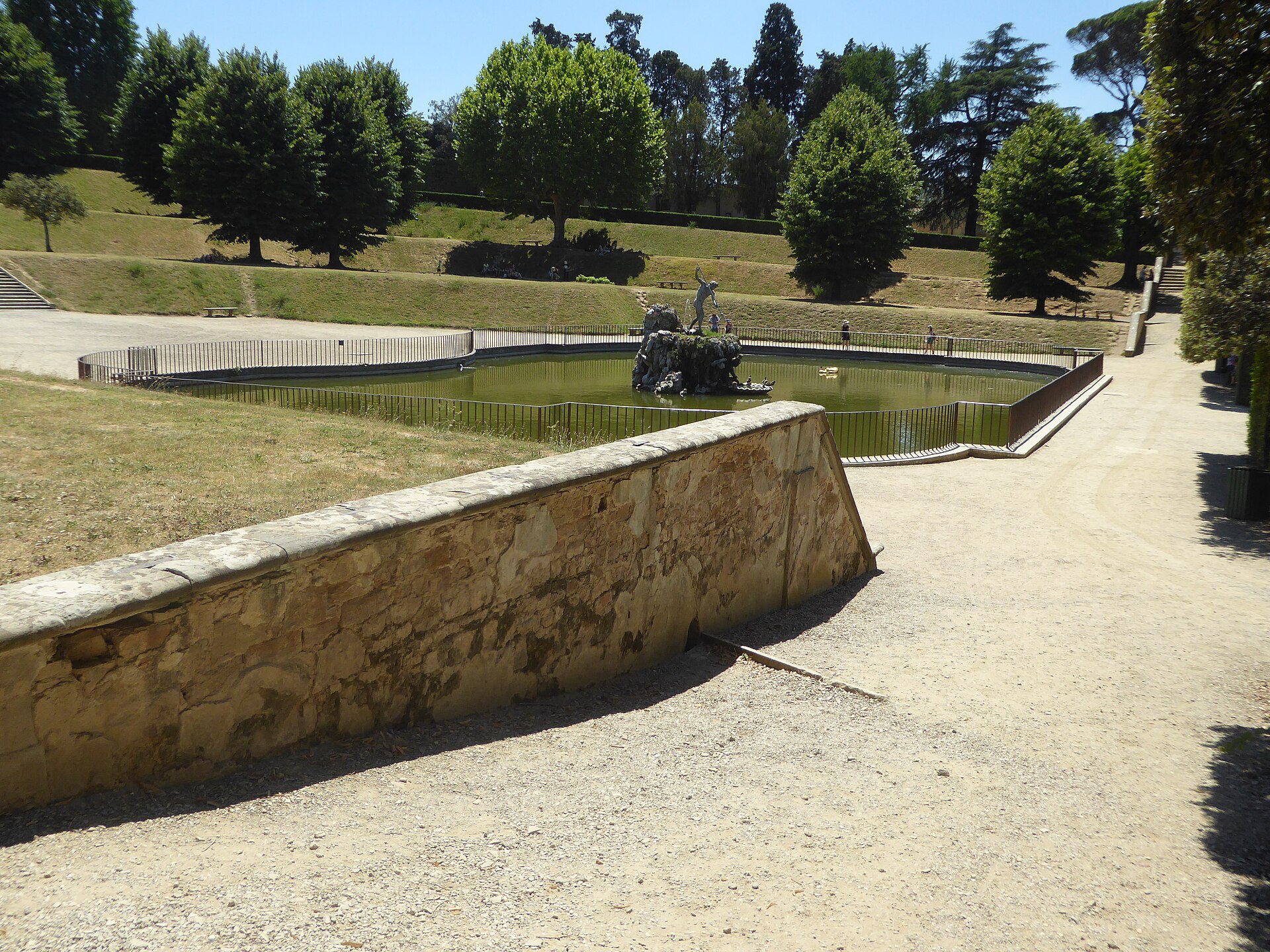
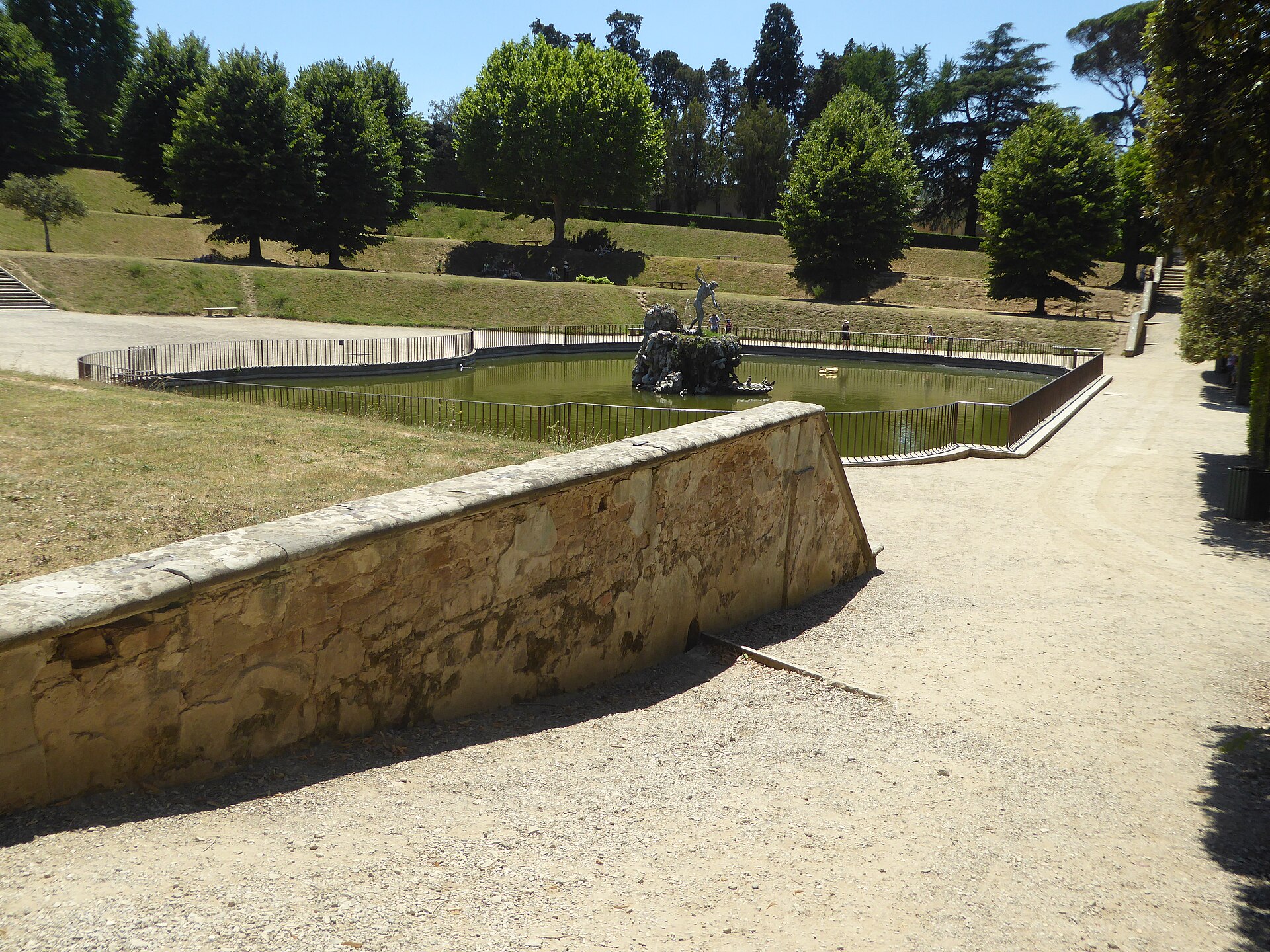
Photograph by Nemo bis · CC BY-SA 3.0 The Boboli Gardens
The formal garden laid out behind the palace from the 1550s, rising up the hill toward the Forte di Belvedere, with fountains, grottoes, an amphitheatre built into the old stone quarry, and long avenues of clipped hedge. Not included on the Palazzo-Pitti-only ticket; it requires the combined Pitti-and-Boboli ticket or the 5-day pass.
What to see first
Maddalena Doni
Raphael, c. 1506Companion portrait to Raphael's Agnolo Doni, painted for a Florentine wool merchant's family; one of the works that anchors the Palatine Gallery's claim to the largest concentration of Raphael paintings in one collection.3
La Velata (The Veiled Woman)
Raphael, c. 1516A portrait long associated, without settled documentary proof, with Raphael's Roman companion Margherita Luti; the sitter's identity remains argued rather than established.3
Madonna della Seggiola
Raphael, c. 1513-1514A tondo Madonna and Child so widely reproduced in the 19th century that its composition became a stock devotional image independent of the original panel.3
Vase of Flowers
Jan van Huysum, 18th centuryRemoved from Villa Bossi Pucci outside Florence by retreating Wehrmacht soldiers in 1944; rediscovered in a private German family's hands in 1989, who resisted return and were investigated over a payment demand, before the Uffizi's 2019 public campaign led to diplomatic restitution. Returned to Palazzo Pitti on 19 July 2019 after 75 years away, handed over in a ceremony in the Sala Bianca by Germany's foreign minister to his Italian counterpart.12
The funeral garments of Cosimo I de' Medici, Eleonora di Toledo and Garzia de' Medici
16th-century textile, Florentine courtRecovered when the Medici tombs in San Lorenzo were opened and now conserved in the Costume and Fashion Museum; burial dress rather than court dress, and the reason the fabric survived at all.6
The Salzburg Treasure
Various silversmiths, SalzburgEcclesiastical and court silver brought to Florence by Grand Duke Ferdinand III of Habsburg-Lorraine, folded into the Medici's own treasury of hardstone vases and rock crystal in what is now the Treasury of the Grand Dukes.5
Maremma landscapes
Giovanni Fattori, 19th centuryThe Gallery of Modern Art's core Macchiaioli holding, built largely from the collection of the Florentine critic Diego Martelli, who championed the group against the academic painting the Uffizi and the Palatine Gallery otherwise represent.7
The Sala di Saturno and Sala della Stufa ceilings
17th-century Florentine fresco decorationThe Palatine Gallery's state rooms are named for planets and decorated as an allegorical cycle for the Medici court; the rooms are part of the collection on the same terms as the paintings hung on their walls, not merely the setting for them.3
Exhibitions on now
- On now18 Jun to 31 Dec 2026Confirmed , 8 weeks ago
A banker's palace, bought by the family he was rivalling
The palace takes its name from Luca Pitti, a Florentine banker who began building it in the mid-15th century, reportedly to a design connected to Filippo Brunelleschi, on rising ground south of the Arno. Pitti died in 1473 with the building unfinished and his family's fortunes in decline; the Medici, whose bank Pitti had once tried to outbuild, ended up owning the result. In 1549 or 1550 - sources give both years - the palace was bought by Eleonora of Toledo, wife of Grand Duke Cosimo I de' Medici, as a new residence for the ruling family, and it quickly became the political and ceremonial centre of the Grand Duchy of Tuscany rather than a private house. The architect Bartolomeo Ammannati more than doubled the building's footprint and laid the foundation for the hillside gardens behind it, which grew into the Boboli Gardens. The building a Florentine banker had left half-built in 1473 became, within a century, the seat from which Tuscany was governed.
Three dynasties, one address
The Medici held the palace until the male line died out in 1737, when it passed to the House of Habsburg-Lorraine, who added the porticoed and terraced wings known as the Rondo to the front of the building. In 1860 the palace passed to the Crown of Italy, and from 1865 to 1871, when Florence briefly served as the capital of the newly unified kingdom, King Victor Emmanuel II lived there. The House of Savoy's tenancy ended with a single deliberate act: in 1919 Victor Emmanuel III gave the palace and its contents to the Italian state outright, converting a royal residence into a public museum complex by decree rather than by confiscation or sale. That gift is why the palace today is administered by the state through the Gallerie degli Uffizi rather than by a private foundation or a municipal authority, and why its collections were assembled by three different ruling houses rather than by curators building toward a single coherent programme - the eclecticism of what is on the walls follows directly from who was living there when each piece arrived.
Five museums under one roof, and a ticket that does not say so on the door
Palazzo Pitti is not one museum but an administrative complex of several: the Palatine Gallery and the Royal Apartments on the first floor, the Treasury of the Grand Dukes and the Museum of Russian Icons on the ground floor, the Gallery of Modern Art and the Museum of Costume and Fashion on the second floor, plus the separate Museum of Carriages and the Boboli Gardens behind the building. It is administered by the Gallerie degli Uffizi, the same body that runs the Uffizi Gallery itself and the Vasari Corridor connecting the two - which is why this record covers Palazzo Pitti's own galleries and does not repeat material that belongs to the Uffizi's separate record in this archive.
The ticketing follows the administrative structure and is genuinely more complicated than a single admission price: a same-day ticket to Palazzo Pitti alone, covering the Palatine Gallery, the Modern Art Gallery, the Costume and Fashion Museum, the Treasury and the Icon Museum, costs 16 euros and does not include the Boboli Gardens. Seeing the gardens requires either the combined Palazzo-Pitti-and-Boboli ticket, at 22 euros same-day, or the five-day pass covering the Uffizi, Palazzo Pitti and the Boboli Gardens together at 40 euros - which requires visiting the Uffizi first, on a booked day and time, before the other two sites can be entered without further booking at any point inside the five-day window. A visitor who buys only the base Palazzo Pitti ticket, assuming it covers the palace grounds as well as the rooms, will be turned away at the garden gate.
What war took, and what came back after 75 years
During the Second World War the palace's collections were evacuated for safekeeping to the Medici villa at Poggio a Caiano outside the city. It did not save everything. As German forces retreated from Florence in 1944 ahead of the advancing Allies, Wehrmacht soldiers removed a number of works from the places they had been moved to for protection, including Jan van Huysum's Vase of Flowers, taken from Villa Bossi Pucci on the city's outskirts, where it had been part of the Palazzo Pitti collection since the 19th century. The painting disappeared from the public record until 1989, when the German family that had ended up with it approached the Bavarian State Picture Gallery seeking authentication. The family resisted returning it, and a payment demand attached to the case drew a criminal investigation into possible extortion. In January 2019 the Uffizi's then director, Eike Schmidt, escalated the case with a public pressure campaign - a video shot in the Palatine Gallery's Room of the Putti, showing a black-and-white replica of the painting stamped RUBATO, GESTOHLEN, STOLEN in red across three languages, and an accompanying social media and press campaign, arguing Germany had a moral duty to return it even though the legal statute of limitations on the theft had expired. The campaign and the ensuing diplomatic effort worked: on 19 July 2019, in a ceremony in the palace's Sala Bianca, Germany's foreign minister Heiko Maas handed the painting to his Italian counterpart, Enzo Moavero Milanesi, and it went back on display at Palazzo Pitti. It is one of the more complete restitution stories attached to Italy's Nazi-looted art, precisely because it took a public campaign rather than the courts to close it.
The apartments as evidence, not backdrop
Two of the palace's five internal museums hold material that is evidentiary rather than purely decorative. The Treasury of the Grand Dukes, in rooms frescoed for a 1637 grand-ducal wedding, holds the Medici's own accumulated hoard of hardstone vases, rock crystal and ivories alongside the unrelated Salzburg Treasure of ecclesiastical and court silver, brought south by the Habsburg-Lorraine dynasty rather than assembled by the Medici at all - two collecting traditions from two different courts, shelved together because one family's palace became the next family's storeroom. The Costume and Fashion Museum's single most striking holding is not fashion in any normal sense: the funeral garments of Cosimo I de' Medici, his wife Eleonora di Toledo, and their son Garzia, recovered and conserved after the Medici family tombs in the basilica of San Lorenzo were opened. They survive because they were buried rather than worn, which is a different kind of provenance from anything else in the costume collection's rotating exhibitions of stage and couture dress. Both rooms make the same point from opposite directions: at Palazzo Pitti, the line between what a family owned to live with and what it was buried in is not always where a visitor expects it.
What visitors say
Visitors consistently rate the depth of the collection and the setting highly, and the recurring theme in visitor accounts is scale: the palace, the five internal museums and the Boboli Gardens add up to more than a single visit comfortably covers, and the ticket structure - Pitti alone, Pitti with Boboli, or the five-day pass with the Uffizi - is not obvious on arrival and catches visitors who assumed one ticket covered everything.
What is praised, what is criticised
- Praised: The Palatine Gallery's Raphael and Titian holdings, and the frescoed state rooms themselves, are named most often as the reason to visit
- Praised: The Boboli Gardens are praised for space and quiet relative to the crowds in central Florence, particularly away from the main avenues
- Criticised: The ticketing structure is a frequent source of visitor confusion: Boboli Gardens access is not included in the base Palazzo Pitti ticket and must be added or bought as part of the combined ticket, which is not obvious from the palace entrance alone
- Criticised: Wait times and crowding are reported as uneven and weather- and season-dependent, with visitors advised to arrive early in high season
Ratings on other platforms
TripAdvisor: 4.4 from 6,154 ratings, read 7 August 2026
A platform average is a tertiary source: it moves, it is not audited, and we quote no visitor's words.
Questions about Palazzo Pitti
Where is Palazzo Pitti?
Piazza de' Pitti 1, 50125 Firenze, Italy.
How much does it cost to visit?
Palazzo Pitti only, same-day: EUR 16; Palazzo Pitti only, advance reservation: EUR 19; Palazzo Pitti, reduced: EUR 3; Palazzo Pitti and Boboli Gardens combined, same-day: EUR 22; Palazzo Pitti and Boboli Gardens combined, advance reservation: EUR 25. As confirmed 22 August 2026.
When is it open?
Tuesday to Sunday 08:15-18:30. Closed: Monday. 1 January. As confirmed 22 August 2026.
How do you get there?
On foot: South bank of the Arno, a 10-minute walk from the Ponte Vecchio and the Uffizi.
What should you see first?
Maddalena Doni (Raphael, c. 1506); La Velata (The Veiled Woman) (Raphael, c. 1516); Madonna della Seggiola (Raphael, c. 1513-1514); Vase of Flowers (Jan van Huysum, 18th century); The funeral garments of Cosimo I de' Medici, Eleonora di Toledo and Garzia de' Medici (16th-century textile, Florentine court); The Salzburg Treasure (Various silversmiths, Salzburg).
What we could not confirm
- The sources consulted for this record do not state whether the criminal extortion inquiry into the German family that held Jan van Huysum's Vase of Flowers before its 2019 return was ever formally concluded, or whether any payment changed hands as part of the eventual restitution.
- La Velata's sitter is conventionally identified with Margherita Luti, said to have been Raphael's companion in Rome, but the sources consulted for this record do not establish that identification as documented rather than traditional.
- This record does not cover the Uffizi Gallery itself, the Vasari Corridor, or the Museum of Carriages, which are administered by the same body but sit outside the scope of what was researched here.
Images
Sources
- 1CoopCulture, Palazzo Pitti (official ticketing partner) coopculture.it/en/poi/palazzo-pitti/
- 2CoopCulture, Palazzo Pitti, wardrobe/cloakroom notice coopculture.it/en/poi/palazzo-pitti/
- 3Uffizi Galleries, Pitti Palace (museum's own site) uffizi.it/en/pitti-palace
- 4Hyperallergic, Uffizi Gallery Launches Online Campaign for Return of Painting Stolen by Nazis hyperallergic.com/uffizi-gallery-launches-online-campaign-for-return-of-painting-stolen-by-nazis/
- 5Uffizi Galleries, Treasury of the Grand Dukes (museum's own site) uffizi.it/en/pitti-palace/treasury-of-the-grand-dukes
- 6Uffizi Galleries, Museum of Costume and Fashion (museum's own site) uffizi.it/en/pitti-palace/costume-and-fashion-museum
- 7Uffizi Galleries, Gallery of Modern Art (museum's own site) uffizi.it/en/pitti-palace/modern-art-gallery
- 8Uffizi Galleries, History of Pitti Palace (museum's own site) uffizi.it/en/pitti-palace/history
- 9Uffizi Galleries, Combined ticket for the Uffizi, Pitti Palace and Boboli Gardens uffizi.it/en/pages/combined-ticket
- 10TripAdvisor, Palazzo Pitti, aggregate rating () tripadvisor.com/Attraction_Review-g187895-d209474-Reviews-Palazzo_Pitti-Florence_Tuscany.html
- 11Wikidata Q29286, Palazzo Pitti (, identity and coordinates) wikidata.org/wiki/Q29286
- 12Uffizi Galleries, news: Il Vaso di Fiori di Jan van Huysum ritorna a Palazzo Pitti uffizi.it/en/news/il-vaso-di-fiori-di-jan-van-huysum-ritorna-a-palazzo-pitti
- 13Wikipedia, Vase of Flowers (van Huysum) en.wikipedia.org/wiki/Vase_of_Flowers_(van_Huysum)