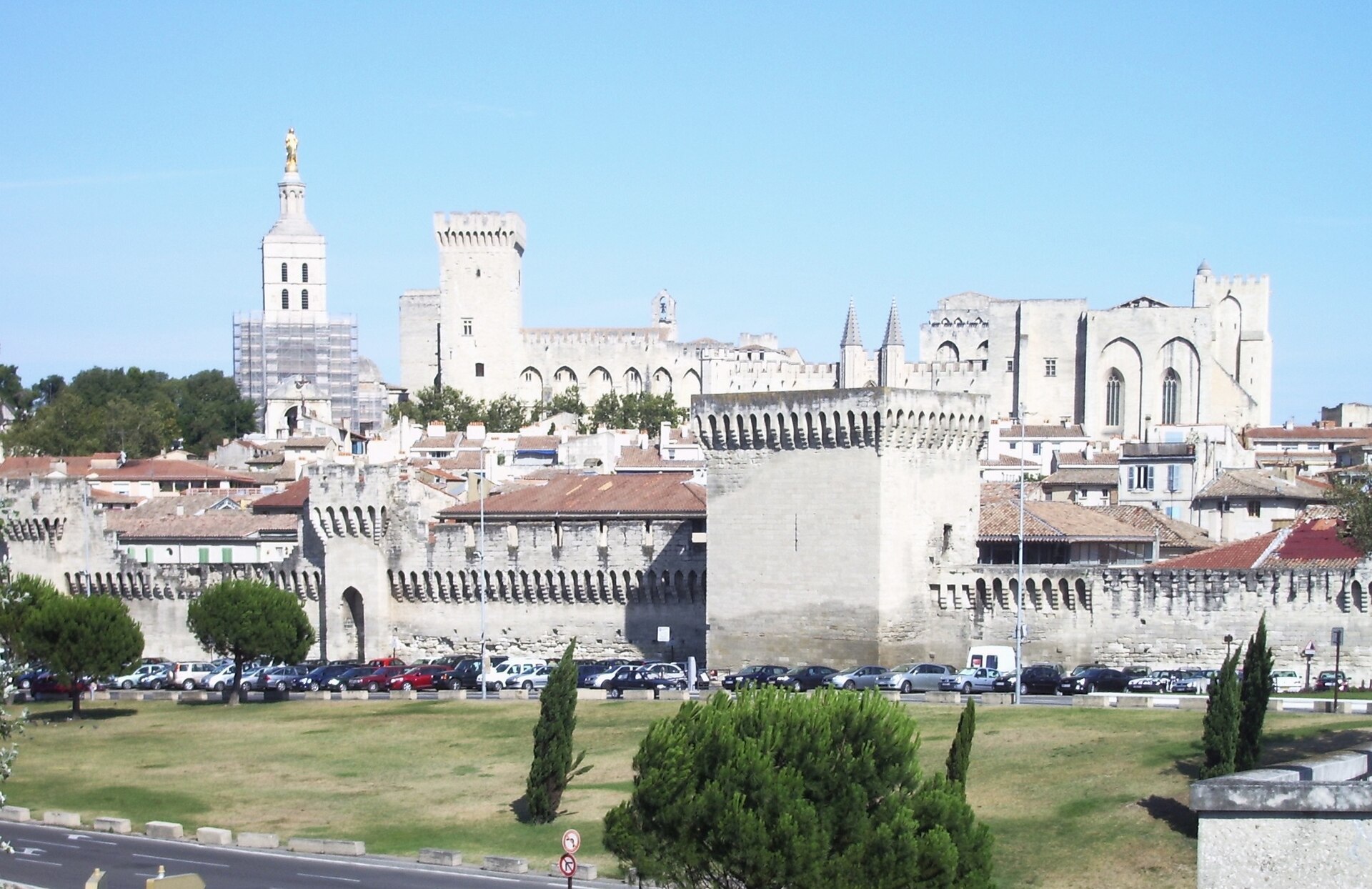
The Palais des Papes and the adjoining Notre-Dame des Doms cathedral rising above Avignon's old town and ramparts.
Photograph by Chris06 · CC BY-SA 4.0On this page 14 sections
ContentsClose
The Palais des Papes does not hold a collection in the way an art museum does; the building itself, and the small fraction of its original decoration that survived the Revolution and the barracks years, is the artefact. What UNESCO's own assessment credits as the site's outstanding value is narrow and specific: Matteo Giovannetti's frescoes in the two chapels and the Grand Tinel, and the secular hunting scenes of the Stag Room, are what survive of a much larger 14th-century painted programme, everything else having been lost, whitewashed or destroyed when the palace spent a century and a half as barracks and prison rather than a residence. That is also the honest limit of what a visit delivers: most of the more than twenty rooms on the public route are empty stone halls whose furniture, tapestries and everyday fittings are gone for good, and the frescoed rooms are the exception rather than the rule.
| Kind | Palace |
|---|---|
| Founded | Construction began under Pope John XXII from 1316; the Palais Vieux was built by Benedict XII from 1335; the Palais Neuf was added by Clement VI from 1342; completed under Innocent VI and Urban V by the 1360s |
| City and country |  Avignon, France Avignon, France |
| Address | Place du Palais, 84000 Avignon, France |
| Website | palais-des-papes.com |
| Status | Open, confirmed |
| Record last verified |
Visiting
- Hours
- 1-4 January10:00 to 18:00
- 5 January-6 February10:00 to 17:00
- 7-28 February10:00 to 18:00
- 1 March-1 November09:00 to 19:00The long main-season hours
- 2 November-18 December10:00 to 17:00
- 19-31 December10:00 to 18:00
- Closed
- Last entry is one hour before the posted closing time year-round; no weekly closing day was found on the pages fetched for this record.
- Admission
- Palace only, standardEUR 16
- Palace only, reducedEUR 13
- Palace only, children 10-17EUR 10
- Palace + Pontifical Gardens + Pont d'Avignon combo, standardEUR 19.50
- Palace + Pontifical Gardens + Pont d'Avignon combo, reducedEUR 16
- Palace + Pontifical Gardens + Pont d'Avignon combo, children 10-17EUR 12
- Under 10FreeFree entry to the monuments
- Avignon City Pass, 24 hoursEUR 24Covers multiple Avignon sites beyond the Palace
- Avignon City Pass, 48 hoursEUR 32
Free entry: Avignon residents: free entry every Saturday, Sunday and public holiday, year-round (the palace's own site: "tous les samedis, dimanches et jours feries", widened from weekends alone as previously recorded)- Tickets
- palais-des-papes.com/tarifs The museum's own ticket page.
- Do I need to book?
- Not compulsory; online booking is available and recommended, per the palace's own tariffs page.
- Address
- Place du Palais, 84000 Avignon, France MapTrain Avignon Centre (Avignon TGV is a separate out-of-town station); a Tripadvisor forum post cites 10-15 minutes from the town-centre station to the Palace
On foot Within the walled historic centre of Avignon, on the Place du Palais next to Notre-Dame des Doms cathedral - Website
- palais-des-papes.com
- Telephone
- +33 4 32 74 32 74
- [email protected]
Before you go how long, access, photography, bags, eating, shop
- How long to allow
- The visit route covers more than twenty rooms; Tripadvisor's own listing carries 11,572 reviews at a 4.3 out of 5 aggregate
- Access
- Not stated on the pages fetched for this record
- Photography
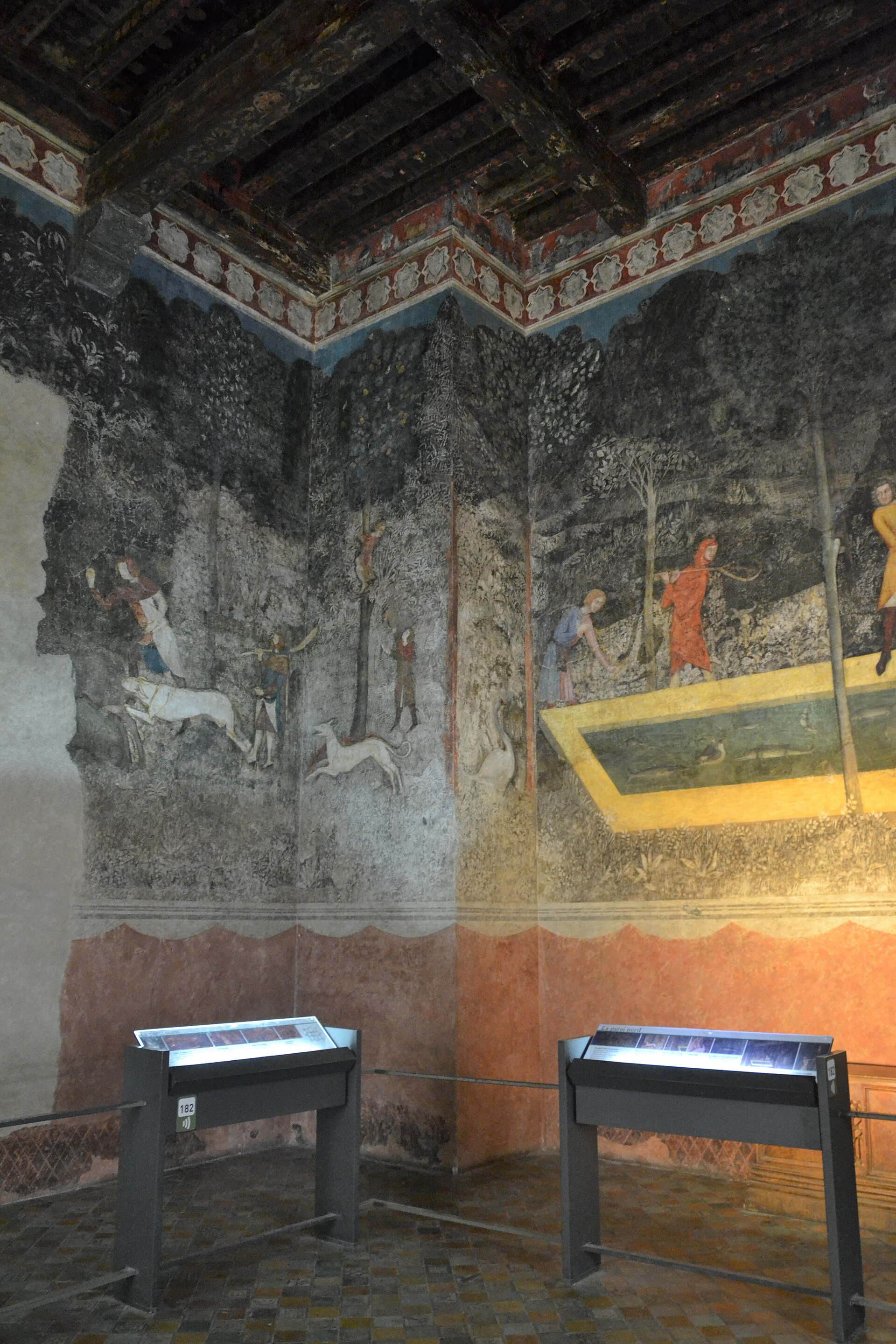
- Permitted throughout the palace except in three fragile painted rooms, where it is prohibited to protect the frescoes: the Chambre du Pape, the Chambre du Cerf, and the Chapelle Saint-Martial.
- Bags
- Not stated on the pages fetched for this record
- Eating
- Not stated on the pages fetched for this record
- Shop
- Not stated on the pages fetched for this record
Prices and hours change. We take them from the institution's own pages and print the day we read them, and you can check the current position at the source we used. Confirm before you travel.
What is inside
Palais Vieux (Old Palace)
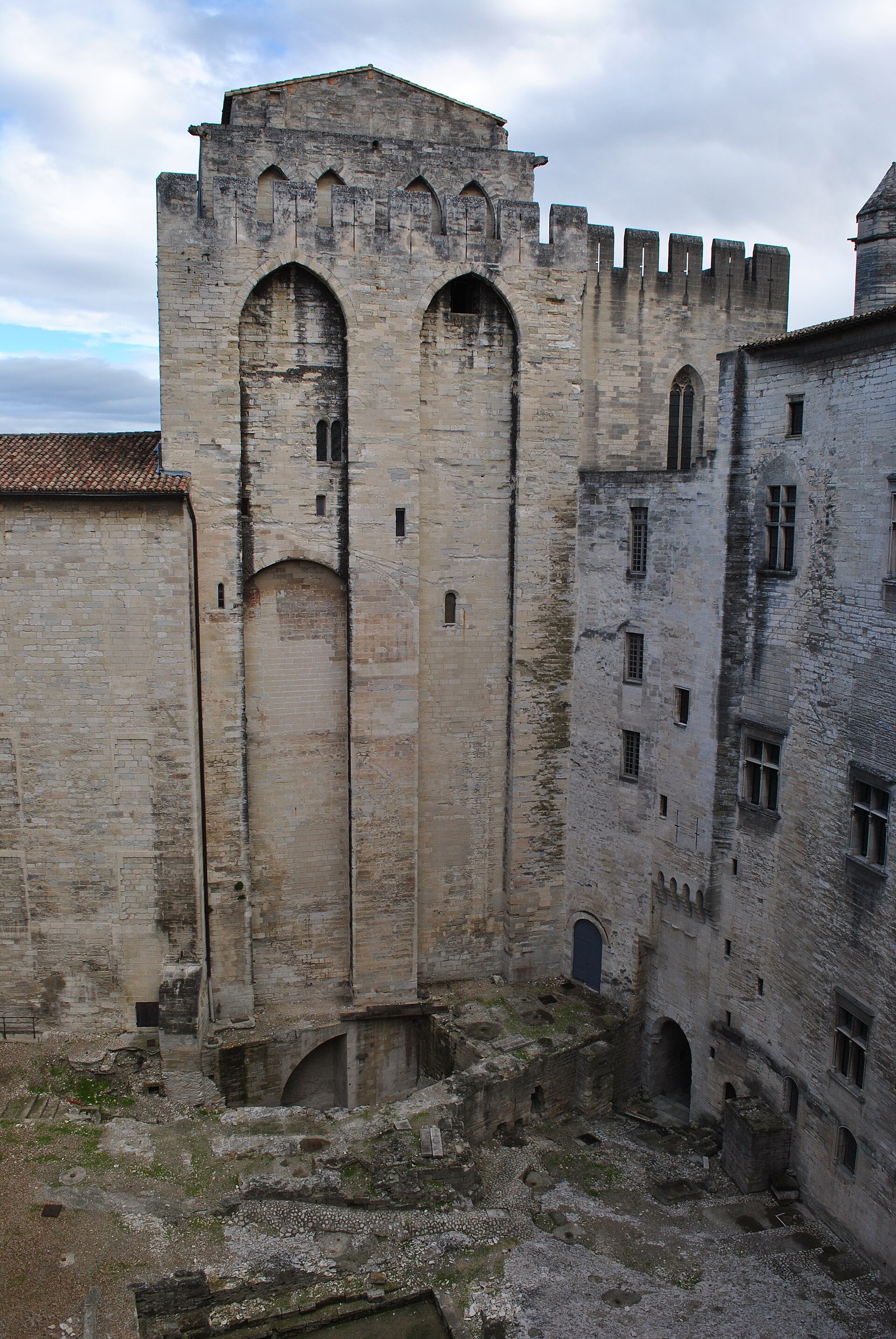
Benedict XII's austere original structure, built from 1335 under the architect Pierre Poisson: the Pope's Tower at its heart protecting the papal apartments and the Church's treasury, the Consistory hall where the pope met with cardinals, and the cloister of Benedict XII.
Photograph by Marianne Casamance · CC BY-SA 4.0 Palais Neuf (New Palace)
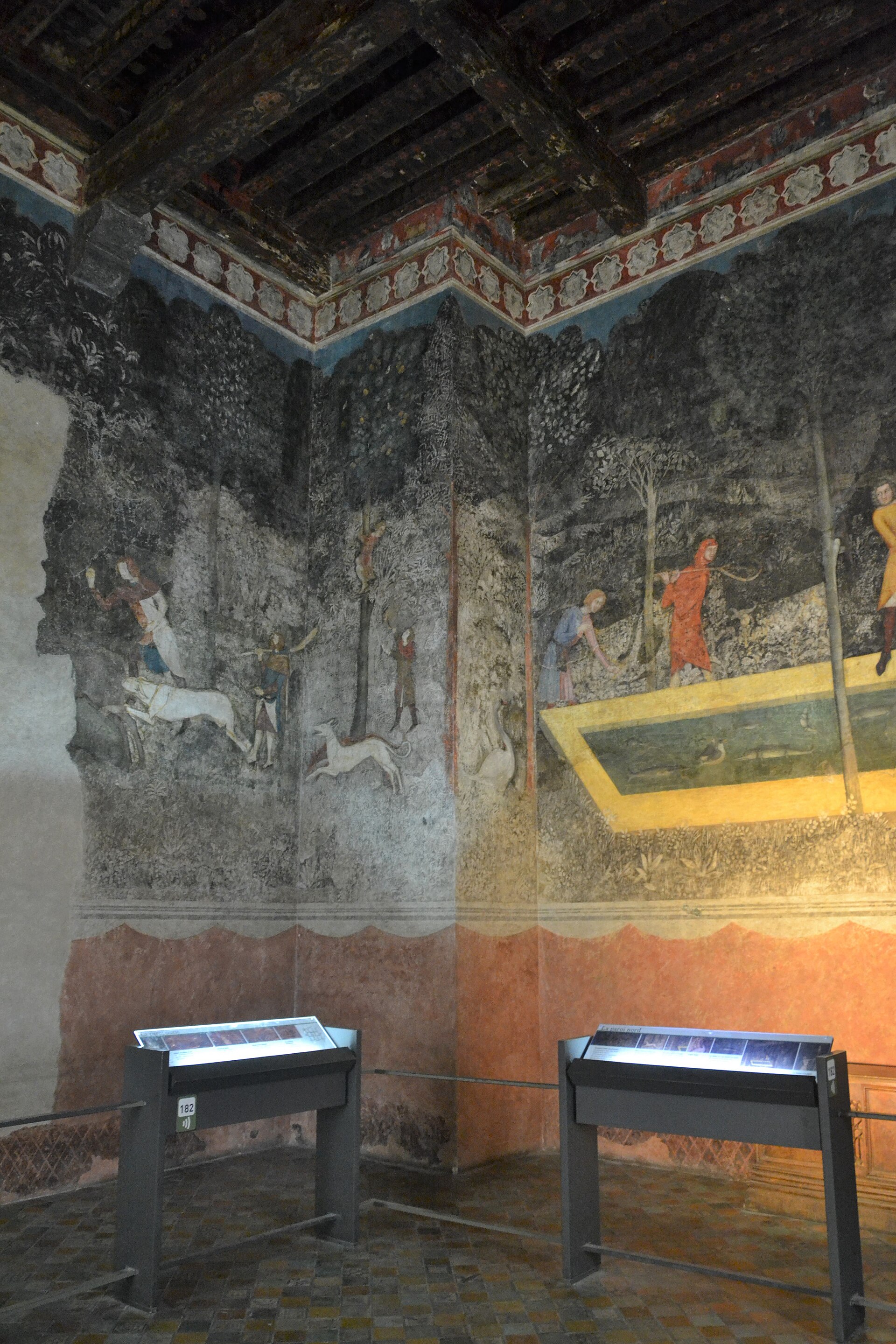
Clement VI's more lavish expansion from 1342, built under the architect Jean de Louvres with roughly 600 workers on site despite the Hundred Years' War and the Black Death under way at the same time: the Grand Tinel feast hall, the Grand Chapel, and Clement VI's private study, the frescoed Chambre du Cerf.
Chapelle Saint-Jean and Chapelle Saint-Martial
Two chapels off the main state rooms, both decorated by the Italian painter Matteo Giovannetti, whom Clement VI brought to Avignon; UNESCO's own inscription singles these frescoes out, along with the Stag Room, as the palace's most important surviving painted decoration.
Photograph by Marianne Casamance · CC BY-SA 4.0 Cour d'Honneur
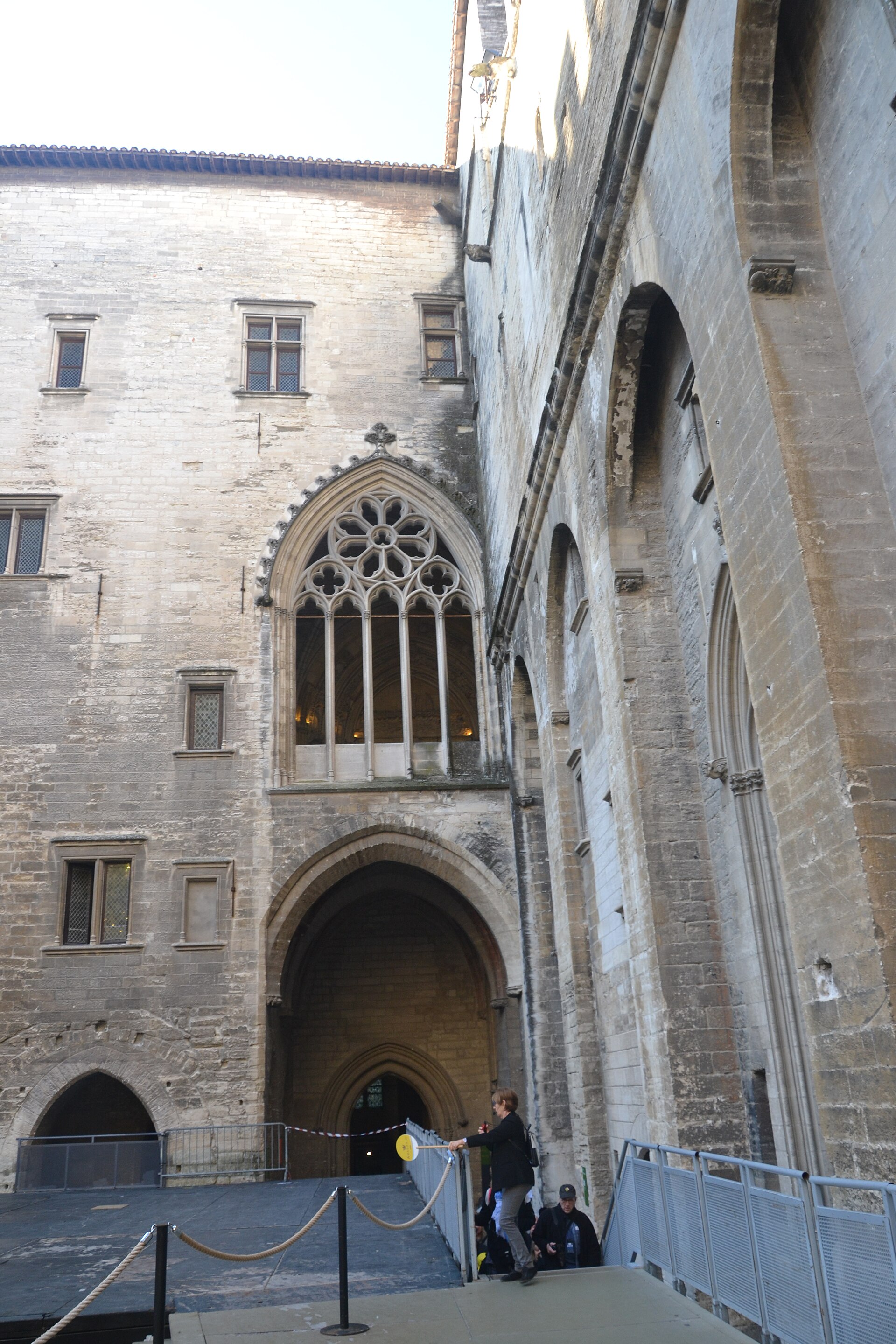
The main courtyard between the Palais Vieux and Palais Neuf, ringed by the entrance porches and towers; since 1947 the principal stage of the Festival d'Avignon's official programme, seating several thousand for outdoor theatre every July.
Grande Audience and the Wing of the Great Dignitaries
The west wing housing the Grande Audience or Hall of Justice, where the papal court's judicial and administrative business was conducted, distinct from the ceremonial rooms of the Palais Neuf.
What to see first
Chambre du Cerf (Stag Room)
Attributed to the workshop associated with Matteo Giovannetti, for Pope Clement VIClement VI's private study, its walls painted floor to ceiling with secular hunting, fishing and forest scenes rather than religious subjects, which UNESCO's own listing calls out specifically as very important frescoes distinct from anything else in the palace.3
Chapelle Saint-Jean, frescoes by Matteo Giovannetti
Matteo GiovannettiOpens directly off the Consistory hall; UNESCO names it alongside the Stag Room and the Tinel as the surviving painted decoration that carries the palace's Outstanding Universal Value.3
Chapelle Saint-Martial, frescoes by Matteo Giovannetti
Matteo GiovannettiA second chapel decorated by the same Italian painter Clement VI brought to Avignon specifically to work on the new palace, part of the same fresco campaign as Saint-Jean and the Stag Room.5
Grand Tinel (Feast Hall)
Jean de Louvres (architecture), decoration attributed to Matteo GiovannettiThe palace's great banqueting hall, where the pontifical court held its feasts; UNESCO's inscription describes it as decorated by the same painter responsible for the Consistory chapel below it.3
Tour de Trouillas
Built under Innocent VI and Urban VAt 52 metres, one of the tallest medieval towers still standing, rising over the north wing alongside the palace's other defensive towers; the writer Jean Froissart called the whole complex the most well-fortified house in the world.3
The Consistory and its access to Chapelle Saint-Jean
Pierre Poisson, under Benedict XIIThe vast hall where the pope met formally with the College of Cardinals, singled out by UNESCO as one of the most characteristic surviving spaces of Benedict XII's original Palais Vieux.3
The Grande Audience (Hall of Justice)
Built in the Wing of the Great DignitariesThe papal court's judicial chamber, occupying the west wing of the palace, distinct in function from the ceremonial and residential rooms elsewhere in the complex and one of the rooms named directly on the palace's own visit-route page.5
Exhibitions on now
Nine popes and a palace built to outlast a crisis
The Avignon Papacy began as an emergency measure and lasted seven decades. Clement V, elected in 1305 amid conflict between the French crown and the papacy, never returned to Rome and settled the papal court at Avignon by 1309; his successor John XXII began converting the existing bishop's residence next to the cathedral into something fit for a papal court, and the ruins of the audience hall he commissioned still stand in the palace's courtyard. It was Benedict XII, elected in 1335, who built the first true palace: an austere, fortress-like structure directed by the architect Pierre Poisson, organised around the Pope's Tower that protected both the pontiff and the Church's treasury. Clement VI, his successor from 1342, had no interest in austerity. He brought in the architect Jean de Louvres and put roughly 600 workers on site simultaneously, an extraordinary commitment given that the Hundred Years' War and the Black Death were both under way in the same years, to build the Grand Tinel feast hall, the Great Chapel and his own private study, the frescoed Chambre du Cerf. Innocent VI and Urban V finished the remaining towers and galleries. In total six papal conclaves were held inside the palace between 1334 and 1394, electing Benedict XII, Clement VI, Innocent VI, Urban V, Gregory XI and, after the papacy had formally returned to Rome, the Avignon claimant Benedict XIII.
The most well-fortified house in the world
UNESCO's own assessment of the site quotes the medieval chronicler Jean Froissart calling the completed palace the most well-fortified house in the world, and the scale supports the claim: the Trouillas Tower, built under Innocent VI and Urban V, rises 52 metres, among the tallest surviving medieval towers anywhere, and the whole complex is commonly described as the largest Gothic palace still standing in Europe. What made the palace more than a fortress was the decoration Clement VI commissioned inside it. He brought the Italian painter Matteo Giovannetti to Avignon specifically to work on the new building, and Giovannetti's frescoes in the Chapelle Saint-Jean, the Chapelle Saint-Martial and the Grand Tinel are what UNESCO's inscription singles out as carrying the site's outstanding value, alongside the secular hunting and forest scenes of the Stag Room, unusual for showing no religious subject at all in a papal building. The palace also held Europe's largest library at the time, drawing scholars including Petrarch to a city that, for a hundred years, functioned as a rival cultural capital to Rome.
Schism, decline, and a French Revolution that gutted the interior
Gregory XI moved the papacy back to Rome in 1377, and the move did not settle the question of who the real pope was. The Western Schism that followed in 1378 produced rival Avignon claimants, Clement VII and then Benedict XIII, who continued to use the palace as their seat until Benedict XIII was besieged there in the 1400s and the Avignon line collapsed. After the schism ended, the building's status fell steadily: it became the residence of the papal legates and vice-legates who continued to govern Avignon as a papal territory (the city and its surrounding Comtat Venaissin remained under direct papal sovereignty, separate from the kingdom of France, until the Revolution), and it never again held a pope.
The French Revolution was harder on the building than seven decades of Schism-era neglect had been. Avignon was annexed to France in 1791 and the palace was stripped and converted first for military use and then into a prison; it went on serving as a barracks into the 20th century, which is the direct reason so many of its rooms are seen today as bare stone rather than furnished apartments. The building was added to France's Historic Monuments list in 1840, one of the earliest protections of its kind, but restoration and the recovery of what remained of the painted decoration continued for decades after that listing rather than starting with it. It was only in the early 20th century that the palace reverted, in UNESCO's own phrase, to a use consistent with its dignity and its history: opened to the public as a monument rather than requisitioned for another purpose.
A stage since 1947
Since 1947 the Cour d'Honneur, the palace's main internal courtyard, has been the principal venue of the Festival d'Avignon, founded that September by the director Jean Vilar as a showcase for new and unknown theatre. The relationship between a medieval papal courtyard and a modern theatre festival has not always been smooth. During a 1968 performance by the choreographer Maurice Bejart, a member of the audience walked onto the stage to order the show stopped, and performers from a rival Off-festival production later rushed the same stage, forcing Bejart's dancers to work around them mid-performance. The 2003 festival was cancelled outright, not over content but over labour: entertainment-industry workers went on strike against proposed changes to their unemployment insurance, and roughly a hundred planned productions across that year's programme never went on. The Cour d'Honneur remains the festival's flagship stage today, which means the palace runs, every July, as both a monument open to daytime visitors and a working theatre by night.
One UNESCO listing, two owners
The Palais des Papes was inscribed by UNESCO in 1995, not alone but as one element of the Historic Centre of Avignon alongside the Petit Palais (the former bishops' residence, begun 1317, a separate building from the unrelated Petit Palais art museum in Paris), the Romanesque Cathedral of Notre-Dame des Doms next door, and the surviving four arches of the Saint-Benezet bridge over the Rhone. UNESCO's own listing records an unusual split in ownership that has nothing to do with the palace's history as a single building: most of the palace belongs to the City of Avignon, but the north-west section, including the Chapel of Benedict XII and the Trouillas Tower, belongs instead to the Department of Vaucluse. The Cathedral belongs to the French state. A monument built by one institution, the medieval papacy, to be indivisible is today governed by three different public owners at once, coordinated through a management committee UNESCO's own documentation describes as still a work in progress.
What visitors say
Visitors consistently rate the Palace among Avignon's essential sights, driven by the scale of the building, the surviving frescoes in the Stag Room and the two chapels, and the multimedia guide included with entry. The most repeated practical complaint is that the building was stripped of its furniture centuries ago, so several rooms are experienced as vast empty stone halls rather than furnished interiors, which some visitors find atmospheric and others find underwhelming next to the entrance fee.
What is praised, what is criticised
- Praised: the scale of the building and its surviving 14th-century frescoes, especially the Stag Room and the two Giovannetti chapels
- Praised: the included multimedia/tablet guide covering the more than twenty rooms on the visit route
- Praised: the view from the terraces over Avignon and the Rhone
- Criticised: largely empty, unfurnished stone rooms in parts of the visit route, a direct consequence of the building's long use as a barracks after the Revolution
- Criticised: no stated weekly closing day or clear photography/bag policy on the pages fetched for this record, which several visitors on Tripadvisor forums ask about in advance of a visit
- Criticised: ticket confusion between the Palace-only rate and the combined Palace-Gardens-Pont d'Avignon rate, a 3.50 EUR difference that is easy to buy the wrong side of
Ratings on other platforms
Tripadvisor: 4.3 from 11,572 ratings, read 7 August 2026
A platform average is a tertiary source: it moves, it is not audited, and we quote no visitor's words.
Questions about Palais des Papes
Where is Palais des Papes?
Place du Palais, 84000 Avignon, France.
How much does it cost to visit?
Palace only, standard: EUR 16; Palace only, reduced: EUR 13; Palace only, children 10-17: EUR 10; Palace + Pontifical Gardens + Pont d'Avignon combo, standard: EUR 19.5; Palace + Pontifical Gardens + Pont d'Avignon combo, reduced: EUR 16. As confirmed 18 August 2026.
When is it open?
1-4 January 10:00-18:00; 5 January-6 February 10:00-17:00; 7-28 February 10:00-18:00; 1 March-1 November 09:00-19:00; 2 November-18 December 10:00-17:00; 19-31 December 10:00-18:00. Closed: Last entry is one hour before the posted closing time year-round; no weekly closing day was found on the pages fetched for this record. As confirmed 18 August 2026.
How do you get there?
Train: Avignon Centre (Avignon TGV is a separate out-of-town station); a Tripadvisor forum post cites 10-15 minutes from the town-centre station to the Palace; On foot: Within the walled historic centre of Avignon, on the Place du Palais next to Notre-Dame des Doms cathedral.
What should you see first?
Chambre du Cerf (Stag Room) (Attributed to the workshop associated with Matteo Giovannetti, for Pope Clement VI); Chapelle Saint-Jean, frescoes by Matteo Giovannetti (Matteo Giovannetti); Chapelle Saint-Martial, frescoes by Matteo Giovannetti (Matteo Giovannetti); Grand Tinel (Feast Hall) (Jean de Louvres (architecture), decoration attributed to Matteo Giovannetti); Tour de Trouillas (Built under Innocent VI and Urban V); The Consistory and its access to Chapelle Saint-Jean (Pierre Poisson, under Benedict XII).
What we could not confirm
- No weekly closing day is stated on the tariffs page fetched for this record; most French national monuments close one day a week and it is not clear from the sources used here whether the Palais des Papes is an exception or whether the closure information simply was not on the page read.
- The claim that this is 'the largest Gothic palace in Europe' or 'in the world' appears repeatedly across sources including the palace's own site, but no source read for this page gives a comparative methodology or names the buildings it is being measured against; treated here as the institution's own characterisation rather than an independently verified superlative.
- The Petit Palais in Avignon (part of the same UNESCO inscription as this palace) is a distinct building and a distinct Wikidata entity from the Petit Palais art museum in Paris (Q820892) researched elsewhere in this project; a future editor should not conflate the two on either page.
- Per the palace's own site, a renovation/reinterpretation phase begun 1 May 2026 is opening rooms never before shown to the public, with implementation work continuing through spring 2027 (WebApp 'Les Clefs du Palais' cited as part of this). No specific new room names appeared on the pages read for this re-check (2026-08-18), so inside[] was left unchanged; a future recheck should look for named new rooms as this phase completes.
Images
Sources
- 1Wikidata, Q143463, Palais des Papes (identity, coordinates, address) wikidata.org/wiki/Special:EntityData/Q143463.json
- 2Palais des Papes, homepage (contact details) palais-des-papes.com/
- 3UNESCO World Heritage Centre, Historic Centre of Avignon: Papal Palace, Episcopal Ensemble and Avignon Bridge (inscription 1995, architecture, ownership, integrity and authenticity assessment) whc.unesco.org/en/list/228/
- 4Palais des Papes, Tarifs (hours and admission prices) palais-des-papes.com/tarifs/
- 5Palais des Papes, Le plus grand palais gothique (history: popes, architects, painters) palais-des-papes.com/le-plus-grand-palais-gothique/
- 6Palais des Papes, Le parcours de visite (visit route, named rooms) palais-des-papes.com/le-parcours-de-visite/
- 7Wikipedia (English), Palais des Papes (, for size claims and visitor-number figures not found on the palace's own site) en.wikipedia.org/wiki/Palais_des_Papes
- 8Wikipedia (English), Festival d'Avignon (, for the 1947 founding, 1968 Bejart incident and 2003 strike cancellation) en.wikipedia.org/wiki/Festival_d%27Avignon
- 9Tripadvisor, search listing for Palais des Papes, Avignon (aggregate rating, read 7 August 2026) tripadvisor.com/Search?q=Palais%20des%20Papes%20Avignon