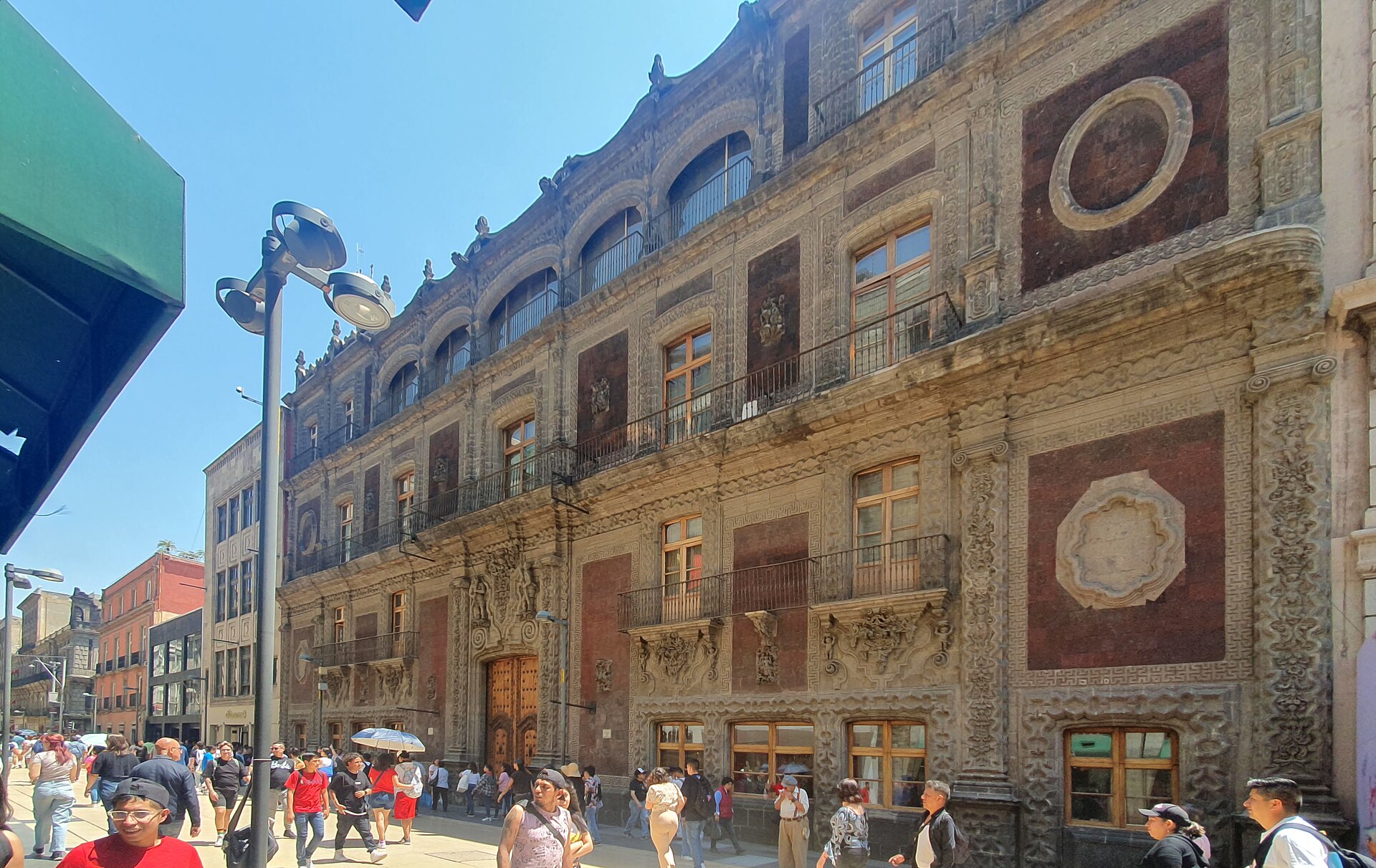
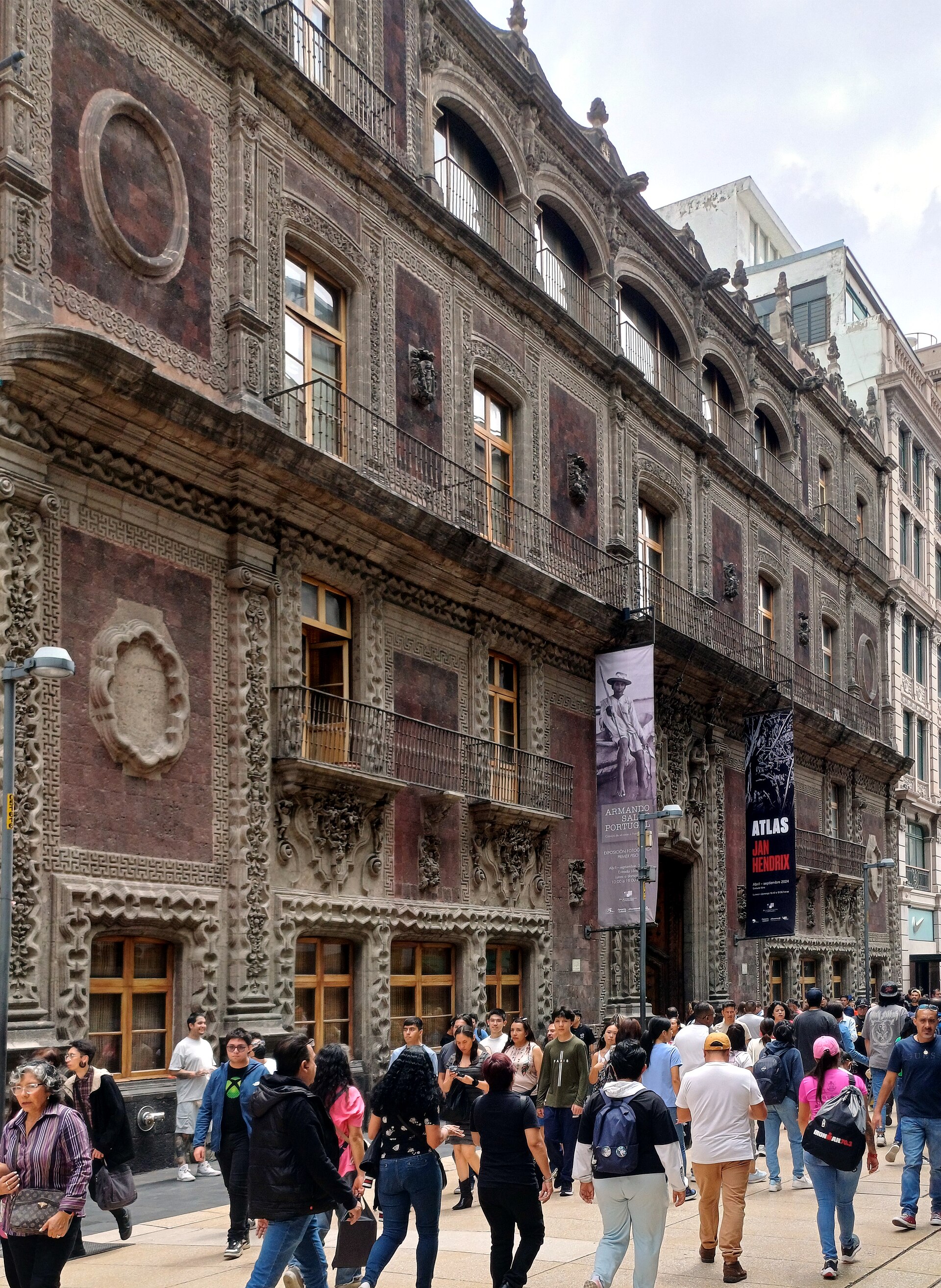
The baroque facade of the Palacio de Iturbide on the pedestrianised Francisco I. Madero street in Mexico City's historic centre, photographed in 2024.
Jose Luiz, CC BY-SA 4.0 · Photograph by José LuizPalace of Iturbide
Museum · Palacio de Iturbide · Founded 1779
Open, admission and hours confirmed 26 September 2026 · 12 sources
On this page 16 sections
ContentsClose
The palace does not hold a large standing collection of its own on permanent view. Its one fixed display is the period room described above, furnished to represent the building's eighteenth and nineteenth century occupants. Everything else a visitor sees is a temporary loan exhibition, changed two to three times a year and drawn from outside collections or from Fomento Cultural Banamex's wider holdings elsewhere; the building's own architecture, restored in 1972 and again by 2004, is treated by both the foundation and by visitors as the permanent exhibit that never leaves.
| Local name | Palacio de Iturbide |
|---|---|
| Kind | Museum |
| Founded | Built 1779-1785 for Miguel de Berrio y Zaldivar, Marques del Jaral de Berrio, designed by architect Francisco Antonio Guerrero y Torres and completed by his brother-in-law Agustin Duran; opened as a public cultural venue in 1972 and reopened in its present museum format on 19 January 2004 |
| City and country |  Mexico City, Mexico Mexico City, Mexico |
| Address | Francisco I. Madero 17, Centro Historico, C.P. 06000, Cuauhtemoc, Ciudad de Mexico, Mexico |
| Website | fomentoculturalbanamex.org |
| Status | Open, confirmed |
| Record last verified |
Visiting
- Hours
- Monday-Sunday10:00 to 19:00Open every day of the week, including Sundays, per the foundation's own site
- Admission
- General admissionFreeEntrada libre: free entry for all visitors, every day. Free guided tours run daily at 12:00, 14:00 and 16:00; family-oriented visits run Saturdays and Sundays at 12:30.
- Do I need to book?
- No. Entry and the daily guided tours are free and do not require advance reservation, per the foundation's own visitor page.
- Address
- Francisco I. Madero 17, Centro Historico, C.P. 06000, Cuauhtemoc, Ciudad de Mexico, Mexico MapMetro Metro Allende (Line 2), about a 4 minute walk
Metro Metro San Juan de Letran (Line 8), about a 5 minute walk
On foot The building fronts Francisco I. Madero, a pedestrian-only street running between the Zocalo and the Palacio de Bellas Artes; no vehicle access to the entrance - Website
- fomentoculturalbanamex.org
- Telephone
- +52 55 1226 0124
- [email protected]
Before you go how long, access, photography, bags, eating, shop
- How long to allow
- Reviewers on Tripadvisor and Yelp-style aggregators consistently put a visit at 30 minutes to an hour, since the palace usually shows one exhibition in the courtyard and a smaller second show upstairs, rather than a large standing collection.
- Access
- Not stated on the foundation's own site as of 2026-09-26. The foundation advertises specialised guided visits for people with intellectual disabilities, but does not publish a statement on step-free or wheelchair access to the building.
- Photography
- Not stated on the foundation's own site as of 2026-09-26.
- Bags
- Not stated on the foundation's own site as of 2026-09-26.
- Eating
- None advertised. The foundation's site lists a library and a photographic archive on this site, not a cafe.
- Shop
- None advertised specifically for this building beyond the foundation's general publications programme.
Prices and hours change. We take them from the institution's own pages and print the day we read them, and you can check the current position at the source we used. Confirm before you travel.
What is inside
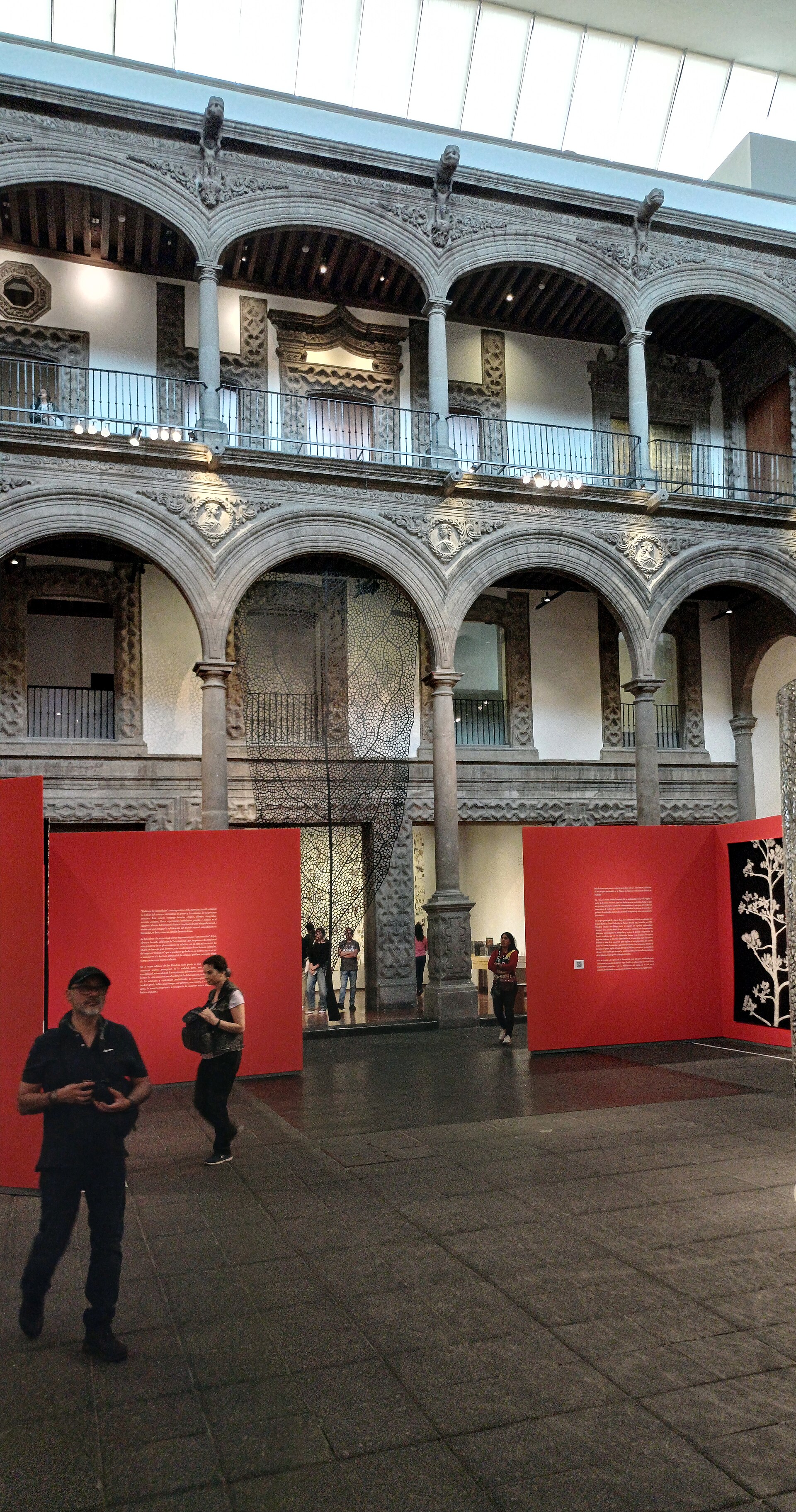
Photograph by José Luiz · CC BY-SA 4.0 The courtyard (patio principal)
The palace's baroque courtyard, ringed by an arcade on slender stone columns and carved medallions. In 1972 architect Ricardo Legorreta replaced a broken glazed roof with a new sloped skylight and added a plain fountain beneath it, converting the private courtyard into the covered hall where the palace's headline exhibitions are now staged, from the 2026 ceramics survey to Jan Hendrix's 2024 'Atlas'.
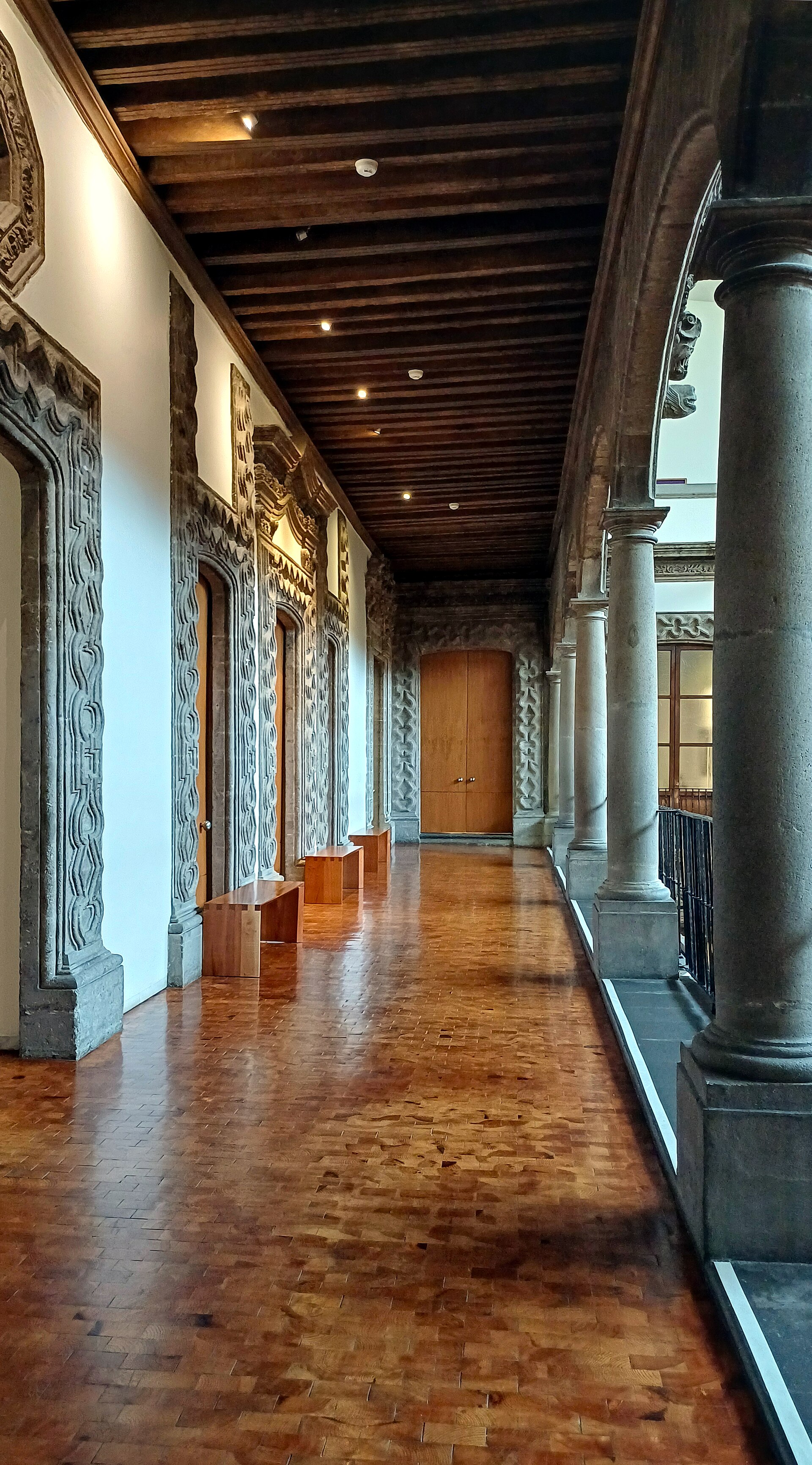
Photograph by José Luiz · CC BY-SA 4.0 Upper corridor and first-floor galleries
A raised gallery running around the courtyard at first-floor level, its walls framed by carved cantera-stone doorcases beneath a dark beamed wooden ceiling. It leads to the smaller upper rooms that, per visitor reports, usually carry a second, more intimate exhibition alongside whatever fills the courtyard below.
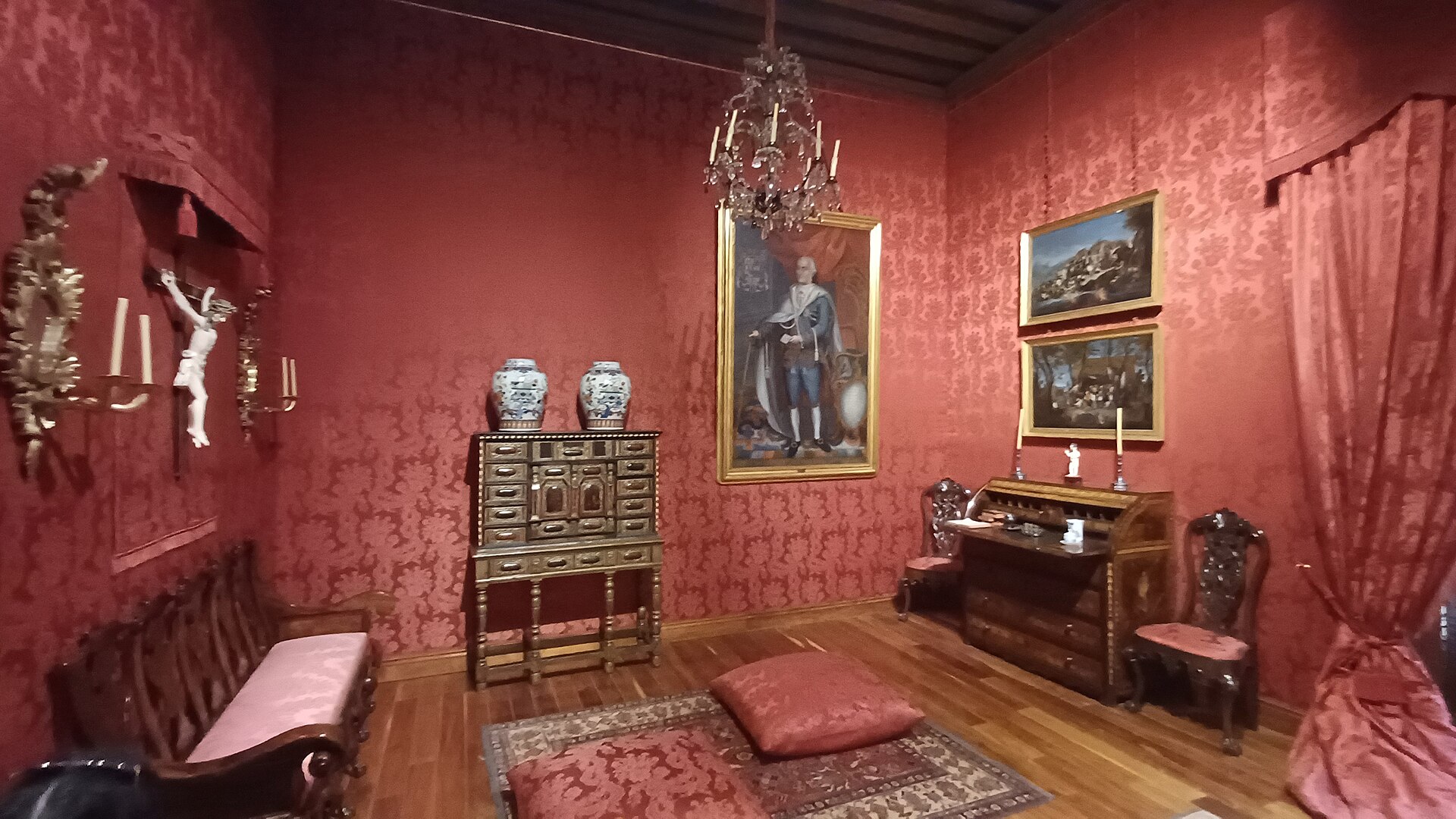
Photograph by José Luiz · CC BY-SA 4.0 The permanent period room
Away from the rotating exhibitions, a single room is dressed as an eighteenth or nineteenth century reception salon: damask-covered walls, an oil portrait, an inlaid drop-front secretaire, blue-and-white jars and a crucifix. Mexico's federal cultural directory describes this as the palace's own 'museum room with original owners' portraits' and its permanent exhibit on the building's architectural history, distinct from the temporary shows.
Library and photographic archive
A research library and a photographic archive maintained by Fomento Cultural Banamex on the premises, together with an interactive gallery using touchscreen displays for public and school programming.
Ground-floor temporary exhibition rooms
The ground-floor rooms flanking the courtyard, where the foundation mounts two to three major temporary exhibitions a year on Mexican art from the sixteenth century to the present: a 2025 retrospective of Miguel Covarrubias, a 2026 survey of Mexican ceramics, and earlier shows on Oaxacan textiles, folk art and named twentieth-century painters.
What to see first
The carved main portal
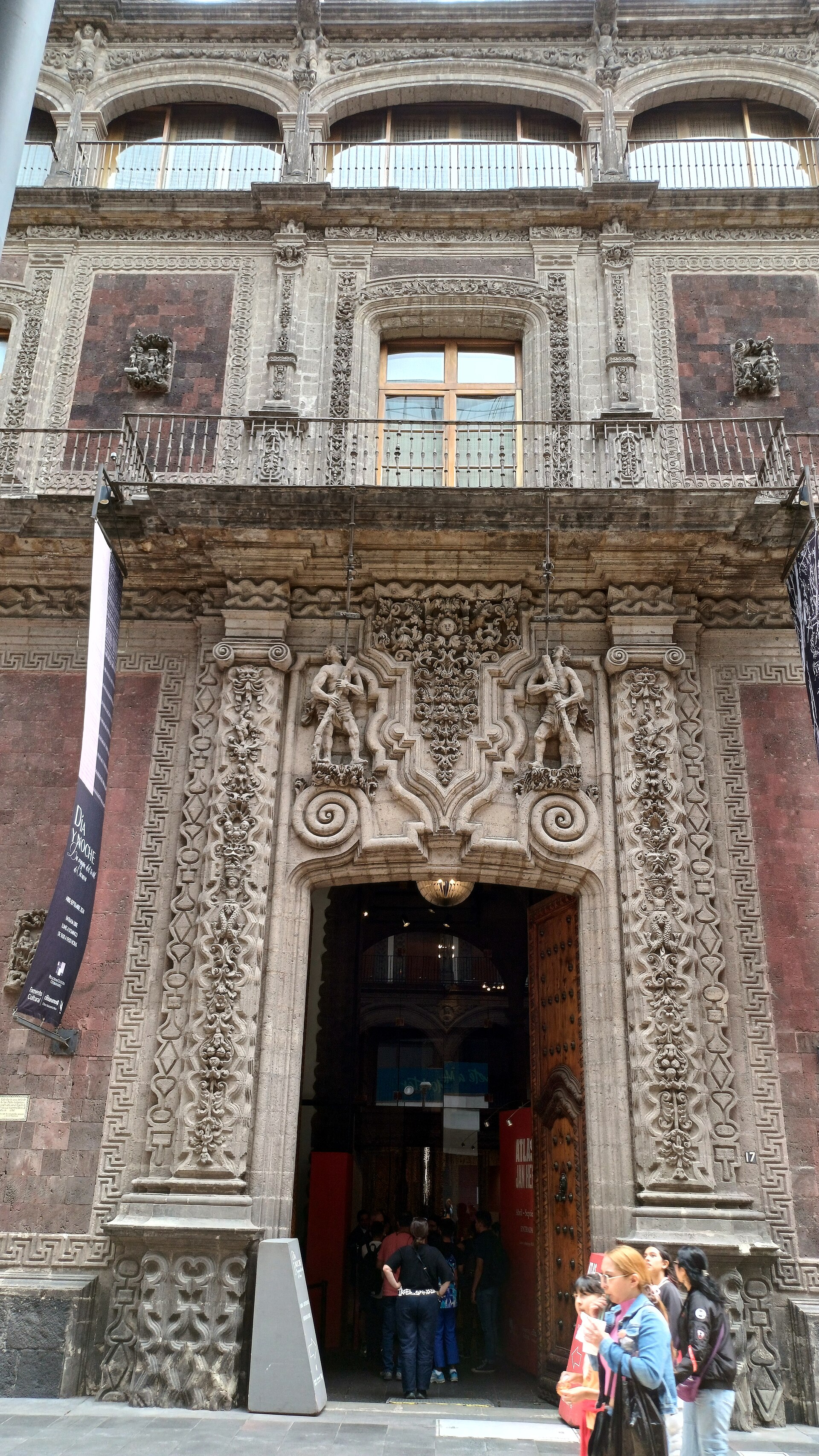
Attributed to architect Francisco Antonio Guerrero y TorresA cantera-stone doorcase carved with two atlantes figures flanking a mixtilinear cartouche that once bore the Berrio family arms; the Spanish Wikipedia account and the building's own street-level plaque both single out this portal as one of the finest baroque entrances left in the historic centre, and it is still the building's public entrance today.5
The courtyard and its 1972 skylight roof
Ricardo Legorreta (1972 remodelling)Legorreta kept the original Tuscan-column arcade but replaced a broken glass roof with a new sloped skylight and a plain fountain beneath it, turning a private courtyard into the covered hall where the palace's major exhibitions are staged; his own architecture studio still lists the project among its restorations.7
The tile plaque of the acclamation
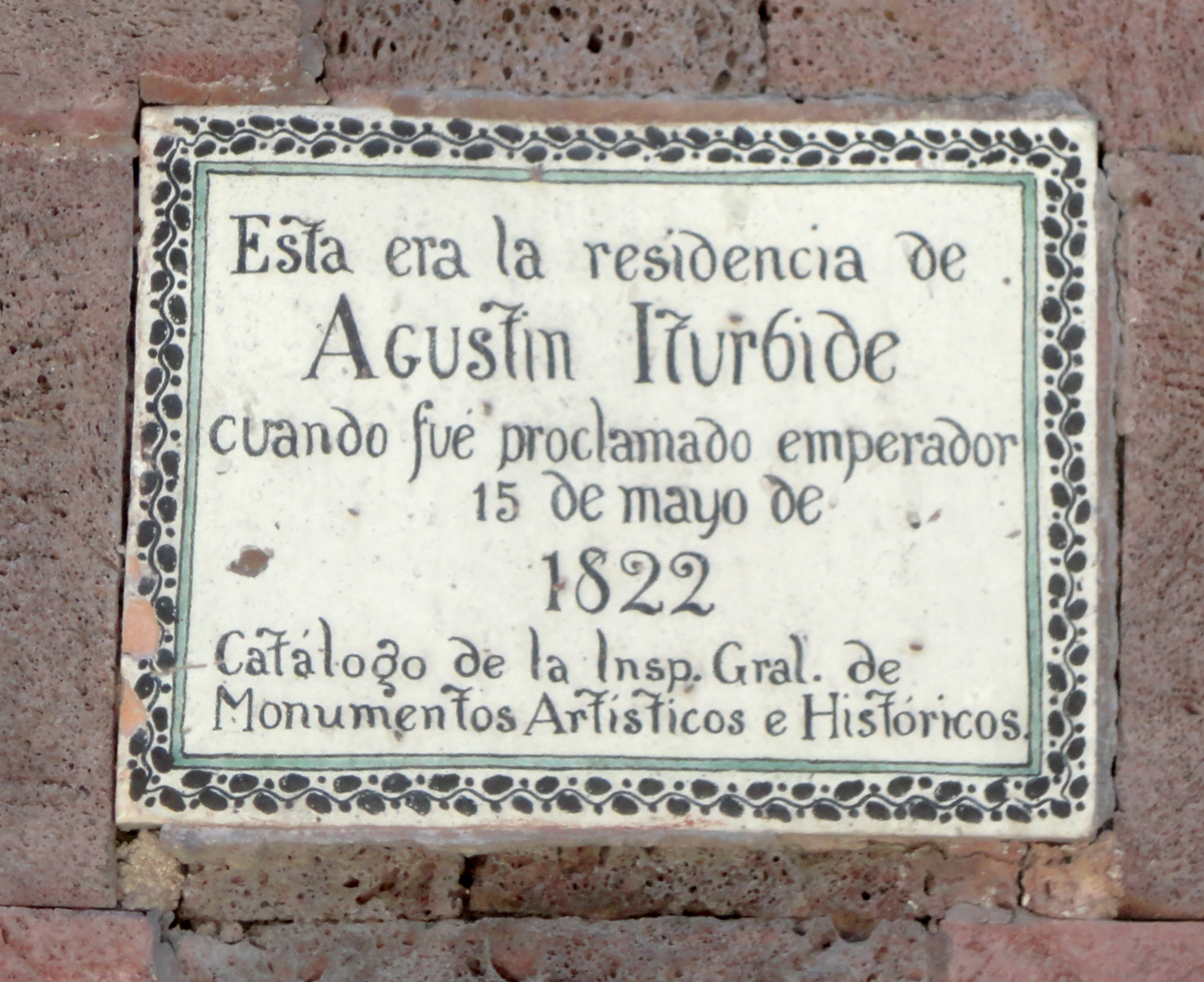
Instituto Nacional de Antropologia e Historia, Inspeccion General de Monumentos Artisticos e HistoricosA period Talavera-style tile set into the facade itself records, in its own words, that this was the residence of Agustin Iturbide when he was proclaimed emperor on 15 May 1822; other secondary accounts of the same events give 18 or 19 May for the proclamation and 21 July 1822 for the formal coronation that followed, which this record keeps distinct rather than flattening into one date.4
'Miguel Covarrubias: una mirada sin fronteras' (2025)
Subject: Miguel Covarrubias (1904-1957)A 450-piece retrospective drawn from 51 public and private collections, organised in 14 thematic sections covering Covarrubias's work as caricaturist, ethnographer, cartographer and stage designer for publications including Vanity Fair and The New Yorker; La Jornada's culture column used the show to walk through his career and called the palace itself one of the historic centre's most beautiful baroque buildings.8
'Barro y ceramica en Mexico: Poeticas de lo utilitario' (2026)
Co-curated by Juan Coronel Rivera and Ana Elena MalletExcelsior reported the show brought together more than 670 ceramic pieces from about 100 makers, studios and workshops spanning three millennia of production, which its curators presented as the first exhibition to unite pre-Hispanic, popular and contemporary Mexican ceramics under one roof.10
'Atlas' (Jan Hendrix) and 'Dia y Noche' (Remigio Mestas), 2024
Jan Hendrix; Remigio MestasStaged together to mark the 140th anniversary of Banco Nacional de Mexico, pairing Hendrix's studies of natural structure, a show that had already drawn more than 130,000 visitors at earlier venues, with Mestas's presentation of Oaxacan weaving and embroidery traditions.12
The permanent period room on the palace's own history
The one part of the visit that does not change with the touring exhibitions: a furnished salon with an oil portrait, an inlaid secretaire and period porcelain, kept as the building's fixed record of itself and the family it was built for.3
A wedding gift built to outdo a dowry
The palace was built between 1779 and 1785 for Miguel de Berrio y Zaldivar, Marques del Jaral de Berrio and Conde de San Mateo de Valparaiso, one of the richest men in New Spain. Several accounts, repeated on the foundation's own site and in secondary histories, describe it as a wedding gift for his daughter, its scale reportedly matched to a dowry of around 100,000 pesos. The architect Francisco Antonio Guerrero y Torres began the design; after his death the work was completed by his brother-in-law, Agustin Duran. The result is a New Spanish Baroque town palace on three main floors plus a mezzanine and, unusually for a viceregal residence, a fourth level formed by two towers joined by a gallery at the top of the facade.
Tezontle, cantera and a private coat of arms
The facade combines red tezontle volcanic stone with carved grey cantera in bands and cartouches, a materials pairing common to civil baroque buildings of the period but worked here with unusual density. Mexico City's own tourism office describes the facade as one of the finest examples of the city's 'civil baroque' architecture. The main portal, at street level, is carved with two atlantes figures flanking a mixtilinear cartouche that once carried the Berrio family's coat of arms, flanked by scrolled pilasters; wrought-iron balconies run the width of the upper floors, and round stone medallions punctuate the wall between them. The building was designed to be read from the street, at a time when Calle Madero (then Calle de San Francisco) was already one of the city's principal thoroughfares.
A borrowed name: the emperor who never owned it
The palace carries the name of a man who never owned it. After Mexico's independence in 1821, the Berrio family, who by then lived in Spain, lent the building to Agustin de Iturbide, commander of the Army of the Three Guarantees. A period tile plaque set into the building's own facade, catalogued by the national Inspeccion General de Monumentos Artisticos e Historicos, records that this was Iturbide's residence when he was proclaimed emperor; the plaque itself dates the proclamation to 15 May 1822, while other secondary accounts give the acclamation as 18 or 19 May of the same year. What is consistent across sources is that Iturbide continued to live in the palace afterward and left it on 21 July 1822 to be formally crowned Agustin I. His reign lasted less than a year: forced to abdicate in March 1823, he went into exile, returned to Mexico in 1824 believing he still had support, and was captured and executed that July. The palace kept his name from the few months he occupied it as a guest, not as an owner.
From imperial address to a hundred years as a hotel
After Iturbide's fall the building passed out of the Berrio family's use as a residence. From 1855 it operated as a hotel for roughly a century; a nineteenth-century print in the palace's own visual record, captioned 'Casa del Imperador Iturbide, hoy Hotel de las Diligencias Generales', documents this period directly, showing the building already known by both names at once, the emperor's house and the coach-line hotel. By the mid twentieth century the building had been altered for commercial use: ground-floor arcades had been built over with mezzanines, and the original grand staircase had been replaced by a smaller stair and an elevator.
Banamex, Legorreta, and the 1972 rescue
The Banco Nacional de Mexico, known as Banamex, bought the palace in 1964-65 as part of a programme to rescue viceregal architecture the bank judged to be at risk. The restoration architect Ricardo Legorreta did not attempt a speculative recreation of the 1785 interior; instead he re-established the original floor levels by removing later paving, removed the commercial mezzanines under the ground-floor arcades, rebuilt the grand staircase, and replaced the courtyard's broken glazed roof with a new sloped skylight of his own design, adding a plain fountain beneath it. His own architecture studio still lists these choices as deliberate modern interventions rather than pastiche: new doors, a new elevator and staircase, wood flooring and hanging lamps, set inside the restored colonial fabric. From 1972 the building became the seat of Fomento Cultural Banamex, the bank's cultural foundation, functioning partly as offices and partly as an exhibition space.
2004: from bank annex to public museum
A further restoration in the early 2000s completed the building's shift away from office use. It reopened in its present form on 19 January 2004 as the Palacio de Cultura Citibanamex, commonly known by the older name Palacio de Iturbide or, in some listings, as the Museo Antiguo Palacio de Iturbide. Mexico's federal cultural directory describes the current facilities as a library, a photographic archive, an interactive gallery with touchscreen displays, a museum room preserving portraits of the palace's original owners, and a permanent exhibit on the building's own architectural history, alongside the rotating temporary exhibitions that now occupy most of the ground and first floors.
What has filled the courtyard since
The foundation mounts two to three major temporary exhibitions a year, and the sequence shows a deliberate range across Mexican visual culture rather than a single specialism. In 2022 the courtyard held a show of Yvonne Domenge's sculpture, which a Tripadvisor reviewer who saw it called world-class, paired upstairs with folk art addressing Mexico's difficult social history. From October 2023 to February 2024 the palace showed 'Teodora Blanco / Maria Izquierdo: Percepciones de belleza', pairing a celebrated Oaxacan potter with a modernist painter. From April to September 2024, to mark the 140th anniversary of Banco Nacional de Mexico, it showed Jan Hendrix's 'Atlas', a survey of natural structure that had already drawn more than 130,000 visitors elsewhere, alongside Remigio Mestas's 'Dia y Noche', on Oaxacan weaving and embroidery. In April 2025 it opened a 450-piece Miguel Covarrubias retrospective, drawn from 51 collections and organised into 14 thematic sections covering his work as caricaturist, ethnographer, cartographer and stage designer. By spring 2026 the courtyard held 'Barro y ceramica en Mexico: Poeticas de lo utilitario', bringing together more than 670 ceramic pieces from about 100 makers and workshops spanning three millennia, which its curators, Juan Coronel Rivera and Ana Elena Mallet, presented as the first exhibition to treat pre-Hispanic, popular and contemporary Mexican ceramics as a single continuous history rather than separate categories.
An exhibition venue, not a museum of its own collection
It is worth being precise about what kind of institution this is, because the palace's own billing can blur it. Fomento Cultural Banamex holds a large art collection built up since around 1920, reported in secondary sources at roughly 4,300 works and including pieces by Diego Rivera, Frida Kahlo and Manuel Alvarez Bravo; the foundation also operates several other historic houses of culture across Mexico, including the Museo Casa Montejo in Merida and houses in Durango and San Miguel de Allende. Nothing on the foundation's own site states how much, if any, of that wider collection is shown at this specific building rather than at its sister venues. What the Palacio de Iturbide itself guarantees a visitor, based on its own published programme, is the rotating temporary exhibition in the courtyard and upstairs, the single fixed period room on the building's own history, and the baroque structure itself, restored twice, in 1972 and again by 2004, specifically so it could be shown rather than merely occupied.
What visitors say
Visitors consistently describe the Palacio de Iturbide as a free, easy stop in the historic centre that rewards a short visit. Praise centres as much on the baroque building itself, the facade and the covered courtyard, as on whatever exhibition currently fills them, and reviewers repeatedly note that the show changes every few months, which makes a repeat visit worthwhile.
What is praised, what is criticised
- Praised: The building itself: the carved facade, the arcaded courtyard and the restored interiors, which visitors say survive the conversion to gallery space
- Praised: Free admission with no advance booking, in a central location on the pedestrianised Calle Madero between the Zocalo and the Palacio de Bellas Artes
- Praised: The quality and range of the rotating exhibitions, from folk ceramics and Oaxacan textiles to retrospectives of named twentieth-century artists
- Criticised: Visitors expecting a fully furnished historic residence report that, beyond the columns, door frames and the single period room, most of the interior has been converted into plain gallery space, so the building itself is a smaller draw than advertised once inside
- Criticised: The palace is easy to misidentify or overlook: it is not listed under the Iturbide name on some map services, which index it as Palacio de Cultura Citibanamex, and one reviewer noted the facade is poorly lit after dark
Ratings on other platforms
Tripadvisor: 4.6 from 171 ratings, read 26 September 2026
A platform average is a tertiary source: it moves, it is not audited, and we quote no visitor's words.
Questions about Palace of Iturbide
Where is Palace of Iturbide?
Francisco I. Madero 17, Centro Historico, C.P. 06000, Cuauhtemoc, Ciudad de Mexico, Mexico.
How much does it cost to visit?
General admission: free. As confirmed 26 September 2026.
When is it open?
Monday-Sunday 10:00-19:00. As confirmed 26 September 2026.
How do you get there?
Metro: Metro Allende (Line 2), about a 4 minute walk; Metro: Metro San Juan de Letran (Line 8), about a 5 minute walk; On foot: The building fronts Francisco I. Madero, a pedestrian-only street running between the Zocalo and the Palacio de Bellas Artes; no vehicle access to the entrance.
What should you see first?
The carved main portal (Attributed to architect Francisco Antonio Guerrero y Torres); The courtyard and its 1972 skylight roof (Ricardo Legorreta (1972 remodelling)); The tile plaque of the acclamation (Instituto Nacional de Antropologia e Historia, Inspeccion General de Monumentos Artisticos e Historicos); 'Miguel Covarrubias: una mirada sin fronteras' (2025) (Subject: Miguel Covarrubias (1904-1957)); 'Barro y ceramica en Mexico: Poeticas de lo utilitario' (2026) (Co-curated by Juan Coronel Rivera and Ana Elena Mallet); 'Atlas' (Jan Hendrix) and 'Dia y Noche' (Remigio Mestas), 2024 (Jan Hendrix; Remigio Mestas).
What we could not confirm
- How much, if any, of the wider Fomento Cultural Banamex collection, reported in secondary sources at around 4,300 works including pieces by Diego Rivera, Frida Kahlo and Manuel Alvarez Bravo, is ever shown at this specific building rather than at the foundation's other houses of culture is not stated on the foundation's own site.
- Primary, dated documentation of the early-2000s restoration that preceded the 2004 reopening (architect of record, exact scope of work) was not found on the foundation's own site; only Ricardo Legorreta's 1972 remodelling is documented by name, and that on his own studio's site rather than the foundation's.
- Whether the building offers step-free or wheelchair access is not stated on the foundation's own site; the only accessibility provision found in the sources checked was a specialised guided-visit programme for people with intellectual disabilities.
Images
Sources
- 1Fomento Cultural Banamex, Palacio de Iturbide visitor page (hours, admission, phone, guided tours) fomentoculturalbanamex.org/palacioIturbide.html
- 2Fomento Cultural Banamex, institutional homepage (mission, list of venues) fomentoculturalbanamex.org/
- 3Sistema de Informacion Cultural, Secretaria de Cultura (Mexico), museum record for Palacio de Cultura Banamex (Palacio de Iturbide) sic.cultura.gob.mx/ficha.php?table=museo&table_id=854
- 4Wikipedia, 'Palace of Iturbide' (English) - history, ownership, architecture en.wikipedia.org/wiki/Palace_of_Iturbide
- 5Wikipedia, 'Palacio de Iturbide' (Spanish) - architectural description, ownership history, restorations es.wikipedia.org/wiki/Palacio_de_Iturbide
- 6Wikidata, Q130898 (Palace of Iturbide) - identity, coordinates, inception date wikidata.org/wiki/Q130898
- 7Legorreta Arquitectos, 'Iturbide Palace Restoration' project page legorreta.mx/en/proyecto-restauracion-del-palacio-de-iturbide
- 8Angeles Gonzalez Gamio, 'El palacio y el Chamaco', La Jornada, opinion column, 6 July 2025 jornada.com.mx/2025/07/06/opinion/026a1cap
- 9Tripadvisor, 'Museo Antiguo Palacio de Iturbide' attraction page (rating, review text, location) tripadvisor.com/Attraction_Review-g150800-d184029-Reviews-Museo_Antiguo_Palacio_de_Iturbide-Mexico_City_Central_Mexico_and_Gulf_Coast.html
- 10Juan Carlos Talavera, 'Exposicion Barro y ceramica en Mexico', Excelsior, 30 April 2026 excelsior.com.mx/cultura/exposicion-barro-y-ceramica-mexico-palacio-iturbide-2026
- 11Mexico City government tourism site, venue page for the Banamex Palace / Iturbide Palace mexicocity.cdmx.gob.mx/venues/banamex-palace-iturbide/?lang=en
- 12Leticia Sanchez Medel, 'Dia y Noche y Atlas llegan al Palacio de Iturbide', Milenio, 17 April 2024 milenio.com/cultura/dia-y-noche-y-atlas-llegan-al-palacio-de-iturbide