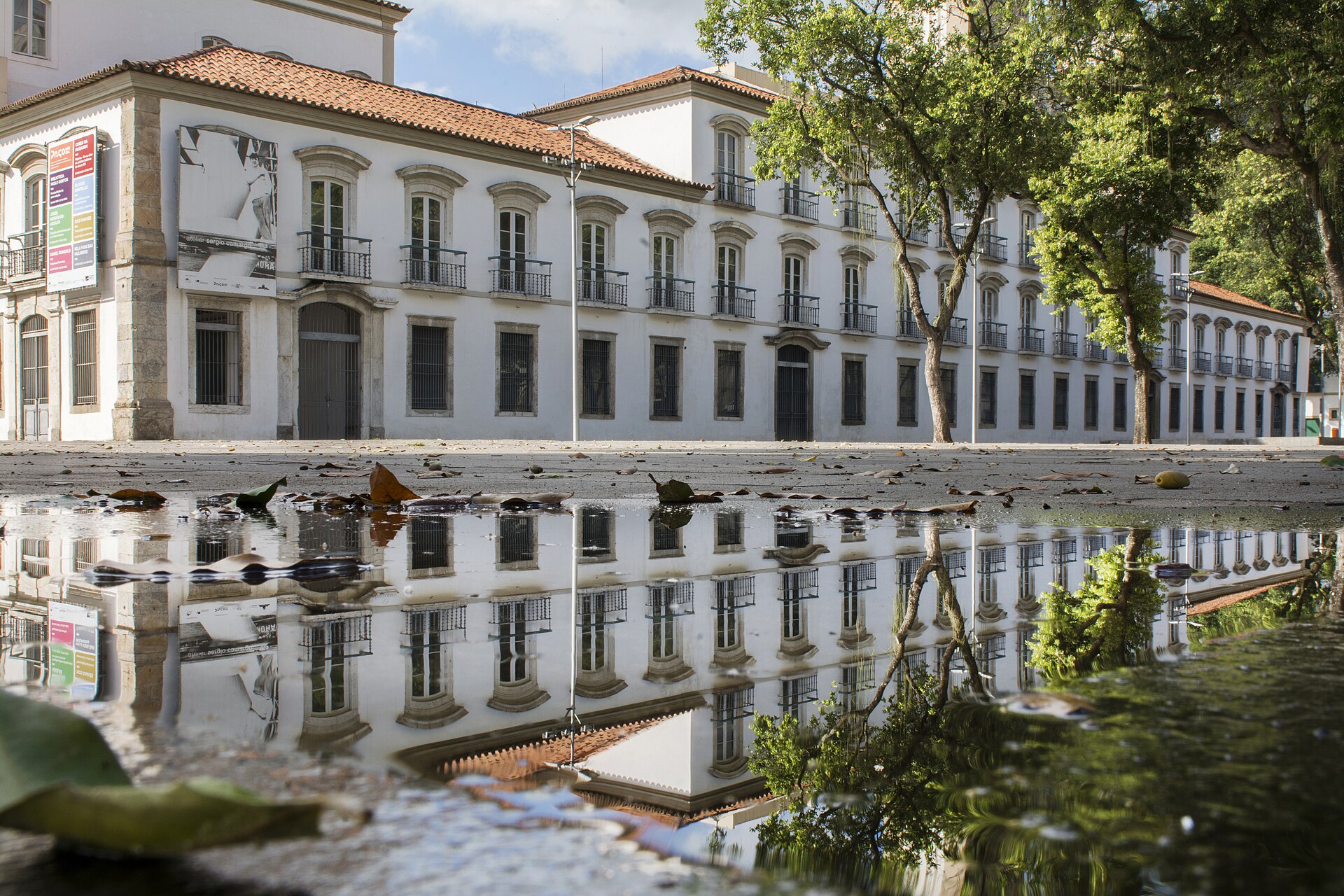
The lateral facade of Paco Imperial, on Praca XV de Novembro, photographed in 2022.
Henrique Liberal · CC BY-SA 4.0Paco Imperial
Museum · Founded 1985
Open, admission and hours confirmed 28 September 2026 · 17 sources
On this page 14 sections
ContentsClose
Paco Imperial holds no permanent art collection, by design and by explicit institutional choice. Its director since the 1990s, Lauro Cavalcanti, has said plainly that the building's own architecture and three centuries of history are its real holdings. The single permanent installation is the Atelie Sergio Camargo, the sculptor's studio and tools kept in the smaller inner courtyard; everything else that has been shown here, from a Henry Moore retrospective to the preview of the collection that founded the Niteroi contemporary art museum across the bay, arrived on loan and moved on. That makes the record of what has passed through its galleries, documented in more than three hundred exhibitions since 1984, the closest thing the institution has to a collection.
| Kind | Museum |
|---|---|
| Founded | 1985 |
| City and country |  Rio de Janeiro, Brazil Rio de Janeiro, Brazil |
| Address | Praca XV de Novembro, 48, Centro, Rio de Janeiro, RJ 20010-010, Brazil |
| Website | amigosdopacoimperial.org.br |
| Status | Open, confirmed |
| Record last verified |
Visiting
- Hours
- Tue-Sun and holidays12:00 to 18:00Exhibition galleries
- Mon-Sun and holidays11:00 to 18:00Building, courtyard, bistro and bookstore stay open on Monday even though the galleries do not
- Closed
- Exhibition galleries only, on Monday; the building itself does not close.
- Admission
- General admissionFreeFree entry to the building and to every exhibition, every day it is open
- Do I need to book?
- No, free walk-in entry, no advance ticket required
- Address
- Praca XV de Novembro, 48, Centro, Rio de Janeiro, RJ 20010-010, Brazil MapMetro Carioca station (Lines 1 and 2), about 8 minutes on foot
Metro Uruguaiana station (Line 1), about 10 minutes on foot - Website
- amigosdopacoimperial.org.br
- Telephone
- +55 21 2215 2093
- [email protected]
Before you go how long, access, photography, bags, eating, shop
- How long to allow
- About one hour for the galleries on a normal day; visitors reported longer during the 2026 fortieth-anniversary show, which fills twelve halls and two courtyards
- Access
- Not detailed on the institution's own visit page at the time of research; the nearby Uruguaiana metro station is listed as step-free
- Eating
- Two on-site dining options, Bistro do Paco and Entrepasso
- Shop
- Livraria Blooks bookshop on the ground floor
Prices and hours change. We take them from the institution's own pages and print the day we read them, and you can check the current position at the source we used. Confirm before you travel.
What is inside
Exhibition galleries
Ground- and upper-floor galleries around the main courtyard carry a year-round rotation of contemporary and historical art, photography and themed shows. The center holds no permanent art collection of its own; its director has said the building's architecture and history are its real holdings.
Atelie Sergio Camargo
In the smaller inner courtyard, on the side facing the ferry terminal, the only permanent installation in the building: work and tools of Brazilian sculptor Sergio Camargo (1930-1990). It grew out of an artist-in-residence program, Atelie Finep, that also placed working studios for Beatriz Milhazes, Cildo Meireles, Waltercio Caldas, Anna Bella Geiger, Iole de Freitas and other Brazilian artists inside the building between 1994 and 1998.
Biblioteca Paulo Santos
First-floor reference library built from the private collection of architect and art historian Paulo Santos: rare 16th- to 18th-century volumes and a large holding on architecture, engineering and Brazilian, Portuguese and Rio history. Open to the public Wednesday and Friday mornings, plus remote consultation.
Cine Estacao Paco
A small in-house cinema, part of the center's regular film and screening program alongside its visual-art exhibitions.
Central courtyard
The building's main internal courtyard, used for large installations tied to temporary shows; for the 2026 fortieth-anniversary exhibition it held a memorial garden built with the Burle Marx estate and a floor piece assembled from materials gathered at the Praca XV market.
What to see first
Signing of the Lei Aurea (Golden Law)
Princess Isabel, 13 May 1888Inside this building the Imperial Princess Isabel, acting as regent, signed the law that abolished slavery in Brazil outright. It is the single event most Brazilian visitors associate with the building and the reason it still carries the word Imperial in its name.3
The Dia do Fico declaration
Dom Pedro I, 9 January 1822From the palace, Pedro I announced his refusal to obey the order to return to Portugal, the moment usually cited as the opening act of Brazilian independence.3
The Mestre Valentim fountain and quay
Mestre Valentim, from 1808Built when the building became the royal residence, the fountain and stone quay supplied ships and nearby houses and are among the few 1808-era additions to survive; the sculptor's name is still attached to one of the building's rooms.4
Atelie Sergio Camargo
Sergio Camargo (1930-1990)The building's only standing permanent installation, set up in the smaller inner courtyard: the sculptor's own works and working tools, kept as a studio rather than a conventional display case.4
Henry Moore, a retrospective (2005)
Henry Moore244 sculptures, prints and drawings spanning 1920 to 1980 filled the galleries from July to September 2005, on a Brazilian tour that the organizers called the largest Moore exhibition held outside Europe; it won the Brazilian Association of Art Critics' award for best exhibition of the year.15
A Caminho de Niteroi: colecao Joao Sattamini (1992-93)
Joao Sattamini collectionA preview showing of the contemporary art collection that, a few years later, became the founding collection of the Niemeyer-designed Museu de Arte Contemporanea in Niteroi, across the bay.4
28th Panorama da Arte Brasileira (2004-05)
Multiple Brazilian artistsA run of Brazil's long-standing itinerant survey of contemporary national production, normally associated with the Museu de Arte Moderna in Sao Paulo, hosted here from December 2004 to February 2005.4
Ai Weiwei - Raiz (2019)
Ai Weiwei, curated by Marcello DantasThe Rio stop of Ai Weiwei's largest Brazilian showing, 60 works split between the Centro Cultural Banco do Brasil and the Paco Imperial from August to November 2019; the show had already been named best international exhibition of 2018 by the Sao Paulo critics' association during its Sao Paulo run.16
Constelacoes, 40 anos do Paco Imperial (2026)
Curated by Claudia Saldanha and Ivair ReinaldimThe center's own fortieth-anniversary exhibition, 28 March to 7 June 2026: about 160 works by more than 100 artists across twelve halls and two courtyards, including Adriana Varejao, Beatriz Milhazes, Cildo Meireles, Helio Oiticica, Lygia Clark and a Burle Marx memorial garden built for the show. A named review called it unmissable and the largest museum show running in Brazil that season.9
A governor's house on a new plaza
The building now called Paco Imperial began in 1738, when the governor of the captaincy, Gomes Freire de Andrade, Conde de Bobadela, ordered a proper residence for his office built at the water's edge in Rio de Janeiro. The engineer Jose Fernandes Pinto Alpoim folded two existing structures into the new design, the royal warehouses (Armazens Del-Rei) and the royal mint (Casa da Moeda), and shaped the result after the Paco da Ribeira, the Portuguese monarchs' own riverside palace in Lisbon. The Casa dos Governadores was finished in 1743. In 1747 a fountain raised in front of it gave the open ground before it the shape of a plaza for the first time, flanked by a Carmelite convent and a row of houses attributed to the same architect. That plaza is Praca XV de Novembro today, and the old governor's house still stands on one side of it.
When the seat of colonial government moved from Salvador to Rio in 1763, the house became the residence of the viceroys and kept that role until 1808, when the arrival of the Portuguese royal family changed its purpose again. A stone quay with steps down to the water, and a new fountain built by the sculptor known as Mestre Valentim, were added in this period to supply ships and nearby houses.
Royal residence and seat of empire
Fleeing Napoleon's invasion of Portugal, Prince Regent Dom Joao arrived in Rio in 1808 and the old viceroys' house became the Paco Real, enlarged by covered passageways linking it to the neighboring Carmo convent and the old city jail so the court could move between buildings without going into the street. After independence in 1822 it kept the name Paco Imperial and continued as the working seat of the new monarchy: not a residence in the ordinary sense, since the emperors mostly lived elsewhere, but the place from which they governed and where the state staged its ceremonies. Under Dom Pedro II a third passageway connected the palace directly to the tribune of the Imperial Chapel next door, again so the imperial family need not step outside.
Two moments here are still central to how Brazilians tell their own history. On 9 January 1822, Dom Pedro I stood on the building's balcony and told the crowd gathered below that he would stay in Brazil rather than obey an order to return to Portugal, the declaration remembered as the Dia do Fico and usually read as the opening act of Brazilian independence. On 13 May 1888, with the emperor in Europe, his daughter the Princess Regent Isabel signed the Lei Aurea inside the building, abolishing slavery in Brazil without qualification. The palace also hosted the more routine business of monarchy: acclamations, coronations, royal weddings, christenings and funerals.
From post office to protected monument
The Proclamation of the Republic in 1889 ended the building's political role at a stroke. Stripped of its government functions, it was handed to the postal and telegraph service and spent decades as a working post office, a use with little regard for the fabric of an eighteenth-century palace. In 1938 the newly formed national heritage service, the predecessor of today's IPHAN, listed the building for protection, but its actual recovery did not begin for another four decades.
Restoration finally started in the early 1980s under the architect Glauco Campello, as part of a wider push to revive Rio's old downtown that ran through the 1980s and 1990s. No complete original floor plan survived, so the work leaned on old photographs, archival research and archaeological digging inside the building, which turned up the old royal warehouse, a chimney from the mint, and the original water-supply well beneath the courtyard. The restoration aimed to keep visible traces of the different centuries the building had passed through rather than freeze it at a single imagined moment.
A cultural center that keeps no collection
The restored building reopened to the public as the Centro Cultural Paco Imperial at the start of 1985, run by IPHAN together with the federal culture ministry's heritage and museums department, and deliberately built no collection of its own. Lauro Cavalcanti, the institution's director since the 1990s, has put the point directly: the architecture and history of the Paco are its real holdings and its real capital. That decision sets it apart from most institutions in this archive. It is not a museum in the sense of a body of objects assembled and kept; it is a listed historic building that hosts other people's exhibitions, on a program that has run since 1984 to more than three hundred documented shows.
The one exception is the Atelie Sergio Camargo, installed in the building's smaller inner courtyard: the sculptor's own works and tools, kept as a studio rather than a conventional gallery hang. It grew out of an artist-residency idea, the Atelie Finep program launched in 1994, which in its short life gave working studio space inside the palace to Beatriz Milhazes and Anna Bella Geiger in 1994, Iole de Freitas and Luiz Aquila in 1995, Waltercio Caldas, Daniel Senise and Angelo Venosa in 1996, Cildo Meireles and Eduardo Sued in 1997, and Luiz Pizarro and Nuno Ramos in 1998. Camargo's studio is what remains of that program as a permanent fixture.
What the building has shown
Without a collection of its own, the Paco Imperial's identity has been built instead by what has passed through it. In 1992 and 1993 it gave an early public showing to the contemporary art collection assembled by Joao Sattamini, a preview of a body of work that would shortly become the founding collection of the Niemeyer-designed Museu de Arte Contemporanea across the bay in Niteroi. From December 2004 to February 2005 it hosted the 28th edition of the Panorama da Arte Brasileira, the long-running itinerant survey of contemporary national production normally associated with the Museu de Arte Moderna in Sao Paulo. That same year, from July to September 2005, its galleries held a 244-piece Henry Moore retrospective touring Brazil, organized with the British Council and the Henry Moore Foundation and billed at the time as the largest Moore exhibition ever held outside Europe; the Brazilian Association of Art Critics named it best exhibition of the year. In 2019 it took the Rio de Janeiro leg of Ai Weiwei - Raiz, sixty works by the Berlin-based Chinese artist split between the building and the nearby Centro Cultural Banco do Brasil, a show already named best international exhibition of 2018 during its earlier run in Sao Paulo.
In March 2026 the center marked its own fortieth year with Constelacoes, an anniversary exhibition curated by Claudia Saldanha and Ivair Reinaldim that filled twelve halls and two courtyards with roughly 160 works by more than a hundred artists who have shown there over four decades, from Helio Oiticica and Lygia Clark to Adriana Varejao and Beatriz Milhazes, alongside a memorial garden built with the estate of landscape architect Roberto Burle Marx.
Visiting today
Paco Imperial sits on Praca XV de Novembro in the middle of Rio's old downtown, a short walk from the Carioca and Uruguaiana metro stations and from other landmarks of the same historic district, including the Centro Cultural Banco do Brasil and the Museu do Amanha on the revived waterfront nearby. Entry to the building and to every exhibition is free, every day the galleries are open. The building itself, its courtyard, bistro and bookshop stay open on Monday even though the exhibition galleries do not; the galleries run Tuesday to Sunday and on holidays from noon to six, and the building overall from eleven to six. A first-floor reference library, the Biblioteca Paulo Santos, opens to the public on Wednesday and Friday mornings and holds rare volumes on architecture and Brazilian history built from a private collection donated to the institution. Reviewers most often describe the whole visit, outside of a major touring show, as taking about an hour.
What visitors say
Visitors consistently describe a compact, free stop in the historic core of Rio that rewards a quick visit more than a long one: a handsomely restored colonial palace whose real draw is the political history enacted inside it, paired with a rotating program of contemporary art that many did not expect to find in a colonial-era building. Reviewers who arrive expecting a grand European-style state residence, on the strength of the name Imperial Palace, tend to note that the rooms are plainer and smaller than that.
What is praised, what is criticised
- Praised: Free admission to both the building and every exhibition
- Praised: The historical weight of the site: independence and abolition each have a documented moment inside these walls
- Praised: An easy, walkable stop in the Praca XV historic core, close to the Carioca and Uruguaiana metro stations
- Praised: Contemporary Brazilian and international exhibitions that visitors did not expect inside a colonial government building
- Criticised: Several visitors note the building is smaller and plainer than the name Imperial Palace suggests, with modest colonial-era rooms rather than grand state apartments
- Criticised: Because the center keeps no permanent collection, what a visitor actually sees depends entirely on which temporary show happens to be running
- Criticised: On-site historical signage is limited in places, and English-language information is inconsistent from room to room
Ratings on other platforms
Tripadvisor: 4 from 389 ratings, read 28 September 2026
A platform average is a tertiary source: it moves, it is not audited, and we quote no visitor's words.
Questions about Paco Imperial
Where is Paco Imperial?
Praca XV de Novembro, 48, Centro, Rio de Janeiro, RJ 20010-010, Brazil.
How much does it cost to visit?
General admission: free. As confirmed 28 September 2026.
When is it open?
Tue-Sun and holidays 12:00-18:00; Mon-Sun and holidays 11:00-18:00. Closed: Exhibition galleries only, on Monday; the building itself does not close. As confirmed 28 September 2026.
How do you get there?
Metro: Carioca station (Lines 1 and 2), about 8 minutes on foot; Metro: Uruguaiana station (Line 1), about 10 minutes on foot.
What should you see first?
Signing of the Lei Aurea (Golden Law) (Princess Isabel, 13 May 1888); The Dia do Fico declaration (Dom Pedro I, 9 January 1822); The Mestre Valentim fountain and quay (Mestre Valentim, from 1808); Atelie Sergio Camargo (Sergio Camargo (1930-1990)); Henry Moore, a retrospective (2005) (Henry Moore); A Caminho de Niteroi: colecao Joao Sattamini (1992-93) (Joao Sattamini collection).
What we could not confirm
- Sources differ on the exact founding date of the cultural center: one authoritative encyclopedia entry gives late 1984 for the opening, while the institution's own site gives 6 March 1985; this page uses 1985 on the strength of the institution's own account but the discrepancy is not resolved.
- No accessibility statement (step-free routes, adapted restrooms, assistance for visitors with disabilities) was found published on the institution's own site at the time of research.
- Photography and bag-check policy inside the galleries were not stated on any source consulted.
Images
Sources
- 1Amigos do Paco Imperial, Visite o Paco Imperial (visitor information) amigosdopacoimperial.org.br/visite-o-paco-imperial/
- 2Instituto do Patrimonio Historico e Artistico Nacional (IPHAN), Centro Cultural Paco Imperial gov.br/iphan/pt-br/unidades-especiais/centro-cultural-paco-imperial
- 3Wikipedia, Paco Imperial en.wikipedia.org/wiki/Pa%C3%A7o_Imperial
- 4Enciclopedia Itau Cultural, Paco Imperial (institution entry, with exhibition history) enciclopedia.itaucultural.org.br/instituicoes/70012-paco-imperial
- 5Tripadvisor, Paco Imperial (Rio de Janeiro attraction page, ratings and visitor comments) tripadvisor.com/Attraction_Review-g303506-d311283-Reviews-Paco_Imperial-Rio_de_Janeiro_State_of_Rio_de_Janeiro.html
- 6Cynthia Garcia, The Iconic Paco Imperial Museum Stages a Definitive Takeover, Newcity Brazil, 24 April 2026 newcitybrazil.com/2026/04/24/the-iconic-paco-imperial-museum-stages-a-definitive-takeover/
- 7Rio Memorias, Paco Imperial riomemorias.com.br/memoria/paco-imperial-2/
- 8Riotur, The Imperial Palace Cultural Center riotur.rio/en/que_fazer/imperialpalace/
- 9Cidade de Niteroi, Paco Imperial celebra 40 anos com megaexposicao Constelacoes no Rio cidadedeniteroi.com/cidades/rio/paco-imperial-40-anos-exposicao-constelacoes/
- 10Amigos do Paco Imperial, Historico e Missao amigosdopacoimperial.org.br/missao/
- 11Visite Museus (Instituto Brasileiro de Museus), Centro Cultural do Patrimonio Paco Imperial (government museum directory entry; ) visite.museus.gov.br/instituicoes/centro-cultural-do-patrimonio-paco-imperial/
- 12Wikimedia Commons, File:Vista da fachada lateral do Paco Imperial.jpg commons.wikimedia.org/wiki/File:Vista_da_fachada_lateral_do_Pa%C3%A7o_Imperial.jpg
- 13Wikimedia Commons, File:Paco Imperial do Rio de Janeiro.jpg commons.wikimedia.org/wiki/File:Pa%C3%A7o_Imperial_do_Rio_de_Janeiro.jpg
- 14Wikimedia Commons, File:Paco Imperial ao entardecer.jpg commons.wikimedia.org/wiki/File:Pa%C3%A7o_Imperial_ao_entardecer.jpg
- 15Art Unlimited, Henry Moore, uma retrospectiva (exhibition record) artunlimited.com.br/portfolio/henry-moore-uma-retrospectiva/
- 16Revista Eletronica Null, CCBB Rio recebe premiada exposicao do chines Ai Weiwei - Raiz, 15 August 2019 fatosdavidacotidiana.wordpress.com/2019/08/15/ccbb-rio-recebe-premiada-exposicao-do-chines-radicado-em-berlim-ai-weiwei-raiz-e-celebra-seus-30-anos-do-instituto-ccbb-no-rio-de-janeiro-1989-2019/
- 17Wikidata, Paco Imperial (Q3361206) wikidata.org/wiki/Q3361206


