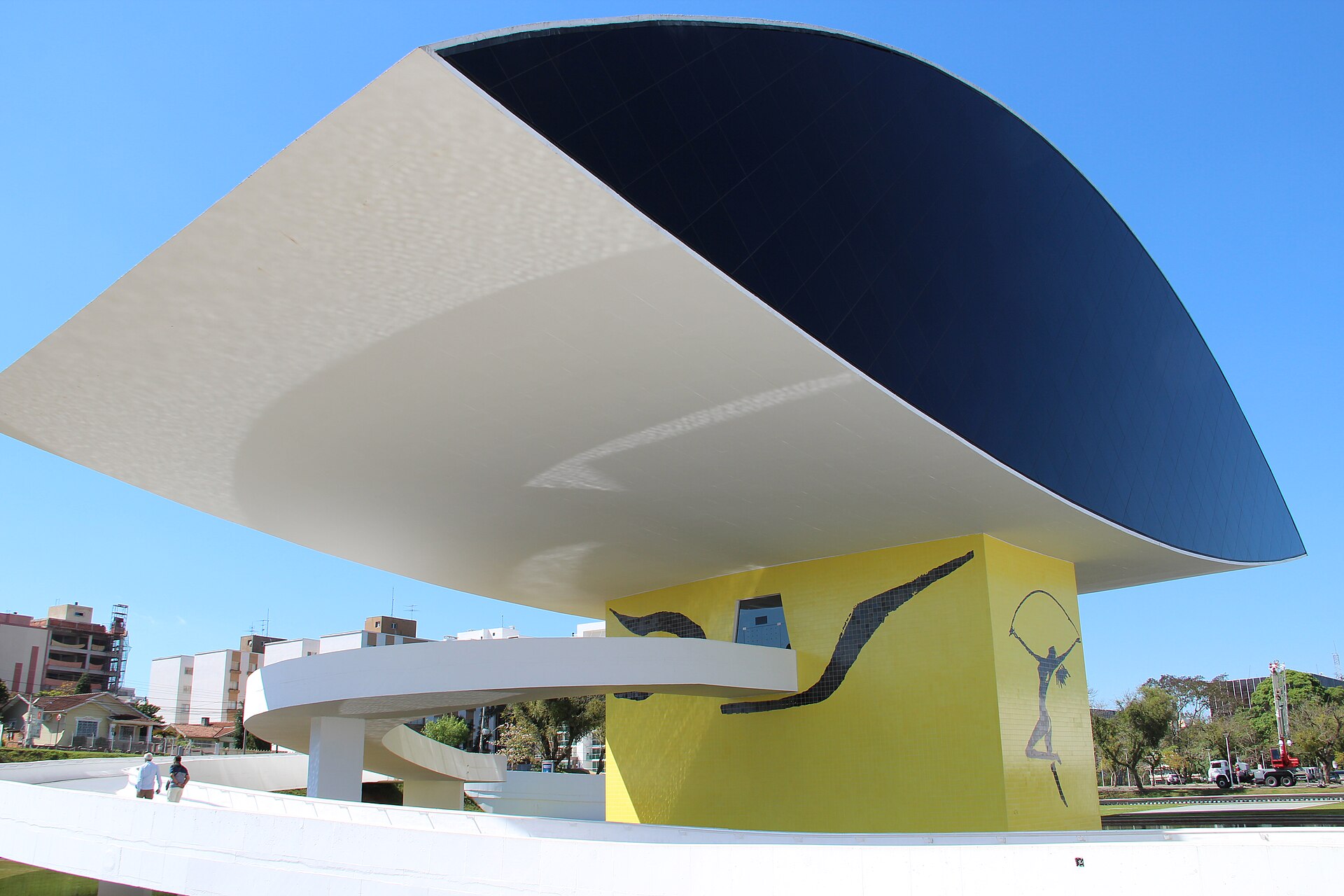
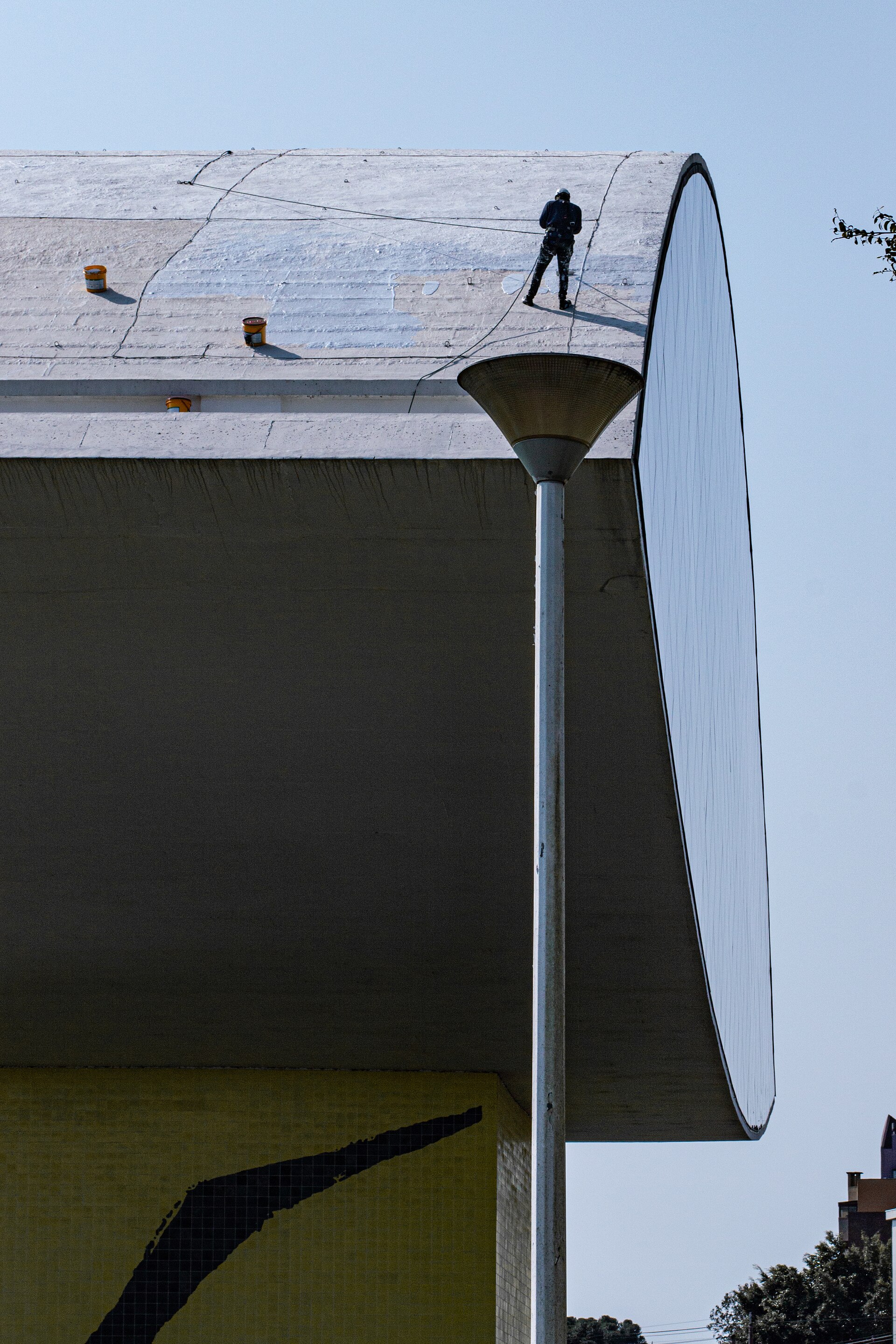
The Eye (O Olho), the museum's 2003 annex, seen from ground level: the shell's white upper surface and dark underside carried on a single painted pillar, with Curitiba's Centro Civico skyline behind.
Photograph by Marinelson Almeida - Traveling through Brazil from Niteroi, Brasil · CC BY 2.0Oscar Niemeyer Museum
Museum · Museu Oscar Niemeyer · Founded 2002
Open, admission and hours confirmed 14 September 2026 · 18 sources
On this page 16 sections
ContentsClose
The museum states its own holdings at roughly 14,000 works, spanning Brazilian modern painting, an architecture collection that includes Niemeyer's own drawings for the museum building itself, international names including Warhol, Picasso and Ai Weiwei, and Asian and African collections. The single largest component by far is the Poty Lazzarotto gift of 2022, 4,478 works given by the artist's family in one act, which the museum itself calls the biggest donation it has ever received and which accounts for most of the growth from a modest founding collection assembled from the pre-existing holdings of the Museu de Arte do Parana and the defunct Banestado bank. The complex occupies about 35,000 square metres in total, with exhibition space reported at 17,000 square metres by the Portuguese Wikipedia entry and 19,000 by the English one; this entry could not confirm either figure against the museum's own site and reports both rather than choosing between them.
| Local name | Museu Oscar Niemeyer |
|---|---|
| Kind | Museum |
| Founded | 2002 as Novo Museu, inside a Niemeyer building completed in 1978 for the state government; renamed Museu Oscar Niemeyer at the reinauguration of 8 July 2003, when the Eye annex opened |
| City and country |  Curitiba, Brazil Curitiba, Brazil |
| Address | Rua Marechal Hermes 999, Centro Civico, Curitiba, PR, Brazil |
| Website | museuoscarniemeyer.org.br |
| Status | Open, confirmed |
| Record last verified |
Visiting
- Hours
- Tuesday-Sunday10:00 to 18:00last entry 17:30
- MondayClosed
- Closed
- Monday, every week.
- Admission
- Full (inteira)BRL 36
- Half-price (meia-entrada)BRL 18teachers, students, blood and organ donors, people with disabilities, young ID holders, cancer patients, healthcare professionals from Parana and poll workers, on production of identification
- Children under 12Freefree
- Seniors 60 and overFreefree
- Visitor with a disability and one companionFreefree
Free entry: Every Wednesday, free to all visitors; tickets for the free slot are distributed at the museum box office until 17:30. The last Sunday of every month, free to all visitors- Tickets
- museuoscarniemeyer.comprenozet.com.br The museum's own ticket page.
- Do I need to book?
- Not required for individual visitors. Tickets are sold at the box office or in advance through the Comprenozet online platform; the museum's own site recommends booking ahead. Group and school visits are arranged through the educational programme's own scheduling address.
- Address
- Rua Marechal Hermes 999, Centro Civico, Curitiba, PR, Brazil Map
- Website
- museuoscarniemeyer.org.br
- Telephone
- +55 41 3350-4462
- [email protected]
Before you go how long, access, photography, bags, eating, shop
- How long to allow
- The Eye alone can be toured in under an hour, but MON runs around twenty exhibitions a year across two buildings joined by an underground tunnel, plus a sculpture garden and a research library. A visitor who wants the architecture and a current show should budget half a day.
- Access
- Reserved parking for visitors with disabilities, older visitors and pregnant visitors; ramps and lifts throughout; wheelchairs loaned subject to availability; accessible restrooms; a tactile model, Braille information and audio description in the sculpture courtyard; and a dedicated sensory accommodation room for autistic and neurodivergent visitors.
- Photography
- Personal photography without flash is allowed. Tripods require prior authorisation, as does any media, commercial, wedding or graduation shoot. Drones are prohibited both inside the museum and on the grounds.
- Bags
- The museum's own FAQ lists guarda-volumes (bag storage) as a topic without publishing the details on the page read for this entry; confirm at the desk on arrival.
- Eating
- MON Cafe, on site.
- Shop
- MON Loja, on site, selling the museum's own publications and object lines, including one inspired by the Poty Lazzarotto collection.
Prices and hours change. We take them from the institution's own pages and print the day we read them, and you can check the current position at the source we used. Confirm before you travel.
What is inside
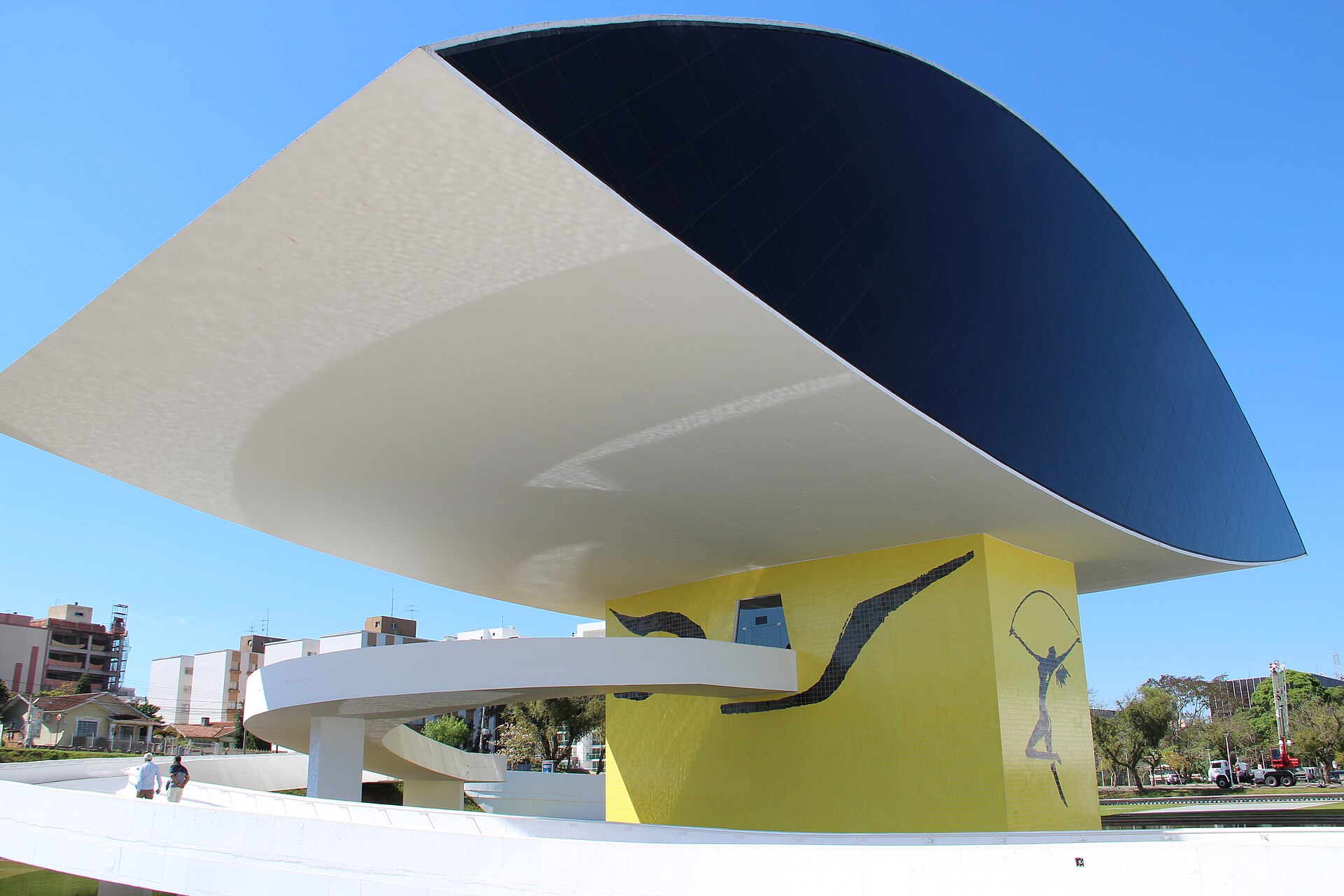
Photograph by Marinelson Almeida - Traveling through Brazil from Niteroi, Brasil · CC BY 2.0 The Eye (O Olho)
Niemeyer's 2003 annex, a curved concrete shell about 30 metres tall on a single yellow pillar, its glass and steel facades lighting the exhibition floors inside and a spiral stair running through the four levels. This is where MON hangs its major touring and temporary exhibitions, the ones that change several times a year.
The Solo Building (Edificio Humberto Castelo Branco)
Niemeyer's original 1967 design, completed in 1978 for the Instituto de Educacao do Parana and later used as state government offices before its 2002 conversion into the museum's first galleries. Its main hall has a free span of about 65 metres, which the museum's own architecture collection page calls the second-largest in Brazil, and it now carries the bulk of the permanent collection.
The underground tunnel
A passage connecting the Solo Building to the Eye beneath the reflecting pool between them, built as part of the 2002-2003 addition and used as circulation and, at times, exhibition space in its own right. It is the connection Ivo Renato Giroto's 2019 formal analysis singles out as the building's weakest sequence.
The sculpture garden and grounds
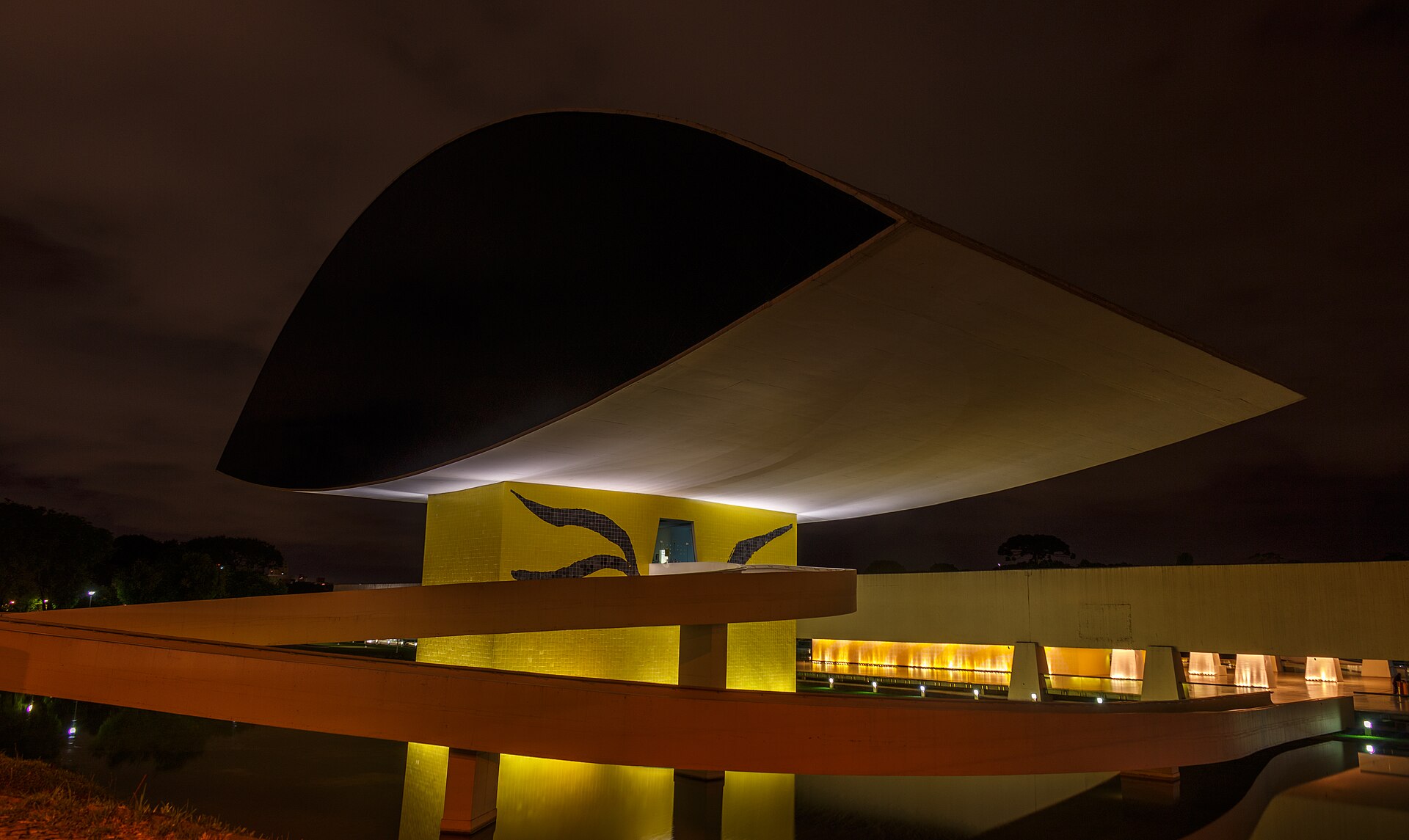
The landscaping around both buildings, including the reflecting pool beneath the Eye, was designed by Roberto Burle Marx, and the museum's own architecture collection page describes Portuguese stone paving intended to read as a natural extension of the surrounding araucaria grove and the city beyond it. Outdoor sculpture is shown here on rotation.
The library and documentation centre
A research library open to the public, holding more than 9,000 publications on art, architecture and design, alongside the museum's own documentation and conservation archive used to catalogue and date works entering the collection.
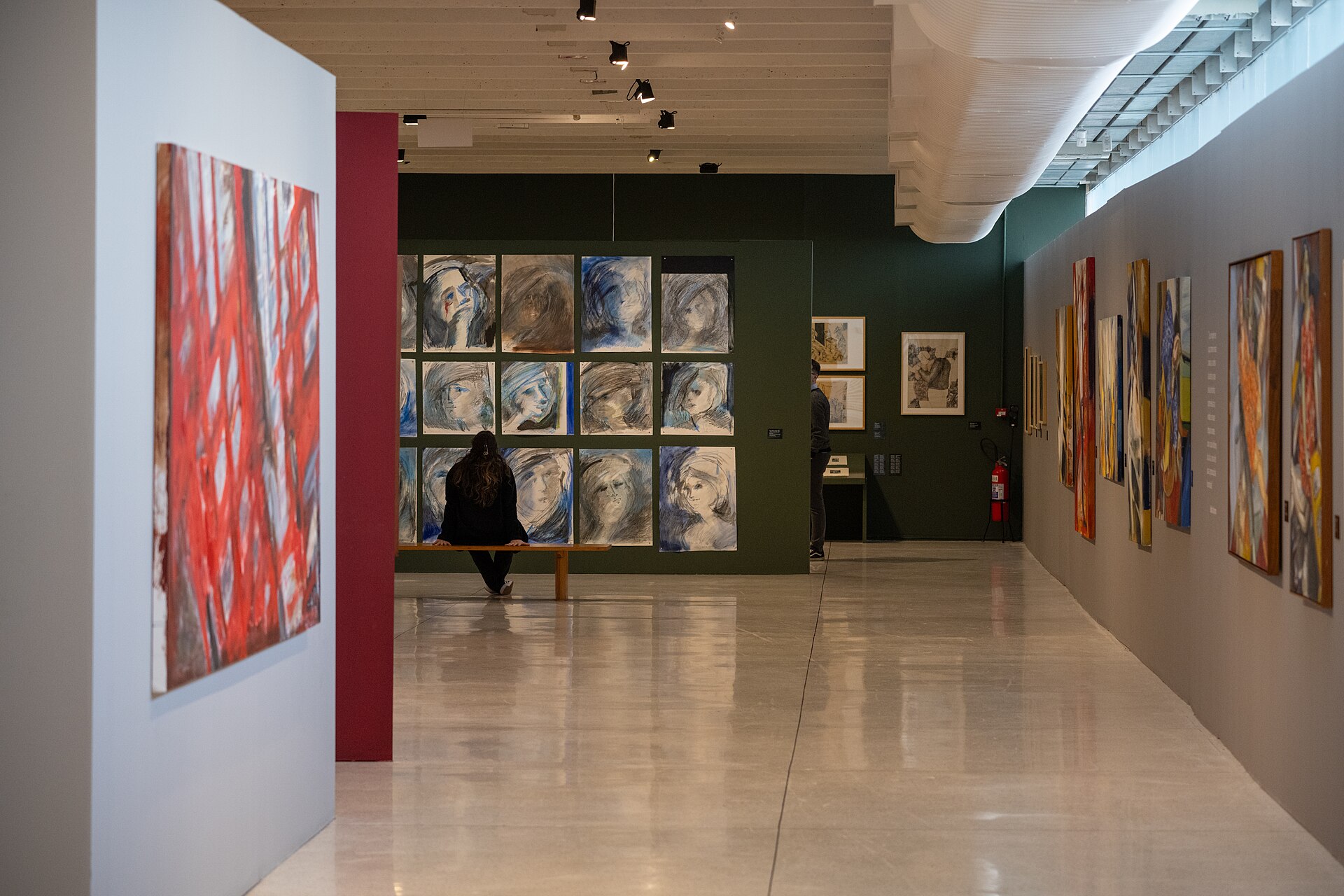
CC0 The exhibition galleries
Partitioned gallery spaces inside the complex, hung salon-style with paintings on temporary walls under track lighting, used for the museum's changing thematic and retrospective shows such as the long-running Poty Lazzarotto centenary exhibition. Which of the museum's several halls is shown in the photograph on file could not be confirmed and is not claimed here.
What to see first
The Eye itself
Oscar Niemeyer, 2003Niemeyer completed the design at 95 years old, and both Brazilian and international writing on the museum treats the annex as the primary reason to visit, ahead of any single object inside it.3
The Poty Lazzarotto collection
Napoleon Potyguara Lazzarotto (Poty Lazzarotto), donated by the artist's family, 2022At 4,478 works, this is the largest single donation MON has ever received, and it alone accounts for most of the growth that took the collection from a few thousand pieces to roughly 14,000.5
The Brazilian modern painters
Tarsila do Amaral, Candido Portinari and othersThe museum's own collection pages name these two among its holdings of Brazilian modernism, the core of the collection MON inherited when it absorbed the state's existing art holdings in 2002.3
The international names in the collection
Andy Warhol, Pablo Picasso, Ai Weiwei and othersNamed by the museum among its holdings, and unusual for a regional Brazilian museum outside Sao Paulo and Rio, giving MON's collection an international reach that its building alone would not predict.3
The Asian and African collections
VariousHeld alongside the Brazilian and international painting, and part of what MON's own visitor-facing description points to as evidence the museum is not read as a purely regional or purely European-facing institution.3
The architecture collection
Oscar Niemeyer, Joao Batista Vilanova Artigas, Frederico Kirchgassner, Jaime LernerIncludes Niemeyer's own preliminary sketches for the museum building itself, alongside drawings and models by three other architects central to twentieth-century Brazilian modernism, making the collection self-referential about the building that holds it.4
The Burle Marx-designed grounds
Roberto Burle MarxThe reflecting pool, paving and planting around the Eye are by the same landscape architect behind some of Brazil's best-known modernist gardens, and the museum's own architecture page treats the grounds as part of the design rather than mere setting.4
The 65-metre free span of the Solo Building
Oscar Niemeyer, 1967-1978The museum's own architecture collection page calls it the second-largest free span in Brazil, a structural feat that predates the Eye by over three decades and shows the same appetite for engineering risk in a plainer, rectilinear building.4
Exhibitions on now
Past exhibitions here
- Closed5 Dec 2025 to 30 Aug 2026Confirmed · check before you travel
A city that lost a Guggenheim and built its own eye instead
The Oscar Niemeyer Museum exists because of a bid Curitiba did not win. In 2001 the Guggenheim Foundation was weighing a Brazilian branch; Rio de Janeiro was chosen, with a design by Jean Nouvel that was never built. Rosa Moura's 2010 account of the episode records that Parana's then-governor, the architect and former Curitiba mayor Jaime Lerner, took the idea that had lost out to Rio and built an institution of his own instead, in a city that already had a Niemeyer building standing empty of purpose.
That building was already three decades old. Niemeyer designed it in 1967 for the Instituto de Educacao do Parana; it was completed in 1978, by which point it had become the Edificio Humberto Castelo Branco and was serving as state government offices. Lerner's administration converted it into a museum, which opened as Novo Museu on 22 November 2002. Niemeyer, then 95, designed a second structure for the site: an eye-shaped shell in reinforced concrete, glass and steel, standing on a single pillar over a reflecting pool and joined to the old building by an underground tunnel. When it was finished, the complex reopened on 8 July 2003 under its current name, Museu Oscar Niemeyer.
The Eye: an architecture built to compete with what it holds
The annex that gave the museum its nickname, Museu do Olho, is the reason most visitors come. It stands about 30 metres tall on four floors, its curved white-and-dark shell lit from inside by glass and steel facades, with a spiral stair running through the levels. Ivo Renato Giroto's 2019 formal analysis in Oculum Ensaios, using the shape-analysis frameworks of Umberto Eco and Rudolf Arnheim, situates the building at the end of Niemeyer's long career and reads the eye form as what Eco would call a work open to interpretation: a shape different visitors and critics are free to read differently, competing for attention with whatever is hung inside it.
Giroto's analysis is not simply admiring. He argues that the building's pursuit of visual impact came at the cost of function, producing circulation that he calls confusing in places, and singles out the underground tunnel joining the Eye to the older building as the clearest case: a connection he characterises as an inexplicable architectural letdown after the drama of the shell above it. He also records that dark filters added to the facade in 2006, for reasons of light control, compromised the visual dialogue Niemeyer had built between the interior and the city outside. The older building the Eye was added to is no less bold in its own register: its main hall has a free span the museum's own architecture collection page puts at about 65 metres, calling it the second-largest in Brazil, a figure that predates the Eye by more than three decades and shows the same appetite for structural risk in a plainer, rectilinear form.
A collection built from leftovers, then transformed by one gift
The building came before the collection had any coherent shape. Academic accounts of the museum's formation, drawn on for this entry, describe the initial holding as assembled largely from the pre-existing collections of the Museu de Arte do Parana and the defunct Banestado bank, brought together under Niemeyer's roof without the kind of museological plan that usually precedes a museum rather than follows it. For its first two decades, MON's collection was consequently read by some of its own critics as an afterthought to the architecture that housed it, the building serving as the identity the collection had not yet earned on its own.
What changed the balance was a single gift. On 29 March 2022, a date chosen to fall on both Curitiba's founding anniversary and what would have been Poty Lazzarotto's birthday, the artist's brother Joao Lazzarotto donated 4,478 works to MON: more than 3,000 drawings, 366 prints, plus woodcuts, carvings, tapestries and sculpture, spanning from finished compositions to the working sketches Poty made on his 1967 Xingu expedition. The museum's own collection page calls it the largest gift MON has ever received in a single act, and it alone accounts for most of the growth that has taken the total collection to roughly 14,000 works. The centenary exhibition drawn from it, Trilhos e Tracos: Poty 100 anos, opened in April 2024 as a long-running show organised into nine thematic sections and remains on view.
What is inside now
Past the Poty Lazzarotto galleries, MON's own collection pages name holdings that range considerably further than the Parana regionalism the museum's origin might suggest. Brazilian modernists including Tarsila do Amaral and Candido Portinari sit alongside international names the museum lists among its holdings, among them Andy Warhol, Pablo Picasso and Ai Weiwei, together with Asian and African collections that the museum's own visitor-facing material points to as evidence it is not read as a purely regional or purely European-facing institution.
The architecture collection is the most self-referential part of the museum: it holds drawings and models by Niemeyer himself, including preliminary sketches for the very building visitors are standing in, alongside work by Joao Batista Vilanova Artigas, Frederico Kirchgassner and Jaime Lerner, the governor who commissioned the museum in the first place. The grounds are part of the same design programme rather than an afterthought: Roberto Burle Marx laid out the reflecting pool beneath the Eye and the paving and planting around both buildings, which the museum's own architecture page describes as intended to read as a natural extension of the surrounding araucaria woodland and the city beyond it.
A museum built to be seen from outside the city
Rosa Moura's 2010 account in the Vitruvius journal arquitextos takes the museum's origin story further than a simple loss to Rio. She argues that MON was conceived less as a museological project and more as an instrument of urban branding: a way for Lerner's Curitiba, already marketed internationally on the strength of its bus rapid transit and planning reputation, to add a cultural landmark to that image after the Guggenheim opportunity went elsewhere. Moura's interviews with construction workers on the project found them unanimous that the building's primary purpose, as they understood it, was to raise Curitiba's international visibility rather than to house a specific collection.
The economic case for that strategy, on Moura's account, did not fully hold up. She reports that the anticipated gentrification and real-estate appreciation around the Centro Civico district, the kind of spillover boosters of landmark museums typically promise, proved disappointing, with some local business owners she spoke to doubting the museum had meaningfully increased their trade. She also traces how the museum's stated purpose shifted under different state administrations, from Lerner's neoliberal emphasis on competitiveness to his successor Roberto Requiao's framing around social inclusion, while its value as an internationally recognisable symbol remained constant across both. The Eye, in other words, did what it was built to do as an image well before the institution behind it had a collection to match.
Visiting MON today
Two decades on, the institution has caught up with its own symbol. The museum's own figures put annual attendance above 700,000 as of 2024, across roughly twenty exhibitions a year, and the 2022 Poty Lazzarotto gift has given the permanent collection a depth the building's first years did not have. Admission remains inexpensive by the standards of a museum this prominent, at R$36 full price and R$18 half price, with free entry every Wednesday and on the last Sunday of each month, and the aggregate ratings on both Google Maps and TripAdvisor sit comfortably above 4.5 out of 5 across tens of thousands of visitors.
What a reader should take from this page is that MON is two overlapping stories that do not always agree with each other: an architecture that international criticism treats as a formally daring but functionally uneven late Niemeyer work, tied to a collection that was assembled almost as an afterthought and then transformed within a single year by one family's decision to give away a hundred years of one artist's working life. The building drew the visitors first, in a strategy its own construction workers could name before the museum had a collection worth the trip; the Poty Lazzarotto gift is the clearest evidence yet that the collection has since started to earn its own claim on that attention.
What visitors say
This entry publishes no visitor review prose and does not treat any single review as representative. What follows draws on two aggregate ratings read on a named platform-tracking page and two pieces of published architectural and urban-studies criticism read in full. On both Google Maps and TripAdvisor, MON scores above 4.5 out of 5 across tens of thousands of ratings, an unusually strong showing for an institution whose own academic critics describe its early collection as incoherent and its circulation as confusing. Visitors consistently name the building itself, ahead of any exhibition inside it, as the reason to come; more than one aggregated comment notes leaving a temporary show underwhelmed while still calling the visit worthwhile for the architecture alone.
What is praised, what is criticised
- Praised: the Eye annex itself: both casual visitors and architecture writers treat the building as the primary reason to visit, ahead of any single exhibition inside it
- Praised: cheap admission at R$36 full and R$18 half price, with free entry every Wednesday and on the last Sunday of the month, unusually generous for a museum this size
- Praised: the pace and variety of temporary exhibitions, with the museum mounting around twenty shows a year, which aggregated visitor comment consistently calls well organised
- Praised: the reflecting pool and grounds beneath the Eye, landscaped by Roberto Burle Marx, which read as public space in their own right rather than as mere approach to the building
- Criticised: the temporary exhibitions are inconsistent: some aggregated visitor comment reports leaving underwhelmed by the specific show on the day, for a museum with this reputation, even while still recommending the building itself
- Criticised: Ivo Renato Giroto's 2019 formal analysis argues the building prioritises visual impact over function, singling out the underground connection between the two structures as producing what he calls an inexplicable architectural letdown, and dark facade filters added in 2006 that weakened the interior's visual dialogue with the city
- Criticised: academic accounts of the collection's formation describe its initial holding as assembled from the leftover collections of the Museu de Arte do Parana and the defunct Banestado bank without a coherent museological plan, a gap only closed two decades later by the single outsized Poty Lazzarotto gift
- Criticised: Rosa Moura's 2010 urban-studies account argues the museum was conceived less as a museological project and more as a branding exercise for Curitiba's international image after the city's failed bid for a Guggenheim franchise, and finds the promised economic spillover into the surrounding Centro Civico district did not materialise as boosters expected
Ratings on other platforms
TripAdvisor: 4.6 from 13,810 ratings, read 13 August 2026
Google Maps: 4.7 from 63,291 ratings, read 13 August 2026
A platform average is a tertiary source: it moves, it is not audited, and we quote no visitor's words.
Questions about Oscar Niemeyer Museum
Where is Oscar Niemeyer Museum?
Rua Marechal Hermes 999, Centro Civico, Curitiba, PR, Brazil.
How much does it cost to visit?
Full (inteira): BRL 36; Half-price (meia-entrada): BRL 18; Children under 12: free; Seniors 60 and over: free; Visitor with a disability and one companion: free. As confirmed 14 September 2026.
When is it open?
Tuesday-Sunday 10:00-18:00; Monday closed. Closed: Monday, every week. As confirmed 14 September 2026.
What should you see first?
The Eye itself (Oscar Niemeyer, 2003); The Poty Lazzarotto collection (Napoleon Potyguara Lazzarotto (Poty Lazzarotto), donated by the artist's family, 2022); The Brazilian modern painters (Tarsila do Amaral, Candido Portinari and others); The international names in the collection (Andy Warhol, Pablo Picasso, Ai Weiwei and others); The Asian and African collections (Various); The architecture collection (Oscar Niemeyer, Joao Batista Vilanova Artigas, Frederico Kirchgassner, Jaime Lerner).
What we could not confirm
- Total exhibition space is given as 17,000 square metres (Portuguese Wikipedia) and 19,000 square metres (English Wikipedia); neither figure appears on the museum's own site as read for this entry, and the discrepancy is unresolved here.
- The museum's own collection pages describe the Asian and African holdings only in general terms; their size, acquisition history and specific contents were not found on the pages read for this entry.
- Rosa Moura's 2010 account of the Centro Civico district's economic response to the museum is now over fifteen years old; whether the gentrification and property effects she found disappointing have since changed was not checked for this entry.
- The museum's FAQ lists bag storage (guarda-volumes) as a topic without publishing its terms on the page read for this entry.
Images
Sources
- 1Museu Oscar Niemeyer, Visite: opening hours, admission prices and free-entry days, accessibility features, and the photography and filming rules. Read as fetched HTML on 13 August 2026. museuoscarniemeyer.org.br/visite
- 2Museu Oscar Niemeyer, Fale conosco: the general public contact phone number and email address, and the separate departmental contacts for the shop, cafe, events, education and press teams. Read 13 August 2026. museuoscarniemeyer.org.br/fale-conosco
- 3Museu Oscar Niemeyer, Sobre: the 22 November 2002 opening as Novo Museu, the 8 July 2003 reinauguration and renaming, the museum's own description of its exhibition spaces and collection scope, the approximately 14,000-work collection figure, the claim to be Latin America's largest art museum, and the 2024 figures of roughly twenty exhibitions and over 700,000 visitors a year. Read 13 August 2026. museuoscarniemeyer.org.br/sobre
- 4Museu Oscar Niemeyer, Acervo > Colecoes > Arquitetura: the 1967-1978 Solo Building's 65-metre free span described as the second-largest in Brazil, the Roberto Burle Marx-designed grounds and reflecting pool, and the architecture collection's holdings by Oscar Niemeyer, Joao Batista Vilanova Artigas, Frederico Kirchgassner and Jaime Lerner. Read 13 August 2026. museuoscarniemeyer.org.br/acervo/colecoes/arquitetura
- 5Museu Oscar Niemeyer, Acervo > Colecoes > Colecao Poty Lazzarotto: the 2021 donation agreement with Joao Lazzarotto, incorporation into the collection in early 2022, the figure of 4,478 works spanning drawings, prints, carvings and sketches including material from the 1967 Xingu expedition, and the museum's own description of the gift's significance. Read 13 August 2026. museuoscarniemeyer.org.br/acervo/colecoes/colecao-poty-lazzarotto
- 6Museu Oscar Niemeyer, Exposicoes > Trilhos e Tracos - Poty 100 anos: the exhibition's nine thematic sections, its opening on 11-12 April 2024, the donation of 29 March 2022 described as the largest ever given to the institution, and the breakdown of the gift into more than 3,000 drawings and 366 prints plus other media. Read 13 August 2026. museuoscarniemeyer.org.br/exposicoes/trilhosetracos-poty-100-anos
- 7Museu Oscar Niemeyer, FAQ: bag storage, photography and filming, and accessibility topics as the museum itself frames them for visitors, plus confirmation of the standard hours and free-entry days. Read 13 August 2026. museuoscarniemeyer.org.br/faq
- 8Wikidata, Oscar Niemeyer Museum (Q4991927): English and Portuguese labels checked against the museum's own name, coordinates -25.409722/-49.267222 cross-checked against the museum's own address, inception date of 22 November 2002, and official website. No dissolution date (P576) recorded. wikidata.org/wiki/Q4991927
- 9Wikipedia (English), Oscar Niemeyer Museum: the 1967 design and 1978 completion of the original building, the 2003 Eye annex's dimensions and materials, the 35,000-square-metre total complex with 19,000 square metres of exhibition space, and the claim of Burle Marx-designed landscaping. Read 13 August 2026. en.wikipedia.org/wiki/Museu_Oscar_Niemeyer
- 10Wikipedia (Portuguese), Museu Oscar Niemeyer: the Instituto de Educacao do Parana origin of the 1967 building, its later use as the Edificio Humberto Castelo Branco for state offices, the 65-metre free span figure, the 30-metre height and four floors of the Eye annex, the 17,000-square-metre exhibition-space figure, and 2019 visitor numbers of about 380,000. Read 13 August 2026. pt.wikipedia.org/wiki/Museu_Oscar_Niemeyer
- 11Ivo Renato Giroto, 'Um olho para ver e ser visto: uma analise do museu Oscar Niemeyer, em Curitiba, Brasil', Oculum Ensaios, vol. 16, no. 1 (2019), Pontificia Universidade Catolica de Campinas: a formal, semiological analysis of the Eye annex within Niemeyer's late career, crediting continuity with his earlier formal language while criticising confused circulation, the underground connection to the older building, and the 2006 addition of dark facade filters. Read via Redalyc, 13 August 2026. redalyc.org/journal/3517/351760258006/html/
- 12Rosa Moura, 'Efeitos simbolicos do museu Oscar Niemeyer na internacionalizacao de Curitiba', arquitextos (Vitruvius), no. 11.125, October 2010: an urban-studies account of the museum's origin in Curitiba's failed Guggenheim bid, its use as a branding instrument for the city under governor Jaime Lerner, interviews with construction workers on its intended purpose, and the disappointing gentrification and property effects around the Centro Civico district. Read 13 August 2026. vitruvius.com.br/index.php/revistas/read/arquitextos/11.125/3567
- 13Wanderlog, Museu Oscar Niemeyer place page: aggregated ratings and review counts read from Google Maps (4.7 of 5, 63,291 reviews) and TripAdvisor (4.6 of 5, 13,810 reviews), plus aggregated visitor comment on the architecture and on inconsistent temporary exhibitions, characterised rather than quoted on this page. Read 13 August 2026. wanderlog.com/place/details/32669/museu-oscar-niemeyer
- 14Wikimedia Commons, Category:Museu Oscar Niemeyer and its files: the plates used on this page, each licence read per file (CC BY 2.0 for Marinelson Almeida's exterior, CC BY-SA 4.0 for Rodrigo Tetsuo Argenton's night exterior, CC BY 4.0 for Whoisramon's roof detail, CC0 for Wilfredor's gallery interior), and each image vetted by eye before use. commons.wikimedia.org/wiki/Category:Museu_Oscar_Niemeyer
- 15Museu Oscar Niemeyer, Visite: opening hours, admission prices and free-entry days re-checked against the live page. Full price R$36,00, half price (meia-entrada) R$18,00, free every Wednesday and on the last Sunday of the month, Tuesday-Sunday 10:00-18:00 with last entry 17:30, closed Monday. All figures match the 13 August 2026 record, no change. Read 14 September 2026. museuoscarniemeyer.org.br/visite
- 16Museu Oscar Niemeyer, Fale conosco: general public phone +55 41 3350-4462 and email [email protected] re-checked against the live page, unchanged from the 13 August 2026 record. Read 14 September 2026. museuoscarniemeyer.org.br/fale-conosco
- 17Museu Oscar Niemeyer, Sobre: re-checked that the museum is open and operating normally with no closure, merger, relocation or renaming notice; collection figure of approximately 14,000 works and 2024 figures of about 20 exhibitions and over 700,000 visitors unchanged from the 13 August 2026 record. Read 14 September 2026. museuoscarniemeyer.org.br/sobre
- 18Museu Oscar Niemeyer, homepage exhibitions listing: confirms the Trilhos e Tracos (Poty 100 anos) centenary exhibition is still on view, so the Poty Lazzarotto highlight has not left the building; current temporary shows are Daquilo que nos escapa (Eder Santos, to 28 February 2027), O verso da pagina contem o outro lado (to 1 November 2026), Moire Beregedee (Mano Penalva, to 25 October 2026), and the 16th Bienal Internacional de Curitiba: LIMIARES (to 15 November 2026), none of which is a new permanent headline object. Read 14 September 2026. museuoscarniemeyer.org.br/