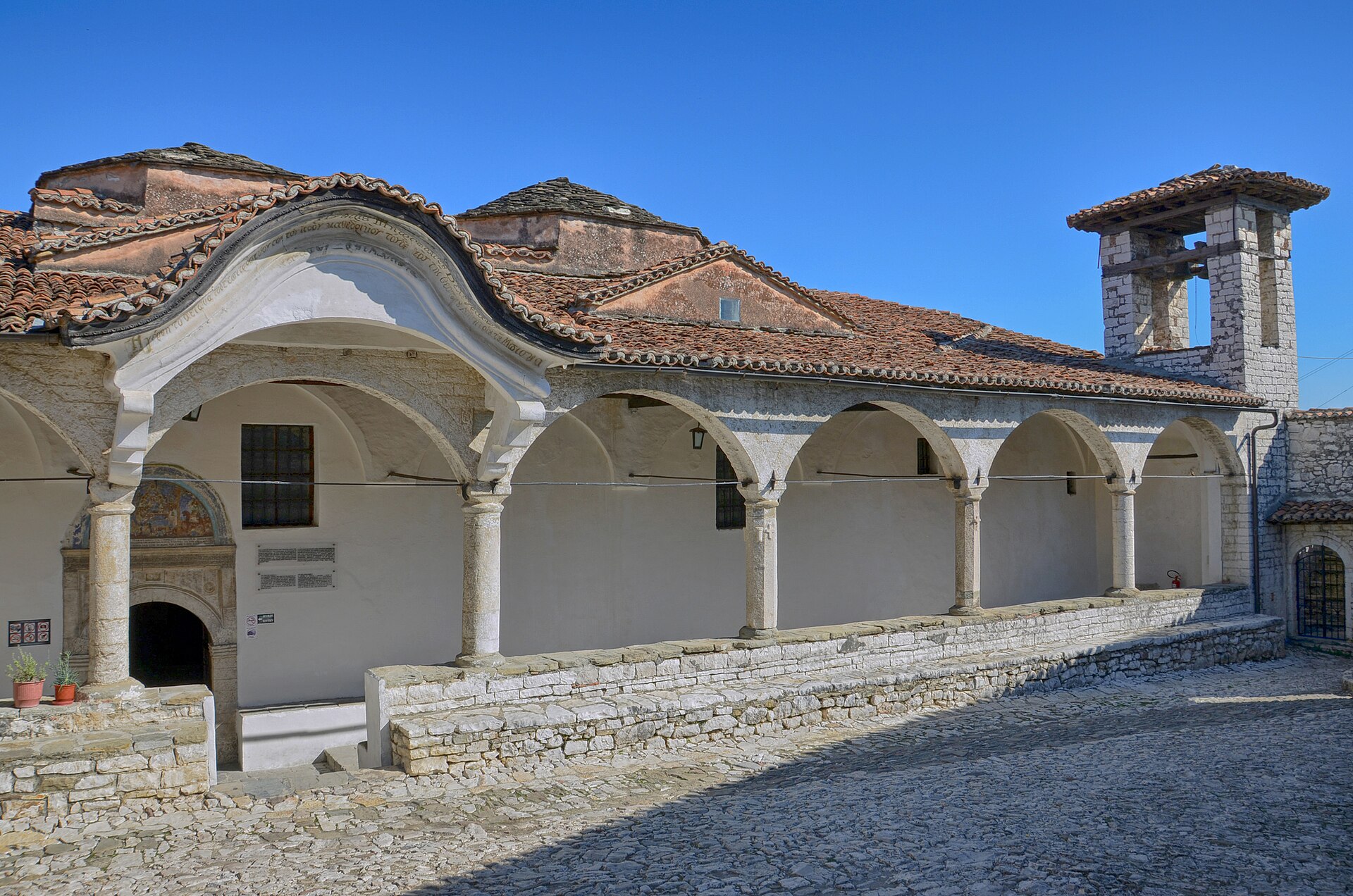
The cathedral that houses the Onufri Iconographic Museum, seen from the cobbled courtyard in the Kala, with the arcaded portico and bell tower. Verified as this building against the portico and arches in a second plate that shows the museum banner.
Pasztilla (Attila Terbocs), CC BY-SA 4.0Onufri Iconographic Museum
Museum · Muzeu Ikonografik Onufri · Founded 1986
Open, admission and hours confirmed 15 November 2026 · 16 sources
On this page 14 sections
ContentsClose
The strength is local and specific: icons and liturgical objects from the churches of one town and its region, with a documented line of painters from Onufri in the 16th century through Nikolla, Onufer the Cypriot and Kostandin Shpataraku to the Cetiri family in the 19th, plus an early 19th century carved iconostasis in its original church. It is not a general museum of Byzantine art and it does not hold the Berat Codices. Source: the museum's own collection page and the Albanian tourism agency.
| Local name | Muzeu Ikonografik Onufri |
|---|---|
| Kind | Museum |
| Founded | 1986 |
| City and country |  Berat, Albania |
| Address | Inside the Dormition of St Mary cathedral, Berat Castle (Kala), Berat, Albania. The Berat Museum Center gives its postal address as Rr. Toli Bojaxhiu, 5001, Berat, Albania |
| Website | muzeumet-berat.al/en/onufri-iconographic-museum |
| Status | Open, confirmed |
| Record last verified |
Visiting
- Hours
- 1 November to 30 April: Tuesday to Saturday09:00 to 16:00Winter hours as printed on the official visit page. The page prints this block once, under the heading for both museums, and does not split it by museum. This is the season in force on the confirmation date.
- 1 November to 30 April: Sunday09:00 to 14:00Same block as above
- Until 31 October 2026: Monday to Sunday09:00 to 19:00Summer hours, Onufri Museum line on the official visit page
- Closed
- Monday, 1 November to 30 April.
- Admission
- Individual ticketALL 400Onufri Iconographic Museum price list on the official visit page
- Reduced ticket (minus 50 percent)ALL 200The page says documentation must be shown at the ticket office
- Children 12 to 18 years and studentsALL 120Documentation required
- ChildrenFreeThe official page words this as 'children +12 years old FREE', which reads as a slip because the same page gives 12 to 18 year olds a 120 ALL ticket. Confirm at the ticket office.
- Individual audio guide ticketALL 500Listed separately on the official page as the audio guide ticket. Whether it replaces or adds to the 400 ALL entry is not stated there.
- Audio guide for groups of 12 or moreALL 400Per the official page
Free entry: 18 April (International Day for Monuments and Sites). 18 May (International Museum Day). 21 May (World Day for Cultural Diversity for Dialogue and Development). 29 September (National Heritage Day and European Days of Cultural Heritage). 28 November (Independence Day, Albanian citizens only). 29 November (Liberation Day, Albanian citizens only)- Do I need to book?
- The official visit page offers an online ticket order link. It does not say that booking is required.
- Address
- Inside the Dormition of St Mary cathedral, Berat Castle (Kala), Berat, Albania. The Berat Museum Center gives its postal address as Rr. Toli Bojaxhiu, 5001, Berat, Albania MapCar The official visit page says the museum can be reached by car near the entrance gate of the castle. There is no parking at the museum itself, only certain places nearby.
Bus The official visit page says buses run up to the entrance gate of the castle.
Bicycle The official visit page says the museum can be reached by bicycle near the entrance. - Website
- muzeumet-berat.al/en/onufri-iconographic-museum
- Telephone
- +355 32 232 224
- [email protected]
Before you go how long, access, photography, bags, eating, shop
- How long to allow
- The official page gives the museum guide a duration of 55 minutes for the Onufri Iconographic Museum.
- Access
- The official visit page states that the museums do not provide accessibility for the disabled. The museum is inside a castle-quarter church reached over the Kala's cobbled lanes.
- Photography
- The official visit page states that filming and photography are prohibited, that use of the mobile phone is prohibited and that touching items is prohibited.
- Bags
- Not stated on the official page.
- Eating
- Not stated on the official page.
- Shop
- Not stated on the official page.
Prices and hours change. We take them from the institution's own pages and print the day we read them, and you can check the current position at the source we used. Confirm before you travel.
What is inside
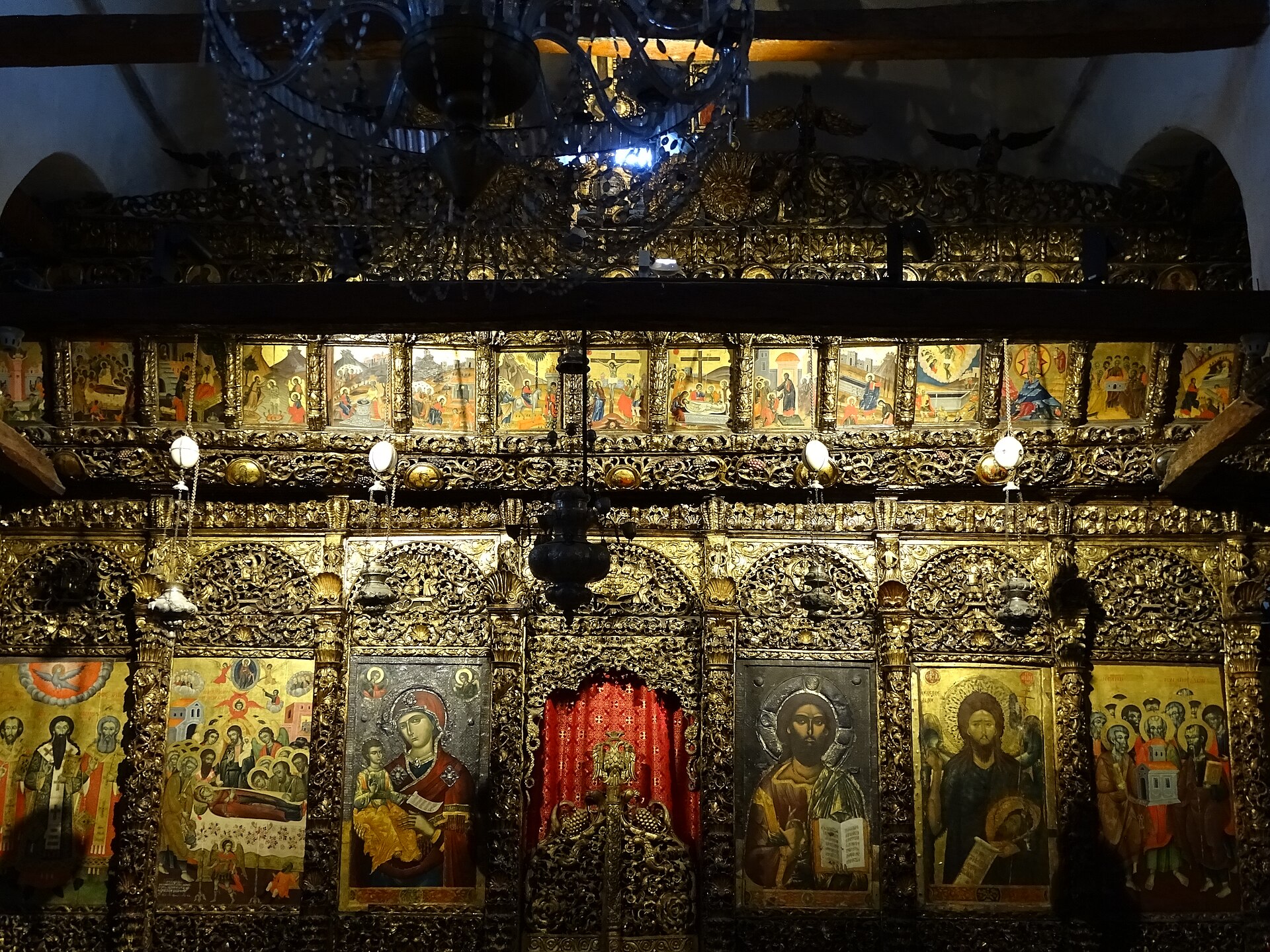
Photograph by Adam Jones from Kelowna, BC, Canada · CC BY-SA 2.0 The iconostasis
The carved and gilded wooden screen of the cathedral, dated 1807 by the museum and about 1806 to 1807 by the Albanian tourism agency. The museum calls it a finest piece of Albanian woodcarving, with Baroque features of the kind that dominated Balkan church building in the 18th and 19th centuries woven into Byzantine tradition. The carvers named on the museum page are Stefan Barka and Naum Ngjela, from Misrasi and Lavdari in Opari, working in the early 19th century. Icons from the cathedral sit in its registers.
The icon halls
The core collection of icons and liturgical items from churches and monasteries of Berat and the surrounding region, dated from the 14th to the 20th century. The museum names works by Onufri, his son Nikolla, Onufer the Cypriot, David Selenica, Kostandin Shpataraku and the Cetiri family, along with anonymous painters, and liturgical objects signed by Albanian silversmiths. The audio guide treats the exhibition halls as its second stop and then moves through icons of Saints Theodore, the Nativity, Jesus in the Temple, the Deisis, Mary caressing, the Life-giving Source, the Last Supper, Saints Constantine and Helen and Saint Demetrius.
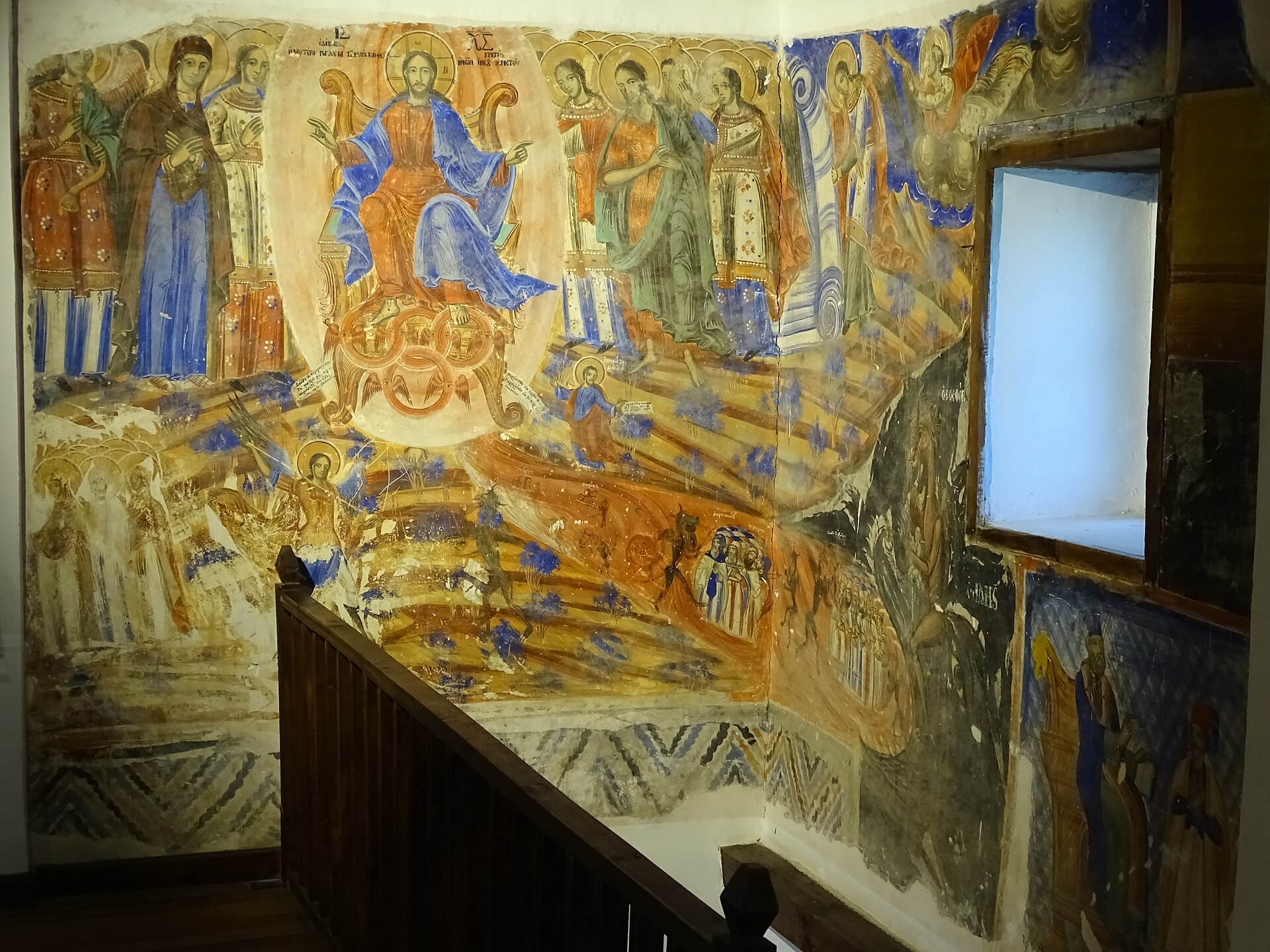
Photograph by Adam Jones from Kelowna, BC, Canada · CC BY-SA 2.0 The nave frescoes
The cathedral's wall paintings, which the Albanian tourism agency attributes to the Cetire atelier and dates to 1860, in the post-Byzantine tradition with sacred figures and biblical scenes. A Last Judgment survives on a wall seen from the gallery stair.
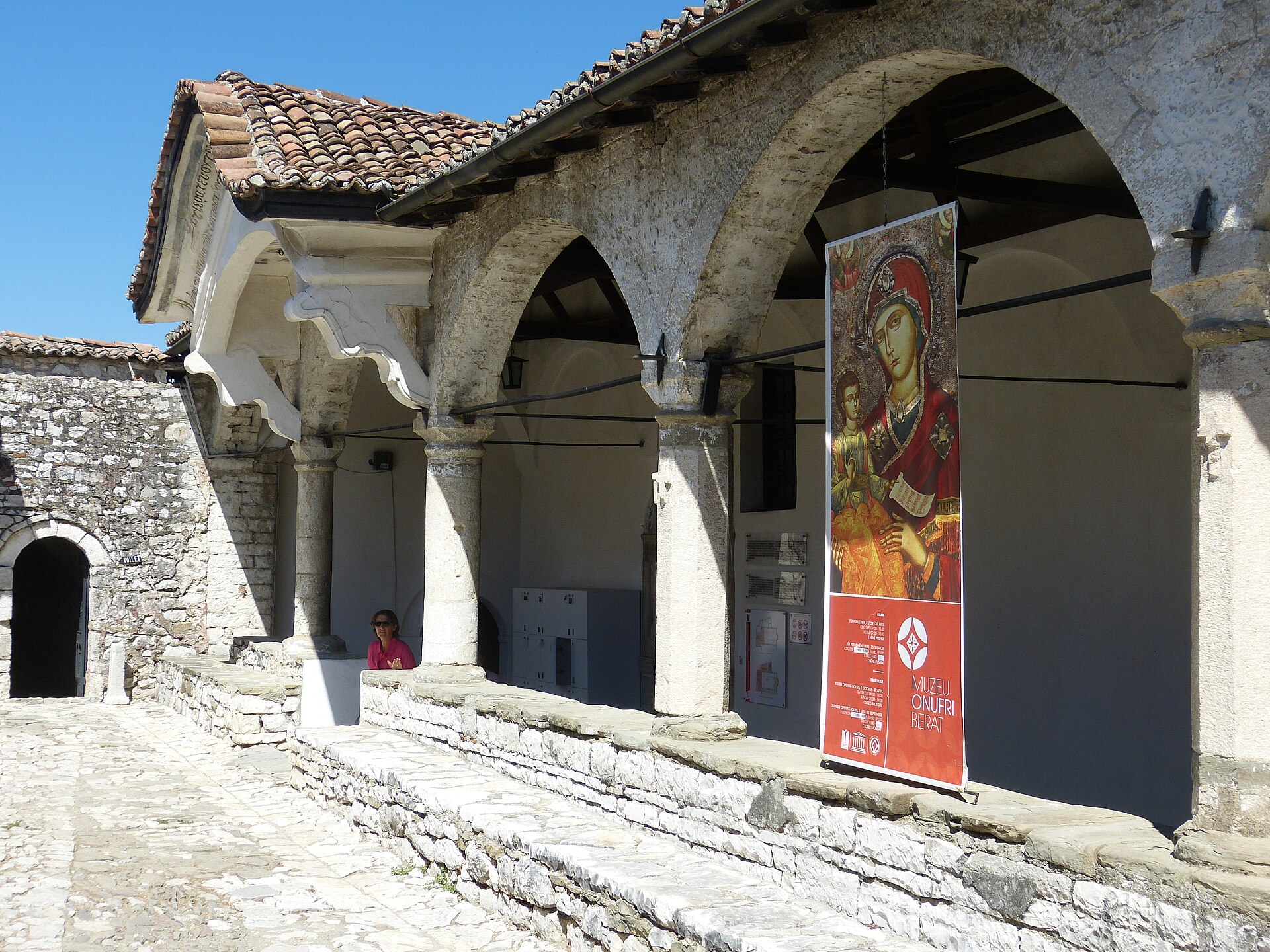
Photograph by Xenophon · CC BY-SA 4.0 The portico and narthex
The covered portico (hajat) that partly surrounds the church from the outside and the narthex at the entrance. This is where visitors arrive; a museum banner hangs in the arcade.
The relic arch and the chapel behind the screen
The museum says a wooden arch near the iconostasis keeps the relics of Saints Gorazdi and Angjellari, described as disciples of Saints Methodius and Cyril. Wikivoyage advises visitors not to miss the chapel behind the iconostasis, whose painted cupola it describes as faded almost to invisibility.
Pulpit and episcopal throne
Besides the screen, the Albanian tourism agency lists a raised pulpit for readings and an episcopal throne among the cathedral's liturgical furniture, which the museum now shows as part of the building.
What to see first
Iconostasis of the Dormition of St Mary cathedral
Stefan Barka and Naum Ngjela (woodcarvers named by the museum)The single object most sources single out. The museum dates it 1807 and calls it a finest piece of Albanian woodcarving; the tourism agency places it among the high points of Baroque woodcarving in the Balkans. It is also the frame in which the whole museum is staged.2
Jesus Appearance in Temple
Onufri, 16th centuryTaken from the Holy Trinity church in Berat castle. The museum singles it out for its colour contrast and the red associated with Onufri, the starting point for anyone who has come for the painter himself.2
Saint Mary with Jesus
Onufri, 16th centuryBelongs to the Dormition cathedral itself. The museum points to the elegance and expressive colour of the painter's hand, and the icon is the one most closely tied to the building you are standing in.2
John the Baptist
Onufri, 16th centuryFrom the Evangelism church in the castle. The museum describes colour contrast against a golden ground stylised with floral motifs.2
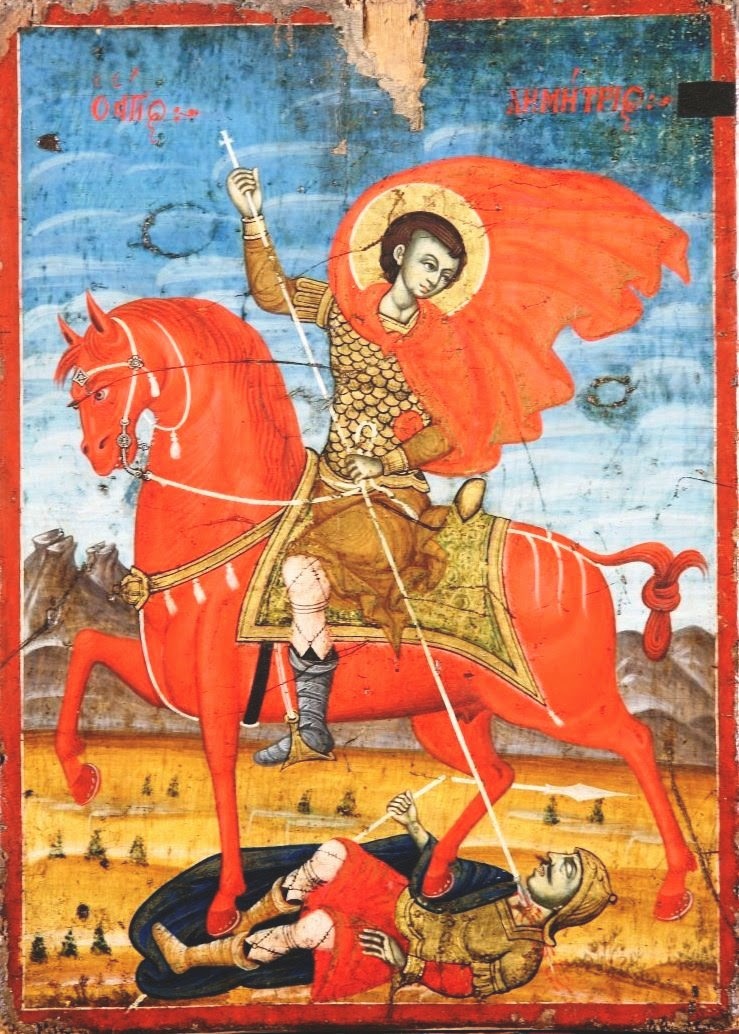
Saint Demetrius
Kostandin Shpataraku, 18th centuryFrom the Prophet Elijah church in Berat. It shows how the school Onufri founded travelled forward two centuries; the museum notes modern elements such as an expressive silhouette and sharp contrasts. Shpataraku is named by Wikipedia as one of the painters who inherited Onufri's workshop tradition.2
Life-giving Source
Anonymous, 18th centuryFrom the Saint Elijah church in Berat. The museum says it belongs to a modern and liberal iconography that combines elements of different religions, an unusual claim worth stopping at.2
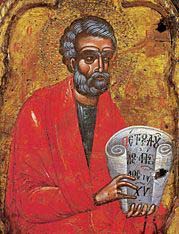
Icon of the Apostle Peter
Nikolla, son of Onufri, second half of the 16th centuryWikimedia Commons describes the plate as a work by Onufri's son now in the Onufri Museum. It shows the continuity of the workshop after the founder.8
The Codices of Berat (story, not objects on view)
6th century Purple Codex and 9th century Golden Codex of AnthimosThe museum says both were found beneath the apse floor on 12 August 1968 in a small metal box in the crypt, and that both are on UNESCO's Memory of the World list. The story belongs to this building. The manuscripts themselves are preserved in the National Archives in Tirana, so do not expect to see them here.9
A cathedral that became a museum
The Onufri Iconographic Museum does not occupy a building made for it. It is the Church of the Dormition of St Mary, the largest church in the Kala, the walled castle quarter that crowns the hill above the Osum river in Berat. The museum's own history page says the museum has been housed there since 27 February 1986. It also says that, on the evidence of the inscriptions found in the church, the cathedral was built in 1797 on the foundations of an older Byzantine church, and calls it one of the most symbolic attractions of post-Byzantine architecture in Berat.
The Albanian tourism agency describes the structure as a basilica-style nave with two domes, a narthex at the entrance and a hajat, a portico, that partly surrounds the building from the outside. A monumental inscription above the main entrance records the year of construction. Wikivoyage, a lesser source, gives the older chapel as a 10th century foundation. Where sources disagree on what stood here before 1797 this page keeps the official wording and records the gap among its open questions.
The museum is run by the Berat Museum Center, a specialised institution with the status of national museum under the Ministry of Culture. The same body administers the Ethnographic Museum lower in the town, which is a different institution and a different visit.
Onufri and the school he founded
The museum is named after the painter Onufri, the 16th century master who Wikipedia, drawing on Robert Elsie's Historical Dictionary of Albania and a UNESCO Courier essay of 1974, calls the most important painter of Orthodox murals and icons in Albania in the early post-Byzantine era. Little about his life is certain. His birthplace is argued between the Berat region and the area around Kastoria in Greece, and the encyclopaedic account says he was active in Berat until 1547, then worked in both Berat and Kastoria. An inscription in the Holy Apostles church near Kastoria dated 23 July 1547 is the one that links him to Berat, according to the Wikipedia article on the city. The first inscription recording his name in Albania was only found in 1951, in the church at Shelqan.
What survives is a style. Sources describe a more individual treatment of faces than the strict conventions of his time allowed, intense colour from natural dyes and a red so recognisable that it has become known as Onufri red. The Albanian tourism agency uses that phrase in its own description of the museum. He founded a school of painting in Berat which passed to his son Nikolla and then to Onufer the Cypriot and Kostandin Shpataraku. All three are named in the museum's collection and they are the reason it can show a line of work running from the 16th to the 18th century rather than a single hand.
A fair expectation matters here. The museum is named for Onufri but it does not consist of Onufri alone. The museum's own list of notable icons gives three works to him: Jesus Appearance in Temple, Saint Mary with Jesus and John the Baptist. The rest of the 200 objects belong to his followers, to the Cetiri family, to anonymous painters and to the silversmiths and woodcarvers of the town and its hinterland.
What is inside
The collection is made of icons and liturgical items from the churches and monasteries of Berat and the region, dated from the 14th to the 20th century. The museum page puts the number at 200. Wikipedia gives 173 objects on display, 106 of them icons and 67 liturgical objects, chosen from roughly 1,500 objects in the fund of Albanian churches and monasteries. The Albanian tourism agency says both about 200 and over 170 on different pages. The reasonable reading is that the display holds a little over 170 objects and that 200 is a rounded count, but no source says so and this page does not assert it.
The painters the museum names are Onufri, Nikolla, Onufer the Cypriot, David Selenica, Kostandin Shpataraku and the Cetiri family, with Gjergji, Johani, Nikolla and Naumi and a younger Gjergji. Beside them are liturgical objects signed by Albanian silversmiths. The cathedral's own woodcarving is by Stefan Barka and Naum Ngjela, early 19th century, from Misrasi and Lavdari in Opari.
The icons come from specific churches, which is one of the pleasures of the labelling. The Annunciation icon of the 14th or 15th century comes from the Evangelism church in the castle. The Jesus Appearance in Temple comes from the Holy Trinity church in the castle. The Last Supper of the late 18th century comes from the iconostasis of the church of the Birth of Saint Mary in the village of Vokopol. Saint Demetrius by Shpataraku comes from the Prophet Elijah church. Labels that name the source church are what let the collection be read as the art of one town.
The iconostasis and the cathedral furnishings
Of everything in the building the iconostasis is the object that most sources agree on. The museum dates it to 1807 and the Albanian tourism agency to around 1806 to 1807. Both rank it among the highest achievements of Albanian and Balkan woodcarving. The museum says its decoration shows Baroque features, the dominant trend of Balkan church building in the 18th and 19th centuries, interwoven with Byzantine elements. The tourism agency adds floral ornament and figures carved in the wood.
The agency also lists a raised pulpit and an episcopal throne among the carved furniture, and says the cathedral walls carry frescoes by the Cetire atelier dated to 1860. A wooden arch near the screen preserves the relics of two saints, Gorazdi and Angjellari, described by the museum as disciples of Saints Methodius and Cyril who are thought to have done their work in the 9th century.
Behind the screen is a chapel whose painted cupola Wikivoyage says has faded almost to invisibility. The cathedral was a working church before it was a museum.
The Codices of Berat and what is really here
The museum's own page ties the building to two of the most famous manuscripts in Albania. It says the Purple Codex of Berat, the Codex Purpureus Beratinus of the 6th century, and the Golden Codex of Anthimos, the Codex Aureus Anthimi of the 9th century, were discovered beneath the apse floor on 12 August 1968 inside a small metal box hidden in the crypt, and that both are on UNESCO's Memory of the World register.
The Wikipedia account of the Purple Codex gives a longer and slightly different history. It describes a Greek gospel book on purple vellum written in silver ink, with 190 surviving leaves of Matthew and Mark, formerly possessed by the St George church in Berat, held in the town from 1356 and now preserved at the National Archives of Albania in Tirana since 1971. It reports the UNESCO inscription of 2005. In Your Pocket says the codex is safely stored in Tirana's National Archive. So the honest guidance for a visitor is plain: the story begins in this cathedral, the manuscripts are elsewhere, and nothing in the sources read says they are on view in Berat.
That is the clearest example on the page of a gap between marketing and reality. The Albanian tourism agency's museum page says the collection preserves the two manuscripts, while the other sources read place them in Tirana. This page treats the manuscripts themselves as housed in Tirana.
Berat, the castle and the visit
The museum sits in a castle that Wikipedia describes as dating mainly from the 13th century, built on a rocky hill at 214 metres on the right bank of the Osum, with some twenty churches built mostly in that century and one mosque for the garrison. Berat itself is part of the UNESCO World Heritage property Historic Centres of Berat and Gjirokastra. A 2014 reader comment on In Your Pocket says the staff can help visitors see other churches in the castle.
The official visit page gives the practical frame. Entry is 400 ALL for an individual, with reduced and student tickets and a short list of free days in April, May, September and November. In summer the museum opens from 09:00 to 19:00 every day until 31 October. From 1 November to 30 April the hours are 09:00 to 16:00 from Tuesday to Saturday, 09:00 to 14:00 on Sunday and closed on Monday. The page gives a guide duration of 55 minutes. It also says photography, filming and mobile phone use are prohibited and that the museums do not provide accessibility for the disabled.
For travellers the sensible plan is to treat the museum as a one-hour stop inside a half-day in the Kala. Pay the entry, consider the audio guide, which the page lists at 500 ALL and offers in several languages, and allow time to look at the building before the icons.
What visitors say
In the sources read for this page the argument for coming is the building and the iconostasis first and the icons second. In Your Pocket calls the church with its 1807 wooden icon screen reason enough to enter, and Wikivoyage ranks the museum among the things to see inside the castle quarter. What counts against it is practical rather than artistic: no photography, no accessibility provision and a patchwork of conflicting hours and prices on third-party sites, which is why this page prints the official figures with their dates.
What is praised, what is criticised
- Praised: The church itself, with its gilded iconostasis, as a setting that is as much the attraction as the icons (In Your Pocket, Wikivoyage)
- Praised: The Onufri icons and the later painters of his tradition gathered in one place (museum page, Albanian tourism agency)
- Praised: Helpful, knowledgeable staff who point visitors to the other churches of the castle (a 2014 reader comment on In Your Pocket, characterised here and not reproduced)
- Criticised: Photography, filming and mobile use are prohibited, and touching objects is prohibited (official visit page)
- Criticised: The official visit page states that the museums do not provide accessibility for the disabled
- Criticised: The two famous manuscripts tied to the building are not shown here: the Purple Codex is in Tirana (In Your Pocket, Wikipedia)
- Criticised: Wikivoyage notes that the frescoes in the painted cupola behind the screen have faded almost to invisibility
- Criticised: Third-party sites disagree with the museum: In Your Pocket gives Sunday winter hours as 10:00 to 14:00 where the museum says 09:00 to 14:00
Ratings on other platforms
Booked.ai (aggregator, underlying review platform not named): 4.6 from 678 ratings, read 15 November 2026
A platform average is a tertiary source: it moves, it is not audited, and we quote no visitor's words.
Questions about Onufri Iconographic Museum
Where is Onufri Iconographic Museum?
Inside the Dormition of St Mary cathedral, Berat Castle (Kala), Berat, Albania. The Berat Museum Center gives its postal address as Rr. Toli Bojaxhiu, 5001, Berat, Albania.
How much does it cost to visit?
Individual ticket: ALL 400; Reduced ticket (minus 50 percent): ALL 200; Children 12 to 18 years and students: ALL 120; Children: free; Individual audio guide ticket: ALL 500. As confirmed 15 November 2026.
When is it open?
1 November to 30 April: Tuesday to Saturday 09:00-16:00; 1 November to 30 April: Sunday 09:00-14:00; Until 31 October 2026: Monday to Sunday 09:00-19:00. Closed: Monday, 1 November to 30 April. As confirmed 15 November 2026.
How do you get there?
Car: The official visit page says the museum can be reached by car near the entrance gate of the castle. There is no parking at the museum itself, only certain places nearby; Bus: The official visit page says buses run up to the entrance gate of the castle; Bicycle: The official visit page says the museum can be reached by bicycle near the entrance.
What should you see first?
Iconostasis of the Dormition of St Mary cathedral (Stefan Barka and Naum Ngjela (woodcarvers named by the museum)); Jesus Appearance in Temple (Onufri, 16th century); Saint Mary with Jesus (Onufri, 16th century); John the Baptist (Onufri, 16th century); Saint Demetrius (Kostandin Shpataraku, 18th century); Life-giving Source (Anonymous, 18th century).
What we could not confirm
- Object count: the museum says 200 objects, Wikipedia says 173 on display, and the tourism agency says both about 200 and over 170.
- Building history: the museum and the tourism agency date the cathedral to 1797 on the foundations of an older church; Wikivoyage names a 10th century chapel. No fetched source gives an excavation or archive reference for the earlier building.
- The Codices: the museum says they were found in the cathedral crypt in 1968; Wikipedia says the Purple Codex was held in Berat from 1356 and formerly belonged to the St George church. How these accounts fit together is not resolved by the sources read.
- Children's admission: the official page prints 'Ticket for children +12 years old FREE' alongside a 120 ALL ticket for 12 to 18 year olds; the intended age bracket should be confirmed with the museum.
- Audio guide: the page lists an individual audio guide ticket at 500 ALL without saying whether it includes entry.
- Winter hours are printed once for both museums; whether the Onufri Museum follows the same winter block is assumed from the page layout, not stated.
Images
Sources
- 1Berat Museum Center, Visit: hours, tickets, free days, rules and guides. Fetched 2026-11-15. muzeumet-berat.al/en/visit/
- 2Berat Museum Center, Onufri Iconographic Museum collection page. Fetched 2026-11-15. muzeumet-berat.al/en/onufri-iconographic-museum/
- 3Berat Museum Center, About us (the museum housed in the cathedral since 27 February 1986; built 1797). Fetched 2026-11-15. muzeumet-berat.al/en/about-us/
- 4Berat Museum Center, Contact (address, phone, email). Fetched 2026-11-15. muzeumet-berat.al/en/contact/
- 5Albanian National Agency of Tourism (akt.gov.al), National Iconographic Museum Onufri. Fetched 2026-11-15. akt.gov.al/en/attractions/Onufri-National-Iconographic-Museum/
- 6Albanian National Agency of Tourism, Cathedral of the Assumption of the Blessed Virgin Mary (architecture, 1860 frescoes). Fetched 2026-11-15. akt.gov.al/en/attractions/Cathedral-of-the-Dormition-of-Saint-Mary/
- 7Fetched 2026-11-15. en.wikipedia.org/wiki/Onufri_Iconographic_Museum
- 8Fetched 2026-11-15. en.wikipedia.org/wiki/Onufri
- 9Fetched 2026-11-15. en.wikipedia.org/wiki/Codices_of_Berat
- 10Fetched 2026-11-15. en.wikivoyage.org/wiki/Berat
- 11In Your Pocket, Onufri Museum, Berat. Fetched 2026-11-15. inyourpocket.com/albania/berat/venues/Onufri-Museum
- 12Fetched 2026-11-15. booked.ai/attractions/visit-the-onufri-national-iconographic-museum
- 13Fetched 2026-11-15. en.wikipedia.org/wiki/Berat_Castle
- 14Fetched 2026-11-15. en.wikipedia.org/wiki/Berat
- 15Berat Museum Center, Onufri audio guide, objects 2 to 11 (titles only; audio not transcribed). Fetched 2026-11-15. muzeumet-berat.al/en/onfurimuseumguide/onfurimuseumguide-3/
- 16Wikimedia Commons file pages (licences and authors of the plates). Queried 2026-11-15. commons.wikimedia.org/wiki/Category:Onufri_Museum