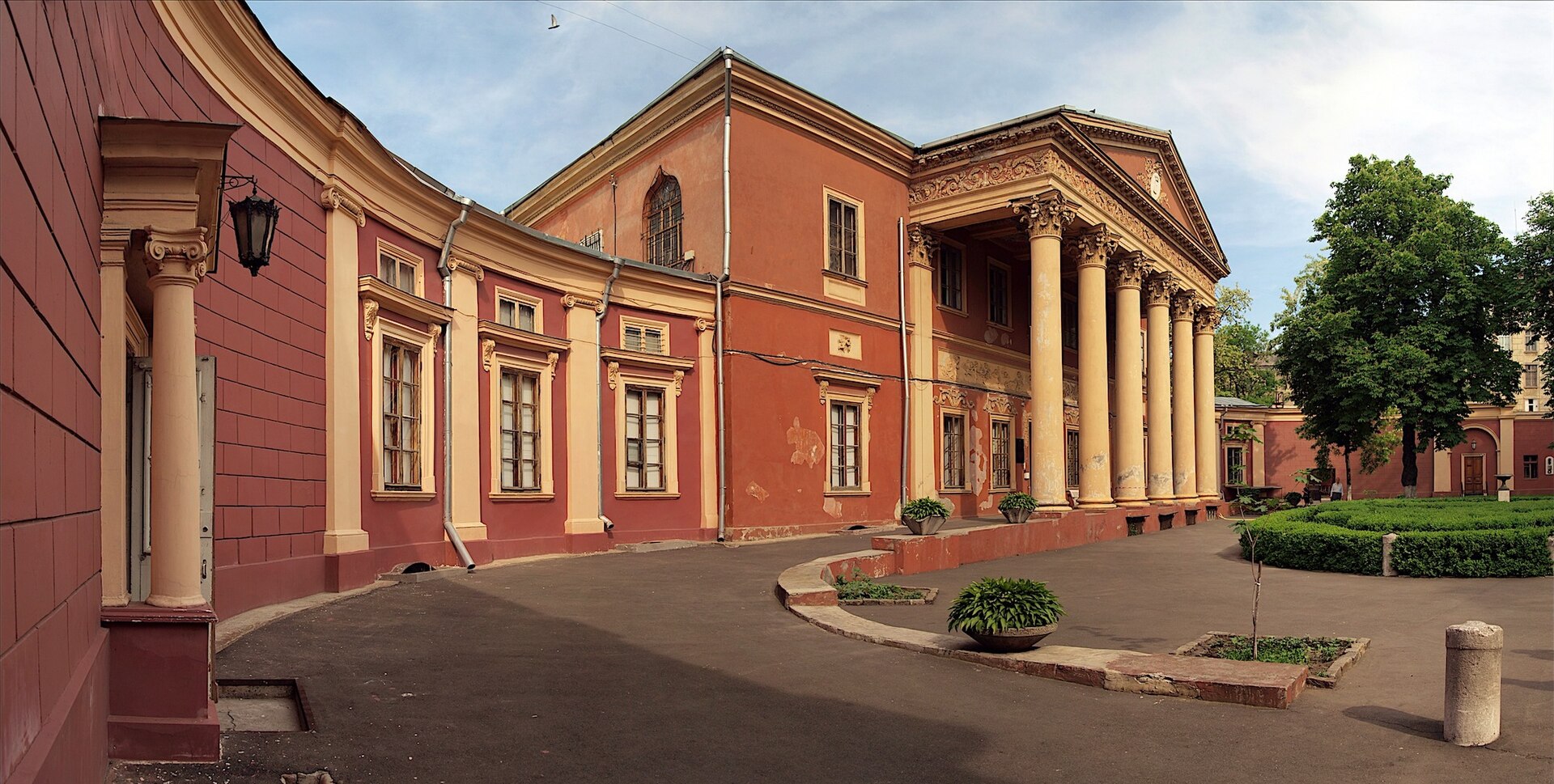
The main facade of the Potocki Palace, Sofiivska Street, Odesa, home of the Odesa Fine Arts Museum since 1899. Photographed in 2012.
Alex Levitsky and Dmitry Shamatazhi, CC BY-SA 3.0 · Photograph by Alex Levitsky & Dmitry ShamatazhiOdesa Fine Arts Museum
Museum · Odeskyi khudozhnii muzei · Founded 1899
Open, admission and hours confirmed 1 September 2026 · 13 sources
On this page 14 sections
ContentsClose
| Local name | Odeskyi khudozhnii muzei |
|---|---|
| Kind | Museum |
| Founded | 1899 |
| City and country |  Odesa, Ukraine Odesa, Ukraine |
| Address | Sofiivska Street 5a, Odesa, 65000, Ukraine |
| Website | ofam.ua |
| Status | Open, confirmed |
| Record last verified |
Visiting
- Hours
- Wed-Thu11:00 to 18:00
- Fri-Sat-Sun11:00 to 19:00
- Closed
- Monday. Tuesday.
- Admission
- Single ticket, temporary exhibitionUAH 200same price is charged for a lecture ticket
- Guided group tour, temporary exhibitionUAH 150per person
- Private guided tour, up to 5 peopleUAH 600flat rate for the group
- Private guided tour, 6 or more peopleUAH 750flat rate for the group
- Children under 7, art/history/architecture students, museum staff, war veterans, people with disabilities, internally displaced persons, large families, orphansFreefree entry to the collection; the same groups get 50 percent off guided tours and lectures
- Tickets
- tickets.ofam.ua The museum's own ticket page.
- Do I need to book?
- No booking requirement is stated on the museum's own visit page; entry is by ticket on the day
- Address
- Sofiivska Street 5a, Odesa, 65000, Ukraine Map
- Website
- ofam.ua
- Telephone
- +380 48 723 72 87
- [email protected]
Before you go how long, access, photography, bags, eating, shop
- How long to allow
- Around one and a half to two hours for the main picture galleries
- Access
- Not published on the museum's own site as checked for this entry
- Photography
- Not published on the museum's own site as checked for this entry
- Bags
- Not published on the museum's own site as checked for this entry
- Eating
- Not published on the museum's own site as checked for this entry
- Shop
- Not published on the museum's own site as checked for this entry
Prices and hours change. We take them from the institution's own pages and print the day we read them, and you can check the current position at the source we used. Confirm before you travel.
What is inside
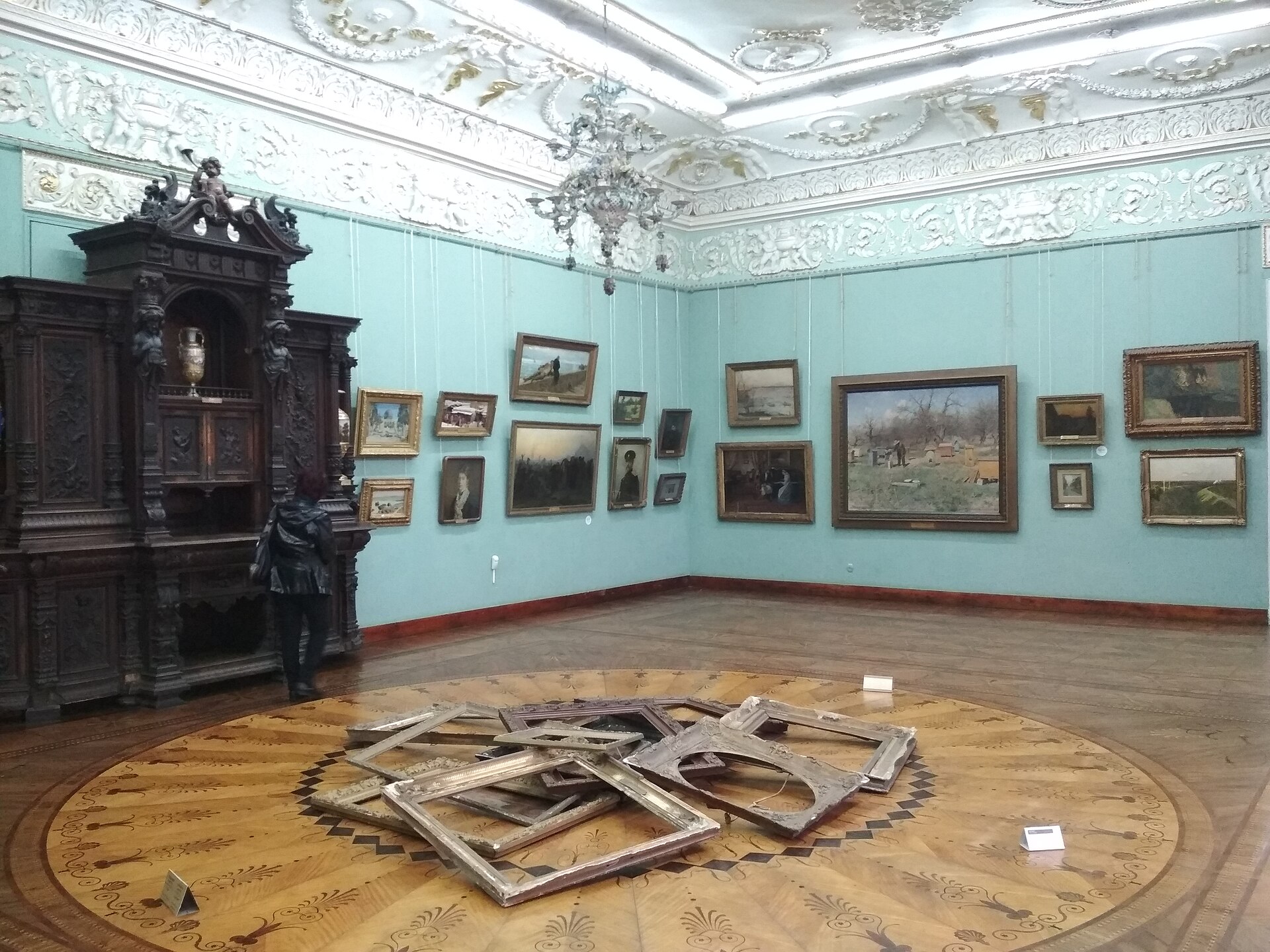
Photograph by Adrian1111 · CC BY-SA 4.0 Picture galleries: the Peredvizhniki, Aivazovsky and the early Kandinsky
The core painting collection, built from a gift of works from the Imperial Academy of Arts in St Petersburg at the museum's founding and grown since. It holds numerous seascapes by Ivan Aivazovsky, early paintings by Wassily Kandinsky, and a strong run of the Peredvizhniki (Wanderers) realist school: Ivan Kramskoi, Alexei Savrasov, Isaac Levitan, Ivan Shishkin, Arkhip Kuindzhi, Ilya Repin and Vasily Surikov, alongside Alexandre Benois, Valentin Serov, Mikhail Vrubel, Nicholas Roerich, Boris Kustodiev and Konstantin Somov.
The Odesa School (TURH) rooms
Work by the city's own turn-of-the-century painting circle, the Society of South Russian Artists (TURH): Kyriak Kostandi, Gennady Ladyzhensky, Pyotr Nilus and Nikolai Kuznetsov among them, and the reason this collection reads differently from a purely Petersburg or Moscow one.
The Soviet-era collection
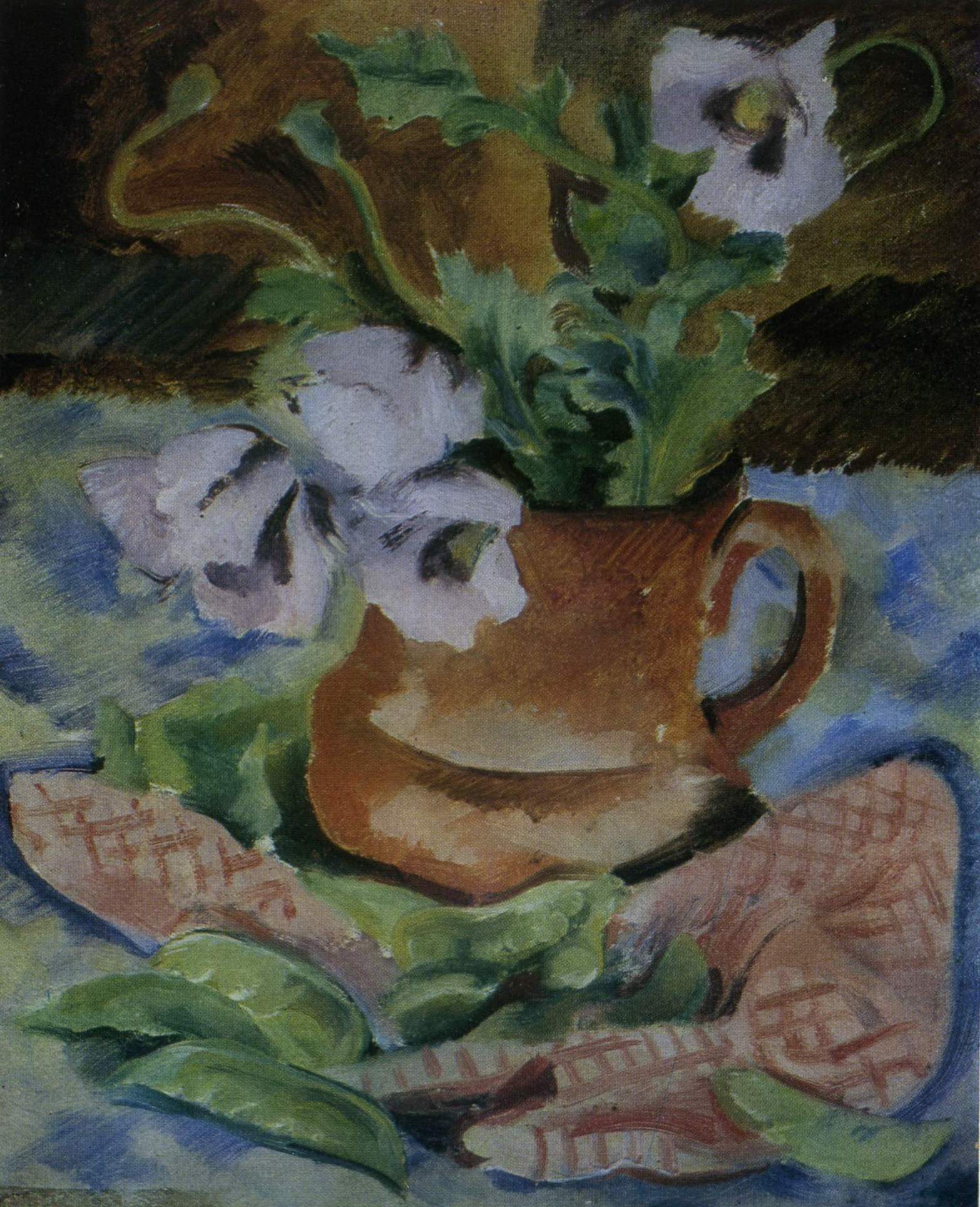
Described by the museum's own English-language Wikipedia entry as the only collection of Soviet painting, so-called social art or social realism, held in Odesa: work by Martiros Sarian, Anatol Petrytsky, Valentin Khrushch and Amshey Nurenberg, plus other Soviet-period painters including Nikolay Tyrsa, whose 1932 oil Still Life with Poppies is held here.
Icon gallery, 16th to 18th century
A room of icon painting spanning three centuries, set apart from the secular collection built up after the palace became a museum.
The Yellow Giants experimental gallery
An experimental contemporary-art space set inside the part of the palace whose vaulted ceilings and walls still carry decorative murals painted for the 1895 Exhibition of Household Arrangement (Vystavka domoustroistva), held in the palace and its garden. The murals survive; the room built under them now shows changing contemporary work under the name Zhovti Velyketni (Yellow Giants).
Sculpture and decorative arts halls
Sculpture, drawing and decorative art from the 16th to the 20th century, shown alongside the painting collection across the museum's roughly two dozen exhibition rooms.
What to see first
Seascapes
Ivan AivazovskyThe museum holds numerous works by Aivazovsky, the Black Sea's own marine painter and one of the most reproduced 19th-century Russian Empire artists; Odesa, a Black Sea port, is exactly his subject.2
Early paintings
Wassily KandinskyPre-abstraction work by an artist who later became one of the founders of abstract painting in Europe, held here from his early, representational period.2
Peredvizhniki-era realist paintings
Ilya Repin and the Wanderers circleA concentrated run of the 19th-century Russian Empire's leading realist movement, alongside Kramskoi, Savrasov, Levitan, Shishkin, Kuindzhi and Surikov, giving the collection a depth in this school that few museums outside Moscow and St Petersburg match.2
Still Life with Poppies (1932)
Nikolay TyrsaAn oil on canvas by the Russian-Soviet painter and graphic artist (1887-1942), photographed in the museum's own galleries; a concrete, identifiable object from the Soviet-era collection rather than a generic description of the school.8
Portrait of Olga Potocka-Naryshkina
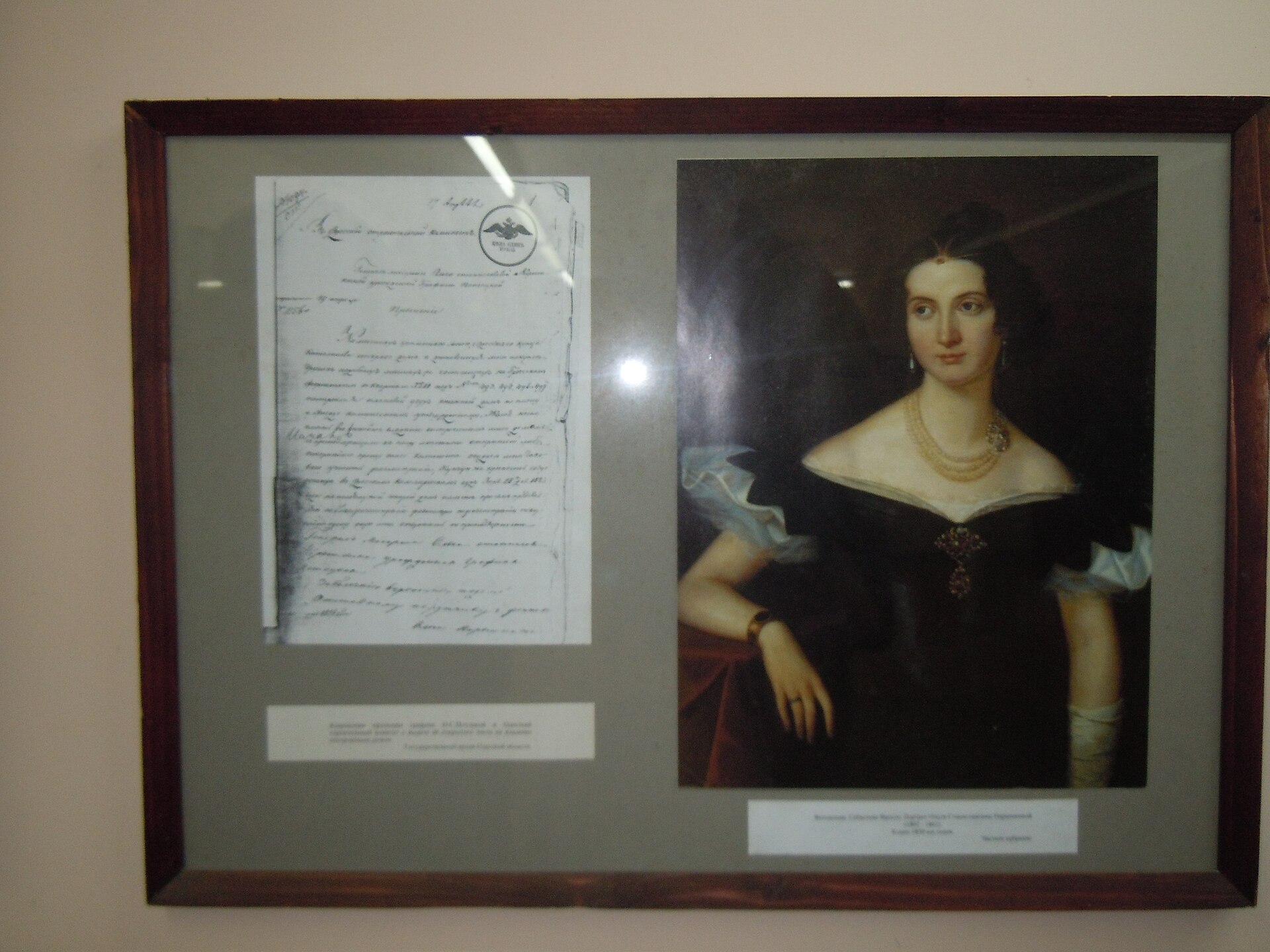
unattributed in the source consultedA portrait, held and photographed in the museum, of the woman a Ukrainian public-broadcaster account names as the first mistress of the palace the museum now occupies, connecting a specific object in the collection directly to the building's own documented history.6
Portrait of Zofia Potocka
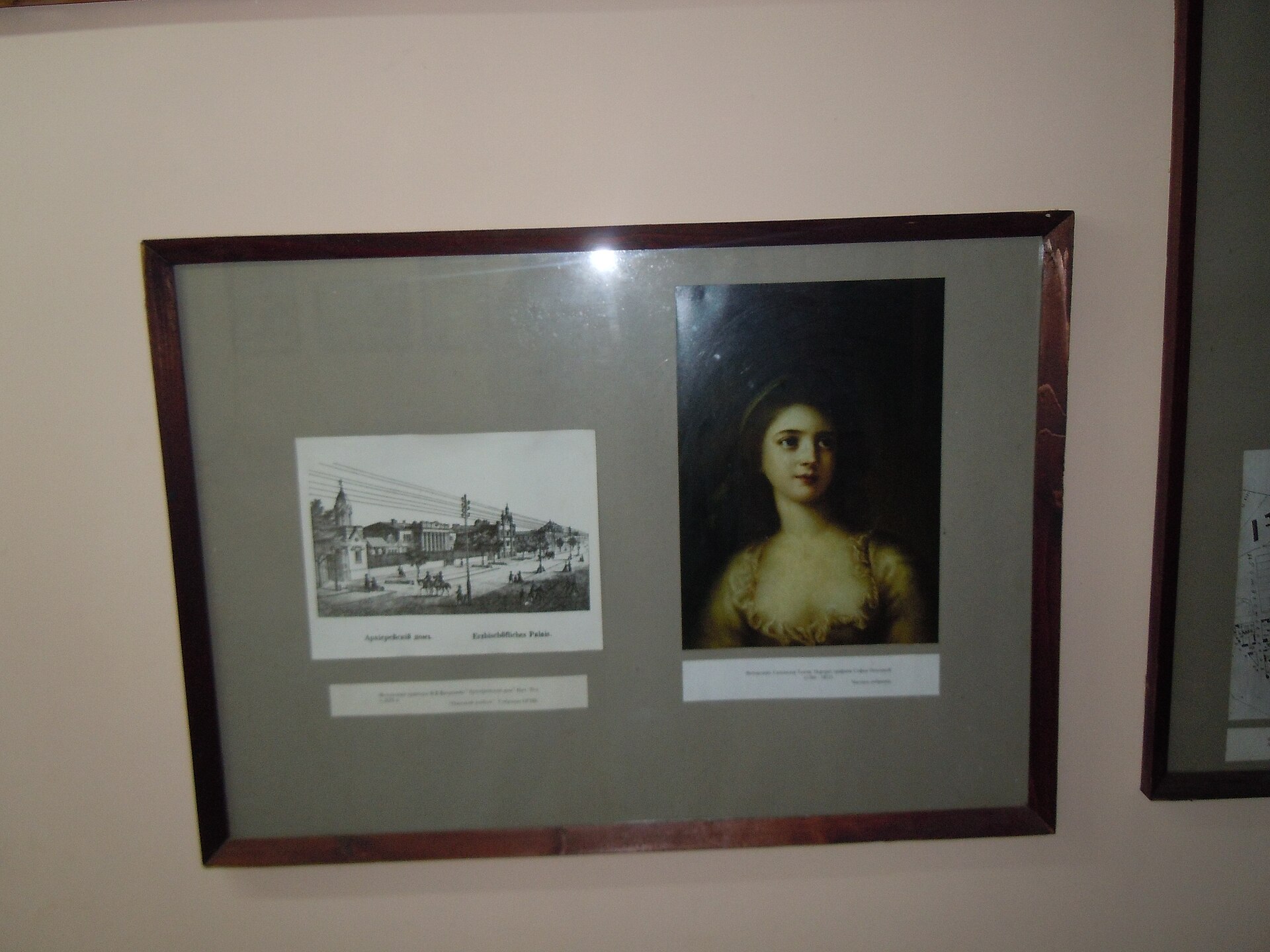
unattributed in the source consultedA companion portrait from the same family whose name the palace still carries, also photographed on the museum's walls.8
Paintings by Mykhaylo Zhuk
Mykhaylo ZhukPortraits and still lifes by the Ukrainian avant-garde painter, singled out in the Ukrainian Ministry of Culture's own Google Arts and Culture feature on the museum's collection.9
Odesa School (TURH) paintings
Kyriak Kostandi and the Society of South Russian ArtistsThe city's own painting circle, distinct from the Peredvizhniki and Moscow/Petersburg schools represented elsewhere in the same halls.2
A palace commissioned for one family, opened for the whole city
The building the Odesa Fine Arts Museum occupies predates the museum by seven decades. Construction began in 1805 and the shell of the palace was finished by 1810, but the interior fit-out was interrupted by the Napoleonic Wars and did not resume until 1824, finishing in 1828. English-language sources name Seweryn Potocki, a former member of the Polish Sejm and a supervisor of Kharkiv University, as the palace's original patron; he died in 1829, before the interior work he had commissioned was complete. A Ukrainian public-broadcaster retrospective published on the museum's 125th anniversary instead names Countess Olga Stanislavivna Naryshkina as the palace's first mistress, and the museum today holds and displays a photographed portrait identified as showing this same woman under the compound name Olga Potocka-Naryshkina, which reconciles the two accounts rather than contradicting them: the palace kept the Potocki name even after it passed to a Naryshkina by marriage.
The building changed hands again later in the 19th century. Hryhoriy Marazli, Odesa's mayor and a noted collector and philanthropist, bought the palace in 1888. In 1892 he donated it to the city with the explicit purpose of founding a museum there. A Ukrainian public-broadcaster account gives the formal opening date as 24 October 1899; the museum itself, and English-language press covering the 2023 missile strike, mark the institution's anniversary on 6 November, so this record notes both dates as given by the sources consulted rather than picking one. Architecturally the palace is neoclassical: a large portico with a tympanum on six classical columns, and semi-circular flanking galleries forming a Cour d'honneur, the formal entrance court in front of the main facade. An English-style landscape garden with a grotto originally extended behind the building. The institution's name has changed more than once since 1899: it became the People's Art Museum in the 1920s, reopened as the Odesa Art Gallery after the Second World War, and took its current name, the Odesa Fine Arts Museum (Odesa National Fine Arts Museum in fuller official use), in 2021.
What is inside: from an Imperial Academy gift to the only Soviet room in the city
The museum's founding collection came largely as a gift: paintings donated by the Imperial Academy of Arts in St Petersburg formed the core of what the new institution had to show in 1899. It has grown since to more than 10,000 works of painting, drawing, sculpture and decorative art from the 16th to the 20th century, spread across roughly two dozen exhibition rooms.
Three strands run through the painting collection in particular. The first is the 19th-century Russian Empire mainstream: numerous seascapes by Ivan Aivazovsky, early representational work by Wassily Kandinsky before his turn to abstraction, and a concentrated run of the Peredvizhniki (Wanderers) realist school, including Ivan Kramskoi, Alexei Savrasov, Isaac Levitan, Ivan Shishkin, Arkhip Kuindzhi, Ilya Repin and Vasily Surikov, alongside Alexandre Benois, Valentin Serov, Mikhail Vrubel, Nicholas Roerich, Boris Kustodiev and Konstantin Somov. The second is local: the Odesa School, more formally the Society of South Russian Artists (TURH), represented by Kyriak Kostandi, Gennady Ladyzhensky, Pyotr Nilus and Nikolai Kuznetsov among others, a circle that gives the collection a flavour distinct from Moscow's or St Petersburg's own museums. The third is Soviet: the museum's own English-language account describes its holding of so-called social art, or socialist realism, as the only such collection in Odesa, naming Martiros Sarian, Anatol Petrytsky, Valentin Khrushch and Amshey Nurenberg. A specific, photographed object from this last group is Nikolay Tyrsa's 1932 oil Still Life with Poppies, a small canvas by a painter who died a decade later in the Siege of Leningrad. Separately, the Ukrainian Ministry of Culture's own Google Arts and Culture feature on the museum highlights portraits and still lifes by the Ukrainian avant-garde painter Mykhaylo Zhuk, landscapes by Mykola Shelyuto, and work by the modernists Veniamin Babadzhan and Maria Siniakova-Urechina, alongside Kandinsky and Nurenberg. A separate icon gallery holds religious painting from the 16th to the 18th century, set apart from the secular collection assembled after 1899.
A palace that still shows its own history on the walls
Part of the building carries a layer of decoration older than the museum's own collection. The vaulted ceilings and walls of one section of the palace still bear decorative murals painted in 1895, four years before the museum opened, for an event called the Exhibition of Household Arrangement (Vystavka domoustroistva) held in the palace and its adjoining garden. Rather than paint over this survival, the museum has built an experimental contemporary gallery, named Zhovti Velyketni (Yellow Giants) in Ukrainian, into the same rooms, so a visitor moving through it is standing under an 1895 ceiling while looking at current work on the walls. Visitor reviews aggregated on Tripadvisor separately point to a guided tour into the building's cellars as an unexpected draw, distinct from the picture galleries above.
5 November 2023: a missile on the museum's own anniversary
On the evening of 5 November 2023, the eve of the museum's anniversary, a Russian missile struck close to the building during a wider attack on Odesa that damaged at least ten other structures in the city. The museum's deputy director, Daria Diakova, said the missile landed in a district heating line, whose water helped extinguish the resulting fire immediately, but the blast wave still blew out windows in the museum and in buildings across the street. Odesa's military governor at the time, Oleh Kiper, separately said the strike had "congratulated" the city's architectural heritage and that the heart of the collection was safe. The museum's entrance, its administrative building, its facade and every window were affected; seven planned exhibitions were cancelled. Ukraine's culture ministry and UNESCO's Kyiv office both condemned the strike on a building that sits inside a UNESCO-protected historic zone of the city. The museum's collection itself had already been evacuated in advance, in coordination with regional authorities and the NGO Museum for Change, and both Ukrainska Pravda's reporting a week after the strike and a later Ministry of Culture feature agree that the paintings were not destroyed. A week after the strike, museum head Kateryna Kulai told Ukrainska Pravda that commissions, restorers and builders had already inspected the building, that a report had been drawn up, and that preventive conservation work on the collection would begin next, with a target of reopening to the public in early December 2023.
Reopening behind sandwich panels, and a bill nobody can total yet
The museum reopened in December 2023, on schedule, with three exhibitions chosen to mark the occasion: work by the Lviv sculptor Volodymyr Semkin, by the Odesa painter Borys Aizenberg, who had been killed in the war, and by the Lviv painters Roman and Marhit Selski. A year later, a Suspilne (Ukraine's public broadcaster) retrospective published on the museum's 125th anniversary, 6 November 2024, reported that stabilisation work on the building was complete and that the administrative building, the part hit hardest, had been fully repaired, but that the main entrance was still blocked and under repair after a year, and that the museum had no glass at all: window openings had been sealed instead with sandwich panels, with wind- and waterproofing and mineral wool behind them, all funded by international organisations. Deputy director Daria Diakova described the moment the blast hit, and confirmed the interim fix was still standing a year on. Director Kateryna Kulai told the same outlet that full restoration was being deferred until after the full-scale invasion ends, and that the roughly 150 million hryvnia the job would have cost before the strike could now run to one and a half or two times that, without yet being able to give a final figure. Digitisation work continued in parallel: a Museum for Change project describes cataloguing more than 2,500 collection records between 2022 and 2024, with museum staff quoted as wanting to capture not only the highlights but works that had not been exhibited for a long time. As of the exhibitions and visit pages checked for this record, the museum is open on its normal schedule, Wednesday to Sunday, with a full programme of temporary exhibitions running.
What is unresolved
Sources consulted for this record disagree on two points of detail rather than substance. English-language accounts name Seweryn Potocki as the palace's original patron and give 1805 to 1828 as the full construction period in two phases; a Ukrainian public-broadcaster account instead dates construction to 1824-1828 alone, names the palace's first owner as Countess Olga Potocka-Naryshkina, and gives the architect as unknown, with Franz Boffo credited only with inspecting the finished building rather than designing it. The formal opening date is given as both 24 October and 6 November 1899 by different sources consulted here; this record states both rather than resolving them. Full restoration of the war damage has no announced completion date: the museum's own director, as recently as the sources checked, could not yet quote a final repair cost, only a range.
What visitors say
Visitors and critics consistently single out the building itself, the former Potocki Palace, as being as much the draw as the collection, and rate the depth of 19th and early 20th century Russian Empire and Ukrainian painting inside as unusually strong for a regional museum. The museum's own leadership is equally consistent, and public, about the cost of keeping that building standing since 2023: stabilisation is finished, but full restoration is deferred until after the war, at a price the director puts at possibly double the roughly 150 million hryvnia the job would have cost before the missile strike.
What is praised, what is criticised
- Praised: The Potocki Palace building, its neoclassical facade and its Cour d'honneur, rated by visitors as worth the visit on its own
- Praised: The breadth of the Peredvizhniki, Aivazovsky and early Kandinsky holdings
- Praised: A guided tour into the palace's cellars, offered as an add-on and singled out by visitors as an unexpected highlight
- Criticised: Aggregated visitor feedback on Google and Tripadvisor repeatedly raises dim lighting and hard-to-see paintings in some rooms, and a lack of visible investment in presentation compared with the strength of the collection behind it
- Criticised: The building still carries the physical cost of the 5 November 2023 missile strike: a year on, the entrance was still rebuilt behind temporary panelling and the museum's own director could not yet put a final figure on the repair bill
Ratings on other platforms
Google: 4.7 from 3,172 ratings, read 1 September 2026
Tripadvisor: 4.3 from 101 ratings, read 1 September 2026
A platform average is a tertiary source: it moves, it is not audited, and we quote no visitor's words.
Questions about Odesa Fine Arts Museum
Where is Odesa Fine Arts Museum?
Sofiivska Street 5a, Odesa, 65000, Ukraine.
How much does it cost to visit?
Single ticket, temporary exhibition: UAH 200; Guided group tour, temporary exhibition: UAH 150; Private guided tour, up to 5 people: UAH 600; Private guided tour, 6 or more people: UAH 750; Children under 7, art/history/architecture students, museum staff, war veterans, people with disabilities, internally displaced persons, large families, orphans: free. As confirmed 1 September 2026.
When is it open?
Wed-Thu 11:00-18:00; Fri-Sat-Sun 11:00-19:00. Closed: Monday. Tuesday. As confirmed 1 September 2026.
What should you see first?
Seascapes (Ivan Aivazovsky); Early paintings (Wassily Kandinsky); Peredvizhniki-era realist paintings (Ilya Repin and the Wanderers circle); Still Life with Poppies (1932) (Nikolay Tyrsa); Portrait of Olga Potocka-Naryshkina (unattributed in the source consulted); Portrait of Zofia Potocka (unattributed in the source consulted).
What we could not confirm
- The palace's original patron and construction dates are given differently by an English-language account (Seweryn Potocki, 1805-1828 in two phases) and a Ukrainian public-broadcaster account (Countess Olga Potocka-Naryshkina as first owner, construction 1824-1828 only, architect unnamed). Not resolved here.
- The formal opening date of the museum is given as both 24 October 1899 and 6 November 1899 by sources consulted. Not resolved here.
- No completion date or final repair cost for the war damage has been published by the museum as of the sources checked; the director's own estimate was a range, not a figure.
- No recurring free-admission day is currently published on the museum's own visit page, though the museum ran a Free Entrance Day at least as recently as November 2023 (cancelled that month because of the strike).
Images
Sources
- 1Wikidata, item Q4331480, Odesa Fine Arts Museum wikidata.org/wiki/Q4331480
- 2Wikipedia, "Odesa Fine Arts Museum" en.wikipedia.org/wiki/Odesa_Fine_Arts_Museum
- 3Odesa National Fine Arts Museum, official site, Visit page ofam.ua/visit
- 4Odesa National Fine Arts Museum, official site, Exhibitions page ofam.ua/exhibitions
- 5Odesa National Fine Arts Museum, official site, homepage (English) ofam.ua/en
- 6Suspilne Odesa, "Odeskomu khudozhnomu muzeiu 125 rokiv: yak vidnovliuietsia pislia ataky ta koly ochikuvaty novi vystavky", 6 November 2024 suspilne.media/odesa/874345-odeskomu-hudoznomu-muzeu-125-rokiv-ak-vidnovluetsa-pisla-ataki-ta-koli-ocikuvati-novi-vistavki/
- 7Ukrainska Pravda, damage assessment report, 13 November 2023 pravda.com.ua/eng/news/2023/11/13/7428531/
- 8Wikimedia Commons, Category:Odesa Art Museum, and individual file pages (interior, portraits, still life) commons.wikimedia.org/wiki/Category:Odesa_Art_Museum
- 9Google Arts and Culture, "Unbreakable Art: Odesa Fine Arts Museum", Ministry of Culture and Information Policy of Ukraine artsandculture.google.com/story/unbreakable-art-odesa-fine-arts-museum-ministry-of-culture-and-information-policy-of-ukraine/BQUhUgzRyrYPPA?hl=en
- 10The Art Newspaper, "Odesa museum of fine arts rocked by Russian missile strike on 124th anniversary", 7 November 2023 theartnewspaper.com/2023/11/07/odesa-museum-of-fine-arts-rocked-by-russian-missile-strike-on-124th-anniversary
- 11Museum for Change / mfcua.org, "Emergency assistance to cultural institutions in Odesa" mfcua.org/en/projects/emergency-assistance-to-cultural-institutions-in-odesa
- 12Wanderlog, "The 35 best museums in Odesa" (aggregated Google and Tripadvisor ratings, read 2026-09-01) wanderlog.com/list/geoCategory/142492/best-museums-in-odesa
- 13Wikimedia Commons, File:Sofievskaya-5a23.jpg (lead exterior photograph) commons.wikimedia.org/wiki/File:Sofievskaya-5a23.jpg
