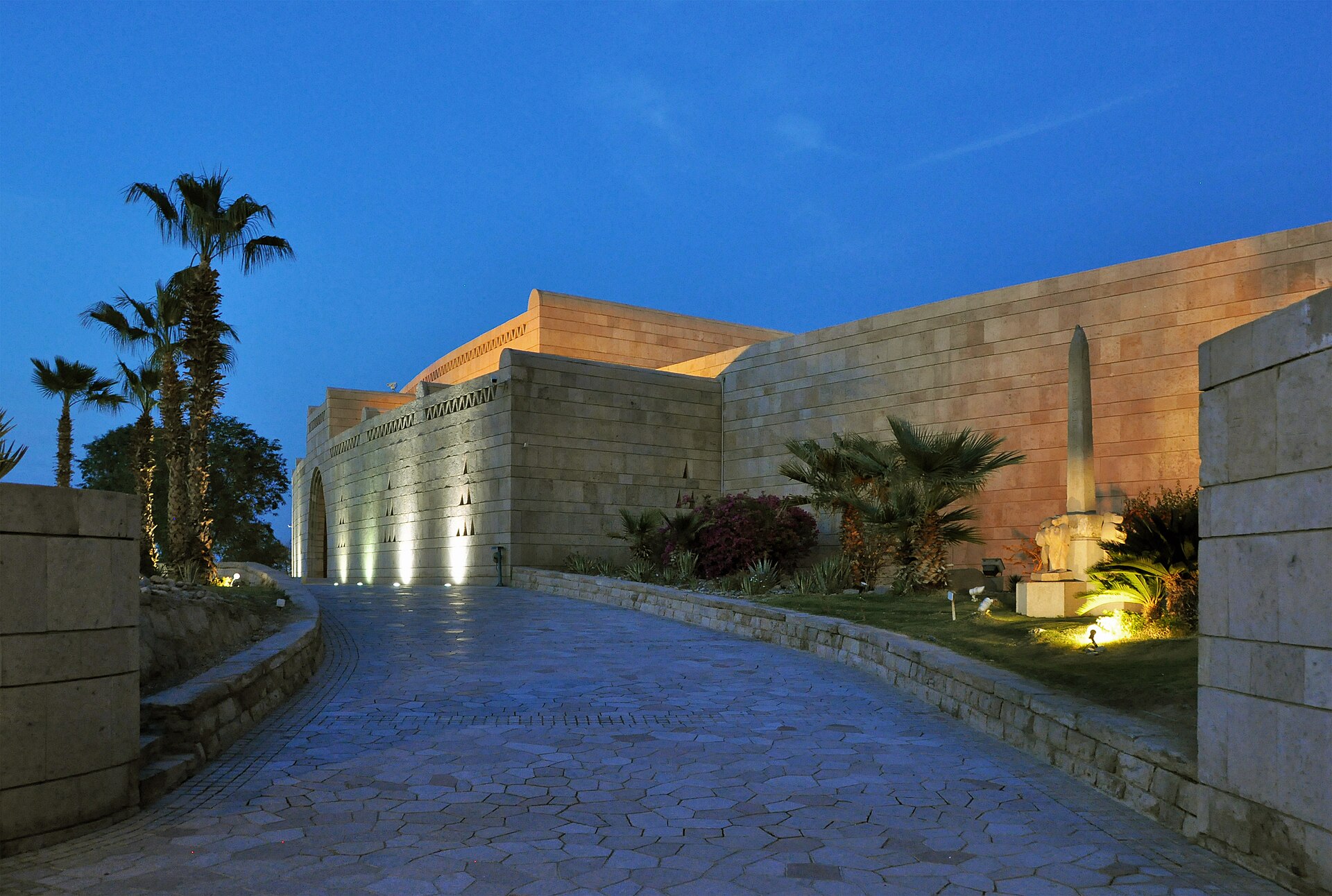
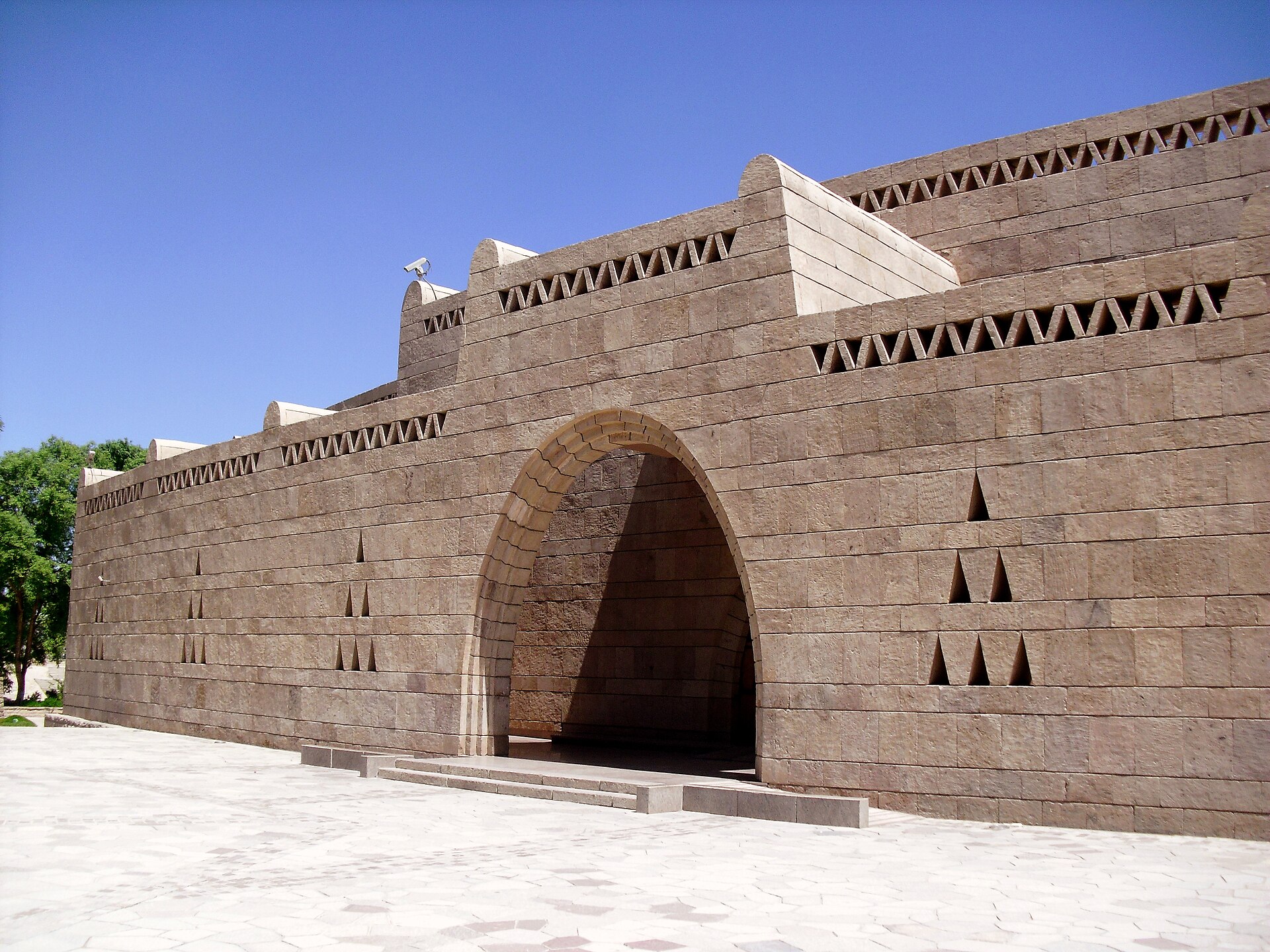
The sandstone entrance wall and arched gateway of the Nubia Museum, photographed at dusk with an obelisk from the museum's outdoor collection in the foreground.
Marc Ryckaert · Photograph by MJJR · CC BY 3.0Nubia Museum
Museum · متحف النوبة · Founded 1960
Open, admission and hours confirmed 15 September 2026 · 11 sources
On this page 14 sections
ContentsClose
A collection built specifically to survive a flood: roughly 2,000 to 3,000 pieces salvaged or documented ahead of the Aswan High Dam's creation of Lake Nasser, arranged across three floors from Nubia's prehistoric rock art through Pharaonic, Kushite, Coptic and Islamic material to the ethnographic record of a Nubian culture the dam then displaced. Its signature object, the eight-metre sandstone colossus of Ramesses II from the Temple of Gerf Hussein, sits alongside a garden that functions as a second museum in its own right: a real Fatimid cemetery, a prehistoric rock-art cave, a full-scale replica of the Nabta Playa astronomical stone circle, and a reconstructed Nubian house standing in for the villages the reservoir now covers.
| Local name | متحف النوبة |
|---|---|
| Kind | Museum |
| Founded | Requested of UNESCO by the Egyptian government in 1960; a founding committee of the Supreme Council of Antiquities, Egyptian universities and UNESCO specialists formed in the early 1980s; opened 23 November 1997 |
| City and country |  Aswan, Egypt Aswan, Egypt |
| Address | El Fanadek Street, opposite the Basma Hotel, Aswan, Egypt |
| Website | egymonuments.gov.eg/en/museums/nubia-museum |
| Status | Open, confirmed |
| Record last verified |
Visiting
- Hours
- Daily09:00 to 17:00ticket window closes at 16:00
- Thu-Fri, evening18:00 to 21:00additional evening opening on top of the daytime hours; ticket window closes at 20:00
- Daily, during Ramadan09:00 to 15:00ticket window closes at 14:00
- Admission
- Foreign adultEGP 400
- Foreign studentEGP 200
- Egyptian adultEGP 30
- Egyptian studentEGP 10
Free entry: Egyptians aged 60 and over. Egyptians with special needs. Orphaned children. Government and Al-Azhar primary and preparatory school trips, booked in advance through the Rehla platform. Children under 6- Tickets
- egymonuments.gov.eg/en/museums/nubia-museum The museum's own ticket page.
- Do I need to book?
- No advance booking is stated on the museum's own page; tickets are sold at the gate
- Address
- El Fanadek Street, opposite the Basma Hotel, Aswan, Egypt MapTaxi About 10 to 15 minutes from central Aswan along the Corniche; fares are commonly quoted in the 30 to 50 EGP range each way
On foot Roughly 2 km south of central Aswan on the Corniche near the Basma Hotel; a 30 to 40 minute walk from central hotels - Website
- egymonuments.gov.eg/en/museums/nubia-museum
- Telephone
- 0-19654
- [email protected]
Before you go how long, access, photography, bags, eating, shop
- How long to allow
- Two to three hours, per visitor guides; the museum's own page does not itemise a typical duration
- Access
- Not itemised on the Ministry's own page; visitor guides describe the building as wheelchair accessible with ramps and elevators
- Photography
- Private photography is permitted after paying the ticket fee; flash photography, audio players and camera holders are prohibited, and commercial filming needs separate permission and a daily fee
- Bags
- Large bags, backpacks, luggage or parcels larger than 40x40cm are not permitted into the galleries and must be left in the cloakroom; sharp items, umbrellas and folding seats are also barred
- Eating
- Not itemised on the Ministry's own page; visitor guides describe a small on-site cafe
- Shop
- Not itemised on the Ministry's own page; visitor guides describe an on-site gift shop selling books, crafts and artefact replicas
Prices and hours change. We take them from the institution's own pages and print the day we read them, and you can check the current position at the source we used. Confirm before you travel.
What is inside
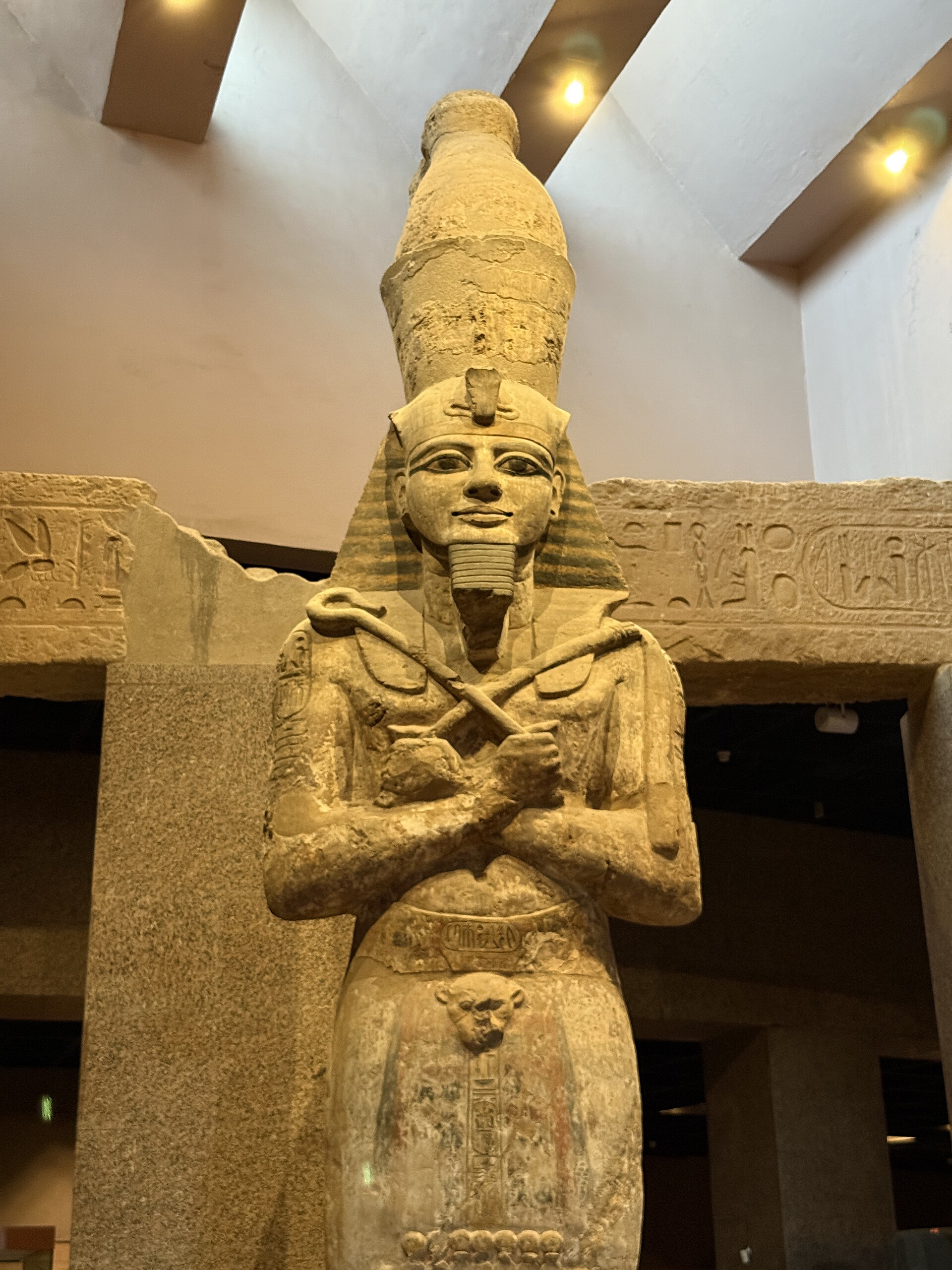
Photograph by Chabe01 · CC BY-SA 4.0 The main exhibition hall
The hall visitor guides and the Ministry's own page treat as the museum's core space, anchored by an eight-metre sandstone colossus of Ramesses II moved here from the free-standing colonnade of the Temple of Gerf Hussein before that temple was partly dismantled ahead of the Lake Nasser floodwaters.
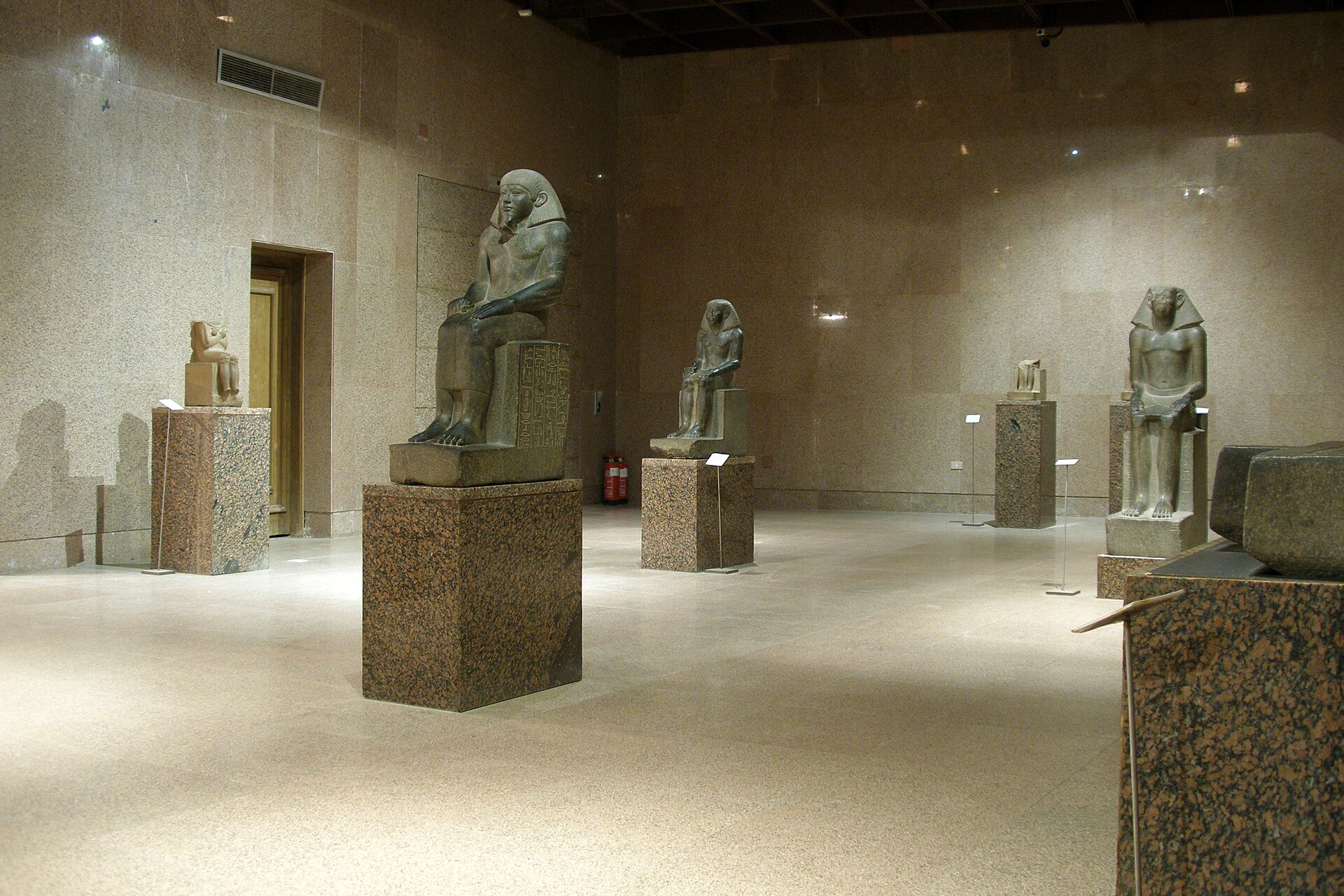
Photograph by Argenberg · CC BY 4.0 Pharaonic, Nubian and Kushite antiquities galleries
Granite-floored rooms holding part of the collection that Wikipedia's own account breaks down as roughly 503 Pharaonic, 140 Nubian-era and further Kushite pieces, including seated statues of officials and rulers displayed individually on plinths rather than crowded together.
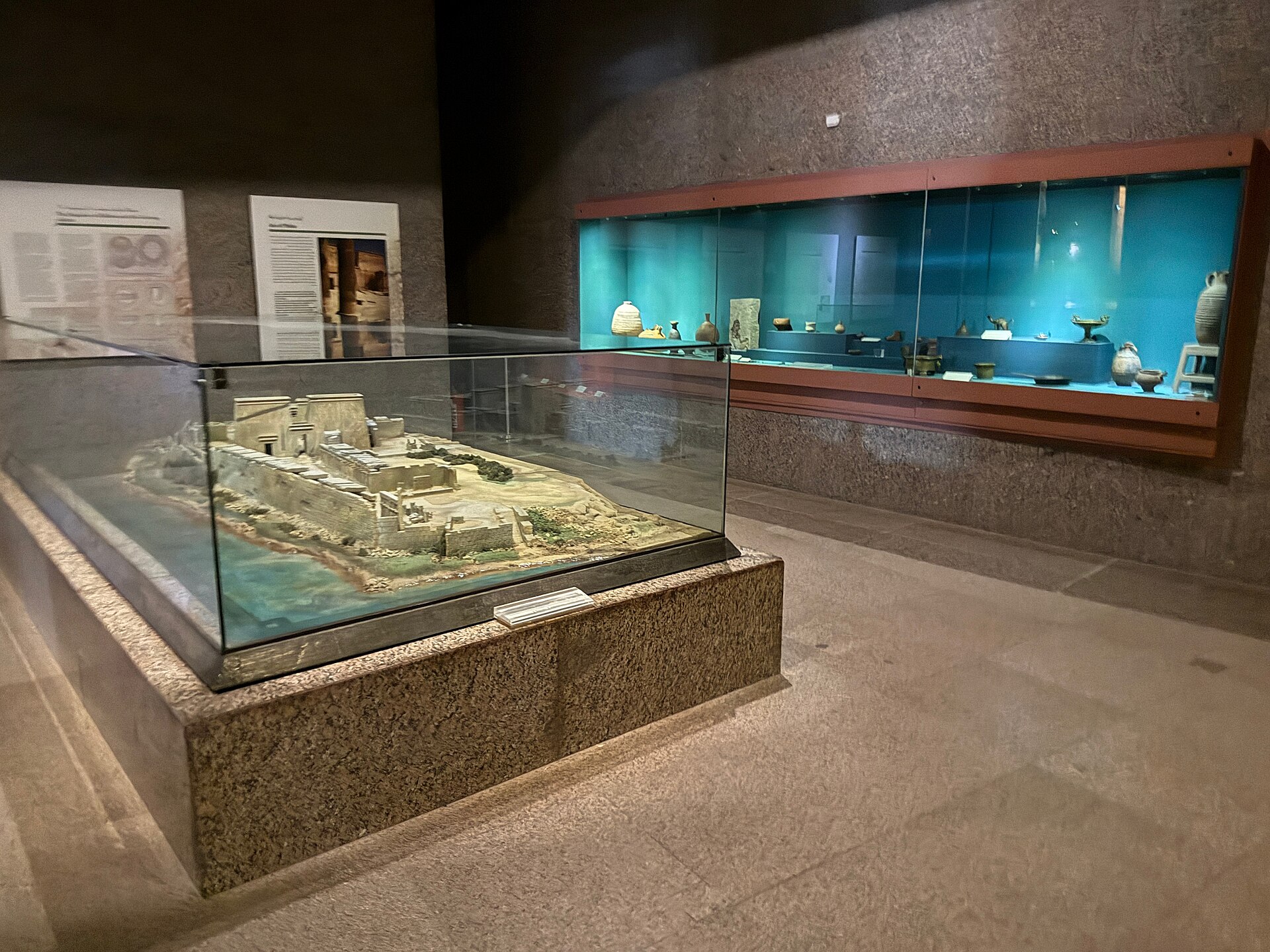
Photograph by Chabe01 · CC BY-SA 4.0 Aswan history and archaeology displays
Cases and a scale architectural model documenting the archaeology and history of Aswan itself, part of the roughly 360 pieces Wikipedia's own account says are devoted specifically to the city's history rather than to Nubia more broadly.
Ethnographic section: Nubian daily life
Dioramas and displays of traditional Nubian dress, crafts, basketry and wall painting, named on the Ministry's own page as one of the museum's two core displays alongside the main hall; this is also the specific section that Cairo's Society for Nubian Heritage was consulted on before at least one of its members later said the consultation had not been acted on.
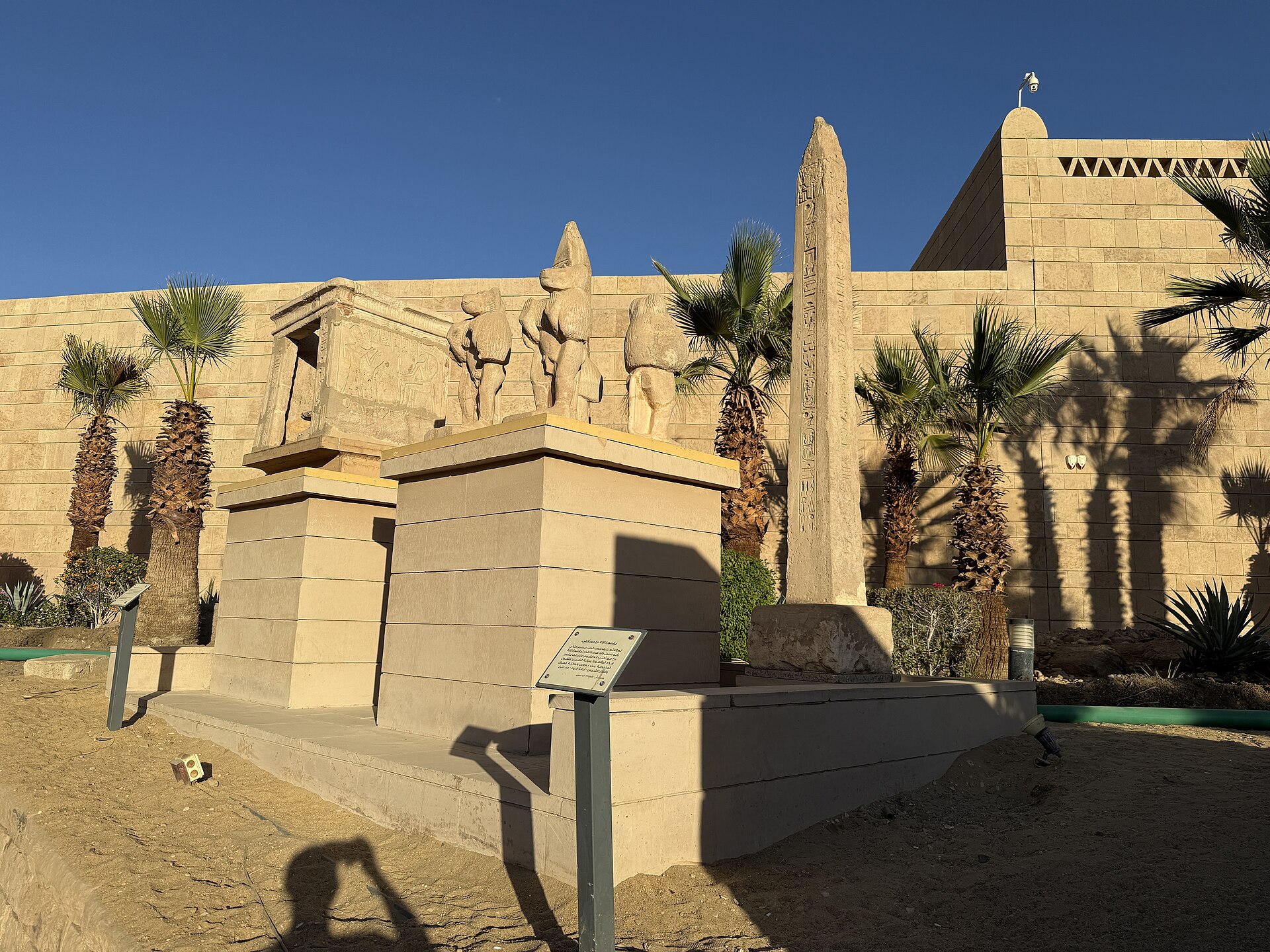
Photograph by Chabe01 · CC BY-SA 4.0 The open-air museum and garden
A garden covering most of the site's 50,000 square metres, built as a second museum in its own right: a surviving part of a Fatimid cemetery, a cave holding genuine prehistoric rock inscriptions, a full-scale replica of the Nabta Playa astronomical stone circle, a reconstructed Nubian house, and a series of water channels tracing the Nile's course through the grounds.
Library, lecture hall and education department
Facilities beyond the display floors: a research library, a lecture hall, an education department and an open amphitheatre used for presentations of Nubian folklore, reflecting a founding brief to document a living culture and not only its excavated objects.
What to see first
The colossal statue of Ramesses II from the Temple of Gerf Hussein
Reign of Ramesses II, 13th century BCAn eight-metre sandstone colossus rescued from Gerf Hussein's free-standing colonnade before the temple was partly dismantled for the rising waters of Lake Nasser, and consistently named by visitor guides as the single object that defines a visit here.9
The Nabta Playa stone circle replica
Neolithic original, roughly 6th to 5th millennium BC; modern replicaA full-scale replica of one of the earliest known astronomical monuments anywhere, built in the garden because the fragile original site in the desert near Abu Simbel is closed to visitors.8
The reconstructed Nubian house
Modern reconstruction of vernacular Nubian architectureRebuilt in the garden to show the domestic architecture of a homeland now mostly submerged beneath Lake Nasser, since almost none of the original villages survived the flooding that followed the High Dam.4
The water channels through the outdoor exhibition
Landscape design element, opened 1997Channels tracing the Nile's course from its African sources to Egypt, built into the garden so the river stays physically present in a museum about a culture the damming of that same river displaced.4
The cave of prehistoric rock inscriptions
Prehistoric petroglyphsGenuine rock art set into the garden's open-air section, giving the collection's prehistoric material an actual outdoor setting rather than only display cases indoors.1
The Fatimid cemetery within the grounds
Islamic eraA surviving part of a real medieval cemetery kept in place within the museum's grounds rather than reconstructed, extending the site's timeline past the pharaonic and Nubian material shown inside.1
The ethnographic dioramas of Nubian daily life
Museum-commissioned displays, installed for the 1997 openingNamed on the Ministry's own page as one of the museum's two core displays, and also the specific section where consultation with Cairo's Society for Nubian Heritage later became a documented point of contention over whose voice actually shaped it.5
A museum requested to answer a flood
The Nubia Museum exists because of a request, not a discovery. In 1960 the Egyptian government asked UNESCO for help saving the monuments of Lower Nubia before the Aswan High Dam raised the level of the Nile behind it and created Lake Nasser, and the resulting International Campaign to Save the Monuments of Nubia went on to relocate temples across the region between 1960 and 1980, Abu Simbel and Philae among them. A museum to house what the campaign recovered, and to document the culture the dam was about to submerge, followed more slowly: a founding committee of the Supreme Council of Antiquities, Egyptian universities and UNESCO specialists was formed in the early 1980s, construction and design took most of the following decade, and the museum finally opened on 23 November 1997, thirty-seven years after the government's original request.
Two architects, one building
The Ministry of Tourism and Antiquities credits the building itself to the Egyptian architect Mahmoud El-Hakim, with the interior design handed to the Mexican engineer Pedro Ramirez Vazquez, best known internationally for Mexico City's National Museum of Anthropology. The result is clad in local sandstone and pink granite and built into the slope of a hillside overlooking the Nile, with a plan and detailing that the Aga Khan Development Network's own award citation describes as drawn from the region's ancient temples, fortresses and domestic building vocabulary rather than imitating any one of them directly. That approach won the museum the Aga Khan Award for Architecture in 2001, one of nine projects recognised that cycle, for building something contemporary that still reads as belonging to Aswan rather than to an international museum template.
Three floors, one long chronology
Inside, the museum's three floors are organised to carry a visitor from prehistory to the present rather than to isolate any one era. Wikipedia's own breakdown of the roughly 2,000 to 3,000 pieces on display gives a sense of the range: around 503 Pharaonic objects, 140 pieces from the Nubian kingdoms, 103 Islamic-era objects, 52 Coptic pieces, and some 360 items devoted specifically to the history of Aswan itself, alongside further prehistoric and Kushite material. The single object every visitor account converges on is the same one: an eight-metre sandstone statue of Ramesses II, originally one of a pair standing in the free-standing colonnade of the Temple of Gerf Hussein roughly ninety kilometres south of Aswan, moved here before that temple was partly dismantled and its remaining sections reassembled at New Kalabsha. Its twin, left in place at the relocated site, survived in noticeably worse condition, which is part of why this particular statue reads in photographs and in person as the museum's obvious centre of gravity.
A garden built as a second museum
Most of the site's 50,000 square metres sit outside the building itself, and the Ministry's own materials describe that garden as an open-air museum rather than as landscaping around one. It holds a genuine surviving section of a Fatimid cemetery, a cave containing real prehistoric rock inscriptions, and a full-scale replica of the Nabta Playa stone circle, a Neolithic astronomical monument whose fragile original site near Abu Simbel is closed to the public. A reconstructed Nubian house stands nearby, built to show the domestic architecture of a homeland that mostly disappeared under Lake Nasser along with the villages that made it up, and a series of water channels runs through the grounds tracing the Nile's course from its sources in Ethiopia and Sudan down into Egypt. An open amphitheatre in the same garden is used for presentations of Nubian folklore, which keeps the outdoor section tied to a living culture rather than treating the garden purely as a setting for stonework.
Whose museum, and who was asked
The completion of the Aswan High Dam in 1970 forcibly relocated something on the order of 100,000 Nubian people from land their communities had occupied for generations, and the museum exists in large part to document the culture that displacement disrupted. That makes how the museum represents Nubian people, rather than only Nubian antiquities, a real question rather than a footnote. Cairo's Society for Nubian Heritage was consulted on the design of the museum's ethnographic displays before it opened, and the reaction from at least one of the society's members was not positive: writing in New Lines Magazine in February 2023, the historian William Carruthers reports the anthropologist Elizabeth A. Smith's account that UNESCO and the Egyptian government did not act on what the society told them. Nubian rights campaigns gained ground in the years after Hosni Mubarak's presidency, and Article 236 of Egypt's 2014 constitution formally recognised a right for Nubians to return to land near the dam's reservoir through development projects; a 2014 presidential decree then placed a number of Nubian border villages under military control, which has kept that constitutional right from being applied in practice. None of this is a claim that the museum's collection was wrongly acquired. It is a documented, ongoing argument about whether the institution built to represent Nubian culture has actually let Nubians shape that representation, and it belongs on this page rather than in a footnote.
What a visit actually looks like today
The museum keeps daily hours of 9am to 5pm, with an additional evening opening from 6pm to 9pm on Thursdays and Fridays and shortened Ramadan hours, and sells tickets at the gate rather than requiring advance booking. Foreign adult admission is 400 Egyptian pounds against 30 pounds for an Egyptian adult, with further reductions for students and free entry for seniors, people with special needs, orphaned children and booked school groups. At 4.5 out of 5 across 747 Tripadvisor reviews, it reads as a genuinely well-regarded stop rather than a dutiful one: visitors consistently single out the chronological clarity of the displays, the architecture itself, and the garden as reasons to allow more time than a quick pass through, while just as consistently flagging gallery lighting, garden upkeep and washroom cleanliness as the things that fall short of the building around them. Most guides suggest budgeting two to three hours, and reviewers who follow that advice tend to describe the garden, not the galleries, as the part they wish they had planned more time for.
What visitors say
We publish no visitor review prose and cite no single platform score as fact; this is our own reading of the pattern in what reviewers report. Visitors consistently describe a well-organised, chronologically clear museum built around striking large-scale sculpture and an unusually strong garden, and just as consistently name maintenance and lighting problems that read as an under-resourced upkeep issue rather than a design one.
What is praised, what is criticised
- Praised: the comprehensive, chronological sweep from prehistoric Nubia through to the Islamic era, with English labelling reviewers find genuinely helpful
- Praised: the modern granite-and-sandstone architecture and the calm, uncrowded atmosphere compared with Aswan's more crowded ancient sites
- Praised: the garden as a destination in its own right, especially the reconstructed Nubian house and the water channels tracing the Nile
- Criticised: inadequate lighting throughout the galleries, making labels and smaller objects hard to see and read
- Criticised: outdoor garden areas that more than one visitor describes as unkempt, partly closed for renovation, or feeling neglected
- Criticised: toilet facilities described as dirty and below the standard of the rest of the building
Ratings on other platforms
Tripadvisor: 4.5 from 747 ratings, read 13 August 2026
A platform average is a tertiary source: it moves, it is not audited, and we quote no visitor's words.
Questions about Nubia Museum
Where is Nubia Museum?
El Fanadek Street, opposite the Basma Hotel, Aswan, Egypt.
How much does it cost to visit?
Foreign adult: EGP 400; Foreign student: EGP 200; Egyptian adult: EGP 30; Egyptian student: EGP 10. As confirmed 15 September 2026.
When is it open?
Daily 09:00-17:00; Thu-Fri, evening 18:00-21:00; Daily, during Ramadan 09:00-15:00. As confirmed 15 September 2026.
How do you get there?
Taxi: About 10 to 15 minutes from central Aswan along the Corniche; fares are commonly quoted in the 30 to 50 EGP range each way; On foot: Roughly 2 km south of central Aswan on the Corniche near the Basma Hotel; a 30 to 40 minute walk from central hotels.
What should you see first?
The colossal statue of Ramesses II from the Temple of Gerf Hussein (Reign of Ramesses II, 13th century BC); The Nabta Playa stone circle replica (Neolithic original, roughly 6th to 5th millennium BC; modern replica); The reconstructed Nubian house (Modern reconstruction of vernacular Nubian architecture); The water channels through the outdoor exhibition (Landscape design element, opened 1997); The cave of prehistoric rock inscriptions (Prehistoric petroglyphs); The Fatimid cemetery within the grounds (Islamic era).
What we could not confirm
- No named published criticism specific to the antiquities collection itself, or to a restitution claim over any individual object, was found. The substantive criticism identified concerns the representation of displaced Nubian communities in the ethnographic section, not the ownership or acquisition of objects.
- The museum's own page does not give a street address, a typical visit duration, or accessibility detail; those fields here rely on visitor guides rather than the museum's own materials and should be re-checked against a primary source if one becomes available.
- The Ministry's own page spells the building's architect 'Mahmoud Al-Hakim'; the Aga Khan Development Network's award record spells the same name 'Mahmoud El-Hakim'. Both are treated here as the same person on the strength of matching project, dates and role, but this should be reconciled against a primary architectural record.
Images
Sources
- 1Ministry of Tourism and Antiquities, Discover Egypt's Monuments: Nubia Museum - founding history, committee formation, architects, opening date, materials, Aga Khan Award, three-floor layout, garden features (Fatimid cemetery, rock-art cave, water channels, reconstructed Nubian house), hours including Ramadan hours, admission prices, free-entry policy, and full visitor policies (photography, bags, general rules). Read directly, full page text, on 13 August 2026. egymonuments.gov.eg/en/museums/nubia-museum/
- 2Ministry of Tourism and Antiquities, Contact Us: the Ministry's central phone numbers and email, used for museums that do not publish a direct line of their own. egymonuments.gov.eg/en/contact-us
- 3Wikipedia, Nubian Museum: 1960 trust fund and UNESCO campaign background, Aga Khan Award for Architecture in 2001, and an object-count breakdown of the collection by era (Pharaonic, Coptic, Islamic, Nubian-era, Aswan history). en.wikipedia.org/wiki/Nubian_Museum
- 4Aga Khan Development Network, Nubian Museum, Aswan (Aga Khan Award for Architecture project record): architect Mahmoud El-Hakim, 1997 completion, materials and design derivation from regional temples and fortresses, main basement exhibition hall, terraced patio over a reconstructed Nubian house, and the water channel through the outdoor exhibition space symbolising the Nile. the.akdn/en/how-we-work/our-agencies/aga-khan-trust-culture/akaa/nubian-museum
- 5William Carruthers, 'How Egypt's Aswan Dam Washed Away Nubian Heritage', New Lines Magazine, 24 February 2023: reports that Cairo's Society for Nubian Heritage was consulted on the Nubia Museum's ethnographic displays, and quotes the anthropologist Elizabeth A. Smith's account that a society member said the consultation was not acted on; also covers Article 236 of Egypt's 2014 constitution and the 2014 presidential decree affecting Nubian border villages. Read directly in raw page text on 13 August 2026; the quoted sentence was confirmed present in the fetched page body. newlinesmag.com/essays/how-egypts-aswan-dam-washed-away-nubian-heritage/
- 6Tripadvisor, Nubian Museum, Aswan: current aggregate rating and review count, and the pattern of praise (chronological clarity, architecture, garden) and complaint (lighting, garden upkeep, washroom cleanliness) across visible review text, paraphrased in our own words rather than quoted. Read directly on 13 August 2026. tripadvisor.com/Attraction_Review-g294204-d472052-Reviews-Nubian_Museum-Aswan_Aswan_Governorate_Nile_River_Valley.html
- 7Wikidata, International Museum of Nubia (Q2354677): label, aliases ('Nubia Museum', 'Nubian Museum'), instance-of museum, country, and coordinates, cross-checked against the Ministry's own location and against Commons GPS-tagged photographs before use. wikidata.org/wiki/Q2354677
- 8Wanderlog, Nabta Playa Replica: location of the replica within the museum grounds, its scale (roughly 5 metres in diameter), its function as a Neolithic astronomical calendar, and why a replica rather than the original (a closed, fragile desert site near Abu Simbel) is displayed here. wanderlog.com/place/details/8206129/nabta-playa-replica
- 9Wikipedia, Temple of Gerf Hussein: the temple's dedication to Ramesses II, its partial dismantling and reconstruction at New Kalabsha during the UNESCO Nubia campaign, and the survival of one of its two colossal statues, in better condition, at the Nubia Museum in Aswan. en.wikipedia.org/wiki/Temple_of_Gerf_Hussein
- 10EgyptATours, 'The Nubian Museum in Aswan: Complete Visitor Guide 2026': street address, typical visit duration (two to three hours), wheelchair accessibility (ramps and elevators), and on-site cafe and gift shop. Travel-guide tier source, used only for practical visit detail not published on the museum's own page, never for admission price or hours. egyptatours.com/the-nubian-museum-in-aswan/
- 11Audiala, 'International Museum of Nubia, Aswan: Visitor Guide 2026': corroborating street address and accessibility detail, and a note on the on-site library's holdings. Travel-guide tier source, used only for corroboration of practical detail, never for admission price or hours. audiala.com/en/egypt/aswan/international-museum-of-nubia