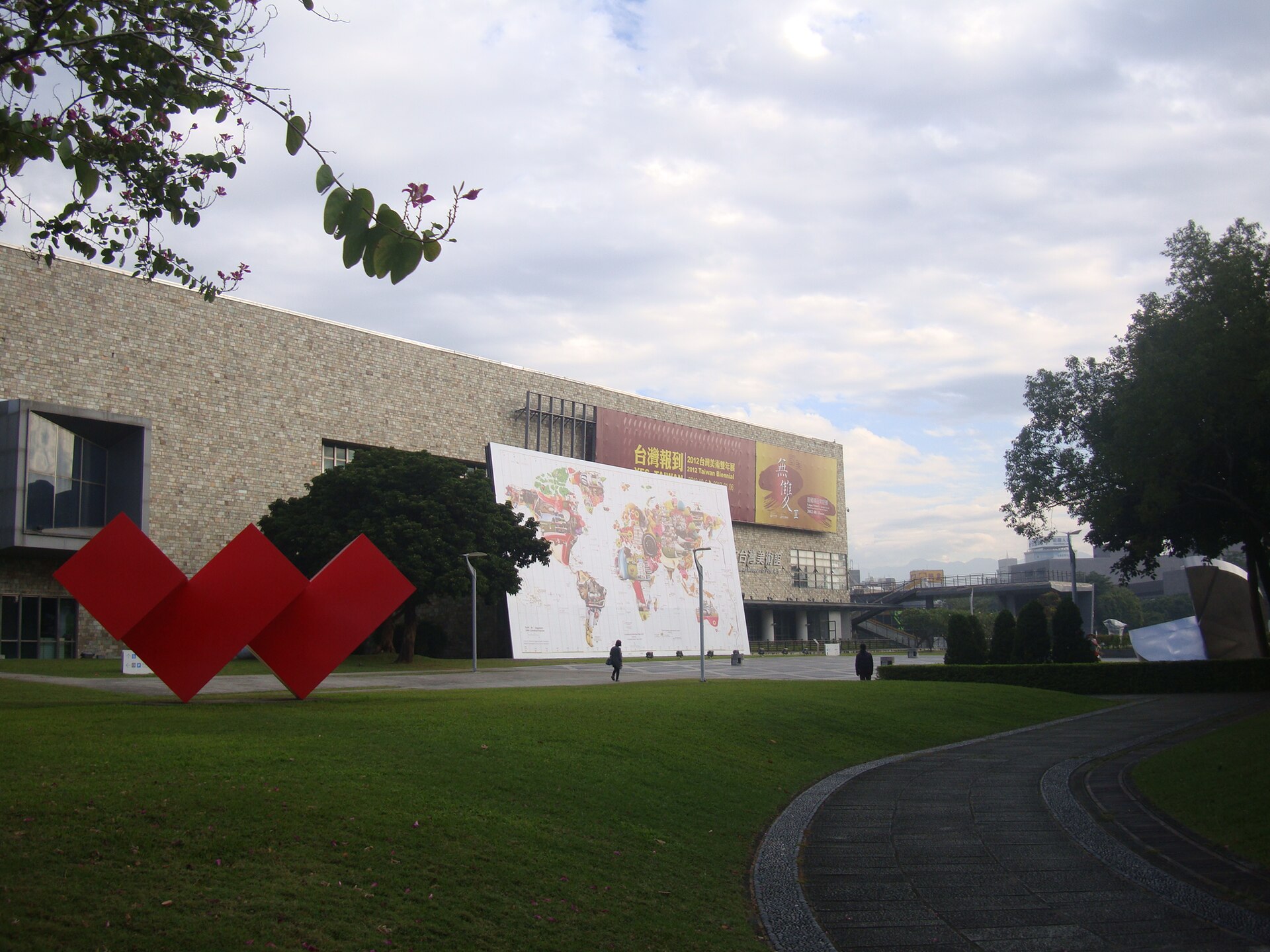
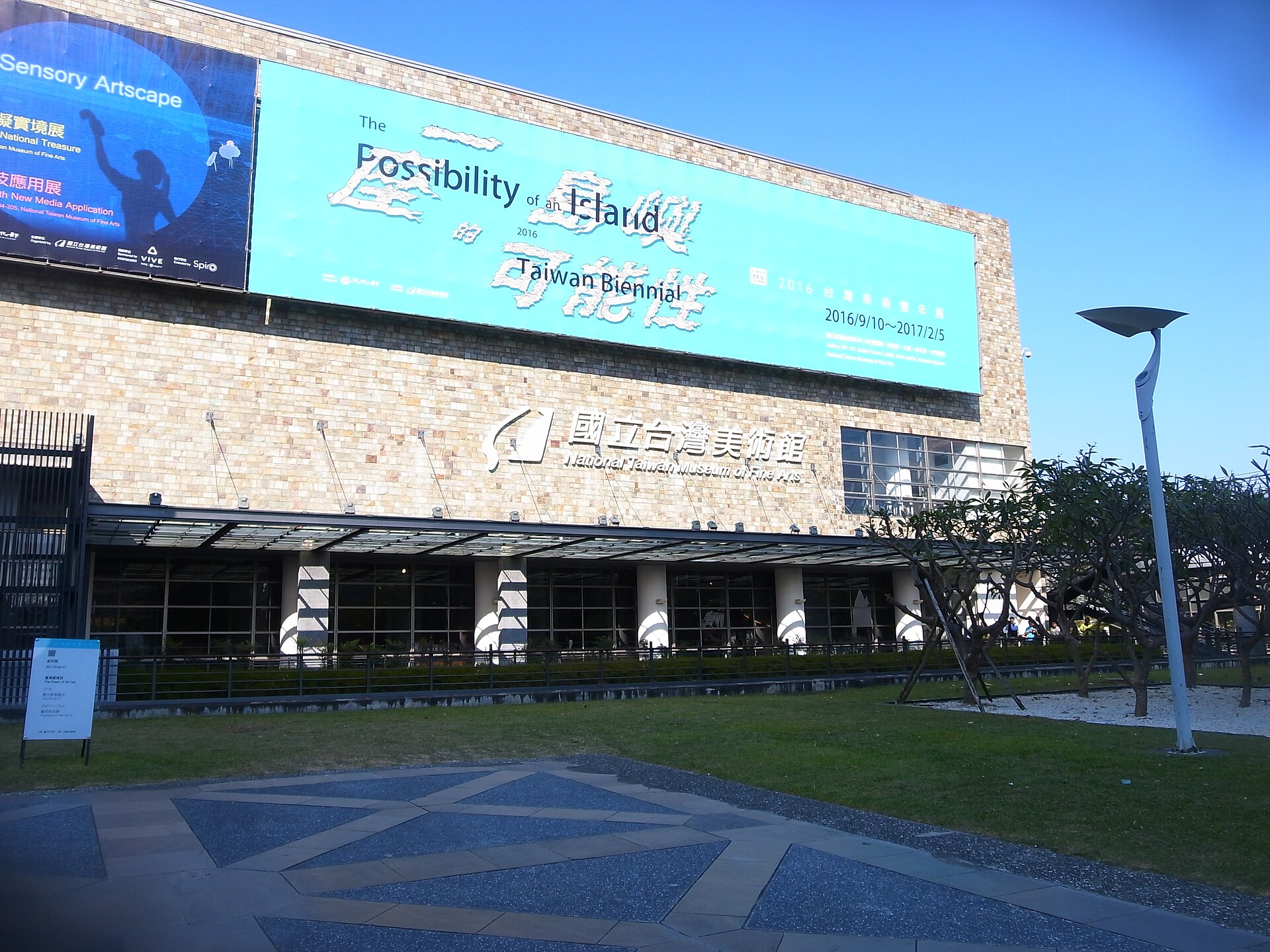
The museum's main building, West District, Taichung.
Yachuen, CC BY-SA 4.0National Taiwan Museum of Fine Arts
Museum · Guoli Taiwan Meishuguan · Founded 1988
Open, admission and hours confirmed 6 September 2026 · 16 sources
On this page 16 sections
ContentsClose
The museum's real depth is in Taiwanese art of the twentieth century: the first generation of Taiwanese painters and sculptors trained in Japan under colonial rule (Chen Cheng-po, Kuo Hsueh-hu, Huang Tu-shui among them), the postwar Modernist movement that followed, and a growing contemporary and new-media programme built around dedicated digital-art spaces (U-108 Space, the Floating Isle VR gallery) that most peer institutions of its generation do not carry. Its Ming- and Qing-dynasty holdings, by its own account, are a smaller and more incidental part of the collection than the modern Taiwanese material that gives the museum its institutional identity.
| Local name | Guoli Taiwan Meishuguan |
|---|---|
| Kind | Museum |
| Founded | 1988 |
| City and country |  Taichung, Taiwan Taichung, Taiwan |
| Address | No. 2, Sec. 1, Wuquan W. Rd., West Dist., Taichung City 403414, Taiwan (R.O.C.) |
| Website | ntmofa.gov.tw/en |
| Status | Open, confirmed |
| Record last verified |
Visiting
- Hours
- Tue-Fri09:00 to 17:00
- Sat-Sun09:00 to 18:00
- Closed
- Monday, except during consecutive national holidays. Lunar New Year's Eve and Lunar New Year's Day. Announced election days, 09:00-13:00 only. Days of announced natural-disaster (typhoon) closure.
- Admission
- General admissionFreeFree for all visitors to the permanent and most temporary exhibitions
Free entry: Every day - general admission is free- Do I need to book?
- No for individual visitors. Group tours require advance online booking: 10 days ahead for a weekday visit, 14 days ahead for a weekend or holiday visit. Free guided tours run Tuesday-Sunday at 10:30 and 14:30
- Address
- No. 2, Sec. 1, Wuquan W. Rd., West Dist., Taichung City 403414, Taiwan (R.O.C.) MapBus UBus No. 23, 75 and 159, Taichung Bus No. 71, Ren-Yeou Bus No. 19 and 30, and Green Transit No. 40 and 89 all stop at 'Art Museum' or 'Dadun Cultural Centre', close to the entrance
Taichung MRT About 10 minutes by UBus No. 56 or 75 from Nantun Station on the Green Line
Rail About 15 minutes by bus from Taichung Railway Station; about 20 minutes by UBus No. 159 from Taichung High Speed Rail Station
Car Freeway No. 1 or No. 3 to the Taichung/Nantun interchange, then Wuquan Rd. or Meicun Rd. to the museum - Website
- ntmofa.gov.tw/en
- Telephone
- +886 4 2372 3552
- [email protected]
Before you go how long, access, photography, bags, eating, shop
- How long to allow
- Two to three hours for the indoor galleries; visitors who add the outdoor sculpture park and Calligraphy Greenway routinely report closer to half a day
- Access
- Accessible parking, accessible ramps at every entrance, elevators and escalators, and accessible toilets. Wheelchairs and visitor stools are available on request at the information desk
- Photography
- Photography without flash is permitted in most galleries unless a sign says otherwise. Tripods, selfie sticks and handheld stabilisers are restricted to pre-approved media
- Bags
- Dangerous goods, food and drink, long umbrellas, toys and helmets may not be carried into the galleries; coin lockers are provided
- Eating
- Rose House cafe and restaurant on the second floor, and a Chun Shui Tang tea house branch in the basement
- Shop
- Museum Shop, on site
Prices and hours change. We take them from the institution's own pages and print the day we read them, and you can check the current position at the source we used. Confirm before you travel.
What is inside
Permanent collection galleries (Arts as Imprints of the Times)
The museum's core holding of modern and contemporary Taiwanese art, hung across 15-16 exhibition rooms on four floors: Japanese-colonial-era Western-style painting, the postwar Modernist generation, and contemporary work. Huang Tu-shui's marble Water of Immortality (1921) stands beside the museum's main entrance, and his relief The Water Buffalo is shown at the far end of the same exhibition hall.
U-108 Space
An experimental, immersive gallery built for techno and new-media art, used for large-scale digital and sound-based installation work rather than the framed-object display of the main galleries.
Floating Isle VR Gallery
A dedicated room for virtual-reality artworks, part of the museum's digital-art programme that has run alongside its painting and sculpture collection since 2004.
Taiwan Children's Art Cave
A basement-level education space for young children, with a picture-book area and hands-on activities separate from the main galleries.
Art Library
A 1,297-square-metre specialist library on the third floor holding over 119,000 titles on Taiwanese art history, plus a digital e-archive; a library card is required to enter.
Outdoor sculpture park and Calligraphy Greenway
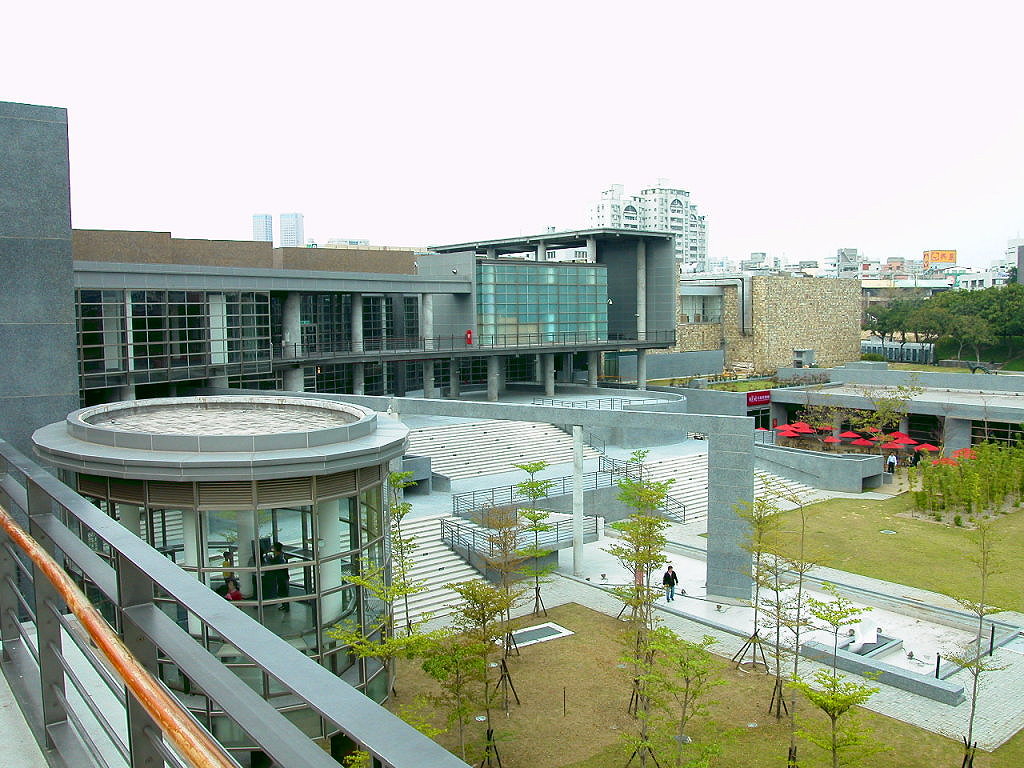
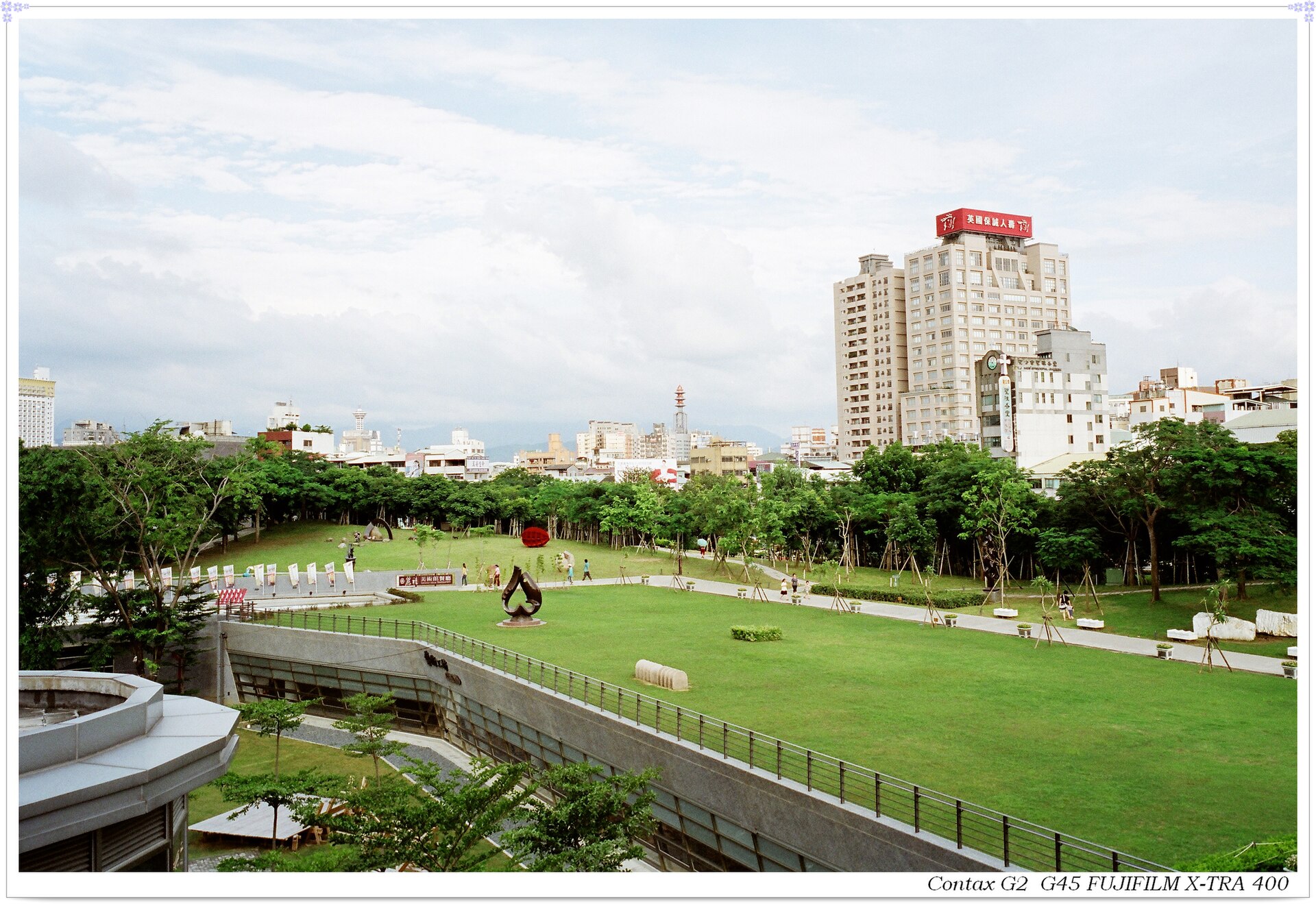
Roughly 102,000 square metres of grounds around the building, carrying about 45 sculptures and 50 inscribed calligraphy stone tablets along a landscaped corridor called the Calligraphy Greenway, with a glazed passage linking the building to the park.
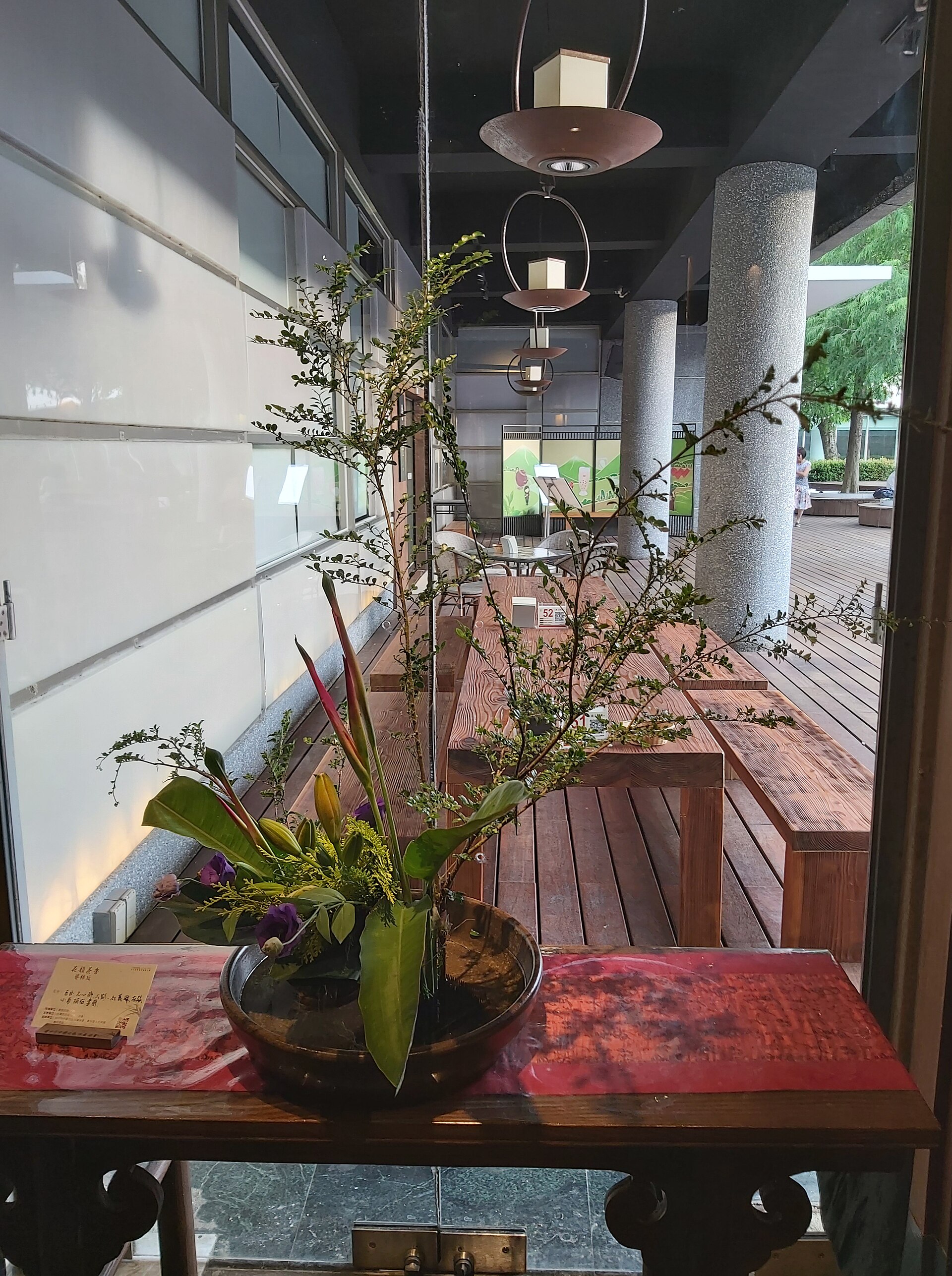
Photograph by 阿道 · CC BY-SA 4.0 Chun Shui Tang tea house
A basement-level branch of the Taichung tea house chain Chun Shui Tang, serving tea and light food to visitors between galleries.
What to see first
Water of Immortality
Huang Tu-shuiA marble nude carved in 1921 and shown at the third Imperial Fine Arts Academy Exhibition in Japan; lost from public view in 1958 and preserved privately for over sixty years before its rediscovery in 2021. It was inducted into NTMoFA's permanent collection on 29 October 2022 and designated a national treasure in 2023, making it the centrepiece case of Taiwan's state-run Reconstruction of Taiwan's Art History project.10
The Water Buffalo
Huang Tu-shuiA large relief of three shepherd boys and five water buffalo, carved in 1930 and left unfinished at the sculptor's death that year. The original plaster deteriorated; bronze casts were made in 1983 for both this museum and the Taipei Fine Arts Museum. NTMoFA's cast is displayed at the far end of the same hall as Water of Immortality.10
Nostalgia
Chen Cheng-poAn oil painting of 1945 by one of the first generation of Taiwanese artists to train in Western oil technique in Tokyo; part of the museum's holding of his work documenting Taiwan's landscape and townscape under Japanese rule.11
Chiayi Park (Benten Pond)
Chen Cheng-poA 1937 oil painting of the park in the artist's home city, combining oil paint with brush techniques drawn from Chinese ink painting; one of several depictions of the same park Chen made across the 1930s.12
Over the Cool Autumn Water
Kuo Hsueh-huA rare four-section gouache flower-and-bird composition of 1940 by one of the three young painters singled out at the first Taiwan Fine Arts Exhibition in 1927; the museum credits it as a synthesis of Chinese, Japanese and Western painting conventions.13
Pacification of Taiwan (Zhuluo Siege)
Qing imperial court painters (Yao Wen-han and six others, under the Jesuit court painter Giuseppe Castiglione)A 1793 copper-engraved print from a twelve-scene Qianlong-era series recording the suppression of the 1787-88 Lin Shuangwen uprising, commissioned by the imperial court and combining Chinese pictorial convention with European engraving technique; part of the museum's small holding of pre-modern material.14
Exhibitions on now
Past exhibitions here
- Closed11 Jul to 18 Oct 2026Confirmed · check before you travel
A provincial gallery that became Taiwan's national museum of modern art
The museum began as a decision rather than a building: on 8 February 1980 a meeting chaired by Taiwan Provincial Government chairman Lin Yang-kang resolved to establish a fine-arts museum for the province, and it opened in June 1988 as the Taiwan Museum of Art under the Provincial Government's Department of Education. Administration passed to the Provincial Department of Culture in 1997.
The institution closed for an extended period from 1999. Its own History page states only that it was closed for renovation that year and that, in July 1999, provincial-government downsizing moved it under the national Council for Cultural Affairs (later the Ministry of Culture, from May 2012), at which point it took its present name and became, in its own words, Taiwan's first national-grade museum of fine arts. Wikipedia adds a specific cause - damage from the 921 (Chi-Chi) earthquake of September 1999 - and dates the reopening to July 2004; the museum's own site does not repeat that reopening date, so it is credited here to the secondary source and flagged as unconfirmed on the museum's own pages.
A building built to hold sixteen galleries and an outdoor park
The current building, per Wikipedia's architectural description, encloses 37,953 square metres of building space and roughly 13,525 square metres of exhibition area across sixteen galleries on four floors, with a glazed corridor connecting the interior to the grounds outside. The site is described by the museum itself as covering about ten hectares, or 102,000 square metres, including its Public Outdoor Sculpture Park, making it one of the larger art museums in Asia by footprint.
That outdoor area is not an afterthought: roughly 45 sculptures and about 50 inscribed calligraphy stone tablets are set along a landscaped route the museum calls the Calligraphy Greenway, which visitors reach without paying admission and without entering the building at all.
What is inside
Beyond the main run of collection galleries, the museum runs several purpose-built spaces that do not fit a conventional gallery template. U-108 Space is an experimental venue for immersive, techno-driven art; the Floating Isle VR Gallery is a dedicated room for virtual-reality artworks, part of a digital-art programme the museum has run since 2004. The Taiwan Children's Art Cave, in the basement, gives younger visitors their own hands-on space away from the main circulation route, and a 1,297-square-metre Art Library on the third floor holds more than 119,000 titles on Taiwanese art history as a research resource rather than a browsing room - a library card is required to go in.
Two food and drink options sit inside the building rather than beside it: the Rose House cafe and restaurant on the second floor, and a branch of the Taichung tea house chain Chun Shui Tang in the basement, photographed in place for this page.
The collection and the Reconstruction of Taiwan's Art History project
The museum holds roughly 19,000 artworks across two purpose-built vaults - an original 2,775-square-metre facility and a second vault of 11,187 square metres completed in 2015 - spanning Ming- and Qing-dynasty material, art of the Japanese colonial period, the postwar Modernist generation, and contemporary Taiwanese work. Its own framing of that collection is explicitly nation-building: establishing, in the museum's own words, a comprehensive resource and research centre for Taiwanese art history.
The clearest recent illustration of that mission is Huang Tu-shui's marble sculpture Water of Immortality. Carved in 1921 and shown at the prestigious Imperial Fine Arts Academy Exhibition in Japan the same year, it disappeared from public record in 1958 and survived only because a family named Chang kept it, first in a family clinic and later in a Wufeng factory, until it resurfaced and was restored. Taiwan's Ministry of Culture inducted it into the museum's permanent collection at a ceremony on 29 October 2022, attended by the culture minister, a descendant of the family that had preserved it, and members of the sculptor's own family; it was designated a national treasure in 2023. The museum now displays it beside its main entrance, with Huang's other major surviving work, a relief called The Water Buffalo, shown at the opposite end of the same hall - the two effectively function as a matched pair introducing the whole collection.
Visiting: free admission, a short bus ride from central Taichung, and a two-hour minimum
Admission is free for everyone, every day the museum is open. Opening hours run Tuesday to Friday from 09:00 to 17:00 and Saturday and Sunday from 09:00 to 18:00; the museum is closed on Mondays (except during a run of consecutive national holidays), on Lunar New Year's Eve and Lunar New Year's Day, for the morning of any announced election day, and on any day of announced natural-disaster closure. No booking is needed for an individual visit; group tours must be booked online at least 10 days ahead for a weekday or 14 days ahead for a weekend or holiday, and free guided tours run Tuesday to Sunday at 10:30 and 14:30.
The museum sits in Taichung's West District at No. 2, Sec. 1, Wuquan W. Rd. Several city bus routes - UBus 23, 75 and 159, Taichung Bus 71, Ren-Yeou 19 and 30, and Green Transit 40 and 89 among them - stop at 'Art Museum' or 'Dadun Cultural Centre' close to the entrance; it is about ten minutes by bus from the Taichung MRT's Nantun station, about fifteen minutes by bus from Taichung Railway Station, and about twenty minutes by bus from Taichung High Speed Rail Station. Drivers reach it from Freeway No. 1 or No. 3 via the Taichung or Nantun interchange and Wuquan or Meicun Road.
Accessible parking, ramps at every entrance, lifts and escalators and accessible toilets are provided, with wheelchairs and stools available at the information desk. Photography without flash is allowed in most galleries; tripods, selfie sticks and stabilisers are reserved for pre-approved media. Dangerous goods, food and drink, long umbrellas, toys and helmets are not permitted inside the galleries, and coin lockers are provided for anything left at the door.
What visitors say
The museum holds a rating of 4.4 out of 5 from 520 TripAdvisor reviews read for this page, placing it among the better-reviewed attractions in Taichung's West District. The pattern in what visitors write is consistent: free admission is named again and again as a reason on its own to visit, the scale of the building and its outdoor park draws frequent comment, and more than one visitor describes being surprised that the collection reads as modern and contemporary Taiwanese art with a strong digital-art component, rather than the older or more decorative work some expected walking in.
The recurring complaint runs the other way from the praise for scale: several visitors, including more than one repeat visitor comparing trips years apart, describe stretches of the museum's considerable floor area as thinly hung, and more than one mentions losing their way when a gallery was closed off mid-route, forcing a walk back through rooms already seen to reach the next open space.
What visitors say
Visitors consistently describe a large, free, modern public museum built around Taiwanese art rather than a classical old-master collection - closer to a contemporary and digital-art venue than the 'vases and paintings' several reviewers say they expected. The outdoor sculpture park and Calligraphy Greenway are named almost as often as the indoor galleries, and the museum's family facilities (the Children's Art Cave, the library, an on-site playground) are singled out by visitors with children.
What is praised, what is criticised
- Praised: Free admission to a large, well-appointed national museum, mentioned in a large share of reviews as reason enough to visit
- Praised: The scale of the building and grounds, including the outdoor sculpture park and green corridor, and the bilingual (Chinese/English) labelling in the galleries
- Praised: The digital and VR programming (U-108 Space, the Floating Isle VR gallery) as an unexpected extra beyond the paintings and sculpture
- Criticised: More than one long-standing visitor describes the huge floor area as thinly hung, with stretches of gallery space between works, and finds the internal circulation confusing when sections are closed off mid-visit, forcing a backtrack through rooms already seen
Ratings on other platforms
TripAdvisor: 4.4 from 520 ratings, read 6 September 2026
A platform average is a tertiary source: it moves, it is not audited, and we quote no visitor's words.
Questions about National Taiwan Museum of Fine Arts
Where is National Taiwan Museum of Fine Arts?
No. 2, Sec. 1, Wuquan W. Rd., West Dist., Taichung City 403414, Taiwan (R.O.C.).
How much does it cost to visit?
General admission: free. As confirmed 6 September 2026.
When is it open?
Tue-Fri 09:00-17:00; Sat-Sun 09:00-18:00. Closed: Monday, except during consecutive national holidays. Lunar New Year's Eve and Lunar New Year's Day. As confirmed 6 September 2026.
How do you get there?
Bus: UBus No. 23, 75 and 159, Taichung Bus No. 71, Ren-Yeou Bus No. 19 and 30, and Green Transit No. 40 and 89 all stop at 'Art Museum' or 'Dadun Cultural Centre', close to the entrance; Taichung MRT: About 10 minutes by UBus No. 56 or 75 from Nantun Station on the Green Line; Rail: About 15 minutes by bus from Taichung Railway Station; about 20 minutes by UBus No. 159 from Taichung High Speed Rail Station; Car: Freeway No. 1 or No. 3 to the Taichung/Nantun interchange, then Wuquan Rd. or Meicun Rd. to the museum.
What should you see first?
Water of Immortality (Huang Tu-shui); The Water Buffalo (Huang Tu-shui); Nostalgia (Chen Cheng-po); Chiayi Park (Benten Pond) (Chen Cheng-po); Over the Cool Autumn Water (Kuo Hsueh-hu); Pacification of Taiwan (Zhuluo Siege) (Qing imperial court painters (Yao Wen-han and six others, under the Jesuit court painter Giuseppe Castiglione)).
What we could not confirm
- The museum's own History page does not give an exact reopening date after its 1999 closure; Wikipedia states July 2004, but that date is not corroborated on ntmofa.gov.tw itself and is recorded here as a tertiary claim only.
- The English-language site does not publish a catalogue of the roughly 45 sculptures and 50 calligraphy stone tablets in the outdoor park, so which pieces are on permanent display versus rotating loan is not established by any source used for this page.
- No English-language source seen for this page states the current medium of Huang Tu-shui's Water of Immortality (marble is widely assumed for this class of 1920s Japanese-academy sculpture, but no fetched source names the stone), so the material is not asserted here.
Images
Sources
- 1NTMoFA official site (English) - Overview ntmofa.gov.tw/en/cp.aspx?n=1579
- 2NTMoFA official site (English) - History ntmofa.gov.tw/en/cp.aspx?n=1580
- 3NTMoFA official site (English) - Hours ntmofa.gov.tw/en/cp.aspx?n=1583
- 4NTMoFA official site (English) - Things to know ntmofa.gov.tw/en/cp.aspx?n=1584
- 5NTMoFA official site (English) - Getting Here ntmofa.gov.tw/en/cp.aspx?n=1585
- 6NTMoFA official site (English) - Facilities ntmofa.gov.tw/en/cp.aspx?n=1586
- 7NTMoFA official site (English) - About Collection ntmofa.gov.tw/en/cp.aspx?n=1625
- 8Wikipedia - National Taiwan Museum of Fine Arts (, for architecture, size and visitor-number claims not stated on the museum's own site) en.wikipedia.org/wiki/National_Taiwan_Museum_of_Fine_Arts
- 9TripAdvisor - National Taiwan Museum of Fine Arts, West District, Taichung (, rating and reviews read 2026-09-06) tripadvisor.com/Attraction_Review-g13808397-d2578833-Reviews-National_Taiwan_Museum_of_Fine_Arts-West_District_Taichung.html
- 10Ministry of Culture (Taiwan), 'Water of Immortality now available as NTMoFA's permanent collection', 2022-11-01 moc.gov.tw/en/News_Content2.aspx?n=467&s=95875
- 11Google Arts & Culture, 'Nostalgia' - Chen Cheng-po (NTMoFA partner collection) artsandculture.google.com/asset/nostalgia-chen-cheng-po/IQGBDZdZGmnKHA
- 12Google Arts & Culture, 'Chiayi Park (Benten Pond)' - Chen Cheng-po (NTMoFA partner collection) artsandculture.google.com/asset/chiayi-park-benten-pond-chen-cheng-po/YgH5b2IM2trrMQ
- 13Google Arts & Culture, 'Ten Artistic Figures from Taiwan that You Should Know' (NTMoFA partner story, Kuo Hsueh-hu / Over the Cool Autumn Water) artsandculture.google.com/story/rgWBeawmVAKFKA
- 14Google Arts & Culture, 'Pacification of Taiwan (I) - Zhuluo Siege' (NTMoFA partner collection) artsandculture.google.com/asset/pacification-of-taiwan-i-zhuluo-siege-yao-wen-han-miao-bing-tai-yang-da-zhang-jia-quan-xie-sui-zhuang-yu-de-and-li-ming/zQErfqZbJvBLdw
- 15Wikimedia Commons, Category:National Taiwan Museum of Fine Arts (image sourcing and licence verification) commons.wikimedia.org/wiki/Category:National_Taiwan_Museum_of_Fine_Arts
- 16Google Arts & Culture, 'Taiwan Buffalos - Look Closer Into the Iconic Sculpture' (NTMoFA partner story) artsandculture.google.com/story/taiwan-buffalos-look-closer-into-the-iconic-sculpture-national-taiwan-museum-of-fine-arts/MQWRXeOH2ydYJQ