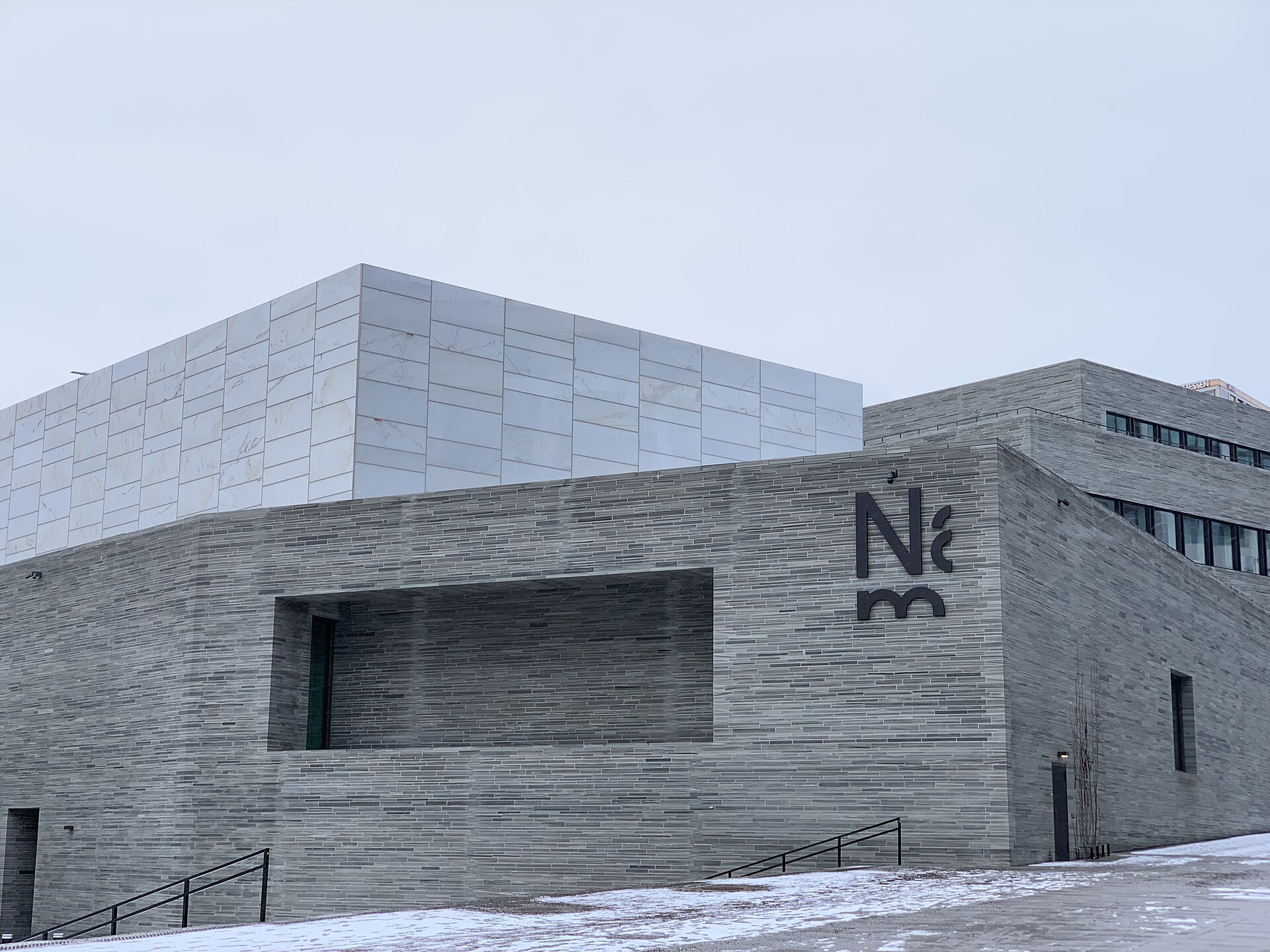
The National Museum's Vestbanen building, photographed shortly before its June 2022 opening.
Premeditated, CC BY-SA 4.0National Museum of Art, Architecture and Design
Museum · Nasjonalmuseet for kunst, arkitektur og design · Founded 2003
Open, admission and hours confirmed 3 September 2026 · 19 sources
On this page 16 sections
ContentsClose
The single largest and most cohesive art collection in Norway - more than 400,000 objects spanning antiquity to the present, of which about 6,500 are on permanent display - built by consolidating the country's former national gallery, its decorative-arts and design museum, and its museum of contemporary art into one holding. Its deepest strength is 19th- and early-20th-century Norwegian painting (Dahl, Backer, Krohg and an extensive Munch holding anchored by The Scream), supported by a significant run of French 19th-century painting, Norway's largest architecture archive, and decorative arts running from the 12th-century Baldishol Tapestry to contemporary Scandinavian design.
| Local name | Nasjonalmuseet for kunst, arkitektur og design |
|---|---|
| Kind | Museum |
| Founded | 2003 |
| City and country |  Oslo, Norway Oslo, Norway |
| Address | Brynjulf Bulls plass 3, 0250 Oslo, Norway |
| Website | nasjonalmuseet.no |
| Status | Open, confirmed |
| Record last verified |
Visiting
- Hours
- Tue-Wed10:00 to 20:00
- Thu-Sun10:00 to 17:00
- Closed
- Monday. 24-26 December. 31 December-1 January.
- Admission
- AdultNOK 220
- Students under 30 (with student ID)NOK 120Purchased at the ticket counter
- Under 25NOK 100
- Under 18FreeFree
Free entry: National Museum members enter free at any time (ticketless, membership card shown at entry)- Tickets
- nasjonalmuseet.no/en/tickets/entry-tickets The museum's own ticket page.
- Do I need to book?
- No, but timed tickets can be bought in advance online
- Address
- Brynjulf Bulls plass 3, 0250 Oslo, Norway MapTram Line 12 to Aker Brygge; lines 11 and 13 to Nationaltheatret
Metro Nationaltheatret station, all lines
Train Nationaltheatret station
Bus No. 33 and 81 to Dokkveien; no. 30 and 31 to Nationaltheatret - Website
- nasjonalmuseet.no
- Telephone
- +47 21 98 20 00
- [email protected]
Before you go how long, access, photography, bags, eating, shop
- How long to allow
- Two to four hours for the permanent Collection Exhibition alone; visitors report the full building cannot be seen in one day
- Access
- Built to current universal-design standards: step-free access and elevators to every public part of the main building, accessible toilets and cloakrooms, loanable wheelchairs, an induction loop at information points, and a loanable flashlight for visitors with reduced vision. The satellite Villa Stenersen has no wheelchair access to its upper floors; the National Museum - Architecture building has a universally accessible entrance from Myntgata.
- Photography
- Not confirmed by direct fetch of a dedicated policy page at the time of writing; check on-site signage.
- Bags
- Bags up to A4 size may be carried into the galleries subject to a security check; larger bags, umbrellas and selfie sticks must go in the lockers on level -1. No food, drink or empty bottles may be taken into the exhibition spaces.
- Eating
- A cafe on the first floor and a members'/visitors' lounge on the second floor; the separate Sirkus Renaa cafe operates in the Station Master's House
- Shop
- Museum shops inside the main building; the former shop in the Station Master's House has closed, though the International Fashion Library there remains open
Prices and hours change. We take them from the institution's own pages and print the day we read them, and you can check the current position at the source we used. Confirm before you travel.
What is inside
The Collection Exhibition - older art (antiquity to 1945)
The former National Gallery's paintings and sculpture, spread over 86 rooms across two floors: 4,500 paintings and 900 sculptures from antiquity to about 1945, plus 50,000 works on paper. Holds Edvard Munch's The Scream (1893) and other Munch canvases, J.C. Dahl's Norwegian Romantic landscapes, Christian Krohg and Harriet Backer's realist painting, the museum's Van Gogh, Cezanne, Manet, Gauguin and Picasso holdings, and the Paus Collection of Roman imperial portrait busts.
Design and decorative arts
The former Museum of Decorative Arts and Design (Kunstindustrimuseet) collection: furniture, silver, glass, ceramics, textiles and fashion from the ancient world to the present, including the 12th-century Baldishol Tapestry and a royal costume collection.
Contemporary art
The former Museum of Contemporary Art's holdings, over 5,000 Norwegian and international works from 1945 to today, including Anna-Eva Bergman, Bjarne Melgaard, Marianne Heske, Cindy Sherman, Ilya Kabakov and Louise Bourgeois, shown in rotating displays and temporary exhibitions.
The Light Hall
A 2,400-square-metre, marble-and-glass-clad hall on the top floor, purpose-built for large-scale temporary exhibitions and installations that need ceiling height (about 7 metres) rather than wall space; it glows at night as the building's lit beacon.
National Museum - Architecture
A separate site at Bankplassen 3, three joined historic buildings (the former Norges Bank Christiania branch of 1830, Sverre Fehn's 2002 Ulltveit-Moe Pavilion, and an 1911 storage building), holding Norway's architecture archive of more than 300,000 drawings, models and photographs from the 1830s to today, including the Sverre Fehn archive.
What to see first
The Scream
Edvard Munch, 1893 (tempera and crayon on cardboard)The National Museum's own tempera-and-crayon version, signed and dated 1893, is the version now generally accepted by scholars as painted before the Munch Museum's tempera version (dated no earlier than 1910); it was gifted to the museum by Olaf Schou in 1910 and stolen and recovered in 1994.9
Self-portrait
Vincent van Gogh, 1889One of the museum's few Van Gogh paintings, acquired in 1910 and now shown alongside the museum's other late-19th-century French holdings.10
View from Stalheim
Johan Christian Dahl, 1842A large, dramatic Romantic landscape built from field drawings Dahl made sixteen years earlier at Stalheim, and one of the museum's central works of Norwegian national-romantic painting.11
Albertine to See the Police Surgeon
Christian Krohg, 1885-1887A realist painting of a scene from Krohg's own banned novel Albertine, showing prostitutes awaiting compulsory police medical inspection; it caused a public sensation in Kristiania in 1887 and a freedom-of-expression court case that Krohg lost.12
Blue Interior
Harriet Backer, 1883One of Backer's best-known interior studies of light, painted in Paris using her colleague Asta Norregaard as the model; widely praised when first exhibited in Kristiania and Copenhagen in 1883.13
Baldishol Tapestry
Unknown weaver, Norway, c. 1040-1190One of the oldest surviving woven tapestries in Europe, found under the floorboards of a demolished church in 1879 and one of only a handful of medieval Gobelin-technique weavings to survive anywhere; the museum considers it one of the most valuable objects it holds.14
Paus Collection Roman portrait busts
Roman, 1st-3rd century AD (donated by Count Christopher Paus)Marble portrait busts of Roman emperors and empresses including Trajan, Galba, Lucius Verus and Julia Domna, assembled in Rome by the collector and papal chamberlain Christopher Paus and donated from 1918; described as one of the largest classical antiquities collections in Northern Europe.2
Exhibitions on now
- Opening soon19 Nov 2026 to 7 Mar 2027Confirmed , 2 months ago
Past exhibitions here
- Closed7 May to 4 Oct 2026Confirmed · check before you travel
- Closed7 May to 6 Sep 2026Confirmed · check before you travel
Thirty years to one building
The National Museum of Art, Architecture and Design (Nasjonalmuseet) was formally established on 28 April 2003 by merging five existing Norwegian state institutions: the National Gallery (founded 1842), the Museum of Contemporary Art, the Museum of Decorative Arts and Design (the old Art Industry Museum), the Museum of Architecture and the National Museum - Architecture. From the outset, a single new building to house all of them was the precondition of the merger, since the separate premises inherited from the old museums were judged too small and too scattered. Architecture competitions for expanding the museums at Tullinlokka in Oslo had already failed to reach a conclusion in 1972 and again in 1995.
In spring 2008 the Norwegian government settled on a new site: Vestbanen, the former Oslo West railway station beside the Aker Brygge waterfront, opposite Oslo City Hall and the Nobel Peace Center. An international design competition followed, won in November 2010 by Kleihues + Schuwerk, a partnership formed specifically for the project between the Berlin firm Kleihues + Kleihues and the Naples-based practice of architect Klaus Schuwerk, who acted as lead designer. The pre-project was completed in spring 2012, and on 22 March 2013 the government presented the scheme with an estimated cost of about 5.3 billion Norwegian kroner; the Storting (parliament) confirmed a cost ceiling of that order on 6 June 2013.
The old museums closed to the public in stages as the collections were packed for the move: the Art Industry Museum on 16 October 2016, the Museum of Contemporary Art permanently on 3 September 2017, and the historic National Gallery building on Universitetsgata on 13 January 2019, after which its rooms served only as storage. Originally targeted for 2020, the new building opened to the public on 11 June 2022, roughly three decades after the idea of a single national museum was first raised.
A temple clad in slate and marble
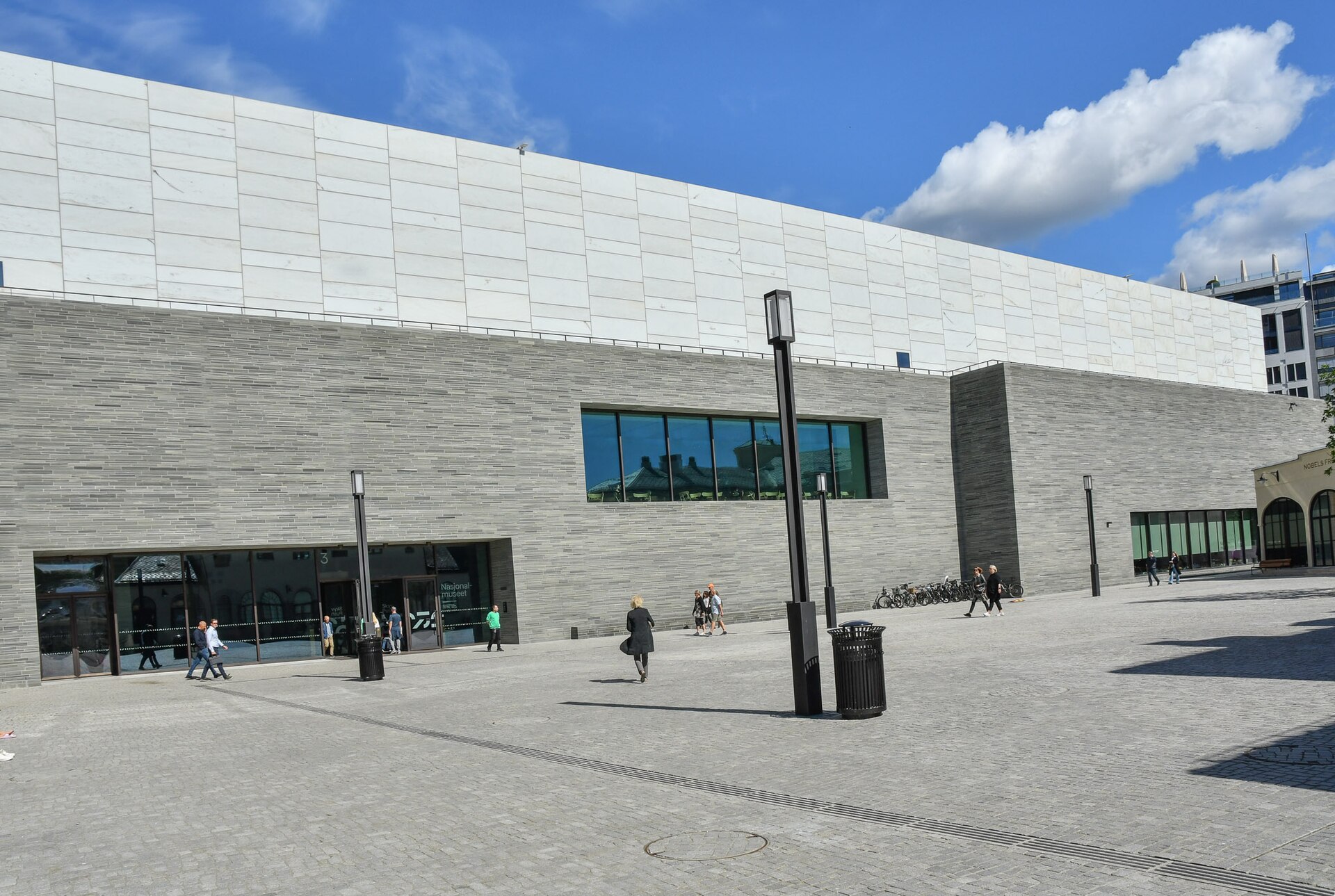
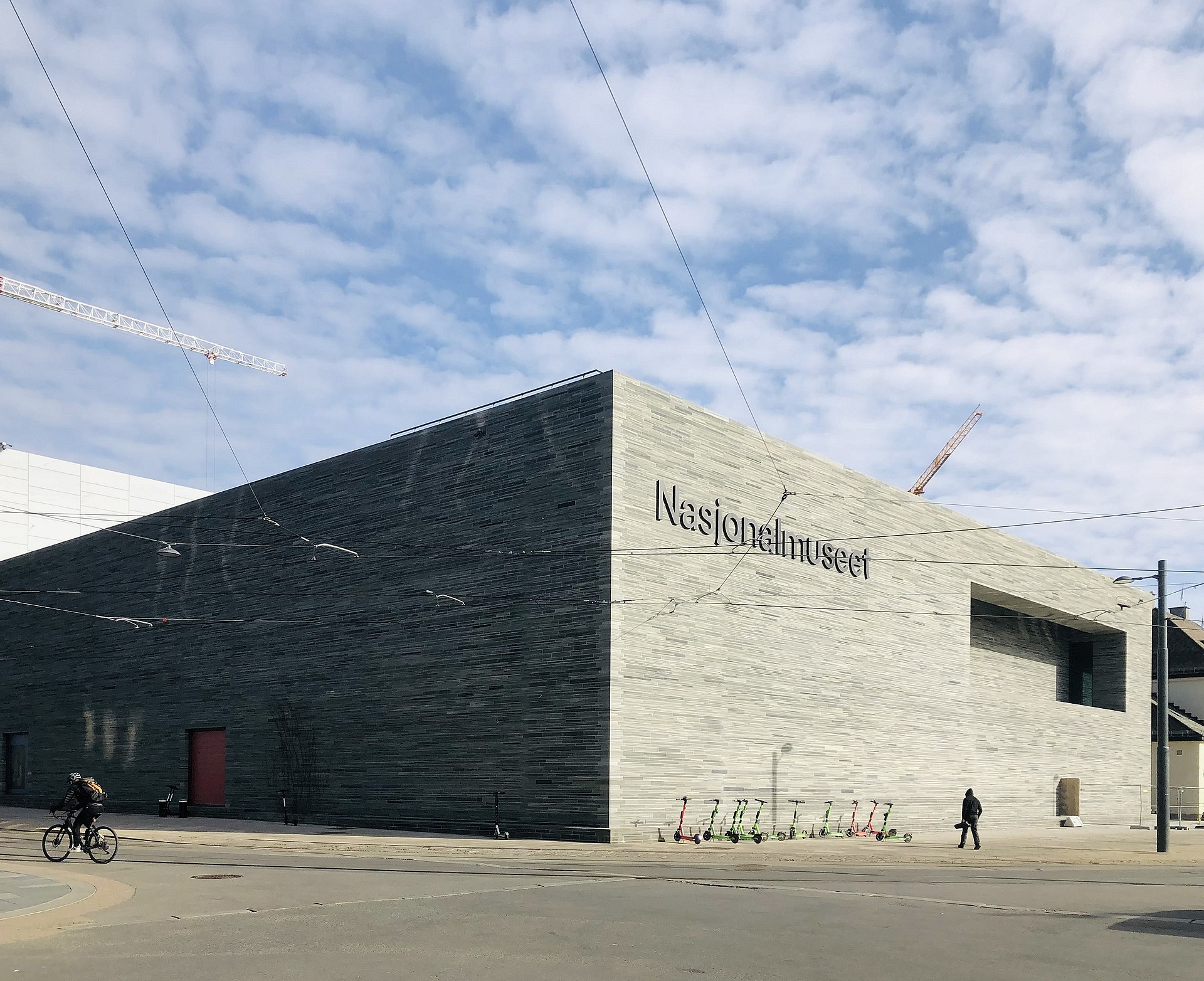
Schuwerk has described his design brief to himself in frankly monumental terms: a museum, he told Dezeen, is 'in a sense the temple of our time,' and he wanted to design 'my own Pantheon.' The finished building is an L-shaped block of about 54,600 square metres wrapped around a paved public courtyard that opens onto the Aker Brygge waterfront, making it the largest art museum in the Nordic countries. Its lower four storeys form a solid stone base, entirely clad in Oppdal slate cut into vertical slabs of varying width - a treatment several critics have compared to an exposed cliff face - while the rear of the block, facing away from the public plaza, holds offices, conservation labs and other back-of-house functions.
Inside the base, 86 rooms across two floors hold the permanent Collection Exhibition, arranged in a broadly chronological sequence from antiquity to the mid-20th century and beyond. White limestone floors on the ground level (a nod to the Louvre, according to the architects) give way to white oak on the floor above, and window bays throughout frame views out to the surrounding streets and internal sculpture courtyards. Capping the whole structure is the Light Hall: a free-standing volume clad in paper-thin, glass-encased marble tiles that glows from within after dark. At roughly 2,400 square metres with a ceiling height of about seven metres, it is built for large-scale temporary exhibitions and installations too big for a conventional gallery wall, and it opens onto a public roof terrace overlooking Oslo's harbour and the Akershus fortress. The total project, financed by the Norwegian state, has been reported in the international press at costs ranging from roughly 5.3 billion kroner to press estimates of 620-650 million US dollars, depending on the exchange rate and date used.
Four museums, one roof
What makes the building unusual is not just its size but what it was built to reconcile: four previously separate, differently run museums, each with its own curatorial tradition, now sharing one set of walls. The former National Gallery's paintings and sculpture - the core of the 'old masters and modern art' holdings, including Edvard Munch's work - occupy most of the ground and first floors. The former Museum of Decorative Arts and Design contributes the furniture, silver, glass, ceramics, textiles and historic costume that used to hang in the St Olavs gate building. The former Museum of Contemporary Art's collection of post-1945 Norwegian and international art, previously shown in a converted 1907 bank building at Bankplassen, is now integrated into the same building and into the temporary programme of the Light Hall. Only the architecture collection - more than 300,000 drawings, models and photographs documenting Norwegian architectural history since the 1830s, including the Sverre Fehn archive - remains in its own building, the National Museum - Architecture at Bankplassen 3, a few minutes' walk away; the museum's network also includes Villa Stenersen, a 1937-39 house designed by Arne Korsmo for the collector Rolf E. Stenersen, and the Station Master's House on the museum plaza.
The result, on the evidence of the museum's own room list, is a permanent display of roughly 6,500 objects drawn from a total collection of more than 400,000, spanning the 12th-century Baldishol Tapestry to newly commissioned contemporary art. The Architect's Newspaper's review noted that the very first artwork visitors encounter on entering is Maret Anne Sara's Pile o'Sapmi Supreme, a curtain of reindeer skulls shot through the head, marking the government-owned museum's decision to open with a piece about the Norwegian state's own historical treatment of the Sami.
The Scream and the depth beneath it
The single work most visitors come to see is Edvard Munch's The Scream, and the museum's own catalogue entry is precise about which version this is: a tempera-and-crayon painting on cardboard, signed and dated 1893, that scholarship now generally accepts as painted before the Munch Museum's own tempera version of the same subject, which internal dating places no earlier than 1910. (Two further pastel versions and a lithograph also exist; the pastel dated 1895 and the lithograph are outside this museum's holdings.) The National Museum's Scream was first shown in Berlin in 1893 under the title Verzweiflung (Despair), entered the old National Gallery's collection as a gift from the industrialist Olaf Schou in 1910, and was stolen from the gallery and recovered undamaged the same year, in 1994. A faint pencil inscription in the top corner - 'Can only be painted by a madman!' - was confirmed by infrared and graphological analysis carried out jointly by the National Museum and the Munch Museum in 2020 to be in Munch's own hand.
The Scream sits among a much larger run of 19th-century Norwegian painting: Johan Christian Dahl's Romantic landscapes, including the 1842 View from Stalheim; Christian Krohg's 1887 realist painting Albertine to See the Police Surgeon, whose subject - and the banned novel behind it - triggered one of the country's earliest freedom-of-expression court cases; and Harriet Backer's light-filled interiors, among them Blue Interior of 1883. The museum's international holdings from the same period include a small Van Gogh self-portrait of 1889, acquired in the same 1910 wave of purchases as The Scream. Further back in time, the Paus Collection - Roman imperial portrait busts assembled in Rome by the collector Christopher Paus and given to the old National Gallery from 1918 - is described by the museum's own historians as one of the largest collections of classical antiquities in Northern Europe. The decorative arts galleries add the Baldishol Tapestry, a fragment of Romanesque weaving found in 1879 under the floor of a demolished parish church and dated by carbon analysis to between 1040 and 1190, alongside Norwegian silver, glass and a royal costume collection.
A collection admired, a building argued over
By most measures the new building has been a public success. The Art Newspaper recorded 1.2 million visitors in 2023, the museum's first full calendar year in the new premises, enough to make it, in the paper's words, the most popular art museum in Scandinavia that year; the same publication reported attendance falling back by about 24 per cent from that opening-year peak in 2024, a pattern common to newly opened flagship museums once initial curiosity subsides. On Tripadvisor the museum holds a 4.4-out-of-5 rating from more than 3,500 reviews, with visitors most often praising the range of the collection, the scale of the galleries and the museum's practical facilities, and most often flagging strict or inconsistent bag-check security and the cost of a ticket.
The architecture has had a rougher critical reception than the collection inside it. Norwegian commentators nicknamed the slate-clad exterior the 'national prison' well before opening, a description that stuck in the country's press. The Architect's Newspaper's review, published shortly after the June 2022 opening, called the design 'surprisingly unassuming' and 'staid' when set against Oslo's more provocative recent cultural buildings - notably the crooked, perforated-metal MUNCH tower a short walk away - and found practical faults as well: an L-shaped floor plan that makes the route between period rooms 'somewhat nonlinear,' English wall text with typos, and a Light Hall whose diffusing glass-and-marble facade leaves the room dim even on a sunny day. The same review, though, praised smaller touches - sunken rooftop display rooms, 32 interactive 'activity benches' throughout the building - and singled out the museum's candour in confronting the Norwegian state's own history with the Sami as a strength rather than a weakness of the new building.
Visiting today
The museum stands on Brynjulf Bulls plass, a short walk from Nationaltheatret station (served by every metro line, the mainline railway and trams 11 and 13) and from the Aker Brygge tram stop (line 12). It opens Tuesday and Wednesday from 10:00 to 20:00 and Thursday to Sunday from 10:00 to 17:00, and is closed on Mondays and over the Christmas and New Year holidays. An adult ticket costs 220 NOK, a discounted ticket for under-25s costs 100 NOK, students under 30 pay 120 NOK at the counter on production of a student card, and everyone under 18 is admitted free; National Museum members enter without a ticket at all.
The building was designed to current universal-access standards throughout its public areas, with step-free routes and lifts to every floor, loanable wheelchairs, an induction loop at information points and a free multilingual Visitor Guide app that doubles as an audio guide. Bags larger than A4 size, umbrellas and similar items go into lockers on the basement level; food and drink are confined to the cafe, the second-floor lounge and the roof terrace rather than the galleries themselves. Beyond the main building, the National Museum - Architecture at Bankplassen and Villa Stenersen keep separate opening hours and are worth checking individually before a visit, since neither runs on the same schedule as the Vestbanen building described here.
What visitors say
The museum's collection and scale are widely admired - it opened as the largest art museum in the Nordic countries and became, by its own first full year, the most-visited art museum in Scandinavia - while the building's severe, minimalist exterior has been persistently criticised by architecture writers as monotonous and closed-off, even as most visitors judge the inside worth the trip.
What is praised, what is criticised
- Praised: The breadth and density of the permanent collection - 86 rooms spanning antiquity to the present, with Munch, Van Gogh, Cezanne, Manet, Degas and Picasso shown alongside a deep run of Norwegian painting
- Praised: The scale, layout and lighting of the galleries and the top-floor Light Hall, and the free multilingual Visitor Guide audio app
- Praised: Practical facilities: ample lockers, an accessible building throughout, a well-regarded cafe and rooftop terrace with harbour views, and family activities and children's programming
- Criticised: The building's exterior - clad entirely in dark slate - has been repeatedly derided by critics as resembling a fortress or prison, nicknamed the "national prison" in the Norwegian press
- Criticised: The Architect's Newspaper's review found the L-shaped floor plan produces a nonlinear, sometimes confusing circulation between period rooms, and that the Light Hall's diffused glass marble cladding leaves it dim even in daylight
- Criticised: Some visitors describe the security and bag-check process as strict or inconsistently enforced, and ticket prices as steep relative to expectations
Ratings on other platforms
Tripadvisor: 4.4 from 3,531 ratings, read 3 September 2026
A platform average is a tertiary source: it moves, it is not audited, and we quote no visitor's words.
Questions about National Museum of Art, Architecture and Design
Where is National Museum of Art, Architecture and Design?
Brynjulf Bulls plass 3, 0250 Oslo, Norway.
How much does it cost to visit?
Adult: NOK 220; Students under 30 (with student ID): NOK 120; Under 25: NOK 100; Under 18: free. As confirmed 3 September 2026.
When is it open?
Tue-Wed 10:00-20:00; Thu-Sun 10:00-17:00. Closed: Monday. 24-26 December. As confirmed 3 September 2026.
How do you get there?
Tram: Line 12 to Aker Brygge; lines 11 and 13 to Nationaltheatret; Metro: Nationaltheatret station, all lines; Train: Nationaltheatret station; Bus: No. 33 and 81 to Dokkveien; no. 30 and 31 to Nationaltheatret.
What should you see first?
The Scream (Edvard Munch, 1893 (tempera and crayon on cardboard)); Self-portrait (Vincent van Gogh, 1889); View from Stalheim (Johan Christian Dahl, 1842); Albertine to See the Police Surgeon (Christian Krohg, 1885-1887); Blue Interior (Harriet Backer, 1883); Baldishol Tapestry (Unknown weaver, Norway, c. 1040-1190).
What we could not confirm
- No free-licence photograph of a National Museum interior (the Collection Exhibition rooms, the Light Hall, or the Contemporary Art galleries) was found on Wikimedia Commons at the time of writing; the inside wings above are described from the museum's own published material rather than illustrated.
- The building's total public cost has been reported differently by different outlets (a Norwegian-kroner cost ceiling of about 5.3 billion versus press conversions of roughly 620-650 million US dollars at various exchange rates); this page reports both rather than picking one.
Images
Sources
- 1Wikidata, Q1132918 (National Museum of Art, Architecture and Design), entity data wikidata.org/wiki/Special:EntityData/Q1132918.json
- 2Wikipedia, "National Museum of Norway" en.wikipedia.org/wiki/National_Museum_of_Norway
- 3Nasjonalmuseet, "Entry tickets" nasjonalmuseet.no/en/tickets/entry-tickets/
- 4Nasjonalmuseet, "The National Museum" (visit page: hours, tickets, exhibitions) nasjonalmuseet.no/en/visit/locations/the-national-museum/
- 5Nasjonalmuseet, "How to find us" nasjonalmuseet.no/en/visit/locations/the-national-museum/how-to-find-us/
- 6Nasjonalmuseet, "Practical information for your visit to the National Museum" nasjonalmuseet.no/en/visit/locations/the-national-museum/practical-information-for-your-visit-to-the-national-museum/
- 7Nasjonalmuseet, "Contact us" nasjonalmuseet.no/en/about-the-national-museum/contact-us/
- 8Nasjonalmuseet FAQ, accessibility pages nasjonalmuseet.no/en/FAQ/visitor-information/photo-and-film-in-the-national-museum/
- 9Nasjonalmuseet collection catalogue, "Edvard Munch, The Scream" (NG.M.00939) nasjonalmuseet.no/en/collection/object/NG.M.00939
- 10Nasjonalmuseet collection catalogue, "Vincent van Gogh, Self-portrait" (NG.M.00943) nasjonalmuseet.no/en/collection/object/NG.M.00943
- 11Nasjonalmuseet collection catalogue, "Johan Christian Dahl, View from Stalheim" (NG.M.01060) nasjonalmuseet.no/en/collection/object/NG.M.01060
- 12Nasjonalmuseet collection catalogue, "Christian Krohg, Albertine to See the Police Surgeon" (NG.M.00776) nasjonalmuseet.no/en/collection/object/NG.M.00776
- 13Nasjonalmuseet collection catalogue, "Harriet Backer, Blue Interior" (NG.M.02582) nasjonalmuseet.no/en/collection/object/NG.M.02582
- 14Wikipedia, "Baldishol Tapestry" en.wikipedia.org/wiki/Baldishol_Tapestry
- 15Dezeen, "Kleihues + Schuwerk completes National Museum of Norway in Oslo", Jon Astbury, 26 June 2022 dezeen.com/2022/06/26/kleihues-schuwerk-national-museum-of-norway-oslo/
- 16The Architect's Newspaper, "Can a staid new National Museum make Oslo the art capital of Europe?", Jonathan Hilburg, 28 July 2022 archpaper.com/2022/07/can-staid-new-national-museum-oslo-art-capital-europe/
- 17Tripadvisor, "The National Museum" (Oslo) reviews and rating tripadvisor.com/Attraction_Review-g190479-d24051441-Reviews-The_National_Museum-Oslo_Eastern_Norway.html
- 18The Art Newspaper, "The 100 most popular art museums in the world - blockbusters, bots and bounce-backs", 26 March 2024 theartnewspaper.com/2024/03/26/the-100-most-popular-art-museums-in-the-world-2023
- 19The Art Newspaper, "The world's most-visited museums 2024: normality returns - for some", 1 April 2025 theartnewspaper.com/2025/04/01/the-worlds-most-visited-museums-2024-