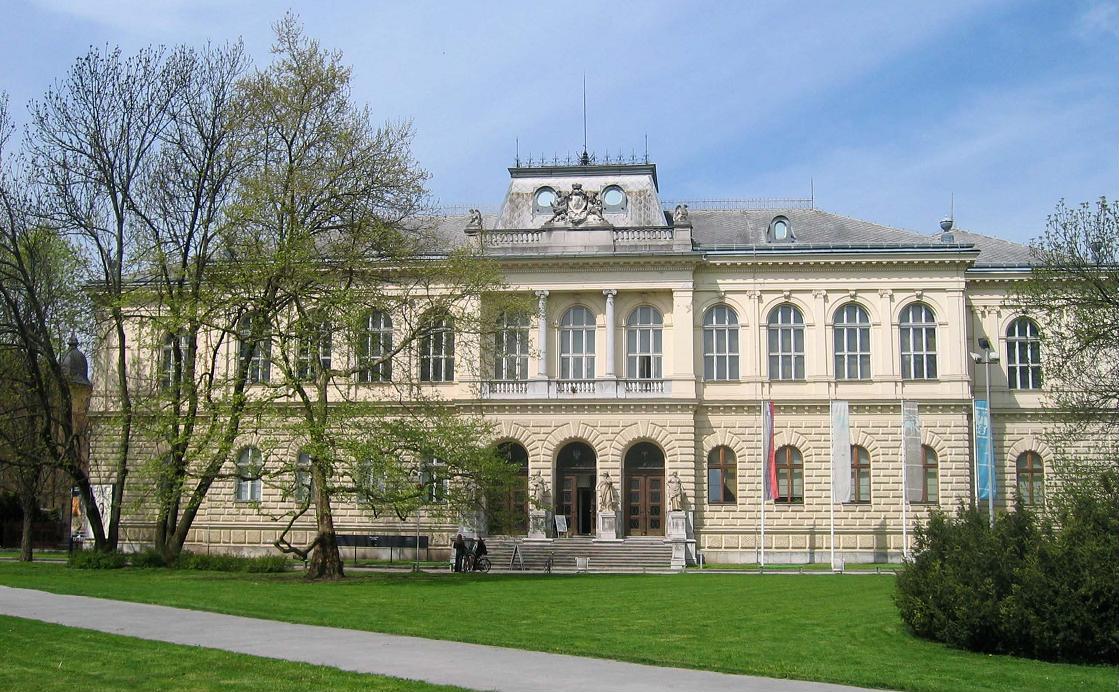
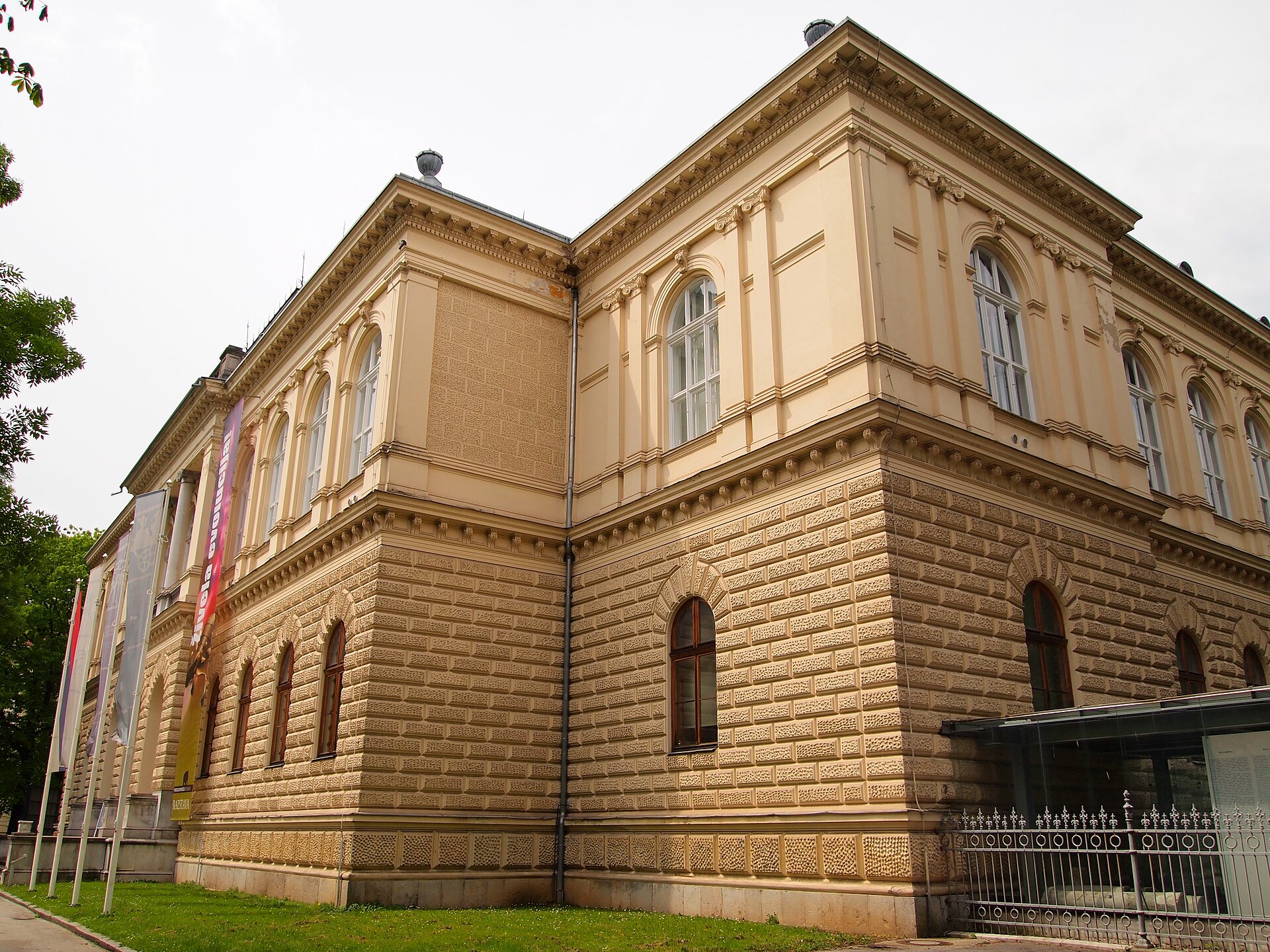
The Neo-Renaissance facade of the National Museum of Slovenia on Presernova cesta, Ljubljana, opened 1888.
Public domainNational Museum of Slovenia
Museum · Narodni muzej Slovenije · Founded 1821
Open, admission and hours confirmed 4 September 2026 · 15 sources
On this page 17 sections
ContentsClose
The National Museum of Slovenia's real strength is depth in a single national story rather than breadth across world art: it holds the physical record of everything from Neanderthal presence in the Slovenian lands 60,000 years ago through the Bronze and Iron Ages, the Roman colony of Emona, and on into the applied arts and numismatics of more recent centuries, largely excavated or acquired from within the country's own territory. Its Roman Lapidarium, at more than 200 inscribed stone monuments, is one of the larger such collections drawn from a single Roman province anywhere in the former empire, and its Egyptian Collection, though a single coffin and mummy rather than a department-scale holding, is unique within Slovenia specifically because no comparable object exists in any other Slovenian collection.
| Local name | Narodni muzej Slovenije |
|---|---|
| Kind | Museum |
| Founded | Founded 15 October 1821 as the Provincial Museum of Carniola; the present Presernova cesta building opened 2 December 1888; took its current name, National Museum of Slovenia, after Slovenian independence |
| City and country |  Ljubljana, Slovenia Ljubljana, Slovenia |
| Address | Muzejska ulica 1 (postal address Presernova cesta 20), SI-1000 Ljubljana, Slovenia |
| Website | nms.si |
| Status | Open, confirmed |
| Record last verified |
Visiting
- Hours
- Mon-Wed, Fri-Sun10:00 to 18:00
- Thu10:00 to 20:00
- 24 and 31 December10:00 to 15:00shortened hours
- Closed
- 1 January. 1 May. 1 November. 25 December.
- Admission
- AdultEUR 8Muzejska building only; Metelkova and the museum's other sites price separately
- Retired / pensionerEUR 4
- StudentEUR 4
- FamilyEUR 16
- School groupEUR 4per pupil
- Group (10 or more)EUR 5per person
- Pre-school children, journalists, Slovenian Museum Society members, ICOM membersFreefree admission
Free entry: First Sunday of every month, except during major temporary exhibitions- Tickets
- nms.si/en/plan-your-visit/admission The museum's own ticket page.
- Do I need to book?
- No advance booking is stated for general admission; guided tours (Slovene EUR 32, English or German EUR 44, curator-led from EUR 45) require advance reservation
- Address
- Muzejska ulica 1 (postal address Presernova cesta 20), SI-1000 Ljubljana, Slovenia MapOn foot In the historic centre of Ljubljana, next to the Slovenian Parliament building and the Opera and Ballet Theatre, at the edge of Zvezda Park. Tripadvisor's own distance data places it about 0.3 miles from Presernov trg and the Triple Bridge and about 0.2 miles from Ljubljana's old town, all within easy walking distance of the pedestrianised centre.
Context The city's official tourism site describes the building as centrally located and directly adjacent to the Parliament and the Opera; it does not name specific bus routes, and none is asserted here that was not read on a fetched page. - Website
- nms.si
- Telephone
- +386 1 241 44 00
- [email protected]
Before you go how long, access, photography, bags, eating, shop
- How long to allow
- Visitor reports on Tripadvisor typically describe two to three hours to cover the permanent archaeological galleries, the Lapidarium and the Egyptian Collection room
- Access
- Wheelchair users are asked to enter from Presernova cesta 20 and call +386 51 701 040 on arrival so that a staff member can assist; the city's own visitor listing additionally describes wheelchair access, accessible restrooms, lifts and adapted materials for visually impaired visitors
- Photography
- Not stated on the museum's own visitor pages as fetched for this record; not asserted here
- Bags
- Not stated on the museum's own visitor pages as fetched for this record; not asserted here
- Eating
- Not confirmed from a fetched source for this record
- Shop
- The museum operates a shop selling replica jewellery cast from its own collection, including brooches based on the motifs of the Vace situla
Prices and hours change. We take them from the institution's own pages and print the day we read them, and you can check the current position at the source we used. Confirm before you travel.
What is inside
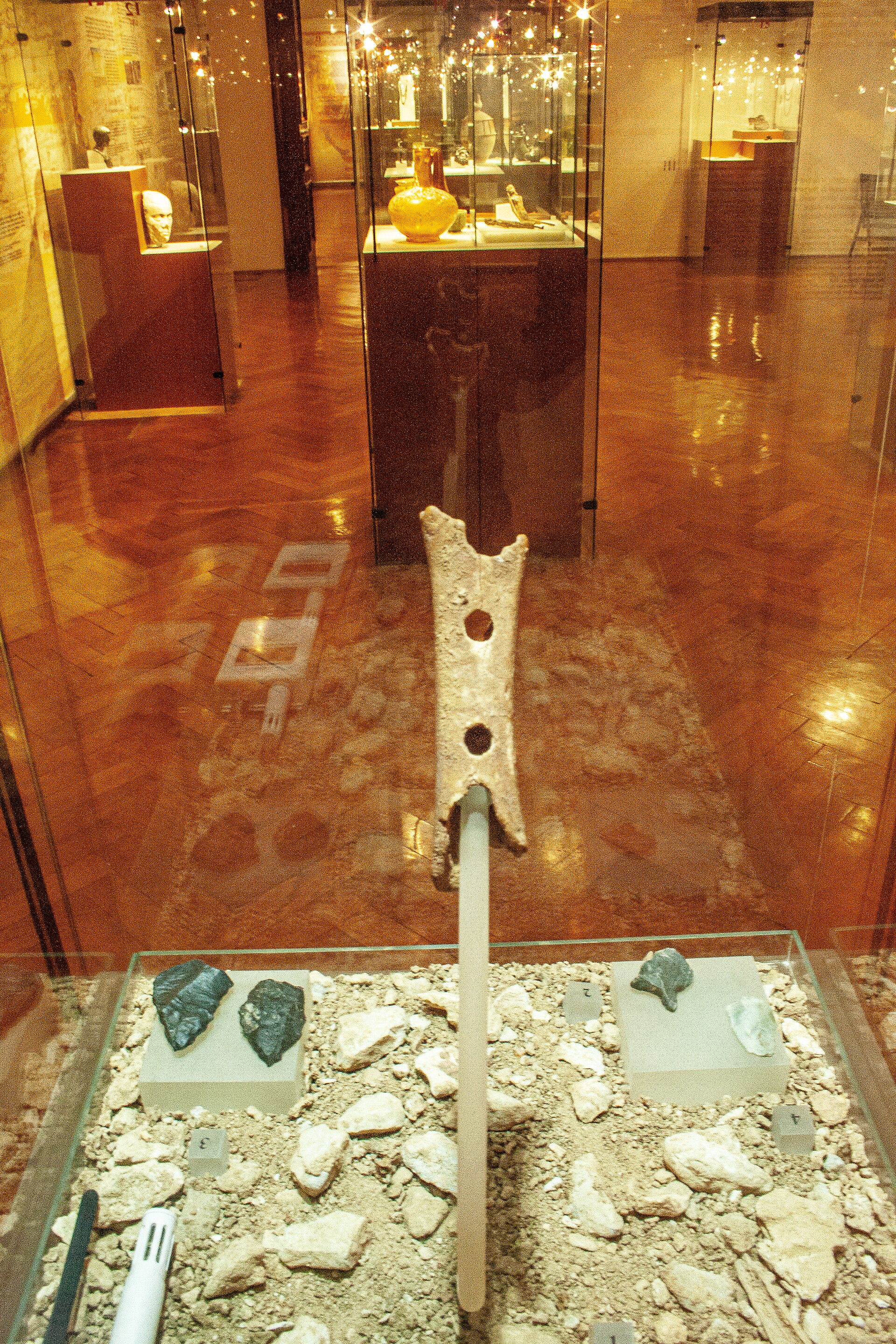
CC0 The Earliest Stories from the Crossroads (permanent archaeological exhibition)
The museum's flagship permanent exhibition, running from the Stone Age through the Iron Age and the Roman period. It holds the Divje Babe flute, the Vace situla, the oldest gold objects found in Slovenia (a pair of appliques), and a dugout canoe over 9 metres long cut from a single oak trunk and recovered from the Ljubljana Marshes (Ljubljansko barje).
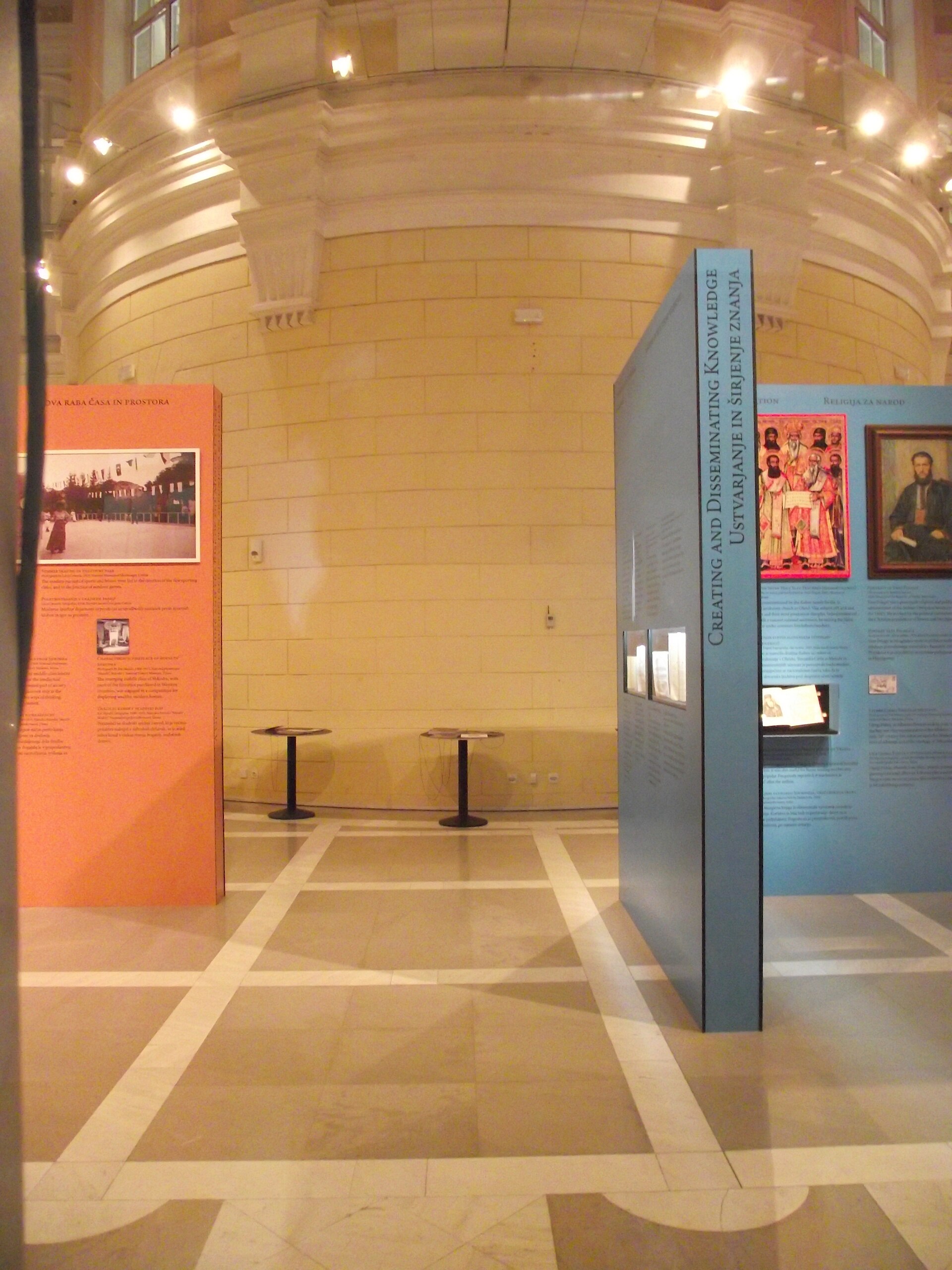
Photograph by Daniel Thornton · CC BY 2.0 Roman Lapidarium
More than 200 Roman stone monuments bearing Latin inscriptions, mostly recovered from Emona (Roman Ljubljana) and the Izanski kot area, plus finds from Trojane, Zasavje and Dolenjska. Held partly on the ground floor of the building and partly in a glass pavilion in the museum garden; running since 2006. Includes the gilded bronze statue known as the Emona citizen and an imperial inscription of Augustus and Tiberius commemorating the building of Emona's walls and towers.
Egyptian Collection
A room designed in the style of an Egyptian burial chamber, opened in January 2017, built around the mummy and painted wooden coffin of the priest Akesuita, who served in the temple of Amon at Karnak and died around 680 BC. The coffin and mummy were given to the then Regional Museum of Carniola in 1846 by Anton Lavrin, the Austrian consul in Egypt; the hieroglyphic inscriptions, drawn from the Egyptian Book of the Dead, were first translated for the museum by the Slovenian orientalist Albert Kosmac in 1866. It is the only ancient Egyptian coffin holding a human mummy in Slovenia.
Numismatic Cabinet
The museum's coin and paper-money department and Slovenia's national reference collection for numismatics, described by the state culture portal Culture.si as holding roughly 80,000 items ranging from medieval coinage to modern banknotes. No free-licence photograph of this room or its display cases was found on Wikimedia Commons for this record.
Department of History and Applied Arts
Furniture, textiles, arms and armour, glass, ceramics and photographic material from the medieval period onward, reported by Culture.si at more than 48,000 objects. Holdings include the suit of armour made by the Nuremberg armourer Valentin Siebenburger, described by the museum itself as the only original, almost completely preserved knight's suit of armour in Slovenia, and the self-portrait of Janez Avgustin Puhar, the first Slovenian photographer. No free-licence photograph specific to this gallery was found for this record.
What to see first
The Divje Babe flute (Neanderthal flute)
Made by a Neanderthal, Divje Babe cave, SloveniaA pierced cave-bear thighbone about 60,000 years old, found in 1995 near Cerkno under the direction of Ivan Turk; the museum's own account calls it the oldest musical instrument in the world and roughly 20,000 years older than the next-oldest known Palaeolithic flutes made by modern humans.6
Vace situla
Hallstatt-period workshop, Vace, Slovenia, early 5th century BCA bronze vessel 23.8 cm high, decorated in three horizontal friezes of human and animal figures narrating scenes from the life of a local noble; found in the grave of a young warrior with his helmet, spears, battle-axe, bracelet and belt. The museum calls it one of the finest examples of situla art anywhere.7
Mummy and coffin of the priest Akesuita
Ancient Egyptian workshop, c. 680 BCThe only ancient Egyptian coffin holding a human mummy in Slovenia, given to the museum's predecessor in 1846 by the Austrian consul in Egypt, Anton Lavrin; its painted inscriptions, drawn from the Book of the Dead, name the deceased, his priestly office at Karnak and his parents.8
Imperial stone inscription of Augustus and Tiberius
Roman state workshop, Emona, AD 14-15A marble fragment recording that Augustus, in his thirteenth consulship, and Tiberius, in his second, gave the walls and towers to the colony of Emona; part of the Roman Lapidarium and a rare piece of dated, dedicatory Latin epigraphy from the earliest years of the colony.9
Emona citizen
Roman workshop, EmonaA gilded bronze statue of a Roman citizen of Emona, one of the pieces the museum names among its highlights of the Lapidarium and its Roman-period holdings.5
Dugout canoe from the Ljubljana Marshes
Prehistoric boatbuilder, Ljubljansko barjeA single oak trunk hollowed into a canoe over 9 metres long, evidence of the marsh-edge settlements around prehistoric Ljubljana and of woodworking technology that changed little for millennia.5
Two gold appliques
Prehistoric goldsmith, SloveniaNamed by the museum as the oldest gold objects found in Slovenia, and displayed in the earliest section of the permanent archaeological exhibition.5
Idol from the Ljubljana Marshes
Prehistoric potter, Ljubljansko barjeA fired-clay vessel modelled as a simplified human figure, one of the earliest representations of the human form held by the museum.5
Boundary stone between Aquileia and Emona
Roman surveying authorityA stone marker recording an administrative border between the Roman colonies of Aquileia and Emona, part of the Lapidarium's evidence for how Roman authority organised the territory of present-day Slovenia.5
Ivory dolls of the Roman period
Roman workshop, Emona regionDescribed by the museum as extremely rare surviving examples of Roman-period ivory dolls, a fragile class of object that seldom survives from antiquity.5
Germanic jewellery and ornaments from Carnium
Germanic workshop, Migration PeriodGrouped by the museum under the heading Prestige of the Germanic world, this jewellery documents the Migration-Period population at Carnium (modern Kranj) and its connections to the wider Germanic world.5
Wooden hunting traps
Prehistoric to historic hunters, SloveniaThe museum highlights these as hunting technology essentially unchanged since the Bronze Age, a rare case of a functional design surviving in near-identical form across millennia.5
Suit of armour by Valentin Siebenburger
Valentin Siebenburger, Nuremberg armourerDescribed by the museum as the only original, almost wholly preserved example of a knight's suit of armour in Slovenia, held in the Department of History and Applied Arts.5
Self-portrait of Janez Avgustin Puhar
Janez Avgustin PuharA self-portrait by the first Slovenian photographer, who was also an inventor of a photographic process on glass; held among the museum's applied-arts and photographic holdings.5
Exhibitions on now
Past exhibitions here
- Closed15 May to 15 Oct 2026Confirmed · check before you travel
- Closed3 Sep to 4 Oct 2026Confirmed · check before you travel
A provincial museum born of a congress
The National Museum of Slovenia traces its founding to a specific date: 15 October 1821, when the Carniolan provincial estates resolved to establish a museum for the province, a decision prompted by delegates who had gathered in Ljubljana for the Congress of Laibach (Ljubljana) that same year and noted that Carniola, alone among comparable provinces, had no museum of its own. It opened as the Provincial Museum of Carniola and is, by its own account and by that of the state Culture.si portal, the oldest scientific and cultural institution in Slovenia.
The museum's name changed more than once as the political map around it changed. In 1882 it took the name Carniolan Provincial Museum - Rudolfinum, honouring the Habsburg crown prince Rudolf. According to the museum's own historical account it became simply the National Museum in 1921, after Carniola's provincial status had been absorbed into the new South Slavic state; it took its current form, National Museum of Slovenia, after Slovenian independence, though the sources consulted for this record do not agree on the exact year of that final renaming - English Wikipedia gives 1992, while Culture.si gives 1997. Both are recorded here rather than silently resolved, because neither is the museum's own primary statement of the date and this record does not invent one.
The palace on Presernova cesta
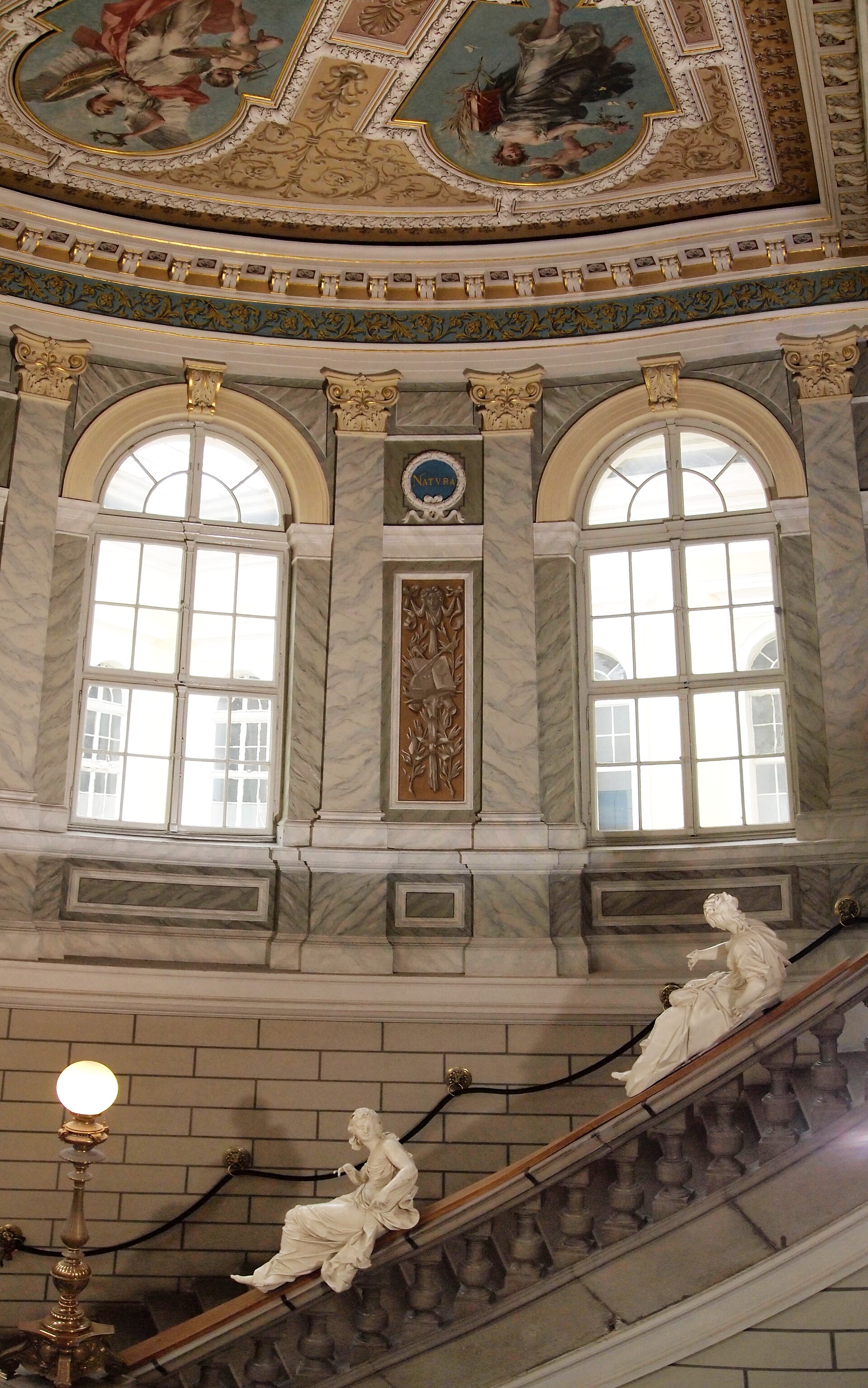
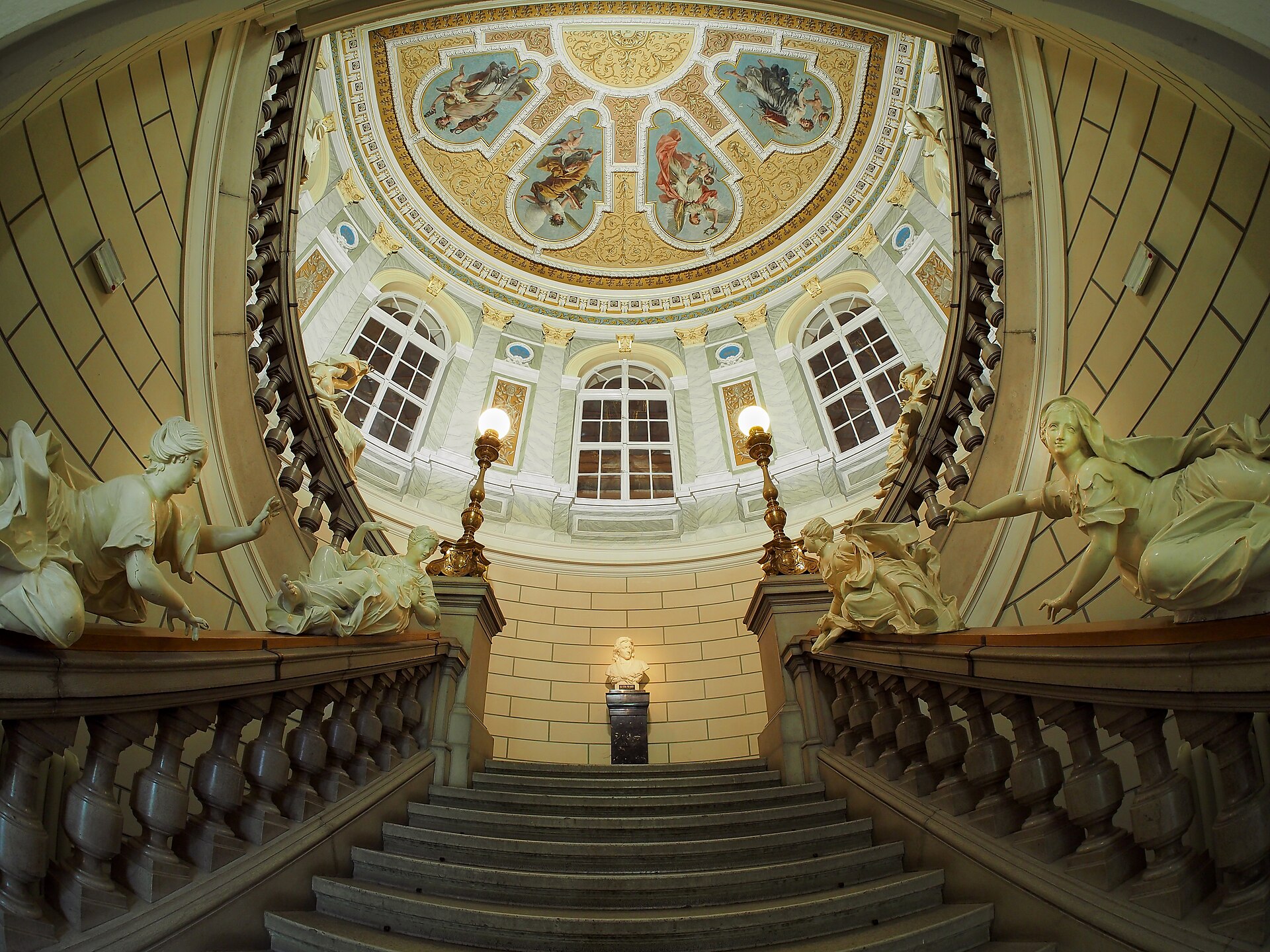
The building the museum occupies today, at Muzejska ulica 1 with its formal postal address at Presernova cesta 20, was built in the 1880s to a Neo-Renaissance design credited to the Viennese architect Wilhelm von Rezori, with the master builder Viljem (Wilhelm) Treo and Jan Vladimir Hrasky carrying the plans into construction. It opened on 2 December 1888 and was, on the museum's own telling, the first building in the Slovene lands built solely for cultural use. The Subic brothers, Janez and Jurij, painted ceiling medallions inside in 1885 personifying Carniola as protector of the arts and sciences, alongside portraits of four notable Carniolans, and the grand staircase still carries eighteenth-century muse statues by the sculptor Veit Koeniger.
The palace has always held more than one institution. The Slovenian Museum of Natural History occupied the same building from the outset and became administratively independent only in 1944; the two remain under the same roof today, sharing an entrance but selling separate tickets, a detail more than one visitor has been caught out by. The National Museum of Slovenia's own fine-art holdings, meanwhile, left the building in 1933 to become the founding collection of the separate National Gallery of Slovenia, a different institution in a different building nearby. This record concerns the National Museum of Slovenia alone - the archaeology, numismatics, prints and applied-arts institution registered at Presernova cesta 20 and carrying Wikidata identifier Q2033282 - and not the National Gallery, and not the Slovenian Museum of Natural History, even though a visitor standing on the same steps could easily buy a ticket to either of the other two by mistake.
The earliest stories: from the Ice Age to Rome
The museum's principal permanent exhibition, titled The Earliest Stories from the Crossroads and running since August 2014, covers the human presence in what is now Slovenia from the Stone Age through the Iron Age and into the Roman period. Its single most famous object is not Roman at all: the Divje Babe flute, a young cave bear's thighbone pierced with four holes, found in 1995 in the Divje Babe cave near Cerkno under the excavation of Ivan Turk. At roughly 60,000 years old it predates the flutes of anatomically modern humans by some 20,000 years, and the museum's own account states plainly that the piercings were made deliberately with stone tools and bone punches rather than by animal gnawing, which is the finding that turned the object from a curiosity into evidence that Neanderthals made music.
The same exhibition holds the Vace situla, a bronze vessel just under 24 centimetres tall, beaten and engraved in three registers of human and animal figures that read almost like a strip of scenes from the life of a Hallstatt-period noble. It was recovered from a warrior's grave at Vace, near Litija, alongside a helmet, spears, a battle-axe, a bracelet and a military belt, though only the warrior's skull survived to be excavated with it. Elsewhere in the same galleries sit two gold appliques the museum describes as the oldest gold objects yet found on Slovenian territory, a fired-clay idol from the Ljubljana Marshes shaped as a simplified human figure, and a dugout canoe cut from a single oak trunk and over nine metres long, recovered from the same marshland and evidence of a prehistoric community that lived and moved on water at the edge of what is now Ljubljana.
Rome under Ljubljana's streets: the Lapidarium
Where the earliest galleries end in the Iron Age, the Roman Lapidarium takes over, a collection the museum's own exhibition page describes as more than 200 stone monuments carrying Latin inscriptions, drawn mostly from Roman Emona - the direct predecessor of modern Ljubljana - and from the Izanski kot district, with further pieces from Trojane, Zasavje and Dolenjska. It has run as a named permanent exhibition since June 2006 and is shown partly on the ground floor of the Presernova cesta building and partly in a glass pavilion in the museum's own garden, so that a visit to the Lapidarium properly includes stepping back outside.
Two pieces from the Lapidarium illustrate what this kind of collection can do that a single spectacular object cannot. One is a marble fragment recording, in formal Latin, that the emperor Augustus, in his thirteenth consulship, and his successor Tiberius, in his second, gave the walls and towers to the colony of Emona - a dedication that can be dated to the very end of AD 14 or the start of AD 15 and so pins down, almost to the year, when Emona's fortifications went up under direct imperial sponsorship. The other is a gilded bronze statue the museum calls the Emona citizen, a rare survival of civic portrait sculpture from a provincial Roman town rather than from Rome itself. Smaller, stranger pieces sit alongside them: a boundary stone marking the administrative line between Aquileia and Emona, and a set of Roman-period ivory dolls that the museum flags as extremely rare survivals, since organic materials this small and this fragile almost never outlast two thousand years in the ground.
A chamber built for the dead: the Egyptian Collection
The most unexpected room in a museum otherwise built around the archaeology of Slovenia is a chamber styled after an Egyptian burial space, opened in January 2017 to give a permanent home to a coffin and mummy that had been in the collection since 1846. Anton Lavrin, the Austrian consul in Egypt, gave the coffin and its mummy to the then Regional Museum of Carniola that year; inside is Akesuita, a priest of Amon's temple at Karnak who died at around forty years of age close to 680 BC, in the politically turbulent late Twenty-Fifth Dynasty. His painted, anthropomorphic coffin carries hieroglyphic text drawn from the Egyptian Book of the Dead, including a column of inscription that names Akesuita himself, states his priestly office, and names his parents; the Slovenian orientalist Albert Kosmac first translated this text for the museum in 1866, two decades after the coffin arrived and more than a century before it found its present room. The museum states plainly that this is the only ancient Egyptian coffin holding a human mummy anywhere in Slovenia, which is as much a statement about the country's museum landscape as about the object itself.
Coins, prints and the applied arts: the departments beyond the headline galleries
Two of the museum's six departments rarely produce a single object dramatic enough to headline a highlights page, and both are large. The Numismatic Cabinet is, in the state culture portal's own description, the only department of its kind in Slovenia and functions as the country's reference collection for coins, banknotes and other financial instruments; Culture.si puts its holdings at roughly 80,000 items running from medieval coinage to present-day banknotes. No free-licence photograph of the numismatic displays themselves was located on Wikimedia Commons for this record, which is recorded here rather than papered over with an unrelated image.
The Department of History and Applied Arts is larger still, reported by Culture.si at more than 48,000 objects spanning furniture, textiles, arms and armour, glass, ceramics and historical photography. Its single most striking piece is a suit of armour made by the Nuremberg armourer Valentin Siebenburger, which the museum itself describes as the only original, almost completely preserved knight's suit of armour surviving in Slovenia. The same department also holds a self-portrait by Janez Avgustin Puhar, credited as the first Slovenian photographer and as an inventor of an early photographic process on glass. As with the Numismatic Cabinet, no verifiable free-licence photograph specific to this gallery's own display was found, so none is claimed here.
A fifth department, Prints and Drawings, holds more than 30,000 sheets by Slovenian and foreign artists with a strong body of religious graphic art, and a sixth, Conservation and Restoration, runs the museum's own laboratories, reported by Culture.si to include electron microscopy, X-ray radiography and CT scanning used on the collection itself rather than displayed to visitors.
Visiting today
The Muzejska building keeps long hours by the standards of a national museum: 10:00 to 18:00 every day except Thursday, when it stays open to 20:00, with no weekly closing day at all - a point more than one visitor has remarked on favourably, since several other Ljubljana museums close on Mondays. It closes only on 1 January, 1 May, 1 November and 25 December, and runs shortened hours, 10:00 to 15:00, on 24 and 31 December. Adult admission to the Muzejska building is EUR 8, with reduced rates for pensioners and students at EUR 4, a family ticket at EUR 16, and free entry every first Sunday of the month outside major temporary exhibitions; the museum's own admission page also lists free entry for pre-school children, journalists, and members of ICOM and the Slovenian Museum Society. An audio guide is included free with a paid ticket. Guided tours require advance booking and are priced separately, from EUR 32 for a Slovene-language group tour to EUR 55 for a curator-led tour in English. Wheelchair users are asked to enter from Presernova cesta 20 and telephone ahead so that staff can assist; the city's own visitor listing for the museum additionally describes accessible restrooms, lifts and materials adapted for visually impaired visitors. A small museum shop sells replica jewellery cast from pieces in the collection, including brooches based on the decorative motifs of the Vace situla.
What visitors say
Visitors on Tripadvisor consistently describe the museum as dense with genuinely old and important material for a modest ticket price, singling out the Divje Babe flute as the one object nobody wants to miss. The recurring complaint is not about the collection but about presentation: several reviewers find the permanent galleries hard to navigate, uncertain whether the layout is chronological or thematic, and some describe display cases as crowded and in need of updating. A number of reviewers also note, approvingly, that the museum shares its building with the Slovenian Museum of Natural History under a single roof but two separate admission tickets, and that unlike many Ljubljana museums it opens on Mondays.
What is praised, what is criticised
- Praised: Clearly written, informative English-language labelling and an audio guide that visitors describe as good value alongside a low ticket price
- Praised: The Divje Babe flute specifically, repeatedly singled out by name as the single object worth the visit on its own
- Praised: A central location next to the Parliament and the old town, and opening hours that include Monday, when several other Ljubljana museums are closed
- Praised: Staff willingness to answer questions, and the range of material covered from the Ice Age to the Roman period in one visit
- Criticised: The route through the permanent galleries reads to some visitors as maze-like, without a clearly signposted chronological or thematic path
- Criticised: Several reviewers describe display cases, particularly for smaller artefacts, as crowded and overdue for refurbishment, with objects simply enclosed in glass rather than given an engaging setting
- Criticised: One 2026 review describes a Saturday-afternoon front-desk encounter where staff made no attempt to assist a non-Slovene, non-English-speaking visitor with translation or written help
- Criticised: The shared building with the Slovenian Museum of Natural History, and the requirement to buy two separate tickets, catches out some visitors who expect one admission to cover both
Ratings on other platforms
Tripadvisor: 4.1 from 153 ratings, read 4 September 2026
A platform average is a tertiary source: it moves, it is not audited, and we quote no visitor's words.
Questions about National Museum of Slovenia
Where is National Museum of Slovenia?
Muzejska ulica 1 (postal address Presernova cesta 20), SI-1000 Ljubljana, Slovenia.
How much does it cost to visit?
Adult: EUR 8; Retired / pensioner: EUR 4; Student: EUR 4; Family: EUR 16; School group: EUR 4. As confirmed 4 September 2026.
When is it open?
Mon-Wed, Fri-Sun 10:00-18:00; Thu 10:00-20:00; 24 and 31 December 10:00-15:00. Closed: 1 January. 1 May. As confirmed 4 September 2026.
How do you get there?
On foot: In the historic centre of Ljubljana, next to the Slovenian Parliament building and the Opera and Ballet Theatre, at the edge of Zvezda Park. Tripadvisor's own distance data places it about 0.3 miles from Presernov trg and the Triple Bridge and about 0.2 miles from Ljubljana's old town, all within easy walking distance of the pedestrianised centre; Context: The city's official tourism site describes the building as centrally located and directly adjacent to the Parliament and the Opera; it does not name specific bus routes, and none is asserted here that was not read on a fetched page.
What should you see first?
The Divje Babe flute (Neanderthal flute) (Made by a Neanderthal, Divje Babe cave, Slovenia); Vace situla (Hallstatt-period workshop, Vace, Slovenia, early 5th century BC); Mummy and coffin of the priest Akesuita (Ancient Egyptian workshop, c. 680 BC); Imperial stone inscription of Augustus and Tiberius (Roman state workshop, Emona, AD 14-15); Emona citizen (Roman workshop, Emona); Dugout canoe from the Ljubljana Marshes (Prehistoric boatbuilder, Ljubljansko barje).
What we could not confirm
- Sources disagree on the exact year the institution took its present name, National Museum of Slovenia: English Wikipedia states 1992, the state Culture.si portal states 1997, and the museum's own history page as fetched for this record confirms only that it became 'the National Museum' in 1921 without giving the later renaming date. Neither year is asserted here as fact.
- No free-licence photograph specific to the Numismatic Cabinet or to the Department of History and Applied Arts display rooms was located on Wikimedia Commons; both wings are described from text sources only.
- The museum's own visitor pages as fetched for this record do not state a photography policy or a bag/cloakroom policy; neither is asserted here.
Images
Sources
- 1National Museum of Slovenia, official site, 'National Museum of Slovenia - Ljubljana' (Muzejska location page) nms.si/en/plan-your-visit/locations/muzejska
- 2National Museum of Slovenia, official site, 'Opening hours and contact' nms.si/en/plan-your-visit/opening-hours-and-contact
- 3National Museum of Slovenia, official site, admission/ticket prices page nms.si/en/plan-your-visit/admission
- 4National Museum of Slovenia, official site, 'Museum' (founding and mission) nms.si/en/museum
- 5National Museum of Slovenia, official site, collection highlights index nms.si/en/collections/highlights
- 6National Museum of Slovenia, official site, highlight page: Neanderthal flute nms.si/en/collections/highlights/343-Neanderthal-flute
- 7National Museum of Slovenia, official site, highlight page: Vace Situla nms.si/en/collections/highlights/420-Vace-Situla
- 8National Museum of Slovenia, official site, highlight page: Egyptian mummy nms.si/en/collections/highlights/418-Egyptian-mummy
- 9National Museum of Slovenia, official site, highlight page: Imperial stone inscription nms.si/en/collections/highlights/708-Imperial-stone-inscription
- 10Wikipedia, 'National Museum of Slovenia' (, machine facts only) en.wikipedia.org/wiki/National_Museum_of_Slovenia
- 11Culture.si (Slovenian state culture portal), 'National Museum of Slovenia' () culture.si/en/National_Museum_of_Slovenia
- 12Tripadvisor, 'Museu Nacional d'Eslovenia' listing, ratings and visitor reviews (, aggregate rating and consensus only, no review prose reproduced) tripadvisor.com/Attraction_Review-g274873-d276327-Reviews-Museu_Nacional_d_Eslovenia-Ljubljana_Upper_Carniola_Region.html
- 13Visit Ljubljana (official city tourism site), 'National Museum of Slovenia' POI page () visitljubljana.com/en/poi/national-museum-of-slovenia
- 14Wikimedia Commons, file page and API metadata for the lead exterior photograph (licence verification) commons.wikimedia.org/wiki/File:NarodniMuzej-ljubljana.JPG
- 15Wikimedia Commons, 'Category:National Museum of Slovenia' and its Exterior, Interior and Lapidarium subcategories (image sourcing) commons.wikimedia.org/wiki/Category:National_Museum_of_Slovenia
