The National Museum of Modern Art, Tokyo
Museum · Tokyo Kokuritsu Kindai Bijutsukan · Founded 1952
Open, admission and hours confirmed 17 September 2026 · 13 sources
On this page 13 sections
ContentsClose
The museum's depth is in the record of Japanese art's own encounter with modernity, from Meiji-era Nihonga through Taisho individualism, wartime art and its unresolved postwar loan status, and into 1960s materials-based experiment and postwar photography, with a smaller but real vein of Western modern painting, Cezanne and Gauguin among it, brought in as reference points for that story rather than as a competing survey of European modernism in its own right.
| Local name | Tokyo Kokuritsu Kindai Bijutsukan |
|---|---|
| Kind | Museum |
| Founded | 1952, as Japan's first national art museum, opened in Kyobashi; moved to the present Kitanomaru Park building in 1969 |
| City and country |  Chiyoda, Japan Chiyoda, Japan |
| Address | 3-1 Kitanomaru Koen, Chiyoda-ku, Tokyo 102-8322, Japan |
| Website | momat.go.jp/en |
| Status | Open, confirmed 17 September 2026 |
| Record last verified | 17 September 2026 |
Visiting
- Hours
- Tue-Thu, Sun10:00 to 17:00Last admission 30 minutes before closing
- Fri-Sat10:00 to 20:00Last admission 30 minutes before closing
- Closed
- Monday, or the following day if Monday is a national holiday. Exhibition changeover periods. New Year holidays.
- Admission
- AdultJPY 500Collection galleries, individual
- Adult, group of 20 or moreJPY 400Collection galleries
- Adult, eveningJPY 300Collection galleries, Friday and Saturday from 17:00
- College or university studentJPY 250Collection galleries, individual
- College or university student, groupJPY 200Collection galleries
- College or university student, eveningJPY 150Collection galleries, Friday and Saturday from 17:00
- 18 and under, 65 and overFreeFree to the collection galleries with ID; a special exhibition is priced separately and is not covered by this free entry
Free entry: International Museum Day, 18 May. Culture Day, 3 November, unless the museum is closed that day- Tickets
- momat.go.jp/en/tickets The museum's own ticket page.
- Do I need to book?
- No advance booking for the collection galleries; ticketed special exhibitions sell advance tickets separately in their own sales window
- Address
- 3-1 Kitanomaru Koen, Chiyoda-ku, Tokyo 102-8322, Japan MapSubway Takebashi Station on the Tozai Line, exit 1b, about a 3-minute walk
Subway Kudanshita Station on the Tozai, Hanzomon and Toei Shinjuku lines, about a 15-minute walk
Subway Jimbocho Station on the Hanzomon and Toei Mita/Shinjuku lines, about a 15-minute walk
Rail Tokyo Station, about a 20 to 25-minute walk via the Marunouchi exits - Website
- momat.go.jp/en
- Telephone
- 050-5541-8600 (Hello Dial, Japan); +81-47-316-2772 (from outside Japan)
Before you go how long, access, photography, bags, eating, shop
- How long to allow
- The collection alone runs to twelve or thirteen themed rooms across three floors, and visitors commonly report spending several hours there before a special exhibition is even added
- Access
- Wheelchairs are available to borrow free of charge from the first-floor information desk; a visitor with a disability certificate is admitted free together with one companion
- Photography
- Still photography without flash or a tripod is permitted in the collection galleries; individual works marked as off-limits for copyright reasons are excluded
- Bags
- Not addressed on the museum's own site
- Eating
- L'Art et Mikuni, a French restaurant on site overseen by chef Kiyomi Mikuni; its hours can differ from the museum's own and are posted separately
- Shop
- Museum shop, free to enter, open 10:00 to 17:00 and until 20:00 on Friday and Saturday, selling books, catalogues and museum-branded goods
Prices and hours change. We take them from the institution's own pages and print the day we read them, and you can check the current position at the source we used. Confirm before you travel.
What is inside
4F, Room 1: Highlights
An introductory room of about a century's worth of prized holdings shown together rather than in chronological order, built around Paul Cezanne's Grand Bouquet of Flowers (circa 1892-95) and Kawai Gyokudo's Parting Spring (1916), the latter an Important Cultural Property
4F, Rooms 2-5: Meiji to the interwar years
Meiji-era (1868-1912) painting and crafts shown jointly with loans from the National Crafts Museum, Taisho-era (1912-26) painting built around individual artistic voices, a room of Noh and Kabuki theatre paintings and prints, and a room of 1920s-30s Surrealist and abstract work including Yves Tanguy's The Ears of a Deaf
3F, Rooms 6-9: war years and postwar experiment
A room devoted to Japanese art of 1941-45, including the museum's War Record Paintings, a room on the postwar female artists Imai Hisae and Okanoue Toshiko and their circle at Bunka Gakuin, a room on 1960s work built around unconventional materials and surfaces, and a room of Ueda Shoji's staged photographs on the Tottori sand dunes
3F Room 10 and 2F Rooms 11-12: seasonal Nihonga and the contemporary close
A rotating room of seasonal Japanese-style painting, followed on the second floor by contemporary painting, sculpture and photography from the 1990s onward, closing on themes of constant change in nature and the city
What to see first
Grand Bouquet of Flowers
Paul CezanneThe anchor work of the introductory Highlights room and one of the museum's best-known Western holdings9
Parting Spring
Kawai GyokudoAn Important Cultural Property and one of eighteen nationally designated works in the collection9
The Stray Child
Yokoyama TaikanA centrepiece of the Meiji-era gallery and a signature work by one of modern Nihonga's founding figures9
Hand
Takamura KotaroA Taisho-era sculpture by a poet-sculptor whose work marks the museum's account of early Japanese modernism in three dimensions9
War Record Paintings
Various Japanese wartime artists, official war painters 1941-45153 surviving works requisitioned by the Allied Powers after 1945, held in the United States and returned to Japan on indefinite loan only in 1970; the museum's most historically loaded holding and a rare case where the collection itself is a document of a national reckoning8
The Kishida Ryusei archive
Kishida RyuseiRoughly 600 works plus sketches and personal papers, the single largest holding of any one artist in the museum and a resource for the study of early twentieth-century Japanese painting8
Gate
Isamu NoguchiInstalled outdoors in 1969 to mark the opening of the Kitanomaru building and now the museum's best-known landmark sculpture4
Sand Dune Theatre
Ueda ShojiStaged photographs made on the Tottori sand dunes between 1948 and 1950, among the museum's strongest holdings in postwar Japanese photography9
The building and what it was built to hold
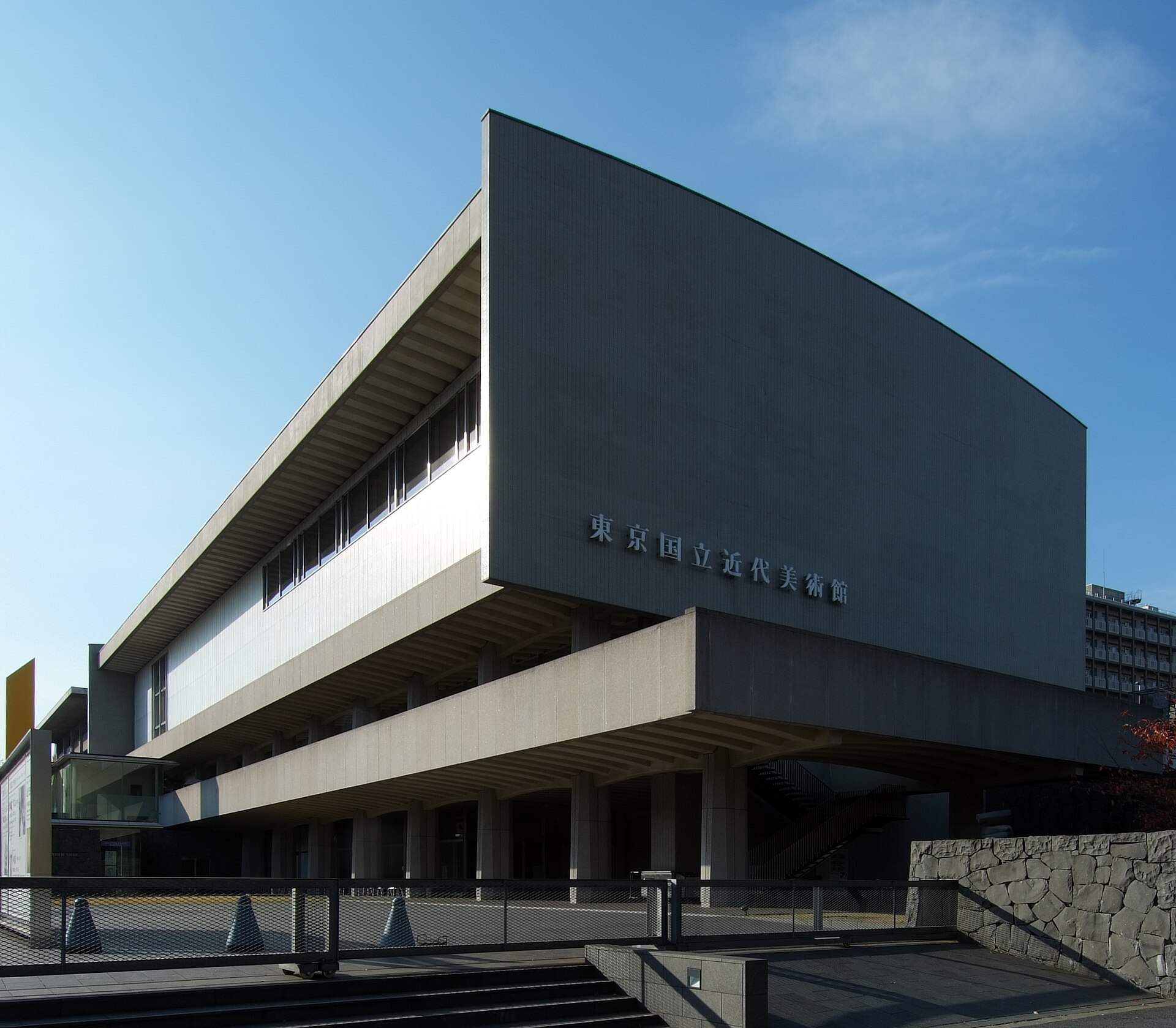
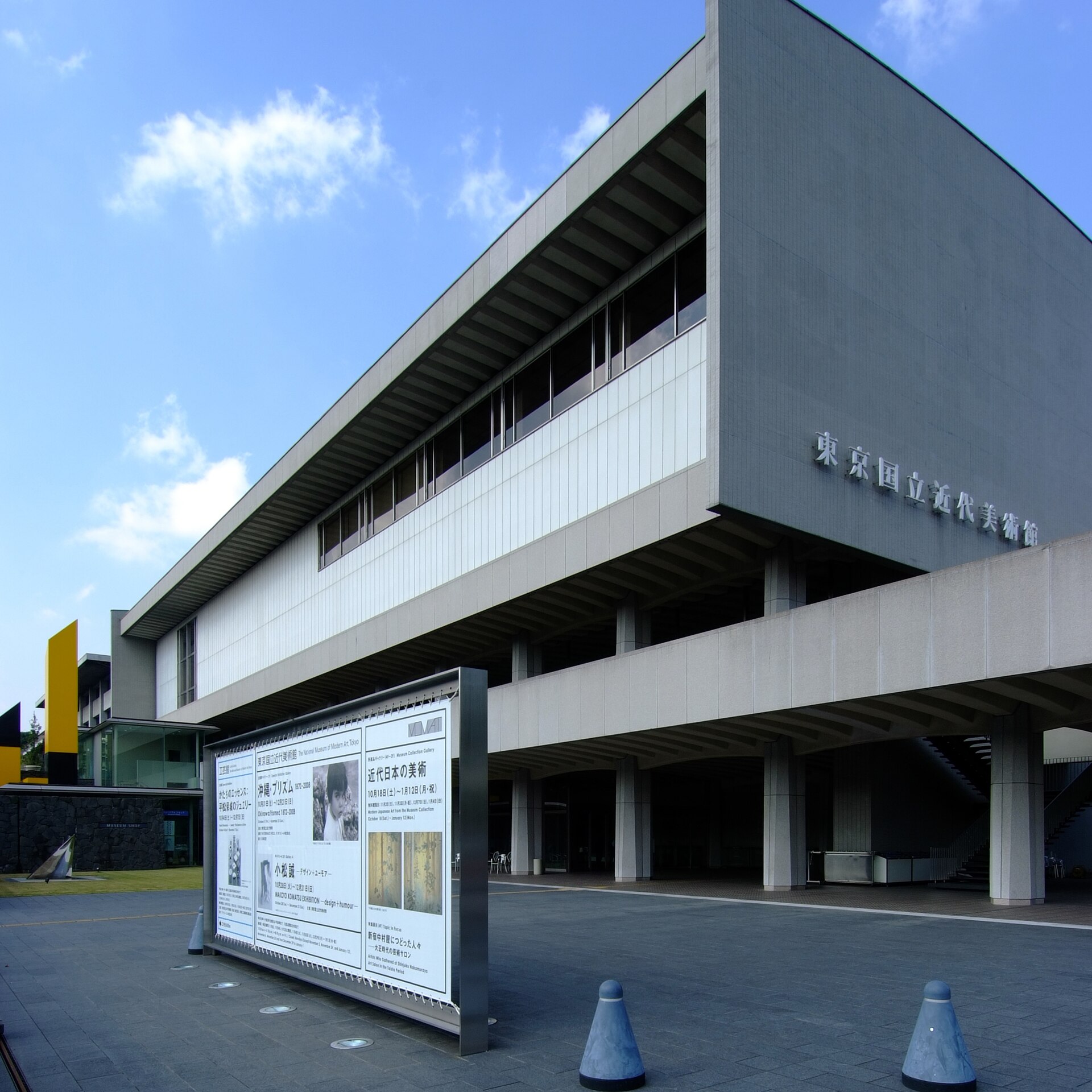
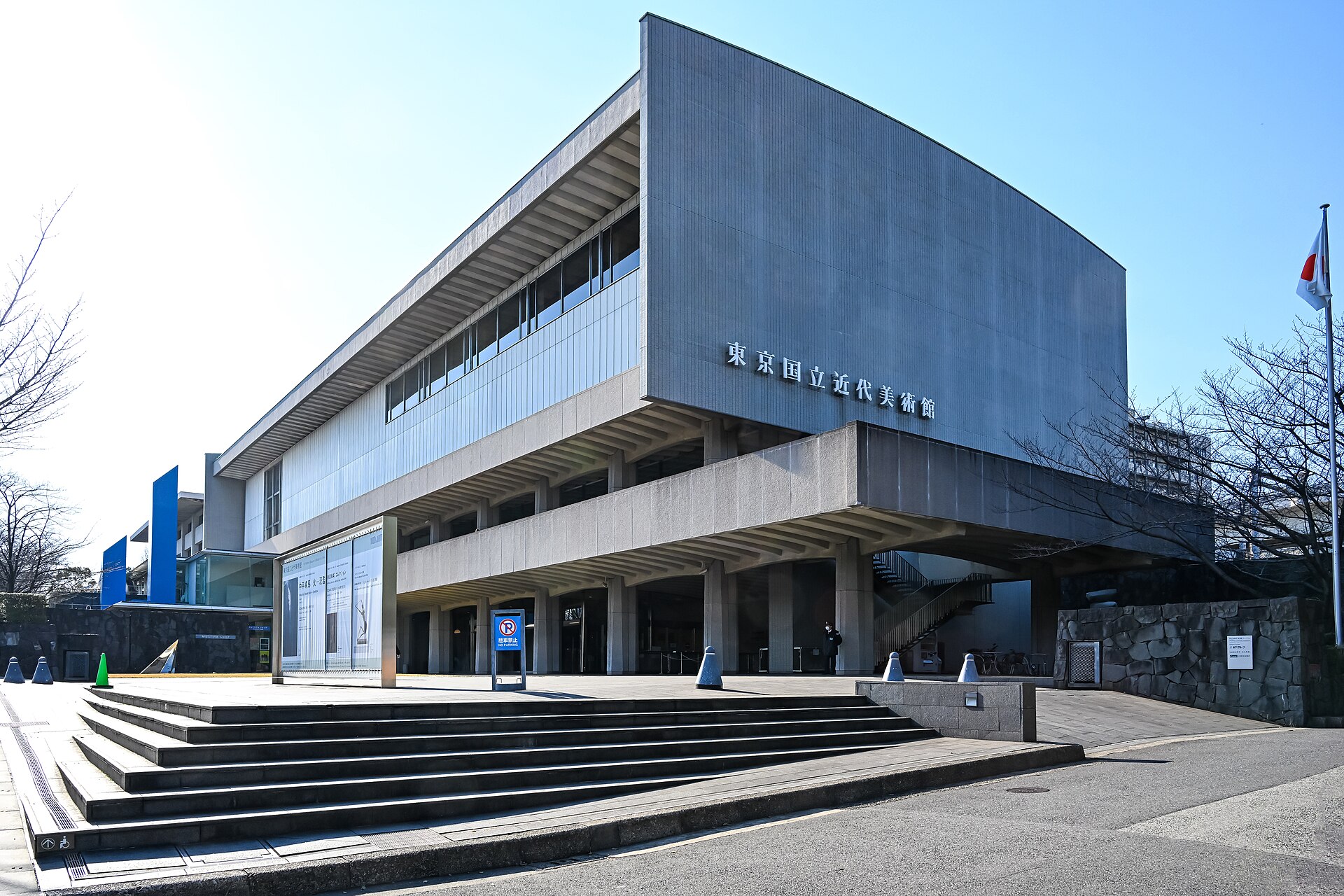
The museum that stands today at 3-1 Kitanomaru Koen is not its original building. It opened there in 1969, on land in Chiyoda ward close to the Imperial Palace, in a structure designed by the architect Taniguchi Yoshiro and funded by a donation from the industrialist Ishibashi Shojiro. Taniguchi's design, in steel-reinforced concrete over four floors above ground and one basement level, was conceived to sit at the meeting point of old Japan and the modern city around it: thick pilotis columns and undulating beams give the concrete exterior a rhythm the museum's own architecture page describes as distinctly Japanese in character rather than a plain import of postwar international style.
Thirty years on, in 2001 and 2002, the firm Sakakura Associates carried out a large-scale extension and earthquake-resistant renovation, reopening the museum in January 2002. The original atrium was removed in that work, but the museum has kept a room on the third floor, informally called the Room to Consider the Building, whose large windows preserve a view of Taniguchi's original design intent even where the safety upgrades changed the structure around it. Isamu Noguchi's sculpture Gate, installed outdoors at the 1969 opening, still stands as the building's most recognisable marker and its opening exhibition, Contemporary Art: Dialogue Between the East and West, set the terms the museum has worked from since.
Japan's first national art museum
The institution predates its building by seventeen years. It opened on 1 December 1952 in Kyobashi, in a former Nikkatsu Corporation building designed by the architect Maekawa Kunio, and it holds the distinction of being Japan's first national art museum. Through the 1950s and 1960s it built a reputation for exhibitions that ranged well beyond painting into photography, design and architecture, and it was that expanding programme, and an expanding collection, that outgrew the Kyobashi building and pushed the museum toward the move that gave it its present address.
A related institution, the Crafts Gallery, opened in 1977 in the former headquarters of the Imperial Guards, also inside Kitanomaru Park, and operated for over four decades as the museum's craft-focused branch. In 2020 it relocated out of Tokyo entirely, to Kanazawa in Ishikawa prefecture, where it reopened as the independent National Crafts Museum in two restored Meiji-period buildings. A reader planning a Tokyo visit should not expect to find it in the park any longer: the crafts collection now has its own address several hundred kilometres away, and the Kitanomaru building is the modern and contemporary art museum on its own.
Three floors, twelve rooms: what is inside today
The permanent holdings run to nearly 14,000 items spanning Japanese and Western-style painting, prints, sculpture, photography and video from the late nineteenth century to the present, of which about 200 works are on view at any one time across twelve or thirteen themed rooms on the fourth, third and second floors. The display rotates every two to three months, so a repeat visit is rarely a repeat of the same rooms. The fourth floor opens with a Highlights room, an introductory selection of prized works spanning roughly a century shown outside strict chronology, before moving into Meiji-era painting and crafts, Taisho-era individualism, a room devoted to Noh and Kabuki theatre imagery, and a room of interwar Surrealist and abstract work.
The third floor carries the collection through the Second World War and into the postwar decades: a room on Japanese art of 1941 to 1945, a room on two postwar women artists and their circle, a room built around unconventional 1960s materials and surfaces, and a room of staged photography made on the Tottori sand dunes. The second floor closes on contemporary painting, sculpture and photography from the 1990s onward. Eighteen items in the collection carry Important Cultural Property status, Japan's second-highest heritage designation for a movable object: twelve traditional Japanese paintings, five oil paintings and one sculpture.
A collection with a complicated inheritance
Not every holding arrived by simple purchase or gift. Under the National Mobilization Law of 1938, Japanese artists were compelled into producing what the museum's own collection history calls War Record Paintings, battlefield and home-front works meant to document and support the war effort. When the war ended, the occupying Allied Powers requisitioned the 153 major surviving works in this genre and transferred them to the United States in 1951. It took until March 1970 for the two governments to agree on their return, and even then only as an indefinite loan from the American government to the Japanese one rather than a restitution or transfer of title. Those 153 paintings still sit in the museum's collection today, on that same loan status, and one room on the third floor is given over to Japanese art of the war years, the War Record Paintings among them.
The museum does not tuck this history away. Its own published material on the genre states plainly that the works are shown to illustrate how Japanese artists depicted the conflict and the Allied forces at the time, not to endorse the picture they present, and that some of what the paintings show reads as inappropriate by present-day standards. For a page whose job is the record rather than the promotion, this is the museum's most consequential holding: a body of work whose ownership status was itself a matter of two governments' negotiation for a quarter of a century, still displayed under the terms of an unresolved loan rather than a settled acquisition.
What visitors take away
Readers planning a visit consistently come away satisfied with the collection itself and with the value it offers for a modest admission fee, an adult ticket to the collection galleries running to 500 yen. The fourth-floor rest area looking out over the Imperial Palace's Kitanomaru grounds, informally known among visitors as the room with a view, comes up often enough in reviews to count as a fixture of the visit rather than an incidental amenity, and the museum's English-language wall text and object labels are regularly credited with making an unfamiliar period of art history legible to a visitor who did not arrive already knowing it.
The recurring complaint runs the other way from what the museum's name promises. Visitors who arrive expecting a survey of current international contemporary practice instead meet a collection weighted toward Japanese art from the late nineteenth century onward, with the truly contemporary rooms confined to the second floor at the end of the route, and some find the room-by-room thematic curation hard to follow without close attention to the didactic panels. Neither complaint touches the quality of what is on the walls; both are about a museum whose English name, Museum of Modern Art, sets an expectation its Japanese remit was never built to match on its own terms.
What visitors say
Visitors consistently rate the collection itself very highly and single out the fourth-floor rest area's view over the Imperial Palace grounds; the most common complaint is that the museum reads as more historical and specialised than the word modern suggests, and that the room-by-room curation can be hard to follow without the wall text
What is praised, what is criticised
- Praised: The breadth and quality of the collection for a modest admission price
- Praised: The fourth-floor rest area, popularly called the room with a view, looking out over the Imperial Palace's Kitanomaru grounds
- Praised: Detailed English-language wall text and object labels giving historical context
- Criticised: Curation that some visitors find confusing to follow without reading the didactic material closely
- Criticised: A programme some visitors find narrower and less contemporary than the name Museum of Modern Art suggests, since the emphasis is on Japanese art from the late nineteenth century onward rather than current international practice
Ratings on other platforms
Google: 4.3 from 7,637 ratings, read 17 September 2026
TripAdvisor: 4.1 from 326 ratings, read 17 September 2026
A platform average is a tertiary source: it moves, it is not audited, and we quote no visitor's words.
Questions about The National Museum of Modern Art, Tokyo
Where is The National Museum of Modern Art, Tokyo?
3-1 Kitanomaru Koen, Chiyoda-ku, Tokyo 102-8322, Japan.
How much does it cost to visit?
Adult: JPY 500; Adult, group of 20 or more: JPY 400; Adult, evening: JPY 300; College or university student: JPY 250; College or university student, group: JPY 200. As confirmed 17 September 2026.
When is it open?
Tue-Thu, Sun 10:00-17:00; Fri-Sat 10:00-20:00. Closed: Monday, or the following day if Monday is a national holiday. Exhibition changeover periods. As confirmed 17 September 2026.
How do you get there?
Subway: Takebashi Station on the Tozai Line, exit 1b, about a 3-minute walk; Subway: Kudanshita Station on the Tozai, Hanzomon and Toei Shinjuku lines, about a 15-minute walk; Subway: Jimbocho Station on the Hanzomon and Toei Mita/Shinjuku lines, about a 15-minute walk; Rail: Tokyo Station, about a 20 to 25-minute walk via the Marunouchi exits.
What should you see first?
Grand Bouquet of Flowers (Paul Cezanne); Parting Spring (Kawai Gyokudo); The Stray Child (Yokoyama Taikan); Hand (Takamura Kotaro); War Record Paintings (Various Japanese wartime artists, official war painters 1941-45); The Kishida Ryusei archive (Kishida Ryusei).
What we could not confirm
- The museum's own site does not state a bag or locker policy; this needs a first-hand or press confirmation before the page can say anything more specific than that it is unaddressed
Images
Sources
- 1The National Museum of Modern Art, Tokyo, official site, English homepage momat.go.jp/en/
- 2The National Museum of Modern Art, Tokyo, About page momat.go.jp/en/about
- 3The National Museum of Modern Art, Tokyo, History page momat.go.jp/en/history
- 4The National Museum of Modern Art, Tokyo, Architecture page momat.go.jp/en/architecture
- 5The National Museum of Modern Art, Tokyo, Tickets page momat.go.jp/en/tickets
- 6The National Museum of Modern Art, Tokyo, Access and visit-planning page momat.go.jp/en/access
- 7The National Museum of Modern Art, Tokyo, FAQ page momat.go.jp/en/faq
- 8The National Museum of Modern Art, Tokyo, About the Collection page momat.go.jp/en/about-collection
- 9The National Museum of Modern Art, Tokyo, MOMAT Collection exhibition page, 2026.3.3-2026.5.10 momat.go.jp/en/exhibitions/r7-3
- 10Wikimedia Commons, File:National Museum of Modern Art, Tokyo (2).jpg, licence and author data commons.wikimedia.org/wiki/File:National_Museum_of_Modern_Art,_Tokyo_(2).jpg
- 11Wikimedia Commons, File:National Museum of Modern Art, Tokyo.jpg, licence and author data commons.wikimedia.org/wiki/File:National_Museum_of_Modern_Art,_Tokyo.jpg
- 12Wikimedia Commons, File:Tokyo Kokuritsu Kindai Bijutsukan (54406710465).jpg, licence and author data commons.wikimedia.org/wiki/File:%E6%9D%B1%E4%BA%AC%E5%9B%BD%E7%AB%8B%E8%BF%91%E4%BB%A3%E7%BE%8E%E8%A1%93%E9%A4%A8_(54406710465).jpg
- 13Wanderlog, The National Museum of Modern Art Tokyo, visitor ratings and review summary wanderlog.com/place/details/19909/the-national-museum-of-modern-art-tokyo
.jpg)

.jpg)