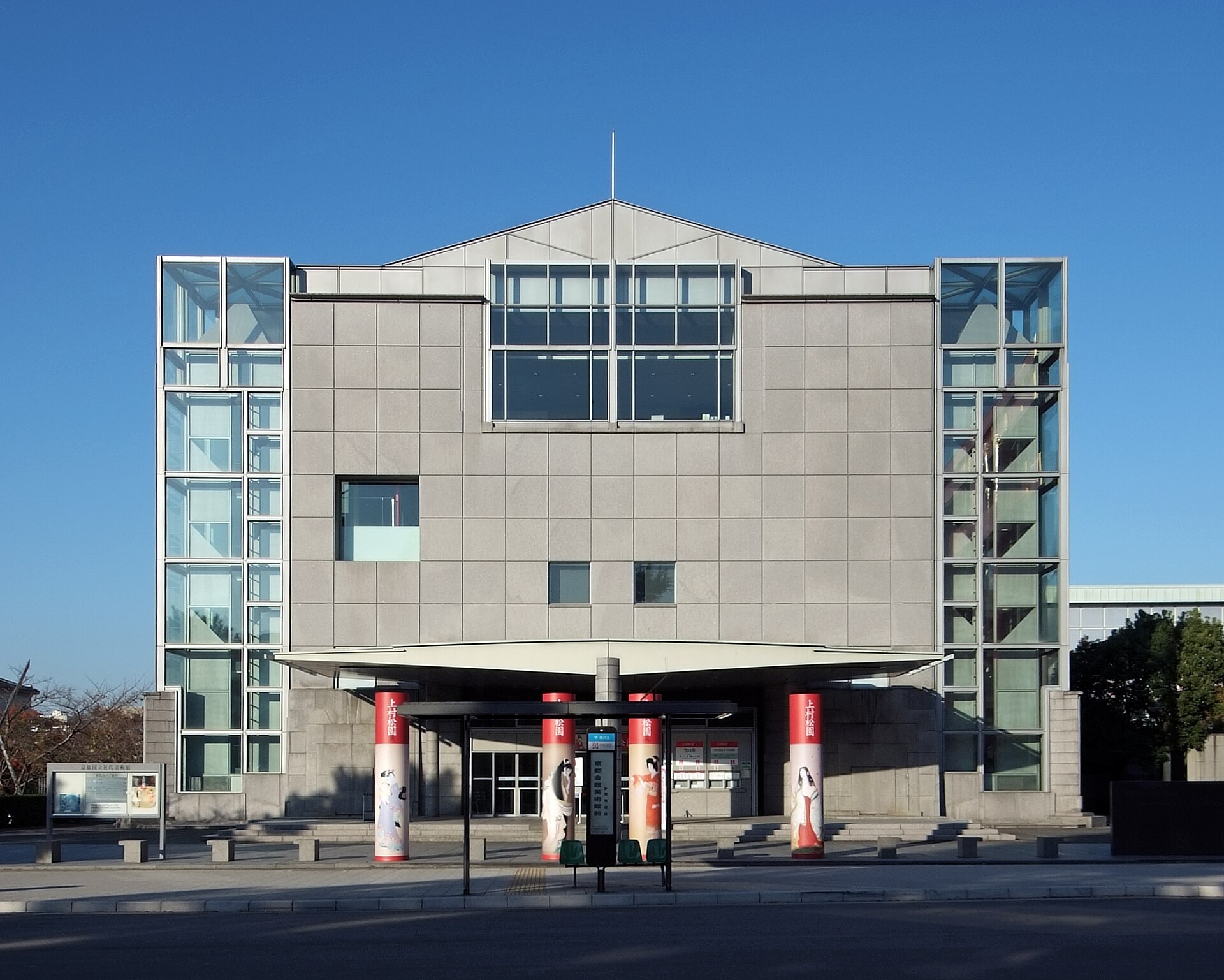
The symmetrical granite-grid facade of the National Museum of Modern Art, Kyoto, designed by Fumihiko Maki.
Wiiii, CC BY-SA 3.0, via Wikimedia CommonsNational Museum of Modern Art, Kyoto
Museum · 京都国立近代美術館 · Founded 1963
Open, admission and hours confirmed 23 November 2026 · 23 sources
On this page 14 sections
ContentsClose
Kyoto School nihonga and the crafts of Kyoto and western Japan, with a smaller group of European and American modernism and a photography holding that runs from Atget to Dorothea Lange.
| Local name | 京都国立近代美術館 |
|---|---|
| Kind | Museum |
| Founded | 1963 |
| City and country |  Kyoto, Japan |
| Address | 26-1 Okazaki Enshoji-cho, Sakyo-ku, Kyoto 606-8344, Japan |
| Website | momak.go.jp |
| Status | Open, confirmed |
| Record last verified |
Visiting
- Hours
- Tue-Sun10:00 to 18:00Last admission 17:30
- Fri10:00 to 20:00Extended hours; last admission 19:30
- Closed
- Monday (or the following Tuesday if Monday is a national holiday). 29 December to 3 January. 18 January 2027 to end of March 2027 for facility maintenance (announced 29 May 2026).
- Admission
- Special exhibition, adultJPY 2,000Reflections in Jewellery, 24 Oct 2026 to 17 Jan 2027; 1,800 yen advance or night discount; includes the Collection Gallery
- Special exhibition, university studentJPY 1,3001,100 yen advance or night discount
- Special exhibition, high school studentJPY 600400 yen advance or night discount
- Special exhibition, junior high school or youngerFreefree
- Collection Gallery only, adultJPY 1,000800 yen night discount from 18:00 on Friday
- Collection Gallery only, university studentJPY 500400 yen night discount
- Collection Gallery only, high school student or younger, or 65 and overFreefree
Free entry: Collection Gallery free days are listed on the museum's event calendar- Tickets
- momak.go.jp/English/guide The museum's own ticket page.
- Do I need to book?
- No booking is stated; advance tickets are sold online for exhibitions
- Address
- 26-1 Okazaki Enshoji-cho, Sakyo-ku, Kyoto 606-8344, Japan MapSubway Higashiyama Station on the Kyoto City subway Tozai Line, about 10 minutes on foot
Bus Kyoto City Bus 5 or 100 from Kyoto Station, or 5 or 46 from Hankyu Karasuma, Kyoto-kawaramachi and Keihan stations, to Okazaki Koen/Bijutsukan, Heian Jingu-mae
Car No museum car park; the underground Okazaki-koen car park is advised, with 200 yen off for paying visitors - Website
- momak.go.jp
- Telephone
- 075-761-4111
Before you go how long, access, photography, bags, eating, shop
- How long to allow
- One reviewer on Trip Advisor, relayed by Live Japan, found the museum small enough to see in about an hour; a special exhibition plus the Collection Gallery needs longer
- Access
- Sloped entrance, elevator, 10 loan wheelchairs, English voice guidance in elevators, Braille intercom, nursing room, strollers
- Photography
- Not stated on the pages read; check at the desk
- Bags
- Free lockers on the first floor
- Eating
- cafe de 505, first floor, glass-walled with a canal terrace, 10:00-18:00
- Shop
- Museum Shop Art+, first floor, 10:00-18:00 (to 20:00 on Fridays during special exhibitions), no ticket needed
Prices and hours change. We take them from the institution's own pages and print the day we read them, and you can check the current position at the source we used. Confirm before you travel.
What is inside
Exhibition Hall (3rd floor)
Special and travelling exhibitions, about five a year. The current show is Reflections in Jewellery: Memory and Identity, about 350 pieces by post-war jewellery artists. A special exhibition ticket includes the Collection Gallery.
Collection Gallery (4th floor)
Selected works from the museum's own collection in rotating, themed displays: Japanese-style and Western-style painting, prints, sculpture, crafts and photography, with modern and contemporary European and American art. The third display of 2026-27 runs 24 October 2026 to 17 January 2027.
Lobby, entrance and auditorium (1st floor)
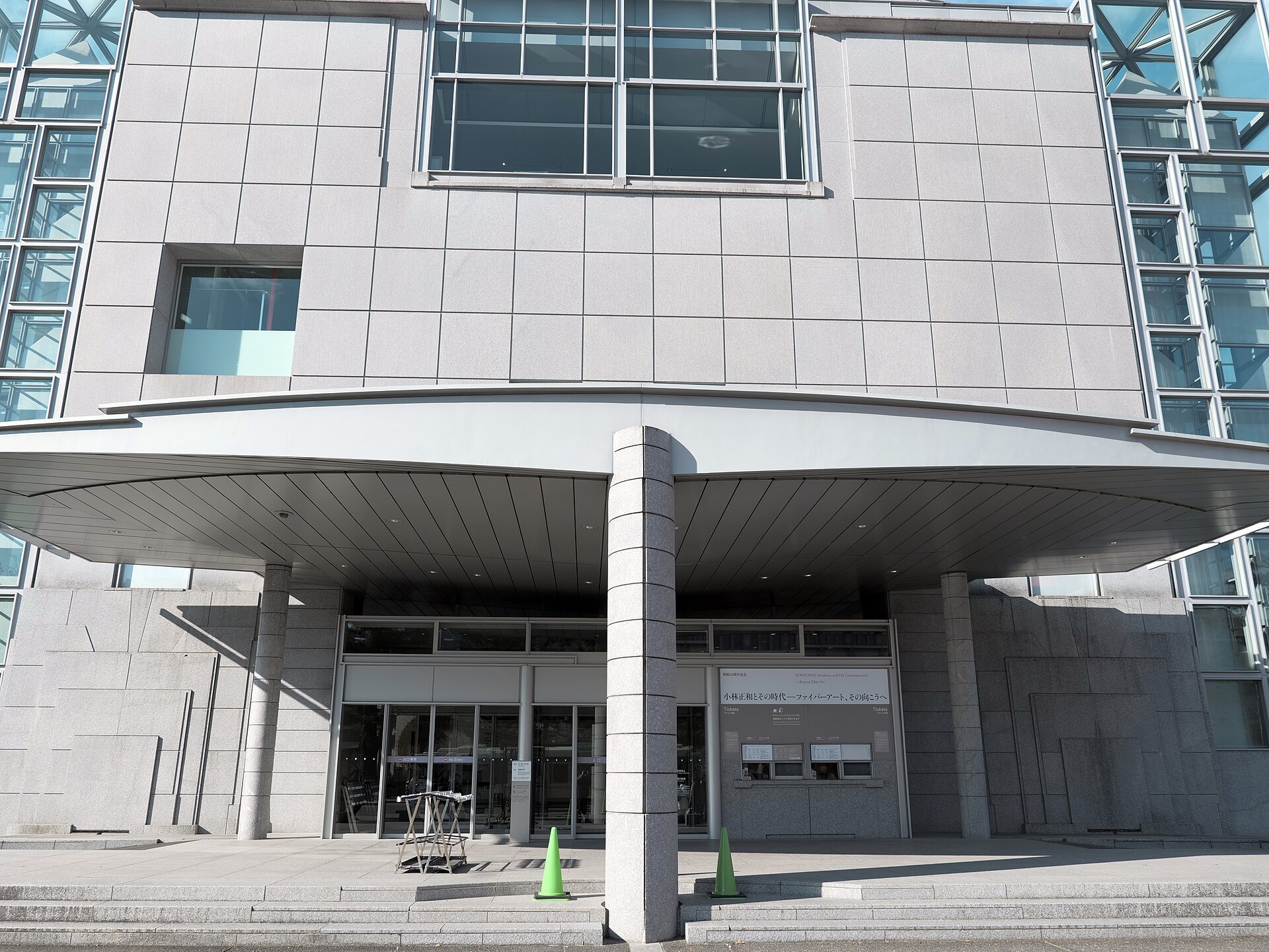
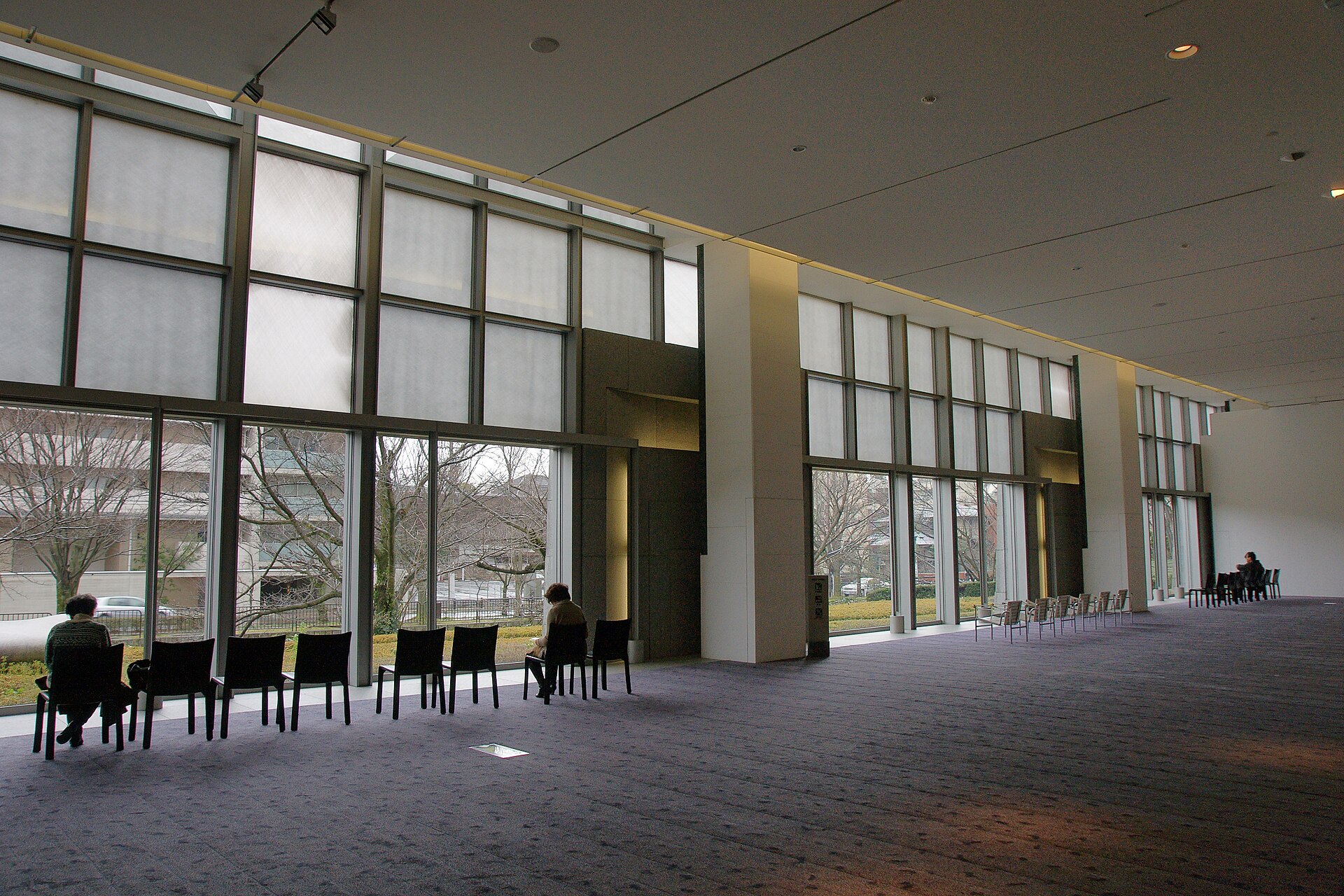
The entrance hall under Maki's raised upper storeys, the main stair lit from above, a rear lobby with large windows over the Lake Biwa Canal, information desk, free lockers and an auditorium. The lobby has hosted concerts and dance performances.
Museum Shop Art+ and cafe de 505 (1st floor)
Exhibition catalogues, art books, postcards of collection works, original goods and glass crafts; and a glass-walled cafe with terrace serving coffee, tea, cake and light meals. Both are open to people without a ticket.
Reference Corner (4th floor)
A reference corner next to the Collection Gallery, shown on the museum's floor plan.
What to see first
Composition No. 1 (1929)
Piet MondrianNamed in the museum's architecture essay, which ties Maki's remark about a De Stijl world to the Mondrian in the collection.5
Small Blue Dress before a Mirror (1937)
Henri MatisseOne of the European oil paintings listed on the collection page, set among a Kyoto-centred holding.9
Spring Snow (1942)
Takeuchi SeihoA leading entry among the Japanese-style paintings on the collection page, the category the museum says it has built since its annex days.9
Preparing to Dance (1914)
Uemura ShoenListed among the nihonga holdings that anchor the Kyoto School emphasis.9
Oharame (Woman Peddlers from Ohara) (1927)
Tsuchida BakusenListed with the Kyoto nihonga group the museum names as its particular emphasis.9
Reiko Playing Shamisen (1923)
Kishida RyuseiOne of the Japanese Western-style oil paintings on the collection page.9
Migrant Mother (1936)
Dorothea LangeListed among the photographs, which also include Atget, Weston, Stieglitz and Capa.9
Distance (1974)
Yagi KazuoA ceramic work listed on the collection page, representing the crafts the museum collects across glass, ceramics, metal, lacquer and textile.9
A national museum that began as an annex
The National Museum of Modern Art, Kyoto, known by its own abbreviation MoMAK, was established on its present site on 1 March 1963 as the Annex Museum of the National Museum of Modern Art in Tokyo. Its first home was not a purpose-built gallery. It was the former auxiliary building of the Kyoto Municipal Exhibition Hall for Industrial Affairs, which Kyoto City granted to the national museum after restoration. On 1 June 1967 the annex became an institution in its own right under its current name. The museum states its remit plainly: it collects and preserves artworks and related reference materials of the twentieth century in Japan and elsewhere, with particular emphasis on artists and movements of Kyoto and the Kansai region, such as the Kyoto School of Japanese-style painting. That regional emphasis is what separates it from its Tokyo counterpart and it is the reason a reader should not confuse the two. It is also one of four national art museums whose holdings are searchable in a shared union catalogue, alongside the Tokyo modern art museum, the National Museum of Art in Osaka and the National Museum of Western Art in Tokyo.
Maki's building, and the rules of the park
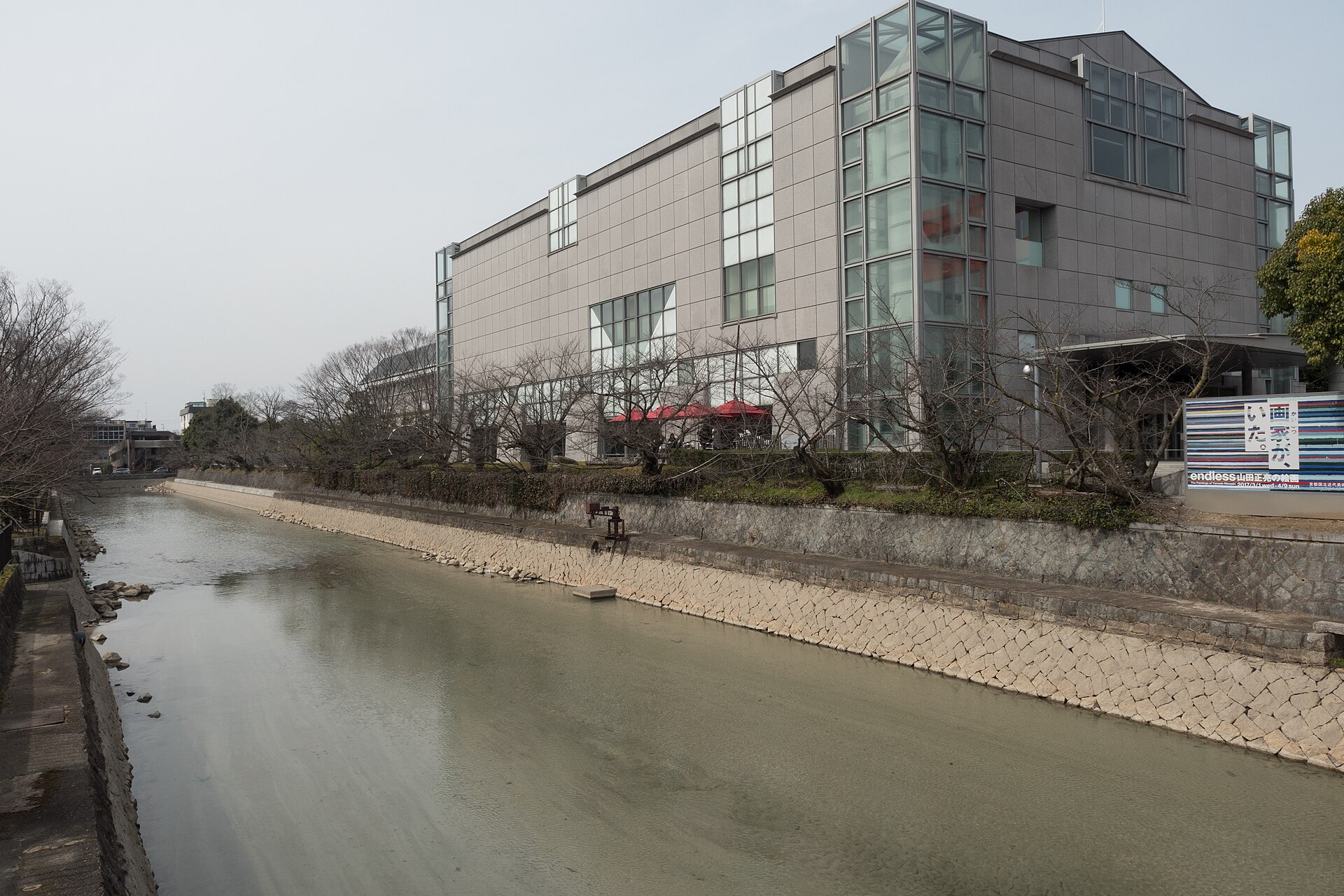
By the early 1970s the old exhibition hall was so cramped that parts of the galleries had to be partitioned off for storage. In 1973 the architect Fumihiko Maki was asked to design a replacement. The old building was dismantled and the new one opened to the public on 26 October 1986, with 9,761.99 square metres of total floor area and 2,604.94 square metres of exhibition area. The site is Okazaki Park, laid out in the Meiji era around Heian Shrine and ringed by the Lake Biwa Canal. The park is a designated scenic area, and the museum states that no building there may rise above the great torii gate on the approach to the shrine. Maki answered with a low block whose second-floor plan is reduced so the entrance and lobby gain height, with skylights over the main stair and a run of windows in the rear lobby facing the canal. The exterior is a symmetrical grid of Portuguese granite. Inside, the museum says, a radically different white marble space waits behind the grey wall, with steel and glass railings and stair columns painted vermilion or grey. Maki is quoted in the museum's own architecture essay, from the journal Shinkenchiku of January 1987, saying he intended a seemingly De Stijl world, and the museum notes that its collection holds a Mondrian composition. Maki and Associates describe a 1.5 metre facade grid that sets horizontality against verticality and mass against transparency, in a building of one basement level and four storeys in steel and reinforced concrete. The galleries themselves admit no sunlight, for conservation. Glass-walled staircases at all four corners give the visitor a view out as soon as a gallery is left. The windows are of two kinds: clear glass and a milky translucent glass with white glass fibre sandwiched inside, which the museum compares to shoji screens. The furniture was designed for the building, including a purple ribbon-like bench by Fujie Kazuko in front of the Collection Gallery.
What the collection is for
The museum's collection page names the categories it holds: Japanese-style paintings, oil paintings, watercolours and drawings, prints, photography, ceramics, metal works, lacquerware, wood works, bamboo works, textiles, non-category works and special collections. Counts vary by source. Japan Travel and Time Out's feature page give about 13,000 works; Time Out's separate listing says around 10,000. The museum's own pages quote no total, so the figure should be read as approximate. The strength is Kyoto. The museum says it has collected with particular emphasis on nihonga and crafts since it was an annex, and its collection page leads with works by Takeuchi Seiho, Uemura Shoen, Murakami Kagaku, Tsuchida Bakusen and Tomita Keisen. Beside them sits a smaller group of European and American modernism: Redon, Mondrian, Matisse and, in photography, Atget, Weston, Dorothea Lange, Stieglitz and Robert Capa. The ceramics list reaches from Kiyomizu Rokuwa and Kitaoji Rosanjin to Yagi Kazuo. Display works on a schedule. The collection is shown in the Collection Gallery on the fourth floor and rotates about five times a year according to the museum's history page, each rotation with themed sub-exhibitions that follow the concurrent show or present the museum's research. English-language Wikipedia says the gallery rotates about twenty times a year, so the two disagree, and the museum's own figure is the one used here.
Exhibitions on the third floor
Special and travelling exhibitions occupy the Exhibition Hall on the third floor, about five a year. The 2026 programme on the museum's archive page has Modern Urban Life and Takehisa Yumeji: Works from the Kawanishi Hide Collection from 28 March to 21 June, then Antonio Fontanesi: Transcending Landscape, a European artist at the opening of Japan, from 18 July to 4 October. The current show, from 24 October 2026 to 17 January 2027, is Reflections in Jewellery: Memory and Identity. The museum describes about 350 pieces by post-war jewellery artists, including a large public presentation of the Hiko Mizuno College of Jewelry collection and masterworks brought to Japan from Germany after a fifty-year absence. It traces the Japan Jewellery Designers Association founded in 1964 and the contemporary jewellery movement that followed. The museum notes that it had already shown the 1984 exhibition Contemporary Jewellery: The Americas, Australia, Europe and Japan, with Otto Kunzli and Caroline Broadhead among the artists. A ticket to a special exhibition includes the Collection Gallery. The Collection Gallery also has its own cheaper ticket, and the museum publishes free-admission days on its event calendar.
The visit: tickets, hours and the neighbours
The museum opens 10:00 to 18:00 with last admission at 17:30, and on Fridays opens until 20:00 with last admission at 19:30. It is closed on Mondays, or on the following Tuesday when the Monday is a national holiday, and over the New Year from 29 December to 3 January. It may also close between shows for installation, which the event calendar shows. The museum shop Art+ and the glass-walled cafe de 505 are on the first floor, with a terrace over the canal that the museum calls a favourite spot in cherry blossom season. Neither needs an exhibition ticket. The first floor also holds lockers, a nursing room and the auditorium. The Collection Gallery and a reference corner are on the fourth floor. Okazaki is a cluster. The museum's own pricing page offers discounted group rates between the museum and two neighbours: the Hosomi Museum, and the Kyoto City KYOCERA Museum of Art, a separate institution next door. Time Out places Heian Shrine to the north. The nearest subway station is Higashiyama on the Tozai line, about ten minutes on foot. Kyoto City Bus routes 5 and 100 from Kyoto Station, and routes 5 and 46 from Hankyu and Keihan stations, stop at Okazaki Koen Bijutsukan Heian Jingu-mae. The museum has no car park of its own and points drivers to the underground Okazaki-koen car park.
Access, and a closure on the calendar
Step-free access is provided by a sloped entrance and an elevator, and ten wheelchairs can be borrowed. Elevators have English voice guidance and an intercom with a Braille panel stands outside. Admission is free for visitors with disabilities and one assistant, and for atomic bomb survivors, on presentation of a certificate or health handbook. One date matters to anyone planning ahead. A notice dated 29 May 2026 on the museum's news page says the museum will be closed from Monday 18 January 2027 through the end of March for facility maintenance, with the reopening schedule for April and later to be announced. That is the day after the current jewellery exhibition ends. The museum is open today and for the weeks until that date, but a visit in the first quarter of 2027 cannot be planned from what is published.
What visitors say
Visitors and critics agree on the setting and the Kyoto focus: the canalside position in Okazaki Park, the calm of the building and the strength of Kansai painting and crafts. Complaints are about the architecture reading as plain, the size of the permanent display and thin English labelling on the permanent collection. Ratings sit close to four out of five on the large platforms.
What is praised, what is criticised
- Praised: The location beside the Lake Biwa Canal and Heian Shrine, with the cafe terrace in cherry blossom season
- Praised: The Kyoto and Kansai collection of nihonga and crafts, which Time Out and Japan Travel both single out
- Praised: Strong temporary exhibitions, with fashion and jewellery shows singled out by one Trip Advisor reviewer as a draw
- Criticised: The building: Time Out Tokyo's reviewer found the Maki block plain and unbecoming as the home of a leading contemporary art venue
- Criticised: Small scale: one Trip Advisor reviewer saw the whole museum in about an hour
- Criticised: Little or no English description beside the permanent exhibits, noted by one Trip Advisor reviewer
Ratings on other platforms
Tripadvisor: 3.9 from 157 ratings, read 23 November 2026
Google (via Tripexpert aggregator, undated): 4.1 from 3,198 ratings, read 23 November 2026
A platform average is a tertiary source: it moves, it is not audited, and we quote no visitor's words.
Questions about National Museum of Modern Art, Kyoto
Where is National Museum of Modern Art, Kyoto?
26-1 Okazaki Enshoji-cho, Sakyo-ku, Kyoto 606-8344, Japan.
How much does it cost to visit?
Special exhibition, adult: JPY 2000; Special exhibition, university student: JPY 1300; Special exhibition, high school student: JPY 600; Special exhibition, junior high school or younger: free; Collection Gallery only, adult: JPY 1000. As confirmed 23 November 2026.
When is it open?
Tue-Sun 10:00-18:00; Fri 10:00-20:00. Closed: Monday (or the following Tuesday if Monday is a national holiday). 29 December to 3 January. As confirmed 23 November 2026.
How do you get there?
Subway: Higashiyama Station on the Kyoto City subway Tozai Line, about 10 minutes on foot; Bus: Kyoto City Bus 5 or 100 from Kyoto Station, or 5 or 46 from Hankyu Karasuma, Kyoto-kawaramachi and Keihan stations, to Okazaki Koen/Bijutsukan, Heian Jingu-mae; Car: No museum car park; the underground Okazaki-koen car park is advised, with 200 yen off for paying visitors.
What should you see first?
Composition No. 1 (1929) (Piet Mondrian); Small Blue Dress before a Mirror (1937) (Henri Matisse); Spring Snow (1942) (Takeuchi Seiho); Preparing to Dance (1914) (Uemura Shoen); Oharame (Woman Peddlers from Ohara) (1927) (Tsuchida Bakusen); Reiko Playing Shamisen (1923) (Kishida Ryusei).
What we could not confirm
- What the museum will publish for the reopening after the facility maintenance closure that starts 18 January 2027; the museum says only April or later
- Collection total: sources give about 10,000 or about 13,000 and the museum's own pages give none
- How often the Collection Gallery rotates: the museum says about five times a year, Wikipedia says about twenty
Images
Sources
- 1MoMAK, English home page (open notice, hours, 2026-11-23) momak.go.jp/English/
- 2MoMAK, Visit: hours and admission momak.go.jp/English/guide/
- 3MoMAK, Getting to MoMAK momak.go.jp/English/guide/access.html
- 4MoMAK, Museum History momak.go.jp/English/about/about.html
- 5MoMAK, Museum Architecture momak.go.jp/English/about/architecture.html
- 6MoMAK, Museum Shop and Cafe momak.go.jp/English/guide/museumShop.html
- 7MoMAK, Accessibility momak.go.jp/English/guide/barrierFree.html
- 8MoMAK, Floor plan momak.go.jp/English/guide/floorGuide.html
- 9MoMAK, The MoMAK Collection momak.go.jp/English/collection/
- 10MoMAK, Collection Gallery momak.go.jp/English/collectionGallery/
- 11MoMAK, News: Notice of Temporary Closure, 29 May 2026 momak.go.jp/English/news/
- 12MoMAK, Calendar of Events, November 2026 momak.go.jp/English/eventCalendar/
- 13MoMAK, Reflections in Jewellery: Memory and Identity momak.go.jp/English/exhibitionarchive/2026/468.html
- 14MoMAK, Japanese visitor guide (telephone 075-761-4111) momak.go.jp/Japanese/guide/
- 15Time Out Tokyo, National Museum of Modern Art, Kyoto (listing) timeout.com/tokyo/art/national-museum-of-modern-art-kyoto
- 16Time Out Tokyo, Five reasons to visit (marked as paid for by the National Museum of Art) timeout.com/tokyo/art/five-reasons-to-visit-the-national-museum-of-modern-art-kyoto
- 17Maki and Associates, National Museum of Modern Art Kyoto maki-and-associates.co.jp/projects/KKB?lang=en
- 18Japan National Tourism Organization, National Museum of Modern Art, Kyoto japan.travel/en/spot/1178/
- 19Tripexpert, MoMAK (aggregated ratings, ) tripexpert.com/kyoto/attractions/national-museum-of-modern-art-kyoto-momak
- 20Live Japan, MoMAK reviews page (Tripadvisor 3.9 from 157, ) livejapan.com/en/in-kansai/in-pref-kyoto/in-gion_kawaramachi_kiyomizu-dera-temple/spot-lj0009326/reviews/
- 21Wikipedia, National Museum of Modern Art, Kyoto () en.wikipedia.org/wiki/National_Museum_of_Modern_Art,_Kyoto
- 22Wikimedia Commons, Category:National Museum of Modern Art, Kyoto commons.wikimedia.org/wiki/Category:National_Museum_of_Modern_Art,_Kyoto
- 23MoMAK, Past Exhibitions 2026 momak.go.jp/English/exhibitionArchive/2026/