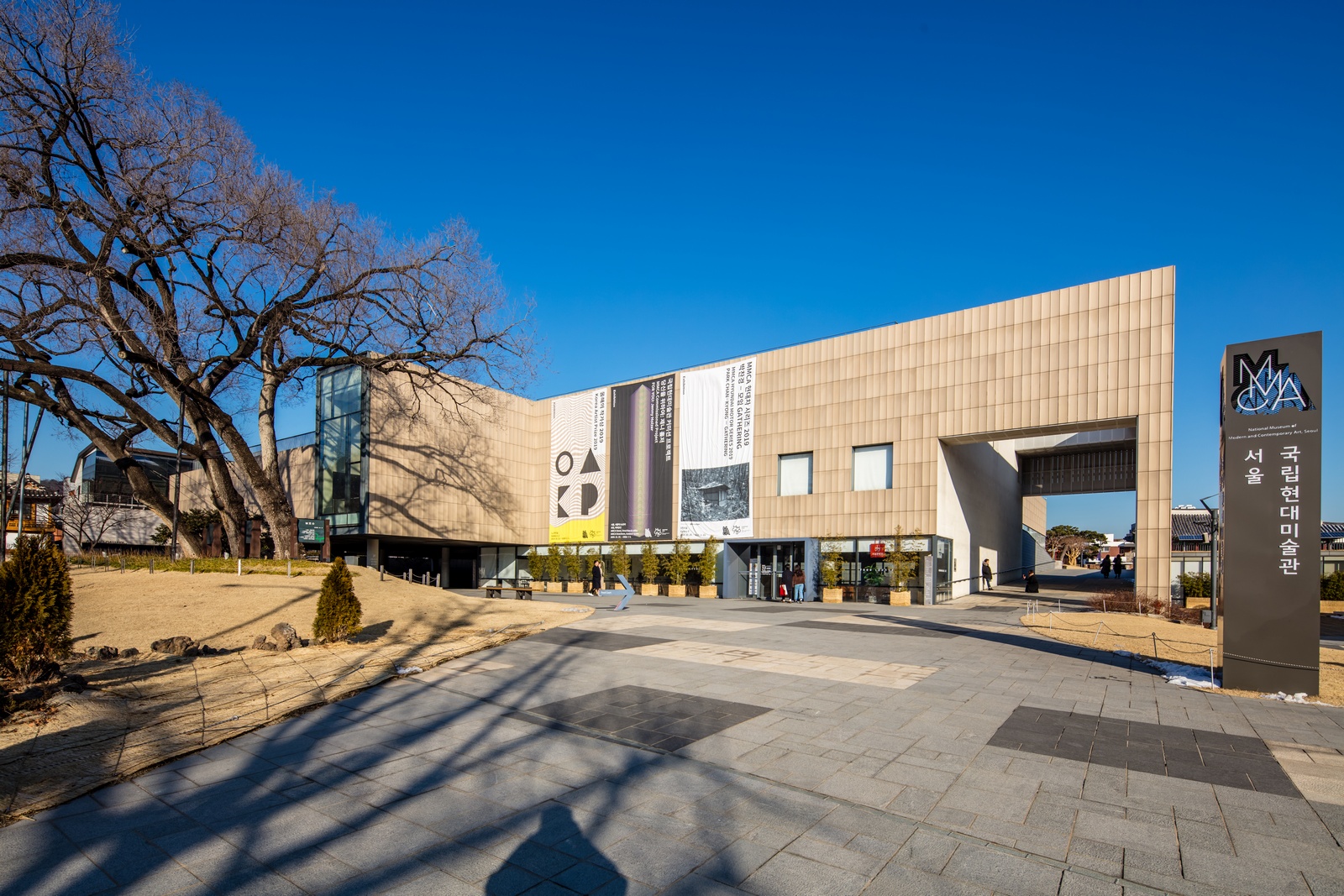
A straight-on view of the museum's low, terracotta-tiled facade, its MMCA pole sign at right, exhibition banners hung across the entrance wall and visitors passing through the glazed ground-floor entrance.
Photograph by the Seoul Institute, CC BY 4.0 · Photograph by 서울연구원National Museum of Modern and Contemporary Art, Seoul
Museum · 국립현대미술관 서울관 · Founded 2013
Open, admission and hours confirmed 24 September 2026 · 13 sources
On this page 16 sections
ContentsClose
MMCA's roughly 11,800-work collection is strongest in twentieth-century and contemporary Korean art, tracing the country's path from late-colonial figuration through 1950s-70s abstraction, the Dansaekhwa monochrome movement of the 1970s, and into the internationally exhibited contemporary generation of Do Ho Suh, Lee Bul and Haegue Yang; the Seoul branch's own galleries are built to show large-scale installation, moving-image and media art at a physical scale the museum's older Deoksugung site cannot accommodate, while Gwacheon remains the branch with the deepest holdings on permanent view.
| Local name | 국립현대미술관 서울관 |
|---|---|
| Kind | Museum |
| Founded | 2013 (Seoul branch; the parent institution, National Museum of Modern and Contemporary Art, Korea, was founded in 1969 with a first gallery inside Gyeongbokgung Palace) |
| City and country |  Seoul, South Korea Seoul, South Korea |
| Address | 30 Samcheong-ro, Sogyeok-dong, Jongno-gu, Seoul, 03062, South Korea |
| Website | mmca.go.kr/eng |
| Status | Open, confirmed |
| Record last verified |
Visiting
- Hours
- Monday, Tuesday, Thursday, Friday, Sunday10:00 to 18:00
- Wednesday, Saturday10:00 to 21:00Late-night opening; admission to all galleries is free from 18:00 to 21:00
- Closed
- 1 January. Lunar New Year's Day. Chuseok.
- Admission
- General entry (Seoul Box, courtyard and permanent MMCA Collection galleries)FreeFree. The Seoul branch's baseline collection displays and public spaces carry no charge; fees apply only to specific ticketed special exhibitions
- Combined ticket for paid special exhibitionsKRW 10,000Only offered when three or more paid special exhibitions are running at once, excluding multidisciplinary/performance programming; a single special exhibition is priced on its own and the price varies by show, so no one figure covers it
- Free evening openingsFreeAll galleries, including paid special exhibitions, are free Wednesday and Saturday 18:00-21:00, and on Culture Day, the last Wednesday of every month
- Free by categoryFreeUnder 24 or over 65 with ID, undergraduate students, donor-card holders plus up to three companions, ICOM and CIMAM cardholders, and museum patron/partner cardholders
Free entry: Every Wednesday and Saturday, 18:00-21:00 (late-night free admission). Culture Day: the last Wednesday of every month- Tickets
- mmca.go.kr/eng/exhibitionEvent/exhibitionList.do The museum's own ticket page.
- Do I need to book?
- Not required for general entry. Specific paid special exhibitions may run timed or capacity-limited entry during busy periods, per the exhibition's own ticket page
- Address
- 30 Samcheong-ro, Sogyeok-dong, Jongno-gu, Seoul, 03062, South Korea MapSubway Anguk Station (Line 3), Exit 1: about 500m straight ahead, right at Dongsipja Crossroads, then 500m further to the museum on the right
Subway Gyeongbokgung Station (Line 3), Exit 6: about 300m to Gwanghwamun intersection, cross, then follow signs toward Anguk Station to Dongsipja Crossroads and turn left
Subway Gwanghwamun Station (Line 5), Exit 2: about 500m, cross the crosswalk, then follow signs toward Anguk Station to Dongsipja Crossroads and turn left
Bus City bus stops near Anguk Station, Jogyesa Temple, Gwanghwamun and the Sejong Center serve the museum on foot - Website
- mmca.go.kr/eng
- Telephone
- +82-2-3701-9500
Before you go how long, access, photography, bags, eating, shop
- How long to allow
- Two to three hours to cover the eight interconnected galleries, the Seoul Box atrium and the courtyard; add time for any paid special exhibition
- Access
- A national government museum built after 2010 to current Korean accessibility law; step-free routes, lifts and accessible restrooms are provided throughout the underground gallery levels
- Photography
- Personal, non-flash photography is generally permitted in the permanent collection galleries; specific loan exhibitions may restrict it, and signage at each gallery entrance states the rule for that show
- Bags
- Large bags and framed items are held at the free cloakroom near the main entrance
- Eating
- A cafe operates off the Seoul Box atrium
- Shop
- A museum shop sells exhibition catalogues, artist editions and design goods near the main entrance
Prices and hours change. We take them from the institution's own pages and print the day we read them, and you can check the current position at the source we used. Confirm before you travel.
What is inside
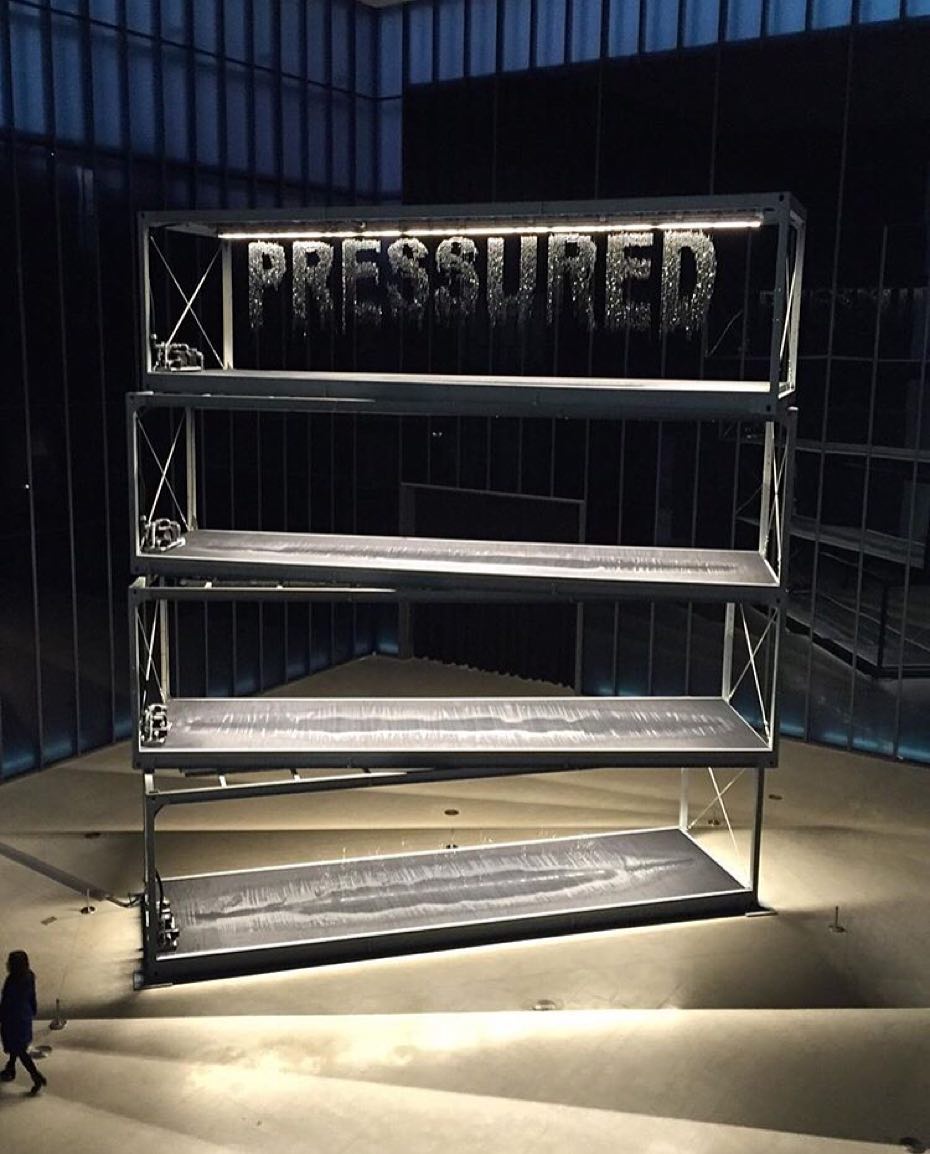
Photograph by designmilk from USA · CC BY-SA 2.0 Seoul Box
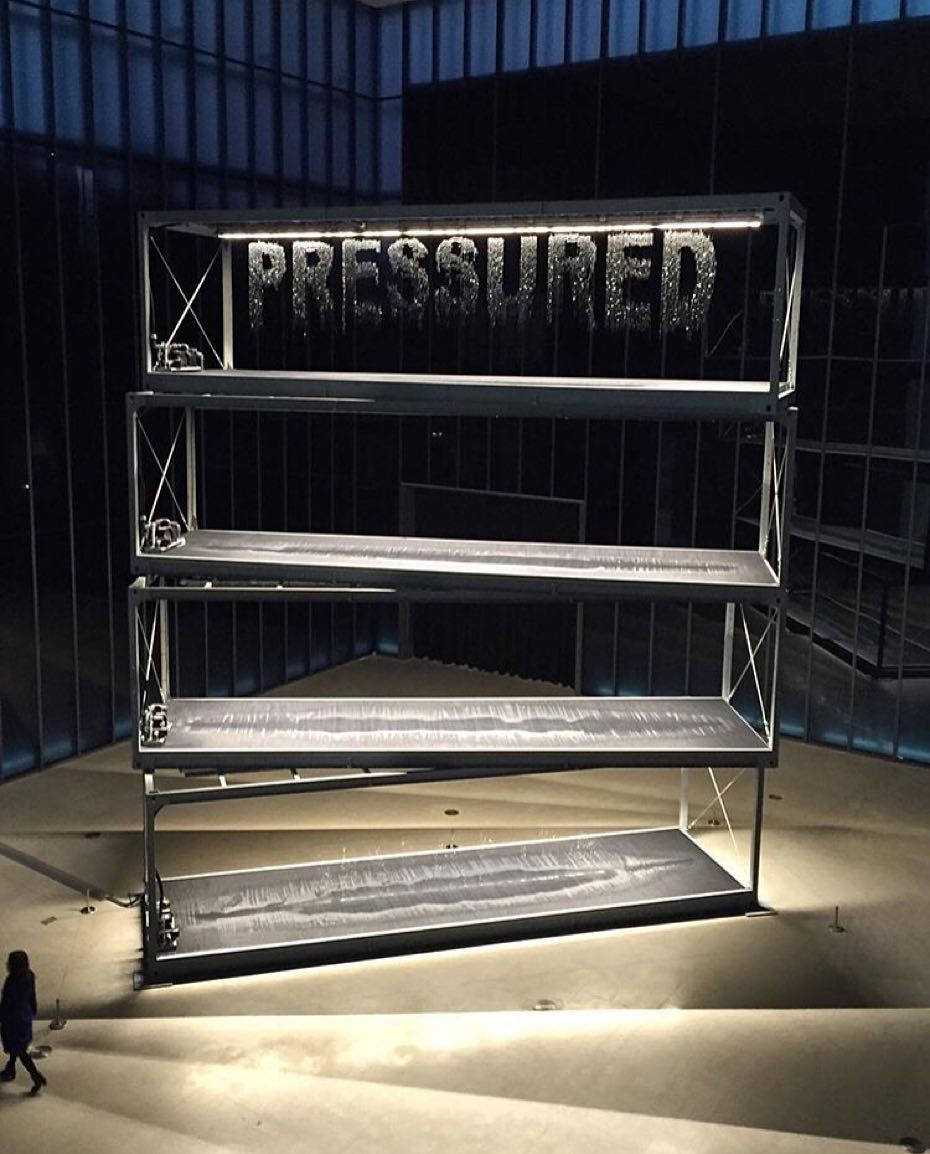
The soaring central atrium the architects dropped below street level so the building's exterior could stay low and quiet beside the palace; it is the museum's signature space for large-scale, site-specific commissions, among them Julius Popp's bit.fall, in which arrays of falling water droplets are timed to spell words pulled from live internet news feeds as they fall
Exhibition galleries 1 to 8
Eight interconnected gallery buildings threaded around the sunken courtyard carry the museum's rotating temporary exhibitions and, since May 2025, its first permanent survey displays of the collection, moving between double-height rooms built for large installation work and smaller rooms scaled to painting
The Jongchinbu courtyard
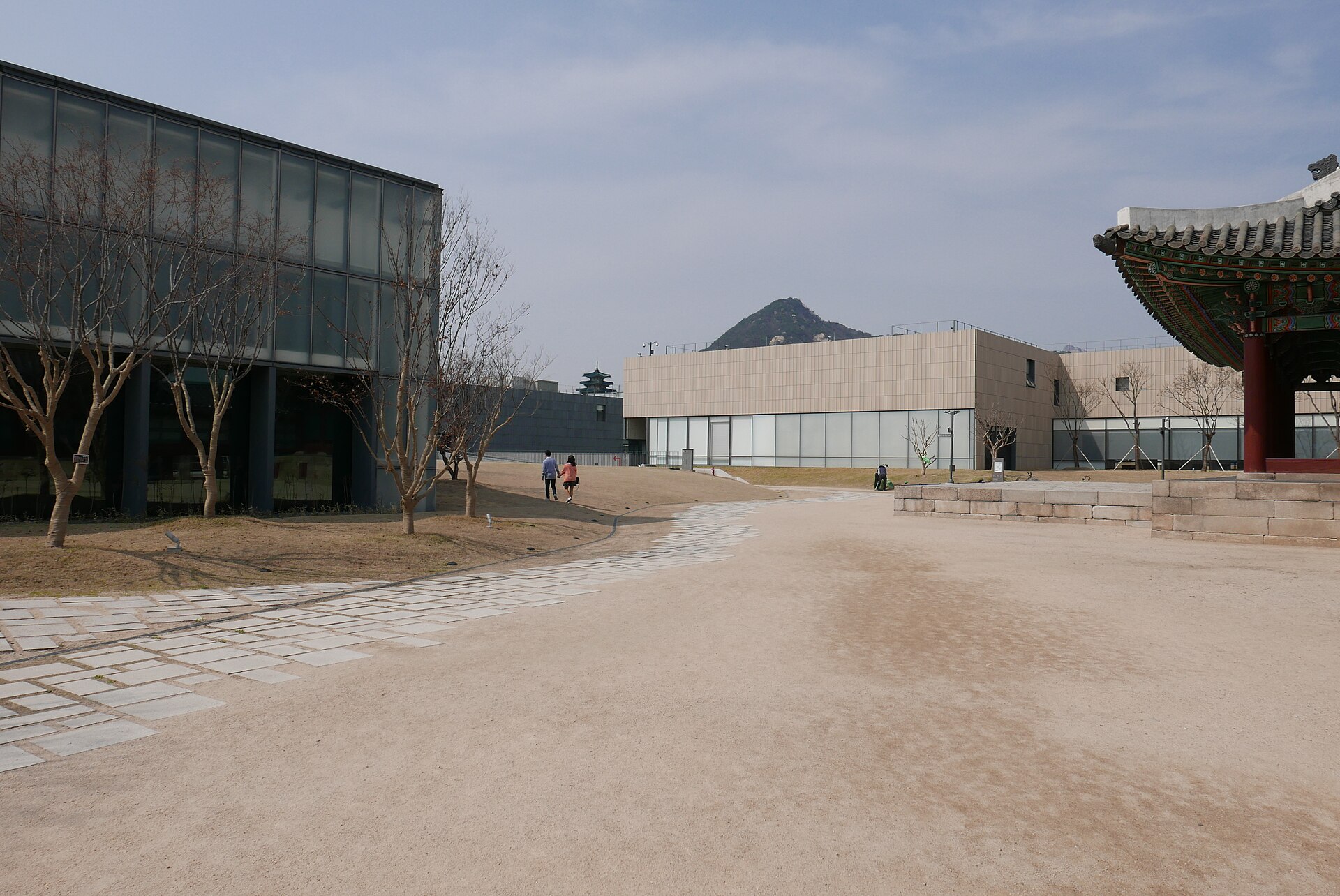
Two masonry government buildings that once housed the Joseon dynasty's Jongchinbu, the royal clan office administering the king's extended family, stand preserved at the heart of the site; the architects sank the new galleries around them rather than beside them, so a visitor moving between exhibition halls crosses this six-century-old courtyard in the open air
MMCA Film and Video
A dedicated screening room programs moving-image and media art, from single-channel artist film to multi-day retrospectives tied to the museum's collection of Korean experimental and documentary work
Art Research Center
The museum's reference library and artist-archive reading room, holding exhibition catalogues, artist files and periodicals for research on Korean modern and contemporary art, open to the public rather than reserved for staff
Multipurpose Hall
A flexible auditorium used for lectures, artist talks, performance programming and the museum's education activities, part of the brief that asked the building to work as a public venue beyond its galleries
What to see first
Opertus Lunula Umbra (Hidden Shadow of the Moon)
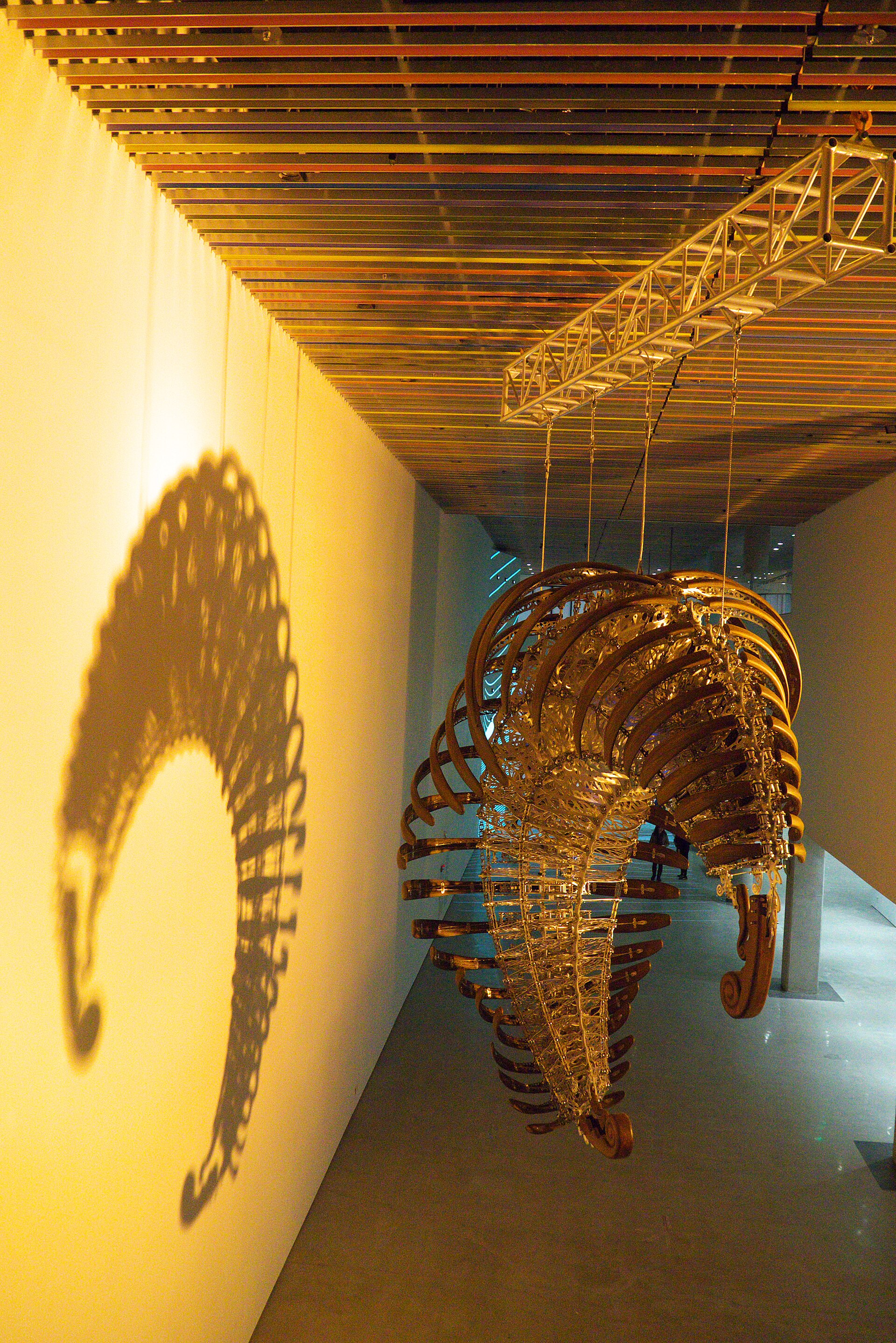
U-Ram Choe, 2013A kinetic, breathing steel-and-organic-glass sculpture commissioned for the branch's November 2013 opening, its plated form expanding and contracting on hidden motors as if the building itself had grown a mechanical organism inside it3
bit.fall
Julius PoppRows of solenoid-controlled nozzles drop water in patterns timed to spell out words scraped from live internet news in the instant before they hit the floor of the Seoul Box, on view since shortly after the branch opened4
Works by Kim Whanki
Kim Whanki, 1950s-1974A central figure in the shift from figurative to abstract Korean painting, whose dot-and-line canvases anchor the museum's 2025 permanent survey of its own collection and are shown, per the museum's own account, with a signature scent developed to accompany them9
Works by Park Seo-bo
Park Seo-boA founding figure of Dansaekhwa, the monochrome-painting movement that became Korea's most internationally traded postwar art export, represented in the collection survey alongside the artists he taught and influenced9
Works by Do Ho Suh
Do Ho SuhSuh's fabric recreations of domestic architecture, built at one-to-one scale from translucent cloth, are among the collection's best-known contemporary holdings and a frequent draw for first-time visitors who know the artist from international biennials9
Works by Nam June Paik
Nam June Paik (Paik Nam June)The Korean-born pioneer of video art, whose multi-monitor sculptures helped define an entire medium, is held in strength across MMCA's branches and represented in the Seoul collection displays8
Epiphyte Chamber
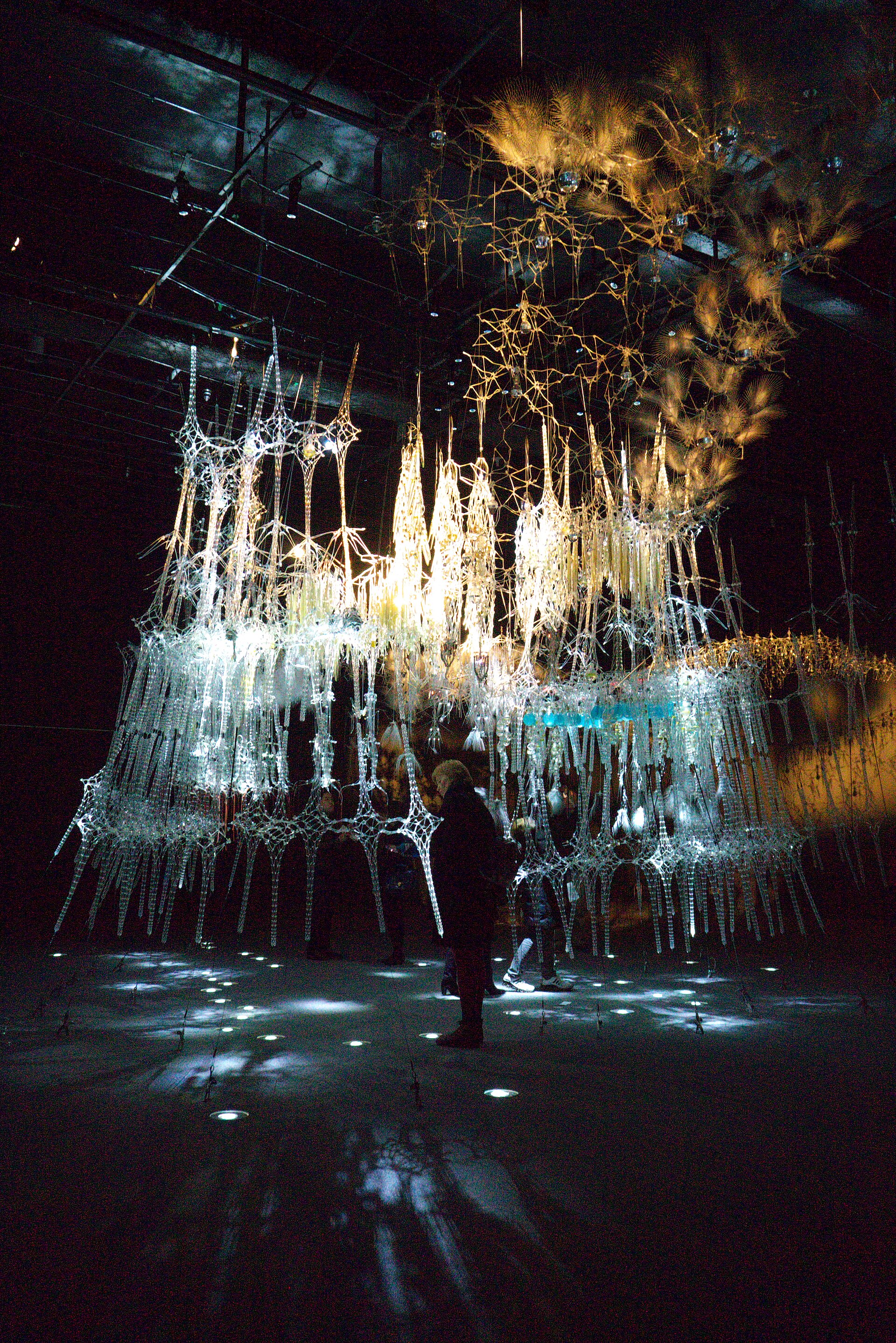
Philip Beesley, 2013An immersive, responsive sculptural environment of hand-cast filaments shown as part of the branch's opening season, photographed the week the museum first opened its doors5
Exhibitions on now
Past exhibitions here
A museum lowered into the ground beside a palace
The Seoul branch of the National Museum of Modern and Contemporary Art opened on 13 November 2013 on a site immediately east of Gyeongbokgung Palace, between the palace walls and the Bukchon Hanok Village. The competition brief the government set in 2009 was unusually constrained: keep two centuries-old masonry buildings on the site standing and visible, keep the new building's exterior low enough not to compete with the palace roofline next door, and still deliver a national-scale contemporary art museum with galleries capable of showing large installation work. Architect Mihn Hyun-jun, working with mp_art Architects, won the competition by burying most of the museum's floor area below grade rather than building upward, dropping the main galleries and a central courtyard beneath a modest, terracotta-tiled surface structure whose curved roof tiles were chosen as a contemporary echo of the tile roofs on the historic buildings around it.
The result is a building that gives away almost nothing of its scale from the street. Above ground, visitors see a low run of tan ceramic-tiled volumes with a large gateway opening cut through one wing; below, the galleries open into soaring, high-ceilinged spaces built for installation art, organized around the Seoul Box, a full-height atrium that functions as the museum's most identifiable interior space. The design deliberately avoids directional signage in favor of sightlines and windows that keep a visitor oriented by daylight rather than arrows, a choice some visitors experience as freeing and others as simply confusing.
What stood on this ground before the museum
The site carries a longer and considerably darker history than its 2013 opening date suggests. For roughly six hundred years, from the early Joseon dynasty, this ground held the Jongchinbu, the royal clan office that administered the king's extended family and its affairs; two of its masonry buildings survive and now sit inside the museum's courtyard, physically incorporated into the plan rather than fenced off as a separate heritage site. During Japan's colonial occupation of Korea, a red-brick building in a rationalist military style was added to the site in 1928 to serve as an army hospital. After Korea's 1945 liberation, that same brick compound passed to the South Korean military and became part of the Defense Security Command, known in Korean as Boan Sa, the army's counter-intelligence and internal-surveillance arm through the authoritarian decades of the later twentieth century, when it also held people it detained.
MMCA's own former director, Bartomeu Mari i Ribas, described this stretch of the institution's history bluntly in a 2017 interview, calling the site one of the dark chapters of recent Korean history rather than treating it as incidental. The Defense Security Command withdrew from the compound in 2006, the government approved converting it into a museum in 2009, and construction ran from late 2011 to 2013. The museum's own institutional history page states plainly that the Seoul branch was built at the old Defense Security Command site, without softening what that agency was.
Opening night and the collection it eventually caught up to
MMCA itself is older than any of its four current branches: it was founded in 1969 with a first, small gallery inside Gyeongbokgung Palace, moved into a dedicated wing of Deoksugung Palace's Seokjojeon building in 1973, and only gained its large-format home in 1986 at Gwacheon, on the southern edge of Seoul, which remains the branch with the deepest permanent collection displays and an outdoor sculpture garden. The Seoul branch was conceived from the start as an urban, city-center complement to Gwacheon rather than a replacement for it, aimed at exhibition programming, education, moving-image and research functions that did not fit the suburban campus.
Seoul opened its doors with newly commissioned, large-scale work built to fill the Seoul Box and the double-height galleries: U-ram Choe's kinetic sculpture Opertus Lunula Umbra, and Philip Beesley's immersive sculptural environment Epiphyte Chamber, both installed and photographed within days of the November 2013 opening. For more than a decade after that opening, however, the Seoul branch had no permanent display drawn from MMCA's own collection; every gallery was programmed as rotating temporary exhibitions. That changed only in May 2025, when the museum opened its first-ever permanent collection displays at both the Seoul and Gwacheon branches, built from a total holding the museum now states at roughly 11,800 works. MMCA's own curatorial head, quoted in the Korean press at the time, said plainly that the collection had previously lacked the scale and depth needed to sustain a permanent display, an unusually candid admission for an institution to make about its own galleries.
Inside: eight galleries wrapped around a six-hundred-year-old courtyard
The Seoul branch is organized as eight interconnected exhibition buildings, numbered rather than named, threaded around the sunken Jongchinbu courtyard so that walking between shows means crossing open air and passing the preserved Joseon-era buildings at ground level. The Seoul Box sits at the physical and programmatic center of the complex, a full-height atrium used for the single largest commissioned work in the building at any given time; visitors who arrive without a specific exhibition in mind are more likely to remember what filled the Seoul Box that day than any individual gallery number.
Beyond the exhibition galleries, the branch carries a dedicated Film and Video space that programs moving-image and media art on its own schedule, distinct from gallery-based exhibitions; an Art Research Center that holds MMCA's reference library and artist-archive materials, open to public researchers rather than restricted to staff; and a Multipurpose Hall used for lectures, artist talks and performance programming. The combination of an active moving-image program, a public research archive and a flexible event hall reflects the brief the Seoul branch was built to answer, complementing Gwacheon's larger permanent-collection footprint with functions a suburban campus museum could not easily support.
What the collection holds
MMCA's holdings span Korean art from the late Joseon period through contemporary practice, alongside a smaller body of international modern and contemporary work; per Wikipedia, labelled here as a tertiary source pending a primary confirmation, the wider collection includes pieces by figures such as Joseph Beuys and Andy Warhol alongside Korean holdings. The 2025 permanent survey at the Seoul branch, drawing on roughly eighty works chosen from the full collection, is built around the artists most identified with Korean modern and contemporary art's international profile: Kim Whanki, whose shift from figuration into abstract dot-and-line compositions in the 1950s-70s is treated as a hinge point in the collection's own narrative of Korean modernism; Park Seo-bo and Yun Hyong-keun, both founding figures of Dansaekhwa, the monochrome-painting movement that has become Korean postwar art's most internationally traded export; and contemporary figures including Do Ho Suh, Lee Bul, Haegue Yang and the artist duo Moon Kyung-won and Jeon Joon-ho.
Nam June Paik, the Korean-born pioneer of video art whose multi-monitor sculptures helped define an entire medium internationally, is held in depth across MMCA's branches and appears in the Seoul collection displays. The 2025 rehang was also built with an unusually sensory curatorial approach for a survey display: rooms dedicated to individual artists incorporate matched scent and sound, including a signature scent developed for the Kim Whanki room and a curated music program for the Yun Hyong-keun room, an attempt to give a walk-through survey some of the immersive quality the museum's temporary exhibitions are known for.
Visiting today
The Seoul branch keeps standard hours of 10:00 to 18:00 Monday, Tuesday, Thursday, Friday and Sunday, extending to 21:00 on Wednesday and Saturday, with every gallery, including paid special exhibitions, free to enter during the Wednesday and Saturday evening hours and on Culture Day, the last Wednesday of each month. General entry to the Seoul Box, the courtyard and the permanent MMCA Collection galleries carries no charge at any time; only specific special exhibitions are ticketed, and a combined ticket covering multiple concurrent paid shows is offered at 10,000 won when three or more are running together. The museum sits an easy walk from Anguk subway station on Line 3, close enough to Gyeongbokgung Palace, Bukchon Hanok Village and the Insadong shopping streets that most visitors fold it into a half-day of old-Seoul sightseeing rather than a dedicated trip.
What a first-time visitor gets depends heavily on what happens to be on: the branch runs no fixed permanent exhibition beyond the 2025 collection survey and the preserved courtyard buildings, so the temporary program, refreshed several times a year, does most of the work of defining any given visit. Checking the current exhibition list before travelling is worth the two minutes it takes, given how differently a visit lands depending on whether the Seoul Box happens to be empty, mid-changeover, or filled with the kind of large-scale commission the branch was built to house.
What visitors say
Visitors consistently single out the building itself as much as any single exhibition: the low, terracotta-tiled exterior that keeps a modest profile beside Gyeongbokgung Palace, opening into unexpectedly large underground galleries and the Seoul Box atrium, reads on travel-review sites as the museum's real headline attraction. Its location, an easy walk from the palace, Bukchon Hanok Village and Insadong, means most reviews describe it as folded into a half-day of palace-and-old-town sightseeing rather than visited on its own. The most repeated practical note is that programming is genuinely contemporary and changes often, so a visitor who has not checked what is currently on can arrive to a show that does not match what brought them, or find major spaces briefly closed between exhibition changeovers.
What is praised, what is criticised
- Praised: The architecture itself: the deliberate sinking of the main galleries below grade so the building's exterior stays low and reticent next to a Joseon-dynasty palace, widely credited by architecture press as the project's central achievement
- Praised: The preserved Jongchinbu courtyard buildings inside the complex, which reviewers repeatedly call an unexpected and effective way to hold thirteenth-to-nineteenth-century court architecture and contemporary art in the same walk
- Praised: Free entry to the permanent collection galleries and the Wednesday and Saturday evening opening hours, which visitors note make repeat, low-commitment visits easy for Seoul residents
- Criticised: The branch operated for over a decade, from its November 2013 opening until May 2025, without a permanent collection display; the museum's own curatorial head has publicly said the collection had previously lacked the scale and depth to sustain one, an admission that first-time and international visitors in that period had comparatively little of MMCA's own collection to see on a single visit
- Criticised: The underground, multi-level layout among eight interconnected gallery buildings is built around open, undirected wayfinding rather than posted arrows, which some visitors describe as disorienting or confusing rather than as the deliberate exploratory design the architects intended
Ratings on other platforms
TripAdvisor: 4.3 from 262 ratings, read 13 August 2026
A platform average is a tertiary source: it moves, it is not audited, and we quote no visitor's words.
Questions about National Museum of Modern and Contemporary Art, Seoul
Where is National Museum of Modern and Contemporary Art, Seoul?
30 Samcheong-ro, Sogyeok-dong, Jongno-gu, Seoul, 03062, South Korea.
How much does it cost to visit?
General entry (Seoul Box, courtyard and permanent MMCA Collection galleries): free; Combined ticket for paid special exhibitions: KRW 10000; Free evening openings: free; Free by category: free. As confirmed 24 September 2026.
When is it open?
Monday, Tuesday, Thursday, Friday, Sunday 10:00-18:00; Wednesday, Saturday 10:00-21:00. Closed: 1 January. Lunar New Year's Day. As confirmed 24 September 2026.
How do you get there?
Subway: Anguk Station (Line 3), Exit 1: about 500m straight ahead, right at Dongsipja Crossroads, then 500m further to the museum on the right; Subway: Gyeongbokgung Station (Line 3), Exit 6: about 300m to Gwanghwamun intersection, cross, then follow signs toward Anguk Station to Dongsipja Crossroads and turn left; Subway: Gwanghwamun Station (Line 5), Exit 2: about 500m, cross the crosswalk, then follow signs toward Anguk Station to Dongsipja Crossroads and turn left; Bus: City bus stops near Anguk Station, Jogyesa Temple, Gwanghwamun and the Sejong Center serve the museum on foot.
What should you see first?
Opertus Lunula Umbra (Hidden Shadow of the Moon) (U-Ram Choe, 2013); bit.fall (Julius Popp); Works by Kim Whanki (Kim Whanki, 1950s-1974); Works by Park Seo-bo (Park Seo-bo); Works by Do Ho Suh (Do Ho Suh); Works by Nam June Paik (Nam June Paik (Paik Nam June)).
What we could not confirm
- How much of the roughly 11,800-work collection cited by the museum in 2025 rotates through the Seoul branch's permanent displays versus staying at Gwacheon or in storage was not stated in the sources checked
- No English-language, named review of the 2025 permanent collection rehang specifically (as opposed to the announcement coverage) was located; a critic's assessment once the display has been open longer would sharpen the reception section
Images
Sources
- 1Wikidata, National Museum of Modern and Contemporary Art, Seoul (Q27207690): English and Korean labels, coordinates (P625) 37.579167/126.980556, country South Korea, official website, inception 13 November 2013, instance of museum and art museum. Fetched 2026-08-13. wikidata.org/wiki/Special:EntityData/Q27207690.json
- 2Fetched 2026-08-13. commons.wikimedia.org/wiki/Category:National_Museum_of_Modern_and_Contemporary_Art_-_Seoul
- 3Wikimedia Commons, File:Opertus Lunula Umbra (Hidden Shadow of the Moon) by U-Ram Choe.jpg: (CC BY-SA 2.0, 13 November 2013) and the image itself, downloaded and viewed, showing U-ram Choe's sculpture inside the museum on its opening date. commons.wikimedia.org/wiki/File:Opertus_Lunula_Umbra_(Hidden_Shadow_of_the_Moon)_by_U-Ram_Choe.jpg
- 4Wikimedia Commons, File:MMCA, Seoul, Julius Popp.jpg: (CC BY-SA 2.0, 19 December 2015) and the image itself, downloaded and viewed, showing the bit.fall water installation in the Seoul Box atrium; cross-checked against search results identifying the Seoul Box as the atrium hosting large-scale commissions. commons.wikimedia.org/wiki/File:MMCA,_Seoul,_Julius_Popp.jpg
- 5Wikimedia Commons, File:Epiphyte Chamber by Philip Beesley.jpg: (CC BY-SA 2.0, 13 November 2013) and the image itself, downloaded and viewed, showing Beesley's installation inside the museum on its opening date. commons.wikimedia.org/wiki/File:Epiphyte_Chamber_by_Philip_Beesley.jpg
- 6National Museum of Modern and Contemporary Art, Korea, official site, Seoul branch visiting information: hours, admission structure, address, phone, and public-transport directions (Anguk, Gyeongbokgung and Gwanghwamun subway stations). Fetched 2026-08-13. mmca.go.kr/eng/seoul/viewingInfo/information.do
- 7ArtDependence Magazine, interview with then-MMCA director Bartomeu Mari i Ribas, published 13 December 2017: confirms the Seoul branch building's history as a 1928 Japanese colonial-era military hospital later used as a prison by South Korea's Defense Security Command, and the director's own characterisation of the site as one of the dark chapters of recent Korean history. artdependence.com/articles/running-a-museum-on-the-korean-peninsula/
- 8Fetched 2026-08-13. en.wikipedia.org/wiki/National_Museum_of_Modern_and_Contemporary_Art
- 9The Korea Times, Park Han-sol, 'Modern art museum unveils new permanent exhibitions featuring Korean art collection', published 7 January 2025: the May 2025 opening of MMCA's first-ever permanent collection displays at Seoul and Gwacheon, the roughly 11,800-work collection total, roughly 80 works shown at Seoul, named artists (Kim Whanki, Park Seo-bo, Do Ho Suh, Haegue Yang, Moon Kyung-won and Jeon Joon-ho, Ron Mueck, Kim Tschang-yeul, Park RaeHyun), and quotes from curatorial head Kim In-hye and director Kim Sung-hee. koreatimes.co.kr/lifestyle/arts-theater/20250107/modern-art-museum-unveils-new-permanent-exhibitions-featuring-korean-art-collection
- 10ArchDaily, 'Museum of Modern and Contemporary Art / Hyunjun Mihn + mp_Art Architects': architect credit (Mihn Hyun-jun with mp_Art Architects), 2013 completion, and project overview. Fetched 2026-08-13. archdaily.com/775738/museum-of-modern-and-contemporary-art-mp-art-architects-plus-siaplan-consortium
- 11CeramicArchitectures, project page for the Museum of Modern and Contemporary Art Seoul: architectural description of the madang/courtyard concept, the below-grade siting of the main galleries, the curved terracotta tile facade, and the building's visual relationship to the Jongchinbu buildings, the former Defense Security Command office, Gyeongbokgung Palace and Bukchon village. Fetched 2026-08-13. ceramicarchitectures.com/obras/mmca-the-museum-of-modern-and-contemporary-art-seoul/
- 12TripAdvisor, 'National Museum of Modern and Contemporary Art Seoul' attraction page: aggregate rating 4.3 out of 5 from 262 reviews, and review themes (architecture, location near Gyeongbokgung, variable exhibition programming). Read 2026-08-13. tripadvisor.com/Attraction_Review-g294197-d3871936-Reviews-National_Museum_of_Modern_and_Contemporary_Art_Seoul-Seoul.html
- 13National Museum of Modern and Contemporary Art, Korea, official site, institutional history page: founding in 1969, branch-by-branch opening dates, and the Seoul branch's site history as the former Defense Security Command compound. Fetched 2026-08-13. mmca.go.kr/eng/about/history.do
_by_U-Ram_Choe.jpg)

